Halt Saudi arms sales immediately, probe civilian attacks in Yemen – MPs
RT | February 3, 2016
A group of MPs have called on the British government to immediately suspend arms sales to Saudi Arabia and have demanded an independent inquiry into the war in Yemen, where British arms are thought to have been used against civilians.
In a letter to Development Secretary Justine Greening, the International Development Select Committee urged the UK to cease opposing an inquiry which aims to examine potential breaches of humanitarian law by the Saudi bombing campaign in Yemen.
It comes after human rights charities and anti-war groups criticized Saudi Arabia for allegedly bombing civilian targets.
The British government has sold £1 billion (US$1.45 billion) worth of arms to the Saudi government in the past year.
Last week a leaked UN report found Saudi Arabia guilty of breaking humanitarian law. In response the Saudi government set up an internal inquiry.
British MPs say the UK should back an independent inquiry. Members of the committee were shocked to hear the UK had hindered efforts to launch such an investigation in September 2015 when it was proposed by the UN.
“We need an independent, international fact-finding mission to uncover the truth. Until then we should cease selling arms to Saudi Arabia,” wrote committee chair Stephen Twigg.
“All parties to this conflict should review their obligations under international law and undertake to put civilians and humanitarian work above other interests.”
MPs said they had been presented with evidence from the head of UNICEF Yemen, who said the Saudi-led coalition had been involved in bombing campaigns which endangered the lives of civilians.
The committee’s letter was welcomed by activist group Campaign Against the Arms Trade (CAAT), which condemned the British government’s actions.
“The humanitarian situation is getting worse and the UK government has been complicit in it. We agree that arms sales need to stop, but they should never have been allowed in the first place.
“Saudi Arabia has a terrible human rights record and has been supported by governments of all political colors for far too long,” said CAAT’s Andrew Smith.
The leaked UN report, obtained by the Guardian last week, found that Saudi airstrikes are breaching international law by hitting civilian targets, including refugee camps, civilian weddings, vehicles, medical facilities and schools.
The UN panel of experts on Yemen used satellite imagery to look at areas before and after bombings, which also targeted an Oxfam warehouse storing equipment for a water project funded by the EU.
US & Israeli arms companies bag £500m UK military contract
RT | February 2, 2016
Israeli arms company Elbit Systems and US military contractor Kellogg, Brown and Root (KBR) have won a £500-million contract to provide aircraft training for the UK military.
The Affinity venture, in which the two are partners, will provide fixed wing training for sections of the UK Armed Forces concerned with aviation.
Affinity’s component is part of a larger deal led by Ascent Flight training and worth £1.1 billion. Ascent is itself a fifty-fifty venture between international arms firms Babcock and Lockheed Martin.
The aim is to deliver flight training up to the year 2033 in line with the UK Military Flying Training System (UKMFTS).
In a statement, Ascent’s director Paul Livingston said: “The award of these contracts marks a key milestone for the fixed wing element of UKMFTS. Modern training aircraft selected specifically to meet the bespoke needs of the UK’s Armed Forces will deliver optimized training alongside high tech simulators and classroom trainers.”
Ministry of Defence (MoD) Procurement Minister Phillip Dunne said the deal was “fantastic news for the future of our military aircrew” and would provide them with “a modern training system which will equip them to deliver on the front line.”
Elbit Systems are well known for their range of drones and the firm is of particular concern among human rights groups.
According to a report by the charity War on Want, the MoD awarded a £1-billion contract to Elbit and its UK partner Thales to develop the Watchkeeper drone. The model is now in service with the military.
The charity argues that Watchkeepers are field tested in the Occupied Palestinian Territories.
“Israeli companies such as Elbit will often boast of their competitive advantage in the global arms market due to their extensive ‘testing’ of their weaponry in ‘real life’ situations,” the report says.
Turkish Artillery Shells Latakia Province, Casualties Reported – Damascus

© Photo: Youtube/ Russian Defence Ministry
Sputnik —February 1, 2016
Turkish artillery on Monday shelled a small town in Syria’s northern Latakia province inflicting casualties among civilians, the Syrian Foreign Ministry said.
Earlier in the day, Lebanese Al Mayadeen TV channel reported that one Syrian serviceman was killed and five others were wounded in a shelling from the Turkish territory.
“The Turkish authorities are responsible for artillery shelling of the town of Jabal Oteira in northern Latakia, which caused casualties among peaceful civilians,” the ministry said in statement as quoted by official SANA news agency.
Meanwhile, the Russian Defense Ministry said Monday that it obtained video proof of Syrian civilian areas being shelled from Turkish border posts.The Russian Defence Ministry expects an explanation from NATO, Pentagon and Turkish Armed Forces on the incident. The corresponding statement was made on Monday by the Ministry’s spokesman Igor Konashenkov.
According to the spokesman, the Ministry of Defense recently received the video footage from the Syrian General Staff which shows “self-propelled heavy artillery weapons deployed at the Turkish outpost in question.”
Sepur Zarco Trial: Guatemala Women Seek Justice for Sex Slavery
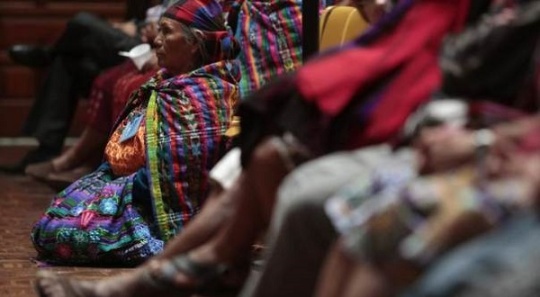
teleSUR – January 30, 2016
Fifteen Mayan women who were raped and forced to be sex slaves after their husbands were disappeared are demanding justice 30 years after the abuses.
Guatemala is about to launch a landmark trial against former military officers accused of committing sexual enslavement and forced disappearance during the most brutal years of the country’s 36-year civil war.
Here’s what you need to know about the historic trial that is scheduled to kick off Monday, Feb. 1.
1. Fifteen women were sexual and domestic slaves.
Guatemalan soldiers forcibly disappeared 15 men from an eastern Maya Q’eqchi’ village in 1982. It was one of the bloodiest years of Guatemala’s civil war, when dictator Efrain Rios Montt’s military regime was unleashing a scorched earth campaign targeting rural Mayans. After the army disappeared the men, they came back for their wives.
The women were raped and their belongings destroyed. They were taken captive and forced to live at the Sepur Zarco military base, where they were enslaved as domestic servants for the soldiers and systematically raped. The women were forced to labor in 12 hour “shifts,” an abhorrent system that lasted several months.
Though the enslaved shifts ended at the end of 1983, 11 of the 15 women were forced under military threat to stay at Sepur Zarco doing domestic chores for the soldiers for six years until the base closed in 1988. The other four women managed to flee to the mountains with their children where they endured painful hardship for years, including suffering the deaths of most of their children.
All of the women, now in their 70s and 80s, bear enormous physical and emotional trauma from the experience. They also faced stigma in their communities for the violence they endured, and did not share what had happened to them for 30 years, finally coming forward in 2011 to seek justice.
The trial accuses two defendants, former Sepur Zarco chief Esteelmer Reyes Giron and former regional military commissioner Heriberto Valdez Asij, of committing crimes against humanity, including sexual violence and sexual slavery, domestic violence, murder, and forced disappearance. They have been held in remand since 2014 awaiting the trial.
2. The Sepur Zarco case is an internationally historic trial.
The trial of two former military officers for crimes against humanity marks the first time in history that sexual slavery charges are prosecuted at the national level, in the country where the crimes were committed.
The more internationally high-profile case of sexual slavery during armed conflict, the case of Japan’s “comfort women,” was rejected by a Japanese court. Former comfort women subjected to sexual slavery during World War II put Japan on trial in a mock war crimes tribunal in Tokyo in 2000, but the case never officially went to court in the country.
Guatemala’s Sepur Zarco trial could set a new precedent for prosecuting sexual violence in the context of armed conflict, which rights defenders say is one of the most widespread yet under-recognized violations of human rights.
3. It is also a historic trial for Guatemala.
The Sepur Zarco trial marks the first that that Guatemala will consider a sexual violence case as an international crime, which could set a precedent for future trials.
The crime of sexual slavery has been recognized internationally since the early 1900s, when the 1907 Hague Convention prohibited rape and the use of prisoners of war as slaves. The 1926 Slavery Convention elaborated anti-slavery laws with a definition that applies to sexual slavery. The Rome Statute of the International Criminal Court, which came into force in 2002, specifically criminalized sexual slavery.
A standing definition of sexual slavery was detailed in the 1998 U.N. Special Rapporteur’s final report on contemporary forms of slavery, “Systematic Rape, Sexual Slavery, and Slavery-Like Practices During Armed Conflict,” also known as the McDougall Report.
The report defined sexual slavery as “the status or condition of a person over whom any or all of the powers attaching to the right of ownership are exercised, including sexual access through rape or other forms of sexual violence.” More simply put, the McDougall report explained: “Slavery, when combined with sexual violence, constitutes sexual slavery.”
The trial will consider the crimes committed as war crimes and crimes against humanity.
Rape was widespread during the civil war. The Sepur Zarco case has the potential to be a precedent-setting trial to break the cycle of impunity for sexual violence in Guatemala.
4. Rape was a concerted strategy in the civil war.
In 1999, three years after the peace accords were signed in Guatemala, the U.N.-backed Truth Commission investigating civil war atrocities found that rape was systematic and widespread during the conflict. According to the commission, “the rape of women, during torture or before being murdered, was a common practice aimed at destroying one of the most intimate and vulnerable aspects of the individual’s dignity.”
The Truth Commission also found that violence against women, include rape, torture, and murder, was often motivated by their political affiliations, social participation, and ideals, and often combined with other human rights abuses. The report attributed 93 percent of all recorded human rights violations to the state, 85 percent for which the army was responsible.
Despite the countless cases of sexual violence during the civil war, the Sepur Zarco case is the only one that has gone to trial in the country where impunity for war crimes has long remained the norm.
According to the Guatemalan organization Women Transforming the World, sexual violence continues to be inflicted on women by state security forces in conjunction with other human rights violations, such as forced displacement.
5. The victims in Sepur Zarco were targeted for defending their land.
Maya Q’eqchi’ communities in Guatemala have long suffered deep inequality, poverty, and precarious access to land. Before they were disappeared in 1982, the 15 husbands of the victims in the Sepur Zarco case were fighting for legal titles to defend the land they had lived and worked on for years. Because they were standing up for their land rights, they were despised by local large landowners, labeled as leftist insurgents, and made into targets to be silenced.
Land conflicts and unequal ownership are central to the history of Guatemala’s civil war. In 1954, a CIA-backed coup ousted the democratically elected president and reversed the fledgling agrarian reform program that aimed to expropriate idle lands from elite landowners and redistribute land to campesinos. The coup not only triggered more than three decades of civil war, but also helped to lock in one of the most unequal land distribution patterns in Latin America.
Rios Montt’s U.S.-backed bloodshed was nominally a campaign to crush leftist guerrilla uprisings in Guatemala, but in practice many poor Mayan campesinos were targeted as “insurgents” as the military protected the interests of elite landowners.
Photo credit – Reuters
UN says Turkey should investigate reports of rescuers being shot
Press TV – February 1, 2016
The UN High Commissioner for Human Rights has called on Ankara to investigate reports that a number of unarmed people trying to attend to the injured victims of clashes in Turkey’s southeast in late January were themselves shot at.
Ten people were injured when their group, which included two opposition politicians, came under fire while trying to help people injured in earlier clashes in the southeastern town of Cizre in Turkey’s mainly Kurdish southeast on January 20.
Zeid Ra’ad Al Hussein described as “extremely shocking” footage filmed of the incident, which purportedly shows what appear to be a man and woman holding white flags and pushing a cart – possibly carrying bodies – across a street before being shot.
“As they reach the other side, they are apparently cut down in a hail of gunfire,” Zeid said in a statement.
He also expressed concern that the cameraman, who was injured in the shooting, may face arrest under a “clampdown on media.”
Turkey has been engaged in a large-scale campaign against the outlawed Kurdistan Workers’ Party in its southern border region in the past few months. The Turkish military has also been conducting offensives against the positions of the group in northern Iraq.
The operations began in the wake of a deadly July bombing in the southern Turkish town of Suruc. More than 30 people died in the attack, which the Turkish government blamed on Daesh Takfiri terrorist group.
After the bombing, the PKK militants, who accused the government in Ankara of supporting Daesh, engaged in a series of supposed reprisal attacks against Turkish police and security forces, in turn prompting the Turkish military operations.
CIA covert ops needs Saudi money: decades story recurring
American Herald Tribune | January 30, 2016
For decades, America’s Central Intelligence Agency (CIA) has been relying on its partner’s money in discrete and covert operations; the money of the Saudi oil-rich kingdom.
Citing several current and former US officials, the New York Times reported on Jan. 23 that from the very beginning of the US operations against the Assad government in Syria, Saudi money was largely the supporter.
The most recent example of this ‘close bond’ between the US and Saudi Arabia has came to light in the New York Times article, which reported that US President Barack Obama knew well the US could rely on Saudi money when, in 2013, he secretly gave the CIA the green light to arm militant groups in Syria that were fighting against President Bashar al-Assad’s government.
Code-named Timber Sycamore, the deal stipulates that the Saudis contribute both weapons and large sums of money and the CIA takes the lead in training the rebels on AK-47 assault rifles and tank-destroying missiles.
In 2012, the US repeatedly claimed that the Timber Sycamore program was designed to deliver what it claimed to be ‘non-lethal’ aid, yet months later, Obama gave his approval for the CIA to begin directly arming and training the rebels from a base in Jordan, amending the Timber Sycamore program to allow lethal assistance.
Also, the NY Times report noticeably underlines that such a long intelligence relationship helps explain why the United States has been reluctant to openly criticize Saudi Arabia for its human rights abuses, its treatment of women and its support for the extreme ideology Wahhabism, that has inspired many of the very terrorist groups.
In the latest violation which brought uproar across the Muslim world in particular, Saudi Arabia executed a prominent Shia cleric, Sheikh Nimr al-Nimr, for challenging the oppression of the royal family and demanding human rights, yet the Obama administration did not publically condemn the action. Also, another form of Saudi human rights abuses to which the US has had no clear condemnation is its war on Yemen that has so far claimed the lives of more than 8,270 people including women and children.
The CIA covert operations in Syria began in 2013, in which more than 10,000 Wahhabi terrorists were armed, funded and trained. The trainings were taking place inside Jordan’s territories, and estimates have put the total cost of the ops at several billion dollars.
“They understand that they have to have us, and we understand that we have to have them,” said Mike Rogers, the former Republican congressman who was chairman of the House Intelligence Committee when the CIA operation began.
The operation was described as part of the so-called “counterterrorism” program. On this note, a former State Department counterterrorism adviser and the author of a book on the Islamic State, William McCants points out “The more that the argument becomes, ‘We need them as a counterterrorism partner,’ the less persuasive it is. If this is purely a conversation about counterterrorism cooperation, and if the Saudis are a big part of the problem in creating terrorism in the first place, then how persuasive of an argument is it?”
Even though the biggest contributor was Saudi Arabia, yet its allies also had their share in the game. According to the NY Times, when Obama signed off on arming the rebels in the spring of 2013, the Qataris, Turkish and Saudis had been funneling weapons into Syria for more than a year. The Qataris had even smuggled in shipments of Chinese-made FN-6 shoulder-fired missiles over the border from Turkey.
MORE…
Drunk on Hate and Mad at the World
Israel’s Diplomatic Wars of Aggression

By Richard Edmondson | Fig Trees and Vineyards | January 29, 2016
Israel these days seems to be increasingly at odds with a good portion of the rest of the world. In just the past few months it has quarreled with:
- Spain over arrest warrants issued for Netanyahu and six other Israeli officials for the 2010 attack on the Gaza Freedom Flotilla;
- Sweden over comments by its foreign minister who has called for an investigation into extrajudicial executions of Palestinians;
- college campus student groups supporting the BDS movement;
- academic associations who have issued calls for academic boycotts of Israeli universities;
- Brazil over its refusal to recognize an Israeli ambassador who hails from the right-wing Israeli settler movement;
- The EU over labeling of products from Israeli settlements.
- The UN over Ban Ki-moon’s recent criticism of the settlements
And really, if truth be known, Israel is probably not too happy just now with Italy either, which recently received Iranian President Hassan Rouhani on a state visit, resulting in a number of agreements between the two countries’ energy sectors as well as cooperation on a future high-speed rail project. Naor Gilon, the Israeli ambassador to Italy, complained that Rouhani was being treated like “the king of the world.”

Zvi Zameret accuses Wallström of ‘ignorance and arrogance’,
and suggests she might meet a violent end
War with Sweden
All in all, Gilon’s comments would have to be viewed as rather tame, however–at least by comparison. For some of the statements issuing from Israelis now, particularly those aimed at Swedish Foreign Minister Margot Wallström, are positively chilling in their level of malice expressed, and frankly it might behoove the Swedish official to consider hiring a bodyguard at this point, if she hasn’t already done so.
As I noted in an article five days ago, Wallström is now regarded in Israel as “public enemy number 1” (the Jerusalem Post’s words, not mine) because of remarks she has made critical of Israel, including a recent call for an investigation into extrajudicial killings of Palestinians.
Now it seems there may be those in Israel hankering for the foreign minister’s blood–literally. If you haven’t read my article, Swedish Media Target Country’s Foreign Minister Following Her Remarks on Israel, I suggest you do so as it will place what follows into greater perspective. One day after posting that article, I became aware of two other articles, one by blogger Richard Silverstein and the other by Jonathan Ofir and posted at Mondoweiss, both of which discuss what appears to have been a scarcely veiled threat on Wallström’s life by a former Israeli official.
The comment was made by Zvi Zameret, a former official in the Israeli Ministry of Education, in an op-ed piece he wrote for an Israeli newspaper owned by Nevada casino magnate Sheldon Adelson. In the article, Zameret waxes lyrical on the 1948 assassination of Swedish diplomat Folke Bernadotte, and then goes on to suggest that Wallström might meet a similar fate. Here is a bit from Silverstein’s commentary on the matter:
Zvi Zameret, the former director for instruction for the Israeli education ministry has written an op-ed in Makor Rishon, Sheldon Adelson’s pro-settler newspaper, praising the 1948 assassination of UN mediator Count Folke Bernadotte by Yitzhak Shamir’s Lehi gang. Zameret accuses Bernadotte of being an anti-Semite and claims that his views originated in a Swedish society that was suffused with this perspective. He claims that ridding the world of the Swedish Count was necessary to protect Israel’s new existence.
He wends his way through a long historical discourse involving material already well-known related to Bernadotte’s proposals, which were rejected by Arabs and Jews alike. Then he brings us up to the present day by alleging that remarks of the current Swedish Foreign Minister, Margot Wallstrom, demanding that Israel be held accountable for the 160 Palestinians killed over the past two months in the latest Intifada, stem from the same well of Swedish anti-Semitism.
Silverstein says Zameret “hints that Wallström herself should share a similar fate to Bernadotte” and then gives us a direct quote from his article as per its English translation:
“What do the things I have mentioned attest about Bernadotte? [They indicate] covert anti-Semitism, ignorance and arrogance, collaboration with senior elements in Israel [Hebrew University President Judah Magnes] and interests that play a decisive role. Has anything changed in the Swedish DNA in the decades following Bernadotte’s death? Nothing has changed.
The Swedish foreign minister Margot Wallstrom, in the covert anti-Semitism which characterizes her, along with her ignorance and arrogance, and anticipation of the interests of her future Muslim voters–she too is attempting to battle against the basic foundation of the State of Israel. I am certain that her intentions will be defeated, just as were those of the disreputable Count Bernadotte.

Count Folke Bernadotte
Bernadotte was assassinated by Lehi, also known as the Stern Gang, the same Jewish terrorist group that carried out the Deir Yassin massacre. Zameret’s glorification of his murder doesn’t seem entirely lucid or rational–during World War II Bernadotte negotiated the release of 31,000 prisoners from German concentration camps, including a large number of Jews. After the war, he became the UN Security Council’s unanimous choice, in a vote on May 20, 1948, to try and mediate a settlement in the Palestine-Israeli conflict.
His murder took place September 17, 1948, carried out by a four-man team of assassins. The Stern Gang had been around since 1940. Its stated goal was to terminate the British mandate in Palestine and set up a “new totalitarian Hebrew republic,” and one of its members, Yithak Shamir, ended up becoming an Israeli prime minister. It was Shamir, in fact, who ordered Bernadotte’s assassination. The man who actually pulled the trigger, Yehoshau Cohen, later became a close confidante of David Ben Gurion and was never charged in the case.

Margot Wallström
In October of 2014, shortly after Wallström took over as foreign minister, Sweden became one of the first Western countries to recognize Palestinian statehood. Wallström called it “an important step that confirms the Palestinians’ right to self-determination” and added that “We hope that this will show the way for others.”
In November of last year, shortly after the Paris terror attacks, Wallström suggested that Israel’s treatment of the Palestinians could be helping to fuel terrorism. She followed that up with a comment in December about Israeli “extrajudicial executions,” and this month called for an investigation of Israel.
“Whether Zameret advocates Wallstrom’s demise explicitly or implicitly is hardly important,” comments Silverstein. “Even if you accept the argument that he isn’t explicit, clearly the reason Bernadotte failed in his mission is that Jewish terrorists assassinated him. When you say you wish her intentions to be defeated just as his were, the line between murder and political defeat becomes exceedingly murky.”
Boycott Sweden! say Israeli Mayors
But of course it isn’t just Zameret. Lots of people in Israel despise Wallström and have “vociferously attacked her contentious words,” as an article here puts it. And this apparently applies to a good many Israeli officials. The same article goes on to give us the low-down on a “boycott movement” launched by 15 Israeli mayors and aimed at Sweden. The mayors were planning to attend a conference in the Scandinavian country in March, but recently announced they have cancelled, while former Foreign Minister Avigdor Lieberman has also called for a boycott of Ikea.
War With Spain
In November of last year, a Spanish judge issued arrest warrants for Israeli Prime Minister Benjamin Netanyahu and six other officials in connection with Israel’s 2010 raid on the Gaza Freedom Flotilla, a violent episode in international waters which resulted in the deaths of 10 people.
The warrants were issued by Judge Jose de la Mata, and in effect meant that should any of the seven officials set foot on Spanish soil they would be subject to arrest.
“Spain is just the latest member of the international community to accuse Israel of war crimes and pursue Israeli officials over the affair,” the Jerusalem Post reported at the time. And that is indeed correct. Both South Africa and Turkey had previously issued similar warrants.
Predictably, the Israeli government expressed hostility and outrage.
“We consider it to be a provocation,” said an Israeli foreign ministry spokesperson. “We are working with the Spanish authorities to get it cancelled. We hope it will be over soon.”
What do you suppose the words “working with Spanish authorities” might imply? Did it include issuing threats? Whatever it was, it took only two months to accomplish. The arrest warrants were in fact cancelled, according to a report published January 13 by the Adelson-owned Israel Hayom newspaper.
War with Brazil
Brazil, on the other hand, seems to be showing a little more resilience. According to a report here, “Israel and Brazil remain at loggerheads five months after Brazil refused to recognize Israel’s appointment of a right-wing settler as its next envoy to the South American country.”
“Settlers are Zionist agents that the world cannot accept, they steal others’ land, they are an insult to Brazil, to the government, and to millions of Brazilians with roots in the Arab world,” said Brazilian parliament member Carlos Maron.
Maron isn’t alone. A group of 40 retired Brazilian diplomats signed a statement against the appointment of Dani Dayan, who lives in the Israeli settlement of Ma’ale Shomron, in the Occupied West Bank. Dayan is an advocate of the settler movement and has made no secret of his views, having widely published articles in the mainstream media, including the New York Times.
“We consider it unacceptable that the Prime Minister of Israel, Benjamin Netanyahu, has publicly announced the name of the person he intended to appoint as his country’s new Ambassador to Brazil before submitting it, in accordance to the norm, to our Government,” said the diplomats. The announcement of Dayan’s appointment was reportedly posted initially on Twitter rather than being communicated directly to the Brazilian government.
The statement continues:
This rupture with a diplomatic practice seems to have been on purpose, an attempt to establish facts, since the appointed, Dani Dayan, between 2007 and 2013, was the President of the Yesha Council, responsible for the settlements in the West Bank, which are considered illegal by the international community, and has already declared himself contrary to the creation of the Palestinian State, which counts on the support of the Brazilian Government and was already recognized by over 70% of the UN member States.
Reportedly a group of 200 Brazilian academics have also endorsed a boycott of Israel. Netanyahu has refused to withdraw Dayan’s nomination or to appoint someone more acceptable to the Brazilians. If the Brazilian government stands its ground, it will mean a de facto end to diplomatic relations between the two countries.
War with the EU
On January 18, the EU’s Foreign Affairs Council reaffirmed requirements that export products from the Israeli settlements be labeled as such. More or less as with Sweden, Spain, and Brazil, the EU’s action has prompted cries of Israeli outrage. Netanyahu pronounced his unwillingness to “accept the fact that the EU labels the side being attacked by terror,” while ‘Justice’ Minister Ayelet Shaked called the EU measure “anti-Israel and anti-Jewish.”
Likewise, opposition party leader Isaac Herzog (supposedly a liberal) compared it to the “Zionism equals Racism” resolution passed by the UN in 1974, while Yair Lapid, another opposition party member, denounced the EU for “capitulating to the worse elements of jihad.”
War Against the BDS Movement
In summer of 2015, ‘Justice’ minister Shaked announced she was preparing lawsuits against BDS activists. The announcement was reported at the time by the Times of Israel in a story which also mentions that Shaked has expanded one of the departments within her ministry in order to “push ahead with the program as soon as possible.”
Ministry officials believe that legal circumstances present the option of suing activists for damaging Israeli trade, and for discrimination and racism, based upon laws as they currently exist in various countries, the report said.
So far as I’m aware, no lawsuits have been filed against individual activists, however Naftali Bennett, leader of the Jewish Home Party, seems to be generally in support of the idea of striking back in some manner at the BDS movement.
“Let it be clear to any company or organization that’s considering boycotting us: We will hit back. We will attack our attackers. We will boycott our boycotters,” Bennett said.
“The boycott weapon is a double-edged sword,” he added. “If you’re thinking of boycotting Israel, keep in mind that there are tens of millions of Israel supporters around the world — Jews and non-Jews — with considerable buying power and boycott power. Whoever boycotts Israel will be boycotted. Whoever hits Israel, will be hit back. We will no longer remain silent.”
Bennett’s comments about the “tens of millions of Israel supporters around the world” are perhaps salient. Also last summer, Adelson hosted an anti-BDS summit in Las Vegas with the aim of establishing and funding “successful strategies for countering the wave of anti-Israel activity on college campuses.” Held at the billionaire’s Venetian hotel on the Vegas strip, the conference was attended by a number of wealthy Jews, including Haim Saban.
“The key decision reached at the conference was that there would be a concerted effort to curtail BDS,” reported the Jerusalem Post.
Though Netanyahu did not attend, a letter from him was read aloud to the conference participants. “De-legitimization of Israel must be fought, and you are on the front lines. It’s not about this or that Israeli policy. It’s about our right to exist here as a free people,” the letter stated.
Reportedly the Israeli government intends to allocate NIS 100 million, or roughly $25.2 million, to the anti-BDS effort.
War Against Academic Associations
At a business meeting held in November, members of the American Anthropological Association voted overwhelmingly (88.4 percent) in favor of a resolution to boycott Israeli academic institutions. A similar measure was passed that same month by the National Women’s Studies Association Executive Committee. These aren’t the first boycott actions taken by academic organizations in the US. The American Studies Association, The Association for Asian American Studies, and the Native American and Indigenous Studies Association have all passed academic boycott measures against Israel. And this is just in the US.
Measures have also been passed by academic organizations in Brazil, South Africa, Canada, the UK, and, of course, in Palestine, and probably elsewhere. And perhaps most recently a group of 71 British doctors have called upon the World Medical Association to expel the Israeli Medical Association. The physicians have accused Israeli doctors of “medical torture” on Palestinian patients and want to see a ban on joint projects with Israeli universities.
On January 20, the Science and Technology Committee of the Israeli Knesset held a meeting to discuss the issue (H/T Helvena). A press release on the discussion which took place can be found here on the Knessett’s website. One of those who gave input at the meeting was Peretz Lavie, president of Technion, or the Israeli Institute of Technology.
“We have no complaints against the global academic leadership; our problem is the campuses,” Lavie said. “Initially it was insignificant campuses, but it quickly spread to leading campuses in the United States.”
When Lavie says he has “no complaints against the global academic leadership” he is probably referring to the Association of American Universities, which on January 14, in response to the vote by the Anthropological Association, re-issued an earlier statement in opposition to academic boycotts. The AAU is an organization whose leadership consists of the presidents and chancellors of the 60 universities (in both the US and Canada) that are its members. Membership is by invitation only. The group’s statement opposing boycotts was initially released in 2013 in response to the boycott actions taken by the American Studies and Native American and Indigenous Studies associations.
The group’s re-release of that canned statement from more than two years ago was described by the Jerusalem Post as “a blow to the BDS movement.”
“Students who are exposed to this activity will be the next generation’s senators, and therein lies the great danger in the long term,” Lavie went on in his testimony before the Science and Technology Committee.
“In its report, the American Anthropological Association referred to us as universities of apartheid and decided to conduct a survey on whether the Israeli academia should be boycotted. We have to reach all 12,000 members of the Association. It is a symptom, and if we do not act now, it will spread. There must be one entity that will concentrate all the efforts related to this issue,” he added.
Another person who gave testimony was Ze’ev Feldman of the Israel Medical Association. It was Feldman who informed the committee of the recent statement by the 71 British doctors.
”The sword of the boycott is being raised on the Israeli scientific-medical community,” he said.
Ariel University Chancellor Yigal-Cohen Orgad asserted that Israel has “a real problem with governments, including western governments that encourage boycotts,” while Professor Zvi Ziegler warned, “We are unable to stop anyone with our meager resources.”
Several committee members are also quoted, including Chairman Uri Maklev:
“There is no doubt that the academic boycott phenomenon is expanding and is connected to the financial and consumer boycotts on Israel. Economic and commercial boycotts are associated with politics, but an academic boycott by educated and moderate people has a very strong effect.”
But rather than calling for an end to the settlements, most of the committee members seemed to be of the opinion that the Israeli government needed to devote more resources to fighting the boycott movement. The one exception to this was Arab Knesset member Basel Ghattas:
The world considers the settlements to be illegitimate. You can think differently from the entire world, it is your right, but it is also the world’s right to take measures in order to force you to establish two states.
War with the UN
On October 1, 2015, Netanyahu gave a speech before the United Nations General Assembly that was marked by a 45-second segment during which he paused and projected hostile glares out at those present:
On January 26, 2016, UN Secretary-General Ban Ki-moon broke the UN’s “deafening silence” and, in a rare display of courage, issued a scathing criticism of Israel’s settlement policies.
Progress towards peace requires a freeze of Israel’s settlement enterprise.
Continued settlement activities are an affront to the Palestinian people and to the international community. They rightly raise fundamental questions about Israel’s commitment to a two-state solution.
I am deeply troubled by reports today that the Israeli Government has approved plans for over 150 new homes in illegal settlements in the occupied West Bank.
This is combined with its announcement last week declaring 370 acres in the West Bank, south of Jericho, as so-called “state land”. These provocative acts are bound to increase the growth of settler populations, further heighten tensions and undermine any prospects for a political road ahead.
The inevitable furious response came quickly, with Netanyahu excoriating the UN chief for helping to “stoke terror.”
“There is no justification for terrorism,” he said. “The Palestinian terrorists don’t want to build a state; they want to destroy a state, and they say that proudly. They want to murder Jews everywhere and they state that proudly. They don’t murder for peace and they don’t murder for human rights.”
He went on to assert that the UN has “lost its neutrality and its moral force, and these statements by the Secretary-General do nothing to improve its situation.”
It seems Israel is now at war with the UN as well.
A Lack of Imagination?
Perhaps most striking in all this is the Israeli lack of imagination–or at least that is one way of looking at it. Nowhere in his hostile comments aimed at his various enemies on the global stage does Netanyahu give the slightest indication of having once thought about halting the settlements and pulling back to Israel’s internationally recognized pre-1967 borders. Ditto with the other Israeli officials quoted above, with the lone exception of the Arab Knessett member. It is almost as if the idea has never even occurred to them.
If that is the case, one could perhaps ascribe all of this to a lack of imagination. Certainly at this point, after 68 years of oppression, it probably does indeed require considerable imagination to conceive of how the two peoples could live at peace. But of course it wasn’t always so. And had Israel, starting in 1967, respected the people of the West Bank, and above all else respected their space rather than crowding them in with settlements and walls and soldiers, a peaceful resolution to the conflict probably could have and would have been achieved by this time.
Yet even now, it isn’t too late. Though it would be politically difficult, Israel could dismantle its settlements (anything is possible when the national will is present) and pull back to the pre-1967 borders–basically the terms of the Arab Peace Initiative proposed back in 2002. If necessary, and it probably would be for a lengthy period of time, UN peacekeeping troops could be deployed along the border.
But Israel’s response to the Arab Peace Initiative was to call it a “non-starter,” and that seems to be its position today as well. And not only is there little prospect of dismantling of presently-existing settlements, but we see even a refusal to halt the construction of new ones. All of which would suggest that Ban Ki-moon is correct and that the settlement enterprise raises “fundamental questions about Israel’s commitment to a two-state solution.”
Or in other words, Israel has no intentions of making peace.
Certainly it’s possible that things could change, and that a new slate of leaders could arise in Israel with the imagination necessary to see the wisdom of complying with international norms of conduct. And that is what its more liberal Jewish supporters in America seem to be hoping for. But failing this, Israel’s wars with the rest of the world are likely to grow in stridency and ferociousness, and at some point could expand from the realms of diplomacy and/or covert operations fully outright into the military arena.
Britain’s ‘proxy war’ in Yemen condemned by critics
RT | January 28, 2016
Britain is at war in Yemen and is arming and facilitating a brutal Saudi dictatorship that is bombing innocent civilians, a growing chorus of critics has warned.
The allegation that Britain is engaged in covert warfare in Yemen was first made by Scottish National Party (SNP) Westminster leader Angus Robertson during a heated discussion in Parliament on Monday. However, it has since been echoed by political commentators and human rights campaigners, who are demanding the government come clean on the role of UK forces in the Saudi-led campaign.
The conflict in Yemen consists of a range of regional, local and international power struggles emanating from historical and recent events. As scrutiny of Britain’s involvement in the war intensifies, campaigners and commentators insist that the UK is intervening in the conflict. They argue that Britain’s arming of the Saudi-led coalition and provision of advice to Saudi military personnel amounts to proxy warfare.
‘Reckless conduct’
Britain’s arms sales to Saudi Arabia totaled £2.95 billion (US$4.23 billion) for the first nine months of 2015, and roughly £7 billion since Prime Minister David Cameron took office in 2010. Amid mounting concerns that UK-made weapons have been used to bomb schools, hospitals, markets and other civilian targets in Yemen, Cameron has been urged to suspend all arms sales to Saudi Arabia.
Labour Party leader Jeremy Corbyn and Shadow Foreign Secretary Hilary Benn sent a letter to the PM on Wednesday demanding transparency on Britain’s involvement, after a leaked version of a UN panel’s report concluded attacks on Yemeni civilians had been “widespread and systemic.”
The 51-page report, which was obtained by the Guardian, examined 199 missions conducted by the Saudi-led coalition that violated international law.
Many of the attacks involved repeated airstrikes on civilian objects, including refugee camps; civilian gatherings such as weddings; civilian vehicles such as buses; residential areas; medical facilities; schools; mosques; markets, factories and essential civilian infrastructure. Three cases of civilians being pursued and shot at by aircraft as they fled residential bombings were also recorded.
UK director of Human Rights Watch said the findings of the UN report “flatly contradict” UK ministers’ rhetoric about the Saudi-led coalition’s actions in Yemen.
“For almost a year, [Foreign Secretary] Philip Hammond has made the false and misleading claim that there is no evidence of law or war violations by the UK’s Saudi ally and other members of the coalition,” he told the Guardian.
Amnesty International UK’s head of policy and government affairs Allan Hogarth expressed disgust at the government’s attempt to downplay concerns over Saudi Arabia’s conduct in Yemen.
“Thousands of civilians have already died and it’s been utterly dismaying to see Downing Street brushing aside extremely serious concerns about the reckless conduct of Saudi Arabia in this devastating conflict,” he said.
Conflict in Yemen
Saudi Arabia revealed earlier this month that British and American forces are stationed in the control center from which military operations against Yemen are being directed. However, the Ministry of Defence (MoD) has refused to disclose how many British personnel are involved.
The department also insists Britain’s involvement is confined to advice and training geared at ensuring Saudi Arabia complies with international law.
Yemen’s civil war kicked off in 2014, after Zaidi Shiite-led Houthi rebels overran the capital, Sanaa. The rebels, who had been targeted in six separate wars by Yemen’s central government, were loyal to Yemen’s former President Ali Abdullah Saleh.
During the Arab spring in 2011, the Houthis had gained control of Yemen’s Saada province. However, it wasn’t until September 2014 that they conquered Sanaa. The Shiite-led rebels subsequently forced President Hadi to resign in January 2015, and seized control of swaths of southern Yemen.
The following March, a Saudi-led coalition of states launched airstrikes against the Houthis in a bid to retake Yemen. Sometime later, a Saudi-led ground operation also began. By August 2015, the Houthis had been pushed back by resistance fighters supported by the Saudi-led coalition.
As the conflict rolls onward and civilian fatalities continue to mount, criticism of Britain’s role in the Saudi-led military campaign is growing ever stronger.
Featured Video

Trita Parsi: Trump’s Swiss Cheese Iran Plan & U.S. Break with Israel?
or go to
Aletho News Archives – Video-Images
From the Archives
MI5 plotted assassination of Irish PM in 1985 – Ulster Volunteer Force

RT | December 29, 2017
Former Irish Prime Minister Charles Haughey was warned by loyalist paramilitaries that they were once tasked with murdering him in an assassination plot purportedly dreamt up by the British secret service.
The sensational disclosure was sent in a letter to the Irish government, newly released under the Public Records Act, which requires documents of historical value to be published by the National Archives within 30 years.
Written on Ulster Volunteer Force (UVF) signature paper, the warning claims the terrorist organization was asked by an MI5 operative about the prospect of carrying out an attack on Republic of Ireland leader Haughey in 1985.
At the time, Haughey would have been in opposition as head of political party Fianna Fáil, but details of the solicitation did not become known to Irish authorities until 1987.
“In 1985 we were approached by a M15 officer attached to the Northern Ireland Office and based in Lisburn, Alex Jones was his supposed name,” the letter reads, according to the Irish Times. “He asked us to execute you.”… continue
Blog Roll
 Aletho News
- Moscow warns NATO over troop buildup
- EU leaders prolonging Ukraine conflict to stay in power – Swiss journalist
- Moscow car bombing injures former aide to Ukraine’s ex-PM Azarov
- Yemeni forces make major advances, complete Aden encirclement
- Trita Parsi: Trump’s Swiss Cheese Iran Plan & U.S. Break with Israel?
- Iran’s NPT exit debate: How repeated attacks exposed the failures of global nuclear safeguards
- Mainstream Israeli Media Celebrates Deadly Floods In Gaza
- Australian Censor Chief Rejects Claims Digital Duty of Care Will Drive Censorship
- Why a New European Security Architecture Will Be Born Through War
- EU incapable of speaking with one voice on Ukraine – analyst to RT
- If Americans Knew
- An error has occurred; the feed is probably down. Try again later.
- No Tricks Zone
- New Study: Barents Sea Temperatures Were Warmer And Sea Ice Less Extensive In The 1700s Than Today
- German Authorities Start Initiative To Evaluate Public Register For Climate “Disinformation” Spreaders!
- Zonal Asymmetry of Temperature Change in the Antarctic Circumpolar Current
- New Study: The Net Fossil Fuel Contribution To Rising Atmospheric CO2 Has Been Zero For 500 Years
- Germany’s Green Energy Transition Becoming Increasingly Expensive…Another 6 Trillion Euros!
- Sudden Stratospheric Warming, Powerful El Niño Combination May Lead To Extreme Europe Cold, Energy Crisis!
- Two New Studies Find Thwaites Glacier Melt Cannot Be Driven By Human Activity Or A Warming Ocean
- E-Cars Reduce CO2 Emissions By Only 41% Compared To Internal Combustion Engine Vehicles
- Predictions Made By Renowned Climate Professor Over Past Decades Have Been Proven To Be Poor
- New Study Suggests Large Regions Of The Pacific Ocean Have Been Cooling For The Last 80 Years

