ICC prosecutor must rethink Gaza flotilla probe: Judges
Press TV – November 7, 2015
Judges at the International Criminal Court (ICC) say the court’s prosecutor must reconsider an earlier decision not to open a probe into an Israeli attack on a Gaza-bound aid flotilla back in 2010.
Following a few months of deliberations, judges at the appeals chamber ruled on Friday that prosecutor Fatou Bensouda must rethink her decision against the Gaza flotilla probe.
Judges at The Hague-based court had initially asked Bensouda to reconsider her decision in July, saying she made “material errors in her determination of the gravity” of the case.
The latest decision could force Bensouda to open a full investigation into the case.
Last year, Bensouda declined a request by the Indian Ocean island nation of Comoros to investigate the attack on the Turkish Mavi Marmara ship that was sailing under a Comoros flag. She ruled the case was not serious enough to merit an ICC probe.
The prosecutor said publicly available information provides “a reasonable basis” to believe that the Israeli forces committed war crimes during the attack in international waters back in 2010, but the case does not fall under their jurisdiction for an official probe.
However, lawyers representing Comoros had sought a review of Bensouda’s original rejection, insisting that “the interests of justice and fairness, which are the core of the ICC’s mandate, strongly militate in favor of the prosecutor reconsidering her decision.”
On May 31, 2010, Israeli commandos attacked the Freedom Flotilla in international waters in the Mediterranean Sea, killing nine Turkish citizens, including a teenager with dual Turkish-US citizenship, and injuring about 50 other people who were part of the team on the six-ship convoy. Another injured activist died in May 2014 after having been in a coma for four years.
The flotilla was attempting to break the Israeli naval blockade of the Gaza Strip, carrying aid to Palestinians in the enclave.
Gaza has been blockaded since June 2007, a situation that has caused a decline in the standard of living, unprecedented levels of unemployment, and unrelenting poverty.
The attack sparked international outcry and plunged relations between Tel Aviv and Ankara to an all-time low at the time.
Is Israel Bombing Syrian Military to Benefit ISIS Near Lebanon?
By Daniel McAdams | Ron Paul Institute | November 2, 2015
The neoconservative Washington Free Beacon is reporting that the Israeli air force has attacked a Syrian government-controlled missile base near Syria’s border with Lebanon. The Beacon cites a pro-rebel website that claims:
Israeli planes breached Lebanese and Syrian airspace and bombed the Syrian regime’s 155th Brigade [base] in the Qutayfa area, destroying a number of missile warehouses.
If the report is accurate it would suggest that Israel is attacking military facilities of the Syrian government to the benefit of ISIS and the al-Qaeda franchise in Syria, at least according to the latest battle map released by the Institute for the Study of War (when coordinated with a Google map search for Qutayfah, Syria).
Israel has routinely violated Syrian airspace to bomb Syrian territory and uses any stray rocket fire into Israel-occupied Golan Heights as a pretext to hit Syrian government positions inside the country.
Recently Israel has been forced to back down from its routine flights over Syrian airspace by the arrival of Russian fighters, and after at least one Israeli close call with sophisticated Russian fighter jets a hotline was reportedly set up for the two countries to avoid any clashes in the area.
Though these reports of Israel hitting Syrian government assets to the benefit of ISIS in the area should be taken with a grain of salt, if true this would mark yet another very volatile variable in an already very complicated and dangerous part of the world. If the Russians are busy bombing ISIS and al-Nusra positions in the area north of Damascus toward Aleppo, how will Moscow take to Tel Aviv making it difficult for Syrian ground forces to take advantage on the ground of their operations in the air?
US Supplying ISIS with Aircraft Downing Weapons
By Stephen Lendman | November 7, 2015
On November 4, the Wall Street Journal headlined “US, Allies to Boost Aid to Syria Rebels” – aka ISIS and other takfiri terrorists, US proxy foot soldiers, imperial death squads, no so-called “moderates” among them.
The Journal stopped short of explaining it, instead saying “(s)hipments of arms (and) supplies are aimed at pressuring Assad while countering Russia (and) Iran.”
Longstanding US plans call for regime change in Syria, eliminating its independent government, replacing it with one Washington and Israel control, raping the country, balkanizing it, and exploiting its people – at the same time, creating endless violence, instability and chaos like what’s happening in Afghanistan, Iraq, Libya and virtually everywhere America shows up, the greatest menace to peace in world history.
According to the Journal, increased weapons shipments to anti-Assad elements aim to “challenge the intervention of Russia and Iran on behalf of Syrian President Bashar al-Assad, US officials and their counterparts (from Saudi Arabia, Qatar and other Gulf States) in the region said.
Obama declared proxy war on Russia after pledging to avoid it. He’s playing with fire. Putin is determined to eliminate the scourge of terrorism in Syria, and by implication perhaps regionally and beyond. That puts him on a collision course with Washington, wanting its proxy death squads protected and used destructively.
The more heavily armed ISIS and other takfiris become, the harder Russian aircraft will likely target them. Expect the battle to liberate Syria to continue for as long as it takes to achieve.
According to the Journal, “(i)n the past month of intensifying Russian airstrikes, the CIA and its partners have increased the flow of military supplies to rebels in northern Syria, including of US-made TOW antitank missiles, these officials said.”
“Those supplies will continue to increase in coming weeks, replenishing stocks depleted by the regime’s expanded military offensive. An Obama administration official said the military pressure is needed to push Mr. Assad from power.”
Shoulder-launched, man-portable, surface-to-air missiles (SAMS) defense systems (Manpads) are being supplied. “Those weapons could help target regime aircraft… and could also help keep Russian air power at bay,” said the Journal, citing unnamed US officials.
Manpads are relatively inexpensive, easy to operate and able to down low-flying aircraft. Helicopters are most vulnerable. So are fixed-wing planes during takeoffs, landings, and when operating at low altitudes.
Military aircraft systems alert pilots when missiles target them. Countermeasures to avoid being struck include evasive action, infrared flares and lasers.
Russian planes are safe at high altitudes. Special precautions are taken to protect them during takeoffs and landings.
So far, Putin outwitted Obama in Syria, effectively challenging his dirty game. He’s determined to eliminate the scourge of terrorism and keep it from spreading, especially to Central Asia and Russia.
He supports Syrian sovereignty, strongly against letting outside powers determine its fate, for its own citizens alone to decide, free from foreign interference.
On September 30, the die was cast when he intervened, a righteous mission fully in accord with international law – polar opposite US aggression throughout the region and beyond.
Obama didn’t wage war on Syria to quit. Putin didn’t intervene responsibly to back off in the face of US pressure, threats and anti-Russian propaganda. Expect him to stay the course with plenty of effective military muscle – impressive enough to make Pentagon commanders leery about challenging him.
A proxy state of war between America and Russia now exists – a hugely dangerous situation, risking possible direct confrontation between the world’s two nuclear superpowers.
Expect Putin to go all-out to avoid it. Put nothing past neocon lunatics in Washington – willing to risk destroying planet earth to own it.
Stephen Lendman lives in Chicago. He can be reached at lendmanstephen@sbcglobal.net. His new book as editor and contributor is titled “Flashpoint in Ukraine: US Drive for Hegemony Risks WW III.”
Americans oppose Obama’s plans for fighting ISIL: Poll
Press TV – November 5, 2015
Most Americans disapprove of US President Barack Obama’s approach in fighting the Daesh (ISIL) terrorist group, a new poll has found.
More than 6 in 10 people in the US reject Obama’s handling of the threat posed by the ISIL in Syria and Iraq, an Associated Press-GfK poll released on Thursday finds.
Support for his approach has dropped since Washington formed a military coalition against ISIL in late 2014. Last year, Americans were approximately even, but disapproval has risen 8 percent since January.
This is while two-thirds of the people surveyed in the poll described the threat posed by Daesh as a “very or extremely important issue.”
The poll also found that only 40 percent of Americans still approve of the president’s management of foreign policy.
Obama announced last week that 50 US special operations troops will head to northern Syria, marking the first time the US is openly sending forces into that war-torn country.
‘Afghanistan, a historic failure’
Concerns about Obama’s strategy overseas become more apparent when it comes to Afghanistan, where he has dropped his plan to pull US forces by the end of 2016. The new plan means that when he leaves office, the US will have at least 5,500 troops in Afghanistan.
The poll found that 71 percent of Americans believe history will judge the Afghanistan war as more of a failure than a success.
Roughly a third of Americans said they approve of Obama’s revamped plan in the country, while one-third opposed it.
‘No armed combatants, no fighting’: MSF issues Afghan hospital bombing report
RT | November 5, 2015
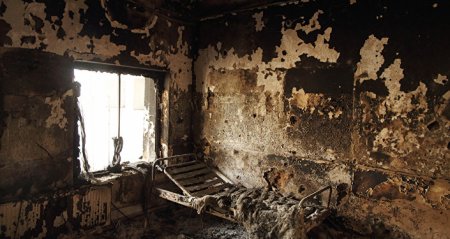
A Médecins Sans Frontières investigation into the Afghan hospital bombing by US forces has found that there were no armed combatants or weapons within the compound, and no fighting in the direct vicinity of the hospital at the time of the airstrikes.
In its report released on Thursday, Médecins Sans Frontières (MSF/Doctors Without Borders) addressed the “relentless and brutal aerial attack by US forces” which took place in Kunduz on October 3 and killed at least 30 people, including MSF staff.
“The MSF rules in the hospital were implemented and respected, including the ‘no weapon’ policy and MSF was in full control of the hospital at the time of the airstrikes,” the organization stated.
The document also said there were “no armed combatants within the hospital compound and there was no fighting from or in the direct vicinity” of the trauma center at the time of the strikes.
The hospital was “fully functioning” at the time of the airstrikes, with 105 patients admitted and surgeries taking place, according to the findings of the investigation.
In addition, MSF said the “agreement to respect the neutrality of our medical facility based on the applicable sections of International Humanitarian Law was fully in place and agreed with all parties to the conflict prior to the attack.”
Despite that neutrality, the hospital was still the target of a US airstrike, leading MSF to ask how such an attack was allowed to happen.
“The question remains as to whether our hospital lost its protected status in the eyes of the military forces engaged in this attack – and if so, why,” MSF said in its statement.
Presenting the report, MSF general director Christopher Stokes said: “From what we are seeing now, this action is illegal in the laws of war. There are still many unanswered questions, including who took the final decision, who gave the targeting instructions for the hospital.”
The MSF statement described the tragic situation at the hospital.
“Patients burned in their beds, medical staff were decapitated and lost limbs, and others were shot by the circling AC-130 gunship while fleeing the burning building. At least 30 MSF staff and patients were killed,” it states.
MSF says its demand is simple: “A functioning hospital caring for patients, such as the one in Kunduz, cannot simply lose its protection and be attacked; wounded combatants are patients and must be free from attack and treated without discrimination; medical staff should never be punished or attacked for providing treatment to wounded combatants.”
Following the aerial attack, the Pentagon initially attempted to shift responsibility onto Afghan security forces, claiming they had requested the airstrikes.
However, the commander of the US and NATO forces in Afghanistan, Gen. John Campbell, later admitted the attack was a “US decision made within the US chain of command.” He went on to say that Washington would “never intentionally target a protected medical facility.”
Read more:
US tank enters MSF hospital in Afghanistan’s Kunduz, ‘destroys potential evidence’ – reports
West Secretly Elated Over Downed Russian Airliner
By Ulson Gunnar – New Eastern Outlook – 05.11.2015
A Russian airliner bound for St. Petersburg crashed while flying over Egypt’s Sinai Peninsula, killing all on board. With the peninsula seeing fierce fighting recently as the presence of foreign-backed terrorist organizations has grown, immediate suspicion was raised regarding a potential terror attack involving either a bomb brought on board or a missile fired from below.
As Russia carries out its investigation of the disaster, the rest of the objective world waits for answers. For others, they have already begun drawing up narratives to use the disaster to serve their purposes. One such individual is John Bradley, a frequent contributor for The Economist, The Forward, Newsweek, The New Republic, The Daily Telegraph, Prospect, and The Independent.
He has also lectured at the Washington-based policy think-tank, the Washington Institute for Near East Policy, and for over 2 years, was given almost unlimited access across Saudi Arabia while writing his establishment-lauded book, “Saudi Arabia Exposed: Inside a Kingdom in Crisis.”
His most recent work is an unsavory op-ed for the UK Spectator titled, “The Russian plane crash could undermine Putin’s Syria strategy.” In it, Bradley conveniently answers the most important question that will be asked if investigators determine the plane’s destruction was an act of terrorism, “cui bono?”
Bradley describes not only how the disaster helps further undermine Egypt, (a nation struggling to balance between placating Western interests and averting a “Libya-style” collapse within its own borders) but also how the incident would undermine Russia’s efforts in Syria.
Bradley states:
It now seems fairly likely that an explosion brought down the Russian passenger airline over Egypt’s Sinai Peninsula over the weekend. One Metrojet official has already suggested that the ‘only explainable cause is physical impact on the aircraft’ and they have ruled out technical failure or human error. If the ongoing investigation proves that to be the case, it will obviously have an immediate and catastrophic impact on Egypt’s already decimated tourism industry.
Regarding Russia in particular, he states:
But it would also be the most unwelcome news possible for Vladimir Putin, who sold military intervention in Syria to the Russian people as a way of making them safer. In turn, opponents of Russian intervention – the US, Turkey and the Gulf Arab despots – would be privately elated. For does this not prove their argument that Russian intervention only complicates the situation on the ground while increasing the threat of terror attacks?
But should the downed airliner turn out to be the victim of terrorism, not only would “the US, Turkey and the Gulf Arab despots” be “privately elated,” it also appears that ISIS would have provided them a much needed card to play during future negotiations regarding the conflict in Syria. After noting that ISIS took credit for the downed airliner as it was closing in on a motorway used to resupply Syrian forces operating in Aleppo, Bradley explains:
All [at the negotiations], of course, realise that it is only worth negotiating from a position of strength. The anti-Assad allies will be hoping that Putin now fears a new Afghanistan, and will therefore be more flexible on the question of Assad’s departure. They will also be determined to ramp up support for the so-called ‘moderate rebels’, especially given that Washington has recently sent in Special Forces to ‘advise’ them (or, in other words, act as human shields against Russian bombs).
Bradley sums up his op-ed by almost celebrating the fact that those who assumed Russia’s entry into the Syrian conflict would spell its quick conclusion were “sadly mistaken.”
Should it turn out that terrorists brought down the Russian airliner, it certainly would fulfill Bradley’s summary regarding “cui bono?” Bradley himself admits that US special forces are simply serving as “human shields” for Western backed militants against Russian strikes. These same militants have in recent days, been coordinating with ISIS openly in the advances mentioned by Bradley along the Syrian motorway. It is clear that ISIS is not a third team competing in this regional conflict, but rather a member of the very team that has been reaping the most benefits from its existence, “the US, Turkey and the Gulf Arab despots.”
MSF Slams Obama’s Silence on Kunduz Hospital Bombing
Sputnik – 05.11.2015
Last month, US airstrikes bombarded a Doctors Without Borders (MSF) hospital in Kunduz, Afghanistan. In one of the deadliest civilian casualty incidents in the history of the Afghan conflict. Thirty were killed, all being medical staff and patients, and another 37 were wounded.
The tragedy elicited an international outcry. But despite almost universal condemnation, no Western nations have stepped forward to hold the United States accountable for its actions.
 “The silence is embarrassing,” MSF executive director Joanne Liu told the Thomson Reuters Foundation. “We have seen an erosion over the years of international humanitarian law. Enough is enough. We cannot keep going like this.”
In the days after the bombing, Doctors Without Borders appealed to 76 nations, requesting support for an impartial international investigation into the circumstances surrounding the incident.
“Yet today, as we mourn the killing of our staff and patients, none of the 76 countries have stepped forward to show their support for an independent investigation by the Humanitarian Commission,” MSF-USA executive director Jason Cone said during a commemoration event on Tuesday.
“No state has been willing to stand up for the Geneva Conventions and the laws of war.”
While President Obama has publicly apologized to Liu, the United States is still refusing to give consent to an independent investigation.
“That is why we again call on President Barack Obama to give his consent for the United States to participate in an independent investigation by the International Humanitarian Fact-Finding Commission,” Cone said on Tuesday.
“Consenting to such an investigation would send a powerful signal of the US government’s commitment to and respect for international humanitarian law and the rules of war.”
MSF has also started an online petition requesting White House consent. It has so far garnered over 430,000 signatures.
“For me the key message is about the safeguarding of the humanitarian medical space in war zones,” Liu said. “No one expects to be bombed when they are in a hospital. Every human being can understand that.”
Reaping the Fruits of the War on Terror in Yemen
By Michael Horton | CounterPunch | November 3, 2015
Yemen was an early victim of the US led war on terror. The first targeted assassination by a US drone occurred there in November 2002. Yemen’s mountains and deserts were where the US developed and tested its flawed drone-centric counter-terrorism strategy. A combination of indifference, faulty intelligence, and incompetence has led to the deaths of hundreds of Yemeni civilians.
As tragic as these deaths are, they pale in comparison with the death and destruction unleashed by the current war in Yemen, a war that US foreign and counter-terrorism policies are partially responsible for.
As in most parts of the world where the US has waged its war on terror, the supposed targets—terrorist organizations like al-Qaeda and the Islamic State—are the primary beneficiaries.
These organizations exploit and feed off the chaotic and divisive environments that arise from short-sighted and uninformed “whack a mole” counter-terrorism strategies. Such an outcome is perfectly acceptable to the thriving military-industrial complex that drives and profits from US foreign policy.
Yemen is one of the countries where the disastrous consequences of the war on terror are most evident and potentially most consequential. Yemen’s strategic location across from the Bab al-Mandeb—a critical shipping corridor—and its long border with Saudi Arabia ensure that the chaos that has engulfed the country will not be easily contained.
The war has already spread across Saudi Arabia’s southern border where Houthi forces and elements of the Yemeni Army have repeatedly attacked military targets deep within Saudi territory. The same forces have reportedly launched anti-ship missiles—which the Yemeni Armed Forces have in their inventory—at ships belonging to the Saudi Navy.
Much of southern Yemen, which includes areas that Saudi Arabia and its allies claim to have “liberated,” is being infiltrated by al-Qaeda in the Arabian Peninsula (AQAP) and the Islamic State. Parts of Aden—Yemen’s major port city—are now under the control of AQAP and allied bands of militant Salafis who are enforcing their version of Sharia law on the once cosmopolitan and relatively liberal city.
Yemen’s internationally recognized government—most of whose members remain in their villas in Saudi Arabia—has been unable to assert its authority in the liberated areas. As one of the better organized forces in the country, AQAP is filling the void. This is undoubtedly being facilitated by Saudi Arabia and its allies who view AQAP and militant Salafis as useful proxies. Just as they view groups like al-Qaeda affiliate al-Nusra Front in Syria as allies in their war against the government of Bashar al-Assad.
So how have US foreign policy and its counter-terrorism strategies contributed to the chaos that has engulfed Yemen?
In the wake of September 11th, then Yemeni President Saleh—a wily political survivor—recognized that the US’ war on terror was going to be a gift to corrupt governments like his. Saleh promised to be an ally in what he knew would be a war without end against organizations that are easily manipulated by intelligence services.
Thanks to the generosity of US tax payers, weapons and US Special Forces trainers poured into Yemen. There was little effective oversight of how the weapons and newly trained soldiers would be used. Rather than targeting al-Qaeda—an organization that the security services of Saleh’s government had already thoroughly penetrated—Saleh used his US supplied and trained special and counter-terrorism forces against his real enemies: namely the Houthis and those in south Yemen who opposed Saleh’s corrupt northerner dominated government.
In exchange for weapons and training, Saleh also agreed to let US drones hunt down and kill Yemeni citizens. It mattered little to him that the strikes strengthened AQAP. AQAP benefited from the cycles of revenge that resulted from the deaths of what were most often civilians. The drone strikes also weakened and de-legitimized tribal authority, one of the few constraints on the growth of AQAP and Saleh’s corrupt government.
US policies in Yemen—which were narrowly focused on killing the “bad guys” in the parlance of George W. Bush—altered the balance of power and helped set in motion the country’s rapid descent into chaos. With support from the US, Saleh was emboldened and rather than falling back on negotiations and patronage, which are long-established traditions in Yemen, he pursued his enemies. However, he and his forces were not powerful enough to prevail. Saleh, who is a student of Yemeni history, forgot that there are few periods when one man or a government has exercised control over the entirety of the country.
Rather than being defeated, Yemen’s Houthi rebels fought back and in the aftermath of the “Arab Spring” in Yemen, they took over a large part of northwest Yemen. In the south, southern separatists, who were routinely imprisoned and disappeared by the security services and “counter-terrorism” forces, were further radicalized. Now, in southern Yemen, the flag of a unified Yemen is nowhere to be seen. It has been replaced by the flag of the formerly independent south Yemen and the black flags of al-Qaeda.
The US has spent billions of dollars—the actual amount is unknown—on its war on terror in Yemen. It is worth contemplating what the political situation in Yemen would look like if even a fraction of that money had been spent on programs that tackled the real issues that drive instability in Yemen like water shortages, government corruption, a lack of schools and medical facilities, and food insecurity. And what if this aid had been linked to meaningful reform within government institutions?
While it is of course unlikely that Yemen would be a bastion of stability and transparent government, it is just as unlikely that the country would be mired in a brutal civil war that has drawn in Saudi Arabia and the UAE.
Unfortunately, US policy makers have learned nothing from fourteen years of trillion dollar failures in Afghanistan and Iraq and now Libya, Syria, and Yemen. Rather than rethinking its policies in Yemen and pushing for a negotiated end to hostilities, the US is aiding and enabling Saudi Arabia’s involvement in the war in Yemen. This war has killed thousands, impoverished millions, and effectively ceded control of large parts of Yemen to AQAP and other militant Salafi organizations.
The US’ war on terror in Yemen has done nothing but increase instability, embolden terrorist organizations, and ensure years—likely decades—of healthy profits for the companies that make up the military-industrial complex. These companies—not the American or Yemeni people—are reaping the fruits of a war without end.
Syria peace talks a small step, but leans forward
By M K Bhadrakumar | Indian Punchline | November 2, 2015
When diplomats from seventeen countries sit down together for the first time in a particular format and after “a frank and constructive discussion” for over seven hours and manage to find common ground to issue a joint statement spelling out in nine points their “mutual understanding”, although “substantial differences remain”, regarding an acute regional conflict, that is commendable effort – especially, when it is about “the grave situation in Syria and how to bring about an end to the violence as soon as possible”.
Indeed, the joint statement issued in Vienna in the evening of Friday, October 30 is notable for both bringing together a common ground between the participants as well as for giving a sense of direction and a pledge that the ministers who attended the talks will reconvene within two weeks “to continue these discussions” and in the meanwhile “working to narrow remaining areas of disagreement, and build on areas of agreement”.
The salience of the joint statement lies in its neatly sidestepping the contentious issue of the future of President Bashar Al-Assad and instead focus on the peace process in search of a settlement and the fight against terrorism. The UN Secretary-General Ban Ki-Moon couldn’t have put it better when he said afterward, “The future of Syria or the future of all these peace talks and Syrian-led negotiations should not be held up by an issue of a future of one man. Basically, I believe it is up to Syrian people, who have to decide the future of President Assad.”
The highlights of the joint statement are: a) the unity, independence, territorial integrity and secular character of Syria are “fundamental”; b) the rights of all Syrians must be protected; c) the peace process will be under the UN auspices; d) the political process will comprise the representatives of the Syrian government and the opposition; e) it will be Syrian-led and Syrian-owned, and the “Syrian people will decide the future of Syria”; f) the political process will lead to “credible, inclusive, non-sectarian governance”, followed by a new constitution and elections under UN supervision in which “all Syrians, including the diaspora” will be eligible to participate”. In the meanwhile, modalities of a ceasefire will be explored, which will, however, exclude the Islamic State and other extremist groups. A follow-up meeting is expected next week.
It does not need much ingenuity to figure out that the stance of Russia and Iran has been vindicated to a very great extent. How could this have happened? The short answer is that the United States has begun distancing itself from the position of its so-called ‘allies’ in Syria – Saudi Arabia, in particular. The body language at the Vienna talks suggests an overarching US-Russia amity. The US Secretary of State John Kerry and Russian Foreign Minister Sergey Lavrov sat side by side and frequently consulted each other. The friendly atmosphere was evident also during their joint press conference after the talks in Vienna.
The unspoken question is how in an “inclusive” political process where the people of the country are to be the final decision-makers regarding the future of their country — and where even the Syrian diaspora can participate — how on earth one single individual by name Assad can be made the solitary exception because Saudi Arabia doesn’t like his face (for whatever reason)? The Saudi insistence that Assad should be removed through a political settlement or by force has become untenable. What Saudi Arabia seeks is a political order in Syria that is imposed top-down, whereas, the joint statement takes the contrarian position that it is the Syrian people who will choose their next leadership – not any foreign power.
During the Kerry-Lavrov press conference, it transpired that Moscow has proposed more cooperation with Washington for a coordinated fight against the Islamic State. Kerry said he would seek President Barack Obama’s approval for the Russian proposal. Meanwhile, it is to be noted that Russia has only perfunctorily disagreed with President Barack Obama’s decision to deploy around four dozen military advisers to Syria. (Iran’s reaction, too, is notably low-key.) Of course, Obama’s detractors in the US have gone to town to vilify him by claiming he has gone back on his word that he will not put ‘boots on the ground’ in Syria. But it stands to reason that this is not a ‘mission creep’, as made out to be by Obama’s critics.
Of course, there is a dichotomy in the Obama administration’s overall approach on Syria following the Russian military intervention. Clearly, Obama is figuring out his way forward and is unsure of the downstream repercussions of the Russian military operations. The tantalizing question is whether the US isn’t, after all, edging closer to the original Russian proposal for a concerted effort to fight the IS? Indeed, if a nation-wide ceasefire takes hold in Syria between the government and the ‘moderate’ opposition concurrent with the political process (which is what has been envisaged in the joint statement), it opens the door to a Russian-American coordinated military effort against the IS. Obama cannot be oblivious of that. The text of the joint statement is here.
Cameron denies scrapping vote on Syria airstrikes after warning from MPs
RT | November 3, 2015
Prime Minister David Cameron has reportedly scrapped plans to call a House of Commons vote on approving airstrikes against Islamic State (formerly ISIS/ISIL) in Syria after failing to win over enough Labour MPs to counterbalance rebellious Tories.
Whitehall sources told The Guardian and The Times that Downing Street had unofficially decided not to extend Royal Air Force (RAF) bombing campaigns from Iraq to Syria over fears Cameron would be humiliated by a second defeat on the issue.
MPs previously voted down launching airstrikes against Syria, specifically targeting forces loyal to President Bashar Assad, in 2013.
Cameron had insisted he would only call a vote when he had achieved a clear, cross-party consensus.
However, the estimated number of Labour MPs expected to vote in favor of airstrikes – between 20 and 30 – would not counteract the number of Tories planning to rebel.
One Downing Street source denied the claims, saying Cameron will still call a vote when a consensus is reached.
“The prime minister’s position hasn’t changed,” the source said.
“He’s consistently said that we would only go back to the House [of Commons] on this issue if there was clear consensus and that remains the case.”
“Meanwhile, the government continues to work to bring the conflict to an end in Syria and we are working closely with our allies to inject greater momentum into efforts to find a political solution, which we’ve always said will be the way to bring this war to an end and give Syria hope for the future.”
In a further blow to Cameron’s campaign to extend British bombing to Syria, the Foreign Affairs Select Committee released a report saying they are “not yet persuaded” by the case for Syrian airstrikes.
The report expresses concerns that Royal Air Force airstrikes would only have a “marginal effect” and could prove a “distraction” from a diplomatic solution.
MPs agreed that the humanitarian catastrophe means there is a “powerful sense that something must be done.”
But they added that military action should not be used unless there is a “coherent international strategy.”
“We believe that there should be no extension of British military action into Syria unless there is a coherent international strategy that has a realistic chance of defeating ISIL and of ending the civil war in Syria.
“In the absence of such a strategy, taking action to meet the desire to do something is still incoherent,” they added.
However, one former Labour minister threatened to quit the party after suggestions Jeremy Corbyn’s leadership team would consult the Stop the War coalition over a government proposal to begin military action.
Tom Harris MP, a former transport minister, posted on Facebook it would be “goodbye” from him if the anti-war group was consulted.
The British government has already authorized drone strikes against ISIS targets in Syria without the backing of parliament. In September, it was revealed that two British nationals fighting for extremist organizations had been killed by RAF drones.
US Secretary of State John Kerry will visit London this week to discuss international relations, including the situation in Syria. The US is already carrying out airstrikes in the country.
“While in London, [Kerry] will meet with British Foreign Secretary [Philip] Hammond to discuss a range of bilateral and global issues, including Syria,” a spokesperson for Kerry said.
Featured Video

Why Hamas Really Attacked Israel on Oct. 7
or go to
Aletho News Archives – Video-Images
From the Archives
Israel: Strategic Ally or Liability?
By Stephen Sniegoski | My Catbird Seat | June 12, 2010
The claim that Israel serves as a valuable ally for the United States is made by both pro-Zionists and much of the anti-war and anti-Zionist Left that is influenced by Noam Chomsky. As a result of the Gaza flotilla massacre, which has caused a world-wide uproar against Israel, the value of Israel to the United States is being publicly questioned in more mainstream foreign policy forums. … continue
Blog Roll
 Aletho News
- Why Hamas Really Attacked Israel on Oct. 7
- Declassified UK exposes British man who fought for ‘Israel’ in Gaza
- West’s death cult in a theater near you
- How the Yandex ‘Russian bots’ lie fell apart
- Burnham’s ‘Russia did Brexit’ ruse crumbles
- Estonia making movies and games to encourage war against Russia
- Four in five new UK jobs taken by foreigners – report
- Here’s what Trump’s latest U-turn really means for Russia and Ukraine
- The Houthis Are Not an Iranian Proxy
- Europe’s Energy Hypocrisy, Russian LNG Profits and US Dependence
- If Americans Knew
- Activists Abused By Israel Return to New Freedom Flotilla Mission
- 60 Minutes won’t tell the full truth about Israeli settler violence
- Nearly 50,000 women, girls killed or severely injured in Gaza since October 2023: UN Women
- ADL is working with AI companies to suppress alleged ‘antisemitism’
- Israeli occupation forces using social media surveillance unit to target hundreds of Palestinians in the West Bank
- Israel’s New – and Terrifying – Security Doctrine
- Israeli Attacks Kill Five in Gaza, Including a four-year-old and a woman
- Air Force Major Who Called for Trump’s Impeachment Held in Solitary Confinement
- It’s a Genocide, I’m Into It’: Seinfeld Mocks Protest over Palestinian Children Killed
- Universities fire dozens amid pressure from Zionist billionaires
- No Tricks Zone
- New Study Suggests Large Regions Of The Pacific Ocean Have Been Cooling For The Last 80 Years
- Germany’s Green Energy Debacle: High Energy Costs Force Kahla Porzellan to Close After 182 Years!
- New Study: 50 Years Of The Most Aggressive ‘Net Zero’ Policies Can Only Affect The Global Climate By 0.03°C
- US September “Heat” Was No Record…Many Records Set Decades Ago
- Latest European Green Energy Debacle; Portugal’s Largest Flagship Solar Park Insolvent!
- Green Energy Debacle: German Expert Professor Fritz Vahrenholt Warns Of Severe Economic And Social Consequences
- Two More Paleo Reconstructions Affirm Meters-Higher Sea Levels Across Ireland, Brazil 7000-6000 Years Ago
- New Study: Earth And Venus Surface Warmth Largely Explained By Convection And Lapse Rate, Not CO2 Or Radiation
- 2025 Nature Paper Claiming Worsening Global Drought Gets RETRACTED …Heavily Flawed
- New Study: ‘Global Drought Shows No Detectable Recent Acceleration Under Climate Warming’

