IRAQI KURDISTAN: Villagers who survived Turkish bombing speak out
CPTnet | November 2, 2015
In the early morning hours of 1 August 2015 Turkish warplanes fired rockets into Zergaly village, destroying houses, killing an elderly woman, and injuring her husband and three relatives.
After people from the surrounding area and other villages came to help the wounded, the warplanes returned—dropping bombs and firing more rockets on to the rescuers—killing seven and injuring eight more.
Throughout the 1990s, and between 2007 and 2012, Turkish warplanes and military forces regularly bombarded the mountain regions of Iraqi Kurdistan. Aided by the USA, the Turkish so-called “war on terror” against the Kurdistan Workers Party (PKK), gravely impacted the lives of thousands of subsistence farmers and shepherds, and their communities.
The airstrikes and artillery bombardments killed and wounded many Kurdish civilians, destroyed and emptied villages, and burned or poisoned much agricultural land and livestock.
The peace process between the PKK and the Turkish government, which began on 21 March 2013, raised long awaited hopes among the Kurdish people, despite being overshadowed by doubts rooted in their historic experience.
Recently, hopes for peace were shattered when the Turkish government—under the pretext of joining the war against Da’esh (ISIS)—restarted attacks on the border regions of Iraqi Kurdistan in July of 2015. Turkey again targeted the PKK—the main force fighting against Da’esh in the region, as well as the civilians.
Christian Peacemaker Teams Iraqi-Kurdistan filmed the testimony of the survivors and family members of the Zergaly bombing. Turkey continues to bomb the villages of Iraqi Kurdistan.
Hobby Lobby Owners Suspected of Illegally Importing Looted Iraqi Artifacts
By Cassius Methyl – ANTIMEDIA – October 29, 2015
Hobby Lobby is a self-proclaimed “deeply Christian” chain of craft stores run by the wealthy Green family that made headlines in 2014 when a landmark Supreme Court ruling in their favor extended religious freedom rights to corporations.
A strange situation with the infamous craft chain store hit the headlines Wednesday as it was revealed the Green family is being investigated for importing hundreds of ancient artifacts from Israel that rightfully belong to Iraq.
According to the Daily Beast, “For the last four years, law enforcement sources tell The Daily Beast, the Greens have been under federal investigation for the illicit importation of cultural heritage from Iraq.”
In 2011, 200-300 thousand-year-old cuneiform clay tablets on their way to an Oklahoma City Hobby Lobby compound from Israel were seized by U.S. customs in Memphis. The tablets were destined to join the wealthy family’s private collection of 40,000 priceless, ancient artifacts already amassed in their $800 million Museum of the Bible — a “giant” museum set to open in Washington D.C. in 2017.
It’s unclear how the artifacts were suspected to have been looted, but they likely came from ISIS pillagers or Iraqi smugglers taking advantage of the current instability in the region.
Although inarguably disrespectful, the Greens’ attempt to smuggle artifacts might not be as offensive as the objects’ questionable future: it’s not clear to whom they should be returned — or if they will be returned at all.
Daesh oil sales fall thanks to Russian airstrikes in Syria
Press TV – October 31, 2015
Russian airstrikes against Takfiri positions in Syria have resulted in a swift decline in oil sales by the terrorist group, says a French official.
ISIL-controlled oil sales “have declined significantly in recent weeks due to the Russian campaign in Syria,” Russia’s Sputnik quoted a French National Assembly Defense Commission member, Nicolas Dhuicq, as saying on Saturday.
Apart from selling crude oil, the group also “pays people to refine oil in its own places,” he noted, adding, the majority of the terrorist group’s oil revenue is from countries such as Saudi Arabia, Turkey and Qatar.
“ISIL is funded, probably, by Saudi Arabia and Qatar, which are trying to gain back their share of influence in the regions of Iraq and Syria against Iran. Until now, ISIL continues to receive money from these countries, most likely from private donors,” said Dhuicq.
He estimated that the militant group’s budget was around $2 billion, adding further that donors from Turkey also had a hand in re-selling crude oil obtained from Daesh.
“Money may also come from the secret services of the countries and also from Turkey,” he noted.
The Takfiri group currently controls parts of territory in Syria, Iraq and Libya, where it carries out heinous acts of terror such as public decapitations.
Russia launched its first airstrikes against the Takfiri terrorists in Syria on September 30 at the request of the Damascus government. Moscow says its air raids are meant to weaken Daesh and other terrorist groups that are wreaking havoc in Syria.
‘Calculated to put American troops in danger’: Why US wants escalation in Syria
RT | October 31, 2015
Sending some 50 US advisers to Syria illegally to train the so-called ‘moderate rebels’ looks like a calculated move. If, or when, someone gets hurt, the US will have a pretext for boots on the ground, believes retired US Air Force Lieutenant Col Karen Kwiatkowski.
RT: Does this deployment mean Americans will be putting themselves in the direct line of fire in Syria?
Karen Kwiatkowski: I think there is a danger of that happening and I think that is part of why they are going there. I think they are looking for an excuse to up the ante, to send more troops and to have a crisis of some sort. Clearly the president has been lying, and so has Ash Carter, about what their real intentions are. So, in my opinion, I think this is provocative and I think it is calculated to put our troops in danger.
RT: How is that not a combat operation?
KK: Well, special forces are combat. And what the president said [is] they are going to be opportunistic. When you are training and advising, you do not use the word opportunistic. Training and advising is a more steady state situation. So they are using the word opportunistic, they are expecting to get involved in combat operations, and they have sent combat troops to do that. I do not care how they have used the term for non-combat. This is combat.
RT: They are going there to support the so-called moderate rebels. We know it hasn’t been terribly successful. Why should this make a huge difference?
KK: In terms of helping the moderate rebels – if there are any that we can identify – it is not going to make any difference in that regard. This is about US exercising some power, some limited power that it has, to kind of assert its relevance, particularly in the face of our allies who are asking how we are helping or not helping them.
RT: Sure, but do you think this is a game changer or, perhaps, this is a question of timing, because Russia has obviously taken on Islamic State?
KK: I don’t think it is a game changer in that regard. It is a gesture to kind of save face in some respects. But there is a real danger, that if our troops, even if it is a limited number, get killed, and if they get killed by, let’s say, Russian fire or something like that, than we have a big problem, that we are not able diplomatically or militarily able to deal with. So it is extremely foolhardy what they are doing. But yes, it is a gesture to show that the US is trying something. But it is a weak gesture and it is a dangerous gesture.
RT: And you mentioned the Russian airstrikes there and, presumably, Americans are saying we do need to speak with the Russians now to say where we are located so we don’t get into an incident like that?
KK: You would think that. You would think so.
RT: But you sound like that might not happen?
KK: If you believe what the president and Ash Carter say, they aren’t really seeking out any cooperation with the Russians. So perhaps behind the scenes they are. I would like to think that they care about the lives of our soldiers that they are sending over there and that they would coordinate, but their public rhetoric is that we will not coordinate. That is what I’ve heard unless something has changed. They are not really interested in coordinating with Russia, anything that Russia is doing in Syria. And by the way remember that it is an illegal act to send our troops into Syrian space, air space or ground space, without the permission of the government of Syria, which we do not have. So this is an act of war on top of everything else that makes this extremely stupid.
RT: Americans clearly don’t see that as a big issue, I mean it has been conducting airstrikes, despite it being against international law. It does not seem to matter in this case, at this stage anyway.
KK: It has not mattered in our policy in the Middle East for a long time. But I have pointed out that if our people killed, if we decide to make some sort of case about that, we are in the wrong totally in this, because we don’t have permission of the Syrian government to put those troops there at all. They are there illegitimately. So when they get killed or injured or harmed we have a problem in a diplomatic sense.
RT: A public opinion sense too, I mean what was the reaction when the US soldier did die on a special operations mission in Iraq. Was there a big public outcry in America?
KK: No. Two things that I have noticed about this: one is there is no public outcry, not a lot of concern. I haven’t seen a lot of attention given to this death. What surprised me was how much Ashton Carter and President Obama paid homage to this particular individual, called him a hero, and this is what we would like to see – some guy running into a fight and getting slaughtered in an illegitimate combat situation, because I think even in Iraq we still have some concerns there about what we are doing. They celebrated it. They tried to put a positive spin on it. American people aren’t listening. We have a lot of other different things on in general. The American people aren’t interested in what is going on in the Middle East. They don’t want to get involved in it. But they really tried to spin the death of this soldier in a very positive way. And, I’m sure, to see if it can be sold. And, as far as I can tell, it was sold. Americans aren’t interested, but they haven’t really pushed back at the death of this guy. I think we’ve become inert to it.
RT: Just looking into the future, you foresee a similar thing?
KK: I do. I mean if you go in the middle of a fire storm in an ill-planned situation, then certainly, you can’t say that anything the Pentagon is doing in the Middle East is well planned. They themselves admit this. So, yes, it is going to lead to the death of Americans. And given how they spun the death that happened last week we’ll see more spinning and, you know, more of Russia as a ‘bad guy’ in this situation, as they try to salvage what is left of their Middle East policy in this final year of the Obama administration, in these final months of the Obama administration… I hate to be cynical about this, but it is such a game that they are playing – no good results for our people, no good results for the Syrian people. It is not going to help the exodus of refugees at all. In fact, it will probably make it worse.
READ MORE: US ground ops in Syria ‘illegal’, may lead to ‘unpredictable’ consequences
71 Palestinians, Including 12 Children, 2 Infants And A Pregnant Woman, Killed This Month
By Celine Hagbard | IMEMC News | October 31, 2015
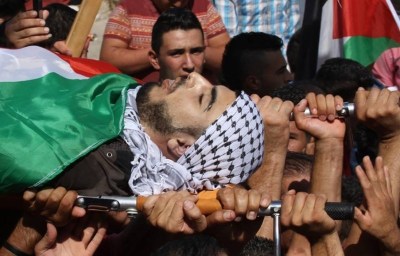
Three Palestinians were killed Friday, including a baby who suffocated to death from tear gas in Bethlehem a day after Israeli forces tore through a Bethlehem neighborhood shouting “We will gas you all to death”.
The Palestinian Health Ministry has reported that 921 Palestinians have been shot and injured with live Israeli army rounds, since the beginning of this month, in the West Bank and the Gaza Strip, while 855 were shot with rubber-coated steel bullets, and 208 suffered fractures and bruises after being assaulted and beaten by soldiers and fanatic settlers.
Palestinians Killed On Friday:
Baby Suffocates to Death from Tear Gas near Bethlehem
Palestinian killed near light rail station in Jerusalem following alleged stabbing of soldier
One Palestinian Killed, Another Seriously Injured, Near Nablus
The names of those killed by the army in October:
West Bank and Jerusalem:
1. Mohannad Halabi, 19, al-Biereh – Ramallah. Shot after allegedly grabbing gun and killing two Israelis. 10/3
2. Fadi Alloun, 19, Jerusalem. Israeli claim of ‘attack’ contradicted by eyewitnesses and video. 10/4
3. Amjad Hatem al-Jundi, 17, Hebron.
4. Thaer Abu Ghazala, 19, Jerusalem.
5. Abdul-Rahma Obeidallah, 11, Bethlehem.
6. Hotheifa Suleiman, 18, Tulkarem.
7. Wisam Jamal Faraj, 20, Jerusalem. Shot by an exploding bullet during protest. 10/8
8. Mohammad al-Ja’bari, 19, Hebron.
9. Ahmad Jamal Salah, 20, Jerusalem.
10. Ishaq Badran, 19, Jerusalem. Israeli claim of ‘attack’ contradicted by eyewitnesses. 10/10
11. Mohammad Said Ali, 19, Jerusalem.
12. Ibrahim Ahmad Mustafa Awad, 28, Hebron. Shot at protest by rubber-coated steel bullet in his forehead. 10/11
13. Ahmad Abdullah Sharaka, 13, Al Jalazoun Refugee camp-Ramallah.
14. Mostafa Al Khateeb, 18, Sur-Baher – Jerusalem.
15. Hassan Khalid Manassra, 15, Jerusalem.
16. Mohammad Nathmie Shamassnah, 22, Kutneh-Jerusalem.
17. Baha’ Elian, 22, Jabal Al Mokaber-Jerusalem.
18. Mutaz Ibrahim Zawahra, 27, Bethlehem. Hit with a live bullet in the chest during a demonstration.
19. Ala’ Abu Jammal, 33, Jerusalem.
20. Bassem Bassam Sidr, 17, Hebron.
21. Ahmad Abu Sh’aban, 23, Jerusalem.
22. Riyadh Ibraheem Dar-Yousif, 46, Al Janyia village Ramallah( Killed while harvesting olives)
23. Fadi Al-Darbi , 30, Jenin – died in Israeli detention camp.
24. Eyad Khalil Al Awawdah, Hebron.
25. Ihab Hannani, 19, Nablus.
26. Fadel al-Qawasmi, 18, Hebron. Shot by paramilitary settler, Israeli soldier caught on film planting knife near his body.
27. Mo’taz Ahmad ‘Oweisat, 16, Jerusalem. Military claimed he ‘had a knife’. 10/17
28. Bayan Abdul-Wahab al-‘Oseyli, 16, Hebron. Military claimed she ‘had a knife’, but video evidence contradicts that claim. 10/17
29. Tariq Ziad an-Natsha, 22, Hebron. 10/17
30. Omar Mohammad al-Faqeeh, 22, Qalandia. Military claimed he ‘had a knife’. 10/17
31. Mohannad al-‘Oqabi, 21, Negev. Allegedly killed soldier in bus station in Beer Sheba.
32. Hoda Mohammad Darweesh, 65, Jerusalem.
33. Hamza Mousa Al Amllah, 25, from Hebron, killed near Gush Etzion settlement.
34. Odai Hashem al-Masalma, 24, Beit ‘Awwa town near Hebron.
35. Hussam Isma’el Al Ja’bari, 18, Hebron.
36. Bashaar Nidal Al Ja’bari, 15, Hebron.
37. Hashem al-‘Azza, 54, Hebron.
38. Moa’taz Attalah Qassem, 22, Eezariyya town near Jerusalem. 10/21
39. Mahmoud Khalid Eghneimat, 20, Hebron.
40. Ahmad Mohammad Said Kamil, Jenin.
41. Dania Jihad Irshied, 17, Hebron.
42. Sa’id Mohamed Yousif Al-Atrash, 20, Hebron.
43. Raed Sakit Abed Al Raheem Thalji Jaradat, 22, Sa’er – Hebron.
44. Eyad Rouhi Ihjazi Jaradat, 19, Sa’er – Hebron.
45. Ezzeddin Nadi Sha’ban Abu Shakhdam, 17, Hebron. Shot by Israeli military after allegedly wounding soldier, then left to bleed to death.
46. Shadi Nabil Dweik, 22, Hebron. Shot by Israeli military after allegedly wounding the same soldier, then left to bleed to death.
47. Homam Adnan Sa’id, 23,Tel Rumeida, Hebron. Shot by Israeli soldiers claiming ‘he had a knife’, but eyewitnesses report seeing soldiers throwing a knife next to his dead body. 10/27
48. Islam Rafiq Obeid, 23, Tel Rumeida, Hebron. 10/28
49. Nadim Eshqeirat, 52, Jerusalem. 10/29 – Died when Israeli soldiers delayed his ambulance.
50. Mahdi Mohammad Ramadan al-Mohtasib, 23, Hebron. 10/29
51. Farouq Abdul-Qader Seder, 19, Hebron. 10/29
52. Qassem Saba’na, 20, shot on motorcycle near Zaatara checkpoint. 10/30
53. Ahmad Hamada Qneibi, 23, Jerusalem. Soldiers claimed ‘he had a knife’.
54. Ramadan Mohammad Faisal Thawabta, 8 month old baby, Bethlehem. Died of tear gas inhalation.
Gaza Strip:
55. Shadi Hussam Doula, 20.
56. Ahmad Abdul-Rahman al-Harbawi, 20.
57. Abed al-Wahidi, 20.
58. Mohammad Hisham al-Roqab, 15.
59. Adnan Mousa Abu ‘Oleyyan, 22.
60. Ziad Nabil Sharaf, 20.
61. Jihad al-‘Obeid, 22.
62. Marwan Hisham Barbakh, 13.
63. Khalil Omar Othman, 15.
64. Nour Rasmie Hassan, 30. Killed along with her child in an Israeli airstrike. 10/11
65. Rahaf Yihiya Hassan, two years old. Killed along with her mother in an Israeli airstrike. 10/11
66. Yihya Abdel-Qader Farahat, 23.
67. Shawqie Jamal Jaber Obed, 37.
68. Mahmoud Hatem Hameeda, 22. Northern Gaza. 69. Ahmad al-Sarhi, 27, al-Boreij.
70. Yihya Hashem Kreira.
71. Khalil Hassan Abu Obeid, 25. Khan Younis. Died from wounds sustained in protest earlier in the week.
Non-Palestinian killed by Israeli mob:
Eritrean asylum-seeker Haftom Zarhum killed in Beer Sheva bus station by angry mob who mistook him for a Palestinian- 10/18
Names of known Israeli casualties during the same time period:
1 & 2. 10/1 – Eitam and Na’ama Henkin, both aged around 30 years old, killed in drive-by shooting near Itamar settlement.
3. 10/3 – Nahmia Lavi, 41 – Rabbi for Israeli military. Killed in Jerusalem stabbing attack near Lion’s Gate when he tried to shoot the attacker but had his weapon taken.
4. 10/3 – Aaron Bennet, 24. Killed in Jerusalem stabbing attack near Lion’s Gate.
5. 10/13 – Yeshayahu Kirshavski, 60, bus shooting in East Jerusalem
6. 10/13 – Haviv Haim, 78, bus shooting in East Jerusalem
7. 10/13 – Richard Lakin, 76, bus shooting in East Jerusalem (died of wounds several days after the attack)
8. 10/18 – Omri Levy, 19, Israeli soldier with the Golani Brigade who had his weapon grabbed and turned against him by an Israeli resident.
An additional 2 Israelis that were initially claimed to have been killed in attacks were actually killed in car accidents.
Chemical weapons in Syria: Who is guilty?
By Dr Alexander Yakovenko | RT | October 31, 2015
Against the background of many complex events occurring in the Middle East, the West continues to accuse the Syrian government on a regular basis of using chemical weapons against its own population.
And this is taking place in spite of the well-known fact that the process of chemical demilitarization of Syria has been actually completed, and all chemical weapons were removed from the country long ago.
It is worth mentioning in this regard that the Organization for the Prohibition of Chemical Weapons (OPCW) has admitted that only one percent of toxic substances removed from Syria remains to be destroyed at a commercial facility in the United States. As for the Syrian chemical weapons production facilities, it has been confirmed that 11 of the 12 sites have already been destroyed, and the remaining one is inaccessible to the government because of the current situation on the ground.
Despite this, our Western partners keep claiming that the Syrian government had initially submitted an incomplete declaration of the existing chemical weapons. However, they forget to mention that Damascus has agreed, as a gesture of goodwill, to establish a special OPCW mission for the verification of its initial declaration, although according to the Chemical Weapons Convention they were not obliged to do so. This mission is still working, and final conclusions have yet to be made.
There is a real concern that, according to available data, Islamic State (IS, formerly ISIS/ISIL) has acquired access to technologies for chemical weapons production, the relevant documentation and production facilities. Reportedly, there have already been numerous chemical weapons attacks by IS militants in both Syria and Iraq. Moreover, there is evidence of them using not only chlorine but “real” chemical weapons – mustard gas and possibly lewisite, the production of which, by the way, requires rather sophisticated technologies.
In these circumstances, it is extremely important that the mandate of the OPCW Fact-Finding Mission in Syria investigating possible use of toxic chemicals be extended to the territory of Iraq. A few weeks ago the Russian side prepared and introduced a UNSC draft resolution for this matter. Unfortunately, despite our repeated and persistent attempts the Security Council so far has failed to respond to those facts, primarily because of the position of our Western partners. In this regard, one can only wonder about the logic of the West, which declares its willingness to combat Islamic State, but at the same time does not bother to raise a finger to prevent this group from developing and using prohibited weapons.
Dr Alexander Yakovenko, Russian Ambassador to the United Kingdom of Great Britain and Northern Ireland, Deputy foreign minister (2005-2011). Follow him on Twitter @Amb_Yakovenko
High Court lifts ban on protests at Israeli drone factory
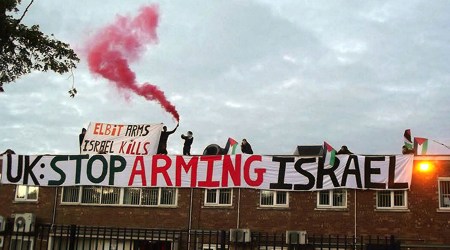
A UK arms factory was recently occupied by nine British activists in protest against the company’s alleged complicity in Israel’s Operation Protective Edge
RT | October 30, 2015
An injunction banning protests from taking place outside a drone factory in Staffordshire has been thrown out by Birmingham High Court. The factory has produced parts for drones used to attack Gaza in 2008, according to Amnesty International.
UAV Engines Limited in Shenstone, owned by an Israeli arms manufacturer Elbit Systems, is one of the world’s leading drone producers. The company says it produces “engines for various size tactical armed unmanned aerial vehicles [UAVs], target drones and single mission platforms.”
Angered by the factory’s unethical behavior, hundreds of protesters have staged demonstrations outside its industrial unit, calling on the manufacturer to stop contributing to the death of Palestinians.
In June, campaigners shut down UAV and another Israeli arms factory in Kent as part of a protest marking the one-year anniversary of the Israeli assault on Gaza.
Soon after, it became illegal for activists to protest within 250 meters of the Shenstone factory. The ban came in the form of a temporary injunction granted by the High Court.
However, Birmingham High Court scrapped the ban on Tuesday, ruling Elbit had failed to disclose information on the history of protests which have taken place at the factory since 2009.
Judge Purle at the High Court said the injunction is dismissed “as if it never existed.”
“I think it inconceivable you would have got the same injunction, possibly even any injunction, if you had disclosed relevant information to me,” she told the court. “Accordingly the injunction I granted on 30 June is dismissed ab initio [from the beginning] and it is as if the injunction never existed.”
‘It shouldn’t have been introduced’
A spokesperson for campaign group Block the Factory said the injunction should not have been imposed in the first place.
“This injunction should never have been imposed.It seems to have been designed to deter protest and campaigning around ending the UK’s deadly arms trade with Israel,” they told IBT.
“It’s Elbit Systems and its arms factories that should be facing a ban, not our protests. Today’s decision will bring even more energy to our campaigning in solidarity with ongoing Palestinian resistance and for a two-way arms embargo on Israel.”
War on Want, a charity fighting against the root causes of poverty and human rights violations, said it is pleased the ban has been lifted.
“It would have been a travesty for people to be criminalized for protesting against the sale of arms that are killing Palestinians. It just goes to show the depths UAV Engines will stoop to in order to protect the profits they make from the sale of deadly drones,” campaigner Ryvka Barnard said.
“We welcome the news that the judge has binned this draconian injunction and we will keep up the fight for an immediate two-way arms embargo between the UK and Israel,” he added.
In July, hundreds of activists protested outside the factory, which led to 19 people being arrested by Staffordshire police.
Photo © londonpalestineaction.tumblr.com / Tumblr
US used Christian NGO to spy on North Korea
Press TV – October 29, 2015
The United States has used a Christian non-governmental organization (NGO) as a front for an espionage program to spy on North Korea, a new report reveals.
In 2004, the Pentagon launched a secret program to gather intelligence from inside the East Asian country that has long been a source of great concern to Washington, The Intercept reported.
“We had nothing inside North Korea,” one former military official familiar with US efforts in the country told the Intercept. “Zero.”
However, a Christian charity organization called the Humanitarian International Services Group, or HISG, was able to finally make way into North Korea through offering much-needed humanitarian aid to Pyongyang.
According to the NGO’s documents, HISG was established by three friends shortly after the September 11, 2001 terrorist attacks in New York. Under the leadership of Kay Hiramine, the organization set out to provide disaster relief and sustainable development in poor and war-torn countries around the world.
The espionage program was the brainchild of Lieutenant General William “Jerry” Boykin, a senior US Defense Department intelligence official during the George W. Bush administration.
Boykin who was an evangelical Christian, obsessed with finding new and unorthodox ways to penetrate North Korea.
He was assigned with the task of increasing the Pentagon’s ability to conduct intelligence operations independent from the CIA.

Lt. Gen. William “Jerry” Boykin
Boykin improvised a plan to use charities as a cover for espionage operations and this was how HISG was chosen to participate in the program.
In the period between 2004 and 2006, HISG helped coordinate a humanitarian shipment to North Korea.
The charity offered faith-based donations that the North Korean government would occasionally accept to help its population endure the country’s harsh winters.
However, the shipment included concealed compartments of bibles underneath the clothing. The idea was that if the bibles were not discovered, the Pentagon could use the same smuggling method to get military sensors and equipment into the country.
Once they made sure that the bibles entered the country unnoticed, the Pentagon tasked HISG with gathering the intelligence it needed inside North Korea.

HISG CEO Kay Hiramine (L) stands next to former US president George W. Bush
Hiramine’s NGO used unsuspecting Christian missionaries, aid workers, and Chinese smugglers to move equipment into and around North Korea without any of them knowing that they were part of a secret Pentagon operation.
The Pentagon planted “spoofers” and similar devices in the country to disrupt North Korean military devices and radio signals. The report also noted that “[equipment] to measure nuclear anomalies” were scattered throughout the country.
The US even planted shortwave radios that could help a downed pilot to escape in the event of a future conflict with North Korea.
Citing a former US military official and documents reviewed in relation to the case, the report noted that before being dismantled in 2013, Hiramine’s organization had received millions in funding from the Pentagon through a complex web of organizations designed to mask the origin of the cash.
In 2007, President Bush awarded Hiramine with a President’s Volunteer Service Award.
Featured Video

Why Hamas Really Attacked Israel on Oct. 7
or go to
Aletho News Archives – Video-Images
From the Archives
Israel: Strategic Ally or Liability?
By Stephen Sniegoski | My Catbird Seat | June 12, 2010
The claim that Israel serves as a valuable ally for the United States is made by both pro-Zionists and much of the anti-war and anti-Zionist Left that is influenced by Noam Chomsky. As a result of the Gaza flotilla massacre, which has caused a world-wide uproar against Israel, the value of Israel to the United States is being publicly questioned in more mainstream foreign policy forums. … continue
Blog Roll
 Aletho News
- Why Hamas Really Attacked Israel on Oct. 7
- Declassified UK exposes British man who fought for ‘Israel’ in Gaza
- West’s death cult in a theater near you
- How the Yandex ‘Russian bots’ lie fell apart
- Burnham’s ‘Russia did Brexit’ ruse crumbles
- Estonia making movies and games to encourage war against Russia
- Four in five new UK jobs taken by foreigners – report
- Here’s what Trump’s latest U-turn really means for Russia and Ukraine
- The Houthis Are Not an Iranian Proxy
- Europe’s Energy Hypocrisy, Russian LNG Profits and US Dependence
- If Americans Knew
- Activists Abused By Israel Return to New Freedom Flotilla Mission
- 60 Minutes won’t tell the full truth about Israeli settler violence
- Nearly 50,000 women, girls killed or severely injured in Gaza since October 2023: UN Women
- ADL is working with AI companies to suppress alleged ‘antisemitism’
- Israeli occupation forces using social media surveillance unit to target hundreds of Palestinians in the West Bank
- Israel’s New – and Terrifying – Security Doctrine
- Israeli Attacks Kill Five in Gaza, Including a four-year-old and a woman
- Air Force Major Who Called for Trump’s Impeachment Held in Solitary Confinement
- It’s a Genocide, I’m Into It’: Seinfeld Mocks Protest over Palestinian Children Killed
- Universities fire dozens amid pressure from Zionist billionaires
- No Tricks Zone
- New Study Suggests Large Regions Of The Pacific Ocean Have Been Cooling For The Last 80 Years
- Germany’s Green Energy Debacle: High Energy Costs Force Kahla Porzellan to Close After 182 Years!
- New Study: 50 Years Of The Most Aggressive ‘Net Zero’ Policies Can Only Affect The Global Climate By 0.03°C
- US September “Heat” Was No Record…Many Records Set Decades Ago
- Latest European Green Energy Debacle; Portugal’s Largest Flagship Solar Park Insolvent!
- Green Energy Debacle: German Expert Professor Fritz Vahrenholt Warns Of Severe Economic And Social Consequences
- Two More Paleo Reconstructions Affirm Meters-Higher Sea Levels Across Ireland, Brazil 7000-6000 Years Ago
- New Study: Earth And Venus Surface Warmth Largely Explained By Convection And Lapse Rate, Not CO2 Or Radiation
- 2025 Nature Paper Claiming Worsening Global Drought Gets RETRACTED …Heavily Flawed
- New Study: ‘Global Drought Shows No Detectable Recent Acceleration Under Climate Warming’

