US made willful decision to create ISIL: Ex-head of US Defense Intelligence Agency
Press TV – August 8, 2015
The former director of the US Defense Intelligence Agency (DIA) has said that the rise of the ISIL terrorist group in Syria was a “willful decision” made by Washington.
An internal DIA study released recently shows Washington knew that the actions of “the West, (Persian) Gulf countries and Turkey” in Syria may create a Takfiri group like the ISIL.
Michael Flynn, the former head of the DIA, has described the study as important and confirmed its findings.
In an interview with Al Jazeera TV, he said he had studied a DIA memo in 2012 predicting the West’s backing of ISIL in Syria, adding it was very clear intelligence.
When the interviewer asked whether the administration turned a blind eye to his analysis, Flynn said, “I don’t know that they turned a blind eye, I think it was a decision. I think it was a willful decision.”
Asked if it was a willful decision to support an insurgency, he responded, “It was a willful decision to do what they’re doing.”
He also said he had even argued against sponsoring foreign militants in Syria, noting the reason behind the rise of the ISIL was the US and its allies sponsoring terrorists in Syria to pressure Damascus.
Observers say that the US and its allies helped create and train the terrorist organizations to wreak havoc in Muslim countries.
The ISIL militants have seized large swathes of land in Syria and Iraq. They have been carrying out heinous crimes against all communities in both neighboring Arab states.
Elsewhere in his remarks, Flynn admitted that Washington was well aware of the chaos Iraq would face following its withdrawal in 2011.
US warplanes have been conducting airstrikes against ISIL in Iraq since early August 2014. Some Western states have also participated in some of the strikes in Iraq.
Since late September 2014, the US and some of its Arab allies have been carrying out airstrikes against ISIL inside Syria without any authorization from Damascus or a UN mandate.
Unarmed civilians killed in Turkish strikes on northern Iraq

Aftermath of a Turkish airstrike against Zergele village in Iraq’s semi-autonomous Kurdistan region on August 1, 2015. (© Firat news agency)
Press TV – August 8, 2015
Turkey’s pro-Kurdish Peoples’ Democratic Party (HDP) has dismissed Ankara’s claims that its attacks targeted positions of the Kurdistan Workers’ Party (PKK) in northern Iraq, saying unarmed civilians have fallen victim to the raids.
The HDP, in a statement released on Friday, said Turkish fighter jets pounded Zergele village in the remote and far-flung Qandil Mountain of the semi-autonomous Kurdistan region of Iraq earlier this month, arguing that the area is populated by civilians contrary to the Turkish government’s allegations that the warplanes hit a PKK training base there.
“Those who lost their lives due to the bombing were civilians and unarmed people. The responsibility of the airstrike that resulted in the massacre of civilians rests with Ankara,” the statement noted.
On August 1, at least nine civilians lost their lives and 15 others sustained injuries, when Turkish military aircraft struck Zergele village.
“Two people initially lost their lives in the airstrikes. Turkish jets later bombed the villagers that had gone to the scene, leaving seven more people dead. Turkey is targeting Kurds. All the people living here, and all those killed in the strikes, were civilians and villagers,” Suleyman Nebi Boki, a Zergele resident, said.
Another villager, Feqi Muhammed, said, “There were six houses in this area, and all of them have been destroyed. The people targeted are innocent civilians. The Turkish government is targeting Kurdish villagers in place of PKK fighters.”
Meanwhile, Turkish military has denied allegations that the country’s jets bombarded civilians in Zergele.
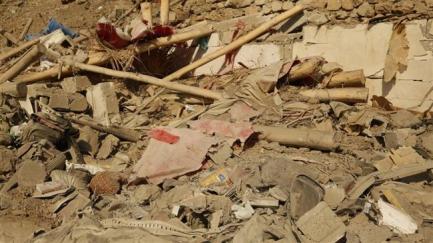
Aftermath of a Turkish airstrike against Zergele village in Iraq’s semi-autonomous Kurdistan region on August 1, 2015. (© Firat news agency)
On August 6, Selahattin Demirtas, the HDP’s co-chair, called on the international community to censure Ankara’s new “unjust war” on Kurds, accusing the government of President Recep Tayyip Erdogan of using the so-called anti-ISIL fight as a cover to pursue its main goal of targeting the PKK and undermining the HDP.
Turkey recently launched airstrikes against purported ISIL targets in Syria as well as PKK positions in Iraq, after a deadly bomb attack attributed to ISIL Takfiris left 32 people dead in the southeastern Turkish town of Suruc, across the border from the northern Syrian town of Kobani.
A shaky ceasefire that had stood since 2013 was declared as null by PKK following the Turkish airstrikes against the group, narrowing chances of the two sides reaching a deal in the near future.
The PKK had been fighting for an autonomous Kurdish region inside Turkey since the 1980s. The conflict has left tens of thousands of people dead.
Jeremy Corbyn calls for UK nuclear disarmament on Hiroshima 70th anniversary

Hiroshima aftermath © U.S. Navy Public Affairs Resources Website / Wikipedia
RT | August 6, 2015
Labour Party leadership frontrunner Jeremy Corbyn has called for Britain’s complete nuclear disarmament at an event commemorating 70 years since the US dropped an atom bomb on the Japanese city of Hiroshima.
Speaking on Thursday at the Campaign for Nuclear Disarmament (CND) commemoration event in London, the anti-austerity candidate said that if he became prime minister he would not renew Trident, Britain’s nuclear deterrent.
Unveiling his Plan for Nuclear Disarmament, Corbyn said he would move away from a nuclear weapons based arsenal.
In the document, Corbyn lays out a strategy to protect the jobs of people currently working on Trident by investing in infrastructure projects and “socially productive” initiatives.
“We are making the case for a defense diversification agency because we have a moral duty, and strategic defense and international commitments, to make Britain and the world a safer place,” the document reads.
“As a signatory to the nuclear non-proliferation treaty, Britain should therefore give a lead in discharging its obligations by not seeking a replacement for Trident, as we are committed to accelerate concrete progress towards nuclear disarmament.
“Senior military figures have described our existing nuclear weapons as ‘militarily useless’ and our possession of them encourages other countries to seek a similar arsenal while undermining the efforts being made to advance the cause of international nuclear disarmament,” it adds.
The Green Party’s Lady Jones also attended the memorial event.
She said: “It is amazing that we haven’t learned more from the nuclear bombing of Japan, that nuclear weapons are indiscriminate, their impact incalculable and their cost insupportable.
“Britain should accept that such weapons are impossible to use with any guarantee of safety and we should scrap plans for renewing the Trident nuclear defense system, freeing up £100b billion to spend on our national wellbeing.”
Currently the UK has committed to the maintenance of four submarines, each equipped with Trident II D-5 nuclear missiles. Parliament will vote on their renewal in 2016.
Corbyn’s call for nuclear disarmament comes after he said Tony Blair could stand trial for war crimes if he is deemed to have broken international law during the 2003 invasion of Iraq.
Speaking to BBC Newsnight, the prominent anti-war campaigner said Blair should stand trial “if he has committed a war crime, yes. Everybody who has committed a war crime should.”
He added the former Labour prime minister, who orchestrated the invasion with then-US President George W. Bush, should “confess” to any plans he made with the former president. The publication of the Chilcot Inquiry report would force Blair’s hand, he said.
Corbyn, who staunchly opposed the invasion and is a leading member of the Stop the War coalition, said: “It was an illegal war. I am confident about that. Indeed Kofi Annan [UN secretary general at the time of the war] confirmed it was an illegal war and therefore [Tony Blair] has to explain that. Is he going to be tried for it? I don’t know. Could he be tried for it? Possibly.”
4 killed, dozens injured as Israeli ordnance explodes in Gaza
Ma’an – August 6, 2015
GAZA CITY – At least four Palestinians were killed on Thursday and over 30 injured when an unexploded ordnance from last summer’s Israeli military offensive went off while clearing rubble from a destroyed house in the southern Gaza Strip, medics said.
Palestinian medical sources at the Abu Yousif al-Najjar hospital in Rafah said four bodies and multiple wounded Palestinians arrived at the emergency room.
The victims, who were all from the same family, were identified as Bakr Hasan Abu Naqira, Abdul-Rahman Abu Naqira, Ahmad Hasan Abu Naqira, and Hassan Ahmad Abu Naqira.
Medics said it is likely that the death toll will increase.
Over 7,000 unexploded ordnance were left throughout the Gaza Strip following last summer’s war between Israel and Palestinian militant groups, according to officials of the UN Humanitarian Coordinator for the Palestinian territories (OCHA).
Even before the most recent Israeli assault, unexploded ordnance from the 2008-9 and 2012 offensives was a major threat to Gazans.
A 2012 report published by the Office of the High Commissioner for Human Rights said that 111 civilians, 64 of whom were children, were casualties to unexploded ordnance between 2009 and 2012, reaching an average of four every month in 2012.
Sad Nuclear Anniversary
By Brian CLOUGHLEY | Strategic Culture Foundation | August 6, 2015
On 1 September 1939 – the date of the beginning of the Second World War – the President of the United States of America, Franklin D. Roosevelt, wrote to «the Governments of France, Germany, Italy, Poland and His Britannic Majesty» saying that «The ruthless bombing from the air of civilians in unfortified centres of population during the course of the hostilities which have raged in various quarters of the earth during the past few years, which has resulted in the maiming and in the death of thousands of defenceless men, women, and children, has sickened the hearts of every civilized man and woman, and has profoundly shocked the conscience of humanity».
He was rightly appalled about the aerial slaughter of civilians and desired each country to which he addressed his appeal «to affirm its determination that its armed forces shall in no event, and under no circumstances, undertake the bombardment from the air of civilian populations or of unfortified cities, upon the understanding that these same rules of warfare will be scrupulously observed by all of their opponents».
We are now marking the seventieth anniversary of the explosion of the atomic bombs that destroyed the Japanese cities of Hiroshima on 6 August 1945 and Nagasaki three days later, killing a total of over 100,000 «defenceless men, women, and children,» prompting the nuclear scientist Robert Oppenheimer to quote from the Bhagavad Gita, the Hindu religious and philosophical text, that «Now I am become Death, the destroyer of worlds».
Development of the atomic bomb began in 1939 but went into high gear as the Manhattan Project three years later. What is intriguing is that President Roosevelt approved the programme on 9 October 1941, a full two months before the Japanese attacked America at Pearl Harbor killing 2,403 people — including civilians. The subsequent declaration of war by the US resulted in concentration on means of war-winning by any means, and resulted in development of the ultimate weapon.
Even before the atomic explosions it was apparent that the major nations involved in the Second World War had no qualms about inflicting devastation. The British considered that their «aim is, therefore, twofold: namely, to produce (i) destruction, and (ii) the fear of death» and to that end mercilessly bombed German cities. The rationale was that it was the Germans who started it and who in 1940-41 subjected London to a non-stop 60 days and nights of aerial bombardment that killed 30,000 people.
In a macabre game of explosive ping-pong the countries at war sought more and deadlier ways to wreak havoc on their opponents, and it would have been difficult to have found a citizen of any of these countries who would have failed to agree with the actions of their government. It was thus that Project Manhattan received its massive impetus, and in an amazing display of technical prowess and organisational proficiency its scientists designed and produced the Atom Bomb.
It was astonishing that President Roosevelt had not told his Vice-President, Harry Truman, one single thing about the bomb project which some well-informed people believed was a potentially catastrophic venture. The first bomb was tested on 16 July 1945 at Alamogordo in New Mexico and caused concern among the scientists who had been involved in its development, 70 of whom sent a letter to President Roosevelt pointing out that use of the atomic bomb would likely presage «an era of devastation on an unimaginable scale» and that «a nation which sets the precedent of using these newly liberated forces of nature for purposes of destruction may have to bear the responsibility of opening the door to an era of devastation on an unimaginable scale».
 Their letter wasn’t allowed to reach the President. He never knew of its existence, but in any event was convinced that the A-bomb was essential and had written to Oppenheimer, who had grave doubts about the military’s attitude to nuclear developments, that «whatever the enemy may be planning, American science will be equal to the challenge». The Bomb was going to be used, no matter the consequences, although the president who gave the order to drop the bombs in August 1945 was Harry Truman, who learned of the project’s existence on 13 April 1945, the day after Roosevelt died.
As recorded by Eric Schlosser in his edifying book Command and Control, there had been air attacks on Japan of staggering intensity in the months before the atom bombs were employed. On the night of 9 March 1945, for example, «American planes struck Tokyo with 2,000 tons of bombs containing napalm and jellied gasoline… Within hours the firestorm consumed one quarter of the city. It killed about 100,000 civilians… «Worse was yet to come because Truman icily warned that the Japanese «may expect a rain of ruin from the air, the like of which has never been seen on this earth».
There were not many large concentrations of Japanese that had not been subjected to firebombing, and choosing the ultimate victims was not easy. Kyoto was removed from the list of four targets because the Secretary of War, Henry Stimson, pointed out that it was a major cultural centre of great importance to Japanese art and history — and Nagasaki was chosen instead. By such decisions are the fates of human beings decided. Countless thousands of Kyoto citizens were spared, but 39,000 in Nagasaki were condemned to death.
First came Hiroshima, where on 6 August «a firestorm engulfed the city» and 66,000 people were killed. Next on the target list was Kokura, and in yet another horrible twist of fate the city was covered in smoke and haze and the plane was diverted to Nagasaki where the second bomb, hideously named Fat Man, was dropped on 9 August.
The war against Japan then ended, but it should be remembered that between the destruction of the two cities there was a Charter was being approved, on 8 August in the German city of Nuremburg, signed by the victorious allies, that included guidelines for the forthcoming trial of German war criminals by the International Military Tribunal. In an alarming example of double standards, the judges were informed that «The following acts, or any of them, are crimes coming within the jurisdiction of the Tribunal for which there shall be individual responsibility… (b) War Crimes: namely, violations of the laws or customs of war. Such violations shall include… wanton destruction of cities, towns, or villages». It did not include the words of President Roosevelt, that it was sickening to «undertake the bombardment from the air of civilian populations or of unfortified cities,» but made it clear that such attacks were against the laws of war.
The Nuremburg Charter guided the conviction of German war criminals, and it is hideous coincidence that it was signed at the very time when «Death, the destroyer of worlds» was thundering down on Japan in what Truman called «a rain of ruin from the air».
Which goes to show that justice is reserved for those who win wars.
Really, Sad Nuclear Anniversary.
Brian Cloughley writes about foreign policy and military affairs. He lives in Voutenay sur Cure, France.
Gaza: Our Child’s Shattered Face in the Mirror
By Gary Corseri | CounterPunch | August 4, 2015
 When I received a copy of Gaza Unsilenced in the mail, about a week ago, the first thing that struck me was the amazing cover photo. Now, I think I’m as wary of judging a book by its cover as the next reader/reviewer; and I read through the entire book before ever thinking of starting a review in this way. Does the book justify this sort of cover? Most assuredly it does!
The face on the cover is that of a girl—somewhere between 10 and 13, I’d guess. She has a marred, but beautiful face, striking dark eyes, and she almost seems to be smiling, acknowledging, at once, the onlooker, the photographer, and her own resilience, her capacity to survive. It is a haunting picture because her face is pockmarked by shrapnel in dozens of places—perhaps caused by the illegal “flechette” dart-bombs used unsparingly in “Protective Edge”; or glass fragments, or chips of concrete?
The book tells a story that is almost impossible to tell: the victims’ view of the 51-day, 2014 War on Gaza, euphemistically called, “Operation Protective Edge” by Israel. One element that disturbed me at first, but which I came to appreciate, is the way the narative gyrates chronologically. Sometimes, we are at the beginning of the war, a few pages more and, with another narrator, we are surveying the rubble at the end of the war; a few more pages, and we’re back in the middle of the unfolding horrors.
And why wouldn’t this be the best way to render the way war shatters everything—even our sense of time? Here, this structure seemed especially appropriate; for, in reality, “Operation Protective Edge” was just the latest outburst of a war that began in 1948 with the “Nakba” (Catastrophe), with Israeli massacres in Palestinian villages like Deir Yassin, leading to the expulsion of hundreds of thousands of Palestinians from their homes, their native land. As awful as things have been in the West Bank and other parts of Palestine, the situation has been most dire in Gaza—a strip of land about the size of Atlanta, Georgia, hugging the Mediterranean, with about 1.8 million people (Atlanta has about ½ million) who have been “under siege” for more than 8 years in a Sartre-like hell with “No Exit,” surrounded by impassable “buffer zones,” with 60% unemployment rates, a frazzled infrastructure, bombed-out hospitals and schools, and half the population children and/or students!
More than 2200 Palestinians were killed during the 51 days of bombardment and invasion. About 70 percent of those who died were unarmed, undefended civilians—mostly women and children.
This is an anthology unlike any I’ve read. An English major, I’ve read my share of literary anthologies; a professional-and-citizen-journalist, I’ve read and learned from collections of work by master-journalists and social and political commentators. The power of Gaza Unsilenced is that it is a symbiosis: “you-are-there” journalism (including “blogger” twitter notes), combined with piercingly beautiful, unforgettable, cherishable essays, poems and photos. (One of Yeats’ phrases ran through my mind as I read the book: “A terrible beauty is born.”)
Other words, phrases, ideas were reiterated: “resilience”; “complicity”; “betrayal”; “human shields”; “de-humanization.”
Several of the authors wrote about the resilience of these Gazans who have endured so much, but re-plant themselves, as they re-plant their olive trees in the dry soil. Resilience is undeniable, but two words they eschew are “heroism” and “victimhood.” They do not want to be depicted as “heroes” or as “victims” by a global media infected with reductionism, always reaching for the simplistic explanation. Certainly, there were many heroes among the dead and wounded—those who risked their lives and gave their lives to save and help others. The victimization will continue for lifetimes. One American doctor who visited Gaza some months after the last bombs fell and the last bullets were fired, described the people as living—not with PTSD, but with “continuous, traumatic, stress disorder.”
Editor/writer/educator Refaat Alareer writes unforgettably about the death of his brother, Mohammad, and how his brother’s 4-year old daughter has been so unnerved by her father’s failure to keep his promise to return to her, she has retreated into a fantasy world—talking to herself, imagining her father giving her presents.
There is that kind of pity-evoking work here, and it may be cathartic for thoughtful, sensitive readers to read it, animating them to learn more about this ongoing crisis. Several of the authors stress that, while Gaza, and Palestine in general, constitute humanitarian crises, we must understand the “deep roots,” the “political” nature of this conflict, of this imbroglio—if we are ever to untangle it.
“Betrayals” have occurred on many fronts, and there has been the “complicity” of the global mainstream media, and the political hacks in Israel, the United States, Europe, and in Arab states like Sisi’s Egypt as well, and even with the West Bank’s Palestine Authority where the default position is, invariably, to blame those who resist the Occupation, and the depredations of war: physical and psychological destruction.
Editors Alareer and Laila El-Haddad have done a masterful job compiling this book. “What else can we do?” the survivors of the onslaughts wonder when journalists and human-rights advocates inquire how they manage to continue, to rebuild. They are rooted to their land, like their olive trees, planted and re-planted for thousands of years.
But, considering these stories, these flashes of insight, these twittering reflections, superlative essays, poems, articles and photos…, and considering that shrapnel-pock-marked face of the child in the mirror we gaze at on the front of this book, we also wonder, “What else can we do?”
How much time we spend dehumanizing the Other! And we go to war, and pay our taxes like good, little citizens, so that those who pander in lies and delusions can advance themselves, gain power and privilege in their narrowly-scoped worlds, shutting us and the Other out!
Is there a way to “re-humanize,” editor Laila El-Haddad wonders in her final essay. “There are no easy answers, but the quest begins by asking the right questions and knowing where to look…. We hope to have provided you a starting point in this book.”
El-Haddad and Alareer, and the mighty contributors here, have provided truth-seekers and truth-tellers with much more than a starting point. They have provided us with a mirror of our shattered human family.
More proof that Western bombing in Syria and Iraq is massacring civilians

A US-led air strike in October 2014 in Kobani, Syria
Stop the War Coalition | August 4, 2015
The bombing campaign against the Islamic State in Iraq and Syria has killed at least 459 civilians, including 100 children, in 52 air strikes, according to a new report by Airwars, a project by a group of independent journalists.
Commenting on the supposed precision of air strikes against Isis, the Airwars project leader Chris Woods has told the Guardian that this “hasn’t been borne out by facts on the ground”.
This is one of the first reports examining the number of civilian casualties which have resulted from the savage bombing campaign against Isis militants. The lack of official interest in and support for investigating these casualties means that their number may actually be far higher. The violence on the ground also greatly impedes the verification of casualties.
It took years before the full scale of mass murder in the Second Iraq War came to light. A recent study by Physicians for Social Responsibility, Physicians for Global Survival and International Physicians for the Prevention of Nuclear War has established that around a million people have died as a result of that war.
The UK is the second-most active participant in the bombing campaign against Isis. The British government’s claims about its commitment to avoiding civilian casualties are negated by facts.
Chris Woods from Airwars has stated that bombing Isis fighters in their strongholds means that the focus is on bombing cities. 40% of civilian casualty reports came from the city of Mosul in Iraq. “You can’t have an air war of this intensity without civilians getting killed or injured,” said Woods.
Western intervention in Iraq and Syria is adding fuel on the fire of a savage war. As the experience of more than a decade of terroristic “war on terror” shows us, Western intervention contributes to a vicious cycle of brutalising violence. It increases suffering and is a major cause of bitterness against the West.
This underscores the need to oppose resolutely the proposed full-scale UK military intervention in Syria, which will lead to more of the same: more misery, more hatred, more death and more destruction. Humanity can be more creative than that.
Featured Video

Why Hamas Really Attacked Israel on Oct. 7
or go to
Aletho News Archives – Video-Images
From the Archives
Confronting the Threat of Ethnic Bioweapons
By Tony Cartalucci – New Eastern Outlook – 29.11.2017
The United States Air Force’s 59th Medical Wing’s molecular biology branch recently was revealed to have been collecting specifically Russian RNA and synovial (connective) tissue samples, prompting fears in Russia of a possible US directed ethnic-specific bioweapons program. … continue
Blog Roll
 Aletho News
- Sally Rooney’s books pulled from UK over support for Palestine Action
- Bombs for Tel Aviv, Promises for Riyadh
- Israeli ad agency conducted vast global espionage campaign using online ads: Report
- Oct. 7 Forever Marks The Big Reveal: ‘We See You, Israel, We Revile You, We Reject You!’
- Meet the US generals and admirals advancing Israeli policy
- Israel’s Straw Widow Protocol: The Kill Zones Where Civilians Were Labelled ‘Terrorists’
- Leading Israeli Think Tank Publishes Psychotic Israeli ‘National Security’ Doctrine
- Are the United States and Israel in Decline-and-Fall Mode?
- Why Hamas Really Attacked Israel on Oct. 7
- Declassified UK exposes British man who fought for ‘Israel’ in Gaza
- If Americans Knew
- No, the world zionist movement is not an antisemitic conspiracy theory
- Hundreds of IDF investigations into killings still have no public outcome, BBC Verify finds
- After Ashley Moody Epstein Probe, Donors Linked to Him Poured Money Into her Senate Campaign
- Worried about Russian meddling in UK politics? Wait till you see what Israel is up to
- Israeli settlers attack West Bank center for disabled children, church leader calls for int’l action
- Pulling Out Teeth Just to Live: How Israel Has Devastated Dental Care in Gaza
- Gaza’s “ceasefire” death toll passes 1,500 – Daily Update
- Activists Abused By Israel Return to New Freedom Flotilla Mission
- 60 Minutes won’t tell the full truth about Israeli settler violence
- Nearly 50,000 women, girls killed or severely injured in Gaza since October 2023: UN Women
- No Tricks Zone
- New Study Suggests Large Regions Of The Pacific Ocean Have Been Cooling For The Last 80 Years
- Germany’s Green Energy Debacle: High Energy Costs Force Kahla Porzellan to Close After 182 Years!
- New Study: 50 Years Of The Most Aggressive ‘Net Zero’ Policies Can Only Affect The Global Climate By 0.03°C
- US September “Heat” Was No Record…Many Records Set Decades Ago
- Latest European Green Energy Debacle; Portugal’s Largest Flagship Solar Park Insolvent!
- Green Energy Debacle: German Expert Professor Fritz Vahrenholt Warns Of Severe Economic And Social Consequences
- Two More Paleo Reconstructions Affirm Meters-Higher Sea Levels Across Ireland, Brazil 7000-6000 Years Ago
- New Study: Earth And Venus Surface Warmth Largely Explained By Convection And Lapse Rate, Not CO2 Or Radiation
- 2025 Nature Paper Claiming Worsening Global Drought Gets RETRACTED …Heavily Flawed
- New Study: ‘Global Drought Shows No Detectable Recent Acceleration Under Climate Warming’

