Nasrallah: The Rules of Engagement with Israel Are Over
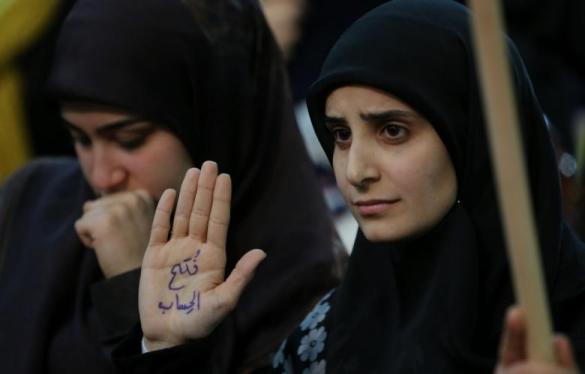
A Hezbollah supporter with the words “time for retribution” written on her hand attends a memorial ceremony to honor six Hezbollah fighters killed in Syria by an Israeli airstrike, during which Hezbollah Secretary-General Hassan Nasrallah made a televised speech. Al-Akhbar/Marwan Tahtah
Al-Akhbar | January 30, 2015
“Don’t try us,” Hezbollah Secretary-General Hassan Nasrallah told Israel in a televised speech Friday broadcast during a memorial ceremony to honor the six Hezbollah fighters and the Iranian general killed in an Israeli airstrike in Syria earlier this month.
On January 18, an Israeli helicopter airstrike on the Syrian city of Quneitra near the Israeli-occupied Golan Heights killed six fighters of Lebanon’s resistance movement Hezbollah, including a commander, Mohammed Abu Issa, and the son of assassinated senior commander Imad Mughniyeh, as well as Iranian Revolutionary Guard General Mohammed Ali Allahdadi.
Hezbollah has been fighting alongside President Bashar al-Assad in Syria against rebels in the nearly four-year Syrian conflict.
According to Nasrallah, who spoke for an hour and a half, Israel had “planned, calculated and took a premeditated decision to assassinate” the fighters, saying that the motive behind the attack was crystal clear.
Hezbollah’s chief said that while Israel isn’t worried about thousands of armed militants from the al-Nusra Front — al-Qaeda’s branch in Syria — near territories it occupies, the Zionist state “was scared on January 18 of six unarmed Hezbollah fighters and an Iranian in civilian vehicles.”
Observers from the United Nations Disengagement Observer Force (UNDOF) confirmed in a report published in December documenting cooperation and coordination between the Israeli army and militant groups in Syria.
The UNDOF report said that observers witnessed several meetings between rebel leaders and Israeli army forces between December 2013 and March 2014, in addition to witnessing the transportation of injured militants to Israeli hospitals following confrontations between the militants and the Syrian army near the occupied Golan border.
Nasrallah said that those killed in the Quneitra attack showed a “fusion of Lebanese-Iranian blood on Syrian soil, and reflects the unity of the cause and the unity of the fate of the countries in the axis of resistance.”
“When the blood of Palestinians, Lebanese, Syrians and Iranians unites, we will enter an era of triumph,” he added.
The deaths of Allahdadi and Issa revealed that commanders were present on the ground alongside fighters, Nasrallah said, adding that Jihad Mughniyeh’s death showed how entire families and not just individual members were joining the resistance.
Nasrallah extended his condolences to the families of the Hezbollah fighters as well as the families of the eight Lebanese soldiers who were killed last week in clashes with al-Nusra Front militants in the area of Tallet al-Hamra near Ras Baalbek on the Lebanese-Syrian border.
Nasrallah’s remarks came two days after Hezbollah claimed responsibility for an attack against an Israel Occupation Forces (IOF) convoy in Israeli-occupied Lebanese Shebaa Farms that left a number of Israeli soldiers dead.
According to Israeli figures, two soldiers were killed and seven others were wounded, although Hezbollah-owned Al-Manar news channel said the toll was much higher.
“They killed us in broad daylight, we kill them in broad daylight … they struck two of our vehicles, we targeted two of their vehicles,” Nasrallah said, likening the Quneitra strike to the one by Hezbollah in Shebaa.
“The only difference is that we announced that Israel struck our fighters in Quneitra half an hour after the attack, whereas the Israelis didn’t,” Nasrallah continued, adding that the number of casualties on the Israeli side was “debatable.”
The Shebaa Farms area is a mountainous, narrow sliver of land rich in water resources measuring 25 square kilometers (10 square miles). It has been illegally occupied by Israel since the 1967 Middle East war, although Lebanon has never ceased to call for its restitution.
Israel occupied most of southern Lebanon for 22 years until 2000 and the two countries are still technically at war.
“The Israelis can’t kill our people and then go to sleep … their farmers can’t stay in their fields and their soldiers can’t stroll up and down the border as if they merely killed mosquitoes,” Nasrallah said, asserting that the Zionist state would pay a price for all of its criminal actions even if that meant going to war with Israel.
“We don’t want war but we are not afraid of going to war,” Nasrallah assured. “I think the Shebaa attack was a clear message … Israel was humiliated on Wednesday.”
Nasrallah said Hezbollah would retaliate against any future Israeli attacks on its members “whenever, however and wherever,” adding that the Hezbollah “no longer cares about the rules of engagement anymore.”
“Don’t try us,” Nasrallah defiantly said to Israel.
Since the January 18 airstrike, troops and civilians in northern Israeli-occupied territories of Palestine and the occupied Golan Heights have been on heightened alert and Israel has deployed an Iron Dome rocket interceptor unit near the Syrian border.
“Israelis have been on edge ever since they targeted our fighters in Quneitra,” Nasrallah stated.
Following Wednesday’s attack, Israeli forces hit several Lebanese villages along the border, killing a 36-year-old UN peacekeeper.
Israeli warplanes routinely violate Lebanon’s airspace and have launched several attacks against Syrian targets in recent months, some reportedly carried out from over Lebanon.
On Thursday, Lebanon’s National News Agency (NNA), said Israeli fighter jets penetrated deep into Lebanese airspace, startling residents as the jets flew over the capital Beirut. Israeli jets were also seen flying over southern Lebanese towns.
Nasrallah said Israel has violated Lebanese’ sovereignty and the 1701 UN resolution “thousands of times” and “on daily basis.”
Moreover, Nasrallah slammed the Arab League as “nonexistent” when it came to fighting Israel and supporting Palestinians, saying the 22-member league has served Israel more than the Palestinians. He gave the 51-day Israeli summer assault on Gaza that left 2,300 Palestinians dead as an example of the Arab League’s failure.
Israeli army spokesman Lieutenant Colonel Peter Lerner said Wednesday’s attack was the “most severe” Israel had faced since 2006, when its war with Hezbollah killed more than 1,200 people in Lebanon, mostly civilians, and some 160 Israelis, mostly soldiers.
Professor Salaita Sues University of Illinois For Free Speech Rights
By Deirdre Fulton | Common Dreams | January 29, 2015
Professor Steven Salaita, a Palestinian-American professor of Indigenous studies whose offer of a tenured position at the University of Illinois at Urbana–Champaign was rescinded last year because of his tweets criticizing the Israeli government’s bombing of Gaza, has filed a civil rights suit against the school and its top officials and donors, saying that his termination violated his First Amendment right to free speech and other constitutional rights, as well as basic principles of academic freedom.
“Like any American citizen, I have the right to express my opinion on pressing human rights concerns, including Israeli government actions, without fear of censorship or punishment,” Salaita said in a statement. “The University’s actions have cost me the pinnacle of academic achievement—a tenured professorship, with the opportunity to write and think freely. What makes this worse is that in my case the University abandoned fundamental principles of academic freedom and shared governance, crucial to fostering critical thought, that should be at the core of the university mission.”
Salaita, who is being represented by the Center for Constitutional Rights along with the Chicago civil rights law firm of Loevy & Loevy, filed the lawsuit Thursday in a U.S. federal court in Chicago.
The complaint (pdf) alleges that university officials, including the chancellor and university trustees, violated Salaita’s constitutional rights to free speech and due process of law, and breached an employment contract with him. According to CCR, the suit is also against university donors who, based on emails made public, unlawfully threatened future donations to the university if it did not fire Salaita on account of his political views.
As Common Dreams reported in September, Salaita had been awarded the tenured position in fall 2013 and was scheduled to begin on August 16, 2014—just two weeks after Chancellor Phyllis Wise rescinded the offer. University documents released in response to a public-records request revealed that Wise had been pressured by numerous pro-Israel students, parents, alumni, and big-money donors to abort his appointment. These demands followed critical comments by Salaita regarding Israel’s most recent attack on Gaza, during which thousands of Palestinians, including hundreds of children, were killed.
The university’s action, which Wise explained was taken because Salaita’s speech lacked “civility,” spurred protests from within the university as well as the academic community at-large. Sixteen academic departments of the university have voted no confidence in the university administration, and prominent academic organizations, including the American Association of University Professors, the Modern Language Association, and the Society of American Law Teachers have publicly condemned the university’s actions.
“The use of ‘civility’ as cover for violating Professor Salaita’s rights must be challenged, as it threatens the very notion of a University as a place for free inquiry and open debate,” said Maria LaHood, a senior attorney with the Center for Constitutional Rights. “There is neither a ‘civility’ exception nor a ‘Palestine’ exception to the First Amendment.”
According to CCR, the lawsuit seeks Salaita’s reinstatement and monetary relief that includes compensation for the economic hardship and reputational damage he suffered as a result of the university’s actions.
“Only donor pressure, or sheer pride, can explain the administration’s stubborn refusal to revisit a decision that has done so much harm to Dr. Salaita and to constitutional and other principles that academics hold dear,” said Anand Swaminathan of Loevy & Loevy. “The administration has something to hide, and through this lawsuit we intend to expose it.”
Fiji compensates victims of 1950s UK nuclear tests
RT | January 30, 2015
Fiji’s prime minister said his island nation would compensate soldiers exposed to radiation during British nuclear tests in the Pacific more than 56 years ago.
The British government has refused to pay any compensation, but Prime Minister Voreqe Bainimarama said Fiji could wait no longer.
“We are righting a wrong. We are closing an unfortunate chapter in our history,” Bainimarama said at a ceremony recognizing the suffering of the veterans.
“We are bringing justice to a brave and proud group of Fijians to whom a great injustice was done.
“Fiji is not prepared to wait for Britain to do the right thing. We owe it to these men to help them now, not wait for the British politicians and bureaucrats.”
Veterans and their families have campaigned for decades to get payouts for their health problems. More than 70 Fijians were stationed on Kiritimati, then known as Christmas Island, during the 1957 and 1958 nuclear tests during the Cold War.
As a result, they suffered serious health problems, including leukemia and other blood disorders, due to the radiation they were exposed to.
The 24 survivors who attended the ceremony each received Fiji$9,855 (£3,181) from a compensation pool of Fiji$2.95 million (£950,000).
“We were only told that we will go there to test some weapons, but when we got there we found out that we were brought there to be part of the British test of weapons of mass destruction,” survivor Naibuka Naicegulevu, 76, whose job was to clean and repair vehicles on the island, told AFP.
“My two sons, now in their early 30s, get sick suddenly and they can be ill for one week, sometimes more, this is all because of the radiation that we were exposed to,” he added.
Bainimarama said Fiji, which was a Crown colony until 1970, could no longer afford to wait for Britain to take the lead on compensation.
“The ranks of these survivors are rapidly thinning. Too many men – our fellow Fijians – have gone to their graves without justice. Those who remain deserve justice and Fiji as a nation is determined for them to finally get it,” he said.
The American Sniper Was No Hero
By Sleldon Richman | FFF | January 28, 2015
Despite what some people think, hero is not a synonym for competent government-hired killer.
If Clint Eastwood’s record-breaking movie, American Sniper, launches a frank public conversation about war and heroism, the great director will have performed a badly needed service for the country and the world.
This is neither a movie review nor a review of the late Chris Kyle’s autobiographical book on which the movie is based. My interest is in the popular evaluation of Kyle, America’s most prolific sniper, a title he earned through four tours in Iraq.
Let’s recall some facts, which perhaps Eastwood thought were too obvious to need mention: Kyle was part of an invasion force: Americans went to Iraq. Iraq did not invade America or attack Americans. Dictator Saddam Hussein never even threatened to attack Americans. Contrary to what the George W. Bush administration suggested, Iraq had nothing to do with the attacks on Sept. 11, 2001. Before Americans invaded Iraq, al-Qaeda was not there. Nor was it in Syria, Yemen, and Libya.
The only reason Kyle went to Iraq was that Bush/Cheney & Co. launched a war of aggression against the Iraqi people. Wars of aggression, let’s remember, are illegal under international law. Nazis were executed at Nuremberg for waging wars of aggression.
With this perspective, we can ask if Kyle was a hero.
Defenders of Kyle and the Bush foreign policy will say, “Of course, he was a hero. He saved American lives.”
What American lives? The lives of American military personnel who invaded other people’s country, one that was no threat to them or their fellow Americans back home. If an invader kills someone who is trying to resist the invasion, that does not count as heroic self-defense. The invader is the aggressor. The “invadee” is the defender. If anyone’s a hero, it’s the latter.
In his book Kyle wrote he was fighting “savage, despicable evil” — and having “fun” doing it. Why did he think that about the Iraqis? Because Iraqi men — and women; his first kill was a woman — resisted the invasion and occupation he took part in.
That makes no sense. As I’ve established, resisting an invasion and occupation — yes, even when Arabs are resisting Americans — is simply not evil. If America had been invaded by Iraq (one with a powerful military, that is) would Iraqi snipers picking off American resisters be considered heroes by all those people who idolize Kyle? I don’t think so, and I don’t believe Americans would think so either. Rather, American resisters would be the heroes.
Eastwood’s movie also features an Iraqi sniper. Why isn’t he regarded as a hero for resisting an invasion of his homeland, like the Americans in my hypothetical example? (Eastwood should make a movie about the invasion from the Iraqis’ point of view, just as he made a movie about Iwo Jima from the Japanese point of view to go with his earlier movie from the American side.)
No matter how often Kyle and his admirers referred to Iraqis as “the enemy,” the basic facts did not change. They were “the enemy” — that is, they meant to do harm to Americans — only because American forces waged an unprovoked war against them. Kyle, like other Americans, never had to fear that an Iraqi sniper would kill him at home in the United States. He made the Iraqis his enemy by entering their country uninvited, armed with a sniper’s rifle. No Iraqi asked to be killed by Kyle, but it sure looks as though Kyle was asking to be killed by an Iraqi. (Instead, another American vet did the job.)
Of course, Kyle’s admirers would disagree with this analysis. Jeanine Pirro, a Fox News commentator, said, “Chris Kyle was clear as to who the enemy was. They were the ones his government sent him to kill.”
Appalling! Kyle was a hero because he eagerly and expertly killed whomever the government told him to kill? Conservatives, supposed advocates of limited government, sure have an odd notion of heroism.
Excuse me, but I have trouble seeing an essential difference between what Kyle did in Iraq and what Adam Lanza did at Sandy Hook Elementary School. It certainly was not heroism.
US government lawyers told Gitmo authorities that force feeding is ‘never acceptable’ under medical ethical standards
Reprieve | January 29, 2015
US government lawyers advised Guantanamo authorities that force-feeding is ‘never acceptable’ under medical ethical standards, at the same time as dozens of military nurses were being sent to the prison to force-feed detainees, it has been revealed.
An internal memo, obtained by Vice News through FOIA and written on June 21st, 2013 – at the height of the prison’s mass hunger-strike – states that ‘international law and certain medical ethical standards hold that the “forced feeding” of a mentally competent person capable of making an informed decision is never acceptable.’
This previously-secret legal advice proves that the Department of Defense knew it was placing military nurses and doctors at risk of professional sanction by conscripting them into an unethical medical procedure.
The advice appears to have been drafted in the same period that dozens of fresh military medics were rushed to Guantánamo in response to the prison’s escalating hunger strike. At that time, prisoners reported that the new personnel exhibited considerable stress because they were participating, for the first time in their careers, in a forcible medical procedure. Former detainee Ahmed Belbacha recounted to lawyers at Reprieve, for example, that “Some of the newer medical staff they sent down… are afraid during feeding and it shows… when one of the new nurses, she was perhaps 40, started to feed me, I saw that her hands were shaking. I asked whether it was her first time ever to force feed someone. ‘Yes it is,’ she responded.”
It is unclear whether Guantánamo ever permits medical staff who have ethical qualms about force-feeding not to participate. One former head of nursing at the prison, Commander Jane French, had previously indicated that medical personnel who objected to force-feeding would be excused without sanction. Yet the Department of Defense is currently weighing disciplinary proceedings against one military nurse who refused to participate in force-feeding on ethical grounds.
Last year, hunger striker Abu Wa’el Dhiab – who has since been released from Guantanamo – revealed to his lawyers at Reprieve that a nurse, witnessing the suffering force-feeding caused detainees, determined he could no longer force-feed, saying “I have come to the decision that I refuse to participate in this criminal act.” The nurse, who has served 18 years in the military and is two years away from retirement, now faces the risk of being forced out of the armed services and forfeiting his pension and potentially his veterans’ benefits.
Cori Crider, a director at Reprieve and counsel to a number of detainees who are force-fed, said: “It’s disturbing to see that the Defense Department knew full well it was exposing its young nurses and doctors to a risk of professional censure and chose to plough ahead with abusive force-feeding anyway. Now the DOD has elected to stamp on the one nurse we know of who consulted his conscience and came to the right conclusion – that force-feeding, especially in the way it is done at Gitmo today, is just wrong. Our military medics shouldn’t be punished for exercising their professional judgment; that is their role, even when they wear a uniform. The DOD needs to drop its misguided effort to ‘make an example’ of this nurse. And the simplest way to keep these nurses out of harm’s way is for President Obama to end the conundrum and shut the prison.”
Spain Blames ’Israel’ for Peacekeeper’s Death
Al-Manar | January 29, 2015
Spain has held the Tel Aviv regime accountable for the death of a Spanish peacekeeper serving with the United Nations Interim Force in Lebanon (UNIFIL) during an exchange of fire between Israeli forces and fighters from Lebanon’s Hezbollah resistance movement.
“It was because of this escalation of violence, and it came from the Israeli side,” Spanish Ambassador Roman Oyarzun Marchesi told reporters in New York on Wednesday.
Marchesi further noted that his country demands full investigation into the killing.
The Spanish defense ministry said in a statement that 36-year-old Corporal Francisco Javier Soria Toledo “died this [Wednesday] morning during incidents between Hezbollah and the Israeli army in the area of responsibility of the Spanish contingent.”
Spain’s Prime Minister Mariano Rajoy expressed on Twitter his “great sadness at the death of a Spanish soldier in Lebanon.”
The Security Council also condemned the peacekeeper’s death in its strongest terms, and extended its sincere sympathies.
See also :
Israel blames Hezbollah for Spanish peacekeeper’s death on Lebanese border
RT | January 28, 2015
Israeli Foreign Minister Avigdor Lieberman has blamed Hezbollah for the death of a Spanish UN peacekeeper killed in retaliatory Israeli mortar fire in southern Lebanon on Wednesday.
After a series of cross-border strikes that left two IDF soldiers and a Spanish peacekeeper from the UN Interim Force in Lebanon (UNIFIL) dead on Wednesday, Lieberman called Spanish Foreign Minister Jose Manuel Garcia Margallo to express his condolences.
He also claimed that the Lebanese government was responsible for any attacks that come from its territory.
Lieberman called on Israel to respond to the attack in a “forceful and disproportionate manner.”
Earlier in the day, Prime Minister Benjamin Netanyahu also warned that Israel could retaliate harshly.
“To those who are challenging us in the north, I suggest you look at what happened in the Gaza Strip,” he said. … Full article
Iran to pursue Golan raid through ‘diplomatic channels’
Press TV – January 28, 2015
Iran has condemned as “state terrorism” Israel’s recent airstrike that killed a top Iranian commander in Syria’s Golan Heights, saying the Islamic Republic will pursue the matter through diplomatic channels.
Speaking at her weekly press conference on Wednesday, Foreign Ministry Spokeswoman Marzieh Afkham dismissed as an instance of state terrorism the Israeli raid that killed six Hezbollah members as well as Iranian commander Brigadier General Mohammad Ali Allahdadi.
“We will pursue the matter through diplomatic means and political channels,” Afkham said.
The Iranian official said that the world is witnessing a wave of state terrorism, calling on countries to recognize the real threat facing the globe and work toward restoring security.
On January 17, an Israeli military helicopter fired two missiles into Amal Farms in the strategic southwestern Syrian city of Quneitra, close to the line separating the Syrian part of the Golan Heights from the Israeli-occupied sector.
The air assault killed six Hezbollah members and the Iranian commander. Following the attack, Israel claimed that it was unaware of the presence of an Iranian commander in the area where the attack happened.
Nuclear Talks
Regarding the ongoing nuclear talks between Iran and the P5+1 group, Afkham said the Islamic Republic seeks to reach an agreement with the six countries “as soon as possible, but not at any price.”
She said that Iran is using every possible opportunity to contribute to the negotiations.
Iran has presented certain “initiatives and proposals” to the other side to lead the talks out of stalemate, Afkham said.
She described the talks as “complicated, tough and sensitive” and said gaps have been narrowed to a little extent and that the two sides are now discussing details and technical issues.
Afkham reiterated that a nuclear deal is possible if more good faith and political will is demonstrated to work out details.
Iran and the P5+1 countries – the US, France, Britain, China, Russia and Germany – are in talks to secure a final comprehensive deal over Tehran’s nuclear work.
Since an interim deal was agreed in Geneva in November 2013, the negotiating sides have missed two deadlines to ink a final agreement.
Tehran and the six countries now seek to reach a high-level political agreement by March 1 and to confirm the full technical details of the accord by July 1.
Two Rockets Fired from Syria Hit Israeli-Occupied Golan Heights
Al-Akhbar | January 27, 2015
At least two rockets fired from Syria hit the Israeli-occupied Golan Heights on Tuesday, prompting Israeli forces to return fire, the Israeli army said.
There were no immediate reports of casualties on the Israeli side.
Israeli army spokesman Peter Lerner claimed in a text message to AFP that the Syrian fire was “intentional, not spillover from the Syrian civil war,” as has sometimes been the case in the past.
A source from within the Syrian foreign ministry told Al-Akhbar English that the rockets were not fired by the army, claiming that they had been launched from rebel-held areas.
In September, Israeli Occupation Forces (IOF) fired at a Syrian military position after what it said was stray fire from fighting between soldiers and Islamist rebels close to the armistice line on the Golan.
There has been repeated fire across the ceasefire line since the uprising in Syria erupted in March 2011, not all of it stray.
In August, five rockets fired from Syria hit the Israeli-occupied sector of the Golan Heights and, in July, Israel shelled Syrian army positions when a rocket struck territory it occupies.
Tensions have soared along the ceasefire line since a January 18 an Israeli airstrike killed six Hezbollah fighters and an Iranian general near Quneitra on the Syrian-held side of the strategic plateau.
Defense Minister Moshe Yaalon said Friday that Israel was prepared for any retaliation by Lebanon’s Hezbollah resistance movement.
“Israel will hold responsible governments, regimes and organizations on the other side of our northern borders over any violation of Israel’s sovereignty, or an attack on soldiers or civilians,” he said during a tour of the Golan and the nearby border with Lebanon.
Nasrallah said in an interview with Al-Mayadeen last week that Israeli airstrikes on Syria “target the whole of the resistance axis,” in reference to Syria, Iran and Lebanon.
“The repeated bombings that struck several targets in Syria are a major violation, and we consider that any strike against Syria is a strike against the whole of the resistance axis, not just against Syria,” he said, adding the “axis is capable of responding” anytime.
Israel has deployed its Iron Dome missile defense system in the north, where local media say it is amassing tanks and infantry reinforcements.
Israel seized 1,200 square kilometers (460 square miles) of the Golan from Syria in the Six-Day War of 1967 and annexed it in 1981 in a move never recognized by the international community.
Syria and Israel are still officially in a state of war.
Observers from the United Nations Disengagement Observer Force (UNDOF) confirmed in a report published in December documenting cooperation and coordination between the Israeli army and militant groups in Syria.
The report revealed ongoing communication between armed groups’ leaders and Israeli army officers.
(AFP, Al-Akhbar)
Kiev takes path of war, selective approach to condemning civilian deaths – Churkin
RT | January 27, 2015
Ukrainian authorities are not making any efforts to hold a national dialogue, and are instead opting for military pressure and the isolation of eastern regions, Russia’s UN envoy said, accusing Kiev of being selective over which civilian deaths to mourn.
“This whole time Kiev was preparing for war. And they didn’t even hide it,” Vitaly Churkin told the UN Security Council on Monday. Since September, while evading any direct dialogue on the implementation of the Minsk agreement, Kiev has been strengthening its military positions in southeastern Ukraine.
“Along the frontline they deployed forces and equipment, including heavy weaponry; new mobilizations were announced, they put in new orders to military factories. At the same time, instead of measures for the economic reconstruction of Donbass, a policy of suppressing the uncontrolled region has been conducted,” Churkin said.
In his speech, Churkin repeated Moscow’s call for Western partners – especially Washington – to “stop egging on the Ukrainian hawks and covering their inhuman deeds.”
“The only thing that will lead to is an even greater catastrophe,” Churkin warned.
Meanwhile, US Ambassador to the United Nations Samantha Power accused Moscow of plotting to annex neighboring Ukraine.
“Russia’s end goal remains… to seize more territory and move the line of Russian-controlled territory deeper and deeper into Ukraine,” she said.
“This offensive is made in Moscow,” Power added. “It is waged by Russian-trained and Russian-funded separatists, who use Russian missiles and Russian tanks, who are backed up by Russian troops.”
British Ambassador Mark Grant took the anti-Russian rhetoric a bit further, accusing Moscow of transferring weapons to rebels in the east of Ukraine.
Churkin however, pointed out that Kiev has not made “a single step” towards constitutional reforms or an inclusive national dialogue with representatives of the rebel regions. Instead, Kiev has “chosen [the] course of suppressing the southeast of Ukraine with military means.”
“Apparently, peace in Donbass is not in [the] interest of Kiev’s ‘party of war’ in the first place,” according to Churkin, as representatives from Kiev did not attend the Minsk contact group meeting on January 16.
“Official Kiev is sabotaging another meeting of the contact group in Minsk, laying ungrounded claims to the level of representation of [Donbass] militias. The most important thing now is holding this meeting, not arguing about the level of representation.”
At the same time, Churkin assured that Russia is compliant with the Minsk agreement to settle the Ukraine crisis. “We are in contact with the sides, the leadership of Ukraine, and the rebels and representatives of interested countries, including in the Normandy format,” Churkin said.
The Russian envoy reminded the 15-nation Security Council of the hundreds of deaths that have occurred as a result of the Ukrainian military’s “indiscriminate shelling” of civilian areas.
Over the last week, over 100 people have been killed in the town of Gorlovka alone, and the Western media chose to ignore it, the Ambassador said, instead selectively focusing on two incidents – the shelling of a bus in Volnovakha and an assault on a neighborhood in Mariupol last week.
“And it’s quite clear why – both cities are being controlled by Kiev’s forces,” Churkin said. A similar tragedy in Donetsk, when 13 people were killed in the shelling of a bus stop, was not followed by mourning marches in Kiev, nor was an urgent meeting of the Security Council called, the Russian envoy said.
“We always condemn all attacks on civilians. And we mourn all civilian victims – unlike Kiev, which declares mourning and commemorations for civilian victims while picking which civilian victims in which regions to mourn,” Churkin said. “Are the people of the self-proclaimed Donetsk and Lugansk Republics some kind of second-class citizens?”
“It is impossible to ignore the fact that the tragedies of last few days are quite traditionally being used by Kiev to fan the flames of hysteria,” Churkin said. The accusations against militias pop up instantaneously, giving an impression they are being “prepared in advance,” he said, accusing Kiev of using any tragedy to call for more financial and military assistance from the US and its allies and to exert pressure on Russia.
“But as soon as the propaganda trick has come to an end, the interest in it falls very rapidly. After some time has passed, very often one finds that the information is very far from what was said initially,” Churkin said.
In light of this, Russia, according to Churkin, is urging an objective investigation into all of the January incidents in Volnovakha, Donetsk, and Mariupol, as well as earlier crimes – including the Maidan and Odessa tragedies.
Taking the floor at an emergency Security Council meeting, UN Under Secretary-General Jeffrey Feltman told the session that a rocket attack on the Ukrainian city of Mariupol that killed 30 people on Saturday is a violation of international humanitarian law.
“Mariupol lies outside of the immediate conflict zone. The conclusion can thus be drawn that the entity which fired these rockets knowingly targeted a civilian population,” said Feltman, revealing the crater analysis by the Organization for Security and Co-operation in Europe.
“We must all send an unequivocal message: The perpetrators must be held accountable and brought to justice,” he said.
The Ukrainian conflict began last April when Kiev launched a military operation in the southeastern Donetsk and Lugansk regions, after the regions refused to recognize the country’s new coup-imposed authorities. The death toll in the Ukraine conflict has exceeded 5,000 people. Over 10,000 have been injured, according to UN estimates.
READ MORE:
US plays ‘instigator’s role’ in Ukraine crisis – Russian UN envoy
Mariupol spotter ‘confession’ another fake by Kiev – Russian Defense Ministry
Why is Hollywood Rewarding Claire Danes and Mandy Patinkin for Glamorizing the CIA?
Legitimizing Torture, Lies and Killer Drones
By Dave Clennon | CounterPunch | January 25, 2015
The Screen Actors Guild has nominated Claire Danes of “Homeland” for its Best Actress Award. It has also nominated Danes, Mandy Patinkin and the rest of the “Homeland” cast for the Outstanding Ensemble Award.
The Hollywood Foreign Press Association nominated Danes for its Golden Globe Award. Danes did not win, but the nomination was a valuable honor for her, and for “Homeland.”
In addition, “Homeland” will be a strong candidate for Emmy nominations, in several categories (Best Drama, writer, director, etc.) in June.
“Homeland” dramatizes the actions of a fictional Central Intelligence Agency.
The CIA is pleased with the way it is portrayed on “Homeland.” The Agency invited the show’s cast and producers to come on a friendly visit to its headquarters in Virginia. CIA Director John Brennan gave actor Mandy Patinkin (Brennan’s fictional counterpart) a tour of his office. USA Today reported, “Patinkin … was struck by the CIA director’s sincerity. ‘I thought he had a wonderful heart,’ [Patinkin] said.”
Later, CIA officials attended a screening of “Homeland”‘s third season premiere at D.C.’s Corcoran Gallery of Art.
The C.I.A. likes “Homeland.”
“Homeland” likes the C.I.A.
The problem is that the C.I.A. has a long history of incompetence and, what is more disturbing, a long history of criminal activity.
I believe that most creative endeavors in film and television have a moral dimension.
Specifically, I believe there can be a powerful connection between real-world government criminality and the mass entertainment which we, the people, consume.
Well-crafted dramas can promote our tolerance of immoral behavior.

Actors physically embody the moral implications of the story they help to tell. For two years, beginning in 2001, I acted in a CBS series, “The Agency.” It showed glimpses of the darker side of the CIA, but each episode implied that the Agency’s morally questionable actions were necessary to safeguard the American people, and therefore, not immoral. Not evil. Taking money for spreading that lie plagued my conscience.
The greatest shame of my career was a fall 2002 episode which dramatized, convincingly, the proposition that Iraq’s Saddam Hussein was actively engaged in the development of nuclear weapons. The Bush Administration was warning Americans that the WMD “smoking-gun” could appear in the form of “a mushroom cloud.” And on “The Agency,” we were confirming Bush’s lies in the minds of viewers in at least 13 million households. Members of Congress were nervously contemplating a resolution giving Bush the power to invade Iraq, and more than 13 million of their constituents were seeing persuasive dramatic “proof” that an invasion was indeed necessary. That hour of television drama was one effective salvo in the larger propaganda war. We all know what followed. I’ll always regret that I didn’t have the courage to quit “The Agency.”
The dismissive cliché, “It’s just a TV show,” just isn’t true.
“Homeland” is more popular and highly esteemed than “The Agency” was. “Homeland” is produced by Howard Gordon and Alex Gansa. The show is a continuation of the flattering posture which they adopted toward the CIA, as producers of Fox’s “24.” Gordon and Gansa are masterful at playing on the audience’s post-9/11 paranoia. They employ outstanding skills to keep us in suspense, and our fears incline us to tolerate crimes we’d ordinarily find inexcusable.
As the recent Senate Intelligence Committee Report makes clear, one of the C.I.A.’s most atrocious crimes has been the routine torture of detainees. Kiefer Sutherland and the producers of “24” succeeded where Dick Cheney and Donald Rumsfeld struggled: they made torture morally acceptable in Bush’s America. And, thanks to the Senate Report, we now have some idea of how wantonly the C.I.A. exploited that popular tolerance.
In Gordon and Gansa’s new show, Claire Danes follows in Sutherland’s footsteps, as C.I.A. officer Carrie Mathison, and “Homeland” is even more openly friendly to the C.I.A. than “24” was.
“Homeland” makes a hero of Mathison who orders Predator drone attacks from her new post in Pakistan. It shows that she is guilty of the murder of innocents, but, in the end, “Homeland” justifies and condones the real-life CIA practice of murder-by-drone, and its horrific “collateral damage.” Despite her crimes, Danes’s Mathison remains sympathetic and admirable.
Under Barack Obama, the CIA has dramatically expanded its drone-homicide program, the perfect expression of malice and cowardice. Obama has revealed that “Homeland” is one of his favorite television shows.
It’s troubling to me that The Hollywood Foreign Press Association nominated Danes for a Golden Globe, and that the Screen Actors Guild, has nominated her and the cast of “Homeland,” including Patinkin, for SAG Actor Awards.
I can only express the hope that SAG and Emmy voters will consider the voice of their consciences, as well as their personal artistic standards, when they cast their ballots. Whatever their final conclusions may be, I hope they will allow the moral dimension to have a place in their own, private evaluations.
I myself would expect to be judged, not only on my performance in a project, but also on the moral values of the film or TV program in which I choose to exercise my skills. I received favorable reviews for my performances on “The Agency,” but the last thing I would have expected was any kind of award for the use of my craft in a deceitful project that condoned grievous crimes, including a catastrophic war of aggression.
The goodness or evil of a fictional character is not the issue. The moral stance of the movie or TV program is what matters. “Homeland”‘s Mandy Patinkin skillfully portrays a sympathetic and upright C.I.A. chief, Saul Berenson, who tries to discourage the misdeeds of his subordinates. Unfortunately, Patinkin’s Good Guy contributes to “Homeland”‘s false portrayal of the CIA as a benevolent, self-correcting institution.
I believe that writers, directors and actors all share responsibility for the world-view and the moral values a film or TV show promotes.
In my opinion, giving members of the “Homeland” cast a Screen Actors Guild Award would be tantamount to rewarding them, and their show, for promoting the C.I.A. and its criminal practices.
I do not advocate censorship. I just don’t think the legitimization of torture, disinformation, drone-killings, and other crimes should be rewarded.
Dave Clennon is a long-time actor and political agitator, probably best known for portraying the advertising mogul Miles Drentell on ABC’s thirtysomething. His more recent projects include: Syriana, Grey’s Anatomy, Prison Break, Weeds, and The Mentalist.
Featured Video
Armando Mema: Finland Used as New Frontline Against Russia
or go to
Aletho News Archives – Video-Images
New Documentary
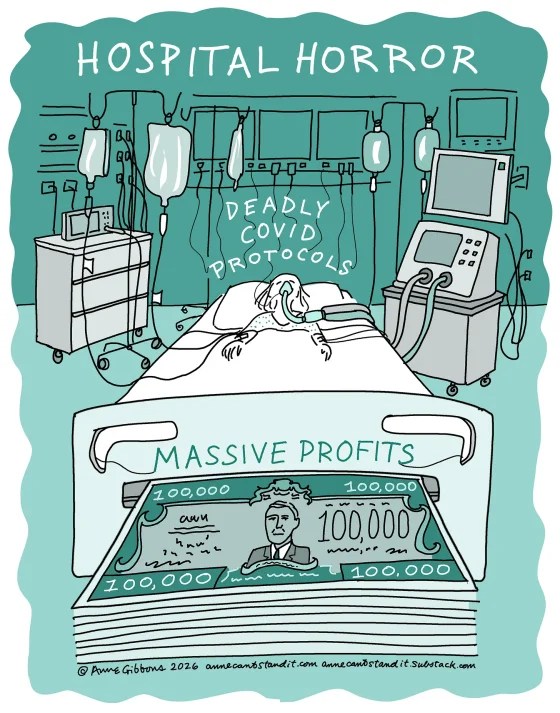
Hospital Horror
Documented in the film,“Bad Medicine”
Blog Roll
 Aletho News
- US rewrites history to dodge blame for illegal war on Iran: Foreign Ministry spokesperson
- TURBO CANCER DATA from Ontario, Canada (OHIP Insurance Billing Data)
- Iran warns France not to fall for Israeli false-flags operations
- Poland and Bulgaria put brakes on Ukraine weapons funding
- Russia Reaffirms Its Support for Sovereignty, Territorial Integrity of Lebanon – Russian MFA
- Araghchi: Failure to punish aggressors against Iran endangers all nations
- Iran tells UN Security Council to stop reversing roles of ‘aggressor and victim’
- Disgraced neocons Feith & Libby: stop whining about ‘endless war’
- CENTCOM rejects Israeli claims of preparations for new Iran attacks
- Your Shopping Bag Runs Through Hormuz
- If Americans Knew
- An error has occurred; the feed is probably down. Try again later.
- No Tricks Zone
- New Study: Barents Sea Temperatures Were Warmer And Sea Ice Less Extensive In The 1700s Than Today
- German Authorities Start Initiative To Evaluate Public Register For Climate “Disinformation” Spreaders!
- Zonal Asymmetry of Temperature Change in the Antarctic Circumpolar Current
- New Study: The Net Fossil Fuel Contribution To Rising Atmospheric CO2 Has Been Zero For 500 Years
- Germany’s Green Energy Transition Becoming Increasingly Expensive…Another 6 Trillion Euros!
- Sudden Stratospheric Warming, Powerful El Niño Combination May Lead To Extreme Europe Cold, Energy Crisis!
- Two New Studies Find Thwaites Glacier Melt Cannot Be Driven By Human Activity Or A Warming Ocean
- E-Cars Reduce CO2 Emissions By Only 41% Compared To Internal Combustion Engine Vehicles
- Predictions Made By Renowned Climate Professor Over Past Decades Have Been Proven To Be Poor
- New Study Suggests Large Regions Of The Pacific Ocean Have Been Cooling For The Last 80 Years

