The New Crossfire: Where Both Sides Support War With Syria
By Peter Hart | FAIR | August 28, 2013
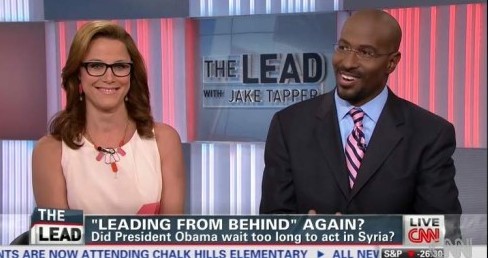 CNN is bringing back Crossfire next month, but viewers on August 27 got a taste of what they might expect: The left thinks we should bomb Syria, while the right thinks we should have started that a long time ago.
On the show The Lead, guest host John Berman moderated a “debate” between conservative S.E. Cupp and left-leaning Van Jones.
“Look, I want to commend the president for finally following through on our red line threats,” Cupp declared–before explaining that Obama’s plan was too timid:
We should absolutely intervene to stop the genocide of more than 100,000 people. We should absolutely intervene to stop Al-Qaeda and Islamic extremism from jihadizing yet another conflict. It is absolutely our obligation, and instead we do the bare minimum to save face and pat ourselves on the back for our civility and our diplomacy. I think it’s pathetic.
OK, and from the left? Jones said:
This president has now said there is a red line. It was not clear before whether the line was crossed. It’s crossed, he’s moving forward. I think we need to stand behind this president and send a clear message to Assad that this type behavior is not acceptable.
And:
If you kill Assad right now, wonderful. You have a huge power vacuum. Who is going to fill it? Listen, people have a nostalgia for 1953 when the U.S. could just sort of thump out dictators like in Iran. This is not the world we live in. It is a tough neighborhood over there, and the idea that we should have a more bloodthirsty and reckless president, I reject.
I’m not sure what “thumping out dictators like in Iran” is supposed to mean; in 1953, the United States supported a coup against Iran’s elected president.
But back to Syria: The American public is generally and overwhelmingly skeptical of military strikes on Syria. But in CNN‘s left/right debate, that point of view seems to be missing entirely.
The Guardian of What?: The Media and War Propaganda
By Jeremy Salt | Palestine Chronicle | August 28, 2013
If there is any comfort in how the Guardian has been reporting the Middle East, especially Libya and Syria, it is that many of its readers, judging from their remarks in ‘Comment is Free’, do not appear to believe or trust it.
The Guardian sells itself as the global beacon of liberal opinion. It is liberal on social issues and alongside the chatterers, it has some excellent political correspondents and commentators, notably Gary Younge and Seamas Milne. As liberals themselves, its readers around the world must think they are on safe ground when quoting from the Guardian but if so, where the Middle East is concerned, they are deluding themselves.
Throughout the crisis in Syria the Guardian has been not so much reporting the conflict as running a propaganda campaign against the government in Damascus, to the benefit of the armed Islamist groups and the outside governments sponsoring them. The wellsprings of its ‘reporting’ have been the unsubstantiated claims of ‘activists’ no matter how wild and improbable. Without any evidence it is now accusing the Syrian government of being responsible for the alleged nerve gas/chemical weapons attack in the Ghouta district around Damascus. The far greater likelihood that the armed groups were responsible for this atrocity scarcely rates a mention. Building on the unsubstantiated claim that it was the Syrian military, Martin Chulov argues in favor of another one, that it was Bashir’s brother Maher who was personally responsible (the same accusation is being made by the Israeli intelligence propaganda outlet Debkafile, from which Chulov may well have taken his lead). This is how propaganda works. Once set in motion it just needs a push to keep it rolling.
Buttressing its editorial and reports, Fawaz Gerges is given space to claim that it is up to the Syrian government to prove that it was not responsible for this atrocity. This is nonsense: if the Syrian government was not responsible for this atrocity, how can it prove what it did not do, especially when anything it says will be dismissed out of hand by the mainstream media and the governments arming, financing and training the ‘rebels’? The onus of proof lies on those making the accusations, and so far neither the Guardian nor the anti-Assad campaigning Kim Sengupta of the Independent (where Robert Fisk has provided balance with some reports giving the perspective of the Syrian government) nor William Hague nor anyone else making this accusation has produced a scrap of evidence that this attack was carried out by the Syrian military.
Probability points in the direction of the armed groups. The ‘rebels’ are known to have acquired stocks of sarin. They used a chemical weapons compound in their home-made missile attack on a military outpost at Khan al Assal in March that killed dozens of soldiers and civilians. (1) In May this year Carla del Ponte, a member of the UN Independent Commission of Inquiry on Syria said investigators had evidence that the ‘rebels’ had used sarin gas. (2) In May also Turkish police seized sarin gas along with hand guns, grenades, ammunition and unspecified ‘documents’ from apartments where Jabhat al Nusra members were living in Adana and Mersin. (3) Early in June the Syrian military seized two barrels of sarin gas from a ‘rebel’ hideout in Hama. (4)
On top of all this the armed groups have filmed themselves experimenting with chemical weapons on rabbits. As they have slaughtered thousands of civilians in the most barbaric fashion there is no argument that moral considerations would prevent them from taking this further atrocious step – and it is they who have every reason to take it. They are being ground down across the country and at this stage only direct military intervention is going to save them and save the project to destroy the Syrian government. It is a measure of the desperation of their outside sponsors that Bandar bin Sultan, Saudi Arabia’s intelligence chief, was recently in Moscow with an offer from his government to buy $15 billion worth of Russian arms if Russia would just allow the passage of a UN Security Council resolution authorizing a military attack on Syria. Putin said no, and what a coincidence it is that a short time later there is a mass atrocity that gives the western-led collective the pretext it wants to attack Syria without a UNSC resolution behind them.
Clearing positions held by the armed groups a few days after the apparent nerve gas/chemical weapons attack, Syrian soldiers found stocks of chemicals, gas masks, syringes and anti-neurotoxin drugs in tunnels at Jobar, one of the three districts on the outskirts of Damascus, along with Ain Tarma and Zamalka, targeted in the attack. Several soldiers were taken to hospital in critical condition. The official Syrian news agency English-language news site, SANA ran photos of cylinders of chemicals and other material, including syringes, produced by the ‘Qatar-German Company for Pharmaceutical Industries’. There is no company of this name but there is a company called Qatar-German Medical Devices whose QG logo can be seen on a box found in the tunnel marked ‘Flow I.V. Cannula’. The army also found a basement stocked with quantities of chemical agents manufactured in Saudi Arabia and a number of European countries. The material included equipment for making chemical weapons and anti-neurotoxins in case the armed men poisoned themselves.
The discovery of this material was followed by the Medecins Sans Frontieres statement that three of the hospitals it supports in the Damascus governorate had received 3,600 patients displaying neuro-toxic symptoms in three hours on the morning of August 21, of which number 355 had died. While MSF cannot say who was responsible for this atrocity, its statement highlights the complete improbability of the Syrian government carrying out a mass chemical weapons/nerve gas attack on civilians in suburbs only a few kilometers from the center of Damascus, shortly after the arrival of UN chemical weapons inspectors and indeed only several kilometers from where they were staying, killing or wounding thousands and filling its own hospitals with the victims. At face value the accusation is ludicrous, yet such is the propaganda whipped up against the Syrian government over the past three years that some people will believe it to be capable of anything.
Not only do the armed groups, their backers and the media salesmen of their pitch, including the Guardian, want the world to believe that the Syrian government was responsible for this atrocity, they want the world to believe that Bashar is stupid, indeed so stupid that he would have ordered this attack within three days of the arrival of the UN chemical weapons inspectors. This canard is reminiscent of the accusation that the Syrian government arranged the assassination of Rafiq Hariri in 2005. The killing was a master stroke used as a lever to get the remaining Syrian troops out of Lebanon, and to blacken Syria’s name internationally. By the time all the four suspects had been freed and Syria cleared by the UN tribunal of any responsibility the media had moved on. It is a long time since it has shown any interest in who killed Hariri. Like the Hariri killing the first question to be asked in the wake of this latest atrocity is ‘who benefits?’ In both cases the answers are clear: in the first, Israel, the US and their proxies in Lebanon; in the second, the armed groups and the outside governments supporting them, including, of course, Israel, which is now leading the charge for a direct military attack on Syria.
By disseminating the deceit and lies put out by Libyan and then Syrian ‘rebels’ and ‘activists’, Al Jazeera ruined its reputation. The Guardian has run the same line as this mouthpiece of the government of Qatar yet remains protected by its mystique as a beacon of liberal opinion. Many of its readers are clearly confused when all they have to do is see that the emperor has no clothes: far from being the guardian of liberal opinion, this newspaper is the guardian of western, gulf and Israeli interests in the Middle East against Iran, Syria and Hezbollah. Its correspondents are still writing seriously and positively about a Palestinian ‘peace process’ that is a grotesque sham. Israel is playing with the Palestinians, as a cat plays with a mouse. It has Abbas in its pocket and by abandoning Syria and embracing Muhammad Morsi and the deposed ruler of Qatar, Ismail Haniyeh and Khalid Misha’al have found themselves without any backers. Not since its foundation has Israel enjoyed such a good run. If only the governments in Tehran and Damascus could be destroyed and Hezbollah extinguished life would be perfect.
The Guardian has never even attempted to provide balanced coverage of what is going on in Syria. There has been no counterweight – no antidote – to the anti-Assad and pro-rebel reporting and comment of Ian Black and Martin Chulov. The techniques will be familiar to all but the most inert readers. The paper runs headlines which are not justified in the text. The claims of ‘activists’ are given prominence and the claims of the Syrian government minimized, without there ever being any doubt about what the Guardian wants its readers to believe. It has downplayed or ignored the evidence of terrible atrocities by the armed groups (such as the massacres this August of hundreds of villagers in the Lattakia governorate (5) , of more than 100 people in Khan al Assal (6) and the massacre by Jabhat al Nusra of an estimated 450 Kurdish women and children around the Syrian-Turkish border town of Tal Abyad). (7) It has printed the wildest claims without any attempt to substantiate them, such as the allegation by a London-based ‘activist’ that the Syrian government was packing detainees into shipping containers and dumping them at sea. It has allowed ‘activists’ to shift the blame for car and suicide bombings on to the government even when it is government institutions that have been bombed and government employees who have been the victims. It has expected its readers to believe that the Syrian government is exploding bombs in densely populated residential areas in the middle of its own cities. It relies on the so-called Syrian Observatory for Human Rights when it must know that it is a completely tainted source. The only explanation for this can be that this one-man band is saying what the Guardian wants to hear and what it wants its readers to believe.
The strategy of the armed groups has been to destroy infrastructure and terrorize the civilian population. This they have largely succeeded in doing. Syrians are pouring out of the country to get away from them. In the name of a twisted pseudo-revolution these armed men are supported by a collective of foreign governments. The line of the moment following the alleged chemical weapon/nerve gas attack is that ‘all red lines have been crossed’ when these governments crossed all red lines in international law long ago by financing and arming groups such as the brigades of the Free Syrian Army and Jabhat al Nusra. International law prohibits armed intervention in other countries and the use of mercenaries. International law forbids the application of economic sanctions against member states of the UN yet in all these categories the collective bent on the destruction of the Syrian government has shown complete contempt for international law. Of course this is merely standard procedure. International law is for other people, not the ‘international community’ as represented by the UK, France and the US [or Israel] and nowhere have they treated international law with more contempt than in the Middle East.
These governments are making the most strenuous effort in the history of the modern Middle East to destroy an Arab government. The reason has been clear from the beginning: Syria is Iran’s strongest regional ally and is being targeted as a second best option to targeting Iran itself. The takfiris inside Syria, demeaning Islam with their shouts of ‘Allahu Akbar’ every time they cut a throat, are doing the work of governments that have done nothing but damage to the Middle East for the past century. The prime losers are the Syrian people. About 100,000 have been killed in this conflict and much of their country’s infrastructure has been deliberately torn to shreds. The chief regional beneficiaries are Israel and Saudi Arabia, holding hands under the table. The destruction of the Syrian government would be an unparalleled strategic triumph for Israel and the ‘west’, which is why Russia and China have not budged in their position that it is the Syrian people who must decide their own future and not outside governments and armed gangs and why Russia in particular will be planning its riposte should Barack Obama be talked into launching a Cruise missile strike.
The Guardian’s propaganda cover for the Syrian ‘rebels’ follows its support for the Libyan ‘rebels’ against another dictator. The protest movement in Benghazi was seized upon by Britain, France and the US as the opportunity to intervene and destroy the government in Tripoli. There was no countrywide movement against Muammar al Qadhafi and the ‘rebels’ could not have advanced a yard beyond the city limits of Benghazi without the cover of NATO missiles. Qadhafi was brought down after a seven month blitz by the air forces of three of the most powerful militaries in the world and eventually murdered after several previous attempts to murder him by missile strike had failed, while killing members of his family. Thousands of innocent Libyans were killed during this prolonged aerial assault. This neo-imperialist adventure was fully underwritten by the mainstream media. None of the war crimes committed by NATO forces or ‘rebels’ on the ground had the same impact on editorials and ‘reporting’ as the claims that the Libyan leader was bombing his own people from the air, using black mercenaries and distributing Viagra to his troops. These sensational allegations were later shown to be lies, but by this time they had served their purpose in setting up Qadhafi as someone who deserved to be killed (rather than put on trial, embarrassing in the process Blair, Sarkozy and others who benefitted from Libyan money and oil concessions). With Libya out of the way the same western governments and the same mainstream media flapped on like vultures to Syria and another supposed dictator, leaving the Libyans to clean up the mess they had created as best as they could.
Having shed the shackles of balanced journalism in Libya and Syria, the Guardian is now defending media ethics and responsibility in the Edward Snowden- Glenn Greenwald affair. Greenwald has been revealing secrets from Snowden’s store of official documents. David Miranda, his partner, was detained for nine hours by British intelligence while in transit through London. If the purpose was to shut Greenwald up by putting pressure on his relationship, his scarcely repressed fury is an indication that it will not work. Alan Rusbridger, the Guardian’s editor-in-chief, had been having private conversations with British intelligence and only decided to take action, by destroying material the Guardian had on hard drives, when threatened with legal action. This was a significant exercise of the power of the surveillance state which had to be challenged, but how much more significant is media support for mass death and destruction delivered to Syria by groups of men financed, armed and trained by outside governments?
The Guardian does not actually call for war. It leaves that to other people. It merely sets the stage. It runs an editorial based on the assumption that this chemical weapons attack was the work of the Syrian government. The possibility that the armed groups might have done it is not even taken into account. It observes that ‘choosing between bad options is even more complex [supporting armed groups responsible for one atrocity after another is obviously not considered a bad option] … this paper has resisted the calls for military intervention in Syria [as if there is not already military intervention in Syria] … but we do appear to be coming ever closer to a tipping point with difficult judgments ahead.’ Without calling for war itself, this beacon of liberal opinion then quotes with approval the arch conservative William Hague, who talks of civilized values while pushing for a war that would bury them in further great mounds of bodies.
Behind the mask of asinine geniality Hague is a warmonger. He has wanted ‘intervention’ in Syria – a war kicked off with the declaration of a no-fly zone and now possibly a Cruise missile strike – for years and now sees it in his grasp. The Guardian should have been on to his smiling duplicity and double-speak like a terrier on to a rat. Instead it is joining the chorus line for war. That is the reality behind its own double-speak. The Syrian government agreed to allow UN inspectors into the districts targeted in this apparent nerve gas/chemical weapons attack but as soon they approached these districts, they were shot at by snipers. If it can be proven that it is the armed groups that carried out this attack it is a safe bet that we will hear no more talk of red lines being crossed. Obama said he would not take a decision until he had proof but now we are being told by an unnamed US official that the on the spot inquiry is too little and, not even a week after the event, too late. The British media is talking of a military attack being launched within days.
The US media is much more reserved: after all, their country is being pushed into the front line by governments that would never have the guts to attack by themselves but will only run in from behind once the US takes the lead. Obama is still holding back and has the intelligence and sense not to fall for this if, unfortunately, not necessarily the strength of character to resist the pressure being applied to him. Britain, France and Israel want to strike now, while the propaganda is running hot and strong and before the UN inspectors ruin their rush to war by concluding that this attack around Damascus either was or might have been the work of the armed groups.
This will not be Libya. This never was Libya. This will not begin and end with a few Cruise missiles fired at Syria from warships in the eastern Mediterranean. This may well spark a major war involving Turkey, Iran, Israel, Hezbollah and Russia for which those pushing for war must be held responsible right now and not just afterwards. If the decision is taken the Guardian will wring its hands about the horrors of war but it will still justify it on humanitarian grounds and the ‘responsibility to protect’. Amidst the smoke and carnage, the question of who fired the chemical weapons around Damascus will soon be forgotten.
– Jeremy Salt is an associate professor of Middle Eastern history and politics at Bilkent University in Ankara, Turkey.
Notes:
1. See ‘Russia’s UN envoy says Syria rebels used chemical weapons’, Los Angeles Times,July 9,2013, reporting the statement by Russian UN ambassador Vitaly Churkin that armed groups had used sarin gas in the attack at Khan Assal on March 15, killing 26 people, including 16 military personnel, and wounding 86.
2. See ‘UN’s Del Ponte says evidence Syrian rebels ‘used sarin’. BBC News Middle East, May 6, 2013.
3. See ‘Adana’da El Kaide operasonyu:12 gozalti ( Al Qaida operation at Adana: 12 arrested), Zaman, May 28, 2013.
4. ‘Syrian army seized sarin cylinders from militants in Hama’, Press TV, June 2, 2013.
5. See ‘Massacre in Latakia, August 2013. A documentary report on Al Nusra massacre in Lattakia’, Sham Times, August 8, 2013. Translated by Australians for Reconciliation in Syria.
6. See ‘UN rights chief calls for investigation into Syrian massacre’, Reuters.com., reporting on the ‘apparent’ massacre ‘carried out by Syrian opposition forces in the town’.
7. See ‘Defend the Kurds in Syria from massacre and ethnic cleansing’, Kurdistan Times, August 8,2013, reporting the massacre of 120 children and 330 women by Jabhat al Nusra at Tal Abyad on August 5. While the numbers have not been independently verified, the massacre triggered off an exodus of tens of thousands of Syrian Kurds into northern Iraq. Syrian Kurds have given details of massacres of Kurds carried out by Jabhat al Nusra across northern Syria.
Erdogan’s policy on Syria counterproductive
By Prof. Rodney Shakespeare | Press TV | August 23, 2013
Turkey’s policy is being smashed apart. It has no depth, no vision, no principle and no morality. It is not just a case of muddle or a failure of cynical opportunism. Rather, it is something which is completely inexplicable without there having been some sort of big bribe (probably of the “We will make you the regional big-wig” variety) for Erdogan, the Prime Minister.
Turkey had a clear, simple policy – be friends with all neighbors. It was a very sensible policy and, as a result, Turkey was able to build its economic and political strength and was increasingly being recognized as a regional leader. (Remember the deal arranged between Turkey, Brazil and Iran over 20% uranium enrichment which made Obama look like a fool, as he is?)
Importantly, Turkey was also seen as a successful example of how Islam and politics can integrate in a modern way.
But now look what has happened! History has many examples of countries, led by incompetent prime ministers, shooting themselves in the foot. However, in the case of Turkey, it’s an instance of shooting itself in both feet.
In Syria, no doubt dreaming of a huge territorial expansion under his benign rule, Erdogan went from friend to not just enemy but to being the worst thing of all – a vicious sectarian out to put the whole of the Middle East at each other’s throats. What a disgraceful turnabout for a man who was being held up as an example to the world!
And look at the consequences! Can anybody guess how many hundreds of thousands, even millions, of refugees will soon be living within Turkey’s borders? What is that going to do for Turkey’s economy?
Can anybody guess what will be the consequences for the unity of Turkey itself (which has a large Kurdish minority) given that the Kurds of Syria have to fight against the Takfiri throat-slitters supported by Turkey?
Will the Kurds in Turkey remain silent? And what about those throat-slitters in Syria (who also like a bit of head-chopping and gas-choking on the side)? Are they going to leave Turkey alone (since they have no intent of leaving anybody else alone)? Turkey is arming them and establishing secret routes for them, in fact, doing everything to ensure that Turkey itself is one day going to be attacked by them. How idiotic can you get?
Moreover, goodness me! What about Turkey’s middle class? They are enraged with Erodogan’s Syria policy and, as history teaches, politicians who upset the middle classes do so at their peril….
Erdogan has been doing some slimy creepy-crawling to the Israelis and Americans (after all, they were the ones promising that he would become the Big Caliph big-wig if he only did a bit of their bidding). But now, Erdogan is being given a nasty dose of reality – the last thing the USA and Israel want is a Big Caliph: rather, all they want is a Greater Israel (from the Mediterranean across to the River Euphrates and down to the Nile).
So, Erdogan is now accusing Israel of being behind Morsi’s ouster in Egypt which is a very reasonable accusation given that Israel (together with the USA and Saudi Arabia) is a member of the Axis of Evil which interferes everywhere in the Middle East. Of course, the USA is angry that anybody should even hint that Israel is behind anything but, then, the USA is another country regularly shooting itself in the foot and, in its case, the feet are very big, clumsy ones.
Thus, Turkey is finding out the hard way that it cannot rely on the USA or Israel as allies (and who, in their right mind, would think otherwise?)
Behind all this, of course, are some big geo-political realities one of which is that China, Russia and Iran are holding firm in backing Assad of Syria. Therefore, the USA is unlikely to intervene in Syria even though it wants to.
So, Turkey’s Syria policy is now down the drain and it’s beginning to look as if Turkey itself is going down the drain (although the country will probably push Erdogan down the drain before it gets near to going down itself….)
Where will Erdogan turn now? He is promoting sectarianism and, by doing so, has betrayed Islam.
The obvious thing to do would be to turn away from the West and Israel and look more to stronger relationships with Muslim countries. But to whom? Saudi Arabia? That would be another strategic mistake (and it is disgraceful that Erdogan has allowed a disgusting Saudi Arabia to become more influential.) Egypt? Unlikely. Iraq? Very unlikely …
Erdogan’s made a ripe mess, hasn’t he? He’s alone. Why should anybody trust him when he has betrayed everybody else? We can expect the Turkish people to be taking action soon.
Related article
Why Western media frames civilian areas as “Hezbollah strongholds”
By Sharmine Narwani | Al-Akhbar | August 19, 2013
Beirut was thrown into turmoil on Thursday evening as a terrorist attack against residents of Dahiyeh – a southern suburb of the Lebanese capital and a predominantly Shia neighborhood – threatened to draw the country into a region wide crisis.
As conflicting news reports began to leak out in the immediate aftermath of the city’s deadliest car bombing in eight years, there was a disconcerting congruity in headlines beaming out from western capitals – and it had nothing to do with facts.
 In lock-step, western media was calling the scene of the crime a “Hezbollah stronghold”:
Wall Street Journal: “Car Bomb Blasts Hezbollah Stronghold in Lebanon”
BBC: “Deadly Lebanon Blast in Beirut Stronghold of Hezbollah”
LA Times: “Massive Explosion in Beirut Rocks Hezbollah Stronghold”
Washington Post: “Bomb Explodes in Hezbollah Stronghold in Beirut, Injuring Dozens”
Reuters: “Over 50 Hurt as Car Bomb Hits Hezbollah Beirut Stronghold”
Associated Press: “Car Bomb Rocks Hezbollah Stronghold in Lebanon”
France24: “Car Bomb Rocks Hezbollah Stronghold in Beirut”
A quick Twitter or Google search for “Hezbollah stronghold” is all you need to see how hard western media works to “frame” language and drive use of a phrase that makes Shia civilian life negligible.
On Twitter Thursday night, “tweeps” questioned the validity of this phrase in describing a civilian neighborhood. Said one observer: “When you write “Hezbollah stronghold” instead of South Beirut it gives the impression military barracks were bombed and no innocents died.
That view seemed to be confirmed by the reaction of an American tweep who wrote: “GREAT NEWS!!!!!” in response to the BBC headline “Deadly Lebanon blast in Beirut stronghold of Hezbollah.”
Worse yet was this reprehensible tweet by Al Monitor’s Washington correspondent and senior fellow at the Atalantic Council Barbara Slavin, who declared on Twitter: “As I recall, Hezbollah invented the car bomb; what goes around, comes around.” Except, of course, the targets of Thursday’s terror attack – where 27 died and nearly 300 injured – were civilians, not Hezbollah.
An army of tweeps quickly reminded Slavin that Hezbollah neither invented the car bomb nor targets civilians, and drew attention to the ironic fact that Israeli militant groups used them liberally in attacking British officials in Palestine last century – well before Hezbollah’s 1985 formation to combat Israel’s occupation of Lebanon.
And herein lies the problem. By calling a residential neighborhood a “Hezbollah stronghold,” western media softens public opinion to accept these terror attacks as justifiable, and their targets, legitimate. Because the only reason for characterizing civilian Shia neighborhoods as “strongholds” of Hezbollah is to justify carnage against those populations most likely to support the Lebanese resistance group.
Similar language – War on Terror, terrorism, militants, extremists, Al Qaeda – is also frequently employed to excuse western carnage in countries from Iraq to Afghanistan to Mali to Yemen to Pakistan. Droning and bombing targets are rarely characterized as “civilian,” even though data suggests that most victims of US attacks are not militants. The goal? To eradicate second thoughts about violence against innocent civilians – often bolstered by a complicit media that characterizes these deaths as “collateral damage.”
While the term “stronghold” can simply refer to an area in which an organization, party or point of view holds sway, in the context of US foes in the Mideast, it is instead usually used to suggest a militant base absolutely controlled by that foe. As one tweep noted, western media uses similar language against other American targets to scene-set for “excusable” carnage: “Hezbollah stronghold” for car bombs in Lebanon, “Assad stronghold” for car bombs in Damascus; “Assad heartland” for massacres in Latakia.”
Dahiyeh – the scene of Thursday’s explosion – is also, for instance, home to significant Maronite Christian and Sunni communities. And even within the suburb’s Shia community, there are disparate political views and affiliations. It is by no means true that all Shia residents are supporters of Hezbollah, a Lebanese political party that – in lieu of national political consensus – provides local social services and security for residents of all sects and backgrounds in these areas.
A December Christian Science Monitor article entitled “In Hezbollah Stronghold, Lebanese Christians Find Respect, Stability,” (a piece which repeats the “stronghold” theme and other Hezbollah stereotypes ad nauseum) does however manage to highlight the positive experiences of Maronites living in Dahiyeh neighborhood, Haret Hreik:
The face of the revered Shiite militant leader appears on posters, a calendar, and in several photographs nestled amid those of Christian homeowner Randa Gholam’s family members. Mr. Nasrallah is, Ms. Gholam asserts amid a string of superlatives, “a gift from God.”
Lebanon’s sectarian divides are legendary, and the residents of the historically Christian neighborhood of Harat Hreik, now a Hezbollah stronghold, remember well the civil war that set Beirut on fire. They were literally caught in the middle of some of the most vicious fighting, with factions firing shots off at one another from either side of their apartment buildings.
But in the intervening years, as Hezbollah cemented its control over the suburb of Dahiyeh, which includes Harat Hreik, the militant group has been an unexpected source of stability and even protection for the few remaining Christian families. Just a few blocks away from Nasrallah’s compound is St. Joseph’s Church, a vibrant church that Maronite Christians from across Beirut flock to every Sunday.
“I feel honored to be here. They are honest. They are not extremists. It’s not like everyone describes,” Gholam says. “I can speak on behalf of all my Christian friends. They would say the same thing.”
Why western media uses the term “Hezbollah stronghold”
Dahiyeh is not the only Lebanese area referred to as a “Hezbollah stronghold” by western media. Most Shia towns, cities and neighborhoods in this country are labelled with that moniker – facts be damned. Bekaa, Nabatiyeh, Bint Jbeil, Khiyyam and other predominantly Shia areas are frequently cited as such. Not coincidentally, all these civilian areas have been subjected to Israeli strikes over the years.
While hunting for Scuds in Lebanon two years ago – a search prompted by Israel’s fabricated claim that Hezbollah was hoarding the difficult-to-conceal ballistic missiles – I came across some IDF “3D animated clips” that allegedly “illustrate how Hezbollah has turned over 100 villages in South Lebanon into military bases.”
Introducing an array of IDF computer-generated slides that purport to identify existing Hezbollah weapons stores by marking large Xs in Shia-heavy civilian centers, the Israeli military then alleges:
“Hezbollah stores their weapons near schools, hospitals, and residential buildings in the village of al-Khiam (Khiyyam). They follow similar tactics in villages across southern Lebanon, essentially using the residents as human shields, in gross violation of UN Resolution 1701. al-Khiam was used as a rocket launching site during the Second Lebanon war.”
When I asked him about it, The Independent’s veteran Beirut-based journalist Robert Fisk scoffed at the IDF slide show: “The Israelis are making excuses for the next war crimes. The Scuds don’t exist, they’re not here. I’ve seen the (IDF) pictures – garbage. There’s nothing in those houses.”
Human Rights Watch’s extensive report on Israel’s 2006 attack on Lebanon, entitled Fatal Strikes: Israel’s Indiscriminate Attacks Against Civilians in Lebanon, covers at length the Jewish state’s unproven allegations that Hezbollah stashes weapons among civilian populations – charges that Israel continues to repeat despite evidence to the contrary.
The group’s Executive Director Kenneth Roth concludes: “The pattern of attacks shows the Israeli military’s disturbing disregard for the lives of Lebanese civilians. Our research shows that Israel’s claim that Hezbollah fighters are hiding among civilians does not explain, let alone justify, Israel’s indiscriminate warfare… In the many cases of civilian deaths examined by Human Rights Watch, the location of Hezbollah troops and arms had nothing to do with the deaths because there was no Hezbollah around.”
Instead the Report clearly states:
“Human Rights Watch did not find evidence that the deployment of Hezbollah forces in Lebanon routinely or widely violated the laws of war, as repeatedly alleged by Israel. We did not find, for example, that Hezbollah routinely located its rockets inside or near civilian homes. Rather, we found strong evidence that Hezbollah had stored most of its rockets in bunkers and weapon storage facilities located in uninhabited fields and valleys. Similarly, while we found that Hezbollah fighters launched rockets from villages on some occasions, and may have committed shielding, a war crime, when it purposefully and repeatedly fired rockets from the vicinity of UN observer posts with the possible intent of deterring Israeli counterfire, we did not find evidence that Hezbollah otherwise fired its rockets from populated areas. The available evidence indicates that in the vast majority of cases Hezbollah fighters left populated civilian areas as soon as the fighting started and fired the majority of their rockets from pre-prepared positions in largely unpopulated valleys and fields outside villages.”
Fisk is correct. The Israelis are making excuses for the next war crimes. in 2006, the IDF used the “Hezbollah stronghold” and “human shielding” arguments for carpet bombing Dahiyeh, the very same residential neighborhood targeted by terrorists on Thursday.
And Western journalists act either as dupes or complicitly when they repeat these same Israeli-generated mantras – laying the groundwork for further military and terror strikes against Lebanese civilians.
It is not just Western media that regurgitates this irresponsible language. “Hezbollah stronghold” has been so mainstreamed that virtually all English-language media utilizes the expression, from Iranian-backed Press TV to Moscow’s Russia Today. But online searches identify Western media – by far – as the main driver of this narrative.
Not all Western journalists are complicit though. On Twitter last Thursday, a rare moment of rationality came from a Voice of America source, of all places. VOA reporter Cecily Hilleary bothered to ask the all-important question: “Does term ‘Hezbollah stronghold’ aptly describe this Beirut neighborhood that was just hit by car bomb?” The first two responses were “no” and “it’s a civilian area.”
And as freelance British journalist Patrick Galey, a past Beirut resident, noted sarcastically after the Bir al Abed car bombing in July unleashed another Twitter-frenzy of “Hezbollah stronghold” tweets: “For ‘Hezbollah stronghold’ you can also say “highly-populated civilian area.” Just a thought.”
Watching an elderly woman sitting alone on the steps outside Bahman hospital on Thursday, her head in her hands, sobbing, as she awaited news of a relative injured in the car bomb earlier that day – it seemed ludicrous that the media still uses “Hezbollah stronghold” as a term to describe Israel’s past and future civilian-targeted neighborhoods.
And yet, on Sunday, as four rockets were fired into the northern Bekaa – one landing in a school playground – the “Hezbollah” association was invoked again. There are many dangerous words and phrases used to frame people and events in the Middle East, but here, now, we can collectively make a start to change that.
Sharmine Narwani is a commentary writer and political analyst covering the Middle East. You can follow Sharmine on twitter @snarwani.
US could easily verify massacre of Kurdish civilians in Syria if they wanted
RT | August 16, 2013
Defending themselves by all means available is the Kurdish Popular Defense Units’ (YPG) last resort in Syria, the group’s spokesperson Redor Khalil told RT.
Amid Western inaction and Russian condemnation of massacres against the Kurds, Redor Khalil said that evidence is readily available to support the injustice perpetrated against the Kurdish people by militants sponsored from abroad – if anybody were to listen.
RT: Tell us about the Popular Defense Units. Is it your objective to protect the Kurds, or to protect all the residents of this territory?
Redor Khalil: The Popular Defense Units were established to protect all the people – Kurds as well as Arabs. We formed the units in 2011 when the war began. You should know that Syria, including Western Kurdistan, has a mixed population of Kurds, Arabs, Armenians, Assyrians, Turkmens, Circassians and so on. Our units were intended to protect all these areas and their residents.
RT: But some are saying that your attacks on enemy positions in Arabic villages are impeding the relations between Kurds and Arabs. Armed clashes in these areas result in losses on both sides.
RK: We don’t believe that our actions will result in social disintegration. Kurds and Arabs have been living side-by-side in these territories for centuries, and they will keep it this way in the future.
We’ve said time and again that we strongly disapprove of ethnic, religious and sectarian wars. However, there are certain powers which have been trying to stir up confusion and to make it look like a fight between Kurds and Arabs for the sake of their own interests.
As you travel through these areas you may ask the local members of minorities and religious groups whether there is a sectarian war taking place here. I can assure you that it’s not the case.
Our traditions, moral values and principles prevent us from starting a war between different religious or ethnic groups. Neither Kurds nor Arabs want this war to happen. But some forces are working on instigating a conflict between us as a part of their plan.
RT: We’ve been around Qamishli, where the clashes take place. The YPG members told us that Jabhat Al-Nusra and the Islamic State of Iraq and the Levant are much better armed. With this in mind, can the YPG really ensure people’s security and extend it to other regions? And what is your opinion on some foreign states supplying weapons to these terrorist groups?
RK: The YPG units are made up of the local population. Our main strategy is defense, not offense. If there are no attacks on our territory, no threats to our towns and cities, we do not take any offensive action. We don’t attack anyone or provoke confrontation. But since our territories are under attack, we have to defend ourselves with all the means available. Our enemy gets support from the outside; they have heavy armaments and plenty of ammunition. I can state openly that the YPG units do not get any support from foreign countries. We employ a defensive strategy in all our operations, using only our own weapons and ammunition.
RT: Recently it was rumored that Kurdish political forces want to create a government of the so-called Western Kurdistan. It’s well-known that there are external Kurdish elements that support the idea. How would you comment on these rumors?
RK: Some parties and movements declare this project their main political objective. On behalf of the YPG members and based on the information we have, I can say that they don’t intend to set up a government for Western Kurdistan. This is just talk meant to drive a wedge between different ethnic groups living in the region. Syria is going through a very difficult and dangerous time right now. There are some places in Syria over which the current regime will never be able to regain control. People living there are in dire need of governing authorities, which the Free Syrian Army has already created in Idlib and Ar-Raqqah. There’s nothing surprising about that, and it’s the same thing the Kurdish people want – self-government over the areas where the Kurds live is an inherent part of our political project. Some political movements claim that it springs from our desire to separate from Syria and create our own state and government. They aim to sow seeds of discord among various ethnic and religious groups living in this area and exacerbate the already complicated state of affairs. They are just pursuing their own selfish goals.
RT: Some opposition groups say that the YPG leaders coordinate their operations with the Syrian government and its army forces. What kind of relations do you maintain with the Syrian government?
RK: We have vehemently denied these allegations before, and we will keep doing so. We don’t maintain any relations with the government. The Popular Protection Units have no connection to the regime. You have seen for yourselves that the government officials stay inside the city. The rest of the territory is under our control. Basically, the YPG is in charge there and responsible for ensuring security.
RT: Speaking of Jabhat al-Nusra’s massacre in Afrin and Qamishli, the Russian Foreign Ministry and several human rights organizations condemned it, but the US State Department said that they have no hard evidence of genocidal intent against the Kurdish people. How would you explain this US stance?
RK: I think that if the US truly wanted to get to the bottom of this, it would be very easy – it’s crystal clear what exactly is happening. The massacre of Kurdish civilians in places like Tal Hasil and Tal Aran is a dark but undeniable fact. There are eyewitnesses of these events, and we at the YPG, as well as several Kurdish civilians, have documentary proof of it. We are ready to give this proof to international organizations and mass media to show them the truth of this horrible war the radical Islamists are fighting on our soil. I think the main reason for this massacre is that the YPG defeated the militants at Ras al-Ayn where they were based, maintaining control over a border checkpoint. After they suffered defeat at Rumeylan the radical groups attacked civilians who are not involved in military action.
Related article
Featured Video

Genocide-linked firm handles Britons’ NHS data
or go to
Aletho News Archives – Video-Images
Book Review
Book review: Boiling Point, How America Brought War to Ukraine
By Tim Kirby | Strategic Culture Foundation | November 14, 2026
Did Vladimir Putin just wake up one day on the wrong side of the bed and decide to invade Ukraine in February of 2022 or is there a lot more to this single decision that has been reshaping the 21st century geopolitical landscape?
Obviously, from the way that I just posed the question you can see that I am on the side that views the causes for the war in Ukraine to be very deep, long-term, historical and consciously nefarious, and most importantly, not from within the halls of the Kremlin. So it was a pleasure to take a look at the book “Boiling Point, How America Brought War to Ukraine” by author Stephen Kinzer, who like myself, also believes that the real reasons behind military conflicts around the world are not what CNN and the BBC have been telling you. The main thesis of this book was stated clearly by its creator; the war “may have been illegal, but it was definitely not unprovoked.” … continue
Blog Roll
 Aletho News
- The 10 Disease Renamings That Rescued the Vaccine
- NATO cancels 2027 leaders’ summit
- IAEA’s politicized use of safeguards undermines its impartiality: Russian envoy
- UK must be ready to strike Russian Arctic – ex-PM
- Fico’s Two Red Lines: Russian Energy and the Next Ukraine Loan
- Thousands rally for banned NATO-skeptic presidential candidate
- Ukraine Settlement and New European Security Architecture Must Go Hand in Hand – Kremlin
- Book review: Boiling Point, How America Brought War to Ukraine
- Israel Revives The ‘Iranian Assassination Threat Against Trump’ Deception In A Desperate Bid To Restart The War
- US rewrites history to dodge blame for illegal war on Iran: Foreign Ministry spokesperson
- If Americans Knew
- An error has occurred; the feed is probably down. Try again later.
- No Tricks Zone
- New Study: Barents Sea Temperatures Were Warmer And Sea Ice Less Extensive In The 1700s Than Today
- German Authorities Start Initiative To Evaluate Public Register For Climate “Disinformation” Spreaders!
- Zonal Asymmetry of Temperature Change in the Antarctic Circumpolar Current
- New Study: The Net Fossil Fuel Contribution To Rising Atmospheric CO2 Has Been Zero For 500 Years
- Germany’s Green Energy Transition Becoming Increasingly Expensive…Another 6 Trillion Euros!
- Sudden Stratospheric Warming, Powerful El Niño Combination May Lead To Extreme Europe Cold, Energy Crisis!
- Two New Studies Find Thwaites Glacier Melt Cannot Be Driven By Human Activity Or A Warming Ocean
- E-Cars Reduce CO2 Emissions By Only 41% Compared To Internal Combustion Engine Vehicles
- Predictions Made By Renowned Climate Professor Over Past Decades Have Been Proven To Be Poor
- New Study Suggests Large Regions Of The Pacific Ocean Have Been Cooling For The Last 80 Years

