
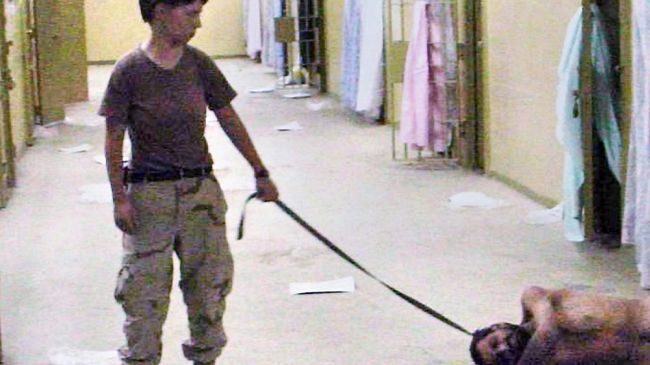
American defense contractor CACI International has sued four former detainees in Abu Ghraib prison to compensate the legal expenses it paid over their dismissed lawsuit regarding the company’s role in torturing the plaintiffs in the notorious jail in Iraq.
The four Iraqi nationals had earlier filed a lawsuit in a District Court in Alexandria against the company accusing it of torturing, humiliating and dehumanizing them when they served time in the prison.
But in July, the judge dismissed the case, saying the court did not have jurisdiction to hear the lawsuit because the incidents happened overseas.
The Arlington-based company has now demanded the plaintiffs pay over $15,000 for travel allowances, deposition transcripts and witness fees, Common Dreams reported.
The lawyers for former Abu Ghraib prisoners in a federal court filing rejected the request.
Our clients “have very limited financial means, even by non-US standards, and dramatically so when compared to the corporate defendants in this case,” according to the filing.
“At the same time, plaintiffs’ serious claims of torture, cruel, inhuman and degrading treatment, and war crimes were dismissed on very close, difficult – and only recently arguable – grounds.”
“Given the wealth disparities between this multi-billion dollar entity and four torture victims, given what they went through, it’s surprising and appears to be an attempt to intimidate and punish these individuals for asserting their rights to sue in US courts,” said Baher Azny, legal director for the Center for Constitutional Rights and the attorney for the plaintiffs.
“Our case is based on reports and investigations by high-level US military investigators, recognizing CACI’s role in conspiracy to torture detainees,” Azny added
“Once we get past legal obstacles and present the case to a jury, we are hopeful justice will come to these Iraqi victims.”
The lawyers who are planning to appeal the case to the US Court of Appeals in fall argue that US law should apply to CACI International as it is an American-based company that operated in a US military prison.
August 15, 2013
Posted by aletho |
Subjugation - Torture, Timeless or most popular, War Crimes | Abu-Ghraib, CACI, Center for Constitutional Rights, Iraq, United States |
Leave a comment
The Syrian government has accepted the ‘essential modalities’ under which the UN was ready to investigate whether chemical weapons had been used in the country, the body has announced, signalling that experts will shortly be traveling to Syria.
“The departure of the team is now imminent,” UN Secretary-General Ban Ki-moon said in a statement. “As agreed with the Government of Syria, the team will remain in the country to conduct its activities, including on-site visits, for a period of up to 14 days, extendable upon mutual consent.”
The Secretary-General has expressed his appreciation to the Syrian government for accepting “the modalities essential for cooperation to ensure the proper, safe and efficient conduct of the Mission.”
The statement also reminded that the use of chemical weapons “by any side under any circumstances” would constitute an “outrageous crime.”
Two weeks ago the United Nations said that an agreement had been reached with Syrian President Bashar al-Assad’s government as to the three locations that UN inspectors would be investigating, led by Swedish scientist, Ake Sellstrom.
One site to be visited by the UN team is Khan al-Assal in Aleppo, where the country’s government says rebels used chemical weapons in March. The two additional locations have yet to be confirmed.
Both Syria’s government and rebel forces have long been accusing each other of using chemical weapons, and both have denied it.
Russia welcomed the move, saying on its Twitter feed that “Damascus is ready to bring clarity into the situation”, and expressing hope that the move will “provide a springboard for a political solution of the ongoing crisis”.
Last month Russia submitted “a full set of documents” to the UN and its analysis of samples taken west of Aleppo. Russia’s findings indicated that it was rebels behind the Khan al-Assal incident, in which more than 30 people died.
The United States cast doubt on the Russian findings saying its own intelligence services believed Syrian government forces had used chemical weapons. However, Paulo Pinheiro, chairman of the UN commission’s inquiry into rights violations in Syria, said the evidence provided by the US did not meet standards as his commission was “very worried about the chain of custody of the substances.”
Back in March Damascus requested UN investigators to visit Khan al-Assal. The UN formed a mission then, but was reluctant to send it, demanding “unconditional and unfettered” access across the country, according to Ban’s spokesman Martin Nesirky.
Syria’s Foreign Ministry rejected the UN’s effort to broaden the probe claiming that it was “at odds with the Syrian request” and that its “possible hidden intentions” could violate Syrian sovereignty.
In total, the UN received some 13 reports of alleged use of chemical weapons in Syria and the UN inspectors will be investigating the “allegations” of chemical weapons use, rather than determining who was responsible for the attacks.
August 15, 2013
Posted by aletho |
War Crimes | Aleppo, Khan al-Assal, Syria, Terrorism, UN, United Nations, United States, USA |
Leave a comment
The extremism of Canada’s support for Israel just keeps growing.
The latest example is the Conservative government in Ottawa helping convince theEuropean Union to list Hizballah’s military wing as a “terrorist” organization. After that decision was taken, Foreign Minister John Baird declared, “We are thrilled that the European Union unanimously has agreed to designate Hizballah as a terrorist organization. We’ve been pushing for this.”
The National Post detailed Canada’s behind-the-scenes effort to get the EU to list Hizballah as a “terrorist” organization. Despite opposition from the Lebanese government, a foreign ministry official told the paper that this was “a clear priority that was set out by the minister.”
Canadian diplomats held bilateral talks with various European countries and also pushed for Hizballah to be listed at numerous multilateral meetings. At both a recent United Nations Office on Drugs and Crime meeting and a UN conference on radicalization in Europe, Canadian officials pressed key EU officials to define Hizballah as a “terrorist” group (“Canada pushed EU to add Hezbollah to list of banned terrorist organizations, official says,” 24 July 2013).
Canadian law enforcement and security officials were also part of the lobbying effort. Reportedly, they’ve been feeding their European counterparts information about the supposed threat Hizballah poses to both Canada and Europe.
The Conservatives push to get the EU to list Hizballah was given a boost when six Israelis were killed in Bulgaria in July last year. Within hours of the bus bombing, Israel claimed Hizballah was responsible, yet more than a year later it’s still unclear exactly who committed this crime.
With a Canadian passport holder allegedly implicated in the bombing, Ottawa jumped at the opportunity to get involved in the investigation. Presumably, Canadian investigators shared information with their Bulgarian counterparts designed to steer them towards the conclusion that Hizballah was responsible.
In response to the EU listing its military wing as a terrorist group the Hizballah leader, Hassan Nasrallah, said: “Why don’t you classify the state of Israel as a terror state? Why don’t you classify Israel’s military wing … as a terror organization if you recognize Israel is occupying Arab lands and refuses to implement international decisions for decades now? The entire world bares witness to the massacres perpetrated by Israel” (“Nasrallah to EU: Why not brand IDF as terror group?,” Ynet, 24 July).
Nasrallah raises an important point that Canadian foreign affairs professionals must be familiar with. It’s a simple fact that Israeli forces have killed far more civilians than the military wing of Hizballah.
The Israeli military and its allies in Lebanon have killed thousands of civilians. In fact, Hizballah was created in large part to fight the Israeli occupation of that country. Israel has conducted scores of targeted assassinations in many countries across Europe, Asia and the Middle East.
Certainly, Canadian foreign affairs officials must remember Gerald Bull. This Canadian engineer and designer of the Iraqi “supergun” was, according to CBC journalist Linden MacIntyre, shot dead by Israel’s secret service Mossad outside his residence inBelgium in 1990 (“Murdered by the Mossad?”, CBC The Fifth Estate, 12 February 1991).
And what about members of the current Israeli government who support illegal settlers and the killing of dozens of Palestinian civilians?
But apparently none of this “terrorism” bothers Prime Minister Stephen Harper’s government. The Conservatives are either ignorant or relish their hypocrisy.
Though they are allowed to support the Israeli military, Canadians can go to jail for sending money to a group operating a school or medical clinic in Lebanon “directly or indirectly” associated with Hizballah, which comprises an important part of the Lebanese governmental and social service structure.
Dozens of Canadian companies sell to the Israeli army and many groups with charitable status promote the Israeli military. The Canadian Jewish News is full of advertisements for such groups: “Express your Zionism by serving as a civilian volunteer on an Israeli army supply base,” reads one ad. Another advertiser, the Libi Fund, runs educational projects for the Israeli military.
Established in 1971 the Association for the Soldiers of Israel in Canada also provides financial and moral support to the Israeli military. A June 2009 Canadian Jewish Newsad promoting the group invited readers to “show your support for the brave youth of the IDF at our gala dinner.”
Prominent Toronto couple Heather Reisman and Gerry Schwartz, who own or control more than two thirds of Chapters/Indigo/Coles bookstores, created the Heseg Foundation for Lone Soldiers. Reisman and Schwartz provide up to $3 million per year for post-military scholarships to individuals without family in Israel who join the Israeli army. After completing their military service these non-Israeli “lone soldiers” gain access to this scholarship money.
For the Israeli high command (Heseg’s board has included a number of generals and a former head of Mossad) “lone soldiers” are of value beyond their military capacities. Foreigners volunteering to fight for Israel are a powerful symbol to reassure Israelis weary of Israel’s behavior. Schwartz and Reisman’s support for Heseg has spurred a campaign to boycott Chapters/Indigo/Coles, which controls 70 percent of Canada’s retail book trade.
The Harper government is plowing full steam ahead with its support for Israel. Double standards and morality be damned.
August 15, 2013
Posted by aletho |
Ethnic Cleansing, Racism, Zionism, Timeless or most popular, War Crimes | European Union, Hassan Nasrallah, Hezbollah, Israel, Middle East, Stephen Harper |
Leave a comment
Turkey has closed its cultural centers and commercial office in Beirut after the kidnap of two Turkish Airlines pilots, Ankara’s ambassador to Lebanon told AFP on Monday.
The two pilots were kidnapped on Friday by a group demanding the release of nine Lebanese pilgrims kidnapped in Syria in May 2012, but reportedly moved to Turkey, a major backer of the kidnapers.
“As a safety measure, the Turkish cultural centre and commercial office in Beirut have suspended their activities,” ambassador Inan Ozyildiz said.
Responsibility for Abduction of Lebanese Pilgrims Denied
Turkish Ambassador to Lebanon Inan Ozyildiz wondered how his country could be responsible for the abduction of the Lebanese pilgrims in Syria, saying that Turkey does not even have an embassy or consulate in the neighboring country, As-Safir newspaper reported on Tuesday.
He told the daily: “Our negotiations to release all the pilgrims failed because of the complexity of the case.” “What will Turkey gain in delaying their release? What is it seeking to achieve if its interests are being harmed?” he asked. “How could Turkey have kidnapped the pilgrims? Does it have control over Syrian territories?” he wondered.
“It cannot be responsible for the abductions that have been taking place and it only intervened in the case from a humanitarian approach and in return it was met with a second abduction of Turkish nationals in Lebanon in less than a year,” said Ozyildiz.
Commenting on the kidnapping of two Turkish pilots in Lebanon on Friday, the ambassador said: “The case is in the hands of Lebanon’s security and political authorities.” He added that he is in contact with all security officials, including General Security chief Abbas Ibrahim, to follow up on the case.
Ozyildiz said however that Turkey’s decision to advise its citizens against traveling to Lebanon is only a preliminary measure and further ones will be taken if any new development takes place in the case of the two pilots.
A Turkish pilot and co-pilot were kidnapped on Friday. Six gunmen intercepted a van carrying the Turkish Airlines employees from Rafik Hariri International Airport to a hotel in the Ain Mreisseh seafront at dawn Friday, kidnapping the two pilots – Murat Akpinar and Murat Agca – but leaving the four other crew members behind.
Mohammad Saleh, a relative of the pilgrims held in Aazaz, was arrested on Sunday in connection to the kidnapping.
Saleh is a Witness not Participant
A widely-informed security source told As Safir: “He revealed the names of the individuals linked to the abduction.” He also said that the pilots were kidnapped in a hope to exchange them with the nine pilgrims.
Saleh’s relatives denied to As Safir however that their son was linked to the case, saying that he only received messages of congratulations on his telephone when news of the abduction broke out.
Meanwhile, caretaker Interior Minister Marwan Charbel told As Safir that Saleh is considered as a witness in the kidnapping and not a participant. His release from custody is in the hands of the General Prosecution, he added.
FM: Turkey Can Help Free Pilgrims
Caretaker Foreign Minister Adnan Mansour said that Turkey was able to play a major role in helping free nine Lebanese hostages held by Syrian rebels since last year.
“Lebanese people ask: Is it possible that after over a year, Turkey, with all its influence, cannot make fruitful efforts? … We deal with Turkey as a friendly state, we urge it to make efforts [to resolve the case], and we believe it can reach a positive outcome,” Mansour told The Daily Star in an interview at the Foreign Ministry in Beirut.
“I once told a Turkish security official in a meeting that no one believes Turkey can do nothing when it controls the situation in northern [Syria] and supports the opposition,” he said.
“He answered [by] saying: ‘The kidnappers are not under the control of the Syrian opposition.’ But this is an unconvincing answer,” Mansour added.
Source
August 13, 2013
Posted by aletho |
War Crimes | Beirut, Lebanon, Syria, Turkiye |
Leave a comment
Nagasaki marks the 68th anniversary of the US atomic attack that killed tens of thousands of people in the Japanese city at the end of World War II.
The memorial service on Friday was attended by Prime Minister Shinzo Abe, survivors of the nuclear bombing, celebrities, relatives and government representatives from more than 40 countries.
The event was held at Nagasaki Peace Park near the epicenter of the August 9, 1945 attack that killed up to 70,000 people.
The mayor of Nagasaki has criticized the government for failing to assume leadership toward nuclear disarmament.
During an address at the ceremony, Nagasaki Mayor Tomihisa Taue censured the government for refusing to sign a statement rejecting unconditional use of nuclear weapons at an international disarmament meeting in April.
He said Japan has failed to assume the leadership, as the world’s only atomic-bombed country, in the drive to totally eradicate nuclear weapons as soon as possible.
Taue also urged the United States and Russia to reduce their nuclear arsenal.
In June, US Defense Secretary Chuck Hagel said that Washington will continue to make investments to sustain its nuclear weapons, despite talks with Russia over cutting the number of deployed strategic nuclear weapons by up to a third.
US filmmaker Oliver Stone also attended the memorial ceremony in Nagasaki on Friday. He said the widely held belief that the nuclear attacks on Japan ended World War II was a “tremendous lie.”
“It’s easy to look at the issue simply that Americans dropped the bomb to end World War II because Japanese militarists would not give up… [however], that would be a surface explanation,” Stone said.
The bombing of Nagasaki came just three days after the United States dropped another atomic bomb on the western city of Hiroshima in the closing days of World War II.
The US nuclear attack on Japan killed more than 200,000 people. The anniversaries of the two bombings are of great significance to Japan.
August 9, 2013
Posted by aletho |
Militarism, Timeless or most popular, War Crimes | Atomic bombings of Hiroshima and Nagasaki, Japan, Nagasaki, Tomihisa Taue, United States, World War II |
Leave a comment
Deployments to war zones and combat exposure have no effect on military suicides and fail to explain the increase in self-inflicted deaths that occurred from 2001 to 2008, concluded a new medical study, thereby contradicting previous research.
Military medical researchers on Tuesday published a paper that claims mental disorders, such as depression and alcohol abuse – not combat – are to blame for military suicides. US service members killed themselves at a record pace last year, with 350 taking their own lives. From 2011 to 2012, the military suicide rate increased by nearly 16 percent, and anti-suicide organizations feared that this number could increase as troops are drawn down in Afghanistan and are “not effectively integrated into suicide-prevention efforts,” Kristina Kaufmann, executive director of Code of Support Foundation, told NBC after the figures were released in January.
And it appears that the rate is continuing to rise: last year, a service member committed suicide every 25 hours, but in April, the rate increased to one suicide every 18 hours. The annual number of suicides last year surpassed the number of troops killed in Afghanistan and the number of military members who died in transportation accidents in 2012.
But the authors of the surprising new medical study, which was financed by the Defense Department and published by the Journal of the American Medical Association, claim that military members kill themselves for the same reasons ordinary civilians do.
The researchers said they tracked 150,000 soldiers between 2001 and 2008, and found that those who killed themselves were usually heavy drinkers, suffering from depression, or had been diagnosed with manic depression. It remains unclear whether their deployments or combat exposure prompted their mental conditions – an important fact that could shed further light on the military’s effect on its members. A 2011 study published by the Journal of Psychiatry Research concluded that deployment increases the likelihood of self-destructive behavior and psychiatric problems. The report also showed an increase in mental illness among those in active-duty service since 2005.
But this week’s study found that those who were deployed for longer than a year had a lower risk of suicide. As a result, the researchers suggested that rather than seek an early discharge, depressed soldiers should remain in the military and seek mental health care – a procedure that could put soldiers’ careers on the line, but that Col. Charles Engel of the Army Medical Corps believes would be more effective than an early discharge.
“The answer has to be an effort to approximate civilian standards of confidentiality,” Engel told Bloomberg News. “Unless we’re dealing with an imminent risk to combat or a tactical mission, really we should be using civilians’ standards.”
But the sharpest increase in the suicide rate occurred after 2008 – a period that the military study failed to examine. Critics claim that because the analysis ended right at the time that the suicide level spiked dramatically, it might underestimate the impact that multiple deployments and traumatic brain injuries may have on military service members.
“Why would the authors repeatedly insist that there is no association between combat and suicide?” Dr. Stephen N. Xenakis, a psychiatrist and a retired Army brigadier general, told the New York Times. “The careful analysis of bad data generates poor evidence.”
August 7, 2013
Posted by aletho |
Deception, Militarism, Science and Pseudo-Science, Timeless or most popular, War Crimes |
Leave a comment

It is perceived wisdom throughout the Western world – particularly America – that the dropping of two nuclear bombs on Hiroshima and Nagasaki was “necessary” to end the war with Japan. Printed throughout textbooks in the post-war world, the understanding is that, had these targets not been struck, the war would have waged on indefinitely, with potentially untold American soldier and Japanese civilian deaths.
As the world commemorates the 68th anniversary of the attacks, however, it is important to take a step back and view the catastrophic event not through the prism of propaganda and mythologizing, but instead through the lens of historical scrutiny. For, as is often the case, the disparity between “Official History” and reality is characterized by lies and deceptions bolstered by patriotism and American exceptionalism.
We are told repeatedly that, without the use of weapons which current Hiroshima Mayor Kazumi Matsui refers to as the “ultimate inhumane weapon and an absolute evil”, Japan would never have surrendered. We are told that President Truman was troubled by the mounting Allied casualties, and that the Joint Chiefs had told him to expect 1,000,000 dead Americans in the pending attack on the Japanese home islands. Yet this figure is a complete fabrication, invented by Secretary of War Stimson. No such claim was made by the Joint Chiefs of Staff, and Truman himself, in different statements, asserted “thousands of lives would be saved,” and “a quarter of a million of the flower of our young manhood was worth a couple of Japanese cities,” and also “I thought 200,000 of our young men would be saved by making that decision.” None of these statements were based on any evidence.
The alleged indefatigability of the Japanese military and their unwillingness to surrender is also a proven myth. By the summer of 1945 their position was hopeless and numerous attempts to surrender had already been made. Brigadier Gen. Carter W. Clarke stated: “We brought them down to an abject surrender through the accelerated sinking of their merchant marine and hunger alone, and when we didn’t need to do it, and we knew we didn’t need to do it, and they knew that we knew we didn’t need to do it, we used them as an experiment for two atomic bombs.”
Truman knew weeks before the Potsdam Conference, which began in July, 1945, that the Japanese were making overtures to surrender, the only condition being the retention of the Emperor. But Truman was determined to test the new bombs. In the words of General Douglas McArthur: ”The war might have ended weeks earlier, he said, if the United States had agreed, as it later did anyway, to the retention of the institution of the emperor.” In the end, the US agreed to the terms of the Japanese surrender anyway – but not until they had tested their new weapons and caused the deaths of 100,000s of innocent civilians.
In reality, most of the military top brass were disgusted at the decision to bomb Hiroshima and Nagasaki and understood completely that it served no military purpose whatsoever. Admiral William D. Leahy, the President’s Chief of Staff said, “The use of this barbarous weapon at Hiroshima and Nagasaki was of no material assistance in our war against Japan. The Japanese were already defeated and ready to surrender.” This view was reiterated by Fleet Admiral Chester W. Nimitz, who said, “The Japanese had, in fact, already sued for peace… The atomic bomb played no decisive part, from a purely military standpoint, in the defeat of Japan.”
So what is the truth about the bombing of Hiroshima and Nagasaki? Why, when intelligence agencies knew months in advance that contingency plans for a large-scale invasion were completely unnecessary and that Japan desperately sought peace, did they, as Admiral Leahy put it, adopt “an ethical standard common to the barbarians of the Dark Ages”?
There are two main reasons. Firstly, the Russians had entered the Japanese war and were making striking advances through Manchuria, decimating the already weakened Japanese army. Indeed, their role was pivotal – as Air Force General Claire Chennault stated: “Russia’s entry into the Japanese war was the decisive factor in speeding its end and would have been so even if no atomic bombs had been dropped.” The last thing the American leadership wanted was for Russia to receive equal spoils of war and emerge from the war as a superpower equal to the US.
In this sense, the bombing of Hiroshima and Nagasaki are more accurately perceived as the opening salvos of the Cold War, rather than the final shots fired in the Second World War – the Cold War was, after all, defined essentially as a balance of nuclear powers; realpolitik and the primacy of power where the arms race and military insanity took supremacy over diplomacy.
The other, far more sinister reason, was one of scientific curiosity. After making such a huge investment in the Manhattan Project (2 billion in 1940) and with three bombs completed, there was little to no desire to shelve the weapons. The fissionable material in the Hiroshima bomb was uranium, while the Nagasaki bomb was plutonium, and subsequently there was intense scientific curiosity as to the different effects these bombs would produce. As the US Army director of the project, General Leslie Groves pondered: “what would happen if an entire city was leveled by a single uranium bomb?” “What about a plutonium bomb?” For the science experiment to go ahead, surrender was not an option.
Perhaps Stanley Kubrick in his movie Dr. Strangelove, Or How I Learned to Stop Worrying and Love the Bomb expressed his understanding more than most of the mentality of those who pushed for the use of atomic weapons on the Japanese at Hiroshima and Nagasaki – it was a decision based on a kind of hell-bent fanatical militarism combined with the worst kind of scientific endeavor devoid of any sense of humanity. Small wonder that the history books and the propaganda machine went into overdrive in the following years, endlessly justifying the use of what President Eisenhower described as “that awful thing”.
August 7, 2013
Posted by aletho |
Militarism, Timeless or most popular, War Crimes | Atomic bombings of Hiroshima and Nagasaki, Hiroshima, Nagasaki, United States, World War II |
Leave a comment

Nagakaki before and after being nuked by the US
Britain supported the vicious US nuclear attacks against the Japanese cities of Hiroshima and Nagasaki at the end of the Second World War, newly released top secret documents show.
The US government documents, declassified by the National Archives and Records Administration after almost 70 years, show London was involved in Washington’s decision to carry out the nuclear attacks as a close ally.
London’s support was officially expressed to US officials one month before the first and only nuclear attacks on a real target killed an estimated 250,000 civilians on August 6 and 9, 1945.
The go-ahead was given in a meeting of the Combined Policy Committee of the US and the UK in Washington on July 4, 1945 in which British officials referred to the nukes as Tube Alloys, a codename they used for their research on nukes and plutonium at the time.
British Field Marshal Sir Henry Wilson told the meeting chaired by U.S. Secretary of War Henry Stimson that the British government “concurred in the use of the T.A. weapon against Japan”, Kyodo News Agency reported.
“The Governments of the United Kingdom and the United States had agreed that T.A. weapons should be used by the United States against Japan, the agreement of the British Government having been communicated” by Wilson, the documents said.
According to the documents, the initial agreement for the use of nukes against Japan when they are developed was made back in September 1944 in a meeting of the then US President Franklin Roosevelt and the then British Prime Minister Winston Churchill.
August 6, 2013
Posted by aletho |
Timeless or most popular, War Crimes | Franklin D. Roosevelt, Government of the United Kingdom, Japan, United States, World War II |
Leave a comment
By Michael McGehee · NYTX · August 5, 2013
The way the New York Times presents Moscow’s rejection of Washington’s extradition request for Edward Snowden, the leaker of details on the massive NSA global spying program, one would think Russia is in the wrong.
According to last Friday’s front page article by Steven Lee Meyers and Andrew E. Kramer, “Defiant Russia Grants Snowden Year’s Asylum,” the words chosen reveal a lot about the paper’s tone.
Moscow was “defiant “ as they “infuriated” Washington by “brushing aside pleas.”
A look at the treatment of Bradley Manning to see how Washington might treat Snowden is apt, but this is not mentioned by Meyers and Kramer.
Nor do Meyers and Kramer mention Ilyas Akhmadov, a former Chechen separatist leader who is on Russia’s most-wanted list. Akhmadov lives in Washington.
Also missing from the coverage is how Moscow has had their requests for an extradition agreement ignored by Washington. As Newsweek reported last week: “The bottom line, Russian officials agreed, was that Snowden would be useful for Russia,” because “Moscow’s biggest complaint was that Washington ignored Russia’s idea to sign ‘an agreement for extradition,’ that would guarantee both sides a mutual exchange of bad boys.”
There is also a differential treatment provided to leakers and whistle-blowers, as opposed to those who commit serious crimes in service of the government.
While Bradley Manning faces more than 130 years in jail for leaking classified documents, consider the following:
Marine Staff Sergeant Frank Wuterich, a squad leader, participated in the brutal killings of 24 Iraqis in Haditha seven years ago. Many of the victims were women and children . A plea bargain on Wuterich’s case resulted in a drop in rank and conviction for dereliction of duty. No jail time.
As U.S. troops were leaving in December of 2011, Michael Schmidt, a New York Times reporter, stumbled upon hundreds of pages of U.S. military documents pertaining to the 2005 Haditha massacre. Schmidt reported on a testimony of a soldier who said the murders were not “remarkable” because, “It happened all the time, not necessarily in MNF-West all the time, but throughout the whole country.”
In 1995 three American soldiers kidnapped and raped a 12-year old Japanese girl. The three men got no more than seven years jail time.
Even Charles Graner and Lynndie England, who were found guilty of abuses in the Abu Ghraib torture scandal—where detainees were tortured, humiliated, beaten, raped, and killed—received no more than ten years in jail.
The writing on the wall is clear: sounding the alarm to the general public about widespread crime and corruption (some of which includes the kind of crimes I bring up above and below) can get you life in prison—but raping, torturing, and killing dozens of civilians will get you no more than a reduction in rank, or a fraction of the time in prison.
And it is more than the differential treatment. There is also the hypocritical attitude towards extradition. Mentioned above was the case of Akhmadov, but he is hardly an exception.
During the spring of 2000 Washington helped Tomas Ricardo Anderson Kohatsu, a Peruvian intelligence official accused of torture escape arrest, saying he was entitled to diplomactic immunity.
In October of 2001, as Washington was asking the Taliban to turnover bin Laden, Haiti was asking Washington to turnover Emmanuel Constant for his role in a 1994 massacre. Washington was “defiant” as they “infuriated” Haiti by “brushing aside” their request.
Then there is Venezuela’s request for Luis Posada Carriles over his role in the 1973 bombing of a jet airliner that killed 73 people off the coast of Cuba.
Nearly a year ago Washington defied and infuriated Bolivia when they brushed aside the latter’s extradition request for former President Gonzalo Sanchez de Lozado, who was wanted for charges of genocide.
Also, there is Armando Fernandez Larios, a Chilean soldier who was part of The Caravan of Death, a death squad group that went from prison to prison in Chile, following the 1973 military coup, and executed prisoners. But it wasn’t this crime that got him in trouble in the U.S. It was his role in the assassination of Americans on American soil. Though, as SF Weekly reports:
Fernandez Larios later fell out of favor with his military. He cut a deal with the U.S. Justice Department, much of which remains secret. In exchange for providing information on the assassin and Chilean intelligence operations, he’d go to a federal prison for seven years and would never be deported to Chile. Argentina wanted to extradite Fernandez Larios for his alleged involvement in another political hit, but the plea agreement protected him from that as well.
And finally there is the case of Robert Seldon Lady, the former CIA station chief in Milan, who is wanted in Italy, along with 22 of Lady’s accomplices in the agency, for his role in the 2003 abduction of Abu Omar, an Egyptian cleric. Omar was renditioned to Egypt, where he was repeatedly tortured.
A more exhaustive search of Washington’s foreign policy could reveal a book’s worth of examples where Washington comes to the aid of kidnappers, torturers, terrorists, executioners, and war criminals, either to avoid extradition or be granted a punishment considerably less than what a whistle-blower can expect. And it is this context which the New York Times has conveniently left out of their coverage of both Bradley Manning and Edward Snowden.
August 5, 2013
Posted by aletho |
Subjugation - Torture, Timeless or most popular, War Crimes | Charles Graner, Edward Snowden, Frank Wuterich, Ilyas Akhmadov, Luis Posada Carriles, Lynndie England, New York Times, Robert Seldon Lady |
Leave a comment
The Obama administration was forced into damage control on Thursday as officials attempted to walk back Secretary of State John Kerry’s pledge to end armed drone operations in Pakistan.
During a diplomatic visit to Pakistan on Thursday, Kerry told Prime Minister Nawaz Sharif that Washington plans to severely curtail and eventually end armed drone operations in the country.
The move was geared toward an overall effort by the Obama administration to forge “a real partnership” between the White House and Islamabad, Kerry told reporters after his meeting with Sharif.
“I think the [drone] program will end as we have eliminated most of the threat and continue to eliminate it,” Kerry said in an interview with Pakistani television.”I think the president has a very real timeline and we hope it’s going to be very, very soon,” the former Massachusetts senator added.
The Obama administration reacted quickly to Kerry’s comments, saying his statements did not reflect a coming change in the use of armed drones against terrorist targets or overall U.S. counterterrorism policy.
“Clearly the goal of counter-terrorism operations, broadly speaking, is to get to a place where we don’t have to use them, because the threat goes away,” State Department spokeswoman Marie Harf said Thursday.
However, she made clear that there was no plan to eliminate the drone program in the near future, or that the White House had a plan to phase out drone operations.
The Obama administration is “realistic about the fact that there is a threat that remains and that we have to keep up our vigilance to fight in this and other places around the world.”
“As we make … progress [against al Qaeda] the need to use these tools will, of course, be reduced,” she added.
U.S. drone strikes against suspected terrorist targets inside Pakistan has long been a source of contention in the often tense relations between Washington and Islamabad.
Pakistan claims the strikes, focused on the volatile provinces in the northwest part of the country that border Afghanistan, are a clear violation of the country’s sovereignty.
U.S. military and intelligence officials maintain the drone strikes have been an invaluable tool in decimating the core leadership of al Qaeda and other extremist groups based inside Pakistan.
Those tensions came to a head in May 2011, when a U.S. special operations team secretly entered Pakistan and killed al Qaeda leader Osama bin Laden.
The infamous terrorist leader had been quietly living in the Pakistani city of Abottabad, only miles from Islamabad.
During a major national security speech in May, President Obama announced plans to transition control of armed drone strikes to the Pentagon.
Under the White House’s plan, the CIA will continue to supply targeting and other intelligence on possible targets, but operational control over the actual drone strikes would fall to the military.
Currently, the Pentagon and CIA coordinate and execute their own independent armed drone operations in various hot spots across the globe.
That shift was part of an overall effort by the White House to update U.S. counterterrorism strategy from the days directly after the 9/11 attacks.
But since Obama’s speech in May, efforts to shift control of armed drone operations to the Department of Defense have stalled at the Pentagon and at CIA headquarters in Langley.
August 4, 2013
Posted by aletho |
Progressive Hypocrite, Subjugation - Torture, Timeless or most popular, War Crimes | Human rights, John Kerry, Obama, Obama administration, Pakistan, United States |
Leave a comment
Soon after taking office, President Obama pledged to open a new inquiry into the deaths of perhaps thousands of Taliban prisoners of war at the hands of U.S.-allied Afghan fighters in late 2001.
Last month, the White House told ProPublica it was still “looking into” the apparent massacre.
Now it says it has concluded its investigation – but won’t make it public.
The investigation found that no U.S. personnel were involved, said White House spokeswoman Caitlin Hayden. Other than that, she said, there is “no plan to release anything.”
The silence leaves many unanswered questions about what may have been one of the worst war crimes since the U.S. invasion of Afghanistan, including why previous American investigations were shut down, and how evidence was destroyed in the case.
“This is not a sufficient answer given the magnitude of what happened here,” said Susannah Sirkin, director of international policy for Physicians for Human Rights, the organization that originally uncovered mass graves where the prisoners were buried.
The long saga began in November 2001, when Taliban prisoners who had surrendered to Northern Alliance commander Abdul Rashid Dostum were transported in shipping containers without food or water. According to eyewitness accounts and forensic work by human rights investigators, hundreds of men died of suffocation while others were shot, and their bodies buried at the desert site of Dasht-i-Leili.
Dostum was working closely with U.S. troops at the time. Surviving prisoners alleged that Americans were present at the loading of the containers – but the Pentagon has said repeatedly that it had no evidence that U.S. forces participated or were even aware of the deaths. (Dostum has denied any personal involvement, and claims that roughly 200 men died in transit, from battlefield wounds.)
In the fall of 2002, the U.S., U.N., and even Dostum himself expressed support for an investigation. But none got underway. In the summer of 2009, prompted by a New York Times report that Bush administration officials had actively discouraged U.S. investigations, President Obama ordered a new review of the case.
Hayden, the White House spokeswoman, said the new investigation “was led by the intelligence community,” and found that no Americans – including CIA officers, who were also in the region – were involved.
She declined to answer the following lingering questions:
- What was the scope of the investigation? Former Bush administration officials who had been involved in the initial U.S. response to Dasht-i-Leili told ProPublica that they had not been contacted for a new inquiry. Physicians for Human Rights said it received only tepid responses to its queries from the administration over the past several years.
- Did the investigation cover the allegations, reported in the New York Times, that Bush administration officials had discouraged inquiries by the FBI and State Department?
- Did the U.S. help with related inquires by the U.N. or the Afghan government? Even absent direct involvement of U.S. personnel, government documents make clear that the U.S. knew about the allegations early on. The U.S. was in an alliance with Dostum, and was the de facto power in the country after the invasion. An Afghan human rights official told ProPublica last month, “I haven’t seen any political or even rhetorical support of investigations into Dasht-i-Leili or any other investigation into past atrocities, from either Bush or Obama.”
- Did the new investigation cover revelations that graves were disturbed and evidence removed as late as 2008? What, if anything, did the U.S. do to help protect the site over the years?
A parallel investigation began by the Senate Foreign Relations Committee in 2010 also never made headway. The committee staffer leading that investigation was former CIA officer John Kiriakou, who is currently serving time in federal prison for revealing the name of an undercover officer to a reporter.
In letters from prison to ProPublica and an interview published recently in Salon, Kiriakou said that Secretary of State John Kerry, who was then chairman of the committee, personally called off the investigation. The State Department declined to comment, but a former Senate aide to Kerry called Kiriakou’s account “completely fabricated.”
August 2, 2013
Posted by aletho |
Deception, Progressive Hypocrite, Timeless or most popular, War Crimes | John Kerry, John Kiriakou, Obama, ProPublica |
Leave a comment
The CIA unmanned aircraft deliberately targeted rescuers attempting to help victims of previous drone strikes in Pakistan’s tribal areas, the Bureau of Investigative Journalism has found.
A field investigation by the Bureau focuses on drone strikes in a single village in North Waziristan last year when the CIA was after Yahya al-Libi, an alleged senior al-Qeada member who was finally killed in one of the aerial attacks on June 4, 2012.
The CIA had at the time shown a video to Congressional aides in which only Libi is killed in a drone strike.
It was first in February 2012 that an investigation by the Bureau found that the CIA had conducted 11 drone attacks on rescuers of previous strikes in Pakistan’s tribal areas between 2009 and 2011.
The tactic, called “double-tap” strikes, apparently stopped in July 2011 but new reports show that the CIA had resumed the strikes a year later.
Five double-tap strikes took place in mid-2012, killing 53 people and injuring 57 others. One of the attacks targeted a mosque, a report by Pakistani journalist Mushtaq Yusufzai, commissioned by the Bureau, found.
The US has always escaped from admitting that civilians have been killed in drone strikes. However, in investigation by legal charity Reprieve indicated that eight civilians died in a double-tap strike on July 6 2012 with the possibility of further civilian deaths in a July 23 attack.
“On both occasions [in July] our independent investigation showed a high number of civilians who were rescuers were killed in the strikes,” Shahzad Akbar, Islamabad-based lawyer, says, confirming the findings of Reprieve’s investigation.
UN’s special rapporteur on extrajudicial executions Christof Heyns noted in June 2012 that double-tap strikes can be labeled as war crimes.
“If civilian ‘rescuers’ are indeed being intentionally targeted, there is no doubt about the law: those strikes are a war crime,” he said.
Another UN official, Ben Emmerson QC, UN special rapporteur on torture, also agreed with his colleague. “Christof Heyns… has described such attacks, if they prove to have happened, as war crimes. I would endorse that view.”
August 2, 2013
Posted by aletho |
Subjugation - Torture, War Crimes | Bureau of Investigative Journalism, Central Intelligence Agency, Christof Heyns, CIA, Drone attacks in Pakistan, North Waziristan, Pakistan |
Leave a comment



 Aletho News

