Syria’s Fake Sectarian War
By Shamus Cooke | Worker’s Action | June 7, 2013
The fate of Syria and the broader Middle East balances on a razor’s edge. The western media is giving dire warnings of an impending sectarian war between Sunni and Shia Muslims, a war that could drown the Middle East in a flood of blood.
Such a war would be completely artificial, and is being manufactured for geo-political reasons. When the most influential Sunni figures in Saudi Arabia and Qatar — both U.S. allies — recently called for Jihad against the Syrian government and Hezbollah, their obvious intentions were to boost the foreign policy of Saudi Arabia and its closest ally, the United States, by destroying Iran’s key ally in the region.
Will Sunni Muslims in Syria — who are the majority — suddenly begin attacking their Shia countrymen and the Syrian government? Unlikely. A compilation of data from humanitarian workers in and around Syria compiled by NATO suggests that:
…70 percent of Syrians support the Assad regime. Another 20 percent were deemed neutral and the remaining 10 percent expressed support for the rebels.”
The pro-Assad 70 percent is mostly Sunni. This data flies in the face of the constant barrage of western media distortion about what’s happening in Syria. Previous polling compiled last year by Qatar had similar results, and was likewise ignored by the western media.
The above article quoted a source familiar with the data:
The Sunnis have no love for Assad, but the great majority of the community is withdrawing from the revolt… what is left is the foreign fighters who are sponsored by Qatar and Saudi Arabia. They are seen by the Sunnis as far worse than Assad.
Syrian Sunnis are likely disgusted by the behavior of the foreign extremists, which include a laundry list of war crimes, ethnic cleansing, as well as the terrorist bombing of a Sunni Mosque that killed the top Sunni cleric in Syria — along with 41 worshipers and 84 others injured. The Sunni cleric was killed because he was pro-Assad.
The recent calls for Jihad by the Saudi and Qatari Sunni leaders are likely in response to the Syrian government scoring major victories against the rebels. The rebels are now badly losing the war, in large part because they’ve completely lost their base of community support.
There are other key rebel supporters now taking urgent action to bolster the flagging rebel war effort. The leader of al-Qaeda, for example, made a recent plea for Sunnis to support the rebels against the Syrian government, while U.S. politician John McCain journeyed into Syria to meet with rebels — later identified as terrorists — to further commit the U.S. to the rebel side.
Meanwhile, The New York Times confirmed that the CIA had increased its already-massive arms trafficking program into Syria, while the European union agreed to drop the Syrian arms embargo, so that even more arms could be funneled to the rebels.
And to top it off, France now says it has proof that the Syrian government used chemical weapons against the rebels — a UN representative has suggested that just the opposite is the case — while the rebels are desperately trying to incite war between Syria and Israel by attacking the Syrian government on the border of the Israeli-occupied Golan Heights.
Also relevant is that the pro-Jihad religious leaders of Qatar and Saudi Arabia are taking a giant gamble in their recent anti-Hezbollah proclamations, and risk triggering political instability to these already-shaky regimes, which are hugely dependent on the religious leaders for support.
Hezbollah is still revered throughout the Muslim world for its military defeat of Israel in 2006; and most Muslims will likely be uninterested in waging Jihad in Muslim majority Syria. Also, attacking the Syrian government and Hezbollah would mean allying with Israel and the United States, not an ideal situation for most jihadists.
It’s very possible that the Syrian tinderbox could drag the surrounding Middle Eastern countries into a massive regional war, with Russia and the United States easily within the gravitational pull.
The Syrian conflict could end very quickly if President Obama rejected U.S. support for the rebels and demanded his U.S. allies in the region do the same. Obama should acknowledge the situation in Syria as it exists, and respect the wishes of the Syrian people, who do not want their country destroyed.
Instead, the U.S. is considering arming the rebels even more.
U.S. Senator John McCain revealed the unofficial U.S. government policy for Syria when he said that he would tolerate an extremist takeover of Syria if it weakened Iran.
At this point an extremist takeover of Syria will cost tens of thousands of more lives, millions more refugees, while exploding the region into a multi-country orgy of violence.
The media will blame such genocide on Islamic sectarian violence, and ignore the obvious political motives.
Hopefully, the social movement in Turkey will force the Turkish government out of the western-controlled anti-Syrian alliance, while empowering other Middle Eastern countries to do the same.
South African bodies call for Israel to be excluded from diamond processing over ‘war crimes’
RT | June 6, 2013
South African human rights groups, trade unions and major civil society organisations are calling for the Kimberley Process Certification Scheme* to exclude Israel from diamond processing.
The certification scheme is designed to stop ‘conflict diamonds’ from entering the mainstream diamond market and was set up in 2003. The organisation which runs the scheme is currently meeting in South Africa.
The coalition of organisations such as South Africa’s National Union of Mineworkers, the country’s largest trade union federation COSATU; South African Students Congress; the Coalition for a Free Palestine and BDS South Africa say that “billions of dollars’ worth of diamonds exported via Israel are a major source of revenue for the Israeli military, which stands accused of war crimes.”
The coalition is calling for Israel to be excluded from the Kimberley Process Certification Scheme due to its human rights record against Palestinians, and to end all exports of rough diamonds to Israel immediately.
The organizations also wants to ban diamond polishing and cutting in Israel. They claim excluding Israel from the diamond processing would be a great chance for the South African authorities to display “moral vision and political leadership”.
“The Kimberley Process has played an important role over the past decade in resolving conflicts linked to the diamond trade but there is no doubt that it has to be reformed… [by] expanding the definition of conflict to include human rights abuses linked to diamond extraction perpetrated by governments and companies; and expanding downstream monitoring so that the process covers not just the rough diamond trade but also the international movement and polishing of diamonds,” Southern Africa Resource Watch director Claude Kabemba told the Business Day newspaper.
The coalition also pointed to the local benefits of such a move, claiming it could bring more diamond processing jobs back to South Africa. “Consumers will have a clear conscience that their diamonds are not funding, assisting or in any way involved with the illegal Israeli occupation of Palestine, and more jobs will be created locally for our people by bringing this diamond processing back home instead of it being done in Israel,” South African activist Mbuyiseni Ndlozi is quoted by the Middle East Monitor as saying.
The Kimberley Process, established a decade ago to help resolve international diamond trade conflicts and to ensure that the diamond trade is not used as an instrument to fund military rebellions and other violence interfering with human rights. The organization includes 54 participants representing 90 countries while its members account for about 99.8 percent of the global production of rough diamonds, the Middle East Monitor reports.
* The Kimberley Process Certification Scheme (KPCS) is the process to prevent “conflict diamonds” from entering the mainstream rough diamond market. Established by UN GA Resolution 55/56 in 2003, the process is aimed “to ensure that diamond purchases were not financing violence by rebel movements and their allies seeking to undermine legitimate governments.” In order for a country to be a participant, it must ensure that any diamond originating from the country does not finance a rebel group or other entity seeking to overthrow a UN-recognized government, that every diamond export be accompanied by a Kimberley Process certificate and that no diamond is imported from, or exported to, a non-member of the scheme. As of 30 November 2012, there were 54 participants in the KPCS representing 80 countries, with the European Union counting as a single participant.
Four Years Ago Obama Promised to Investigate Afghan Massacre. Has Anything Happened Since?

Physicians for Human Rights sent forensic experts to conduct a preliminary forensic assessment of various mass graves in northern Afghanistan, including the one at Dasht-e-Leili. (Physicians for Human Rights)
By Cora Currier | ProPublica | June 4, 2013
In his first year in office, President Barack Obama pledged to “collect the facts” on the death of hundreds, possibly thousands, of Taliban prisoners of war at the hands of U.S.-allied Afghan forces in late 2001.
Almost four years later, there’s no sign of progress.
When asked by ProPublica about the state of the investigation, the White House says it is still “looking into” the apparent massacre. Yet no facts have been released and it’s far from clear what, if any, facts have been collected.
Human rights researchers who originally uncovered the case say they’ve seen no evidence of an active investigation.
The deaths happened as Taliban forces were collapsing in the wake of the American invasion of Afghanistan. Thousands of Taliban prisoners had surrendered to the forces of a U.S.-supported warlord named Abdul Rashid Dostum. The prisoners, say survivors and other witnesses, were stuffed into shipping containers without food or water. Many died of suffocation. Others were allegedly killed when Dostum’s men shot at the containers.
A few months later, a mass grave was found nearby in Dasht-i-Leili, a desert region of northern Afghanistan.
The New York Times reported in 2009 that the Bush administration, sensitive to criticism of a U.S. ally, had discouraged investigations into the incident. In response, Obama told CNN that “if it appears that our conduct in some way supported violations of the laws of war, I think that we have to know about that.”
A White House spokeswoman told ProPublica that there has indeed been some kind of review – and that it’s still ongoing: “At the direction of the President, his national security team is continuing its work looking into the Dasht-i-Leili massacre.” She declined to provide more details.
“This seems quite half-hearted and cynical,” said Susannah Sirkin, director of international policy at Physicians for Human Rights, the group that discovered the grave site in 2002 and since then has pushed for an investigation.
The group sent a letter to the president in December 2011, the tenth anniversary of the incident. In a follow-up meeting some months later, senior State Department officials told Physicians for Human Rights that there was nothing new to share.
“This has been a hot potato that no one wanted to deal with, and now it’s gone cold,” said Norah Niland, former director of human rights for the United Nations in Afghanistan.
Human rights advocates have long said the responsibility for a comprehensive investigation lies with the U.S., because American forces were allied with Dostum and his men at the time. Surviving prisoners have also claimed that Americans were present when the containers were loaded, though that’s never been corroborated.
A Pentagon spokesman told ProPublica that the Department of Defense “found no evidence of U.S. service member participation, knowledge, or presence. A broader review of the facts is beyond D.O.D.’s purview.” That initial review has never been made public.
At this point, say advocates, an investigation should address not just the question of U.S. involvement, but also what the U.S. did in the years that followed to foster accountability.
“I’m not saying Dostum ordered these people killed, and I’m not saying U.S. troops participated,” said Stefan Schmitt, a forensic specialist with Physicians for Human Rights. “All I’m saying is there are hundreds if not thousands of people that went missing. In a country that’s looking to have peace, to be under the rule of law, you need to answer these questions.”
Initially excited by Obama’s statement, researchers with Physicians for Human Rights peppered the administration with their findings. But the response was “murky at best,” said Sirkin.
“We were never very clear on who within the administration was delegated the task,” she said. Current and former administration officials interviewed by ProPublica couldn’t say which agency or department had the job.
Sirkin and others eventually resigned themselves to the fact that Obama, in his televised remarks, had not specifically called for a full investigation. With the U.S. now withdrawing from Afghanistan, many observers say it’s no surprise that investigating Dasht-i-Leili is no longer a priority.
Dostum still holds considerable sway in Northern Afghanistan, though he has fallen in and out of favor with the U.S. and with Afghan president Hamid Karzai. The Times recently reported Dostum is one of several former warlords to whom Karzai passes on thousands of dollars in cash he receives from the CIA each month. (We were unable to reach Dostum himself for this story.)
The Obama administration has been cool toward him in recent years, saying ahead of Afghanistan’s elections in 2009 that the U.S. “maintains concerns about any leadership role for Mr. Dostum in today’s Afghanistan.”
Back in 2001, Dostum was far more important to the U.S. He was a U.S. proxy, fighting the Taliban as part of the Northern Alliance. American Special Forces famously rode on horseback alongside Dostum’s men, advising and calling in airstrikes. The alliance took the city of Mazar-i-Sharif from the Taliban in one of the first major victories of the invasion in early November 2001.
The shipping container deaths occurred a few weeks later, when Taliban fighters who had surrendered to the Northern Alliance at the city of Kunduz were en route to a prison about 200 miles away.
That winter, Physicians for Human Rights discovered a mass grave at Dasht-i-Leili. A preliminary investigation exhumed several bodies that appeared to have died from suffocation. Stories began to circulate in the region and Newsweek and others published detailed accounts from surviving prisoners, truck drivers, and other witnesses.
The Times also reported that an FBI agent interviewing new Afghan arrivals to Guantanamo Bay prison in early 2002 heard consistent accounts of prisoners “stacked like cordwood,” and death by suffocation and shooting. When the agent pressed for an investigation, he was reportedly told it was not his responsibility.
Dostum has said that he would welcome an investigation. He said that some 200 prisoners had indeed died in transit, but that the deaths were unintentional, the result of battlefield wounds.
Other estimates put the toll much higher.
A widely cited State Department memo from fall 2002 said that “the actual number may approach 2,000.”
Around the same time, then-Secretary of State Colin Powell tasked his Ambassador for War Crimes, Pierre-Richard Prosper, with looking into Dasht-i-Leili. Prosper told ProPublica that due to the U.S. alliance with Dostum, Washington felt the U.S. should not take the lead in an investigation.
“We were in the middle of fighting, and we thought we should keep the lines clear, let someone else, the U.N. or Afghans, handle this,” said Prosper.
But the newly installed Afghan government had neither the will nor the resources for a thorough investigation, and U.N. officials said they could not guarantee security. Witnesses and others involved in Dasht-i-Leili had already been killed and harassed, according to State Department memos.
A declassified Defense Department memo from February 2003 indicates the U.S. was not providing security for an investigation. The memo’s author, Marshall Billingslea, told the Times in 2009, “I did get the sense that there was little appetite for this matter within parts of D.O.D.” (Billingslea did not respond to our requests for comment.)
As the years went by, no one from the U.S., the U.N., or Afghanistan guarded the grave site. In 2008, reporters and researchers found empty pits where they had once found human remains. Satellite photos obtained later showed what appeared to be earth-moving equipment in the desert in 2006. Locals told McClatchy that Dostum’s men had dug up the graves.
After Obama pledged in 2009 to look into the case, a parallel inquiry was begun the next year in the Senate Foreign Relations Committee, chaired by current Secretary of State John Kerry.
The fate of that investigation is also unclear. The lead investigator, John Kiriakou, was a former CIA officer who was caught up in a criminal leak prosecution and is now in prison. Other Senate staffers could not provide details on Kiriakou’s efforts. Physicians for Human Rights says contact from the committee fizzled out within a year.
New attention to Dasht-i-Leili had also been sparked within the U.N.’s mission in Afghanistan and the organization’s High Commission on Human Rights, former U.N. officials said.
However, Peter Galbraith, who was the U.N.’s deputy special representative for Afghanistan until the fall of 2009, told ProPublica that “an investigation would’ve required a push from the U.S. It required the cooperation of the coalition forces.” (Neither the U.N. mission in Afghanistan nor the office of the High Commissioner on Human Rights responded to our requests for comment.)
The mass grave at Dasht-i-Leili is one of many left unexamined in Afghanistan. In late 2011, the nation’s Independent Human Rights Commission concluded a massive report on decades of war crimes and human rights abuses, which reportedly documents 180 mass graves across the country. The region near Dasht-i-Leili is also believed to hold the remains of civilians massacred by the Taliban in 1998, in what Human Rights Watch called “one of the single worst examples of killings of civilians in Afghanistan’s twenty-year war.” In all, the report named 500 individuals responsible for mass killings – some of whom hold prominent government positions.
American and Afghan officials reportedly discouraged publication of the report, and the commission has still not made it public. “It’s going to reopen all the old wounds,” an American Embassy official told the New York Times last year. Afghanistan also recently adopted an amnesty law offering blanket immunity for past war crimes.
Nader Nadery, the commissioner responsible for the report, told ProPublica: “I haven’t seen any political or even rhetorical support of investigations into Dasht-i-Leili or any other investigation into past atrocities, from either Bush or Obama.”
A History of Inaction
Nov. 24, 2001: As Taliban forces surrender to the U.S.-backed Northern Alliance in Afghanistan, several thousand prisoners of war are transported in shipping containers. Survivors and witnesses later allege as many as 2,000 prisoners died — some suffocated while others were shot — and are buried in a grave site at Dasht-i-Leili.
February 2002: Physicians for Human Rights visits the graves at Dasht-i-Leili. That spring, under the auspices of the U.N., PHR conducts an initial forensic investigation of the graves, exhuming a number of recent remains that indicated death by suffocation.
Spring and Summer 2002: Media reports detail eyewitness allegations about deaths in the containers.
Fall 2002: U.S., U.N. and Afghan authorities say that a full investigation is warranted, but none gets off the ground.
2006: Satellite photos show disturbances at the grave sites at Dasht-i-Leili.
2008: Researchers and reporters find empty pits where graves had once been.
July 10, 2009: The New York Times reports that Bush administration officials had discouraged U.S. government investigations into Dasht-i-Leili.
July 13, 2009: Obama tells CNN, “I’ve asked my national security team to… collect the facts for me that are known.”
Early 2010: The Senate Foreign Relations Committee begins an inquiry into Dasht-i-Leili. The scope and result of that investigation is not clear.
May 2013: A White House spokesperson says that the president’s “national security team is continuing its work looking into the Dasht-i-Leili massacre.”
Over 8,000 Mau Mau victims seek compensation from Britain
Press TV – June 5, 2013
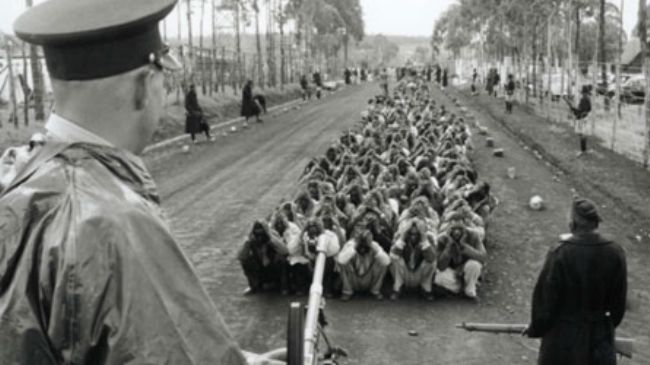
More than 8,000 Kenyans, severely mistreated under British colonial rule during the 1950s Mau Mau uprising, are seeking compensation from the UK.
According to the reports, thousands of names have been submitted to the Law Society of Kenya (LSK), seeking multi-million pound compensation from the British government.
“The Law Society of Kenya has received lists of ex-Mau Mau fighters seeking compensation running into billions of shillings from the British government,” LSK chief Apollo Mboya said in a statement.
More names are expected to be submitted from the Kenya Human Rights Commission, the statement added.
There are also reports that Britain agreed on a compensation settlement totaling £14 million. Britain’s Foreign Office, however, has refused to comment on the issue.
At least 10,000 people died during the 1952-1960 Mau Mau uprising against British colonial rule, with some sources giving far higher estimates.
The British government has admitted to British forces’ torturing of detainees at the time following disclosure of a vast archive of colonial-era documents which the Foreign Office had kept secret for decades.
Related article
Corporate Media Drones on about Venezuela’s Defence Program
By Tamara Pearson | Venezuelanalysis | June 4th 2013
Merida – After President Nicolas Maduro attended a military display in Aragua state which included Venezuela’s three unarmed drones, some mainstream media have highlighted Venezuela’s defence program, stressing Venezuela’s relationship with Iran.
Maduro presided over a ceremony to hand over and display National Bolivarian Armed Forces (FANB) equipment last week. There was a demonstration of Venezuela’s Harpy System of Drone Planes.
The unarmed planes are operated by remote, can take photographs and be used for disaster situations, agricultural research and protection of the electrical grid, according to Defence minister Diego Molero.
Molero said that through the Simon Bolivar satellite, the drones can observe any part of Venezuela. He also presented the Gavilan project, for a drone plane which he said has been designed completely with Venezuelan technology.
Venezuela’s Harpy drones are small and can only be used for remote controlled long distance surveillance. They weigh 85kg, have a maximum flight distance of 100km and flight time of 90 minutes, a cargo capacity of 17 kg, and video cameras which can transmit in real time.
Venezuela’s Cavim (Venezuelan Military Industrial Company) manufactured the drones, with the help of Venezuelan military engineers who were trained in Iran. The system consists of three planes, a launcher, and a control unit.
Ciudad CCS reports that the government eventually hopes to have “at least a dozen” Harpies (Arpías in Spanish).
“We’re advancing in the development and management of military science and technology, for preserving peace and security in Venezuela,” Maduro said at the demonstration, adding that Venezuela is “prepared to resist any attack that could be fabricated overseas, against Venezuela”.
Minister for internal affairs at the time, Tareck el Aissami reported in September last year that Venezuela’s drones had detected a plane with a US registration number, allegedly transporting drugs, in Venezuelan territory. The first Harpy (Arpia-001) was manufactured in January 2012.
Media and U.S. response
Last week’s military demonstration led to some corporate media headlines over the following days about Venezuela “launching” its drones system. Media in and outside Venezuela have reported that the drones are for surveillance and to be used to “curb drug trafficking” but has also emphasised that Iran “helped to build them”.
Univision Noticias headlined with, “Venezuela will use drones to protect the country from any threat”. Fox News and AP reported that “Venezuela’s announcement comes as the United States has begun to use unmanned drones to hunt drug traffickers on both the U.S.’s southern border with Mexico and in the open waters of the Caribbean.”
Last year the U.S. said it would watch Venezuela’s drone development closely, with U.S. State Department spokesperson Victoria Nuland saying at the time, “Our concern, obviously, would be with any breaking of international sanctions on Iran. And we will be most vigilant in watching how this goes forward”.
Further, according to an April 2013 article by the InterAmerican Security Watch (IASW), which “monitors threats to regional security” and the Jerusalem Post, “the growing military ties between Iran and Venezuela… have raised concerns in both the US[sic] and Israel”.
The IASW also made the claim that “Iran’s extended reach in Latin America could pose a threat to US national security; Tehran’s strategies in the region could also threaten Jewish and Israeli interests”.
However, while Venezuela’s 3 small drones are unarmed and have not left Venezuelan territory, the U.S. has used armed and unarmed drones in Afghanistan, Pakistan, Iraq, Yemen, and Somalia, while Israel has used them in Lebanon. According to a February 2012 report by the Bureau of Investigative Journalism, U.S. drones had killed at least 2,413 civilians in Pakistan alone, between May 2009 and the date of the report.
UN lashes out at Britain’s human rights record
RT | June 2, 2013
The UN’s torture watchdog has hit out at the British government for human rights abuses. In its harshest criticism yet of the British government, the panel warned that urgent action is needed for the country to meet international standards.
The UN Committee against Torture focused on human rights abuses during the so-called war on terror and the mistreatment of prisoners in British custody in Iraq. It also flagged up some 40 separate incidents on which the UK government must act.
The findings highlighted the British governments actions following 9/11 and the commission urged the British government to quickly establish an inquiry into whether detainees held overseas were ill-treated or tortured by British officials.
The report reads that the committee is “deeply concerned at the growing number of serious allegations of torture and ill-treatment, as a result of the state party’s military interventions in Afghanistan and Iraq.”
The UN team also slammed what they called “an escape clause” in the Criminal Justice Act (1988), which allows British officials to escape prosecution for inflicting severe pain or suffering if they can show that they had “lawful authority, justification or excuse” for doing so.
Another legal loophole the committee voiced concern about is the Intelligence Services Act (1994), which effectively insures that intelligence officers cannot be prosecuted within the UK once a warrant giving them lawful authority has been signed by a government minister.
The panel was disappointed at the failure to date to prosecute anyone for the torture of Iraqi prisoners and in particular the failure to convict anyone for the murder of Baha Mousa who died in British custody in 2003. Only one soldier received a one-year sentence for admitting inhumane treatment.
There was also concern with the government’s planned introduction of secret court procedures in July for issues that may affect national security under the Justice and Security Act. Closed Material Procedures as they are known make it easier to use hearsay evidence or evidence obtained through torture, the committee maintains. The system of Special Advocates – lawyers who are vetted and chosen by the government – “have a very limited ability to conduct a cross-examination and cannot discuss full content of confidential materials with their client thus undermining the right to a fair trial,” the report reads.
The watchdog also urged the UK government to halt the deportation of failed asylum seekers to Sri Lanka. The deportation of failed Tamil asylum seekers has led to their torture or ill-treatment on return and the UK government hasn’t changed its policy on the issue despite a ruling by the High Court in February ordering them to suspend deportations.
The government was criticized in its handling of the case of Shaker Aamer, the last remaining UK resident in Guantanamo. The committee regretted that despite the “best endeavors” of the UK to try and get him released “there are no encouraging signs of this happening soon”.
There were also accusations against the UK government on several issues connected with Northern Ireland. The Northern Irish justice system must abolish all non-jury trials the report concludes, adding that historical investigations into past misconduct, particularly of military officials, must not be delayed or suspended.
The committee asked that police officers only use tasers when they face “a real and immediate threat to life or risk or serious injury”.
There was also unease that the age of criminal responsibility in England, Wales and Northern Ireland has not been raised from 10-years, despite calls by more than 50 organizations for this to be done.
Further concerns were raised about the steady increase of the prison population over the past decade and the problem of overcrowding. To help rectify the issue the committee urged the government make wider use of non-custodial sentences.
In a further blow, committee members accused the UK delegation of being evasive when questioned about Britain’s human rights record during a two-day hearing in Geneva last month.
The British government was given a year to explain how it could improve its human rights record in 4 key areas: overseas torture, getting Shaker Aamer out of Guantanamo, stopping the forced deportation of Sri Lanka asylum seekers and setting up inquiries into past abuses in Northern Ireland.
Related article
Moscow disappointed political games prevented investigation into chemical weapons use in Syria
RT | May 31, 2013
Russia’s Foreign Minister Sergey Lavrov stressed that “political games” prevented Russia from investigating the data on the use of toxic substances in Aleppo: the UN Secretariat couldn’t respond promptly to Moscow’s demand to look into the matter.
In March, the Syrian government invited the United Nations to investigate possible chemical weapons use in the Khan al-Assal area of rural Aleppo. Military experts and officials said a chemical agent, most likely sarin, was used in the attack which killed 26 people, including government forces.
Several countries, including Israel, the UK, France and the US – all vocal critics of Syrian President Bashar Assad – all claimed they had evidence that chemical weapons were used in Syria.
Damascus denied that a chemical attack was carried out by the Syrian army, blaming the rebels and Turkey for the incident: “The rocket came from a place controlled by the terrorists and which is located close to the Turkish territory. One can assume that the weapon came from Turkey,” Syrian Information Minister Omran al-Zoabi alleged in an interview with Interfax news agency.
Lavrov spoke following the reports that Turkish security forces found a 2kg cylinder with sarin gas after searching the homes of Syrian militants from the Al-Qaeda linked Al-Nusra Front who were previously detained.
The sarin gas was found in the homes of alleged Syrian militants, who were reportedly planning a terrorist attack on the southern Turkish city of Adana.
Russia expressed concern over the incident, urging for a thorough investigation into the matter.
Almost a month ago, the Syrian Deputy Foreign Minister Faisal Muqdad said that Damascus was ready to have the UN investigation team look into alleged chemical weapons use in Syria.
“We were ready and we are always ready, right now, to receive the delegation that was set up by [UN Secretary-General] Ban Ki-moon to investigate what happened in Khan al-Assal,” Muqdad said, referring to the March 19 incident near Aleppo.
Syrian rebels are accused of using a rocket with a chemical warhead, killing 25 people and injuring 86, according to SANA news agency.
The Syrian civil war has been raging for more than two years now, with more than 80,000 people killed, according to UN estimates.
In his latest statement on the matter, Lavrov noted the Russian government’s concern over the issue due to the chance of provocations around the situation.
Obama’s “illusion of movement” on Guantanamo
RT | May 31, 2013
President Obama may pledge to finally close Guantanamo’s doors, but all his words are just an illusion, while prisoners are suffering at the notorious detention facility.
Human rights lawyer David Remes, who represents 17 Guantanamo detainees has been talking to RT.
RT: President Obama has made numerous promises over the years to close Guantanamo Bay prison. Is it likely to happen?
David Remes: I don’t see how it can happen under the current circumstances. For one thing, President Obama keeps blaming Congress for preventing him from transferring detainees. As long as he puts responsibility on Congress, it’s unlikely that he will make major moves. In addition, he’s set up this new system for releasing Yemenis, whereby they have to go through another review process, which is likely to take a long time if it happens at all. So I think what he said sounded good, as usual, but, once again, it only provides the illusion of movement. The men face a very bleak circumstance in Guantanamo in terms of being transferred.
RT: Has the hunger strike involving over a hundred detainees influenced the pledge to close the facility?
DR: I haven’t talked to anyone yet, I’m going to speak to a couple of them tomorrow afternoon. But I imagine, based on what we’ve discussed in the past, that this was all a big snooze to them. Obama has no credibility down there. The men even say that they prefer Bush because he released detainees. I think this will be disregarded or just snorted at with cynicism.
RT: Some inmates from Yemen have already been cleared for release – but what about those from other countries?
DR: There are about thirty other detainees, from other countries, who have been approved for transfer. About half of them can be sent home to their own countries, but about half have to be re-settled in third countries because of concerns about torture in their own countries. Ambassador Dan Fried who has been appointed to place the detainees was on the verge to transfer these men when Congress stepped in, and that’s basically why his office was closed. They are the most promising candidates for transfer, but I don’t really think it’s going to happen very soon.
RT: In the event of Guantanamo actually closing, is it likely Washington will use other secret detention centers?
DR: If they are secret, we don’t know about them. I’m not trying to be flip about it. I also don’t think that the US is using secret centers – although obviously, if they are secret, I don’t know for sure. I think they may be handing men over to countries of origin or we may be just drowning these people instead of imprisoning them.
America’s Long History of Bloodletting
By Lawrence Davidson | Consortium News | May 30, 2013
There is an American tradition of frequent war. Indeed, over the course of the country’s history the United States has been at war almost constantly. Some of these have been relatively short conflicts like interventions in various Central American venues. Some have been much larger and longer affairs, like the Civil War, World War II and Vietnam.
The point to be drawn from this is that the people of the United States are (perhaps unconsciously) acclimated to always being in one sort of armed conflict or another. Unfortunately, this history renders a recent public statement by the Pentagon’s general counsel, Jeb Johnson, into just a bit of fanciful idealism. He insisted “war must be regarded as a finite, extraordinary and unnatural state of affairs.” Certainly not for Americans.
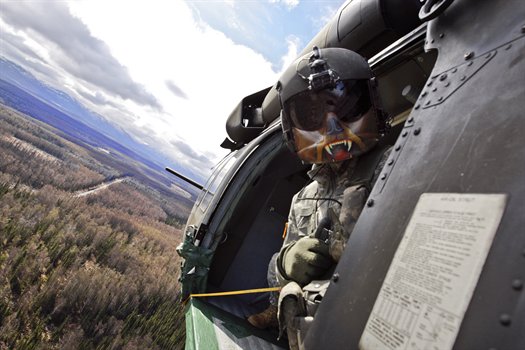
An Army sergeant peers out the door of a UH-60 Black Hawk helicopter on the way to pick up soldiers in a training operation at Joint Base Elmendorf-Richardson, Alaska, May 23, 2013. (U.S. Army photo by Percy Jones)
With their active assumption that the U.S. represents the world’s best chance for the victory of “good” against “evil,” Americans seem willing to battle on as long as they are convinced they are winning and the casualties are low. That may be why there was no popular protest when Michael Sheehan, Obama’s assistant secretary of defense for “special operations,” told a Senate hearing that the country’s “war on terror” might last “at least 10 or 20 years” longer (it has already been going on 12 years). In the mainstream media, there was not even a noticeable raising of an anchorperson’s eyebrows!
The reason given for Sheehan’s prognosis was that al-Qaida, and its franchise allies, keep recreating themselves as fast as their alleged leaders can be droned into oblivion. Missing from the congressional and media reaction was the obvious question of “how come” such groups keep recreating themselves?
Many middle-echelon State Department analysts familiar with the Middle East know the answer has something to do with the fact that U.S. policies in the region have not significantly changed since the 9/11 attacks. Most of the personnel above the middle echelon are political appointees who keep asserting that what motivates the al-Qaida types is religious fanaticism.
Of course there are religious fanatics at work on both sides of the “war on terror,” but those in the Middle East have grievances to focus on and U.S. policies are seen as one source of those. The fact that the “war on terror” is largely a consequence of American policies cemented into place by powerful special interests calls into question President Barack Obama’s recent assertion that “this is a just war, a war waged proportionally in last resort and in self-defense.”
It also suggests that the struggle is likely to go on and on until its ruinous consequences become so obvious to the voting public that the politicians are forced to break with their special-interest supporters. This is the real criterion for change, for, under the present circumstances, there will always be “terrorists” out there who, to reword (and correct) an assertion by President George W. Bush, “hate our policies.”
And what is there not to hate about draconian sanctions, the arming of dictators, and giving opened-ended support to the most racist state in the region?
Rules of Engagement
In the meantime, President Obama has been trying to create “rules of engagement” for the use of the government’s primary weapon in this endless war: those remote controlled bombs we call drones. These rules will, he says, provide “clear guidelines, oversight and accountability” and satisfy partisan congressional grumblings, if not the more pertinent questions of human rights advocates.
To this end the White House has issued guidelines concerning procedures for counterterrorism operations such as drone attacks. The guidelines tell us “there must be a legal basis for using lethal force” and decisions to use such “force against individual terrorists outside the United States and areas of active hostilities are made at the most senior levels of the U.S. Government.” The document then lays out other specific preconditions for the use of lethal force, among which are:
1. “Near certainty” that the terrorist target is present.
2. “Near certainty” that noncombatants will not be injured or killed.
3. An assessment that “capture is not feasible at the time of the operation.”
4. An assessment that the relevant governmental authorities in “the country where action is contemplated cannot or will not effectively address the threat to U.S. persons.”
5. An assessment that “no other reasonable alternatives exist” to effectively address the threat to U.S. persons.
Finally, “International legal principles, including respect for sovereignty and the law of armed conflict, impose important constraints on the ability of the United States to act unilaterally – and on the way in which the United States can use force. The United States respects national sovereignty and international law.”
The problem with these guidelines, beyond a number of undefined terms such as “near certainty,” “reasonable” and “feasible,” is that its criteria misrepresent reality or are utterly unreliable. For instance, under international law there is no “legal” basis for this sort of use of “lethal force.”
What the Obama administration (and the Bush regime before it) has done is take up the illegal Israeli “targeted assassination” program, which constitutes the behavior of a rogue state. Even from a domestic legal prospective, Obama’s criteria for targeted assassination will be carried out behind closed doors. There will be no due process. And there will be no accountability for “mistakes.”
Finally, nothing in the guidelines is enacted into legislation and therefore, assuming an effort to actually follow their criteria, they are specific to the Obama presidency and have no authority over his successors. As Kenneth Roth, director of Human Rights Watch, put it, “a mere promise that the U.S. will work within established guidelines . . . provides little confidence that the U.S. is complying with international law.”
Throughout the country’s history of one war following another, there has been a parallel history of cyclical deterioration and recovery of constitutional rights.
However, with the government’s wholehearted embrace of targeted assassination, as well as modern surveillance technology and the precedent of offshore prisons for “enemy combatants,” one wonders if, from now on, the recovery of rights will ever be fully equal to their loss. Maybe now it really will be all downhill for freedom in the “land of the free.”
~
Lawrence Davidson is a history professor at West Chester University in Pennsylvania. He is the author of Foreign Policy Inc.: Privatizing America’s National Interest; America’s Palestine: Popular and Official Perceptions from Balfour to Israeli Statehood; and Islamic Fundamentalism.
Featured Video

Genocide-linked firm handles Britons’ NHS data
or go to
Aletho News Archives – Video-Images
Book Review
Book review: Boiling Point, How America Brought War to Ukraine
By Tim Kirby | Strategic Culture Foundation | November 14, 2026
Did Vladimir Putin just wake up one day on the wrong side of the bed and decide to invade Ukraine in February of 2022 or is there a lot more to this single decision that has been reshaping the 21st century geopolitical landscape?
Obviously, from the way that I just posed the question you can see that I am on the side that views the causes for the war in Ukraine to be very deep, long-term, historical and consciously nefarious, and most importantly, not from within the halls of the Kremlin. So it was a pleasure to take a look at the book “Boiling Point, How America Brought War to Ukraine” by author Stephen Kinzer, who like myself, also believes that the real reasons behind military conflicts around the world are not what CNN and the BBC have been telling you. The main thesis of this book was stated clearly by its creator; the war “may have been illegal, but it was definitely not unprovoked.” … continue
Blog Roll
 Aletho News
- The 10 Disease Renamings That Rescued the Vaccine
- NATO cancels 2027 leaders’ summit
- IAEA’s politicized use of safeguards undermines its impartiality: Russian envoy
- UK must be ready to strike Russian Arctic – ex-PM
- Fico’s Two Red Lines: Russian Energy and the Next Ukraine Loan
- Thousands rally for banned NATO-skeptic presidential candidate
- Ukraine Settlement and New European Security Architecture Must Go Hand in Hand – Kremlin
- Book review: Boiling Point, How America Brought War to Ukraine
- Israel Revives The ‘Iranian Assassination Threat Against Trump’ Deception In A Desperate Bid To Restart The War
- US rewrites history to dodge blame for illegal war on Iran: Foreign Ministry spokesperson
- If Americans Knew
- An error has occurred; the feed is probably down. Try again later.
- No Tricks Zone
- New Study: Barents Sea Temperatures Were Warmer And Sea Ice Less Extensive In The 1700s Than Today
- German Authorities Start Initiative To Evaluate Public Register For Climate “Disinformation” Spreaders!
- Zonal Asymmetry of Temperature Change in the Antarctic Circumpolar Current
- New Study: The Net Fossil Fuel Contribution To Rising Atmospheric CO2 Has Been Zero For 500 Years
- Germany’s Green Energy Transition Becoming Increasingly Expensive…Another 6 Trillion Euros!
- Sudden Stratospheric Warming, Powerful El Niño Combination May Lead To Extreme Europe Cold, Energy Crisis!
- Two New Studies Find Thwaites Glacier Melt Cannot Be Driven By Human Activity Or A Warming Ocean
- E-Cars Reduce CO2 Emissions By Only 41% Compared To Internal Combustion Engine Vehicles
- Predictions Made By Renowned Climate Professor Over Past Decades Have Been Proven To Be Poor
- New Study Suggests Large Regions Of The Pacific Ocean Have Been Cooling For The Last 80 Years

