Mass graves of Palestinians killed in 1948 Nakba discovered in Jaffa
Al-Akhbar | May 30, 2013
Six mass grave sites dating back to the 1936 Palestinian uprising and the 1948 Nakba were discovered around the Jaffa cemetery, the al-Aqsa Foundation for Endowment and Heritage reported Wednesday, revealing hundreds of bodies of Palestinians killed by Zionist forces.
“During [the foundation’s] repair and maintenance work on the [Kazkhana] cemetery, we discovered nozzles to dig into the ground where we found the mass graves…including hundreds of skeletons and human remains of rebels, martyrs and civilians who perished during the Nakba,” head of the Islamic Movement in Jaffa, Sheikh Mohammed Najem, said in the report.

A picture by the al-Aqsa Foundation shows skeletons buried in a mass grave
The foundation has proved the remains date back to the victims killed in the 1948 war, whether from bombings and shelling of residential neighborhoods or snipers located around the city, the report said.
“The Kazkhana cemetery has exposed the historical facts that Israel has tried to hide and erase for over 65 years relating to the massacres committed by Zionist gangs during the 1948 Palestinian Nakba,” it read.
“These mass graves have banished all doubts of the certainty of oral histories collected by historians of people who lived through the Nakba of 1948 and parts of the war documenting massacres in Jaffa and its suburbs,” the report added.
Some of the recorded histories document eyewitnesses witnessing piles of bodies scattered around in all of Jaffa’s neighborhoods, which were buried in mass graves due to the violent circumstances at the time.
The report shares an eyewitness account explaining how the residents of Jaffa were forced to move bodies to the cemetery and bury them in mass graves as the town was being heavily bombarded by Zionist forces.
“The foundation will continue to conduct research and scientifically test the remains…to send media messages to the whole world that Israel is built on the skulls of the Palestinian people,” Abed al-Majid Ighbariya, the head of the files on holy sites of the foundation, said.
The Nakba, or “Catastrophe,” refers to the expropriation and mass expulsion of Palestinians from their homeland by Zionists.
Related articles
- Activists: Facebook blocks Nakba group page (alethonews.wordpress.com)
- Palestinian Nakba: The Young Will Never Forget (alethonews.wordpress.com)
Syria: After Qusayr, Regime Eyes Aleppo
By Radwan Mortada | Al-Akhbar | May 28, 2013
As the battle for Qusayr winds down, regime forces are preparing to wrest Aleppo from the Syrian opposition, which overran the city last July.
According to Syrian security sources, the Syrian army has begun building up its forces in several areas in preparation to storm opposition-controlled Aleppo. The sources explained that they are in the process of surrounding the city in order to cut off the oppositions supply lines.
If it were to succeed, then the regime would have managed to regain two of Syria’s most important governorates: Homs and Aleppo.
Homs was the “capital of the Syrian revolution,” until government troops retook the city. Ten months have passed since opposition fighters managed to flood Aleppo by the thousands, surprising both the regime and the city’s residents. The city had remained solidly in the loyalist camp for more than a year into the Syrian crisis and no one expected it to fall into the hands of the opposition so quickly and easily.
Government sources attributed the fall of Aleppo to the collusion of Mohammed Mufleh, the former chief of Syrian Military Intelligence in Hama, with the opposition’s Tawhid Brigade. According to military sources, Mufleh was paid a large sum of money to facilitate the passage of thousands of opposition fighters into the city.
Military sources maintained that the Aleppans were not particularly welcoming of the opposition, which committed massacres against whole loyalist families, like the Bazzi clan. The same sources estimated the number of fighters in the city may have now reached 20,000.
Mufleh’s defection and the role he played in Aleppo is old news by now. What has not been known until now, however, is his relationship to the Muslim Brotherhood’s Tawhid Brigade, particularly in its initial phases.
Reports suggested that the intelligence chief – before announcing his defection – was in cahoots with Tawhid as it tried to establish its hold in the areas of Aleppo and Idlib.
The relationship reached a point in which Mufleh was prepared to hand over all the weapons at his disposal to the brigade. Tawhid waged a series of successful side battles with other armed groups, accusing them of working for the regime.
After Mufleh’s defection, contacts between Tawhid and commanders loyal to him continued. The breaking point, however, came when these commanders requested that Tawhid “lay down its weapons and declare that it will enter into negotiations with the regime,” only to discover that the opposition brigade had opened up new channels with Turkey and Qatar, before finally announcing its loyalty to the Muslim Brotherhood.
Related articles
- Syria: Border Clashes Pit FSA Against Kurds (alethonews.wordpress.com)
- Have Washington and Tel Aviv Miscalculated Events in al-Qusayr (alethonews.wordpress.com)
The UK’s intransigence in the EU shows the West’s true intentions in Syria
By Phil Greaves | notthemsmdotcom | May 28, 2013
The UK Foreign secretary William Hague, and his French counterpart Lauren Fabius, are leading an isolated charge within the EU to lift a supposed arms embargo to self-described ‘rebels’, hitherto destroying Syria for over two years. Several underlying factors need to be addressed before these diplomatic (some would say military) manoeuvres are put into context.
Firstly, the most obvious issue with allowing the UK and France to freely arm ‘rebels’ of their choosing inside Syria is that this policy is against all international law, and will, as proven already to be the case, continue to vastly exacerbate the growing death toll and displacement in Syria. As the head of arms control at Oxfam noted:
“Transferring more weapons to Syria can only exacerbate a hellish scenario for civilians. If the UK and France are to live up to their own commitments – including those set out in the new arms trade treaty – they simply must not send weapons to Syria.”
Acting under the auspices, or “consultation” of Western intelligence services, Qatar, Saudi Arabia, Turkey, and non-state actors sending thousands of tonnes of arms and funds to extremist militants in Syria; is directly synonymous with both a huge increase in casualty numbers and civilian displacement; and the huge rise and proliferation of extremist militants operating in Syria. This highlights, as previous conflicts in the region have shown; that further Western military intervention is not about to bring peace and harmony to a nation already engulfed in the throes of war (much of which western powers promoted and enabled). But peace and harmony are not on either France, nor the UK’s list of priorities in the region; removing President Assad and weakening the state of Syria, Iran’s staunch ally, most certainly are. It seems the less Imperial-minded states of the EU, and indeed, those less attached to US militarism and designs for the Middle East, were incensed by Hague and Fabius’ stubborn attempts to stifle the popular opinion within the EU that sending yet more military equipment to a disparate melee of extremist rebels may be of dire consequence. Hague, with his vast intellect, failed to acknowledge this most obvious of pitfalls, and seems more eager than war-mongerer/profiteer US Senator John McCain is to feed into the western public the idea that ‘moderate’, or ‘secular’ minded ‘rebels’ in Syria actually exist.
To quote an equally moral and intelligent Western statesman, the UK is acting on the policy of “unknown unknowns”. Hague et al claim to know of ‘moderate’ and ‘secular’ fighting forces wishing to take up arms against the Syrian Government; yet literally no one in Syria or analysing the conflict from afar is able to find them. As the weapons flow increased and the funds from Gulf donors magnified, it has been the most extreme sectarian elements of militia that have been bolstered by such support, and indeed, further encouraged by Western diplomatic cover and the dutiful Western mainstream media’s glowing appraisals of freedom fighters and ‘rebel’ propaganda. This has only enabled the Jihaddi/Salafist elements hell-bent on sectarian violence and destruction to gain in recruits and popularity. As in Central America, Afghanistan, Libya, Serbia, Kosovo, etc: these extremist elements form the ‘Shock Troops’ of a Western designed subversion model; used to great effect by Western powers to enable the social and structural destruction of a nation “outside the West’s sphere of influence”, in order to bring about regime change.
Libya, again, provides us with a recent, and very much relevant example of how the UK and France are free to manipulate what are, when first employed, supposedly ‘humanitarian’ measures to fit their own military and Imperial advantage. When the No Fly Zone resolution over Libya was first passed in the UN, it was designed to enable ‘rebel’ forces in Libya to “protect the civilian population” from air and armour attacks from the Libyan Army. What ensued almost immediately after the resolution passed was nothing of the sort: the UK and France – under US direction – took it upon themselves, in almost 10,000 airstrike sorties within six months, to not only destroy all of Libya’s meagre air-force and armour, but destroy the vast majority of the infrastructure Gaddafi had built. This ran alongside a targeted assassination campaign against Gaddafi himself to bring about the desired regime change, which just by chance, also happens to be completely against international law. The results of which were neither in the interest of civilians or humanitarianism. As former MI5 officer Annie Machon put it:
“They’ve had free education, free health, they could study abroad. When they got married they got a certain amount of money. So they were rather the envy of many other citizens of African countries. Now, of course, since NATO’s humanitarian intervention, the infrastructure of their country has been bombed back to the Stone Age,”
This “bombing back to the stone age” is what Imperialist apologists might term: holding down the competition. As previously noted by many a statesman and scholar, the last thing any Western government desires is the self-determination and independence of resource-rich, strategically placed nations.
Furthermore, as candidly revealed by Hague himself, the UK and France’s pressure to lift the embargo is solely designed to pressure the Assad government to meet their demands, stating: (my emphasis)
“[it is] important for Europe to send a clear signal to the Assad regime that it has to negotiate seriously, and that all options remain on the table if it refuses to do so”.
One thing is certain, Hague does not speak for Europe. 25 of the 27 European nations were against the lifting of the embargo. The French and British refusal to accept the popular consensus meant that no decision or required extension of the current embargo could be made, resulting in its expiration. This in turn allows EU states to act as they please, as Hague said himself, this was the exact outcome the UK was hoping for. Once more, Hague is speaking with no authority, only 16% of the UK population agree to sending arms to ‘rebels’ in Syria: UK democracy in action.
The desired outcome of the lifting of the EU embargo will be increased military support to what the CIA, and NATO aligned governments describe as “vetted moderate” rebel forces. Which for all intents and purposes, simply don’t exist. The more likely outcome will be to create further reluctance of the Syrian ‘opposition’ elements within the SNC to negotiate with the Assad Government; further encouraging them and the extremist elements on the ground in Syria to continue their futile quest for a military solution. This policy will embolden extremist rebels fighting the Syrian Army in the hope they are to receive further Western support, with the ultimate desire of Western intervention just around the corner.
As Hague warns of “conflict spread”, which is evidently already occurring in Northern Lebanon, and inextricably linked to increased sectarian strife in Iraq; his Orwellian mindset seems unable to realise that adding more arms to this conflict ridden region will result in anything other than further destabilization. Surely Western powers cannot uphold this pretence any longer, it is glaringly obvious to many that Western involvement and “concern” over Syria has nothing to do with the civilian population and everything to do with regime change by all means necessary, including the tacit arming, funding and diplomatic support of extremist Al Qaeda affiliated ‘rebels’.
Furthermore, while the UK was desperate to lift the arms embargo on Syrian ‘rebels’. It was at the forefront of attempts to uphold the crippling economic sanctions put in place against the Syrian Government. These sanctions, as applied to devastating effect many times before, are again, solely designed to punish the civilian population in attempts to create civil unrest and discord against the Syrian government to bring about regime change, a wholly illegal act in itself. Hague, in another world-class show of diplomatic cognitive dissonance, candidly admitted the failure of these sanctions as a reason to lift the arms embargo, stating: “The EU arms embargo must be lifted because the current economic sanctions regime is ineffective.” If the economic sanctions aren’t working, yet evidently punishing the civilian population, why is the EU keeping them in place? Simply as a tool to further pressurize the Syrian Government and push the civilian population into chaos, poverty and revolt.
Whilst the UK government declares a “battle against terrorism” on its own soil, its Foreign Policy wilfully follows the Western trend of fomenting, arming and supporting the very same ideologues abroad. All to suit the pernicious Western establishment agenda of economic and military dominance throughout the Greater Middle East and beyond.
Related articles
- EU Continues with US-Led Sanctions against Syrians as It Scraps Arms Embargo
- Syria: Border Clashes Pit FSA Against Kurds
- Several injured in Syrian rocket attacks on Lebanon
Several injured in Syrian rocket attacks on Lebanon
Al-Akhbar | May 28, 2013
Several people were wounded Tuesday when a barrage of rockets launched from Syria hit Lebanon’s eastern Hermel region, one day after a girl was killed in a similar attack.
The National News Agency said that at least seven rockets struck Lebanon in third straight day of such attacks. They landed only hours after gunmen killed three Lebanese soldiers in nearby Ersal.
Three people were injured when one of the rockets struck a residential home, the NNA said. Several others were “slightly” wounded by another rocket.
The other five rockets landed in fields or uninhabited areas causing no casualties, the report added.
Similar rocket attacks on Hermel left a 17-year-old girl dead and other members of her family injured Monday.
Earlier Tuesday unidentified gunmen opened fire on young Lebanese soldiers manning a checkpoint in the eastern town of Ersal, near the Syrian border, before fleeing.
No one has claimed responsibility for any of Tuesday’s attacks, but rebels fighting to overthrow the Syrian government have hit neighboring Lebanon on a number of occasions since the uprising began over two years ago.
Attacks on Lebanon have escalated over the past week as Syrian rebels threatened the country with strikes in what they describe as retaliation for Hezbollah’s involvement in the Syrian war.
On Sunday, two rockets struck a southern suburb of Beirut injuring four Syrian workers. The rockets, launched from hills several kilometers southeast of Beirut, hit the Chiyah district where Hezbollah maintains strong support.
Without explicitly claiming responsibility for the incident, Ammar al-Wawi, a Syrian rebel commander, later told LBCI news that the country should expect more attacks, including on the airport, should Hezbollah fail to withdraw from Syria.
Qatar seeks to send Yemen’s military elite to fight alongside the Free Syrian Army
Yemen Post | May 27, 2013
Qatar which has been a staunch supporter of the Free Syrian Army against President Bashar al-Assad in Syria is now looking to enroll Yemen’s military elite to fight alongside other Arab-backed militias in a bid to offset Assad’s recent advances against the opposition.
Yemen Republican Guards, Yemen’s best of the best, the very units which were meant to ward off former President Ali Abdullah Saleh’s foes are now being bid for by foreign powers in a regional effort to depose Syria’s regime.
Faced with the very possibility that Assad could after all outrun his enemies, strong of the support of Iran and the Hezbollah and restore his hold over the country, the Free Syrian Army has turned to his sponsors for support, awaiting more troops and more weapons.
While regional powers have committed money and military equipment, as well as allowed volunteers to cross over onto Syria to swell the resistance ranks, none has so far agreed to commit men to the conflict, a move which would equate to a declaration of war against the Syrian regime.
Qatar is now looking to by-pass the hurdle by sending Yemen Republican Guards to the front. Of course the men would go in their civilian capacity, hired as mercenaries by the State of Qatar.
According to local newspapers, Qatar would be looking to enroll 10,000 soldiers.
Military officials have warned that such a move would leave Yemen vulnerable, its defenses weakened.
Russia slams end of EU arms embargo, calls S-300s ‘stabilizing factor’ in Syria
RT | May 28, 2013
The failure of the European Union to agree on a new arms embargo for Syria is undermining the peace process, Moscow says. But the delivery of S-300 surface-to-air missiles may help restrain warmongers.
The comments come from Deputy Russian Foreign Minister Sergey Ryabkov, referring to the results of Monday’s meeting in Brussels. After a lengthy negotiating session, EU governments failed to resolve their differences and allowed a ban on arming the Syrian opposition to expire, with France and Britain scoring an apparent victory at the expense of EU unity.
The EU’s move, which the Russian diplomat branded as an “example of double standards”, opens the door for Britain and France to supply weapons to Syrian rebels fighting the regime of President Bashar Assad.
Criticizing Europe’s decision to open the way for potential arms shipments to Syrian rebels, Russia insists that its own sale of arms to the Syrian government helps the international effort to end the two-year-long conflict, the diplomat added. He was referring to the delivery of the advanced S-300 long-range air defense systems, which Russia is carrying out under a contract signed with Syria several years ago.
“Those systems by definition cannot be used by militant groups on the battlefield,” Ryabkov said. “We consider this delivery a factor of stabilization. We believe that moves like this one to a great degree restrain some hotheads from escalating the conflict to the international scale, from involving external forces.”
The S-300 is a series of Russian long-range surface-to-air missile systems designed to intercept ballistic missiles, regarded as the most potent weaponry of its class. The missiles are capable of engaging aerial targets as far away as 200km, depending on the version used.
Once the Russian SAM missiles are deployed by Syria, it will have a better control of its airspace. The country endured three airstrikes this year, which are widely thought to have been conducted by Israel, but were never officially confirmed as such.
Britain and France have made a commitment not to deliver arms to the Syrian opposition “at this stage,” an EU declaration said. EU officials, however, said the commitment effectively expires on August 1.
London and Paris have argued support for rebels fighting Assad by allowing EU arms deliveries, despite the fact that extremist elements are known to work alongside the rebels.
Other EU governments, led by Austria and Sweden, argued that sending more weapons to the region would increase violence and spread instability.
Russia’s envoy to NATO Aleksandr Grushko said that the abolition of the EU arms embargo on the Syrian opposition will only exacerbate armed conflict in that country.
“We need to refrain from taking steps that would be contrary to this logic. Such steps include armed or non-lethal support to the opposition. This just adds fuel to the fire,” Grushko said on Tuesday.
Meanwhile, Moscow and Washington remain undecided as to the content of a proposed international conference on Syria, according to Deputy Foreign Minister Sergey Ryabkov.
“There remains a gap between the positions of Russia and the US regarding some issues and aspects of this major international crisis,” he emphasized.
“And we, for our part, cannot agree to hold such events [the international conference on Syria] amid a situation where partners and possible participants in such a conference seek to impose solutions on the Syrian people from the outside, as well as predetermine the course of a transitional process, the parameters of which have not been determined yet,” Ryabkov said.
Related article
EU Continues with US-Led Sanctions against Syrians as It Scraps Arms Embargo
By Franklin Lamb | Al-Manar | May 28, 2013
Beirut – Under withering pressure from Washington and the UK, the European Union met this week to decide whether to increase the pressure on the Syrian public by repealing the March 2011 arms embargo that was intended to prohibit arms shipments to Syria and whether or not to continue economic sanctions against the Syrian public.
On 5/27/13 it decided to open the flood gate of arms flow into Syria and to keep the civilian targeting economic sanctions in place.
Lobbying for scrapping the arms embargo, set to expire at midnight on 31 May, had reached nearly historic intensity at EU HQ in Brussels, London and Washington. Recently, the US State Department demanded that every one of the 27 European Ambassadors posted in the US appear at the State Department for “consultations to avoid any misunderstandings about what the White House was expecting at the upcoming EU meeting.”
US Secretary of State John Kerry had been urging the EU to gut the arms embargo so as to expedite weapon shipments to the rebels. It currently appears that Britain now has the support of France, Italy and Spain, while Germany appears neutral and Austria, Finland, Sweden and the Czech Republic are still opposed. “Fine for him to say, but what is Washington willing to do?” one European foreign minister opposed to lifting the ban put it to BBC correspondent Lyse Doucet.
This week’s EU meeting, which was postponed three months ago, raised again the obligation of the international community to respect the laws of armed conflict and the Geneva Convention with respect to protecting the civilian population during armed conflicts and virtually every other international humanitarian law requirement.
For the American administration, designing and applying economic sanctions in order to pressure a population to break with its government to achieve regime change or any other political objective, as in the case of both Syria and Iran are fundamentally illegal under US law.
Just as soon as a group of Syrian-Americans and/or Iranian-American file a class action lawsuit in US Federal District Court ( the Court will have in persona and subject matter jurisdiction and the Plaintiffs will have standing to sue, given that they are American citizens) and the day after filing when they would no doubt file a Motion petitioning the Court for an Interim Measure of Protection (injunction) immediately freezing and lifting the US-led sanctions against the two countries civilian population, pending the final Court (Jury Trial) on the merits, the Obama administration is going to face serious judicial challenges to its outlawry.
William Hague, the UK Defense Minister, was quite active the past several days supporting the various Syrian militias’ arguments including: “The EU arms embargo must be lifted because the current economic sanctions regime is ineffective.” Presumably the right honorable gentleman means by “ineffective” that these brutal sanctions have not broken the will of the populations to settle their own affairs without transparent foreign interference. This is true if by “effective” Hague means that the US-led sanctions, that target Syria’s civilian population for purely political purposes of regime change, will cause the people of Syria, who unlike their leaders, are the ones directly affected by the sanctions to revolt over the lack of medicines and food stuffs plus inflation at the grocery stores.
Mr. Hague surely must be aware that very rarely, if ever at all in history, have civilian targeted sanctions designed to cause hardships among a nation’s population for purely political purposes actually broken the population such that they turned against their governments. Both the Syrian and Iranian sanctions have confirmed history’s instruction that the civilian targeting sanctions imposed from outside tend to have the exact opposite intended effect. This is true particularly modernly with more available information, and that the populations turn not against their national governments but rather against those foreign governments viewed as being responsible for these crimes.
The British, French, Turks and the Americans (the latter, not actually an EU member but then, who would know from its involvements in EU deliberations?) were the zealots in Brussels advocating amendment of the imposed arms embargo so that weapons can be sent to “moderate” forces in these countries largely nurtured and sustained “opposition”.
The UK Defense Minister gave his colleagues repeated assurances that weapons would be supplied only “under carefully controlled circumstances” and with clear commitments from the opposition… We have to be open to every way of strengthening moderates and saving lives rather than the current trajectory of extremism and murder.” The assurances have apparently convinced very few.
Unanimity was needed to repeal the embargo and several countries were opposed. So it was allowed to lapse. One Austrian official told the BBC that allowing lethal weapons to be sent into a war zone “would turn EU policy on its head.” Another European diplomat insisted that “It would be the first conflict where we pretend we could create peace by delivering arms,” the diplomat said. “If you pretend to know where the weapons will end up, then it would be the first war in history where this is possible. We have seen it in Bosnia, Afghanistan and Iraq. Weapons don’t disappear; they pop up where they are needed.”
Oxfam warned before and after the vote of “devastating consequences” if the embargo ends.”There are no easy answers when trying to stop the bloodshed in Syria, but sending more arms and ammunition clearly isn’t one of them,” the aid agency’s head of arms control, Anna Macdonald told the media this week.
The result of the predicted 5/27/13 European Union meeting prevented the renewal of the arms embargo on Syria, raising the possibility of a new flow of weapons to various jihadist militias working with Qatar and Saudi Arabia, among others, to bring down the government of President Bashar al-Assad.
Sustaining a personal rebuke of sorts given that the EU did not affirmatively oppose the embargo as he had hoped, William Hague, the British foreign secretary, told the media after more than 12 hours of stormy talks: “While we have no immediate plans to send arms to Syria, it gives us the flexibility to respond in the future if the situation continues to deteriorate and worsen,”
As a claimed safeguard of some kind, according to EU officials, the European Union declared that member states who might wish to send weapons to Syrian rebels “shall assess the export license applications on a case-by-case basis” in line with the organization’s rules on exports of military technology and equipment.
Some of the 27 EU countries are now even more concerned that anti-aircraft and anti-tank weapons given to “moderate” militiamen (per Libya?) would end up Lord knows where, in the hands of salafist, jihadist-takfiri militants, including those from the al-Nusra Front, which has pledged fealty to al-Qaeda in Iraq.
The current embargo includes the following:
- Ban on export/import of arms and equipment for internal repression since May 2011All Syrian cargo planes banned from EU airports
- All Syrian cargo planes banned from EU airports
- EU states obliged to inspect Syria-bound ships or planes suspected of carrying arms
- Assets freeze on 54 groups and 179 people responsible for or involved in repression [many who are not involved in decision making are included-ed]
- Export ban on technical monitoring equipment
In February this year, EU foreign ministers agreed to enable any EU member state to provide non-lethal military equipment “for the protection of civilians” or for the opposition forces, “which the Union accepts as legitimate representatives of the Syrian people”.
As is its habit recently, the European External Action Service (EEAS), the EU’s diplomatic service, has spoken on both sides of this critical issue. On the one hand it has cautioned against “any counterproductive move” that could harm the prospects of the Geneva conference and suggests extending the embargo to allow “more time for reflection”. On the other suggesting that lifting the arms embargo would only prolong the war.
The practice of targeting a civilian population by outsiders in order to achieve political objectives such as regime change is fast heading for the dustbin of history given its blatant violation of all norms of international humanitarian law and common decency reflected in the values of most societies.
This week revealed on which side of history the European Union has chosen to anchor itself on the issue of targeting civilian populations in a blatant attempt to achieve regime change. It affirmatively voted “to renew all the economic sanctions already in place against the Syrian government.”
One imagines, as surely the EU is aware, that officials are not suffering much from the economic sanctions, but rather it is exactly those the EU claims to want to help, who will continue to suffer rises in the cost of living generally as well as the sanctions causing shortages of medicines and medical equipment as well as specialized cancer treatments and other medicines for seriously ill drug-dependant citizens.
Related article
- EU nations split over Syria weapons embargo (morningstaronline.co.uk)
Pakistanis: We want the U.S. out. New York Times: No, you don’t.
By Justin Doolittle | CrimeThink | May 26, 2013
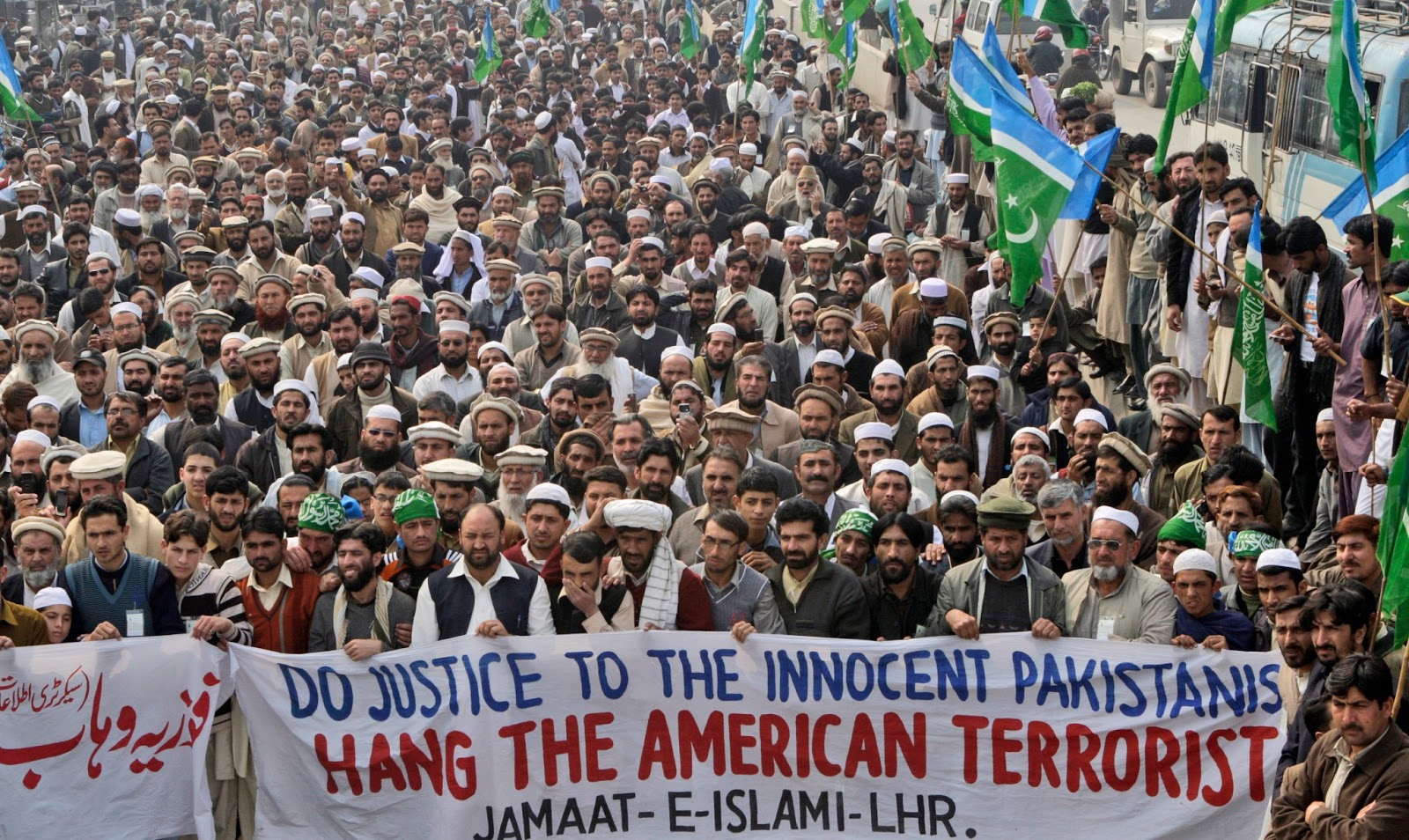 The A1 story in Sunday’s New York Times, written by Declan Walsh, is titled “U.S. Shift Poses Risk to Pakistan.” The story argues that, with the United States gradually dwindling down its political and military engagement with Pakistan, the latter faces a highly uncertain future. Walsh tells us that the disengagement will “diminish” the “prestige” and “political importance” Pakistan held as a “crucial player in global counterterrorism efforts” and could very well “upset its internal stability.”
It’s a piece that is revealing because one voice is noticeably left out of the analysis: that of the Pakistani people. Arguably the most salient fact about the U.S.-Pakistan dynamic is that Pakistanis – you know, the actual human beings who live in that country – despise the U.S. government and think the interaction between the two countries does more harm than good. Gallup conducted polling on these matters in Pakistan last year. An amazing 92% of Pakistanis expressed disapproval of U.S. leadership (i.e. Obama), while 4% approved. In a separate poll, 55% of Pakistanis reported that interaction with the West constitutes “more of a threat”; just 39% thought it was “more of a benefit.”
In a surprising development, Pakistanis don’t seem to support flagrant intrusions on their sovereignty, drone strikes that kill their fellow citizens, and a corrupt, secretive military government that regularly colludes with the U.S. (as of October, just 23% of Pakistanis expressed “confidence” in their government, which Gallup reports is widely viewed as being “too cozy” with the U.S.).
The Times article does not pay much attention to the thoughts and opinions of the Pakistani people, though. They’re background players and largely irrelevant. Walsh instead quotes a single Pakistani academic to support the article’s thesis; at other times in the piece he relies on unnamed “analysts” and “experts.” The only other individual he does quote on this narrow question of whether or not American disengagement “poses a risk” for Pakistan, a former Pakistani foreign minister, explicitly rejects the notion, saying that “less American involvement is good, not bad.”
The article concludes by stressing that, in fact, this alleged “shift” in the U.S.’s posture toward Pakistan is largely illusory, with “few” doubting that America “will remain deeply involved in Pakistan.” A former Obama administration official confidently predicts that the “mutual dependency” between the two countries “will not go away.” This basically undermines the entire point of the story.
Declan Walsh is a good reporter and he has spent a lot of time in Pakistan. But his virtual ignoring of the Pakistanis’ clearly expressed thoughts on these matters is instructive (the extent of the Pakistanis’ role in the article is a single sentence pointing out that drone strikes “stoked anger”). Consider the reverse scenario. Let’s say Pakistan had been propping up a corrupt military government here in the United States for years with aid and support. Pakistan was violating U.S. sovereignty at will, assassinating residents it considers a threat to Pakistani security, dumping their corpses in the ocean. Pakistan flew robots over American skies, from which missiles were regularly launched, killing American men, women, and children. Now imagine how we would feel if the most esteemed newspaper in the world published an article about all of this on its front page that completely ignored the will of the American public and disregarded our opinions.
Perhaps, when discussing geopolitics, we should consider the views of the populations themselves, and not just governments and elites. It’s a radical notion, but it just might make sense.
Syrian TV reporter killed by rebel sniper near Qusair
RT | May 27, 2013
Yara Abbas, a prominent female Syrian war reporter, was killed in the country’s west, Syrian officials confirmed. The country remains a dangerous place for journalists, especially as some rebel groups reportedly target them for assassination.
Abbas, 26, who worked for the privately-owned Damascus-based Al-Ikhbariyah TV (Syrian News Channel), was killed by sniper fire in a rebel attack not far from the Dabaa air base. The country’s Information Ministry offered no further details, but the pro-rebel Syrian Observatory for Human Rights claimed that several members of her TV crew were also wounded in the attack.
The base is located near the town of Qusair in Homs Province, an area near the Lebanese border that is the site of intense ongoing fighting between the Syrian army and rebel fighters.
More than 150 reporters have been killed in the Syrian conflict as of April 2013, the Union of Syrian Journalists reported. The majority of the victims were civilian journalists or local freelancers working for professional media.
Outlets that have lost staffers in the violence include French TV station France 2, French magazine Assaut, British newspaper the Sunday Times, Japanese news agency the Japan Press, Qatari TV station Al Jazeera, Iraqi newspaper Al-Thawra and Iran’s Press TV, as well as Syria’s Al-Ikhbariyah TV, Addounia TV and Sana news agency.

Yara Abbas at work. Screenshot from youtube.com @podrouga
Reporters also risk kidnap in Syria, as was the case with NBC News journalist Richard Engel and Russian-Ukrainian civilian journalist Ankhar Kochneva.
Some rebel groups specifically target journalists who work for government-affiliated outlets and international media, RT reporters were told by colleagues in Syria.
“I received confirmed news that some of the armed opposition forces are looking after the journalists working with international TV stations. This armed group is collecting a list of names. Mine is one of them. They are going to collect information about them from the Internet and keep them for future trials or assassination. You know for sure that the websites of RT, CCTV and Iran TV will be the first to be checked,” a local reporter told RT on condition of anonymity.
The ongoing civil war in Syria has claimed tens of thousands lives so far, with the UN estimating that more than 80,000 people have died in the violence.
Related article
- Journalist: Yara Abbas killed by NATO mercenary fire in Qusair, Syria (pennyforyourthoughts2.blogspot.com)
Colombia: extrajudicial executions killing still ongoing according to report
By George Nelson | The Argentina Independent | May 24, 2013
The Centre for Popular Research and Education (Cinep) in Bogotá has reported that during 2012 there were 11 separate cases of extrajudicial executions in Colombia, suggesting that executions known as ‘false positives’ are still ongoing. A further eight cases of arbitrary detention have also been reported, amassing a total of 52 victims.
The false positives scandal refers to the Colombian military’s alleged sanctioned practice of killing civilians and then dressing them up in guerrilla fatigues in order to present them as combat kills. Reports show that the executions usually target farmers, social activists, and political opponents.
The scandal is part of continuous armed conflict between Colombia’s government and the FARC and ELN, both guerilla forces. In May last year the International Federation of Human Rights (FIDH) alleged that over 3,000 civilians had been killed between 2002 and 2008 as a result of the conflict.
Cinep also claim that the general state of human rights in Colombia is poor with members of the paramilitary “the greatest violators” responsible for 565 cases, followed by the police with 268. Giraldo Serna, of Cinep, said, “Threats, tortures, disappearances, deaths, and social cleansing are still implemented in Colombia.”
The government denied ‘false positives’ are still occurring but Cinep believes the problem is far greater than people think. “Those who justify the false positives don’t realise they are damaging the prestige of the police force,” said Cinep spokesman Alejandro Angulo.
A million Israeli landmines planted in occupied Palestinian West Bank
MEMO | May 23, 2013
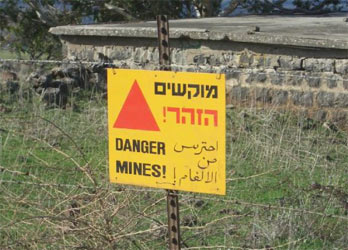
The 1997 Ottawa Treaty bans the use of mines, but countries like the US and Israel have opted to not sign the treaty
About a million landmines have been planted by the Israeli occupation in occupied Palestinian West Bank, official Palestinian data has shown.
The Commissioner General of the Palestinian Liberation Organisation in Washington, Maan Erekat, said: “The number of Israeli landmines planted is between 800,000 to a million.”
During his meeting with UN and NGO officials in New York on Wednesday, Erekat said: “This significant number of landmines poses great direct danger to the safety and security of Palestinian citizens.” He discussed efforts with the officials he met to remove these landmines.
Erekat reiterated the importance of “continuing the efforts being exerted by the UN and NGO in cooperation with Palestinian parties to remove the landmines planted around the occupied West Bank.”
The Israeli occupation has planted landmines in the Palestinian territories since it occupied the West Bank and the Gaza Strip in 1967 under “security” pretexts.
There are about 51 landmine fields scattered around the West Bank and the Gaza Strip, especially in the Jordan valley, the north and west of the West Bank, near the ‘Green Line,’ around Israeli settlements and around large empty spaces where Israeli soldiers practice their military drills.
Related article
Featured Video

Genocide-linked firm handles Britons’ NHS data
or go to
Aletho News Archives – Video-Images
Book Review
Book review: Boiling Point, How America Brought War to Ukraine
By Tim Kirby | Strategic Culture Foundation | November 14, 2026
Did Vladimir Putin just wake up one day on the wrong side of the bed and decide to invade Ukraine in February of 2022 or is there a lot more to this single decision that has been reshaping the 21st century geopolitical landscape?
Obviously, from the way that I just posed the question you can see that I am on the side that views the causes for the war in Ukraine to be very deep, long-term, historical and consciously nefarious, and most importantly, not from within the halls of the Kremlin. So it was a pleasure to take a look at the book “Boiling Point, How America Brought War to Ukraine” by author Stephen Kinzer, who like myself, also believes that the real reasons behind military conflicts around the world are not what CNN and the BBC have been telling you. The main thesis of this book was stated clearly by its creator; the war “may have been illegal, but it was definitely not unprovoked.” … continue
Blog Roll
 Aletho News
- The 10 Disease Renamings That Rescued the Vaccine
- NATO cancels 2027 leaders’ summit
- IAEA’s politicized use of safeguards undermines its impartiality: Russian envoy
- UK must be ready to strike Russian Arctic – ex-PM
- Fico’s Two Red Lines: Russian Energy and the Next Ukraine Loan
- Thousands rally for banned NATO-skeptic presidential candidate
- Ukraine Settlement and New European Security Architecture Must Go Hand in Hand – Kremlin
- Book review: Boiling Point, How America Brought War to Ukraine
- Israel Revives The ‘Iranian Assassination Threat Against Trump’ Deception In A Desperate Bid To Restart The War
- US rewrites history to dodge blame for illegal war on Iran: Foreign Ministry spokesperson
- If Americans Knew
- An error has occurred; the feed is probably down. Try again later.
- No Tricks Zone
- New Study: Barents Sea Temperatures Were Warmer And Sea Ice Less Extensive In The 1700s Than Today
- German Authorities Start Initiative To Evaluate Public Register For Climate “Disinformation” Spreaders!
- Zonal Asymmetry of Temperature Change in the Antarctic Circumpolar Current
- New Study: The Net Fossil Fuel Contribution To Rising Atmospheric CO2 Has Been Zero For 500 Years
- Germany’s Green Energy Transition Becoming Increasingly Expensive…Another 6 Trillion Euros!
- Sudden Stratospheric Warming, Powerful El Niño Combination May Lead To Extreme Europe Cold, Energy Crisis!
- Two New Studies Find Thwaites Glacier Melt Cannot Be Driven By Human Activity Or A Warming Ocean
- E-Cars Reduce CO2 Emissions By Only 41% Compared To Internal Combustion Engine Vehicles
- Predictions Made By Renowned Climate Professor Over Past Decades Have Been Proven To Be Poor
- New Study Suggests Large Regions Of The Pacific Ocean Have Been Cooling For The Last 80 Years

