The tears shed by assorted media at the news of David Miliband’s departure from British politics for a new life in New York had me reaching once again for the sick-bag.
“British politics will be a poorer place without David,” said brother Ed, leader of the Labour Party.
Will it? I’m pleased to see Peter Oborne’s straight-talking piece in The Telegraph putting Miliband D in his place.
“We are, after all, talking about someone who was at best a minor politician, no towering colossus,” writes Oborne. “After Labour’s 1997 election victory he was the poster boy of a new ruling elite which seized control of the commanding heights of British politics. Anti-democratic, financially greedy and morally corrupt, this new political class has done the most enormous damage. Since David Miliband was its standard-bearer, his political career explains a great deal about what has gone wrong with British public life, about why politicians are no longer liked or trusted, and about how political parties have come to be viewed with contempt.”
Oborne makes the point that Miliband set the pattern so many others, including his brother Ed, have followed. “Obsessed by politics at university, he has never had even the faintest connection with the real world. From life in think tanks he became a Labour Party researcher and special adviser, before being parachuted into the north-eastern constituency of South Shields as an MP.”
Miliband wrote Labour’s vacuous 1997 and 2001 election manifestos and was at the heart of the Labour machine when it generated the now notorious falsehoods over Iraq. Oborne also notes the irony of Miliband’s new job heading a humanitarian organisation “when the government of which he was such a loyal member created so many of the world’s disasters”.
We are reminded that Miliband was inexperienced and had no idea how the world worked, so was out of his depth when promoted to the Foreign Office. “During his short, undistinguished career, Mr Miliband has done grave damage to British politics. He is part of the new governing élite which is sucking the heart out of our representative democracy while enriching itself in the process… David Miliband has belittled our politics and he will not be missed.”
And having gone, many will be praying the Miliband brat won’t be back.
He will be forever remembered as the British foreign secretary who shamelessly apologized to Israel’s gangsters for the risk they ran of being arrested if they set foot in London. Back in 2009 Ehud Barak, Tzipi Livni and retired general Doron Almog, cancelled engagements in London for fear of ‘having their collar felt’. Israel complained bitterly and Miliband promised Lieberman that UK laws relating to ‘universal jurisdiction’ would be changed. He asked Prime Minister Gordon Brown and Justice Minister Jack Straw for urgent action.
When the general election ousted him from the Foreign Office, Miliband’s groveling promise was eagerly taken up by his replacement, William Hague, another fanatical ‘friend of Israel’, who declared that a situation where politicians like Mrs Livni could be threatened with arrest in the UK was “completely unacceptable… We have agreed in the coalition about putting it right, we will put it right through legislation… and I phoned Mrs Livni amongst others to tell her about that and received a very warm welcome for our proposals.”
Never mind that the arrest warrants were issued to answer well-founded criminal charges. Never mind that under ‘universal jurisdiction’ all states that are party to the Geneva Conventions are under a binding obligation to seek out those suspected of having committed grave breaches of the Conventions and bring them, regardless of nationality, to justice. And never mind that there should be no hiding place for those suspected of crimes against humanity and war crimes.
Human rights activists resorted to private arrest warrants because the government was in the habit of shirking its duty under the Fourth 1949 Geneva Convention and dragged its feet until the birds had flown.
Bringing a private prosecution for a criminal offence is an ancient right in common law and, in the words of Lord Wilberforce, “a valuable constitutional safeguard against inertia or partiality on the part of the authority.” Lord Diplock, another respected Lord of Appeal, called it “a useful safeguard against capricious, corrupt or biased failure or refusal of those authorities to prosecute offenders against the criminal law”.
And the beauty of the private warrant was that it could be issued speedily.
The servile Miliband’s action disgusted those who will never forget that Tzipi Livni, Israel’s former foreign minister, was largely responsible for the terror that brought death and destruction to Gaza’s civilians during the blitzkrieg known as Operation Cast Lead. Showing no remorse, and with the blood of 1,400 dead Gazans (including 320 children and 109 women) on her hands and thousands more horribly maimed, Livni’s office issued a statement saying she was proud of it. Speaking later at a conference at Tel Aviv’s Institute for Security Studies, she said: “I would today take the same decisions.”
Any British government minister who brings this degree of obsequiousness to his job and is prepared to undermine our justice system in order to make the UK a safe haven for the likes of her, deserves to be judged harshly.
Miliband is also remembered for not having the guts to visit Gaza, or even Iran, while in office. Yet he managed to reach Gaza in 2011 with Save the Children. “I had not been able to visit while in government for security reasons,” he said in an article in The Guardian. What nonsense. The only danger would have been from an air-strike by his psychopathic friends in Tel Aviv or a Mossad assassin. Those risks go with the job. You can’t be an effective foreign secretary wrapped in cotton wool.
He said the purpose of his eventual trip to Gaza was “to get a sense of life… to get a glimpse, albeit brief, of life for the people”. A pity he didn’t do that earlier instead of wielding his ministerial power in ignorance
While David Miliband headed up foreign policy it was frankly embarrassing to be British. What magical transformation has this pipsqueak recently undergone to make him the ideal candidate to run an organization like the International Rescue Committee? With the likes of Madeleine Albright, Condoleeza Rice, Colin Powell, and Henry Kissinger on board, you might wonder about the IRC’s presence in vulnerable countries like Syria, Iraq and Afghanistan.
No-one is about to forget Albright’s infamous remark about the human misery caused by the intervention and mayhem in Iraq, that “the price is worth it”.
– Stuart Littlewood’s book Radio Free Palestine, with Foreword by Jeff Halper, can now be read on the internet by visiting http://www.radiofreepalestine.org.uk.
March 29, 2013
Posted by aletho |
Ethnic Cleansing, Racism, Zionism, Timeless or most popular, War Crimes | David Miliband, Gaza, Geneva Conventions, Israel, Labour, Palestine, Peter Oborne, Politics of the United Kingdom, Tzipi Livni, Zionism |
Leave a comment
Official U.S. support for bands of killers dates back to the nation’s inception, likely one reason H. Rap Brown called violence “as American as cherry pie.” The country’s founding father helped start the trend when he sent General John Sullivan to Iroquois territory in 1779, giving him explicit instructions “that the country may not be merely overrun, but destroyed.” “It will be essential to ruin their crops,” the Town Destroyer—as Washington became known—emphasized. Sullivan and his men brought their adventure to a close when they “skinned the bodies of Indians from the hips downward, to make boot tops or leggings,” historian Ernest Cruikshank wrote in the late 1800s, prompting a contemporary, John Watts de Peyster, to wonder “which were the savages, the Continental troops or the Indians,” in the situation just described.
Scholars today tend to remark only that Washington seems “more a monument than a man,” as Gordon Wood never tires of pointing out; Wood spoke a month ago at an event celebrating Washington’s birthday, beginning with the premise that the first U.S. president was great, and proceeding from there. Bertrand Russell once criticized medieval philosophy for assuming in advance it knew the truth, thereby avoiding genuine inquiry—still apparently a prerequisite for academic success, given Wood’s reputation.
The belief that indigenous groups wasted the opportunities the land provided drove policies of dispossession and extermination, the latter being the term Jefferson, Jackson, and other luminaries favored. Little wonder Hitler admired this facet of U.S. history. During the California Gold Rush, whites murdered and raped the region’s native inhabitants, some of whom had known there was gold in the area, without valuing it as an exploitable resource. What could the land’s rightful owners do with such people? “Why not annihilation?” Wizard of Oz author L. Frank Baum asked in an 1890 editorial, capturing the zeitgeist.
These assumptions about the right to control territories, and the obstacles blocking enlightened developers from achieving their aims, grew more expansive after the Native American genocide. As WWII drew to a close, U.S. planners outlined a system of “foreign missions throughout the world” in conformity with corporate aims. “We are colonizing to some extent,” Representative Eugene Worley (D-TX) affirmed, not quite doing justice to Washington’s plans to copy the British imperial model—“a good goal to shoot at, because they are the masters,” the American Maritime Council’s John E. Otterson argued, voicing views his audience, a House subcommittee, received well. After listening to Assistant Secretary of State Adolf Berle’s 1943 discussion of U.S. intentions to govern the planet’s skies, Representative Charles A. Eaton (R-NJ) asked him to “define for us the difference in principle between Mr. Hitler’s program to obtain control of all land and all peoples and all oceans and seas, and the proposed program now for America to obtain control of all the air on earth[.]”
One of Eaton’s colleagues clarified the distinction: the U.S. sought “world power as trustee for civilization,” while Hitler wanted it merely “for the benefit of a bunch of Nazi gangsters.” Any student of U.S. history should have been able to recognize the country’s pure intentions—and if, for some reason, the examples of Town Destroyer and the Gold Rush proved unpersuasive, the coming decades would further testify to its benevolence. In 1976, we see that Secretary of State Kissinger encouraged the Argentine government to carry on with its dirty war, in which the military “disappeared” as many as 30,000 people. “The quicker you succeed the better,” the Nobel Peace Laureate stressed, and by the late ’70s the CIA was bringing Argentine officers into Honduras, so they could teach their Central American counterparts what they had mastered.
Doris Rosibel Benavides Tarrius, a young psychologist, experienced first-hand the Honduran students’ aptitude. Security forces abducted her in March 1987, taking her to a facility where they raped her, and strung her up on a metal bar to shock her feet and breasts, in what was called an “airplane position.” A decade earlier, an Argentine mechanic named Marcos Queipo watched as military planes passed over the Paraná Delta, dropping mysterious packages that plummeted to the riverbanks far below. Horacio Verbitsky, an investigative journalist, learned about these flights years later, when a stranger approached him in the Buenos Aires subway. “I want to talk to you,” the man said, explaining he had helped prosecute the dirty war. “You’ll see that we did things worse than the Nazis,” Adolfo Scilingo continued, subsequently telling of how he pushed several thousand suspected subversives, each drugged into a stupor but still alive, out of airplanes. Queipo saw some of their bodies in the packages he opened, though most of the murdered have never been found.
The killings continue in Honduras, where violence targeting lawyers, human rights defenders, LGBT people, women and others has intensified since the June 2009 coup. Two School of the Americas graduates helped topple the democratically-elected leader that month, and Obama supported the ensuing presidential election, a farce the mainstream media would have ridiculed had it taken place in, say, Venezuela. Last fall, the Honduran Commission of Truth identified several patterns of repression endangering the public, which the World Bank never mentions in the summary of its “Safe Municipalities Project,” ostensibly aimed at promoting “citizen security.” One of the Bank’s real goals seems to be expanding the Honduran police’s reach into areas like Choloma—“a dustbin industrial mecca for maquiladoras,” as scholar-activist Adrienne Pine described it. Juan Carlos Bonilla, accused of extrajudicial killings, oversees the entire Honduran National Police, even though the State Department tried to claim otherwise, saying it directed U.S. funds only to vetted units outside his purview.
Allegations of death squad-style murders have been leveled at Bonilla’s men in recent years, indicating the Bank’s “security” aims apply less to human beings then they do to the current economic model, in which agribusinesses thrive, while displaced peasants are forced into manufacturing work. The situation brings to mind the Bank’s steady lending to Guatemala in the late ’70s and early ’80s, when the genocidal government was slaughtering Mayans to free up the areas designated for the Chixoy Hydroelectric Dam.
As in the past, only an enlightened few seem to grasp the land’s enormous potential as a profit source. The rest pay for their ignorance, often with their lives. It’s an old story, but no less infuriating for that—and the trend’s deep roots in the past indicate a combination of radical thinking and enormous effort is required to end the system enabling it.
Nick Alexandrov lives in Washington, DC. He can be reached at: nicholas.alexandrov@gmail.com.
March 29, 2013
Posted by aletho |
Ethnic Cleansing, Racism, Zionism, Subjugation - Torture, Timeless or most popular, War Crimes | California Gold Rush, George Washinton, Honduran National Police, Honduras, Latin America, Obama, Town Destroyer, United States |
Leave a comment
The frontier between North and South Korea is the most militarized border in the world. There is, of course, another partitioned state in Asia, India-Pakistan, where each side possesses nuclear weapons and commands hundreds of thousands of soldiers. In Korea, though, the stakes are especially high because one of the belligerents is a superpower.
On the opposite side, the world’s most likely superpower-in-the-making, China, is North Korea’s only close ally. It’s not clear that China would intervene militarily in the North’s defense, but the possibility of such action raises the stakes of confrontation even higher. The last war on the Korean peninsula, from 1950 to 1953, pitted the same two outside powers against each other. The Korean War produced well over 2 million civilian casualties.
At various times in the past 20 years, the Pentagon has estimated that one million Korean civilians, divided evenly between North and South, would die in the first days of an all-out war. More than 25 million people live in metropolitan Seoul, South Korea’s capital. The Pentagon refers to the area as the “kill box.”
US military power is overwhelming, but North Korea does possess some deterrents. That’s why there would be casualties on both sides. Chief among the North’s deterrents may be its set of more than 10,000 artillery pieces, dug into the mountains, which could bombard Seoul with explosive, incendiary or chemical weapons. There is no evidence that the North is technically capable of delivering or detonating a nuclear weapon in the South, but the regime has worked in recent years to develop suitable delivery systems and to turn their unwieldy nuclear “devices” into bombs.
In the standard media representation, the rulers of the Democratic People’s Republic of Korea (DPRK — North Korea’s official name) are uniquely bellicose, unpredictable and irrational. Some would say “inscrutable” if that word weren’t obviously racist. George W. Bush was an obvious racist, of course, so he was true to form when he called the regime’s then-General Secretary Kim Jong-il a “pygmy.”
Despite the media’s befuddlement over the regime’s motivations and intentions, they aren’t difficult to figure out. They come through quite clearly at the English-language site of the Korean National News Agency (KCNA) once you figure out how to read through the froth and invective. American reporters and editors are inclined to dismiss the KCNA’s reports because they’re pretty sure that the US can’t be “imperialist” or “arrogant,” as the KCNA claims, and because they treat State Department and Pentagon sources as generally honest and reliable.
These credulous attitudes may arise from complacency, unthinking patriotism, or the job pressures inside the corporate media. In any case, US news outlets consistently produce egregious distortions when they cover the DPRK’s conflicts with the United States. Sometimes the accounts of North Korean actions are accurate enough. Often what makes the picture false is the misrepresentation — or simple omission — of US actions.
As a result, the picture of US-DPRK relations is topsy-turvy. Below, I discuss three points that the media usually get backwards.
1) North Korea nuclearized the peninsula with its bomb test of 2006.
Wrong. The US threatened the use of nuclear weapons in the Korean War of 1950-1953, and President Eisenhower installed an ongoing nuclear arsenal beginning in 1958. The weapons included missiles, bombs and artillery shells. F-4 fighter planes were on constant alert — armed only with nuclear bombs.[1]
There were also portable “atomic demolition mines” (ADMs) that weighed just 60 pounds each. With an explosive yield equivalent to 20 kilotons of TNT, the mines were more powerful than the Hiroshima bomb. Korea specialist Bruce Cumings writes:
The ADMs were moved around in Jeeps and placed by special teams who carried them in backpacks; meanwhile, US helicopters routinely flew nuclear weapons near the DMZ [the Demilitarized Zone, which divides North from South Korea].… Meanwhile, forward deployment of nuclear weapons bred a mentality of “use ‘em or lose ‘em”; even a small North Korean attack might be cause enough to use them, lest they fall into enemy hands.[2]
President George H.W. Bush withdrew nuclear weapons from the peninsula in 1991 as a cost-free way to place the burden of disarmament on North Korea. The US, of course, was not disarming at all. The Gulf War had shown that the latest generation of “conventional” weapons could inflict suitably horrific damage, and besides, nuclear weapons would be ready-at-hand on offshore ships, submarines and planes.
2) North Korea is serial violator of the Armistice of 1953.
The DPRK regime declared on March 11 of this year that it was nullifying the armistice of 1953. Ban Ki-moon of the United Nations replied that the North could not nullify the agreement unilaterally. The UN is involved because the US fought the Korean War against North Korea and mainland China in the name of the UN. At the time, the anticommunist Taiwan government represented China on the Security Council — a fact that led the USSR to boycott the council. With mainland China excluded and the USSR boycotting, the war resolution passed without a veto.
The fighting ended with an armistice, not a peace treaty, so the “UN coalition” is still technically at war with North Korea. I’m not sure why nobody mentions being at war with China, too.
The South Korean defense ministry declared in 2011 that North Korea had violated the armistice 221 times since 1953. This includes 26 claims of military attacks. Some of these attacks were serious, including a 2010 torpedo attack that killed 46 South Korean sailors and an artillery bombardment later in the same year that killed two South Korean marines and two civilians. In the first case, North Korea denies making the attack. In the second, the regime claims that South Korea shot first.
In fact, the regime often disputes accusations of violating the armistice, declaring that their actions were responses to violations by the US and South Korea. Unfortunately, nobody seems interested in keeping records about those violations. (If somebody finds a decent account, please let us know.)
The important thing to know about armistice violations is the big one: The US deployment of nuclear weapons violates an explicit ban on the introduction of “qualitatively new” weapons to Korea. The ban applies to the whole Korean “theater,” so offshore weapons are included.[3] The US has thus committed a major violation of the Armistice continuously for 55 years.
This nuclear posture was known in the Cold War as a “first-strike” policy, since it licensed the use of nuclear weapons even without a nuclear provocation. The US renounced the first-strike option in the European theater but not in Korea. “The logic,” writes Bruce Cummings, “was that we dare not use nuclear weapons in Europe because the other side has them, but we could use them in Korea because it doesn’t.”[4]
3) North Korea has violated the nuclear Nonproliferation Treaty.
The world’s great powers came up with the nuclear Non-Proliferation Treaty (NPT) in 1968 as a way to maintain their monopoly on nuclear weapons. In the treaty, the nuclear states of that time — the US, Britain, France, the USSR and China — made a vague promise to negotiate their own disarmament in the future.
In order to induce non-nuclear states to sign, the treaty stipulated that nuclear-armed states would help the NPT’s non-nuclear members to develop nuclear power for peaceful uses such as energy production. As a further inducement, the nuclear-weapons states offered a side agreement (not in the NPT) in which they promised not to threaten non-nuclear signatories of the NPT with nuclear attack — or to carry out such attacks.
North Korea did not sign the NPT until 1985. At the time, the DPRK had a small reactor that produced plutonium waste and very little electricity. The Reagan administration feared that the waste could be stockpiled to make a weapon. The US encouraged Konstantin Chernenko, then premier of the USSR, to offer North Korea light-water reactors (LWRs), which produce no waste that can easily be converted into weapons-grade material. The energy-strapped DPRK accepted the deal and agreed to sign the NPT.[5] This was the kind of quid pro quo that the treaty’s authors anticipated when they wrote it.
The USSR was crisis-ridden in the 1980s and dithered over construction of the four promised LWRs, which would have cost about $1 billion apiece. When the Soviet state collapsed in late 1991, the DPRK lost one of its two patrons — the other was China — and entered a decade of natural disaster, economic regression and famine.[6]
With US technical help, and upon US insistence, the UN’s atomic agency (IAEA) began mandatory, intrusive inspections of the DPRK’s nuclear sites in 1992. Following the Gulf War of 1991, the US and the chief inspector of the International Atomic Energy Agency (IAEA), Hans Blix, improvised a new regime of mandatory inspections backed by the threat of Security Council sanctions. Iraq, Iran and North Korea were the intended target of these “special inspections.” The NPT does not authorize any of this.
IAEA inspectors did surmise in 1992-1993 that North Korea had probably stockpiled a significant amount of plutonium. US intelligence operatives looked over the IAEA data and concluded that the hypothesized amount of stockpiled plutonium would be enough to construct one or two nuclear weapons, although they believed that the DPRK was as yet technically incapable of making the plutonium into bombs. These intelligence estimates gave rise to an oft-quoted “worst-case scenario” according to which North Korea already possessed two nuclear weapons in the 1990s.[7]
Stockpiling plutonium may constitute a violation of the NPT, but if so, then Japan is many times more guilty than North Korea. With US approval, Japan has stored up enough plutonium to construct 5,000 warheads. Nevertheless, Japan’s nuclear sites have never been subject to UN “special inspections,” although the country’s nuclear safety record suggests that it wouldn’t be a bad idea.
North Korea declared Blix to be a stooge of the United States — which, of course, he was — and threatened to pull out of the NPT. Eventually, Clinton backed away from the crisis. He offered to provide the LWRs previously promised by the USSR in return for North Korea’s acceptance of further IAEA inspections. The deal was formally written up along with some other provisions, dubbed the “Agreed Framework,” and signed by both parties.
Like the USSR, the US never delivered the LWRs — never even broke ground on them. If we’re looking for violations of the NPT, that’s a clear one, since the NPT obligates nuclear-weapons states to help non-weapons states with nonmilitary nuclear projects.
The promise of LWRs may have been the part of the Agreed Framework that the Northern regime cared most about. For the entire time of its membership in the NPT, from 1985 to 2003, North Korea waited for assistance with nuclear electricity-production that never came. In Clinton’s second term, those who wanted to ridicule the DPRK began to point to nighttime satellite photos of East Asia that showed every country but North Korea lit up. They didn’t mention that the US played a role in turning out the lights.
Meanwhile, although the US had signed every updated version of its 1968 promise not to target non-nuclear-weapons states, Bill Clinton reaffirmed the first-strike policy against North Korea in 1993. After the Soviet Union collapsed, Clinton publicly approved the retargeting of ballistic missiles from Russia to North Korea.[8]
In January 2002, George W. Bush named North Korea, Iraq and Iran as members of an “Axis of Evil.” Then in March, a leak of Bush’s “nuclear posture review” reconfirmed the US first-strike policy. By the fall, Bush was building up troops in the Middle East to overthrow the Iraqi government. Kim Jong-il had good reason to believe that his government would be next.
In January 2003, North Korea withdrew from the NPT. The treaty itself authorizes a members’ withdrawal when its sovereignty is threatened:
“Each Party shall in exercising its national sovereignty have the right to withdraw from the Treaty if it decides that extraordinary events, related to the subject matter of this Treaty, have jeopardized the supreme interests of its country.”
There’s no doubt that George W. Bush’s “global war on terror” qualified as a set of extraordinary events that jeopardized the DPRK’s supreme interests.
In 2010, Barack Obama confirmed once again that the US “nuclear posture” was to keep targeting North Korea. For North Korea and Iran, said Defense Secretary Robert Gates, “All options are on the table.” It’s a phrase that Obama has used many times since, and it suits his understated style: Threaten the maximum, but make it sound moderate.
[1] Bruce Cumings, Parallax Visions: Making Sense of American–East Asian Relations at the End of the Century (Duke University Press Books, 1999), 127-130.
[2] Ibid., 130.
[3] Ibid., 128.
[4] Ibid., 132.
[5] Don Oberdorfer, The Two Koreas: A Contemporary History (Rev. & upd. Basic Books, 2002), 245 and 289.
[6] For more detail on North Korea’s crisis, and on the imperial interests at play in Korea from 1985 to 2003, see my “What’s at stake in North Korea” in the International Socialist Review, March-April 2003. A PDF is available here.
[7] Oberdorfer, 276.
[8] Cumings, 142.
March 29, 2013
Posted by aletho |
Deception, Mainstream Media, Warmongering, Militarism, Timeless or most popular, War Crimes | George H. W. Bush, George W. Bush, Korea, Korean War, North Korea, Seoul, South Korea, United States |
Leave a comment
With Syria on the brink of national genocide, outside nations have only two options: help reverse the catastrophe or plunge this torn nation deeper into the abyss. Countries can either work towards a peaceful political solution or they can continue to pour money, guns, and fighters into the country to ensure a steady gushing into the bloodbath.
President Obama will have no talk of peace. He has chosen war since the very start and he’s sticking to it. A recent New York Times article revealed that President Obama has been lying through his teeth about the level of U.S. involvement in the Syrian conflict since the beginning.
The President recently said that the U.S. government continues to give only “non-lethal” military aid to the rebels, but the New York Times revealed that the CIA has been actively funneling and distributing massive shipments of weapons to the rebels over the borders of Jordan and Turkey.
This “arms pipeline” of illegal gun trafficking has been overseen by the U.S. government since January 2012. It has literally been the lifeblood of the Syrian “rebels,” and thus the cause of the immense bloodshed in Syria.
The New York Times reports:
The C.I.A. role in facilitating the [weapons] shipments… gave the United States a degree of influence over the process [of weapon distribution]…American officials have confirmed that senior White House officials were regularly briefed on the [weapons] shipments.
The article also explains that a “conservative estimate” of the weapons shipment to date is “3,500 tons.”
So while Obama has repeatedly lied about “non-lethal” military aid, he has been personally involved in overseeing a multi-country flood of weapons into Syria, many of which are given to terrorist organizations. The only effective fighting force for the Syrian rebels has been the terrorist grouping the Al Nusra Front, and now we know exactly where they got their guns.
If not for this U.S.-sponsored flood of guns, the Syrian rebels — many of them from Saudi Arabia and other countries — would have been militarily defeated long ago. Tens of thousands of lives would thus have been spared and a million refugees could have remained in their homes in Syria. The large scale ethnic cleansing initiated by the rebels would have been preventable.
But Obama is so intent on war that he will not even discuss peace with the Syrian government. He has repeatedly stated that there are “preconditions” for peace negotiations, the most important one being the downfall of the Syrian government, i.e., regime change. If a toppling of a nation’s government is Obama’s precondition for peace, then Obama is by definition choosing war.
Never mind that Syria is a sovereign nation that should not have to worry about a foreign country making demands as to who is in power. Obama doesn’t seem to think this relevant. In fact, his administration has been very busy determining who the “legitimate” government of Syria is, by hand picking the “National Coalition of Syrian Revolution,” the prime minister of which is a U.S. citizen.
One of the preconditions for being on Obama’s National Coalition of Syrian Revolution is that there be no peace negotiations with the Syrian government. Of course most Syrians want to immediately end the conflict in Syria, since it threatens an Iraq-like destruction of the country.
The most popular leader of the National Coalition of Syrian Revolution, Moaz al-Khatib, recently quit in protest because he was prohibited from pursuing peace negotiations by the U.S.-appointed opposition Prime Minister, Ghassan Hitto, a U.S. citizen who had lived in the U.S. for the previous 30 years.
The Guardian reports:
Immediately after his nomination as interim [Prime Minister], Ghassan Hitto [U.S. citizen], had distanced himself from Al-Khatib’s willingness to negotiate with elements of the Assad regime in a bid to bring an end to the civil war.
By appointing Hitto as the leader of the opposition, Obama has splintered the already-splintered opposition while making “no peace negotiations” the official policy of the U.S.-backed opposition, the so-called “legitimate” government of Syria.
Obama also recently pressured the Arab League — composed of regimes loyal to the United States — to install as a member the hand-picked National Coalition of Syrian Revolution as the official government of Syria. The appointment didn’t give as much credibility to the opposition as much as it degraded the Arab League’s legitimacy.
The rebel’s seat in the Arab league implies, again, that the U.S. and its allies are fully intent on “regime change,” no matter how many people die, no matter the existing political alternatives. They will not reverse course.
The Russian government called the Arab League membership decision “… an open encouragement of the [rebel] forces which, unfortunately, continue to bet on a military solution in Syria, not looking at multiplying day by day the pain and suffering of the Syrians…. Moscow is convinced that only a political settlement and not encouraging destructive military scenarios, can stop the bloodshed and bring peace and security to all Syrians in their country.”
Obama has rejected both Russian and Syrian calls for peace negotiations in recent months, as he has greatly increased the frequency of the weapons trafficking plan. Reuters reports on the Obama Administration’s reaction to peace proposals from Russia and Syria:
…[Syria’s Foreign Minister’s] offer of [peace] talks drew a dismissive response from U.S. Secretary of State John Kerry, who was starting a nine-nation tour of European and Arab capitals in London [to help organize support for the Syrian rebels].
Obama rejects peace because he cannot dictate its outcomes. When it comes to war the more powerful party decides what the peace looks like, and Obama’s rebels are — after two years — still in a poor position to bargain a favorable peace to the United States, no matter how many tons of guns the U.S. has dumped into Syria. This is because the Syrian government still enjoys a large social base of support, something you’ll seldom read about in the U.S. media.
Another sign of war lust from the Obama administration came after the Syrian government accused the rebels of a chemical weapons attack. The U.S. government initially dismissed the accusation, until the rebels later accused the Syrian government of the attack.
But even Syria’s rebels have admitted that the chemical weapons attack took place in a government controlled territory, and that 16 Syrian government solders died in the attack along with 10 civilians plus a hundred more injured. But the rebels make the absurd claim that the government accidentally bombed themselves with the chemical weapons.
No matter who is responsible, the Obama administration plans to hold the Syrian Government responsible for crossing the “red line” of a chemical weapons attack (Obama’s version of Bush’s infamous “weapons of mass destruction”). The red line refers to a direct military invasion, versus the prolonged blood-letting that has been U.S. policy so far.
Obama’s envoy for the United Nations, Susan Rice, issued a statement about the chemical weapons attack that, according to the New York Times, “… repeated previous American warnings that there would be “consequences” if the Assad government used or failed to secure chemical weapons.”
So, if the Syrian rebels get hold of chemical weapons and use them on the Syrian government — as seems to be the case — the Syrian government should be held responsible, according to the Obama Administration, “for not securing chemical weapons.”
There is zero room for truth with logic like this. But the perverse logic serves to protect Obama’s prized rebels, who’ve committed a slew of atrocities against the Syrian population, and who gain key political and media protection from the U.S.
Ultimately, the entire Syrian war was born amid the big lie that the battle began — and continues — as a popular armed struggle. But the real revolutionaries in Syria like the National Coordination Committee, have long ago declared that they want a peaceful end to this conflict.
Obama’s Bush-like determination to overthrow the Syrian government has led him down the same path as his predecessor, though Obama is fighting a “smarter” war, i.e., he’s employing more deceptive means to achieve the same ends, at the exact same cost of incredible human suffering.
March 29, 2013
Posted by aletho |
Militarism, Progressive Hypocrite, War Crimes | Moaz al-Khatib, Obama, Syria, United States |
Leave a comment

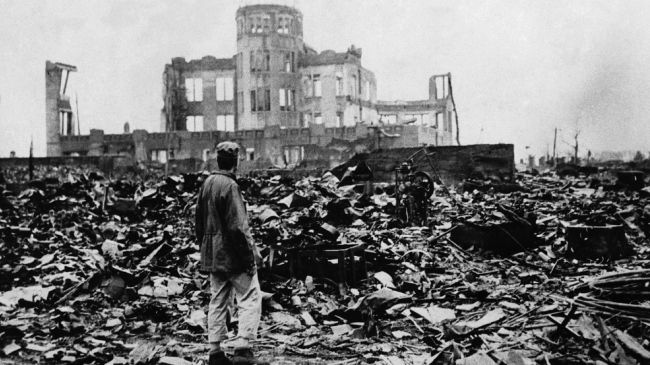
Officials in the Japanese city of Hiroshima have updated the number of victims from the Second World War atomic bombing by the United States, saying it is 15,000 more than the previously recorded figure.
According to a new report released on Thursday, the total number of the explosion-affected people from the 1945 nuclear bombardment of the city has climbed up to hit 557,478 people, Xinhua reported.
The report also updated the actual number of “direct victims” of the atomic bombing – those who were within the city and its neighboring towns and villages – to 384,743. It also put the number of victims who have died so far at 277,996.
The report primarily focuses on demographic changes in recent decades and was compiled as part of an over 30-year investigative project by the Hiroshima City on the atomic bombing victims.
Kaoru Ohsugi, Director of the research division of the Atomic Bomb Survivors Relief Department at the Hiroshima City Office, said that since there are still different ways to interpret the numbers concerning the A-bomb victims and damage, the division decided to update the figures, collecting new information and checking the details using computers.
“Considering the remaining time the survivors have to live and the verification procedures we can use, this report may be the last edition the city officially issues,” he said.
In the only instances of the use of nuclear weapons against another nation in history, the United States bombed the Japanese cities of Hiroshima and Nagasaki within a space of three days, killing hundreds of thousands of people. The nuclear radiation continued to claim thousands of more lives over the following years.
March 29, 2013
Posted by aletho |
War Crimes | Hiroshima, Hiroshima City, Nuclear weapon, United States |
Leave a comment
Deutsche Bank is bracing for more than 300 million euros (256 million pounds) in charges linked to suspect violations of U.S. sanctions on Iran, a German weekly reported on Sunday.
Deutsche Bank, Europe’s biggest bank by assets, on Wednesday increased its provisions for litigation by 600 million euros to 2.4 billion euros, citing mortgage-related lawsuits and other regulatory investigations, Reuters reported.
Without specifying its sources, magazine Der Spiegel said the money set aside could be a sign U.S. investigations of possible Iran-linked transactions had reached an advanced stage.
Deutsche Bank on Wednesday declined to lay out in detail why it had increased provisions. On Sunday, it would not comment on the magazine report.
The U.S. government is cracking down on foreign banks it accuses of undermining its effort to throttle Iran’s economy. In the most prominent case, London-based Standard Chartered last year agreed to pay $667 million (437 million pounds) to settle charges it violated sanctions against Iran and other countries.
Other lenders in the crosshairs of U.S. investigators include Commerzbank , Unicredit division HVB, and HSBC in Britain.
Der Spiegel said that apart from the Iran probe, Deutsche Bank’s 2.4-billion-euro legal provisioning included 500 million for a probe of suspected manipulation of interbank lending rates.
Several sources familiar with the investigation told Reuters on Thursday that German markets watchdog Bafin is set to rebuke Deutsche Bank over how it supervised its contribution to the setting of the lending rates.
March 28, 2013
Posted by aletho |
Economics, War Crimes, Wars for Israel | Deutsche Bank, Iran, Sanctions against Iran, Standard Chartered, Unicredit |
Leave a comment
The comprehensive economic sanctions imposed on Iraq by the UN Security Council in the 1990s fundamentally changed the way we think about sanctions. Sanctions had been seen as a middle route, which was nonviolent, yet more robust than diplomacy. But in Iraq, the humanitarian impact was devastating: child mortality spiked, malnutrition was widespread, the middle class disappeared, and critical infrastructure, such as electricity and water treatment, declined precipitously and never recovered. As the humanitarian crisis continued, activists, practitioners and scholars questioned the ethical legitimacy of sanctions.
The response was the development of targeted “smart” sanctions, which would ostensibly harm only the political or military leadership of the targeted state, or block prohibited goods, without impacting the civilian population. Targeted sanctions included arms embargoes, asset freezes of individual persons and companies, visa denials, and targeted trade sanctions, such as conflict diamonds. There were still unilateral measures that were patently indiscriminate, most prominently the U.S. embargo against Cuba. But by the late 1990s, the Security Council was no longer imposing new measures that were comprehensive.
In the last couple of years we have seen a return to aggressive, deeply damaging measures that are designed to cripple the target nation’s economy as a whole, particularly in the case of Iran. The U.S. sanctions on Iran have been extreme, broadly prohibiting trade, shipping, banking transactions, and investment in Iran’s energy sector. In the last few years we’ve seen the U.S. expand these prohibitions, to restrict not only American companies, but foreign banks and companies as well. The U.S. has aggressively prosecuted major global financial institutions for violations of U.S. sanctions law, and in the last two years there have been a number of cases where banks paid penalties on the order of half a billion dollars each.
Unsurprisingly, the result has been a considerable chilling effect: it is now common to see companies refusing to engage in any transactions at all with Iranian nationals, even for clearly legal purposes. For example, a Swiss organization, the GAVI Alliance, provides vaccines to developing countries. The GAVI Alliance is not subject to U.S. law, but its efforts to provide medical goods to Cuba and Sudan are hampered by U.S. restrictions on shipping companies. Canada’s TD Bank summarily closed down the accounts of Iranians residing legally in Canada. In the U.S., there are growing reports that Iranian-Americans, who in principle are permitted to send remittances to family members in Iran, cannot find any bank in the U.S. or elsewhere that will transfer the funds.
No one could plausibly claim that the U.S. sanctions on Iran are “smart” sanctions. They have crippled Iran’s ability to export oil, to buy gasoline, to import goods of all kinds, to extract and refine oil and natural gas, and to manufacture pharmaceuticals. The irony is that the UN Security Council measures on Iran are perceived to be narrowly crafted to avoid exactly this outcome. The Security Council resolutions only require member states to address cargo, technology, or financial transactions that could contribute to Iran’s nuclear program or ballistic missiles. No one would think that such a specific mandate could have humanitarian consequences—how can depriving a country of nuclear weapons affect education and food security?
But the resolutions contain “hooks” that are then invoked by U.S. allies to impose measures that mirror those of the United States, in a kind of dance of mutual deniability. The Security Council resolutions invite nations to “exercise vigilance” in their dealings with Iran, specifically with Iran’s Central Bank, and with two of its leading banks, Bank Saderat and Bank Melli. It is hard to imagine a term that is more vague and less informative than “exercise vigilance.” After all, we exercise vigilance every time we cross a street or lock a door. But a number of U.S. allies, known as the “like-minded” countries—the European Union, Canada, Australia, Japan, and South Korea—have invoked the call to “vigilance” as justification for imposing broad, damaging measures on Iran, approaching the blanket nature and severity of the U.S. sanctions. Last year, the EU cut off gasoline sales to Iran, and blocked Iranian access to European ports and shipping lines. SWIFT, the global hub for financial messaging critical for international commercial transactions, cut off access to Iran last year.
This disconnect between a seemingly narrow mandate and its broad application is far from a coincidence; it is a deliberate strategy that affords the international community mutual deniability. The EU and the “like-minded” countries can claim that they are not acting unilaterally; they are just being vigilant, as the Security Council has asked them to. At the same time, the Security Council can maintain that it has not imposed unreasonable measures on Iran; its sanctions only concern nuclear weapons and are meant to minimize the humanitarian damage.
In the end, the result is not so different than what we saw in Iraq two decades ago. If you cripple a nation’s access to shipping, energy, and banking, that will cripple its ability to provide health care, food security, electricity, transportation, and other basic needs of its population. The dance of mutual deniability may mean that it’s harder to see how the sanctions work. But that doesn’t mean they’re doing any less harm.
March 28, 2013
Posted by aletho |
Deception, Timeless or most popular, War Crimes | European Union, GAVI Alliance, Human rights, Iran, Iraq, Sanctions against Iran, United States |
Leave a comment
UN Secretary General Ban Ki-moon has chosen Swedish scientist Ake Sellstrom to lead a UN investigation into the use of chemical weapons in Syria.
“He is an accomplished scientist with a solid background in disarmament and international security,” UN spokesman Martin Nesirky announced on Tuesday.
The fact-finding team was set up at the request of the Syrian government after insurgents in Syria were accused of using chemical weapons against civilians near the northern city of Aleppo where dozens of people have been killed and nearly 140 more injured.
It was not immediately clear who else would be on Sellstrom’s team. Russia said on Monday that Russian and Chinese experts should be part of the investigation, but Moscow’s U.N. Ambassador Vitaly Churkin said on Tuesday that Russia would “most likely not” be represented.
Sellstrom was a chief inspector for UNSCOM, the U.N. inspection team that investigated and dismantled Iraq’s biological and chemical weapons programs in the 1990s, reports said.
Sellstrom also worked with UNMOVIC, the U.N. group that returned to Iraq in 2002 and found no solid evidence that Baghdad had revived its weapons-of-mass-destruction programs before the 2003 U.S.-led invasion as Washington and London alleged at the time.
March 27, 2013
Posted by aletho |
War Crimes | Aleppo, Syria, United Nations Special Commission |
Leave a comment

(photo: U.S. Air Force)
Apparently stung by mounting criticism of its remote control assassination program, the Obama administration early this month secretly reneged on an Air Force promise to “provide more detailed information on [drone operations] in Afghanistan” by failing to provide data on drone strikes for February. And in an Orwellian twist, the Air Force removed the previously released data on drone strikes from the reports for October 2012 to January 2013.
According to the data, the Air Force actually relies more heavily on piloted aircraft to conduct airstrikes, with drones responsible for only about one-quarter of missiles fired. The data shows that the Air Force conducted 1,366 drone strikes in Afghanistan between 2009 and January 2013. Although casualty figures were omitted, it is known that the U.S. has killed between 3,049 and 4,376 civilians in Pakistan, Yemen, and Somalia during about 500 “covert” drone strikes, including at least 179 children—the equivalent of 9 Newtown child massacres.
Indeed, parents who have seen their children killed by U.S. bombs don’t care if the person who pushed the button that released the bomb was inside an airplane or in a control room thousands of miles away.
The “sanitized” reports without the drone strike data were created on February 22, just two days after Sen. Rand Paul (R-Kentucky) threatened to filibuster the nomination of John Brennan to be CIA Director over Paul’s concerns that the Obama administration believed it had the authority to use drone strikes inside the U.S. Joined by Sen. Ron Wyden (D-Oregon), Paul filibustered for almost 13 hours, finally getting a denial from Attorney General Eric Holder that this administration believes it has such authority.
Although the Defense Department released a statement claiming the data was removed to make the reports more accurate in light of the unsupported assertion that most drone operations do not include strikes, the Pentagon also took pains to state that it was not involved in the decision to hide the data. That can only mean that the decision came straight from the White House—almost certainly from President Obama himself, who, ironically, promised in 2008 to run the federal government in a more open and transparent manner.
March 26, 2013
Posted by aletho |
Militarism, Progressive Hypocrite, War Crimes | Afghanistan, Air Force, Eric Holder, Obama, Rand Paul, Ron Wyden, United States, Unmanned aerial vehicle |
Leave a comment
NATO’s cyberwarfare center says cyber attacks launched against the Islamic Republic of Iran by the US and Israel constituted “an act of force” and were illegal under international law.
According to The Tallinn Manual on the International Law Applicable to Cyber Warfare, commissioned by NATO’s Cooperative Cyber Defense Center of Excellence in Estonia, “Acts that kill or injure persons or destroy or damage objects are unambiguously uses of force,” The Washington Times reported on Sunday.
Michael D. Schmitt, the manual’s lead author and professor of international law at the US Naval War College in Newport, said the group of researchers who wrote the manual all agreed that the use of Stuxnet virus, that attacked Iran’s cyber structures in 2009, was an act of force.
Washington and Tel Aviv are believed to have jointly developed the malware, although neither has accepted responsibility for the attack.
Iran has been the target of several cyber attacks over the past few years.
In June 2012, a report by the Washington Post said the US and the Israeli regime had cooperated in creating the computer virus Flame to spy on Iran. US National Security Agency, the CIA and the Israeli military worked together to create the Flame virus, the paper added.
In addition, the New York Times also revealed in the same month that US President Barack Obama secretly ordered a cyber attack with the Stuxnet computer virus against Iran in 2010 to sabotage the country’s nuclear energy program.
“From his first months in office, President Obama secretly ordered increasingly sophisticated attacks on the computer systems that run Iran’s main nuclear enrichment facilities, significantly expanding America’s first sustained use of cyber weapons,” the report said.
In response to such attacks, Iran launched a cyber defense headquarters tasked with preventing computer worms from breaking into or stealing data from the country’s maximum security networks, including nuclear facilities, power plants, data centers, and banks.
March 25, 2013
Posted by aletho |
Militarism, Progressive Hypocrite, Timeless or most popular, War Crimes | Cyberwarfare, Flame, Iran, Israel, NATO, Obama, United States |
Leave a comment
The American media are full of glowing reports and praise for President Obama for “brokering” a detente between Israel and Turkey, two former allies who have been at loggerheads since May 31, 2010 when heavily armed Israeli forces boarded the Mavi Marmara, a Turkish-flagged vessel seeking to break Israel’s illegal blockade of Gaza with non-military supplies, and killed nine unarmed peace flotilla activists.
In the deal arranged by the American president, Israel’s hot-head prime minister, Benjamin Netanyahu, who had ordered the raid, apologized “to the Turkish people” for “any mistakes that might have led to the loss of life or injury.”
It was a lame excuse for murder, but it appears that Turkey’s government was ready to bury the hatchet and, as a client state of the US, was also under some pressure from this country too.
It is interesting and indicative of the continuing power of the pro-Israel lobby in the US, that President Obama did not, as part of this brokered deal, bother to demand that Netanyahu include an apology, weak or otherwise, to the American people for the killing of an American national. For one of the nine people slaughtered by Israel in that raid, a 19-year-old young man named Furkan Dogan, was an American citizen — a son of Turkish parents, but born and raised to adulthood in the U.S.
Dogan’s death has never been protested or even investigated or questioned by the US government — an astonishing abrogation of this government’s oft-repeated promise to protect American lives. Indeed, in his first debate in the series of three presidential campaign debates with Republican Mitt Romney last fall, President Obama said, in his first answer to a question from the moderator, that his number on responsibility was to protect Americans.

Furkan Dogan in Turkey before he was killed on a peace voyage to Gaza by Israeli Forces
Not young Furkan Dogan, though.
As we reported in ThisCantBeHappening!, the unarmed Dogan, who was filming the IDF boarding of the Mavi Marmara, was beaten and kicked viciously on the deck by two IDF thugs, who then fired at him with their shotguns at point blank range.
As we also reported, the Turkish Council of Forensic Medicine conducted an official autopsy which concluded that Dogan had been killed by two shots to the face fired at close range — this as he lay already gravely wounded on the deck of the ship, having been already shot in the back, leg and foot.
This report, which was conveyed directly to the US Embassy in Ankara in July, 2010, was sat on, covered up and ignored, and went unreported. Turkey later relayed the autopsy report directly to the White House, and finally, when that elicited no response, Turkish Prime Minister Recep Tayyip Erdogan mentioned it specifically himself during a state visit to Obama. The Turkish leader later expressed his surprise to reporters following his meeting with the president that the US had not protested the killing of one of its citizens. As he told reporters, ‘I asked President Obama whether the reason he showed no interest in one of his nationals being killed was because [the victim] was [ethnically] Turkish. He didn’t reply.’”
What a freaking outrage!
The idea that this president cannot demand even a mild apology from an Israeli prime minister for the brutal slaughter of an unarmed US citizen, even as he is brokering such an apology for the killing of nine Turkish citizens, is beyond appalling.
Equally, or perhaps even more appalling, is the complete failure of the US corporate media to mention this failure, even as they note that one of the nine killed was a “Turkish-American.”
Actually, he was more than that. He was an American, pure and simple. An American born in America, and you don’t get more American than that.
I guess if you think you have the right to kill US citizens without a trial, as Obama does, you probably figure you don’t have to demand apologies from foreign leaders who order their deaths, too.
The victims are just US citizens after all. No big deal.
March 24, 2013
Posted by aletho |
Civil Liberties, Ethnic Cleansing, Racism, Zionism, Progressive Hypocrite, Subjugation - Torture, Timeless or most popular, War Crimes | Benjamin Netanyahu, Furkan Doğan, Gaza flotilla raid, Israel, Obama, Zionism |
Leave a comment
A blast ripped through a mosque in the Syrian capital, killing a prominent pro-government Sunni cleric Sheikh Mohammed Said Ramadan al-Bouti. At least 42 people have died and 84 more were wounded in the attack.
“Senior cleric Dr Mohammed Saeed Ramadan al-Bouti was martyred in a terrorist suicide attack at the Iman Mosque in Mazraa in Damascus,” Syrian State TV said.
Syria’s SANA news agency reports that the scholar’s grandson was also killed in the bombing.
Syrian President Bashar Assad has condemned the attack and vowed to “cleanse” Syria of extremism.
“I present my condolences to the Syrian people for the martyrdom of Sheikh Mohamed Saeed al-Bouti, a great figure in Syria and the Islamic world,” he said in a statement on Thursday night.
Sirens could be heard echoing through the capital as the scene of the blast was cordoned off by the military. TV footage revealed a chaotic scene of eviscerated bodies with severed limbs strewn across the blood-stained floor of the mosque.
RT Arabic’s correspondent Kamel Saqv, who is in Damascus, said that elementary courses on Islam were being conducted at the time of the attack. Many of the dead are believed to be students, he said.
An official source told Syrian State TV that the assailant intended to blow himself up while the students were listening to prayer.
Local residents contacted by Reuters said they initially believed the explosion was caused when a mortar shell hit a nearby political office.
The British-based Syrian Observatory for Human Rights said that rebel fighters were battling with government forces in the area and that mortars had been fired.
Bouti, 83, was President of the Association of Islamic Scholars of Syria and a staunch supporter of President Bashar Assad. Bouti had once characterized the Syrian opposition as ‘scum’, and had also called on Syrians to join the military and help the government defeat the rebel fighters in the two-year-long conflict.
Syrian TV had broadcast his sermons live every week from mosques around Damascus and he also hosted his own religious TV program. His death has been viewed as a serious blow to the government, which is fighting a primarily Sunni-led insurgency.
“The mainstream media will have difficulty” in reporting about this attack, because this was a pro-Assad Sunni cleric, believes, RT Contributor Afshin Rattansi.
“How is it that the Anglo-French-backed, or what should we call them, rebels – insurgents or are they terrorists – are going around killing Sunni clerics in a mosque in Damascus. Perhaps, the [mainstream media] will not be reporting about it at all because it’s so against their idea of sectarianizing Syria between Shia’s and Sunnis,” he observed.
Rattansi also expressed hope that in the context of today’s bombing, “the whole idea of a NATO-backed instability creation in Syria, and three million displaced people in Syria, people within the State Department in Washington will realize that funding must stop for these insurgent groups.”
March 22, 2013
Posted by aletho |
War Crimes | Damascus, Middle East, Syria |
Leave a comment

 Aletho News

