Iraqi nationals have called for a probe into alleged acts of brutality by the UK military during the Iraq war. Reports of beatings, sleep deprivation and sexual humiliation, some involving women and children, were turned over to the UK High Court.
A group of lawyers representing 192 Iraqi citizens handed the 82-page report to the UK High Court on Tuesday, and asked for an independent inquiry into detention practices between 2003 and 2008. During the next three days of the hearing, the Court will rule whether the abuses were systematic and whether the UK Ministry of Defense (MOD) is impartial enough to head an investigation.
In addition to the 192 Iraqi nationals currently being represented in the High Court, another 800 are taking legal action against the UK military.
The MOD currently opposes an independent probe into the abuse reports, and argues that a wide-ranging public inquiry would be “premature and disproportionate.” The MOD created an official body, the Iraq Historical Allegations Team (IHAT), to examine the cases.
The lawyers representing the Iraqis have insisted that the investigation must be carried out by an independent body because the IHAT is incapable of a balanced inquiry.
“Enough is enough. There must be a public inquiry in relation to the credible and prima facie cases of human rights violations perpetrated by the British military in Iraq from 2003 to 2009,” QC Michael Fordham told reporters outside London’s High Court.
The cases of torture documented by the report handed over to the High Court describe beatings, hooding, sleep deprivation and the sexual humiliation of detainees. The report also claimed that women, the elderly and some children were among those killed in attacks on civilians.
Lawyers said that the abuse included unlawful detention, death in custody as well as threats of rape against Iraqis and their wives.
Phil Shiner, one of the lawyers representing the Iraqis, told reporters outside the High Court that there were “hundreds and hundreds” of Iraqis with “tens of thousands” of allegations of mistreatment.
“Some of the cases are truly shocking,” he said. “A 62-year-old grandmother who is led away alive, she is seen by her husband and her son alive, then found a few hours later in a British body bag very much dead, with signs of torture.”
Another case documented in the report tells of a tribal chief who was “utterly humiliated” in front of his family when soldiers broke into his home, arrested him, and then forced him to expose his genitals to his family, including the women.
“The military can’t investigate themselves, we need an independent judicial process here in London,” Shiner said.
Comprehensive steps?
MOD lawyers have assured the High Court that comprehensive steps are being taken to ensure that lessons are learned from the mistakes made in Iraq.
However, the MOD seems intent on glossing over its past failings: in December, the ministry paid over $22 million (£14 million) in compensation to hundreds of Iraqi citizens who claimed to have been illegally detained and abused by British forces posted in the country.
“In particular… a significant amount of work has already been done to ensure that MOD policies and training on tactical questioning and interrogation are lawful and fit for purpose,” MOD lawyers said.
Most of the 227 who received compensation were men who claimed to have been tortured in custody. The allegations included beatings, sleep deprivation and sexual humiliation.
To hear the Obama administration tell it, through anonymous leaks to the press of course, the United States’ “targeted killing” program will soon be bound by clear and “more stringent” rules before a drone strike gets the green light. This counterterrorism “playbook,” so says the administration, will institutionalize the process for the remote-controlled killing program and keep it within the rule of law.
But that isn’t true for three reasons, Chris Anders, a senior legislative counsel at the ACLU, explained to PBS’s NewsHour on Wednesday night. First, secret rules are inconsistent with the rule of law, which is predicated on everyone knowing the rules. Second, the Obama administration’s playbook rules will not apply to CIA drone strikes in Pakistan for at least a year if not more, according to the Post. Third, and most importantly, the rules undergirding the program, secret or not, violate the Constitution and international law.
Anders noted the Kafkaesque nature of the secrecy during the program. “To say we follow the rule of law, but we don’t even know what the rules are, and then the rules don’t apply to the biggest player is a little bit of a joke.”
Drone strikes occur frequently inside Pakistan, the only country in which the CIA is exempt from the secret rules. And contrary to the claims of CIA Director nominee John Brennan, arguably the most important cog in the remote-controlled killing machine, drone strikes do kill civilian bystanders, including children. In total, about 3,000 people, including 176 children, have been killed by over 300 drone strikes in Pakistan, according to the Bureau of Investigative Journalism.
Although we’re not at war with Pakistan, Pakistanis feel under attack from the United States. “Drones hover twenty-four hours a day over communities in northwest Pakistan, striking homes, vehicles, and public spaces without warning,” a recent report, Living Under Drones, explained. “Their presence terrorizes men, women, and children, giving rise to anxiety and psychological trauma among civilian communities.” The impact as well as the legality of these kinds of drone attacks, and the larger “targeted killing” toolkit, is now the focus of a U.N. investigation.
Nevertheless, President Obama frequently makes reference to the importance of the rule of law in guiding our national security decisions.
“We will defend our people, and uphold our values through strength of arms, and the rule of law,” he said during his inaugural speech on Monday. “We will show the courage to try and resolve our differences with other nations peacefully. Not because we are naive about the dangers we face, but because engagement can more durably lift suspicion and fear.”
Obama’s remote-controlled killing program, however, continues to instill suspicion and fear rather than lift it. It’s a dangerous legacy for a program that has become an illegal hallmark of his administration.
It happens every time I write an article about war. It happens every time I write an article about the military. It happens every time I even mention war or the military.
The question may take a variety of forms but it is really always the same: “Have you ever been in combat” “Have you ever been in the military?” “Have you ever served?”
Because I have never been in combat, been in the military, or “served,” my answer is, of course, always in the negative.
Those who ask such questions have one purpose: to discredit everything I say about the military. In their mind, it is either that I can’t possibly have sufficient knowledge of what it is like in the military to be able to criticize it or I have no right to criticize the military because I have never been in it, or both.
But rather than hang my head in shame and sheepishly acknowledge that I have never been in the military, I lift it up high and shout No, I have never been in the military. I have never experienced the “glories” of combat. I have never had the “honor” of serving. Thank God I was never in the military.
No, I have never been in the military. I have never sung filthy cadences that glorify rape and killing.
No, I have never been in the military. I have never put my family through unnecessary hardship.
No, I have never been in the military. I have never helped to carry out an evil, reckless, and interventionist U.S. foreign policy.
No, I have never been in the military. I have never destroyed a country’s industry and infrastructure that was no threat to the United States.
No, I have never been in the military. I have never enforced a UN resolution.
No, I have never been in the military. I have never killed someone that I didn’t know, who was no threat to me, my family, my city, my state, or my country.
No, I have never been in the military… I have never been a prostitute, but I know it is an immoral activity.
No, I have never been in the military. I have never experienced PTSD because I had serious doubts about the justness of what I was fighting for.
No, I have never been in the military. I have never experienced the desire to commit suicide.
No, I have never been in the military. I have never unnecessarily been in a situation where I had to kill or be killed.
No, I have never been in the military. I have never been part of an organization that was a global force for evil.
No, I have never been in the military. I have never embraced the values that are all too prevalent in the military: adultery, fornication, promiscuity, drug abuse, alcohol abuse, pornography, sodomy, divorce, sexual assault, sexual harassment, suicide.
No, I have never been in the military. I have never had to be on guard against being sexually assaulted.
No, I have never been in the military. I have never been an accomplice to murder.
No, I have never been in the military. I have never killed a civilian and called it collateral damage.
No, I have never been in the military. I have never fought a police action for the UN.
No, I have never been in the military. I have never played golf on a U.S. military base thousands of miles away in a county that could provide for its own defense.
No, I have never been in the military. I have never violated the Constitution I swore to uphold.
No, I have never been in the military. I have never urinated on a dead body.
No, I have never been in the military. I have never been all that I can be in an organization that was the greatest purveyor of violence in the world today.
No, I have never been in the military. I have never expressed blind, unconditional obedience to someone’s orders.
No, I have never been in the military. I have never cursed like a sailor.
No, I have never been in the military. I have never fought an undeclared war.
No, I have never been in the military. I have never committed random acts of depravity and violence.
No, I have never been in the military. I have never killed civilians for sport.
No, I have never been in the military. I have never participated in state-sponsored terrorism.
No, I have never been in the military. I have never posed for photos with murdered civilians.
No, I have never been in the military. I have never tortured and humiliated prisoners.
No, I have never been in the military. I have never worn a uniform in an airport and grinned from ear to ear when a group of people cheered me as I walked by.
No, I have never been in the military. I have never stopped having independent thoughts.
No, I have never been in the military. I have never transported anyone to some secret CIA prison to undergo “enhanced interrogation techniques.”
No, I have never been in the military. I have never piloted a drone over Pakistan and killed people like I was playing a video game.
No, I have never been in the military. I have never been part of the president’s personal attack force.
No, I have never been in the military. I have never unleashed violence and civil unrest in another country.
No, I have never been in the military. I have never deprived my child of his father while I made multiple duty tours with increased deployment terms.
No, I have never been in the military. I have never fought an unjust war of aggression.
No, I have never been in the military. I have never cut off someone’s body part as a trophy.
No, I have never been in the military. I have never died in vain or for a lie.
No, I have never been in the military. I have never dropped a bomb on a wedding party.
No, I have never been in the military. I have never traveled thousands of miles from the United States to fight in a senseless foreign war.
No, I have never been in the military. I have never dwelled in one of the filthiest moral environments on the face of the earth.
No, I have never been in the military. I have never helped to keep in business the worldwide network of brothels around U.S. military bases.
No, I have never been in the military. I have never traveled the world, met interesting people, and killed them.
No, I have never been in the military. I have never told people that I was defending their freedoms when I was doing nothing of the kind.
No, I have never been in the military. I have never agreed to kill people to get money for college.
No, I have never been in the military. But when men that have been in combat, and have been in the military, and have served confirm what I say about the military and add their own criticisms of the military to it, they are not listened to either.
No, I have never been in the military. But I will continue to criticize it and persuade people to not join it. How could any thinking person do otherwise?
Human rights groups and journalists have complained that they have not been permitted access to Malian war zones. They have also not been given information on civilian and military casualties. After being contacted by Press TV, France’s Ministry of Defense said that there have been no civilian casualties, thanks to the precision of their air strikes. This claim of military perfection has been trumpeted since the beginning of the invasion. But the mayor of the Malian town of Konna recently declared that 11 civilians died as a result of French air strikes, including women and children. No one knows if there have been similar deaths in other areas of conflict, because since the war started Mali’s government has not issued a single figure about the war’s human casualties. Malian soldiers have been accused of summarily executing dozens of people, some only because of their ethnicity or for lacking identity papers.
Despite its claims of easing the restrictions on the sales of medicine to Iran, Washington has launched an investigation into the transactions of Switzerland’s biggest pharmaceutical company, Novartis, with the Islamic Republic.
In its 2012 annual report, Novartis said its Alcon eye-care unit is being investigated by the United States for exporting medicine to Iran, Wall Street Journal reported.
Alcon received a subpoena in 2012 from the US attorney’s office for the Northern District of Texas, seeking documents related to its exports to Iran that date back to 2005, years before the current sanctions were enacted.
This is while the US Treasury Department said in October 2012 that American companies are allowed to sell certain medicines and basic medical supplies to Iran without first seeking a license from the Office of Foreign Assets Control.
The move was made amid Iran’s protests that the US-engineered sanctions were hurting ordinary Iranian citizens and over fears that the humanitarian effects of the unilateral sanctions could undermine support for the bans among Washington’s allies.
According to US rules, exporters of medicine and medical supplies to Iran are required to apply for special licenses. Besides, as the aftermath of the sanctions, the impossibility of transferring money through banks has cast its cumbersome shadow upon medicine and healthcare in Iran and has gravely affected the import of medicines to Iran.
On January 26, in a second letter to UN Secretary General Ban Ki-Moon, President of Academy of Medical Sciences Dr. Seyed Alireza Marandi criticized him for his silence and indifference to the threats directed at the health of Iranian people and urged him to show real action.
“As the individual responsible for surveying and monitoring national health related issues, I affirm that this problem is real and the current situation was predictable from the start of the brutal sanctions,” Marandi said in his letter.
At the beginning of 2012, the United States and the European Union imposed sanctions on Iran’s oil and financial sectors with the goal of preventing other countries from purchasing Iranian oil and conducting transactions with the Central Bank of Iran. The sanctions entered into force in early summer 2012.
On October 15, the EU foreign ministers reached an agreement on another round of sanctions against Iran.
The illegal US-engineered sanctions were imposed based on the accusation that Iran is pursuing non-civilian objectives in its nuclear energy program.
Iran rejects the allegations, arguing that as a committed signatory to nuclear Non-Proliferation Treaty (NPT) and a member of International Atomic Energy Agency (IAEA), it has the right to use nuclear technology for peaceful purposes.
The UK government is facing more allegations of vicious abuse in its Iraqi prisons during the occupation. Now, on the eve of the 10th anniversary of the invasion, lawyers want to prove that the abuse was systemic.
Next week, from January 29, not long before the 10th anniversary of the invasion of Iraq, UK lawyer Phil Shiner will present 180 statements to a high court in London. They were gathered in Beirut by Shiner and his Public Interest Lawyers team from Iraqis detained by the British army in southern Iraq between 2003 and 2008. The testimony is shocking, both because of its volume (another 871 statements are still to come), and its sickening detail.
One civilian, known only as Khalid, said, “[A British soldier] then grabbed my penis and dragged me around the floor while holding it. He also made me squat up and down whilst naked and inserted his finger into my anus. I would have preferred to have been killed than subjected to this.”
Another prisoner, named Halim, claimed he was told: “Fuck you and fuck Islam!” by a soldier who then “opened the belt of my trousers and said ‘now jiggy jiggy’. The soldier put his boot in my chest and pulled my trousers down … The soldier put his foot on my chest … lifted me in the air and turned me on to my front.”
Not just ‘bad apples’
These are two of the dozens of descriptions, which feature hooding, sleep and sensory deprivation, mock executions, stress positions, threats of rape of detainees’ female relatives, regular beatings, and religious abuse.
Shiner intends to show that the “bad apples” defense usually peddled by governments in such cases will no longer wash. He will argue that the sheer volume of the evidence he has gathered shows that the abuse was “systemic,” and that, under the European Convention on Human Rights, a full inquiry is required.
“We’ve got the training materials, we’ve got the policy documents,” Shiner told the British Observer newspaper. “Violence was endemic to the state practices.”
Kartik Raj, UK-based campaigner for Amnesty International, agreed. “The allegations of abuse, ill-treatment, and death in custody – some of them are not allegations, they’re proven fact – are so credible and so many, that there really does need to be an independent and thorough investigation,” he told DW. “And it is something that should be looked at as a systemic issue in a systematic manner, rather than a series of individual cases where individuals have to take out a civil action against the government.”
Proving systemic abuse
The importance of proving that such cases are not isolated is shown by the injustice that followed the killing of Baha Mousa. Mousa, a 26-year-old hotel receptionist, died after just 36 hours of British custody in Basra in September 2003. A British government inquiry into the death found that he had died after having been hooded for 24 hours and severely beaten. He suffered “at least” 93 injuries, including fractured ribs and a broken nose, and died, the inquiry concluded, of a combination of lack of food and water, heat, exhaustion, fear, previous injuries, and the hooding and stress positions. Andrew Williams, a law professor who wrote the book A Very British Killing on the Baha Mousa case, concluded more simply, “He was kicked to death.”
Baha Mousa’s father Dawood Mousa arrives to give evidence to the Baha Mousa Inquiry in London, Wednesday Sept. 23, 2009. Mousa was a 26-year old Iraqi who was beaten and killed in the custody of British troops following a raid on his hotel in the southern Iraq city of Basra in September 2003.
Seven soldiers were charged for the war crime. Six were acquitted or had their charges dropped, while the seventh, Corporal Donald Payne, was discharged from the army, served a year in prison for “inhumane treatment,” while being cleared of manslaughter and perverting the course of justice. The judge, Justice Ronald McKinnon, stated that “none of those soldiers has been charged with any offence simply because there is no evidence against them as a result of a more or less obvious closing of ranks.” “A collective amnesia set in,” Williams told DW.
Thanks to the sheer number and the repetition in the new statements collected by Shiner, it seems easy to establish that there was a pattern of abuse during the British army occupation of southern Iraq. According to Williams, who also works as a researcher and legal advisor for the Public Interest Lawyers, “Under international criminal law, it’s not completely required that you have to prove beyond any doubt that a particular person was responsible for setting up a program of abuse.” Instead, Shiner will try to “establish that there is clear evidence… that people in authority knew that it was happening, and yet nothing was done to stop it.”
Training interrogators
Some of the interrogation techniques described both in the Baha Mousa inquiry and the new testimonies – including hooding, sensory deprivation, and stressing – were made illegal in Britain in the early 1970s, following a European Court of Human Rights case on the treatment of Irish prisoners.
In this undated still photo provided by The Washington Post on Friday, May 21, 2004, a hooded Iraqi detainee appears to be cuffed at the ankle chained to a door handle while being made to balance on two boxes at the Abu Ghraib prison on the outskirts of Baghdad. The Washington Post has obtained what it says are hundreds of photographs and short digital videos – as of yet unreleased – depicting U.S. soldiers physically and emotionally abusing detainees last fall in the Abu Ghraib prison.
In light of this, the training materials for British army interrogators, some of which were disclosed in the Baha Mousa inquiry, have become key evidence. But the allusions in those manuals and Powerpoint presentations are vague. “They show that there was a degree of contempt for detainees,” said Williams. “There would be comments such as, ‘Get them naked.’ There are certain indications in these materials that most people would see as abusive in themselves, but they also open the door for soldiers to take the material as a license to invent ways of treating detainees. You need to put together the pieces of a jigsaw.”
The British Ministry of Defense’s answer to all this is that any general questions about abuse were dealt with by the Baha Mousa inquiry, which resulted in 73 recommendations, as well as the ongoing work of its own internal “Iraq Historic Allegations Team.” But this, says Amnesty International’s Raj, is not enough.
“It’s clear that the Baha Mousa recommendations, including the systemic recommendations, are based on a very, very specific time frame,” he said. “I think the new issues have not been sufficiently addressed.”
British soldiers help Iraqi soldiers during the construction of a military base in Basra, southern Iraq on 13 April 2008. Iraqi security forces set up several military bases in areas which witnessed battles between Iraqi security forces and the Mahdi Army in Basra.
“The inquiry only looked at the particular systems in that particular case,” added Williams. “It couldn’t look at the investigation that took place after Baha Mousa was found dead, nor could it look at any other examples of abuse that had come to light. It couldn’t join the dots.”
‘Culture of contempt’
Once they are joined, argues Williams, these dots create an image of what he calls a “culture of contempt” during the occupation of Iraq – including not only abuse of prisoners of war and civilians, but also unlawful killings on the streets.
If the high court does rule that there will be a public inquiry, it could go beyond making recommendations to actually prescribing responsibility. “From an international criminal law position, the answer to the question ‘how high does it go?’ is that it goes to top of government,” said Williams. “But in terms of direct culpability – that’s impossible to know unless you look at individual cases. As to general governmental responsibility, one has to ask who was in power at the time, who was overseeing the way that troops were operating and the means of interrogation.”
The fact that the British government recognizes that there is a problem seems beyond doubt – in December it was reported that over £14 million (16.7 million euros) had been paid out to over 150 Iraqis in compensation for their treatment at the hands of British soldiers. “Why would they receive compensation, unless there was some legitimacy to their complaints?” asked Williams.
The Central Intelligence Agency’s (CIA) drone campaign in Pakistan will not be bound by new counterterrorism rules that the Obama administration is finalizing.
The rules, referred to as the “playbook” by officials, are supposed to establish parameters for killing overseas threats. Once completed, the playbook will detail how names are added to assassination lists, which legal principles justify the killing of U.S. citizens, and what offices must sign off before drone strikes are carried out.
But the CIA will be exempted from the rules for at least a year. Agency leaders objected to being bound by the playbook, citing the pressing need to continue bombing Taliban and al-Qaeda targets in Pakistan before the U.S. withdraws from neighboring Afghanistan, where the drones are based.
Greg Miller of The Washington Post wrote that the drafting of “the playbook was nearly derailed late last year by disagreements among the State Department, the CIA and the Pentagon on the criteria for lethal strikes and other issues. Granting the CIA a temporary exemption for its Pakistan operations was described as a compromise that allowed officials to move forward with other parts of the playbook.”
Critics of the government assassination program view the playbook as indicative of the institutionalization of the U.S. killing policy. It is “a step in exactly the wrong direction,” Hina Shamsi, director of the American Civil Liberty Union’s National Security Project, told the Post. She called it “a further bureaucratization of the CIA’s paramilitary killing program.”
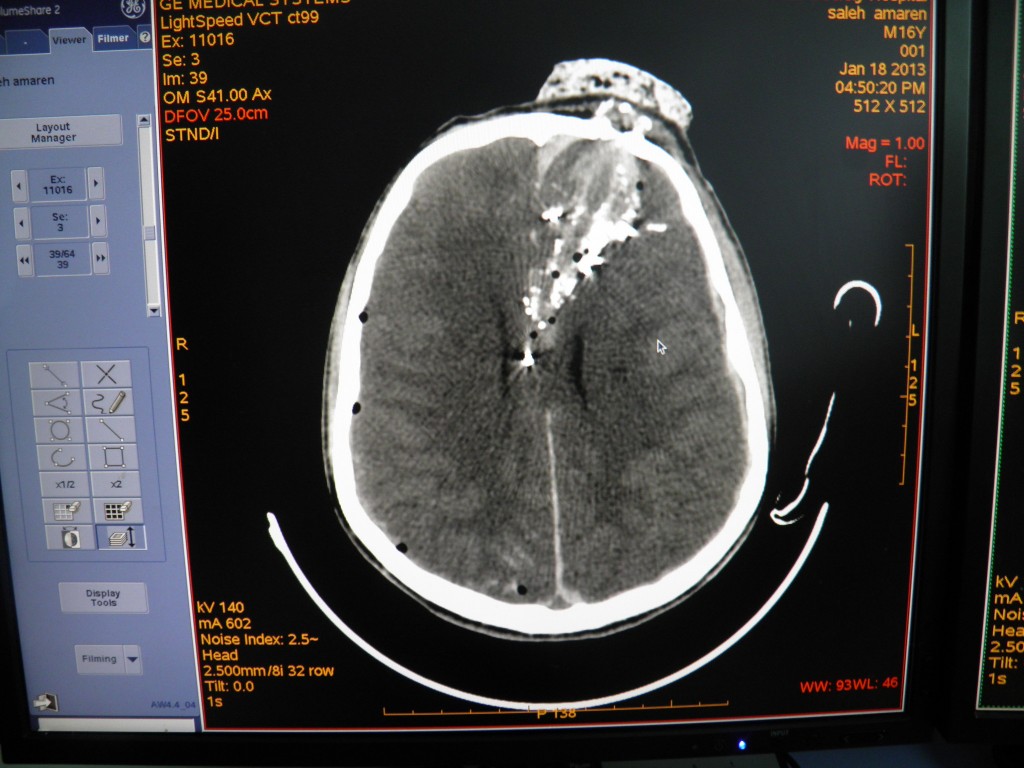
Bethlehem, Occupied Palestine – On Friday January 18th at approximately 3.20 pm, fifteen year old Saleh Elamareen was shot in the head by an Israeli soldier in Aida refugee camp, Bethlehem. Today Wednesday 23 January he was pronounced dead.
Salah Elamareen was outside the Lajee Refugee Centre when he was shot through the left forehead. The Centre lies some distance from the wall itself. At the time of the shooting eyewitnesses have said that protests were not happening, and that the people of Aida were simply watching the soldiers from afar. This is supported by video documentation of the incident, which shows a group of youth carrying Elamareen after he was shot.
Two of the doctors who treated Elamareen did not rule out previous rumours that he was shot with a dumdum bullet, due to the fragmentation of the bullet within his head. Another doctor has claimed it was definitely a dumdum bullet in his opinion.
Dumdum bullets expand after impact and are designed to cause maximum damage and pain. Due to the brutality of these bullets they are illegal under international law. Article 8 at the Review Conference of the Rome Statute in Kampala made the use of expanding bullets in non-international armed conflict a war crime. The Hague Convention also prohibits there use in international warfare. If the doctors are correct and a dumdum bullet was in-fact used, this would be another serious violation of international laws and standards by Israel.
The head of the department under which he was treated at the government hospital said he was hit with the bullet in the left frontal section of the head, around the eye, causing large intracranial hemorrhaging. A number of doctors who looked at the patient concluded that the bullet exploded in the brain. The CT scan shows the shrapnel inside his skull. The entry wound shows significant impact to the skull, and there is no exit wound.
Meet the new boss who, upon his inauguration, declared that the right to life is unalienable. Let me be clear, that does not mean he cannot take yours.
In fact, he runs through a list of men, women, and children on Tuesdays, hung over from inaugurations or not, and picks whom to murder and murders them.
We are not supposed to call it murder, of course, because it is properly assassination. Except that no public figures are being assassinated; 98% of those killed are not targeted at all; some are targeted for suspicious behavior without knowing their names; one type of suspicious behavior is the act of retrieving the dead and wounded from a previous strike; and those targeted are not targeted for politics but for resisting illegal occupations. Moreover, an assassination is a type of murder.
We’re not supposed to call it murder, nonetheless, because it sounds more objective to call it killing. But murder is a type of killing, specifically unlawfully killing a person especially with malice aforethought. Killing by accident is not murder and not what the president is doing. Killing legally is not murder and not what the president is doing – at least not as far as anyone knows or according to any interpretation of law put forward. Killing indirectly by encouraging poverty or environmental destruction or denial of healthcare may be things the president is doing, but they are not murder and not drone wars.
Imagine if a non-president went through a list of everyone in your local elementary school, picked out whom to kill, and ordered them killed. You would call it murder. You would call it mass-murder. You would call it conspiracy to commit mass murder. Why would electing that mass murderer president change anything? Why would moving the victims abroad change anything?
KILL ANYTHING THAT MOVES
Kill Anything That Moves is the title of an important new book from Nick Turse, covering the mass-murdering enterprise known in Vietnam as the American War, and in the United States as the Vietnam War. Turse documents that policy decisions handed down from the top led consistently, over a period of years, to the ongoing slaughter of millions of civilians in Vietnam.
Much of the killing was done by hand or with guns or artillery, but the lion’s share came in the form of 3.4 million combat sorties flown by US and South Vietnamese aircraft between 1965 and 1972. Air strikes are President Obama’s primary instrument of foreign relations as well; he ordered 20,000 air strikes in his first term.
The well-known My Lai massacre in Vietnam was not an aberration, but an almost typical incident and by no means the worst of them. Turse documents a pattern of ongoing atrocities so pervasive that one is compelled to begin viewing the war itself as one large atrocity. Something similar could be done for the endless war on everywhere that we are currently living through. Scattered atrocities and scandals in Afghanistan and Iraq are interpreted as freak occurrences having nothing to do with the general thrust of the war. And yet they are its essence.
Kill anything that moves, was an order given to US troops in Vietnam indoctrinated with racist hatred for the Vietnamese. “360 degree rotational fire” was a command on the streets of Iraq given to US troops similarly conditioned to hate, and similarly worn down with physical exhaustion.
Dead children in Vietnam resulted in comments like “Tough …, they grow up to be VC.” One of the US helicopter killers in Iraq heard in the Collateral Murder video says of dead children, “Well it’s their fault for bringing their kids into a battle.”
In Vietnam anyone dead was the enemy, and sometimes weapons would be planted on them. In drone wars, any dead males are militants, and in Iraq and Afghanistan weapons have often been planted on victims.
The US military during the Vietnam War shifted from keeping prisoners toward murdering prisoners, just as the Endless War on Everywhere has shifted from incarceration toward murder with the change in president from Bush to Obama.
In Vietnam, as in Iraq, rules of engagement were broadened until the rules allowed shooting at anything that moved. In Vietnam, as in Iraq, the US military sought to win people over by terrorizing them. In Vietnam, as in Afghanistan, whole villages were eliminated.
In Vietnam, refugees suffered in horrible camps, while in Afghanistan children are rapidly freezing to death in a refugee camp near Kabul.
Torture was common in Vietnam, including water-boarding. But it wasn’t at that time yet depicted in a Hollywood movie as a positive occurrence.
Napalm, white phosphorus, cluster bombs, and other widely despised and banned weapons were used in Vietnam as in the current war.
Vast environmental destruction was part of both wars.
Gang rape was a part of both wars.
The mutilation of corpses was common in both wars.
Bulldozers flattened people’s villages in Vietnam, not unlike what US-made bulldozers do now to Palestine.
Mass murders of civilians in Vietnam, as in Afghanistan, tended to be driven by a desire for revenge.
New weaponry allowed US troops in Vietnam to shoot long distances, resulting in a habit of shooting first and investigating later, a habit now developed for drone strikes.
Self-appointed teams on the ground and in helicopters went “hunting” for natives to kill in Vietnam as in Afghanistan.
And of course, Vietnamese leaders were targeted for assassination.
Then, as now, the atrocities and “war crimes” were committed with impunity as part of the crime that was the war itself. Or perhaps it would be more accurate to say: because there was impunity then, it remains today.
Turse discovered that the military investigated numerous accusations, documented incidents, and then buried the reports. So did others in the government. So did the media, including Newsweek which buried a major investigation. Those who engaged in that cover-up don’t have on their hands the blood that had already been spilled, but do have on their hands the blood that has been spilled since in similar wars that might have been prevented. … Full article
On January 14th, a day marking the one-year anniversary of his administration, Guatemalan president Otto Pérez Molina presented his first annual report on the state of the country. In his speech, Pérez Molina, a former general, graduate of the School of the Americas and accused of being a war criminalimplicated in the systematic use of torture and acts of genocide, hailed a “historic 10 percent reduction in violent crime” and “an almost five point drop in the homicide rate per every 100,000 inhabitants” from the previous year. Guatemala currently has one of the highest murder rates in the world (41 murders per every 100,000 inhabitants); it had a total of 5,122 murders in 2012. Ironically, while President Pérez Molina was reporting back to the nation on crime statistics and murder rates that morning, the mayor of the town of Jutiapa had just been shot down, dying almost immediately of sixteen bullet wounds.
In the 1980s, the “scorched-earth” campaign of the Guatemalan military tortured, slaughtered and massacred entire villages, resulting in the deaths of over 200,000 people. Under the dictatorship of General Efraín Ríos Montt from 1982-83 state violence in Guatemala has been said to have been the most brutal. A year ago, after years of attempts by human rights defenders to put him on trial, Ríos Montt was charged with genocide in Guatemalan courts. He has since filed two petitions to acquire amnesty from the law, the second of which is still awaiting a ruling. Last month Pérez Molina, who himself served under General Ríos Montt during the 1980s, issued and then suspended a decree stating that it would stop adhering to the Inter-American Court of Human Rights on cases of crimes against humanity and genocide that occurred before 1987, which human rights defenders say could be an attempt to prevent legal challenges from taking place.
In 2011, when presidential elections were held, Guatemalan and international human rights organizations warned of the danger in electing a former general implicated in “scorched earth” campaigns and extrajudicial executions, pointing out that militarization and repression would likely escalate if Pérez Molina were to win.
On October 4th 2012, those fears were realized as military forces once again attacked, shooting indiscriminately into a crowd of peaceful protesters in the Mayan K’iché community of Totonicapán, and effectively carrying out a massacre. When the ordeal was over, at least six protestors had been killed and another 34 wounded in the first military massacre since the 1996 peace accords were signed. The 3,000 unarmed indigenous protestors had blocked a section of the Inter-American Highway in order to protest rising energy prices, a new educational reform and to negotiate a constitutional reform.
Seven days later, an investigation by the Public Ministry and the National Institute of Forensic Sciences confirmed that the 5.56 caliber bullets that killed and wounded protestors had come from the Galil rifles used by the military. Until then, Pérez Molina had steadfastly denied that his soldiers had been armed or had fired, and attempted to misrepresent details of the incident, finally insisting that soldiers had only fired into the air, and attributing the first shot fired at protestors to a private security guard.
After Pérez Molina was forced to retract his denials about the incident, the officer in charge, Coronel Chiroy, and eight of his soldiers were arrested and charged with “extrajudicial execution”.
In response to international criticism about the incident days after its occurrence, Guatemalan Foreign Minister Harold Caballeros dismissed the murder of the indigenous protestors, stating that: “With sadness, I recognize that in some parts of the world eight deaths is a very big deal, but, although it sounds bad to say this, … every day we have double that number of deaths [from violence]. So, it’s not something that we should make a big deal about.”
At a time when militarization in the region is on the rise and violent repression of dissent has returned, a president accused of war crimes who denies that genocide ever took place in his country, and who has attempted to cover up an obvious massacre, it is difficult to take with much optimism the news that 526 less homicides were reported in 2012 than in 2011. And it begs the question; does the Guatemalan government include its own murders in that calculation? Or does the massacre at Totonicapán actually put the 2012 total at 5,128?
British Prime Minister David Cameron called off his long-awaited speech on the relations with the European Union on Friday to deal with the hostage-taking in Algeria as his country actively assisted France in its military intervention in Algeria’s neighbor Mali.
Cameron was outraged by, what he described in an address to the MPs on Thursday, as the Algerian government’s “all guns blazing” tactic against the “terrorist” kidnappers at BP’s In Amenas gas plant because it could endanger British and other western lives.
“I won’t hide, of course I was… we were disappointed not to be informed of the assault in advance,” Cameron told the MPs.
In effect, Cameron was telling Algeria that they are not supposed to be fighting “terrorists” at the cost of British lives while he and his French allies were – and are — exactly killing innocent Malians for the alleged ‘greater good’ they tend to name fighting terrorism.
There are no precise figures on the number of Malian civilians killed in the French Britain-assisted airstrikes near the country’s borders with Algeria but Human Rights Watch said on the second day of the attacks last Sunday that 10 civilians including three children, were killed during airstrikes.
The situation has also been grave enough for international organizations to call for restraint.
“Forces involved in armed attacks should avoid indiscriminate shelling at all costs, and do their utmost to prevent civilian casualties,” said Paule Rigaud, Amnesty International’s Africa deputy director.
However, there has been no such restr aint to the point that United Nations High Commissioner for Refugees (UNHCR) Melissa Fleming warned on Friday “that in the near future there could be up to 300,000 people additionally displaced inside Mali, and over 400,000 additionally displaced in the neighboring countries” many of them escaping indiscriminate attacks on Malian rebels and civilians.
Nor has Cameron advised French president Francois Hollande to hold back attacks to avoid collateral damage to women and children probably because their skins are not as white as the British hostages in Algeria.
This comes as Hollande said on Friday that the attack and hostage crisis in the remote desert gas plant show the French military intervention in Mali was justified.
However, one comes to think that matters are exactly the other way round, especially after the hostage-takers said their move was in response to the French intervention in Mali.
One should also note a report by Amnesty International on brutality on the part of the ally of Britain and France, the Malian government, against the Tuareg ethnic minority where rebels are rooted.
When the conflict originally exploded, Tuaregs were arrested, tortured, bombed and killed by the security forces, “apparently only on ethnic grounds”, Amnesty said in a report on December 21.
Meanwhile, last July, 80 inmates arrested by the Malian army were stripped to their underwear, jammed into a 5 sqm cell and cigarettes were burnt into their bodies.
Also, back in September 2012, 16 Muslim clerics were rounded up at a checkpoint and summarily executed by the Malian army, which is now Britain’s ally.
Indeed, Britain could apparently pat itself on the back for setting the stage for the kidnapping of its own nationals in Algeria by helping the Malian government.
Britain should also answer whether the “botched” Algerian operation to free hundreds of hostages that left a few western hostages killed would have been also botched if the hostages were not white westerners, or if the scenario was one of British forces and its allies pounding Malian targets with huge civilians casualties on people with darker skins.
On January 15, 2013, University of Houston Law Center professor Jordan Paust penned an article entitled “Iran’s Nuclear Weapons Program and Lawful Israeli Self-Defense,” which was published on Jurist, a website of analysis and opinion pieces written by law professors, lawyers, and legal scholars. It is clear throughout Paust’s piece that his arguments are neither sound nor based in fact, and unfortunately rely entirely on false premises and long debunked propaganda. Paust himself is a contributing editor to Jurist.
To begin with, the title of Paust’s analysis itself betrays both its agenda and its absurdity, considering Iran doesn’t have a nuclear weapons program according to all Western and Israeli intelligence agencies and unprovoked, “preventative,” “anticipatory” or “preemptive” military assaults are not only totally illegal but also can not possibly be justified as “self-defense.”
And that’s just the beginning; the falsehoods continue to stack up. In fact, Paust reveals his utter ignorance from the get-go, writing – in his very first sentence, no less – that the Iranian leadership “continues to proclaim its desire to wipe Israel off the map” – something even Israel’s own Deputy Prime Minister Dan Meridor admits it has neverdone. His understanding of Article 51 of the United Nations Charter (which affirms the right to retaliatory self-defense if attacked first) is bizarrely lacking, especially considering he’s a law professor. He joins the shameful company of Alan Dershowitz in this regard.
Paust goes on to (1) accuse of Hezbollah and Hamas of terrorism and serving as Iranian proxies, without ever mentioning Israel’s decades of international law violations and continuing war crimes and occupation or the fact that they are autonomous organizations that don’t take direction from Iran; (2) ignore all facts pertaining to the illegality of initiating of a “war of aggression” (the “supreme international crime,” according to the Nuremberg Tribunal); and (3) claim that Iran is violating UNSC resolutions regarding the cessation of uranium enrichment, a demand many have long acknowledged is ultra vires, itself abrogates the NPT and the resolutions are themselves illegal.
Apparently, though, these facts aren’t important to Professor Paust.
Furthermore, among the “facts” that Paust marshals to advance his argument that Israel could legally launch a preemptive attack on Iran is the contention that “Iran is publicly ‘gunning’ for Israel.” Yes, he wrote that. And he still has a law degree. And is presumably literate.
From there, Paust launches into a bizarre and wholly inapplicable “Wild West Showdown” analogy in which the (Israeli) “good guy” is justified in “shoot[ing] first” since he knows the (Iranian) “bad guy” is out to get him. It is “not necessary that the bad guy shoot first,” Paust writes, elaborating (for some inexplicable reason) that “the good guy could have drawn first once it was known that the bad guy was gunning for him and they were staring each other down in the street.” By way of trying to make this dumbfounding, Manichean analogy make sense, he explains, “Someone was about to draw first and, in context, the process of attack had begun and a right of self-defense had been triggered even though it was possible that the bad guy might back down and make this clearly known before the good guy fired.”
If this passes for astute legal analysis these days, it’s no wonder the United States has little to no respect for basic tenets of international law.
The analysis is so strained, based entirely on presumptions and assumptions with no basis in fact (only in Netanyahu-approved talking points), that Paust discredits himself by writing in the first place.
In the end, Paust pines for a peaceful way out. His solution? That Iranian leaders “shift their attention to peace,…comply with the Treaty on the Non-Proliferation of Nuclear Weapons” and not build a bomb. As countless IAEA reports have demonstrated, Iran’s nuclear program remains peaceful and no nuclear material has ever been diverted to a military program. Iran has also never been found to have violated its obligations to the NPT. Its leaders, for decades now, have repeated denounced nuclear weapons as, not only amoral and religiously sinful, but also strategically useless and politically irrelevant.
By Tim Kirby | Strategic Culture Foundation | November 14, 2026
Did Vladimir Putin just wake up one day on the wrong side of the bed and decide to invade Ukraine in February of 2022 or is there a lot more to this single decision that has been reshaping the 21st century geopolitical landscape?
Obviously, from the way that I just posed the question you can see that I am on the side that views the causes for the war in Ukraine to be very deep, long-term, historical and consciously nefarious, and most importantly, not from within the halls of the Kremlin. So it was a pleasure to take a look at the book “Boiling Point, How America Brought War to Ukraine” by author Stephen Kinzer, who like myself, also believes that the real reasons behind military conflicts around the world are not what CNN and the BBC have been telling you. The main thesis of this book was stated clearly by its creator; the war “may have been illegal, but it was definitely not unprovoked.” … continue
This site is provided as a research and reference tool. Although we make every reasonable effort to ensure that the information and data provided at this site are useful, accurate, and current, we cannot guarantee that the information and data provided here will be error-free. By using this site, you assume all responsibility for and risk arising from your use of and reliance upon the contents of this site.
This site and the information available through it do not, and are not intended to constitute legal advice. Should you require legal advice, you should consult your own attorney.
Nothing within this site or linked to by this site constitutes investment advice or medical advice.
Materials accessible from or added to this site by third parties, such as comments posted, are strictly the responsibility of the third party who added such materials or made them accessible and we neither endorse nor undertake to control, monitor, edit or assume responsibility for any such third-party material.
The posting of stories, commentaries, reports, documents and links (embedded or otherwise) on this site does not in any way, shape or form, implied or otherwise, necessarily express or suggest endorsement or support of any of such posted material or parts therein.
The word “alleged” is deemed to occur before the word “fraud.” Since the rule of law still applies. To peasants, at least.
Fair Use
This site contains copyrighted material the use of which has not always been specifically authorized by the copyright owner. We are making such material available in our efforts to advance understanding of environmental, political, human rights, economic, democracy, scientific, and social justice issues, etc. We believe this constitutes a ‘fair use’ of any such copyrighted material as provided for in section 107 of the US Copyright Law. In accordance with Title 17 U.S.C. Section 107, the material on this site is distributed without profit to those who have expressed a prior interest in receiving the included information for research and educational purposes. For more info go to: http://www.law.cornell.edu/uscode/17/107.shtml. If you wish to use copyrighted material from this site for purposes of your own that go beyond ‘fair use’, you must obtain permission from the copyright owner.
DMCA Contact
This is information for anyone that wishes to challenge our “fair use” of copyrighted material.
If you are a legal copyright holder or a designated agent for such and you believe that content residing on or accessible through our website infringes a copyright and falls outside the boundaries of “Fair Use”, please send a notice of infringement by contacting atheonews@gmail.com.
We will respond and take necessary action immediately.
If notice is given of an alleged copyright violation we will act expeditiously to remove or disable access to the material(s) in question.
All 3rd party material posted on this website is copyright the respective owners / authors. Aletho News makes no claim of copyright on such material.

 Aletho News

