Activists refuse to send Gaza aid via Israel
By Romen Bose – AFP – 27/05/2011
KUALA LUMPUR — Activists on a Malaysian aid ship that had been bound for Gaza refused to hand their cargo to Egypt on Thursday, saying they feared it would end up in Israel.
They had tried to land in Gaza last week but changed course when the Israeli navy fired warning shots.
Matthias Chang, who is heading the mission for the Perdana Global Peace Foundation, told AFP the group was not consulted when the Malaysian and Egyptian governments worked out a deal to end the impasse.
Chang said Egypt had insisted the cargo be discharged and transported via Kaern Shalom, at the Israeli border in Gaza.
“We are not assured that this cargo would in fact be delivered to Gaza, as in the past… most of the humanitarian aid was laid to waste in Israel,” he added.
Chang also questioned Cairo’s refusal to allow the cargo, consisting of 4.6 miles of sewage pipes, to be transferred via the Rafah crossing — Gaza’s only crossing that bypasses Israel — given that it would be open this weekend.
“This turn of events demonstrates the insincerity of the Egyptian government and their implicit endorsement of the illegal siege when they explicitly stated they would permanently open the Rafah crossing,” Chang said.
Egyptian state media have said the Rafah border crossing would open on a daily basis starting Saturday.
Perdana Foundation adviser Mukhriz Mahathir, a son of former Malaysian premier Mahathir Mohamad, told AFP they were unhappy with Cairo’s actions.
“We are disappointed that it has come to this as we were hopeful that with the new government there would be substantial change in regard to the way they treat Palestinians and Gaza but this is clearly not the case,” he said.
“We urge the Egyptian government to allow the aid ship to dock and unload the pipes and ensure that they are delivered to Gaza via the Rafah crossing,” Mukhriz added.
However, Foreign Minister Anifah Aman said Kuala Lumpur and Cairo were working to enable the MV Finch, which has been refused entry to El-Arish for the last 10 days, to dock and unload its aid, according to a statement.
Anifah and his Egyptian counterpart urged “the parties concerned not to resort to any unnecessary action that could further aggravate the situation.”
The 12 activists and crew onboard the MV Finch aborted their second attempt to land in Gaza on Monday after engine trouble, and are anchored in a waiting area off the Egyptian port of El-Arish. … Full article
The Housemaid, Her Union and Strauss-Kahn
By DEAN BAKER | CounterPunch | May 25, 2011
One very important fact has been largely absent from the coverage of the sexual assault case against Dominique Strauss-Kahn, the former head of the International Monetary Fund (IMF) and leading candidate to be the next president of France. The hotel housekeeper who he allegedly assaulted was represented by a union.
The reason that this is an important part of the story is that it is likely that Mr. Strauss-Kahn’s victim likely would not have felt confident enough to pursue the issue with either her supervisors or law enforcement, if she had not been protected by a union contract. The vast majority of hotel workers in the United States, like most workers in the private sector, do not enjoy this protection.
This matters because under the law in the United States, an employer can fire a worker at any time for almost any reason. It is illegal for an employer to fire a worker for reporting a sexual assault. If any worker can prove that this is the reason they were fired, they would get their job back and probably back pay. (The penalties tend to be trivial, so the back pay is unfortunately not a joke.)
However, it is completely legal for an employer to fire a worker who reports a sexual assault for having been late to work last Tuesday or any other transgression. Since employers know the law, they don’t ever say that they are firing a worker for reporting a sexual assault. They might fire workers who report sexual assaults for other on-the-job failings, real or invented.
In this way the United States stands out from most other wealthy countries. For example, all the countries of Western Europe afford workers some measure of employment protection, where employers must give a reason for firing workers. Workers can contest their dismissal if they think the reason is not valid, unlike the United States where there is no recourse.
Imagine the situation of Mr. Strauss-Kahn’s victim had she not been protected by a union contract. She is a young immigrant mother who needs this job to support her family. It seems that she did not know Mr. Strauss-Kahn’s identity at the time she reported the assault, but she undoubtedly understood that the person staying in the $3,000 a night suite was a wealthy and important person.
In these circumstances, how likely would it be that she would make an issue of a sexual assault to her supervisors? Housekeepers are generally among the lowest paid workers at hotels, often earning little more than the minimum wage. It is a high turnover job, meaning that any individual housekeeper is likely to be viewed as easily replaceable by the management.
If this housekeeper did not enjoy the protection of a union contract, is it likely that she would have counted on her supervisors taking her side against an important guest at the hotel? Would she be prepared to risk her job to pursue the case?
We can never know how this particular woman would have responded; fortunately she did have the protection of the union. However, it is likely that many similar assaults go unreported because the victims do not feel they can risk their jobs to pursue the case. They have to simply accept an attack like this as part of the job.
There is a special irony to this situation given Mr. Strauss-Kahn’s position. The IMF, along with other pillars of the economic establishment, has long pushed for reducing the rights of workers at their workplace. Specifically, they have pushed countries around the world to adopt measures that would weaken the power of unions.
They have also urged the Western European countries to eliminate or weaken the laws that prevent employers from firing workers at will. These laws, along with unions, are seen as labor market rigidities that prevent labor markets from operating efficiently.
In the dream world of the economists’ textbook policies, all employers would have the ability to fire employees at will. There would be no protective legislation and no unions to get in the way.
In that economist’s dream world, Mr. Strauss-Kahn and any other powerful individual would be fairly certain that they could sexually assault hotel workers with impunity. Maybe the IMF will adopt a new policy of putting up its top male managers in non-union hotels.
~
Dean Baker is the co-director of the Center for Economic and Policy Research (CEPR). He is the author of Plunder and Blunder: The Rise and Fall of the Bubble Economy and False Profits: Recoverying From the Bubble Economy.
This article originally appeared in The Guardian.
US holds up Smallpox stock eradication
Press TV – May 25, 2011
Despite opposition by many nations, the eradication of the world’s last smallpox stocks remaining in the US and Russian labs have been postponed for three more years.
After two long days of strong debate, UN members at the World Health Assembly in Geneva reached an agreement on the destruction of smallpox samples held in stockpile in the US Center for Disease Control labs in Atlanta, Georgia and a Russian-government sponsored lab in Siberia.
Washington and Moscow said that they want to keep their virus stocks for five more years to develop new vaccines for possible resurgence in future. The European Union, Canada, Israel, Monaco, Colombia and China are among countries that support the delay.
Many countries including the North African nations, Iran, Thailand, Zimbabwe and Malaysia, on the other hand, are in favor of the immediate destruction of the remaining samples of the virus.
The debate over the destruction of the stocks of the deadly smallpox virus, which was irradiated in 1979, has been recurring since 1986.
The supporters of the US and Russia’s program finally accepted to compromise with at most 3 years of delay in the destruction program.
Based on the final decision, there will be another meeting in 2014 in the World Health to decide on a more defined date of complete destruction of the stocks.
The supporters of the destruction program are satisfied with the decision. “The outcome shows destruction is imminent,” said Edward Hammond, a consultant for the Third World Network, a nongovernmental organization based in Malaysia that advocates for smallpox-virus destruction.
The US-led resolution for saving the stocks for five more years did not succeed despite the intense lobbying, Hammond said, adding that “I have never seen the US put more time and effort into trying to get a resolution passed.”
Occupied Afghanistan: Logar resident dies in detention with foreign troops
By Abdul Maqsud Azizi | Pajhwok Afghan News | 20 May, 2011
PUL-I-ALAM: Foreign troops handed over to family the body of a 25-year-old man with his hand cut off six days after he was arrested on the charge of “links” with Taliban militants in central Logar province, officials said on Friday.
Amir Mohammad, the victim, had been arrested by foreign troops during an operation six days ago in Sheikhi village , Charkh district for alleged ties with the Taliban.
His body was handed over to his family on Thursday night, the provincial council chief, Dr. Abdul Wali Wakeel, told Pajhwok Afghan News. He said Mohammad had been arrested on the charge of having links to the Taliban, but had no link to the movement. His hands were cut off and throat had been slit before his body was handed over to his family, Wakeel said.
He said the family was reluctant to receive the body, but later they took the body and buried him at a graveyard. Mohammad had died two days after his arrest at the Bagram prison where he was taken by foreign troops. His dead body, with his hands cut and throat slit, was handed over to family four days after his death, the public representative said.
The district development council chief, Mohammad Naeem, said foreign troops had cut off Mohammad’s hands during interrogation.
He asked the central government to order an investigation into the death of Mohammad in detention. He feared the incident could spark violent protest demonstrations by residents.
The governor’s spokesman, Din Mohammad Darwish, confirmed the hand over of Mohammad’s body to his family, but provided to further details.
NATO’s International Security Assistance Force (ISAF) media office in Kabul confirmed the death of Mohammad in detention and said he had died a natural death.
Specialist doctors operated upon Mohammad after his death to determine the causes which led to his demise, the force said in a statement. The signs on his body were operation wounds, it said.
US-led forces shoot Afghan official
Press TV – May 22, 2011
US-led forces have shot and injured the spokesman for the provincial governor of Afghanistan’s southern Kandahar province, as he was entering his office.
Spokesman Zalmay Ayoubi said on Sunday that he was shot in the leg by the US-led troops as he was entering his office at the government’s heavily-guarded compound, a Press TV correspondent reported.
The provincial spokesman added that the incident occurred after he refused to allow US-led forces to frisk him.
He added that the US-led forces have been tasked with providing the security of the office of Kandahar’s governor following the recent violence in the Afghan province, but they are not allowed to frisk the officials.
Two weeks ago, militants attacked the heavily guarded compound of the governor, leaving several people injured.
British Colonial War Crimes in 1950s Kenya Mau-Mau Rebellion Whitewashed
By Jemima Pierre | BAR | 05/17/2011
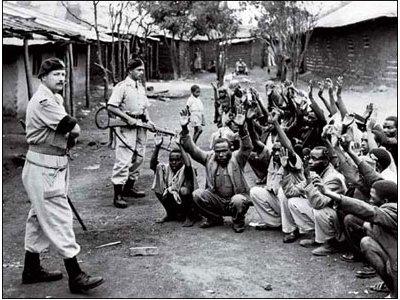
The western-manipulated International Criminal Court, which has indicted only African leaders, tries to give the world the impression that barbarity descended on the continent when the white colonists left. But four aging Kenyan “Mau Mau” freedom fighters, demanding reparations, are forcing Britain to acknowledge the savagery of white settlers and soldiers. “The generation of Africans who fought against colonialism is dying without recognition of their fight or their suffering at the hands of racist colonialism.”
In early April 2011, four elderly Kenyansi—three men and one woman—appeared in the High Court in London, accusing England of systematic torture during their siege of the so-called Mau Maus and demanding reparations for their treatment. One of the men was castrated by the British colonial government in Kenya. Handcuffed and pinned to the ground with his legs pulled apart, his genitals were sliced off by the white officers. He was then left for days without medical attention until he was liberated by Kenyan rebels. The one woman claimant was subjected to sexual torture. White soldiers repeatedly inserted bottles of boiling hot water into her vagina. In addition to these cases, thousands of Kenyans were maimed, lynched and brutally murdered by the British during the last century. Thousands of others were subjected to rape, forced labor, and gross abuse and torture in detention camps. It was part of a deliberate policy of the colonial British government to break a civilian population cast as “baboons,” “barbarians,” and “terrorists” and who were seen as a threat to the colonial order in east Africa.
The proper name for the liberation forces that fought against British colonialism and land-grabbing in East Africa was the Kenya Land and Freedom Army.ii The movement was derisively called “Mau Mau” by the British propaganda machine in an attempt to depict these African freedom fighters as a primitive and anti-white tribal cult. Against this, the late C. L. R. James described the movement as “an ad hoc body of beliefs, oaths, disciplines newly created for the specific purpose of gathering and strengthening the struggle against British imperialism, its military, political and economic domination and, in particular, the Christianity it sought to inject and impose.” And it was land and white settlers, not African “tribal” beliefs that were at the heart of the so-called Mau Mau revolt against British colonialism.
The colonial invasion of Central Kenya began in the late 1880s. It was formalized through military conquest, particularly over the most numerous ethnic group, the Gikuyu, as well as the Embu and the Meru. By 1903, the British colonial government sent in waves of white settlers, from South Africa and England, with the hope of creating another “white man’s country” in Kenya. They stole between 60,000 and 1 million acres of land, settling whites in the most fertile regions with the coolest climates—an area they eventually named the “White Highlands.” By the time the colony of Kenya came into being in 1920, more than 10,000 whites had settled over 25% of Kenya’s best territory. At the same time, the African population, mainly but not entirely the Gikuyu, were driven into reservations or were forced to work as sharecroppers. Then, through hut and poll taxes, restrictions on movement through the issuing of kipande (identity passes), and limits on agricultural production, Africans became systematically entrapped into the racist Kenyan colonial system. Add to this mix the ever-expanding power of the white settlers and Christian missionaries, and Kenya was primed for a revolution.
Though all ethnic groups were affected by British colonial land-grabbing and dispossession, the Gikuyu experienced this most acutely. They did not take lightly the heavy theft of land. When, in 1943, the colonial government threatened groups of Gikuyu with yet another eviction from their lands, they decided to take action. Their struggle began with overt passive resistance but was quickly radicalized. Wings of the movement began armed guerilla attacks on white settler holdings and on Africans who supported the British regime. At the height of the revolt, it was estimated that 1.5 million Gikuyu and other Kenyan groups had taken secret oaths of unity to fight against white settlers and colonial rule. They were met with a brutal armed retaliation. By late 1952, the colonial governor of Kenya declared a state of emergency. The colonial government established and enforced communal punishment, curfews, schemes to confiscate African properties, censors for publications, detention without trial, control of African markets, forced migrations, and detention and labor camps.
By late 1954 the revolt was said to have been militarily defeated by the British army, but the state of the emergency was not lifted until 1960. During the six intervening years, the Mau Mau struggle continued as the British colonial government established a terrorist state. The assault on the Africans continued both through the campaign to arrest and dispose of the alleged Mau Mau leadership, and in detention camps, prisons, and “emergency villages.” The British focused primarily on forcing the Gikuyu to renounce their oath of unity by the most brutal means. According to the Kenya Human Rights Commission, by the time the colonial government ended the state of emergency, over 90,000 Kenyans were executed, maimed, or tortured, while 160,000 were held in detention camps. Others have argued that the numbers were higher. What is well documented is how colonial agents were unrivaled in their barbarity. They castrated and sexually abused, starved, and maimed detainees in order to force the alleged oath takers to confess. They used electric shock, cigarettes and fire, broken bottles, gun barrels, knives, snakes, vermin, and hot eggs were thrust up men’s rectums and women’s vaginas. The assault only came to an end when the Gikuyu population was almost physically decimated and psychologically broken.
If not for the legal case brought against the British government by four surviving Kenyans, we would not know about the trove of secret colonial files documenting the systematic nature of their torture of Africans. The generation of Africans who fought against colonialism is dying without recognition of their fight or their suffering at the hands of racist colonialism. In the current context where Africans, through organizations such as the ICC, are constructed and targeted as the greatest purveyors of “crimes against humanity,” it is well worth remembering the venal work of Europeans in Africa. The demands for reparations may begin with four elderly Kenyans traveling to the old center of the British empire, but the colonial archive surely documents crimes against the Herero, the Congolese, and many other victims of European colonialism. We should not forget their struggles.
i – Wambugu Wa Nyingi, Jane Muthoni Mara, Paulo Nzili, and Ndiku Mutwiwa Mutua
ii – For Further Reading: C. L. R. James, A History of Pan-African Revolt (1995); Caroline Elkins, Britain’s Gulag: The Brutal End of Empire in Kenya (2005); Cora Presley, Kikuyu Women, the Mau Mau Rebellion, and Social Change in Kenya (1992); Gerald Horne, Mau Mau in Harlem? The U.S. and the Liberation of Kenya (2009)
Jemima Pierre can be reached at BAR1804@gmail.com.
21 Bodies Found in Iraq Mass Grave
Al-Manar – May 18, 2011

The bodies of 21 people, most likley killed by the US occupation forces in the town of Fallujah, west of the Iraqi capital, were discovered on Tuesday in a cemetery.
According to Fallujah police chief Brigadier General Mahmud al-Essawi, the bodies were found in body-bags with Latin letters and numbers on them. “They were blindfolded, their legs were tied and they had suffered gunshot wounds,” Essawi said.
The discovery was made in a section of Al-Maadhidi cemetery in the centre of the town, 60 kilometers (35 miles) west of Baghdad, as a grave was being dug in preparation for a funeral, a security official said on condition of anonymity.
Essawi and town mayor Adnan Hussein both said the dead were killed in 2004 when the US occupation army launched two major offensives on Fallujah to dislodge insurgents.
Hussein charged that the 21 were killed by US occupation forces. “The black body-bags and the manner in which they were buried proves this,” he said.
According to AFP, the US military declined immediate comment on the report.
Lebanon files complaint against Israel
Press TV – May 16, 2011

Lebanon has submitted a complaint to the United Nations Security Council against Israel over the killing of 10 civilians in the Lebanese border town of Maroun al-Ras.
At least 10 people were killed and over 110 others wounded after Israeli soldiers opened fire on thousands of Palestinian refugees who were holding a symbolic march toward their homeland on the Lebanese side of the border on Sunday.
The Palestinian refugees living in Lebanon were marking the 63rd anniversary of the forcible eviction of 700,000 Palestinians from their homeland by Israelis and the occupation of Palestine, which Palestinians refer to as “Nakba Day,” or the day of catastrophe.
“The attack represents a hostile act and once more highlights Israel’s violation of Lebanese sovereignty and its disregard of UN resolutions,” Lebanon’s permanent mission to the UN said.
Lebanon also called on the Security Council to pressure Israel to end its hostile and provocative policies against Lebanon and hold it accountable for killing civilians.
The leader of Lebanon’s resistance movement Hezbollah, Seyyed Hassan Nasrallah, said the protests gave the anniversary a new meaning and proved to Israel that the Palestinians hold onto their uncompromising right to return to their homeland.
“We must bow before the courage, the bravery, of those who protested yesterday at Lebanon and Syria’s borders with occupied Palestine, who faced the tyranny of the enemy with bare chests and their heads held high,” Nasrallah said on Monday.
“Your message, loud and clear, to the enemy is that you will liberate your lands, that the fate of this entity [Israel] is demise, and that no initiatives, treaties or borders will protect it,” he added.
A total of 25 protesters were killed in southern Lebanon, the Gaza Strip, the West Bank and Syria’s occupied Golan heights by Israeli forces on Nakba Day.
The United Nations has condemned Israel’s “disproportionate, deadly force” against demonstrators marking the anniversary of the creation of Israel.
“I am shocked by the number of the deaths and the use of disproportionate, deadly force by the Israeli Defense Forces against apparently unarmed demonstrators, which I condemn,” UN Special Coordinator for Lebanon Michael Williams said on Monday.
War Crimes & the Bombing of Libya
Conn Hallinan | Dispatches From The Edge | May 16, 2011
According to the New York Times (5/16/11), Gen. Sir David Richards, “Britain’s top military commander,” is proposing that the North Atlantic Treaty Organization (NATO) target Libyan “infrastructure,” including electrical power grids and fuel dumps, in government held areas.
Frustrated by the two-month old stalemate, Gen. Richards told the Times that “The vice is closing on [Muammar el-] Qaddadi, but we need to increase the pressure further through more intense military activity.” The British are playing a major role in the bombing campaign, and Gen. Richards was in Naples, the command center for the war in Libya, when he talked with the Times.
The Times went on to write, “The General suggested that NATO should be freed from restraints that precluded attacking infrastructure targets.”
Let us be clear what “infrastructure” means: “The fundamental facilities and systems serving a country, city or area, as transportation and communication systems, power plants and schools”(Random House Dictionary, Second Edition).
Now let’s see what the 1977 Protocol Addition to Geneva Conventions of 12 August 1949 say on the business of attacking “infrastructure.”
“In order to ensure respect for and protection of the civilian population and civilian objects, the Parties to the conflict shall at all times distinguish between the civilian population and combatants and between civilian objects and military objectives and accordingly shall direct their operations only against military objectives.”
Part IV, Section I, Article. 48
“It is prohibited to attack, destroy, remove or render useless objects indispensable to the survival of the civilian population, such as foodstuff, agricultural areas for the production of foodstuffs, crops, livestock, drinking water installations and supplies and irrigation works…”
Article 54
“It is prohibited for the Parties to the conflict to attack, by any means whatsoever, non-defended localities…”
Article 59
In short, you can’t bomb power plants, electrical grids, water pumping plants, or transport systems that service the civilian population, even if the military also benefits from them. As Article 50 states: “The presence within the civilian population of individuals that do not come within the definition of civilians does not deprive the population of its civilian character.”
The pressure to step up the bombing and widen the delineation of targets reflects the fact that the war has turned into a stalemate. “We need to do more,” Gen. Richards told the Times, “If we do not up the ante now there is a risk that the conflict could result in Qaddafi clinging to power.”
That last statement appears to be a violation of United Nations Resolution 1973, which called for “protection of civilians,” a “no-fly zone,” “sanctions,” a “freeze of assets” and an “arms embargo.” Nowhere does 1973 mention regime change and getting rid of Qaddafi.
So are we being dragged into a war whose goals violate UN Resolution 1973, and whose means violate the Geneva Conventions for the Protection of Victims of International Armed Conflicts? It is hard not to answer that question in anything but the affirmative.
Israeli Navy Attack Aid Ship to Gaza and Force it Back to Egypt
PNN – 16.05.11
Egypt – Israeli Naval forces attacked and intercepted on Monday morning aid boat named “The Spirit of Rachel Corrie Mission” off the Gaza coast. The ship’s 12 crew and passengers are safe. Currently the ship has been forced to anchor in the Egyptian waters at one and a half nautical miles from the Gazan waters. The vessel left the Port of Piraeus, Greece on Wednesday, May 11.
The humanitarian initiative is sponsored by Perdana Global Peace Foundation (PGPF) and participating in this mission includes anti-war activists and journalists from the Asian, American and European continents.
The cargo ship The Spirit of Rachel Corrie (officially known as FINCH) is carrying 7.5 kilometers of UPVC (plastic) sewage pipes to help restore the devastated sewerage system in Gaza. The ship was named after the courageous American activist who was crushed and killed by an Israeli bulldozer in 2003 while trying to prevent the demolition of another Palestinian home. She died at 23.
The Spirit of Rachel Corrie Mission is part of the Perdana Global Peace Foundation’s (PGPF) “Break the Siege on Gaza” campaign. The purpose of this campaign is to highlight the effects of the illegally imposed Israeli siege and raise awareness of the human rights violations of the people of Gaza. Breaking the siege and ending the illegal collective punishment of 1.5 million people must be a priority for the international community.
“The Palestinian struggle is nothing more than a struggle for justice, to which they, as much as everyone else, have a right.” Tun Dr. Mahathir Mohamad, President of PGPF stated.
In a press release by PGPF the group said that on 27 December 2008, the Israeli military launched Operation Cast Lead, which not only killed some 1400 Palestinians, but also destroyed vital infrastructure leaving the Gazans with critical water and sewage problems. PGPF says Repair of the infrastructure has proved impossible as Israel has prevented the entry of construction materials and fuel to resolve this dire situation.
According to a report from the Emergency Water, Sanitation and Hygiene group (EWASH), “the release of 80 million litres of untreated or partially treated sewage into the environment and Mediterranean Sea each day is primarily a result of the Israeli imposed blockade on the Gaza Strip.”
According to Physicians for Human Rights-Israel: “Between 90% and 95% of the aquifers in the Gaza Strip are not safe for drinking.” The primary cause of the current problem originates from the destruction, during Operation Cast Lead, of “20 kilometers of water pipes, 7.5 kilometers of sewage pipes and 5,700 mobile water tanks”.
Featured Video

10 Climate Myths Busted (in 60 seconds!)
or go to
Aletho News Archives – Video-Images
Book Review
How the U.S. Navy Sold the Vietnam War
By Gareth Porter | TruthDig | March 27, 2019
Dr. Tom Dooley, whose best-selling book “Deliver Us From Evil” helped create a favorable climate of opinion for U.S. intervention in South Vietnam, has long been linked to legendary CIA officer Edward G. Lansdale and his black operations in Vietnam between 1954 and 1955. But the real story about Dooley’s influential book, which has finally emerged from more recent scholarly research, is that it was engineered by an official of the U.S. Navy’s Pacific Command, Capt. William Lederer.
Lederer is best known as the co-author, with Eugene Burdick, of the 1958 novel “The Ugly American,” which was turned into a 1963 movie starring Marlon Brando. Far more important, however, is the fact that from 1951 through 1957 Capt. Lederer was on the staff of the commander in chief of the U.S. Pacific Fleet (CINCPAC), Adm. Felix Stump. … continue
Blog Roll
 Aletho News
- The 10 Disease Renamings That Rescued the Vaccine
- NATO cancels 2027 leaders’ summit
- IAEA’s politicized use of safeguards undermines its impartiality: Russian envoy
- UK must be ready to strike Russian Arctic – ex-PM
- Fico’s Two Red Lines: Russian Energy and the Next Ukraine Loan
- Thousands rally for banned NATO-skeptic presidential candidate
- Ukraine Settlement and New European Security Architecture Must Go Hand in Hand – Kremlin
- Book review: Boiling Point, How America Brought War to Ukraine
- Israel Revives The ‘Iranian Assassination Threat Against Trump’ Deception In A Desperate Bid To Restart The War
- US rewrites history to dodge blame for illegal war on Iran: Foreign Ministry spokesperson
- If Americans Knew
- An error has occurred; the feed is probably down. Try again later.
- No Tricks Zone
- New Study: Barents Sea Temperatures Were Warmer And Sea Ice Less Extensive In The 1700s Than Today
- German Authorities Start Initiative To Evaluate Public Register For Climate “Disinformation” Spreaders!
- Zonal Asymmetry of Temperature Change in the Antarctic Circumpolar Current
- New Study: The Net Fossil Fuel Contribution To Rising Atmospheric CO2 Has Been Zero For 500 Years
- Germany’s Green Energy Transition Becoming Increasingly Expensive…Another 6 Trillion Euros!
- Sudden Stratospheric Warming, Powerful El Niño Combination May Lead To Extreme Europe Cold, Energy Crisis!
- Two New Studies Find Thwaites Glacier Melt Cannot Be Driven By Human Activity Or A Warming Ocean
- E-Cars Reduce CO2 Emissions By Only 41% Compared To Internal Combustion Engine Vehicles
- Predictions Made By Renowned Climate Professor Over Past Decades Have Been Proven To Be Poor
- New Study Suggests Large Regions Of The Pacific Ocean Have Been Cooling For The Last 80 Years

