Libya and Gaza: Double Standards in Conflict Reporting at The New York Times
By Ed Moloney | The Broken Elbow | April 20, 2011
Excerpts:
Hats off to The New York Times for being one of the first, if not the first, to report last Friday that Col. Gaddafi’s forces in Libya have been firing cluster bombs into residential neighborhoods of Misurata, the sole city in western Libya still in rebel hands, thereby escalating the possibility of major civilian carnage.
Deployment of the weapon, along with ground-to-ground rockets, represents a significant intensification in the two-month old crisis in Libya sparked by the so-called Arab Spring of democratic rebellions that have surged through the Middle East.
The Libyan uprising, however, is the only one of these insurrections that has seen direct Western military involvement and it was the apparent threat to civilian life of the sort reported this weekend by the NYTimes and other media outlets that brought that about. Following an allegedly bloodcurdling threat from Gaddafi in early March to exact revenge against the citizens of Benghazi, the eastern city that has been the epicenter of the revolt, the United Nations Security Council authorised the use of force to protect civilians.
Justifying US involvement in the NATO-led bombing campaign against Gaddafi’s forces that followed, President Barack Obama said: “If we waited one more day, Benghazi . . . could suffer a massacre that would have reverberated across the region and stained the conscience of the world.’’
Gaddafi’s use of cluster bombs clearly increases the danger to Libya’s civilian population. The munitions, which contain many smaller, shrapnel-packed bomblets are designed to shower wide areas with deadly explosives. On the battlefield they can cut down scores of soldiers at a time but in heavily populated urban neighborhoods the weapon can kill and maim on a massive scale. As The NYTimes put it, describing the deployment of the weapon along with rockets:
Both of these so-called indiscriminate weapons, which strike areas with a dense succession of high-explosive munitions, by their nature cannot be fired precisely. When fired into populated areas, they place civilians at grave risk.
The dangers were evident beside one of the impact craters on Friday (in Misurata), where eight people had been killed while standing in a bread-line. Where a crowd had assembled for food, bits of human flesh had been blasted against a cinder-block wall.
The NYTimes’ report came just as other media outlets, such as The Boston Globe, were beginning to offer a platform to more skeptical analyses of the rationale for war in Libya. These pointed out that not only did Gaddafi not threaten a civilian massacre in Benghazi – this claim was made instead by rebels – he had offered an amnesty to those who threw their weapons away and even offered rebels an escape route to Egypt. The use of cluster bombs, however, tilts the balance the other way, strengthening the view that Gaddafi is prepared to kill his own people in order to survive. […]
So how did The New York Times cover the deployment of white phosphorous by the IDF in Gaza? Again by way of contrast, the best way to start answering that question is perhaps to look at how one its European rivals covered the same story. The paper in question is The Times of London. […]
The Times can sometimes rise majestically to the occasion. Its coverage of Israel’s deployment of white phosphorous was one such instance. The paper’s first story appeared on January 5th [2009] under the headline ‘Israel rains fire on Gaza with phosphorous shells’ and two days later, on January 8th, followed that up with a story about the horrifying injuries caused by WP, while noting that the IDF’s official denials that the weapon was in use and identifying the shells as being of US origin: “There is also evidence that the rounds have injured Palestinian civilians, causing severe burns. The use of white phosphorous against civilians is prohibited under international law”. Another story on January 12th provided more detailed evidence of widespread civilian casualties caused by the weapon.
On January 15th, The Times reported that the UNWRA complex in Gaza had been hit by white phosphorous shells and that the UN General Secretary, Ban Ki-Moon had protested to the Israeli government (a counter claim by Israeli PM, Ehud Olmert that his forces had been forced to reply to Hamas attacks was not supported by Goldstone). It continued in terms that left little doubt the paper believed the Israelis to be liars: “The Israeli military has denied using white phosphorous shells in the Gaza offensive, although an investigation by The Times has revealed that dozens of Palestinians in Gaza have sustained serious injuries from the substance, which burns at extremely high temperatures.”
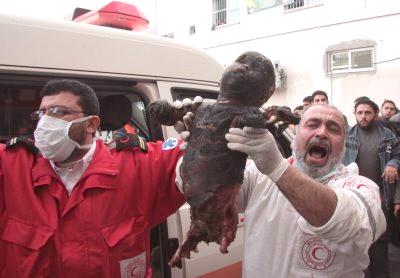
So how did The New York Times compare to its British equivalent? I did a search of the paper’s website and archive and trawled Lexis-Nexis for references in the paper to white phosphorous during Operation Cast Lead. In total there were just five reports and with the exception of the last article, filed after the Israelis had withdrawn from Gaza, the NYT’s references to WP were perfunctory, repeated IDF and Israeli government explanations for its use and made little if any mention of the death and injury caused to Gazan civilians.
The first was a story on January 11th by Ethan Bronner, the Jerusalem bureau chief for the NYT since March 2008. Although the subject had been well reported by The Times of London and other European newspapers up to a week beforehand, Bronner devoted just one sentence to WP in a report that led with Israel’s warnings to Gaza residents about a planned escalation of its incursion. Although Bronner also reported signs of growing international criticism of Israeli tactics and the dangers posed to Gazan civilians, the reference to WP was a meager one that carried echoes of the IDF’s line on its use. He wrote: “Human rights groups are also concerned about the Israeli use of white phosphorous, which creates smoke on a battlefield, at low altitudes or crowded areas, because it can burn like a kind of napalm.”
The second report came on January 16th, five days later and dealt with the shelling of the UNWRA complex. The article dwelt on Israeli doubts about the UN’s neutrality and complaints about its “institutional bias”, carried the IDF claim that its shelling was in response to Hamas fire and devoted just two paragraphs in a 1600 word article to the use of White Phosphorus.
Bylined Isabel Kershner, the story had this to say about the weapon:
Citing agency representatives who were present during the attack, Mr Gunness (a UNWRA spokesman) said three white phosphorous shells had hit the compound, causing fires that raged for hours, an allegation to which the Israeli military did not respond.
White phosphorous is a standard, legal weapon in armies, long used as a way to light up an area or to create a thick white smoke to obscure troop movements. While using it against civilians, or in an area where many civilians are likely to be affected, can be a violation of international law, Israel has denied using the substance improperly. On Wednesday, Hamas fired a phosphorous mortar shell into Israel, but no-one was hurt.
On January 22nd, the day after Israel withdrew from Gaza, The New York Times carried two pieces on WP, one by Ethan Bronner and Alan Cowell which reported that Israel had established a military investigation “to look into the issue” of alleged misuse of WP following allegations reported in what an IDF spokesman called “the foreign press”. It was the first admission by the paper that Israel’s use of white phosphorous had angered and incensed international opinion.
A second piece, solely by Ethan Bronner, finally put a human face to the consequences of white phosphorous use and reported on the ordeal of the Abu Halima family. Five members of the family, four children and their father, had perished in a WP attack over two weeks earlier and the incident had been widely reported, both in The Times of London and other European outlets, but it was only now that The New York Times was giving the story any coverage.
Bronner quoted Sabah Abu Halima, the surviving widow, at length and also doctors who had treated survivors and had seen the horrific injuries up close. One doctor said that in a few cases the damage done by WP was so acute that “seemingly limited burns led to the patients’ deaths.” Sabah Abu Halima’s grief was so profound, she said she wanted to see Israel’s foreign minister and president “burn like my children burned”.
It was a good piece of reporting that well reflected the horrors visited upon Palestinian civilians by Israeli white phosphorous. But it came far too late, like the horse that bolted the stable. It also smacked of catch up by the Gray Lady, as if someone in the New York HQ had realized that the paper really ought to say something about the matter given the level of international concern over Israel’s behavior in Gaza. But by this stage the horse had galloped several fields away.
It could be said in the paper’s defense that The New York Times was hampered, as was all the media, by Israeli government restrictions on media access to the Gaza war zone. Reporters like Ethan Bronner and Isabel Kershner couldn’t actually report from the ground, could not see the evidence or lack thereof for themselves and couldn’t get to speak to victims like Sabah Abu Halima, much less look into her eyes as she voiced her allegations. All their reports, bar the second Bronner piece on January 22nd, carried the Jerusalem dateline. Only when the IDF had evacuated could Ethan Bronner get into Gaza to speak to Palestinians.
That all sounds reasonable except for one thing. Like the NYT, The Times of London’s reports were all datelined Jersualem and for its detailed coverage of events on the ground in Gaza the paper seemingly relied on local stringers. And it managed to report in considerable detail both the use of WP and the devastating injuries being caused. So what about The New York Times? Did the paper have someone on the ground in Gaza and if so, why didn’t its coverage match its English counterpart?
Well yes, the paper did have someone on the ground in Gaza. Her name was Taghreed El-Khodary, a Palestinian journalist and she was the paper’s local correspondent, able to go places and speak to people inaccessible to Bronner and Kershner. On January 19th, 2009, she featured in a lengthy readers’ Q&A session reported in the Lede blog on the NYT website where she was asked about evidence that she had seen about the use of WP. She replied, inter alia: “I could find evidence of the use of white phosphorus bombs……As a result, we wrote about the use of the phosphorus. Israel used white phosphorus in densely populated areas.”
Ms El-Khodary may well have written about white phosphorous but if so, her reports about its use, the evidence she had found and her assertion that the weapon was used in “densely populated areas” never appeared in her paper, at least no edition available in any archive that I could search.
In all of this, it may entirely be a coincidence that the NYT’s Jerusalem bureau chief Ethan Bronner has what many would see as a major conflict of interest. He is married to an Israeli citizen and his son is a soldier in the Israeli army. Philip Weiss in his Mondoweiss blog reported on The New York Times response when Bronner’s background became known: “When it broke the news last year, Electronic Intifada said that it was a conflict of interest; and the newspaper’s public editor concurred; he said that Bronner should be reassigned to some other beat. The Times’ executive editor, Bill Keller, has kept Bronner in Jerusalem, presumably hoping that the issue dies down and no one says anything about it.” (Taghreed El-Khodary resigned when the NYT refused to reassign Bronner and spoke of her “disappointment” at the paper’s decision). The NYT’s other Jerusalem-based correspondent Isabel Kershner is an Israeli citizen.
Perhaps it is unfair to suggest that such considerations would or could affect how a journalist covers a particular story or how a newspaper should regard his or her stories. But put it this way. If CJ Chivers was a Libyan citizen, or was married to one, and had a son who was fighting for the rebels in Benghazi and all this was known to the world, would The New York Times have been just as quick to publish his story about Gaddafi’s use of cluster bombs, just as confident that it could weather the inevitable controversy?
Israeli army used white phosphorous in latest attack on Gaza
Medical examinations point to the continued use of prohibited weapons by Israel in Gaza
Saleh Naami | Al-Ahram | 18 Apr 2011
The head of the justice department’s medical examiner’s office in the Gaza Strip, Ihab Keheal, has stated that examinations conducted by his office have unveiled evidence indicating that the Israeli army used white phosphorous and other internationally prohibited weapons in its latest operation in Gaza.
Making his comments in a press statement released Monday, Keheal said that the bodies of Palestinians killed in the latest escalations were torn apart and charred to the extent that they were barely recognizable.
Keheal added that his office was conducting delicate tests to discover the instruments used by the occupation army in its operations on civilians, including weapons and chemical munitions forbidden under international law.
The Palestinian Ministry of Justice, according to Keheal, is in contact with committees responsible for documenting war crimes as well as Palestinian and international rights organizations.
He hopes the reports issued by his office could be used to try the Israeli occupation for its crimes in an international court of justice.
In this way, explained Keheal, it is of the utmost importance that the world is aware that the occupation forces persist in using internationally forbidden weaponry against Palestinian civilians. He called on the world to take responsibility and protect civilians especially in light of Israel’s renewed threats of launching military operations on the Gaza Strip.
In the aftermath of Operation Cast Lead, which claimed the lives of 1,400 Palestinians, most of which were civilians, Israel admitted using white phosphorous against civilian targets in the strip.
NATO Irradiates Libya
By THOMAS MOUNTAIN | CounterPunch | April 15, 2011
NATO aircraft are routinely equipped with anti-armor missiles fitted with depleted uranium war heads. It has been widely reported that NATO has fired hundreds of anti-armor missiles in many parts of Libya, including in the immediate environs of the Libyan capital Tripoli. This means that thousands of kilos of depleted uranium have been used in Libya in the past weeks.
Depleted uranium, or D.U., ignites when it strikes armored vehicles. Ignition causes D.U. to break down to a microscopic powder, measured in microns or millionths of an inch. Upon impact D.U. creates a fireball in many cases that rises hundreds of feet into the atmosphere where the wind helps spread it over large areas.
D.U. is a very dangerous, long term poison. It is radioactive and when ingested internally causes a host of problems to its victim. It is nonspecific and generational in impact, meaning that it does not distinguish between friend or foe and the damage it does goes on for generations into the future.
Large quantities of D.U. were used during the attack on Iraq in 1991 and the invasion of Iraq in 2003. The damage done by D.U. to the Iraqi population is well documented and continuing.
The use of D.U. constitutes a war crime and crime against humanity, just as poison gas and dumdum bullets were designated in their time. The Libyan people are the latest victims of this western inflicted plague.
Irradiate the Libyan people to save the Libyan people? How else could you describe the NATO attack on Libya?
~
Thomas C. Mountain can be reached at: thomascmountain at yahoo dot com
Gaza War and Goldstone’s Moral Collapse
By Ramzy Baroud | Palestine Chronicle | April 14, 2011
Shocking is not a sufficient term to describe Justice Richard Goldstone’s decision to recant parts of the 2009 report on alleged war crimes in Gaza.
The document, known as the Goldstone Report, was compiled after a thorough investigation led by the South African judge and three other well-regarded investigators. They documented 36 incidents that occurred during the Israeli Operation Cast Lead, an unprecedentedly violent attack against small, impoverished and besieged Gaza. It resulted in the death of over 1,400 Palestinians, and the wounding of over 5,500.
Goldstone is both Jewish and Zionist. His love for Israel has been widely and affectionately conveyed. In this particular case, he seemed completely torn between his ideological and tribal position and his commitment to justice and truth, as enshrined in the mandate of the UN Human Rights Council.
After 18 months of what seemed a wholly personal introspection, accompanied by an endless campaign of pressure and intimidation by Zionist and pro-Israel Jewish groups from all over the world, the man finally surrendered.
“If I had known then what I know now, the Goldstone Report would have been a different document,” he wrote in the Washington Post on April 1. But what did Goldstone learn anew since he issued his 575-page report in September 2009?
The supposed basis of Goldstone’s rethink is a follow-up report issued by a UN committee chaired by retired New York Judge Mary McGowan Davis. Her report was not a reinvestigation of Israel’s — and Hamas’ — alleged war crimes in Gaza, but a follow up on the Goldstone Commission’s findings, which urged the referral of the matter to the International Criminal Court. McGowan Davis made this distinction clear in a recent interview with the Israeli Jerusalem Post. According to the post, she said, “Our work was completely separate from (Goldstone’s) work.” She further stated, “Our mandate was to take his report as given and start from there.”
So how did a probe that used Goldstone’s findings as a starting point go on to inspire such a major refutation from one of the authors of the original report?
McGowan Davis’ report merely acknowledged that Israel has carried out an investigation into a possible “operational misconduct” in what is largely known outside Israel as the Gaza massacre. The UN follow-up report recognized the alleged 400 investigations, but didn’t bear out their validity. These secret inquiries actually led to little in terms of disciplinary action.
More, the UN team of experts claimed there was “no indication that Israel has opened investigations into the actions of those who designed, planned, ordered and oversaw Operation Cast Lead.”
In fact, Israel is known for investigating itself, and also for almost always finding everyone but its own leadership at fault. Israeli investigations are an obvious mockery of justice. Most of their findings, like those that followed another investigation of the Israeli war on Lebanon in 2006, merely chastised the failure to win the war and to explain Israeli action to the world. They said little about looking into the death and wounding of innocent civilians. Is this what Goldstone meant when he used the words, “if I had known then what I know now”? And could this added knowledge about Israel’s secret — and largely farcical — investigations be enough to draw such extreme conclusions such as “civilians were not intentionally targeted as a matter of policy”?
This was the trust of the Israeli argument, which attempted to reduce a persistent policy predicated on collective punishment — one that used controversial and outright illegal weapons against civilians — to the injudiciousness of individual soldiers. Goldstone’s calculated retraction is an adoption of “the Israeli position that any misdeeds during the Gaza assault were caused by individual deviants, not by policies or rules of engagement ordered by military leaders,” according to George Bisharat, professor at the Hastings College of the Law (as reported by the San Francisco Chronicle, April 7). Bisharat added, “Yet the original report never accused Israel of widespread deliberate attacks on civilians, and thus Goldstone retracted a claim that had never been made. Most of its essential findings remain unchallenged.”
John Dugard, professor of law at the University of Pretoria and former UN Special Rapporteur on Human Rights in the occupied Palestinian territory agrees. “Richard Goldstone is a former judge and he knows full well that a fact-finding report by four persons, of whom he was only one, like the judgment of a court of law, cannot be changed by the subsequent reflections of a single member of the committee.”
Dugard, well known for his principled stances in the past, is also known for his moral consistency. “It is sad that this champion of accountability and international criminal justice should abandon the cause in such an ill-considered but nevertheless extremely harmful op-ed,” he wrote in the New Statesman on April 6.
Unsurprisingly, Israeli leaders are gloating. “Everything we said was proved true,” declared Prime Minister Benjamin Netanyahu in response to Goldstone’s moral collapse. The New York Times reported on April 5 that Goldstone agreed to visit Israel in July during a telephone call with Israel’s Interior Minister Eli Yishai. “I will be happy to come,” Yishai quoted Goldstone as saying. “I always have love for the State of Israel.”
The fact is, Goldstone’s repudiations of some of his commission’s findings clearly have no legal validity. They are personally, and in fact selfishly motivated, and they prove that political and ideological affiliations are of greater weight for Goldstone than human suffering and international law and justice. There is no doubt, however, that Goldstone’s rethink will represent the backbone of Israel’s rationale in its future attacks on Gaza. Goldstone, once regarded as an “evil, evil man” by a prominent Israel apologist in the US, will become the selling point of Israel’s future war crimes.
If the killing of over 1,400 Palestinians is not a “matter of policy”, and Hamas’ killing of four Israelis is “intentional” — as claimed by Goldstone — then the sky is the limit for Israel’s war machine.
Indeed, “shocking” is not the right term. “Disgraceful” may be more fitting.
~
Ramzy Baroud (www.ramzybaroud.net) is an internationally-syndicated columnist and the editor of PalestineChronicle.com. His latest book is My Father Was a Freedom Fighter: Gaza’s Untold Story (Pluto Press, London), available on Amazon.com.
US Senate urges UN to revoke Gaza War report
Press TV – April 15, 2011
The US Senate has urged the UN to revoke a report on the Gaza War, which accuses Israel of committing war crimes during the 22-day offensive against the Gaza Strip.
The US senators have drawn up a resolution calling on UN Human Rights Council members “to rescind the report and reconsider further Council actions with respect to the report’s findings.”
The resolution also urged UN Secretary General Ban Ki-moon to help “reform” the Human Rights Council “so that it no longer unfairly, disproportionately, and falsely criticizes Israel on a regular basis,” AFP reported
It also called on the UN chief to “do all in his power to redress the damage to Israel’s reputation” caused by the report.
The resolution comes after head of the UN inquiry over the Gaza offensive Richard Goldstone said earlier this month that he was wrong to conclude Israel targeted civilians.
In April 2009, Goldstone investigated reports of the international human rights and humanitarian law violations during the December 2008-January 2009 assault, which left more than 1,400 Palestinians, mostly women and children, dead.
The report said that the Israeli operations “were carefully planned in all their phases as a deliberately disproportionate attack designed to punish, humiliate and terrorize a civilian population.”
However, under intensive pressure from the Israelis, Goldstone on April 3 announced that he was wrong to say Israel had deliberately targeted civilians.
Goldstone later announced that he has no reason to believe any part of the report needs to be reconsidered at the moment.
On Thursday, three of the authors of the report, which was condemned by the US House of Representatives in a November 2009 vote, rejected calls to retract it.
The report could pave the way for dragging Israel before the Hague tribunal for war crimes.
Goldstone’s Retraction Rejected
Al-Manar | April 15, 2011
The three co-authors of the United Nations report on the 2008-2009 Gaza war rejected on Thursday an op-ed by the fourth member and chairman Richard Goldstone in which he retracted key conclusions of the report – in particular claiming that Israel had not intentionally targeted civilians during the war.
In an article in the British daily The Guardian, the three members – the Pakistani human rights lawyer Hina Jilani; Christine Chinkin, professor of international law at the London School of Economics; and former Irish peace-keeper Desmond Travers maintained that the conclusions of the report remain valid despite Goldstone’s shift and subsequent calls to retract the report in the UN.
“There is no justification for any demand or expectation for reconsideration of the report as nothing of substance has appeared that would in any way change the context, findings or conclusions of that report with respect to any of the parties to the Gaza conflict,” they wrote.
Earlier this month, Goldstone published an op-ed in the Washington Post in which he backtracked on claims he had made in the UN report, accusing Israel of targeting civilians during its war on the Gaza Strip two years ago.
The three international law experts did not mention Goldstone by name, but slammed a number of the points he made in his op-ed in the Washington Post, writing that “aspersions cast on the findings of the report cannot be left unchallenged” and said they have “misrepresented facts in an attempt to delegitimize the findings” of the Goldstone Report and “to cast doubts on its credibility.”
Moreover, they said that any kind of retraction of the report is an insult to the victims of the Gaza war. “We consider that calls to reconsider or even retract the report, as well as attempts at misrepresenting its nature and purpose, disregard the right of victims, Palestinian and Israeli, to truth and justice.”
In his Washington Post op-ed earlier this month, Goldstone said that if Israel had cooperated with his probe then the conclusions on the report would have been different.
Palestinians and Internationals call for release of Italian ISM activist kidnapped in Gaza
INTERNATIONAL SOLIDARITY MOVEMENT, FREE GAZA MOVEMENT – April 14, 2011

Vittorio Arrigoni
Today, our friend and colleague, Vittorio Arrigoni, a journalist and human rights defender working in the Gaza Strip, was kidnapped by Salafists, members of a very small extremist group in Gaza.
Vittorio has been active in the Palestine cause for almost 10 years. For the past two and a half years, he has been in Gaza with the International Solidarity Movement, monitoring human rights violations by Israel, supporting the Palestinian popular resistance against the Israeli occupation and disseminating information about the situation in Gaza to his home country of Italy. He was aboard the siege-breaking voyage in 2008 with the Free Gaza Movement and was incarcerated in Israeli prisons several times. He was in Gaza throughout Israel’s brutal assault (Operation Cast Lead), assisting medics and reporting to the world what Israel was doing to the Palestinian people. He has been arrested numerous times by Israeli forces for his participation in Palestinian non-violent resistance in the West Bank and Gaza. His last arrest and deportation from the area was a result of the Israeli confiscation of Palestinian fishing vessels in Gazan territorial waters.
Vittorio frequently writes on the issue of Palestine for the Italian newspaper, IL Manifesto and Peacereporter. Additionally, he maintains a popular blog (http://guerrillaradio.iobloggo.com) and Facebook page (http://www.facebook.com/pages/Vittoriatio-Arrigoni/).
Khalil Shaheen, a friend of Vittorio and Head of the Economic and Social Rights Department at the Palestinian Center for Human Rights said, “This is outside of our traditions. We are calling for the immediate release of my best friend. Vittorio Arrigoni is a hero of Palestine. He was available everywhere to support all the poor people, the victims. I’m calling on the local authorities here in Gaza, and all security departments, to do their best to guarantee his safety and immediate release.”
Vittorio was granted honorary citizenship for his work on promoting the cause of the Palestinian people. Members of Gazan civil society are demanding his release; tomorrow at 4:00pm there will be a mass demonstration in Jundi Square.
Woman killed in Gaza air strike was anticipating wedding
Rami Almeghari, The Electronic Intifada, 14 April 2011
 |
The chairs that Nidal and Najah Qdeih were sitting in when they were killed in an air strike. (Rami Almeghari) |
Around midday last Friday, Ibrahim Qdeih was chatting with his daughters and wife about preparations underway for his daughter Nidal’s wedding later this month. Those plans would be forever disrupted after an Israeli missile hit their house, taking the lives of Ibrahim’s wife, Najah, and daughter, Nidal.
“I was set to go to the Friday sermon [at the mosque] and it was about 12:15pm, when my daughter Nidal was talking to me about the final touches for her wedding party. By then, electricity was cut off and my wife Najah and my daughters Nidal, Neda and Fida, all moved to rest a bit on these chairs,” Qdeih explained, standing near a crater left by the fatal missile strike next to his modest, rural home in al-Faraheen, east of Khan Younis in the southern Gaza Strip.
The bereaved father added “After we talked, I took my son to the Friday sermon at a nearby mosque. While in the middle of the road, we heard a large explosion but we went on walking, for I didn’t expect it was my home. As we arrived at the mosque, someone told me that my house was struck by a missile. Then I rushed back along with my son to the house.”
As the two arrived, Ibrahim’s 43-year-old brother, Fathi, along with Ibrahim’s neighbor, Mansi, were trying to aid Ibrahim’s wounded daughters, Neda and Fida. Najah and Nidal did not survive the strike. Neda is currently in critical condition and is being treated at al-Nasser hospital, while Fida’s injuries are moderate.
Fathi was the first to arrive at the gruesome scene.
“As I was walking down just few meters away from my brother’s house, just near this palm tree, I was shocked by the explosion and saw some pillars of smoke rising up from Ibrahim’s house,” Fathi said while surrounded by family in Ibrahim’s three-room home.
“Then I pushed the door to see what happened. It was horrible, it was horrible — Najah’s face was smashed and stained with blood, while Nidal’s abdomen was ripped open with blood covering all over her body.”
Nidal’s fiance, 24-year-old Jihad al-Qarra, was waiting anxiously for their wedding day before the missile hit. Al-Qarra teared up when he entered the room where luggage lay, stuffed in preparation for a wedding that will never happen.
 |
| Ibrahim Qdieh and his son Ahmad. (Rami Almeghari) |
“Just four hours before Nidal was killed, I was taking part in the funeral procession for my cousin Abdallah, who was also killed by an Israeli drone the day before,” al-Qarra, a university graduate and farmer, said. “It was a very difficult moment for me when I heard Nidal was killed. Nidal was a very quiet, simple and kind girl who I really loved for the past six months and I wanted her to be my life partner.”
Asad al-Najjar, Ibrahim’s brother-in-law, vented his anger over the loss of his sister and niece.
“This is a catastrophe,” al-Najjar said. “Where is the UN Security Council, where are the rights groups and others who are concerned about the protection of civilians in the time of war? It is really the climax of atrocities! This is an unbearable situation where people can never feel safe inside their homes. How come such helpless women are struck by missiles, killed and wounded inside their home?”
In the half-meter-wide crater left by the strike, Najah and Ibrahim’s 12-year-old son, Ahmad, began collecting small pieces of shrapnel. “I am collecting these small pieces for remembrance,” the boy said before being overcome by emotion.
The Qdeih family were not the only to suffer casualties last week as the Israeli military bombed across the Gaza Strip. According to Adham Abu Silmia, spokesperson for the ambulance service in Gaza, the Israeli army targeted civilian homes and even medical centers such as the Hijazi clinic in northern Gaza.
“Eighteen persons, including three children, two women and two elderly men have been killed either by air strikes or artillery fire,” Abu Silmia explained. “And 67 other persons have been wounded, including forty women, children and elderly and two ambulance crew members.”
Abu Silmia added that four of the wounded, including an elderly farmer in northern Gaza, had limbs amputated due to the drone or artillery fire.
Israeli army spokesperson Arieh Shaliqar, asked to comment on the deaths of Najah and Nidal Qdeih in their home, said: “Please let me emphasize that the Israeli army is not interested in fighting civilians or fighting people who are uninvolved or people who are regular citizens living in the Gaza Strip or in any other place. Our enemy is the Hamas terrorist organization, which keeps on sending rockets on the Israeli home front.”
In the wake of last week’s strikes, several Gaza-based armed factions, topped by the ruling Hamas party, declared a unilateral ceasefire in Gaza. Israel threatened to collectively punish Gaza in the event of additional rocket fire from Gaza.
Last Thursday, Israel stepped up attacks on the Gaza Strip after Hamas’ military wing fired an anti-tank rocket on a school bus in southern Israel, critically wounding a 16-year-old boy and the bus driver. Hamas said the strike was in retaliation for Israel’s 1 April extrajudicial killing of three Hamas members in Gaza.
The latest violence follows weeks of escalation of violence between Gaza and Israel, which Israeli analysts say has been fueled and instigated by Israel.
In Cairo, Arab League chief Amr Mousa signaled the possibility that he would request the United Nations consider imposing a no-fly zone over Gaza to prevent further Israeli air strikes.
Meanwhile, in Gaza, there will be one less wedding celebration this month. And during this reporter’s time in al-Faraheen with the Qdeih family, the Israeli drones — or unmanned aerial vehicles — overhead signaled the end of the interview.
“Let’s leave the house right now; the drone is overhead and I think this is enough,” Fathi Qdeih said.
Rami Almeghari is a journalist and university lecturer based in the Gaza Strip.
Displaced indigenous Guatemalans, undaunted by war crimes, re-establish communities
Written by Emma Volonté, Translation by Alex Cachinero-Gorman | Upside Down World | 11 April 2011

“The CPRs [Communities of Popular Resistance] exist because the army has forced us to resist. We carry with us the scraps of bombs and bullets that you tried to kill us with. (…)You know very well that we are not guerrillas, but rather peasants, civilians; you know well how you have fired on our huts, which you’ve burned many times before (…) You have bombarded our communities, kidnapped thousands of our brothers; you have also ordered civilian patrols to stop us from setting up businesses (…). The Constitution gives us the right to resist when you place yourself above the reproach of civil society, when you persecute us, when you kidnap us illegally, when you have poisoned our rivers and tried to kill us by starvation.” ~ Message to the Guatemalan Army from the CPRs.
At first sight, CPR-Salvador Farjado (Petén) seems like any other community in Guatemala. A few small shops, a school, and houses made of wooden boards, out of which one can catch always smell that wafting, warm perfume—firewood being burnt in preparation for dinner.
About 400 families—hailing from Cobán, Santa Rosa, Alta Verapaz, Huehuetenango and Chimaltenango—now live in Salvador Fajardo, a meager human community carved out of a small portion of the Petén jungle. There, I got to know Ms. Elvira, who told me of her past and of the community’s history, which reflect the extreme extent of violence that Guatemala had seen until 1996.
The Guatemalan state has always been characterized as authoritarian, militarized, and managed by the ruling classes to serve their own interests. In the ’60s, various guerilla groups began to form as state violence and repression increased. These groups joined together as the URNG (Guatemalan National Revolutionary Unity) in 1982.
The tension between guerrillas and the army intensified between ’78 and ’83: but the atrocious “scorched earth politics” advanced by the ‘Kaibiles‘ special operations unit, the PACs (Civilian Self Defense Patrols), and various paramilitary groups, showed clearly that the growing counter-insurgency effort was, without a doubt, disproportionately brutal.
According to the Historical Clarification Commission of Guatemala, the total sum of both dead and ‘disappeared’ during the conflict in Guatemala is over 200,000, 83% of which are indigenous Mayans. In their report, the Commission writes: “The great majority of these human rights violations were carried out viciously and in public. […] Assassinating defenseless boys and girls, on many occasions by throwing them against walls or tossing them into ditches alive, only later to be buried by the corpses of adults; the traumatic amputation or removing of limbs; assassination by being burned alive; disembowelment of still-living victims with others looking on; the internment of victims who had already been fatally tortured, and keeping them alive deliberately in a state of constant agony; the cutting open of pregnant womens’ stomachs. Extreme cruelty was consciously utilized as a technique to create a climate of terror in the population. The vast majority of victims of the State’s actions were not guerrilla combatants, but rather civilians.”
It is estimated that in the early ’80s, between 500,000 and 1 and a half million people were forced to flee from Guatemala because of the violence: of these, around 150,000 took refuge in Mexico, while the rest were condemned to continual, internal displacement within the country. Some of these internally displaced persons [IDPs] formed the CPRs: in Ixcán, in the high plateaus of Quiché (CPR Sierra), and in the Petén jungle. These then became the preferred target of military operations.
The CPR-Petén hid in the impenetrable snare that is the Lacandon Jungle, in a strip of Guatemalan land that borders the Eastern frontier of Chiapas. Ms. Elvira, who was originally displaced from the Santa Rosa District, lived there for 12 years. She gladly recounted her experience there, in what has come to be known as “the mountain” in Salvador Fajardo.
Back then, military incursions were so frequent that every morning the families of the CPR-Petén packed up the few things that they had so that they would be ready to flee at any moment. “We always had lookouts at four different points”, Ms. Elvira told me. “When the army arrived, a shot fired into the air was the signal that it was time to grab your suitcase and go. And the army would make incursions continually: sometimes every four days, at the very least every month. When they came, we had to escape, to go to some other part of the mountains—if we didn’t have enough time to take our things, they would just destroy everything. So we would set up camp somewhere else, because the army already knew where we’d settled and would check to see if we came back—that’s why you would never return to the same encampment.”
Ms. Elvira told me about the difficulties she faced in those years, of the constant fear, of a solidarity of both the community and hunger. One ate what the jungle gave you: roots, plants, and fruits. Some managed to get into Mexico to get food—“a bit limited”, Ms. Elvira emphasizes. “Sometimes when community members walked around they would come across milpas [small crop fields] and they would steal a little bit of corn to feed their children…there were a lot of children in the mountain. We cooked what little bit of corn they took: we would walk around with a mill and a pot, and wherever you came across corn you would grind it right there. We would make little balls of dough out of it and then wrap it in leaves. Then we would go look for a place to eat safely, each person with their own portion tucked away in their bag, but you couldn’t light a fire in the daytime, because there was always a plane hovering over the mountain—if it detected the smoke from a campfire, it would drop bombs on the whole encampment. So we would cook at night.”
After the final offensive in 1992, the displaced families of CPR-Petén realised that the army would no longer be as vigilant of their presence, and that they had the possibility to settle down in the Lacandon Jungle. There they founded four communities: Fajardo, Esmeralda, Virgilio, and Albeño, where they sowed milpa fields and vegetable gardens. They also decided to begin pressuring the government to award them a finca [agricultural plot of land] so that they could leave the jungle and begin life anew.
It was in 1998 that the CPR-Petén founded a community in memory of Salvador Fajardo in Santa Rita, after the “Firm and Lasting Peace Agreement” (1996) was signed. Fajardo was a community member who, in the ’80s, after the umpteenth flight to the jungle, offered to return to the encampment to retrieve their pots and pans. When he arrived, he found that the army had already taken all except one pot, which was sitting in the middle of a campfire. When he lifted it up, it exploded—a mine had been planted beneath the firewood.
“When we came here we didn’t bring anything with us, because we had nothing to bring, but after being here for awhile many organizations supported us”, Ms. Elvira told me. “The only governmental institution that gave us a little bit of support was FONAPAZ [National Peace Fund]: they helped by giving us food, but it wasn’t much. Everything we have was possible because of support from international organizations: the preschool and elementary school, the clinic, the radio station, the store. But the government did not fulfill its promises—the only thing it followed up on was building a mechanical well to secure a water supply. And sure, they bore the well; they even bought a bomb to clear it out but in the end it didn’t serve us well: after three months it was completely dry and we were left without water. The municipality didn’t help us either, instead claiming we were guerrillas—they discriminated against us.”
Many have accused members of the CPRs of being part of the UNRG, but they have always responded that they have only ever served as bases of support for the guerrillas, whom they guaranteed a place to eat and rest. In exchange, the UNRG offered an indispensable service to the CPRs: “the guerrillas defended us, because in reality, if the guerrillas were not around, the army would have annihilated us already. They were with us; they knew that there were people, women and children, elders, defenseless people here. It was when they neglected us, when they retreated from the surrounding area, that the army would come in. But as long as they were with us, nothing would happen to us”, said Ms. Elvira—a very special woman indeed.
Featured Video

10 Climate Myths Busted (in 60 seconds!)
or go to
Aletho News Archives – Video-Images
Book Review
How the U.S. Navy Sold the Vietnam War
By Gareth Porter | TruthDig | March 27, 2019
Dr. Tom Dooley, whose best-selling book “Deliver Us From Evil” helped create a favorable climate of opinion for U.S. intervention in South Vietnam, has long been linked to legendary CIA officer Edward G. Lansdale and his black operations in Vietnam between 1954 and 1955. But the real story about Dooley’s influential book, which has finally emerged from more recent scholarly research, is that it was engineered by an official of the U.S. Navy’s Pacific Command, Capt. William Lederer.
Lederer is best known as the co-author, with Eugene Burdick, of the 1958 novel “The Ugly American,” which was turned into a 1963 movie starring Marlon Brando. Far more important, however, is the fact that from 1951 through 1957 Capt. Lederer was on the staff of the commander in chief of the U.S. Pacific Fleet (CINCPAC), Adm. Felix Stump. … continue
Blog Roll
 Aletho News
- In Mexico, the CIA Is Playing a Dangerous Game
- Spain’s Left Protested the Crisis It Legitimized: the General Strike as election stunt
- The power of inflicting oblivion
- The 10 Disease Renamings That Rescued the Vaccine
- NATO cancels 2027 leaders’ summit
- IAEA’s politicized use of safeguards undermines its impartiality: Russian envoy
- UK must be ready to strike Russian Arctic – ex-PM
- Fico’s Two Red Lines: Russian Energy and the Next Ukraine Loan
- Thousands rally for banned NATO-skeptic presidential candidate
- Ukraine Settlement and New European Security Architecture Must Go Hand in Hand – Kremlin
- If Americans Knew
- An error has occurred; the feed is probably down. Try again later.
- No Tricks Zone
- New Study: Barents Sea Temperatures Were Warmer And Sea Ice Less Extensive In The 1700s Than Today
- German Authorities Start Initiative To Evaluate Public Register For Climate “Disinformation” Spreaders!
- Zonal Asymmetry of Temperature Change in the Antarctic Circumpolar Current
- New Study: The Net Fossil Fuel Contribution To Rising Atmospheric CO2 Has Been Zero For 500 Years
- Germany’s Green Energy Transition Becoming Increasingly Expensive…Another 6 Trillion Euros!
- Sudden Stratospheric Warming, Powerful El Niño Combination May Lead To Extreme Europe Cold, Energy Crisis!
- Two New Studies Find Thwaites Glacier Melt Cannot Be Driven By Human Activity Or A Warming Ocean
- E-Cars Reduce CO2 Emissions By Only 41% Compared To Internal Combustion Engine Vehicles
- Predictions Made By Renowned Climate Professor Over Past Decades Have Been Proven To Be Poor
- New Study Suggests Large Regions Of The Pacific Ocean Have Been Cooling For The Last 80 Years

