Professor Richard Falk on Universal Jurisdiction
Dr. Hanan Chehata | Middle East Monitor | 03 December 2010
The Middle East Monitor (MEMO) hosted UN Special Rapporteur Prof. Richard Falk for a series of events this week including a parliamentary briefing on the issue of Universal Jurisdiction. The following is an extract from the talk he delivered in the House of Commons:
The issue of universal jurisdiction is of special interest at this time because of the apparent effort to give assurances to Israeli leaders that they won’t be subject to a legal process if they come here (to the UK); and that of course is in reaction to the problems that the former Foreign Minister [Tzipi] Livni had when she cancelled her trip [to the UK last year].
I think it is important to realise that the whole idea of universal jurisdiction is to take account of the weakness of international institutions in upholding international criminal law. There has always been the sense that national judicial institutions reinforce the norms of international law and take account of that institutional vacuum that exists in international society; this has been a historical practice in relation to piracy and to other kinds of international crimes that were a threat to the international community as a whole. The idea of Nuremberg after World War Two was that crimes against the peace, crimes against humanity and war crimes are also offences against the whole of international society. There is an interest on the part of all states in trying to implement those norms of international criminal law. The American Chief Prosecutor at Nuremberg said the law the state applied to the German survivors of World War Two will not be respected unless those who sit in judgement uphold it in relation to their own behaviour; that it was a promise to the future.
It seems to me that if a country such as Britain, which has a proud constitutional tradition, reserves the implementation of international criminal law just for those the government doesn’t like at the time – in other words if international criminal law is used for prosecuting Saddam Hussein or Slobodan Milosevic but not the friends of the government – then you discredit, in a fundamental way, the rule of law which really does depend on equals being treated equally. If that is not done then double standards become very manifest; it also has the effect of saying that geopolitics and foreign policy always trump the law. Again, that is an unfortunate way of thinking in an increasingly globalised world where the discipline of international law is very important as a way of restraining and containing foreign policy within appropriate boundaries. I’ve said often that US foreign policy would be much more successful had the Americans chosen to respect international law in the last several decades; that most of the failures of American foreign policy have correlated with deviations from international legal norms. Hence, in that sense I think a lot is at stake with this whole idea of universal jurisdiction.
Putting it now in the Israel-Palestine context, universal jurisdiction is part of the struggle against impunity for the Israeli military and the country’s political leaders. That impunity has been possible both because Israel itself doesn’t impose accountability on those who perpetrate violations of international criminal law and because the US, and to some extent European countries, have given a geopolitical insulation to Israel in relation to its responsibilities as a sovereign state.
Thus, part of the wider stage of the conflict between Israel and Palestine is a shift in tactics on the Palestinian side much more in the direction of non-violent symbolic instruments of soft power. They include this much more robust global solidarity movement that has concentrated on building a boycott and divestment campaign which has been surprisingly effective, even in the United States. It has been increasingly a matter for university campuses, for instance, even at conservative universities. Part of this issue of impunity and accountability was also raised by the UN’s Goldstone report and by the international law panel appointed after the flotilla incident of May 31st;all of these issues converge to suggest that at this time the most effective way of implementing international law is both through the activism of civil society and through national legal institutions. One of the dimensions of the flotilla incident that is interesting and worth noticing is that Israel, for the first time, abandoned the claim that it was entitled to impose a comprehensive blockade. Everything the UN tried to do had had no effect, but this flotilla incident and the outrage associated with the way in which it was attacked led the Israeli leadership to say that henceforth humanitarian goods, fuel, food and medicine would be allowed to enter Gaza without restriction. Of course, even though Israel then “eased” the blockade it hasn’t ended it and the most recent statistics show that the blockade has actually been tightened in such a way that the people of Gaza get only about 28% of the goods that they were receiving prior to the blockade. So there is still very severe pressure on the Gazan population, which is forcing them to rely on some black market economy through the tunnels and which is generally an extension of the collective punishment of a whole population; that is a violation of Article 33 of the Geneva Convention that unconditionally prohibits collective punishment as an instrument of occupation.
Following the main text of his talk Prof. Falk and the MPs discussed a number of issues in addition to universal jurisdiction, including the issue of the illegal arrest of Palestinian children.
US-led troops abduct Afghan journalist
Press TV – December 4, 2010
US-led forces have abducted an Afghan journalist in the eastern province of Khost amid escalating anti-American sentiments in the war-ravaged country.
The troops stormed into the journalist’s home overnight and took him and his three brothers. Reports say they have been taken to a military base.
The move has caused uproar among other Afghan journalists, who say he is arrested without being charged. They maintain that even if he is to face charges he should be tried at an Afghan court. US-led troops in Afghanistan have abducted four other journalists in recent months.
This comes two days after Afghan President Hamid Karzai ordered an investigation into the NATO killing of a local Afghan official in the country’s south.
According to Karzai’s office, troops broke into the house of a former district governor in the province of Helmand earlier this week, killing him and arresting six members of his family.
Local officials say preliminary investigations have revealed that the man was innocent. They say NATO forces have not responded to inquiries about the killing.
The developments follow US President Barack Obama’s brief visit to Bagram airbase and prison, located north of the capital Kabul, on Friday. He spent a total of four hours on the ground in Afghanistan.
Obama has told US troops that they will have difficult days during their stay in the war-torn country. “Progress comes slow” and “there are going to be difficult days ahead,” Obama told thousands of US troops at Bagram Airbase.
US-led forces have some 150,000 soldiers deployed in Afghanistan. They are often accused of killing civilians during operations against the country’s militants.
Revelations on Rafik Hariri’s assassination
By Thierry Meyssan | Voltairenet | 29 November 2010
While western media have announced that indictments against Hezbollah will be issued shortly by the Special Tribunal for Lebanon, the Russian magazine Odnako challenges the entire UN investigation. Thierry Meyssan posits that the weapon used to assassinate former Prime Minister Rafik Hairiri was supplied by Germany. Former German prosecutor and first commissioner in charge of the UN probe, Detlev Mehlis, seemingly doctored evidence to cover up his country’s involvement. These revelations embarrass the Tribunal and reverse the tide in Lebanon.

All the conflicts rocking the Middle East today crystallize around the Special Tribunal for Lebanon (STL). Peace hinges on it, and so does war. For some, the STL should bring about the dissolution of the Hezbollah, quell the Resistance and establish a Pax Americana. Others consider that the STL is flouting the law and subverting the truth to ensure the takeover of a new colonial order in the region.
The Tribunal was created on 30 May 2007, pursuant to UN Security Council resolution 1757, to prosecute the alleged sponsors of former Prime Minister Rafik Hariri’s assassination. In the political context at that time, this implied nothing more and nothing less than bringing to trial serving Presidents Bashar el-Assad of Syria and Emile Lahoud of Lebanon, not exactly favourites of the neo-conservatives. However, the charges were not pursued since they were based on flimsy evidence planted by false witnesses. With no accused left, the Tribunal could easily have disappeared in the meanders of bureaucracy were it not for a turn of events that catapulted it back into the epicenter of the turbulent Middle East political scene.
On 23 May 2009, Atlanticist journalist Erick Follath disclosed on Der Spiegel Online that the prosecutor was poised to indict new suspects: certain Hezbollah military leaders. For the past 18 months, Hassan Nasrallah, Hezbollah’s secretary-general, has been proclaiming his party’s innocence. He maintains that the real aim of the proceedings is to decapitate the Resistance and clear the region for the Israeli army. For its part, the U.S. administration in a sudden surge of righteousness pledged that no one would be allowed to shun international Justice.
In any event, the indictment – which all believe to be imminent – against Shia leaders for the assassination of a Sunni leader is of such a nature as to spark off a fitna, namely a Muslim civil war, plummeting the region into new depths of bloodshed and violence.
During his 15 and 16 November official visit to Moscow, Saad Hariri – current Lebanese Prime Minister and son of the deceased – reiterated that the political exploitation of the Tribunal exposes his country to the risk of a new conflagration. President Medvedev retorted that Russia wants Justice to be served and reproves any attempt to discredit, weaken or delay the Tribunal’s proceedings. This position of principle arises from the confidence that the Kremlin decided to place in the STL. But it risks being severely eroded by Odnako’s revelations.
Indeed, we deemed it desirable to delve into the circumstances of Rafik Hariri’s assassination. The data we unearthed has opened a new avenue, making one wonder why it had never been explored until now. In the course of our lengthy investigation, we encountered a great number of actors, too many no doubt, so that the news of our work spread quickly, alarming those for whom the assassination trail implicating the armed Lebanese Resistance represents a real godsend. Aiming to intimidate us, the Jerusalem Post on 18 October launched a preventive attack through a piece referring to our work. In a purely libelous vein, it accuses the author of this article of having received 1 million dollars from Iran to exonerate Hezbollah.
Getting down to facts, Rafik Hariri’s convoy was attacked in Beirut on 14 February 2005. Twenty-three people were killed and one hundred injured. A preliminary report commissioned by the Security Council calls attention to the unprofessional conduct of the Lebanese magistrates and police. To redress the situation, the SC assigned its own investigators, providing them with the important means that Lebanon was unable to offer. From the outset of the investigation, it was generally accepted that the attack had been perpetrated by a suicide bomber driving a van packed with explosives.
Having been established to compensate for the Lebanese lack of professionalism, one would have expected the United Nations mission to scrupulously observe the classical criminal procedures. Not so! The crime scene – on the basis of the topography still intact as well as the photos and video footage shot on that day – was not examined in detail. The victims were not exhumed and no autopsies were performed. For a long time, no attempt was made to ascertain the modus operandi. After discarding the hypothesis of a bomb buried in the ground, the investigators espoused the one involving the van without bothering to verify it.

And yet, this version is implausible: looking at the crime scene, anyone can easily observe the very large and deep crater that a surface explosion could not have dug out. Faced with adamant Swiss experts who refused to endorse the official version, on 19 October the Special Tribunal for Lebanon (STL) recreated the crime scene behind closed doors. It didn’t take place in Lebanon, nor in the Netherlands which is the seat of the STL, but in France, one of the countries funding the Tribunal. The buildings surrounding the crime scene were reconstructed and earth was brought in from Beirut. The convoy was reconstituted, including the armoured vehicle. The aim was to demonstrate that the height of the concrete buildings had confined the explosion, making it possible for the blast to produce the crater. The results of this costly experiment have never been divulged.

When looking at the photos and videos taken immediately after the attack, the first most striking feature is the blaze. Car parts and various types of objects are burning all around. Then, the bodies of the victims: they are charred on one side and intact on the other. An astonishing phenomenon which bears no resemblance to what is normally caused by conventional explosives. The theory that the van was transporting a mix of RDX, PETN and TNT does not account for the damages which occurred.
What is more, from the photos showing Rafik Hariri’s corpse one can observe that his solid gold wristwatch has melted, whereas the collar of his luxury shirt still hugs his neck in pristine condition.
So, what really happened?
The explosion generated a blast of an exceptionally intense heat and exceptionally brief duration. Thus, the flesh exposed to the blast was instantly carbonized, while the body underneath was not burnt.
High-density objects (such as the gold watch) absorbed the heat and were destroyed. Conversely, low-density objects (like the delicate fabric of Hariri’s shirt collar) didn’t have enough time to absorb the heat and were unaffected.
 Rafik Hariri’s remains
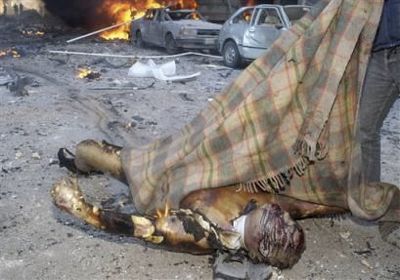
Moreover, the videos show that a number of limbs were severed by the explosion. Oddly, the cuts are clean, as if made on clay statues. There is no sign of shattered or jutting bones, nor of any torn flesh. The reason is that the explosion sucked up all the oxygen and dehydrated the bodies, rendering them friable. In the hours that followed, several on-the-spot witnesses complained of breathing ailments. Wrongfully, the authorities interpreted them as a psychosomatic reaction following their psychological trauma.
Such observations constitute the abcs of any criminal inquiry. They should have been the starting point, yet they do not figure in any of the reports submitted by the “professional experts” to the Security Council.
When we asked a number of military experts what kind of explosives would be capable of generating such damage, they mentioned a new type of weapon which has been developed over several decades and is featured in reports appearing in scientific journals. The combination of nuclear and nanotechnology science can trigger an explosion the exact strength of which can be regulated and controlled. The weapon is set up to destroy everything within a given perimeter, down to the nearest centimeter.
According to the same military specialists, this weapon can also produce other types of effects: it exerts a very strong pressure on the area of the explosion. The minute it stops, the heaviest objects are propelled upwards. Accordingly, cars were sent flying through the air.
There is one unequivocal fact: this weapon is equipped with a nano-quantity of enriched uranium, emanating radiations which are quantifiable. Now, it just so happens that one of the passengers in Rafik Hariri’s armoured car survived the explosion. Former Minister Bassel Fleyhan was taken to a topnotch French military hospital for treatment. The doctors were astounded to discover that he had been in contact with enriched uranium. But no one linked this to the attack.
Technically speaking, the weapon is shaped like a small missile, a few tens of centimeters long. It must be fired from a drone. Actually, several witnesses assured they had heard an aircraft flying over the scene of the crime. The investigators asked the United States and Israel, whose surveillance satellites are permanently switched on, to provide them with the pertinent images. On the day of the attack, the United States had deployed AWACS aircraft over Lebanon. The live feeds could help to establish the presence of a drone and even to determine its flight path. But Washington and Tel Aviv – which indefatigably urge all parties to cooperate with the STL – turned down the request.
 Hezbollah intercepted and released videos from Israeli drones surveying Rafik Hariri’s movements and the scene of the crime.
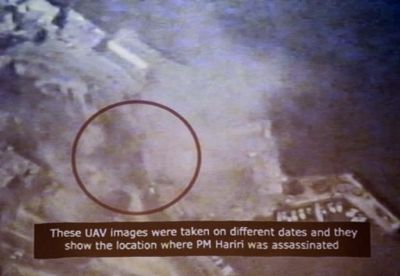
At a press conference held on 10 August 2010, Hassan Nasrallah showed a video which, according to him, was shot by Israeli military drones and intercepted by his organisation. All of Rafik Hariri’s movements had been registered for months, until the final day when all the surveillance converged on the bend in the road where the attack was staged. Thus, Tel-Aviv had been surveying the area prior to the assassination. Which is not to say, as Mr Nasrallah himself points out, that they were the authors of the crime.
So, who fired the missile?
This is where things get complicated. According to the military experts, in 2005, Germany was the only country which had a handle on this new technology. It is, therefore, Berlin which supplied and set up the crime weapon.
Hence, it is easy to understand why former Berlin Attorney General Detlev Mehlis – a very controversial figure within his own profession – was eager to preside over the UN Investigation Commission. He is, in fact, notoriously linked to the German and U.S. secret services. Assigned in 1986 to shed light on the attack against the La Belle disco in Berlin, he diligently covered up all Israeli and U.S. fingerprints to falsely accuse Libya and justify the bombing of Mouammar Khadafi’s palace by the U.S. Air Force. In the early 2000s, Mr Mehlis was lavishly paid for his stint as researcher at the Washington Institute for Near East Policy (a think-tank linked to AIPAC, the pro-Israel lobby) and at the Rand Corporation (a think-tank attached to the U.S. military industrial complex). All elements which cast a shadow over his impartiality in the Rafik Hariri affair and should have sufficed to have him taken off the case.
Mehlis was seconded by Commissioner Gerhard Lehmann, who is also a well-known German and U.S. secret services agent. He was formally identified by a witness as having taken part in the programme run by the Bush Administration in Europe, involving the abduction, detention and torture of prisoners in “black holes”. His name is mentioned in the ad hoc Report by the Council of Europe. Notwithstanding, he managed to dodge all judicial proceedings on the strength of a strong though unlikely alibi provided by his colleagues in the German police.
Mehlis and Lehmann propagated the theory of the explosives-laden suicide van to deflect the investigation from the German weapon that was used to commit the crime.
Various earth samples were taken from the scene of the crime. They were first mixed, then divided into three jars that were sent to three different laboratories. In the first two no trace of explosives was found. The third jar was kept by Mehlis and Lehmann, who personally sent it to the third laboratory. Here, remnants of explosives were detected. In principle, if the decision is made to resort to three judiciary experts, in case of disagreement it is the majority opinion that prevails. No way! Mehlis and Lehmann violated the protocols. They deemed that theirs was the only reliable sample and embarked the Security Council on a false trail.
The profoundly flawed character of the Mehlis-Lehmann investigations has amply been proven. Their successors acknowledged as much sotto voce and declared entire sections of proceedings nul and void.
Amidst their manipulations, the most famous one relates to the false witnesses. Five individuals purported to have seen the preparations for the attack and incriminated Presidents Bashar el-Assad and Emile Lahoud. While these allegations were fueling the drums of war, their lawyers exposed the lies and the prosecution backed down.
 Detlev Mehlis, President of the UN Investigation Commission violated all the rules of the criminal procedure, fabricated evidence and used false witnesses to exonerate Germany and accuse Syria.

Based on these false testimonies, Detlev Mehlis arrested – in the name of the international community – four Lebanese generals and had them incarcerated for four years. Pushing his way with his cow-boys into private homes, without a warrant from the Lebanese authorities, he also detained for questioning members of their entourage. With his assistants – who spoke Hebrew to each other – he manipulated the families. Thus, on behalf of the international community, he showed the wife of one of the generals a doctored picture to prove that her husband had not only obscured his implication in the murder, but was also two-timing her.
Concurrently, he tried the same maneuver on the son of the “suspect”’, but in this case to convince him that his mother was a woman of loose morals, a situation which had plunged his desperate father into a murderous folly. The aim was to induce a family crime of honour, thereby tarnishing the image of respected and respectable people.
Even more incredible is Lehmann’s proposition to liberate one of the four imprisoned generals in exchange for his false testimony against a Syrian leader.
Moreover, German journalist Jürgen Cain Külbel highlighted a disturbing detail: it would have been impossible to trigger the explosion by remote control or by marking the target without first disactivating the powerful interference system built into Rafik Hariri’s convoy. A system among the most sophisticated in the world, manufactured in … Israel.
Külbel was approached by a well-known pro-Palestinian advocate, Professor Said Dudin, to promote his book. However, the outrageous declarations frequently made by Dudin served to torpedo it instead. Külbel, a former East German criminal police officer, was quick to find out that Dudin had a long-standing reputation for being a CIA mole within the German left-wing. The journalist published a number of old East-German reports attesting to this fact and was sentenced and briefly imprisoned for illicit dissemination of documents; meantime, Dudin was settling into the German Embassy in Beirut for the purpose of infiltrating the families of the four generals.
Overlooked in the Middle East, Germany’s role in this region is worth spotlighting. After Israel’s war of aggression against Lebanon in the Summer of 2006, Chancellor Angela Merkel deployed a very large contingent to join the United Nations Interim Force in Lebanon (UNIFIL). The 2,400 soldiers from Germany control the maritime infrastructure to prevent arms supplies from reaching the Resistance via the Mediterranean. On that occasion, Ms Merkel declared that the mission of the German army was to protect Israel. A wind of rebellion arose among the officers. By the hundreds, they sent letters to remind her that they had enlisted to defend their homeland not a foreign country, be it an ally.
An unprecedented development took place on 17 March 2008 and 18 January 2010, when the German and Israeli governments held a joint Council of Ministers meeting where various programmes were adopted, especially in the defense sector. At this stage, there shouldn’t be too many secrets left between the Tsahal and the Bundeswehr.
The investigation conducted by Detlev Mehlis is both steeped in ridicule as regards the false witnesses, and tainted with the illegal detention of the four generals. To the extent that the UN Human Rights Council’s Working Group on Arbitrary Detention formally and firmly condemned this excess of power.
This being said, the opprobrium that befalls Mr Mehlis’ work should not reflect on the Special Tribunal for Lebanon which is in no way responsible for his manipulations. But here, again, things get complicated. The credibility of the STL rests on its ability to curb, in the first place, all those who attempted to mask the truth and falsely accused Presidents Bashar el-Assad and Emile Lahoud, with the intention of provoking a war.
Now, it transpires that the Tribunal refuses to try the false witnesses, giving the impression that it is covering up the manipulations under Mehlis’ watch and is in fact pursuing the similar political objectives (this time against Hezbollah, and perhaps against others in the future). Even worse, the Tribunal will not hand over to Jamil Sayyed (one of the four generals illegally detained) the minutes of his accusers’ hearings, thereby barring him from requesting compensation and making it look as if it condones four years of arbitrary detention.
In more prosaic terms, the Tribunal is shirking its responsibilities. On the one hand, it must judge the false witnesses to thwart further manipulations and to make plain its impartiality; on the other hand it refuses to undertake a “clean-up” operation which might force it to arrest Prosecutor Mehlis. However, Odnako’s revelations on the German lead render this posture untenable. All the more since it’s already too late: General Jamil Sayyed filed a complaint in Syria and a Syrian examining magistrate has already indicted Detlev Mehlis, Commissioner Gerard Lehmann plus the five false witnesses. One can imagine the commotion at the STL should Syria decide to call on Interpol to have them arrested.
Just as the Mehlis commission was supposed to compensate for the lack of professionalism on the part of the Lebanese forces of law and order, the STL should equally have ensured the impartiality that the Lebanese courts may have been short of. But things are far off target, which raises the question of the Tribunal’s legitimacy.
Kofi Annan didn’t want the Lebanon Tribunal to exert international jurisdiction, but to function as a national Lebanese tribunal with an international character. It would have been subjected to Lebanese law while half of its members would have been nationals of other countries. The plan did not materialize because the negotiations came to a sudden end. More precisely, an agreement was reached with the Lebanese government presided at the time by Fouad Siniora, the former authorised representative of the Hariri estate, but it was never ratified either by Parliament or by the president of the Republic. Hence, the agreement was endorsed unilaterally by the UN Security Council (Resolution 1757 of 30 May 2007). The end result is a hybrid and fragile entity.
As pointed out by Kofi Annan, this Tribunal is not analogous to any other so far created within the purview of the United Nations. “It is neither a subsidiary organ of the UN, nor a component of the Lebanese judiciary system”; it is simply “a conventional organ” sitting between the executive authority of the Lebanese government and the UN. Judging by the international rule of separation of powers and independence of the judiciary, the STL cannot be regarded as a genuine tribunal, but rather as a joint disciplinary commission within the executive frameworks of the UN and the Lebanese Government. Whatever decision it may make will inevitably be coated with suspicion.
Worse still, any Lebanese government can terminate it since, not having been ratified, the related agreement was binding only on the previous government. As a result, the present Lebanese coalition government has become a battlefield between partisans and foes of the Tribunal. In an attempt to maintain governmental stability, week after week Lebanese President Michel Sleimane has been dissuading the Council of Ministers from taking a vote on any issue linked with the STL. This embargo cannot hold out forever.
Bad news coming in pairs, suspicions have now extended to the President of the STL, Antonio Cassese. This reputable international jurist was President of the International Criminal Tribunal For the Former Yugoslavia (ICTY). He happens to be an ardent supporter of the Jewish colonialisation of Palestine. A personal friend of Elie Wiesel, Cassese received and accepted an honorary award, presented by Wiesel himself. He should normally have withdrawn and resigned when Hassan Nasrallah disclosed that Israeli drones had been reconnoitering the crime scene as well as the victim’s movements for months.
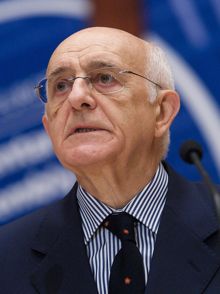
According to the President of the Special Tribunal for Lebanon, Antonio Cassese, the armed resistance in Palestine, Lebanon, Iraq and Afghanistan should be tried for “terrorism”.
Worst of all, Judge Cassesse personifies an interpretation of international law that causes division in the Middle East. Although his official curriculum vitae obscures it, he took part in the 2005 negotiations between member states of the European Union and those bordering the Mediterranean Sea (“Barcelona Process: Union for the Mediterranean”). His definition of terrorism blocked the discussions. According to him, terrorism is exclusively the act of individuals or private groups, never states. It follows that a struggle against an occupying army would not be considered to be “resistance” but rather “terrorism”. In the local context, this juridical view is consistent with a colonial framework and disqualifies the STL.
The methods of the Special Tribunal do not differ from those applied by the Mehlis Commission. STL investigators collected mass files on Lebanese students, social security recipients and subscribers of public utility services. On 27 October, in the absence of the Lebanese judges, they even tried to snatch medical records from a gynecological clinic frequented by the wives of Hezbollah members. It is obvious that these probes have no link whatsoever with the Rafik Hariri assassination. Everything leads the Lebanese to believe that the information is actually earmarked for Israel, of which, in their eyes, the STL is merely an offshoot.
All these problems had clearly been foreseen by President Putin when, in 2007, he had vainly made a pitch for a different wording of the STL founding resolution. Ambassador Vitaly Churkin had denounced the “juridical loopholes” of the system. He deplored that the Security Council should threaten to resort to force (Chapter VII) to achieve unilaterally the creation of this “conventional organ”. He had emphasised that while the Tribunal should be working towards the reconciliation of the Lebanese people, it was devised in such a way as to divide them even more. Finally, Russia – as China – refused to endorse Resolution 1757.
The truth ultimately seeps through. The Israeli drone videos released by the Hezbollah expose Israel’s involvement in the crime preparations. The facts revealed by Odnako point to the use of a sophisticated German weapon. The puzzle is nearly complete.
“War criminals” leak strikes at heart of Israeli society
By Paul Larudee | Redress | 23 November 2010
When unknown elements in Israel leaked the name, rank, identification number and other information about two hundred Israeli military personnel who reportedly participated in the 2008-09 invasion of Gaza, the effect was sudden and profound, according to sources in Israel.
Although the first site on which the leaked information appeared was taken down by the host, it has continued to circulate via email, and has appeared on a number of other sites. The Israeli military and other Israeli agencies are reportedly doing all they can to shut down every site on which it appears, and to prevent it from “going viral”. At least one popular blog that links to the site has received a record number of death threats.
What is so special about the list? As several critics have pointed out, it doesn’t even state the crimes that the listed individuals are alleged to have committed.
The root of the problem, according to the sources in Israel, is a poorly kept secret — namely, that it is hard to serve in the Israeli military without committing war crimes, because such crimes are a matter of policy. What Israeli soldier has not ordered a Palestinian civilian to open the door to a building that might house armed militants or be booby-trapped? Who has not denied access to ambulances or otherwise prevented a Palestinian from getting to medical care, education or employment?
Some, of course, have gone much farther, and deliberately targeted unarmed civilians (as in the “buffer zones” along the border of the Gaza Strip), tortured detainees, and have either ordered or participated in massive death, injury and destruction at one time or another. These acts have all been heavily documented by numerous credible agencies, such as the Palestinian Centre for Human Rights, Amnesty International, the Goldstone Commission, Human Rights Watch, and B’tselem.
What has been missing in large measure is accountability. To be sure, isolated victories have been won, usually with great effort. Within Israel, token trials and punishment, such as the conviction of the shooter of British human rights volunteer Tom Hurndall, continue to provide a thin cloak of respectability to the Israeli justice system. Beyond Israel’s control, however, senior Israeli officials have been forced to avoid travel to an increasing number of countries for fear of law-enforcement action. Nevertheless, ordinary Israelis had not yet been made to feel directly subject to such pressures.
The publication of the list of 200 changes everything. The list contains the names of a few high-ranking officers, but many of those named are in the lower ranks, all the way down to sergeant. The effect is to make ordinary Israelis concerned that they, too, may be subject to arrest abroad, and without the protection that well-connected higher officials might enjoy. They know what they have done, or been ordered to do, or have ordered others to do, and they suspect that they may be held accountable by foreign laws, over which their government has little control.
Many Israelis already fear that an anti-Semitic world is looking for an excuse to shut down the Zionist experiment. It is therefore not a great leap to believe that they could become pawns — or scapegoats — in the rising chorus of voices speaking out for Palestinian rights and against Israeli abuses.
Coupled with this is the Israeli addiction to vacationing abroad, which is a national obsession and almost a right, in the mind of many. The result is that suddenly, with the release of the list of 200, the prospect of being held accountable outside Israel is no longer an abstraction, to be dealt with at the level of diplomats, government policy and the news stories. It hits home.
This has serious consequences for Israeli society. It potentially increases the number of youths who will try to avoid the military, the rates of emigration and immigration, and other patterns of commitment to Israel and its military. Most of all, according to the sources, it may cause soldiers to begin to question policy and orders far more than in the past, because of the way it may affect them personally. The debate is already taking place around the question, “Can I be held responsible?”
The answer to that question could potentially determine whether it will be possible to mount a massive offensive against a population that has no effective military forces, as in Gaza, or where saturation bombing, cluster munitions and depleted uranium might be used, as in Lebanon. This is potentially a daunting prospect for Israeli military commanders, and some sources in Israel believe that the publication of the 200 has already had that effect.
More likely, however, it is premature to make such a call. It seems unlikely that Israel will succeed in putting the genie back in the bottle with regard to the list of 200. It is already leaping from one place to another in cyberspace, via website and email (although Israel seems to have been temporarily successful in banning it from Facebook). However, will it generate further research and release of information on the potential offences committed by the named individuals, and will it lead to further publication of such lists?
According to the sources in Israel, the military and perhaps other agencies have gone into high gear to track down the source of the leaks. This is a typical Israeli response to the problem. Instead of asking why some groups or individuals in Israeli society are willing to take great risks to hold that society accountable for its actions, Israel prefers to blame the problem on treacherous, self-hating, anti-Semitic Jews, and to instill fear and hatred as the means for preventing Israelis from examining their consciences.
Israeli army still using children as human shields in 2010
Defence for Children International | 22 November 2010
 One day after an Israeli military court imposed a suspended sentence on two Givati Brigade soldiers for using a nine-year-old boy as a human shield in Gaza, DCI-Palestine has just obtained an affidavit from a 13-year-old boy who reports being used as a human shield on 19 August 2010. This brings to three, the number of human shield cases documented by DCI-Palestine in 2010.
18 February 2010 – Voices From The Occupation (16-year-old girl from Nablus)
16 April 2010 – Voices From The Occupation (14-year-old boy from Beit Ummar)
19 August 2010 – Voices From The Occupation (13-year-old boy from near Nablus)
The practice of using human shields involves forcing civilians to directly assist in military operations or using them to shield an area or troops from attack. Both of these circumstances expose civilians to physical, and sometimes, mortal danger. Civilians are usually threatened and/or physically coerced into performing these tasks, most of the time at gunpoint. The practice is illegal under both international and Israeli domestic law.
In the latest case documented by DCI-Palestine, a 13-year-old boy from a village near Nablus, in the occupied West Bank, was beaten and then forced at gunpoint to search and open doors in a house where the army suspected a wanted person might be hiding – Nazzal A. – Voices From The Occupation.
Since April 2004, DCI-Palestine has documented 16 cases involving Palestinian children being used as human shields by the Israeli army. Fifteen of the 16 cases, occurred after the Israeli High Court of Justice ruled the practice to be illegal in October 2005, suggesting that the army is not effectively implementing the Court’s decision, or simply disregarding the Court’s order altogether.
On Sunday, 21 November 2010, two soldiers from the Givati Brigade became the first soldiers to be charged and convicted of using a child as a human shield. The two soldiers were demoted from the rank of staff sergeant to sergeant and each given a three-month suspended prison sentence. DCI-Palestine is of the view that the lenient sentences handed down on Sunday are unlikely to deter the future use of children as human shields – Majed J. – Voices From The Occupation.
Tel Aviv wants US to release Israeli spy
Press TV – November 21, 2010
Israel conditions the extension of a partial freeze on settlement activities in the occupied Palestinian lands on the freedom of one of Tel Aviv’s spies imprisoned in the US.
Israeli Prime Minister Benjamin Netanyahu has asked the US to release the agent, Jonathan Pollard, in exchange for a temporary halt in Tel Aviv’s construction of the Jewish settlements, Israeli newspaper The Jerusalem Post wrote on Sunday.
Tel Aviv refused to renew a partial 10-month moratorium on its September 26 expiration date, breaking off Washington-backed direct talks with the Palestinian Authority (PA).
A September piece, ran by the prominent British daily The Guardian, quoted Israel’s Army Radio as saying that Netanyahu was ready to extend the partial freeze for three months in return for the release.
A former US Navy intelligence analyst, Pollard was arrested by the country’s Federal Bureau of Investigation (FBI) on charges of selling classified material to Israel, which was later sold to the Soviets. In 1987, Pollard was convicted of espionage and sentenced to life imprisonment.
He has already spent 25 years in prison with Israeli leaders pressing unsuccessfully for his freedom. In 1998, Netanyahu said that “if we signed an agreement, I expected a pardon for Pollard.”
Israel is accused of hunting for military and dual-use civilian technology on the US soil through espionage activities with impunity.
Former US Central Intelligence Agency (CIA) officer Philip Giraldi has said the Israeli lobby’s massive clout has prevented Washington from addressing Tel Aviv regarding the spying issue, which has been going on for many years.
While each side has rated the other as its strongest strategic ally, relations between the two have been marred historically and repeatedly due to several incidents, involving Israeli fifth columnists.
In 2008, the US arrested an American suspected of spying for Israel.
Ben-Ami Kadish had given Israel secrets on nuclear weapons, fighter jets and missiles in the 1980s. The case was linked to that of Pollard’s.
Should the settlement freeze be extended, it would be used as an incentive for the PA to return to the US-backed talks.
Washington has also reportedly offered to give Tel Aviv twenty F-35 fighters and veto any anti-Israeli resolution at the United Nations Security Council in exchange for the three-month freeze.
The US proposal, however, calls for a halt of construction activities in the occupied West Bank and not East al-Quds (Jerusalem). Tel Aviv occupied the Palestinian territories in 1967 and later annexed them in a move not recognized by the international community.
The Palestinians say that the settlement construction aims to prevent the establishment of an independent Palestinian state.
Also on Sunday, acting PA Chief Mahmoud Abbas said his organization would not return to the negotiation table, “if there is no complete halt to settlements in all of the Palestinian territories including [al-Quds] Jerusalem,” Reuters reported.
Israel harbors fugitive wanted for war crimes in Colombia
By Saed Bannoura – IMEMC News – November 20, 2010
International fugitive, arms trader and death squad leader Yair Klein has arrived in Israel a free man, despite warrants for his arrest in Colombia for training the death squads of the notorious Medellin drug cartel.
Klein was captured in Russia and held in a Russian prison awaiting extradition to Colombia when Israeli authorities intervened to secure his release to Israel, where he will be harbored illegally by Israeli authorities.
The Israeli government has a history of harboring fugitives – one example is the case of US citizen Samuel Sheinbein, who brutally murdered and dismembered a man in the suburbs of Washington DC, then escaped to Israel in the late 1990s.
In Klein’s case, the evidence is substantial that he trained and assisted death squads in torture and murder techniques in Colombia. These death squads were part of the Medellin drug cartel, run by Pablo Escobar and Gonzalo Rodriguez Gacha.
Klein has also worked as an international arms dealer, and served a sentence in Sierra Leone in 1999 for illegally smuggling weapons to right-wing guerrilla armies. This took place in the height of a brutal war over resources in which guerrillas recruited child soldiers and engaged in systematic chopping off of limbs of victims throughout Sierra Leone.
LAOS: For Cluster Bomb Survivors, War Far From Over
By Irwin Loy | November 10, 2010 | IPS

VIENTIANE – Eighteen-year-old Phongsavath Manithong rubbed his eyes with the back of his arms as he described how his life changed forever.
He was not even born yet when U.S. military pilots dropped millions of tiny explosives onto Laos. But almost four decades after war ended for this South-east Asian nation, it is people like him who still suffer.
Three years ago, Phongsavath stumbled onto a small, metallic sphere buried in the ground near his school.
He had heard stories about the planes that rumbled overhead decades before, dropping fire from the sky. But he had never before seen a bomb, or held one in his hands. “I didn’t know what it was. I didn’t think it would be dangerous. So I tried to open it,” Phongsavath recalled.
That decision changed his life forever. Phongsavath remembers only seeing a flash of light before his world fell dark. When he awoke in a hospital, he was blind. The bomb had robbed him of his eyesight and ripped away both his hands.
The weapon was part of a decades-old cluster bomb that had been dropped on Laos during the U.S. military’s secretive operations in Indochina between 1964 and 1973. The goal of the air strikes had been to destroy the crucial North Vietnamese Army supply line that snaked its way through Laos and Cambodia on its way to the south. By the time the war was over, those aerial campaigns entrenched Laos as the most heavily bombed country in history.
But today, it is people like Phongsavath who are paying the price for that conflict. Since the war ended, more than 20,000 people in this country have been killed or injured by leftover explosives.
Critics take particular aim at so-called cluster bombs – large explosives dropped from the sky, which contain hundreds of smaller submunitions, or ‘bombies’, as they are referred to in Laos – because they are especially deadly to civilians long after military hostilities have ended.
Estimates suggest more than 270 million individual bombies were scattered over Laos. With a failure rate estimated at around 30 percent, these deadly weapons litter the Lao countryside.
But advocates hope that 2010 represents a turning point in a long-running campaign to eradicate cluster bombs. In August, a treaty banning the use of cluster bombs came into effect. Starting Nov. 9 here in Vientiane, delegates from more than 100 countries are taking part in the first high- level meeting of signatory nations since then, aiming to hammer out a plan to implement the landmark accord.
“The horrifying thing is there may be up to 80 million of these bombs scattered around the countryside, in farmers’ fields, next to schools, beside roads,” said Thomas Nash, coordinator for the Cluster Munition Coalition, a broad group of civil society organisations who have pushed for the wide-reaching ban. “So there’s a huge amount of work to be done to clear this country of the deadly legacy from a war that ended over 35 years ago.”
Laos is seen, per capita, as the most heavily affected country by such munitions. But cluster bombs have riddled conflict-ridden countries around the globe, from Angola to Zambia and Lebanon to Libya.
The 108 nations that have signed on to the Convention on Cluster Munitions have committed to banning the use of the weapons and the eventual destruction of existing stockpiles. They have also made broad pledges to clear contaminated land and provide adequate aid to victims of cluster bombs.
But while heavily affected countries like Laos have ratified the treaty, major military players that still stockpile the weapons – the United States, China and Russia, for example – have not.
Advocates like Nash, however, are hoping the convention will serve to stigmatise the weapons enough so that their use is considered untenable – something he believes has already been accomplished with landmines.
The United States, for example, has not signed on to the Ottawa Treaty, which banned the use of landmines and came into effect more than a decade ago. But it is believed that the U.S. military has not deployed the weapons since the first Gulf War.
“Anti-personnel mines have been eradicated from most military arsenals and we believe the same will happen with cluster munitions,” Nash said.
“You cannot win a political war if you kill civilians, and that’s what cluster bombs do. So I think the message to countries … that haven’t signed is that we believe we have established a standard by which all countries are judged, whether they sign the treaty or not,” he added.
For many who are already scarred by cluster bombs, however, life remains a daily struggle.
Thirty-nine-year-old Ta Doangchom lost both his arms and the sight in his right eye when he triggered a bombie while foraging for food nine years ago. “I can’t support my family,” he said. “All of my children had to leave school because we were so poor. I feel like a burden on my wife and on my family.”
Like Ta, Phongsavath now advocates on behalf of other survivors, urging an end to the use of the weapons that devastated their lives. But he is also still learning to cope with what happened to him.
“I never saw the war with my own eyes,” Phongsavath said. “But I now know that the bombs were dropped on my country. And they didn’t just kill soldiers. They killed men, women and children.”
Pentagon blows up thousands of homes in Afghanistan
Repeating the horrors of the Vietnam War
By Brian Becker | ANSWER Coalition | November 18, 2010
 Borrowing a page from its infamous “pacification” effort in South Vietnam, where peasant villages were napalmed and burned to the ground to “save them from the communists,” the Obama-ordered surge in Afghanistan has been secretly blowing up thousands of homes and leveling portions of the Afghan countryside.
As tens of thousands of U.S. troops have surged into southern Afghanistan, villagers have fled. Then the Petraeus-led occupation forces have determined which homes will be destroyed.
“In Arghandab District, for instance, every one of the 40 homes in the village of Khosrow was flattened by a salvo of 25 missiles, according to the district governor, Shah Muhammed Ahmadi, who estimated that 120 to 130 houses had been demolished in his district,” reported the New York Times, Nov. 16, 2010.
The Pentagon asserts that they must destroy the homes because some of them may have explosive devices inside.
The Pentagon’s murderous rampage and terror campaign 40 years ago against South Vietnamese villages, in areas that were considered sympathetic to the resistance forces, used much of the same kind of explanation. In fact, the New York Times in a throw back to Vietnam quotes the Arghandab District Governor, who is working with the occupation forces:
“We had to destroy them to make them safe.”
That this tactic is part of a high-tech terror campaign against Afghan villages and the people who inhabit them is evident even by the descriptions and accounts of western media outlets that are supporting the war.
Again, from the New York Times, Nov. 16, 2010, which describes weapons as tools:
“American troops are using an impressive array of tools not only to demolish homes, but also to eliminate tree lines where insurgents could hide, blow up outbuildings, flatten agricultural walls, and carve new “military roads,” because existing ones are so heavily mined, according to journalists embedded in the area recently.
“One of the most fearsome tools is the Miclic, the M58 Mine-Clearing Line Charge, a chain of explosives tied to a rocket, which upon impact destroys everything in a swath 30 feet wide and 325 feet long. The Himars missile system, a pod of 13-foot rockets carrying 200-pound warheads, has also been used frequently for demolition work.
“Often, new military roads go right through farms and compounds, cutting a route that will keep soldiers safe from roadside bombs. In Zhare District alone, the 101st Airborne’s Second Brigade has lost 30 soldiers since last June, mostly to such bombs.”
Activists at the organization Afghanistan Rights Monitor described the destroyed homes. “These are all mud houses, quite humble houses.”
When Gen. David Petraeus describes his counter-insurgency strategy, he always puts in a few diplomatic words about the need of surging troops to win the “hearts and minds” of the people in Afghanistan’s poverty stricken villages. That is purely for public consumption—a message echoed endlessly by the complicit corporate-owned media and the politicians of both parties that serves as a mask for the Pentagon’s campaign of systematic terror employed to subdue an occupied people.
On Dec. 16, 2010, anti-war veterans and people of conscience will stand up in a dramatic action in opposition to the terror campaign waged from the White House and Pentagon. Join us in Washington, D.C. on Dec. 16 and be part of history.
Dutch Film Director Accuses Ariel Sharon of Killing Two Palestinian Children in 1982
By Ane Irazabal – IMEMC & Agencies – November 19, 2010
George Sluizer declared that in 1982 he saw then Israeli defense minister Ariel Sharon shooting Palestinian children from near the Sabra-Shatilla refugee camp, Beirut, while he was filming a documentary. Israel officials called the report a ‘modern blood libel’.
The accusation was first made in Volkskrant, a Dutch newspaper, during an interview to George Sluizer, who was promoting the screening of his most recent film about Israel in the International Documentary Film Festival of Amsterdam.
According to Sluizer, who has made several documentaries about the Israeli-Palestinian conflict, he saw Sharon killing two Palestinian children with a pistol in 1982, near the refugee camp Sabra-Shatilla in Lebanon. Sharon was an Israeli minister of defense at that time.
“Sharon shot two children like you shoot rabbits, in front of my eyes,” he added.
Sluizer gave more details and reported hat the children were two or three years old and that Sharon shot them from a distance of 10 meters with a pistol. However, he could not specify in which month the event occurred, but he thought it was in November.
Meanwhile, Israeli government’s officials have been quick to deny accusations, claiming that the statement is not supported by a single shred of evidence and that it is very cruel to accuse Sharon of committing a murder when he cannot defend himself, Haaretz reported.
“Firstly, Sharon would never shoot a child; secondly, he was not in Lebanon in November of 1982: and thirdly, protocol prohibits ministers from wearing weapons,” Sharon’s successor as defense minister, Moshe Arens, explained.
In an interview for Haaretz, Sluizer defended his statement and said that after seeing the shooting, he had complained against Sharon in the International Court of Justice in Hague and the European Court of Human Right in Strasbourg, in 1983.
However, Israeli officials pointed out that no evidences that support that complaint have been found and added that they have warned the Dutch magazine to be careful when publishing anything that is not corroborated.
Sharon is currently in a permanent vegetative state after suffering a stroke in January 2006.
Federal Judge Orders CIA to Release Records on Secret Experiments on Soldiers
By David Wallechinsky and Noel Brinkerhoff | AllGov | November 19, 2010
The CIA is being forced to produce specific information regarding secret tests conducted on thousands of soldiers over a 25-year period.
In response to a lawsuit filed by three veterans groups and six individual veterans, a federal judge, James Larson, ordered the CIA and other government agencies to turn over documents about testing programs and the substances used on soldiers from 1950 through 1975. The plaintiffs allege that the government used about 7,800 military personnel as human guinea pigs to research biological, chemical and psychological weapons at Edgewood Arsenal and Fort Detrick in Maryland.
The soldiers volunteered for the testing, but were not told at the time to what they were being exposed. They also were required to sign an oath of secrecy about their participation.
The CIA has put forth a variety of arguments to avoid revealing information about the 35-year-old experiments, including privacy protections, state-secrets privilege, the fact that the Department of Defense is conducting its own investigation, the passage of time, the fact that witnesses no longer work for the government, that the gathering of relevant information would take too much time, and the questionable claim that it never funded or conducted research on military personnel.
Judge Larson has insisted that the CIA must produce evidence relating to a 1963 CIA Inspector General report on an experiment called MKUltra; the basis for each redaction in that report; the doses and effects of certain substances administered to test subjects; any payments made to contractors or university researchers, any outside-party proposals concerning the experiments; a confidential Army memo about the use of volunteers in research; all government-led human experiments from 1975 to date involving specific drugs; and whether the government secretly administered MKUltra materials to “the patrons of prostitutes” in safe houses in New York and San Francisco, as the veterans allege.
Featured Video

Piers Corbyn on religion of climate change
or go to
Aletho News Archives – Video-Images
Book Review
How the U.S. Navy Sold the Vietnam War
By Gareth Porter | TruthDig | March 27, 2019
Dr. Tom Dooley, whose best-selling book “Deliver Us From Evil” helped create a favorable climate of opinion for U.S. intervention in South Vietnam, has long been linked to legendary CIA officer Edward G. Lansdale and his black operations in Vietnam between 1954 and 1955. But the real story about Dooley’s influential book, which has finally emerged from more recent scholarly research, is that it was engineered by an official of the U.S. Navy’s Pacific Command, Capt. William Lederer.
Lederer is best known as the co-author, with Eugene Burdick, of the 1958 novel “The Ugly American,” which was turned into a 1963 movie starring Marlon Brando. Far more important, however, is the fact that from 1951 through 1957 Capt. Lederer was on the staff of the commander in chief of the U.S. Pacific Fleet (CINCPAC), Adm. Felix Stump. … continue
Blog Roll
 Aletho News
- More EU Citizens Face Sanctions For Criticizing The Ukraine Proxy War
- In Mexico, the CIA Is Playing a Dangerous Game
- Spain’s Left Protested the Crisis It Legitimized: the General Strike as election stunt
- The power of inflicting oblivion
- The 10 Disease Renamings That Rescued the Vaccine
- NATO cancels 2027 leaders’ summit
- IAEA’s politicized use of safeguards undermines its impartiality: Russian envoy
- UK must be ready to strike Russian Arctic – ex-PM
- Fico’s Two Red Lines: Russian Energy and the Next Ukraine Loan
- Thousands rally for banned NATO-skeptic presidential candidate
- If Americans Knew
- An error has occurred; the feed is probably down. Try again later.
- No Tricks Zone
- New Study: Barents Sea Temperatures Were Warmer And Sea Ice Less Extensive In The 1700s Than Today
- German Authorities Start Initiative To Evaluate Public Register For Climate “Disinformation” Spreaders!
- Zonal Asymmetry of Temperature Change in the Antarctic Circumpolar Current
- New Study: The Net Fossil Fuel Contribution To Rising Atmospheric CO2 Has Been Zero For 500 Years
- Germany’s Green Energy Transition Becoming Increasingly Expensive…Another 6 Trillion Euros!
- Sudden Stratospheric Warming, Powerful El Niño Combination May Lead To Extreme Europe Cold, Energy Crisis!
- Two New Studies Find Thwaites Glacier Melt Cannot Be Driven By Human Activity Or A Warming Ocean
- E-Cars Reduce CO2 Emissions By Only 41% Compared To Internal Combustion Engine Vehicles
- Predictions Made By Renowned Climate Professor Over Past Decades Have Been Proven To Be Poor
- New Study Suggests Large Regions Of The Pacific Ocean Have Been Cooling For The Last 80 Years

