The Dunbar Martyrs
“March of shame” and incarceration at Durham Cathedral
On September 3rd, 1650 Scottish defence forces suffered a terrible defeat at the hands of Oliver Cromwell’s invading English army at the Battle of Dunbar. Cromwell went on to ruthlessly ransack Edinburgh and other Scottish towns and cities and take control of the country south of the Highlands.
Immediately after the battle, Cromwell’s forces rounded up around five thousand Scottish prisoners and embarked on the ‘march of shame’. You will hear little about this in the history books probably because it marks a profound disgrace in the annals of English military history. The battle weary Scots were brutally forced on an eight-day, 118 miles march south to the English cathedral city of Durham with virtually no rest (the first 28 mile stage to Berwick being undertaken non-stop and through the night) and with no food or water other than what could be scavenged. So starved, en route, raw cabbages and roots were pulled from fields in a desperate effort to gain some sustenance, however, this only served to cause dysentery like symptoms. Of the estimated five thousand who started out the march, only around three thousand were left at the end when they reached their destination on September 11th.
Of the survivors, Durham Cathedral and Castle was used as a makeshift prison and an equivalent disgraceful episode commenced. The conditions the Scots were kept in were utterly appalling. Records indicate that the Scots died at an average of 30 a day between 11th September and 31st October and it seems this reached over 100 a day with virtually no food, clean water or heat and the linked spread of disease and infection.
By the end of October 1650, approximately 1,600 Scots had died horrible deaths in Durham’s much-revered House of God and Durham Castle. This was a desecration of the holy Cathedral. The military leader appointed by Cromwell to take charge of the prisoners (Sir Arthur Haselrigge, Member of the English Parliament for Leicester) later claimed in a letter to the Parliament that adequate food, water, bedding and fuel for heating had been provided, however, the facts speak for themselves that this was merely an attempt to excuse his own conduct during the horrific weeks in September and October 1650. The Scots in a desparate effort to create some heat and reduce the death toll stripped the Cathedral bare of all wooden items, including pews and the organ for the making of fires, save as for one item – a clock embossed with a carved Scots Thistle, which remains to this day.
Only 1,400 of the estimated 5,000 men who started the march from Dunbar in September were still alive less than two months later, when they were sold as slave labour by their captors. Nine hundred of those survivors were sold to the New World, mainly Virginia, Massachusetts and the Barbados colony in the Caribbean. Another 500 were forced the following spring to serve in the French army, and were still fighting seven years later against the Spanish, side by side with a contingent of English soldiers sent over by Cromwell. Those who profited from the slave trade grasped every opportunity to earn money from this evil practice which wasn’t abolished in Britain until 1807.
Discovery of mass grave at Durham Cathedral?
According to research and a paper written by past Cathedral employee, John Cole, 1991, “The Scottish Prisoners from Dunbar Held in Durham Cathedral”, when a central heating system was installed in The Music School at the Cathedral in 1946, the trench for the pipes cut into a mass grave on the north side of the Cathedral. The conclusion was that it held the bodies of the Scots who had perished. That they had been, “buried without coffins and had been tossed in on top of one another.”. Separately, a Cathedral gardener spoken to in 2008 recalls seeing the corpses of Scot’s soldiers during works on the lanscape. The Cathedral has recently (2008) cast doubt on their earlier conclusions.
To this very day, there is no memorial of any kind to these unknown Scottish soldiers who died such horrible deaths at Durham Cathedral and Castle. It would appear that they lie in anonymity and without Christian burial in what they would have regarded as foreign soil in the place they had been imprisoned, far from their homes and the graves of their loved ones.
‘Israel flotilla raid was unlawful’
Al Jazeera | September 23, 2010
The UN Human Rights Council’s fact-finding mission has accused Israeli forces of violating international law when they raided a Gaza-bound aid flotilla.
The three UN-appointed human rights experts said in a report released on Wednesday that Israeli forces showed “incredible violence” during and after their raid on the aid flotilla that left eight Turkish activists and one Turkish-American killed.
The UN probe said there was “clear evidence to support prosecutions” against Israel for “wilful killing” and torture committed when its troops stormed the aid flotilla last May.
Israel’s military response to the flotilla “betrayed an unacceptable level of brutality” and violated international law “including international humanitarian and human rights law.” The three-member panel said.
“The conduct of the Israeli military and other personnel towards the flotilla passengers was not only disproportionate to the occasion but demonstrated levels of totally unnecessary and incredible violence.”
The report is scheduled to be debated by the Human Rights Council on Monday.
The report also rejected Israel’s stance that its forces acted in self-defence when they raided the flotilla, arguing that even those who did not attempt to stop Israeli soldiers from boarding the aid ships “received injuries, including fatal injuries.”
“It is apparent that no effort was made to minimise injuries at certain states of the operation and that the use of live fire was done in an extensive and arbitrary manner. The circumstances of the killing of at least six of the passengers were in a manner consistent with an extra-legal, arbitrary and summary execution.”
Israel’s reaction
Israel rejected the report as “biased” and “one-sided.”
“The report… is as biased and as one sided as the body that has produced it,” the statement said.
“Israel… is of the opinion that the flotilla incident is amply and sufficiently investigated as it is. All additional dealing with this issue is superfluous and unproductive.”
Israel insisted that it acted in line with international law, arguing that it had the right to retaliate against ships attempting to breach its blockade of the impoverished Gaza Strip.
However, the panel said that since Gaza was suffering from a humanitarian crisis on the day of the deadly raid, for this reason alone, Israel’s blockade is unlawful and cannot be sustained in law.
Hamas welcomed the report and told Al Jazeera that the findings show that Israel’s occupation of Palestinian territories violates human rights.
“More should now be done, the commander who led the raid should be taken to International Criminal Court.” Hamas said.
The fact-finding mission, chaired by Karl Hudson-Phillips, former judge of the International Criminal Court in The Hague, had travelled to Turkey, Jordan and Britain to interview witnesses and officials for the probe.
Desmond de Silva, former chief prosecutor of the Sierra Leone War Crimes Tribunal, and Shanthi Dairiam, as Malaysian human rights expert, are the other members of the panel.
Ahmadinejad: Israeli PM an assassin
Press TV – September 22, 2010

Iran’s President Mahmoud Ahmadinejad in interview with CNN’s Larry King
Iran’s President Mahmoud Ahmadinejad says the Israeli prime minister is a professional assassin, who should be tried for his crimes against the people of Palestine.
“[Benjamin] Netanyahu should be tried in court for blockading Gaza and massacring innocent Palestinian women and children,” Ahmadinejad said in an interview with CNN’s Larry King on Wednesday.
“Netanyahu is a professional assassin. All dictators in history accuse others to turn the spotlight away from themselves,” the Iranian president said when asked about the Israeli prime minister’s worries about Iran.
“It is questionable [why] American media feel responsible for this person (Netanyahu),” Ahmadinejad said, adding that “you (American media) are afraid of Netanyahu’s warmongering.”
The Iranian president said the US and Israel’s nuclear weapons are the main threat to the world, and they are mistaken to think they can divert attention from this issue by using propaganda campaigns and spreading lies about others.
“Iran is firmly after the nuclear disarmament of the US and Israel.”
Ahmadinejad added that Israel is an “illegitimate regime” and an “occupier” and that the US easily starts wars and massacres people, “they are not qualified to have nuclear weapons and should be disarmed as soon as possible.”
When asked about the fate of a former FBI agent who allegedly disappeared on Kish Island, the Iranian president said a “joint Iranian-American intelligence committee is to investigate the matter.”
Robert Levinson, a former FBI agent, disappeared on March 9, 2007 on Kish Island where he was doing investigative work for a private security firm. US officials have dismissed suggestions that Levinson was on assignment for a US government agency.
Iranian authorities have announced that Tehran has no information on the matter but they stand ready to work with the FBI if asked by Washington.
Al Jazeera slams ISAF over arrests
Al Jazeera | September 22, 2010
Al Jazeera has called on the Nato-led International Security Assistance Force (Isaf) to immediately release two of its cameramen arrested in Afghanistan over the last 72 hours.
In a statement issued on Wednesday, Al Jazeera said the arrests were “an attempt by the Isaf leadership to suppress its comprehensive coverage of the Afghan war”.
The two Al Jazeera cameramen detained are Mohamed Nader and Rahmatullah Nekzad.
According to Nader’s wife, he was picked up from his home in southern Kandahar by Isaf troops on September 22.
 |
Rahmatullah Nekzad was arrested by Isaf in Afganistan |
She said she was woken up when the troops raided their home during the night. The troops then proceeded to arrest her husband, removing him from his bedroom, she said. The troops also confiscated some of their valuables.
Nekzad, the other cameraman working for Al Jazeera in a freelance capacity, was arrested two days earlier under similar circumstances in Ghazni province.
Isaf, though, in statements described both as “suspected Taliban media and propaganda facilitator[s]”.
“The insurgents use propaganda, often delivered through news organisations as a way to influence and in many cases intimidate the Afghan population,” Isaf wrote to Al Jazeera.
“Coalition and Afghan forces have a responsibility to interdict the activities of these insurgent propaganda networks. Individuals detained as a consequence will be investigated and if substantiated will remain in detention awaiting Afghan judicial review.
“Each case will be investigated and reviewed in accordance with standard Isaf and USFOR-A procedures,” the statement said.
Al Jazeera response
Al Jazeera, however, strongly rejected the claims and insisted the two were innocent.
“There are two very important issues here, one is the vagueness of the allegations against this cameraman: what exactly is the allegation of being ‘a propagandist’ – how do you define that?” Anthony Mills, from the International Press Institute in Geneva, told Al Jazeera.
“If it just means that as a cameraman he was doing his work as a journalist filming the violence which we know has been wrecking that country in recent years – I think one has to be really careful before jumping to these kinds of accusations and arresting the cameraman.”
If there are no concrete criminal charges behind the arrest, then they should be released immediately, Mills said.
The arrests follow a recent pattern of escalation by Isaf and coalition forces to target Al Jazeera journalists in Afghanistan.
Recently, Al Jazeera’s Afghan bureau chief Samir Allawi was threatened and pressed to change the editorial line.
Al Jazeera, however, said it will continue to maintain its coverage on the basis of fair and impartial journalism in line with its Code of Ethics and will not bias its coverage in favour of any party or coalition despite pressures being imposed on it.
As part of their work, cameramen and crew need to contact all sides of those involved in a particular issue, which in this case includes Isaf forces, the Afghanistan government as well as the Taliban.
These contacts should not be seen as a criminal offence but rather as a necessary component of the work that journalists undertake, the channel said.
Novel gets to truth of Sabra and Shatila
Matthew Cassel, The Electronic Intifada, 17 September 2010
 |
Israel’s invasion of Lebanon and subsequent 22-year-long occupation has been the focus of three acclaimed Israeli films in recent years: Lebanon, Waltz with Bashir and Beaufort tell the story of this era from the perspective of the occupiers. All young men serving in the Israeli army, the films’ protagonists question their roles in Lebanon. However, this narrative perspective leads the viewer to empathize with the occupier and thus do little other than reinforce a simplistic falsification of Israel’s history as a country always conflicted when waging necessary wars of self-defense. This is the narrative that continues to dominate the Western media.
Not one of these films makes the slightest attempt to humanize Israel’s victims or tell the story from their perspective. In contrast, UK author Mischa Hiller’s first novel, Sabra Zoo is told through the eyes of a young man named Ivan. Sabra Zoo follows the adventures of this son of a Dutch mother and Palestinian father who serves as an officer in the Palestine Liberation Organization (PLO) in Beirut during the most intense period of Israel’s invasion of Lebanon.
Ivan’s thrilling story starts in the weeks following the evacuation of the PLO after more than a decade of being based in Lebanon and ends soon after the Israeli invasion of Beirut. The evacuation of the PLO was followed by the infamous massacres at the Sabra and Shatila Palestinian refugee camps in southern Beirut committed 28 years ago this week by right-wing militias allied with Israel. Because of his multicultural background and European passport, Ivan acts as an interpreter for foreign nongovernmental organization (NGO) workers in Sabra and Shatila and also runs packages and undertakes other menial yet dangerous tasks for a presumed PLO operative working covertly in West Beirut.
Sabra Zoo leads the reader through various aspects of Israel’s 1982 invasion of Lebanon in the midst of the country’s 15-year-long civil war. Yet Hiller attempts to ground the story through its protagonist. As an 18-year-old, Ivan acts like many other young men, constantly preoccupied with thoughts of sex and alcohol. At points throughout the story, however, Ivan’s character comes across as insensitive and unbelievable for the way he jumps from the horrors faced by people in the camps to his more immediate obsession with getting laid.
Yet, like most who witness war at a young age, Ivan shows a wisdom that others only get much later in life, if ever at all. He’s deeply disturbed through his exposure to Palestinian children and families affected by cluster bombs and other ordnance and is distraught when he has to translate the doctors’ unfortunate prognoses to patients and their families. But he never shies away. Ivan shows incredible courage, learning to deal with the siege and attack while continuing his various jobs.
Ivan’s character is also able to offer readers a glimpse of Western perception of the war through the eyes of foreign NGO workers and journalists with whom he collaborates throughout the story.
A foreign cameraperson covering the war tells Ivan while editing video of cluster bomb victims that doing so is a “‘waste of time.'” He explains: “‘People in the West don’t want to see too much reality over dinner. All the gory stuff gets edited out in London or New York … I think if they showed the real effects of war we wouldn’t have it anymore.'” Through this character, Hiller presents a universality that any Western journalist who has covered conflict in this region is aware of: the horrific effects of war as seen on the ground are much different than the sanitized imagery the media sells in the West.
However, throughout the book Hiller leaves the reader frustrated by not narrating who fired the cluster bombs, even making it difficult to understand who is laying siege to Beirut. The most problematic part comes when Hiller introduces the reader to the Nakba, or “the catastrophe” as Ivan translates it while working with refugees in the camp, with no mention of the ethnic cleansing that took place by Zionist militias who forced 750,000 Palestinians to leave their homes in what is today considered Israel. Sure to mention that “back home was Palestine,” the story goes no further to describe the circumstances in which Palestinians, soon to be massacred in refugee camps, had to leave their homes in the first place. While a reader familiar with the history of this region can easily deduce that Israel is responsible for the Nakba, firing cluster bombs and laying siege to Beirut, others might be left wondering. This is a novel and not a history text book, but as an historical novel, such context is important.
Despite this, Sabra Zoo makes viscerally clear the brutality of Israel’s invasion, unlike the skewed history presented in Waltz with Bashir, which also focuses on the massacres. Waltz’s portrayal of mostly benign Israeli soldiers who merely fired a few shots on their way to Beirut and then lit flares over the camp, mostly oblivious to the massacring happening below, is contradictory to both history and Hiller’s narrative. When Israel finally entered Beirut after a brutal assault that killed nearly 20,000 Lebanese and Palestinians and injured many more, the PLO had already left and thus the invading army faced practically no resistance at the Lebanese capital. “‘Who will resist them now?'” asks Ivan’s PLO friend, frightened after the fighters had left and turned their weapons over to the Lebanese authorities. Hiller’s narrative exposes the utter cowardice of Israel’s invasion of a city unable to defend itself as well as its responsibility for one of the most gruesome events of recent decades.
Retelling the story of an event that took place 28 years ago may seem trivial to some who want to remain focused on the present and future, rather than with events of the past. But before Beirut — now one of the world’s most popular tourist destinations — becomes a city that can be enjoyed by foreigners and its inhabitants alike, those who have devastated it before with impunity and are threatening to do so again must first be brought to justice. Sabra Zoo is recommended reading for anyone hoping to better understand Israel’s invasion of Beirut and Palestinian refugees’ long struggle for justice that continues to this day.
Matthew Cassel is based in Beirut, Lebanon and is Assistant Editor of The Electronic Intifada. His website is http://justimage.org.
Due to Gaza closure, 40,000 students refused from UNRWA schools
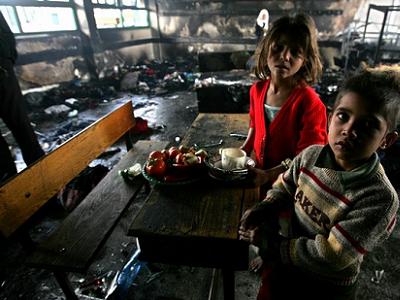 Notebooks and pens are in, construction materials are out
GISHA | September 15, 2010
- UNRWA can’t meet enrollment demand because of ban on construction materials
- UNRWA needs to build 100 schools, none built since 2007 closure
- UNRWA schools have specialized curriculum on human rights and critical thinking, not available in government schools
Despite Israel’s promise to ease the closure of the Gaza Strip, the Gaza school year opened this week with a severe shortage of classrooms. While for the first time in three years Israel has allowed the import of school supplies for government schools in Gaza, the almost absolute ban on the import of construction materials has left students with lots of pens and notebooks but without classrooms.
UNWRA needs 100 new schools to meet the enrollment demands of the children of Gaza. But despite the “easing” of the closure, building materials for the construction of schools have not been approved to enter Gaza since 2007. Therefore, UNRWA has had to turn away 40,000 children eligible to enroll in its schools for the academic year that began yesterday. Students at UNRWA schools study a specialized curriculum in human rights and critical thinking, not available in government schools. Furthermore, according to UNWRA records, students in its schools score 20% higher than government school students on international aptitude tests.
Students being turned away from UNRWA schools is only one consequence of the classroom shortage in the Gaza Strip. To deal with the shortage of classroom space, students in most of Gaza’s schools study in two shifts, in classrooms with up to 50 students, and sometimes oversized metal containers are used as classrooms, with three children seated at desks designed for two.
Onerous bureaucracy, limited capacity of crossings
Construction of a standard school requires an estimated 220 truckloads of building materials, or 22,000 truckloads for 100 schools. The only crossing Israel allows to open, Kerem Shalom, can accommodate just 250 truckloads per day, mostly for food and basic humanitarian supplies. Despite promises, Israel has yet to approve a single truckload of construction materials for UNRWA’s schools and has agreed to “negotiate” coordinating materials for just 8 out of the 100 needed schools. Since the “easing” of the closure, Israel has allowed just 240 truckloads of construction materials monthly for all uses, compared with more than 5,000 trucks monthly before the closure (4% of pre-closure levels).
According to UNRWA’s Gaza Director John Ging: “The right to education is a basic right of children everywhere. For the children of Gaza, realization of that right depends on the continued construction of schools, because all of the temporary measures and substitutes have already been exhausted”.
For an information sheet on the changes in the closure policy since the June 2010 cabinet decision, see: Unraveling the Closure of Gaza.
Blair Reveals Cheney’s War Agenda
By Robert Parry | September 6, 2010
Ex-British Prime Minister Tony Blair’s new memoir offers the expected rationalizations for his joining in an illegal, aggressive war against Iraq, even to the point of quibbling about the death toll. But Blair does reveal how much more war was favored by Vice President Dick Cheney and the neocons.
In A Journey: My Political Life, Blair depicts Cheney as believing the United States was at war not only with Islamic terrorists but with “rogue states that supported them” and that “the only way of defeating [this threat] was head-on, with maximum American strength.”
Cheney wanted forcible “regime change” in all Middle Eastern countries that he considered hostile to U.S. interests, according to Blair.
“He would have worked through the whole lot, Iraq, Syria, Iran, dealing with all their surrogates in the course of it – Hezbollah, Hamas, etc.,” Blair wrote. “In other words, he [Cheney] thought the world had to be made anew, and that after 11 September, it had to be done by force and with urgency. So he was for hard, hard power. No ifs, no buts, no maybes.”
Over the years, there have been indications of this larger neoconservative strategy to attack America’s – and Israel’s – “enemies” starting with Iraq and then moving on to Syria and Iran, but rarely has this more expansive plan for regional war been shared explicitly with the American public.
Usually, the scheme could be found only in obscure neocon policy papers or as part of Washington scuttlebutt. After the Iraq invasion, a favorite neocon joke was whether to next head west toward Damascus or east to Tehran with the punch line, “real men go to Tehran.”
Under this neocon plan, once “regime change” was achieved in Syria and Iran, then Israel’s front-line adversaries, Hezbollah in Lebanon and Hamas in the Palestinian territories, would be left impoverished and isolated. Israel could dictate settlement terms to the Palestinians and incorporate the Jewish settlements on prime West Bank land into a Greater Israel.
A Clean Break
The early outlines of this aggressive concept for remaking the Middle East predated the 9/11 attacks by half a decade, when a group of American neocons, including Richard Perle and Douglas Feith, went to work for Israeli Likud leader Benjamin Netanyahu during his 1996 campaign for prime minister.
The neocon strategy paper, called “A Clean Break: A New Strategy for Securing the Realm,” advanced the idea that only regime change in hostile Muslim countries could achieve the necessary “clean break” from the diplomatic standoff that had followed inconclusive peace negotiations.
Under the “clean break,” Israel would no longer seek peace through mutual understanding and compromise, but rather through confrontation, including the violent removal of leaders such as Iraq’s Saddam Hussein.
The plan called Hussein’s ouster “an important Israeli strategic objective in its own right,” but also one that would destabilize the Assad dynasty in Syria and thus topple the power dominoes into Lebanon, where Hezbollah might soon find itself without its key Syrian ally. Iran also could find itself in the cross-hairs of “regime change.”
But what the “clean break” needed was the military might of the United States, since some of the targets like Iraq were too far away and too powerful to be defeated even by Israel’s highly efficient military. The cost in Israeli lives and to Israel’s economy from such overreach would have been staggering.
In 1998, the U.S. neocon brain trust pushed the “clean break” plan another step forward with the creation of the Project for the New American Century, which urged President Bill Clinton to seek the ouster of Saddam Hussein.
However, Clinton would only go so far, maintaining a harsh embargo on Iraq and enforcing a “no-fly zone” which involved U.S. aircraft conducting periodic bombing raids. Still, with Clinton or his heir apparent, Al Gore, in the White House, a full-scale invasion appeared out of the question.
The first key political obstacle was removed when the neocons helped engineer George W. Bush’s ascension to the presidency in Election 2000. However, the path was not fully cleared until al-Qaeda terrorists attacked New York and Washington on Sept. 11, 2001, leaving behind a political climate across America for war and revenge.
Though Hussein had no hand in 9/11 and rejected al-Qaeda’s religious extremism, Bush and Blair clambered onboard for an invasion of Iraq. Their differences were mostly tactical, such as whether to present the WMD case to the United Nations or to simply act unilaterally with the so-called “coalition of the willing.”
According to Blair’s memoir, hardliner Cheney opposed going to the UN at all, but Blair argued that the move was politically necessary and won over Bush during a visit to Camp David on Sept. 7, 2002.
“Once George declared he was in favour of going the UN route, the visit relaxed,” Blair wrote. “Dick Cheney had been there for part of the time, and made it clear he was not for going down the UN route. He was unremittingly hard line.”
Common Ground
But Blair explained that Cheney’s aggressive attitude differed from the Bush-Blair approach only by degree, not fundamentally. In that regard, Blair said he considered Cheney as unfairly maligned by progressives and many centrists.
“To those on the left, he is, of course, an uncomplicated figure of loathing,” Blair wrote. “Even for the middle ground, they tend to reach for the garlic and crucifixes. You have to go pretty far right to find Dick’s natural constituency.
“My take on him was different from that of most people. I thought he had one central insight which was at least worth taking seriously. He believed, in essence, that the U.S. was genuinely at war. … [And his response was] we’re coming after you, so change or be changed.”
Though acknowledging that Cheney’s “attitude terrified and repelled people,” Blair expressed a degree of solidarity with the former vice president, saying:
“I did not think [Cheney’s position] was as fantastical as conventional wisdom opined. It is one struggle. Our enemy has an ideology. It does threaten us. The ultimate answer is in the spread of democracy and freedom. It is even possible to conceive of this, in different language, as being a progressive position, certainly where removing someone like Saddam was concerned.
“My problem with the way he put it and wanted to do it was that the manner of doing it was incomplete. Precisely because the war was based loosely around an ideology, the fight had to be waged and won at the level of ideas and in a way that would appeal not to us, but to those who had fallen or might fall prey to that ideology.
“In other words, it couldn’t be a hard-power strategy alone. It had to encompass more than military might. It had to engage the people out in the Middle East, in the Muslim world, and had to build alliances within that world.
“This wasn’t some namby-pamby peacenikery; it was a critical part of winning.”
In other words, Blair saw Cheney’s determination to overthrow U.S.-disliked leaders in the Middle East as more a problem of PR tactics than core strategy.
Despite the widespread impression that Cheney’s grandiose neocon scheme for remaking the Middle East through warfare represented an extreme vision, Blair indicated that he and other supposed moderates shared Cheney’s broader determination to replace anti-U.S. and anti-Israeli governments across the Middle East with more compliant regimes under the banner of “democracy.”
That, in turn, suggests the danger of a wider regional war has not fully abated.
Robert Parry broke many of the Iran-Contra stories in the 1980s for the Associated Press and Newsweek. His latest book, Neck Deep: The Disastrous Presidency of George W. Bush, was written with two of his sons, Sam and Nat, and can be ordered at neckdeepbook.com
Egypt seizes load of bricks bound for Gaza
Ma’an – September 2, 2010
GAZA CITY – Egyptian security forces in Rafah took control of two tunnels near Rafah they said were used for smuggling goods into Gaza, security sources told Ma’an on Wednesday.
Forces went looking for the tunnels following a tip they received around plans for smugglers to bring a load of bricks into the Gaza Strip.
With a continued ban on the entrance of construction goods for private building projects, materials like bricks and cement are unavailable to the public, restricted to the use of international aid agencies.
Egyptian security said the tunnels were located in the Al-Brazil neighborhood of Egyptian Rafah. They added that the bricks were seized and taken to a warehouse in Egypt.
What’s the difference between Iran’s Ahmadinejad and Israel’s Rabbi Yosef?
By Alan Hart | August 31, 2010
Short answer. Iran’s President Ahmadinejad did NOT call for Israeli Jews to be annihilated. Rabbi Ovadia Yosef, the spiritual leader of Israel’s Shas party, HAS called, more than once, for the Palestinians (and, in fact, all Arabs) to be exterminated.
As reported by the mainstream Western media, Ahmadinejad called for Israel to be “wiped off the map”. What that meant, it was asserted, was the destruction, the driving into the sea, of Israel’s Jews.
What Ahmadinejad actually called for was the de-Zionization of Palestine. His actual words were to the effect that he wanted the Zionist state to disappear as the Soviet Union had done. In other words, there would be a place in a de-Zionized Palestine for all Jews who wanted to stay and live in peace with their fellow Arab citizens.
As has been widely and accurately reported, Rabbi Yosef called on 27 August for the Palestinian Authority, its President Mahmoud Abbas and “all these evil people” (the occupied and oppressed Palestinians) to “perish from this world.” How was this to happen? “God should strike them with a plague.”
And what if God doesn’t act in the way Rabbi Yosef wishes?
He gave his own answer to that in 2001 when his subject was the Arabs. He said: “It is forbidden to be merciful to them. You (the Israeli government and the IDF) must send missiles to them and annihilate them. They are evil and damnable.”
But let us give credit where credit is due. Rabbi Yosef, unlike most others in Israel’s political, military and spiritual leadership, is being honest. I mean only that he dares to say in public what he really thinks.
Related article
Israel’s Vision Problem
The Reut Report on the Assault on the Gaza Flotilla
By PAUL LARUDEE | August 31, 2010
Israel and I are close in age, so it is not surprising that we suffer some of the same ailments. I have both myopia and hyperopia (nearsightedness and farsightedness), due to stretching of the eye globe and increasing rigidity of the lens, making it difficult to focus on both nearby and distant objects without correction. In addition, cataracts filter and reduce the incoming light. In Israel’s case, these vision impairments are due to overstretching of credibility and rigidity of mindset, while paranoia filters incoming facts and reduces the perception of reality. Israel also needs correction.
Israel’s vision deficiencies are both the subject of and evident in The Gaza Flotilla: A Collapse of Israel’s Political Firewall, a report from the Reut Institute (RI), an Israeli think tank devoted to government policy and strategy. Although the report criticizes the Israeli government for its lack of vision, it suffers the same impairment, and therefore fails to recognize and address the problem that the RI calls the “delegitimization challenge,” i.e. increasing worldwide public criticism and reaction to Israel’s treatment of Palestinians (the “collapse of its political firewall”).
In cruder terms (my own), the RI accuses the Israeli government of trying to put lipstick on a pig, an exercise in futility. However, the RI recommendation is cosmetic surgery – not really much better. “Take our advice,” it says, “and change Israeli policy, so as to project a better image.” Neither of these approaches addresses the underlying reality: it’s a pig. The problem is with the nature of the animal itself, which Israel (and RI) is unable to see because of its limited vision.
The deficiencies of the report begin with its description and analysis of the problem. It perceives the challenge to come from two “extremist” forces. The first is the “Resistance Network,” which is Arab and Islamist, and the second is the “Delegitimization Network,” which is global, liberal and radical. The report concludes that incapacitation of these forces will remove the threat.
The failure of this analysis is stunning. In order to accept it, one must conclude that the “delegitimization network” must be spectacularly effective, despite their relatively small numbers and modest resources. The Gaza Freedom Flotilla cost millions of dollars, but that is minuscule compared to the resources of Israel and its supporters. For Israel (and the RI) to consider this relatively small convoy of humanitarian aid to be a threat to its existence speaks volumes to the paranoia that filters its thinking.
The fact is that resistance and “delegitimization” are a natural outgrowth of the historical and actual ethnic cleansing requirements of the state of Israel and of the ideological underpinnings that motivate such requirements. Neither the Palestinians nor the Arabs, nor the world community, nor even the Jewish community will remain complacent in the face of the continued dispossession and expulsion of Palestinians from their land, or of Israel’s repeated attacks and wars on its neighbors for the sake of maintaining a demography that privileges particular citizens within the state. This is the pig that neither lipstick nor cosmetic surgery can effectively disguise. The surgery may keep some from immediately identifying the animal, but you can’t fool all of the people all of the time.
In order to fool itself, however, the RI must resort to distortions of fact, with which the report is replete. To cite only one example, it reports that “Israel managed to take over five of the six vessels in the…flotilla without violence.” This would be news to the passengers who were beaten and suffered broken bones on those vessels. The RI is apparently relying on the propaganda of its own client for information. Other sections clearly borrow from hysterical Zionist websites that treat rumor as fact and even fabricate for purposes of vilification. It is one thing to purvey misinformation but quite another to believe it oneself.
This is typical. The RI ascribes almost superhuman powers to Hamas (“Hamas’ Agility, Israel’s Rigidity”), Hezbollah and the groups of Palestine solidarity groups trying to survive on a tiny fraction of the income of organizations like the American Israeli Public Affairs Committee (AIPAC). This is very flattering to the groups, but a much more realistic explanation is that far fewer resources are necessary when the facts speak for themselves, while much greater resources are needed to mislead the public.
The RI addresses this to a partial extent by advocating policy changes so as to make the deceit more plausible. This is a reasonable and pragmatic strategy, given the preservation and welfare of a Jewish supremacist state as an axiomatic objective. To an extent, in fact, such changes may represent a vindication for the efforts of human rights advocates that the RI describes as “delegitimizers.” In order to be completely realistic, however, the RI would need to recognize that Israel’s credibility problem is inherent in the axiom itself – i.e. that such a state is essentially racist to the core. Obviously, it cannot do this, which limits the extent to which it can provide objective advice to its client.
If, however, the RI is incapable of providing objective advice, it can nevertheless influence Israeli government policy, and should therefore be taken seriously by the human rights groups that are the targets of its recommendations. Those targets are primarily the global Palestine solidarity (“delegitimization”) network and its supporters, which the RI lumps together with Israel’s more conventional adversaries like Hamas and Hezbollah.
Unfortunately for RI and Israel, the recommendations are little more than a change in emphasis and “more of the same.” Israel and its supporters already actively work to “delegitimize” Palestine solidarity groups, and the strategies that the report proposes (e.g. “re-branding” Israel and “naming and shaming delegitimizers”) are nothing new. Palestine solidarity groups, and especially those named in the report, might possibly expect renewed efforts to undermine them. Even if such efforts are partially successful, however, they are unlikely to remain so for long, given the difficulty of promoting a racist agenda in today’s world.
We who have been engaged in civilian human rights advocacy for Palestinians (sometimes called the “peace” movement) can take a perverse satisfaction in the recognition and importance given to us in the Reut report. It is an error, however, to describe us as “delegitimizers.” We are incapable of legitimizing or delegitimizing anything. Israel’s own actions do that. At most, we draw attention to those actions and to the nature of the Israeli state, much as M. K. Gandhi did in the Indian independence movement and Dr. Martin Luther King, Jr. did in the U.S. civil rights movement.
If the Reut Institute and Israel wish to address the fundamental problem, they will have to reconsider the premise upon which they are founded, namely that a state that expels, excludes and represses people simply because they are not Jews can achieve and convince others of its moral legitimacy. No amount of lipstick can disguise a pig, and even cosmetic surgery will not change the underlying reality. The only thing that will provide such legitimacy is a society that welcomes all who call it home. Even those of us who are past our prime and have limited vision can see that.
Paul Larudee is co-founder of the group that first broke the Israeli naval blockade of Gaza in 2008, and of the Free Palestine Movement, www.freepalestinemovement.org, which sent a U.S. delegation as part of the Gaza Freedom Flotilla.
Featured Video

Piers Corbyn on religion of climate change
or go to
Aletho News Archives – Video-Images
Book Review
How the U.S. Navy Sold the Vietnam War
By Gareth Porter | TruthDig | March 27, 2019
Dr. Tom Dooley, whose best-selling book “Deliver Us From Evil” helped create a favorable climate of opinion for U.S. intervention in South Vietnam, has long been linked to legendary CIA officer Edward G. Lansdale and his black operations in Vietnam between 1954 and 1955. But the real story about Dooley’s influential book, which has finally emerged from more recent scholarly research, is that it was engineered by an official of the U.S. Navy’s Pacific Command, Capt. William Lederer.
Lederer is best known as the co-author, with Eugene Burdick, of the 1958 novel “The Ugly American,” which was turned into a 1963 movie starring Marlon Brando. Far more important, however, is the fact that from 1951 through 1957 Capt. Lederer was on the staff of the commander in chief of the U.S. Pacific Fleet (CINCPAC), Adm. Felix Stump. … continue
Blog Roll
 Aletho News
- More EU Citizens Face Sanctions For Criticizing The Ukraine Proxy War
- In Mexico, the CIA Is Playing a Dangerous Game
- Spain’s Left Protested the Crisis It Legitimized: the General Strike as election stunt
- The power of inflicting oblivion
- The 10 Disease Renamings That Rescued the Vaccine
- NATO cancels 2027 leaders’ summit
- IAEA’s politicized use of safeguards undermines its impartiality: Russian envoy
- UK must be ready to strike Russian Arctic – ex-PM
- Fico’s Two Red Lines: Russian Energy and the Next Ukraine Loan
- Thousands rally for banned NATO-skeptic presidential candidate
- If Americans Knew
- An error has occurred; the feed is probably down. Try again later.
- No Tricks Zone
- New Study: Barents Sea Temperatures Were Warmer And Sea Ice Less Extensive In The 1700s Than Today
- German Authorities Start Initiative To Evaluate Public Register For Climate “Disinformation” Spreaders!
- Zonal Asymmetry of Temperature Change in the Antarctic Circumpolar Current
- New Study: The Net Fossil Fuel Contribution To Rising Atmospheric CO2 Has Been Zero For 500 Years
- Germany’s Green Energy Transition Becoming Increasingly Expensive…Another 6 Trillion Euros!
- Sudden Stratospheric Warming, Powerful El Niño Combination May Lead To Extreme Europe Cold, Energy Crisis!
- Two New Studies Find Thwaites Glacier Melt Cannot Be Driven By Human Activity Or A Warming Ocean
- E-Cars Reduce CO2 Emissions By Only 41% Compared To Internal Combustion Engine Vehicles
- Predictions Made By Renowned Climate Professor Over Past Decades Have Been Proven To Be Poor
- New Study Suggests Large Regions Of The Pacific Ocean Have Been Cooling For The Last 80 Years

