Made in America. Hidden in Berkshire. Dropped on Iran.
Introducing RAF Welford the largest repository of Weapons of Mass Destruction in the country
By Daid Miller | UK Column | July 26, 2026
Tucked away off an obscure exit from the east-bound M4 near Swindon is a military base referred to regularly in the local press as ‘secret’. What is the connection between this obscure RAF facility and the mass destruction of civilian infrastructure in Iran in March and April this year? Back then we saw reports of attacks on the desalination plants in Qeshm Island, and commercial and energy infrastructure targets in Bandar Abbas, which also caused noted civilian casualties. There were also reports of attacks on Kashan International Airport, including on civilian infrastructure such as passenger terminals. Serious bombs were dropped in Isfahan, destroying the protected Shah Mosque heritage site and causing civilian deaths among facility workers and nearby residents.
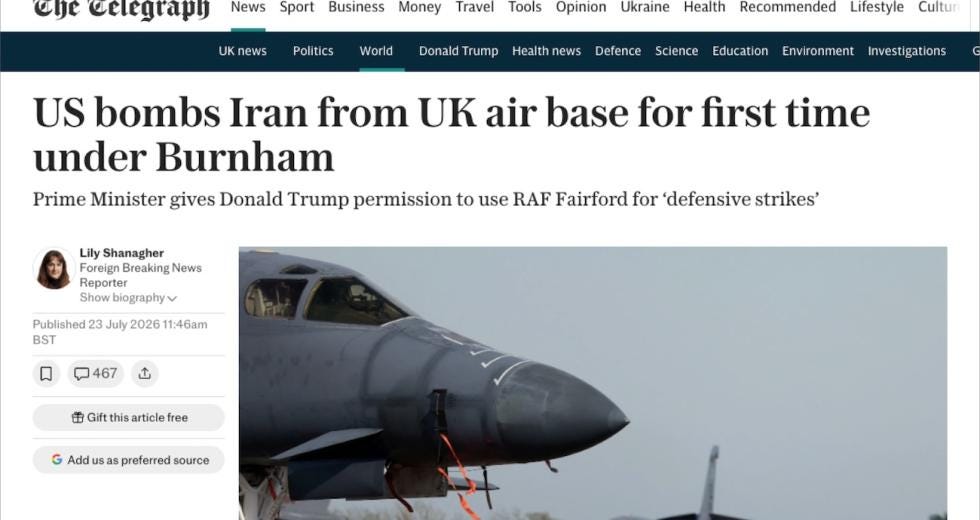
In the recent resumption of daily US attacks on Iran, it has been reported that the planes dropping the bombs have come from RAF Fairford in Gloucestershire.
One thing connecting all these incidents is that the bombs in the long range bombers came from a little-known location in the sleepy Berkshire countryside. Perhaps it’s surprising to learn that the RAF were involved, but here’s the thing: Welford is not an RAF base any more. Rather, it’s the largest US bomb arsenal in the UK, and the second largest in Europe. The bombs stored here are transported by road to RAF Fairford where they are loaded onto long-range B-1 and B-52 bombers.
Mainstream reporting by the BBC as well as in independent media like the Canary and Declassified UK have all described the goings on at RAF Fairford. But hardly anyone seems to know about the secret munitions dump only miles away. Let’s examine what’s been going on there.
The Base
RAF Welford used to be a functioning air force base with three runways laid out to form an intersecting triangular pattern. Aerial photographs from the 1940s show the base clearly, but it has not functioned as an airstrip for many years. The US Air Force doesn’t fly in here, either — in fact, they dug up the runways and replaced them with a myriad of cavernous underground bomb silos.
The base is referred to as secret in part because there are opaque signs on the motorway indicating ‘Works unit only’, with no further information. Before 2015 these signs were edged in red, an indication, at least, that the destination was a military installation. Reviewing data from Google Street View indicates that the signs were changed between April 2015 and September 2016 to the current blue colour indicating, deceptively, a civilian installation.
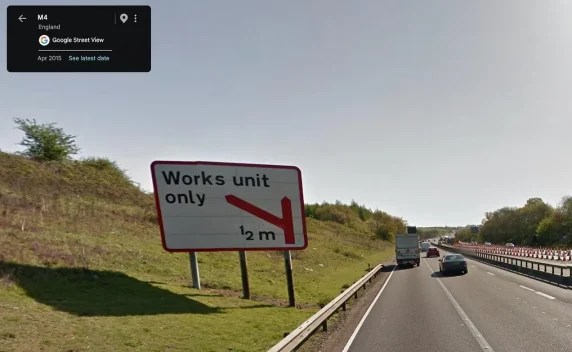
The previous, less deceptive, sign. Image: Google Street View, April 2015.
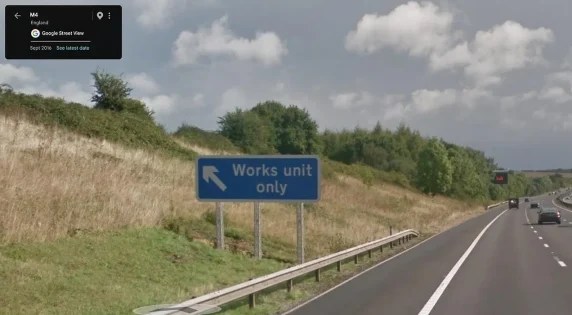
The replacement sign. Image: Google Street View, September 2016.
Munitions stored at, or supplied from, RAF Welford have supported USAF bomber operations from RAF Fairford in multiple conflicts, including the 1991 Gulf War (Operation Desert Storm) and the 2003 illegal invasion of Iraq, plus operations in Afghanistan, Syria, and elsewhere. Operations against Iranian targets in 2026 have involved bunker-busting and precision-guided bombs loaded for B-1B missions and launched from Fairford.
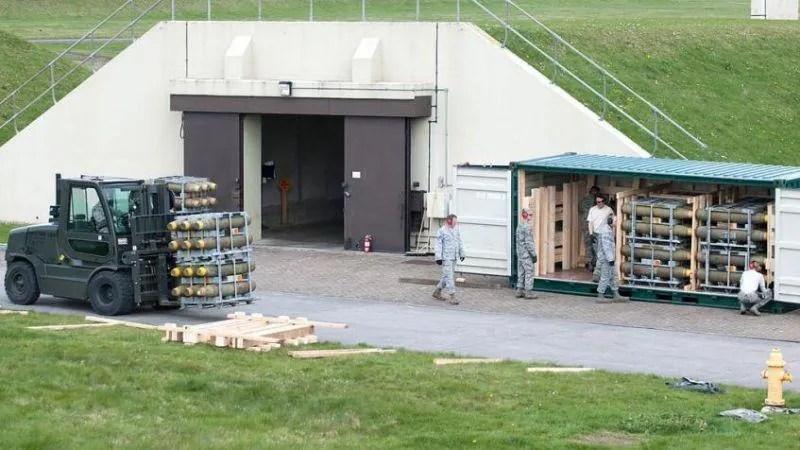
Bombs being loaded at RAF Welford
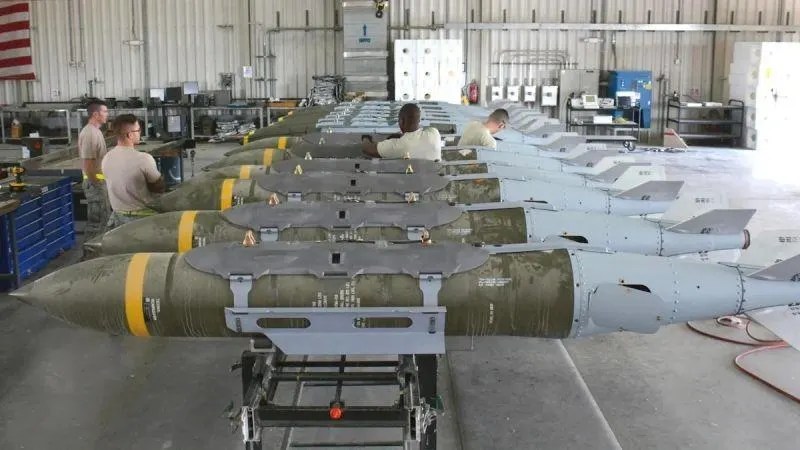
These JDAMs are among the types of bomb loaded at RAF Fairford. Image: USAF
The massive stockpiles of bombs at Welford are looked after by the USAF 420th Munitions Squadron, part of the 501st Combat Support Wing which is headquartered at RAF Fairford. Welford functions as the second largest conventional munitions storage area in Europe and one of the largest heavy munitions compounds for the entire United States Air Forces in Europe–Air Forces Africa (USAFE-AFAFRICA).
In May 2019, the USAF moved 450,000 pounds (200 tonnes) of explosives to the site which hides a huge variety of bombs. They include three key types — ‘smart’, ‘dumb’ and ‘stand off’:
- ‘Iron’ or ‘dumb’ bombs (Mk 82/Mk 84 ): 500-pound/2,000-pound unguided general-purpose bombs. Blast/fragmentation for troops, vehicles, buildings, rail yards, infrastructure.
- Joint Direct Attack Munition or ‘smart’ bombs (technically GBU-31 JDAM): These are GPS-guided 2,000-pound ‘precision’ bombs. They are essentially an add-on to ‘dumb’ bombs to make them more accurate. They can also use BLU-109 penetrator add-ons — so called ‘bunker busters’ — for hardened bunkers/underground facilities. Intended for military bunkers, infrastructure, fixed/relocatable targets. These, of course, were responsible for the attacks on civilian infrastructure and the inevitable civilian casualties caused.
- Joint Air-to-Surface Standoff Missile (AGM-158 JASSM): Stealthy long-range stand-off cruise missile for high-value, defended military targets from range. The US uses these if they want to avoid Iranian air defences and the possibility of their planes being shot down, as started to happen in April this year.
RAF Welford is directly linked to RAF Fairford, the USAF’s primary bomber forward operating location in Europe. The 420th Munitions Squadron at Welford supplies munitions to bombers (including B-1, B-2 and B-52 bombers) deployed at Fairford, enabling heavy bombing missions. Moves occur when heavy bombers (B-1B, B-52) deploy to RAF Fairford for exercises or operations. Bombs are then fitted with JDAM kits and loaded onto aircraft.
These munitions and bombs are routinely transported by road between RAF Welford and Fairford, which lie on opposite sides of Swindon. Convoys — reportedly highly secure with armed escorts — travel west via the M4 motorway, a distance of approximately 32 miles. Movements often take place at night with no identifying markings on vehicles for operational security.
However, quite strict rules apply to transporting bombs on British streets and motorways! Military high explosives (UN Class 1) moved by road from RAF Welford to RAF Fairford are regulated under the Ministry of Defence Explosives Regulations (JSP 482) and JSP 800 Volume 4b (Transport of Dangerous Goods by Road).
Convoy vehicles on the M4 are required to display plain orange plates at the front and rear of each transport unit, along with explosive hazard placards (Class 1 diamonds) on both sides and the rear. It’s not clear whether these rules are always adhered to.
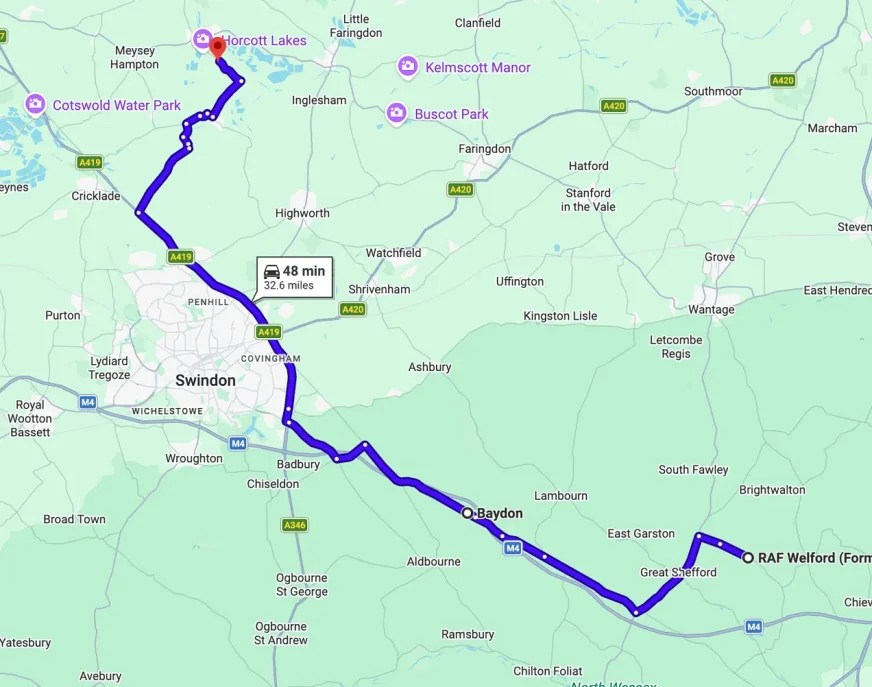
The route from RAF Welford to RAF Fairford is fairly restrictive and predictable. Image: Google Maps
Within Range?
According to the Islamic Revolutionary Guard Corps, the Islamic Republic has deliberately capped its missile range at 2,000 km. If this policy has not been changed, it would be difficult for the IRGC to eliminate the USAF’s UK bunkers of death with a missile attack. That’s because RAF Welford is some 4,035 km from Tabriz in north-west Iran, the closest location from which missiles might be fired. Nevertheless, as a result of Burnham’s reckless decision, the Iranian Foreign Minister has now announced that these bases are legitimate targets for Iran.
Andy Burnham has put British citizens at risk.
RAF Welford is not, however, beyond the range of anti-war campaigners in England. Newbury is less than 10 miles away. Reading, Oxford, and Swindon are less than 30 miles away, Bristol 58 miles, and central London less than 70 miles.
A quick examination of Google Maps shows that when US bombs leave Welford they need to take country roads and can only access the M4 heading west at Junction 14, Shefford Woodlands. They likely then leave the motorway at Junction 15, Badbury, onto the A419. It should not be too difficult to find ways to mount effective demonstrations or blockades to markedly interfere with the smooth supply of death-dealing to US bombers.
No bombs on the planes means no bombs on civilian heads.
You know what to do.
Iranian business still active in UAE despite US ‘Economic D-Day’: WSJ

Al Mayadeen | August 28, 2026
Iranian commercial and financial activity continues across Dubai despite Washington’s push to sharply restrict Tehran’s access to regional markets and financial networks, The Wall Street Journal reported.
According to the newspaper, Iranian banks, airlines, restaurants, and businesses remain active in the United Arab Emirates even after US Treasury Secretary Scott Bessent announced what he called an “Economic D-Day” campaign aimed at countries and companies maintaining economic links with Iran.
Bessent had specifically demanded the closure of overseas branches of Bank Melli Iran, but the bank’s operations in Dubai appeared unchanged this week.
At one Bank Melli branch in Dubai’s old city, around a dozen tellers were continuing to serve Farsi-speaking customers, according to the report. Employees said they had received no instructions ordering the branch to cease operations.
“We put our trust in God on what happens next,” an Iranian bank employee said.
Bank Melli has operated in the UAE since 1969 and currently maintains two branches in Dubai.
US waves secondary sanctions
The continued activity comes despite the UAE Foreign Ministry announcing last week that the country was suspending trade, commercial exchanges, and financial transactions with Iran amid mounting US pressure.
Washington has warned governments and companies that continued dealings with Tehran could expose them to secondary sanctions.
“It is no longer acceptable to operate in the gray spaces of this conflict,” Bessent said. “These measures broaden secondary sanctions risk for anyone foolish enough to continue conducting business with this regime.”
Iranian economic networks remain embedded in Dubai
According to the WSJ, the gap between the public announcements and conditions on the ground reflects the depth of economic ties connecting Iran and the UAE, particularly Dubai.
Iranian businesses have operated in the emirate for decades, while hundreds of thousands of Iranians are believed to live in the UAE and use Dubai as an important gateway to international finance and trade.
Iranian airlines also continue to operate direct services between Iran and the Emirates. UAE carriers Emirates, Etihad, and FlyDubai are not currently flying directly to Iranian destinations, although some reportedly continue to use Iranian airspace.
The newspaper also found Iranian restaurants and cafes operating normally in Dubai, with Iranian residents interacting openly with Emirati customers.
Earlier restrictions eased
Some restrictions imposed earlier in the year appear to have eased as well.
During a broader crackdown in the spring, UAE authorities closed the Iranian Hospital and Iranian Club, temporarily restricted Iranian passport holders from entering or transiting the country and revoked visas belonging to some Iranian residents.
The hospital and club remain closed, but Iranians interviewed by the newspaper said widespread visa cancellations appear to have stopped and some previously withdrawn visas have since been restored.
Iranian residents are nevertheless preparing for the possibility of tighter financial restrictions. Some told the newspaper they could turn to the traditional hawala transfer system if formal banking links with Iran are eventually disrupted.
Severing Iran-UAE trade seen as difficult
Economic ties between the two countries are extensive.
Around $28 billion in trade passed between Iran and the UAE in 2024, according to World Trade Organization figures cited by the newspaper.
Neil Quilliam, an associate fellow at Chatham House, said the economic relationship cannot easily be dismantled.
“The Gulf Arab state economies are so closely integrated and intertwined with the Iranian economy, you can’t just simply sever economic trade and activity overnight,” Quilliam said. “The U.A.E., and Dubai in particular, have always managed to continue to do trade, even when the maximum pressure is on. Cutting off that trade will be cutting off their nose, basically.”
Dubai has also long been identified by US authorities as a major center for financial activity linked to Iran.
The UAE also hosts the second-largest number of individuals and companies sanctioned by the US Treasury over alleged Iran-related activity after China, according to Levitt.
Washington faces competing interests in UAE
The report noted that pushing Abu Dhabi to fully sever its economic relationship with Tehran could create complications for Washington because of the UAE’s broader strategic importance to the United States.
The Emirates hosts US military facilities, maintains close security relations with Washington, and was the first Gulf Arab state to sign the US-brokered “Abraham Accords” establishing formal diplomatic relations with “Israel”.
The country has also emerged as a major source of investment in US sectors including artificial intelligence.
Those interests give Washington incentives to preserve strong relations with Abu Dhabi even as it demands tougher enforcement against Iranian commercial networks.
For Emirati authorities, maintaining some economic channels with Iran may also be viewed as a means of reducing regional tensions.
“There will be some in the U.A.E. who say, ‘Whatever the price of calm, that is what we need to do,’ ” Levitt said. “Better to do that by allowing them to access banking and supply chains through our country than not,” he said of the Emirates’ thinking on Iran.
Dubai faces an additional economic calculation because, unlike oil-rich Abu Dhabi, its economy relies heavily on trade, finance, tourism, and international capital flows.
The WSJ report therefore suggests that despite Washington’s escalating sanctions threats and the UAE’s public commitment to restrict economic links with Tehran, deeply established Iranian financial and commercial networks in Dubai remain difficult to dismantle.
Mearsheimer: IRAN WINNING THE BATTLE FOR WORLD OPINION
Daniel Davis / Deep Dive – August 26, 2026
Prof. John Mearsheimer joins Daniel Davis LIVE to discuss the latest developments in the Iran war, U.S. strategy, Israel, and the broader geopolitical consequences of the conflict.
Iran vows response if US moves to seize its oil at sea
Al Mayadeen| August 27, 2026
Iran will respond swiftly and decisively to any US attempt to revive a mechanism known as “prize courts” to detain oil tankers and seize Iranian oil shipments, a senior Iranian security official stated on Thursday.
According to Nournews, the official said that if Washington uses the mechanism to detain Iranian oil tankers and confiscate their cargoes, the Islamic Republic of Iran would take “serious and swift measures” to impose reciprocal costs on US interests in the Gulf.
“If America is going to detain Iranian oil at sea and then confiscate it under the title of war prize, it must also be prepared to expose American interests to corresponding retaliatory measures,” the official warned.
The official said US interests in shipping, energy, insurance, finance, and Gulf-related infrastructure would not be insulated from the consequences of such action.
He added that companies and institutions involved in owning, financing, insuring, or operating US interests in the region have been identified and are being monitored.
Iran warns against escalation in Gulf
The official further stressed that Iran does not seek to harm regional trade or disrupt the activities of neutral states, but cautioned that this should not be mistaken for an inability to respond.
“If the Americans believe they can take advantage of the complexities of the maritime navigation network and intermediary companies to avoid bearing the consequences of their actions at the hands of Iran, they are mistaken in this belief,” the official said.
He added that, if necessary, Iran would establish a proportionate response for each level of US action.
“Beginning the organized detention and confiscation of Iranian oil will mean the beginning of a two-way process,” the official said, warning that “America cannot grant itself the right to confiscate while simultaneously expecting its interests in the Gulf to remain immune from any reciprocal response.”
The official stressed that the final decision on the nature and scale of any Iranian response would depend on the conduct of the other side. However, he warned that if Washington escalates its economic and maritime confrontation with Tehran, Iran also possesses the means to increase the cost of such a policy.
US reportedly weighs revival of ‘prize courts’
The warning follows reports by US media on Wednesday evening that the US Department of Justice is working to revive “prize courts,” an old mechanism that could allow Iranian oil tankers to be detained and their oil and other confiscated cargoes converted into US-owned assets.
According to Nournews, the seized cargoes could subsequently be sold, with the proceeds transferred to the US Treasury.
The reported move comes amid the economic war Washington waged against Tehran amid its inability to achieve its so-called objectives militarily.
US Looks to Revive ‘Prize Courts’ to Seize Iranian Oil Tankers — Reports
Sputnik – 27.08.2026
The US Justice Department is preparing to revive long-dormant maritime “prize courts” to speed up the military capture of Iranian oil tankers and cargo as US property, Bloomberg reported.
The plan would allow the US to seize oil and other cargo from enemy or even neutral vessels, sell it, and transfer the proceeds to the US Treasury.
Aaron Reitz, a US attorney involved in the initiative, confirmed that the Justice Department is “now reviving” what he called an “ancient body of maritime law.”
The move is expected to face legal challenges, as prize courts have gone largely unused since the Spanish-American War of 1898 and have been dormant since World War II.
The plan comes as US forces have already illegally intercepted and seized multiple Iranian-owned or Iran-linked ships since imposing an unlawful blockade in April.
The US lectures the world about “freedom of navigation” — then digs up antique courts to “legalize” piracy against whoever it decides to bully next.
Pro-‘Israel’ Dems win key panel posts, influence over West Asia policy
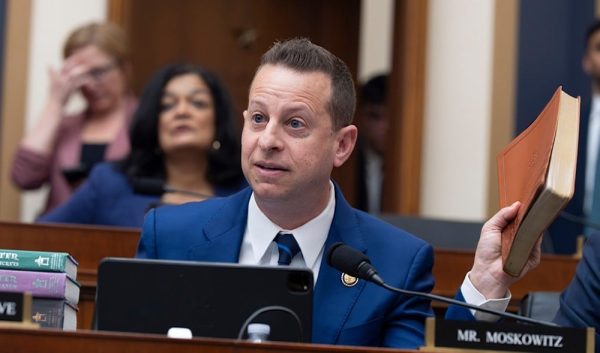
Al Mayadeen | August 26, 2026
Three vocally pro-“Israel” House Democrats were given influential posts on the House Foreign Affairs Committee on Tuesday, with Rep. Jared Moskowitz taking the reins of the subcommittee that oversees US policy toward West Asia, according to Axios.
The appointments represent a significant win for the Democratic Party’s pro-“Israel” wing despite growing pro-Palestinian sentiment among the party’s grassroots.
“If Democrats take control of the House, I’ll be in a position to help steer US policy on Israel and the Middle East,” he told Axios.
In addition to Moskowitz leading Democrats on the West Asia and North Africa subcommittee, pro-“Israel” Reps. Debbie Wasserman Schultz and Wesley Bell were appointed to the Foreign Affairs Committee on Tuesday. They all defeated left-wing primary challengers during this election cycle who targeted their support for “Israel”.
Rep. Mark Pocan, a pro-Palestinian progressive and outspoken critic of AIPAC, was also appointed to the panel.
Pro-Israeli lawmakers overtake committee
Rep. Greg Meeks, the ranking member of the Foreign Affairs Committee, said the appointees’ “experience, commitment, and expertise will strengthen our work and help guide the committee as it addresses urgent challenges in national security and diplomacy.”
“I look forward to working closely with all of our members during this turbulent time when Congressional oversight is most needed,” added Meeks, who is also a vocal supporter of “Israel”.
AIPAC punishes Democrats over ‘Israel’, ends their fundraising
This notably comes after AIPAC suspended campaign fundraising support for more than two dozen House Democrats who voted in July in favor of reducing billions of dollars in US military funding to “Israel”.
On Wednesday, more than 100 Democrats in the House backed an amendment to the fiscal 2027 State Department and national security appropriations bill introduced by Rep. Thomas Massie (R-Ky.). The measure would have barred funds in the legislation from being used to assist “Israel” and cut the Foreign Military Financing program by $3.3 billion.
The amendment was defeated in a 104-314-10 vote. Democrats were nearly evenly divided on the proposal, while Massie was the only Republican to support it. The vote underscored an increasingly visible shift within the Democratic Party regarding the United States’ closest ally in West Asia.
Netanyahu Claims Reaching Agreement With Iran Impossible
Sputnik – 26.08.2026
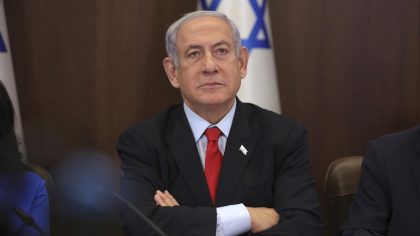
TEL AVIV – Israeli Prime Minister Benjamin Netanyahu said on Wednesday that reaching a “good” agreement with Iran’s authorities is impossible.
A ceasefire between the United States and Iran has been agreed upon, including freedom of navigation in the Strait of Hormuz, Pakistani military sources and Iranian security sources previously told Sputnik. The parties are expected to officially announce the ceasefire in the coming days.
Speaking at an event on settling the West Bank, the Israeli prime minister said that he is determined to ensure no threats from Iran. Netanyahu said that he discussed this with US President Donald Trump a few weeks ago at the White House.
“We discussed three options. I told him about an old option – to reach a good agreement. We have no objections. But I doubt that with this group of people … an agreement can be reached. I told him [Trump] that an agreement is impossible,” Netanyahu said.
The prime minister said that the second option is a resumption of hostilities.
Trump announced the launch of an economic operation against Iran on August 20, calling it “isolation on an unprecedented scale.” He urged US allies to join Washington.
Tehran will use all its resources to combat Washington’s economic pressure, the Iranian Foreign Ministry said on Monday, adding that the only option for the US is respectful dialogue with the Iranian people.
Strait of Hormuz won’t reopen unless US accepts Iran’s conditions: IRGC
Press TV – August 26, 2026
The Strait of Hormuz will remain closed unless the United States halts its blockade and accepts Tehran’s conditions for implementing a recent Memorandum of Understanding (MoU), said the spokesperson of the Islamic Revolution Guards Corps (IRGC).
Brigadier General Hossein Mohebbi said on Wednesday the strategic waterway is firmly under Iranian control and that hostile military forces have been pushed back.
“The Strait of Hormuz is in our hands, and no enemy military vessels are currently present inside the Persian Gulf,” he added.
He said all warships have retreated at least 400 kilometers away from the Strait, adding that from a military and territorial standpoint, “no vessel is capable of transiting this waterway without Iran’s permission and management.”
Addressing the administration of the Strait, which is geographically shared by Iran and Oman, the IRGC spokesman said Tehran has been in active negotiations with Muscat for the past month.
General Mohebbi confirmed that the two sides have reached mutually acceptable agreements regarding the demarcation of their respective shares of the waterway and the distribution of revenues generated from maritime traffic.
He also said the waters near the Omani coast are fully under joint control.
US obstruction primary obstacle
Despite the progress with Oman, General Mohebbi pointed to the United States as the primary obstacle to normalizing traffic through the world’s most critical energy chokepoint.
“The United States is creating obstacles in this process, which has caused delays.”
General Mohebbi stated that if Washington ceases its interference and returns to the framework of the existing MoU, Iran is prepared to reopen the Strait in accordance with that agreement.
“Therefore, the United States must accept our conditions,” the IRGC spokesman said.
“If the US does not accept our conditions, the Strait of Hormuz will under no circumstances be reopened.”
Tehran has established new regulatory frameworks requiring commercial vessels to register with Iranian authorities, obtain transit permits, follow Iran-designated shipping routes, and utilize Iran-provided security and insurance mechanisms amid the US-Israeli war of aggression.
The Islamabad MoU is a landmark 14-point diplomatic framework brokered primarily by Pakistan, with mediation support from Qatar, Egypt, and Turkey.
Signed in mid-June between Iranian and US leadership, the agreement was designed to halt the military aggression, ensure an immediate and permanent cessation of hostilities, and establish a clear roadmap for de-escalation.
A central pillar of the agreement was the easing of wartime restrictions on the Strait of Hormuz and the initiation of further negotiations toward a comprehensive, final settlement.
However, the fragile framework has recently unraveled. Tehran announced the suspension of its own obligations under the accord, asserting that Washington shattered the agreement first through bad-faith negotiations, continued economic coercion, and a failure to honor its commitments.
This diplomatic impasse has prompted urgent, high-level shuttle diplomacy by Pakistani officials, including the Chief of Army Staff, who are actively working to salvage the MoU and prevent the region from sliding back into open conflict.
Iran inflicted billions in damage to American intelligence sites during US-Israeli aggression: Report
Press TV – August 26, 2026
Iranian missile and drone strikes during the US-Israeli aggression caused unprecedented damage to Central Intelligence Agency (CIA) facilities and equipment across West Asia, a report says.
Four officials familiar with the damage told NBC News that the destruction represents an unprecedented setback for US intelligence agencies.
Since CIA was established in 1947, it has never experienced attacks on its facilities and equipment on a similar scale, the officials said.
Iranian missiles and drones hit intelligence sites as well as conventional military targets, including a CIA office in Riyadh, Saudi Arabia, and an intelligence center in Iraq’s Sulaymaniyah Province.
Radar systems and other surveillance equipment were also struck, along with fixed electronic intelligence stations, satellite communications systems and data-processing centers.
Power lines and cooling systems needed to operate high-technology equipment were damaged, reducing Washington’s ability to monitor developments across West Asia.
The strikes also spread across a wide geographic area, with an earlier assessment finding more than 100 targets.
Those countries included Qatar, the United Arab Emirates (UAE), Bahrain, Jordan, Kuwait, Iraq and Saudi Arabia, the report said while it put the number of damaged US bases at 16.
The financial toll is enormous, with the American Enterprise Institute estimating that infrastructure repairs alone could exceed $5 billion, excluding damaged equipment and weapons.
The US Department of War requested $67 billion in emergency funding in late July, including $18.2 billion to replenish Patriot, Terminal High Altitude Area Defense (THAAD), Standard Missile-6 (SM-6) and other advanced missiles.
The cost of the wider war has also been staggering, with Bloomberg reporting that the US fired 13,629 munitions at Iranian targets between February and April.
CBS News estimated the total cost of the aggression at no less than $50 billion, while Joint Chiefs Chairman Daniel Caine warned that renewed fighting could dangerously deplete US interceptor supplies.
The attacks have also exposed failures in American preparations, prompting questions over why US facilities were not better protected against Iran’s growing missile and drone capabilities.
Seth Jones of the American Enterprise Institute offered a blunt assessment, saying, “The US walked into this war and had not sufficiently thought through base defense in any way, shape or form, and we got hammered.”
The latest round of US-Israeli aggression against Iran began on February 28, when Washington and Tel Aviv forces launched large-scale strikes on Iranian territory.
Iran responded with daily waves of missiles and drones targeting US and Israeli assets.
Although Iran and the US signed a Memorandum of Understanding (MoU) on June 17 in an effort to end the aggression, repeated US attacks on southern Iran violated the agreement.
Iranian authorities have since suspended all contact with Washington until it ends its military attacks and hostile rhetoric.
Iran Channels Demands on MoU and Strait of Hormuz to US Through Pakistan
Sputnik – 25.08.2026
Iran has conveyed its conditions regarding the memorandum and the Strait of Hormuz to the United States through Pakistan, Iranian media reported, citing an informed source.
“Contrary to reports by some media outlets that Pakistani Army Chief Asim Munir carried a message containing US threats during his visit to Iran, the trip was aimed at creating space for negotiations and conveying Iran’s conditions and position to the American side,” the source told Tasnim.
According to the source, Tehran’s demands included the US returning to compliance with the memorandum on ending the conflict, signed in mid-June, as well as implementing provisions related to Iran’s rules for navigation through the Strait of Hormuz.
The US and Israel began strikes on targets in Iran on February 28, after which Tehran responded with its own attacks. In mid-June, Iran and the US signed a memorandum on ending hostilities, but later resumed strikes against each other. The conflict remains unresolved, although active fighting has stopped and Washington is relying on economic pressure.
Media previously reported, citing an unnamed senior source, that the US had offered to end the blockade of Iran and lift sanctions in exchange for the reopening of the Strait of Hormuz.
After 6 months of war, why aren’t oil prices even higher?
By Sam Fraser | Responsible Statecraft | August 25, 2026
For decades, the potential closure of the Strait of Hormuz has been considered the ultimate doomsday scenario for global oil markets. So, when Iran effectively closed the Strait earlier this year in response to the joint U.S.-Israeli assault, many analysts warned that oil prices could skyrocket to record highs.
The logic was straightforward. Prior to the war, about 20% of the global oil supply transited the Strait. A loss of supply on this scale could easily have pushed oil prices to $150 or even $200 per barrel — but it didn’t. Instead, prices peaked around $120 per barrel in April and have largely stayed below $100 since June.
To understand the dynamics that have so far prevented an even higher price spike, and to get a sense of where oil supply and prices may be headed as the conflict drags on, I spoke with Rory Johnston, a leading oil markets analyst and the author of the Commodity Context blog. Our conversation has been edited for length and clarity.
Sam Fraser: Let’s talk about why we haven’t seen the $150-200 per barrel oil prices that you warned about early in the war. You’ve pointed to a few reasons, including China’s massive import cuts. As we understand it, what has China done with their oil imports and how have they managed it?
Rory Johnston: It’s a bit of a mystery. At this stage, what we know for sure is that China reduced its crude oil imports by over five million barrels a day, roughly 45% of their total pre-war import appetite. For China, there’s two endpoints of that crude oil balance: into a refinery or into storage. We know that China had been building up a massive volume of strategic reserves prior to the war.
Essentially half of the 5 million barrels a day reduction can be explained roughly by reductions in refining runs in China. The remainder is a question of balancing in and out of stockpiles. Some of it would’ve been likely a drawdown of less visible or underground stockpiles. And the other portion of it is the halting of that prior pace of stockpile building. The main debate is how much each of these factors is contributing. If, let’s say, 80% of that remainder is a halt to prior purchases that were building strategic stocks, that is a bearish outcome for oil prices because it means that Beijing doesn’t need to replace those volumes anytime soon. But if they are aggressively drawing down less visible strategic stocks right now, that’s a much more bullish interpretation because it means they can’t keep going on forever and they’re going to need to replace those stockpiles.
On the refined product side, they cut refining runs by about 2.5 to 3 million barrels a day. What are they doing with that prior flow of diesel, jet fuel, et cetera? And that’s where we start to get even more speculative. Above-ground storage tanks for refined products don’t have floating roofs. We can’t independently verify their fill.
It comes down to the apparent consumption and the apparent available supply of these fuels within China. For gasoline and diesel, each of those supplies have apparently fallen by about 20%, which is a stark reduction. There’s no evidence that people in China are just driving a fifth less. If they aren’t actually cutting back that much on consumption, where is the fuel coming from? Prior to the war, we suspected that China was also building strategic reserves of refined fuels. Again, we can’t verify that, but if they had built that up, they could be drawing it down. We’re then faced with that same question as in crude oil, how much of this is a cessation of prior stock building and how much of this is the drawdown of existing stock?
For reference, the last moment we saw anything like this in terms of apparent consumption collapse was COVID zero in 2022 when the country was entirely locked down.
Fraser: So we can say that stockpiles of refined products must exist, but we have no insight into their size or how much is being drawn down or how sustainable those drawdowns would be?
Johnston: Correct. There are mixed estimates, but I think they are at best estimates. It’s funny, I think in some ways the lack of verifiable data allows people to speak very confidently about what’s happening in China, because there’s no data to rebut virtually any argument. That’s just allowing people to run with it without any kind of real pushback.
Fraser: How have we seen the Chinese buying patterns change since the U.S.-Iran Memorandum of Understanding and since it collapsed?
Johnston: What we saw following the MOU was a surge of exiting cargoes from Hormuz. The vast majority of that seems to have routed towards China. What we saw was that, at the very bottom, Chinese crude oil imports fell to around 6 million barrels a day in June. And then those spiked back up to more than 10 million barrels a day in July, or at least that was the high point in July. Roughly a month later, those imports are back down around six. You’ve seen a rollover back to where we stood pre-MOU.
Fraser: Do we know how long this import suppression can continue?
Johnston:. Let’s say this has been entirely a drawdown of stocks, which seems implausible. Even then, they have more than a billion barrels of crude oil stocks that we know about for sure. If they want to support the market to their maximum ability, they can do that for months further. But in doing so, they would deplete the entirety of the energy security blanket they’ve spent almost two decades constructing.
Fraser: Let’s move on to the strategic petroleum reserve releases by the U.S. and other partners. To what degree have those been instrumental in keeping prices from going a lot higher?
Johnston: It’s part of the suite that the world has kind of engaged in to blunt those effects. This is the largest release of strategic stocks on record. Depending on the exact month you’re talking about, it has potentially been over 3 million barrels a day of incremental supply coming from OECD SPRs. Without that, the market would’ve been much tighter and we likely wouldn’t have experienced the same relief even with China’s import cut at the same time.
Fraser: Last week the U.S. SPR dipped under 300 million barrels. There’s a lot of discussion of what the physical limits on those stockpiles are given that they’re stored in salt caverns. They need a certain amount of fill to maintain structural integrity. Are we anywhere close to pushing up against the U.S. ability to continue drawing down from those stockpiles?
Johnston: I do not believe we are. I think that you have probably at least another 200 million barrels that can be readily drawn down. With the required fill level, absolutely it would be a massive issue if you just drew it down and left a vacuum in there. It would implode on itself. But they don’t do that. They one-to-one replace a barrel of crude oil extracted with a barrel of saturated brine. So theoretically it should maintain the same fill. The issue for SPRs is not necessarily fill level, but number of refill and empty cycles. It’s the actual up-and-down motion that disturbs and further erodes the walls and structural integrity.
I think that the SPR caverns can get below 100 million barrels of fill before we run into any issues.
Fraser: So if we continued the current rate of drawdown, that would take us well into next year.
Johnston: Correct.
Fraser: Over the course of the war, Trump or someone in his administration will make a statement about how diplomacy is progressing or about how much oil is coming out of the strait. And even if those are quickly disproven, there is a downward impact on prices. So why do these traders keep listening to Trump? Has there been a change in the reaction of markets over the course of this war?
Johnston: You definitely get smaller drawdowns to these kinds of jawboning attempts today than you would have, say, in March and April, where there are multiple days that you saw $15 to $20 per barrel reductions in the span of a day.
When you look at the history of oil, there’s a tendency on these geopolitical events to overdo it. That’s a natural kind of fear-driven phenomenon. In some ways Trump has short-circuited that normal behavior in oil markets. Because while you’re right that it’s never coming true, the price action is coming true. At the end of the day, for prices to go higher, you need traders to bid higher. And if they bid higher and they get blown out of the water and they lose their jobs, they’re going to be replaced by someone that doesn’t bid higher on geopolitical risk. It has successfully arrested the upside volatility. But if we keep getting tighter, markets will continue to respond higher; we just won’t get those runaway phenomena that we would’ve seen historically.
Fraser: Since the start of the war, we’ve seen Saudi Arabia and the UAE successfully use pipelines as an alternative route to get oil out of the Gulf. How much oil are those getting out at this point? And has the Houthi blockade of Saudi shipping in the Red Sea had a meaningful effect on this?
Johnston: The total volume coming out of Emirates at Fujairah and then the west coast of Saudi Arabia and the Red Sea rose to about 6-7 million barrels. It was about 2-3 million before, so that was an incremental change of 4-5 million barrels.
To your question with the Houthis, it has absolutely been having an effect. As soon as they started attacking Saudi ships, the entire Red Sea fleet went dark. Everyone turned off their transponders, making it much harder to verify flows out of Saudi Arabia. Verifiable transits of Saudi tankers through the Bab al-Mandab have gone functionally to zero. They still are probably getting some out, but we’re also seeing evidence of flows north into the Mediterranean. Pre-war flows here were around a million barrels a day, give or take. That’s jumped over the past week or two to around 2.5 million barrels a day, presumed Saudi flow.
Over the past two weeks, we’ve also seen Saudi Arabia begin loading tankers in the Gulf again, which they hadn’t done since the collapse of the MOU. And the question is, does Riyadh know something? Is something big going to break in the Hormuz negotiations? Or are they being forced back into the Gulf? You’re seeing reports now that they are participating in the Emirati-led shuttle trade, ship-to-ship transfers in the Gulf of Oman. It seems likely that some of that is displaced barrels coming back from the Red Sea. So Saudi Arabia is needing to diversify away from its diversification. There’s a poetic side to it.
Fraser: Pulling all these factors together, where are we left in terms of a kind of global supply shortage? And what kinds of price impacts can we expect if that persists over the next few months?
Johnston: It’s very hard to estimate global balance right now. My bet would be 2-4 million barrels a day undersupplied on a global basis.
The rub on top of that is that we now have a parallel crisis that’s emerging on the refining side of the slate. So even if we’ve sorted out what was happening on the crude oil side, we have the Ukrainian hammering of Russian refineries, the attacks in the Black Sea, the reduction in U.S. exports now that stocks have drawn down, and China is not exporting refined products either. All together this further tightens global refined product markets.
If this persists and we keep drawing down crude oil stocks, the crude oil price is going to keep rising. On top of that, we could see refined product prices independently going higher. So that’s just an amplification. For consumers, it’s refined product prices and not crude oil that are going to drive those economic issues.
Fraser: So even though these factors we’ve discussed have kept oil prices down so far, and the biggest of these can persist for a while, we could still be looking at those extremely elevated prices by a few months from now.
Johnston: Easily. We’re already feeling it. Refined prices are already at demand-destructive levels. It’s just a question of whether they are at sufficiently demand-destructive levels. It’s the same fundamental concern I would’ve had back in April, playing out on a much longer timeline and now more on the product side than the entire oil complex.
Sam Fraser is a writer based in New York City. He holds a Master’s in International Finance and Economic Policy from Columbia University’s School of International and Public Affairs, where his studies focused on the changing global trade system. Previously, Sam worked as Senior Communications Associate and Publications Manager at the Quincy Institute.
Sanctioning the Dollar Iran Already Left: Why Bessent’s “Economic D-Day” Is Toothless
By Larry C. Johnson | SONAR21 | August 24, 2026
There was one sentence in Scott Bessent’s Monday sanctions announcement that gave the whole game away. Anyone who launders money for the Iranian regime, the Treasury Secretary warned, “will be removed from the US dollar system.” He meant it as a threat of annihilation. It is, instead, a confession of the policy’s central weakness. The entire architecture of what Bessent has branded “Operation Economic Outcast” rests on a single assumption — that Iran and its trading partners need the U.S. dollar. They increasingly do not. And a threat to bar someone from the dollar system means nothing to a trade that has already walked out of it and into the Chinese yuan.
What Bessent actually announced
Strip away the “economic D-Day” theatrics and the substance is a secondary-sanctions framework: the United States threatens to punish any country or entity that refuses to sever economic ties with Iran, expands the categories of activity exposed to those secondary sanctions into five new fields — digital assets, technology, gold, aviation, and shipping — and designates roughly sixty individuals, entities, and vessels tied to nuclear and missile procurement, cyber operations, and oil smuggling. The mechanism of pain, in every case, is the same: exclusion from the dollar-based financial system that Washington polices through its control of dollar clearing, SWIFT messaging, and correspondent banking.
That is a devastating weapon against anyone who lives inside the dollar system. It is close to irrelevant against those who have deliberately built their most important trade outside it. And Iran’s lifeline — the oil trade with China — is now largely outside it.
The trade that runs on yuan
Follow the barrels. China is now the buyer of over 80 percent of Iran’s seaborne crude exports. Iran is shipping somewhere around 1.65 to 1.8 million barrels a day, almost all of it to the independent “teapot” refiners of Shandong, moved by a shadow fleet of more than 350 tankers using ship-to-ship transfers off Malaysia, Singapore, and the Sea of Oman, the cargoes routinely rebranded as Malaysian or Omani. And critically, the money for it increasingly does not move in dollars. Payment flows in yuan, routed through small Chinese banks and Hong Kong trading shells, settled in a growing volume of renminbi that bypasses the dollar clearing system entirely.
The plumbing for this is China’s Cross-Border Interbank Payment System, CIPS — the settlement network the People’s Bank of China launched in 2015 precisely to clear cross-border yuan transactions without touching the Western financial architecture. Its use has surged in lockstep with the war. CIPS processed on the order of $214 billion in March 2026, hit a single-day record of 1.22 trillion yuan — roughly $178 billion — across nearly 42,000 transactions, and saw its average daily value jump about 50 percent from February to March, a spike analysts tied directly to the Iran conflict and rising yuan demand in oil trade. More than five thousand institutions are now connected. These channels allow settlement without any intermediary US bank in the chain — which is the entire point.
Nor is this confined to China. Even Indian refiners buying rare cargoes of Iranian oil have settled the payments in yuan, routed through the Shanghai branch of an Indian bank, because Iran wants a currency that sidesteps the dollar sanctions channel. Iran’s Revolutionary Guard has reportedly begun demanding yuan or cryptocurrency for oil transactions outright. When Bessent adds “digital assets” and “gold” to his sanctions categories, he is chasing evasion routes Iran is already using by design, through a shadow system purpose-built to be untraceable.
You cannot freeze a yuan payment out of a dollar system it never enters. That is not a loophole in Bessent’s plan. It is the plan’s foundation, missing.
The market already delivered its verdict
The most eloquent judgment on these sanctions came not from a pundit but from the oil market itself. If traders believed Bessent’s “economic onslaught” would actually choke off Iranian barrels, crude would have spiked on the announcement. It did the opposite. Brent fell about 2.3 percent on August 24, sliding below $92, as investors concluded the measures were unlikely to remove Iranian oil from the market. A sanctions package advertised as an economic D-Day was met by the market marking the price of oil down. The traders who move real money on real supply read the announcement for exactly what it was: sound and fury aimed at a target the dollar can no longer reach.
The one tooth Bessent won’t bare
There is precisely one measure that could actually bite the yuan trade: sanctioning the major Chinese banks and the CIPS architecture that clear it — cutting large Chinese financial institutions out of the dollar system and forcing Beijing to choose. And that is the step Bessent, once again, announced but did not take. He warned that at least one major financial institution could face sanctions this week, and said China would not be exempt. A threat, not an action — the same threat that has hovered over this campaign for months and never descends, because executing it means a financial rupture with Beijing on the eve of a planned Trump-Xi meeting, and an oil-price shock Washington cannot afford heading into the midterms.
And even if he pulled that trigger, the trade is engineered to survive it. The yuan payments already move through small Chinese banks and Hong Kong front companies precisely so that the large, dollar-exposed institutions stay clean and the flow continues if a big bank is hit. The system was designed by people who assumed Washington would eventually come for it. Bessent is threatening to breach a wall its builders reinforced years ago.
Ten years of sanctions, and a larger economy
Step back from Monday’s announcement and ask the longer question: what has a decade of sanctions actually done to the size of Iran’s economy? Measured properly, it has grown.
The measure matters, because there are two ways to size an economy and here they tell opposite stories. In nominal dollars — the plane on which sanctions operate — Iran looks devastated: its dollar GDP is around $300 billion in 2026, and dollar income per head has been falling fast, because the rial has been pulverized and everything Iranian looks cheap when priced in a currency Iranians increasingly cannot obtain. But nominal-dollar GDP largely measures the exchange rate, not the economy. Measured by purchasing power parity — which values what Iran actually produces at the prices Iranians actually pay, stripping out the collapsed currency — Iran’s GDP has risen from roughly $1.4 trillion in 2015, when the JCPOA-era sanctions architecture was in force, to about $2.18 trillion in 2026, by the IMF’s reckoning the world’s twenty-third-largest economy. That is an expansion of more than fifty percent over the same decade of “maximum pressure” that was supposed to break it.
The caveat belongs in plain sight, not buried: part of that gain is simply more Iranians — the population has grown by roughly a sixth since 2015 — so per-capita output has risen far more modestly, and none of it means Iranian households feel richer, with inflation running near forty percent and the currency in ruins. Growth of the economy is not prosperity for the family. But that is a different claim from the one that matters for sanctions policy. A pressure campaign that can wreck a currency and still not shrink real output is a campaign that produces hardship without submission. Iran has now demonstrated exactly that across two sanctions architectures — the JCPOA snapback and its “maximum pressure” successors — and ten years of data. Bessent is adding a chapter to a book whose ending is already written.
The honest limits
This is a dollar bypass, not the death of the dollar. The greenback still makes up around 57 percent of global foreign-exchange reserves against roughly 2 percent for the yuan, and only a low single-digit share of cross-border trade settles in renminbi; CIPS remains far smaller than the SWIFT-and-CHIPS system it shadows. The claim here is narrow and it is enough: a determined seller like Iran, with a willing Chinese counterparty, can route its oil revenue around the dollar — not that the world has.
Nor are the sanctions literally costless to Tehran. The friction of operating in the shadows is real: Iran sells its crude at discounts of $14 to $17 a barrel below Brent, up from $8 in 2023, precisely because sanctions raise the risk and complexity of buying it; its fiscal break-even sits far above the price it actually realizes, and the rial has lost most of its value. Bessent’s measures will add a little more friction at the margin — another turn of the screw on the discount, another few front companies to replace.
But friction is not a chokehold, and a poorer Iran is not a compliant one. The sanctions make Iran’s oil cheaper and its economy more strained; they do not, and cannot, sever the yuan-denominated artery to China that keeps the oil flowing and the regime funded. That artery is the thing Bessent promised to cut, and it is the one thing his announcement does not touch.
Bessent has threatened to expel Iran and its partners from a financial system Iran has spent years leaving. The dollar guillotine is real, and it still falls with terrible force on anyone standing beneath it — but Iran’s oil trade stepped off the block and into the yuan, and every fresh round of dollar-weaponization only sharpens the incentive for others to follow. The measures announced Monday will generate headlines, a few dozen designations, and a marginal widening of the discount China already enjoys on Iranian crude. What they will not do is the thing they were sold to do: collapse Iran’s options and force it to heel. You cannot sever a lifeline that no longer runs through your hands. Bessent is standing guard at a door Iran walked out of a long time ago, threatening to lock it.
Featured Video

“Historic Russia”: The Land Putin Will Not Give Back
or go to
Aletho News Archives – Video-Images
Book Review
Why the War on Conspiracy Theories Is Bad Public Policy
By Kevin Barrett • Unz Review • February 1, 2019
 A Review of Conspiracy Theories and Other Dangerous Ideas by Cass Sunstein (based on an earlier paper co-authored with Adrian Vermeule); In Defense of Troublemakers: The Power of Dissent in Life and Business by Charlan Nemeth; and Conspiracy Theories and the People Who Believe Them, edited by Joseph E. Uscinski
On January 25 2018 YouTube unleashed the latest salvo in the war on conspiracy theories, saying “we’ll begin reducing recommendations of borderline content and content that could misinform users in harmful ways—such as videos promoting a phony miracle cure for a serious illness, claiming the earth is flat, or making blatantly false claims about historic events like 9/11.”
At first glance that sounds reasonable. Nobody wants YouTube or anyone else to recommend bad information. And almost everyone agrees that phony miracle cures, flat earthism, and blatantly false claims about 9/11 and other historical events are undesirable.
But if we stop and seriously consider those words, we notice a couple of problems. First, the word “recommend” is not just misleading but mendacious. YouTube obviously doesn’t really recommend anything. When it says it does, it is lying. … continue
Blog Roll
 Aletho News
- “Historic Russia”: The Land Putin Will Not Give Back
- How the Cambridge Analytica scandal still haunts Mark Zuckerberg
- The Ongoing Cancellation Campaign Against a Dissenting Academic in Norway
- Yemen and ‘the Houthis’: Challenging Sami Hamdi’s Narrative
- No, Christians did not invent Zionism
- AIPAC-led lobbying network opens branches in Cypriot, Greek parliaments
- Araghchi blasts ‘parasitic’ alliance as US taxpayers pay for Israel’s war on Iran
- Easy fix for Europe’s chaos? Stop fueling war against Russia
- Putin’s key remarks on peace talks and Europe’s ‘schizophrenia’
- Trita Parsi: Israel Set a Trap for Total War in the Region
- If Americans Knew
- An error has occurred; the feed is probably down. Try again later.
- No Tricks Zone
- Two New Studies Find Thwaites Glacier Melt Cannot Be Driven By Human Activity Or A Warming Ocean
- E-Cars Reduce CO2 Emissions By Only 41% Compared To Internal Combustion Engine Vehicles
- Predictions Made By Renowned Climate Professor Over Past Decades Have Been Proven To Be Poor
- New Study Suggests Large Regions Of The Pacific Ocean Have Been Cooling For The Last 80 Years
- Germany’s Green Energy Debacle: High Energy Costs Force Kahla Porzellan to Close After 182 Years!
- New Study: 50 Years Of The Most Aggressive ‘Net Zero’ Policies Can Only Affect The Global Climate By 0.03°C
- US September “Heat” Was No Record…Many Records Set Decades Ago
- Latest European Green Energy Debacle; Portugal’s Largest Flagship Solar Park Insolvent!
- Green Energy Debacle: German Expert Professor Fritz Vahrenholt Warns Of Severe Economic And Social Consequences
- Two More Paleo Reconstructions Affirm Meters-Higher Sea Levels Across Ireland, Brazil 7000-6000 Years Ago


