Pro-Israel groups back US military action against Syria
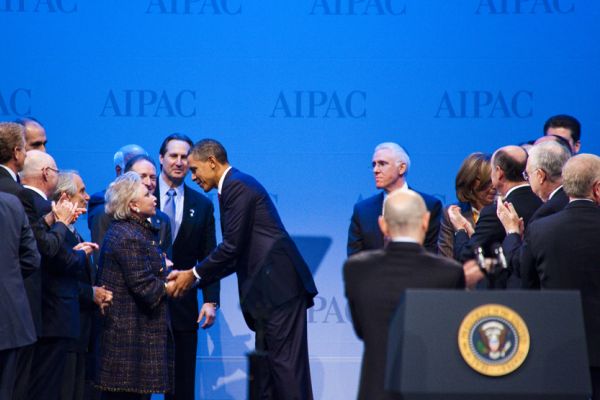
Barack Obama greets board members of the AIPAC conference following his speech to the group in 2012
Press TV – September 4, 2013
Three influential pro-Israel pressure groups in the United States pressed Congress on Tuesday to authorize an attack on Syria.
Signaling an increased lobbying effort for American military action, the American Israel Public Affairs Committee (AIPAC), the Anti-Defamation League (ADL) and the Republican Jewish Coalition (RJC) issued statements that they support US military intervention in Syria, Reuters reported.
The groups also had a 45-minute meeting at the White House on Tuesday with administration officials, according to government sources. But they have been careful as not to be seen encouraging Washington to go to war for the sake of Israel’s interest.
The lobby groups generally wanted the war debate to focus on US national security rather than how the decision to attack Syria might help Israel.
The Israel lobby is a diverse coalition of individuals and groups that seek to influence the foreign policy of the United States in support of Israel. Commentators in the US have asserted that the lobby has undue or pervasive influence over US foreign policy in the Middle East.
US President Barack Obama and some members in Congress want to attack Syria over recent accusations that the Arab country used chemical weapons against militants. Syrian authorities have categorically rejected the allegation that it had any role in the chemical attack.
Related articles
No War for Bernard Henri Lévy
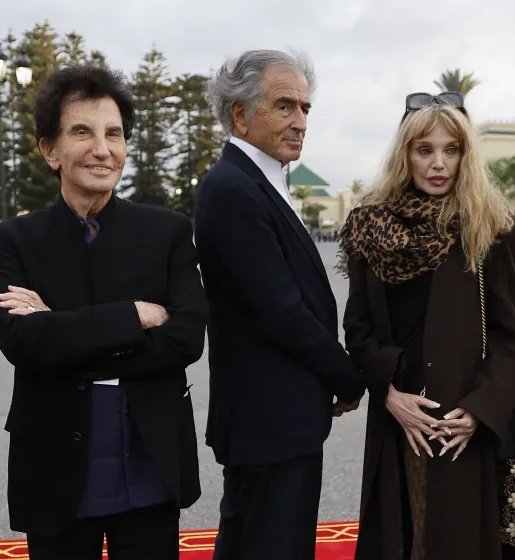
By DIANA JOHNSTONE | September 3, 2013
The American people do not want US armed forces to get involved in the civil war in Syria. The United Nations will not back US bombing of Syria. The British Parliament does not want to get involved in bombing Syria. World public opinion is opposed to US bombing Syria. Not even NATO wants to take part in bombing Syria. So who wants the United States to bomb Syria?
The same people who brought us the war in Iraq, that’s who.
On August 27, the Foreign Policy Initiative, a reincarnation of the Project for the New American Century (PNAC) that dictated the Bush 2 administration’s disastrous foreign policy, issued its marching orders to Obama. In an open letter to the President, the FPI urged “a decisive response to Syrian dictator Bashar al-Assad’s recent large-scale use of chemical weapons”.
The neocon “foreign policy experts” skipped over the pathos designed to arouse feelings of guilt in ordinary Americans for sitting in front of their television sets and “doing nothing”. Rather, their argument is based on power projection. Once Obama set a “red line”, he must react to “show the world”.
“Left unanswered, the Assad regime’s mounting attacks with chemical weapons will show the world that America’s red lines are only empty threats.”
The FPI told Obama that the United States should consider “direct military strikes against the pillars of the Assad regime”, not just to get rid of the chemical weapons threat, “but also to deter or destroy the Assad regime’s airpower and other conventional military means of committing atrocities against civilian non-combatants.”
At the same time, “the United States should accelerate efforts to vet, train, and arm moderate elements of Syria’s armed opposition, with the goal of empowering them to prevail against both the Assad regime and the growing presence of Al Qaeda-affiliated and other extremist rebel factions in the country.” The United States should “help shape and influence the foundations for the post-Assad Syria”.
In short, what is called for is a full-scale regime change, getting rid of both the existing regime and its main military opposition, and putting in power supposed “moderate elements of Syria’s armed opposition”, who by all accounts are the weakest in the field.
So, after failing to produce such nice, moderate results in Iraq or Afghanistan, try, try again.
The most familiar names among the 78 signatories included Elliott Abrams, Max Boot, Douglas J. Feith, Robert Kagan, Lawrence F. Kaplan, Joseph I. Lieberman, Martin Peretz, and Karl Rove. No surprises there.
The novelty on the list was the signature of Bernard-Henri Levy.
Not surprising either, when you stop to think about it. After all, Bernard-Henri Levy is widely credited with having persuaded former French president Nicolas Sarkozy to lead the charge that overthrew Kaddafi and delivered Libya to its current chaos. After such an accomplishment, the Parisian dandy naturally feels entitled to tell the United States President what to do.
I vividly recall Bernard-Henri Levy reacting with the mock indignation that serves as his usual shield from criticism to claims that the Benghazi rebels included Islamic extremists with ties to al Qaeda. Outrageous! he vociferated. He had been to Benghazi and seen for himself that the folks there were all liberal democrats who just wanted to enjoy free elections and multicultural harmony. Not so very much later, liberated Benghazi was sending Islamist fighters to destabilize Mali, recruiting Islamists to fight in Syria and assassinating a U.S. ambassador. This turn of events has not fazed the media star the French call “BHL” in the slightest. Although widely ridiculed and even hated in France, his influence persists.
In 2010, the writer Jacob Cohen published a novel entitled “Le Printemps des Sayanim”*. Despite the usual disclaimer, the novel was a roman à clés. A main character, named MST, was described in this fiction by an Israeli diplomat in Paris as follows: “MST is of capital importance to us. He is worth more than a hundred sayanim. […] He covers a large part of the left for us. Inasmuch as he ‘criticizes’ Israel, what he says is taken seriously. That way he can get our interests into a lot of media. […] Moreover, that man has incredible networks, in the most influential circles in Europe, in America. He can call Sarkozy whenever he wants, or the king of Morocco, or the president of the European Commission. […]”
No French reader would have any trouble recognizing BHL, although, of course, this was fiction.
But the question deserves to be raised: why has the real BHL been so keen to overthrow governments in Libya and Syria? Even if the countries fall apart?
Perhaps this flashy dilettante thinks these wars are good for Israel. BHL’s devotion to Israel is as conspicuous as his white v-neck shirts and back-swept hairdo. Perhaps he fantasizes that if all the surrounding countries are in hopeless shambles, “the only democracy in the Middle East” will be the only tree left standing in the forest.
But even Israeli intelligence, which is a major source of US assessment of happenings in the region, doubts that Assad’s chemical weapons are a threat to Israel.
Giora Inbar, the former head of the IDF’s liaison unit in southern Lebanon, was quoted by the August 27 Times of Israel as saying that “there would be no logic in Assad attacking Israel”.
Inbar said that Israeli military intelligence made a priority of intelligence-gathering in Syria, was very well-informed, and was widely trusted. The United States was “aware of” Israel’s intelligence on the doings of the Syrian regime, “and relies upon it.”
Still, Israeli officials are not hyping the incident the way John Kerry did, insisting on deliberate murder of children.
The New York Times on Tuesday quoted an Israeli official as saying: “It’s quite likely that there was kind of an operational mistake here […] I don’t think they wanted to kill so many people, especially so many children. Maybe they were trying to hit one place or to get one effect and they got a much greater effect than they thought.”
All that is speculation. But the most plausible hypothesis so far is that the incident was an accident. Indeed, rebel sources themselves have been quoted as saying that the incident occurred as a result of their own mishandling of chemical weapons obtained from Saudi Arabia. In that case, the victims were the “collateral damage” so frequent in war. War is a series of unintended consequences. The most obvious unintended consequence of US air strikes on Syria, if they happen, will be the total collapse of whatever pro-American sentiment may be left in the world, and a furious backlash against Israel, which is widely seen as the influence behind US policy in the Middle East. Some Israelis are fully aware of this.
The New York Times quoted former Israeli ambassador to the United States Itamar Rabinovich as warning that it would be “a mistake to overplay the Israeli interest” in striking Syria. “It’s bad for Israel that the average American gets it into his or her mind that boys are again sent to war for Israel. They have to be sent to war for America.”
If not for Israel, why do boys, or girls, or missiles, have to be sent at all?
And the best way to prevent the backlash against Israel and its supporters is to call a halt to the whole project of using US military force in Syria.
But whatever happens, the reckless adventurer Bernard-Henri Levy can retire to his palatial villa in Marrakech, and dream up some new scheme.
*Sayanim is a Hebrew word (singular sayan) defined by Wikipedia “passive agents most usually called “sleeping agents” established outside Israel, ready to help Mossad agents out of feelings of patriotism toward Israel.
Diana Johnstone can be reached at diana.josto@yahoo.fr
The Troodos Conundrum
By Craig Murray | August 31, 2013
The GCHQ listening post on Mount Troodos in Cyprus is arguably the most valued asset which the UK contributes to UK/US intelligence cooperation. The communications intercept agencies, GCHQ in the UK and NSA in the US, share all their intelligence reports (as do the CIA and MI6). Troodos is valued enormously by the NSA. It monitors all radio, satellite and microwave traffic across the Middle East, ranging from Egypt and Eastern Libya right through to the Caucasus. Even almost all landline telephone communication in this region is routed through microwave links at some stage, picked up on Troodos.
Troodos is highly effective – the jewel in the crown of British intelligence. Its capacity and efficiency, as well as its reach, is staggering. The US do not have their own comparable facility for the Middle East. I should state that I have actually been inside all of this facility and been fully briefed on its operations and capabilities, while I was head of the FCO Cyprus Section in the early 1990s. This is fact, not speculation.
It is therefore very strange, to say the least, that John Kerry claims to have access to communications intercepts of Syrian military and officials organising chemical weapons attacks, which intercepts were not available to the British Joint Intelligence Committee.
On one level the explanation is simple. The intercept evidence was provided to the USA by Mossad, according to my own well placed source in the Washington intelligence community. Intelligence provided by a third party is not automatically shared with the UK, and indeed Israel specifies it should not be.
But the inescapable question is this. Mossad have nothing comparable to the Troodos operation. The reported content of the conversations fits exactly with key tasking for Troodos, and would have tripped all the triggers. How can Troodos have missed this if Mossad got it? The only remote possibility is that all the conversations went on a purely landline route, on which Mossad have a physical wire tap, but that is very unlikely in a number of ways – not least nowadays the purely landline route.
Israel has repeatedly been involved in the Syrian civil war, carrying out a number of illegal bombings and missile strikes over many months. This absolutely illegal activity by Israel- which has killed a great many civilians, including children – has brought no condemnation at all from the West. Israel has now provided “intelligence” to the United States designed to allow the United States to join in with Israel’s bombing and missile campaign.
The answer to the Troodos Conundrum is simple. Troodos did not pick up the intercepts because they do not exist. Mossad fabricated them. John Kerry’s “evidence” is the shabbiest of tricks. More children may now be blown to pieces by massive American missile blasts. It is nothing to do with humanitarian intervention. It is, yet again, the USA acting at the behest of Israel.
NYT excises AIPAC from Let’s Attack Syria story
September 2, 2013
Passage removed, H/T Niqnaq:
Administration officials said the influential pro-Israel lobby group AIPAC was already at work pressing for military action against Assad, fearing that if Syria escapes US retribution for its use of chemical weapons, Iran might be emboldened in the future to attack Israel. House majority leader Eric Cantor, the only Jewish Republican in Congress, has long worked to challenge Democrats’ traditional base among Jews. One administration official called AIPAC “the 800 lb gorilla in the room,” and said its allies in Congress had to be saying:
If the White House is not capable of enforcing this red line against the catastrophic use of chemical weapons, we’re in trouble.
NewsDiffs reports that the article had no less than nine edits:
President Gains McCain’s Backing On Syria Attack (NYT), Change Log
By JACKIE CALMES, MICHAEL R. GORDON and ERIC SCHMITT | First archived on September 2, 2013, 1:18 p.m.
Related articles
- AIPAC is trying to stay out of sight, but it will be worth watching the CPMAJO’s daily alert (niqnaq.wordpress.com)
- Why Is the Israel Lobby Keeping Quiet on Syria Crisis? (alethonews.wordpress.com)
Israel and the Jewish lobby likely to get embroiled in Congress debate on Syria
By Gilad Atzmon | September 2, 2013
Israeli writer Chemi Shalev predicts today in Haaretz that Israel and the Jewish Lobby will be putting pressure on congressmen. In practice they will push for a war against Syria.
“Supporters of Israel will likely be told that at this critical juncture, neutrality is a luxury that neither the lobby nor the Administration can afford. Time to put up or shut up, get off the fence and spend some of the precious political capital that Israel supporters have amassed in order to fight in the Washington trenches for something that most Israelis contend is crucial to their national interests.”
And the verdict is clear, if you have a powerful Jewish lobby in you country, you don’t really need an enemy, you will end up fighting a war with no end…
The Full Story on Why Obama Backed Down on Syria
By Ibrahim al-Amin | Al-Akhbar | September 2, 2013
Commentators in the West will surely declare that it was their democratic systems of government that forced US President Barack Obama to back down on attacking Syria. But the events that led up to Washington’s de-escalation suggest there were other factors at play.
When Obama stepped out into the White House Rose Garden to declare that, though still intent on attacking Syria, he wanted to get Congress’ approval first, the Pentagon must have breathed a sigh of relief, knowing full well that a military strike against Damascus could spark a major confrontation in the Middle East for which they were not adequately prepared.
The story starts shortly before the Israeli-Saudi intelligence operation that engineered the chemical attack near the Syrian capital. The Americans and Europeans had begun negotiating with the Russians and the Iranians for a political settlement, after having failed to remove the regime by force. The West’s only condition was that Bashar al-Assad would not be part of the solution, even proposing to Moscow that they would be willing to allow the Syrian president to pick a successor of his own choosing.
When the Russians – after extensive discussions with their allies – told Washington that it was difficult to accept such a condition, the West turned to Plan B, which was to raise the level of military support for the opposition and reorganize the armed groups fighting against the regime, allowing Saudi Arabia to take the lead in mobilizing them to up the ante on Damascus.
The goal was to squeeze Assad by launching major offensives from both the north and the south of the country, in addition to wreaking havoc on Hezbollah on its home ground and providing more appealing incentives for Syrian army officers to defect.
In the meantime, the regime and its allies were already in the process of consolidating military gains on a number of fronts by expanding the area under government control, particularly in the area around Damascus. One such operation was to be launched on the eve of the chemical attack on August 20 against opposition forces to the south and east of the capital.
After the opposition was quickly routed in the north as it tried to sweep through the coastal Latakia region, many of their regional and international backers understood that the only way to bring about a qualitative change on the ground was by drawing the West into a direct foreign military intervention in Syria – but a justification was necessary to prompt Washington to act.
It was for this reason that the “chemical massacre” in the Ghouta area around Damascus was carried out, most likely at the hands of the Saudi and Israeli intelligence. Barely an hour had passed before the orchestrated media campaign to get Assad was in full swing, followed by condemnations and threats from Western capitals.
Washington rushed to cash in on what they insisted was an imminent military attack by sending envoys to both Russia and Iran, giving the two countries a last opportunity to stand down before unleashing their missiles on Syria. But all the sabre-rattling was not enough to force any political concessions – even Assad informed his allies that he had chosen to take a stand.
The Americans tried to respond to this by showing that they were serious about a strike, moving additional naval vessels into the eastern Mediterranean, as well as increasing the number of fighter planes in bases around Syria. But again, Russia and Iran were unmoved, refusing to give Washington any guarantees that its limited strike would not turn into a broader, prolonged war, with devastating consequences for the region as a whole.
They backed their words with action, as Russia, Iran, Syria, and Hezbollah put their forces on high alert, ordering them to make preparations for a military confrontation. Most notably, Hezbollah directed its fighters to return to their bases, as it set up an operations room in coordination with Damascus to make effective use of their combined arsenal of rockets.
The first to buckle was that old hand at such affairs, the United Kingdom, whose parliament gave Prime Minister James Cameron a way out, putting their ally Washington in the uncomfortable position of going it alone. Suddenly, Obama, too, felt the need to consult the American public and seek the approval of their representatives in Congress.
Nevertheless, Obama – having lost the initiative – has but two choices before him: He either retreats and seeks out a political settlement, or enters into a military adventure, whose outcome he cannot control. The results of round one of this global confrontation in Syria provide yet another indicator that the days when the US can call the shots, without regard for the rest of the world, are on their way to becoming a relic of history.
Students campaign to expel Dahlan from UAE

MEMO | September 2, 2013
Hundreds of students in the United Arab Emirates have signed-up to a Twitter campaign to expel one-time Fatah strongman Mohammed Dahlan from the country. The students insist that Dahlan has “betrayed” the Palestinian cause for Israel’s benefit and are asking the Emirates government why they allow “Israel’s number one client” to stay in the UAE.
Under the theme “Expel Dahlan from the country”, the activists have stressed their belief that Dahlan’s “nasty streak” in spreading “misleading” ideas about Palestine has already started to be reflected in public attitudes towards the issue. They accuse the government of supporting a “criminal” whose work has led to the deaths of his own people as well as promoted the Israelis at the expense of Islamists. The campaign is pushing for the UAE government to be more discerning about allowing such “criminals” into the country: “Those who are being valued by the Emirati authorities,” they allege, “sell their own land and kill their own people.”
Previous reports suggest that Dahlan, a former leader in the Palestinian Fatah movement who occupied a senior security position with the Palestinian Authority, is the instigator of a number of acts of sabotage against the Egyptian army and police in Sinai, near the Gaza Strip. These, it is claimed, have been coordinated with parties in Egypt in order to blame Hamas and incite distrust and hatred among Egyptians against the Islamic Resistance Movement and the Palestinians in Gaza.
Related article
- Fatah security officer loyal to Dahlan captured in the Sinai (altahrir.wordpress.com)
Egypt coup enters second phase: the overthrow of Hamas
MEMO | September 2, 2013
The military coup in Egypt is believed to have entered its second phase. The security forces affiliated with General Abdel Fattah al-Sisi, commander-in-chief of the Egyptian armed forces, have begun gradual attacks to topple the Hamas movement in the Gaza Strip, supported by incitement from the pro-Sisi media. A few obscure activists, meanwhile, have organised protests against the government in the Strip. The activists are believed to have received financial aid from the United Arab Emirates.
The news site, Secrets of Arabia, has observed signs of an orchestrated campaign, initiated by Egypt, to attack Hamas and overthrow its government in Gaza. Meanwhile, other sources have claimed that the UAE has been orchestrating the campaign in collaboration with Palestinian, former Fatah leader, Mohammed Dahlan, who works as a consultant for Abu Dhabi Crown Prince, Mohammed bin Zayed. Dahlan was expelled from Gaza following a failed attempt to topple the democratically elected Hamas-led government.
Over the past few weeks, Egyptian troops have launched an extensive campaign against the smuggling tunnels. The tunnels are used to transport essential goods to Gazans, who are suffering from the tight Israeli blockade. News was also leaked of an order by Egyptian security forces to demolish more than 500 houses near the Gaza Strip border and 500 meters deep into the Egyptian territories.
The operation to demolish Palestinian houses, on the border with Gaza, is considered a first of its kind in the history of the Egyptian-Palestinian relations. The operation has raised concerns in the region, of a possible Egyptian military action against Hamas and the tunnels. According to Egyptians residents of the area the Egyptian community believe that the operation is designed to strengthen the siege on Gaza.
Campaign of incitement
The Egyptian military’s actions are supported by an unprecedented campaign by the Egyptian pro-military coup media which calls on Palestinians to revolt against Hamas, in a clear, blatant and unprecedented intervention in the internal affairs of Palestine. Meanwhile, the same media channels have criticised non-Egyptians who interfere in the political affairs of Cairo.
The controversial Egyptian media personality, Tawfiq Okasha, surprised his viewers on Saturday evening with an unprecedented instigation against the Palestinians in Gaza. Okasha said the Palestinians must rise up against Hamas and that the Egyptian army would support them militarily to eliminate the movement.
Okasha is close to the General Sisi regime and is a prominent defender of the military coup. It is widely believed among Egyptians that Okasha reflects the official position of the army. He receives his instructions from the department of moral and military intelligence, which funds his al Faraein TV channel.
Gaza Rebellion
Meanwhile a new movement in Gaza has emerged under the name of Tamarod Gaza or Gaza Rebellion. The movement called on Palestinians in the Gaza Strip to voice their protests against the rule of Hamas on November 11th. The movement has stirred controversy on the Palestinian street.
The majority of the Palestinian residents in Gaza believe that members of the Gaza Rebellion movement are an extension of a counter-revolution led by the United Arab Emirates to topple the Arabs revolutions and Islamist rule in the Arab world. The movement is similar to Egypt’s Tamarod movement led by Egyptian, Mahmoud Badr. Badr is known as Mahmoud Cannabis due to claims of his previous involvement in the cannabis business. Badr built a deep relationship with the United Arab Emirates and was allowed to meet UAE Foreign Minister, Sheikh Abdullah bin Zayed Al Nahyan.
The Palestinians also believe that Mohammed Dahlan has been provoking problems in the Egyptian Sinai to drag the Egyptian army into confrontation with Gaza. Dahlan is also believed to be a supporter of the Gaza Rebellion which aspires to oust the Hamas government in Gaza, as the Muslim Brotherhood were ousted in Egypt.
Related articles
Egypt creates a buffer zone with Gaza
MEMO | September 2, 2013
The Egyptian army is working to create a buffer zone on the Egyptian border with the Gaza Strip in a purported effort to undermine weapon smuggling and chaos caused by militants in the Sinai Peninsula.
The military envisions that the ten kilometres long and 500 metre wide buffer zone is to be a building free area without trees. The area stretches from the Rafah Crossing through to the Mediterranean Sea.
Witnesses said that the Egyptian military bulldozers had started uprooting trees in the area and that 13 Egyptian houses had been destroyed in the al-Sarsouriya neighbourhood on Saturday.
At the time of writing this report, Egyptian military bulldozers were working fast razing sand-hills and trees in the area.
A military source, speaking anonymously, told the AP that homes had been knocked down over the last 10 days as a test of the buffer zone idea.
The interim Egyptian government said that this was a part of its “war on terrorism” campaign. The government and Egyptian mass media have been claiming that the tunnels between Egypt and Gaza have been used to smuggle weapons and Palestinian militants in to Egypt.
Egyptian residents in the neighbourhoods in the planned buffer zone took to the streets on Saturday, torching car tires and hurling stones at the Egyptian army in an effort to delay the demolition of their homes.
Witnesses said that the army called for residents to leave their houses through the loudspeakers of nearby mosques. The army bulldozers then immediately started damaging the houses.
“They did not give residents eviction notices and did not even give them enough time to collect their properties,” a tribal leader told AP.
In an interview with the Egyptian TV, CBC, Egyptian interior minister, Mohamed Ibrahim, claimed that the tunnels were the main cause of the uncertainty in Egypt. He insisted that prominent leaders of the Muslim Brotherhood had used the tunnels to enter and hide in Gaza.
Meanwhile, Hamas spokesman, Sami Abu-Zuhri, denied that the tunnels had been used to smuggle weapons and militants to Egypt or to smuggle Muslim Brotherhood leaders in to Gaza.
“Once they said that Osama Yassin was in Gaza, and two days later, they arrested him in Cairo,” Abu-Zuhri said in an example of the misinformation being reported on Gaza’s involvement in the Egyptian issue and the misuse of tunnels.
Since the end of the Israeli war on Gaza in 2008/2009, the tunnels have been used to smuggle goods, commodities and medicines. Numerous Palestinian, Egyptian and international journalists have observed the work of the tunnels.
They have reported that the tunnels have been used for humanitarian purposes in the light of the strict Israeli blockade on Gaza since 2006.
Featured Video

New positive ivermectin evidence
or go to
Aletho News Archives – Video-Images
From the Archives
Fanatical Followers of the Covid Regime: A Jim Jones-Style Cult?
By Professor Roger Watson and Dr. Niall McCrae | The Daily Sceptic | November 15, 2021
As scholars at leading British universities over recent decades, we witnessed the replacement of critical thinking and debate by narrative: facts are discrimination and scientific method is imperialism; truth, instead, is derived from ‘progressive’ values. This educational trend may be a major contributory factor to the ease in which society has been inculcated to the Covid ‘new normal’ of masking, testing, and repeated doses of vaccines for a disease of similar risk to severe influenza.
One doesn’t need much critical reasoning to observe the flawed logic of some vaccination enthusiasts, such as people who respond to experiencing any side effects, however debilitating, by saying “at least I know it’s working”, or, after contracting the disease despite their promised inoculation (over 90% effective, according to initial drug company claims), “I’d have been worse off without the jab.” … continue
Blog Roll
 Aletho News
- EU Council Advances Chat Control 2.0 Scanning Proposal
- Ex-Greek MEP files complaint against Israeli spyware firm over alleged Pegasus surveillance
- Troubling ideas throughout the Torah, Talmud, Mishneh Torah and Tanya
- ‘Grave, alarming’: Iran mission on Trump’s UNGA ‘annihilation’ threats
- Najaf airport to reopen to Iranian flights within 24 hours: Ambassador
- From ‘How Will This End For Iran’ to ‘When America Walks Away’: A tale of two Economist covers
- Tehran blasts ‘baseless’ speculation linking Iran to alleged bomb plot at UK air base
- The Rise And… Rise Of ‘Color Revolutions’
- The Coming GOP Bloodbath?
- Arctic Scare Stories Melt Away
- If Americans Knew
- Netanyahu Asked UAE Leader to Deny Report on Oct. 7 Warning in Secret Visit, Sources Say
- CNN Chief Int’l Correspondent Clarissa Ward on Journalists in Gaza
- Democratic Party Consultants Surround Troy Jackson with Pro-Israel Donors
- Christian Leader Responds To Netanyahu’s Claims Regarding Palestinian Christians
- In Gaza, ‘Whoever Survives the Bombing Won’t Survive the Rubble’
- Israel kills more Palestinians, amid push to resettle Gaza – Daily Update
- Israel forces Gazans to live in constant peril – Daily Update
- Deconstructing Netanyahu’s pants-on-fire UN rant – Daily Update
- Trump betrayed voters with his campaign lies and prioritized a foreign country once he took office
- Netanyahu calls Israel’s war in Gaza ‘opposite of genocide’ in UN speech to near-empty hall
- No Tricks Zone
- New Study: Earth And Venus Surface Warmth Largely Explained By Convection And Lapse Rate, Not CO2 Or Radiation
- 2025 Nature Paper Claiming Worsening Global Drought Gets RETRACTED …Heavily Flawed
- New Study: ‘Global Drought Shows No Detectable Recent Acceleration Under Climate Warming’
- Economic Masterminds: German Socialists Suggest Taxing Productivity Gains Stemming From Using AI
- The South China Sea Has Not Been Cooperating With The Climate Change Narrative
- Energy Crisis: Germany Enters Heating Season With Historically Low Gas Reserve Fill Levels
- New Study: The Antarctic Ice Sheet Gained Mass From 2020-2024 Due To Staggering Snow And Ice Accumulation
- Study: Ocean Heating Rates From Thousands Of Years Ago ‘Dwarf’ Modern Ocean Heating Rates
- Climate Extremists Target, Attack Large-Scale Power Grid Infrastructure In Germany!
- New Study: Antarctic Ice Melt Has Contributed Less Than 1 Centimeter To Sea Level Rise In The Last 30 Years

