Larry Johnson: AIR POWER CANNOT BEAT an ENTRENCHED ENEMY LIKE IRAN
Daniel Davis / Deep Dive – March 4, 2026
Larry Johnson argues that Iran will not back down because it sees the conflict as existential, while the U.S. lacks the long-term resolve to sustain another major war—citing failures since the Vietnam War.
He claims Iran has effectively neutralized much of the U.S. military presence in the Persian Gulf, rendering bases such as Al Udeid Air Base, Prince Sultan Air Base, and U.S. naval facilities in Bahrain combat-ineffective, and destroying key radar systems. He argues that airpower alone—referencing “shock and awe” from the Iraq War—cannot secure victory without ground forces.
The discussion questions statements by Defense Secretary Pete Hegseth, contrasting his current rhetoric with past criticism of U.S. interventionism. The speaker suggests current leadership is overstating progress and creating unrealistic expectations that Iran will soon collapse.
He further argues that despite heavy bombardment, Iran remains capable of striking Israel and that damage inside Israeli cities is being underreported due to social media censorship. He claims missile defenses such as Patriot, THAAD, and Iron Dome are being depleted or are ineffective.
Strategically, he contends the U.S. and Israel lack the capacity to conquer Iran, noting its vast size, mountainous terrain, and the logistical impossibility of a ground invasion—drawing comparisons to difficulties in Afghanistan. He also points to Israel’s ongoing struggle in the Gaza Strip since October 2023 as evidence that overwhelming airpower does not guarantee political or military victory.
Overall, the speaker concludes that U.S. leadership is misrepresenting the situation, underestimating Iran’s resilience, and setting itself up for strategic and political failure.
Report- U.S. and Israel Are Targeting ‘Hospitals, Residential Buildings And Schools Across Tehran’
The U.S. and Israel Are Repeating The Gaza Strategy In Iran
The Dissident | March 4, 2026
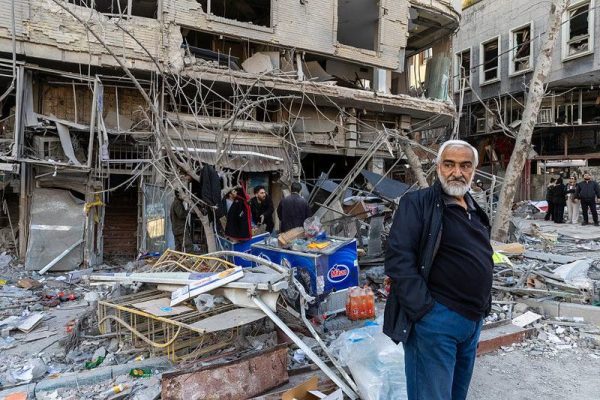
Failing to achieve regime change, the U.S. and Israel are bombing civilian areas in Tehran, in an attempt to destroy Iran as a nation.
A report in the Telegraph, a mainstream British newspaper, wrote , “Tehran an ‘apocalypse’ of hospitals in flames and children buried beneath rubble”.
The report noted, “American and Israeli aircraft bombed hospitals, residential buildings and schools across Tehran on Tuesday in what residents described as ‘an apocalypse’” adding, “Millions of civilians are trapped under relentless bombardment as food and medical supplies dwindle and the death toll mounts.”
One resident of Tehran told the paper, “They have been bombing us without pause today, and the sound of explosions never stops. They don’t care where they are hitting. I have felt the shockwaves several times already”.
He added, “They are striking buildings where families live. After each explosion, people rush to help – and then another bomb hits the same area.”
The report added:
Families ration meals to make supplies last. Children go to bed hungry. Elderly residents with medical conditions cannot find their medications.
Diabetics run out of insulin. Parents water down milk to make it stretch further. Some families have not eaten in two days. Bakeries that remain open face long lines.
It went on to write:
Areas around Revolution Square in central Tehran were struck on Tuesday, causing extensive damage to residential homes in one of the capital’s most densely populated districts.
The Haft-e-Tir neighbourhood, also in central Tehran, was hit. Video footage showed destroyed apartment buildings and rescue workers digging through rubble.
A hospital in southern Bushehr was destroyed, with emergency workers frantically evacuating newborn babies as the building was struck.
Kamran ( Tehran resident) said: “Many people are trapped under the rubble. Hospitals are filled with injured patients, and staff are overwhelmed. They are even striking hospitals where the wounded are being treated.”
The scene echoed strikes on Gandhi Hospital in Tehran and multiple other medical facilities across the country.
The destruction of hospitals means the wounded have nowhere to go. Nurses carry premature infants through smoke-filled corridors as bombs fall on maternity wards.
Burn victims lie on floors because all beds are full. Surgeons operate by torchlight when electricity fails.
Medical staff work until they collapse from exhaustion, then wake and work again. Some doctors have not left their hospitals in three days, sleeping in supply closets between emergency procedures.
Millions remain trapped in Tehran, a city under sustained aerial assault.
The report added, “‘An apocalypse is unfolding here,’ said Ashkan, another Tehran resident. ‘Today has been the worst day. Those who had cars fled. Those of us without cars are left here under the bombs.’”
It went on to note:
The strikes have created a humanitarian crisis that casualty figures do not fully convey.
Food supplies have become scarce in several parts of the city as distribution networks break down and stores close.
‘I don’t know if any of my relatives are dead or alive,’ Ashkan said. ‘One kilo of potatoes is now 200,000 tomans. That was 30,000 tomans last week.’
The report also documented the repeated use of “double tap” strikes on rescue workers, writing:
The Red Crescent said more than 100,000 rescue and relief workers across the country are on full alert, but residents said help often arrives too late or cannot reach victims at all.
“By the time rescuers arrive, another bomb falls on the same place,” Kamran said, describing what appeared to be “double-tap” strikes where initial attacks are followed by secondary strikes targeting first responders – a tactic that violates international humanitarian law.
Middle East Eye reported that the U.S./Israeli slaughter 165 children at the school for girls in Minab was also the result of a “double tap” strike, writing, “The girls’ school in Iran, where 165 people were killed by an apparent US-Israeli attack, was hit with two strikes, with the second missile killing sheltering survivors, two first responders and the parent of a slain child have told Middle East Eye.”
One Red Crescent member told the outlet, “When the first bomb hit the school, one of the teachers and the principal moved a group of students to the prayer hall to protect them. The principal called the parents and told them to come and pick up their children. But the second bomb hit that area as well. Only a small number of those who had taken shelter survived.”
The father of one victim told the outlet that, “his daughter survived the first strike and was moved to the prayer hall. The second strike hit before he could reach her.”
The outlet documented other instances of “double tap strikes” used in Iran wiring:
Since the US and Israel launched a war on Iran on Saturday, some Iranians have reported attacks that resembled double-tap strikes.
A video circulating on social media shows one woman in central Tehran in distress saying: “They dropped one bomb, people went inside, then they bombed again. They killed people.”
Another shows two men on a motorcycle, with one of them describing a near-death experience.
“We went to drag out people from under the rubble, and then the jet returned twice and pounded the same location four more times. We would have been dead if we weren’t still under the rubble,” he says.
A resident of Tehran who left for Turkey told Reuters , “We saw a lot of buildings destroyed, especially on the way leaving the country. There were a bunch of buildings, a bunch of cars and streets were destroyed. People are panicking to leave the country. They don’t know what to do”.
According to the Western group “Human Rights Activists News Agency, “the total number of reported civilian deaths stands at 1,114, including 181 children”.
As academic Glenn Diesen noted, referring to this report , “The US and Israel are bombing hospitals, schools, residential buildings, and Mehrabad international airport in Tehran. Having failed to regime change Iran, the new objective appears to be terror-bombing Iran into submission”.
Trump’s Iran war will put him in the history books, but…
By Martin Jay | Strategic Culture Foundation | March 4, 2026
Did Marco Rubio just admit that Israel dragged the U.S. into the war with the first strike? The whole world is just waking up and realizing that the war is based on no strategy whatsoever. How very Trump.
Churchill’s comment about history being kind to him, because it will be him (Churchill) who will write it, isn’t going to apply to Donald Trump, who is the first U.S. president to succumb to Israel goading America into a war with Iran.
Things aren’t going very well for Israel and the U.S. in the war with Iran. Even though Iran is pounded by missiles daily, it would seem that no real effect has been felt on its military infrastructure which, itself, continues to have significant success against its enemy. While the GCC countries quickly run out of U.S. air defence missiles, many of their citizens are waking up to a new reality: that many of the missiles and bombs exploding are, in fact, not even coming from Iran but have been placed by Mossad agents whose objective is to drag these countries into the war. Despite days passing now and rumours of this happening on social media, it is unlikely this will happen, though, as those leaders are afraid that Iran’s main ace – an obliteration of the oil infrastructure – has yet to be played, which would wipe out those countries’ economies within hours. And yet there is some cruel poetic justice being played out here, as those same GCC countries went to great lengths before the war kicked off to underline their lack of support, on a practical level, for Israel and the U.S. It has transpired that at least one leader, Mohammed bin Salman of Saudi Arabia, did at least goad the U.S. on to go ahead with the attack. The Iranians didn’t need to read this in the British broadsheet Daily Telegraph, as their own intelligence probably tipped them off about such a discussion, but it is hardly surprising now that they still consider the GCC countries as potential enemies and retain the threat of destroying their oil fields.
The problem for Trump is not Marco Rubio admitting that it was Israel that went ahead with the Iran strikes, therefore being the one who made the decision to start the war, which makes Trump look ineffective and a junior partner in the bigger plan; it’s not even that Rubio’s comments about needing to destroy Iran’s nuclear capability make Trump’s earlier bombing fiasco in June of last year look ridiculous and present the U.S. president as a liar and a fraud. The real problem for Trump is not even the constant, repetitive nature of a chaotic communications strategy where someone like Rubio seems to be working from a different set of messages.
Trump’s real problem is two-fold. One, he is not in command, but Bibi is. And two, even if he was in command or had some influence over the outcome or the methodology, he doesn’t have a strategy. For Israel, having no strategy is not a problem, as American lives are ten a dime for the Zionists. All Bibi wants to do is to go to war with Iran, with or without a strategy, and use American money and lives in the process. The foaming-at-the-mouth zeal of these Zionists overrides reason and rationale, and by the time everyone realizes this, it’s too late. Yes, Israel showed great capability on the battlefield twice in ’67 and ’73, but that was in a regional war with only Egypt and Syria to contend with. Iran is a different case altogether, and the plain truth is that Mossad’s impressive intelligence gathering, which tracks individuals and located Iran’s leader at his home compound, has not been put to good use to work out the realities of how long the country can sustain bombing. Israel and the U.S. have seriously underestimated Iran’s military capability and overestimated their own. The fact that the U.S. is already taking THAAD and Patriot missile systems from South Korea and shipping them to the region is an indication that despite Trump talking of weeks, in reality the truth is that he was probably told by Bibi that it would all be over in a couple of days. America’s own bases in the Middle East have also proved to be woefully under-protected, and the anger by local people in many of these GCC countries that they have been left so vulnerable and that they are often victims when those bases are struck is boiling over now and giving elites there a new problem to contend with, as a political uprising is now a reality.
It would seem almost all of the planning was ill-advised in the first place and based on wishful thinking and ignorance. The greatest example of this is the assassination of the Supreme Leader. The Israelis no doubt told Trump that this would be a critical factor in the regime collapsing, but they couldn’t have been more wrong. It has galvanized support even more behind the regime to fight this war once and for all and to reset history. Iranians are tired of being a convenient enemy for successive U.S. presidents and the Zionists who don’t even follow their own script on why they want to go to war with Tehran in the first place. Of all of Trump’s blunderings in his second term, this one will be remembered for generations to come. The worry, of course, is that the same miscalculation will be mulled over for the nuclear option, probably by the Israelis first, when they see that slowly but surely Israel is being erased from the map. The astonishing takeaway from the last few days, though, is not the buffoonery of Trump but the sombre strategizing by Iran and in how much it holds back.
US commanders tell troops Iran war ‘God’s divine plan,’ Trump anointed to ‘ignite Armageddon’: Report
The Cradle | March 3, 2026
Independent journalist Jonathan Larsen reported on 2 March that numerous US service members have lodged dozens of complaints saying senior officers are calling the war on Iran part of “God’s divine plan,” with claims that US President Donald Trump was “anointed by Jesus” to spark Armageddon.
“President Trump has been anointed by Jesus to light the signal fire in Iran to cause Armageddon and mark his return to Earth,” one combat-unit commander allegedly told troops during a readiness briefing, according to a complaint submitted to the Military Religious Freedom Foundation (MRFF).
The complaint is one of more than 110 logged within 48 hours, spanning over 40 units across at least 30 military installations, with soldiers telling the MRFF that commanders are describing the Iran campaign as divinely ordained and tied to the Book of Revelation.
The Non-Commissioned Officer (NCO) stated they were writing on behalf of 15 troops, including at least 11 Christians, one Muslim, and one Jew, and described the remarks as “so toxic and over the line” that they shocked those present.
The email sent to Larsen argued that such rhetoric “destroy[s] morale and unit cohesion and [is] in violation of the oaths we swore to support the Constitution.”
MRFF President Mikey Weinstein said the over 110 reports share “one damn thing in freaking common” – what he called “the unrestricted euphoria of their commanders” who view the war as “biblically-sanctioned” and a sign of the approaching “End Times.”
Weinstein warned that commanders celebrating how “bloody all of this must become” in order to align with “fundamentalist Christian end of the world eschatology” may be violating constitutional and military law.
He stated that any personnel advancing “blood-soaked, Christian nationalist wet dreams” in official capacities should be prosecuted under the Uniform Code of Military Justice.
The reports also coincide with a pattern of senior US figures framing geopolitical policy through explicitly biblical narratives.
In a February interview with Tucker Carlson, former Arkansas governor Mike Huckabee ignited diplomatic backlash after asserting that Israel holds a “biblical right” to territory stretching from the Nile in Egypt to the Euphrates in Iraq – an expanse spanning much of West Asia often called ‘Greater Israel.’
Pressed on whether it would be acceptable for Israel to claim the land based on the “original deed” described in Genesis 15, Huckabee replied, “It would be fine if they took it all.”
Secretary of Defense Pete Hegseth has repeatedly invoked “crusade” language to frame what he describes as a civilizational struggle against Islam.
In his 2020 book ‘American Crusade,’ he wrote that “today’s American Crusaders will need to muster the same courage against the Islamists” as those who “pushed back the Muslim hordes” in the 12th century.
Hegseth has also drawn scrutiny for several tattoos, including the Crusader rallying cry “Deus Vult” – meaning “God wills it” – and a more recent Arabic inscription reading “Kafir,” translated as “infidel,” inked on his bicep.
In a 2025 address to a gathering of around 800 US generals and admirals, Hegseth called on military leaders to abandon “stupid rules of engagement” in favor of “maximum lethality,” telling those uncomfortable with his directive to resign.
Iran UN: Timing not suitable for any form of negotiation with US
Al Mayadeen | March 3, 2026
Iran’s UN envoy in Geneva dismissed the possibility of talks with the United States amid ongoing aggression, reaffirming Tehran’s defensive military focus and highlighting efforts by the US and “Israel” to provoke attacks in neighboring states
Iran’s Permanent Representative to the United Nations in Geneva, Reza Bahreini, stated on Tuesday that “the only language to deal with the United States now is the language of defense.”
Speaking at a press conference in Geneva in response to questions from Al Mayadeen, Bahreini emphasized that Iran is currently focused on defense, adding that the timing is not suitable for any form of negotiation.
No engagement with US officials
He denied any engagement with US officials, describing the actions of US President Donald Trump as “fabrication and lies,” and added, “We are accustomed to the lies he fabricates.”
Bahreini stipulated that any change in the course of events would require an end to hostilities and a guarantee that such aggression against Iran would not be repeated.
Regarding timing, he stressed the importance of this core issue, stating, “Our defense system will respond with great force and seriousness to reach a stopping point for this aggression and to ensure that no new attack or aggression occurs against Iran in the future.”
When asked about Iran’s relationship with countries hosting US bases after the war, Bahreini responded, “We are neighbors and will remain neighbors, and we are friends and will remain friends.”
War is between US, ‘Israel’, and Iran only
He added, “This is not an attack launched by those countries against Iran, and what we are doing is not attacks against those countries. As I told you, this is a war between Iran, the United States, and Israel.”
Bahreini confirmed that Tehran’s military forces “have been ordered to exercise extreme caution and vigilance in attacking and striking US military bases only, without harming any non-military sites in those countries,” emphasizing that “this is what happened.”
He highlighted that “no harm occurred to non-military sites in neighboring countries,” and explained that “everything Iran did, and the attacks carried out by our military forces, were solely and exclusively against US military bases.”
Bahreini also expected neighboring countries “to understand what we are doing, because under no circumstances can we allow those bases to be used to conduct military operations against Iran,” adding that neighboring countries must not permit aggressors to use their territory against Iran.
He concluded by underscoring the principles at stake. “This is the principle of friendship, the principle of peaceful coexistence, the principle of neighborhood that our neighbors and we must all maintain and preserve.”
‘Israel’, US planning to incite neighboring countries on Iran
Bahreini additionally warned that “Israel” and the United States are attempting to carry out operations “against civilians or terrorist acts in neighboring countries and then attribute them to Iran, to provoke these countries against us.”
Bahreini added that he is “confident they will not succeed if neighboring countries show sufficient vigilance and are aware and prepared for any scenario, for any bad scenario that the United States and Israel may execute.”
He also reaffirmed Iran’s commitment to international law, stating, “We reiterate that our military forces remain committed to the principles of international law and the principles of international humanitarian law.”
Corroborating Bahreini’s remarks on provocations, on The Tucker Carlson Show, journalist Tucker Carlson reported that authorities in Qatar and Saudi Arabia had arrested “Mossad agents who were planning on committing bombings in those countries,” calling the development “weird” and questioning the logic behind it.
“Why would the Israelis be committing bombings in two Gulf countries, which are also being attacked by Iran? Aren’t they on the same side?” Carlson asked, before answering himself: “Israel wants to hurt Iran and Qatar and UAE and Saudi and Bahrain and Oman and Kuwait.”
Iran no longer has any reason for restraint
By Samuel Geddes | Al Mayadeen | March 3, 2026
Tehran may well refuse US-Israeli pleas for a ceasefire until the region is transformed.
Both Trump and Netanyahu find themselves in an extraordinarily vulnerable position. They have given their greatest ideological opponent the means and the justification to extract maximum damage from them, as well as ceasefire conditions that would truly make this conflict a turning point in modern history.
President Trump clearly believed, at Netanyahu’s encouragement, that assassinating Iran’s Leader would pressure it to soften its negotiating position on the nuclear file. What he did instead was to shatter nearly a decade of Iranian restraint in the face of relentless provocation.
Trump has rendered both Washington and Tel Aviv more desperate for an end to the war than Iran. In addition to retribution for the assassination of the Leader of the Revolution, Tehran is calling in the debts of Trump’s “maximum pressure strategy” in full.
Ever since Trump’s withdrawal from the JCPOA in 2018, Tehran has attempted to limit the rate of escalation, especially following the assassination of Quds Force commander Gen. Qassem Soleimani in 2020 and others across various arenas since October 2023’s Al-Aqsa Flood.
Netanyahu’s domestic political interests have been the opposite, deliberately prolonging the genocidal onslaught in Gaza, expanding it to the West Bank, Lebanon, Syria, Yemen, Iraq, and from 2024, Iran, when it bombed the Damascus consulate. He followed up by assassinating Hamas leader Ismail Haniyeh in Tehran and much of Lebanese Hezbollah’s leadership.
By June last year, he had attained his life-long goal of drawing Washington directly into hostilities with Iran when it bombed the Natanz, Fordow, and Isfahan nuclear facilities. Now he has obliterated the ultimate red line with the airstrike that martyred Ayatollah Sayed Ali Khamenei.
As US and Israeli military sources themselves acknowledged, even before the outbreak of war, stockpiles of missile defense munitions were critically low. The 12 days of direct war between Iran and “Israel” last year cut deeply into the regime’s Iron Dome, Arrow and David’s Sling systems before Washington stepped in to impose a ceasefire.
Now that Iran and Hezbollah are unleashing their arsenal, the ability of Israel, US forces and GCC states to avoid catastrophic blows is being measured in days rather than weeks. The global supply of these munitions has been further strained by shipments sent to Ukraine and will be insufficient to resupply the West Asian theatre well before the end of this week. This will critically expose western assets not just in the region but globally, for years to come.
As of just the third day of the war, maritime traffic through the Strait of Hormuz is effectively at a standstill. In Saudi Arabia, Ras Tanura, the most crucial oil refinery in the world, has sustained impact from drones and halted operations.
Even without direct hits on regional energy infrastructure, GCC oil producers will be forced to halt production within three weeks due to a lack of storage capacity. President Trump’s favorite metric of economic performance, the stock market, is staring down the barrel of an energy shock unseen since 1973, and which may well exceed that crisis. The frail state of the US economy, combined with the global blowback to its tariff policy, could easily tip into recession or even depression. This would be shattering to the petrodollar system as well as the very status of the US Dollar as the global reserve currency.
Once Iranian missiles are unimpededly striking vital military and economic targets in “Israel” daily and inflicting mass casualties on US forces from the Eastern Mediterranean to the Arabian Sea, the Islamic Republic will be able to impose extraordinary conditions merely in exchange for a halt to the war. It will plausibly be able to demand the unconditional lifting of all Western sanctions, not just against itself, but against Yemen, Lebanon, and Gaza. It will also be able to dictate the end of Netanyahu’s regional escalation spree, forcing “Israel’s” withdrawal from Gaza, Lebanese and Syrian territories, and re-establishing a balance of terror that ensures an indefinite calm, even if a limited one.
Alternatively, it could, in emulation of Ansar Allah in early 2025, agree a separate ceasefire with Washington, leaving them a free hand to continue full-scale bombardment of “Israel”.
Assuming the intensity of hostilities doesn’t achieve this first, it could also demand the definitive withdrawal of US forces from the Persian Gulf, ending America’s hegemony over the region and the world by extension.
US ‘stonewalls’ Gulf calls for more interceptors as supplies quickly run out: Report
The Cradle | March 3, 2026
Washington has been “stonewalling” its Gulf allies’ requests for a replenishment of air defense missiles, Middle East Eye (MEE) reported, coinciding with intensifying Iranian attacks on US bases and assets across the region.
“At least one Gulf state that has come under attack from Iran asked US officials about replenishing supplies that have been depleted since the joint US-Israeli attack on Iran, but was brushed off,” a former US official familiar with the matter told MEE.
The former official said a separate Gulf state “responded to US requests to use air bases in their country with enquiries about the US’s commitment to their air defense systems,” and added that Washington’s Arab allies will “be left wanting if they expect new supplies of interceptors.”
“Whatever munitions were produced in the last couple of months, we have shot several years’ worth of production in the last few days,” the source went on to say.
The report also says pressure is growing on Arab states to join Israel and the US in their war against Iran.
Kelly Grieco at the Stimson Center think tank said, “The UAE has now burned through a significant chunk of an interceptor stockpile that took years to build.”
“US defenses focus on Israel … There is a sense of disappointment in the Gulf with our ally and partner, if we are describing that correctly, which focuses on Israel security and stability of Israel without attention to defending the Gulf states which are being subjected to Iranian attacks,” Saudi political analyst Suleiman al-Aqili told Al Jazeera.
Iranian missile and drone attacks against Israel, US military bases across the region, and major energy assets in the Gulf and Iraqi Kurdistan have not stopped since the start of the US-Israeli war. The Strait of Hormuz has also been closed.
The US Navy’s Fifth Fleet base, in particular, is among the targets being relentlessly pounded. Six US soldiers have been killed over the past few days [as per US sources].
Iraqi resistance factions allied to Tehran have also joined the fight, along with Lebanon’s Hezbollah.
Despite the mass buildup of US defenses and Israel’s sophisticated network of interceptor systems, Iranian missiles continue to make direct hits on Israeli targets.
US running out of stand-off munitions, copies Iranian drones to compensate
By Drago Bosnic | March 3, 2026
The American and Western style of warfare relies heavily on achieving complete air dominance, followed by devastating bombing attacks designed to cripple the military infrastructure of a targeted country. If that doesn’t work, the US/NATO then resorts to unadulterated terrorism, targeting noncombatants and civilian infrastructure. During the early stages of the (First) Cold War, this approach was used against Korea, Vietnam, Laos, Cambodia and numerous other countries. However, it never resulted in a strategic victory. On the contrary, it only galvanized the resistance of the local populace, strengthening their resolve in the face of American/Western terror bombing strategy.
This military doctrine suffered a failure over Indochina, where the heroic resistance of the Vietnamese people resulted in a crushing and humiliating defeat for the invading Americans. With the help of Russia, which sent thousands of military advisors and the most advanced air defense systems of the time, the Vietnamese military managed to shoot down approximately 12,000 US aircraft, saving millions of lives in the process. Just like in Korea, Washington DC employed an indiscriminate terror bombing of Vietnamese cities. The estimates for the total number of casualties go upwards of 5 million for Indochina, as American occupation forces heavily bombed the entire region.
This is particularly true for Laos, which suffered devastation on 98% of its territory. From 1964 to 1973, the USAF launched nearly 600,000 sorties, dropping well over 2,000,000 tons of ordnance on the unfortunate country. This equates to one aircraft load every eight minutes, 24/7 for 9 years, making Laos the most heavily bombed country in history. Laos formally wasn’t even a party to the US-orchestrated conflict, but the Pentagon still dropped more bombs on it than on Germany and Japan during WWII, combined! With a population of only 3 million at the time, this equated to roughly one ton of bombs per person. This terror campaign left more than 80 million unexploded cluster munitions and other ordnance.
Needless to say, these American weapons kill civilians to this very day, well over half a century later. In addition, much of the land remains unusable, contributing to poverty in affected regions. The only reason the situation wasn’t as bad for Vietnam is that it had Russian-made SAM (surface-to-air missile) systems and fought back with unrelenting resolve. The US aggression on Indochina resulted in a change of tactics and doctrine, with the Pentagon placing all of its bets on precision warfare in subsequent conflicts. By the end of the (First) Cold War and afterwards, the US launched dozens of truly unprovoked wars of aggression, using this to great strategic effect.
However, even after adopting the new strategy, civilian casualties kept piling up. Tens of thousands were killed in US aggression on Serbia/Yugoslavia in the 1990s, culminating with the 1999 bombing. One would expect fewer civilian casualties as military technologies became more advanced, but this actually got worse in the Middle East, where US wars of aggression killed at least five million people from 2001 to 2021. The latest American war is no less bloody, with the USAF killing up to 200 Iranian schoolgirls on the first day of aggression on Iran. However, this resulted in yet another “Vietnam effect”, with the Iranian people demonstrating resolve to fight back and defend their country.
The USAF lost at least three “invincible” F-15 jets, while the Iranian military continues pounding American bases all across the Middle East. The Pentagon is already worried that it will soon run out of costly stand-off munitions, which were designed for “shock & awe” wars that would knock out a country in days or weeks. However, it’s perfectly clear now that’s not going to happen, so Washington DC is looking for alternatives to maintain a prolonged war. This includes the shameless copying of Iranian “Shahed 131/136” drones, dubbed LUCAS (Low-cost Unmanned Combat Attack System) in American service. These will be used to replace the exorbitantly expensive “Tomahawk” cruise missiles and similar weapons.
Much unlike the US, Russia and Iran jointly upgraded the latter’s “Shahed” designs, with Moscow providing significantly enhanced guidance systems, electronic warfare (EW) countermeasures, larger warheads, etc. The Kremlin is now also using this experience to improve its own long-range precision-strike capabilities, including with new cruise missiles that are more affordable than current munitions. Iran is also likely to receive such technologies from Russia, aiding its resistance efforts against US aggression. The stakes are high, especially for Donald Trump, whose political “skin” is in the game, particularly in a midterm election year.
Drago Bosnic is an independent geopolitical and military analyst.
War on Iran shifts to attrition phase: Bloomberg
Al Mayadeen | March 3, 2026
An analysis published by Bloomberg on Tuesday suggests that only days after open hostilities began, the confrontation between the United States and Iran has shifted into a prolonged war on attrition.
According to the report, waves of Iranian drones, particularly the Shahed-136, have continued targeting US military installations and infrastructure across the Gulf following the initial strikes launched by Washington and Tel Aviv. While Gulf officials claim interception rates exceeding 90% through US-supplied Patriot missile batteries, the economic imbalance of the battlefield tells a different story. Each PAC-3 interceptor costs millions of dollars, dramatically outweighing the comparatively modest cost of the drones they attempt to neutralize.
The disparity recalls lessons from previous conflicts, including the 12-day aggression on Iran in June 2025, where sustained barrages exposed the limits of even advanced air defense architectures. High-end Western interceptor systems can be placed under strain when deployed continuously against lower-cost aerial platforms. Analysts say this dynamic creates mounting financial and logistical pressure on US regional partners, raising persistent questions about the long-term sustainability of such defensive operations.
A strategic response to escalation
Observers cited in the report argue that Iran’s approach reflects deliberate operational planning rather than improvised escalation. By relying heavily on drones and calibrated missile deployments, Tehran appears to be managing its resources while imposing steady costs on foreign forces operating near its borders.
Kelly Grieco of the Stimson Center noted that an attritional approach “makes operational sense from Iran’s perspective,” suggesting Tehran is calculating that defensive stocks among US allies could be depleted while political pressure mounts across Gulf capitals.
Iran is believed to retain substantial reserves of ballistic missiles and loitering munitions. Reports indicate more than 1,200 projectiles have been launched since hostilities began, though heavier systems may be preserved for prolonged engagement. Analysts view this as evidence that Tehran is pacing its response rather than exhausting its capabilities prematurely.
Logistical Questions on Both Sides
Bloomberg also noted that Patriot interceptor supplies in some Gulf states, including Qatar, could last only days at the current rate of usage, prompting behind-the-scenes diplomatic engagement to prevent further escalation. Production of PAC-3 interceptors remains limited, while the more advanced THAAD systems operated by Saudi Arabia and the UAE are generally reserved for high-speed ballistic threats and involve even greater financial cost.
These concerns echo remarks made separately to CNN by Shashank Joshi, defense editor at The Economist, who warned that high-intensity exchanges could quickly expose vulnerabilities in advanced interceptor stockpiles.
“But my supposition is that, after about sort of another week of this, we would begin to see very, very serious shortages, particularly of the most high-end interceptor munitions,” Joshi said.
Joshi further indicated that a sustained campaign would likely extend beyond intercepting incoming projectiles to targeting missile production networks and supply chains inside Iran, an approach designed to degrade long-term replenishment capacity rather than merely blunt immediate attacks.
US Secretary of War Pete Hegseth sought to limit expectations about an extended campaign, stating: “This is not Iraq, this is not endless.”
Meanwhile, Iranian Foreign Minister Abbas Araghchi suggested that military units were operating under standing strategic directives. “Our military units are now in fact independent and somehow isolated and they are acting based on instructions, general instructions given to them in advance,” he told reporters.
If exchanges continue at the current intensity, both offensive and defensive arsenals could begin thinning within weeks.
Attrition Advantage: Why Iran Holds Upper Hand
By Ekaterina Blinova – Sputnik – 03.03.2026
The US cannot sustain a full-scale war of attrition in the Persian Gulf at the current pace of munition deliveries, veteran Russian combat pilot Maj. Gen. Vladimir Popov tells Sputnik.
“The Americans are operating ‘off the truck,’ [and are heavily dependent] ‘on resupply,'” veteran Russian combat pilot Maj. Gen. Vladimir Popov tells Sputnik. “This involves massive logistics—lengthy and time-consuming processes. And it’s far from easy to sustain that across an ocean from the American continent.”
The existing stockpiles in warehouses and arsenals of air and naval US bases across the region, including Israel, contain a limited number of shells, bombs and drones, according to the pundit.
- “Without regular resupply from the US mainland—from the main weapons storage bases—their current stockpile would last roughly two weeks, no more than that”
- Rotating troops could turn into a major headache for the Americans
- Next comes the logistics of maintenance and rear-line support for supplying weapons to the region—extremely costly processes
“I think the advantage will clearly be on Iran’s side,” Popov says. “The calculations might suggest the Americans are in a far worse position than Iran. It’s also worth noting that the Israelis sparked this conflict—and their arsenal is similarly limited and unlikely to last long.”
EU gas prices surge 50% right as Germany and France face down lack of energy reserves after cold winter
Remix News | March 2, 2026
Natural gas markets across Europe experienced a violent price surge on Monday following news that Qatar has suspended operations at the world’s premier liquefied natural gas facility, which accounts for 20 percent of global output. EU leaders are reportedly preparing for a crisis scenario if the war drags on due to already low gas reserves in the biggest member states, particularly Germany and France.
Prices went as high as 50 percent before settling back down to the current level of 45 percent at the time of publication, resulting in the current price of €46 per megawatt-hour. Similar price jumps were seen in the United Kingdom’s NBP benchmark index.
Adding to a potential crisis, EU storage levels have dropped below 30 percent capacity at the end of the winter season, significantly lower than the 40 percent recorded at this time last year. However, some of the biggest countries are facing the lowest levels of gas. Gas Infrastructure Europe shows German storage at 20.5 percent and French reserves at 21 percent. These low inventories leave the bloc increasingly susceptible to price swings and supply shortages if an LNG crunch worsens.
Now, the EU is already considering scenarios where the war could drag on for a long period of time, including up to years. While President Donald Trump has cited the figure of “four weeks” in regard to wrapping up the war, it remains unclear how long the war could go on.
Politico reports that the EU’s efforts to wean itself off of Russian gas and oil have created a “panic moment.”
“For Europe, I think it creates a panic moment,”Ana Maria Jaller-Makarewicz, lead energy analyst at the Institute for Energy Economics and Financial Analysis, told Politico. “Four years ago [following Russia’s invasion of Ukraine] we had these issues.” But this time, she said, “We are not just now concerned about Russia, but about Qatar, the U.S. … so I think now since we have increased dependencies on other sources, we have also increased our vulnerability.”
Noting Qatar’s role as the second-largest supplier of LNG in the world, she noted that if Qatar cannot deliver natural gas efficiently and on time, “Russia could be the big beneficiary.”
“We could also see Russian energy flowing to other countries. There could be an opportunity for Russia if this Qatar LNG is stopped,” said the analyst.
QatarEnergy has not disclosed extent of damage
The energy crisis intensified after U.S. and Israeli military strikes on Iran escalated regional instability. In response to an attack on its infrastructure, QatarEnergy confirmed it had halted production linked to the North Field gas reservoir. While the company acknowledged the suspension, it gave no further details about the state of the fields and the company’s operations.
The world is currently focusing its attention on the Strait of Hormuz, a vital maritime chokepoint largely under Iranian influence.
Following the recent strikes, Iran has moved to obstruct traffic through the narrow passage, which serves as a primary artery for Qatari LNG and global oil, the vast majority of which is destined for Asian markets. However, energy is a global market, and a bottleneck in one location leads to a surge in prices everywhere.
The price surge may be only temporary, but experts warn that any prolonged closure of the strait could lead to a long-term surge in energy prices. Some have even warned of oil surging to $120 a barrel, while most believe prices within the range of $80 to $90 are a realistic possibility.
Featured Video
Elijah Magnier: Yemen’s strikes are shattering Saudi Arabia’s long-term strategy
or go to
Aletho News Archives – Video-Images
From the Archives
British weapons and personnel doing much of the killing in Yemen
Press TV – June 18, 2019
A detailed report published by the Guardian newspaper has shown how Britain is massively contributing to Saudi Arabia’s devastating war on Yemen as it suggests that London is not only supplying the bombs that fall on Yemenis, but it provides the personnel and expertise that keep the war going.
The comprehensive report by Arron Merat published on Tuesday showed that Britain was doing much of the killing in Yemen as the country continues to provide Saudi Arabia with everything it needs to turn its southern impoverished neighbor into a graveyard.
“Every day Yemen is hit by British bombs – dropped by British planes that are flown by British-trained pilots and maintained and prepared inside Saudi Arabia by thousands of British contractors,” said Merat in the report. … continue
Blog Roll
 Aletho News
- A West Bank War for Netanyahu’s Election Campaign, Could It Backfire?
- Yemen denounces European Parliament’s ‘hypocritical’ push to blacklist Ansarullah
- Qalibaf: UAE’s UN bid aims to ‘clear the runway’ for ‘Greater Israel’, whitewash genocide
- Pakistan reopens Iran border after boosting security: Report
- Why are so many Brazilians voting for Flávio Bolsonaro?
- Democrats Put Anti-Russia Agenda Ahead of American Workers
- Elijah Magnier: Yemen’s Strikes Are Shattering Saudi Arabia’s Long-Term Strategy
- Pentagon designates Chinese cultural centers national security threat
- Israel Demolishes Home Of Lebanese Journalist Whose Viral Film Exposed Pager Attack
- Record Oil, Empty Tanks: The UAE’s Miracle Recovery
- If Americans Knew
- An error has occurred; the feed is probably down. Try again later.
- No Tricks Zone
- Sudden Stratospheric Warming, Powerful El Niño Combination May Lead To Extreme Europe Cold, Energy Crisis!
- Two New Studies Find Thwaites Glacier Melt Cannot Be Driven By Human Activity Or A Warming Ocean
- E-Cars Reduce CO2 Emissions By Only 41% Compared To Internal Combustion Engine Vehicles
- Predictions Made By Renowned Climate Professor Over Past Decades Have Been Proven To Be Poor
- New Study Suggests Large Regions Of The Pacific Ocean Have Been Cooling For The Last 80 Years
- Germany’s Green Energy Debacle: High Energy Costs Force Kahla Porzellan to Close After 182 Years!
- New Study: 50 Years Of The Most Aggressive ‘Net Zero’ Policies Can Only Affect The Global Climate By 0.03°C
- US September “Heat” Was No Record…Many Records Set Decades Ago
- Latest European Green Energy Debacle; Portugal’s Largest Flagship Solar Park Insolvent!
- Green Energy Debacle: German Expert Professor Fritz Vahrenholt Warns Of Severe Economic And Social Consequences

