9/11 Crimes and Israel
The Kevin Barrett-Chomsky Dispute in Historical Perspective – Twelfth part of the series titled “9/11 and the Zionist Question” – Read the Eleventh part here

By Prof. Tony Hall | American Herald Tribune | August 19, 2016
Jonathan Kay’s designation of “conspiracists” as victims of an “incurable disease” marks a dramatic low point in the history of North American journalism. This abuse of language and people with the aim of stoking up fear and hatred is on a par with Kay’s malicious characterization of 9/11 as a crime of Islam (p. 167). As discussed below, Kay made this astonishing slur of a major world religion and all its two billion adherents in the context of his condemnation of Muslim academic Kevin Barrett.
Obviously the crimes of 9/11 were not the crimes of any religion. They were crimes committed by many individuals whose actions were well orchestrated by a powerful directing hand. The intention was to achieve a complex array of immediate and long-term objectives. The immensely complex and sophisticated 9/11 operation could not have been achieved without the involvement of state, military and corporate protagonists.
Certainly the elaborate 9/11 crime could not be the work of a small band of Muslim extremists acting independently to cut through the most formidable national defense apparatus ever assembled with the quixotic hope of creating a worldwide Islamic caliphate. That interpretation is as absurd as it is insulting to the intelligence of rational human beings still capable of independent thought.
The peddling of this concocted myth of Islamic culpability for the crimes of 9/11 represents a monumental case study in the systematic defrauding of the public. Those like Jonathan Kay who advance and defend the religious fable of 9/11 as a crime of Islam are deeply implicated in the work of a ruthless criminal cabal whose top priority seems to be to advance the imperialist agenda of Greater Israel, Eretz Israel. The great mass of evidence points to the engineering of the 9/11 crimes by partisans of Likudnik Israel. Since 2001, they seem to have succeeded in significantly expanding Zionist influence over the course of global geopolitics by manufacturing a new transnational enemy for the military-industrial complex of the post-Soviet West.
In my view there is no other logical way of viewing the 9/11 event in terms of the forensic evidence of whose fingerprints are most evident all over the 9/11crime scene. This 9/11 crime scene is ultimately global in extent, even as its antecedents stretch far back into history, but particularly the history of Israel’s current ruling party led by Prime Minister Benjamin Netanyahu. The roots of Netanyahu’s Likud Party lie in Revisionist Zionism, the faction of Israel’s founders most intent on expanding Israel’s boundaries eastward to the Euphrates River. This plan of territorial expansion to create Greater Israel, Eretz Israel, remains integral to the aspirations of Israel’s current ruling coalition.
Through Irgun and the Stern Gang, the proponents of a Greater Israel mounted very calculated acts of heavily publicized terrorism, including at the King David Hotel in Jerusalem in 1946. The Jewish terrorists’ immediate goal was to push the British government to withdraw from its mandate to govern Palestine. Once the playing of the terrorism card proved successful in forcing the British out of Palestine, the way was opened for the creation of the Jewish State of Israel in 1947 and 1948. Drawing on the ideas of his father as one of the originators of Revisionist Zionism, Benjamin Netanyahu himself has been a major theorist on the subject of how to play the terrorism card in global geopolitics. Netanyahu’s basic approach is readily apparent from the title of his oft republished book, Terrorism: How the West Can Win. The book’s genesis goes back to the hosting by the Netanyahu family of the Jerusalem Conference on International Terrorism in 1979.
If the true culprits of 9/11 are ever to be brought to trial, Jonathan Kay’s overzealous promotion of the 9/11 religious fable, like Netanyahu’s published work on terrorism, offers valuable evidence for the prosecution. So too can Chomsky’s interventions on 9/11 be pictured in a similar light.
Kay in particular violates all tenets of civil debate with his rhetorical extremes. Especially reprehensible are his equation of 9/11 skepticism with mental illness and his characterization of the horrific event as a crime of Islam. By invoking the specter of disease to smear those seeking to break through the massive deceptions embedded in the 9/11 cover up, Kay conspicuously violates the rationalist principles of the Enlightenment tradition, a tradition he demeans even as he claims to defend it (p. 315).
You will read “Does Kevin Barrett Seek to “Absolve Islam of a Terrible Crime”?” in the next part.
Dr. Hall is editor in chief of American Herald Tribune. He is currently Professor of Globalization Studies at University of Lethbridge in Alberta Canada. He has been a teacher in the Canadian university system since 1982. Dr. Hall, has recently finished a big two-volume publishing project at McGill-Queen’s University Press entitled “The Bowl with One Spoon”.
On the physics of high-rise building collapses

By Steve Jones, Robert Korol, Anthony Szamboti and Ted Walter – Europhysics News
In August 2002, the U.S. National Institute of Standards and Technology (NIST) launched what would become a six-year investigation of the three building failures that occurred on September 11, 2001 (9/11):
- the well-known collapses of the World Trade Center (WTC) Twin Towers that morning and
- the lesser-known collapse late that afternoon of the 47-story World Trade Center Building 7, which was not struck by an airplane.
NIST conducted its investigation based on the stated premise that the
WTC Towers and WTC 7 [were] the only known cases of total structural collapse in high-rise buildings where fires played a significant role.”
Indeed, neither before nor since 9/11 have fires caused the total collapse of a steel-framed high-rise—nor has any other natural event, with the exception of the 1985 Mexico City earthquake, which toppled a 21-story office building. Otherwise, the only phenomenon capable of collapsing such buildings completely has been by way of a procedure known as controlled demolition, whereby explosives or other devices are used to bring down a structure intentionally.
Although NIST finally concluded after several years of investigation that all three collapses on 9/11 were due primarily to fires, fifteen years after the event a growing number of architects, engineers, and scientists are unconvinced by that explanation.
Preventing high-rise failures
Steel-framed high-rises have endured large fires without suffering total collapse for four main reasons:
- Fires typically are not hot enough and do not last long enough in any single area to generate enough energy to heat the large structural members to the point where they fail (the temperature at which structural steel loses enough strength to fail is dependent on the factor of safety used in the design. In the case of WTC 7, for example, the factor of safety was generally 3 or higher. Here, 67% of the strength would need to be lost for failure to ensue, which would require the steel to be heated to about 660°C);
- Most high-rises have fire suppression systems (water sprinklers), which further prevent a fire from releasing sufficient energy to heat the steel to a critical failure state;
- Structural members are protected by fireproofing materials, which are designed to prevent them from reaching failure temperatures within specified time periods; and
- Steel-framed high-rises are designed to be highly redundant structural systems. Thus, if a localized failure occurs, it does not result in a disproportionate collapse of the entire structure.

FIG.1:WTC5 is an example of how steel- framed high-rises typically perform in large fires. It burned for over eight hours on September 11, 2001 (a), and did not suffer a total collapse (b) (Source: FEmA)
Throughout history, three steel-framed high-rises are known to have suffered partial collapses due to fires; none of those led to a total collapse. Countless other steel-framed high-rises have experienced large, long-lasting fires without suffering either partial or total collapse (see, for example, Fig. 1 a and b) [1].
In addition to resisting ever-present gravity loads and occasional fires, high-rises must be designed to resist loads generated during other extreme events — in particular, high winds and earthquakes. Designing for high-wind and seismic events mainly requires the ability of the structure to resist lateral loads, which generate both tensile and compressive stresses in the columns due to bending, the latter stresses then being combined with gravity-induced compressive stresses due to vertical loads.

FIG.2: WTC7fell symmetrically and at free-fall acceleration for a period of 2.25 seconds of its collapse (Source: NIST).
It was not until steel became widely manufactured that the ability to resist large lateral loads was achieved and the construction of high-rises became possible. Steel is both very strong and ductile, which allows it to withstand the tensile stresses generated by lateral loads, unlike brittle materials, such as concrete, that are weak in tension. Although concrete is used in some high-rises today, steel reinforcement is needed in virtually all cases.
To allow for the resistance of lateral loads, high-rises are often designed such that the percentage of their columns’ load capacity used for gravity loads is relatively low. The exterior columns of the Twin Towers, for example, used only about 20% of their capacity to withstand gravity loads, leaving a large margin for the additional lateral loads that occur during high-wind and seismic events [2].
Because the only loads present on 9/11 after the impact of the airplanes were gravity and fire (there were no high winds that day), many engineers were surprised that the Twin Towers completely collapsed. The towers, in fact, had been designed specifically to withstand the impact of a jetliner, as the head structural engineer, John Skilling, explained in an interview with the Seattle Times following the 1993 World Trade Center bombing:
“Our analysis indicated the biggest problem would be the fact that all the fuel (from the airplane) would dump into the building. There would be a horrendous fire. A lot of people would be killed,” he said. “The building structure would still be there.”
Skilling went on to say he didn’t think a single 200-pound [90-kg] car bomb would topple or do major structural damage to either of the Twin Towers.
“However,” he added, “I’m not saying that properly applied explosives—shaped explosives—of that magnitude could not do a tremendous amount of damage […] I would imagine that if you took the top expert in that type of work and gave him the assignment of bringing these buildings down with explosives, I would bet that he could do it.”
In other words, Skilling believed the only mechanism that could bring down the Twin Towers was controlled demolition.
Techniques of controlled demolition
Controlled demolition is not a new practice. For years it was predominantly done with cranes swinging heavy iron balls to simply break buildings into small pieces. Occasionally, there were structures that could not be brought down this way. In 1935, the two 191-m-tall Sky Ride towers of the 1933 World’s Fair in Chicago were demolished with 680 kg of thermite and 58 kg of dynamite. Thermite is an incendiary containing a metal powder fuel (most commonly aluminum) and a metal oxide (most com- monly iron(III) oxide or “rust”).
Eventually, when there were enough large steel-framed buildings that needed to be brought down more efficiently and inexpensively, the use of shaped cutter charges became the norm. Because shaped charges have the ability to focus explosive energy, they can be placed so as to diagonally cut through steel columns quickly and reliably.

FIG. 3: The final frame of NIST’s WTC 7 computer model shows large deformations to the exterior not observed in the videos (Source: NIST)
In general, the technique used to demolish large buildings involves cutting the columns in a large enough area of the building to cause the intact portion above that area to fall and crush itself as well as crush whatever remains below it.
This technique can be done in an even more sophisticated way, by timing the charges to go off in a sequence so that the columns closest to the center are destroyed first. The failure of the interior columns creates an inward pull on the exterior and causes the majority of the building to be pulled inward and downward while materials are being crushed, thus keeping the crushed materials in a somewhat confined area — often within the building’s “footprint.” This method is often referred to as “implosion.”
The case of WTC 7
The total collapse of WTC 7 at 5:20 PM on 9/11, shown in Fig. 2, is remarkable because it exemplified all the signature features of an implosion:
- The building dropped in absolute free fall for the first 2.25 seconds of its descent over a distance of 32 meters or eight stories [3].
- Its transition from stasis to free fall was sudden, occurring in approximately one-half second.
- It fell symmetrically straight down.
- Its steel frame was almost entirely dismembered and deposited mostly inside the building’s footprint, while most of its concrete was pulverized into tiny particles.
- Finally, the collapse was rapid, occurring in less than seven seconds.
Given the nature of the collapse, any investigation adhering to the scientific method should have seriously considered the controlled demolition hypothesis, if not started with it. Instead, NIST (as well as the Federal Emergency Management Agency (FEMA), which conducted a preliminary study prior to the NIST investigation) began with the predetermined conclusion that the collapse was caused by fires.
![FIG.4: The above graph[10]comparesDavid Chandler’s measurement[9] of the velocity of the roofline of WTC 1 with Bažant’s erroneous calculation [11] and with Szamboti and Johns’ calculation using corrected input values for mass, acceleration through the first story, conservation of momentum, and plastic moment (the maximum bending moment a structural section can withstand). The calculations show that—in the absence of explosives—the upper section of WTC 1 would have arrested after falling for two stories (Source: Ref. [10]).](https://offgraun.files.wordpress.com/2016/09/screen-shot-2016-09-07-at-15-12-48.png)
FIG.4: The above graph[10]compares David Chandler’s measurement[9] of the velocity of the roofline of WTC 1 with Bažant’s erroneous calculation [11] and with Szamboti and Johns’ calculation using corrected input values for mass, acceleration through the first story, conservation of momentum, and plastic moment (the maximum bending moment a structural section can withstand). The calculations show that—in the absence of explosives—the upper section of WTC 1 would have arrested after falling for two stories (Source: Ref. [10]).
Trying to prove this predetermined conclusion was apparently difficult. FEMA’s nine-month study concluded by saying, “The specifics of the fires in WTC 7 and how they caused the building to collapse remain unknown at this time. Although the total diesel fuel on the premises contained massive potential energy, the best hypothesis has only a low probability of occurrence.”NIST, meanwhile, had to postpone the release of its WTC 7 report from mid-2005 to November 2008. As late as March 2006, NIST’s lead investigator, Dr. Shyam Sunder, was quoted as saying,
Truthfully, I don’t really know. We’ve had trouble getting a handle on building No. 7.
All the while, NIST was steadfast in ignoring evidence that conflicted with its predetermined conclusion. The most notable example was its attempt to deny that WTC 7 underwent free fall. When pressed about that matter during a technical briefing, Dr. Sunder dismissed it by saying,
[A] free-fall time would be an object that has no structural components below it.
But in the case of WTC 7, he claimed,
there was structural resistance that was provided.
Only after being challenged by high school physics teacher David Chandler and by physics professor Steven Jones (one of the authors of this article), who had measured the fall on video, did NIST acknowledge a 2.25-second period of free fall in its final report. Yet NIST’s computer model shows no such period of free fall, nor did NIST attempt to explain how WTC 7 could have had “no structural components below it” for eight stories.
Instead, NIST’s final report provides an elaborate scenario involving an unprecedented failure mechanism: the thermal expansion of floor beams pushing an adjoining girder off its seat. The alleged walk-off of this girder then supposedly caused an eight-floor cascade of floor failures, which, combined with the failure of two other girder connections — also due to thermal expansion — left a key column unsupported over nine stories, causing it to buckle.
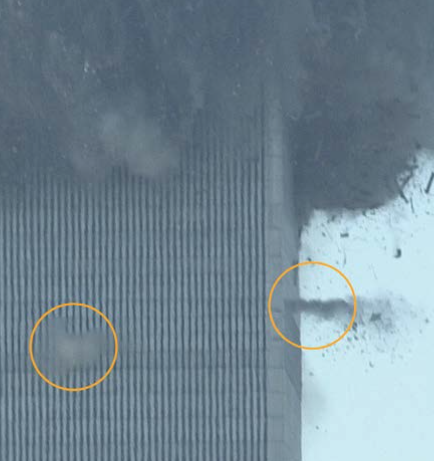
FIG. 5: High-velocity bursts of debris, or “squibs,” were ejected from point-like sources in WTC 1 and WTC 2, as many as 20 to 30 stories below the collapse front (Source: Noah K. murray).
This single column failure allegedly precipitated the collapse of the entire interior structure, leaving the exterior unsupported as a hollow shell. The exterior columns then allegedly buckled over a two-second period and the entire exterior fell simultaneously as a unit [3].
NIST was able to arrive at this scenario only by omitting or misrepresenting critical structural features in its computer modelling.[4] Correcting just one of these errors renders NIST’s collapse initiation indisputably impossible. Yet even with errors that were favorable to its predetermined conclusion, NIST’s computer model (see Fig. 3) fails to replicate the observed collapse, instead showing large deformations to the exterior that are not observed in the videos and showing no period of free fall. Also, the model terminates, without explanation, less than two seconds into the seven-second collapse.
Unfortunately, NIST’s computer modelling cannot be independently verified because NIST has refused to release a large portion of its modelling data on the basis that doing so “might jeopardize public safety.”
The case of the Twin Towers
Whereas NIST did attempt to analyze and model the collapse of WTC7, it did not do so in the case of the Twin Towers. In NIST’s own words,
The focus of the investigation was on the sequence of events from the instant of aircraft impact to the initiation of collapse for each tower…. this sequence is referred to as the ‘probable collapse sequence,’ although it includes little analysis of the structural behaviour of the tower after the conditions for collapse initiation were reached and collapse became inevitable.”[5]
Thus, the definitive report on the collapse of the Twin Towers contains no analysis of why the lower sections failed to arrest or even slow the descent of the upper sections — which NIST acknowledges “came down essentially in free fall” [5-6]— nor does it explain the various other phenomena observed during the collapses.
When a group of petitioners filed a formal Request for Correction asking NIST to perform such analysis, NIST replied that it was
unable to provide a full explanation of the total collapse
because
the computer models [were] not able to converge on a solution.
However, NIST did do one thing in an attempt to substantiate its assertion that the lower floors would not be able to arrest or slow the descent of the upper sections in a gravity-driven collapse. On page 323 of NCSTAR 1-6, NIST cited a paper by civil engineering professor Zdeněk Bažant and his graduate student, Yong Zhou, that was published in January 2002 [7] which, according to NIST, “addressed the question of why a total collapse occurred” (as if that question were naturally outside the scope of its own investigation).

FIG. 6: molten metal was seen pouring out of WTC 2 continuously for the seven minutes leading up to its collapse (Sources: WABC-Tv, NIST).
In their paper, Bažant and Zhou claimed there would have been a powerful jolt when the falling upper section impacted the lower section, causing an amplified load sufficient to initiate buckling in the columns. They also claimed that the gravitational energy would have been 8.4 times the energy dissipation capacity of the columns during buckling.
In the years since, researchers have measured the descent of WTC 1’s upper section and found that it never decelerated — i.e. there was no powerful jolt [8-9]. Researchers have also criticized Bažant’s use of free-fall acceleration through the first story of the collapse, when measurements show it was actually roughly half of gravitational acceleration [2]. After falling for one story, the measurements show a 6.1 m/s velocity instead of the 8.5 m/s velocity that would be the result of free fall. This difference in velocity effectively doubles the kinetic energy, because it is a function of the square of the velocity.
In addition, researchers have demonstrated that the 58 × 106 kg mass Bažant used for the upper section’s mass was the maximum design load—not the actual 33 × 106 kg service load [10]. Together, these two errors embellished the kinetic energy of the falling mass by 3.4 times. In addition, it has been shown that the column energy dissipation capacity used by Bažant was at least 3 times too low [2].
In January 2011 [11] Bažant and another graduate student of his, Jia-Liang Le, attempted to dismiss the lack-of-deceleration criticism by claiming there would be a velocity loss of only about 3%, which would be too small to be observed by the camera resolution. Le and Bažant also claimed conservation-of-momentum velocity loss would be only 1.1%. However, it appears that Le and Bažant erroneously used an upper section mass of 54.18 × 10⁶ kg and an impacted floor mass of just 0.627 × 10⁶ kg, which contradicted the floor mass of 3.87 × 10⁶ kg Bažant had used in earlier papers.
The former floor mass is representative of the concrete floor slab only, whereas the latter floor mass includes all the other materials on the floor. Correcting this alone increases the conservation-of-momentum velocity loss by more than 6 times, to a value of 7.1%. Additionally, the column energy dissipation has been shown to be far more significant than Bažant claimed. Researchers have since provided calculations showing that a natural collapse over one story would not only decelerate, but would actually arrest after one or two stories of fall (see Fig. 4) [2, 10].
Other evidence unexplained
The collapse mechanics discussed above are only a fraction of the available evidence indicating that the airplane impacts and ensuing fires did not cause the collapse of the Twin Towers. Videos show that the upper section of each tower disintegrated within the first four seconds of collapse. After that point, not a single video shows the upper sections that purportedly descended all the way to the ground before being crushed.
Videos and photographs also show numerous high-velocity bursts of debris being ejected from point-like sources (see Fig. 5). NIST refers to these as “puffs of smoke” but fails to properly analyze them [6]. NIST also provides no explanation for the midair pulverization of most of the towers’ concrete, the near-total dismemberment of their steel frames, or the ejection of those materials up to 150 meters in all directions.
NIST sidesteps the well-documented presence of molten metal throughout the debris field and asserts that the orange molten metal seen pouring out of WTC 2 for the seven minutes before its collapse was aluminum from the aircraft combined with organic materials (see Fig. 6) [6].
Yet experiments have shown that molten aluminum, even when mixed with organic materials, has a silvery appearance — thus suggesting that the orange molten metal was instead emanating from a thermite reaction being used to weaken the structure [12]. Meanwhile, unreacted nano-thermitic material has since been discovered in multiple independent WTC dust samples [13].
As for eyewitness accounts, some 156 witnesses, including 135 first responders, have been documented as saying that they saw, heard, and/or felt explosions prior to and/or during the collapses [14]. That the Twin Towers were brought down with explosives appears to have been the initial prevailing view among most first responders. “I thought it was exploding, actually,” said John Coyle, a fire marshal.“Everyone I think at that point still thought these things were blown up” [15].
Conclusion
It bears repeating that fires have never caused the total collapse of a steel-framed high-rise before or since 9/11. Did we witness an unprecedented event three separate times on September 11, 2001? The NIST reports, which attempted to support that unlikely conclusion, fail to persuade a growing number of architects, engineers, and scientists. Instead, the evidence points overwhelmingly to the conclusion that all three buildings were destroyed by controlled demolition. Given the far-reaching implications, it is morally imperative that this hypothesis be the subject of a truly scientific and impartial investigation by responsible authorities.
ABOUT THE AUTHORS
Steven Jones is a former full professor of physics at Brigham Young University. His major research interests have been in the areas of fusion, solar energy, and archaeometry. He has authored or co-authored a number of papers documenting evidence of extremely high temperatures during the WTC destruction and evidence of unreacted nano-thermitic material in the WTC dust.
Robert Korol is a professor emeritus of civil engineering at McMaster University in Ontario, Canada, as well as a fellow of the Canadian Society for Civil Engi- neering and the Engineering Institute of Canada. His major research interests have been in the areas of structural mechanics and steel structures. More recently, he has undertaken experimen- tal research into the post-buckling resistance of H-shaped steel columns and into the energy absorption associated with pulverization of concrete floors.
Anthony Szamboti is a mechanical design engineer with over 25 years of structural design experience in the aerospace and communications industries. Since 2006, he has authored or co-authored a number of technical papers on the WTC high-rise failures that are published in the Journal of 9/11 Studies and in the International Journal of Protective Structures.
Ted Walter is the director of strategy and development for Architects & En- gineers for 9/11 Truth (AE911Truth), a nonprofit organization that today represents more than 2,500 architects and engineers. In 2015, he authored AE-911Truth’s Beyond Misinformation: What Science Says About the Destruction of World Trade Center Buildings 1, 2, and 7. He holds a Master of Public Policy degree from the University of California, Berkeley.
References
[1] NIST: Analysis of Needs and Existing Capabilities for Full-Scale Fire Resistance Testing (October 2008).
[2] G. Szuladziński and A. Szamboti and R. Johns, International Journal of Protective Structures 4, 117 (2013).
[3] NIST: Final Report on the Collapse of World Trade Center Building 7, Federal Building and Fire Safety Investigation of the World Trade Center Disaster (November 20, 2008).
[4] R. Brookman, A Discussion of ‘Analysis of Structural Response of WTC 7 to Fire and Sequential Failures Leading to Collapse, Journal of 9/11 Studies (October 2012).
[5] NIST: Final Report of the National Construction Safety Team on the Collapses of the World Trade Center Towers (December 1, 2005).
[6] NIST: Questions and Answers about the NIST WTC Towers Investi- gation (Updated September 19, 2011).
[7] Z. Bažant, Y. Zhou, Yong, Journal of Engineering Mechanics 128, 2 (2002).
[8] A. Szamboti and G. MacQueen, The Missing Jolt: A Simple Refu- tation of the NIST-Bažant Collapse Hypothesis, Journal of 9/11 Studies (April 2009).
[9] D. Chandler, The Destruction of the World Trade Center North Tower and Fundamental Physics, Journal of 9/11 Studies (February 2010).
[10] A. Szamboti and R. Johns, ASCE Journals Refuse to Correct Fraudulent Paper Published on WTC Collapses, Journal of 9/11 Studies (September 2014).
[11] J.-L. Le and Z. Bažant, Journal of Engineering Mechanics 137, 82 (2011).
[12] S. Jones, Why Indeed Did the WTC Buildings Collapse Completely? Journal of 9/11 Studies (September 2006).
[13] N. Harrit et al., Open Chemical Physics Journal (April 2009).
[14] G. MacQueen, Eyewitness Evidence of Explosions in the Twin Towers, Chapter Eight, The 9/11 Toronto Report, Editor: James Gourley (November 2012).
[15] Fire Department of New York (FDNY): World Trade Center Task Force Interviews, The New York Times (October 2001 to January 2002).
Jonathan Kay and the Israel First Movement
The Kevin Barrett – Noam Chomsky Dispute in Historical Perspective – Eleventh part of the series titled “9/11 and the Zionist Question” – Read the tenth part here

By Prof. Tony Hall | American Herald Tribune | August 12, 2016
Jonathan Kay began his literary career in 1998 as a founding member of the editorial board of Canada’s National Post. Kay worked under Conrad Black and his Israeli-American partner, Richard Perle. Perle was an executive member of the advisory board of Black’s Hollinger International, which oversaw one of the world’s largest English-language newspaper chains based in North America, Great Britain and Israel. A main objective of Hollinger Inc.’s Canadian flagship, the National Post, was to push the country’s political culture far enough rightward that the Christian Zionist politician, Stephen Harper, could take the reigns of the federal government. Canadian Prime Minister between 2006 and 2015, Harper swept into power riding the wave of political fervor originating in the 9/11 psychological operation.
Richard Perle is sometimes referred to as the Prince of Darkness. He is a frequent and unabashed proponent of “total war.” Perle was a PNAC member and lead author of the “Clean Break” document that in 1996 encouraged Israeli Prime Minister Benjamin Netanyahu to move away from negotiations with the Palestinians toward a more militant posture in the Middle East and globally. Quite likely Perle had a significant role in planning the 9/11 event.
After the Bush administration was delivered its new Pearl Harbor on September 11, 2001, Perle renewed his call for “total war.” In advancing this agenda, Perle helped lead the charge resulting in the US and UK-led invasion of Iraq in 2003. Along with David Frum, another Canadian neocon spin doctor deeply implicated in the lies and crimes of 9/11, Perle co-authored the propaganda text, An End to Evil: How to Win the War on Terror. One of the book’s key recommendations was for the United States to invade the Islamic Republic of Iran. Going back to his role in the formulation of the “Clean Break” document, Perle had long advocated the invasion of Iran as well as Iraq and Syria in his capacity as an influential adviser within Israel’s Netanyahu government.

In looking back in 2014 at his sixteen years at the National Post, Kay emphasized that his work on 9/11 infused his literary career with a “sense of purpose.” For a lot of “conservative pundits… this was our Spanish Civil War. The fate of Western Civilization was at stake.” Kay continues, “I became obsessed with 9/11. I read the Koran, hoping to gain insights into Osama Bin Laden’s mindset, travelled to conferences in Israel, joined a Washington, D.C.-based think tank devoted to protecting democratic countries from terrorism. [Foundation for the Defense of Democracies] I helped a former Mossad agent [Michael Ross] write his memoir, and then wrote a book about 9/11 conspiracy theories.” [1]
If Jonathan Kay’s journalistic crusade is conceived as his equivalent to fighting in the Spanish Civil War between 1936 and 1939, his position on 9/11 puts him on the side of the Falangists, on the side of Francisco Franco’s right-wing nationalist forces. As clearly displayed in the ultra-Zionist content of Among The Truthers and The Volunteer as well as his frequent columns in the National Post, Kay is an extreme nationalist whose highest priority is to advance the imperial reach of the Jewish state centered in the expansionary polity of Israel. Kay seems surprisingly candid in identifying himself as a partisan journalist spinning propaganda for the Israel First faction that now prevails inside the governing elites that rule Canada, the United States and all the NATO countries.
The Underground Asylum Imagined by Jonathan Kay
The difference between Noam Chomsky and Jonathan Kay in dealing with Kevin Barrett’s 9/11 work helps illuminate the complex dynamics of a many-faceted cover up campaign. Kay’s Among The Truthers, for instance, is based largely on detailed ad hominem attacks on those that do not accept the official narratives he seeks to advance and defend. Chomsky on the other hand avoids any reference to scholarship of those that have critically evaluated the evidence of what did or did not happen on 9/11. This treatment of his intellectual opponents as unworthy even of named recognition is made very clear in his failure to identify Dr. Barrett and his qualifications even as the MIT professor accused the former University of Wisconsin Lecturer of academic wrongdoing.
In Among The Truthers, Kay’s sponsors assigned him the task of developing the primary commemorative text created with an eye to maintaining Zionist control over the MSM discourse that would mark the tenth anniversary of 9/11. The task given Kay in the prelude to the commemorate events in 2011 was to extend the meme of “9/11 conspiracy theories” into new extremes of deceit and obfuscation through fear mongering, defamation, misrepresentation and guilt-by-association.
The text’s title well encapsulates the core features of the smear campaign that is so central to the strategy of preventing the public from realizing how severely and systematically we have been lied to. Kay’s fervid literary invention of a “Growing Conspiracist Underground of 9/11 Truthers” was meant to invoke connotations of darkness, dementia and concealment. Among the engineered mental pictures conjured up by the literary reference to a “Conspiracist Underground” are concocted media memes of Osama bin Laden and his al-Qaeda network supposedly coordinating international havoc from elaborate networks of Eurasian terrorist caves.
Chomsky and Kay and the other 9/11 obfuscators consistently avoid dealing with the evidence. There is never any discussion, for instance, of the US government’s position that a catastrophic failure of intelligence flows, together with a complete breakdown of a whole series of emergency measure procedures, was the main cause of the 9/11 debacle. This narrative line is called into question by the fact that not one of the officials supposedly responsible for this alleged failure of intelligence and national defense was so much as reprimanded let alone fired. If the official narrative was true, why is it that the supposed incompetents actually received promotions?
There is never any effort to address huge anomalies like the fact, for instance, that the black boxes from the weaponized jet planes could not be found and yet passports of the alleged hijackers were miraculously located amidst the debris. There is never any real reckoning on the side of the obfuscators with the ongoing and blatantly illegal destruction of the forensic evidence of the 9/11 crimes.
This process starts under Michael Chertoff in his capacity as the person responsible for the US Justice Department’s criminal investigation of 9/11. Under Chertoff’s guidance this federal “investigation” quickly assumed the character of a federally orchestrated cover up. The destruction of evidence begins with the unseemly haste in the autumn of 2001 to dispose of the steel remnants of the three pulverized WTC towers. The twisted steel girders were quickly removed and sold off to scrap metal customers in China without prior forensic testing for signs of controlled demolitions. The quick destruction of evidence included the removal and destruction of human remains.
The saga of federal destruction of the evidence of the 9/11 crime, including the illegal destruction of the taped evidence of CIA torture in secret black site dungeons, extends to the proceedings currently underway in the Guantanamo Bay concentration camp. There, the military trial being pressed against the supposed “mastermind of 9/11” broke down in May of 2016 because a military judge improperly allowed the destruction of state evidence.
Kay’s excuse for not dealing with the evidence in Among The Truthers is to cite the supposed advice of a supposed New York editor who supposedly cautioned him, “debunking books don’t sell… Conspiracy theorists won’t believe you. And normal people don’t need to be told what you’re telling them. So you have no audience.” The implication here is that somehow “normal people” need not be burdened with knowledge of the evidentiary substance of what really happened. (p.320)
Kay effectively destroys his journalistic credibility with this startling declaration that he ignored the 9/11 evidence due to the marketing advice of his New York editor. From this very compromised position of surrender to the vagaries of media salesmanship, Kay launches into his pop psychology fakery profiling the inhabitants of his imagined underground realm. Those “conspiracists” that the author chooses to highlight are simply wrong because Jonathan Kay declares them to be wrong. No proof required. All those that have developed interpretations that do not conform with the Israeliocentric worldview of Jonathan Kay and his publishers in the Rupert Murdoch media empire are simply swept aside as members of “cults and cult-like movements.” (p.315)
The inhabitants of Kay’s invented realm are pronounced by their Inquisitor to be heretics and worse. Kay declares them to be common victims of an “incurable disease” against which young people require “inoculation” through the introduction of special curricula and programs in schools. In taking on the personae of a public health official charged to protect our youth from the spread of infectious conspiracy theories, is Kay, the self-proclaimed poseur, implicitly prescribing the quarantining of those with whom he disagrees?
You will read “9/11 Crimes and Israel” in the next part.
Endnotes
[1] Jonathan Kay, “My Life at the National Post and Why I’ll Miss It,” National Post, 21 November, 2014
Dr. Hall is editor in chief of American Herald Tribune. He is currently Professor of Globalization Studies at University of Lethbridge in Alberta Canada. He has been a teacher in the Canadian university system since 1982. Dr. Hall, has recently finished a big two-volume publishing project at McGill-Queen’s University Press entitled “The Bowl with One Spoon”.
Conspiracy Theory in America
By Lance deHaven-Smith | OffGuardian | September 4, 2016

As an opener to our “9/11 – 15 years on” we’re sharing this extract from the book Conspiracy Theory in America by Lance deHaven Smith. Regardless of where we stand on the events of 9/11 we need to be aware of the intelligence-backed media campaign that lies behind the current social context of the phrase “conspiracy theory”.
A Curious History
The term “conspiracy theory” did not exist as a phrase in everyday American conversation before 1964. The conspiracy-theory label entered the American lexicon of political speech as a catchall for criticisms of the Warren Commission’s conclusion that President Kennedy was assassinated by a lone gunman with no assistance from, or foreknowledge by, any element of the United States government. Since then, the term’s prevalence and range of application have exploded. In 1964, the year the Warren Commission issued its report, the New York Times published five stories in which “conspiracy theory” appeared. In recent years, the phrase has occurred in over 140 New York Times stories annually. A Google search for the phrase (in 2012) yielded more than 21 million hits—triple the numbers for such common expressions as “abuse of power” and “war crime.” On Amazon.com, the term is a book category that includes in excess of 1,300 titles. In addition to books on conspiracy theories of particular events, there are conspiracy-theory encyclopedias, photographic compendiums, website directories, and guides for researchers, skeptics, and debunkers.
Initially, conspiracy theories were not an object of ridicule and hostility. Today, however, the conspiracy-theory label is employed routinely to dismiss a wide range of anti-government suspicions as symptoms of impaired thinking akin to superstition or mental illness. For example, in a massive book published in 2007 on the assassination of President Kennedy, former prosecutor Vincent Bugliosi says people who doubt the Warren Commission report are “as kooky as a three dollar bill in their beliefs and paranoia.” Similarly, in his recently published book Among the Truthers (Harper’s, 2011), Canadian journalist Jonathan Kay refers to 9/11 conspiracy theorists as “political paranoiacs” who have “lost their grip on the real world.” Making a similar point, if more colorfully, in his popular book Wingnuts, journalist John Avlon refers to conspiracy believers as “moonbats,” “Hatriots,” “wingnuts,” and the “Fright Wing.”
The same judgment is expressed in more measured terms by Cass Sunstein and Adrian Vermeule in a 2009 journal article on the “causes and cures” of conspiracy theories. Sunstein is a Harvard law professor appointed by President Obama to head the Office of Information and Regulatory Affairs. He and Vermeule claim that once a person buys into them, conspiracy theories are resistant to debunking because they are “self-sealing.” That is, because conspiracy theories attribute extraordinary powers to elites to orchestrate events, keep secrets, and avoid detection, the theories encourage their adherents to dismiss countervailing evidence as fabricated or planted.
In a book on technology and public opinion, Sunstein argues further that conspiracy-theory groups and networks are proliferating because the highly decentralized form of mass communication made possible by the Internet is altering the character of public discourse. Whereas television and radio provide platforms for debating competing viewpoints on matters of widely shared interest, the Internet tends to segment discussion into a multitude of small groups, each focusing on a separate and distinct topic. Sunstein argues that this splintering of discourse encourages extremism because it allows proponents of false or one-sided beliefs to locate others with similar views while at the same time avoiding interaction with competing perspectives. In Sunstein’s words, “The Internet produces a process of spontaneous creation of groups of like-minded types, fueling group polarization. People who would otherwise be loners, or isolated in their objections and concerns, congregate into social networks.” Sunstein acknowledges that this consequence of the Internet is unavoidable, but he says polarization can and should be mitigated by a combination of government action and voluntarily adopted norms. The objective, he says, should be to ensure that those who hold conspiracy theories “are exposed to credible counterarguments and are not living in an echo chamber of their own design”.
In their law review article, Sunstein and Vermeule expand this idea and propose covert government action reminiscent of the FBI’s efforts against the civil rights and antiwar movements in the 1960s. They consider a number of options for countering the influence of conspiracy theories, including public information campaigns, censorship, and fines for Internet service providers hosting conspiracy-theory websites. Ultimately rejecting those options as impractical because they would attract attention and reinforce anti-government suspicions, they call for a program of “cognitive infiltration” in which groups and networks popularizing conspiracy theories would be infiltrated and “disrupted.”
A Flawed and Un-American Label
As these examples illustrate, conspiracy deniers assume that what qualifies as a conspiracy theory is self-evident. In their view, the phrase “conspiracy theory” as it is conventionally understood simply names this objectively identifiable phenomenon. Conspiracy theories are easy to spot because they posit secret plots that are too wacky to be taken seriously. Indeed, the theories are deemed so far-fetched they require no reply or rejoinder; they are objects of derision, not ideas for discussion. In short, while analyzing the psychological appeal of conspiracy beliefs and bemoaning their corrosive effects on public trust, conspiracy deniers have taken the conspiracy-theory concept itself for granted.
This is remarkable, not to say shocking, because the concept is both fundamentally flawed and in direct conflict with American legal and political traditions. As a label for irrational political suspicions about secret plots by powerful people, the concept is obviously defective because political conspiracies in high office do, in fact, happen. Officials in the Nixon administration did conspire to steal the 1972 presidential election. Officials in the Reagan White House did participate in a criminal scheme to sell arms to Iran and channel profits to the Contras, a rebel army in Nicaragua. The Bush-Cheney administration did collude to mislead Congress and the public about the strength of its evidence for Iraqi weapons of mass destruction. If some conspiracy theories are true, then it is nonsensical to dismiss all unsubstantiated suspicions of elite intrigue as false by definition.
This fatal defect in the conspiracy-theory concept makes it all the more surprising that most scholars and journalists have failed to notice that their use of the term to ridicule suspicions of elite political criminality betrays the civic ethos inherited from the nation’s Founders. From the nation’s beginning, Americans were fearful of secret plots by political insiders to subvert constitutional governance. Those who now dismiss conspiracy theories as groundless paranoia have apparently forgotten that the United States was founded on a conspiracy theory. The Declaration of Independence claimed that “a history of repeated injuries and usurpations” by King George proved the king was plotting to establish “an absolute tyranny over these states.” Today, most Americans are familiar only with the Declaration’s opening paragraphs about self-evident truths and inalienable rights, but if they were to read the rest of the document, they would see that it is devoted to detailing the abuses evincing the king’s tyrannical design. Among the complaints listed are onerous taxation, fomenting slave rebellions and Indian uprisings, taxation without representation, and indifference to the colonies’ complaints. The document’s signers claimed it was this “design to reduce them under absolute despotism,” not any or all of the abuses themselves, that gave them the right and the duty “to throw off such government, and to provide new guards for their future security.”
The Founders considered political power a corrupting influence that makes political conspiracies against the people’s interests and liberties almost inevitable. They repeatedly and explicitly called for popular vigilance against antidemocratic schemes in high office. Educated in classical political philosophy, they understood that one of the most important questions in Western political thought is how to prevent top leaders from abusing their powers to impose arbitrary rule, which the Founders referred to, appropriately, as “tyranny.” Whereas Great Britain relied on common law to define the powers and procedures of its government, the generation that established the American republic developed a written constitution to set clear limits on public officials. Nevertheless, they understood that all constitutions are vulnerable to subversion because ultimately they are interpreted and administered by public officials themselves. The Founders would view today’s norms against conspiratorial suspicion as not only arrogant, but also dangerous and un-American.
The Founders would also be shocked that conspiracy deniers attack and ridicule individuals who voice conspiracy beliefs and yet ignore institutional purveyors of conspiratorial ideas even though the latter are the ideas that have proven truly dangerous in modern American history. Since at least the end of World War II, the citadel of theories alleging nefarious political conspiracies has been, not amateur investigators of the Kennedy assassination and other political crimes and tragedies, but the United States government. In the first three decades of the post–World War II era, U.S. officials asserted that communists were conspiring to take over the world, that the U.S. bureaucracy was riddled with Soviet spies, and that the civil rights and antiwar movements of the 1960s were creatures of Soviet influence. More recently, they have claimed that Iraq was complicit in 9/11, failed to dispose of its biological weapons, and attempted to purchase uranium in Niger so it could construct nuclear bombs. Although these ideas were untrue, they influenced millions of Americans, fomented social panic, fueled wars, and resulted in massive loss of life and destruction of property. If conspiracy deniers are so concerned about the dangers of conspiratorial suspicions in American politics and civic culture, why have they ignored the conspiracism of U.S. politicians?
Finally, there is something very hypocritical about those who want to fix people who do not share their opinions. Sunstein and Vermeule say conspiracy believers need to have their discussions disrupted, because they are dangerous. But what could be more dangerous than thinking it is acceptable to mess with someone else’s thoughts? Sunstein and Vermeule’s hypocrisy is breathtaking. They would have government conspiring against citizens who voice suspicions about government conspiracies, which is to say they would have government do precisely what they want citizens to stop saying the government does. How do Harvard law professors become snared in such Orwellian logic? One can only assume that there must be something bedeviling about the idea of conspiracy theory.
Naming the Taboo Topic
In what follows, I shall attempt to reorient analysis of the phenomenon that has been assigned the derisive label of “conspiracy theory.” In a 2006 peer-reviewed journal article, I introduced the concept of State Crime against Democracy (SCAD) to displace the term “conspiracy theory.” I say displace rather than replace because SCAD is not another name for conspiracy theory; it is a name for the type of wrongdoing about which the conspiracy-theory label discourages us from speaking. Basically, the term “conspiracy theory” is applied pejoratively to allegations of official wrongdoing that have not been substantiated by public officials themselves.
Deployed as a pejorative putdown, the label is a verbal defense mechanism used by political elites to suppress mass suspicions that inevitably arise when shocking political crimes benefit top leaders or play into their agendas, especially when those same officials are in control of agencies responsible for preventing the events in question or for investigating them after they have occurred. It is only natural to wonder about possible chicanery when a president and vice president bent on war in the Middle East are warned of impending terrorist attacks and yet fail to alert the American public or increase the readiness of the nation’s armed forces. Why would Americans not expect answers when Arabs with poor piloting skills manage to hijack four planes, fly them across the eastern United States, somehow evade America’s multilayered system of air defense, and then crash two of the planes into the Twin Towers in New York City and one into the Pentagon in Washington, DC? By the same token, it is only natural to question the motives of the president and vice president when they drag their feet on investigating this seemingly inexplicable defense failure and then, when the investigation is finally conducted, they insist on testifying together, in secret, and not under oath. Certainly, citizen distrust can be unwarranted and overwrought, but often citizen doubts make sense. Americans are not crazy to want answers when a president is assassinated by a lone gunman with mediocre shooting skills who manages to get off several lucky shots with an old bolt-action carbine that has a misaligned scope. Why would there not be doubts when an alleged assassin is apprehended, publicly claims he is just a patsy, is interrogated for two days but no one makes a recording or even takes notes, and he is then shot to death at point-blank range while in police custody at police headquarters?
Of course, some suspicions go too far. The idea that lizard-like aliens from space are secretly infiltrating top positions in government and business is ludicrous. However, the conspiracy-theory label makes fun of conspiratorial suspicions in general. Consequently, the label discourages Americans from registering doubts about their leaders’ motives and actions regardless of the circumstances. Any suspicions that public officials conspired to cause a tragedy or allowed it to happen are dismissed without further discussion because, supposedly, public officials simply do not engage in conspiracies.
Communication scientists Ginna Husting and Martin Orr, both of whom are professors at Boise State University, have studied the use of the conspiracy-theory label as a putdown. At the beginning of a peer-reviewed 2007 article on the subject, they point out how the label works rhetorically:
If I call you a conspiracy theorist, it matters little whether you have actually claimed that a conspiracy exists or whether you have simply raised an issue that I would rather avoid . . . I twist the machinery of interaction so that you, not I, are now called to account. In fact, I have done even more. By labeling you, I strategically exclude you from the sphere where public speech, debate, and conflict occur.
Husting and Orr go on to explain that the accusation of conspiracy theory discredits any explanations offered for specific social or historical events “regardless of the quality or quantity of evidence.” The label has this discrediting, end-of-argument effect because conspiracy theories have come to be seen as mere suspicions with no basis in fact, not as reasonable inferences from circumstances and evidence about matters of great importance.
In contrast, the SCAD construct does not refer to a type of allegation or suspicion; it refers to a special type of transgression: an attack from within on the political system’s organizing principles. For these extremely grave crimes, America’s Founders used the term “high crime” and included in this category treason and “conspiracies against the people’s liberties.” SCADs, high crimes, and antidemocratic conspiracies can also be called “elite political crimes” and “elite political criminality.” The SCAD construct is intended, not to supersede traditional terminology or monopolize conceptualization of this phenomenon, but rather to add a descriptive term that captures, with some specificity, the long-recognized potential for representative democracy to be subverted by people on the inside—the very people who have been entrusted to uphold the constitutional order.
SCADs are defined as concerted actions or inaction by government insiders intended to manipulate democratic processes and undermine popular sovereignty. Examples of SCADs that have been officially proven include the Watergate break-in and cover-up; the illegal arms sales and covert operations in Iran-Contra; and the effort to discredit Joseph Wilson by revealing his wife’s status as an intelligence agent.
Many other political crimes in which involvement by high officials is reasonably suspected have gone uninvestigated or have been investigated only superficially. They are included in SCAD studies even when the evidence of state complicity is contested, because excluding them would mean accepting the judgment of individuals and institutions whose rectitude and culpability are at issue. The nature of the subject matter is such that official inquiries, if they are conducted at all, are usually compromised by conflicts of interest. Hence the evidence must be evaluated independently on its merits, and decisions must be made on a case-by-case basis about which events are most likely elite political crimes. Of course, as Husting and Orr point out, engaging the evidence is precisely what the pejorative conspiracy-theory putdown is deployed rhetorically to avoid.
SCADs constitute a special type of political criminality. Unlike bribery, kickbacks, bid-rigging, and other, more mundane forms of political corruption, which tend to be isolated and to affect only pockets of government activity, SCADs have the potential to subvert political institutions and entire governments or branches of government. Committed at the highest levels of public office, they are crimes that threaten democracy itself. Clearly, such crimes and the circumstances that allow or encourage them warrant scientific study, both to better understand elite politics and to identify institutional vulnerabilities that can be corrected to make antidemocratic conspiracies less likely and less likely to succeed. Hence, one would have expected elite political crime, like white-collar crime, hate crime, and racketeering, to have been singled out for research and theorizing by social scientists long ago.
However, because powerful norms discourage Americans from questioning the integrity of their top leaders, and because anyone who raises such questions is likely to be seen as a “conspiracy theorist” who may be mentally unbalanced, the topic has been almost completely ignored by scholars. Social scientists have studied various forms of state crime, but in almost every case the potential for public officials in liberal democracies to subvert democratic institutions has been disregarded. Political science research on Watergate, Iran-Contra, and other U.S. political scandals has sidestepped questions about state criminality by studying the use of congressional investigations and independent prosecutors as political tactics in partisan competition.
Of course, a vast popular literature exists that presents a wide range of conspiracy theories of domestic assassinations and other high crimes, but the form of analysis employed, while careful and in many ways insightful, is not really scientific. Amateur investigators have uncovered important evidence overlooked by official inquiries, but, with only one or two exceptions, they have failed to investigate the general phenomenon of high criminality and instead have speculated about one suspicious incident at a time. There is a body of work on the assassination of President Kennedy, another on the events of 9/11, and still others on the 1980 October Surprise, the disputed 2000 presidential election, and the anthrax letter attacks. To be sure, we do learn a lot about each case; we learn a great deal, for example, about the assassination of President Kennedy and the assassination of Martin Luther King, but we learn next to nothing about assassinations in general, such as their typical targets, tactics, and timing, nor do we learn much about differences and similarities between assassinations and false-flag terrorism as political tactics. By the same token, since we learn little about the nature of elite political criminality in general, we gain little insight into the extent, nature, and role of elite crime and intrigue in American politics.
Perceptual Silos
The tendency to consider suspicious political events individually and in isolation rather than collectively and comparatively is not limited to the conspiracy-theory literature; it is built into the conspiracy-theory label and has become a pervasive predisposition in U.S. civic culture. For Americans, each assassination, each election breakdown, each defense failure, each war justified by “mistaken” claims is perceived as a unique event arising from its own special circumstances. While Americans in the present generation have personally witnessed many political crimes and tragedies, we see them as if through a fly’s eye, situating each event in a separate compartment of memories and context.
Even when obvious factors connect political crimes, the crimes are thought of as disparate and unrelated. For example, John Kennedy and Robert Kennedy were brothers; both were rivals of Richard Nixon and were hated by Lyndon Johnson; their murders occurred less than five years apart; both were killed while campaigning for the office of president; and both appeared likely to win the upcoming presidential election. Without their murders, neither Nixon nor Johnson would probably have ever become president. Nevertheless, the assassinations of John and Robert Kennedy are seen as entirely unrelated; parallels, if they are recognized at all, are dismissed as coincidences. It is seldom considered that the Kennedy assassinations might have been serial murders.
In fact, in speaking about the murders, Americans rarely use the plural, Kennedy assassinations. In the lexicon, there is the Kennedy assassination (singular), which refers to the murder of President Kennedy, and there is the assassination of Robert Kennedy. Clearly, this quirk in the Kennedy assassination(s) lexicon reflects an unconscious effort by journalists, politicians, and millions of ordinary Americans to avoid thinking about the two assassinations together, despite the fact that the victims are connected in countless ways and that they also deserve better—they deserve to be remembered as brothers who stood for the same values and who were somehow struck down by forces still beyond our grasp. This clever feat of keeping the Kennedy assassinations singular and separate might be called linguistic “compartmentalization,” for, by avoiding the plural of “assassination,” we have unconsciously split and compartmentalized in our awareness significantly related events.
For another example, consider how we compartmentalize our perceptions of the disputed 2000 and 2004 presidential elections. The election breakdowns are not widely suspected of being repeat offenses by the same network of political operatives employing the same tactics and resources, even though both elections were plagued by very similar problems, including inadequately equipped and staffed polling places in heavily Democratic areas, computer anomalies in the tabulation of county and state totals, highly partisan Republicans in charge of election administration, aggregate vote tabulations benefiting George W. Bush, and exit polls indicating that the other candidate had won rather than Bush. The two elections are seen as separate and without any forensically important parallels. No one called for statisticians to review both elections for similar problems or signs of election tampering. No one speaks of “the disputed Bush-Cheney elections,” or of “the back-to-back election disputes,” or even simply of the plural, “election breakdowns.”
A slightly different example of this phenomenon of compartmentalization is offered by contemporary perceptions of, on the one hand, the hijacked-airplane attacks on September 11, 2001, and on the other hand, the anthrax letter attacks that began a few weeks later. Today, 9/11 and the anthrax mailings are cognitively dissociated even though initially they were thought to be closely connected. It made sense to think they were connected because they shared many characteristics: they occurred closely together in time; both were acts of terrorism; both targeted private individuals as well as government officials; and both exploited essential services (commercial air travel and the postal service). In fact, for the first few months, the anthrax letter attacks were blamed on the terrorist group that was assumed to have carried out the hijacked-airplane attacks on the Twin Towers and the Pentagon.
Soon, however, the FBI investigation reached the conclusion that the anthrax came from a strain developed by the U.S. military at the Army Medical Research Institute of Infectious Diseases at Fort Detrick, Maryland. This discovery should have caused investigators and the public to wonder if the events of 9/11 might likewise have been connected in some way to the U.S. military. Alarm bells should also have sounded when, shortly after the anthrax letter attacks were discovered, the FBI authorized the destruction of a rare collection of anthrax samples at Iowa State University. According to scientists, this made it much more difficult to trace the anthrax in the letters to domestic laboratories. However, rather than look for connections between the anthrax case, the 9/11 hijackings, and what appears to have been an effort to prevent the domestic origins of the anthrax from being discovered, everyone just dropped the anthrax attacks from consideration as a terrorist threat. Talk of duct tape ended. In effect, the anthrax letter attacks were quickly sealed off cognitively, and awareness of their domestic origins did not have to be reconciled with what Americans later learned about 9/11—about the warnings President Bush received in his daily briefing in August 2001; about the war games that were scheduled on 9/11, some of which included hijacked airplanes and interfered with the response to the real hijackings; about the expedited flights of Osama bin Laden’s relatives . . . The list could go on. The point is that the domestic origins of the anthrax became a side story, and yet, at the time the anthrax letters were being received and people were being infected, the anthrax attacks appeared to be an integral part of a war on America.
But once the anthrax was traced to Fort Detrick, the fear was relieved and the crime was mentally cordoned off. There were no calls for investigators to look for U.S. military personnel with multiple connections to air defense, war games, and germ warfare. There was never any effort to identify government officials who were involved in national defense policy and who owned or had recently purchased stock in pharmaceutical companies that manufactured medicines for preventing or treating anthrax infections. To the contrary, rather than look for people linking anthrax, 9/11, air defense, and biological weapons, the investigation was narrowed to lone microbiologists who were considered to be disgruntled, emotionally troubled, or opportunistic.
Causes and Consequences
It should be stressed that this way of thinking about elite political crimes—this very common tendency to view parallel crimes separately and to see them as disparate and unrelated—is exactly opposite the way crimes committed by regular people are treated. If a man marries a wealthy woman and she dies in a freak accident at home, people would be suspicious simply because she was wealthy and the accident was improbable. If this same man then marries another wealthy woman who dies in a freak accident at home, foul play would naturally be suspected, and the husband would be the leading suspect in the wives’ demise. If the husband had taken out a life insurance policy on either wife a few weeks or months prior to the accidents, it would be considered circumstantial evidence of foreknowledge. If police failed to recognize the obvious similarities in the wives’ deaths, they would be considered incompetent, negligent, or bought off.
It is routine police protocol to look for patterns in burglaries, bank robberies, car thefts, and other crimes, and to use any patterns that are discovered as clues to the perpetrators’ identity and the vulnerabilities to crime that are being exploited. This method of crime analysis is shown repeatedly in crime shows on TV. It is Criminology 101. There is no excuse for most Americans, much less criminal investigators, journalists, and other professionals, to fail to apply this method to assassinations, election fiascos, defense failures, and other suspicious events that shape national political priorities.
Why do we compartmentalize crimes involving political elites while doing just the opposite with the crimes of ordinary people? At least two factors discourage us from connecting the dots in elite political criminality. One is the term “conspiracy theory,” which is applied to crimes that have major political consequences but not to other crimes. The conspiracy-theory phrase encourages cognitive compartmentalization because the phrase is not meant to apply to interconnected crimes. In American public discourse, multiple crimes planned and committed by a single group are generally called “organized crime,” not conspiracies. The term “conspiracy” is reserved for plots surrounding one major criminal objective and for the networks that come together for that purpose. The Mafia is not a conspiracy; it is an organization. A conspiracy theory about the assassination of President Kennedy is implicitly a theory about a temporary combination of plotters, not an enduring assassination squad or lethal criminal organization. Therefore, even if we think the assassination of John Kennedy was a conspiracy, and we think the assassination of Robert Kennedy was a conspiracy, we are nevertheless unlikely to see the two as connected, because the conspiracy concept envisions them as isolated, self-contained schemes.
The second factor impeding us from drawing connections between political crimes involving political elites is that looking for connections requires being suspicious to begin with, and yet being suspicious of political elites violates norms that are embodied in the pejorative connotations of the conspiracy-theory label. As shown by our speech habits and observation tendencies about assassinations, disputed elections, and terrorist attacks, we are averse to talking about such events as connected in any way.
This aversion is learned. Americans know that voicing suspicions about political elites will make them objects of hostility and derision. The verbal slaps vary, but they are difficult to counter because they usually abuse reason. For example, in using the conspiracy-theory label as a putdown, conspiracy deniers imply that official accounts of troubling events are something altogether much more solid than conspiratorial suspicions—as if official accounts are in some sense without speculation or presuppositions. In fact, however, conspiracy deniers and debunkers are relying on an unstated theory of their own—a very questionable theory. In the post-WWII era, official investigations have attributed assassinations, election fiascos, defense failures, and other suspicious events to such unpredictable, idiosyncratic forces as lone gunmen, antiquated voting equipment, bureaucratic bumbling, innocent mistakes, and, in the case of 9/11 (to quote the 9/11 Commission, p. 339), a “failure of imagination.” In effect, official accounts of suspicious events have answered conspiracy theories with coincidence theories.
Far from being more factual and plausible than theories positing political crimes and intrigues, coincidence theories become less and less plausible as coincidences pile up, which they have been doing for decades in the U.S. It is like flipping a coin ten times and it always falls on heads. In general, as SCADs and suspected SCADs pile up, the odds of coincidence drop rapidly. The Bush-Cheney ticket winning in one or two states despite exit polls indicating they had lost could have been the result of random variations in exit poll samples. When the same thing happens in state after state; when the difference between exit polls and election returns almost always favors the same candidates, the odds of this being by chance alone are astronomically low. This does not necessarily mean the elections were stolen, but it does mean something caused the election returns to differ from how voters said they voted.
The CIA’s Conspiracy-Theory Conspiracy
If political conspiracies in high office do, in fact, happen; if it is therefore unreasonable to assume conspiracy theories are, by definition, harebrained and paranoid; if the Declaration of Independence is a conspiracy theory; if the United States was founded on a conspiracy theory that alleged King George was plotting to take away the colonists’ rights; if the conspiracy-theory label makes it difficult to see connections between political crimes that, in fact, may be connected; if, because it ridicules suspicion, the conspiracy-theory label is inconsistent with the traditional American ethos of vigilance against conspiracies in high office; if, in summary, the conspiracy-theory label blinkers perceptions, silos thinking, and is un-American and unreasonable, how did the label come to be used so widely to begin with?
Most Americans will be shocked to learn that the conspiracy-theory label was popularized as a pejorative term by the Central Intelligence Agency (CIA) in a propaganda program initiated in 1967. This program was directed at criticisms of the Warren Commission’s report. The propaganda campaign called on media corporations and journalists to criticize “conspiracy theorists” and raise questions about their motives and judgments. The CIA told its contacts that “parts of the conspiracy talk appear to be deliberately generated by Communist propagandists.” In the shadows of McCarthyism and the Cold War, this warning about communist influence was delivered simultaneously to hundreds of well-positioned members of the press in a global CIA propaganda network, infusing the conspiracy-theory label with powerfully negative associations.
How the occupied mentality syndrome works
Saudi Arabia on the American chessboard – Part 3
By B. J. Sabri | American Herald Tribune | June 27, 2016
Read part 2: “The occupied mentality Syndrome“
Previously I argued whether Saudi Arabia’s repeated involvements in U.S. interventions and wars stem from free national will or in response to a specific condition. For starters, in Saudi Arabia there is no national will. In Saudi Arabia, the national will is the will of the Al Saud clan. Still, when a major Arab state allies itself with a superpower that committed unspeakable crimes against humanity in almost every Arab country, then something is wrong. This fact alone should compel us to examine the U.S.-Saudi relation for one exceptional reason. As a result of the U.S.-Saudi wars, hundreds of thousands of people in Afghanistan, Iraq, Iran, Libya, Syria, Yemen, and Somalia have lost their lives. Millions became displaced in their own homelands. And millions more rendered refugees.
Attributing the Saudi policies to the bonds of “partnership” with the U.S. is frivolous. There are no bonds between these two thugs except those of business, military deals, secret plots, and wars. Proving this point, bonds such as these have no space for the American and Saudi peoples to share significant cultural or societal exchanges. If partnership is not the reason for the Saudi contribution to the U.S. strategy of empire and imperialism, then another reason must exist.
This leads to three possibilities. (1) The Saudis are exercising their supreme national rights to do whatever they want. Or, (2), they are responding to inducement. Or, (3), they are complying with applied pressure. While the first possibility cannot be taken seriously, the remaining two possibilities are plausible. This means the Saudi participation in the U.S. wars—by proxy and directly—must have origins in factors other than the fluid concepts of alliance and partnership.
By the way, yielding to pressure is not new in international relations. In the age of today’s imperialism, the U.S. use of the UNSC to impose its policies is an example. If impositions fail, then the U.S. acts unilaterally. Examples: the imposition of the no-fly zone in Iraq 1991-2003 and the invasion in 2003. In the era of classical colonialism during 19th century, Britain’s gun boat diplomacy to force the opening of China to foreign trade is another example. Again, when a nation succumbs to another nation, that succumbence is never ordinary.
I also argued that succumbence to power is the result of protracted material, mental, and emotional processes performing as one element. From this premise I went on to coin the term: Occupied Mentality Syndrome (OMS) to describe such an element. Unlike other forms of mentalities (national, group, personal, and so on), the mentality I am debating is atypical. Driven by subjective factors but influenced by politically construed constraints—real or imagined—, this mentality has special traits. It competes with ideology, it conforms to pressure, it lays the blame on others, and it discards accountability.
Although such traits may not appear all at once, the presence of any one of them in a given situation is a reason to suspect that an OMS is lurking behind. Most interesting, those afflicted by this syndrome accept what comes next as a normal outcome of free deliberation. This is an anomaly. It is so because those who endorse it only calculate value versus detriment.
But calculations gutted from analysis, congruency of purpose, or the study of variables lead to contentious decisions. It is no mystery that decisions with far-reaching negative consequences impacting others could lead to tension or even open hostility. How does the Saudi regime get away from the impact of their decisions?
The usual act has been to reject any responsibility without discussion—as it happened with Iraq’s war against Iran. In doing so, the Saudi regime takes cues directly from Niccolò Machiavelli. Explanation: after converting the deliberation process into a justificatory procedure, the Saudi regime moves to the next phase: conferring legitimacy to already made decisions. Here is how they do it: make the decisions appear as if they were the result of (1) the collective national will—through the regime’s talking heads, preachers, and media,—and (2) purported adherence to the “Islamic Sharia”. The bogus legitimacy ruse that ensues is ludicrous. A tyrannical and obscurantist regime has now the authority to move forward with its decisions by calling on its citizens to observe a Quranic verse—taken out of context—calling on Muslims to obey their rulers.
To test the validity of the OMS concept, let me reprise my argument about how the Iranian Revolution and the Soviet invasion of Afghanistan shaped the mindset of the Saudi regime. Although the outcome of the 18-month long anti-Shah demonstrations was predictable, it, nevertheless, caught the U.S. and Saudi Arabia unprepared for his downfall. With the Shah gone, a psycho-political “drama” unfolded. The United States lost one of Nixon’s two pillars (the other is Saudi Arabia) in the Middle East; Israel lost its only ally in the Muslim world; Al Saud lost their inner confidence. The mere idea of a Khomeini-style revolution sweeping Saudi Arabia was enough to induce convulsive spasms in all those concerned with power, money, and oil.
Afghanistan was a different story. While the United States was mostly concerned with the Soviet power and on how to respond to the invasion, Saudi Arabia was literally terrified about the potential spread of “godless” Communism. . . . Thus was born the “special relationship” between U.S. ruling circles and a reactionary, absolutist clan.
What do we understand from the U.S.-Saudi relation?
Marked differences between the U.S. and Saudi polities make it intuitive that such a relation is no more than an opportunistic convergence between two regimes. Said differently, what we have here is a forum for massive business encounters and ideological boastings that both regimes struggle to call “alliance”. Generally, in the pre-9/11 period that relation had two sets of motives. While the American set is trite—empire-building, hegemony, oil, wars, and Israel—, the Saudi’s is issue-focused. (1) The clan must have the absolute primacy over Saudi life and society. (2) The clan defines its quest for security and survival in U.S. imperialistic context. That is, whatever the U.S. needs, the Saudi regime can supply in exchange for the clan’s needs.
It would be interesting to imagine the following scenario. The subject is Afghanistan. Was it ever possible for the Saudi regime to pursue a course independent from the objectives of the United States policy because they run against the legitimate interests of the Saudi people? To debate this point: was the spending of over $3.2 billion (indexed for that period) on the anti-Soviet Afghan war of any benefit to the Saudi society?
Let us make another supposition. Because Al Saud think of their clan as being the most powerful on earth, then a pressing question comes to mind. If they were that powerful, why did they not take alternative measures to counter U.S. pressure in the decades before 9/11? For instance, they could have purchased technology, weapons, and advanced commodities—and even “protection” from any industrial country other than the United States. [1] Or, with all the money they had, they could have started an autonomous national industrialization process like that of India, Iran, Turkey, China, South Korea, and others.
Ironically, even if the Saudi regime had the means to undertake that process, it would not have moved to implement it. Explanation: advanced statecraft mechanisms leading to independent decision making in any sector of the national life are unavailable because of the despotic nature of the regime. Not only that, but achieving sovereignty means also sovereignty for the people. This would surely curtail the power of the clan due to increased popular participation in the setting of national priorities.
Let us consider another point: the Saudis have always bragged that their “alliance” with the U.S. is unbreakable. This has an implication: the preventive imprisonment of their critical judgment and free will. Explanation: while the Saudis are unwilling to break with the U.S., the U.S. can discard them at will and play them at any given time—as happened recently with the story of the 28 pages never published from the 9/11 report. Tentative conclusion: from the clan’s perspective, it appears that whatever the U.S. wants can be addressed and accepted. Still, my earlier supposition that Saudi Arabia had the means and will to be independent from the United States has merit, It means, any U.S. pressure on the Saudis for burden sharing would be useless if the Saudis resist and go somewhere else for their needs.
If a counter-argument suggests that the Saudi spending in Afghanistan was worth it to deter a potential Russian aggression, then a reasoned rebuttal could be as follows. Fact 1: we know that the U.S.-Saudi relation revolves around deterring hypothetical “threats” against the kingdom. Fact 2: but we also know that neither the USSR, nor any other regional or international power has ever threatened to attack or invade Saudi Arabia. Amusingly, the only rumored threat of invasion came from Saudi Arabia’s “ally”, the United States (and from Britain) consequent to the Arab oil embargo in 1973. Conclusion: Al Saud had no impelling reasons to finance the U.S. imperialist enterprise in Afghanistan—even if they loathed the Soviets.
My argument: the Saudi regime has been concealing the primary motive feeding their “alliance” with the United States. Yet, it is not that difficult to guess what the clan thinks. Being a superpower with massive Zionist and Israeli influence, the United States offered the best guarantee for the survival of the regime on two fronts.
On the domestic front, the U.S. may help the regime survive if domestic unrest becomes unstoppable. The American-authorized French intervention to quell the Mecca uprising in 1979 is an example. As for The Zionist and Israeli component in American politics viewed from a Saudi angle, this is intuitive too. Like all Arab regimes, deluding themselves that the U.S. has a sovereign Arab policy, the Saudis thought of their U.S. relation as a buffer against America’s ally and protégée: Israel.
Furthermore, whereas Saudi motives are clan-based, those of the United States are system-based. This means, they are global, rationalized, and originate from how the ruling circles view the role of the United States in the world. Still, motives need forces to have effect. Consequently, the motives of a political state are the same motives of the ideological and material forces that drive it. For instance, in post-WWII United States, such forces worked as one construct to drive the purpose of U.S. hegemony. The economics, politics, and ideology of militarized capitalism, imperialism, colonialism, and Zionism are a few examples of such forces.
I mentioned colonialism as a force in the making of the United States. Does this apply to the United States of today? Here is how I see it. With military bases in over 160 countries, with bases count ranging from 761 to 900 plus, with military personnel in excess of 156,000, with a land mass of over 2,202,735 hectares (approx. 5,443,076 acres) occupied by the U.S. military, and with $150 billion annual budget, the United States is nothing but a global colonialist power whose bases are nothing less than outposts for a colonialist enterprise in progress. See deployment map in the article: These are all the countries where the US has a military presence. [2], [3], [4], [5], [6] [Note: I included several links to the issue of bases because some data differ from one source to another. Besides, the cited articles could offer an integrated view of the subject.]
Three motives define the course of U.S. power. These are (1) the determination to expand the spheres of U.S. influence, (2) the relentless intent to dominate geostrategic regions, and (3) wars as economic enterprises. How does the United States implement its domination project? The U.S. has an impressive array of tools and gadgets. Limited sampling: planned hostility, military interventions against countries resisting U.S. demands, wars against independent-minded countries that U.S. rulers love to call “rogue states”, seizure of foreign assets in the U.S., economic sanctions against “disobedient” states, applying U.S. laws on foreign states, dubbing adversaries as terrorists, harassment of big rival powers . . .
If examined in the context of classical colonialism, the U.S. domination of Saudi Arabia has all the signs of a colonialist dependency model. In this model, the periphery depends on the center in a way designed to consecrate the primacy of the center. But Saudi Arabia has never been a U.S. colony. This is true but irrelevant. The changing nature of modern dependency uses revamped practices. In one such practice, Washington makes the decisions and Riyadh implements them as if they were its own. The examples of Libya, Syria, and Yemen are instructive.
Keeping this in mind, I contend that many facts of the U.S.-Saudi relation point into the direction of multiple forms of dependency. The U.S. as a “protector” of the clan, massive Saudi purchase of U.S. arms, financial deals, and U.S. military presence in the kingdom are just the most prominent forms. One crucial aspect of the relation deserves stringent analysis. The U.S.-Saudi “alliance” goes beyond dependency, beyond petrodollar deposits, beyond investments in the U.S. economy, beyond the purchase of weapons, and beyond buying of treasury bonds. I am referring to a subject often overlooked: Saudi Arabia as a destructive interventionist tool in the hands of U.S. imperialists and Zionists.
To recap, stating that the U.S.-Saudi coupling is an alliance makes no sense. The alliance notion has different requirements, defining clauses, and formal obligations. Not even the claim of partnership is valid. Partnership takes its name from concepts such as equal sharing of burden, profits, and losses. This is not the case between the United States and Saudi Arabia. What we have here is an opportunistic platform between two different regimes pursuing separate agendas.
Again, prior to the collapse of the Soviet Union, U.S. aims included the opposition to Communism, containing Arab hostility to the U.S. and Israel, securing cheap oil, and providing basing rights for the U.S. military. On the Saudi side, preventing potential Iranian-style Islamic and progressive national revolutions in the region was the top concern. After the collapse of the Soviet Union, things changed. Generally, while the Saudis are obsessed with keeping the status quo in their regional milieu, the Americans are maneuvering their regional marionettes and intervening directly to alter the socio-structures and political assets of the entire region known as the Middle East.
Countless facts during the past 35 years attest that Saudi Arabia’s foreign policy coincided with or was in response to the U.S. world agenda. As a result, we can draw a preliminary conclusion. From 9/11 forward, the disoriented Saudi regime has been devotedly executing what the United States wants it to do in exchange for not complicating its life. With that, Saudi Arabia has become the material accessory and financing tool of the United States and Israel to remake (destroy) the Arab homeland according to the U.S. and Israeli plans. Iraq, Syria, and Libya are examples. [7], [8]
It is natural that an event such as 9/11 would have traumatized the clan and drove them to panic and despair. This is not only due to the nationality of some of the alleged attackers but also because Wahhabism, the creed of the Saudi state, has taken a post among the accused. For one, 9/11 worsened the socio-political instability of the clan and amplified their notorious arrogance. But 9/11 alone cannot explain the real reasons behind the intensified proclivity of the regime for violence toward the few remaining Arab states that still reject U.S. hegemony and Israeli settler colonialism.
However, in Saudi contest, the principal effect of 9/11 was “surgical”. It exposed the ugly face of Saudi barbarity by externalizing its warring enmity toward Iran and any Arab nation that opposes U.S. hegemony and the criminal practices of the Wahhabi state. That proclivity for violence and that foaming anti-Arab and anti-Iranian enmity were the means with which Al Saud thought they could placate post-9/11 United States and appease Israel in the process. Involving the Saudi ruling family in 9/11 was a master stroke of a strategy. With it, the United States has skillfully exploited the primal fear of the Saudi regime from losing power. And just like that, with one unsubstantiated accusation, the United States seized the grand moment—the prey was ready to be devoured.
It is beside the point to state that analyses meant to explain post-9/11 Saudi actions and policies must consider the determination of the Saudi regime to take whatever is needed to appease the United States. After 9/11 the Saudis thought they could silence the hyper-imperialist bully by withdrawing their recognition of Afghanistan under the Taliban rule. It did not work out. Then they moved, as requested by the United States, to cut off funding to religious organizations and Wahhabi-inspired schools in many countries. It did not work out either. Afterwards, they offered King Abdulla’s initiative to recognize Israel. Still, it did not work out. . . .
Here is what the crude mentality of Al Saud failed to comprehend. The appeasement the hyper-empire was thinking of was much wider, much deeper, and has no end—it is the unconditional Saudi willingness to play along with the U.S. plans and strategies.
I maintain, therefore, that explaining the Saudi post-9/11 wars and interventions against selected Arab states is ineffective without proper investigative tools. What we need are approaches that would enable us to see below, above, and around the appearances of events.
Another significant outcome of 9/11 was tangible: the transformation of Saudi Arabia from an American “ally” into a near hostage pliable for blackmail. For instance, the Saudi regime voiced concern and even some opposition to the planned U.S. invasion of Iraq in 2003. Still, they were unable to stop the U.S. from using their territory, airports, ports, and military facilities for that purpose. But when the invasion took its course, they mightily supported it. This is duplicity, of course; but I do not have to debate that such behavior says more than it could hide. Simply, it indicates fear from opposing U.S. moves.
I hold, therefore, that the radical change in Saudi Arabia’s post-9/11 regional conduct (the war against Libya, Syria, Yemen, Iraq; the harassment of Lebanon; the anti-Iran bellicosity; the tryst with Israel) was not in response to pressing Saudi needs, or to sudden wakening of the regime’s dormant “democratic values”. By extracting meanings out of statements, and by reading deeply into the cumulative consequences of the Saudi actions and their purpose, the answer should dispense with theoretical uncertainties. That is, those radical changes were in response to U.S. pressure or other forms of hard persuasion including implicit blackmail.
In which way did Iraq’s war against Iran confirm the U.S. scheme for the Middle East? What role did Al Saud play in that war? How does all this relate to and corroborate the occupied mentality syndrome?
Next: Part 4
Notes
- I should mention that Saudi Arabia has purchased missiles from China, as well as advanced weapons from Germany, Italy, Britain, Japan and other countries. Still, none of these deals would have been completed without the United States approving them first. The U.S. approval is motivated. First, U.S. military industry licenses the making of its weapons abroad and has deals to manufactures other weapons in partnership with many countries. Second, by submitting the weapons sale to its preventive approval, the United States establishes equal control on buyers and sellers. And this is how hegemony works. (Read: Why Did Saudi Arabia Buy Chinese Missiles? This is an imperialist view by the Foreign Policy Magazine. Pay attention to how Jeffrey Lewis explains the conditions that made the purchase possible. He writes, “Apparently with the approval of the George W. Bush administration.” [Italics mine]. Needless to say, the word “apparently” should have been omitted. . . .
- Gilbert Achcar, Greater Middle East: the US plan, Le Monde Diplomatique
- Mahdi Darius Nazemroaya, Plans for Redrawing the Middle East, Uruknet, 18 November 2006.
- David Vine, The United States has Probably More Foreign Military Bases than Any Other People, Nation, or Empire in History, The nation, 14 September, 2015
- David Vine, Where in the World Is the U.S. Military? Politico Magazine, July/August, 2015
- Julia Zorthian and Heather Jones, This Graphic Shows Where U.S. Troops Are Stationed Around the World, Time, 16 October 2015
- Tom Engelhardt, The US Has 761 Military Bases Across the Planet, and We Simply Never Talk About It, AlterNet, 7 September 2008
- Louis Jacobson, Ron Paul says U.S. has military personnel in 130 nations and 900 overseas bases, POLITIFACT, 14 September, 2011
Zionist thought police wreak havoc on campus
Bullies and career-wreckers target professor Joy Karega at Oberlin College
By Prof. Tony Hall | American Herald Tribune

An Open Letter to Marvin Krislov, President of Oberlin College, Following the Suspension of Dr. Joy Karega for Publishing References to Alleged “Anti-Semitic Conspiracy Theories” on Facebook
10 August, 2016
Dear President Krislov;
I want to include my voice among the many that have chosen to comment on the treatment extended to Dr. Joy Karega, Assistant Professor of Rhetoric and Composition at Oberlin College. Dr. Karega is a promising young Black scholar with a new Ph.D.. She finds herself in her present dilemma employed at an institution that advertises itself as a champion of Black equality ever since Oberlin’s involvement in the anti-slavery struggle before the US Civil War.
A report published in Israel on the simmering Karega-Krislov affair includes the text of a letter said to emanate from 174 Oberlin faculty members. All but a few of those that ratified the statement criticizing Dr. Karega’s controversial Facebook posts chose to remain anonymous. This wish to exact professional retribution by colleagues not willing to accept their own personal and professional accountability for a career-wrecking collective intervention speaks of a serious problem in Oberlin’s academic culture. It also illustrates a more pervasive ethical malady plaguing the halls of North American higher education, a sickness that extends far beyond your school or the scope of the Karega-Krislov affair.
Florida Atlantic University is one of those schools where the collapse of academic integrity is far advanced. Central to this collapse is the demise of the core mission of higher education, namely independent inquiry aimed at distinguishing truth from falsehood no matter how threatening this process might be to the status quo.
Tenured Communication Professor, James Tracy, is engaged in suing FAU in a dispute originating in unsubstantiated accusations treating the academic’s important original research and publications on the Sandy Hook debacle as “conspiracy theories.” The creep of the weaponized term, “conspiracy theory,” into academic useage is a telling marker of the insidious submission of universities to masters intent on suppressing those truths incompatible with their agendas of profit and power.
The terminology of “conspiracism” creates the basis for arbitrary blockage of academic work that might menace entrenched power.
With an eye towards Oberlin’s treatment of alleged “conspiracy theorist” Dr. Karega, Prof. Tracy has written about imposed “strictures” that
characterize and define the modern state of academe and its often gutless approach to today’s most urgent social and political problems. Intellectuals recognize as a right of passage how they must tiptoe around concrete geopolitical and historical realities, lest they draw the ire of today’s thought police and face the potential consequences: financial deprivation and professional ruin. In this way what was once higher education has become yet another racket for high finance.
Where Is the Evidence?
Israel’s Haaretz newspaper has published the text of the Oberlin professors’ letter that is advertised as emanating from a “majority” of faculty members. The supposed majority has opted not to remain silent even as most of its members “tiptoe around concrete geopolitical and historical realities.” Their irresponsible refusal to allow their names to be published amounts to an unwillingness to accept personal accountability for their group action directed at discrediting an academic colleague. The core of the faculty members’ statement is that
Bigotry has no place on the Oberlin campus (or anywhere). It sullies the values of equality and mutual support that are embedded in our institutional DNA as the first coeducational college and the first to admit students of all races as a matter of policy. It undermines our classrooms as places where students and faculty accord each other the deep respect required for the exercise of free and open expression and the development of reasoned analysis grounded in evidence.
Your school’s decision to suspend with pay Dr. Karega’s teaching and advising responsibilities does not seem to me to be in line with the conditions required for “free and open expression and the development of reasoned analysis grounded in evidence.” I have looked long and hard through the considerable volume of information published on this matter on-line to discover that there is not yet much serious discussion of the actual evidence supporting or negating Dr. Karega’s pronouncements in the highlighted Facebook posts.
This neglect of issues of evidence and proof is especially stark in The Tower, an aggressively partisan publication created by “The Israel Project.” I have not been able to find a coherent explanation on-line of what The Israel Project, also referred to as TIP, actually is. The Tower has tended to lead and arguably also to create the Karega-Krislov story.
The Tower’s narrative is then picked up by other larger publications like The New York Times, The New York Post and Haaretz. One Tower headline presented a summary of Dr. Karega’s contested posts, indicating “Oberlin Professor Claims That Israel Was Behind 9/11, ISIS, Charlie Hebdo Attack.” Another biased and sensationalistic headline in a publication entitled Forward proclaims, “Inside the Twisted Anti-Semitic Mind of Oberlin Professor Joy Karega.”
This pattern of condemning Dr. Karega without any proof that she is wrong in her assertions extends to the anonymous Faculty letter and to a similar statement by Oberlin’s Board of Trustees. You yourself, Dr. Krislov, mirror and replicate this propensity. Even before you decided to suspend Dr. Karega’s teaching you introduced your own unsubstantiated assumptions that Dr. Karega is necessarily misguided and unjustified in all her assertions. Why is she wrong? The answer seems to be…. Well she just is. Everyone knows. How does everyone know? Well…. We just do. Where is your evidence to back up your conclusions? Where is the evidence on which to base “reasoned analysis”? Where are proper definitions of the language you deploy like juridical markers of a proven crime?
What do you mean when you associate Dr. Karega with “anti-Semitic conspiracy theories?” What is your theory of conspiracy and of anti-Semitism? Are theories about conspiracies ever legitimate in your view? What are the criteria? How can the mission of the Liberal Arts be accomplished without the development of theories, including those theories that speak to issues of power and how it is exercised? Who can deny that influential interests, entities and individuals sometimes conspire secretly and outside the law to achieve shared goals? Aren’t you guilty of deploying a propaganda term that has been deviously engineered to block, rather than promote, reasoned exchange on subjects of core importance to the future of higher education and of civilization itself?
The Contrasting Experiences of Dr. Kevin Barrett and Dr. Philip Zelikow Post-9/11
Dr. Kevin Barrett has followed closely what he refers to as a witch hunt on Dr. Karega. A Muslim convert himself and a Ph.D. in Islamic Studies, Dr. Barrett is a martyr who was notoriously nailed to the cross of anti-intellectual vigilantism in 2006. Dr. Barrett lost his teaching position as a Lecturer at the University of Wisconsin after Fox News and publicity-seeking politicians succeeded in hounding the custodians of higher education into sabotaging the principles of free speech and academic freedom. Are you giving way to similar intimidation, Dr. Krislov?
Dr. Barrett was fired from the University of Wisconsin for doing his job too conscientiously. He included in his broad-ranging introductory survey course on Islam a new topic highlighting the impact on Muslims of 9/11. To have not incorporated this subject in his curriculum would have been to fail to maintain the contemporary relevance of his course. All people, but especially Muslims the world over, have been profoundly impacted by what happened in New York and Washington on September 11, 2001.
An internal review at the University of Wisconsin found that Dr. Barrett had been conscientious in providing a range of perspectives of the subject of 9/11. Dr. Barrett was at the time a skeptical critic of the government’s account of 9/11 but that did not deter him from presenting various perspectives on the event, including those outlined in 2004 by the Bush government’s highly politicized 9/11 Commission Report.
It should be noted that the conclusions of this investigation, drafted by Prof. Philip Zelikow, were based on supposed “evidence” obtained by the CIA in secret “dark sites” through domestically and internationally outlawed torture. Is the making of public policy based on evidence obtained through torture even legal, let alone ethical? When lawmakers sanction legislation and policy produced by evidence obtained through torture, are they complicit in heinous international crimes? Are there any professional sanctions that should be imposed on Prof. Zelikow, a historian expert in the deployment of public mythology to influence public attitudes and opinion?
Evidence-Based Interpretation or Conspiracy Theory?
Since 2006 Dr. Barrett has established himself in the United States and internationally as a leading expert among the broad constituency that has conducted independent research on 9/11 and related subjects. I make this assessment as a Full Professor of Liberal Education and Globalization Studies at the University of Lethbridge in Alberta Canada.
I have taken some of my leads in my own academic work on 9/11 and related subjects from Dr. Barrett as well as from the writings and talks of professors David Ray Griffin, Graeme MacQueen, Michel Chossudovsky, Peter Dale Scott, Steven E. Jones, John McMurtry, Richard B. Lee, Niels Harritt, Michael Keefer, Richard Falk, Barrie Zwicker and many others. From this starting point of reading the peer-reviewed and journalistic literature, I have conducted my own independent scholarly research on some of the same subjects addressed in Dr. Karega’s media-highlighted Facebook posts.
I have published my findings on these matters in a number of venues including the peer-reviewed volume, Earth into Property: Colonization, Decolonization, and Capitalism. The narrative is a global history from 1492 until the time of publication. It includes my account of the genesis of the 9/11 Truth movement in which Dr. Barrett played a significant part. Published by McGill-Queen’s University Press, Earth into Property was chosen by The Independent in UK as one of the best history books published in the English-speaking world in 2010. The Journal of the American Library Association, Choice, described Earth into Property as “a scholarly tour de force.”
In Earth into Property I outlined my understanding of 9/11 and its outgrowth in the so-called Global War on Terror. I integrated this analysis into an historical interpretation going back to the American Indian Wars and before. Like other imperial assaults on Indigenous peoples the world over, the US invasions of the North American Indian Country were justified in the name of the assumed imperative of “civilization” to ascend over “savagery.” This justification for genocide and land grabs is very similar to the justifications of imperial Israel’s expansionism with massive US military backing, all in the name of “fighting terror.”
The imagery of Islamic jihadists is regularly mainstreamed into the mental environment by many of the same media venues currently attempting to smear Dr. Karega’s reputation with a vengeance. This psychological operation plays on many of the same themes as those deployed by the authors of the US Declaration of Independence who referred to “merciless Indian savages.” America’s founding manifesto racially profiled the victims of the original American genocide much as Muslims collectively are now being profiled in the hate-inciting propaganda of the Zionist-driven Islamophobia Industry.
In the current media-induced environment of psychological paralysis, it is made to seem like the steady flow of violent events in, for instance, Nice, Munich, Orlando, and San Bernardino emanate from the actions of Islamic jihadists acting alone. It is made to seem that their sole motivation is that of religious zealotry and an irrational hatred of “Western freedoms.” This cartoon-like depiction for TV-addicted folks disguises the role in contemporary geopolitics of mercenary proxy armies fighting under Islamic flags. Funded, armed and logistically backed by the United States, Israel, Saudi Arabia and various other governments and corporations, these mercenary forces give justification to military adventurism of war profiteers abroad, police state and surveillance state incursions at home.
The governments of USA and Israel, the dominant, heavily nuclearized superpowers in this imperial system, do much of their aggression and intrigue through their own network of proxies, puppet governments and corporate clients including Qatar, Canada, UK, France and Exxon Mobil. This imperial coalition is at once backing, while concurrently seeming to fight, the so-called “Islamic State.”
In the effort to overthrow the Assad government of Syria, the inheritors of the Anglo-American empire are openly assisting their intelligence agencies’ offshoot, namely al-Qaeda. A creation of the CIA and Pakistani intelligence in Afghanistan, the very group blamed for 9/11 from the very first hour of the debacle is now declared to be a US ally.
What chain of events led former Israeli Prime Minister Ehud Barack to pin 9/11 on Osama bin Laden and to call for a “concerted war on terror” at the London studios of the BBC on the morning of 9/11? He laid out this scenario even before the Twin Towers burst into pulverized clouds of dust and vapor. How is it that the very group, al-Qaeda, immediately blamed for 9/11 without any investigation whatsoever, has now morphed into one of the “moderate rebel” groups backed by those seeking to overthrow the government led Bashir al-Assad? What is wrong with this picture? Plenty.
Wikileaks has recently added new evidence in the form of hacked US State Department E-Mails to support the interpretation that the Israeli and US superpowers are primary sponsors of proxy armies regularly depicted in the Western media as Islamic jihadists. It has been widely reported that Wikileaks founder, Julian Assange, has been developing a documentary record demonstrating the connections linking Hillary Clinton’s role in the overthrow and mob murder of Muammar Gaddafi to the transfer of armaments to proxy forces fighting under various Islamic flags in Syria and Iraq.
This sequence of connections is now clearly a matter of public record. Nevertheless the evidence of what is actually going on is not reflected in the media campaigns of Israeli-backed propaganda agencies such as those being orchestrated by Rita Katz’s SITE Intelligence, an extension of the Rand Corporation.
The Academic Martyrdom Club
The overwhelming weight of evidence points, therefore, to the conclusion that Dr. Karega’s characterization of the behind-the-scenes genesis of 9/11 and the Islamic State are, at the very least, plausible. Will the lynch mob mentality that is being incited inside and outside Oberlin College be allowed to run its course to strangle the career of a young academic?
As I see it, Dr. Karega’s Facebook posts suggest that this scholar of anti-apartheid and decolonization studies has shown herself strong enough and intellectually capable enough to stroll through, rather than “tiptoe around, concrete geopolitical and historical realities.” Unlike her 174 Oberlin colleagues, most of whom chose to hide their identity rather than take academic responsibility for their professional actions, Dr. Karega is showing a capacity to stand behind what she teaches and publishes no matter how inconvenient to entrenched interests.
Those who assume Dr. Karega to be wrong, including many of her fearful, duck-and-cover colleagues at Oberlin College, must reckon with the reality that a considerable weight of evidence is on the side of the besieged Assistant Professor of Rhetoric and Composition. The position that Dr. Karega is actually closer to the truth than her critics is edified by the dubious resort of many of her detractors to ad hominem attacks and ill-defined propaganda terms like “anti-Semitic conspiracy theorist.”
This kind of weaponized language has everything to do with marginalizing dissenting voices and nothing to do with “according each other the deep respect required for the exercise of free and open expression and the development of reasoned analysis grounded in evidence.”
Better, much better is expected especially of those of us with tenured academic positions. It is during our watch that, as Prof. James Tracy puts it, what was “once higher education is becoming yet another racket for high finance.” What are the forces that are undermining the will or the capacity of faculty with the protection of tenure to rise to the higher level of our professional academic calling?
How many of us have been enticed away from the academic quest for truth as an end in itself to pursue grants and contracts and media engagements? How many of us have sought the rewards of money, fame or professional tranquility by taking the side of power, by veering away from lines of research, publication and teaching that involve the bringing to light of controversial interpretations inconvenient to power?
What is the impact on our colleagues of the examples being set through the persecution of, for instance, Kevin Barrett or James Tracy or Steven Salaita or Ward Churchill or Rabab Abdulhadi or the latest pilloried nominee for the academic martyrdom club, Joy Karega? They are some of the more prominent examples of those that have left the safety of officially-sanctioned narratives to study the deep politics of current configurations of power.
What are we to make of the fact that our Black, Muslim, Palestinian, and Native American colleagues seem to face disproportionately high levels of professional persecution? How can faculty members best address this increasingly blatant failure of the academy to live up to the higher calling of our profession, to transcend intimidation of thought police in order to advance the ideals of truth, justice, equality, peace and ecological sanity?
Patterns of Persecution
The tidal wave of new revelations and disclosures in this age of pervasive digitalized information has vindicated many of the positions that Dr. Barrett began developing in 2006 when the academic career of this promising Muslim scholar was wrongfully sabotaged. Will the same kind of premature rush to judgment in the Barrett case at the University of Wisconsin now extend to the Karega-Krislov matter at Oberlin College? Will the rule of political expediency continue to prevail over the protection of free speech and academic freedom?
Will Oberlin College continue to act in defiance of the traditions it claims to represent? Will your school continue siding with power to further the repression of an important academic voice giving expression to the struggle for justice by those who Frantz Fanon once described as the wretched of the earth? Dr. Karega’s academic work on the liberation struggles of marginalized people is being pushed farther to the margins. Can there be any doubt that her marginalization is further empowering those who have superior access to media, money and political influence?
The smear campaign directed at Dr. Joy Karega is part of a very elaborate effort by thought police targeting free speech and academic freedom on many campuses throughout North America and beyond. The primary objective is to silence criticism of Israel for its imperial policies but especially its malicious and often lethal treatment of Palestinian people. Dr. Karega is one of those that has connected the dots to associate the underlying impetus of the Global War on Terror with a Zionist-driven effort to demonize in the public’s imagination not only Palestinians but Muslim and Arab peoples the world over.
Sociology Professor William I. Robinson has presented a very broad and illuminating overview of the methodology being deployed to constrain free speech and open academic debate on university campuses throughout North America. His analysis emanates from his own professional experience as a target of an effort to purge this senior sociology professor, a Jew himself, from his tenured position at the University of California at Santa Barbara. The attack on Prof. Robinson and his academic work emanated from an elaborate complex of Israel-First Zionist organizations inside and outside the Santa Barbara campus of University of California.
The attacks came after Prof. Robinson was openly critical of the Israeli military assault in 2009 in Operation Cast Lead on the Gaza enclave. Some have described Gaza under Israeli occupation as a prison complex to contain Palestinian inmates. Prof. Robinson describes the tactics of recrimination used against him as follows:
The persecution to which I was subjected involved a litany of harassment, slander, defamation of character and all kinds of threats against the university by outside forces if I was not dismissed, as well as hate mail and death threats from unknown sources. More insidiously, it involved a shameful collaboration between a number of university officials and outside forces from the Israel lobby as the university administration stood by silently, making a mockery of academic freedom.
The disciplinary procedure initiated against me by UCSB officials involved a host of irregularities, violations of the university’s own procedures, breaches of confidentiality, denial of due process, conflicts of interest, failure of disclosure, improper political surveillance, abuses of power and position, unwarranted interference in curriculum and teaching and so on. As I would discover during the course of the ordeal, individuals inside the university and in positions of authority had linked up with agents of the lobby outside the university in setting out to prosecute me.
It seems this same pattern of treatment, one which has been re-enacted frequently with some variations throughout many centers of higher education, is underway now in the Karega-Kristov matter at Oberlin College. One major difference is that, as a younger professor, Dr. Karega is still in the process of establishing herself professionally. Dr. Karega is at a particularly vulnerable stage in her career. As Prof. Robinson observes, “across the country whenever such persecutions are launched the burden falls on those that are targeted to defend themselves, often tying up the individual’s time and life for months and generating great emotional stress.”
The Robinson case attracted much attention nationally and internationally. Many students and professors organized themselves to create a Committee for Academic Freedom. One of the more vocal members of this committee was Prof. Richard Falk, a Professor of International Law at Princeton University and formerly UN Special Rapporteur on Israeli Treatment of Palestinians in the Occupied Territories.
The effort to pressure the university administration to terminate Prof. Robinson was dropped once the organization, the Foundation for Individual Rights in Education, threatened to sue the protagonists seeking recriminations. About the broader context of propaganda and geopolitics surrounding the improper professional assault against him, Prof. Robinson has written,
The Israeli army is the fifth most potent military machine in the world and one that is backed by a propaganda machine that rivals and may well surpass that of the US, a machine that dares to make the ludicrous and obnoxious claim that opposition to the policies and practices of the Israeli state is anti-Semitism. It should be no surprise that a state founded on the negation of a people was one of the principal backers of the apartheid South African state not to mention of the Latin American military dictatorships until those regimes collapsed under mass protest…..
The Boycott Divestment and Sanctions Movement, BDS, in Israel-First Interventions on Campus
One important facet of the worldwide resistance to the Israeli government’s current imperial policies is the Boycott, Divestment and Sanctions Movement, BDS. Prof. Robinson stresses the growing strength of the BDS movement especially among Palestinian-support groups on university campuses. This growing strength is cited as one of the primary reasons why Israel-First organizations in North America are targeting institutions of higher education.
Dr. Karega supports the BDS movement, as do a number of Oberlin students including some Jewish students. I would go so far as to surmise that she sees this global campaign as an important extension of the resistance of people and peoples to the colonizing incursions of those at the commanding heights of power over banking, media, intelligence agencies and armed forces.
Campus Watch, the AMCHA Initiative, the Simon Wiesenthal Center for Campus Outreach, the Zionist Organization of America, Stand With Us, Israel on Campus Coalition, Hillel, the American Jewish Congress, and David Horowitz’s FrontPage are some of the Zionist-directed agencies that are destroying the atmosphere of free, open and respectful discourse in our institutions of higher learning.
One of the most active of the groups is Campus Watch, one of Daniel Pipes’ primary agencies of intervention at universities. Its primary technique for wreaking havoc on campus is to quarterback the proliferation of student complaints as a means of initiating attacks like those directed, for instance, at professors Robinson and Karega. About this method of assaulting academic freedom, Will Youmans has written,
Campus-Watch encourages students to snitch on their professors. It has a whole section dedicated to student reports. Campus-Watch is essentially forming a paramilitary thought police, a private TIPS program for pro-Israeli advocates.
In a Counterpunch article entitled “David Horwitz’s Corrosive Projects” Paul De Rooji observes
The Hasbara Manual, a 131-page propaganda manual, was distributed to US-zionist campus organizations; it lists many techniques to whitewash Israel, and to defuse the message of its critics. Two of its key recommendations are to: (1) “attack the messenger and not the message”, and (2) to “gain points” with the public targets by “manipulating,” and diverting them from “rationality,” “real examination,” and “thinking critically”. Well now, this is a splendid explanation for the role FrontPage and Campus-Watch play in the US today. Much of what these organizations do is smearing and undermining rational discussion of a range of issues…….
FrontPage is not merely a contributor to the “marketplace of ideas,” it is a wrecking operation comparable with the book-burners of yesteryear. It is also a mistaken conception to think that we just encounter a “marketplace of ideas”, but a more accurate understanding of our society is that we are confronted with a “battleground of ideas”, and here there is no room for complacency and neutrality…
Horowitz’s FrontPage rag is the equivalent of the village idiot gaining control of the megaphone.
In their investigation of “The Trial of Israel’s Campus Critics,” in Tikkun magazine, David Theo Goldberg and Sariee Makdisi provide another telling characterization of the notorious Hasbara Handbook. They write
The Hasbara Handbook offers several other propaganda devices, all of which can be seen vividly at play in the coverage of the UCLA Gaza panel and other similar events, including, again, the Robinson affair. “Creating negative connotations by name calling is done to try to get the audience to reject a person or idea on the basis of negative associations, without allowing a real examination of that person or idea,” the handbook states with remarkable bluntness, in advocating that tactic. It also suggests using the opposite of name calling, to defend Israel by what it calls the deployment of “glittering generalities” (words like “freedom,” “civilization,” “democracy”) to describe the country; manipulating the audience’s fears (“listeners are too preoccupied by the threat of terrible things to think critically about the speaker’s message”); and so on. The point of all this is not to use arguments backed by reason and evidence. It is, instead, to manipulate (the handbook’s own term) an audience precisely in order not to examine arguments, not to think critically about what is being said. Which is a rather remarkable approach for a book intended for a university audience.
One of those academics that has faced the full force of this kind of professional harassment described in detail by Prof. Robinson is Prof. Rabab Abdulhadi, Associate Professor of Ethnic Studies/Race Resistance Studies at San Francisco State University. Like Dr. Karega and Dr. Barrett, Prof. Abdulhadi has been the target of “ritual defamation.”
Prof. Abdulhadi described in 2014 the nature of the obstacles put in her way to develop research alliances in the Middle East with Palestinian colleagues. She writes:
Baseless accusations of anti-Semitism and support for terrorism have had devastating impacts on me and other members of the university community. Students and faculty have been consumed by defending our right to speak freely. These smear campaigns can affect our future and career opportunities and subject us to unwarranted government scrutiny of our speech activities.
Contextualizing Dr. Kevin Barrett’s Unanswered Letter to the President of Oberlin College
Where does Oberlin reside in the historic struggle between those on the delivering and receiving sides of imperial globalization? I am aware you face criticism from those who allege you have not been active enough in taking the side of those that seem to be prevailing in this test of institutional influence. A headline in the unabashedly Zionist publication, the Tablet, for instance alleges, “How Oberlin Repeatedly Failed to Confront Anti-Semitism on Campus.”
There can be no doubt about where Dr. Kevin Barrett has situated himself in a world where the struggle between the forces of colonization and decolonization are as animated as ever. Since 2008 I have looked to Dr. Barrett as a martyred academic colleague. I became aware of Dr. Barrett through my now-deceased friend and colleague, Splitting The Sky.
STS was a Native American sovereigntist, a Mohawk activist and a remarkable human being. In 2009 Splitting The Sky attempted a citizen’s arrest, for war crimes, of George W. Bush in Calgary, Alberta. This action led to a trial where a group of us attempted to hold the former US president accountable for his war crimes and crimes against humanity.
Splitting The Sky was an avid student of the 9/11 false flag terror event and a regular guest on Dr. Barrett’s Truth jihad radio show. The Mohawk activist insisted I address the evidence of 9/11, initiating a process that led to my current professional interaction with one of the most articulate voices in the 9/11 Truth Movement.
Since 2008 I have collaborated professionally with Dr. Barrett. This collaboration led in late 2015 to my co-hosting with Dr. Barrett a regular survey of contemporary events for No Lies Radio. The program is titled False Flag Weekly News. On FFWN we have covered and will continue to cover Oberlin’s treatment of Dr. Karega and the controversy it is arousing.
I have also contributed essays to Dr. Barrett’s publishing projects including two recent edited books on the two false flag terror events in Paris in 2015. One essay is entitled “Witch Hunt on Terrorism.” The second is entitled “Academic Complicity in the Global War of False Flag Terrorism.”
It will come as no surprise that I share Dr. Barrett’s view of the recent suspension of Dr. Karega at Oberlin College as a witch hunt. The attempt to silence her helps facilitate a massive cover up essential to the continuing operations of the Global War of False Flag Terrorism. Having presented this background I republish below the letter that Dr. Barrett sent you last March on the Karega-Kislov matter. He tells me he is still waiting for an answer from you. Dr. Barrett has explained to you, Dr. Krislov, the following:
You write that you are similarly nonplussed by “anti-Semitic conspiracy theories.” Are you referring to the theory that 19 young Semites, led by an older Semite on dialysis in a cave in Afghanistan, blew up the World Trade Center by using box-cutters to kindle minor office fires?
I, too, am outraged by anti-Semitic conspiracy theories. Today virtually all of the world’s Semites are the speakers of Arabic. (“Semite” is a linguistic category, not a racial one.) And I am outraged by the way Arabic Semites have been falsely blamed for the controlled demolition of the World Trade Center, the murders of innocents by large white paramilitary professionals in Paris and San Bernadino, and many similar false flag incidents. These false flag public relations stunts have triggered the murder of more than 1.5 million people and the destruction of the homes and lives of tens of millions more. THIS is the real, indisputable and ongoing Holocaust; you and your colleagues are perpetrating it right now with your tax money, your silences and your lies. The blood of more than a million innocents is on your hands.
So while I appreciate your support for academic freedom, I respectfully request that you take the next step and sponsor a debate or symposium on false flags in general and 9/11 and the 2015 Paris attacks in particular. If you or anyone else believes they can defend the 9/11 Commission Report, or the official versions of the Paris attacks, in a debate, they should be not just willing but actually eager to put the “conspiracy theories” to rest.
I will be happy to travel to Oberlin at my own expense to participate in any such debate. Meanwhile, I am sending my three books Questioning the War on Terror, We Are NOT Charlie Hebdo, and ANOTHER French False Flag as a gift to the Oberlin College Library, where faculty and students can refer to them to understand the positions of Professor Karega and the hundreds of millions of people around the world who share her interpretations of current events.
Sincerely,
Dr. Kevin Barrett
The Imposed Illusions of Empire versus the Liberating Impulses of Applied Reason
I agree with Dr. Barrett that there is a very real need for some sort of conference to encourage free and open debate about the issues raised to the surface by the Karega-Krislov matter. I would like to see, however, a broader focus than that proposed by Dr. Barrett. I think the time has come for a conference that highlights the problems that are preventing institutions of higher learning from living up to their mission to identify, disseminate and defend truth, but especially inconvenient truths, through the process of education.
Among the issues that are indicative of our educational failures are the following: 1. the marginality and total ineffectiveness of the near-defunct anti-war movement, 2. the disproportionate level of criminalization of minorities as reflected in demography of our penal institutions, 3. the huge and growing economic polarization between haves and have-nots and, 4. the near absence of credible law enforcement when it comes to the rampant criminality of those at the top of our systems of banking, intelligence, militarism, public safety including public health, and mass communications. Should university governance be added to this list?
I think we in the academy should take to heart these appalling trajectories and propensities, these markers of the failure of our educational project. I think it especially important that we respond thoughtfully and proactively to these trends in what you call at Oberlin the Liberal Arts and in what we describe at the University of Lethbridge as Liberal Education. The patterns of decline and deterioration described above point exactly in the opposite direction from everything we claim to stand for in the Liberal Arts/Liberal Education.
The reasons for the breakdown in civility, honesty, equity, due process, and simple sanity in international relations are complex and many faceted. From my perspective, one of the factors in the decline is reflected in the unwillingness of leaders like you to examine the full array of evidence publicly available on core issues like who did 9/11 and who is behind the existence and activities of ISIS/ISIL/Daesh/ “Islamic State.” Once again, where is your evidence that Dr. Karega is wrong in her interpretation of these matters?
Without honestly looking into the deep state intrigues facilitating war-profiteering in the twenty-first century, it is hard to fathom the sheer recklessness of those directing our increasingly militarized society. A fundamental facet of this wanton recklessness is the engineering of hatred towards Muslim people as a key to securing public consent for ramped up militarism especially in the Middle East.
In our running commentary on this story Dr. Barrett and I sometimes meet recriminations similar to those being directed at Dr. Karega. This kind of power-serving antagonism to our public service of offering public education in social media was recently put on display on the front page of my hometown newspaper, the Lethbridge Herald.
In an article entitled “Conspiracy Theories,” a local reporter argued that our interpretations of the news are necessarily unfounded because they do not conform to the dominant narrative disseminated 24/7 by the mainstream media. The Lethbridge Herald’s resort to the uncontextualized condemnation as “conspiracy theories” of our effort to share with the public our analysis as senior and well published practitioners in our fields highlights the growing distance between officialdom’s dominant narrative of deception and evidence-based assessments of humanity’s true conditions.
The disparity between the imposed illusions of empire and the liberating impulses of applied reason offers a key to understanding the depth of the betrayal by our governors of the Enlightenment’s rationalist heritage. With this rejection of evidence-based approaches to interpretation comes our accelerating descent into civilizational chaos. The malevolent intent of the criminals currently dominating old pyramids of power seems to be to plunge the largest part of humanity into a Hobbesian state of a war of all against all.
Much is revealed by the failure of officialdom to address, let alone stop, the unbridled crime wave reigning down growing suffering and angst on average folk the world over. I am far from alone in this perception that we are subject to a massive failure of leadership in places like universities where faculty members should be joining together in solidarity to expose the abundant frauds of the empire of illusion. Where do you fit into this picture Dr. Krislov? What signal do you send as a leader in the academy when you refuse to look at the full body of evidence to consider if there is any truth in any of Dr. Karega’s contentions?
Sir, I respectfully suggest you revisit your initial reactions by giving fair consideration to the evidence supporting how Dr. Karega sees 9/11, or ISIS, or the Charlie Hebdo affair, or the historic role of the Rothschild family in the genesis of the world’s dominant system for creating fiat currency by privately-owned central banks. Can you honestly be sure that there is no merit in how Dr. Karega is interpreting Power’s exercise? Who else shares her views? Can you say for sure your own relationship to Power is not a factor in your judgments so far?
In my view, Dr. Krislov, you confuse the issues by connecting your rejection of Dr. Karega’s positions to your own family history. To explain your relationship to the controversy you have written, “Members of our family were murdered in the Holocaust. As someone who has studied history, I cannot comprehend how any person could or would question its existence, its horrors and the evil which caused it. I feel the same way about anti-Semitic conspiracy theories.”
This way of characterizing the context of the controversy over Dr. Karega’s Facebook posts does not serve well the need for objectivity in assessing all sides of this matter.
The memory of Jews killed during the Second World War is too often subject to disrespect by those that abuse their victimhood to cover over and even explain the crimes of the Jewish state. As University of California Professor William I. Robinson has commented, the Israeli response to charges that the Jewish state has “colonized” the Indigenous people and Aboriginal lands of Palestine is often framed in polemics about “righting the wrongs of the holocaust.” Prof. Robinson characterizes this way of justifying genocidal incursions as “a unique system of propaganda and legitimation.”
Since you made the decision to suspend Dr. Karega’s teaching, the onus of proof is on you to demonstrate how you know Dr. Karega is wrong in her contentions. Have you, or have those howling for Dr. Karega’s professional termination, considered the contents of Dr. Barrett’s recent books on false flag terrorism or the extensive literature, including the ten books by Prof. David Ray Griffin, demonstrating that the government’s own conspiracy theory of 9/11 cannot be true?
Will you examine at least some parts of Earth into Property or read Christopher Bollyn’s Solving 9/11? Will you consider the assessment of 9/11 by Dr. Alan Sabrosky whose academic credentials within the US military establishment meet and far exceed the gold standard?
Have you reckoned with the assessment by Dr. Gideon Polya in his article entitled “Zionist-Subverted Oberlin College Trashes Academic Free Speech and Suspends Professor Joy Karega”? Dr. Polya might be considered one of the world’s leading authorities on the demography of war crimes and crimes against humanity. This Australian scientist is proud of his Hungarian Jewish heritage and carries on his family’s tradition of anti-Zionism.
Dr. Polya is unrelenting in his criticism of the deliberate lies spewed throughout media and academic venues. He contrasts this trend with the largely accurate reflection of reality he sees in the posts of Prof. Karega. He writes,
Lying is utterly forbidden in science and in scholarship and academia in general because it subverts rational inquiry. Lying by commission and lying by omission utterly subvert rational risk management that is crucial for societal safety and successively involves (a) accurate information, (b) scientific analysis , and (c) informed systemic change noting that lying by omission is far, far worse than lying by commission because the latter at least admits the possibility of refutation and public debate. Lying by omission is exampled by the Mainstream journalist, politician and academic presstitutes utterly ignoring the ongoing Muslim Holocaust and Muslim Genocide. Lying by commission is exampled by the finding by the US Center for Public Integrity that the Bush Administration told 935 lies between 9-11 and the invasion of Iraq.
Professor Joy Karega’s truth-telling is a notable exception to the dominant Mainstream culture of lying by omission and commission about the ongoing Muslim Holocaust and Muslim Genocide, the ongoing Iraqi Holocaust and Iraqi Genocide, and the ongoing Palestinian Genocide.
In order to contextualize his case study Dr. Polya presents a number of examples of persecution similar to that facing Dr. Karega at Oberlin College. This reference to individual cases should be understood in the context of Prof. Robinson’s comment that “dozens, perhaps hundreds, of professors and student groups have been harassed and persecuted for speaking out against Israeli occupation and apartheid and in support of the Palestinian struggle.” Dr. Polya writes,
The suspension of anti-racist truth-teller Professor Joy Karega by Zionist-subverted Oberlin College is but one further example of racist Zionists attacking Western academic free speech through egregious defamation, subversion, perversion, and institutional suspension or sacking of anti-racist Jewish or non-Jewish academics critical of Apartheid Israel. Thus, for example, outstanding anti-racist Jewish scholar Professor Norman Finkelstein was denied tenure and pressured to leave by a by Zionist-pressured De Paul University. Outstanding anti-racist humanitarian Anul Gandhi (the grandson of Mahatma Gandhi) was pushed out by Zionist pressure from the University of Rochester and the M. K. Gandhi Institute for Nonviolence he had founded. In slavishly pro-Zionist Apartheid Australia, Professor Jake Lynch and his Centre for Peace and Conflict Studies at the University of Sydney University have been under concerted attacks from Israeli and Australian Zionists. Anti-racist Middle East scholar Dr Sandra Nasr was censored by the Zionist-pressured UK London School of Economics and defamed and “investigated” by a Zionist-pressured Notre Dame Australia.
Rather than falling back on the canard of “anti-Semitic conspiracy theories,” how about transcending your own personal prejudices? How about moving to the higher ground of a conscientious academic or jurist that affords fair consideration to all sides in a debate before arriving at conclusions?
Shooting the Messengers with Weaponized Words
In 2014 Kevin Barrett and I and a number of talented investigative journalists attended a conference in Tehran entitled the 2nd New Horizon Conference of Independent Thinkers and Film Makers. The participants in this event came mostly from North America and Europe. In Tehran, we were able to discuss openly the kind of issues before us in an atmosphere of safety, mutuality and respect cultivated by our hosts. We the invited delegates could exchange ideas in a much more relaxed and less paranoid way than would be possible in the intensively policed academic milieus of our own home countries.
In some of our Western countries, including Canada, the constraints against free speech and academic freedom are growing, including through the authoritarian threat of criminal prosecution. Such prosecutions have been visited upon, for instance, my colleague Arthur Topham and his RadicalPress.com.
As I have already discussed, I see very clear connections between the assault on free articulation and the rise of unbridled militarism, the surveillance state, the increasingly transnational police state, financial malfeasance, ecological degradation and toxic contamination of our mental environments. What are our responsibilities in Liberal Arts/Liberal Education to stand up against this onslaught? What can we do as human beings and as faculty members to try to at least slow the erosion of the human condition, indeed the conditions of all life on this planet?
When I returned to Canada from the New Horizon Conference in Iran, I became aware of a press conference that had taken place in New York. There, Abraham Foxman of the Anti-Defamation League engaged in harsh defamation of his own. The Anti-Defamation League emerges from the international operations of the B’nai Brith.
Foxman has recently retired from the ADL, an entity with over 400 regular employees and an annual budget of about $40 million. In 2014 Foxman was at the peak of his power in the role he had built up for himself since the 1960s. Over decades as the ADL’s primary mouthpiece, Foxman became one of the most powerful lobbyists and aggressive smear meisters to represent the Israeli government in the United States. Part of his job, it is reputed, was to have engaged in close collaboration with the Israeli secret service agency, the Mossad.
For his frequent attacks predictably targeting as “anti-Semites” a broad array of individuals and groups critical of Israel, Foxman was paid about $700,000 per year. In 2009 the professional assault on Prof. William I. Robinson’s career began when Abraham Foxman secretly visited selected administrators, professors and students at the University of California’s Santa Barbara campus.
Abraham Foxman’s smear of the New Horizon conference in Tehran in 2014 echoed widely throughout the mainstream media. Foxman used the occasion to condemn the whole event as a “hatefest” and its participants as “anti-Semites, conspiracy theorists, and holocaust deniers.” As on other occasions, Foxman referred specifically to “9/11 conspiracy theories”
Seeing these weaponized phrases— conspiracy theorist, 9/11 conspiracy theorist, anti-Semite, and holocaust denier— highlighted and grouped by the ADL, was something of a revelation for me. It caused me to reflect on how these weaponized terms are being malevolently flung about as a package. To be accused of one of the criminal categories is to be accused of them all. No definitions are ever offered when these control words are deployed for ritual defamation. There is never, as far as I can see, any real grappling with evidence to justify what is being asserted. You have demonstrated the consistency of this pattern yourself, Dr. Krislov. You implicitly directed two of these weaponized phrases at Dr. Karega without addressing how you arrived at your defamatory conclusions.
The deployment of the weaponized terms inevitably has the effect of blocking open, evidence-based discussion on fundamentally important issues of history and power. This malicious methodology is aimed, often by paid agents of Israel First organizations, at doing as much professional, personal and financial damage as possible. This process is already well advanced at Oberlin College where Dr. Karega has been pulled from the classroom because some individuals did not like her Facebook posts.
Seeking an Academic Language of Peace to Replace the Sullied Rhetoric of Verbal Warfare
This exercise of power over what gets taught and who does the teaching at a famous American Liberal Arts institution of higher learning does not bode well for the future of society. A very aggressive style of elite bullying is on full display here. Such bullying to assert political influence over the academic life of universities should not be sanctioned nor rewarded.
With all this in mind I propose that the conference we might mount could be entitled
Anti-Semitic Conspiracy Theories: A Rational or Irrational Phrase in Academic Discourse?
I invite you to work with Dr. Barrett and me in putting together some of the ingredients of this conference. Other possible participants that immediately come to mind are Daniel Pipes, Noam Chomsky, Jonathan Kay, Rita Katz, Alan Sabrosky, Barrie Zwicker, Robert Faurisson, Kevin Ryan, Richard Perle, E. Michael Jones, David Frum, Denis Rancourt, Gearóid Ó Colmáin, Gideon Polya, Cythia McKinney, Catherine Shakdam, Michael Chossudovsky, Alfred Schaefer, Vic Sadot, Janet Stein, Mark Taliano, William I. Robinson, John Baird, Sheldon Adelson, Newt Gingrich, David Naylor, Brian Mulroney, Gareth Porter, Pepe Escobar, Ken O’Keefe, Maisoon Rice, Ursula Haverbeck, James Corbett, Joshua Blakeney, John McMurtry, Christopher Bollyn, James Tracy, Steven Salita, Norman Finkelstein, Jez Turner, Stephen Toope, Elizabeth May, and Nader Talebzadeh.
Perhaps we could invite Dr. Joy Karega to set the tone with the opening address. Has Dr. Karega been offered a proper public platform at Oberlin College or elsewhere to tell her side of the story in a safe and secure academic setting? What arrangements if any is Oberlin College making to protect her person from assault for the alleged crime of publicizing her ideas?
Who might be involved in the institutional backing of this conference? I would like to propose that we invite the participation of the Munk School of Global Affairs at the University of Toronto. I completed my Ph.D. at the U of T in 1984. I have written critically about the genesis and activities of the Munk School. I have accused it of isolating itself from scholars and scholarship that do not conform with the configurations of power behind the Munk School’s creation and operation.
To me the history of the Munk School illustrates many of the forces subordinating university life to the merging power of corporate and Zionist influence. A manifestation of this more general tendency is to be seen in attempts to exclude from the intellectual life of the academy contributions by the likes of Dr. Kevin Barrett, Dr. James Tracy and now, it seems, Dr. Joy Karega.
The Munk School of Global Affairs’ founder, Peter Munk, is a businessman who worked with Adan Khashoggi, George H.W. Bush, Brian Mulroney and others to expand the international operations of the Barrick Gold Corporation headquartered in Toronto. This history helps explain the Munk School’s strong political support for government deregulation of international mining operations headquartered in Canada. Another preoccupation of the Munk School is to advance some of the policies of Likudnik Israel including its anti-Iranian positions.
I have exchanged collegial correspondence with Munk School Director, Dr. Stephen Toope. In this process I have sent Dr. Toope publications illuminating subjects and interpretations that I think the Munk School should address to avoid the charge that it is engaged in forms of academic censorship. In particular, I have made the case that the Munk School should be much more open to including in its handling of the Global War on Terror due consideration of scholarship pertaining to false flag terrorism.
I observe that Dr. Toope has co-edited a book of conference papers on the Charlie Hebdo affair in Paris in January of 2015. The conference was sponsored by the Munk School that also partially funded the book entitled, After the Paris Attacks: Responses in Canada, Europe, and Around the Globe (Toronto: University of Toronto Press, 2015). Dr. Karega’s interpretation of the Charlie Hebdo affair is not consistent with any of the interpretations presented in the Munk School’s book. Dr. Karega’s interpretations are consistent with some of the interpretations that appeared in the book on which Dr. Barrett and I worked.
Dr. Barrett specifically refers to We Are Not Charlie Hebdo: Free Thinkers Question the French 9/11 (Lone Rock Wisconsin: Sifting and Winnowing Press, 2015) in both his letters to you. The volume’s 22 contributors include professors, a rabbi, a structural engineer, a former US Congress women, a former White House policy analyst, a former Assistant Secretary of the US Treasury Department and a Head of State.
This diverse array of public intellectuals has come up with a broad range of interpretations based on many different types of evidence. Most contributors agree, however, that the Charlie Hebdo affair was to some degree engineered covertly by intelligence agencies. Some think that the most likely architects of the false flag terror event have strong attachments to the policies and imperial aspirations of the Israeli government as well as many of its citizens.
Whether or not you agree with this interpretation, Dr. Krislov, it is one that a number of serious thinkers have put forward after conscientious engagement with the available evidence. There should have been some reckoning with this interpretation, even if only to say why it is wrong, in the Munk School’s volume that appeared months after We Are Not Charle Hebdo.
This exclusion of evidence is a small example of a much larger phenomenon of academic censorship, often in collusion with powerful political lobbies. One of the main censored subjects currently is false flag terrorism and the evidence of extensive Israeli deployment of this tactic to generate widespread public hostility towards the enemies of the Jewish state. A good case study of the extent of academic censorship would be to look at the reception, by university faculty members and libraries, of Dr. Barrett’s three recent volumes on false flag terrorism.
To justify ignoring this impressive scholarly achievement simply by uttering the magical hex phrase, “anti-Semitic conspiracy theorist,” or maybe even “Nazi” or “white supremacist,” hardly does justice to our community of scholarship.
Rather than continue our descent into a Hobbesian state of an all-encompassing war of all against all, why not try to move towards a more elevated objective of scholarship that advances peace with justice? Why not join together as peers to take the high road of academic endeavour in the spirit of civility, collegiality and the liberating potential of the Liberal Arts.
I am
Yours Sincerely,
Anthony James Hall
Professor of Liberal Education and Globalization Studies
University of Lethbridge
Featured Video
BRITAIN’S WARNING: PREPARE FOR WAR
or go to
Aletho News Archives – Video-Images
From the Archives
British weapons and personnel doing much of the killing in Yemen
Press TV – June 18, 2019
A detailed report published by the Guardian newspaper has shown how Britain is massively contributing to Saudi Arabia’s devastating war on Yemen as it suggests that London is not only supplying the bombs that fall on Yemenis, but it provides the personnel and expertise that keep the war going.
The comprehensive report by Arron Merat published on Tuesday showed that Britain was doing much of the killing in Yemen as the country continues to provide Saudi Arabia with everything it needs to turn its southern impoverished neighbor into a graveyard.
“Every day Yemen is hit by British bombs – dropped by British planes that are flown by British-trained pilots and maintained and prepared inside Saudi Arabia by thousands of British contractors,” said Merat in the report. … continue
Blog Roll
 Aletho News
- Yemen denounces European Parliament’s ‘hypocritical’ push to blacklist Ansarullah
- Qalibaf: UAE’s UN bid aims to ‘clear the runway’ for ‘Greater Israel’, whitewash genocide
- Pakistan reopens Iran border after boosting security: Report
- Why are so many Brazilians voting for Flávio Bolsonaro?
- Democrats Put Anti-Russia Agenda Ahead of American Workers
- Elijah Magnier: Yemen’s Strikes Are Shattering Saudi Arabia’s Long-Term Strategy
- Pentagon designates Chinese cultural centers national security threat
- Israel Demolishes Home Of Lebanese Journalist Whose Viral Film Exposed Pager Attack
- Record Oil, Empty Tanks: The UAE’s Miracle Recovery
- Burnham tackles Britain’s poverty with aggression in Yemen
- If Americans Knew
- An error has occurred; the feed is probably down. Try again later.
- No Tricks Zone
- Sudden Stratospheric Warming, Powerful El Niño Combination May Lead To Extreme Europe Cold, Energy Crisis!
- Two New Studies Find Thwaites Glacier Melt Cannot Be Driven By Human Activity Or A Warming Ocean
- E-Cars Reduce CO2 Emissions By Only 41% Compared To Internal Combustion Engine Vehicles
- Predictions Made By Renowned Climate Professor Over Past Decades Have Been Proven To Be Poor
- New Study Suggests Large Regions Of The Pacific Ocean Have Been Cooling For The Last 80 Years
- Germany’s Green Energy Debacle: High Energy Costs Force Kahla Porzellan to Close After 182 Years!
- New Study: 50 Years Of The Most Aggressive ‘Net Zero’ Policies Can Only Affect The Global Climate By 0.03°C
- US September “Heat” Was No Record…Many Records Set Decades Ago
- Latest European Green Energy Debacle; Portugal’s Largest Flagship Solar Park Insolvent!
- Green Energy Debacle: German Expert Professor Fritz Vahrenholt Warns Of Severe Economic And Social Consequences

