Aletho News

ΑΛΗΘΩΣ

Is There a ‘Secret US Hand’ Supporting Daesh in Afghanistan?

Sputnik – February 16, 2018

Commenting on the claim made by the Iranian military that the US has provided direct assistance to Daesh in Afghanistan, political analyst Ahmad Wahid Mozhda told Sputnik that many Afghan politicians and ordinary Afghans are saying the same thing. According to the observer, the US’s likely goal is to cause problems for the country’s neighbors.

Speaking to Sputnik Dari, Ahmad Wahid Mozhda, a political scientist and former Mujahedeen commander, explained that many Afghans believe in the presence of a ‘mysterious foreign hand’ in their country helping to consolidate Daesh’s position.

“Many members of Afghanistan’s parliament, as well as ordinary citizens, are saying that Daesh terrorists are being brought here by unidentified helicopters. There is a great deal of evidence to support this,” Mozhda said. “Afghans believe in a kind of ‘mysterious hand’ working to strengthen Daesh’s positions,” he added.

Mozhda challenged the US’s long-standing assertion that fighting terror was its main mission in Afghanistan, and pointed out that in its 17 years of fighting, the US has not only suffered significant material and personnel losses, but has not been unable to win this war. On the contrary, he noted, the number of terrorist groups operating in Afghanistan has grown exponentially.

“It’s worth keeping in mind that when the US sent its forces to Afghanistan in 2001, their main goal was the destruction of al-Qaeda, which at that moment was the only terrorist group in the country. 17 years have passed, and now Afghanistan has over twenty terrorist groups…. Why, with the US having spent a trillion dollars on this war, and the international coalition losing about 4,000 troops, has the war not ended?… Why did [even a] 150,000-strong international coalition troop presence fail to ensure Afghanistan’s security?”

Mozhda also pointed to the steep rise in drug production in Afghanistan since 2001. “The Americans are saying that drugs fuel terrorism, and that [terrorists] receive income from drug production. Over the past 17 years, there has not been any serious struggle against drug production and drug trafficking in Afghanistan, even though this serious problem clearly exists.”

All this, the observer says, “gives rise to a number of questions regarding the fight against terrorism, which has not been successful in Afghanistan.

“Ultimately, Mozhda indicated that concerns from Iran and other countries with the possibility of US intrigue in Afghanistan were fully justified, since unlike the Taliban, which limits its activities to one country, Daesh is bent on destabilizing the entire region.

“Unlike the Taliban, who did not have an international program, Daesh’s goals are to create problems in neighboring countries, including China or the Central Asian countries.”

In this light, “the goal of supporting terrorism in Afghanistan is to create a threat to the countries of the region – to Iran, Russia and China, countries which have difficult relations with the USA,” the analyst concluded.

Last week, Iranian Armed Forces’ Chief of Staff Mohammad Baqeri accused the US of transferring Daesh militants from their crumbling caliphate into Afghanistan. “When the Americans realized that Daesh and [other] terrorist groups lost the territories they had previously occupied in Iraq and Syria, they transported them, by various means, to Afghanistan, and we are now witnessing the explosions, terror and new crimes being committed in Afghanistan,” the officer said.

The Iranian military’s claims follow on similar charges made earlier Russian officials, as well as remarks late last year by former Afghan President Hamid Karzai, who called Daesh a “tool” used by Washington to pursue its broader goals in the region.

Speaking to Sputnik Dari, Afghan Defense Ministry press secretary Dawlat Waziri denied Baqeri’s claims. On the contrary, he noted, “the Americans help us destroy the Daesh terrorists, as well as other terrorist groups in Afghanistan.” Waziri stressed that the US military contingent in Afghanistan was crucial to the country’s security, and noted that the US provides valuable training, consultations and planning assistance to the Afghan military, as well as direct air and ground support against the terrorists.

February 16, 2018 Posted by | Timeless or most popular | , , , , , | Leave a comment

Taliban Letter to the American People

Full text in English of the Taliban “Letter to the American People” published February 14, 2018

Letter of the Islamic Emirate to the American people!

The American people, officials of independent non-governmental organizations and the peace loving Congressmen!

With the hope that you will read this letter prudently and will evaluate the future of American forces and your profit and loss inside Afghanistan in light of the prevailing realities alluded to in the following lines!

The American people!

You realize that your political leadership launched a military invasion of our country 17 years ago. This invasion was not only contrary to the legal and national norms of our own sovereign country but also a violation of all international rules and regulations, but still the following three main points were put forward by your authorities to justify this illegitimate invasion:

1. Establishing security by eliminating the so called terrorists inside Afghanistan.
2. Restoring law and order by establishing a legal government.
3. Eradicating narcotics.

However let us analyze how successful your war-monger leaders were in achieving the above three slogans in this illegitimate war?

Increased insecurity and fighting:

In 2001 when your ex-president George W. Bush ordered the invasion of Afghanistan, his justification for that felonious act was the elimination the Islamic Emirate (Taliban) and Al-Qaeda.

But despite continuing this bloody war for seventeen years and accepting huge casualties and financial losses, your current president Donald Trump – to continue the illegal 17 year old war in Afghanistan – acknowledged increased insecurity and emergence of multiple groups instead of the single unified Islamic Emirate (Taliban).

This was stated by Trump while declaring his new war strategy for Afghanistan and South Asia on 23rd August 2017 and seventeen years later, again ordered the perpetuation of the same illegitimate occupation and war against the Afghan people. Since your authorities admit the presence of multiple warring factions inside Afghanistan, it verifies our claim that by invading Afghanistan and overthrowing a unified responsible government of Taliban, the Americans have merely paved the way for anarchy in the country.

No matter what title or justification is presented by your undiscerning authorities for the war in Afghanistan, the reality is that tens of thousands of helpless Afghans including women and children were martyred by your forces, hundreds of thousands were injured and thousands more were incarcerated in Guantanamo, Bagram and various other secret jails and treated in such a humiliating way that has not only brought shame upon humanity but is also a violation of all claims of American culture and civilization.

In this lopsided war and as confirmed by your own military authorities, 3546 American and foreign soldiers have been killed, more than 20,000 American forces injured and tens of thousands more are suffering mentally but in reality the amount of your casualties is several times higher and is deliberately being concealed by your leaders. Similarly this war has cost you trillions of dollars thus making it one of the bloodiest, longest and costliest war in the contemporary history of your country.

Chaos and the most corrupt regime:

Even though it is not the duty of America to draft laws and suggest systems for other countries but nevertheless, the second excuse of George W. Bush for the invasion of Afghanistan was to establish a supposed legitimate government. But despite seventeen years of war costing thousands of American and coalition lives and billions of dollars, such a system has taken root in Afghanistan which has achieved the following administrative, legal, military and political records:

Number one internationally in administrative and financial corruption.
Number one internationally in violating human rights.
Number one internationally in usurping of land and embezzling international aid.
Number one internationally in violence against women, etc. etc.

The latest example of the corrupt regime formed in the wake of American invasion is the presence of a two-headed system which is unparalleled in the established laws of forming a government throughout the world.

Production and expansion of narcotics:

The third justification of George W. Bush to invade Afghanistan was the prevention and eradication of narcotics. Let us examine the amount and levels of production and expansion of the narcotic trade in Afghanistan after seventeen year war effort?

According to the data provided by UNODC (United Nations Office on Drugs and Crimes) – prior to the American invasion – poppy was cultivated only on 185 hectors land of Afghanistan and only in areas controlled by anti-Taliban forces whereas the level of heroin addiction among Afghans was next to nil. But following the American invasion of Afghanistan, poppy cultivation skyrocketed from 185 hectors to 328,000 hectors while under the shadow of seventeen year occupation, the number of drug addicts has reached 3 million people.

On 21st December 2017, the UNODC (United Nations Office on Drugs and Crimes) reported that drug production increased by 87% and poppy cultivation increased by 63% during the year 2017, thus mounting the total production of narcotics to 9000 metric tons.

The American people!

You proclaim to be a developed and civilized nation of the world. Since the imposed government in Afghanistan is established by you therefore we leave it to your judgment to decide – according to your logic and conscience – whether the present system and its pertinent changes, insecurity, chaos and 87% increase in narcotics are reforms or crimes against humanity?

Your authorities proclaim that tens of billions of dollars have been spent on various reconstruction projects in Afghanistan. Of course this is the same money which is collected from you as taxes and revenues, but here it has been distributed among thieves and murderers.

Do you agree that the hard earned money of your labor should be wasted on such a corrupt system where in only one criminal case, $900 million were stolen from Kabul Bank by corrupt officials?

Do you consider it the rule of law in American culture and lexicon where the first deputy of a government is a person involved in the felonious act of sexual assault on a 70-year-old man besides hundreds of other crimes against humanity?

Is this the civilization, modernity and rule of law proclaimed by you in the world?

Were your 3546 forces killed in Afghanistan to establish and empower such a system?

Can your scholars, intellectuals and unbiased analysts produce an answer to our questions?

You must understand that our people are living, watching and closely analyzing all these calamities and that is why the regime working under the shadow of your military support and the corrupt elements assembled therein are not looked upon as a legitimate government rather they are considered a band of usurpers, looters, mafia warlords and drug-dealers while at the same time, the resistance against them is considered their legal, moral and national obligation. The people working alongside you to impose this system are committing treason against our nation and national interests. On the other hand, the people who waging armed resistance against your corrupt regime are the defenders of their homeland, national interests, sovereignty as well as their dignity and they are revered by the Afghan masses as their heroes. That the American media is propagating against the Afghan resistance and labelling them as foreign terrorists instead of Afghan freedom fighters, all of this is baseless propaganda aimed at concealing their own humiliating defeat. To repudiate this propaganda, we only want to say that had there been any chance of success in Afghanistan with foreign support, the American invaders and their coalition forces would definitely have succeeded due to enjoying the political and military support of a powerful country like the United States of America as well as the support of a well-equipped military alliance like NATO.

The People of America!

We would like to summarize our message to you in the following words:

The Afghans who are fighting your forces and any other invader today, this is their legal, religious and national obligation. However mighty and well-equipped your forces might be, even if supported by the entire world, this resistance will be sustained by the Afghan people due to their religious, legal and national obligation. This resistance is considered by Afghan masses as a sacred responsibility of defending their creed and country. To relinquish this sacred obligation is considered by them as abandoning Islam and all human values and this disgrace is never acceptable for any valiant Muslim Afghan individual.

Afghans have continued to burn for the last four decades in the fire of imposed wars. They are longing for peace and a just system but they will never tire from their just cause of defending their creed, country and nation against the invading forces of your war-mongering government because they have rendered all the previous and present historic sacrifices to safeguard their religious values and national sovereignty. If they make a deal on their sovereignty now, it would be unforgettable infidelity with their proud history and ancestors.

Afghanistan is a country which has maintained its independence throughout its several thousand year history. Even in the 19th and 20th century when most Muslim countries were occupied by the then European imperial powers, Afghanistan was the only country in the region to preserve its independence and despite an eighty year imperialistic endeavor, the British failed make them accept occupation. It is the same inherent zeal and historic succession in the hearts and minds of Afghan masses which presently inspires this empty-handed nation to continue protracted resistance against your occupying forces. This is not exaggeration rather irrefutable reality that today the valiant Afghan self-sacrificial attackers are competing among themselves to carry out martyrdom seeking attacks against your invading forces.

This national religious resistance of the Afghans is not a futile war, rather it is progressing everyday as various parts of the country are liberated. At this moment the head of SIGAR (Special Inspector General for Afghanistan Reconstruction) acknowledged that sixty percent of Afghan territory is under the control of Taliban (Islamic Emirate).

In 2001 during the American invasion of Afghanistan, a number of world countries came under the influence of misleading propaganda by your officials and supported the warring strategy of the then president George W. Bush. But today we see that your government has lost that international support as a number of your coalition partners have withdrawn their forces from our country by discerning the prevailing realities and they are currently seeking a political solution. The international community at large is now backing our justified resistance against the illegitimate American occupation. If your government is still insisting on perpetuating the war in Afghanistan by conjuring excuses, it will further undermine American prestige in the world.

The People of America!

In the American society where the main source of power is the masses and the authorities are elected by public votes, the Islamic Emirate of Afghanistan – as representatives of the will of Afghan nation – asks the American people and the peace loving Congressmen to put pressure on your authorities and demand an end to the occupation of Afghanistan because stubbornly seeking the protraction of this war and existence of a corrupt and ineffective regime here in Kabul will have dreadful consequences for the region and particularly for the stability of America herself.

The Afghan masses feel pity for the whole American nation because they are being sacrificed and are losing respect through the world with each passing day solely due the war-mongering policies of a few war-mongering officials.

Your intellectuals, peace loving Congressmen and independent chiefs of civil organizations should question your authorities as to why the American people are so insecure and detested at home and abroad despite their international prestige?

For how long will your modern country and your children continue to be sacrificed for the war-mongering policies of a few war-mongering officials?

And what eventual benefit will these warring policies bring for your country?

The American People!

Your president and his military and political officials following his war policies still speak the language of war in Afghanistan. They intentionally release fake statistics for the sake of their vested interests and misguide you and the world by throwing dust in your eyes. The reality is that in contemporary world, the use of force and arms has been replaced by peaceful dialogue and wars cannot be won with lies.

Only in past September – in accordance with Trump’s new strategy – American forces used all their new powers and carried out 751 air strikes. You should ask your Generals that despite using such force, have you retaken even a single inch of land from the Taliban or have they become even more powerful.

If you do not understand the inexperienced policies of president Trump and his war-monger advisors, then look no further than his irrational decision of shifting the American embassy to from Tel Aviv to Jerusalem which brought America in opposition with 128 countries of the world.

Truly it is humiliating for a civilized people like you to be confronted with such a decisive international majority. It was only due of the pursuit of policies of force which pitted majority of the world countries against America, and your authorities are still insistent upon that ridiculous policy!!

The Islamic Emirate had asked America from the very beginning to solve her issues with the Islamic Emirate through talk and dialogue. The use of force has adverse consequences, and you might have now discerned the bitter consequences of American aggression against Afghanistan. If the policy of using force is exercised for a hundred more years and a hundred new strategies are adopted, the outcome of all of these will be the same as you have observed over the last six months following the initiation of Trump’s new strategy.

According we still believe that it is not too late for the American people to understand that the Islamic Emirate – as representative of its people – can solve its problems with every side through healthy politics and dialogue. Needless use of force only complicates the issues by creating new dimensions which gradually move out of the realm of control. The Islamic Emirate is a regional power with deep roots which cannot be subdued by sheer force. The chances of dialogue however are not exhausted. The American people must understand that the Islamic Emirate understands its responsibility and can play a constructive role in finding a peaceful solution for issues but this can never mean that we are exhausted or our will has been sapped. It is our policy that logic should be given a chance before the use of force. Whatever can be achieved by logic, should not be relinquished due to the use of force. It is the moral obligation of the Islamic Emirate of Afghanistan to inform you, the American masses, about these realities.

We must state that the Islamic Emirate of Afghanistan undertakes legitimate efforts for the independence of our homeland. Having a sovereign country free from any foreign occupation is our natural and human right. Seeking freedom of our homeland and establishing an Islamic system conforming to the creed of our people can never be called terrorism by any law of the world. It is worth mentioning that we have no agenda of playing any destructive role in any other country and we have practically proven over the past seventeen years that we have not interfered in any other country. Likewise we will not allow anyone else to use Afghan territory against any other country. War is imposed on us, it is not our choice. Our preference is to solve the Afghan issue through peaceful dialogues. America must end her occupation and must accept all our legitimate rights including the right to form a government consistent with the beliefs of our people. After gaining independence, we would like to have positive and constructive relations with all countries of the world including our neighboring countries. We welcome their assistance and support in the reconstruction and rehabilitation of our country. We want to play a beneficial role in regional and world peace and stability, provide high standard education and employment opportunities for our people and guarantee all human and legal rights of every child, woman and man, secure our youth from drugs and all other moral indecencies, provided job opportunities to every individual such that they not leave their homeland or seek refuge abroad.

In brief, insisting on prolonging the war in Afghanistan and maintaining American troop presence is neither beneficial for America nor for anyone else, rather it endangers the stability of the entire world. This is irrefutable reality which is only rejected by your arrogant authorities. If you want peaceful dialogue with the Afghans specifically and with the world generally, then make your president and the war-mongering congressmen and Pentagon officials understand this reality and compel them to adopt a rational policy towards Afghanistan!

This will be the most constructive step for the stability of your people, the Afghans as well as the whole world.

Our only obligation is to convey (the message) to you!

The Islamic Emirate of Afghanistan
هـ ق 1439/5/28
هـ ش 1396/11/25

February 15, 2018 Posted by | Illegal Occupation, Militarism, Timeless or most popular | , | Leave a comment

Afghan Officials in Secret Talks With Taliban – Reports

Sputnik – February 13, 2018

Kabul has found itself in a challenging situation due to the intra-governmental struggle and the Taliban’s expanding influence on Afghan soil.

Afghan officials are holding secret talks with Taliban representatives amid the bombings that have left some 200 people dead and the group’s outgrowth in the country, the Associated Press reported Tuesday, citing individuals “familiar with the backdoor negotiations.”

Afghanistan’s intelligence Chief Masoom Stanikzai and its National Security Chief Mohammed Hanif Atmar continue to each talk separately to the Taliban,” the outlet said.

According to the sources cited by the AP, the move was prompted by Kabul’s desire to end the Taliban’ militancy that has been continuing for 17 years since the US overthrew the then-ruling group.

Speaking further, the sources pointed out disagreements in the Afghan government, as neither of the two officials, assigned to hold talks with Taliban, want to talk to each other or the High Peace Council that was established to discuss the Afghan peace process.

At the same time, Hakim Mujahid, a member of the High Peace Council, has confirmed that Stanikzai still maintains contacts with the Taliban’s negotiator Mullah Abbas Stanikzai, who is not related to the government’s official, the Associated Press continued.

Furthermore, former top Taliban member Aga Jan Motasim has said that he was eager to be a mediator in talks between Kabul and the group. He is now reportedly traveling between Kabul, where he holds talks with the authorities, and Turkey, where he is in contact with Taliban representatives.

Meanwhile, according to the US, the Taliban has gained control over more than a half of Afghanistan, while some reports say that the group either controls or has influence over some 70 percent of the countries territory.

In this respect, Donald Trump has ordered to intensify airstrikes on Taliban’s positions. The order came half a year after the US president released his new Afghanistan strategy, envisaging the deployment of an additional 4,000 troops, as well as other support to the politically, socially and security-wise unstable country.

See Also:

Chief of Iranian General Staff Accuses US of Transferring Daesh Terrorists to Afghanistan

February 13, 2018 Posted by | Illegal Occupation, Militarism | , | Leave a comment

Afghanistan War Spending, In 2018 Alone, Could End US Homelessness—TWICE

While the United States government spends $45 billion on the 17th year of the Afghanistan War, it ignores the fact that just half of that money could be used to virtually end homelessness in the U.S. annually.

By Rachel Blevins | Free Thought Project | February 7, 2018

Defense Department officials are claiming that the cost of the United States’ longest war in history will be $45 billion in 2018, which is actually double to estimate of what it would cost to end homelessness in the U.S. annually.

Randall Schriver, the assistant secretary of Defense for Asian and Pacific security affairs, said that he expects the Afghanistan war to cost American taxpayers $45 billion this year, which in addition to logistical support, will include about $13 billion for U.S. forces, $5 billion for Afghan forces, and $780 million for economic aid.

Schriver made the announcement during the Senate Foreign Relations Committee hearing on Tuesday. Deputy Secretary of State John Sullivan also spoke, and said he believes the United States’ policy “acknowledges that there isn’t a military solution or a complete solution.”

“I understand it’s America’s longest war, but our security interests in Afghanistan, in the region are significant enough … to back the Afghan government in their struggle against the Taliban,” Sullivan said.

Over 31,000 civilian deaths have been documented in Afghanistan following the U.S. invasion. The United Nations Assistance Mission in Afghanistan began documenting civilian casualties in 2009, and the combined number of civilians who were killed and injured that year was nearly 6,000. The number has steadily increased over the years, and in 2016, it reached a record high with nearly 3,500 killed and nearly 8,000 injured.

report from the UNAMA noted that in 2017, the death rate for children increased by 9 percent over the previous year, and the death rate for women increased by 23 percent. The report also claimed that an increase in airstrikes has led to a 43 percent increase in causalities.

The Hill reported that the Defense Department officials did receive some criticism from senators such as Jeff Merkley, a Democrat from Oregon, who questioned why the Taliban would want a political settlement now when they already “control more territory than they did since 2001” when the U.S. invaded the country—claiming the purpose was to defeat the Taliban.

Sen. Rand Paul, a Republican from Kentucky, also criticized the massive 2018 budget for the Afghanistan War, and argued that after 16 years, Afghans still “don’t seem to be able to defend themselves,” and for U.S. taxpayers, billions of dollars are “just being thrown down a hatch in Afghanistan.”

“I think there’s an argument to be made that our national security is actually made more perilous the more we spend and the longer we stay there. … We’re in an impossible situation,” Paul said. “I just don’t think there is a military solution.”

Paul has a history of criticizing the amount of money the U.S. government spends in foreign countries, especially on wars in the Middle East. After Trump vowed to continue the longest war in U.S. history in August 2017, Paul criticized the move and asked when the U.S. would start focusing on its own country.

“We spent billions of dollars—I think it’s over $100 billion—building roads in Afghanistan, blowing up roads in Afghanistan, building schools, blowing up schools, and then rebuilding all of them,” Paul said. “Sometimes we blow them up, sometimes someone else blows them up, but we always go back and rebuild them. What about rebuilding our country?”

Paul has a point, and the money that is being used to kill innocent civilians in Afghanistan is desperately needed in the United States. According to estimates from Mark Johnston, the acting assistant housing secretary for community planning and development, “homelessness could be effectively eradicated in the United States at an annual cost of about $20 billion.”

If the United States government cut its budget for the Afghanistan War in half, and put half of the money towards ending homeless in America, it could make a difference. If the government gave the entirety of the money it is using for endless proxy wars in the Middle East back to the taxpayers it was originally stolen from so that they could invest it in helping the individuals in need in their own communities, it could work wonders.

Rachel Blevins is an independent journalist from Texas, who aspires to break the false left/right paradigm in media and politics by pursuing truth and questioning existing narratives. Follow Rachel on Facebook, TwitterYouTube, Steemit and Patreon.

February 8, 2018 Posted by | Economics, Militarism | , , | Leave a comment

The US-ISIS Nexus in Afghanistan Becomes Hot Topic

By Melkulangara BHADRAKUMAR | Strategic Culture Foundation | 06.02.2018

Tehran has begun highlighting in loud decibel its hitherto-low key voice of disquiet that the United States is transferring the Islamic State* fighters from Syria and Iraq, where they have been defeated, to Afghanistan.

On January 30, Iran’s Supreme Leader Ali Khamenei said: “The US goal of transferring the ISIL terrorists to Afghanistan is aimed at creating the justification for its continued deployment in the region and for buttressing the security of the Zionist regime.” Indeed, any statement at the level of the Supreme Leader invariably draws attention as signaling an authoritative policy directive based on careful decision taken in the light of relevant intelligence inputs.

The point is, three days before Khamenei spoke, Islamic Revolutionary Guards Corps (IRGC) had an encounter with ISIS terrorists infiltrating Iran’s western province of Kermanshah from Iraq. By all accounts, it was a major encounter in which three IRGC personnel were killed, including an officer of the rank of major. According to the commander of the IRGC’s ground forces, Gen. Mohammad Pakpour, as many as sixteen ISIS terrorists were captured. Incidents of this nature are happening with increasing frequency along Iran’s borders and Iranian security agencies are busting large caches of explosives and arms smuggled across the border, but this is the first time such a big encounter took place.

Significantly, the senior foreign policy advisor to the parliament speaker, Hossein Amir Abdollahian, who is an influential voice in the Iranian diplomatic circuit, raised the issue of the US’ covert transfer of ISIS fighters to “northern Afghanistan” at a meeting with Jan Kubis, chairman of the United Nations Assistance Mission for Iraq on January 28.

Kubis, a Slovak career diplomat, has previously served as UN special envoy to Tajikistan (during the transitional period following the civil war in the late 1990s), Secretary-General of the OSCE (1999-2005), EU’s special envoy to Central Asia (20015-2006) and, most recently, as UN Special Representative and Head of the United Nations Assistance Mission in Afghanistan (2011-2015). Abdollahian couldn’t have chosen better his interlocutor for making such a sensitive demarche. The message would have reached the intended quarters in no time.

Two days after that, Khamenei spoke. Given the above backdrop, it needs to be noted carefully that Iran has since listed the topic of US-ISIS nexus as a bilateral issue between Tehran and Kabul. On February 4, Iran’s Defense Minister Brigadier General Amir Hatami made a phone call to his Afghan counterpart Tariq Shah Bahrami and warned that Washington is “implementing plots to transfer the ISIL terrorist group to Afghanistan.” General Hatami spoke on the lines of Khamenei’s remarks, and, importantly, warned against the US’ plans to increase its military deployment to Afghanistan. He underscored that security in Afghanistan is going to be possible only in harmony with the regional states and by pooling their resources to fight terrorism.

Gen. Hatami stopped just short of warning that Tehran may have to act to counter the perceived threat to its national security interests from Afghan soil. It is conceivable that his phone call to Kabul reflected the threat perceptions in Tehran following the interrogation of the 16 ISIS terrorists in the IRGC’s custody.

Iran has reason to feel perturbed that western Afghanistan is also witnessing a political vacuum lately similar to what has been happening in northern Afghanistan in the Amu Darya region during the past several weeks. The Afghan President Ashraf Ghani has destabilized the entire northern region bordering Central Asia by his abrupt dismissal of the governor of Balkh province, Atta Mohammad Noor in November. It is improbable that Ghani took such a precipitate step on his own volition. Atta is a powerful figure, popularly known as the ‘King of the North’. Noor, by the way, is also the head of the Jamiat-i-Islami and happens to be an aspirant to contest the presidential election in 2019.

No doubt, the US concurred with Noor’s removal – if not outright sought it. Curiously, the Trump administration has since voiced support for Ghani’s move. The US Vice-President Mike Pence made two phone calls to Ghani in January to express solidarity. On January 24, the White House took an extraordinary step to issue a statement that it “has been closely following the current dispute” and demanding a quick resolution to the Ghani-Noor standoff, virtually forewarning the latter to capitulate. But Noor hit back on February 3, naming the Kabul regime as puppets of the Americans and stoking the fires of Afghan nationalism.

Of course, the prolonged power vacuum in Balkh has created favorable conditions for the ISIS terrorists to establish presence in northern Afghanistan. Similarly, Rashid Dostum, the Uzbek strongman, who has been a bulwark against terrorist groups in the northern provinces, is on enforced exile in Turkey. The US, which controls Afghan air space, twice refused permission to his aircraft to land. (Interestingly, Turkish President Recep Erdogan since had a one-on-one with Dostum in Ankara.)

The heart of the matter is that a situation similar to Balkh is also on cards in the western province of Farah bordering Iran, where the provincial governor Mohammad Aref Shah Jahan abruptly “resigned” from the post ten days ago, citing as reasons “the worsening security situation in Farah” and “interference in my responsibilities from various individuals.” From all appearances, he decided to quit under duress. (In recent months, US made fresh deployments to Farah.)

What becomes an enigma wrapped in mystery is that Jahan, a Pashtun, and Noor (a Tajik) also happen to enjoy reputation as staunch Afghan nationalists. The conclusion becomes unavoidable that for reasons of its own, Washington desires ‘regime change’ in these two crucially important border provinces (Balkh and Farah), which border Central Asia and Iran respectively. Suffice to say, Tehran would wonder, “Who stands to gain?” Of course, it can only be the ISIS.

February 6, 2018 Posted by | Timeless or most popular | , , , | Leave a comment

China Builds Military Base in Afghanistan

By Peter KORZUN | Strategic Culture Foundation | 30.01.2018

The Afghan province of Badakhshan borders China’s Xinjiang Uygur Autonomous Region. It used to be part of an artery between the East and West known as the ancient Silk Road. Today, that road is being revived as an element of China’s “One Belt, One Road” (OBOR) initiative, which has prompted major infrastructure construction in Afghanistan and Central Asia, designed to fuel Beijing’s interest in the province.

Afghanistan is home to significant deposits of raw materials that China could import. Beijing is investing $55 billion in neighboring Pakistan and plans to construct an economic corridor stretching to the Arabian Sea. OBOR will energize the global economy and benefit Afghanistan as well. China is Afghanistan’s largest trading partner and investor. Stability in Afghanistan is in China’s interest, but there is little hope the United States can provide it. After all, Washington has not achieved any substantial gains since 2001. There have been surges and drawdowns, changes of tactics and strategy, and many treatises on how to turn the tide of the war, but the Taliban is strong and the Afghan economy is in shambles – drug trafficking is the only type of business to thrive there. So far the Trump administration has not presented its long-awaited strategy outlining its Afghanistan policy, despite the fact that there are at least 8,400 American troops in the country. And their number will soon be growing. Relationships between the US and other relevant actors, such as Pakistan, are a mess. Washington recently suspended military aid to that country.

The instability in Afghanistan threatens the China-Pakistan Economic Corridor – an important element of OBOR. China is acting as a mediator, trying to reconcile the differences between the regional actors. Afghan-Pakistani relations deteriorated in 2017 when they each accused the other of rendering support to the jihadists operating in the border areas. Beijing is working hard to improve those bilateral ties. It set up three-way meeting between all the foreign ministers in 2017. One result of the talks was the creation of working panels to promote cooperation in various spheres of activity. Another meeting is expected to take place this year in Kabul.

The East Turkistan Islamic Movement, an Uighur nationalist and Islamic movement from China’s Xinjiang region, is active in Afghanistan. The militants gain combat experience fighting side-by-side with the Taliban and other militant groups. Beijing does not want those seasoned warriors to come back and engage in terrorist activities on its home soil.

Russia and China have stepped up their military aid to the Central Asian states. They believe that the Shanghai Cooperation Organization (SCO) can substantially contribute to achieving a peaceful settlement. Both are trying to build a network of regional states. Moscow and Beijing are motivated by their national interests. Mindful of their responsibilities as major powers, they are working together to promote security in Afghanistan and Central Asia.

All told, China might feel that its interests in the area are strong enough to justify a military engagement outside its borders. Afghan government officials have reported that China is planning to build a military base in Badakhshan. Discussions over the technicalities are to start soon. The weapons and equipment will be Chinese, but the facility will be manned by Afghan personnel. Vehicles and hardware will be brought in through Tajikistan. No doubt Chinese military instructors and other personnel will also come to conduct training and assist missions. The vice chairman of China’s Central Military Commission, Xu Qiliangclaims that the construction is expected to be complete in 2018.

After some powerful offensives in 2017, the Taliban temporarily captured the Ishkashim and Zebak districts of Badakhshan. The Afghan government failed to provide a military presence that was substantial enough to ensure security. An agreement with the local field commanders had been in place, giving them a share of the lapis lazuli production there, in exchange for a cessation of hostilities. But internal bickering undermined the fragile peace between the local groups, and the Taliban seized the opportunity to intervene. The Islamic State’s presence in the province is a matter of particular concern. It makes border security an issue of paramount importance for Beijing.

The question is: how far is China prepared to go? Until now, it has limited its military activities to special-operations teams patrolling the Wakhan Corridor. A military base in Badakhshan would be an important move demonstrating that Beijing is ready to expand its presence in the country and provide an alternative to the United States. China has a trump card the US lacks – its good relations with Russia and Pakistan. Beijing represents the SCO, a large international organization that includes actors such as Turkey, Iran, India, Pakistan, and the countries of Central Asia. Last year, Russian President Vladimir Putin took the initiative to restart the work of the SCO Afghanistan Contact Group. Those activities had been suspended in 2009. Russia advocates opening up direct talks between the Afghan government and the Taliban as soon as possible. Beijing also supports the idea. The two nations are in the same boat. Moscow has said it is ready to host a conference on Afghanistan.

The SCO can make the peace process a real, multilateral effort. It will weaken US clout in the region, but strengthen the chances for finding a settlement to the conflict. Cooperation and diplomacy might open a new chapter in the history of Afghanistan.

January 30, 2018 Posted by | Economics, Illegal Occupation | , | Leave a comment

Declassified Files Reveal Britain’s Secret Role in the Soviet-Afghan War

By Kit Klarenberg | Sputnik | January 29, 2018

Newly published declassified files reveal the UK provided financial, material and practical support to jihadist fighters before and during the Soviet campaign, in what may well represent the country’s largest covert overseas operation since 1945.

On December 27 1979, the Soviet Union started a campaign in Afghanistan at the request of the country’s government, in response to a violent rebellion by extreme Islamic opposition elements. The conflict quickly became an international effort, with thousands flocking from the Middle East and North Africa to assist Afghan Muslims in a “holy war” against the Soviet Army.

American support for these fighters, under the auspices of Operation Cyclone, is well-documented. While supportive of these efforts, then-UK Prime Minister Margaret Thatcher and other officials either did not mention, or actively denied, the country’s involvement in the conflict.

However, newly published declassified files reveal Britain played a significant role in the financing, arming and training of mujahideen fighters before and during the Soviet operation, going so far as to help execute sabotage missions in the Soviet Union itself.

On July 3 1979, US President Jimmy Carter signed a covert directive that provided secret aid to violent opposition fighters in Afghanistan. As Zbigniew Brzezinski, Carter’s National Security Advisor, later explained, the aid was sent in the full knowledge it would prompt the government to request Soviet military assistance.

“That secret operation was an excellent idea. It [drew] the Russians into the Afghan trap. The day the Soviets crossed the border, I wrote to President Carter: we now have the opportunity of giving the USSR its Vietnam War. Indeed, for almost 10 years, Moscow [carried[ on a war unsupportable by the government, a conflict that brought about the demoralization and finally the breakup of the Soviet empire,” Brzezinski told Counterpunch in 1998.

However, the files indicate the US was not alone – Britain likewise covertly supported the Afghan rebels before the Soviet invasion.

On December 17 1979, 10 days prior to the Soviet Army’s entrance to the country, US Vice President Walter Mondale convened a meeting in the White House – officials agreed to discuss with Britain “the possibility of improving the financing, arming and communications of the rebel forces to make it as expensive as possible for the Soviets to continue their efforts.”

The UK duly agreed to train the jihadist resistance in Afghanistan, and send military specialists to support their efforts.

While the operation was carried out entirely in secret, Thatcher effectively acknowledged the policy – and its motivations – on January 28 the next year, during a parliamentary debate.

“If [the Soviet] hold on Afghanistan is consolidated, the Soviet Union will have vastly extended its borders with Iran, acquired a border over 1,000 miles long with Pakistan, and advanced to within 300 miles of the Straits of Hormuz, which controls the Persian Gulf.”

The files reveal while the US provided far more in financial and material terms to the Afghan jihad, the UK played a direct combat role, with covert British forces – in particular the SAS – practically supporting resistance groups.

Current and former SAS officers trained numerous jihadi forces at MI6 and CIA bases in Saudi Arabia and Oman, teaching them sabotage, reconnaissance, attack planning, arson, and how to use explosive devices, heavy artillery such as mortars, and attack aircraft, among other things.

The SAS also, in conjunction with US special forces, training Pakistan’s Special Services Group (SSG), which led insurrectionary operations in Afghanistan, in the hope officers could impart their learned expertise directly to jihadists in Afghanistan.

Mujahideen were also trained in the UK – snuck into the country as tourists, they spent three-weeks at a time in camps situated in Scotland and the North of England. A key trainer was Brigadier General Rahmatullah Safi, former senior officer in the royal Afghan army who, who’d lived in the UK since the 1970s.

He trained as many as 8,000, continuing to live in the UK well into the 1990s, when he was regarded by the United Nations as the Taliban’s key representative in Europe, by then the undisputed rulers of Afghanistan.

Another key individual supported by the UK was Hadji Abdul Haq, of the Hizb-i-Islami group. He was provided 600 ‘Blowpipe’ anti-aircraft missiles missiles and maps of Soviet military positions by MI6, and introduced to the CIA.

Unlike many other jihadist groups, Haq had no qualms about targeting innocent civilians, arranging the infamous September 1984 bombing at Kabul airport, which killed 28, and attacks on hotels.

Despite this, in March 1986 he was welcomed to the UK as a guest of Thatcher. An official spokesperson explained at the time the Prime Minister had “a degree of sympathy with the Afghan cause” as they were “trying to rid their country of invaders, which you cannot say of the ANC or PLO.”

In reality, far in excess of a “degree of sympathy” with Afghan fighters, by that point the UK’s role in the conflict entailed directly military involvement not only in Afghanistan, but the Central Asian republics of the Soviet Union.

MI6 organized and executed “scores” of terror strikes in Tajikistan and Uzbekistan, on the basis Soviet Army troop supplies flowed from these areas – the first direct Western attacks on the Soviet Union since the 1950s. MI6 also funded the spread of extremist Islamic literature in the Soviet republics.

Soviet forces would eventually leave Afghanistan February 15 1989, leaving the government of Mohammed Najibullah to be overthrown in 1992. By 1996, the Taliban had taken control of the country, during which time strong restrictions were imposed on women, public executions were reinstituted, and international aid was prevented from entering Afghanistan, leading to thousands of deaths through starvation.

Consequences Ignored

The US/UK policy had significant ramifications not only for the future of Afghanistan, but the world. During the conflict, many individuals funded, armed and trained by the West formed militant groups, which in years to come would carry out terrorist attacks across the Middle East, Europe and North America.

For instance, the globally infamous Al-Qaeda was led and peopled by former members of the anti-Soviet jihadist resistance – in a July 8 2005 column for The Guardian, former UK Foreign Secretary Robin Cook noted the group’s leader, the now-slain Osama Bin Laden, was “throughout the 1980s” armed by “the CIA, and funded by the Saudis, to wage jihad against the Russian occupation of Afghanistan.”

“Al-Qaeda, literally ‘the database’, was originally the computer file of the thousands of mujahideen who were recruited and trained with help from the CIA to defeat the Russians,” Cook wrote.

Missing from Cook’s list of culpable parties were the British, and MI6. While there is no evidence of direct financial or material support given to Bin Laden by London in the files, he is known to have been granted entry to the UK on many occasions through the 1980s, speaking at several mosques and Islamic centers.

Moreover, several camps used by the mujahideen during the Soviet-Afghan war, such as the infamous Tora Bora,were constructed with British funding – these camps would subsequently serve as training centers and planning hubs for domestic and international terror strikes by Al-Qaeda.

The weaponry supplied by the UK to extremist forces also assisted the efforts of extremist groups in Afghanistan and elsewhere. For instance, Blowpipe missiles have regularly been found in Taliban and Al-Qaeda arms-caches across the country since the 2001 US-led invasion – as late as 2010, the mainstream media was reporting the shoulder-fired missiles were a major threat to US troops.

In essence, the UK both directly and indirectly assisted in the global rise of Islamist terrorism in the wake of the conflict – were it not for their arms, supplies, training and funding, scores of extremists would lack the means and infrastructure to plan and conduct major atrocities.

January 29, 2018 Posted by | Timeless or most popular, War Crimes | , , , , | Leave a comment

A National Defense Strategy of Sowing Global Chaos

By Nicolas J.S. Davies | Consortium News | January 23, 2018

Presenting the 2018 National Defense Strategy of the United States on Friday at the Johns Hopkins University, Secretary of Defense James Mattis painted a picture of a dangerous world in which U.S. power – and all of the supposed “good” that it does around the world – is on the decline.

“Our competitive edge has eroded in every domain of warfare – air, land, sea, space, and cyberspace,” he said. “And it is continually eroding.”

What he could have said instead is that the United States military is overextended in every domain, and that much of the chaos seen around the world is the direct result of past and current military adventurism. Further, he could have acknowledged, perhaps, that the erosion of U.S. influence has been the result of a series of self-inflicted blows to American credibility through foreign policy disasters such as 2003 invasion of Iraq.

There were also two important words hidden between the lines, but never mentioned by name, in the new U.S. National Defense Strategy: “empire” and “imperialism.”

It has long been taboo for U.S. officials and corporate media to speak of U.S. foreign policy as “imperialism,” or of the U.S.’s global military occupations and network of hundreds of military bases as an “empire.”  These words are on a long-standing blacklist of “banned topics” that U.S. official statements and mainstream U.S. media reports must never mention.

The streams of Orwellian euphemisms with which U.S. officials and media instead discuss U.S. foreign policy do more to obscure the reality of the U.S. role in the world than to describe or explain it, “hiding imperial interests behind ever more elaborate fig leaves,” as British historian A.J.P. Taylor described European imperialists doing the same a century ago.

As topics like empire, imperialism, and even war and peace, are censored and excised from political debate, U.S. officials, subservient media and the rest of the U.S. political class conjure up an illusion of peace for domestic consumption by simply not mentioning our country’s 291,000 occupation troops in 183 other countries or the 39,000 bombs and missiles dropped on our neighbors in Iraq, Syria and Afghanistan since Trump took office.

The 100,000 bombs and missiles dropped on these and other countries by Obama and the 70,000 dropped on them by Bush II have likewise been swept down a kind of real time “memory hole,” leaving America’s collective conscience untroubled by what the public was never told in the first place.

But in reality, it’s been a long time since U.S. leaders of either party resisted the temptation to threaten anyone anywhere, or to follow through on their threats with “fire and fury” bombing campaigns, coups and invasions. This is how empires maintain a “credible threat” to undergird their power and discourage other countries from challenging them.

But far from establishing the “Pax Americana” promised by policymakers and military strategists in the 1990s, from Paul Wolfowitz and Dick Cheney to Madeleine Albright and Hillary Clinton, the results have been consistently catastrophic, producing what the new National Defense Strategy calls, “increased global disorder, characterized by decline in the long-standing, rules-based international order.”

Of course the drafters of this U.S. strategy document dare not admit that U.S. policy is almost single-handedly responsible for this global chaos, after successive U.S. administrations have worked to marginalize the institutions and rules of international law and to establish illegal U.S. threats and uses of force that international law defines as crimes of aggression as the ultimate arbiter of international affairs.

Nor do they dare acknowledge that the CIA’s politicized intelligence and covert operations, which generate a steady stream of political pretexts for U.S. military intervention, are designed to create and exacerbate international crises, not to solve them.  For U.S. officials to admit such hard truths would shake the very foundations of U.S. imperialism.

Opposition to the Joint Comprehensive Plan of Action with Iran – the so-called nuclear deal – from Republicans and Democratic hawks alike seems to stem from the fear that it might validate the use of diplomacy over sanctions, coups and war, and set a dangerous precedent for resolving other crises – from Afghanistan and Korea to future crises in Africa and Latin America.  Iran’s success at bringing the U.S. to the negotiating table, instead of falling victim to the endless violence and chaos of U.S.-backed regime change, may already be encouraging North Korea and other targets of U.S. aggression to try to pull off the same trick.

But how will the U.S. justify its global military occupation, illegal threats and uses of force, and trillion-dollar war budget once serious diplomacy is seen to be more effective at resolving international crises than the endless violence and chaos of U.S. sanctions, coups, wars and occupations?

From Bhurtpoor to Baghdad

Major Danny Sjursen, who has fought in Iraq and Afghanistan and taught history at West Point, is a rare voice of sanity from within the U.S. military. In a poignant article in Truthdig, Major Sjursen eloquently described the horrors he has witnessed and the sadness he expects to live with for the rest of his life. “The truth is,” he wrote, “I fought for next to nothing, for a country that, in recent conflicts, has made the world a deadlier, more chaotic place.”

Danny Sjursen’s life as a soldier of the U.S. Empire reminds me of another soldier of Empire, my great-great-great grandfather, Samuel Goddard.  Samuel was born in Norfolk in England in 1793, and joined the 14th Regiment of Foot as a teenager. He was a Sergeant at the Battle of Waterloo in 1815. During 14 years in India, his battalion led the assault on the fortress of Bhurtpoor in 1826, which ended the last resistance of the Maratha dynasty to British rule. He spent 3 years in the Caribbean, 6 years in Canada, and retired as Commandant of Dublin Castle in 1853 after a lifetime of service to Empire.

Danny’s and Samuel’s lives have much in common.  They would probably have a lot to talk about if they could ever meet.  But there are critical differences.  At Bhurtpoor, the two British regiments who led the attack were followed through the breech in the walls by 15 regiments of Indian “Native Infantry.” After Bhurtpoor, Britain ruled India (including Pakistan and Bangladesh) for 120 years, with only a thousand British officials in the Indian Civil Service and a few thousand British officers in command of up to 2.5 million Indian troops.
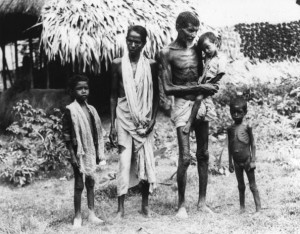
The British brutally put down the Indian Mutiny in 1857-8 with massacres in Delhi, Allahabad, Kanpur and Lucknow. Then, as up to 30 million Indians died in famines in 1876-9 and 1896-1902, the British government of India explicitly prohibited relief efforts or actions that might reduce exports from India to the U.K. or interfere with the operation of the “free market.”

As Mike Davis wrote in his 2001 book, Late Victorian Holocausts, “What seemed from a metropolitan perspective the nineteenth century’s final blaze of imperial glory was, from an Asian or African viewpoint, only the hideous light of a giant funeral pyre.”

And yet Britain kept control of India by commanding such loyalty and subservience from millions of Indians that, in every crisis, Indian troops obeyed orders from British officers to massacre their own people.

Danny Sjursen and U.S. troops in Afghanistan, Iraq and other post-Cold War U.S. war zones are having a very different experience. In Afghanistan, as the Taliban and its allies have taken control of more of the country than at any time since the U.S. invasion, the U.S.-backed Afghan National Army has 25,000 fewer troops under its command than it did five years ago, while ten years of training by U.S. special operations forces has produced only 21,000 trained Afghan Commandos, the elite troops who do 70-80% of the killing and dying for the corrupt U.S.-backed Afghan government.

But the U.S. has not completely failed to win the loyalty of its imperial subjects. The first U.S. soldier killed in action in Afghanistan in 2018 was Sergeant 1st Class Mihail Golin, originally from Latvia.  Mihail arrived in the U.S. in November 2004, enlisted in the U.S. Army three months later and has now given his life for the U.S. Empire and for whatever his service to it meant to him. At least 127 other Eastern Europeans have died in occupied Afghanistan, along with 455 British troops, 158 Canadians and 396 soldiers from 17 other countries.  But 2,402 – or 68%, over two-thirds – of the occupation troops who have died in Afghanistan since 2001, were Americans.

In Iraq, an American war that always had even less international support or legitimacy, 93% of the occupation troops who have died were Americans, 4,530 out of a total of 4,852 “coalition” deaths.

When Ben Griffin, who later founded the U.K. branch of Veterans for Peace, told his superiors in the U.K.’s elite SAS (Special Air Service) that he could no longer take part in murderous house raids in Baghdad with U.S. special operations forces, he was surprised to find that his entire chain of command understood and accepted his decision. The only officer who tried to change his mind was the chaplain.

The Future of Empire

The U.S. Joint Chiefs of Staff have explicitly told Congress that war with North Korea would require a ground invasion, and the same would likely be true of a U.S. war on Iran. South Korea wants to avoid war at all costs, but may be unavoidably drawn into a U.S.-led Second Korean War.

But besides South Korea, the level of support the U.S. could expect from its allies in a Second Korean War or other wars of aggression in the future would probably be more like Iraq than Afghanistan, with significant international opposition, even from traditional U.S. allies. U.S. troops would therefore make up nearly all of the invasion and occupation forces – and take nearly all of the casualties.

Compared to past empires, the cost in blood and treasure of policing the U.S. Empire and the blame for its catastrophic failures fall disproportionately – and rightly – on Americans. Even Donald Trump recognizes this problem, but his demands for allied countries to spend more on their militaries and buy more U.S. weapons will not change their people’s unwillingness to die in America’s wars.

This reality has created political pressure on U.S. leaders to wage war in ways that cost fewer American lives but inevitably kill many more people in countries being punished for resistance to U.S. imperialism, using air strikes and locally recruited death squads instead of U.S. “boots on the ground” wherever possible.

The U.S. conducts a sophisticated propaganda campaign to pretend that U.S. air-launched weapons are so accurate that they can be used safely without killing large numbers of civilians. Actual miss rates and blast radii are on the “banned topics” blacklist, along with realistic estimates of civilian deaths.

When former Iraqi foreign minister Hoshyar Zebari told Patrick Cockburn of the U.K.’s Independent newspaper that he had seen Iraqi Kurdish intelligence reports which estimated that the U.S.- and Iraqi-led destruction of Mosul had killed 40,000 civilians, the only remotely realistic estimate so far from an official source, no other mainstream Western media followed up on the story.

But America’s wars are killing millions of innocent people: people defending themselves, their families, their communities and countries against U.S. imperialism and aggression; and many more who were simply in the wrong place at the wrong time under the onslaught of over 210,000 American bombs and missiles dropped on at least 7 countries since 2001.

According to a growing body of research (for example, see the UN Development Program study, Journey to Extremism in Africa: Drivers, Incentives and the Tipping-Point for Recruitment), most people who join armed resistance or “terrorist” groups do so mainly to protect themselves and their families from the dangers of wars that others have inflicted on them. The UNDP survey found that the final “tipping point” that pushes over 70% of them to take the fateful step of joining an armed group is the killing or detention of a close friend or family member by foreign or local security forces.

So the reliance on airstrikes and locally recruited death squads, the very strategies that make U.S. imperialism palatable to the American public, are in fact the main “drivers” spreading armed resistance and terrorism to country after country, placing the U.S. Empire on a collision course with itself.

The U.S. effort to delegate war in the Middle East to Saudi Arabia is turning it into a target of global condemnation as it tries to mimic the U.S. model of warfare by bombing and starving millions of innocent people in Yemen while blaming the victims for their plight. The slaughter by poorly trained and undisciplined Saudi and Emirati pilots is even more indiscriminate than U.S. bombing campaigns, and the Saudis lack the full protection of the Western propaganda system to minimize international outrage at tens of thousands of civilian casualties and an ever-worsening humanitarian crisis.

The need to win the loyalty of imperial subjects by some combination of fear and respect is a basic requirement of Empire. But it appears to be unattainable in the 21st century, certainly by the kind of murderous policies the U.S. has embraced since the end of the Cold War. As Richard Barnet already observed 45 years ago, at the end of the American War in Vietnam, “At the very moment the number one nation has perfected the science of killing, it has become an impractical instrument of political domination.”

Obama’s sugar-coated charm offensive won U.S. imperialism a reprieve from global public opinion and provided political cover for allied leaders to actively rejoin U.S.-led alliances. But it was dishonest. Under cover of Obama’s iconic image, the U.S. spread the violence and chaos of its wars and regime changes and the armed resistance and terrorism they provoke farther and wider, affecting tens of millions more people from Syria and Libya to Nigeria and Ukraine.

Now Trump has taken the mask off and the world is once again confronting the unvarnished, brutal reality of U.S. imperialism and aggression.

China’s approach to the world based on trade and infrastructure development has been more successful than U.S. imperialism. The U.S. share of the global economy has declined from 40% to 22% since the 1960s, while China is expected to overtake the U.S. as the world’s largest economy in the next decade or two – by some measures, it already has.

While China has become the manufacturing and trading hub of the global economy, the U.S. economy has been financialized and hollowed out, hardly a solid basis for future growth. The neoliberal model of politics and economics that the U.S. adopted a generation ago has created even greater wealth for people who already owned disproportionate shares of everything, but it has left working people in the U.S. and across the U.S. Empire worse off than before.

Like the “next to nothing” that Danny Sjursen came to realize he was fighting for in Iraq and Afghanistan, the prospects for the U.S. economy seem ephemeral and highly vulnerable to the changing tides of economic history.

The Rise and Fall of the Great Powers

In his 1987 book, The Rise and Fall of the Great Powers: Economic Change and Military Conflict from 1500 to 2000, historian Paul Kennedy examined the relationship between economic and military power in the histories of the Western empires who colonized the world in the past 500 years. He described how rising powers enjoy significant competitive advantages over established ones, and how every once-dominant power sooner or later has to adjust to the tides of economic history and find a new place in a world it can no longer dominate.

Kennedy explained that military power is only a secondary form of power that wealthy nations develop to protect and support their expanding economic interests. An economically dominant power can quickly convert some of its resources into military power, as the U.S. did during the Second World War or as China is doing today. But once formerly dominant powers have lost ground to new, rising powers, using military power more aggressively has never been a successful way to restore their economic dominance. On the contrary, it has typically been a way to squander the critical years and scarce resources they could otherwise have used to manage a peaceful transition to a prosperous future.

As the U.K. found in the 1950s, using military force to try to hold on to its empire proved counter-productive, as Kennedy described, and peaceful transitions to independence proved to be a more profitable basis for future relations with its former colonies. The drawdown of its global military commitments was an essential part of its transition to a viable post-imperial future.

The transition from hegemony to coexistence has never been easy for any great power, and there is nothing exceptional about the temptation to use military force to try to preserve and prolong the old order. This has often led to catastrophic wars and it has always failed.

It is difficult for any political or military leader to preside over a diminution of his or her country’s power in the world. Military leaders are rewarded for military strategies that win wars and expand their country’s power, not for dismantling it. Mid-level staff officers who tell their superiors that their weapons and armies cannot solve their country’s problems do not win promotion to decision-making positions.

As Gabriel Kolko noted in Century of War in 1994, this marginalization of critical voices leads to an “inherent, even unavoidable institutional myopia,” under which, “options and decisions that are intrinsically dangerous and irrational become not merely plausible but the only form of reasoning about war and diplomacy that is possible in official circles.”

After two world wars and the independence of India, the Suez crisis of 1956 was the final nail in the coffin of the British Empire, and the Eisenhower administration burnished its own anti-colonial credentials by refusing to support the British-French-Israeli invasion of Egypt. British Prime Minister Anthony Eden was forced to resign, and he was replaced by Harold Macmillan, who had been a close aide to Eisenhower during the Second World War.

Macmillan dismantled the remains of the British Empire behind the backs of his Conservative Party’s supporters, winning reelection in 1959 on the slogan, “You’ve never had it so good,” while the U.S. supported a relatively peaceful transition that preserved Western international business interests and military power.

As the U.S. faces a similar transition from empire to a post-imperial future, its leaders have been seduced by the chimera of the post-Cold War “power dividend” to try to use military force to preserve and expand the U.S. Empire, even as the relative economic position of the U.S. declines.

In 1987, Paul Kennedy ended The Rise and Fall of the Great Powers with a prescient analysis of the U.S. position in the world. He concluded,

“In all of the discussions about the erosion of American leadership, it needs to be repeated again and again that the decline referred to is relative not absolute, and is therefore perfectly natural; and that the only serious threat to the real interests of the United States can come from a failure to adjust sensibly to the newer world order.”

But after Kennedy wrote that in 1987, instead of accepting the future of peace and disarmament that the whole world hoped for at the end of the Cold War, a generation of American leaders made a fateful bid for “superpower.” Their delusions were exactly the kind of failure to adjust to a changing world that Kennedy warned against.

The results have been catastrophic for millions of victims of U.S. wars, but they have also been corrosive and debilitating for American society, as the perverted priorities of militarism and Empire squander our country’s resources and leave working Americans poorer, sicker, less educated and more isolated from the rest of the world.

When I began writing Blood On Our Hands: the American Invasion and Destruction of Iraq in 2008, I hoped that the catastrophes in Afghanistan and Iraq might bring U.S. leaders to their senses, as the Suez crisis did to British leaders in 1956.

Instead, eight more years of carefully disguised savagery under Obama have squandered more precious time and good will and spread the violence and chaos of U.S. war-making even farther and wider. The new National Defense Strategy’s implicit threats against Russia and China reveal that 20 years of disastrous imperial wars have done nothing to disabuse U.S. leaders of their delusions of “superpower status” or to restore any kind of sanity to U.S. foreign policy.

Trump is not even pretending to respect diplomacy or international law, as he escalates Bush’s and Obama’s wars and threatens new ones of his own. But maybe Trump’s nakedly aggressive policies will force the world to finally confront the dangers of U.S. imperialism. A coming together of the international community to stop further U.S. aggression may be the only way to prevent an even greater catastrophe than the ones that have already befallen the people of Afghanistan, Iraq, Somalia, Honduras, Libya, Syria, Ukraine and Yemen.

Or will it actually take a new and even more catastrophic war in Korea, Iran or somewhere else to finally force the United States to “adjust sensibly to the new world order,” as Paul Kennedy put it in 1987? The world has already paid a terrible price for our leaders’ failure to take his sound advice a generation ago. But what will be the final cost if they keep ignoring it even now?

Nicolas J.S. Davies is the author of Blood On Our Hands: the American Invasion and Destruction of Iraq.

January 23, 2018 Posted by | Economics, Militarism, Timeless or most popular, War Crimes | , , , , , | Leave a comment

2018 will see US fighting three and a half wars in Middle East

By M K Bhadrakumar | Indian Punchline | December 31, 2017

At a ‘press gaggle’ at the Pentagon on Friday, US Defence Secretary James Mattis revealed that there isn’t going to be any withdrawal from the Syrian conflict. The Trump administration, on the contrary, plans to expand the presence by deploying diplomats and contractors to the north of Syria. Mattis called this a shift “from what I would call an offensive, terrain-seizing approach to a stabilizing” one.

That is to say, he explained, while the diplomats would work toward the “initial restoration of services” and to manage and administer rebuilding cities, the Pentagon will “bring in contractors” for training people on how to clear IEDs” (improvised explosive devices), etc. and alongside there will be a continuing military component to the US presence that “would move our diplomats around, protect them.” Mattis insisted that there is a “demarcation line” separating the US military zone in north and northeastern Syria, which the “Russian regime” and Syrian government are well aware of and are tacitly respecting so far.

Evidently, the US will continue its alliance with the Syrian Kurdish militia (known as YPG) in northern Syria, including the supply of weapons. The US defense spending bill for 2018 has made provision for sending weapons worth $393 million to US partners in Syria. Overall, $500 million, which is an increase of $70 million over 2016) is the allocation for Syria under ‘Train and Equip’ requirements. The budget mentions the opposition forces supported as a part of the train and equip program in Syria as 25,000 strong. The figure will now go up to 30,000 in 2018. Besides, the US and British military are training several hundred militants to create a New Syrian Army to fight the Syrian government forces in the south. (According to Russian estimates, most of the recruits are from ISIS and al-Qaeda groups.)

To be sure, the US’ ‘regime change’ agenda in Syria is back on track. But the Syrian conflict is also transforming as another template of a broader regional confrontation with Iran (and Russia) in the Middle East. The petard of Iran is useful to encourage the Sunni Arab petrodollar states to bankroll the war and overall make the US military interventions in the Middle East to be “self-financing”. (Mattis said, “We’ve got a lot of money coming from international donors for this, including Syria.”)

Meanwhile, this also means that the wars in Syria and Yemen are going to get fused at the hips, as it were. While the Obama administration was inclined to acknowledge that Iran’s interference in the war in Yemen, if at all, has been very minimal, the Trump administration has swung to the other extreme and brands the war as quintessentially a manifestation of Iran’s expansionist policies in the region. This creates the raison d’etre for more direct US intervention in the war in Yemen.

That makes it two full-bodied wars. Then, there is half a war to be added, which is in the nature of the Trump administration’s agenda to generally push back at Iran anywhere and everywhere (eg., Iraq, Lebanon), and, if possible, to bring about a ‘regime change’ in Tehran. According to a report in the Jerusalem Post last week, the US and Israel have set up 4 working groups to advance their “joint work plan” against Iran. This decision has been taken apparently at a secret meeting at the White House in Washington two weeks ago and will be put into the pipeline in 2018.

These two and a half wars become three and a half wars if we are also to add the Afghan war, which is entering its 17th year in 2018. The US has upped the ante by seeking a military solution to the Afghan war, disregarding the saner advice that a political solution is the best way out. The big question is whether 2018 will witnesses a US-Pakistani showdown.

A report in the New York Times on Friday hinted at the Trump administration “strongly considering whether to withhold $255 million in aid that it had delayed sending to Islamabad… as a show of dissatisfaction with Pakistan’s broader intransigence toward confronting the terrorist networks that operate there.” Evidently, the US’ capacity to leverage Pakistani policies is touching rock bottom. The next step could be to deliver on the threat to punish Pakistan. If that happens, there will be hell to pay.

Indeed, in the above cauldron, one hasn’t included the succession in Saudi Arabia, which can likely happen during 2018; the growing instability in Egypt; the continuing anarchy in Libya; or the Saudi-Qatar rift and the consequent unraveling of the GCC. Who says the US is about to cut loose from the Middle East and escape to the ‘Indo-Pacific’? Do not overlook that an overarching priority of the US’ Middle East strategy is also to evict Russia from the region as it managed to do in the early 1970s so as to contain the bear in its lair in Eurasia.

December 31, 2017 Posted by | Militarism, Timeless or most popular, Wars for Israel | , , , , , , , | Leave a comment

CPEC heading north to Hindu Kush

By M K Bhadrakumar | Indian Punchline | December 26, 2017

From the Indian perspective, today’s announcement by Chinese Foreign Minister Wang Yi that Beijing and Islamabad are open to extending the China-Pakistan Economic Corridor to Afghanistan dramatically changes the power dynamic in the region. Wang was speaking at a press conference following the first meeting in Beijing today of the newly created China-Afghanistan-Pakistan Dialogue format at foreign minister level, which has been a Chinese initiative. (Xinhua )

Some early deductions are possible. First, for the first time in the region, China is deploying the Belt and Road Initiative to leverage regional security and stability in South Asia. Of course, the economic aspects are there in terms of connectivity, infrastructure development, expansion of trade and investment and so on, but if Kabul becomes a CPEC partner, something fundamentally changes in the 3-way Afghan-Indian-Pakistani equation. That this would be happening under China’s mentorship is important.

Second, India is getting surrounded by BRI projects – north, east, south and west. It lacks the energy and resources to project and sustain a counter-strategy. All we are left with is our vacuous negative propaganda to malign the BRI for which there are no takers abroad. By implication, Afghanistan is rejecting India’s notions of “territorial sovereignty”, et al. At the same time, China’s interest in Indian participation in the BRI is self-evident. Time is running out for India. New thinking is needed urgently.

Third, Wang’s statement in Beijing on Monday during a media briefing on the agenda for Chinese diplomacy in the coming year singled out North Korea and Afghanistan as two regional problems where China intends to push for peacemaking. Today’s disclosure fits in with that. The trilateral format may eventually provide the platform for a regional initiative. The joint press release issued after today’s meeting called on the Taliban “to join the peace process at an early date.”

Fourth, China is displeased that the US is seeking a military solution to the conflict in Afghanistan. The Trump administration is pursuing a dangerous strategy that can destabilize the entire region surrounding Afghanistan. But China will not confront the US, either. Instead, China is introducing a counter-narrative. The US will increasingly find itself in a false position by threatening Pakistan even as Afghanistan is edging toward the CPEC to “conduct win-win trilateral economic cooperation”.

Fifth, the geopolitical implications are profound. Wang today outlined that the CPEC will eventually extend northward to link with the China-Central Asia-West Asia Economic Corridor (CCWAEC), which connects China with the Arabian Peninsula. The CCWAEC starts from China’s Xinjiang and traverses Central Asia before reaching the Persian Gulf, the Mediterranean Sea and the Arabian Peninsula. It crosses the five Central Asian countries and 17 countries and regions in West Asia (including Iran, Saudi Arabia and Turkey). It is a vast landmass, which is rich in resources but backward in infrastructure.

Finally, there is a high degree of foreign-policy coordination between Beijing and Moscow. We must anticipate that it is a matter of time before Russia evinces interest in the CPEC in one form or another. President Vladimir Putin disclosed on Monday that during a phone conversation with his Turkmenistan counterpart, the subject of the TAPI (Turkmenistan-Afghanistan-Pakistan-India) gas pipeline project came up. “He invites us to participate. Generally, certain projects are indeed implemented there, and quite successfully, including by Turkmenistan. But we must take a look, of course, at how feasible projects of this kind will be,” Putin has been quoted as saying.

Indeed, the bottom line is that the tense relations with Pakistan — and the downhill slide in the relations with China — through the past 3-year period virtually shut India out of the power dynamic in the region and reduces it to a lone bystander. The scenario looks pretty bleak.

December 26, 2017 Posted by | Economics | , , , , | Leave a comment

Washington’s seasonal tidings of Phoenix-style dirty war for Afghanistan

By Finian Cunningham | RT | December 25, 2017

This week saw another deadly bomb attack in the Afghan capital, Kabul, only days after US Vice President Mike Pence promised American troops “victory was in sight.”

This war is far from over, and signs are it will get much worse in the year ahead.

Lurking behind the cheery seasonal tidings brought by Pence lies a forthcoming year of much-increased violence in Afghanistan. Away from the upbeat headlines are portents of ever-deeper involvement by US elite forces in the country’s unrelenting mayhem.

In particular, the US military is moving toward a new strategy under President Trump of unleashing killer units in an apparent bid to drown the Afghan insurgency in blood. It’s a policy America has tried elsewhere, for example, the infamous Phoenix program of assassination during the Vietnam War. The policy usually fails in its stated objectives of “peace and security.”

The “surprise” nature of Pence’s whirlwind visit just before the weekend shows the Central Asian country’s security is on a knife-edge. The unannounced trip by the vice president – his first to Afghanistan – was reportedly “shrouded in secrecy” for security reasons.

Arriving on board a C-17 military plane at the giant US air base at Bagram, then flown by helicopter to meet with Afghan President Ashraf Ghani, the logistics were an unmistakable indicator of how dangerous the country is. This after 16 years of the most protracted US war ever – supposedly to defeat Taliban militants.

Earlier in September, when US Secretary of Defense James Mattis flew into Kabul International Airport, Taliban insurgents were reportedly able to launch a rocket attack on his aircraft. Mattis and his delegation did not come to harm. This time, however, US officials seemed to be taking no chances with Pence, flying the vice president under cover of darkness to the high-security military airbase.

Wishing troops a “Merry Christmas,” Pence said: “I believe victory is closer than ever before.” He assured American forces that President Trump’s new “fight-to-win strategy” for Afghanistan was “bearing fruit.”

“The results are really beginning to become evident around the country,” claimed Pence after meeting with Ghani. The question is: what “evidence” was he referring to?

It was nearly four months ago, in August, that President Donald Trump announced a new plan for military involvement in Afghanistan. It was something of U-turn on his election campaign pledges last year to wind down American overseas wars.

Under Trump, up to 4,000 troops are to return to the country taking the total US presence there to 15,000. The numbers are set to substantially increase, according to Stars and Stripes, citing US Army Undersecretary Patrick Murphy.

The re-deployment to Afghanistan is still a lot less than the peak numbers during the Obama years when troop levels surged to 100,000. But there seems to be a qualitative shift under Trump marking more deadly involvement.

Trump’s “fight-to-win” strategy suggests US troops are to pursue much more aggressive tactics. Officially, the American military is supposed to be only “advising and training” local Afghan forces. But what the Trump administration is signaling is a return to heavy combat with elite infantry troops.

The Washington Post reported that Pence was briefed by the Afghan officials that “more senior Taliban leaders have been eliminated this year than in all previous years combined.”

If that’s confirmed, that marks a dramatic increase in US combat violence under Trump. It would also tally with Trump’s declared aim to give American commanders in Afghanistan a “freer hand” to carry out missions. This gloves-off policy under Trump has the hallmarks of US troops stepping up assassination squads to go after insurgents.

Another foreboding indicator is that US military journals are reporting, according to Stars and Stripes, elite combat troops being sent to Afghanistan in anticipation of sharper fighting in the Spring season. Those forces include infantry brigades from Fort Carson, Colorado, which are trained in “unconventional warfare” and operating deep inside enemy territory. Unconventional warfare can be seen as a euphemism for extrajudicial killings, torture, and terroristic operations.

The 1st Stryker Brigade Combat Team is reportedly replacing forces from the 82nd Airborne Division, who have completed a tour of duty under Trump’s new strategy. The latter are out of Fort Bragg, North Carolina, another center for elite killer forces trained in unconventional warfare.

Stars and Stripes quotes Army General John Nicholson, the top US commander in Afghanistan, as saying he is “optimistic” that under Trump’s freer-hand instructions it would “help push the long-stalemated war in favor of the US-backed Afghan government.”

In another sign of the covert operations underway, General Nicholson said: “more than 1,000 Americans would be operating away from bases at any given time once the fighting season begins.” In other words, the Trump administration has signed off on commando-warfare in Afghanistan, not with large troop numbers strewn across the country but with hunter-combat units operating behind enemy lines. In short, elite killer teams.

Given the briefings received by Pence while in Kabul of a seeming dramatic increase in killings of senior Taliban militants, what appears to be underway in Afghanistan is a Phoenix-style assassination campaign similar to what US elite forces carried out in the early years of the Vietnam War. That was where US personnel, along with local forces, went on murder sprees targeting enemy “suspects.” In Vietnam, it is believed that thousands of innocent, non-combatants were assassinated as part of a lethal trawl against militants.

It seems sinister that while Trump is giving US military commanders the green light to expand the war with elite forces operating behind enemy lines, his vice president Mike Pence is crowing about “real progress on the ground.”

It also seems impossibly doomed. Afghanistan is now a foothold for Daesh (Islamic State) as well as the Taliban. The former terror group claimed responsibility this week for the suicide bomb attack outside the Afghan security intelligence headquarters in Kabul, reportedly killing at least 10 bystanders. In recent months, bombings have apparently surged in the capital.

Up to half of all Afghan territory is now under control of insurgent groups. Opium drug production is soaring, and the US-backed state institutions are groaning from corruption.

Former Afghan President Hamid Karzai recently claimed that terrorism and lawlessness have flourished during the US presence in his country. Indeed, Karzai said the US forces and terror groups were working “hand in hand” across Afghanistan. He cited cases where militants have been allegedly transported to various parts of the country using US helicopters. Similar claims of US collusion with terror groups have also been made by the Russian government regarding Afghanistan and Syria.

So, just what “progress” the Trump administration is referring to in Afghanistan remains cryptic.

The US-backed regime in Kabul is losing more control of territory, while the country descends further into chaos and violence. More than 30,000 civilians have been killed during 16 years of “Operation Enduring Freedom” launched by Washington in October 2001.

Fiendishly, the Afghan population is set to endure more such American-style freedom with Trump’s dispatch of killer troops.

December 25, 2017 Posted by | Illegal Occupation, Militarism, Timeless or most popular, War Crimes | , | Leave a comment

Did Obama Arm Islamic State Killers?

By Daniel Lazare | Consortium News | December 21, 2017

Did Barack Obama arm ISIS? The question strikes many people as absurd, if not offensive. How can anyone suggest something so awful about a nice guy like the former president? But a stunning report by an investigative group known as Conflict Armament Research (CAR) leaves us little choice but to conclude that he did.

CAR, based in London and funded by Switzerland and the European Union, spent three years tracing the origin of some 40,000 pieces of captured ISIS arms and ammunition. Its findings, made public last week, are that much of it originated in former Warsaw Pact nations in Eastern Europe, where it was purchased by United States and Saudi Arabia and then diverted, in violation of various rules and treaties, to Islamist rebels seeking to overthrow Syrian President Bashar al-Assad. The rebels, in turn, somehow caused or allowed the equipment to be passed on to Islamic State, which is also known by the acronyms ISIS or ISIL, or just the abbreviation IS.

This is damning stuff since it makes it clear that rather than fighting ISIS, the U.S. government was feeding it.

But CAR turns vague when it comes to the all-important question of precisely how the second leg of the transfer worked. Did the rebels turn the weapons over voluntarily, involuntarily, or did they somehow drop them when ISIS was in close proximity and forget to pick them up? All CAR will say is that “background information … indicates that IS [Islamic State] forces acquired the materiel through varied means, including battlefield capture and the amalgamation of disparate Syrian opposition groups.” It adds that it “cannot rule out direct supply to IS forces from the territories of Jordan and Turkey, especially given the presence of various opposition groups, with shifting allegiances, in cross-border supply locations.” But that’s it.

If so, this suggests an astonishing level of incompetence on the part of Washington. The Syrian rebel forces are an amazingly fractious lot as they merge, split, attack one another and then team up all over again. So how could the White House have imagined that it could keep weapons tossed into this mix from falling into the wrong hands? Considering how each new gun adds to the chaos, how could it possibly keep track? The answer is that it couldn’t, which is why ISIS wound up reaping the benefits.

But here’s the rub. The report implies a level of incompetence that is not just staggering, but too staggering. How could such a massive transfer occur without field operatives not having a clue as to what was going on? Was every last one of them deaf, dumb, and blind?

Not likely. What seems much more plausible is that once the CIA established “plausible deniability” for itself, all it cared about was that the arms made their way to the most effective fighting force, which in Syria happened to be Islamic State.

This is what had happened in Afghanistan three decades earlier when the lion’s share of anti-Soviet aid, some $600 million in all, went to a brutal warlord named Gulbuddin Hekmatyar. Hekmatyar was a raging bigot, a sectarian, and an anti-western xenophobe, qualities that presumably did not endear him to his CIA handlers. But as Steve Coll notes in Ghost Wars, his bestselling 2004 account of the CIA’s love affair with Islamic holy war, he “was the most efficient at killing Soviets” and that was the only thing that mattered. As one CIA officer put it, “analytically, the best fighters – the best-organized fighters – were the fundamentalists” that Hekmatyar led. Consequently, he ended up with the most money.

After all, if you’re funding a neo-medieval uprising, it makes sense to steer the money to the darkest reactionaries of them all. Something similar occurred in March 2015 when Syrian rebels launched an assault on government positions in the northern province of Idlib. The rebel coalition was under the control of Jabhat al-Nusra, as the local branch of Al Qaeda was known at the time, and what Al-Nusra needed most of all were high-tech TOW missiles with which to counter government tanks and trucks.

Arming Al Qaeda

So the Obama administration arranged for Nusra to get them. To be sure, it didn’t provide them directly. To ensure deniability, rather, it allowed Raytheon to sell some 15,000 TOWs to Saudi Arabia in late 2013 and then looked the other way when the Saudis transferred large numbers of them to pro-Nusra forces in Idlib. [See Consortiumnews.com’sClimbing into bed with Al-Qaeda.”] Al-Nusra had the toughest fighters in the area, and the offensive was sure to send the Assad regime reeling. So even though its people were compatriots with those who destroyed the World Trade Center, Obama’s White House couldn’t say no.

“Nusra have always demonstrated superior planning and battle management,” Yezid Sayigh, a senior associate at the Carnegie Middle East Center in Beirut, said a few weeks later. If the rebel coalition was successful as a whole, it “was entirely due to their willingness to work with Nusra, who have been the backbone in all of this.”

Scruples, assuming they existed in the first place, fell by the wayside. A senior White House official told The Washington Post that the Obama administration was “not blind to the fact that it is to some extent inevitable” that U.S. weapons would wind up in terrorist hands, but what could you do? It was all part of the game of realpolitik. A senior Washington official crowed that “the trend lines for Assad are bad and getting worse” while The New York Times happily noted that “[t]he Syrian Army has suffered a string of defeats from re-energized insurgents.” So, for the master planners in Washington, it was worth it.

Then there is ISIS, which is even more beyond the pale as most Americans are concerned thanks to its extravagant displays of barbarism and cruelty – its killing of Yazidis and enslavement of Yazidi women and girls, its mass beheadings, its fiery execution of Jordanian fighter pilot Moaz al-Kasasbeh, and so on.

Yet U.S. government attitudes were more ambivalent than most Americans realized. Indeed, the U.S. government was strictly neutral as long as ISIS confined itself to attacking Assad. As a senior defense official told the Wall Street Journal in early 2015: “Certainly, ISIS has been able to expand in Syria, but that’s not our main objective. I wouldn’t call Syria a safe haven for ISIL, but it is a place where it’s easier for them to organize, plan, and seek shelter than it is in Iraq.”

In other words, Syria was a safe haven because, the Journal explained, the U.S. was reluctant to interfere in any way that might “tip the balance of power toward Syrian President Bashar al-Assad, who is fighting Islamic State and other rebels.” So the idea was to allow ISIS to have its fun as long as it didn’t bother anyone else. For the same reason, the U.S. refrained from bombing the group when, shortly after the Idlib offensive, its fighters closed in on the central Syrian city of Palmyra, 80 miles or so to the east.  This was despite the fact that the fighters would have made perfect targets while “traversing miles of open desert roads.”

As The New York Times explained: “Any airstrikes against Islamic State militants in and around Palmyra would probably benefit the force of President Bashar al-Assad. So far, United States-led airstrikes in Syria have largely focussed on areas far outside government control, to avoid the perception of aiding a leader whose ouster President Obama has called for.” [See Consortiumnews.com’sHow US-Backed War on Syria Helped ISIS.”]

Looting Palmyra

The United States thus allowed ISIS to capture one of the most archeologically important cities in the world, killing dozens of government soldiers and decapitating 83-year-old Khalid al-Asaad, the city’s retired chief of antiquities. (After looting and destroying many of the ancient treasures, ISIS militants were later driven from Palmyra by a Russian-backed offensive by troops loyal to President Assad.)

Obama’s bottom line was: ISIS is very, very bad when it attacks the U.S.-backed regime in Iraq, but less so when it wreaks havoc just over the border in Syria. In September 2016, John Kerry clarified what the administration was up to in a tape-recorded conversation at the U.N. that was later made public. Referring to Russia’s decision to intervene in Syria against ISIS, also known by the Arabic acronym Daesh, the then-Secretary of State told a small knot of pro-rebel sympathizers:

“The reason Russia came in is because ISIL was getting stronger.  Daesh was threatening the possibility of going to Damascus and so forth, and that’s why Russia came in, because they didn’t want a Daesh government and they supported Assad. And we know this was growing. We were watching. We saw that Daesh was growing in strength, and we thought Assad was threatened. We thought, however, we could probably manage, that Assad might then negotiate. Instead of negotiating, he got … Putin in to support him. So it’s truly complicated.”  (Quote starts at 26:10.)

“We were watching.” Kerry said. So, by giving ISIS free rein, the administration hoped to use it as a lever with which to dislodge Assad. As in Afghanistan, the United States thought it could use jihad to advance its own imperial interests. Yet the little people – Syrian soldiers, three thousand office workers in lower Manhattan, Yazidis, the Islamic State’s beheading of Western hostages, etc. – made things “truly complicated.”

Putting this all together, a few things seem clear. One is that the Obama administration was happy to see its Saudi allies use U.S.-made weapons to arm Al Qaeda. Another is that it was not displeased to see ISIS battle Assad’s government as well. If so, how unhappy could it have been if its allies then passed along weapons to the Islamic State so it could battle Assad all the more? The administration was desperate to knock out Assad, and it needed someone to do the job before Vladimir Putin stepped in and bombed ISIS instead.

It was a modern version of Henry II’s lament, “Who will rid me of this meddlesome priest?” The imperative was to get rid of Assad; Obama and his team had no interest in the messy details.

None of which proves that Obama armed ISIS. But unless one believes that the CIA is so monumentally inept that it could screw up a two-car funeral, it’s the only explanation that makes sense. Obama is still a congenial fellow. But he’s a classic liberal who had no desire to interfere with the imperatives of empire and whose idea of realism was therefore to leave foreign policy in the hands of neocons or liberal interventionists like Secretaries of State Hillary Clinton and John Kerry.

If America were any kind of healthy democracy, Congress would not rest until it got to the bottom of what should be the scandal of the decade: Did the U.S. government wittingly or unwittingly arm the brutal killers of ISIS and Al Qaeda? However, since that storyline doesn’t fit with the prevailing mainstream narrative of Washington standing up for international human rights and opposing global terrorism, the troublesome question will likely neither be asked nor answered.


Daniel Lazare is the author of several books including The Frozen Republic: How the Constitution Is Paralyzing Democracy (Harcourt Brace).

December 21, 2017 Posted by | Timeless or most popular, War Crimes | , , , , , , | Leave a comment