Iran opposed to US push for reforms in global health rules: Official
Press TV – May 25, 2022
A senior Iranian health ministry official says the country has publicly declared its opposition to a US-led proposal to reform the International Health Regulations (IHR).
Mohammad Hassan Niknam, a special aide to the Iranian health minister, said on Wednesday that an Iranian delegation attending the World Health Organization’s annual assembly in Geneva had rejected a proposal put forward by the United States and other countries to speed up the implementation for future IHR reforms from 24 to 12 months.
“The Islamic Republic of Iran officially distanced itself from accepting any commitment on this proposal during the assembly,” said Niknam.
Media reports on Tuesday suggested Iran and Malaysia had expressed reservations about the IHR reforms while a delegate representing African countries had entirely rejected the move.
Niknam said, however, that Iran has publicly announced that it is opposed to fast tracking future IHR reforms.
He said Iranian health minister Bahram Einollahi had declared the opposition during his speech to the WHO assembly while delegates representing the country in committee discussions had also opposed the move.
The Iranian health system has suffered from the impacts of American sanctions on the country during the spread of the coroanvirus pandemic.
Iran was forced to rely on home-grown capacities to tackle one of the largest outbreaks of the disease in the Middle East as the sanctions hampered its access to foreign supplies of vaccines, medicines and medical equipment.
US officials have repeatedly claimed that Iran’s humanitarian needs have been exempt from the sanctions. That comes as foreign suppliers and banks have refused to process Iranian requests for medical supplies under pressure from Washington.
Global demand for vaccines drops sharply
Free West Media | May 14, 2022
Chinese biotech firm Kexing Holdings has made a fortune selling Sinovac’s Chinese vaccine. A few days ago, however, it became known that the bonus payments were withheld and most of the workforce has been laid off. Exports of Chinese vaccines (Sinovac, Sinopharm, CanSino) were 97 percent lower in April than in September 2021.
The Chinese outlet Caitong News reported, citing Kexing employees, that the company made a profit of 82 billion yuan (around 11.6 billion euros) last year. At the same time, the company announced that the year-end bonus payment for the past year would be “postponed”.
Shortly thereafter, Kexing suddenly announced massive layoffs. According to Kexing officials, the company has given staff two options: resign themselves and collect an indefinite severance pay, or take indefinite leave. In the latter case, with 80 percent of Beijing’s minimum wage as compensation.
According to the report, Kexing (Sinovac) has already laid off up to 70 percent of its staff. After the last wave of layoffs was completed in April of this year, the year-end bonuses were then distributed to the remaining employees on April 25. There is no statement or justification for the layoffs by Kexing. However, according to Japanese media reports, China’s vaccine exports have fallen sharply.
Thus, Nikkei Asia, citing UNICEF, reported that the vaccine against Covid-19, which is manufactured by three Chinese companies Sinopharm, Sinovac and CanSino, exported a total of 6,78 million doses in April this year. This is a drop of 97 percent compared to the peak exports in September 2021.
Massive drop in exports also for other Covid jabs
Global demand for vaccines has fallen sharply this year. Not only the exports of Chinese vaccines have fallen sharply due to their ineffectiveness against the Omicron variant.
Exports of Moderna’s and Pfizer’s mRNA drugs are also down 57 and 71 percent, respectively, compared to September last year, according to the report. Pfizer’s exports are nevertheless still eight times those of the three Chinese companies combined.
In South Africa, vaccine production has been grinding to a halt due to the fact that there are no orders.
Vaccine production in Africa almost halted
In South Africa, for example, the pharmaceutical company Aspen, which produces its own filling of the vaccine from Johnson & Johnson and sells it under the name Aspenovax, reported that there were no orders.
“It is feared that the production of the vaccine in South Africa will have to end. There is simply no demand for it. Not a single order has come in for weeks,” German daily Süddeutsche Zeitung reported.
The risk is “very high that the company will actually stop producing Johnson & Johnson vaccines,” the head of the African health authority (African Centers for Disease Control and Prevention) is quoted as saying in the report. Only around 12 percent of the population in Africa have been vaccinated twice. About 40 percent of the vaccine doses shipped to Africa were not used.
The over-supply of free Covid-19 vaccine doses — donated by high-income countries — had closed the gap that Aspen was meant to fill in the market.
According to another German daily, the Tagesanzeiger, millions of BioNTech vaccine doses will have to be disposed of in June.
The comparatively young population of Africa is hardly affected by Corona and faces completely different challenges, such as malaria or the impending starvation catastrophe. Against the background of the threat of starvation or an infection with malaria, which affects millions of people and kills hundreds of thousands every year, there is simply no room for media hysteria around the Corona virus.
Climate Colonialists Disrupt African Pipeline, Perpetuate Poverty
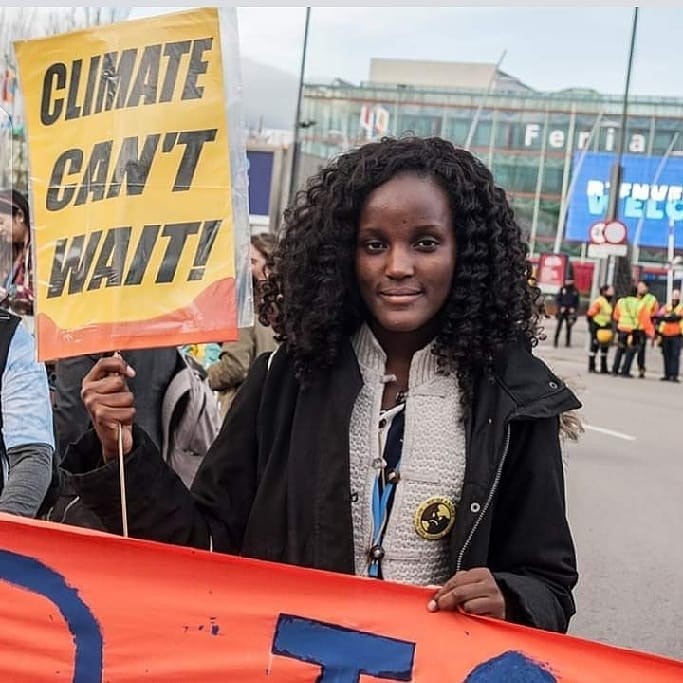
Vanessa Nakate
By Vijay Jayaraj | RealClear Energy | April 28, 2022
Climate activists’ ill-founded opposition to fossil fuels threatens to stop a major pipeline project in East Africa and stymie economic growth in Uganda and Tanzania — home to some of the world’s poorest people.
Uganda is betting big on its fossil fuel reserves. In February, China National Offshore Oil Corporation (CNOOC) and France’s TotalEnergies agreed to invest $10 billion to develop two Ugandan oil reserves. But the landlocked country needs the East African Crude Oil Pipeline project (EACOP) to transport its product to a port in Tanzania.
The 895-mile-long pipeline from Uganda’s Lake Alberta region to the seaport of Tanga will be the longest electrically heated crude oil pipeline in the world and will carry 216,000 barrels per day. The project received a green light for construction after the completion of an Environment and Social Impact Assessment.
The Africa Report says that the investment will be huge: “(A)bout $10 billion will be invested in the sector (oil and gas) before first oil is produced in 2025, mainly on the pipeline, refinery, and infrastructure. The government has been commissioning road construction in the region where oil will be produced, in Buliisa and Hoima districts, and an airport is also being constructed in the region.” The project is expected to generate around 10,000 jobs even after the construction phase.
The Government of Uganda expects massive employment of its citizens during construction: “This will be through direct employment of about 14,000 people by the companies, indirect employment of about 45,000 people by the contractors, and induced employment of about 105,000 people as a result of utilization of other services by the oil and gas sector. Of the direct employment, 57 percent are expected to be Ugandans, which is expected to result in an estimated $48.5 million annual payment to Ugandan employees.”
However, the global war against fossil fuel has now reached Ugandan soil and extremists are determined to stop this lifesaving, economically critical project.
Vanessa Nakate of StopEACOP rants against the pipeline in a recent column in the New York Times, saying the project would bring poverty and destruction to the people of Africa. She also references extreme weather in implying the pipeline will worsen the climate.
During a visit to the ultra-rich Vatican, Vanessa says: “It is evident that there is no future in the fossil fuel industry…. we know the impacts on our food. We know the impacts on our water. We know the impacts on our livelihood…… the climate crisis is already affecting so many people not only in Uganda, but the African continent.”
But her reasons for opposing the pipeline are scientifically inaccurate and logically senseless.
She points to a forecast by the Intergovernmental Panel on Climate Change (IPCC) that predicts African droughts. But IPCC, by its own admission, has indicated that extreme weather events have no significant correlation with rising global average temperatures. Neither has there been any significant increase in the frequency of extreme cyclones, droughts, rainfall, and fires. Even if droughts and cyclones were to increase, a better socio-economic condition would enable people to adapt more effectively.
Contrary to Vanessa’s hyperbole, the world is experiencing near optimum temperatures for global food production and the advancement of human society, much as it did 1,000 years ago during the Medieval Warm Period and 2,000 years ago during the Roman Warm Period. Globally, we now have better access to clean water, better access to nutritious food, people with higher income, and a very rapid increase in life expectancy rates. How are we in a crisis if climate is aiding the improvement of every metric used to measure the quality of people’s lives?
It is shocking how Vanessa ignores the plight of millions of her own people dwelling in persistent poverty and in need of affordable, dependable energy sources like coal, oil, and gas. It is less shocking if we understand the DNA of climate extremists, which has them deny the reality of energy needs and promote unreliable, primitive, and expensive wind turbines that even economic giants like Germany and the U.S. hesitate to adopt completely.
Climate extremists like Vanessa are fostering the continuation of abject poverty in Africa — a continent with the lowest level of electrification and highest rates of poverty in the world. Vanessa claims that the pipeline is another colonial project subjecting Africans to slavery. But, it is Vanessa and her ilk who are the colonialists and would-be slave masters.
Vijay Jayaraj is a Research Associate at the CO2 Coalition, Arlington, Va., and holds a Master’s degree in environmental sciences from the University of East Anglia, England. He resides in Bengaluru, India.
African Governments to Western Eco-Imperialists Who Tell Them Not to Drill Their Own Oil and Gas – Get Lost
By Chris Morrison | The Daily Sceptic | May 5, 2022
It was never going to work. Telling African countries to stop developing their economies by banning cheap, reliable fossil fuel is little more than an eco-imperialist dream. Writing in Monday’s Daily Telegraph, Uganda President Yoweri Museveni lauded the discovery of oil in Lake Albert, but noted it was a battleground for the green NGOs and activists who claim that Armageddon is nigh at every opportunity.
“We are accustomed to these lectures, but we are tired of hearing them,” he added.
For the last decade, the West through the IMF and the World Bank has imposed a moratorium on support for African fossil fuel development – initially coal and more recently oil and gas as well. Museveni notes that in Africa the population is set to double by 2050, “and it is becoming increasingly clear that our energy needs cannot be met with a sudden shift to more expensive and less reliable solar and wind alone”.
Rich Western eco elites, of course, argue that the world must rid itself of fossil fuel as soon as possible. They believe the world is facing climate breakdown, although as articles in the Daily Sceptic show on a regular basis, that belief is backed by surprisingly few scientific facts. These Western elites effectively seek a command-and-control economy based on Net Zero, and a neo-pagan return to ancient Gaia goddess worship that elevates nature as sacred and denigrates humanity as destructive of it.
It might all play better in Africa if so-called global warming could be detected.
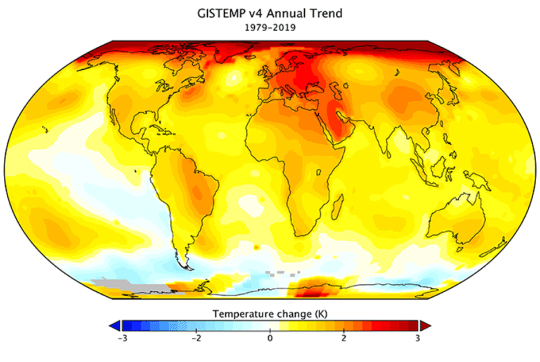
Atmospheric warming over the last 40 years has been more pronounced over the northern hemisphere, despite regular scare stories appearing about equatorial regions becoming uninhabitable. The GISS temperature database is run by NASA, and as with similar datasets it has been subject to considerable recent modifications, with the past cooled and later results warmed. Without these retrospective data adjustments, global recorded warming ran out of steam nearly two decades ago. Nevertheless, the contrast between the north, painted in fiery red, and most of Africa is clear from the GISS map (above).
The Lake Albert project is going ahead following a $10bn investment from the China National Offshore Oil Corporation and Total Energies of France. It includes the building of a 900 mile pipeline to the port of Tanga. According to Real Clear Energy, the project will provide $48.5m in annual payments to Ugandan employees living in one of the least developed countries in the world. But opposition is fierce. Writing in the New York Times the local green agitator Vanessa Nakate of StopEACOP said the project would bring “poverty and destruction to the people of Africa”. It is claimed by her activist group that building the East African crude oil pipeline would tip the world closer to “full blown climate catastrophe”.
It is comments such as these which mostly surface in mainstream media, rather than those of the President of Uganda. It might also be thought that most Africans are less impressed with other solutions advanced in the West to solve any problems caused by growing populations. Sir David Attenborough is on record as stating humans are a plague on the Earth, and it was “barmy” to send food to Ethiopia to solve the famine crisis. In Attenborough’s view, sending flour bags to under-developed countries was pointless.
In public in the West, many African politicians pay lip service to the aims of COP, not least because plenty of aid cash is on offer. Others take a more challenging and outspoken view. N.J. Ayuk is the Executive Chairman of the African Energy Chamber and he recently called the idea that you could develop Africa with handouts, “preposterous and sickening”.
He continued: “You cannot take people of any colour and exempt them from the requirements of civilisation – including work, free markets, behavioural standards, personal responsibility, fossil fuels, financial literacy and all the other basic things that the clever intelligentsia disdain – without ruinous consequences to them and society at large.”
In his view, no country has ever been developed by fancy wind and green hydrogen. Africans see oil and gas as a path to success and a solution to their problems. “The demonisation of oil and gas companies will not work,” he added.
Writing in 2015, the former Chancellor of the Exchequer Nigel Lawson commented that something deep inside the human psyche makes it receptive to apocalyptic warnings. By a cruel irony, he said, too many climate scientists and their hangers-on have become the high priests of a new age of unreason. Asking developing countries to abandon the cheapest available sources of energy is, at the very least, asking them to delay the conquest of malnutrition, to perpetuate the incidence of preventable diseases and to increase the number of premature deaths.
“Global warming orthodoxy is not merely irrational. It is wicked,” he concluded.
Nigerian Minister Says Russian Investors Interested in Financing African Gas Mega-Pipeline

Samizdat | May 4, 2022
The EU has been wooing Nigeria in recent weeks as one of the nations whose natural gas could help replace Russian supplies amid the bloc’s spat with Moscow over Ukraine. The charm offensive comes after years of efforts by the West to starve Sub-Saharan Africa of financing for gas projects.
Russian investors have expressed an interest in financing a massive gas pipeline from Nigeria to Morocco, Nigerian Minister of Petroleum Resources Timipre Sylva has announced.
“The Russians were with me in the office last week. They are very desirous to invest in this project and there are lots of other people who are also desirous to invest in the project,” Sylva said, speaking to reporters in Abuja, Nigeria on Monday.
The prospective 5,600 km+ long pipeline project, agreed to by Nigeria and Morocco in 2016, would run along the west coast of Africa, connecting to the Ivory Coast, Liberia, Sierra Leone, Guinea, Guinea-Bassau, Gambia, Senegal, and Mauritania along the way and serve as a major potential catalyst for regional economic development. It could also be used to pipe Nigerian gas to Europe via Spain. Six years after being agreed, the project still lacks the necessary financing for implementation.
The infrastructure would extend an existing pipeline pumping gas from southern Nigeria to neighbouring Benin, Togo and Ghana. “We want to continue that same pipeline all the way to Morocco down the coast. Right now, we are still at the level of studies and of course, we are at the level of securing funding for this project and a lot of people are indicating interest,” the oil minister said.
Sylva did not provide any further details on the eager Russian investors, or the project’s total expected cost, but said Abuja has yet to identify the “investors that we want to go with” for the ambitious infrastructure scheme.
Russia’s reported interest in the gas mega-pipeline is unclear, given that it could theoretically provide the same European countries threatening to halt the purchase of Russian natural gas and oil with a cost-effective Sub-Saharan African alternate.
European officials have flocked to Nigeria – the world’s 12th largest producer of natural gas, and 15th largest producer of oil, in recent weeks to try to secure additional energy from the African nation amid unprecedented tensions with Moscow over Ukraine. Last month, ambassadors from the European Union, Portugal, Spain, Italy and France met with Nigerian National Petroleum Company officials to discuss a “strengthened partnership” in the energy sector. No agreements were announced at the conclusion of the meeting.
On Monday, Bloomberg reported on an EU energy plan document which mentioned Nigeria, Senegal and Angola as nations with ‘largely untapped potential for liquefied natural gas’.
Nigeria has over 206 trillion cubic feet of proven gas reserves valued at hundreds of trillions of dollars, but has long been starved of capital for developing these resources amid a raft of problems ranging from corruption and inter-ethnic strife to pipeline vandalism.
On top of that, before the Ukraine crisis began, Europe largely ignored Nigeria’s gas potential. Last year, Nigerian environment minister Mohammad Mahmood Abubakar blasted developed countries for what he said was their deliberate policy of defunding African national gas projects.
“Many [wealthier nations] are now limiting financing to gas projects for domestic use in Sub-Saharan Africa, a region responsible for 0.55% of global carbon emissions that still needs to industrialize and grow. The defunding of gas projects by most financing organizations is a threat to achieving a global energy transition that is equitable, inclusive, just, leaving no one behind,” Abubakar said, speaking at a virtual ministerial event hosted by the United Nations last June.
The European Investment Bank stopped financing fossil fuels projects at the end of 2021. The same year, the Western cash-dominated World Bank indicated that it would shift resources to “combating climate change,” and limit assistance for natural gas projects except for rare exceptions.
Despite its vast wealth in energy resources, about 43 percent of Nigeria itself still lacks access to grid electricity.
World food prices hit new high – UN
Samizdat | April 10, 2022
Global food prices surged to a historic high last month on grain and edible oil supply woes brought about by the conflict in Ukraine, the UN Food and Agriculture Organization (FAO) said on Friday.
“World food commodity prices made a significant leap in March to reach their highest levels ever, as war in the Black Sea region spread shocks through markets for staple grains and vegetable oils,” the FAO said in a statement.
The FAO’s food price index rose by 12.6% to a record 159.3 points in March against February’s high of 141.4 points, “making a giant leap to a new highest level since its inception in 1990.” The index represents a measure of the monthly change in international prices of a basket of food commodities.
The current surge includes new all-time highs for vegetable oils, cereals, and meats, the agency said, noting that prices of sugar and dairy products “also rose significantly.”
The FAO also recently warned that food and feed prices could further jump by up to 20% as a result of the Russian-Ukrainian conflict and lead to a surge in global malnourishment.
Russia and Ukraine are the globe’s largest exporters of wheat, corn, barley, and sunflower oil. Ukrainian exports have been stalled, and sanctions placed on Russia may affect its own deliveries as Black Sea ports used to ship grain remain blocked. Industry analysts fear the planting season in Ukraine may also be affected by the current crisis.
The situation could lead to famine and food rioting in poor countries, especially in Africa, the head of the World Trade Organization (WTO), Ngozi Okonjo-Iweala, warned earlier this month. She specified that food imports from the Black Sea region were crucial for the survival of 35 African nations.
Meanwhile, the FAO also lowered the projection of global wheat production in 2022 to 784 million tons from last month’s forecast of 790 million, citing the possibility that at least 20% of Ukraine’s winter crop area would not be harvested. It also cut its forecast of global cereals trade in the current marketing year due to disruptions in Black Sea exports. The agency noted, however, that larger exports from India, the EU, Argentina and the US could somewhat offset the trend.
India, US have different priorities
BY M. K. BHADRAKUMAR | INDIAN PUNCHLINE | MARCH 23, 2022
An extraordinary week has passed for the Modi government’s dalliance with the Quad. Call it a defining moment, a turning point or even an inflection point — it has elements of all three.
The last week saw a 2-day visit to Delhi by Japanese prime minister Fumio Kishida, virtual summit between Prime Minister Narendra Modi and Australian PM Morrison, and foreign ministry level consultations with the visiting US Undersecretary for Political Affairs Victoria Nuland. The leitmotif was the situation around Ukraine.
Biden has since taken a jab that India has a “somewhat shaky” stance on Ukraine. Who would have imagined that the geopolitics of Ukraine was going to shake up Quad?
Certainly, India had a premonition. The Indian foreign-policy establishment has had no misconceptions about what began unfolding in Ukraine in the last week of February. It had spotted as far back as November/December at least, like Elijah in the Bible, a small cloud like the palm of a hand coming up from the sea.
Unlike the Indian media, academia or think tanks at large, the Indian leadership could sense that an epochal global struggle for ascendancy by the US and its western allies versus Russia and China was breaking out in Ukraine. Modi sensed that there would be collateral damage to India unless it saddled up to get down from the mountain, as the sky began to grow black with wind-driven clouds, before the huge cloudburst of rain arrived.
There is a background to it. Any perceptive observer would have noticed that Modi has been in a reflective mood as regards foreign affairs for the past several months. His participation in the Summit for Democracy last December discernibly had a fin-de-siècle air about it — the closing of one era and onset of another. One could attribute it to the sobering effect of the pandemic.
The point is, India struggled with the pandemic all by itself. No matter the hype about it, India realised that it has no real partnership with the US or EU, that it was a mere transactional relationship — and that in the final analysis, India lived in its region.
Indeed, India handled the pandemic far better than most countries. International experts acknowledge it today, and those who threw stones at that time grudgingly accept it, too.
However, with the economy ravaged beyond recognition, the government is picking up the pieces and staggering forward. There is still so much of uncertainty in the air about yet another “wave” of the pandemic stealthily advancing to drown all ceremonies of repair and reconstruction of life.
Succinctly put, the big-power struggle in faraway Europe, precipitated by the Biden administration for geopolitical purposes to isolate and weaken Russia, erupted at a most critical juncture when India has been increasingly sceptical about American policies and statesmanship. The picture that the US is presenting of itself is far from convincing either: a battleground of tribalism and culture wars, an ageing superpower in decline with dwindling influence globally.
In the Indian economy’s tryst with destiny, the US is of no help. On the other hand, the waning multilateralism and the new constraints imposed on growth by the US’ growing propensity to weaponise the dollar, threaten to blight the shoots of post-pandemic growth in the Indian economy.
On Monday, Biden celebrated a Business Roundtable with the CEOs of the largest corporations in the American economy. He boasted: “6.7 million jobs last year –- the most ever created in one year; more than 7 million now. 678,000 created just last month, in one month. Unemployment down to 3.8 percent. Our economy grew at 5.7 percent last year, and the strongest in nearly 40 years… We reduced the deficit by $360 billion last year… And we’re on track to reduce it by over $1 trillion this year.”
Biden is understandably thrilled beyond words. Yet, when he deliberately orchestrated a confrontation with Russia at this juncture, it didn’t occur to him what crippling impact and downstream consequences his draconian “sanctions from hell” against a major G20 economy would have on the developing economies.
A UNCTAD report on March 16, titled The Impact on Trade and Development of the War in Ukraine, concludes, “The results confirm a rapidly worsening outlook for the world economy, underpinned by rising food, fuel and fertiliser prices, heightened financial volatility, sustainable development divestment, complex global supply chain reconfigurations and mounting trade costs.
“This rapidly evolving situation is alarming for developing countries, and especially for African and least developed countries, some of which are particularly exposed to the war in Ukraine and its effect on trade costs, commodity prices and financial markets. The risk of civil unrest, food shortages and inflation-induced recessions cannot be discounted…”
Does Biden even know that at least 25 African countries depend on Russia for meeting more than one-third of their wheat imports? Or, that Benin actually relies 100% on Russia for its wheat imports? And that Russia supplies wheat at concessional prices for these poor countries?
Now, how do these meek and wretched countries of the planet import from Russia when Biden and EU chief Ursula Gertrud von der Leyen join hands to block the banking channels for trading with Russia? Can Delaware find a solution?
The cruelty and cynical complacency with which the Biden Administration and the EU conduct their foreign polices is absolutely stunning. And, mind you, all this is happening in the name of “democratic values” and “international law”!
India cannot agree with the US and EU’s reckless attempt to weaponise global economic links. The fact of the matter is that the US and EU may not even win this war in Ukraine. Russia has almost completed 90 percent of its special operations. Unless Biden allows Kiev to agree to a peace settlement, the division of Ukraine along the Dnieper river is in the cards.
The US is destabilising the European security order while the western sanctions are destabilising the global economic order. The US and EU must bear responsibility for this collateral damage. The West is in panic that the world is living in the Asian century already.
“One reason for the optimism across the heart of Asia is the immense natural resources of the (Asian) region,” writes the famous Oxford historian Peter Frankopan in his recent book The New Silk Roads: The Present and Future of the World. For, the Middle East, Russia and Central Asia account for almost 70% of global proven oil reserves, and nearly 65% of proven natural gas reserves.
Prof. Frankopan writes: “Or there is the agricultural wealth of the region that lies between the Mediterranean and the Pacific… which account for more than half of all global wheat production… (and) account for nearly 85% of global rice production.”
“Then there are elements like Silicon, which plays an important role in microelectronics and in the production of semiconductors, where Russia and China alone account for three-quarters of global production; or there are rare earths like yttrium, dysprosium and terbium that are essential for everything from super magnets to batteries, from actuators to laptops — of which China alone accounted for more than 80% of global production… Resources have always played a central role in shaping the world… This makes the control of the Silk Roads more important than ever.”
The West still seems to want to “return to ‘normal’”, Frankopan writes, “and expects the newcomers to resume their old positions in the world order.” Clearly, India, an erstwhile British colony, understands the real agenda behind Washington and Brussels’ geopolitical struggle with Russia. Principally, India is looking in all directions — Russia and China included — for partnerships.
If the Chinese news website Guancha is correct, which it mostly is, “China-India diplomatic relations will significantly ease and enter a recovery period. China and India will realise the exchange of visits of diplomatic officials in a relatively short time. Chinese officials will go to India first, and Indian Foreign Minister Jaishankar will come to China.”
This is good news. Modi’s unique stature in Indian politics enables him to take difficult decisions. The renewed mandate he secured from the heartland puts him in a position to break fresh ground in foreign policy.
Oil price hikes hit poor countries the hardest
By Vijay Jayaraj | American Thinker | March 13, 2022
The fighting in Ukraine has intensified with Russian forces showing no signs of retreating and residents are fleeing cities.
What does this have to do with the lives of billions of people living far away from the war? Oil price increases.
The conflict has caused an increase in international oil prices, which have now crossed $130 per barrel, a 13-year high. As a result, gas prices at pumps across the globe are set to rise even further.
Being the largest consumers of automobile fuels, motorists in the U.S. and Europe are feeling significant economic pain. However, the situation is far more serious for populations of developing countries who have a much smaller buffer against life-threatening deprivation.
Take Nigeria, for example, the largest economy in Africa with $514 billion GDP. Neither the size of the economy nor the presence of crude reservoirs was sufficient to protect the country from the price shock. Nigerians already were grappling with a month-long fuel shortage due to quality-related import restrictions. While government subsidies soften the effect on users of gasoline, there is no such support for diesel.
Diesel is selling for 625 naira per liter in Lagos and Abuja, 30 percent higher than two weeks ago. Diesel prices are expected to touch 650 soon and are disrupting everyday lives. Nigeria is infamous for its energy poverty, with only 40 percent of the country’s 193 million population having access to electricity. The rising fuel costs will force many more millions into energy poverty.
In the neighboring West African country of Ghana, which is a net exporter of oil, fuel prices have risen dramatically in the first quarter and are affecting all kinds of businesses. For a country that is already in an ongoing economic crisis caused by debt distress, rising gasoline and diesel prices have become a nightmare.
Though Ghana exports high-quality crude, it has inadequate refinery capacity to convert domestic oil into finished petroleum products. Like Nigeria, it depends on imports of refined products. Currently, 80 percent of all finished petroleum products are imported. Inflation rates will be driven up by fuel prices that may increase by 6 percent, sending households into further chaos in what was originally supposed to be the fastest growing major economy in Africa.
In Asia, less-developed economies that were caught up with the decade-long green movement failed to invest in fossil-fuel technology and now face extraordinary import bills due to the rise in international crude prices.
Last month, Thailand’s inflation rose to its highest level in 13 years at 5.28 percent. Speaking to Al Jazeera, the chairman of the Thai National Shippers Council said: “The geopolitical situation, global inflation, the pandemic – Thailand still has a high number of cases – and freight costs are still very high. All of that is certain to damage our growth.”
Neighboring Philippines is in murky waters as well, with gasoline prices set to rise by 11 Phillipine pesos and eventually increase by a further 20 pesos by the end of March. A record high of 100 pesos per liter for gasoline will send small businesses and households into great distress.
In the abstract, the victims of higher energy prices are economic growth and the long-running fight against poverty, which translates into harder lives for billions of people struggling to fend off malnutrition and disease.
A simple solution would be to reverse anti-fossil fuel policies that cause shortages and to make the well-being of citizens the first priority.
Vijay Jayaraj is a Research Associate at the CO2 Coalition, Arlington, Va., and holds a Master’s degree in environmental sciences from the University of East Anglia, England. He resides in Bengaluru, India.
Somali court: Money confiscated from UAE plane in 2018 will not be returned
MEMO | January 31, 2022
A Somali court yesterday ruled that millions of dollars confiscated from an Emirati civilian plane in 2018 will not be returned, local media outlets reported.
According to reports, the Banadir Regional Court instructed the Central Bank not to release $9.6 million found in three unmarked bags aboard a Royal Jet plane that arrived at Mogadishu airport in April 2018.
The extent of the court’s jurisdiction on the government’s pledge to return the money is not clear and there has been no official comment from authorities.
The court’s decision coincides with the visit of the Somali caretaker Prime Minister, Mohamed Hussein Roble, to the UAE where he will hold talks with Emirati officials on bilateral relations.
It is unclear whether the money was intended for the military or to buy political leverage. Somalia’s relations with the UAE have been unsettled since June 2017 when the Emirates – along with Saudi Arabia, Egypt and Bahrain – launched a blockage on Qatar. Somalia was pressured to support one of two camps.
Somalia, initially supported Qatar, but officially decided to ally with the UAE and Saudi Arabia in September last year after extensive lobbying by Abu Dhabi.
But last month, Somalia rejected a UAE port deal with Ethiopia and the self-declared state of Somaliland, claiming that it undermines its unity, sovereignty and constitution. Saudi Arabia offered to mediate between Somalia and the UAE but no diplomatic moves were made.
Uninvited foreign troops must leave, African nation says
RT | January 24, 2022
Denmark must “immediately withdraw” some 90 troops it deployed to Mali last week “without [the government’s] consent and in violation of the protocols” allowing European nations to intervene in that African country, the government in Bamako said on Monday.
Some 91 Danes from the Jaeger Corps special forces arrived in Mali on January 18, as part of Task Force Takuba, a French-led counter-terrorism mission in the West African country. According to the Danish defense ministry, their job will be to reinforce the border with Niger and Burkina Faso, train Malian Armed Forces, and provide medical services to the peacekeepers.
While the government of Mali is grateful to “all its partners involved in the fight against terrorism,” it stressed “the need to obtain the prior agreement of the Malian authorities” before sending any troops to the country, says the communique signed by Colonel Abdoulaye Maiga, spokesman for the Ministry of Administration and Decentralization.
Announcing the deployment of the force last week, the government in Copenhagen said it had been scheduled in April 2021, as France sought to withdraw some of its troops from Mali.
Their objective was “to stabilize Mali and parts of the border triangle between Mali, Niger and Burkina Faso, and to ensure that civilians are protected from terrorist groups,” the Danish military said.
The Jaegers are also experienced in “training and educating” local militaries, a job they have previously performed in Afghanistan and Iraq. They were sent shortly after Sweden withdrew its contingent from Mali. The French-led operation also involves forces from Belgium, Czechia, Estonia, Hungary, Italy, the Netherlands, Portugal and Sweden.
Task Force Takuba has operated in Mali since March 2020, when Paris decided to wrap up the previous Operation Barkhane. France has maintained a military presence in its former West African colony since 2013, to help the government in Bamako deal with a Tuareg rebellion in the northwest of the country and subsequent terrorist insurgency loyal to Islamic State (IS, formerly ISIS).
Relations between Bamako and Paris have grown chilly since the latest military takeover in Mali in 2021, and France has since closed three of its military bases there, in Kidal, Tessalit, and Timbuktu.
Featured Video

Racist Seinfeld Dances for Joy as Bibi Unveils His New Map
or go to
Aletho News Archives – Video-Images
TV Drama Review
Japanese drama projects Japan’s wartime atrocities onto Chinese characters

Global Times | October 25, 2026
By portraying Chinese characters as perpetrators of ruthless violence while casting Japanese Self-Defense Forces (SDF) intelligence operatives as defenders, the season 2 of the Japanese drama Vivant has recently drawn criticism from Chinese netizens, who argue that its depiction turns historical reality on its head while ignoring Japan’s wartime atrocities.
The TBS drama series – a spy suspense story in which an alleged unofficial intelligence unit of the SDF operates across the globe — has attracted a passionate fanbase. Its currently airing season 2 opened with a household rating of 18.8 percent, the highest for a TV drama this year, according toa commentary article by Japanese media Toyo Keizai.
What draws attention is the portrayal of the enemies in the series, the article noted. Scenes in which the Chinese organization subjects kidnapped members of the SDF unit to brutal torture are repeated with unrelenting intensity.
It is rare for Japanese TV dramas to explicitly portray a real-life country as the enemy, the article noted.
Japanese Prime Minister Sanae Takaichi also made a reference to the drama, saying that she has been recording Vivant and hopes to binge-watch it over the year-end and New Year holidays, according to Japanese media outlets.
China’s CCTV News report on Sunday revealed that the drama features scenes in which Chinese personnel cut off the fingers of and stab Japanese intelligence operatives in the abdomen. Such acts bear striking similarities to the torture inflicted on Chinese nationals by invading Japanese troops during the World War II.
The drama distorts the truth by attributing these atrocities to modern Chinese characters. Beneath the surface, it subtly glorifies Japan’s cross-border overseas operations, blurs the functional boundaries of the SDF and implicitly promotes an expansionist narrative, per CCTV News. … continue
Blog Roll
 Aletho News
- Iran FM Araghchi: “Hormuz Will No Longer Be the Same”
- EU facing trillion-euro debt hole while seeking more cash for Kiev
- How US, Europe, Persian Gulf states exhausted missile stockpiles, splurged billions to defend Israel
- Up in arms… Koreans reject U.S. empire’s plan to make South Korea the next Ukraine
- Iran, Turkey, Pakistan, Saudi Arabia could advance region-led security framework in Tehran: FM spox
- Netizens condemn Japanese drama for projecting Japan’s wartime atrocities onto Chinese characters
- Racist Seinfeld Dances for Joy as Bibi Unveils His New Map
- A West Bank War for Netanyahu’s Election Campaign, Could It Backfire?
- Yemen denounces European Parliament’s ‘hypocritical’ push to blacklist Ansarullah
- Qalibaf: UAE’s UN bid aims to ‘clear the runway’ for ‘Greater Israel’, whitewash genocide
- If Americans Knew
- Israel punishes Palestinian prisoners with solitary confinement for making a cake
- US midterms: Where do candidates in key Senate races stand on Israel, Gaza, and Iran?
- Israeli forces demolish Hebron homes, displace thousands of Palestinians as raids expand
- Their Son Died in Israeli Prison. No Answers. No Body
- Biden’s Israel Catastrophe
- Why Israel’s latest assault on Hebron is so significant for the West Bank
- Israel Used “Where’s Daddy?” AI to Relentlessly Murder Palestinian Journalists and Their Families in Their Homes from October to December 2023
- DAILY UPDATE: Latest essential news on Palestine, Israel, & region
- Netanyahu Says Israel Must Prepare for Banking Sanctions, Floats Crypto as a Possible Bypass
- Latest updates from Israeli assault on West Bank
- No Tricks Zone
- Sudden Stratospheric Warming, Powerful El Niño Combination May Lead To Extreme Europe Cold, Energy Crisis!
- Two New Studies Find Thwaites Glacier Melt Cannot Be Driven By Human Activity Or A Warming Ocean
- E-Cars Reduce CO2 Emissions By Only 41% Compared To Internal Combustion Engine Vehicles
- Predictions Made By Renowned Climate Professor Over Past Decades Have Been Proven To Be Poor
- New Study Suggests Large Regions Of The Pacific Ocean Have Been Cooling For The Last 80 Years
- Germany’s Green Energy Debacle: High Energy Costs Force Kahla Porzellan to Close After 182 Years!
- New Study: 50 Years Of The Most Aggressive ‘Net Zero’ Policies Can Only Affect The Global Climate By 0.03°C
- US September “Heat” Was No Record…Many Records Set Decades Ago
- Latest European Green Energy Debacle; Portugal’s Largest Flagship Solar Park Insolvent!
- Green Energy Debacle: German Expert Professor Fritz Vahrenholt Warns Of Severe Economic And Social Consequences

