Peace still on table in Syria as China scrambles to set up talks
Global Times | 2012-8-15
According to Chinese Ministry of Foreign Affairs, Buthaina Shaaban, special envoy for and political and media advisor of Syrian President Bashar al-Assad, has been invited to Beijing Tuesday. The ministry also stated that it will invite members of the Syrian opposition to come to Beijing on a later date.
These moves are widely believed to be aimed at persuading the Syrian sides to get back to the negotiation table and solve their differences through a political solution. But such hopes suffered a heavy blow after UN Special Envoy Kofi Annan quit his job earlier this month. This has prompted observers to question the effectiveness of China’s mediation efforts.
China’s influence in the Middle East is certainly weaker than other major world powers like the US and Russia. It’s natural that there are doubts on what China can achieve through its talks with the Assad regime and the Syrian opposition. China’s efforts will not bear fruits instantly after just one round of talks.
However, China will keep trying. Solving the Syrian crisis through a political solution has always been China’s position. It will work to explore every possibility, however thin.
Though Annan has left the special envoy post, the UN hasn’t halted its mission. It has been actively seeking a replacement for Annan. The leaders of some Western countries, like French President François Hollande, have also agreed to solve the Syrian crisis through talk rather than war.
For China, a major supporter of the UN mission, its mediation efforts this time are intended to send a bold signal to the international community that the possibility of a political solution is still on the table, and that China is determined to continuously work with the UN to broker such a deal in Syria.
The US and some Western and Gulf countries are now exploring the option of imposing a no-fly zone in Syria, which, as witnessed in Libya, is an important step to enable foreign military intervention. China will need this mediation opportunity to counter that idea and to give undecided countries second thoughts on which approach is more feasible.
There are several issues that will pose serious challenges to efforts to broker a political solution.
First, making a political solution effective will require the cooperation of all parties in Syria. But at this stage, the will to get back to the negotiation table is weak on both sides. They have been pouring more efforts onto the battlefield than in setting up talks, because both believe that victory is within reach. The longer they are at war, the harder it will be for them to talk.
Second, the largely divided opposition makes it difficult for China or the UN to carry out effective mediation work. For instance, there is confusion in China as to which opposition group the Chinese government should make contact with.
While the Syrian National Council, based mainly outside Syria, is widely perceived as a representative of the rebel movement, does it truly have authority over groups and factions that have been operating inside Syria like the Free Syrian Army? Should China’s mediation also include representatives from other opposition groups?
While China is making its efforts, some countries are paving the way for military intervention, including supplying arms. The more weapons the opposition receives, the more confident they grow of an ultimate military triumph.
The opposition will increasingly prefer war over talks, but Assad won’t easily surrender either. This will eventually deadlock both sides in a cycle of conflict, blocking the way to a peaceful solution and risking more people’s lives.
Due to China’s lack of influence and channels to present its argument in full, its struggle to stop bloodshed in Syria has been constantly misinterpreted by some countries that are willing to throw Assad out at any cost and have been actively promoting their stance to the international community.
This will not only undermine China’s effort but even leave China isolated. Chinese policymakers should learn from this, and try to win understanding and support to its stance on Syria through various international platforms.
For instance, China can put forward this issue at developing country-orientated platforms like the Non-Aligned Movement or BRICS.
Most developing countries these days know that political reforms are a much better option than revolution induced by foreign intervention. China’s stance will win support there relatively easily.
By gathering such supports, China will not only find itself better positioned when confronted by similar issues, but also draw more nations to defend the UN principles from being violated by a few super powers.
This article was compiled by Global Times reporter Gao Lei based on an interview with He Wenping, director of the African Studies at the Institute of West Asian and African Studies at the Chinese Academy of Social Sciences. leigao@globaltimes.com.cn
Pfizer Pays $60 Million for Bribing Foreign Doctors
By Noel Brinkerhoff | AllGov | August 10, 2012
Foreign subsidiaries of Pfizer spent years bribing foreign doctors and healthcare officials to expand sales of the company’s pharmaceuticals, according to a $60 million settlement reached with the U.S. government.
The deal, brokered by the Securities and Exchange Commission (SEC) and the U.S. Department of Justice, resolves charges of illegal activities that took place in about a dozen countries, including China, Bulgaria, Croatia, Kazakhstan, and Russia.
“Pfizer subsidiaries in several countries had bribery so entwined in their sales culture that they offered points and bonus programs to improperly reward foreign officials who proved to be their best customers,” Kara Brockmeyer, an SEC official, said in a news release. “These charges illustrate the pitfalls that exist for companies that fail to appropriately monitor potential risks in their global operations.”
In China, a subsidiary awarded doctors with points for every Pfizer prescription they wrote, allowing them to redeem the points for medical books, cell phones, and other gifts. In some cases, Pfizer’s China operation bribed physicians with free trips abroad.
Pfizer officials in the U.S. reportedly learned of the bribes in 2004 and began in internal investigation that kept federal regulators in the loop on what they discovered. The company insisted its executives knew nothing about the schemes before then.
Related articles
- Pfizer Admits Bribery in Eight Countries (corpwatch.org)
China Hits back at New US Sanctions over Iran
Al-Manar | August 1, 2012
Beijing reacted furiously Wednesday to new US sanctions imposed on a Chinese bank over transactions with Iran, urging Washington to revoke them and saying it would lodge an official protest.China, US flags
China’s Foreign Ministry urged the United States to lift the sanctions on the Bank of Kunlun and stop “damaging China’s interests and Sino-US relations.”
US President Barack Obama on Tuesday imposed new economic sanctions on Iran’s oil export sector and on a pair of Chinese and Iraqi banks accused of doing business with Tehran.
Obama said the new measures underlined the United States’ determination to force Tehran “to meet its international obligations” in nuclear negotiations, according to a statement released by the White House.
The US president accused the Bank of Kunlun and the Elaf Islamic Bank in Iraq of arranging transactions worth millions of dollars with Iranian banks already under sanctions because of alleged links to Tehran’s weapons program.
In a brief statement, China’s foreign ministry expressed “strong dissatisfaction and firm opposition” to the US move and said it would officially protest the decision.
“China has regular relations with Iran in the energy and trade fields, which have no connection with Iran’s nuclear plans,” the statement said.
Source: AFP
Related articles
- US Congress OKs new Iran sanctions (english.ruvr.ru)
China, Singapore to be exempted from Iran sanctions
By Jamie Crawford | Jeenyus Corner | June 28, 2012
China and Singapore will receive exemptions from U.S. sanctions scheduled to go into effect Thursday that would have cut off banks in those countries from the U.S. financial system for handling Iranian oil transactions, a source in the office of Sen. Robert Menendez, D-New Jersey, a source in the office of Sen. Robert Menendez (D-N.J.) tells Security Clearance.
Secretary of State Clinton called Senator Menendez earlier today to inform him.
Under legislation signed by President Barack Obama In December, the United States will take action against countries that continue buying large volumes of Iranian oil through Iran’s Central Bank by cutting off financial institutions engaged in those transactions from the U.S. banking system.
– State Department released a statement from Secretary of State Hillary Clinton:
Today I have made the determination that two additional countries, China and Singapore, have significantly reduced their volume of crude oil purchases from Iran. As a result, I will report to the Congress that sanctions pursuant to Section 1245(d)(1) of the National Defense Authorization Act (NDAA) for Fiscal Year 2012 will not apply to their financial institutions for a potentially renewable period of 180 days.
A total of 20 world economies have now qualified for such an exception. Their cumulative actions are a clear demonstration to Iran’s government that Iran’s continued violation of its international nuclear obligations carries an enormous economic cost. According to the International Energy Agency (IEA), Iran’s crude oil exports in 2011 were approximately 2.5 million barrels per day, and have dropped to roughly 1.5 million barrels per day, which in real terms means almost $8 billion in lost revenues every quarter. When the European Union oil embargo goes into effect July 1, Iran’s leaders will understand even more fully the urgency of the choice they face and the unity of the international community.
Today marks an important milestone in the implementation of the NDAA and U.S. sanctions toward Iran. Following the President’s determinations on March 30 and June 11 on the availability of non-Iranian supplies of oil, as of today, any foreign financial institution based in a country that has not received an NDAA exception is subject to U.S. sanctions if it knowingly conducts a significant transaction with the Central Bank of Iran for the sale or purchase of petroleum or petroleum products to or from Iran.
We have been clear all along that there is a path for Iran to fully re-join the global economy. Iran’s leaders have the opportunity to address international concerns by engaging seriously and substantively in negotiations with the P5+1. I urge Iran to demonstrate its willingness to take concrete steps toward resolving the nuclear issue during the expert-level talks scheduled in Istanbul on July 3. Failure to do so will result in continuing pressure and isolation from the international community.
Related articles
- US Sanctions Policy on a Collision Course against Iran; Increasing Tensions with China (alethonews.wordpress.com)
US Sanctions Policy on a Collision Course against Iran; Increasing Tensions with China
By Flynt Leverett and Hillary Mann Leverett | Race for Iran | June 27th, 2012

America’s policy on Iran-related secondary sanctions is on a collision course with itself as well as China. Secondary sanctions violate the United States’ obligations under the World Trade Organization and are, thus, illegal. (While a WTO signatory may decide, on national security grounds, to restrict its trade with another country, there is no legal basis for one state to impose sanctions against another over business that the second state conducts with a third country.) If Washington actually imposed secondary sanctions on another state for, say, buying Iranian oil and the sanctioned country took the United States to the WTO’s Dispute Resolution Mechanism, the United States would almost certainly lose the case.
Given this reality, the whole edifice of Iran-related secondary sanctions is in reality a house of cards. It rests on an assumption that no state will ever really challenge the legitimacy of America’s Iran-related extraterritorial sanctions—and this means that the United States cannot ever really impose them. Instead, successive U.S. administrations have used the threat of such sanctions to elicit modifications of other countries’ commercial relations with the Islamic Republic; when these administrations finally reach the limit of their capacity to leverage other countries’ decision-making regarding Iran, the United States backs off.
The Obama Administration is bringing this glaring contradiction increasingly to the fore, by supinely collaborating with the Congress to enact secondary sanctions into laws that give the executive branch less and less discretion over their actual application. This dynamic is now coming to a head in the Administration’s dealings with China.
We are currently in China, as Visiting Scholars at Peking University’s School of International Studies. And that means we are here during the run-up to formal implementation of the United States’ newest round of Iran-related secondary sanctions, due to go into effect on June 28.
These new sanctions, at least as legislated, threaten to punish financial and corporate entities in countries that continue to purchase Iranian oil at their historic levels of consumption. So far, the Obama Administration has issued sanctions waivers to all of the major buyers of Iranian oil, see here and here—all the major buyers, that is, except the People’s Republic of China.
Trade data indicate that China’s imports of Iranian oil declined significantly in the first quarter of this year. It is unclear to what extent this reduction was intended as an accommodation to the United States and to what extent it was the product of a payment dispute with Tehran. But, whatever the reason, the reduction prompted Secretary of State Hillary Clinton to note last week that “we’ve seen China slowly but surely take actions,” see here. Clinton even seemed to hint that the Administration might be looking for an opening to waive the imposition of sanctions against China: “I have to certify under American laws whether or not countries are reducing their purchases of crude oil from Iran and I was able to certify that India was, Japan was, South Korea was… And we think, based on the latest data, that China is also moving in that direction.”
Since the resolution of the payments dispute between China and Iran, however, China’s imports of Iranian oil have picked up once again, see here and here. And the Chinese government continues to insist that the country’s purchases of oil from the Islamic Republic are “fully reasonable and legitimate,” see here.
Once June 28 comes the White House and State Department will be under enormous pressure from the Congress (Hill Democrats will provide the President no cover on the issue), the Romney campaign, and various domestic interest groups to sanction China over its continued oil buys from Iran. The Administration’s alliance with Congress and the pro-Israel lobby on Iran sanctions, combined with its misguided assessment that the United States can somehow compel Iran’s “surrender” on the nuclear issue, have put the President and his team in a “damned if you do, damned if you don’t” position. This is very much a problem of the Administration’s own making.
Related articles
- Russia: US anti-Iran sanctions against international law (alethonews.wordpress.com)
China seeks free trade deal with Mercosur
Press TV – June 26, 2012
Chinese Premier Wen Jiabao says China is interested in sealing a free trade agreement with the South American regional trade bloc Mercosur.
“We share ample common interests and we have great potential,” Wen said in Buenos Aires on Monday, while standing next to Argentine President Cristina Fernandez de Kirchner in a videoconference that included the presidents of Brazil and Uruguay, AP reported.
In the videoconference, Brazilian President Dilma Rousseff said strengthening relations between Chian and Mercosur could become a “strategy to keep the crisis contagion from reaching our markets and provoking unwanted consequences in employment and income that would hurt economic growth.”
In a meeting with the Argentine president, the Chinese premier signed deals on nuclear energy and the export of Argentine agricultural products.
Fernandez called the expansion of ties between China and Mercosur “a historic opportunity to add value to our raw materials and create jobs.”
The Mercosur bloc also includes Paraguay, which does not have diplomatic relations with Beijing because it recognizes Taiwan, which China, Mercosur’s second-biggest trade partner, considers a renegade province.
Related articles
- Paraguay faces expulsion from Mercosur/Unasur, economic isolation (alethonews.wordpress.com)
- Mercosur Bars New Paraguay Leader from Summit (voanews.com)
Russia denies planning war games in Syria
Voice of Russia | June 19, 2012
Russia has denied reports in media that it allegedly planned joint military exercises with China and Iran on Syrian territory.
‘This is absurd’, Mr. Igor Dygalo, aide to Russia’s Navy commander said.
Earlier this week the Dubai-based Al Arabiya TV channel reported that Russia, China and Iran were planning joint exercises, the largest in the Middle East, comprising some 90,000 ground, naval and air forces, as well as 400 aircraft, 1,000 tanks and Russian submarines, destroyers and an aircraft carrier.
The report said that Egypt had allowed 12 Chinese navy ships to go through the Suez Canal to arrive in Syria.
This false report also claimed that Syria was going to test its anti-ship missiles and air defense system.
Featured Video
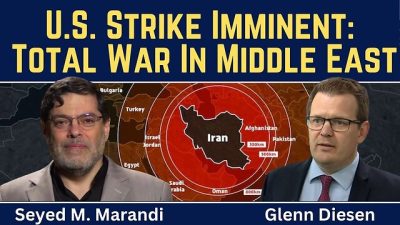
Seyed M. Marandi: Toward Total War in the Middle East
or go to
Aletho News Archives – Video-Images
From the Archives
The Geopolitics behind the War in Yemen (I)
By Mahdi Darius NAZEMROAYA | Strategic Culture Foundation | 30.03.2015
The United States and the Kingdom of Saudi Arabia became very uneasy when the Yemenese or Yemenite movement of the Houthi or Ansarallah (meaning the supporters of God in Arabic) gained control of Yemen’s capital, Sanaa/Sana, in September 2014. The US-supported Yemenite President Abd-Rabbuh Manṣour Al-Hadi was humiliatingly forced to share power with the Houthis and the coalition of northern Yemenese tribes that had helped them enter Sana. Al-Hadi declared that negotiations for a Yemeni national unity government would take place and his allies the US and Saudi Arabia tried to use a new national dialogue and mediated talks to co-opt and pacify the Houthis.
The truth has been turned on its head about the war in Yemen. The war and ousting of President Abd-Rabbuh Manṣour Al-Hadi in Yemen are not the results of «Houthi coup» in Yemen. It is the opposite. Al-Hadi was ousted, because with Saudi and US support he tried to backtrack on the power sharing agreements he had made and return Yemen to authoritarian rule. The ousting of President Al-Hadi by the Houthis and their political allies was an unexpected reaction to the takeover Al-Hadi was planning with Washington and the House of Saudi. … continue
Blog Roll
 Aletho News
- Pakistan-Iran talks secure LNG shipment to Islamabad through Hormuz
- Black Sea grain crisis puts global wheat supplies under pressure
- IRGC air defenses destroy another US MQ-1 drone over Strait of Hormuz
- Imran Khan’s entire immediate family detained in Pakistan ahead of mass protest demanding his release
- EU nation detains former presidential frontrunner
- Leaked: Britain’s Sham Conviction Of Hashim Thaci
- Seyed M. Marandi: U.S. Strike Imminent – Toward Total War in the Middle East
- Russia Voted Under Fire. Washington Is Loading the Tankers.
- 12 Things Your Oncologist Was Trained Not to Tell You
- Anthrax Attacks Paved Way for COVID-Era ‘Junk Drugs and Vaccines’
- If Americans Knew
- Israeli Attacks in Gaza Kill at Least Seven Palestinians Over Three Days, including Woman and Child
- Trump’s militarization of Washington DC as he pursues Israel’s war against Iran
- Why Israel Fears This Searing New Documentary
- Huckabee aide solicited cash gifts from Israelis
- This isn’t sci-fi, AI is already killing people
- ‘The Most Brutal Thing’: Investigation Reveals Execution of Elderly Woman in Rafah
- Inside Israel’s ‘soft’ ethnic cleansing plan for Gaza through the eyes of its victims
- New online database tracks pro-Israel political donations in the United States
- Israeli president pardons soldier convicted for killing wounded Palestinian
- Singer Ed Sheeran says his ‘heart broken’ by Gaza devastation, addresses Macklemore controversy
- No Tricks Zone
- 2025 Nature Paper Claiming Worsening Global Drought Gets RETRACTED …Heavily Flawed
- New Study: ‘Global Drought Shows No Detectable Recent Acceleration Under Climate Warming’
- Economic Masterminds: German Socialists Suggest Taxing Productivity Gains Stemming From Using AI
- The South China Sea Has Not Been Cooperating With The Climate Change Narrative
- Energy Crisis: Germany Enters Heating Season With Historically Low Gas Reserve Fill Levels
- New Study: The Antarctic Ice Sheet Gained Mass From 2020-2024 Due To Staggering Snow And Ice Accumulation
- Study: Ocean Heating Rates From Thousands Of Years Ago ‘Dwarf’ Modern Ocean Heating Rates
- Climate Extremists Target, Attack Large-Scale Power Grid Infrastructure In Germany!
- New Study: Antarctic Ice Melt Has Contributed Less Than 1 Centimeter To Sea Level Rise In The Last 30 Years
- Fear Of Debate: Alarmist German Climate Scientist Calls On Mainstream Media To Discredit Skeptic Voices
 Aletho News