Iraq grants $20bn projects to Chinese companies
MEMO | January 17, 2021
Iraq has given construction projects worth $20 billion in the southern province of al-Muthanna to a consortium of Chinese companies, an Iraqi official said on Sunday, Anadolu Agency reports.
“The projects include the construction of a power station and a factory for floors and porcelain with a production capacity of 32,000 m2 per day, and a factory for ceramic walls and façades with a capacity of 36,000 m2 per day,” Adel Al-Yasiri, the head of the al-Muthanna Investment Authority, said in a statement.
He added that an initial approval has been granted to establish the projects.
“The first phase of the projects amounts to $2 billion where two sites have been prepared near the Samawah refinery for the companies to complete the remaining procedures,” he said.
Other projects include the construction of a sanitary ware factory with a capacity of 360 m3 per day, a ceramic factory for accessories with a capacity of 108,000 m2 per month, and a factory for papers and 125 million cardboards per month.
China does not have allies, but has friends with partnership diplomacy

By Xue Li – Global Times – 2020/11/8
The Wall Street Journal published an article earlier this month entitled “China’s Risky Bet on a Lonely Return to Greatness,” suggesting China has no friends. China does not have allies indeed, but it doesn’t lack of friends. This is not only because of China’s historical tradition and the current international environment, but also because of China’s own choices.
Based on Christian monotheism, the spirit of Roman law and Greek formal logic, Western civilization largely views problems and world order from the perspective of binary opposition. Therefore, they prefer forming alliances in diplomacy so as to restrain and even assimilate allies through mandatory mechanisms. This allows them to confront and even defeat the non-allies.
At the same time, they firmly believe that every country must have a similar diplomatic philosophy, so it is necessary to encircle and even disintegrate emerging powers. They not only try to equate the history of Christian expansion since the maritime exploration during the age of discovery with the universal history of humanity, but also view the diplomatic concept of the Christian civilization over past 500 years as the world’s universal diplomatic philosophy. They do not realize that 500 years is a relatively short period in the history of human civilization, and that different civilizations have different views on diplomacy world order.
During the Han Dynasty (206BC-AD220), Taoism and Confucianism are the main concepts on which Chinese civilization is used to view issues, advocating the construction of an order through rule of ritual. Therefore, China has few diplomatic alliances, and it advocates that countries should adjust their ties according to specific situations. In diplomatic operations, China emphasizes that a country should believe in the charm of their own values and civilization, rather than forcefully imposing their own values and systems onto others.
In the past 500 years, some European countries became global empires through colonial expansion by means of force. The US has become a superpower after the end of the two world wars through building alliance systems. With the changing times and the emergence of nuclear weapons, it’s impossible for China to copy the emergence of European countries or the approaches of the US. One feasible option to realize the rejuvenation of Chinese civilization would be to expand its overseas interests in a way that is acceptable to the host country – whether with general policies, economics, and culture.
In modern times, China once allied itself with other countries. Those alliances were not systematic and continuous, and the outcomes were not ideal enough. China thus gave up diplomatic alliances, and carried out its non-aligned diplomacy in 1960s and 1970s, independent foreign policy of peace in 1980s, and partnership diplomacy since 1990s.
Chinese civilization is a kind of regional civilization. Although it has global influence in some aspects, it lacks the gene of global expansion of monotheistic civilizations. Perhaps because of the reasons mentioned above, Chinese leaders have repeatedly stressed that China has no intent to replace any other country in the world. But Western countries will take a long time to accept this.
Partnership diplomacy meets the needs of the contemporary world. On the road of rejuvenation, China firmly believes that partnership diplomacy is a better and more suitable choice for itself than alliance diplomacy. So far, 112 countries and international organizations have established partnerships with China. This number will undoubtedly continue to increase. Partnership diplomacy has become a prominent feature of China’s diplomacy.
After the Belt and Road Initiative was proposed in 2013, China’s diplomacy has changed from maintaining a low profile to becoming more proactive in global affairs. But the policy of “partnership rather than alliance” has not changed, and it is unlikely to change in the future. The indisputable fact is that the system of alliance diplomacy preferred by Western countries is the choice of a few countries in the world, and most countries choose non-aligned diplomacy. Besides, the vast majority of them are developing countries in Asia, Africa and Latin America.
The world has entered a long period of competition and cooperation among civilizations. It is necessary for the West to think outside the box instead of seeing the world from the perspective of Christian civilization, and learn to put itself into China’s position. Only in this way can the West truly understand the Chinese civilization and contemporary China, and base the relationship between China and the West on an accurate judgment and a relatively solid foundation so as to reduce misunderstandings and conflicts, and increase cooperation and mutual benefits.
The author is director of the Department of International Strategy at the Institute of World Economics and Politics under the Chinese Academy of Social Sciences. opinion@globaltimes.com.cn
China to strengthen military coordination with Russia
By M. K. BHADRAKUMAR | Indian Punchline | December 24, 2020
The joint aerial strategic patrol held by the air forces of Russia and China on December 22 over the Sea of Japan and the East China Sea makes a big statement in the geopolitics of the Asia-Pacific region. Chinese experts have hinted that such events could become “routine” in future.
The Chinese and Russian defence ministries made a joint announcement on the occasion Tuesday. China sent four nuclear-capable H-6K strategic bombers “to form a joint formation” with two of Russia’s famous Tu-95 bombers (NATO reporting name: “Bear”) to conduct the joint patrol as “part of annual military cooperation plan” between the two countries.
The announcement said the joint patrol “aims to further develop the China-Russia comprehensive strategic partnership of coordination in the new era, and enhance the level of the two militaries’ strategic coordination and joint operational capability to jointly safeguard global strategic stability.”
Curiously, only a month ago, on November 6, two Tupolev Tu-95MS strategic missile-carrying bombers of Russia’s Aerospace Force had performed a scheduled 8-hour flight over the neutral waters of the Sea of Japan and the north-western Pacific. Russia’s Defense Ministry said “At some sections of the route, the strategic missile-carrying bombers were escorted by Su-35S fighters.”

Russia’s Tu-95MS Strategic Bomber (Filephoto)
Clearly, the joint patrol with China was not an absolute must from the perspective of Russia’s national defence. But its optics and messaging mattered. This has everything to do with the regional setting with the US and its partners stepping up.
On Dec. 19, USS Mustin conducted a transit through the Taiwan Strait; on Dec. 20, Taiwan conducted a live-fire drill in the Pratas Islands (approx. 300 kms from mainland China) and plans to conduct another on Dec. 27. Pratas Islands are strategically located near the gateway to the South China Sea and are a waypoint for oil tankers and Chinese vessels en route to the Pacific Ocean.
Last week, Taiwan launched its first missile corvette, which the Taiwanese press described as an “aircraft carrier killer”, even as PLA Navy’s first Chinese-made aircraft carrier, the Shandong, completed its third sea trial in a 23-day transit in the Bohai Sea.
Also this month, a US Navy Amphibious Ready Group (ARG) consisting of the USS Makin Island and USS Somerset (LPD 25) patrolled the South China Sea and conducted “unscripted” live-fire drills. The Chinese state-run newspaper Global Times angrily called the ARG “US muscle-flexing actions” that “could damage regional stability,” and commented that “China should be prepared to confront the US in the South China Sea and the Taiwan Straits no matter who sits in the White House.”
Japan has bestirred itself lately, inviting like-minded Western countries to send military units to the Far East signalling that they are united in seeking a free and open Indo-Pacific region. The US, French and Japanese navies conducted integrated exercises in the Philippine Sea in December focusing on anti-submarine warfare; another joint military exercise is planned for May on an outlying Japanese island; the UK plans to send an aircraft carrier strike group to conduct joint exercises with the US Navy and Japanese Maritime Self-Defense Force (JMSDF) early next year.
The Japanese Defense Minister Nobuo Kishi held talks last week with his German counterpart Annegret Kramp-Karrenbauer where he “expressed hope that a German vessel” would join exercises with the JMSDF in 2021 and “suggested it would assist the international community’s efforts to ensure the right of passage of vessels through the South China Sea if the German warship would traverse waters” over which Beijing claims jurisdiction.
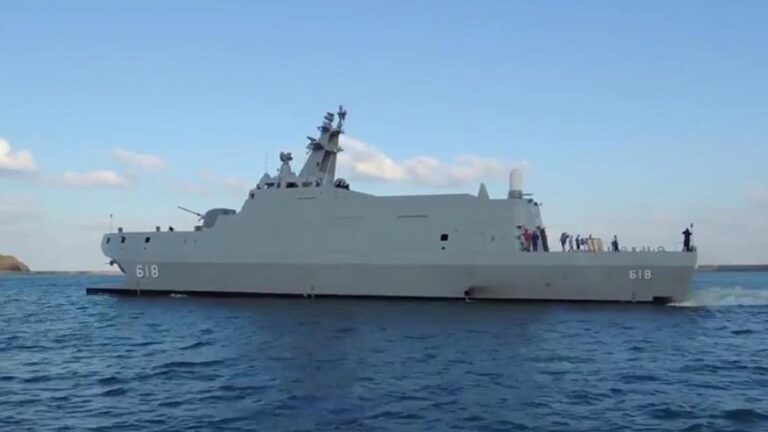
Taiwan Navy’s first stealth ‘carrier killer’ corvette Tuo Jiang
Amidst all this, the US’ Naval Service released an integrated maritime strategy designed to take a “more assertive (approach) to prevail in day-to-day competition (with China) as we uphold the rules-based order and deter our competitors from pursuing armed aggression.” Also, the US secretary of the Navy has called for the reestablishment of the 1st Fleet, a numbered Navy fleet, “in the crossroads between the Indian and the Pacific oceans.”
On Dec. 18, the US began building on the second Quad Foreign Ministers’ Meeting in October by organising a virtual “Quad” meeting of senior diplomatic officials from the US, Australia, India and Japan. The US State Department readout said the four countries discussed “practical ways … to coordinate efforts to support countries vulnerable to malign and coercive economic actions in the Indo-Pacific region.”
There is much speculation about how the [prospective] Biden administration will approach the Indo-Pacific. So far, Biden has not mentioned Quad, but he uses the phrase “Indo-Pacific.” But instead of discussing a “free and open” Indo-Pacific (as Trump does), Biden uses the phrase “secure and prosperous.”
To be sure, given the high stakes involved, China and Russia will not take chances. Their joint aerial patrol Tuesday reflects common concern over the region’s strategic stability. Both countries take note of growing interference by extra-regional powers inciting frictions, potentially posing a major threat to regional peace. Meanwhile, the US is deploying anti-missile systems and keeps talking about a NATO-like military alliance in Asia.
In sum, the joint patrol signals that China and Russia are “the linchpins of peace and stability in the Asia-Pacific region and Eurasia. They have no intention to challenge the regional order. They are propelled to respond to external powers which threaten regional security”, as a prominent think tanker at the Institute of Russian, Eastern European and Central Asian Studies under the Chinese Academy of Social Sciences, Yang Jin, put it.
Chinese pundits have discussed the pros and cons of a Sino-Russian military alliance, the consensus opinion being that in the prevailing security environment, the existing format of strategic partnership serves the purpose of meeting common challenges while giving flexibility to serve the self-interests each side. Having said that, military alliance also remains “a last option for the worst situation – when the US or another country launches a war that forces China and Russia to fight side by side” — to quote Yang.
An editorial in the Chinese Communist Party daily Global Times noted, “China and Russia have no intention of forming a military alliance because it cannot resolve the comprehensive challenges the two countries have to face” but the pressure from the US and its allies have “provided an important external impetus” to the strengthening of the comprehensive strategic cooperation as such, including military cooperation.
“As long as they cooperate strategically and jointly deal with challenges, they can generate effective deterrent, form a joint force to deal with specific problems, resist the attempts to suppress the two countries and curb the US’ international misconduct,” the editorial said.
The US-Russia-China triangle is sure to transform under the [prospective] Biden presidency if Washington sets sights on Moscow as the biggest threat to the US national security. Unsurprisingly, Beijing is signalling that the China-Russia strategic partnership should remain close and continue to be strengthened to handle increasing pressure from the US, even if Biden might ease tensions with Beijing.
This strategic emphasis is the leitmotif of an unusually lengthy report by Xinhua in the People’s Daily on the phone conversation between the State Councilor and Foreign minister Wang Yi with his Russian counterpart Sergey Lavrov on December 22.
Washington vetoes aid to Sri Lanka and paves the way for Chinese expansion
By Lucas Leiroz | December 22, 2020
Sri Lanka has become the scene of a new battle in the trade war between China and the US. The growth of the Chinese presence in the country has led Washington to a strong concern, materialized in Mike Pompeo’s visit to Colombo in October. But even the strong American pressure was not enough to prevent the advance of Chinese investments and this is taking the American government to a drastic measure: to cancel the development aid that it had promised to Sri Lanka.
The official statement about the end of the aid program came through the US Embassy in Colombo on Thursday, December 17. The Embassy confirmed that the Millennium Challenge Corporation (MCC) fund that had been approved for aid to Sri Lanka will now be redirected to other strategic partners. According to Washington, Sri Lanka showed a lack of involvement and interest in the alliance – which is due to the fact that it continued to cooperate economically with China, in parallel with the US.
This agreement was part of a cooperation program between the US and Sri Lanka established during the previous government of Ranil Wickremesinghe in the last year of his term. At the time, Wickremesinghe faced strong resistance at the congress due to the lack of transparency about the nature of the agreement. Its critics say the terms are unclear and claim that the program could simply be an excuse to guarantee American military advance in the region. The MCC, however, says it is a cooperation program whose sole purpose is to help reduce poverty in the Asian country, without any political or military interest related to it. Currently, MCC has partnerships of this type with approximately 30 countries in different regions of the planet, totaling more than 13 billion dollars invested in these programs. In the case of Sri Lanka, the agreement provided for an investment of 480 million dollars.
Although Washington denies the political nature of the agreement, it is clear that it is a financial aid in exchange for political support and international alignment. The very end of the agreement proves this: simply because Sri Lanka has ties with China, Washington canceled the agreement. As we can see, the interest in “alleviating poverty” seems quite secondary to the interest in isolating China economically in the global trade war.
Relations between the US and Sri Lanka have deteriorated greatly over the past few months. Gotabaya Rajapaksa’s government has been characterized by a moderately pro-Chinese stance, which was enough to irritate Americans. The Trump Administration went to the extreme of banning the entry of Sri Lankan Army Chief, General Shavendra Silva, into American territory. Shavendra Silva is considered a national hero in his country but has entered the Washington blacklist due to alleged human rights violations that would have been committed on the battlefield during the civil war. Obviously, it is fair to punish someone for violating human rights, but strangely this denunciation by Washington only appeared after the beginning of the deterioration of relations between the two countries.
The definitive point of tensions occurred in October, when Washington tried to “recover” Sri Lanka by sending Secretary of State Mike Pompeo to Colombo. During a 12-hour visit, Pompeo met with local authorities and made several public statements attacking China, saying that the only way for Sri Lanka to become a strong and sovereign country is through strategic cooperation with the US. On the same occasion, Pompeo said that Chinese behavior is “predatory”.
Also in October, US Principal Deputy Assistant Secretary Dean Thompson said that Sri Lanka needs to make some choices that would be necessary, albeit difficult – and said that such choices would be the only way to guarantee the country’s economic development. In other words, Thompson said that Sri Lanka needs to abdicate from relations with China in order to develop, which is absolutely unrelated to reality. China has already invested nearly 8 billion dollars in infrastructure projects in Sri Lanka. Colombo Port City and Hambantota Port are Chinese developments. Still, Beijing has been providing billionaire loans to Sri Lanka since 2005, with long repayment terms and even forgiving some debts. This is not the typical “predatory” behavior, much less seems that Sri Lanka’s abdication from ties with Beijing is a condition for development.
What happens, however, is that Washington continues to act with a war mentality. Sri Lanka accepts cooperation agreements with Washington and Beijing simply because it is a sovereign country with its own interests and does not want to take part in a trade conflict that does not concern it. Sri Lanka’s stance is sovereign and not aligned and the country will continue to make deals with any power that helps to deal with its main social problems. Washington will certainly put Sri Lanka on its blacklist from now on and impose sanctions and blockades, but it is the Americans who have the most to lose from it. Without American help, Colombo will seek even more Chinese support and Beijing will have a geographically strategic ally on its side, further reducing the American presence in Asia.
Lucas Leiroz is a research fellow in international law at the Federal University of Rio de Janeiro.
Iran, Pakistan open 2nd border crossing for trade surge
Press TV | December 19, 2020
Iran and Pakistan have inaugurated the second official border crossing for the transfer of goods and passengers.
The border point opened during a ceremony on Saturday, with Iran’s Minister of Roads and Urban Development Mohammad Eslami and the Pakistani Minister for Defense Production Zubaida Jalal attending the event.
The gateway connects Rimadan, located in Dashtyari country of Iran’s southeastern Sistan and Baluchestan Province, with Pakistan’s Gabd.
The Rimadan border crossing has a capacity for exporting and importing goods and transporting Pakistani pilgrims and tourists.
The border’s 70-kilometer distance with Gwadar port also enables Pakistani citizens to reach Iran’s strategic Chabahar port, from where they can travel by plane or train to Iran’s religious cities and tourist sites.
The connection of the Rimadan border with Pakistan’s Karachi port would pave the way for linking China and Southeast Asian countries to Eastern Europe.
In an interview with IRNA news agency, Iran’s Ambassador to Pakistan Mohammad Ali Hosseini said there was only one crossing, Mirjaveh-Taftan, on the 900-kilometer border between the two neighboring states.
So, he added, Iranian and Pakistani officials decided to open two more border gateways, Rimadan-Gabd and Pishin-Mand.
The envoy also stressed that the inauguration of Rimdan-Gabd border point will increase economic and trade cooperation between Tehran and Islamabad, reduce smuggling and improve the livelihood of border residents as well as the security situation along the common frontier.
Strategic Victory For China? US Drops Key Project Amid Sri Lanka’s Unrelenting Security Concerns
By Rishikesh Kumar – Sputnik – 17.12.2020
US Secretary of State Mike Pompeo paid a visit to Sri Lanka in October to coax the Gotabaya Rajapksa government to sign the Millennium Challenge Cooperation Agreement. A controversy erupted ahead of Pompeo’s visit, as the US called upon Colombo “to make difficult but necessary decisions” to pick sides between Beijing and Washington.
In a major setback amid the growing Chinese presence in the Indian Ocean Region, the US has decided to discontinue a proposed $480 million development assistance programme in Sri Lanka due to “lack of partner country engagement”.
The US Embassy in Colombo on Thursday informed through a press statement that the Millennium Challenge Corporation (MCC) board has decided that the approved fund for Sri Lanka will now be made available to other eligible partner countries.
The Millennium Challenge Cooperation Agreement was approved by the previous government of Ranil Wickremesinghe in the last year of his tenure, but he was unable to get approval from parliament, evoking widespread resistance among people who believed it compromised the nation’s sovereignty and national security.
Nevertheless, the US has once again reiterated that the programme, also facing resistance in another South Asian nation, Nepal, is transparent in nature.
“Country ownership, transparency, and accountability for grant results are fundamental to MCC’s development model”, the statement reads.The MCC has been dubbed a “development project aimed at poverty alleviation” by the US, but many people in Sri Lanka consider it a tool to expand military outreach in the Indian Ocean.
The MCC has partnered with nearly 30 countries worldwide on 38 grant agreements, totalling nearly $13.5 billion.
Ties between the two countries soured under the Gotabaya Rajapaksa government as the Trump administration considered it biased in favour of China. The Trump administration also introduced a ban on the entry of Sri Lanka’s Army Chief Lt. Gen. Shavendra Silva – who is considered a war hero in the 30-year battle against Tamil militancy – into the United States on charges of human rights violations.
In October this year, US Principal Deputy Assistant Secretary Dean Thompson urged Sri Lanka to make “difficult but necessary choices” to secure its economic independence instead of choosing opaque practices in an apparent reference to China deepening its relations with the South Asian country. Beijing reacted to the remark and asked the US to shun a “Cold War” mentality. China has invested nearly $8 billion in infrastructure projects in Sri Lanka, with Colombo Port City and the Hambantota Port Projects being the two major ones.
Pakistan returns $1 bln of Saudi Arabia’s loan over Kashmir dispute
MEMO | December 16, 2020
Pakistan has returned $1 billion to Saudi Arabia as a second installment of a $3 billion soft loan, as Islamabad reaches out to Beijing for a commercial loan to help it offset pressure to repay another $1 billion to Riyadh next month, officials said on Wednesday according to a report by Reuters.
Analysts say it is unusual for Riyadh to press for the return of money. But relations have been strained lately between Pakistan and Saudi Arabia, historically close friends.
Saudi Arabia gave Pakistan a $3 billion loan and a $3.2 billion oil credit facility in late 2018. After Islamabad sought Riyadh’s support over alleged human rights violations by India in the disputed territory of Kashmir, Saudi Arabia has pushed Pakistan to repay the loan.
With the $1 billion flowing out, Pakistan – which has $13.3 billion in central bank foreign reserves – could face a balance of payments issue after clearing the next Saudi installment.
“China has come to our rescue,” a foreign ministry official told Reuters. A finance ministry official said Pakistan’s central bank was already in talks with Chinese commercial banks.
“We’ve sent $1 billion to Saudi Arabia,” he said. Another $1 billion will be repaid to Riyadh next month, he said. Islamabad had returned $1 billion in July.
Although a $1.2 billion surplus in its current account balance and a record $11.77 billion in remittances in the past five months have helped support the Pakistani economy, having to return the Saudi money is still a setback.
Pakistani army chief General Qamar Javed Bajwa, who visited Riyadh in August to ease the tensions, met the Saudi ambassador in Islamabad on Tuesday.
Russia may benefit from trade rift between China and Australia
RT | December 16, 2020
Russian coal suppliers could boost their exports to China, as the world’s largest coal buyer is reportedly curbing shipments of the commodity from Australia amid escalating tensions between the two countries.
The developer of the largest Russian coal deposit, Elga, announced on Tuesday that it created a joint venture with a Chinese shipping company to promote Russian coal on the massive Chinese market. The project between Elgaugol and GH-Shipping is set to satisfy China’s growing demand for high-quality coking coal.
The deal is set to help boost Russian coal supplies to China from one million tons this year to 30 million tons in 2023, and the developer could potentially further increase annual imports to 50 million tons. The joint venture is also expected to contribute to the ambitious goal of the Russian and Chinese governments to significantly increase bilateral trade turnover, as it would increase the volume of trade between the two countries by $5 billion per year.
“The supplies of coking coal from Elga will replace a significant amount of Australian and American coal of similar quality,” Elgaugol Director-General Aleksandr Isaev said.
Another Russian producer, Mechel, previously said that it was planning to increase exports of coal to China amid Beijing’s restrictions on Australian imports. In November, the shipments rose by 13 percent, and are set to jump by 25-30 percent in December, Mechel CEO Oleg Korzhov said as cited by Russian media.
Tensions between the two countries have been growing for around three years, after the Australian government began limiting Chinese investments in the country. In 2018, Canberra added fuel to the fire when it banned China’s Huawei and ZTE from its 5G rollout. The most recent escalation occurred when Australia pushed in April for an international inquiry into the origins of the coronavirus outbreak.
Earlier this week, Chinese state-linked media reported that the nation’s top economic planner gave domestic power plants the greenlight to import coal without clearance restrictions from several countries “except for Australia.” While Beijing has not officially confirmed the restrictions, Canberra has already urged the Chinese government to clarify the reports.
This week’s reports are not the first to allege that China is quietly banning coal imports from Australia. Last month, several million tons of Australian coal worth more than $500 million were reportedly stuck in Chinese ports.
Politicians Criticize China’s Role in Hong Kong while Ignoring Canada’s Role in Haiti
By Yves Engler | Dissident Voice | December 11, 2020
For those who support a truly just foreign policy comparing Canadian politicians’ reactions to protests in Hong Kong and the slightly more populous Haiti is instructive. It reveals the extent to which this country’s politicians are forced to align with the US Empire.
Despite hundreds of thousands of Canadians having close ties with both Haiti and Hong Kong, only protests in the latter seem to be of concern to politicians.
Recently NDP MP Niki Ashton and Green MP Paul Manly were attacked ferociously in Parliament and the dominant media for participating in a webinar titled “Free Meng Wanzhou”. During the hullabaloo about an event focused on Canada’s arrest of the Huawei CFO, Manly — who courageously participated in the webinar, even if his framing of the issue left much to be desired — and Ashton — who sent a statement to be read at the event but responded strongly to the backlash in an interview with the Winnipeg Free Press — felt the need to mention Hong Kong. Both the NDP (“Canada must do more to help the people of Hong Kong”) and Greens (“Echoes of Tiananmen Square: Greens condemn China’s latest assault on democracy in Hong Kong”) have released multiple statements critical of Beijing’s policy in Hong Kong since protests erupted there nearly two years ago. So have the Liberals, Bloc Québecois and Conservatives.
In March 2019 protests began against an extradition accord between Hong Kong and mainland China. Hong Kongers largely opposed the legislation, which was eventually withdrawn. Many remain hostile to Beijing, which later introduced an anti-sedition law to staunch dissent. Some protests turned violent. One bystander was killed by protesters. A journalist lost an eye after being shot by the police. Hundreds more were hurt and thousands arrested.
During more or less the same period Haiti was the site of far more intense protests and state repression. In July 2018 an uprising began against a reduction in subsidies for fuel (mostly for cooking), which morphed into a broad call for a corrupt and illegitimate president Jovenel Moïse to go. The uprising included a half dozen general strikes, including one that shuttered Port-au-Prince for a month. An October 2019 poll found that 81% of Haitians wanted the Canadian-backed president to leave.
Dozens, probably over 100, were killed by police and government agents. Amnesty International, Human Rights Watch and other western establishment human rights organizations have all documented dozens of police killings in Haiti. More recently, Moïse has ruled by decree, sought to extend his term and to rewrite the constitution. Yet, I couldn’t find a single statement by the NDP or Greens, let alone the Liberals or Conservatives, expressing support for the pro-democracy movement in Haiti.
Even an equal number of statements from a Canadian political party would be less than adequate. Not only were the protests and repression far more significant in Haiti, the impact of a Canadian politician’s intervention is far more meaningful. Unlike in Hong Kong, the police responsible for the repression in Haiti were trained, financed and backed by Canada. The Trudeau government even gave $12.5 million to the Haitian police under its Feminist International Assistance Policy! More broadly, the unpopular president received decisive diplomatic and financial support from Ottawa and Washington. In fact, a shift in Canada/US policy towards Moïse would have led to his ouster. On the other hand, a harder Canada/US policy towards Hong Kong would have led to well … not much.
The imperial and class dynamics of Haiti are fairly straightforward. For a century Washington has consistently subjugated the country in which a small number of, largely light-skinned, families dominate economic affairs. During the past 20 years Canada has staunchly supported US efforts to undermine Haitian democracy and sovereignty.
Hong Kong’s politics are substantially more complicated. Even if one believes that most in Hong Kong are leery of Beijing’s growing influence — as I do — the end of British rule and reintegration of Hong Kong into China represents a break from a regrettable colonial legacy. Even if you take an entirely unfavorable view towards Beijing’s role there, progressive Canadians shouldn’t focus more on criticizing Chinese policy in Hong Kong than Canadian policy in Haiti.
Echoing an open letter signed by David Suzuki, Roger Waters, Linda McQuaig and 150 others and the demands of those who occupied Justin Trudeau’s office last year, the national president of the Public Service Alliance of Canada, Chris Aylward, recently sent a letter to Prime Minister Trudeau critical of Canadian support for Moïse. It notes, “Canada must reassess its financial and political support to the Jovenel Moïse government, including police training, until independent investigations are conducted into government corruption in the Petrocaribe scandal and ongoing state collusion with criminal gangs.” The NDP, Greens and others should echo the call.
To prove they are more concerned with genuinely promoting human rights – rather than aligning with the rulers of ‘our’ empire – I humbly suggest that progressive Canadians hold off on criticizing Beijing’s policy towards Hong Kong until they have produced an equal number of statements critical of Canada’s role in Haiti.
• To learn more about Canada’s role in Haiti tune into this webinar Sunday on “Imperialist attacks on Haiti and Haitian resistance: Canada’s Imperialist Adventures in Haiti.”
 Yves Engler is the author of 10 books, including A Propaganda System: How Canada’s Government, Corporations, Media and Academia Sell War and Exploitation.
China to bail out Iraq in multibillion dollar oil deal
MEMO | December 10, 2020
Iraq is currently deciding whether to go ahead with a multibillion dollar oil deal with China which will bail the country out as part of the effort to solve Baghdad’s worsening economic crisis. The deal comes after SOMO, Iraq’s state agency in charge of oil exports, welcomed bids from various oil traders and companies in a letter issued last month.
That resulted in “several offers” being made by various companies. These were then evaluated by Prime Minister Mustafa Al-Kadhimi, reported Bloomberg, which quoted cabinet spokesman Hassan Nadhim.
In the Iraqi government’s bid conditions, SOMO said that the successful company would purchase four million barrels of oil per month, or around 130,000 per day, with the first year’s supply being paid for up front. The deal is meant to last for five years.
In return for supplying oil to the winning bidder, Iraq will receive $2 billion for a fraction of the promised quantity of oil, with the balance paid later. The barrels of oil are effectively security for a loan.
The winning bidder turned out to be ZhenHua Oil Co., a major state-owned company in China with ties to the Chinese military. It is the latest example of China’s international lending strategy, in which state-controlled banks and trading organisations lend money to oil-rich countries struggling to keep afloat financially, such as Venezuela, Ecuador, Angola and now potentially Iraq.
If Prime Minister Al-Kadhimi signs the deal, then it would not be the first time that the company has dealt with Iraq. ZhenHua Oil, which trades around 1.3 million barrels per day of oil and other products, began a joint-venture with SOMO back in 2018 in order to help market Iraqi oil in China to increase exports. That venture was later scrapped.
Iraq’s economy and oil industry suffered greatly from the oil price crash earlier this year, after Russia and Saudi Arabia triggered an oil price war in March over a dispute over oil production.
In September, Iraq’s crude oil exports fell by six per cent and last week its oil minister acknowledged that the industry is in a critical condition due to the coronavirus pandemic.
See Also:
Iraq eyes construction deals with China in return for oil sales
Featured Video

The Truth About the Trump Shootings with Ken Silva
or go to
Aletho News Archives – Video-Images
From the Archives
Trans ‘milk’ as good as the real thing – NHS
RT | February 18, 2024
The drug-induced nipple secretions of trans women are as good as mothers’ breast milk for babies, the University of Sussex Hospitals NHS Trust claimed in a letter to campaigners made public in a report by British think tank the Policy Exchange on Sunday.
The healthcare trust’s medical director, Rachel James, argued that the off-label prescription drug cocktail men transitioning to female take in order to produce milk was “similar to the natural hormones which encourage lactation to develop when the baby is newly born.”
“The evidence which is available demonstrates that the milk is comparable to that produced following the birth of a baby,” James wrote in the letter, sent to Children of Transitioners last August.
Biological men who wish to lactate must first take hormones to grow milk glands and then take high doses of either domperidone or metoclopramide to stimulate milk production. Neither drug is approved for this use, though they are occasionally prescribed off-label to biological women who have trouble lactating.
However, domperidone’s own manufacturer, Janssen, warns patients the drug “may cause unwanted side effects affecting the heart in a breastfed baby” and “should be used during breastfeeding only if your physician considers this clearly necessary.” … continue
Blog Roll
 Aletho News
- Seyed M. Marandi: U.S. Strike Imminent – Toward Total War in the Middle East
- Russia Voted Under Fire. Washington Is Loading the Tankers.
- 12 Things Your Oncologist Was Trained Not to Tell You
- Anthrax Attacks Paved Way for COVID-Era ‘Junk Drugs and Vaccines’
- How Real Is the Impact of Western Sanctions on Israel?
- France, You Are Guilty: How Paris Turned Western Sahara into the Maghreb’s Powder Keg
- 2025 Nature Paper Claiming Worsening Global Drought Gets RETRACTED …Heavily Flawed
- Your Milk Is Not the Problem
- The Truth About the Trump Shootings with Ken Silva
- ARE PATIENTS BEING PROPERLY INFORMED ABOUT OZEMPIC?
- If Americans Knew
- Salah Sarsour’s Legal Team Says DHS Has Not Met Its Burden to Prove He Is Deportable
- An analysis of tax forms by The Intercept show Kraft’s charity and LLC have donated to Friends of the IDF and AIPAC’s super PAC.
- Israeli attacks kill four Palestinians in Gaza – Daily Update
- Inside Gaza’s death trap of collapsing, bombed-out buildings
- The everyday items Israel bans from Gaza every day
- Inside the siege, the ruined buildings of Gaza – Daily Update
- Debunking The Claim That Macklemore Has A “History Of Antisemitism”
- CPJ demands release of arrested Palestinian-US journalist near Bethlehem
- Robert Kraft: The Billionaire Friend of Netanyahu Pulling The Strings Behind the Macklemore/Ed Sheeran Blow Up
- Columbia Administered Fund Gives Big Money to Pro-Israel Groups
- No Tricks Zone
- 2025 Nature Paper Claiming Worsening Global Drought Gets RETRACTED …Heavily Flawed
- New Study: ‘Global Drought Shows No Detectable Recent Acceleration Under Climate Warming’
- Economic Masterminds: German Socialists Suggest Taxing Productivity Gains Stemming From Using AI
- The South China Sea Has Not Been Cooperating With The Climate Change Narrative
- Energy Crisis: Germany Enters Heating Season With Historically Low Gas Reserve Fill Levels
- New Study: The Antarctic Ice Sheet Gained Mass From 2020-2024 Due To Staggering Snow And Ice Accumulation
- Study: Ocean Heating Rates From Thousands Of Years Ago ‘Dwarf’ Modern Ocean Heating Rates
- Climate Extremists Target, Attack Large-Scale Power Grid Infrastructure In Germany!
- New Study: Antarctic Ice Melt Has Contributed Less Than 1 Centimeter To Sea Level Rise In The Last 30 Years
- Fear Of Debate: Alarmist German Climate Scientist Calls On Mainstream Media To Discredit Skeptic Voices
 Aletho News