After Orlando, Democrats and Republicans Clamor for Expanded Police State

By Eric Draitser | Stop Imperialism | June 16, 2016
The horrific massacre in Orlando has once again thrust the specter of domestic terrorism into the limelight, and into the media space. Pundits and politicians alike have taken the incident as yet another opportunity to thump their chests about the need for even more counter-terrorism legislation, a further increase in surveillance state activity and, of course, more war abroad.
And while such opportunists posture as defenders of the American people, none care to face the inescapable reality that since 9-11, and the introduction of numerous pieces of draconian legislation ostensibly aimed at combatting terrorism, the agencies charged with surveillance and law enforcement have not managed to prevent attacks. Obviously, this raises the question of what exactly legislation such as the PATRIOT Act is really intended for if not to ‘keep Americans safe.’
But even more critical than retrospective criticism of the erosion of civil liberties after nearly a decade and a half of propaganda and fearmongering, is the need to oppose the further expansion of such legislation and domestic spying programs. Indeed, while what were once considered rights are now seen as passé, the US is staring down the barrel of a presidential election where the leading candidates are calling for even more surveillance, expanded government databases, and more billions of dollars to be poured into the NSA, FBI, CIA, DIA, and the rest of the alphabet soup that comprises Police State USA.
Clinton, Trump, and Death as Political Currency
In the immediate aftermath of the heinous slaughter in Orlando, the neoconservative-neoliberal chimera known as Hillary Clinton predictably called for an expansion of surveillance and the police state. Less than 48 hours after the attack, in a speech in Cleveland, Clinton proclaimed:
We already know we need more resources for this fight. The professionals who keep us safe would be the first to say we need better intelligence to discover and disrupt terrorist plots before they can be carried out. That’s why I’ve proposed an ‘intelligence surge’ to bolster our capabilities across the board, with appropriate safeguards here at home.
As with all things Hillary, one must carefully deconstruct the statement to unravel the distortions and empty rhetoric, and distill her actual proposal. The first part of her statement is instantly suspect as the US has already grossly inflated its intelligence budget. According to the Federation of American Scientists, the 2017 intelligence budget will reach nearly $70 billion, with $50 billion being spent on the National Intelligence Program (NIP). One would have to seriously question the logic in Clinton’s statement, namely the implied consensus about the need for more resources. How much more exactly will prevent incidents like the one in Orlando? Perhaps another $50 billion would do the trick?
The second fallacy embedded in the torrent of misinformation that is a Hillary Clinton speech excerpt is the specious argument that “better intelligence” would “discover and disrupt terrorist plots before they can be carried out.” This vacuous statement must be dismissed out of hand after one considers the fact that the alleged Orlando killer, Omar Mateen, was investigated, followed, and interviewed by the FBI multiple times (he was also introduced to FBI informants whose responsibility was likely to keep tabs on him).
So, according to Clinton the US should spend tens of billions more dollars to fund the agencies and programs that already have the ability to single out a potential terrorist, do all the leg work to establish contact with him, invest human resources into his case, and yet still be unable to stop his alleged actions. To put it in terms Hillary’s Wall Street patrons would understand: sounds like a bad investment strategy.
The third unmistakably wrongheaded statement (I only selected three sentences, so she’s 3 for 3) is the absolutely odious suggestion of an “intelligence surge” to improve the capabilities of the intelligence community. In fact, what Clinton is actually suggesting is a massive increase in contracts awarded to private intelligence firms and military contractors, though veiling it as a boost to the intelligence community. This fact is made clear by the renowned investigative journalist Tim Shorrock in his 2008 book Spies for Hire: The Secret World of Intelligence Outsourcing where he notes that:
In 2006… the cost of America’s spying and surveillance activities outsourced to contractors reached $42 billion, or about 70 percent of the estimated $60 billion the government spends every year on foreign and domestic intelligence. Unfortunately, we cannot know the true extent of outsourcing, for two reasons. First, in 2007, the Office of the Director of National Intelligence (ODNI) refused to release an internal report on contracting out of fear that its disclosure would harm U.S. national security interests. Second, most intelligence contracts are classified, allowing companies like CACI to hide their activities behind a veil of secrecy.
Think about that figure for a second: 70 percent of the intelligence budget goes to outsourcing. In other words, government expenditure on surveillance and intelligence is an indirect subsidy to private corporations. This should come as no surprise considering similar indirect subsidies to energy companies, private mercenaries, and even big retail corporations.
Of course, Clinton knows all this perfectly well. So when she calls for an intelligence surge what she’s actually doing is making clear to her military-industrial-surveillance complex cronies that she will make sure to feed the goose that continues to lay the golden eggs. Just like her speeches to Goldman Sachs served to reassure Wall Street that she was their lady, so too does Clinton use the tragic events in Orlando to give a wink and a nod to Booz Allen Hamilton, CACI International, and the rest.
As with all things Clinton, her words drip with cynicism like her hands drip with the blood of Libyans, Syrians, Iraqis, Serbians, and countless others.
It should be mentioned too that aside from just funding, Clinton undoubtedly represents a further rightward shift in terms of “anti-terror” legislation – the kinds of bills that she’d promote and sign into law as president would be, to put it bluntly, no different than the Bush era bills that she supported such as the PATRIOT Act. As Conor Friedersdorf noted in The Atlantic in 2015:
[Clinton] served in the United States Senate from 2001 to 2009. She cast votes that enabled the very NSA spying that many now regard as a betrayal. And she knew all about what the NSA wasn’t telling the public. To say now that the NSA should’ve been more transparent raises this question: Why wasn’t Clinton among the Democrats working for more transparency?
Friedersdorf is being much too kind with his concluding rhetorical question. Clinton is perhaps one of the most hawkish surveillance state proponents in the US. Her total disregard for even the basic tenets of the US Constitution, let alone domestic or international law, make her not only unfit for office, but a dangerous criminal.
And then of course there’s the trainwreck made flesh, Donald Trump, who with his typically bombastic and utterly vacuous public statements has once again managed to make the criminal Hillary into the “sensible one.” In a speech on Monday June 13, Trump reverted to his usual racist demagogy that is light on actual policy prescriptions and heavy on xenophobia, racism, and outright lies. But in the midst of the Trump madness, there are indeed kernels of policy that should be worrying.
During the speech Trump called, once again, for a ban on Muslim immigration to the US, warning of “major consequences” for the Muslim community in the country. But Trump went further saying, “We have a dysfunctional immigration system, which does not permit us to know who we let into our country, and it does not permit us to protect our citizens properly.” Again, Trump provides no specific policy prescription, but the implication from his statement is an increase in surveillance of citizens domestically, as well as presumably the codification of a deeply racist immigration system which would discriminate based on religion and/or ethnicity.
Trump continued, saying “With these people, folks, it’s coming. We’re importing radical Islamic terrorism into the West through a failed immigration system and through an intelligence community held back by our president.” Here again Trump aligns with Clinton. While supposedly the two are opposed to one another, the fact is that both accept the false assumption that our problems would be solved if only we could just stop “holding back” the intelligence community. Clinton calls for a surge while Trump calls for taking off the training wheels. Sort of like an argument about which is better Pepsi or orange juice.
The Police State Is Not the Answer
While the Demopublican-Republicrat Party continues its political posturing, the assumptions that both have internalized are what need to be excised from the body politic. It is patently absurd to call for more surveillance in a country where, thanks to Edward Snowden, we now know the following:
- The PRISM program allows “The National Security Agency and the FBI [to tap] directly into the central servers of nine leading U.S. internet companies, extracting audio and video chats, photographs, emails, documents, and connection logs.” According to cybersecurity experts PRISM uses obviously illegal tactics to “circumvent formal legal processes… to seek personal material such as emails, photos and videos.”
- The BLARNEY system is utilized extensively. According to former AT&T technician Mark Klein and former Senior Advisor for Internet Technology at the FCC Scott Marcus, “Using a device called a ‘splitter’ a complete copy of the internet traffic that AT&T receives… is diverted onto a separate fiber-optic cable which is connected to a room which is controlled by the NSA.” Therefore, unlike PRISM, which the government and its apologists attempt to justify as being used to target key individuals, BLARNEY has no such capacity. Rather, it is designed solely to collect data, all internet data, to be used and likely stored.
- The NSA has constructed enormous data storage facilities such as the Utah Data Center in Bluffdale, Utah. As one top security official told Wired, “Everybody’s a target; everybody with communication is a target.”
Naturally, there is not nearly enough space here to detail all of the myriad surveillance programs. But, taking them together with what we know of government funding to private intelligence firms, how could anyone rightly argue that surveillance should be increased? If anything, the enormous expenditure has proven utterly useless.
Indeed, the legal framework developed in the post-9/11 era including draconian legislation such as the PATRIOT Act, the National Defense Authorization Act (NDAA), and many others, laid the foundation for the systemic and systematic stripping away of civil liberties and human rights. The technical infrastructure has been steadily evolving since 9/11 as technology continues to improve, providing the intelligence agencies with ever more tools for surveillance and intelligence gathering. The continued, unrestrained neoliberal policy of privatization has created a complex network of companies, contractors, and subcontractors, usually working independently of each other, all in the service of the security state. Finally, the political landscape in the United States has so thoroughly devolved that elected officials are more concerned about stopping the whistleblowers and leakers, than about addressing America’s continued descent into a fascist police state.
Such is the state of the union in 2016. And while the aspiring Mass Murderer-in-Chief Clinton continues to attack the political snake-charmer Trump, and The Donald does what The Donald does, the bodies of 50 innocent people are being laid to rest. Must the values and freedoms that the US allegedly once stood for also be buried?
The FBI, Not “ISIS,” Radicalized the Orlando Shooter
By Tony Cartalucci | Land Destroyer | June 20, 2016
As predicted, the FBI is revealed to have approached Orlando shooting suspect Omar Mateen in 2013 with informants posing as terrorists in an attempt to “lure” him into participating in a terrorist attack.
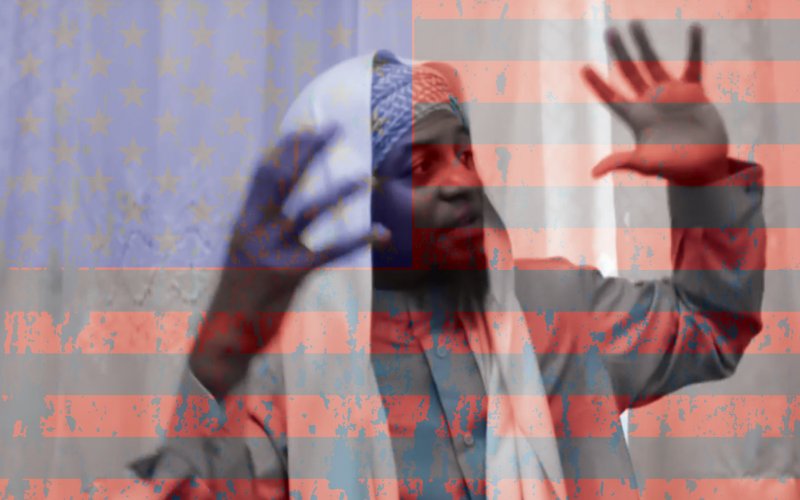 |
Image: As scary as any cartoon villain – and ironically – quite literally a manufactured villain. Marcus Robertson is not only a former US Marine, but also a long-time CIA and FBI asset. He runs an extremist website on American soil with absolute impunity and is likely one component of the FBI’s counterterror entrapment pipeline. |
USA Today’s TC Palm reports in an article titled, “Exclusive: PGA Village residents want answers from security firm,” that (emphasis added):
The FBI launched an investigation into Mateen after Sheriff’s Office officials reported the incident to the agency. As part of its investigation, the FBI examined Mateen’s travel history, phone records, acquaintances and even planted a confidential informant in the courthouse to “lure Omar into some kind of act and Omar did not bite,” Mascara said. The FBI concluded Mateen was not a threat after that, Mascara said.
This is in line with the FBI’s practice of approaching and entrapping potential terror suspects by posing as terrorists themselves and aiding and abetting them in the planning and preparations for high-profile attacks. These undercover operations include everything from “casing out” potential targets, to the obtaining and training with actual, live explosives, to the purchasing of small arsenals of firearms including the sort of semi-automatic rifles and pistols used by Mateen during the Orlando shooting.
In addition to the FBI’s undercover operation, it is now also revealed that Mateen frequented the website of another FBI/CIA informant, Marcus Dwayne Roberson, a former US Marine, turned bank robber, turned US government informant.
While US politicians, law enforcement officials, and media networks attempt to claim Robertson’s extremist website, the Timbuktu Seminary, was his own independent project, the extent of his association with the US government makes this difficult, if not impossible to believe. Instead, it appears to be the perfect mechanism to feed the FBI’s entrapment pipeline, attracting and identifying possible suspects for the FBI to then approach and “investigate.”
The National Review’s article, “The Orlando Jihadist and the Blind Sheikh’s Bodyguard,” would report (emphasis added):
According to Fox News, Omar Mateen, the jihadist who carried out the mass-murder attack at a gay nightclub in Florida this weekend, was a student of Marcus Robertson, an Orlando-based radical Muslim who once served as a bodyguard to Omar Abdel Rahman — the notorious “Blind Sheikh” whom I prosecuted for terrorism crimes in the early to mid 1990s.
The National Review also reported that (emphasis added):
In Robertson’s case, it is reported that he agreed to work for the government, gathering intelligence both overseas and in the United States. According to Fox, however, he was expelled from the covert informant program in early 2007 after attacking his CIA handler in Africa.
But Robertson’s stint with the CIA was not the only time he would work for the US government after his service in the US Marine Corps. The National Review leaves out the fact that before his dismissal from the CIA, he was an informant for the FBI between 2004 and 2007.
The Daily Beast in its article, “Was Orlando Shooter Omar Mateen Inspired by This Bank-Robbing Ex-Marine?,” would report (emphasis added):
“Plaintiff worked as a covert operator for the FBI Terrorist Task Force from 2004 until 2007, performing operations in the United Sates and internationally with and against suspected and known terrorist organizations,” Robertson says in court papers.
Robertson remained in touch with American law enforcement and intelligence officials when he moved back to the United States, according to court papers filed by his attorney, “served as a confidential source in domestic terrorism investigations from Atlanta to Los Angeles.”
Is the American public expected to believe that a US government asset who received special training in the military and served as an informant and operative for both the FBI and the CIA would somehow, suddenly be allowed to drop off the US government’s radar and be allowed to run an extremist website in the United States?
 |
Image: How far do undercover FBI investigations go? How about building a van-bomb for a suspect after taking him to a public park to detonate real explosives? The FBI’s own affidavit reveals that is precisely what FBI informants did while investigating Portland, Oregon terror suspect Mohamed Osman Mohamud. Did the FBI’s attempts to lure the Orlando shooter, Omar Mateen, into committing a terror attack contribute in his radicalization? The FBI must answer to this. |
Indeed, no American should believe this. Robertson was step one in Omar Mateen – the Orlando shooter’s – radicalization. The FBI’s attempt to pose as terrorists to lure Mateen into going along with a terrorist attack was step two. Though the FBI has so far failed to disclose the details of that investigation, comments made by FBI Director James Comey himself indicate that FBI informants may have worked on Mateen for up to 10 months.
Between exposure to Robertson’s extremist propaganda, honed after years of working as an informant and operative identifying and exposing terror suspects, and the FBI’s own informants over the course of months, if not years, it is clear that the US government and its “counterterrorism” measures radicalized Mateen – not “ISIS.”
The Guardian in its article, “CIA has not found any link between Orlando killer and Isis, says agency chief,” further highlights this blatant truth by reporting (emphasis added):
The Central Intelligence Agency chief has not been “able to uncover any link” between Orlando killer Omar Mateen and the Islamic State, despite Mateen’s stated allegiance to the jihadist group during Sunday’s LGBT nightclub massacre.
If Omar Mateen was a “homegrown terrorist,” the FBI served as the gardeners.
The American public must now demand the details of the FBI’s undercover work regarding Omar Mateen, as well as the truth behind any enduring ties between Robertson and the US government. If Robertson has no connections with the US government, an explanation as to why he is allowed to operate an extremist website on American soil must be provided.
For political and ideological opportunists attempting to seize upon the Orlando tragedy to uphold an example of “Islamic extremism,” it is especially ironic that the facts indicate that the act of terrorism was entirely divorced from “Islam,” and instead the result of America’s ongoing view of terrorism as a convenient and versatile geopolitical tool, rather than a threat to genuinely combat.
That quite literally every aspect that contributed to Omar Mateen’s radicalization is directly connected to the US government itself, illustrates just who the real threat is that American’s should fear – the threat within the halls of its own government – not “terrorists” dwelling beyond them.
When Phoenix Came to Thanh Phong: Bob Kerrey and War Crimes as Policy in Vietnam
By Douglas Valentine | CounterPunch | May 2001
By now everybody knows that former Senator Bob Kerrey led a seven-member team of Navy Seals into Thanh Phong village in February 1969, and murdered in cold blood more than a dozen women and children.
What hardly anyone knows, and what no one in the press is talking about (although many of them know), is that Kerrey was on a CIA mission, and its specific purpose was to destroy that village of civilian peasants. It was illegal, premeditated mass murder and it was a war crime.
And it’s time to hold the CIA responsible. It’s time for a war crimes tribunal to examine the CIA’s illegal activities during and since the Vietnam War.
War Crimes As Policy
War crimes were a central part of CIA strategy for fighting the Vietnam War. The strategy was known as Contre Coup, and it was the manifestation of a belief that the war was essentially political, not military, in nature. The CIA theorized that it was being fought by opposing ideological factions, each one amounting to about five percent of the total population, while the remaining ninety percent was uncommitted and wanted the war to go away.
According to the CIA’s mythology, on one side were communist insurgents, supported by comrades in Hanoi, Moscow and Peking. The communists fought for land reform, to rid Vietnam of foreign intervention, and to unite the north and south. The other faction was composed of capitalists, often Catholics relocated from North Vietnam in 1954 by the CIA. This faction was fighting to keep South Vietnam an independent nation, operating under the direction of quiet Americans.
Caught in the crossfire was the silent majority. The object shared by both factions was to win these undecided voters over to its side.
Contre Coup was the CIA’s response to the realization that the Communists were winning the war for the hearts and minds of the people. It also was a response to the belief that they were winning through the use of psychological warfare, specifically, selective terror ? the murder and mutilation of specific government officials.
In December 1963, Peer DeSilva arrived in Saigon as the CIA’s station chief. He claims to have been shocked by what he saw. In his autobiography, SubRosa, DeSilva describes how the VC had “impaled a young boy, a village chief, and his pregnant wife on sharp poles. To make sure this horrible sight would remain with the villagers, one of the terror squad used his machete to disembowel the woman, spilling he fetus onto the ground.”
“The Vietcong,” DeSilva said, “were monstrous in the application of torture and murder to achieve the political and psychological impact they wanted.”
But the methodology was successful and had tremendous intelligence potential, so DeSilva authorized the creation of small “counter-terror teams,” designed “to bring danger and death to the Vietcong functionaries themselves, especially in areas where they felt secure.”
How Counter-Terror Worked In Vietnam
Thanh Phong village was one of those areas where Vietcong functionaries felt secure. It was located in Kien Hoa Province, along the Mekong Delta. One of Vietnam’s most densely populated provinces, Kien Hoa was precariously close to Saigon, and is criss-crossed with waterways and rice paddies. It was an important rice production area for the insurgents as well as the Government of Vietnam, and thus was one of the eight most heavily infiltrated provinces in Vietnam. The estimated 4700 VC functionaries in Kien Hoa accounted for more than five percent of the insurgency’s total leadership. Operation Speedy Express, a Ninth Infantry sweep through Kien Hoa in the first six months of 1969, killed an estimated 11,000 civilians-supposedly VC sympathizers.
These functionaries formed what the CIA called the Vietcong Infrastructure (VCI). The VCI consisted of members of the People’s Revolutionary Party, the National Liberation Front, and other Communist outfits like the Women’s and Student’s Liberation Associations. Its members were politicians and administrators managing committees for business, communications, security, intelligence, and military affairs. Among their main functions were the collection of taxes, the recruitment of young men and women into the insurgency, and the selective assassination of GVN officials.
As the CIA was well aware, Ho Chi Minh boasted that with two cadre in every hamlet, he could win the war, no matter how many soldiers the Americans threw at him.
So the CIA adopted Ho’s strategy-but on a grander and bloodier scale. The object of Contre Coup was to identify and terrorize each and every individual VCI and his/her family, friends and fellow villagers. To this end the CIA in 1964 launched a massive intelligence operation called the Provincial Interrogation Center Program. The CIA (employing the US company Pacific Architects and Engineers) built an interrogation center in each of South Vietnam’s 44 provinces. Staffed by members of the brutal Special Police, who ran extensive informant networks, and advised by CIA officers, the purpose of the PICs was to identify, through the systematic “interrogation” (read torture) of VCI suspects, the membership of the VCI at every level of its organization; from its elusive headquarters somewhere along the Cambodian border, through the region, city, province, district, village and hamlet committees.
The “indispensable link” in the VCI was the District Party Secretary–the same individual Bob Kerrey’s Seal team was out to assassinate in its mission in Thanh Phong.
Frankenstein’s Monster
Initially the CIA had trouble finding people who were willing to murder and mutilate, so the Agency’s original “counter-terror teams” were composed of ex-convicts, VC defectors, Chinese Nungs, Cambodians, Montagnards, and mercenaries. In a February 1970 article written for True Magazine, titled “The CIA’s Hired Killers,” Georgie-Anne Geyer compared “our boys” to “their boys” with the qualification that, “Their boys did it for faith; our boys did it for money.”
The other big problem was security. The VC had infiltrated nearly every facet of the GVN-even the CIA’s unilateral counter-terror program. So in an attempt to bring greater effectiveness to its secret war, the CIA started employing Navy Seals, US Army Special Forces, Force Recon Marines, and other highly trained Americans who, like Bob Kerrey, were “motivationally indoctrinated” by the military and turned into killing machines with all the social inhibitions and moral compunctions of a Timothy McVeigh. Except they were secure in the knowledge that what they were doing was, if not legal or moral, fraught with Old Testament-style justice, rationalizing that the Viet Cong did it first.
Eventually the irrepressible Americans added their own improvements. In his autobiography Soldier, Anthony Herbert describes arriving in Saigon in 1965, reporting to the CIA’s Special Operations Group, and being asked to join a top-secret psywar program. What the CIA wanted Herbert to do, “was to take charge of execution teams that wiped out entire families.”
By 1967, killing entire families had become an integral facet of the CIA’s counter-terror program. Robert Slater was the chief of the CIA’s Province Interrogation Center Program from June 1967 through 1969. In a March 1970 thesis for the Defense Intelligence School, titled “The History, Organization and Modus Operandi of the Viet Cong Infrastructure,” Slater wrote, “the District Party Secretary usually does not sleep in the same house or even hamlet where his family lived, to preclude any injury to his family during assassination attempts.”
But, Slater added, “the Allies have frequently found out where the District Party Secretaries live and raided their homes: in an ensuing fire fight the secretary’s wife and children have been killed and injured.”
This is the intellectual context in which the Kerrey atrocity took place. This CIA strategy of committing war crimes for psychological reasons? to terrorize the enemy’s supporters into submission–also is what differentiates Kerrey’s atrocity, in legal terms, from other popular methods of mass murdering civilians, such as bombs from the sky, or economic boycotts.
Yes, the CIA has a global, illegal strategy of terrorizing people, although in typical CIA lexicon it’s called “anti-terrorism.”
When you’re waging illegal warfare, language is every bit as important as weaponry and the will to kill. As George Orwell or Noam Chomsky might explain, when you’re deliberately killing innocent women and children, half the court-of-public-opinion battle is making it sound legal.
Three Old Vietnam Hands in particular stand out as examples of this incestuous relationship. Neil Sheehan, CIA-nik and author of the aptly titled Bright Shining Lie, recently confessed that in 1966 he saw US soldiers massacre as many as 600 Vietnamese civilians in five fishing villages. He’d been in Vietnam for three years by then, but it didn’t occur to him that he had discovered a war crime. Now he realizes that the war crimes issue was always present, but still no mention of his friends in the CIA.
Former New York Times reporter and author of The Best and The Brightest, David Halberstam, defended Kerrey on behalf of the media establishment at the New School campus the week after the story broke. Halberstam described the region around Thanh Phong as “the purest bandit country,” adding that “by 1969 everyone who lived there would have been third-generation Vietcong.” Which is CIA revisionism at its sickest.
Finally there’s New York Times reporter James Lemoyne. Why did he never write any articles linking the CIA to war crimes in Vietnam–perhaps because his brother Charles, a Navy officer, was in charge of the CIA’s counter-terror teams in the Delta in 1968.
Phoenix Comes To Thanh Phong
The CIA launched its Phoenix Program in June 1967, after 13 years of tinkering with several experimental counter-terror and psywar programs, and building its network of secret interrogation centers. The stated policy was to replace the bludgeon of indiscriminate bombings and military search and destroy operations–which had alienated the people from the Government of Vietnam–with the scalpel of assassinations of selected members of the Viet Cong Infrastructure.
A typical Phoenix operation began in a Province Interrogation Center where a suspected member of the VCI was brought for questioning. After a few days or weeks or months undergoing various forms of torture, the VCI suspect would die or give the name and location of his VCI comrades and superiors. That information would be sent from the Interrogation Center to the local Phoenix office, which was staffed by Special Branch and Vietnamese military officers under the supervision of CIA officers. Depending on the suspected importance of the targeted VCI, the Phoenix people would then dispatch one of the various action arms available to it, including Seal teams like the one Bob Kerrey led into Thanh Phong.
In February 1969, the Phoenix Program was still under CIA control. But because Kien Hoa Province was so important, and because the VCI’s District Party Secretary was supposedly in Thanh Phong, the CIA decided to handle this particular assassination and mass murder mission without involving the local Vietnamese. So instead of dispensing the local counter-terror team, the CIA sent Kerrey’s Raiders.
And that, very simply, is how it happened. Kerrey and crew admittedly went to Thanh Phong to kill the District Party Secretary, and anyone else who got in the way, including his family and all their friends.
Phoenix Comes Home To Roost
By 1969 the CIA, through Phoenix, was targeting individual VCI and their families all across Vietnam. Over 20,000 people were assassinated by the end of the year and hundreds of thousands had been tortured in Province Interrogation Centers.
On 20 June 1969, the Lower House of the Vietnamese Congress held hearings about abuses in the Phoenix VCI elimination program. Eighty-six Deputies signed a petition calling for its immediate termination. Among the charges: Special Police knowingly arrested innocent people for the purpose of extortion; people were detained for as long as eight months before being tried; torture was commonplace. Noting that it was illegal to do so, several deputies protested instances in which American troops detained or murdered suspects without Vietnamese authority. Others complained that village chiefs were not consulted before raids, such as the one on Thanh Phong.
After an investigation in 1970, four Congresspersons concluded that the CIA’s Phoenix Program violated international law. “The people of these United States,” they jointly stated, “have deliberately imposed upon the Vietnamese people a system of justice which admittedly denies due process of law,” and that in doing so, “we appear to have violated the 1949 Geneva Convention for the protection of civilian people.”
During the hearings, U.S. Representative Ogden Reid said, “if the Union had had a Phoenix program during the Civil War, its targets would have been civilians like Jefferson Davis or the mayor of Macon, Georgia.”
But the American establishment and media denied it then, and continue to deny it until today, because Phoenix was a genocidal program — and the CIA officials, members of the media who were complicit through their silence, and the red-blooded American boys who carried it out, are all war criminals. As Michael Ratner a lawyer at the Center for Constitutional Rights told CounterPunch: “Kerrey should be tried as a war criminal. His actions on the night of February 24-25, 1969 when the seven man Navy Seal unit which he headed killed approximately twenty unarmed Vietnamese civilians, eighteen of whom were women and children was a war crime. Like those who murdered at My Lai, he too should be brought into the dock and tried for his crimes.”
Phoenix, alas, also was fiendishly effective and became a template for future CIA operations. Developed in Vietnam and perfected with the death squads and media blackout of Afghanistan and El Salvador, it is now employed by the CIA around the world: in Colombia, in Kosovo, in Ireland with the British MI6, and in Israel with its other kindred spirit, the Mossad.
The paymasters at the Pentagon will keep cranking out billion dollar missile defense shields and other Bush league boondoggles. But when it comes to making the world safe for international capitalism, the political trick is being more of a homicidal maniac, and more cost effective, than the terrorists.
Incredibly, Phoenix has become fashionable, it has acquired a kind of political cachet. Governor Jesse Ventura claims to have been a Navy Seal and to have “hunted man.” Fanatical right-wing US Representative Bob Barr, one of the Republican impeachment clique, has introduced legislation to “re-legalize” assassinations. David Hackworth, representing the military establishment, defended Kerrey by saying “there were thousands of such atrocities,” and that in 1969 his own unit committed “at least a dozen such horrors.” Jack Valenti, representing the business establishment and its financial stake in the issue, defended Kerrey in the LA Times, saying, “all the normalities (sic) of a social contract are abandoned,” in war.
Bullshit.
A famous Phoenix operation, known as the My Lai Massacre, was proceeding along smoothly, with a grand total of 504 Vietnamese women and children killed, when a soldier named Hugh Thompson in a helicopter gunship saw what was happening. Risking his life to preserve that “social contract,” Thomson landed his helicopter between the mass murderers and their victims, turned his machine guns on his fellow Americans, and brought the carnage to a halt.
Same with screenwriter and journalist Bill Broyles, Vietnam veteran, and author of Brothers in Arms, an excellent book about the Vietnam War. Broyles turned in a bunch of his fellow Marines for killing civilians.
If Thompson and Broyles were capable of taking individual responsibility, everyone is. And many did.
Phoenix Reborn
There is no doubt that Bob Kerrey committed a war crime. As he admits, he went to Vietnam with a knife clenched between his teeth and did what he was trained to do ? kidnap, assassinate and mass murder civilians. But there was no point to his atrocity as he soon learned, no controlling legal authority. He became a conflicted individual. He remembers that they killed women and children. But he thinks they came under fire first, before they panicked and started shooting back. The fog of war clouds his memory
But there isn’t that much to forget. Thanh Phong was Kerrey’s first mission, and on his second mission a grenade blew off his foot, abruptly ending his military career.
Plus which there are plenty of other people to remind Kerrey of what happened, if anyone will listen. There’s Gerhard Klann, the Seal who disputes Kerrey’s account, and two Vietnamese survivors of the raid, Pham Tri Lanh and Bui Thi Luam, both of whom corroborate Klann’s account, as does a veteran Viet Cong soldier, Tran Van Rung.
As CBS News was careful to point out, the Vietnamese were former VC and thus hostile witnesses and because there were slight inconsistencies in their stories, they could not be believed. Klann became the target of Kerrey’s pr machine, which dismissed as an alcoholic with a chip on his shoulder.
Then there is John DeCamp. An army captain in Vietnam, DeCamp worked for the organization under CIA executive William Colby that ostensibly managed Phoenix after the CIA let it go in June 1969. DeCamp was elected to the Nebraska State Senate and served until 1990. A Republican, he claims that Kerrey led an anti-war march on the Nebraska state capitol in May 1971. DeCamp claims that Kerrey put a medal, possibly his bronze star, in a mock coffin, and said, “Viet Cong or North Vietnamese troops are angelic compared with the ruthless Americans.”
Kerrey claims he was in Peru visiting his brother that day. But he definitely accepted his Medal of Honor from Richard Nixon on 14 May 1970, a mere ten days after the Ohio National guard killed four student protestors at Kent State. With that badge of honor pinned on his chest, Kerrey began walking the gilded road to success. Elected Governor of Nebraska in November 1982, he started dating Deborah Winger, became a celebrity hero, was elected to the US Senate, became vice-chair of Senate Committee on Intelligence, and in 1990 staged a run for president. One of the most highly regarded politicians in America, he showered self-righteous criticism on draft dodger Bill Clinton’s penchant for lying.
Bob Kerrey is a symbol of what it means to be an American, and the patriots have rallied to his defense. And yet Kerrey accepted a bronze star under false pretenses, and as John DeCamp suggests, he may have been fragged by his fellow Seals. For this, he received the Medal of Honor.
John DeCamp calls Bob Kerrey “emotionally disturbed” as a result of his Vietnam experience.
And Kerrey’s behavior has been pathetic. In order to protect himself and his CIA patrons from being tried as a war criminals, Bob Kerrey has become a pathological liar too. Kerrey says his actions at Than Phong were an atrocity, but not a war crime. He says he feels remorse, but not guilt. In fact, he has continually rehabbed his position on the war itself-moving from an opponent to more recently an enthusiast. In a 1999 column in the Washington Post, for example, Kerrey said he had come to view that Vietnam was a “just war. “Was the war worth the effort and sacrifice, or was it a mistake?” Kerrey wrote. “When I came home in 1969 and for many years afterward, I did not believe it was worth it. Today, with the passage of time and the experience of seeing both the benefits of freedom won by our sacrifice and the human destruction done by dictatorships, I believe the cause was just and the sacrifice not in vain.” Then at the Democratic Party Convention in Los Angeles last summer Kerrey lectured the delegates that they shouldn’t be ashamed of the war and that they should treat Vietnam veterans as war heroes: “I believe I speak for Max Baucus and every person who has ever served when I say I never felt more free than when I wore the uniform of our country. This country – this party – must remember.” Free? Free to murder women and children. Is this a consciousness of guilt or immunity?
CBS News also participated in constructing a curtain of lies. As does every other official government or media outlet that knows about the CIA’s Phoenix Program, which continues to exist and operate worldwide today, but fails to mention it.
Why?
Because if the name of one targeted Viet Cong cadre can be obtained, then all the names can be obtained, and then a war crimes trial becomes imperative. And that’s the last thing the Establishment will allow to happen.
Average Americans, however, consider themselves a nation ruled by laws and an ethic of fair play, and with the Kerry confession comes an opportunity for America to redefine itself in more realistic terms. The discrepancies in his story beg investigation. He says he was never briefed on the rules of engagement. But a “pocket card” with the Laws of Land Warfare was given to each member of the US Armed Forces in Vietnam.
Does it matter that Kerrey would lie about this? Yes. General Bruce Palmer, commander of the same Ninth Division that devastated Kien Koa Province in 1969, objected to the “involuntary assignment” of American soldiers to Phoenix. He did not believe that “people in uniform, who are pledged to abide by the Geneva Conventions, should be put in the position of having to break those laws of warfare.”
It was the CIA that forced soldiers like Kerrey into Phoenix operations, and the hidden hand of the CIA lingers over his war crime. Kerrey even uses the same rationale offered by CIA officer DeSilva. According to Kerrey, “the Viet Cong were a thousand per cent more ruthless than” the Seals or U.S. Army.
But the Geneva Conventions, customary international law and the Uniform Code of Military Justice all prohibit the killing of noncombatant civilians. The alleged brutality of others is no justification. By saying it is, Kerrey implicates the people who generated that rationale: the CIA. That is why there is a moral imperative to scrutinize the Phoenix Program and the CIA officers who created it, the people who participated in it, and the journalists who covered it up ? to expose the dark side of our national psyche, the part that allows us to employ terror to assure our world dominance.
To accomplish this there must be a war crimes tribunal. This won’t be easy. The US government has gone to great lengths to shield itself from such legal scrutiny, at the same it selectively manipulates international institutions, such as the UN, to go after people like Slobodan Milosevic.
According to human rights lawyer Michael Ratner the legal avenues for bringing Kerrey and his cohorts to justice are quite limited. A civil suit could be lodged against Kerrey by the families of the victims brought in the United States under the Alien Tort Claims Act. “These are the kinds of cases I did against Gramajo, Pangaitan (Timor),” Ratner told us. “The main problem here is that it is doubtful the Vietnamese would sue a liberal when they are dying to better relations with the US. I would do this case if could get plaintiffs–so far no luck.” According to Ratner, there is no statute of limitations problem as it is newly discovered evidence and there is a stron argument particularly in the criminal context that there is no statute of limitations for war crimes.
But criminal cases in the US present a difficult, if not impossible, prospect. Now that Kerrey is discharged from the Navy, the military courts, which went after Lt. Calley for the My Lai massacre, has no jurisdiction over him. “As to criminal case in the US–my pretty answer is no,” says Ratner. “The US first passed a war crimes statute (18 USC sec. 2441 War Crimes) in 1996–that statute makes what Kerrey did a war crime punishable by death of life imprisonment–but it was passed after the crime and criminal statutes are not retroactive.” In 1988, Congress enacted a statute against genocide, which was might apply to Kerrey’s actions, but it to can’t be applied retroactively. Generally at the time of Kerrey’s acts in Vietnam, US criminal law did not extend to what US citizens did overseas unless they were military.
[As a senator, Kerrey, it should be noted, voted for the war crimes law, thus opening the opportunity for others to be prosecuted for crimes similar to those he that committed but is shielded from.]
The United Nations is a possibility, but a long shot. They could establish an ad hoc tribunal such as it did with the Rwanda ICTR and Yugoslavia ICTY. “This would require action by UN Security council could do it, but what are the chances?” says Ratner. “There is still the prospect for a US veto What that really points out is how those tribunals are bent toward what the US and West want.”
Prosecution in Vietnam and or another country and extradition is also a possibility. It can be argued that war crimes are crimes over which there is universal jurisdiction–in fact that is obligation of countries-under Geneva Convention of 1948–to seek out and prosecute war criminals. “Universal jurisdiction does not require the presence of the defendant–he can be indicted and tried in some countries in absentia–or his extradition can be requested”, says Ratner. “Some countries may have statutes permitting this. Kerrey should check his travel plans and hire a good lawyer before he gets on a plane. He can use Kissinger’s lawyer.”

U.S. Government Secretly Destroyed Evidence in Trial of Accused “9/11 Masterminds”
By Derrick Broze | Activist Post | May 21, 2016
In another setback for the death penalty trial of the five men accused of aiding the terrorist attacks of September 11, 2001, two defense lawyers for Khalid Shaikh Mohammed say the U.S. government secretly destroyed relevant evidence.
On May 11, defense lawyers for the accused mastermind of the 9/11 terror attacks asked for judge Col. James Pohl and the prosecution team to be recused from the trial, and for the case to be shut down. Defense lawyers David Nevin and Maj. Derek Poteet say that the U.S. government destroyed evidence related to the case, according to the New York Times. The two men are unable to provide further details because the issue is classified, but Mr. Nevin said the evidence was “favorable” to the defendants.
Major Poteet also told the Times that the defense was first informed in February that Colonel Pohl would provide them with a “summary of a substitute” for the original, classified evidence. The defense requested Colonel Pohl to preserve the evidence for the record and Pohl complied. Or so they thought.
“But they learned in February, they said, that about 20 months earlier, and without their knowledge, prosecutors had obtained from Colonel Pohl a secret order that reversed his previous decision,” the Times writes. “By the time they found out, the government had already destroyed the evidence, giving them no opportunity to challenge the move.”
Major Poteet said the situation created the appearance that Colonel Pohl was “colluding with the government.” The Times reports that the original, now destroyed evidence, may have been related to one of several foreign black site prisons operated by the Central Intelligence Agency in Thailand, Poland, Romania, Lithuania and Afghanistan, and at a secret site at the Guantánamo base. KSM was tortured for several years at one of these sites before being transferred to the military prison at Guantánamo Bay, Cuba in 2006.
The accusations are likely to delay upcoming scheduled hearings from May 30 to June 3. If there is a delay it will be latest in a long line of interruptions to this alleged pursuit of justice. Most recently, Col. Pohl canceled two weeks of hearings that were scheduled to begin on Friday, April 1st.
“The whole thing is really odd to me. I thought it was an April Fools’ joke,” said Chicago defense attorney Cheryl Bormann, who was already in Washington to travel to Guantánamo this weekend to represent alleged 9/11 plot deputy Walid bin Attash.
The destruction of evidence is, unfortunately, not the first controversy this trial has faced. Another conflict of interest became an issue in 2014 when the defense attorneys for Mohammed and the four alleged co-conspirators said they believed they were being spied on by the Federal Bureau of Investigation.
Foreign Policy reported,
the FBI had secretly conducted an investigation into possible wrongdoing on the part of one or more members of the five separate defense teams (one for each defendant). Such an investigation could put defense team members in the untenable position of having to provide information to defend themselves or others against possible criminal action — information that could be used against the interests of their own clients.
There was also the issue of interference from outside sources during the hearings. FP continues:
In January 2013, the court’s audio-visual feed, visible to a small set of commission observers, was abruptly cut off by someone other than Judge Pohl; previously, Pohl was believed to be the only person with the authority to use the unique-to-Guantanamo “kill-switch.”
Later, a clearly annoyed Pohl learned that something called the Original Classification Authority (OCA) — which is likely the CIA given that most of the information subject to censorship in the case is related to the agency’s rendition, detention, and interrogation program — had hit the kill switch. Judge Pohl promptly cut off their privileges.
In February 2013 it was revealed that listening devices were hidden within smoke detectors, possibly infringing upon attorney-client privileges. The defense also claimed their emails and work files were disappearing. Former defendant Ramzi Bin al-Shibh was also removed from the trial by the judge in an attempt to speed the process along after so many delays. However, critics argue that al-Shibh was removed because he refused to be quiet, complaining loudly of sleep deprivation.
Is this trial really about truth, justice, and upholding law and order? If the military court hopes to find something close to the truth they should open the hearings to the public, end the spying on the defense team, and be transparent about the treatment of the alleged hijackers. Only by allowing the truth to be released will the wounds of 9/11 begin to heal.
Derrick Broze is an investigative journalist and liberty activist. He is the Lead Investigative Reporter for ActivistPost.com and the founder of the TheConsciousResistance.com. Follow him on Twitter.
‘Pouring arms onto troubled Libyan waters makes no sense’
RT | May 17, 2016
World powers’ decisions to provide weapons to Libya’s unity government may lead to negative consequences as the arms will likely be used not only against ISIS but against all other sides, says Marko Gasic, an international affairs commentator.
World powers are ready to lift an arms embargo and to arm Libya’s internationally-recognized unity government to combat Islamic State terrorists.
The decision was announced by US Secretary of State John Kerry on Monday as members of the UN Security Council signed an official communique at talks in Vienna.
RT discussed the issue with experts.
RT: Libya is far from stable at the moment. Is this the right time to arm the country?
Diana Johnstone, political writer: There isn’t any right time. This would be comic if it wasn’t so tragic. We talk about the internationally recognized government. This is an internationally imposed government that was imposed by the supposed UN which has become really an instrument of US policy in this case. This government is called the government of national accord – but there is no national accord, this is a government of international accord that allows the US to bring in 20 countries to fight ISIS. Of course, ISIS is there because of the US bombing. So this is a perfectly circular situation: the US creates the chaos and then sends in soldiers…
RT: Is Libya ready to be armed? Or will this add more fuel to the fire?
Abayomi Azikiwe, the editor of Pan-African News Wire: We have to look at who caused the crisis in Libya. It was, in fact, the Pentagon, the CIA and NATO that armed Islamist extremist organizations five years ago. NATO and the Pentagon [dropped] 10,000 bombs on the country over a period of seven months. It is they who created the crisis. This is just another method of justifying a ground intervention in Libya by saying they are willing to lift the arms embargo. The arms embargo was imposed by the Pentagon and NATO during the period of the bombing in 2011. They were the ones who prevented arms and other goods from reaching Libya.
RT: Is it a practical way to try and counter ISIS in Libya?
AA: I don’t think it is a method to bring stability to Libya. It was the US who created the conditions for the growth of ISIS in Iraq and later in Syria. Because of the intervention of Russia, of Hezbollah, of Lebanon and assistance from the Islamic Republic of Iran many of them have now been forced to flee to Libya, where there is a political vacuum in existence. I think that the US has to be honest about its overall intentions in Libya. They have destroyed the country. They turned it into one of the major sources of human trafficking across North Africa, the Mediterranean into southern, eastern and central Europe. They created the worst humanitarian crisis since the conclusion of World War Two with some 60 million refugees and internally displaced persons. No, I don’t think they can create a solution for the problem that they in fact are responsible for bringing into existence.
RT: How do you see this decision to arm the recognized government – decisive or destructive?
Marko Gasic, an international affairs commentator: I don’t know what there is to recognize here because what we have to recognize first of all, is that there is a degree of chaos in Libya. There are alliances which are shifting, which are in a state of flux, which you can’t predict probably more than couple of months ahead. It makes no sense to be pouring arms onto troubled Libyan waters because all that we are going to do effectively is give one side an encouragement to attack the other side, to create more refugees and problems for Libya and the wider region.
The problem is of course that ISIS will not be the only side that will be attacked. Because when a side has weapons it of course will use these weapons against all its enemies as convenient. It is not going to have a glass ceiling between one of the enemies and the other. It will simply act in a pragmatic way to achieve its self-interests. So, there is absolutely no guarantee that these weapons would purely be used against ISIS. And they are far more likely to be used against all other sides as well with negative consequences to the stability of Libya and also for the chance of creating an inclusive solution for the peoples of Libya because with an increasing killing, an upscale of killing we are not going to have less polarization – we are going to get more.
Attorney-client privilege denied to us, used by Feds to keep the law secret
PrivacySOS | May 9, 2016
How do you spell chutzpah? I submit an alternate spelling: O-B-A-M-A D-O-J.
How the Obama administration interprets the phrase “government transparency,” in three acts.
Act One: Secret Law
The Obama administration is trying to keep secret a 2003 Office of Legal Counsel memo outlining how federal intelligence agencies interpret “commercial services agreements” between telecoms and their customers. The memo, which the ACLU seeks in a FOIA lawsuit, likely outlines the government’s legal position on how intelligence agencies can access information held by telecommunications companies. Senator Ron Wyden, who from his position on the Senate Intelligence Committee has routinely warned Americans of unconstitutional intelligence activities, has said the government’s “opinion is inconsistent with the public’s understanding of the law, and should be withdrawn.”
Wyden has also publicly stated that the DOJ misled a federal court during its legal fight to keep the memo secret. In a March 2016 letter, Wyden wrote that a DOJ memorandum of law filed in the case contains a “key assertion” that is false. “This assertion appears to be central to the DOJ’s legal arguments,” Wyden wrote.
Now the DOJ has fired back at Wyden, asserting in a brief in the ACLU lawsuit that the Senator’s claims about this “key assertion” were “wholly erroneous” and “based on a fundamental misunderstanding of the law.” The Justice Department claims the administration can keep the legal memo secret because it is not “working law,” but rather confidential legal advice. According to the DOJ, even though an agency may rely on an Office of Legal Counsel memo “by acting in a manner that is consistent with the advice,” the memo doesn’t necessarily “establish agency policy,” meaning it’s not “working law”—which is subject to public disclosure—but instead confidential legal advice.
(As Wyden noted, the DOJ “isn’t denying that this opinion is inconsistent with the public’s understanding of the law”; instead, it’s arguing that the legal memo at issue doesn’t constitute law.)
To repeat: The government is arguing that even if agencies “rely” on an OLC memo and act “in a manner consistent” with its advice, it isn’t law. Instead, it’s private legal advice, which just so happens to be something the government can keep secret from the public.
Act Two: Limitless Surveillance
In April 2016, the Office of the Director of National Intelligence (ODNI) released parts of a November 2015 Foreign Intelligence Surveillance Court (FISC) opinion about how the FBI, NSA, and CIA use information collected pursuant to Section 702 of the FISA Amendments Act. (The FISA Amendments Act, signed into law in 2008, put congress’ stamp of approval on the Bush administration’s warrantless wiretapping program.) Section 702 of that statute allows the intelligence agencies to warrantlessly wiretap Americans’ international communications, as long as Americans or people within the United States are not “targeted.” Part of that statute requires that the Attorney General and ODNI prepare annual reports, called “certifications,” to be reviewed by FISC judges. These certifications include information about how, why, and under what circumstances intelligence agencies “minimize” information about non-targets or US persons caught up in its dragnets.
The recently released November 2015 FISC opinion describes some of these minimization procedures in detail. Among them are procedures related to the capture, dissemination, and use of attorney-client privileged communications. The opinion reveals that the FBI can disseminate attorney-client privileged communications as long as the FBI’s lawyers approve it. The rules require the FBI to “advise recipients that the dissemination contains information subject to attorney-client privilege, that the information is being disseminated ‘solely for intelligence or lead purposes,’ and that it may not be further disseminated or used in any trial, hearing, or other proceeding without the approval of the AG or the Assistant AG for National Security.”
In other words: The US government allows itself to warrantlessly wiretap our international communications and even use our attorney-client privileged communications for intelligence purposes, as long as it doesn’t disclose to criminal defendants or courts that it has done so.
Act Three: Upside Down World
The US government refuses to disclose a legal memo that likely describes how intelligence agencies spy on our communications, claiming that the memo isn’t “working law” but instead constitutes “private” legal advice. Secret law is thereby justified by attorney-client privilege. In this case, the attorney and the client are one in the same: the executive branch.
At the same time, the government gives itself the power to warrantlessly wiretap, retain, disseminate, and use for intelligence purposes our attorney-client privileged communications—so long as the fact of agencies doing so never becomes public. Surveillance of attorney-client privileged communications is justified, as long as it remains secret.
Secret law, secret surveillance. Attorney-client privilege for government lawyers advising government agencies about government policy. No attorney-client privilege for ordinary people, who will likely never learn that the FBI or NSA has warrantlessly obtained their confidential communications.
Only in an upside down world could this administration choose this path, having called itself the “most transparent administration” in history.
Drone ‘kill list’ could leave MPs, military & spies ‘facing murder charges’
RT | May 10, 2016
Britain’s drone ‘kill list’ could leave politicians, pilots and intelligence personnel facing murder charges unless rules of engagement are quickly clarified, a parliamentary report has warned.
The joint committee on human rights warned on Tuesday that killing with drones outside warzones could lead to “criminal prosecution for murder or complicity in murder.”
The report also warned that the widely-used term “targeted killing” sounded “uncomfortably close to assassination“ and took the view that the UK pursues an active policy “to use lethal force abroad outside armed conflict” under the banner of “counter-terrorism.”
The committee acknowledged the likelihood of the Crown Prosecution Service (CPS) pursuing a case is slim, but said authorities in other countries may if their citizens are killed.
Chaired by Labour‘s Harriet Harman, the committee also said the UK owed it “to all those involved in the chain of command for such uses of lethal force to provide them with absolute clarity about the circumstances in which they will have a defense against any possible future criminal prosecution.”
The investigation began in August 2014 after it was announced a UK targeted drone strike had killed British Islamic State (IS, formerly ISIS/ISIL) fighter Reyaad Khan in Syria.
The killing took place prior to December’s parliamentary vote on military action in the country. The US had developed a pattern of carrying out drone strikes in regions which are not official warzones such as Yemen and Pakistan, a trend which critics find worrying.
Harman’s panel said it is “vital that the legal line between counter-terrorism law enforcement and the waging of war by military means does not become blurred, leading to the use of lethal force in circumstances not permitted by law.”
Human rights NGO Reprieve warned on Tuesday the report highlighted some of the risks involved in an assassination policy.
Reprieve staff attorney Jennifer Gibson said “this is a wakeup call.”
She warned there is a “very real danger that the UK is following the US down the slippery slope of kill lists and targeted killings.”
“This is alarming, given the CIA’s secret drone war has killed hundreds of civilians and been described as a ‘failed strategy’ by [US President Barack] Obama’s own former head of defense intelligence,” she added.
While UK Prime Minister David Cameron acknowledged at the time that the Khan killing was a “new departure,” the government maintains it only uses such methods in cases where there is an “immediate” or “imminent” threat to the UK.
Syria, ISIS, and the US-UK Propaganda War
By Eric Draitser | New Eastern Outlook | May 6, 2016
With the war in Syria raging in its fifth year, and the Islamic State wreaking havoc throughout the Middle East and North Africa, it’s clear that the entire region has been made into one large theater of conflict. But the battlefield must not be understood solely as a physical place located on a map; it is equally a social and cultural space where the forces of the US-UK-NATO Empire employ a variety of tactics to influence the course of events and create an outcome amenable to their agenda. And none to greater effect than propaganda.
Indeed, if the ongoing war in Syria, and the conflicts of the post-Arab Spring period generally, have taught us anything, it is the power of propaganda and public relations to shape narratives which in turn impact political events. Given the awesome power of information in the postmodern political landscape, it should come as no surprise that both the US and UK have become world leaders in government-sponsored propaganda masquerading as legitimate, grassroots political and social expression.
London, Washington, and the Power of Manipulation
The Guardian recently revealed how the UK Government’s Research, Information, and Communications Unit (RICU) is involved in surveillance, information dissemination, and promotion of individuals and groups as part of what it describes as an attempt at “attitudinal and behavioral change” among its Muslim youth population. This sort of counter-messaging is nothing new, and has been much discussed for years. However, the Guardian piece actually exposed the much deeper connections between RICU and various grassroots organizations, online campaigns, and social media penetration.
The article outlined the relationship between the UK Government’s RICU and a London-based communications company called Breakthrough Media Network which “has produced dozens of websites, leaflets, videos, films, Facebook pages, Twitter feeds and online radio content, with titles such as The Truth about Isis and Help for Syria.” Considering the nature of social media, and the manner in which information (or disinformation) is spread online, it should come as no surprise that a number of the viral videos, popular twitter feeds, and other materials that seemingly align with the anti-Assad line of London and Washington are, in fact, the direct products of a government-sponsored propaganda campaign.
In fact, as the authors of the story noted:
One Ricu initiative, which advertises itself as a campaign providing advice on how to raise funds for Syrian refugees, has had face-to-face conversations with thousands of students at university freshers’ fairs without any students realising they were engaging with a government programme. That campaign, called Help for Syria, has distributed leaflets to 760,000 homes without the recipients realising they were government communications.
It’s not hard to see what the British Government is trying to do with such efforts; they are an attempt to control the messaging of the war on Syria, and to redirect grassroots anti-war activism to channels deemed acceptable to the political establishment. Imagine for a moment the impact on an 18-year-old college freshman just stepping into the political arena, and immediately encountering seasoned veteran activists who influence his/her thinking on the nature of the war, who the good guys and bad guys are, and what should be done. Now multiply that by thousands and thousands of students. The impact of such efforts is profound.
But it is much more than simply interactions with prospective activists and the creation of propaganda materials; it is also about surveillance and social media penetration. According to the article, “One of Ricu’s primary tasks is to monitor online conversations among what it describes as vulnerable communities. After products are released, Ricu staff monitor ‘key forums’ for online conversations to ‘track shifting narratives,’ one of the documents [obtained by The Guardian ] shows.” It is clear that such efforts are really about online penetration, especially via social media.
By monitoring and manipulating in this way, the British Government is able to influence, in a precise and highly targeted way, the narrative about the war on Syria, ISIS, and a host of issues relevant to both its domestic politics and the geopolitical and strategic interests of the British state. Herein lies the nexus between surveillance, propaganda, and politics.
But of course the UK is not alone in this effort, as the US has a similar program with its Center for Strategic Counterterrorism Communications (CSCC) which describes its mission as being:
…[to] coordinate, orient, and inform government-wide foreign communications activities targeted against terrorism and violent extremism… CSCC is comprised of three interactive components. The integrated analysis component leverages the Intelligence Community and other substantive experts to ensure CSCC communicators benefit from the best information and analysis available. The plans and operations component draws on this input to devise effective ways to counter the terrorist narrative. The Digital Outreach Team actively and openly engages in Arabic, Urdu, Punjabi, and Somali.
Notice that the CSCC is, in effect, an intelligence hub acting to coordinate propaganda for CIA, DIA, DHS, and NSA, among others. This mission, of course, is shrouded in terminology like “integrated analysis” and “plans and operations” – terms used to designate the various components of the overall CSCC mission. Like RICU, the CSCC is focused on shaping narratives online under the pretext of counter-radicalization.
It should be noted too that CSCC becomes a propaganda clearinghouse of sorts not just for the US Government, but also for its key foreign allies (think Israel, Saudi Arabia, Britain), as well as perhaps favored NGOs like Human Rights Watch, Amnesty International, or Doctors Without Borders (MSF). As the New York Times noted:
[The CSCC will] harness all the existing attempts at countermessaging by much larger federal departments, including the Pentagon, Homeland Security and intelligence agencies. The center would also coordinate and amplify similar messaging by foreign allies and nongovernment agencies, as well as by prominent Muslim academics, community leaders and religious scholars who oppose the Islamic State.
But taking this information one step further, it calls into question yet again the veracity of much of the dominant narrative about Syria, Libya, ISIS, and related topics. With social media and “citizen journalism” having become so influential in how ordinary people think about these issues, one is yet again forced to consider the degree of manipulation of these phenomena.
Manufacturing Social Media Narratives
It is by now well documented the myriad ways in which Western governments have been investing heavily in tools for manipulating social media in order to shape narratives. In fact, the US CIA alone has invested millions in literally dozens of social media-related startups via its investment arm known as In-Q-Tel. The CIA is spending the tens of millions of dollars providing seed money to these companies in order to have the ability to do everything from data mining to real-time surveillance.
The truth is that we’ve known about the government’s desire to manipulate social media for years. Back in February 2011, just as the wars on Libya and Syria were beginning, an interesting story was published by PC World under the title Army of Fake Social Media Friends to Promote Propaganda which explained in very mundane language that:
… the U.S. government contracted HBGary Federal for the development of software which could create multiple fake social media profiles to manipulate and sway public opinion on controversial issues by promoting propaganda. It could also be used as surveillance to find public opinions with points of view the powers-that-be didn’t like. It could then potentially have their “fake” people run smear campaigns against those “real” people.
Close observers of the US-NATO war on Libya will recall just how many twitter accounts miraculously surfaced, with tens of thousands of followers each, to “report” on the “atrocities” carried out by Muammar Gaddafi’s armed forces, and call for a No Fly Zone and regime change. Certainly one is left to wonder now, as many of us did at the time, whether those accounts weren’t simply fakes created by either a Pentagon computer program, or by paid trolls.
A recent example of the sort of social media disinformation that has been (and will continue to be) employed in the war on Syria/ISIS came in December 2014 when a prominent “ISIS twitter propagandist” known as Shami Witness (@ShamiWitness) was exposed as a man named “Mehdi,” (later confirmed as Mehdi Biswas) described as “an advertising executive” based in Bangalore, India. @ShamiWitness had been cited as an authoritative source – a veritable “wealth of information” – about ISIS and Syria by corporate media outfits, as well as ostensibly “reliable and independent” bloggers such as the ubiquitous Eliot Higgins (aka Brown Moses) who cited Shami repeatedly. This former “expert” on ISIS has now been charged in India with crimes including “supporting a terrorist organisation, waging war against the State, unlawful activities, conspiracy, sedition and promoting enmity.”
In another example of online media manipulation, in early 2011, as the war on Syria was just beginning, a blogger then known only as the “Gay Girl in Damascus” rose to prominence as a key source of information and analysis about the situation in Syria. The Guardian, among other media outlets, lauded her as “an unlikely hero of revolt” who “is capturing the imagination of the Syrian opposition with a blog that has shot to prominence as the protest movement struggles in the face of a brutal government crackdown.” However, by June of 2011, the “brutally honest Gay Girl” was exposed as a hoax, a complete fabrication concocted by one Tom MacMaster. Naturally, the same outlets that had been touting the “Gay Girl” as a legitimate source of information on Syria immediately backtracked and disavowed the blog. However, the one-sided narrative of brutal and criminal repression of peace-loving activists in Syria stuck. While the source was discredited, the narrative remained entrenched.
And this last point is perhaps the key: online manipulation is designed to control narratives. While the war may be fought on the battlefield, it is equally fought for the hearts and minds of activists, news consumers, and ordinary citizens in the West. The UK and US both have extensive information war capabilities, and they’re not afraid to use them. And so, we should not be afraid to expose them.
Featured Video
Trita Parsi: Middle East Unraveling — Are We on the Path to World War?
or go to
Aletho News Archives – Video-Images
New Book
Trans agenda is ‘normalization of sadism’ – US author

RT | September 23, 2026
The US Democratic Party has embraced a transgender agenda that amounts to “the normalization of sadism,” author A.J. Rice has said, warning that radical trans policies would return if the party is allowed to regain power.
Speaking to RT’s America First host Scotty Nell Hughes about his new book, ‘The Curse of the Bearded Lady: How the Trans Mafia Whacked American Sanity’, Rice argued that activists have gained significant influence in schools, medicine, and corporate America while people who questioned the agenda have faced pressure to stay silent.
The author described the “trans mafia” as the sprawling network of people and institutions that have helped the movement gain influence. He singled out parts of academia, wealthy backers, and corporations, and stated that providers of transition-related treatment also have a financial incentive to keep young people in their care indefinitely.
Rice argued that the consequences of these policies ultimately fall on children who are being drawn toward gender-affirming medical treatments and on girls who are expected to share locker rooms or compete in sports with biological males.
He noted that while voters rejected the Democrats’ approach to gender in 2024, the party, which has been “captured by madness,” has since only doubled down and is seeking what is effectively “the normalization of sadism.” … Full report
Blog Roll
 Aletho News
- German chemicals giant reveals details of downsizing
- Refaat Al-Areer Was The Canary In The Coal Mine In Israel’s War On The Truth
- Israeli election committee bars candidate from Knesset race over Gaza war opposition
- French-Lebanese man files war crimes complaint over Israeli attacks
- Mahan Air Flight Lands in China Despite US Threat against Iranian Airlines
- US eyes $10bn fund to rebuild war-battered Gulf infrastructure
- Trump meets Rodríguez near Maduro’s prison as Venezuela’s oil flows to US
- Trita Parsi: Middle East Unraveling — Are We on the Path to World War?
- Iran FM meets with US envoy on UN meeting’s sidelines at American side’s insistence: Report
- Qatar PM calls for Gulf security framework with Iran, says war must be ‘wake-up call’
- If Americans Knew
- Caught on Tape: AIPAC CEO Boasted of Controlling Trump’s National Security Officials
- Why Hamas Attacked Israel in October 2023 – Israeli professor Ilan Papé
- They see them, then kill them: Israeli quadcopters track, deliberately target civilians in Gaza
- Winter could turn Gaza’s treacherous, war-damaged buildings into deathtraps
- Majority of Democratic Voters Want to Prosecute Both Biden and Trump Administration Officials Over Gaza
- As Gaza languishes, world leaders gather at the UN – Daily Update
- Sanctions are collective punishment: immoral and self-defeating
- Phosphorus Munitions Fired by Israel Burn Groves, Orchards in Southern Lebanon
- Israel Carries Out New Ceasefire Violations Across Gaza
- AI – Emphasis on the ‘I’: Israel Is Funding AI Chatbot Propaganda
- No Tricks Zone
- New Study: Earth And Venus Surface Warmth Largely Explained By Convection And Lapse Rate, Not CO2 Or Radiation
- 2025 Nature Paper Claiming Worsening Global Drought Gets RETRACTED …Heavily Flawed
- New Study: ‘Global Drought Shows No Detectable Recent Acceleration Under Climate Warming’
- Economic Masterminds: German Socialists Suggest Taxing Productivity Gains Stemming From Using AI
- The South China Sea Has Not Been Cooperating With The Climate Change Narrative
- Energy Crisis: Germany Enters Heating Season With Historically Low Gas Reserve Fill Levels
- New Study: The Antarctic Ice Sheet Gained Mass From 2020-2024 Due To Staggering Snow And Ice Accumulation
- Study: Ocean Heating Rates From Thousands Of Years Ago ‘Dwarf’ Modern Ocean Heating Rates
- Climate Extremists Target, Attack Large-Scale Power Grid Infrastructure In Germany!
- New Study: Antarctic Ice Melt Has Contributed Less Than 1 Centimeter To Sea Level Rise In The Last 30 Years

