‘Progressive’ Journalists Jump the Shark on Russiagate
By Ray McGovern | Consortium News | March 7, 2018

Russiagate’s sensationalist media coverage
Jane Mayer of The New Yorker and Cenk Uygur of The Young Turks are the latest progressives to jump on the anti-Trump, pro-Russiagate bandwagon. They have made it crystal clear that, in Mayer’s words, they are not going to let Republicans, or anyone else, “take down the whole intelligence community,” by God.
Odd? Nothing is too odd when it comes to spinning and dyeing the yarn of Russiagate; especially now that some strands are unraveling from the thin material of the “Steele dossier.”
Before the 2016 election, British ex-spy Christopher Steele was contracted (through a couple of cutouts) by the Clinton campaign and Democratic National Committee to dig up dirt on candidate Donald Trump. They paid him $168,000. They should ask for their money back.
Mayer and Uygur have now joined with other Trump-despisers and new “progressive” fans of the FBI and CIA – among them Amy Goodman and her go-to, lost-in-the-trees journalist, Marcy Wheeler of Emptywheel.net. All of them (well, maybe not Cenk) are staying up nights with needle and thread trying to sew a silk purse out of the sow’s-ear dossier of Steele allegations and then dye it red for danger.
Monday brought a new low, with a truly extraordinary one-two punch by Mayer and Uygur.
A Damning Picture?
Mayer does her part in a New Yorker article, in which she – intentionally or not – cannot seem to see the forest for the trees.
In her article, Mayer explains up front that the Steele dossier “painted a damning picture of collusion between Trump and Russia,” and then goes on to portray him as a paragon of virtue with praise that is fulsome, in the full meaning of that word. For example, a friend of Steele told Mayer that regarding Steele, “Fairness, integrity, and truth, for him, trump any ideology.”
Now, if one refuses to accept this portrait on faith, then you are what Mayer describes as a “Trump defender.” According to Mayer, Trump defenders argue that Steele is “a dishonest Clinton apparatchik who had collaborated with American intelligence and law enforcement officials to fabricate false charges against Trump and his associates, in a dastardly (sic) attempt to nullify the 2016 election. According to this story line, it was not the President who needed to be investigated, but the investigators themselves.”
Can you imagine!
I could not help but think that Mayer wrote her piece some months ago and that she and her editors might have missed more recent documentary evidence that gives considerable support to that “dastardly” story line. But seriously, it should be possible to suspect Steele of misfeasance or malfeasance – or simply telling his contractors what he knows they want to hear – without being labeled a “Trump supporter.” I, for example, am no Trump supporter. I am, however, a former intelligence officer and I have long since concluded that what Steele served up is garbage.
Character References
Mayer reports that Richard Dearlove, head of MI6 from 1999 to 2004, described Steele as “superb.” Personally, I would shun any “recommendation” from that charlatan. Are memories so short? Dearlove was the intelligence chief who briefed Prime Minister Tony Blair on July 23, 2002 after a quick trip to Washington. The official minutes of that meeting were leaked to the London Times and published on May 1, 2005.
Dearlove explained to Blair that President George W. Bush had decided to attack Iraq for regime change and that the war was to be “justified by the conjunction of terrorism and weapons of mass destruction.” Dearlove added matter-of-factly, “The intelligence and facts are being fixed around the policy.”
Another character reference Mayer gives for Steele is former CIA Deputy Director John McLaughlin (from 2000 to 2004) who, with his boss George Tenet, did the fixing of intelligence to “justify” the war on Iraq. State Department intelligence director at the time, Carl Ford, told the authors of “Hubris: The Inside Story of Spin, Scandal, and the Selling of the Iraq War” that both McLaughlin and Tenet “should have been shot” for what they did.
And then there is CIA veteran spy John Sipher who, Mayer says, “ran the Agency’s Russia program before retiring, in 2014.” Sipher tells her he thinks the Steele dossier is “generally credible” in “saying what Russia might be up to.” Sipher may be a good case officer but he has shown himself to be something of a cipher on substance.
Worse still, he displays a distinct inclination toward the remarkable view of former National Intelligence Director James Clapper, who has said that Russians are “typically, almost genetically driven to co-opt, penetrate, gain favor, whatever.” If Mayer wanted to find some ostensibly authoritative figure to endorse the kind of material in Steele’s dossier, she surely picked a good one in Sipher.
Mayer notes, “It’s too early to make a final judgment about how much of Steele’s dossier will be proved wrong, but a number of Steele’s major claims have been backed up by subsequent disclosures. She includes, as flat fact, his claim that the Kremlin and WikiLeaks were working together to release the DNC’s emails, but provides no evidence.
Major Holes
Mayer, however, should know better. There have been lots of holes in the accusation that the Russians hacked the DNC and gave the material to WikiLeaks to publish. Here’s one major gap we reported on Jan. 20, 2017: President Barack Obama told his last press conference on Jan. 18, that the U.S. intelligence community had no idea how the Democratic emails reached WikiLeaks.
Using lawyerly language, Obama admitted that “the conclusions of the intelligence community with respect to the Russian hacking were not conclusive as to whether WikiLeaks was witting or not in being the conduit through which we heard about the DNC e-mails that were leaked.”
It is necessary to carefully parse Obama’s words since he prides himself in his oratorical constructs. He offered a similarly designed comment at a Dec. 16, 2016 press conference when he said: “based on uniform intelligence assessments, the Russians were responsible for hacking the DNC. … the information was in the hands of WikiLeaks.”
Note the disconnect between the confidence about hacking and the stark declarative sentence about the information ending up at WikiLeaks. Obama does not bridge the gap because to do so would be a bald-faced lie, which some honest intelligence officer might call him on. So, he simply presented the two sides of the chasm – implies a connection – but leaves it to the listener to make the leap.
It was, of course, WikiLeaks that published the very damaging Democratic information, for example, on the DNC’s dirty tricks that marginalized Sen. Bernie Sanders and ensured that Secretary of State Hillary Clinton would win the Democratic nomination. What remained to be demonstrated was that it was “the Russians” who gave those emails to WikiLeaks. And that is what the U.S. intelligence community could not honestly say.
Saying it now, without evidence, does not make it true.
Cenk Also in Sync
Cenk Uygur of The Young Turks at once picked up, big time, on the part of Mayer’s article that homes in on an “astonishing” report from Steele in late November 2016 quoting one “senior Russian official.” According to that official, “The Kremlin had intervened to block Trump’s initial choice for secretary of state, Mitt Romney.” Steele’s late November memo alleged that the Kremlin had asked Trump to appoint someone who would be prepared to lift Ukraine-related sanctions and cooperate on security issues like Syria.
Mayer commented, “As fantastical as the memo sounds, subsequent events could be said to support it.” Fantastical or not, Uygur decided to run with it. His amazing 12-minute video is titled: “New Steele Dossier: Putin PICKED Trump’s Secretary of State.” Uygur asks: “Who does Tillerson work for; and that also goes for the President.”
Return to Sanity
As an antidote to all the above, let me offer this cogent piece on the views of Joseph E. diGenova, who speaks out of his unique experience, including as Counsel to the U.S. Senate Select Committee on Intelligence (the Church Committee). The article is entitled: “The Politicization of the FBI.”
“Over the past year,” diGenova wrote, “facts have emerged that suggest there was a plot by high-ranking FBI and Department of Justice (DOJ) officials in the Obama administration, acting under color of law, to exonerate Hillary Clinton of federal crimes and then, if she lost the election, to frame Donald Trump and his campaign for colluding with Russia to steal the presidency.”
He pointed out that nearly half of Americans, according to a CBS poll, believe that Mueller’s Trump-Russia collusion probe is “politically motivated.” And, he noted, 63 percent of polled voters in a Harvard CAPS-Harris Poll believe that the FBI withheld vital information from Congress about the Clinton and Russia collusion investigations.
This skepticism is entirely warranted, as diGenova explains, with the Russiagate probe being characterized by overreach from the beginning.
Ray McGovern works with Tell the Word, a publishing arm of the ecumenical Church of the Saviour in inner-city Washington. He served in Army and CIA intelligence analysis for 30 years and, after retiring, co-founded Veteran Intelligence Professionals for Sanity (VIPS).
Contradictions In Seth Rich Murder Continue To Challenge Hacking Narrative
By Tyler Durden – Zero Hedge – 03/02/2018
As rumors swirl that Special Counsel Robert Mueller is preparing a case against Russians who are alleged to have hacked Democrats during the 2016 election – a conclusion based solely on the analysis of cybersecurity firm Crowdstrike, a Friday op-ed in the Washington Times by retired U.S. Navy admiral James A. Lyons, Jr. asks a simple, yet monumentally significant question: Why haven’t Congressional Investigators or Special Counsel Robert Mueller addressed the murder of DNC staffer Seth Rich – who multiple people have claimed was Wikileaks’ source of emails leaked during the 2016 U.S. presidential election?
Mueller has been incredibly thorough in his ongoing investigations – however he won’t even respond to Kim Dotcom, the New Zealand entrepreneur who clearly knew about the hacked emails long before they were released, claims that Seth Rich obtained them with a memory stick, and has offered to provide proof to the Special Counsel investigation.
Let me assure you, the DNC hack wasn’t even a hack. It was an insider with a memory stick. I know this because I know who did it and why. Special Counsel Mueller is not interested in my evidence. My lawyers wrote to him twice. He never replied. 360 pounds!https://t.co/AGRO0sFx7s https://t.co/epXtv0t1uN
— Kim Dotcom (@KimDotcom) February 18, 2018
#SethRichpic.twitter.com/JjAp0n56JO
— Kim Dotcom (@KimDotcom) March 2, 2018
Reminder: Here’s the first letter my lawyers wrote to Special Counsel Mueller regarding Seth Rich. We never received any reply. It’s astonishing considering my first hand knowledge of the DNC leak. https://t.co/TvpVaLsmzW
— Kim Dotcom (@KimDotcom) March 2, 2018
I knew Seth Rich. I know he was the @Wikileaks source. I was involved. https://t.co/MbGQteHhZM
— Kim Dotcom (@KimDotcom) May 20, 2017
On May 18, 2017, Dotcom proposed that if Congress includes the Seth Rich investigation in their Russia probe, he would provide written testimony with evidence that Seth Rich was WikiLeaks’ source.
In addition to several odd facts surrounding Rich’s still unsolved murder – which officials have deemed a “botched robbery,” forensic technical evidence has emerged which contradicts the Crowdstrike report. The Irvine, CA company partially funded by Google, was the only entity allowed to analyze the DNC servers in relation to claims of election hacking:
Is it true the DNC would not allow the FBI access to check server or other equipment after learning it was hacked? Can that be possible?
— Donald J. Trump (@realDonaldTrump) March 5, 2017
Notably, Crowdstrike has been considered by many to be discredited over their revision and retraction of a report over Russian hacking of Ukrainian military equipment – a report which the government of Ukraine said was fake news.
In connection with the emergence in some media reports which stated that the alleged “80% howitzer D-30 Armed Forces of Ukraine removed through scrapping Russian Ukrainian hackers software gunners,” Land Forces Command of the Armed Forces of Ukraine informs that the said information is incorrect.
Ministry of Defence of Ukraine asks journalists to publish only verified information received from the competent official sources. Spreading false information leads to increased social tension in society and undermines public confidence in the Armed Forces of Ukraine. –mil.gov.ua (translated) (1.6.2017)
CrowdStrike has retracted statements it used to buttress claims of Russian hacking https://t.co/8AZOvoQl0K
— Michael Tracey (@mtracey) March 28, 2017
In fact, several respected journalists have cast serious doubt on CrowdStrike’s report on the DNC servers:
- How To Get To “Reasonable Certainty” on a Russia Finding – Jeffrey Carr, Medium (12.13.2016)
- HERE’S THE PUBLIC EVIDENCE RUSSIA HACKED THE DNC — IT’S NOT ENOUGH – Sam Biddle, The Intercept (12.14.2016)
Pay attention, because Mueller is likely to use the Crowdstrike report to support the rumored upcoming charges against Russian hackers.
Also notable is that Crowdstrike founder and anti-Putin Russian expat Dimitri Alperovitch sits on the Atlantic Council – which is funded by the US State Department, NATO, Latvia, Lithuania, and Ukranian Oligarch Victor Pinchuk. Who else is on the Atlantic Council? Evelyn Farkas – who slipped up during an MSNBC interview with Mika Brzezinski and disclosed that the Obama administration had been spying on the Trump campaign:
The Trump folks, if they found out how we knew what we knew about the Trump staff dealing with Russians, that they would try to compromise those sources and methods, meaning we would not longer have access to that intelligence. –Evelyn Farkas
Odd facts surrounding the murder of Seth Rich
“The facts that we know of in the murder of the DNC staffer, Seth Rich, was that he was gunned down blocks from his home on July 10, 2016. Washington Metro police detectives claim that Mr. Rich was a robbery victim, which is strange since after being shot twice in the back, he was still wearing a $2,000 gold necklace and watch. He still had his wallet, key and phone. Clearly, he was not a victim of robbery,” writes Lyons.
Another unexplained fact muddying the Rich case is that of a 40 caliber Glock 22 handgun stolen from an FBI agent’s car the same day Rich was murdered. D.C. Metro police said that the theft occurred between 5 and 7 a.m., while the FBI said two weeks later that the theft had occurred between Midnight and 2 a.m. – fueling speculation that the FBI gun was used in Rich’s murder.
Furthermore, two men working with the Rich family – private investigator and former D.C. Police detective Rod Wheeler and family acquaintance Ed Butowsky, have previously stated that Rich had contacts with WikiLeaks before his death.
“According to Ed Butowsky, an acquaintance of the family, in his discussions with Joel and Mary Rich, they confirmed that their son transmitted the DNC emails to Wikileaks,” writes Lyons.
While Wheeler initially told TV station Fox5 that proof of Rich’s contact with WikiLeaks lies on the murdered IT staffer’s laptop, he later walked the claim back – though he maintained that there was “some communication between Seth Rich and WikiLeaks.”
Rod Wheeler telling Fox5 his FBI sources linked Seth Rich to Wikileaks. “Absolutely, and that’s confirmed” #RodWheeler #SethRich pic.twitter.com/IGWERgRBkE
— ZeroPointNow (@ZeroPointNow) August 2, 2017
Wheeler also claimed in recently leaked audio that Seth Rich’s brother, Aaron – a Northrup Grumman employee, blocked him from looking at Seth’s computer and stonewalled his investigation.
Wheeler said that brother Aaron Rich tried to block Wheeler from looking at Seth’s computer, even though there could be evidence on it. “He said no, he said I have his computer, meaning him,” Wheeler said. “I said, well can I look at it?…He said, what are you looking for? I said anything that could indicate if Seth was having problems with someone. He said no, I already checked it. Don’t worry about it.”
Aaron also blocked Wheeler from finding out about who was at a party Seth attended the night of the murder.
“All I want you to do is work on the botched robbery theory and that’s it,” Aaron told Wheeler –Big League Politics
Perhaps the most stunning audio evidence, however, comes from leaked audio of a recorded conversation between Ed Butowsky and Pulitzer Prize winning investigative journalist Seymour Hersh, who told him of a “purported FBI report establishing that Seth Rich sent emails to WikiLeaks.”

As transcribed and exclusively reported on by journalist Cassandra Fairbanks last year:
What the report says is that some time in late Spring… he makes contact with WikiLeaks, that’s in his computer,” he says. “Anyway, they found what he had done is that he had submitted a series of documents — of emails, of juicy emails, from the DNC.”
Hersh explains that it was unclear how the negotiations went, but that WikiLeaks did obtain access to a password protected DropBox where Rich had put the files.
“All I know is that he offered a sample, an extensive sample, I’m sure dozens of emails, and said ‘I want money.’ Later, WikiLeaks did get the password, he had a DropBox, a protected DropBox,” he said. They got access to the DropBox.”
Hersh also states that Rich had concerns about something happening to him, and had
“The word was passed, according to the NSA report, he also shared this DropBox with a couple of friends, so that ‘if anything happens to me it’s not going to solve your problems,’” he added. “WikiLeaks got access before he was killed.”
Brennan and Russian disinformation
Hersh also told Butowsky that the DNC made up the Russian hacking story as a disinformation campaign – directly pointing a finger at former CIA director (and now MSNBC/NBC contributor) John Brennan as the architect.
I have a narrative of how that whole f*cking thing began. It’s a Brennan operation, it was an American disinformation, and the fu*kin’ President, at one point, they even started telling the press – they were backfeeding the Press, the head of the NSA was going and telling the press, fu*king c*cksucker Rogers, was telling the press that we even know who in the Russian military intelligence service leaked it.
Listen to Seymour Hersh leaked audio:
(full transcription here and extended audio of the Hersh conversation here)
Hersh denied that he told Butowsky anything before the leaked audio emerged, telling NPR “I hear gossip… [Butowsky] took two and two and made 45 out of it.”
Techincal Evidence
As we mentioned last week, Dotcom’s assertion is backed up by an analysis done last year by a researcher who goes by the name Forensicator, who determined that the DNC files were copied at 22.6 MB/s – a speed virtually impossible to achieve from halfway around the world, much less over a local network – yet a speed typical of file transfers to a memory stick.

The big hint
Last but not least, let’s not forget that Julian Assange heavily implied Seth Rich was a source:
FLASHBACK:@Wikileaks‘ J Assange brought up#SethRich & said “no” whn asked if it was a robbery|Hey media—TAKE A HINT. pic.twitter.com/sxzi8gB55g
— Kyle M Johnson (@McWhorterJ) May 21, 2017
Given that a) the Russian hacking narrative hinges on Crowdstrikes’s questionable reporting, and b) a mountain of evidence pointing to Seth Rich as the source of the leaked emails – it stands to reason that Congressional investigators and Special Counsel Robert Mueller should at minimum explore these leads.
As retired U.S. Navy admiral James A. Lyons, Jr. asks: why aren’t they?
How ‘Operation Merlin’ Poisoned U.S. Intelligence on Iran
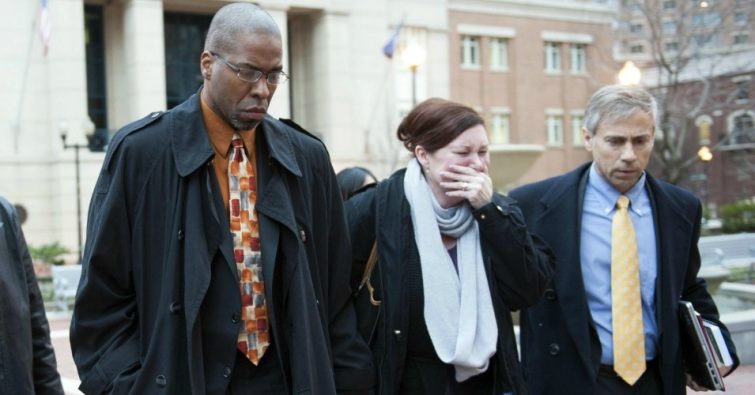
Former CIA officer Jeffrey Sterling, left, leaves the Alexandria Federal Courthouse on Jan. 26, 2016 with his wife Holly, center, and attorney Barry Pollack. Photo: Kevin Wolf/AP
By Gareth Porter | Consortium News | March 3, 2018
Jeffrey Sterling, the case officer for the CIA’s covert “Operation Merlin,” who was convicted in May 2015 for allegedly revealing details of that operation to James Risen of the New York Times, was released from prison in January after serving more than two years of a 42-month sentence. He had been tried and convicted on the premise that the revelation of the operation had harmed U.S. security.
The entire case against him assumed a solid intelligence case that Iran had indeed been working on a nuclear weapon that justified that covert operation.
But the accumulated evidence shows that the intelligence not only did not support the need for Operation Merlin, but that the existence of the CIA’s planned covert operation itself had a profound distorting impact on intelligence assessment of the issue. The very first U.S. national intelligence estimate on the subject in 2001 that Iran had a nuclear weapons program was the result of a heavy-handed intervention by Deputy Director for Operations James L. Pavitt that was arguably more serious than the efforts by Vice-President Dick Cheney to influence the CIA’s 2002 estimate on WMD in Iraq.
The full story of the interaction between the CIA operation and intelligence analysis, shows, moreover, that Pavitt had previously fabricated an alarmist intelligence analysis for the Clinton White House on Iran’s nuclear program in late 1999 in order to get Clinton’s approval for Operation Merlin.
Pavitt Plans Operation Merlin
The story of Operation Merlin and the suppression of crucial intelligence on Iran’s nuclear intentions cannot be understood apart from the close friendship between Pavitt and CIA Director George Tenet. Pavitt’s rise in the Operations Directorate had been so closely linked to his friendship with Tenet that the day after Tenet announced his retirement from the CIA on June 3, 2004, Pavitt announced his own retirement.
Soon after he was assigned to the CIA’s Non-Proliferation Center (NPC) in 1993 Pavitt got the idea of creating a new component within the Directorate of Operations to work solely on proliferation, as former CIA officials recounted for Valerie Plame Wilson’s memoir, Fair Game. Pavitt proposed that the new proliferation division would have the authority not only to collect intelligence but also to carry out covert operations related to proliferation, using its own clandestine case officers working under non-official cover.
Immediately after Tenet was named Deputy Director of the CIA in 1995, Pavitt got the new organization within the operations directorate called the Counter-Proliferation Division, or CPD. Pavitt immediately began the planning for a major operation targeting Iran. According to a CIA cable declassified for the Sterling trial, as early as March 1996 CPD’s “Office of Special Projects” had already devised a scheme to convey to the Iranians a copy of the Russian TBA-486 “fireset” – a system for multiple simultaneous high explosive detonations to set off a nuclear explosion. The trick was that it had built-in flaws that would make it unworkable.
A January 1997 declassified cable described a plan for using a Russian émigré’ former Soviet nuclear weapons engineer recruited in 1996 to gain “operational access” to an Iranian “target.” The cable suggested that it would be for the purpose of intelligence on the Iranian nuclear program, in the light of the fact that the agency had not issued a finding that Iran was working on nuclear weapons.
But in mid-March 1997 the language used by CPD to describe its proposed covert operation suddenly changed. Another declassified CPD cable from May 1997 said the ultimate goal was “to plant this substantial piece of deception information on the Iranian nuclear weapons program.” That shift in language apparently reflected Tenet’s realization that the CIA would need to justify the proposed covert operation to the White House, as required by legislation.
With his ambitious plan for a covert operation against Iran in his pocket, Pavitt was promoted to Associate Deputy Director of Operations in July 1997. On February 2, 1998, CPD announced to other CIA offices, according to the declassified cable, that a technical team from one of the national laboratories had finished building the detonation device that would include “multiple nested flaws,” including a “final fatal flaw” ensuring “that it will not detonate a nuclear weapon.”
An official statement from the national lab certifying that fact was a legal requirement for the CIA to obtain the official Presidential “finding” for any covert operation required by legislation passed in the wake of the Iran-Contra affair.
Pavitt obtained the letter from the national laboratory in mid-1999 a few weeks after it was announced he would be named Deputy Director of the CIA for Operations.
But that left a final political obstacle to a presidential finding: the official position of the CIA’ s Intelligence Directorate remained that Iran did not have a nuclear weapons program. The language of the CIA’s report to Congress for the first half of 1999, which was delivered to Congress in early 2000, contained formulations that showed signs of having been negotiated between those who believed Iran just have a nuclear weapons program and those who did not.
The report referred to nuclear-related projects that “will help Iran augment its nuclear technology infrastructure, which in turn would be useful in supporting nuclear weapons research and development.” The shift from “will” to “would” clearly suggested that nuclear weapons work was not yet an established fact.
A second sentence said, “expertise and technology gained, along with the commercial channels and contacts established-even from cooperation that appears strictly civilian in nature-could be used to advance Iran’s nuclear weapons research and developmental program.” That seemed to hint that maybe Iran already had such a nuclear weapons program.
That was not sufficient for Tenet and Pavitt to justify a covert nuclear weapons program involving handing over a fake nuclear detonation device. So the dynamic duo came up with another way around that obstacle. A new intelligence assessment, reported in a front page article by James Risen and Judith Miller in the New York Times on January 17, 2000, said the CIA could no longer rule out the possibility that Iran now had the capability to build a bomb – or even that it may have actually succeeded in building one.
Risen and Miller reported that Tenet had begun briefings for Clinton administration officials on the new CIA assessment in December 1999 shortly after the document was completed, citing “several U.S. officials” familiar with it. The Tenet briefings made no mention of any evidence of a bomb-making program, according to the sources cited by the Times. It was based instead on the alleged inability of U.S. intelligence to track adequately Iran’s acquisition of nuclear technology and materials from the black market.
But the new assessment had evidently not come from the Intelligence Directorate. John McLaughlin, then Deputy Director for Intelligence, said in e-mail response to a query that he did not recall the assessment. And when this writer asked him whether it was possible that he would not remember or would not have known about an intelligence assessment on such a high profile issue, McLaughlin did not respond. Pavitt and Tenet had obviously gone outside the normal procedure for an intelligence assessment in order to get around the problem of lack of support for their thesis from the analysts.
A declassified CIA cable dated November 18, 1999 instructed the Russian émigré to prepare for a possible trip to Vienna in early 2000, indicating that Tenet hoped to get the finding within a few weeks. Clinton apparently did give the necessary finding in early 2000; in the first days of March 2000 the Russian émigré dropped the falsified fireset plans into the mail chute of the Iranian mission to the United Nations in Vienna.
Pavitt Suppresses Unwelcome Iran Nuclear Intelligence
Pavitt’s CPD was also managing a group of covert operatives who recruited spies to provide information on weapons of mass destruction in Iran and Iraq. CPD not only controlled the targeting of the operatives working on those accounts but the distribution of their reports. CPD’s dual role thus represented a serious conflict of interest, because the CPD had a vested interest in an intelligence estimate that showed Iran had an active nuclear weapons program, and it could prevent intelligence analysts from getting information that conflicted with that interest.
That is exactly what happened in 2001. One especially valuable CPD operative, who was fluent in both Farsi and Arabic, had begun recruiting agents to provide intelligence on both Iran and Iraq since 1995. His talents had been recognized by the CPD and by higher levels of the Operations Directorate: by 2001 he had been promised an intelligence medal and a promotion to GS14 – the second highest grade level in the civil service.
But that same year the operative reported very important intelligence on the Iran nuclear issue that would have caused serious problems for Pavitt and CPD and led ultimately to his being taken out of the field and being fired.
In a November 2005 court filing in a lawsuit against Pavitt, the unnamed head of CPD and then CIA Director Porter Goss, the operative, identified only as “Doe” in court records, said that one of his most highly valued “human assets” – the CIA term for recruited spies – had given him very important intelligence in 2001. That information was the subject of three crucial lines of the key paragraph in the operative’s complaint that were redacted at the demand of the CIA. For years “Doe” sought to declassify the language of that had been redacted, but the CIA had fought it.
It was assumed in press accounts at the time that the redacted lines were related to Iraq. But the lawyer who handled the lawsuit for “Doe,” Roy Krieger, revealed to this writer in interviews that the redacted lines revealed that the CIA “human asset” in question was an Iranian, and that he had told “Doe” that the Iranian government had no intention of “weaponizing” the uranium that it was planning to enrich.
It was the first intelligence from a “highly-valued” U.S. spy – one who was known to be in a position to know he claimed to know – on Iran’s intentions regarding nuclear weapons to become available to the U.S. intelligence community. “Doe” reported what the spy had said to his supervisor at CPD, according to the court filing, and the supervisor immediately met with Pavitt and the head of CPD. After that meeting the CPD supervisor ordered “Doe” not to prepare any written report on the matter and assured him that Pavitt and the head of the CPD would personally brief President Bush on the intelligence.
But “Doe” soon learned from his own contacts at CIA headquarters that no such briefing ever took place. And “Doe” was soon instructed to terminate his relationship with the asset. After another incident involving intelligence he had reported on WMD in Iraq that had also conflicted with the line desired by the Bush administration, CIA management took “Doe” out of the field, put him in a headquarters job and denied him the intelligence medal and promotion to GS-14 that he had been promised, according to his court filing. The CIA fired “Doe” without specifying a reason in 2005.
Pavitt did not respond to requests for an interview for this story both at the Scowcroft Group and, after he retired, at his home in McLean, Virginia.
The intervention by Pavitt to prevent the intelligence from Doe’s Iranian asset from circulating within the U.S. government came as the intelligence community was working on the 2001 National Intelligence Estimate (NIE) on the Iranian nuclear program. That NIE concluded that Iran was working on a nuclear weapon, but the finding was far from being clear-cut. Paul Pillar, the CIA’s National Intelligence Officer for the Middle East and North Africa, who was involved in the 2001 NIE, recalled that the intelligence community had no direct evidence of an Iranian nuclear weapons program. “We’re talking about things that are a matter of inference, not direct evidence,” Pillar said in an interview with this writer.
Furthermore he recalls that there was a deep divide in the intelligence community between the technical analysts, who tended to believe that evidence of uranium enrichment was evidence of a weapons program, and the Iran specialists, including Pillar himself, who believed Iran had adopted a “hedging strategy” and had made no decision in favor or a nuclear weapon. The technical analysts at the CIA’s Weapons Intelligence Non-Proliferation and Arms Control (WINPAC), were given the advantage of writing the first draft not only on Iranian technical capabilities but on Iranian intentions – a subject on which it had no real expertise – as well, according to Pillar.
The introduction of the intelligence from a highly credible Iranian intelligence asset indicating no intention to convert its enriched uranium into nuclear weapons would arguably have changed the dynamic of the estimate dramatically. It would have meant that one side could cite hard intelligence from a valued source in support of its position, while the other side could cite only their own predisposition.
Pillar confirmed that no such intelligence report was made available to the analysts for the 2001 NIE. He noted just how rarely the kind of intelligence that had been obtained by “Doe” was available for an intelligence estimate. “Analysts deal with a range of stuff,” he said, “from a tidbit from technical intelligence to the goldmine well-placed source with an absolutely credible account,“ but the latter kind of intelligence “almost never comes up.”
After reading this account of the intelligence obtained by the CPD operative, Pillar said he is not in a position to judge the value of the intelligence from the Iranian asset, but that the information from the CPD Iranian asset “should have been considered by the NIE team in conjunction with other sources of information.”
That lead to a series of estimates that assumed Iran had a nuclear weapons program.
In 2004, a large cache of purported Iranian documents showing alleged Iranian research related to nuclear weapons was turned over to German intelligence, which the Bush administration claimed came from the laptop of an Iranian scientist or engineer. But former senior German Foreign Official Karsten Voigt later revealed to this writer that the whole story was a fabrication, because the documents had been given those documents by the Mujahedin-E Khalq, the Iranian opposition group that was known to have publicized anti-Iran information fed to it by Israel’s Mossad.
Those documents led directly to another CIA estimate in 2005 asserting the existence of an Iranian nuclear weapons program, which in turn paved the way for all the subsequent estimates – all of which were adopted despite the absence of new evidence of such a program. The CIA swallowed the ruse repeatedly, because it had already been manipulated by Pavitt.
Operation Merlin is the perfect example of powerful bureaucratic interests running amok and creating the intelligence necessary to justify their operations. The net result is that Jeffrey Sterling was unjustly imprisoned and that the United States has gone down a path of Iran policy that poses serious – and unnecessary – threats to American security.
Gareth Porter is an independent journalist and winner of the 2012 Gellhorn Prize for journalism. He is the author of numerous books, including Manufactured Crisis: The Untold Story of the Iran Nuclear Scare (Just World Books, 2014).
Did the CIA Sabotage Russia at the Olympics?
By Rick Sterling | American Herald Tribune | February 26, 2018
There is something very fishy about the Anti Doping Rule Violations (ADRVs) pinned on the Russian curler and Russian bobsledder during the final week of the Peyongchang Winter Olympics.
It makes no logical sense that an athlete would do a one-time consumption of a chemical that is of no value in circumstances where it is almost certain to be detected with huge negative consequences.
That is precisely the situation. The Russian Mixed Curling bronze medal winner, Alexander Krushelnitsky, had to give up his medal, plus that of his partner wife, because traces of meldonium were found in his urine sample. He had previously tested clean. Meldonium is a medication which helps keep the heart healthy by increasing blood flow. That would be of no benefit in a sport like curling which requires accuracy, strategy and focus but is not taxing physically. The “sweeping” to help guide the rock down the ice lasts only 20 seconds or less. International curlers were astounded at the news and bemused at the idea of performance enhancing drugs (PEDs) for curling. The skip of the Danish curling team said ”I think most people will laugh and ask, ‘what could you possibly need doping for?”
Krushelnitsky strongly denies taking banned drugs. “I am categorically opposed to doping …. never, at any time that I have been involved in sport, have I ever used prohibited substances”.
Similar curious circumstances apply in the second ADRV. Russian bobsledder Nadezhda Sergeeva had numerous negative (clean) tests before she was tested positive for banned trimetazidine. Bobsledding is another sport which requires physical and mental skill but not physical endurance.
In the February 25 IOC meeting to close the Pyeongchang Winter Games, the head of the IOC Implementation Group, Nicole Hoevertz, said the Russian athletes had been tested “more than any other athletes”. She and her group were convinced that the 168 member Russian athletic team was clean. At about 82:00 in the video, she says the two Russian doping violations were “very peculiar.” She introduced the Director of the IOC Medical and Scientific Commission, Dr. Bludgett, to provide more detail. He suggested that meldonium would not be of benefit in curling. He then went further and suggested the ADRV regarding trimetazidine may be in error. He said trimetazidine “is a substance where there is a parent compound which is a common headache migraine treatment available particularly in China and Japan and if that is found then it is not considered an ADRV. And if there is a very low level, as there was in this case, that is a possibility.”
Sergeeva denies ever taking banned drugs and even went on social media with a T-shirt declaring her commitment to clean sport.
In summary, it seems highly unlikely that two different Russian athletes would intentionally take medications that have no benefit but which are almost guaranteed to be detected resulting in huge harm to them and their team.
Who Benefits?
Another possibility is that meldonium or trimetazidine powder was surreptitiously put in the food of the athletes. This one time consumption would cause a positive test.
In fact there are forces on the international scene who are pleased that Russia has been battling defamation and charges of “state sponsored doping” for the past two years. They want the current denigration and punishments of Russia to continue, perhaps influencing Russia’s upcoming national election and undermining Russia’s hosting of the Football World Cup this summer.
One such group is the US Central Intelligence Agency (CIA). The CIA has a long history of big and small criminal deeds. Presumably it would not be difficult for them to infiltrate Olympic facilities or bribe a corrupt individual to put traces of meldonium or another powder in someone’s food or drink.
Those who quickly dismiss this possibility probably also thought that Iraq had weapons of mass destruction in 2002. That was a false claim supported by evidence fabricated by the CIA.
It is well documented the CIA carries out murders, coups and major sabotage. The CIA has documented some of their methods in “The Official CIA Manual of Trickery and Deception”. They don’t just carry out assassinations and coups. In the book “In Search of Enemies”, former CIA officer John Stockwell documented how the CIA created a false story about Cuban soldiers raping Angolan women to defame Cuba.
Corrupt police forces sometimes plant evidence on a suspect they wish to convict. It would be essentially the same thing to get a Russian athlete to ingest spiked food or beverage. The CIA has motive and expressed intent:
* In contrast with Russian leaders who call the US a “partner”, US officials increasingly call Russia an “adversary”. The latest US National Security Strategy explicitly says they intend to respond to Russia as an adversary: “The United States will respond to the growing political, economic and military competitions we face around the world. China and Russia challenge American power, influence, and interests, attempting to erode American security and prosperity.”
* Despite the lack of clear evidence, there is widespread belief that Russia “meddled” in the US election. The anti-Russia sentiment has been fanned into the exaggerated claim that the unproven Russian action was “an act of war, an act of hybrid warfare”.
* Neoconservative forces openly talk about “punishing” Russia. The former Deputy Director of the CIA, Michael Morrell, said “We need to make the Russians pay a price”. He confirmed on public television that means killing Russians (and Iranians) in Syria. This is the 33 year veteran CIA leader who publicly campaigned for Hillary Clinton.
Did the CIA plant the doping evidence? We don’t know for certain but it should not be dismissed out of hand. The CIA has the means, opportunity and above all the motive to falsely implicate Russians in new doping cases with the goal of preventing Russia from getting beyond the international sporting sanctions and punishments. They have done vastly more deceitful, manipulative, and outrageous things than this.
Media Bias
Unfortunately, western media will not investigate this possibility. Western media cannot even accurately report on events like the IOC meeting yesterday. The fact that the head of the IOC Implementation Group warmly praised the Russian participation at the Pyeongchang Olympics is not mentioned in western media. The fact that Dr. Bludgett raised questions about the accuracy of the ADRVs against Russia is not mentioned in reports from NY Times, the UK Guardian or Inside the Games. Instead, the writer at Inside the Games once again exaggerated the voice of critics of Russia as he downplayed the voices of international athletes who want to put the doping scandal behind and move forward.
Western media have reported deceptively that the Russian athletes have “admitted” to the violations. In fact, both Russian athletes strongly deny taking banned drugs.
Western media bias is also shown in the focus on alleged Russian doping and minimization or ignoring of other possible violations. For example the story about the Norwegian cross-country ski team and their use of banned asthmatic medications. They get around the restrictions by having their doctor claim that most of their athletes are asthmatic. This situation is a result of the inconsistent rules and regulations. A Therapeutic Use Exemption (TUE) can be given to any athlete designated by a doctor and in secrecy. They are not required to publicly disclose this, giving incentive to corruption and misuse.
Richard McLaren’s Bias
The World Anti-Doping Agency (WADA) has also been biased. Over one year ago, their investigator Richard McLaren claimed “over one thousand Russian athletes benefited” from the alleged Russian conspiracy to cheat the ant-doping system. McLaren said the proof would be provided to the various sport federations. In September 2017 it was revealed that charges had been filed against 96 athletes. Of these, WADA cleared 95 athletes of wrongdoing; only one athlete was proven to be in violation. More recently, the Court of Arbitration in Sport completely overturned the bans on 28 Russian athletes. In summary, it appears that McLaren’s accusation about “over one thousand athletes benefiting” was a huge exaggeration or fabrication.
Where Do Things Go From Here?
The IOC Executive Board has indicated they intend to lift the suspension of the Russian Olympic Committee if no more “anti-doping rule violations” are found in the last batch of athlete samples from the Pyeongchang Olympics. The results are expected in a few days.
Another ADRV may appear. If so, that will greatly complicate the effort to reintegrate Russian athletics. Even if the final tests are all clean, those who oppose Russia will continue trying to delay or prevent the full integration of Russia within the world sporting Community.
The former Moscow Laboratory Director Grigory Rodchenkov is the primary weapon in the campaign accusing Russia of “state sponsored doping”. “Icarus” is a movie about him which has received huge funding and promotion. It is nominated for an an Oscar Academy award. This will serve the campaign well.
The Russian have been accused of trying to murder Rodchenkov. But if he suddenly dies one day, it is more likely to be by the CIA. At this point, Rodchenkov has done all the damage he can to Russian sports. The only thing he could possibly do is to recant or fall apart. His handlers have prevented him from appearing before the various committees looking into the accusations. At this point, Rodchenkov could be more valuable dead than alive. His death would be a powerful weapon to disrupt the normalization of relations with Russia.
In conclusion, going back to the Pyeongchang Olympics, there should be caution before assuming the guilt of the Russian athletes who received ADRVs. It makes no sense that two Russian athletes would take useless medications knowing they will be tested and found out.
The doping incident serves the interests of those in the West who seek more not less conflict and seek to weaken Russia through “hybrid” warfare. It is possible the CIA has a hand in the latest incidents, just as they have a hand in Dr. Grigory Rodchenkov. They have the means, opportunity and motive. They have the experience and history.
If this is true, it’s another example of the dangerous descent in international relations. The Olympics movement has the goal of fostering peaceful relations. The sad truth is there are forces who want to prevent that. They prefer to demonize and divide in a quest for economic and geopolitical supremacy over “adversaries”. International sports is just another arena for them.
America Needs a 21st Century Church Committee
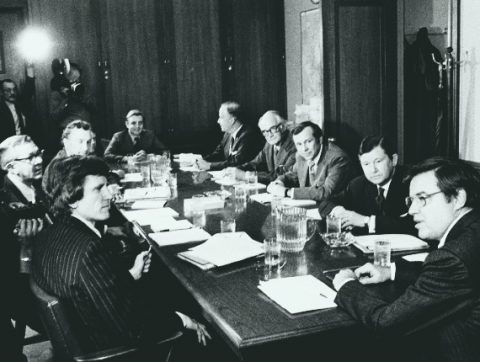
Former members and staffers of the Church Committee | March 17, 2014
Dear Congress, Mr. President and the American public,
In 1975 the public learned that the National Security Agency had been collecting and analyzing international telegrams of U.S. citizens since the 1940s under secret agreements with all the major telegram companies. Years later, the NSA instituted another watch list program to intercept the international communications of key figures in the civil rights and anti–Vietnam War movements among other prominent citizens. Innocent Americans were targeted by their government. These actions were uncovered — and stopped — only because of a special Senate investigative committee known as the United States Senate Select Committee to Study Governmental Operations with Respect to Intelligence Activities, commonly known as the Church Committee.
We are former Church Committee members and staffers and write today as witnesses to history and as citizens with decades of collective experience in Congress, the federal courts, the executive branch and the intelligence community. We write today to encourage Congress to create a Church Committee for the 21st century — a special investigatory committee to undertake a thorough and public examination of current intelligence community practices affecting the rights of Americans and to make specific recommendations for future oversight and reform. Such a committee would work in good faith with the president, hold public and private hearings and be empowered to obtain documents. Such congressional action is urgently needed to restore the faith of citizens in the intelligence community and in our federal government.
The actions uncovered by the Church Committee in the 1970s bear striking similarities to the actions we’ve learned about over the past year. In the early 1970s, allegations of impropriety and illegal activity concerning the intelligence community spurred Congress to create committees to investigate those allegations. Our committee, chaired by Sen. Frank Church, was charged with investigating illegal and unethical conduct of the intelligence community and with making legislative recommendations to govern the intelligence community’s conduct. The bipartisan committee’s reports remain one of the most searching reviews of intelligence agency practices in our nation’s history.
Our findings were startling. Broadly speaking, we determined that sweeping domestic surveillance programs, conducted under the guise of foreign intelligence collection, had repeatedly undermined the privacy rights of U.S. citizens. A number of reforms were implemented as a result, including the creation of permanent intelligence oversight committees in Congress and the passage of the Foreign Intelligence Surveillance Act.
Even though our work was over 30 years ago, our conclusions seem eerily prescient today. For example, our final report noted:
We have seen a consistent pattern in which programs initiated with limited goals, such as preventing criminal violence or identifying foreign spies, were expanded to what witnesses characterized as “vacuum cleaners,” sweeping in information about lawful activities of American citizens. The tendency of intelligence activities to expand beyond their initial scope is a theme, which runs through every aspect of our investigative findings.
The need for another thorough, independent and public congressional investigation of intelligence activity practices that affect the rights of Americans is apparent. There is a crisis of public confidence. Misleading statements by agency officials to Congress, the courts and the public have undermined public trust in the intelligence community and in the capacity of the branches of government to provide meaningful oversight.
The scale of domestic communications surveillance the NSA engages in today dwarfs the programs revealed by the Church Committee. Thirty years ago, the NSA’s surveillance practices raised similar concerns as those today. For instance, Church explained:
In the case of the NSA, which is of particular concern to us today, the rapid development of technology in this area of electronic surveillance has seriously aggravated present ambiguities in the law. The broad sweep of communications interception by NSA takes us far beyond the previous Fourth Amendment controversies where particular individuals and specific telephone lines were the target.
As former members and staffers of the Church Committee, we can authoritatively say the erosion of public trust currently facing our intelligence community is not novel, nor is its solution. A Church Committee for the 21st century — a special congressional investigatory committee that undertakes a significant and public re-examination of intelligence community practices that affect the rights of Americans and the laws governing those actions — is urgently needed. Nothing less than the confidence of the American public in our intelligence agencies and, indeed, the federal government, is at stake.
Sincerely,
Counsel, advisers and professional staff members of the Church Committee, including
Chief Counsel Frederick A.O. Schwarz Jr.
Loch Johnson
John T. Elliff
Burt Wides
Jim Dick
Frederick Baron
Joseph Dennin
Peter Fenn
Anne Karalekas
Michael Madigan
Elliot Maxwell
Gordon Rhea
Eric Richard
Athan Theoharis
Christopher Pyle
My First Day as CIA Director
By Ray McGovern | Consortium News | February 22, 2018
Now that I have been nominated again – this time by author Paul Craig Roberts – to be CIA director, I am preparing to hit the ground running.
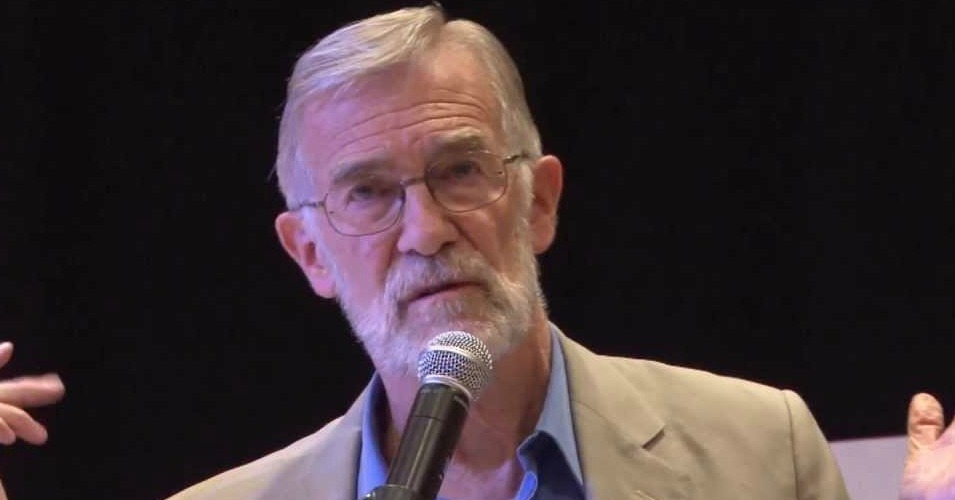
Ray McGovern
Last time my name was offered in nomination for the position – by The Nation publisher Katrina vanden Heuvel – I did not hold my breath waiting for a call from the White House. Her nomination came in the afterglow of my fortuitous, four-minute debate with then-Defense Secretary Donald Rumsfeld, when I confronted him on his lies about the attack on Iraq, on May 4, 2006 on national TV. Since it was abundantly clear that Rumsfeld and I would not get along, I felt confident I had royally disqualified myself.
This time around, on the off-chance I do get the nod, I have taken the time to prepare the agenda for my first few days as CIA director. Here’s how Day One looks so far:
Get former National Security Agency Technical Director William Binney back to CIA to join me and the “handpicked” CIA analysts who, with other “handpicked” analysts (as described by former National Intelligence Director James Clapper on May 8, 2017) from the FBI and NSA, prepared the so-called Intelligence Community Assessment (ICA) of Jan. 6, 2017. That evidence-impoverished assessment argued the case that Russian President Vladimir Putin ordered his minions “to help President-elect Trump’s election chances when possible by discrediting Secretary Clinton.”
When my predecessor, CIA Director Mike Pompeo invited Binney to his office on Oct. 24, 2017 to discuss cyber-attacks, he told Pompeo that he had been fed a pack of lies on “Russian hacking” and that he could prove it. Why Pompeo left that hanging is puzzling, but I believe this is the kind of low-hanging fruit we should pick pronto.
The low-calorie Jan. 6 ICA was clumsily cobbled together:
“We assess with high confidence that Russian military intelligence … used the Guccifer 2.0 persona and DCLeaks.com to release US victim data obtained in cyber operations publicly and in exclusives to media outlets and relayed material to WikiLeaks.”
Binney and other highly experienced NSA alumni, as well as other members of Veteran Intelligence Professionals for Sanity (VIPS), drawing on their intimate familiarity with how the technical systems and hacking work, have been saying for a year and a half that this CIA/FBI/NSA conclusion is a red herring, so to speak. Last summer, the results of forensic investigation enabled VIPS to apply the principles of physics and the known capacity of the internet to confirm that conclusion.
Oddly, the FBI chose not to do forensics on the so-called “Russian hack” of the Democratic National Committee computers and, by all appearances, neither did the drafters of the ICA.
Again, Binney says that the main conclusions he and his VIPS colleagues reached are based largely on principles of physics – simple ones like fluid dynamics. I want to hear what that’s all about, how that applies to the “Russian hack,” and hear what my own CIA analysts have to say about that.
I will have Binney’s clearances updated to remove any unnecessary barriers to a no-holds-barred discussion at a highly classified level. After which I shall have a transcript prepared, sanitized to protect sources and methods, and promptly released to the media.
Like Sisyphus Up the Media Mountain
At that point things are bound to get very interesting. Far too few people realize that they get a very warped view on such issues from the New York Times. And, no doubt, it would take some time, for the Times and other outlets to get used to some candor from the CIA, instead of the far more common tendentious leaks. In any event, we will try to speak truth to the media – as well as to power.
I happen to share the view of the handful of my predecessor directors who believed we have an important secondary obligation to do what we possibly can to inform/educate the public as well as the rest of the government – especially on such volatile and contentious issues like “Russian hacking.”
What troubles me greatly is that the NYT and other mainstream print and TV media seem to be bloated with the thin gruel-cum-Kool Aid they have been slurping at our CIA trough for a year and a half; and then treating the meager fare consumed as some sort of holy sacrament. That goes in spades for media handling of the celebrated ICA of Jan. 6, 2017 cobbled together by those “handpicked” analysts from CIA, FBI, and NSA. It is, in all candor, an embarrassment to the profession of intelligence analysis and yet, for political reasons, it has attained the status of Holy Writ.
The Paper of (Dubious) Record
I recall the banner headline spanning the top of the entire front page of the NYT on Jan. 7, 2017: “Putin Led Scheme to Aid Trump, Report Says;” and the electronic version headed “Putin Led a Complex Cyberattack Scheme to Aid Trump, Report Finds.” I said to myself sarcastically, “Well there you go! That’s exactly what Mrs. Clinton – not to mention the NY Times, the Washington Post and The Establishment – have been saying for many months.”
Buried in that same edition of the Times was a short paragraph by Scott Shane: “What is missing from the public report is what many Americans most eagerly anticipated: hard evidence to back up the agencies’ claims that the Russian government engineered the election attack. That is a significant omission.”
Omission? No hard evidence? No problem. The publication of the Jan. 6, 2017 assessment got the ball rolling. And Democrats like Adam Schiff (D-Calif.) ranking member of the House Intelligence Committee, were kicking the ball hard down the streets of Washington. On Jan. 25, 2017, I had a chance to confront Schiff personally about the lack of evidence — something that even Obama had acknowledged just before slipping out the door. I think our two-minute conversation speaks volumes.
Now I absolutely look forward to dealing with Adam Schiff from my new position as CIA director. I will ask him to show me the evidence of “Russian hacking” that he said he could not show me on Jan. 25, 2017 – on the chance his evidence includes more than reports from the New York Times.
Sources
Intelligence analysts put great weight, of course, on sources. The authors of the lede, banner-headlined NYT article of Jan. 7, 2017 were Michael D. Shear and David E. Sanger; Sanger has had a particularly checkered career, while always landing on his feet. Despite his record of parroting CIA handouts (or perhaps partly because of it), Sanger is now the NYT’s chief Washington correspondent.
Those whose memories go back more than 15 years may recall his promoting weapons of mass destruction in Iraq as flat fact. In a July 29, 2002 article co-written with Them Shanker, for example, Iraq’s (non-existent) “weapons of mass destruction” appear no fewer than seven times as flat fact.
More instructive still, in May 2005, when first-hand documentary evidence from the now-famous “Downing Street Memorandum” showed that President George W. Bush had decided by early summer 2002 to attack Iraq, the NYT ignored it for six weeks until David Sanger rose to the occasion with a tortured report claiming just the opposite. The title given his article of June 13 2005 was “Prewar British Memo Says War Decision Wasn’t Made.”
Against this peculiar reporting record, I was not inclined to take at face value the Jan. 7, 2017 report he co-authored with Michael D. Shear – “Putin Led a Complex Cyberattack Scheme to Aid Trump, Report Finds.”
Nor am I inclined to take seriously former National Intelligence Director James Clapper’s stated views on the proclivity of Russians to be, well, just really bad people — like it’s in their genes. I plan to avail myself of the opportunity to discover whether intelligence analysts who labored under his “aegis” were infected by his quaint view of the Russians.
I shall ask any of the “handpicked” analysts who specialize in analysis of Russia (and, hopefully, there are at least a few): Do you share Clapper’s view, as he explained it to NBC’s Meet the Press on May 30, 2017, that Russians are “typically, almost genetically driven to co-opt, penetrate, gain favor, whatever”? I truly do not know what to expect by way of reply.
End of Day One
In sum, my priority for Day One is to hear both sides of the story regarding “Russian hacking” with all cards on the table. All cards. That means no questions are out of order, including what, if any, role the “Steele dossier” may have played in the preparation of the Jan. 6, 2017 assessment.
I may decide to seek some independent, disinterested technical input, as well. But it should not take me very long to figure out which of the two interpretations of alleged “Russian hacking” is more straight-up fact-based and unbiased. That done, in the following days I shall brief both the Chair, Devin Nunes (R-Calif.) and ranking member Schiff of the House Intelligence Committee, as well as the Chair and ranking member of its counterpart in the Senate. I will then personally brief the NYT’s David Sanger and follow closely what he and his masters decide to do with the facts I present.
On the chance that the Times and other media might decide to play it straight, and that the “straight” diverges from the prevailing, Clapperesque narrative of Russian perfidy, the various mainstream outlets will face a formidable problem of their own making. Mark Twain put it this way: “It is easier to fool people than it is to convince them they have been fooled.”
And that will probably be enough for Day One.
Ray McGovern works with Tell the Word, a publishing arm of the ecumenical Church of the Savior in inner-city Washington. He served 30 years as an U.S. Army Intelligence and CIA analyst, and in retirement co-founded Veteran Intelligence Professionals for Sanity (VIPS).
Bear scare! Why the US Democrats desperately need a Russian bogeyman
By Robert Bridge | RT | February 20, 2018
Even before Donald Trump set foot in the White House, loveless liberals were busy pushing the narrative that Russia meddled in the elections. But could this claim be – just maybe – a dastardly ploy to hide some unsavory truths?
Pass the popcorn, the theater of the political absurd known as ‘Russiagate’ continues playing to disappointed audiences without so much as an intermission. And with the latest episode featuring an indictment against 13 Russian nationals without rhyme or reason, perhaps it’s a good time to pause and reflect on the question the mainstream media conspicuously ignores: was the real meddlesome actor in the 2016 presidential election not the perennial bogeyman known as ‘Putin’s Russia’, but the Democratic Party itself?
Indeed, some highly questionable moves on the part of the Democrats before, during and after the elections go far in exonerating the Russian fall guy from any and all charges. You be the judge.
The FISA fail
In a memo declassified by the White House and released to great fanfare by the House Intelligence Committee on February 2, it was alleged that on October 21, 2016, the FBI and the Department of Justice (DOJ) – armed with the notorious Trump dossier – secured a Foreign Intelligence Surveillance Act (FISA) warrant to conduct surveillance on Carter Page, a Trump campaign adviser.
But something looks rotten in Denmark. As it turned out, the explosive Trump dossier, compiled by former MI6 spy Christopher Steele, was bought and paid for by the Democratic National Committee (DNC) and the Clinton campaign. In other words, this represents – at the very least – a very big conflict of interest.
At the same time, in the their application for the FISA warrant, the FBI and DOJ “cited extensively” a Yahoo News article by one Michael Isikoff, which discusses Page’s July 2016 trip to Moscow.
As it turned out, however, there were serious problems with that article. As the Nunes memo states, Isikoff’s article “does not corroborate the Steele dossier because it is derived from information leaked by Steele himself…”
Indeed, Steele admitted that he met with Yahoo News “at the direction of Fusion GPS,” the firm that organized the dossier, in September 2016. Meanwhile, the mainstream media has largely played down these glaring violations of FISA protocol, as it continues to heap scorn on Russia.
“Putin’s KGB-inspired maneuvering of the United States via Donald Trump and the Republican Congress has all the earmarks of a carefully planned, professionally executed war game in which Trump, congressional Republicans and some in right wing media are his comrades,”wrote Cheri Jacobus in USA Today.
The specter of the Russian bogeyman is truly the gift that keeps giving.
Clinton’s email scandal
In March 2015, the news broke that Hillary Clinton, while serving as secretary of state, had used her home computer while handling classified government documents. An assortment of experts and politicians accused Clinton of violating State Department protocol.
On July 5, 2016, following an investigation, FBI Director James Comey said Clinton had been “extremely careless” in handling her email correspondences. He added that “no reasonable prosecutor would bring such a case.”
That statement did little to calm the critics, however, as Clinton was haunted by the ghosts of emails past right up to the eve of the elections.
On October 28, 2016, the FBI said it was reopening its investigation into Clinton’s private email server after messages were discovered on the computer of top aide Huma Abedin’s husband, Anthony Weiner, who was then embroiled in a sexting scandal. Comey announced just before the elections that nothing had changed in the Clinton case, which had been closed four months earlier without criminal charges.
However, the email saga refuses to go away as the DOJ once again reopened its investigation into Clinton’s email server in January.
To this day, Hillary Clinton has been able to divert attention away from the very serious charge of handling classified government emails over her private server thanks to a giant smokescreen known as Russia, the bogeyman that conveniently explains every transgression and setback by the Democratic Party.
Operation Sink Sanders
In July 2016, the DNC suffered a broadside after WikiLeaks released a batch of emails purporting to show that Debbie Wasserman Schultz, the chairwoman of the body, was actively conspiring against the campaign of Senator Bernie Sanders. Naturally, this news had a way of upsetting those donors who contributed funds to the Sanders campaign. Wasserman Schultz resigned in disgrace following the revelations.
Despite there being a deliberate effort to undermine the Sanders campaign, that disturbing news was sidelined by the conspiracy theory that a Russian army of apparatchiks hacked the DNC computers, turning over the information to Julian Assange. To this day, no evidence has been provided to support that claim.
Meanwhile, Wasserman Schultz was eventually cleared of rigging the Democratic primary in favor of Hillary Clinton, while Russia continues to suffer from mainstream media mudslinging.
Clinton cheated in debates
One of the most shocking revelations to come from the leaked/hacked DNC emails was the claim that Donna Brazile, interim chairperson of the DNC who once worked at CNN, used her inside connections to feed Hillary Clinton the questions to several of her public debates against Donald Trump.
Following the DNC debacle, Brazile hoped to cash in on the scandal by publishing a tell-all book entitled, ‘Hacks: The Inside Story of the Break-ins and Breakdowns that Put Donald Trump in the White House.’
In one particularly candid part, Brazile said she was secretly concerned about Clinton’s health as Election Day drew closer. This comment did not sit well with Brazile’s former colleagues. Clinton’s staffers published an open letter in response to the book, saying, “It is particularly troubling and puzzling that she would seemingly buy into false Russian-fueled propaganda, spread by both the Russians and our opponent, about our candidate’s health.”
Once again, Russia was used and abused as the convenient 11-time-zone Band-Aid that can cover any political wound, whatever the size. What is the most surprising about this tactic is that anybody still falls for it.
Regime change
Given Hillary Clinton’s past track record for advocating on behalf of military adventures, most memorably in Iraq and Libya, the tall tale of Trump-Russia collusion appears to have been a desperate effort on the part of the establishment to get their candidate into office and the military industrial complex into another war.
According to the Center for Public Integrity’s review of Federal Election Commission data, over a 14-month period (January 2015 through February 2016), Clinton and Sanders jointly received at least $765,049 from employees of major defense contractors – more than twice the $357,775 sum received by the Republican Party presidential candidates.
To prove the liberal media’s (and by extension, the establishment’s) apparent desire for military conflict, consider how it lavished praise on Trump after he attacked Syria’s Shayrat Airbase on April 7, 2017, America’s first unilateral military act aimed at the Syrian government forces (not the terrorists).
CNN analyst Fareed Zakaria waxed poetically, “I think Donald Trump became president of the United States,” he said dreamily. “I think this was actually a big moment.” On MSNBC, Nicholas Kristof, a regular Trump critic, said the Republican leader “did the right thing.” Elliott Abrams could barely contain his newfound enthusiasm for Trump: “… the Trump administration can truly be said to have started only now. The president has been chief executive since January 20, but this week he acted also as Commander in Chief. And more: He finally accepted the role of Leader of the Free World.”
Judging by such comments, had Trump continued bombing Syria, and thereby pacifying the hawks in Washington, there is a very good chance that Russiagate would have been quietly swept under the media’s carpet.
Impeach Trump
It would be difficult to name another US president who has suffered the slings and arrows of media scorn more than Donald J. Trump. And he’s only been in office for just over one year. Indeed, no sooner had his Inauguration finished there were already calls for him to be impeached. In fact, the subject has become so popular among the Democrats that there is even a special Wikipedia page dedicated to the relentless campaign.
Although the clamor to impeach the Republican leader has subsided of late, when the idea does raise its head, the empty claim that Russia influenced the elections ranks high among the reasons.
Clinton Foundation ‘pay to play’
Another reason why the Democrats would need to push the anti-Russia narrative is to protect the Clinton family from allegations that they personally profited from donations to the Clinton Foundation.
In January 2017, it was reported that the FBI opened an investigation into whether the Clinton Foundation accepted donations in exchange for political favors while Hillary Clinton served as secretary of state in the Obama administration, the Los Angeles Time reported, citing two anonymous sources.
“Critics have accused the Clinton family of using the foundation to enrich themselves and give donors special access to the State Department when Hillary Clinton was its head,” the article said.
The LA Times said that the Democrats have rejected the claims, saying that “Trump is trying to steer attention away from investigations examining…Russian attempts to influence the 2016 election.”
Nunes Memo, Part 2
If anybody thought the Trump administration would just release the Nunes memo and drop it, think again. In fact, Trump’s legal team backs the idea of a second special counsel to investigate the FBI and Justice Department
White House Deputy Press Secretary Raj Shah told reporters on Air Force One Monday that Trump’s attorneys have given the green light to starting the process of appointing a second special counsel to investigate the FBI and Justice Department’s behavior during the 2016 presidential campaign, according to a report by Axios.
In other words, expect a lot more anti-Russia outbursts from the Democrats in the days and weeks to come.
Read more:
Nunes: FBI and DOJ Perps Could Be Put on Trial
By Ray McGovern | Consortium News | February 19, 2018
Throwing down the gauntlet on alleged abuse of the Foreign Intelligence Surveillance Act (FISA) by the Department of Justice and the FBI, House Intelligence Committee Chair Devin Nunes (R-Calif.) stated that there could be legal consequences for officials who may have misled the FISA court. “If they need to be put on trial, we will put them on trial,” he said. “The reason Congress exists is to oversee these agencies that we created.”

Devin Nunes interview with Sharyl Attkisson
Nunes took this highly unusual, no-holds-barred stance during an interview with Emmy-award winning investigative journalist Sharyl Attkisson, which aired on Sunday.
Attkisson said she had invited both Nunes and House Intelligence Committee Ranking Member Adam Schiff (D-Calif.) but that only Nunes agreed. She asked him about Schiff’s charge that Nunes’ goal was “to put the FBI and DOJ on trial.” What followed was very atypical bluntness — candor normally considered quite unacceptable in polite circles of the Washington Establishment.
Rather than play the diplomat and disavow what Schiff contended was Nunes’ goal, Nunes said, in effect, let the chips fall where they may. He unapologetically averred that, yes, a criminal trial might well be the outcome. “DOJ and FBI are not above the law,” he stated emphatically. “If they are committing abuse before a secret court getting warrants on American citizens, you’re darn right that we’re going to put them on trial.”
Die Is Cast
The stakes are very high. Current and former senior officials — and not only from DOJ and FBI, but from other agencies like the CIA and NSA, whom documents and testimony show were involved in providing faulty information to justify a FISA warrant to monitor former Trump campaign official Carter Page — may suddenly find themselves in considerable legal jeopardy. Like, felony territory.
This was not supposed to happen. Mrs. Clinton was a shoo-in, remember? Back when the FISA surveillance warrant of Page was obtained, just weeks before the November 2016 election, there seemed to be no need to hide tracks, because, even if these extracurricular activities were discovered, the perps would have looked forward to award certificates rather than legal problems under a Trump presidency.
Thus, the knives will be coming out. Mostly because the mainstream media will make a major effort – together with Schiff-mates in the Democratic Party – to marginalize Nunes, those who find themselves in jeopardy can be expected to push back strongly.
If past is precedent, they will be confident that, with their powerful allies within the FBI/DOJ/CIA “Deep State” they will be able to counter Nunes and show him and the other congressional investigation committee chairs, where the power lies. The conventional wisdom is that Nunes and the others have bit off far more than they can chew. And the odds do not favor folks, including oversight committee chairs, who buck the system.
Staying Power
On the other hand, the presumptive perps have not run into a chairman like Nunes in four decades, since Congressmen Lucien Nedzi (D-Mich.), Otis Pike (D-NY), and Sen. Frank Church (D-Idaho) ran tough, explosive hearings on the abuses of a previous generation deep state, including massive domestic spying revealed by quintessential investigative reporter Seymour Hersh in December 1974. (Actually, this is largely why the congressional intelligence oversight committees were later established, and why the FISA law was passed in 1978.)
At this point, one is tempted to say plus ça change, plus c’est la même chose – or the more things change, the more they stay the same – but that would be only half correct in this context. Yes, scoundrels will always take liberties with the law to spy on others. But the huge difference today is that mainstream media have no room for those who uncover government crimes and abuse. And this will be a major impediment to efforts by Nunes and other committee chairs to inform the public.
One glaring sign of the media’s unwillingness to displease corporate masters and Official Washington is the harsh reality that Hersh’s most recent explosive investigations, using his large array of government sources to explore front-burner issues, have not been able to find a home in any English-speaking newspaper or journal. In a sense, this provides what might be called a “confidence-building” factor, giving some assurance to deep-state perps that they will be able to ride this out, and that congressional committee chairs will once again learn to know their (subservient) place.
Much will depend on whether top DOJ and FBI officials can bring themselves to reverse course and give priority to the oath they took to support and defend the Constitution of the United States against all enemies foreign and domestic. This should not be too much to hope for, but it will require uncommon courage in facing up honestly to the major misdeeds appear to have occurred — and letting the chips fall where they may. Besides, it would be the right thing to do.
Nunes is projecting calm confidence that once he and Trey Gowdey (R-Tenn.), chair of the House Oversight Committee, release documentary evidence showing what their investigations have turned up, it will be hard for DOJ and FBI officials to dissimulate.
In Other News …
In the interview with Attkisson, Nunes covered a number of other significant issues:
- The committee is closing down its investigation into possible collusion between Moscow and the Trump campaign; no evidence of collusion was found.
- The apparently widespread practice of “unmasking” the identities of Americans under surveillance. On this point, Nunes said, “In the last administration they were unmasking hundreds, and hundreds, and hundreds of Americans’ names. They were unmasking for what I would say, for lack of a better definition, were for political purposes.”
- Asked about Schiff’s criticism that Nunes behaved improperly on what he called the “midnight run to the White House,” Nunes responded that the stories were untrue. “Well, most of the time I ignore political nonsense in this town,” he said. “What I will say is that all of those stories were totally fake from the beginning.”
Not since Watergate has there been so high a degree of political tension here in Washington but the stakes for our Republic are even higher this time. Assuming abuse of FISA court procedures is documented and those responsible for playing fast and loose with the required justification for legal warrants are not held to account, the division of powers enshrined in the Constitution will be in peril.
A denouement of some kind can be expected in the coming months. Stay tuned.
Ray McGovern works with Tell the Word, a publishing arm of the ecumenical Church of the Savior in inner-city Washington. He was a CIA analyst for 27 years and is co-founder of Veteran Intelligence Professionals for Sanity (VIPS).
Featured Video
Benoit Paré: OSCE Whistleblower: The Ukraine War – Narratives vs. Reality
or go to
Aletho News Archives – Video-Images
Book Excerpt
How CIA used Ukraine as a platform for covert war against Russia
By Stephen KINZER | Responsible Statecraft | November 17, 2026
The following is an excerpt from Stephen Kinzer’s new book: Boiling Point: How America Brought War to Ukraine (Henry Holt and Company, November 2026)
Huddled beside an airstrip in southern Germany, a handful of anti-Communist warriors prepared to fire the first shots of the Cold War. A CIA officer from the Munich Operations Base was in charge. The Hungarian crewmen he had recruited stood nearby in flight suits. With them were two Ukrainian exiles who had volunteered to parachute into their homeland. They were code-named Apostle 1 and Apostle 2. Each carried forged identity papers, a miniature radio transmitter, a pistol, a machine gun, hand grenades, a purse full of gold coins, and a poison pill to be taken in case of capture. An unmarked C-47 transport plane was waiting.
The CIA officer overseeing this operation, a twenty-six-year-old Yale graduate named Stephen Tanner, watched the plane take off and disappear into the night. It flew over East Germany and Poland, then crossed into Soviet airspace. As it approached the Ukrainian city of Lviv, a cargo bay swung open. The two Ukrainians jumped into the darkness. Their mission was to link up with partisan fighters, seize territory, and establish a clandestine base through which the CIA could send them weapons.
That flight, on September 5, 1949, was the first American act of covert war in Ukraine. … continue
Blog Roll
 Aletho News
- The Food Book — First Edition, 2026, Paperback
- Benoit Paré: OSCE Whistleblower: The Ukraine War — Narratives vs. Reality
- UK forced to admit ordering backdoor access to Apple users’ data
- It’s not about China or national security. It’s about which foreign entity is allowed to spy on Americans
- Banning Palestine activists from the West will not save Israel’s image
- Iran rejects unlimited IAEA inspections amid continued military threats
- A Bridge Too Far
- David Barnea in the Bundestag – Mossad as a model for Germany’s Intelligence Services?
- Rome blasts Kiev after Italian lawmakers added to ‘kill list’
- Another €45 bn down the drain: Why the EU is desperate to waste more cash on Zelensky
- If Americans Knew
- ‘One Started Spraying Bullets’: Palestinian Eyewitnesses Describe Settler Incursion That Left 72-Year-Old Woman Dead
- Palestinian children are 40% of all children killed & maimed worldwide, says Save the Children
- WATCH: Netanyahu boasts how his father helped establish Israel through manipulating the U.S.
- Tom Friedman’s deceptive effort to lure Dems to escalate in Iran
- Leading humanitarian groups give Gaza peace plan failing grade one year on
- 9,500 Palestinians face starvation, torture and medical neglect in Israeli prisons
- DAILY UPDATE: Latest essential news on Palestine, Israel, & region
- Drowning in plain sight: a sobering reminder of what may come next
- Israel threatens to seize more territory in Gaza, Lebanon, Syria
- Fracture, Expel, Humiliate
- No Tricks Zone
- Argentina’s Perito Moreno Glacier Joins Antarctica and Arctic In Defying Doomsday Melt Claims
- New Study: Barents Sea Temperatures Were Warmer And Sea Ice Less Extensive In The 1700s Than Today
- German Authorities Start Initiative To Evaluate Public Register For Climate “Disinformation” Spreaders!
- Zonal Asymmetry of Temperature Change in the Antarctic Circumpolar Current
- New Study: The Net Fossil Fuel Contribution To Rising Atmospheric CO2 Has Been Zero For 500 Years
- Germany’s Green Energy Transition Becoming Increasingly Expensive…Another 6 Trillion Euros!
- Sudden Stratospheric Warming, Powerful El Niño Combination May Lead To Extreme Europe Cold, Energy Crisis!
- Two New Studies Find Thwaites Glacier Melt Cannot Be Driven By Human Activity Or A Warming Ocean
- E-Cars Reduce CO2 Emissions By Only 41% Compared To Internal Combustion Engine Vehicles
- Predictions Made By Renowned Climate Professor Over Past Decades Have Been Proven To Be Poor

