Early treatment book is now available on Amazon
By Steve Kirsch | January 9, 2022
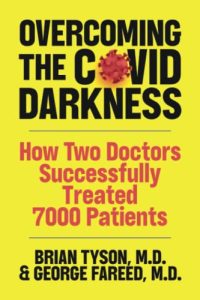 COVID is a very treatable disease if it is treated early using an early treatment protocol. There are lots of such protocols that are highly successful. This new book documents one such protocol.
Since March of 2020, Brian Tyson and George Fareed, two physicians with impeccable credentials, have been treating COVID patients of all ages in Imperial Valley, CA using early treatment protocols.
Their track record is extraordinary. If you started treatment within 7 days of first symptoms, only 2 people were briefly hospitalized and there were no deaths. The earlier you start treatment, the better the results and the faster you recover.
Their book is now available at Amazon (if you buy it now on Kindle for $5.95, it will be delivered Jan 24). It is a #1 best seller as you can see below.

The entire pandemic response was unnecessary: COVID is very treatable if treated early
This book shows that we’ve known about effective treatments since March 2020.
Had the CDC publicized such treatments, it would have made the entire pandemic response completely unnecessary: lockdowns, vaccines, mandates, masking, business closures, etc. Everyone would have gotten natural immunity and the pandemic would have ended with virtually no deaths.
Tyson and Freed tried contacting the FDA, CDC, and NIH, but nobody would talk to them or return their calls. The same is true today. They are just “too busy” to talk to them. Keeping patients out of the hospital and morgue is not a priority for them.
The same is true of the mainstream media. The NY Times refused to run op-eds about early treatments and CNN said that they were too busy covering the vaccines and people dying from COVID that they didn’t have the resources to talk about early treatment protocols that would have prevented everything.
Instead of promoting early treatment using repurposed drugs, the CDC instructed people to just stay home and do nothing until they were so sick that they had to go to the hospital. Even after drugs in the Tyson/Fareed protocol like ivermectin and fluvoxamine have been proven time and time again to work in clinical trials and, in the case of ivermectin, published in systematic reviews and meta-analyses, the NIH still fails to acknowledge them rating them NEUTRAL. This means that most doctors will not use them.
On May 24, 2021, I offered $2M to anyone who could show that the NIH made the proper decision on these two drugs, but nobody came forward.
In short, nobody in the world thought they made the right decision (or at least could justify it). But they are the authorities and we cannot question their judgement, ever.
The CDC doesn’t want you to share this post with anyone
The CDC would like you to know the following:
- You need to follow our advice. Do not think. Do not ask questions. Just do as you’re told. We are the CDC and we always know best.
- Trust us: early treatments don’t work. Ignore all the data from these physicians. Even though we’ve never even talked to them or looked at their data, we know they are wrong. We don’t even have to look at their data to know that they are wrong. The data does not matter. It is our opinion that matters. Got it?
- Do not share this post with anyone, especially your doctor, anyone in mainstream media, or Congress. Do not to do anything to disrupt Big Pharma’s profits.
- Even if you did share it, nobody would believe you anyway; they will think you are crazy. We have totally brainwashed pretty much everyone except for a relatively small number of people.
- Don’t read the book. This book will destroy our credibility as well as that of the NIH and FDA. You may not be able to deal with the cognitive dissonance. Just do what we say. Don’t worry, be happy.
- If you feel you must read the book, ask your doctor to prescribe Versed and take it as directed before you read the book. That way, after you are done reading it, you won’t remember anything.
- If the public finds out about this book, a lot of people are going to be very upset about how they’ve been fooled. You wouldn’t want that to happen now, would you?
The Global Disinformation Campaign Against Ivermectin in COVID-19 (Part I)
By Pierre Kory | January 6, 2022
Ivermectin, a decades-old, off-patent drug costing pennies to make, with an unparalleled safety profile and numerous manufacturers across the world, actually sits atop one of the largest and strongest clinical trials evidence base in history. The existing, massive amount of clinical trials data shows immense efficacy against COVID-19 in all its phases; prevention, early and late treatment, and long-haul syndrome (no actual trials in long-haul but rather extensive positive clinical experiences). Despite this inarguable (yes, inarguable) supportive evidence, no major Western or international health agency has recommended its use in COVID-19. Conversely, ivermectin has been officially adopted for early treatment in all or part of 23 “less developed” countries (39 if you include non-government medical organizations), and which include about 25% of the world’s population.
Now, before we delve deeper into the workings of the most heinous disinformation campaign ever waged by the pharmaceutical industry in history (and also it’s most successful so far as 75% of the earth’s inhabitants still have not been recommended to use it to treat COVID), I will ask you not to just “take my word for it” but instead take you on a brief, guided tour of the insanely positive evidence base supporting the use of ivermectin in COVID-19.
Let’s go. First, the below “Forest Plot” was compiled by the anonymous expert research group at c19early.com (not enough can be said of the impact their meticulous work has had on COVID clinicians and scientists across the globe). Please visit their site, it is mind-blowingly impressive. The compounds listed in the rows represent the medicines with the most clinical trials evidence as of today, either by size or by number and are listed in order of potency against COVID.
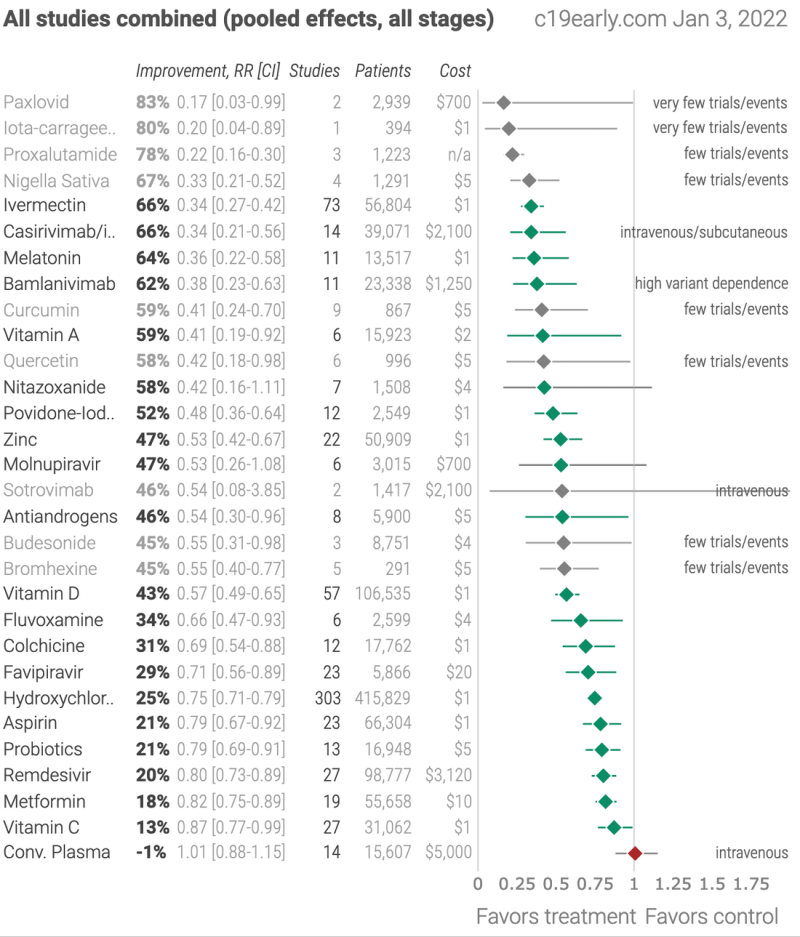
Here is how to read and understand a Forest Plot: there is a thin grey line in the center, on either side of which are plotted squares which represent an estimate of the true size of the “treatment effect,” derived from an average of the treatment effects measured from all the trials performed of that medicine. If the box is squarely on the vertical line it means it is a treatment whose benefits have been found equal to its harms. In the above list, (with the exception of one) medicines with “positive” treatment effects are listed, meaning the benefits of treatment with these agents outweigh any potential or actual harms. No medicine on the list above, besides convalescent plasma (CP), indicates it is inferior to placebo (note that CP was the initial favored therapy of every single academic medical center in the U.S despite the fact CP has only ever been shown to be effective in hematogenous infections). In cases, such as with CP, due to the fact it’s harms outweigh it’s benefits, the box is plotted on the right side of the line and shaded in red. Conversely, the farther to the left of the vertical line that a box is plotted, the larger the measured impact on the clinical outcome tested. Green boxes indicate the effect estimate is based on at least 4 trials. Grey boxes and greyed out medicine names mean the estimate for that medicine is based on fewer than 4 trials. The thin horizontal line through each little box indicates the degree of precision, i.e. how confident we can be in the estimate of the treatment effect – narrow horizontal lines through the boxes mean the data in support is large and consistently positive and is “statistically significant” in favor of the medicine. The wider the line, the less consistent, or less amount of data can be relied upon to make the estimate. When the horizontal line through a box extends across the vertical gray line, this indicates that it is statistically possible that the true estimate may actually be in favor of placebo!
With ivermectin, what sets it apart from all the other compounds tested, is the sheer number of randomized and observational controlled trials that have been performed to date. It is #1 among the “green box” compounds given it has been tested in 73 controlled trials which include an unheard-of 56,804 patients. Why unheard of? Because never in history has a medicine been so thoroughly tested, with such consistent positive results, yet led to a situation where governmental agencies in highly developed countries call for even more placebo-controlled trials to be done… and then slow walk to doing them. The ethics of giving a covid patient a placebo given this amount of supportive data are too miserable to contemplate this early in the article (fun fact – I was personally asked to try to help recruit patients for the ongoing University of Minnesota placebo controlled RCT. I got off the phone as fast as I could). Another not-so-fun fact: penicillin was mass deployed to great effect to all our troops for their battlefield injuries in World War II… based on a case series of 157 patients where their bacterial infections overtly resolved without signs of toxicity during treatment. Not one RCT was done before this decision was made by military and medical leaders.
The only other medicine with a larger supportive evidence base is hydroxychloroquine (HCQ), especially when only the early treatment trials of HCQ are considered as that collection of trials results in an equally impressive position on the Forest plot (not shown). A tired topic I will explore later is the much parroted (and highly favored by Pharma) notion that “retrospective, observational controlled trials (OCT)” cannot be trusted as they are inferior to “proper, large, double-blind, randomized, placebo controlled trials (RCT).” This notion is not evidence based. Even the captured (I know, sorry) Cochrane Library knows this. They themselves have shown that, on average, over thousands of clinical trials, over decades of research, OCT’s and RCT’s reach the same conclusions. So stop with the false dichotomy. Pharma wants you to only trust in “large RCT’s”… because they are the only ones with the cash to do them. That way, they can control the only medicines that get “proven” and thus adopted into guidelines.
Two absurdities (crimes) must be highlighted in the above diagram – one is the sheer number of medicines with demonstrated efficacy, most costing under $5 a dose (and almost all with unparalleled safety profiles and/or “over the counter” status) that are still not recommended by any U.S or “western” health agency (with the exception of the state of Florida since the hire of Surgeon General Dr. Joseph Ladapo who has put together a terrific public health campaign supporting the use of a combination early treatment protocol which includes another FLCCC adopted drug, fluvoxamine).
Meanwhile our federal governmental health agencies, which I have argued repeatedly (and will for years until it stops) are so completely captured by the pharmaceutical industry that they have not advocated for any one of these “repurposed” compounds, even as a “precautionary principle” (meaning that even if the purported benefits may not be realized to the extent estimated, the risks are so small it is more likely best for all we employ them now in early treatment given the world is cratering). Their most unforgivable and absurd inaction is the deliberate ignoring of the critical role of Vitamin D in protecting against the worst outcomes of COVID, despite knowing full well significant portions of the U.S population is Vitamin D deficient. Even Anthony Fauci recommends to himself that he take Vitamin D… regularly. The data below was given to me by a Dr. Henele and is from work he published in 2016. Note the percent of the U.S population that is critically deficient in Vitamin D.

The second absurdity is found when looking at the plot with only the medicines recommended in the NIH’s COVID protocol circled. Note that the NIH protocol is adhered to by almost the entirety of the country’s hospitals (largely due to large add-on bonuses paid to hospitals when the protocol elements are used – I am not making this up). A “theme” should begin to emerge as you look at the circled, “recommended” medicines vs the non-circled, “non-recommended” medicines – every single one is massively expensive. Every single one. Note not one inexpensive drug is circled. How much more evidence do you need to prove that our agencies have been completely captured by the pharmaceutical industry?

Fun fact now that you are en expert in reading Forest Plot’s: Merck’s mutagenic new drug molnupiravir, after the highly positive results from their study’s “interim analysis,” published in a press release, instead found that, in the 2nd half of its one study, the data favored… placebo. Thus if the 2nd half was a stand-alone study (which it arguably could have been) it’s box would be firmly on the right side of the line. FDA still approved… while feigning concern. Unsurprising really.
Now, beyond the above 73 controlled trials supporting ivermectin, there are, in addition, numerous health ministries from around the world that deployed ivermectin in either the prevention or early treatment of COVID, among often very large populations. Each program’s report found that ivermectin use led to massive reductions in the need for hospitalization and/or death (Mexico City, Uttar Pradesh, Brazil, Misiones, La Pampas, Peru, Phillipines, and Japan – I will do a deeper dive on these in a later post). The program in the city of Itajai, Brazil is both the largest study of ivermectin in the world (data from nearly 200,000 patients was carefully collected over a 6 month period) and most impressive. They found that, despite the fact that the 120,000 patients who agreed to take ivermectin every 15 days were older, fatter, and sicker than the approximately 37,000 that did not… they went to hospital 67% less frequently, and died 70% less frequently… from all causes, not just COVID. The issue with ivermectin as a therapeutic in COVID… has NOTHING to do with the science.
The issue with ivermectin is simply it’s price – it costs less than a $1 and represents the biggest threat to the immense and future profits of the pharmaceutical industry’s novel oral anti-viral drugs… as well as their vaccines.
The previous title holder of the largest threat to Pharma profits in COVID was the highly effective (and also anti-viral) drug hydroxychloroquine (HCQ). However, it lost that title after the 2020 war on HCQ was essentially won by Pharma (for now?), using tactics so sinister as to be unimaginable, and which I will not review here as that macabre war has already been expertly reviewed in incredible and highly referenced detail in the book “The Real Anthony Fauci” by Robert F. Kennedy Jr. His book, in my opinion, is a must read for all the globe’s citizens, as without it, no coherent understanding of the innumerable non-scientific actions and policies across the entirety of the developed (and majority of the undeveloped) world can be gained.
I must emphasize that ivermectin is just the latest drug under attack during Pharma’s long-standing (and highly successful) war on off-patent, “no-longer-obscenely-profitable” medicines. Books have been written about the numerous, and often criminal actions that Big Pharma has employed to replace older off-patent medicines with newer, highly profitable, and often poorly tested drugs with either prospectively known dangers or quickly discovered dangers which they then criminally suppress or distort to preserve profits. When science supporting older, off-patent, often “repurposed” medicines (particularly in the lucrative environment of a global pandemic) becomes “inconvenient” to the financial promise of newer agents, the industry employs what are called “Disinformation” tactics, first invented and perfected by the Tobacco Industry, and now used to great effect by the Pharmaceutical (and many other) industries. These tactics are brilliantly and succinctly summarized in an article called The Disinformation Playbook written by The Union for Concerned Scientists. I encourage all to read. The 5 main “plays” from the playbook are listed below. If you are at all versed in the ivermectin in COVID saga (many FLCCC followers are), it should be easy to quickly come up with numerous examples of each nefarious tactic. I give some hints below…
1) The “Fake”: Conduct counterfeit science and try to pass it off as legitimate research (Dr. Andrew Hill)
2) The “Blitz”: Harass scientists who speak out with results or views inconvenient for industry (attacks on FLCCC founders)
3) The “Diversion”: Manufacture uncertainty about science where little or none exists (Dr. Andrew Hill/captured high-impact journals)
4) The “Screen”: Buy credibility through alliances with academia or professional societies (i.e. high impact medical journal influences)
5) The “Fix”: Manipulate government officials or processes to inappropriately influence policy (i.e. capture the health agencies by creating “revolving doors” between Pharma and government to ensure total synchrony in objectives amongst their leaders)
Given the Disinformation Playbook was last updated in 2018, it does not include newer, more nefarious tactics that industries have been able to deploy since the historic consolidation of financial power by just 3 multi-trillion dollar investment funds (Black Rock, State Street, and Vanguard). These three corporations have now acquired influential or outright controlling investment stakes in nearly every major corporation in nearly every industry. These investment managers power, particularly the power held synchronously over media companies, social media companies, and the near entirety of the pharmaceutical industry, has allowed even more fearsome tactics to be used in the near-global suppression of the efficacy of ivermectin (and HCQ) as they now:
1) CENSOR any mentions of supportive evidence in corporate, (a.k.a. “legacy”) media. Note that, besides the influence of these investment manager overlords, the global censoring ability of media was greatly helped by the “Trusted News Initiative (TNI),” an obscene (and either naively misguided or completely corrupt) effort by the most powerful journalism organizations in the world to band together to try to control the spread of “mis-information”. Yes, professional journalists decided they needed to control information in a pandemic. I am not making this up. Would an appropriate analogy be that a bunch of physician leaders decided they needed to spread disease in a pandemic?
2) CENSOR any mentions or discussions of efficacy on almost all social media – see explicit youtube “community” policy below as the most unsubtle example:
YOUTUBE COMMUNITY GUIDELINES

3) RETRACT positive papers from impactful medical journals (3 fully peer-reviewed and highly supportive scientific reviews of ivermectin have been retracted, either immediately prior to or post-publication (I was the lead author on the first one with my FLCCC colleagues)
4) BLOCK review and publication of positive trials of ivermectin in major medical journals (in my now global network of ivermectin-expert and/or ivermectin study investigator colleagues, all lament how their positive clinical trials or papers were rejected for review from all the high-impact (captured) journals, with Dr. Eli Schwartz’s highly sophisticated, expertly conducted, and immensely positive study from Israel being one of the most illustrative examples
5) PUBLISH numerous “hit pieces” within high profile print media outlets discrediting the science and/or the scientists who support the medicine. This is actually an example of the already described “Blitz” tactic, but in 2021, during COVID, using total media control, it was deployed by a division of Howitzers. A more recent and relatable example of “the Diversion” tactic was when the NFL used media hit pieces to go after the scientists (and their inconvenient science) after they began publishing and disseminating data about the high rates and disastrous impacts of chronic traumatic encephalopathy in retired NFL players.
What I have found fascinating, is that for every planted hit piece article discrediting the mountain of evidence supporting ivermectin as a therapeutic, the FLCCC is actually rarely mentioned. But why? I think it is because the FLCCC is a sizeable group of highly published physicians and researchers (Professor Paul Marik is actually the most published practicing ICU physician in the history of the specialty). Thus, it’s hard (but not impossible) to call us “fringe.” The last thing they want to do is call attention to our high degree of credibility. Instead they seem to be trying to destroy it using separate hit pieces (among other tactics) which has led to the recent loss of employment for three founding FLCCC members (Drs. Marik, Meduri, and yours truly have been forced to leave jobs or had their exemplary clinical and research careers ended (Drs. Marik and Meduri). An article on ivermectin that does not mention our organization does so purposefully so as not to give attention to credible support for its use given we are considered the foremost clinical experts on the clinical use of ivermectin in COVID in the world.
6) employ a coordinated media-government agency PROPAGANDA campaign;
August 26th, 2021: Pharma used their CDC to send out a “health advisory” to all 50 state Departments of Health, which they then sent to all the physicians licensed in their respective states (a terrifying example of the immense destructive power of a federal agency captured by pharmaceutical industry interests). The bulletin both;
1) depicted ivermectin as a dangerous drug by deliberately exaggerating reports of calls to poison control centers
2) cited the meaningless fact that it “is not FDA approved for COVID” as a reason it should not be used, hoping doctors may not realize that “off-label” prescribing is both legal and encouraged… by the FDA.
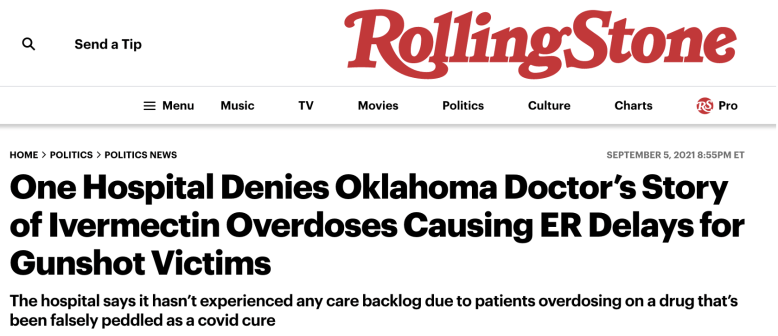
Next, a quickly debunked (not quickly enough) planted media article in Rolling Stone appeared with an impressively click-bait-able headline describing emergency rooms so overflowing with ivermectin overdoses that our nation’s gunshot victims couldn’t get (obviously) needed care (even I clicked on it). The article then went viral across the world (thousands of media mentions) before the hospital could put out a statement saying it was 100% false. Gee, do you think Pharma hired a professional PR firm to pull that one off or did they just benefit from a serendipitous and lamentably lazy journalist’s error?
Then, in another terrifying example of the control of major corporate media… for week after week every news broadcaster, pundit, and late-night talk show host prefaced the word ivermectin with the descriptor “horse de-wormer.” Over and over and over again (totally pissing off Joe Rogan who recovered from COVID with ivermectin as part of his combination protocol- hah!)
Then finally, in a coup de grace, in comes Pharma’s FDA proudly using twitter to associate ivermectin with, you guessed it, horses. Janet Woodcock, the acting Commissioner of the FDA, even sent out a congratulatory email to her team about the success of the tweet.
Was this a coordinated attack led by an expert team of brazen PR professionals who have a fondness for horses… or did it arise organically via a series of disconnected events?
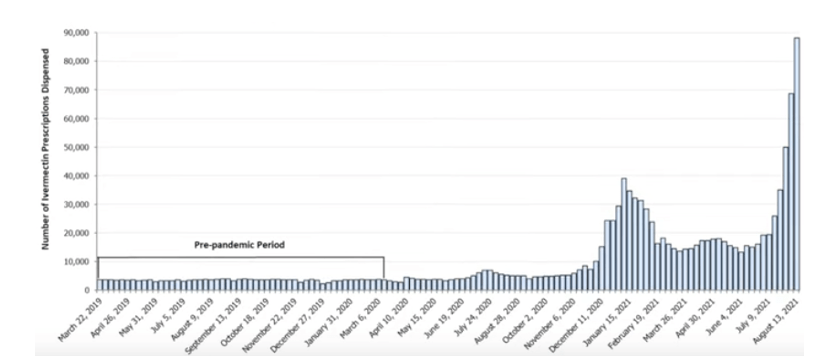
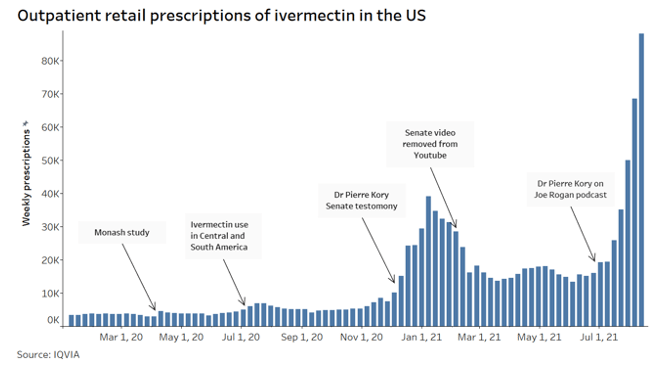
If you are still not convinced of the former, I need to point out that this “series of disconnected events” had an uncanny sense of when to “roll-out.” The CDC’s Health Advisory was issued on August 26th. Look at the below chart and see if you can find any reason why it would start then? Recall that the advisory was ostensibly in reaction to false “reports of calls to poison control centers”. The below chart shows instead what was really going on at the time – hundreds, if not thousands of licensed medical professionals across the country were prescribing ivermectin like mad during the terrible, and deadly summer surge of the Delta variant. Was someone getting nervous that a “dirty little secret” was being rapidly discovered by American citizens and physicians? The answer is a definitive yes – thus triggering Pharma to nefariously try to “stuff the genie back in the bottle” by unleashing their terrifying disinformation propaganda campaign.
NUMBER OF IVERMECTIN PRESCRIPTIONS DISPENSED IN THE U.S OVER TIME
But check this out… the good ole’ FLCCC, my little band of brothers and sisters, is somehow making a opening in the wall of information suppression and distortion as shown in the chart below (compiled by our data analyst and ivermectin expert, Juan Chamie). I say this makes us “the Bad News Bears” in the repurposed drug war.
I am going to stop here… and call it PART I. Please subscribe below so you can be sure to get Part II where I will continue to detail the numerous and wide-ranging corrupt actions taken to suppress the knowledge of efficacy and restrict the use of ivermectin… across the world. There is way way more to this story.
Also, please be aware of the following events:
World-wide Rally for Freedom Day
Join us for a march in DC on defeating the mandate and to march in support of our international colleagues- who are also rallying on this day: Sunday January 23rd.
United we stand, in peace we watch. Bring friends and jackets.
Go to https://defeatthemandatesdc.com/ for details
Finally, I am honored to have been invited by Dr. Chris Martenson and Peak Prosperity to their Annual Seminar as part of a speaker panel including some powerhouse thought leaders. Don’t miss it folks. Register using this link: http://peak22.events/kory
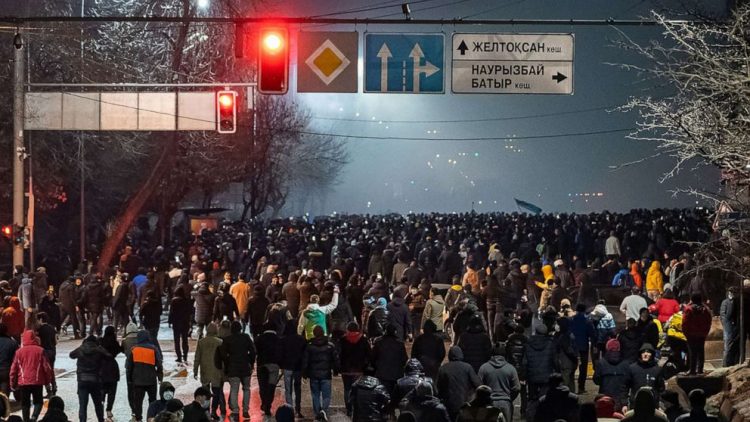
There Was an Element of Medical Freedom Uprising to Kazakhstan’s Revolt
It sprung up just as new bans for the unvaccinated (55% of the population) were to go into effect
RIA Katyusha | January 5, 2022
Anti-Empire : Did pan-Turks, Islamists, and Soros try to jump on the train? They would be stupid not to. But social unrest doesn’t start because Joe Kazakh wants more CIA black sites, but because his bread costs twice as much, he will have to lockdown his shop for the fourth time in two years, and he’s having to get experimental mRNA or lose the ability to feed his family. That he has been ruled by the same authoritarian and corrupt guy and network of clans since 1989 doesn’t help things either. The Russian alternative media outlet RIA Katyusha has more.
Machine-translated from Russian.
Last Kazakh warning to Putin: vaccination and greed of elites as the cause of the revolution in Kazakhstan
Another republic of the former USSR and Russia’s strategic ally, Kazakhstan, found itself embroiled in the classic color revolution. And although it is obvious that the conductors of current events are located in Paris, London and Washington and their goal is to weaken China and implement the old Masonic idea of a “united Europe from Lisbon to Vladivostok”, the local authorities, which cared exclusively about their own pockets and following the covid instructions of the globalists, hoping to come to terms with the devil. That is, she was doing the same thing as the Russian “elite”.
Gas prices shouted about by the Russian state media have become nothing more than a pretext for massive protests. The “technocrats” in power in Kazakhstan (hello to “ours” Mishustin and Kiriyenko) brought the people to seething anger with a drop in living standards and mandatory vaccination with QR codes, and also missed the preparation of protests by Soros structures.
This — namely, the stupidity and inability to discern the threat even to one’s own skin — is one of the main differences between technocrats and traditional rulers, of which Alexander Lukashenko can serve as an example. But Lukashenko sat there because he had someone to rely on. Putin and his comrades have no one to rely on – the people and the army with the Church will not defend the servants of the globalists. Therefore, the Russian elite need to study the Kazakh experience very deeply if, of course, they do not want to step on the neighbor’s rake.
Apparently, Russia is on the verge of losing one of its main allies, without which it will lose its influence throughout Central Asia. Power is slipping away from the hands of local technocrats and the former head of the country Nazarbayev in real time, and it is time for President Tokayev to sit next to Yanukovych and start writing the second volume of the book: “How to lose everything and understand nothing.”
Formally, the protests began on January 2 in the west of the country in the city of Zhanaozen, Mangistau region, after the price for a liter of liquefied gas rose to 120 tenge ($ 0.27) from January 1. The protesters demanded to lower the gas price to 60 tenge ($ 0.13), but they were simply not noticed by either the authorities or the media, and therefore calmly spread to the rest of the country. Moreover, the country’s leadership was fully confident that everything would “dissolve by itself,” and TV experts cited the Europeans as an example, where, they say, they walked around and went home. But these experts did not take into account the most relevant things – there is no Soros in Europe, USAID (recognized as undesirable in Russia), which openly work with both government officials and civic activists, and the NED fund, which openly and since mid-December have been waiting for a riot and supported the movement.”
But that’s not the point. The main thing is that the authorities of Kazakhstan, just like the authorities of the Russian Federation, refused to see people’s protests against compulsory vaccination, vaccination of children and pregnant women and QR codes. They were unable to resolve issues with wild food prices, shortages of gasoline and diesel fuel, drought and deaths of livestock, but, like their Russian colleagues, they followed all the instructions of the WHO and the IMF, leading people to the point that any pretext would become the spark that Lenin talked about more than a hundred years ago. As a result, technocrats began to react only when the Kazakh revolt turned from a pure economy into politics, and militants and protesters began to seize administrative buildings and television channels. But the protesters seized the president’s residence in Alma-Ata. The total number of victims in Kazakhstan has already exceeded 700 people, of which 150 are policemen and soldiers. So far, there is no confirmed data on the deceased.
Now President Tokayev has already agreed to everything, even having fired Nazarbayev [and the PM and the cabinet], but the time has passed and no one wants to talk to him anymore. The only thing that can still save his skin is the introduction of martial law and the brutal suppression of the protest. However, he is unable to do this, for he is too tied to the West, which already considers the “buns” from the emergence of a “new Ukraine” under the belly of Russia and China. It is pointless to list everything that is happening there now – events are developing at such a speed that any information by the time of publication will be outdated. It is much more important for us to understand the reasons, because much of what is happening there is too similar to what is happening in Russia.
Let’s start with the main factors that drove people to the streets. The main one is the fall in the standard of living of the population (which is officially not there) and the rise in prices (hello to Rosstat named after the Ministry of Economy of the Russian Federation together with the Central Bank and who else is counting inflation for us). Last year, according to official data, prices for goods in Kazakhstan soared by 8.9%, which is higher than in Russia. The prices for food products rose most noticeably in Kazakhstan: plus 11.3% for the year in October 2021. In July-August of this year, there was a growth in prices for vegetables of long-term storage (potatoes, carrots, beets), which was not typical for the summer months and a record in recent years, against the background of a shortage of their supply by the end of the off-season. Amid depletion of domestic stocks before the arrival of the new harvest, the monthly price increase for these products in June showed record values in recent years, which led to a sharp jump in the annual inflation rate (immediately by 30.6% over the same period a year earlier). In October 2021, the annual growth in consumer prices for vegetables was 25.5%. Meat rose 10.3%, sunflower oil 56.2% year on year and sugar 32.1% year on year.
Also in October, the country faced a diesel shortage. The situation influenced not only the increase in the cost of diesel fuel, but also gave rise to problems for transport companies, KTZ, and also created risks to ensure the stable operation of utilities and road services. Diesel fuel was sold at many gas stations in the country only with coupons during these weeks, some of them did not have it at all. According to official data, the growth in gasoline prices was (+ 15.6% per year), diesel (+ 24.4% per year), or by a quarter. The shortage of fuel was added to the shortage of electricity. In a number of regions, in order to save electricity during peak hours, its supply was suspended. In addition, in the west of Kazakhstan in the summer of 2021, there was an intense heat and lack of rainfall, which led to a large-scale drought. Farmers have suffered huge losses in the Mangistau region and the Aral region of the Kyzylorda region, livestock deaths were recorded everywhere. The network spread eerie footage of emaciated animals, which the owners were forced to feed with cardboard paper. Despite the difficult situation, the Ministry of Agriculture was in no hurry to provide prompt assistance to farmers.
Objectively speaking, the price of autogas in Kazakhstan is several times lower than in Russia, Belarus and Ukraine – even after the increase. But if it was only a question of gas, then there would be no protests. As the inhabitants of the Russian north of the country write, the worst thing in this situation is that the technocrats did not have any positive plan to improve the situation of people, but they had plans to drag people through lockdowns and stab them to death.
In Russia, the state media are trying to keep silent about this, but one of the main reasons for the current protests is not the economy, but new restrictions that were planned to be introduced there from January 5. Due to the rapid spread of the omicron strain, unvaccinated citizens were disallowed from crowded places: banks, post offices, baths, fitness rooms, public service centers, not to mention shopping and entertainment centers.
This is after lockdowns and vaccinations in the worst European and Australian traditions. The news of a new lockdown was the second reason for the riot. For understanding – Kazakhstan has become the toughest country in terms of vaccinations, QRs and restrictions in the ex-USSR, constantly testing its people for strength. Aizhan Esmagambetova, Chairperson of the Committee for Sanitary and Epidemiological Control of the Ministry of Health of Kazakhstan, stated that since the beginning of the year, workers in labor collectives who refuse compulsory vaccination against COVID-19 will be fined: Administrative responsibility is provided for both individuals – 5 monthly calculation indices, and for legal entities”, – Yesmagambetova said at a briefing, answering the question of what sanctions are provided for refusing vaccination and undergoing PCR testing for coronavirus. She noted that the employer in case of non-fulfillment of the requirements can also be involved to administrative responsibility. The current lockdown, after all the restrictions and vaccinations, would have become the 4th for Kazakhstan since the beginning of 2021, although a number of them were not in the entire country. It makes no sense to say how many small businesses were closed because of this, and people were left without a livelihood. And no one will say, because they were not counted.
But in the summer, the local WHO branch, the “interdepartmental commission on the non-proliferation of COVID-19,” recommended the chief state sanitary doctor of Kazakhstan to prohibit more than 20 people from working in the service sector, in industrial enterprises and in labor collectives with an experimental potion.
Since November 15 of last year, schools and medical institutions in Kazakhstan began vaccination against the coronavirus with the Pfizer drug for adolescents, pregnant and lactating women. Since November 22, vaccination has begun in the city of Aktobe [0.5 million people], and only eight breastfeeding women and four adolescents have been vaccinated. In October 2021, the chief sanitary doctor of Kazakhstan, Yerlan Kiyasov, approved the guidelines for vaccination of adolescents with Pfizer. “We are now seeing that everything seems to be going well. We did not see any obvious problems. Babies, pregnant women and lactating women are easily tolerated, ” said the head of their Ministry of Health.
In general, the Kazakh authorities did everything they could to get as many people as possible to hate them and take part in the protests. At the same time, as in Russia, total hatred and distrust of the regime was masked with deliberate lies from the court sociologists, who, like ours, sang the mantras about “Everything is calm in Baghdad.”
Of course, the agents of the United States and Britain, favored by the Kazakh authorities, could not help but take advantage of this. We sweep aside the Turkish trail, because both the current government and the rebels are completely pro-Turan and they win in any case. But for the United States and Britain, destabilization in Kazakhstan is just a gift for the New Year. Create a “new Ukraine” with such a border with Russia and China, start pogroms against the Russians and drive out Chinese business, support the Uighurs not only with words.
With all this, the Kazakh elite helped the sorrows as best they could — just like the Kiriyenko’s department helped and helps organizations-inagents to receive presidential grants, supported all sorts of Morgensterns, etc.
However, in Russia, fortunately, in addition to Kiriyenko, there is a “power tower” that thinned out this residency at least a little – and in Kazakhstan, for a minute, the Soros Foundation, USAID, the National Endowment for Democracy NED and etc. In the last 15 years, the total number of NGOs in the republic has grown significantly. If in 2003 there were about two thousand of them, now there are 22 thousand. About 200 non-governmental organizations in Kazakhstan receive foreign funding, 70% of which comes from the United States. These data were presented in his report at the Civil Forum in Astana by Minister of Social Development Darkhan Kaletayev. “Today, 53 international organizations, 30 foreign government organizations, 77 foreign NGOs and foundations operate in Kazakhstan,” – he noted. Moreover, since 2019, on the one hand, actively working with the elites, especially the regional ones, on the other, they openly worked against Nazarbayev and Atayev, promoting Russophobia (for example, blaming Russia for sugar prices) and campaigning for a “path to Europe.” The Strategic Culture Foundation wrote about this in 2019 in its large article “The United States Increases Pressure on Kazakhstan “. Who was not among the NGOs? Of course, the representatives of Russia. Thus, our country did not react in any way to the arrest of one of the few supporters of Russia – Ermek Taychibekov. She not only did not oppose his arrest, but did not even grant him citizenship last year. Moreover, it was revealingly done while talking about “the friendship of our countries.” However, now the main question is what Moscow will do in the event of the start of ethnic cleansing of Russians in the north of the country. And this scenario, given the activation of nationalists, is far from being so fantastic.
Of course, it was not without the fugitive oligarchs. Thus, Mukhtar Ablyazov, accused of corruption and living in Europe, does not even try to deny that he actively supports the riots, dreaming that Kazakhstan would be like Ukraine and Armenia.
In addition to these reasons, one can find a hundred more ethnic and regional problems, such as the competition between the junior and senior Zhus, the strengthening of nationalists under the leadership of the Turks, the betrayal of the elite under the control of London, and so on and so forth. Coups generally include the sum of all factors, most of which we can see in our country, starting with the coronavirus according to the WHO guidelines and the destruction of the economy according to the IMF patterns and ending with the complacency of the authorities through their own experts and the growing discontent of the “fugitive oligarchs” who continue to hold their agents in the governing bodies of the Russian Federation. And in place of the relevant departments, it would be nice to study the Kazakh experience. But the main conclusion is obvious: the bestial attitude towards their people and the betrayal of national interests for a carrot from the globalists will in any case sideline the authorities themselves, no matter how much they count on agreements with the Rothschilds and other “owners of money.” Do not negotiate with the devil, expel him – this is how the Russian civilization acted during the heyday of its history.
Source: RIA Katyusha (Russian alternative media)
Hat tip to Edward Slavsquat.
The Great Reset: Do You Really Want To Go There?
Money Circus | February 9, 2021
Time to make an educated, perspicacious estimation of where this is heading. The following applies to most countries:
The pretext (problem):
- Scientific data is being manipulated to drive public fear, out of all proportion to medical and health norms or recent hospital, infection or mortality rates.
- Mask and social distancing rules have a clearly negative impact on social health.
- Corporate interests are ‘informing’ government policy: from jabs to ‘immunity’ passports; facial recognition and software that tracks location and distance from other people; to paying hospitals for ‘finding’ Covid and intubating patients.
- Corporate interests linked to the above censor social media for the ‘public good’.
- Military and ad hoc bureaucratic committees censor information to encourage ‘consent’. The press is used to deliver wartime blanket propaganda.
- Lockdowns are extended on numerous pretexts.
The process (reaction):
- Rules are tweaked constantly, maximizing disruption and uncertainty perhaps with the intention of disguising the objective of preventing resistance.
- Masks, distancing, gathering limits and even attempts to ban singing or speaking loudly, directly curb fundamental liberties.
- Economic life is sharply curtailed, killing small and mid-size businesses and rendering the population dependent on government and corporations for support.
- Military have been put on standby to assist police in maintaining order, to vaccinate the population forcibly (why else would the military be needed), and to isolate politicians from the public.
- Concentration camps for vaccine resisters have been publicly discussed in countries like Germany, Canada, Australia and New Zealand. The silence of other countries like Britain speaks volumes (on the other hand Britain is rather small and previously used Australia as its holding pen for deplorables).
- The Executive operates by diktat, rules, ‘mandates’ and the misuse of earlier laws. Only sometimes through legislation, often submitted to lawmakers retrospectively or at short notice.
The outcome (solution):
Several front organizations, mainly bankers and tech companies drive this part but the ideology is technocracy, as promoted by Rockefeller’s Trilateral Commission (see second part of this article, Origins of Technocracy):
- Food and farming is already disrupted, particularly meat but also soy and other forms of protein. Inevitable impact on diet. Some positive outcome likely, such as reduction in obesity, but may also impact brain health and intelligence.
- Energy: Considerable shortfall if politicians implement plans to end use of hydrocarbons. Bio-fuel, solar and wind will make up a fraction of the difference, while plans for smart cities and 5G, electric cars and electric heating will massively increase demand.
- Energy-based accounting could make many products uneconomic or expensive. Hard to estimate as governments may subsidize some items.
- Innovation to suffer from move to a recycling-based economy where repurposing replaces manufacturing.
- Service based economy will replace consumption. Personal ownership of cars may cease. Air travel may become a rarity.
- Rationing and waiting lists are likely, as in the Soviet Union where people waited years to acquire a car (this time you may even wait to borrow a car). No private deals, all transactions to be public, not only tracked and surveilled but regulated. Those raised with electronic gadgets and battery-driven everything may experience material privation.
- Regulation will see the biggest lifestyle changes. Residence permits will decide where you live. You will need a reason to travel. Social credit scores will determine your access to services.
- Economic dependence, from income to spending. Jobs may be allocated, with limited choice of location, as in the former USSR.
- Public services may be interrupted as government transition from tax-based system to energy credits and carbon offsets. Massive decline in wealth. Stuff not made is never regained.
- Monetary system: Plan to replace money with energy-based credits.
- Pensions, savings and assets may be lost, seized by government or compulsorily purchased and exchanged at a rate favourable to the authorities.
It seems clear to me where this is intended to lead. Those who willfully ignore reality will not be persuaded by words and we need to stop focusing on the small data. Yes it is a fraud but perhaps it is intended to distract us. After all, it is only a pretext.
Do you want to go to this outcome? If not, now is the time to turn away.
One must always identify and name one’s enemy. In this case he has hidden for years. Authors like Carroll Quigley were censored, the books pulped, the printing plates smashed. Those like Antony Sutton lost their jobs, too. Thanks, however, to those who knew them, such as Patrick M Wood who collaborated with Sutton, we know where their efforts were directed and some inkling of their intention. In recent years, the mask of secrecy has slipped somewhat. The State Corporatist Media has conceded that the Trilateral Commission is not a conspiracy theory; that front organizations like the Bilderberg Group do in fact exist.
The press still refuses to interrogate the work of these groups, instead mentioning them only in hushed, reverential tones. This does not mean the press ignores them, it simply refuses to acknowledge that it acts on their behalf. It has for years conveyed the message and prepared public opinion clandestinely. We had to wait for David Rockefeller himself to draw aside the curtain in 1991.
“We are grateful to the Washington Post, the New York Times, Time Magazine and other great publications whose directors have attended our meetings and respected their promises of discretion for almost 40 years… It would have been impossible for us to develop our plan for the world if we had been subjected to the lights of publicity during those years. But, the world is more sophisticated and prepared to march towards a world government. The supernational sovereignty of an intellectual elite and world bankers is surely preferable to the national autodetermination practiced in past centuries.” ― David Rockefeller
So what’s the plan?
The following is a summary and potted history courtesy of Patrick Wood and his interlocutor Richard Grove of Tragedy & Hope.
Is ensuring people’s compliance with future diktats the key reason for the re-imposition of masks in the classroom?
Masking is not normal and should not be normalised
Health Advisory & Recovery Team | January 8, 2022
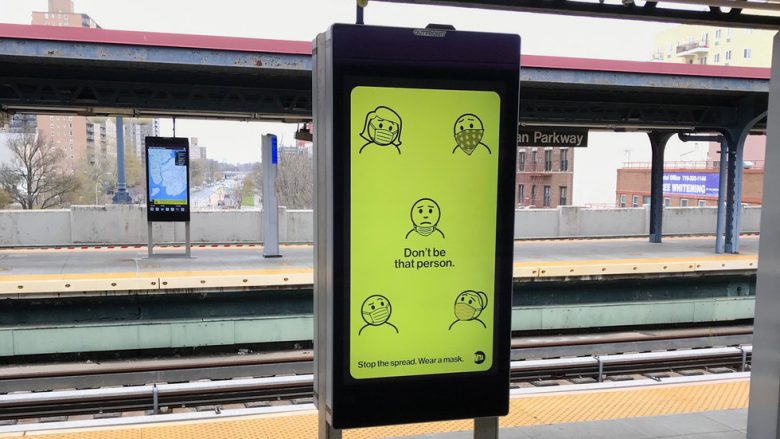
In the week when the requirement (or is it only a ‘recommendation’?) to mask children in the classroom was reinstated, it is worthwhile to consider the likely reasons underpinning the decision to return to a restriction that is both ineffective and harmful. Undoubtedly, there has again been pressure from the education unions for pupils to cover their faces, motivated either by a baseless belief that such a measure will reduce the risk of teachers contracting the virus, or perhaps a desire to further damage Government credibility by causing more disruption in our schools. Whatever their reason, at this juncture it is timely to revisit the range of circumstantial evidence that supports what HART believes to be the most plausible reason for compelling the healthy to wear face coverings: to increase compliance with future COVID-19 restrictions and the vaccination rollout.
Prior to June 2020, public health experts did not endorse masking healthy people in the community as a means of reducing viral transmission. In March 2020, Dr Jenny Harris (England’s Deputy Chief Medical Officer) was unequivocal when she stated, ‘For the average member of the public, masks are really not a good idea’ and that ‘People can put themselves at more risk than less’. North of the border, Professor Jason Leitch (Scotland’s Clinical Director) was equally emphatic when – in April 2020 – he said, ‘The global evidence is masks in the general population don’t work’. Strikingly, in December 2020 – several months after mask mandates had been imposed in the UK – the World Health Organisation (WHO) published a document titled, Mask use in the context of COVID-19 that formed the conclusion that, ‘There is only limited and inconsistent scientific evidence to support the effectiveness of masking healthy people in the community’. Many contemporary public figures spread a similar message.
So what changed in 2020 that flipped the public health experts into a pro-mask narrative?
One thing is clear: it was not in response to the advent of robust scientific evidence showing that face coverings significantly reduce viral transmission. On the contrary, a review of 14 controlled studies, published in May 2020, concluded that masks did not significantly lessen the spread of influenza in the community, protecting neither the wearer nor others. Although it is not possible to draw an unequivocal conclusion about the reason for the volte-face, several factors are consistent with masks being deployed primarily to enhance compliance with the Government’s COVID-19 interventions.
Deborah Cohen, a medically-qualified correspondent working for the BBC Newsnight programme, stated (in July 2020) that various sources had informed her that the WHO had recommended masks in response to political lobbying, and when she put this possibility directly to the WHO they did not deny it. Also, in her book, A State of Fear, Laura Dodsworth interviewed Gavin Morgan – an educational psychologist and member of the SPI-B (the behavioural science subgroup of SAGE) – who told her that his antipathy to masks had been nullified by some colleagues in the group who believed they were useful in promoting a sense of ‘solidarity’, strengthening people’s feelings of cohesion in the collective fight against the virus.
Further support for the compliance explanation derives from an examination of the activities of the Government’s behavioural scientists who, throughout the pandemic, have recommended the use of covert psychological ‘nudges’ as a means of promoting people’s acceptance of COVID-19 restrictions and the subsequent vaccine rollout. Masking healthy people (adults and children) significantly enhances two fundamental ‘nudges’ used within this campaign. First, the exploitation of fear to promote compliance with Government diktats has been well documented. Masking people in community settings, as well as being one of the restrictions fuelled by fear, is also a powerful way of perpetuating fear. Acting as a crude reminder that danger is – purportedly – all around, face coverings will also prevent disconfirmation of anxious beliefs, preventing the wearer from concluding that our communities are now safe enough to re-engage with in a normal way. A self-reinforcing restriction; something that would strongly appeal to our ethically-compromised behavioural scientists.
Second, the awareness of ‘norms’ – the prevalent views and behaviour of our fellow citizens – can exert pressure on us all to conform, and this widely-deployed ‘nudge’ is also greatly strengthened by mask wearing. Normative pressure (otherwise known as peer pressure or scapegoating) is less effective in changing the behaviour of the deviant minority if there is no visible indicator of pro-social compliance rooted in communities. A face covering, or lack of one, enables instant recognition of the rule followers and rule breakers, thereby escalating the pressure to comply.
These observations as a whole are consistent with the premise that masking healthy people is primarily a compliance device. Clearly, widespread wearing of face coverings in community settings is an effective way of keeping the British public on board with any future restrictions the state decides to impose in pursuit of its agenda. Would the Government have so easily capitulated to union pressure to re-mask children in the classroom if this was not so?
Turning point
eugyppius | January 8, 2022
“Where’s the vaccine mandate they promised us?” whines Daniel Brössler, reporter for the Süddeutsche Zeitung, disappointed because yesterday’s Corona summit of German minister presidents returned nothing but some adjustments to quarantine and sharpened testing rules. The double vaccinated will now have to submit negative tests if they want to eat at restaurants. Markus Söder, lockdown- and vaccine mandate-loving minister president of Bavaria, criticised even these milquetoast restrictions, with some bluster about how he’d already taken a hard line against bars and discos. This is after leading German Corona astrologer, Christian Drosten, used his state media podcast to suggest that Germany should start tolerating some of degree of SARS-2 transmission, and that breakthrough infections among the vaccinated should be considered normal. Such statements, which almost surely reflect sentiments within the coalition government, destroy most of the rationale for ongoing restrictions and vaccine mandates.
Meanwhile, in Austria, the thrice-vaccinated chancellor Karl Nehammer has tested positive for Corona. The news comes as Austria announces they will delay implementing their vaccine mandate by two months. It will now take effect in April, if at all. Gerald Gartlehner, an epidemiologist and sometime governmental adviser, suggested that mandates (or at least their enforcement) might have to be re-evaluated in light of Omicron and the widespread immunity the new variant will elicit across the Austrian population. There is every reason to think that Austria will be past the peak of the Omicron wave in April, and that a majority of Austrians will have SARS-2 antibodies by then.
In the United States, former Biden advisers have published a series of editorials in the Journal of the American Medical Association, arguing that it is time to normalise containment and begin managing SARS-2 as one of various seasonal respiratory infections.
It is obvious that we are at a turning point, even if everyone has yet to realise it – even if France is sharpening vaccine requirements, even if Italy has imposed vaccine mandates for everyone over 50, and even if Canada is for the moment determined to remain a prison state. This is the first time since the Floyd riots in America, that major political leaders and public health authorities have said that preventing Corona can no longer be the highest goal of western society.
It is a commonplace observation, but a true one: Since the vaccines began to fail in August, the vaccinators have been progressing through the proverbial five stages of grief. They spent a lot of time in denial, before becoming very angry and punitive. Then they began bargaining, hoping that SARS-2 would go away after four doses, or after five, with just the right dosing intervals, with a return to double masking, with child vaccinations. Now they appear to be drifting finally into depression and acceptance. They have realised, not a second too soon, that there is nothing to be done [outside of improving personal health and early treatment protocols].
Omicron is a highly contagious variant with immune escape features. The vaccinators can vaccinate all they want, but their vaccines will not stop the waves of infection to come. A lot of the hyperbolic rhetoric about Corona was put about in the hopes that most everyone wouldn’t be infected. They thought they could terrify people for a few years, vaccinate them, and harvest their gratitude for saving them from the worst respiratory virus since SARS. Now, though, it’s clear that everyone will have personal experience with Corona infection, whether or not they are vaccinated. This will destroy popular faith measures, it will erode their confidence in the vaccines, and it will do away with their fear of the virus. Maybe a few people somewhere will still support containment, after two years of heavy restrictions, mandated vaccinations, and infection, but I doubt there will be very many of them. It’s the beginning of the end.
UK Culture Secretary boasts about shadowy “anti-disinformation” unit; “daily we have contact with the online providers”
The unit provides no transparency
By Dan Frieth | Reclaim The Net | January 8, 2022
The UK Government’s “disinformation” unit is “working,” the Culture Secretary Nadine Dorries said, after she was challenged by the Labour party who said the shadowy unit shut down last year.
In the UK, both the Conservative and Labour governments support more online censorship.
“It’s not the case, it’s not true; it is there, it is working,” Nadine Dorries said in response to a question this week.
“That work takes place daily, and daily we work to remove content online that is harmful and particularly when it comes to Covid-19, daily we have contact with the online providers.”
Ministers in the UK government created a “disinformation unit” to fight the spread of “false” information about COVID-19. The government felt that people were getting misleading information about the virus on social media.
The disinformation unit included civil servants in Whitehall. They were to work with communication experts and collaborate with social media companies.
At the time, then-Culture Secretary Oliver Dowden said: “Defending the country from misinformation and digital interference is a top priority. As part of our ongoing work to tackle these threats we have brought together expert teams to make sure we can respond effectively should these threats be identified in relation to the spread of Covid-19.
“This work includes regular engagement with the social media companies, which are well placed to monitor interference and limit the spread of disinformation, and will make sure we are on the front foot to act if required.”
The team was supposed to focus on disinformation, which refers to the deliberate spreading of false information for personal gain or “trolling.”
The misleading information the government was concerned about included recommendations of cures that are ineffective or potentially “dangerous” and “false claims” about the origin of the coronavirus.
Social media companies had already begun flagging Covid-related misinformation and directing users to what they deemed reliable sources.
Featured Video

ARE PATIENTS BEING PROPERLY INFORMED ABOUT OZEMPIC?
or go to
Aletho News Archives – Video-Images
From the Archives
Trans ‘milk’ as good as the real thing – NHS
RT | February 18, 2024
The drug-induced nipple secretions of trans women are as good as mothers’ breast milk for babies, the University of Sussex Hospitals NHS Trust claimed in a letter to campaigners made public in a report by British think tank the Policy Exchange on Sunday.
The healthcare trust’s medical director, Rachel James, argued that the off-label prescription drug cocktail men transitioning to female take in order to produce milk was “similar to the natural hormones which encourage lactation to develop when the baby is newly born.”
“The evidence which is available demonstrates that the milk is comparable to that produced following the birth of a baby,” James wrote in the letter, sent to Children of Transitioners last August.
Biological men who wish to lactate must first take hormones to grow milk glands and then take high doses of either domperidone or metoclopramide to stimulate milk production. Neither drug is approved for this use, though they are occasionally prescribed off-label to biological women who have trouble lactating.
However, domperidone’s own manufacturer, Janssen, warns patients the drug “may cause unwanted side effects affecting the heart in a breastfed baby” and “should be used during breastfeeding only if your physician considers this clearly necessary.” … continue
Blog Roll
 Aletho News
- 2025 Nature Paper Claiming Worsening Global Drought Gets RETRACTED …Heavily Flawed
- Your Milk Is Not the Problem
- The Truth About the Trump Shootings with Ken Silva
- ARE PATIENTS BEING PROPERLY INFORMED ABOUT OZEMPIC?
- US lawmaker blocks $2.8 billion weapons sale to Israel: Report
- Yemeni army claims responsibility for strikes on sensitive sites in Saudi capital, Aramco facilities in Yanbu
- Iran Judiciary issues indictments against 159 US, Israeli officials for assassination of Leader, commanders
- Turkiye revokes Iranian bank license under US sanctions campaign
- US-Denmark Agreement on Greenland Is ‘PR Stunt’ Ahead of Midterms
- Araghchi: Military intervention cannot create security; coercion cannot bring peace
- If Americans Knew
- Inside Gaza’s death trap of collapsing, bombed-out buildings
- The everyday items Israel bans from Gaza every day
- Inside the siege, the ruined buildings of Gaza – Daily Update
- Debunking The Claim That Macklemore Has A “History Of Antisemitism”
- CPJ demands release of arrested Palestinian-US journalist near Bethlehem
- Robert Kraft: The Billionaire Friend of Netanyahu Pulling The Strings Behind the Macklemore/Ed Sheeran Blow Up
- Columbia Administered Fund Gives Big Money to Pro-Israel Groups
- Deportation Case of Palestinian Activist Salah Sarsour Tests First Amendment
- ‘We Will Not Forget’: Palestinians Mark 44 Years since Sabra and Shatila
- Why do we let Zionists decide what we can and can’t say?
- No Tricks Zone
- 2025 Nature Paper Claiming Worsening Global Drought Gets RETRACTED …Heavily Flawed
- New Study: ‘Global Drought Shows No Detectable Recent Acceleration Under Climate Warming’
- Economic Masterminds: German Socialists Suggest Taxing Productivity Gains Stemming From Using AI
- The South China Sea Has Not Been Cooperating With The Climate Change Narrative
- Energy Crisis: Germany Enters Heating Season With Historically Low Gas Reserve Fill Levels
- New Study: The Antarctic Ice Sheet Gained Mass From 2020-2024 Due To Staggering Snow And Ice Accumulation
- Study: Ocean Heating Rates From Thousands Of Years Ago ‘Dwarf’ Modern Ocean Heating Rates
- Climate Extremists Target, Attack Large-Scale Power Grid Infrastructure In Germany!
- New Study: Antarctic Ice Melt Has Contributed Less Than 1 Centimeter To Sea Level Rise In The Last 30 Years
- Fear Of Debate: Alarmist German Climate Scientist Calls On Mainstream Media To Discredit Skeptic Voices
 Aletho News
ORIGINS OF TECHNOCRACY
Utopian movement seeking to abandon the use of money to price goods, instead judging value purely by energy inputs. Technocracy is a method of governance that has no political ideology. Plato’s Republic has a chapter on cybernetics and social control.
Utopians took many forms — communism, socialism, fascism — and some came close to religion, like scientism and humanism.
Henri Saint-Simon stated, “A scientist, my dear friends, is a man who foresees; it is because science provides the means to predict that it is useful, and the scientists are superior to all other men.”
Saint-Simon’s disciple was Auguste Comte, the father of sociology. They developed Positivism, the concept that truth can only be determined through rationalism or science. Positivism in turn gave birth to Scientism, which says that only science can discover truth about humans and reality and there is no other truth. As it does not explain the soul, emotion, caring or jealousy, it does not acknowledge these truths. The Prussian physiologist and psychologist Wilhelm Wundt took this further, insisting humans have no soul and so can be manipulated like a clockwork orange and this gives rise to outcomes-based education, focused on standardization as an end in itself.
Born in the white heat of industrial expansion. Gained attention from the apparent failure of capitalism during the Great Depression. Boosted when taken up by Columbia University in 1932. Technocracy Inc formed as an ideological movement in 1933.
FOCUS ON DATA PROCESSING, LINKS TO IBM
Shared basement in Hamilton Hall, Columbia U, with the early IBM which was then developing the tabulators which they would lease to the German government for social profiling in the 1930s and 40s. No further information exists as IBM historical documents have been lost.
Brzezinski in his book Political Power: USA/USSR (1964) writes that the DDR Stasi was gathering huge amounts of data on people but lacked the technical power to put it to use.
LINKS TO HITLER’S GERMANY
Technocracy and technocrats don’t care what political system they operate under. It is concerned with the correct scientific methodology rather than the political ends.
German technocracy movement was not connected to the U.S. counterpart but shared and reprinted articles. Hitler saw technocrats as a rival and outlawed the organisation. However, technocrats had a profound influence on Hitler’s Germany and continued to communicate. The Third Reich could not have happeed without technocrats and the Technocracy movement. Ironically, Canada temporarily outlawed Technocracy Inc fearing it had fascists links.
Technocracy started at Columbia U, jumped over to Germany. The experiments in the concentration camps created a body of science that they brought back to the U.S. After WW2, Operation Paperclip transfered thousands of German technocrats to the U.S. where the German scientific experiments were continued under MK-Ultra by the CIA.
TECHNOCRACY IS NOT FASCISM OR SOCIALISM
Mistaken association with Communism. Members of Technocracy Inc would have bridled at association with Communists, who still used money and priced goods in money. However Brzezinski proposed that Marxism could be a stepping stone, destroy capitalism prior to installing the technotronic era. This will not be a personal dictator but a system of control, technology enforcing laws that keep you in line.
As for Fabian socialism, which aimed to merge the corporate and government world but still envisaged private property and a price based system. In short, all former systems have supply and demand, resolved by prices, and technocracy has an energy or resource-based economy. Technocracy is not proposed as a political form of government.
OVERLAP WITH EUGENICS
Eugenics was mostly based in California rather than Columbia but the peak of eugenics coincided with that of technocracy. There was no organizational link between Technocracy and the Eugenics movement, however they shared a common approach. From a scientists’ perspective managing society is similar to livestock.
Eugenics was a response to the challenge of Darwin and Marx and the fascists, challenging people to think of ways to change society in previously unthinkable ways. These were radicals of their time: not of a left-wing radicalism but utopians in a race to the future. The Eugenics Record Office, of Cold Spring Harbor, New York, inspired many of Hitler’s speeches.
ELITES AND TECHNOCRACY
There was no backing from the tax-exempt foundations in the beginning. Technocracy was a grass roots movement and its founders were relatively poor.
In the 1960s Brzezinski taught at Columbia U and many of his books mirror Technocracy.
The Journal on Race Development (1910) became the Journal of International Relations, which in turn was merged with Foreign Affairs in 1922. It was founded by Yale alumnus Stanley Hall who was a student of Wilhelm Wundt and a member of Skull and Bones. This shows the link between the Council on Foreign Relations, the elite secret societies dedicated to “thinking the unthinkable” or shaking up society, as well as the sending of American academics to Europe for indoctrination before returning them to shape U.S. universities, future graduates and social institutions.
THE TRILATERAL COMMISSION
At the 1972 Bilderberg meeting, Rockefeller and Brzezinski went to sell the TC. They likely invited the Europeans of the Bilderbergers to join, such as Kissinger. They invite members, like any fraternity.
Brzezinski picked Jimmy Carter as presidential candidate, to whom he became National Security Adviser, gatekeeper to the President (10/17 have been members of the Trilateral Commission). Brzezinski bragged about educating Carter on foreign affairs and economics. At one point Carter had one third of the U.S. membership of the Trilateral Commission to his administration. Of his Cabinet, all were TCs bar one.
The Trilateral Commission decides policy in advance and implements it without reference to Congress through control of the Executive. What’s more, this was not political control.
They only wanted the executive branch in order to use the influence of the U.S. presidency to create their new world economic order. Of U.S. Trade Representatives, the first was appointed by Jimmy Carter. Of 12, nine have been members of the TC.
In addition to the U.S. Executive, the Trilateral Commission influences the World Bank. Of WB presidents, 6/8 have been members of the Trilateral Commission.
David Rockefeller in April 1967 as he spearheaded construction of the new World Trade Center, eight months after breaking ground.
ROCKEFELLER LOCK ON POLICY
Involved in Council on Foreign Relations, Columbia U, and United Nations. It is surprising that they did not fund Technocracy at the start, given that it was housed in Columbia. It’s competitor was the even more radical New School. Until the 1970s, these families never funded Technocracy.
The payback for the Rockefeller influence to the UN was the use of the UN as a contagion mechanism to spread Agenda 21 around the world. The UN makes an ugly project look pretty. It is the user interface that makes evil look friendly. Slogans like interdependence,
Jay Rockefeller is one of the few family members to be elected, in W. Virginia. Nelson had to be appointed as Vice President but as head of the Senate he pushed through the fast-track mechanism for trade treaties. It was used to push through trade deals with minimal oversight, including NAFTA, CAFTA, TIP and TPP. The Senate knew how dangerous this legislation is, by delegating to the executive branch the ability to negotiate treaties. They should be passed with a two-thirds vote but the president can now present a treaty for approval, that has 20 hours of floor debate, no amendments allowed and reduces the floor vote to 50 per cent. In the case of NAFTA, the Trilateral Commission pulled out all the big guns including Henry Kissinger to browbeat Congressmen to pass it. And it only just passed.
NAFTA was written by Carla Hills, member of the Trilateral Commission, signed by George HW Bush a member of the TC, pushed into law by Bill Clinton, a member of the TC, and lobbied by numerous members of the TC like Jimmy Carter, Henry Kissinger…
Nelson Rockefeller ensured through the fast-track mechanism could force through these changes.
FAMILY TAX-EXEMPT FOUNDATIONS
NGOs, Trust Funds, Foundations have been the engine of social change for 100 years, as exposed by the Reece committee and the testimony of Norman Dodd.
These have reshaped universities, grade school and common core, business regulation, and then they for the United Nations, International Monetary Fund, World Bank. Aspen Institute for Humanistic Studies was closely associated with the Trilateral Commission at board of directors level.
Beneath this like a submarine is Technocracy, now surfacing.
AGENDA 21, AKA TECHNOCRACY
1930s Technocracy proposed “functional sequences” or common functions that need to be managed by a central authority: health, manufacturing… Their view of the “service sequence” of education is “conditioning”.
Smart Grid is an original specification of Technocracy — the idea of controlling the energy that is consumed.
Total Awareness Surveillance is an original specification of Technocracy — you cannot manage what you cannot monitor. That is an engineer’s mindset.
For an economic system: financial records, people’s purchase intentions and desires, health records, education records like Common Core collects 400 data points on students now.
Public Private Partnership with flavors of partenrship.
All of these are in the Rio 1992 conference which was preceded by the Gro Harlem Brundtland Commission which convened 1982-87 producing a report, Our Common Future, popularising the phrase, sustainable development. Brundtland was a member of the Trilateral Commission, whose stated purpose is to create a new international economic order.
Was Agenda 21 an organic United Nations creation or was it produced by the Trilateral Commission, just like NAFTA? It completely reflects the new international economic order. The UN picks it up, the Rio Conference follows, Agenda 21 is published, book on biodiversity is published… Today Earth Charter and Sustainable Development has spread to every country right dnown to county and district level.
ROTHSCHILD EMPIRE
This overlaps with Agenda 21, as espoused in the UNCED (United Nations Conference on Environment and Development) promoted by Edmond de Rothschild in 1987 with Maurice Strong: they were participating in a United Nations project but if you see where their interests lay, they were gaining authority to pursue personal financial interests.
David de Rothschild wrote the comic book to spread the gospel to young people.
DISARMING THE PEOPLE
How do the Rockefellers and Rothschilds benefit from people not being able to defend themselves.
Why would Rockefeller try to end capitalism?
Bankers’ expertise is money. They don’t make anything. Perhaps it was never meant to be permanent and there is an end to money.
Their view of wealth is different. They don’t see thousands in the bank as security. There is no value in money. It can be declared obsolete tomorrow.
Wealth lies in resources of the Earth that support all life.
These will be licensed to people as the feudal barons let you survive in return for 80 per cent of your produce.
Sustainable development is twisting the resources out of the people and transfering it to a global trust (they never say who are the trustees: they will be those who set up the system).
WHITHER LIBERTY
It took 300-500 years to develop the principles of liberty.
They culminated in the U.S. Declaration of Independence and the U.S. Constitution.
If Technocracy wins it could take hundreds of years, perhaps even longer, for liberty to surface again.
Once they get control of the economic mechanims, they will control life itself.
THE CASTE SYSTEM
The system will manage your carbon footprint. If you use too much electricity at home you may be denied a flight to a funeral. The elite will face no such restrictions.
THE CRISIS IN DEMOCRACY
This paper was issued in 1975 by the Trilateral Commission. The republic and democracy was outmoded for the coming technotronic era.
This suggested democracy is out of date… Brzezinski argued in his book Between Two Ages that bankers and multinational corporations already control countries, rendering the nation state a plaything. People who support nation states are derided as nativists.
THE MEDIA
Antony Sutton meanwhile was fired and censored for reporting on the Trilateral Commission. Sutton exposed how Wall Street had enabled the revolutions to take place in Russia and Germany and continued to finance and support the fascists and communists. Sutton saw the stacking of the Carter administration and recognized the patterns.
Before he even published anything David Packard, of Hewlett Packard, a member of the Trilateral Commission and trustee of the Hoover Institution had Sutton fired.
THE CHURCH
Steven Clark Rockefeller put together the Earth Charter. A theologian, Rockefeller is an instigator of the interfaith movement and all the major faiths have gone Green, with encyclicals from the Pope on climate change. Global stewardship, sustainable planning and development are the common buzzwords indicating their complete co-option. This goes back to the World Council of Churches and the Dulles brothers.
Nazi Oaks, by Mark Musser, explores the first Green movement to become state policy, which was that of the NAZI movement. Now there are books with titles like, Green Faith. Yet the new priesthood are the scientists who go up the mountain to listen to the volcano and come down and say the god of science says, ‘you must do x or y.’ No one is allowed to go to the volcano themselves, or to question what the scienpriests say they know, otherwise you are punished as a denier and excommunicated as a heathen.
TRANSHUMANISM AND THE DENIAL OF DEATH
Death is central to life. Transhumanism excludes god without being atheistic: they believe that they will become immortal.
In religion, the fall of man prescribes that death will be a feature until god wraps things up in the future. The transhumanists are making an end run around what religion says.
The mass surveillance society competes with god in another way, seeking to be the overseer of humanity and the recording of all your life’s deeds, good and bad. You will pay for your sins through your social credit score.
SURVEILLANCE STATE AS TECHNOCRACY.
In 2005 the intelligence system in the U.S. was completely overhauled with the creation of the Office of the Director of National Intelligence, lording it over 17 national intelligence agencies, including the National Security Agency.
The legislation to Congress to authorize the ODNI was sponsored by Jay Rockefeller and Dianne Feinstein, both members of the Trilateral Commission. George Bush created the ODNI and appointed John Negroponte as the first director: member of the Trilateral Commission.
So the TC proposed the law, filled the position and has taken control of the reorganisation of all intelligence gathering.
We know they want a new international economic order. Now the ODNI takes full control of data gathering, under which the NSA is merely an agent. This is the monitoring network for the whole Technocracy system.
They have all the phone calls and emails, all the health records through Obamacare, all the education data through Common Core, all financial and business data. The collection has grown but the ability to analyse the data has not kept up: moving the data from the storage devices into the CPUs to process, that’s the bottleneck, and putting it back again if necessary. They estimate they will solve that problem in three to five years. Then we’ll be in big trouble (date of interview, 2015).
This alone shows how close we are to the launch of Technocracy. This is an expression of the Trilateral Commission’s dominance over policy for the past 40 years. The odds of this small group having this much influence are, according to mathematicians, infinitesimal.
THE FIGHT NOW
Two economic systems are fighting for control. They cannot co-exist. Technocracy and Capitalism are matter and anti-matter. One will die, one will live.
If the Technocracy system is set up properly, the system does the controlling. It monitors you and self corrects. This allows it to manage populations of billions without many people being involved. That is the idea of a scientific dictatorship.
The global elite are pedestrian academics and intellectuals at best. They have never had an original idea of their own. To gain advantage they have to hijack the ideas of others.
Technocracy was not their idea. It goes way back. The originals Greens of the 1960s will “spit molten nails that they got pushed out of their own movement”. The global elite took over the green movement and the purest objectives were hijacked by this elite who took off in a totally different direction.
They are hijackers. They take whatever idea suits them to push forward their own vested interests. It does not speak too well of their intellectual abilities.
Know who the enemy is. We have had our ladder leaning against the wrong wall, and we are worse off than we’ve been, for 40 years. We must identify the enemy to have any success, and make a target of them.
In the longer term, we must retain some vestige of liberty in the hearts of men, says Patrick Wood. If we lose our liberty people will be living in a scientific dictatorship where freedom is a curiosity. Hopefully enough people can keep a seed of liberty alive so that one day, when the dark ends, it may sprout again.
Notes from an interview by Patrick M Wood given to Richard Grove.