Florida and Texas Ban Vaccine Passports
By Stephen Lendman | April 8, 2021
Digital vaccine passports are all-about pushing unwitting people to be jabbed with experimental, hazardous to heath drugs that risk potentially irreversible harm short-or-longer-term when taken as directed.
Already rolled out in Israel, Denmark, and Estonia by late April, they’re coming to the US and other Western states.
Apartheid in new form, they’ll create two-tiered societies — jabbed individuals afforded rights everyone deserves and unjabbed social outcasts denied them.
Where vaccine/health passports are instituted, they’ll likely be required for employment, attending school, air travel, other public transportation, hotel reservations, restaurant dining, in-store shopping, attending sporting events, and other social interactions.
Normal daily lives and routines will likely be denied without proof of covid jabs.
What was inconceivable not long ago already became the new abnormal.
Refuseniks will become untouchable social outcasts.
Draconian brave new world conditions will be more intolerable, unsafe and unfit to live in than already.
Nothing remotely justifies lockdowns, quarantines, face masks that don’t protect and risk harm from longterm use, PCR tests not designed to diagnose viral infections, social distancing that destroys normal human interactions, and hazardous experimental drugs that risk contracting diseases they’re supposed to protect against, but don’t.
What’s happening in real time is all-about replacing free and open societies with dystopian ones.
It’s about transforming world community states into ruler-serf societies.
It’s about instituting social control — enforced by police state harshness.
It’s about powerful monied interests owning everything, exploited ordinary people nothing.
It’s the worst of Orwell’s 1984 and Huxley’s Brave New World combined.
Florida Governor Ron DeSantis and Texas Governor Greg Abbott banned the transformation of their states into two-tiered ones.
On April 2, DeSantis banned businesses from requiring customers to show proof of covid jabs (by executive order) to enter their premises and be served.
Barring government agencies from requiring proof of jabs, he said “vaccination passports reduce individual freedom and will harm patient privacy.”
His order doesn’t prevent businesses from establishing screening protocols and other policies recommended by state and federal public health officials.
On Tuesday, Texas Governor Abbott banned state agencies, political organizations receiving public funds, and some private entities from requiring vaccine passports or other proof of jabbing for covid to receive services.
His executive order overrides local ones that call for mandating what infringes on civil liberties.
“We will continue to (jab) Texans (for covid) and protect public health, (but) will do (it) without treading on Texans’ personal freedoms,” Abbott said, adding:
The US Constitution does not permit the federal government to mandate proof of inoculations.
The Biden regime ruled out establishing a national mandate to show proof of covid jabs — so far.
At this time, it’s up to states and local communities to set their own standards.
That policy isn’t written in stone and could change ahead — notably if millions of refuseniks refuse jabs to protect their health and well-being.
Pre-2020, no one could have imagined what’s going on now.
Draconian policies may harden ahead. Guidelines being developed by the White House could be stiffened after in place.
Free and open societies in the West are being replaced by draconian ones.
Based on what happened since early last year, what remains of personal freedoms may disappear entirely ahead — full-blown tyranny replacing them.
A Final Comment
Since Texas scrapped mandatory mask-wearing in public weeks earlier, seasonal flu-renamed covid outbreaks and deaths declined in numbers.
Days earlier, MSNBC noted that Texas today resembles 2019, adding:
“(R)estaurants are full. Ballparks are full.” Yet covid outbreaks declined.
Asked for an explanation, pro-mass-jabbing huckster, fraudster, profiteer, chief Biden regime medical adviser Fauci — a doctor who never treated a patient — failed to explain what’s clear to truth-telling medical and scientific experts.
Policies imposed since early last year did infinitely more harm than any number of serious diseases combined — notably by creating deeper Main Street Depression conditions than in the 1930s and deceiving the public to self-inflict harm from toxic covid jabs.
Former Trump regime trade representative Peter Navarro slammed Fauci, saying the following:
“From the first time I met him, he just did not make a lot of sense.”
“We’ve seen all of his flipflops.”
“My new theory is that he’s simply a sociopath. He just lies to advance his own interest.”
Navarro wants him held accountable for serial lying that contributed to inflicting enormous harm on millions of Americans and countless others abroad.
For what I call crimes against humanity, US and other Western political hardliners, their public health handmaidens, Pharma and media press agents for all of the above share guilt.
The “Unvaccinated” Question

By CJ Hopkins | Consent Factory | March 29, 2021
So, the New Normals are discussing the Unvaccinated Question. What is to be done with us? No, not those who haven’t been “vaccinated” yet. Us. The “Covidiots.” The “Covid deniers.” The “science deniers.” The “reality deniers.” Those who refuse to get “vaccinated,” ever.
There is no place for us in New Normal society. The New Normals know this and so do we. To them, we are a suspicious, alien tribe of people. We do not share their ideological beliefs. We do not perform their loyalty rituals, or we do so only grudgingly, because they force us to do so. We traffic in arcane “conspiracy theories,” like “pre-March-2020 science,” “natural herd immunity,” “population-adjusted death rates,” “Sweden,” “Florida,” and other heresies.
They do not trust us. We are strangers among them. They suspect we feel superior to them. They believe we are conspiring against them, that we want to deceive them, confuse them, cheat them, pervert their culture, abuse their children, contaminate their precious bodily fluids, and perpetrate God knows what other horrors.
So they are discussing the need to segregate us, how to segregate us, when to segregate us, in order to protect society from us. In their eyes, we are no more than criminals, or, worse, a plague, an infestation. In the words of someone (I can’t quite recall who), “getting rid of the Unvaccinated is not a question of ideology. It is a question of cleanliness,” or something like that. (I’ll have to hunt down and fact-check that quote. I might have taken it out of context.)
In Israel, Estonia, Denmark, Germany, the USA, and other New Normal countries, they have already begun the segregation process. In the UK, it’s just a matter of time. The WEF, WHO, EU, and other transnational entities are helping to streamline the new segregation system, which, according to the WEF, “will need to be harmonized by a normative body, such as the WHO, to ensure that is ethical.”
Here in Germany, the government is considering banning us from working outside our homes. We are already banned from flying on commercial airlines. (We can still use the trains, if we dress up like New Normals.) In the village of Potsdam, just down the road from Wannsee (which name you might recall from your 20th-Century history lessons), we are banned from entering shops and restaurants. (I’m not sure whether we can still use the sidewalks, or whether we have to walk in the gutters.) In Saxony, we are forbidden from attending schools. At the Berliner Ensemble (the theater founded by Bertolt Brecht and Helene Weigel, lifelong opponents of totalitarianism and fascism), we are banned from attending New Normal performances.
In the USA, we are being banned by universities. Our children are being banned from public schools. In New York, the new “Excelsior Pass” will allow New Normals to attend cultural and sports events (and patronize bars and restaurants, eventually) secure in the knowledge that the Unvaccinated have been prevented from entering or segregated in an “Unvaccinated Only” section. The pass system, designed by IBM, which, if history is any guide, is pretty good at designing such systems (OK, technically, it was Deutsche Hollerith Maschinen Gesellschaft, IBM’s Nazi-Germany subsidiary), was launched this past weekend to considerable fanfare.
And this is only the very beginning.
Israel’s “Green Pass” is the model for the future, which makes sense, in a sick, fascistic kind of way. When you’re already an apartheid state, what’s a little more apartheid? Here’s a peek at what that looks like …

OK, I know what the New Normals are thinking. They’re thinking I’m “misleading” people again. That I’m exaggerating. That this isn’t really segregation, and certainly nothing like “medical apartheid.”
After all (as the New Normals will sternly remind me), no one is forcing us to get “vaccinated.” If we choose not to, or can’t for medical reasons, all we have to do is submit to a “test” — you know, the one where they ram that 9-inch swab up into your sinus cavities — within 24 hours before we want to go out to dinner, or attend the theater or a sports event, or visit a museum, or attend a university, or take our children to school or a playground, and our test results will serve as our “vaccine passports!” We just present them to the appropriate Covid Compliance Officer, and (assuming the results are negative, of course) we will be allowed to take part in New Normal society just as if we’d been “vaccinated.”
Either way, “vaccine” or “test,” the New Normal officials will be satisfied, because the tests and passes are really just stage props. The point is the display of mindless obedience. Even if you take the New Normals at their word, if you are under 65 and in relatively good health, getting “vaccinated” is more or less pointless, except as a public display of compliance and belief in the official Covid-19 narrative (the foundation stone of the New Normal ideology). Even the high priests of their “Science” confess that it doesn’t prevent you spreading the “plague.” And the PCR tests are virtually meaningless, as even the WHO finally admitted. (You can positive-PCR-test a pawpaw fruit … but you might want to be careful who you tell if you do that.)
In contrast to the “vaccine” and the “test” themselves, the forced choice between them is not at all meaningless. It is no accident that both alternatives involve the violation of our bodies, literally the penetration of our bodies. It doesn’t really matter what is in the “vaccines” or what “results” the “tests” produce. The ritual is a demonstration of power, the power of the New Normals (i.e., global capitalism’s new face) to control our bodies, to dominate them, to violate them, psychologically and physically.
Now, don’t get all excited, my “conspiracy theorist” friends. I haven’t gone full QAnon just yet. Bill Gates and Klaus Schwab are not sitting around together, sipping adrenochrome on George Soros’ yacht, dreaming up ways to rape people’s noses. This stuff is built into the structure of the system. It is a standard feature of totalitarian societies, cults, churches, self-help groups, and … well, human society, generally.
Being forced to repeat a physical action which only makes sense within a specific ideology reifies that ideology within us. There is nothing inherently diabolical about this. It is a basic socialization technology. It is how we socialize our children. It is why we conduct weddings, baptisms, and bar mitzvahs. It is how we turn young men and women into soldiers. It is how actors learn their blocking and their lines. It is why the Nazis held all those rallies. It is why our “democracies” hold elections. It is also basic ceremonial magic … but that’s a topic for a different column.
The issue, at the moment, is the Unvaccinated Question, and the public rituals that are being performed to make the New Normal ideology “reality,” and what to do about those of us who refuse to participate in those rituals, who refuse to forswear “old normal” reality and convert to New Normalism so that we can function in society without being segregated, criminalized, or “diagnosed” as “sociopathic” or otherwise psychiatrically disordered.
For us “conspiracy-theorizing reality deniers,” there is no getting around this dilemma. This isn’t Europe in the 1930s. There isn’t anywhere to emigrate to … OK, there is, temporarily, in some of the US states that have been staging rebellions, and other such “old normal” oases, but how long do you think that will last? They’re already rolling out the “mutant variants,” and God only knows what will happen when the long-term effects of the “vaccines” kick in.
No, for most of us denizens of the global capitalist empire, it looks like the New Normal is here to stay. So, unless we are prepared to become New Normals, we are going to have to stand and fight. It is going to get rather ugly, and personal, but there isn’t any way to avoid that. Given that many New Normals are our friends and colleagues, or even members of our families, it is tempting to believe that they will “come to their senses,” that “this is all just a hysterical overreaction,” and that “everything will go back to normal soon.”
This would be a monumental error on our parts … very possibly a fatal error.
Totalitarian movements, when they reach this stage, do not simply stop on their own. They continue to advance toward their full expressions, ultimately transforming entire societies into monstrous mirror-images of themselves, unless they are opposed by serious resistance. There is a window at the beginning when such resistance has a chance. That window is still open, but it is closing, fast. I can’t tell you how best to resist, but I can tell you it starts with seeing things clearly, and calling things, and people, exactly what they are.
Let’s not make the same mistake that other minorities have made throughout history when confronted with a new totalitarian ideology. See the New Normals for what they are, maybe not deep down in their hearts, but what they have collectively become a part of, because it is the movement that is in control now, not the rational individuals they used to be. Above all, recognize where this is headed, where totalitarian movements are always headed. (See. e.g., Milton Mayer’s They Thought They Were Free: The Germans 1933-45.)
No, the Unvaccinated are not the Jews and the New Normals are not flying big Swastika flags, but totalitarianism is totalitarianism, regardless of which Goebbelsian Big Lies, and ideology, and official enemies it is selling. The historical context and costumes change, but its ruthless trajectory remains the same.
Today, the New Normals are presenting us with a “choice,” (a) conform to their New Normal ideology or (b) social segregation. What do you imagine they have planned for us tomorrow?
#
Was the Estonia Downed by Submarine? Huge Hole in Hull Kindles New Theories About 1994 Tragedy

By Igor Kuznetsov – Sputnik – 29.09.2020
The Estonia catastrophe 26 years ago that claimed 852 lives is the worst peacetime tragedy in the Baltic Sea and the second-deadliest peacetime sinking of a European ship, second only to the Titanic.
The foreign ministers of Finland, Estonia, and Sweden have agreed to jointly assess new evidence regarding the Estonia ferry that sank in 1994.
New underwater footage of the shipwreck from a Swedish documentary about the disaster shows extensive damage on the starboard side, including a previously unknown 4-metre hole.
The find has since fuelled renewed speculations and theories about the massive cruise ship’s tragic fate.
Margus Kurm, former public prosecutor and former chairman of the Estonian government’s investigation into the disaster, suggested that the Estonia probably collided with a submarine, a Swedish one at that.
Based on the new information, Kurm speculated that there could have been a “sensitive consignment” on board the ship that needed to be monitored. The botched surveillance operation was likely performed by a Swedish submarine, he mused in an interview with the Estonian newspaper Postimees, suggesting that Sweden “lied straight to our face”. Kurm stressed that 400,000 cubic metres of sand and stone had been transported there and a decision to declare the sanctity of the site was made very quickly in 1995 when the inquiry was still underway.
Former Estonian Defence Minister Enn Tupp, active when the disaster occurred, also argued that the ship sank after a collision with a submarine, but didn’t point out Sweden specifically.
Lars Ångström, a former member of the parliamentary defence committee for the Green Party who has been involved in the issue for several years, believes that the hole was probably caused by another ship, most likely a military one.
However, ex-Swedish Defence Minister Anders Björck has dismissed the claims as “rather incredible”. “Had it been so, we would have immediately received a report about it, and it would have been noticed”, he told Swedish national broadcaster SVT. He also stressed that it would have taken a huge blackout operation to perform anything like that and then try to hide it.
None of Sweden’s other top ministers who in the 1990s were responsible for the Estonia investigation, including Prime Ministers Carl Bildt and Göran Persson, have commented on the matter.
The hole discovered in the hull of the Estonia can be explained in several ways, suggested Jørgen Amdahl, a professor at the Norwegian University of Science and Technology, who ran a computer simulation of the disaster. He dismissed the results of the official 1997 investigation that the sinking was caused by a broken bow visor.
Two other explanations are more likely, Amdahl mused to SVT. One is that the ship was damaged when it hit the bottom. Another possibility is that an object hit the ship from the side with a force of up to 600 tonnes.
Survivors Demand Justice
Meanwhile, an open letter by Estonia survivors has been published by the daily Aftonbladet, demanding a new investigation.
“It is the Swedish government’s responsibility to immediately take the initiative for such a diving operation with full and open presentation of the results to the public and the media in all countries affected by the disaster”, they wrote.
Kent Härstedt, survivor and former MP for the Social Democrats, supported the demand for a new investigation as the current one doesn’t feel “complete and credible”, he said.
“I am not conspiratorial, but with what has emerged today, there will be further questions – why is the hole not included in the official investigation”, Härstedt told SVT.
Estonian Prime Minister Jüri Ratas has called for a new Estonian investigation since the findings were presented in a new documentary. He suggested that the new information raises questions that must be answered in a “clear, dignified, and transparent way”.
Second Only to the Titanic
The sinking of the Estonia in the Baltic Sea between Sweden, Åland, Finland, and Estonia is seen as one of the worst maritime disasters of the 20th century, second to only the Titantic in peacetime. Some 852 people died in the disaster and only 137 survivors were rescued. The official version has so far been that the bow visor separated and the ship’s bow door opened, whereupon it immediately took on a heavy starboard tilt, as water flooded into the vehicle deck.
Based on a suggestion by the Swedish government, thousands of tonnes of pebbles were dropped on the site to bury the whole ship in situ. The subsequent 1995 Estonia Agreement prohibits citizens from the signatory counties to even approach the wreck, which has long fuelled various speculations. The wreck is monitored by radar by the Finnish Navy.
Lithuania’s Television Commission Bans Broadcasting of Five RT Channels
Sputnik – 08.07.2020
The Lithuanian Radio and Television Commission (LRTK) has banned the broadcasting of five RT channels in the country, following the example of neighbouring Latvia, commission chairman Mantas Martisius said on Wednesday.
“Yes, we can confirm this. The decision will come into force after being published on the LRTK website,” Martisius said.
The ban is applicable to RT, RT HD, RT Spanish, RT Documentary HD and RT Documentary, and will go into effect on Thursday, LRTK chairman explained.
Last week, Latvia banned the broadcasting of seven RT channels (namely RT, RT HD, RT Arabic, RT Spanish, RT Documentary HD, RT Documentary, RT TV), saying they are all owned by Rossiya Segodnya International Information Agency Director-General Dmitry Kiselev, who is under EU sanctions. Notably, Rossiya Segodnya and RT are two different legal entities, RT is not chaired by Kiselev, and RT Editor-in-Chief Margarita Simonyan is not under any EU sanctions.
The Russian Foreign Ministry’s spokeswoman, Maria Zakharova, has slammed Latvia’s decision to ban seven RT channels as a disgraceful and illegal move.
Estonian Foreign Minister Urmas Reinsalu said on Tuesday that the government was mulling the possibility to ban RT broadcasting in the country.
Baltic countries seek relevance on the international scene
By Lucas Leiroz | March 20, 2020
In 2017, RAND Corporation published in its associated media Small Wars Journal an article by the researchers Marta Kepe and Jan Osburg, outlining a strategic defense plan for the Baltic countries in the event of a Russian invasion. The authors claim that Estonia, Lithuania and Latvia will manage their weaknesses to face the Russians, overcoming their population and military deficit through the participation of civilians in the conflicts, working with the armed forces to create a “total defense” plan that would make the invasion too costly and laborious for Russia. Subsequently, the RAND Corporation article was mentioned in a paper by the National Interest magazine, authored by Michael Peck, in which the author studies the Baltic defense strategy, speculating about “total defense” and its efficiency in a possible case of Russian invasion. The researcher, finally, takes a pessimistic conclusion, stating that, despite all efforts, nothing will change the fact that Russia is a large country and the Baltic States are small and weak.
In March last year, the renowned American magazine Foreign Policy published an article by Mikheil Saakashvili, former president of Georgia, claiming that Russia’s next “targets” would be European nations. In the text, Saakashvili considers the possibility of a Russian attack on the Baltic countries, saying that President Vladimir Putin sees them as real threats because they are “functional democracies on the Russian border”. After developing his reasoning, the author comes to the conclusion that this invasion will not occur, pointing other countries as future “targets” of Russia. However, even though Saakashvili does not believe in the possibility of a Russian invasion, rumors about a Russian plan to invade and annex the Baltic nations have generated unfounded tensions in the region.
The height of media alarmism regarding relations between Russia and the Baltic countries was, however, an article published by the American expert Hall Brands on Japan Times website, whose title is “How Russia could force a nuclear war in the Baltics”. Referring again to the studies of the RAND Corporation, the author considers the possibility of a nuclear escalation on the frictions between Moscow and NATO in the Baltics, concluding that the geographic condition of these states would hinder rapid action by the West in the event of Russian action, raising the risks of forced annexation.
Apparently, media agencies aligned with the liberal establishment are working together to spread the idea that there is a Russian interest in invading and annexing the Baltics. For these agencies, the interest is so great that it would even justify a nuclear action. However, when we investigate the reasons for such despair, we found no concrete argument to justify such speculations. The great Western think tanks, such as the RAND Corporation, are spreading this myth with the specific purpose of instilling fear and tension in the Baltic States, so that, in the face of “Russian terror”, they will increasingly align themselves with Washington and NATO.
The concrete data indicate exactly the opposite of the rumors spread by RAND analysts. In January last year, Estonian Prime Minister Juri Ratas publicly expressed an interest in improving relations between his country and Russia, with a view to pacifying bilateral tensions and envisioning a future of peace and cooperation, despite divergent interests. Also, Latvia remains the only member country of the European Union that is totally dependent on Russian gas – a situation Lithuania has only recently withdrawn from. So why Moscow would be interested in invading and annexing such countries, when the threat they pose to the Russian political structure is absolutely nil? In a way, it is much more logical to think that for the Baltic countries it is more profitable and interesting to maintain good relations with Russia than to embark on unfounded conspiracies by Western experts who are extremely ideologically involved. However, there is a second hypothesis.
It is still likely that the Baltic States are simply acting in the interest of increasing their role on the international scene. Unable to form a solid political, military and economic force, even if united, capable of facing the great world powers, these States may be anchoring themselves in NATO’s military apparatus to seek the affirmation of their own interests in Europe and in the world. By this logic, Lithuania, Latvia and Estonia would be voluntarily adopting the alarmist discourse of the West and reaffirming it in order to, increase the western military presence on its borders, try to increase its regional and global influence, moving from being small European States to becoming potencies in the global geopolitical game.
Indeed, the Baltic countries are making a big mistake in adopting either of these two stances. Unlike Moscow, for whom the interest in “invading” the Baltic is nil, Washington has clear interests in occupying the region, so as to face Russia. That is the main reason for the presence of NATO troops in the Baltic expected for the Defender Europe 2020 drills – now canceled by the coronavirus pandemic.
The Baltic States are adhering to the discourse of Western think tanks, however, under no perspective can this opposition to Russia be profitable for them. Following the interests of Washington, Estonia, Latvia and Lithuania have too much to lose.
Lucas Leiroz is a research fellow in international law at the Federal University of Rio de Janeiro.
Sputnik Estonia Journalists to Terminate Employment Over Threats – Rossiya Segodnya
Sputnik – December 31, 2019
Sputnik Estonia journalists are forced to terminate their employment starting January 1, 2020, over a fear of criminal prosecution in the country, Rossiya Segodnya International Information Agency said, slamming the Estonian government’s pressure on the journalists as a totalitarian campaign violating the freedom of speech.
“Due to the threat of criminal prosecution by the Estonian authorities under an article envisioning up to five years of imprisonment, Sputnik Estonia employees have been forced to make a decision to terminate their employment with the agency starting January 1, 2020. Sputnik Estonia and Rossiya Segodnya support this decision of their employees”, Rossiya Segodnya said in a statement, adding that it does not find it possible to put the journalists’ freedom at risk.
“We consider the Estonian regime’s actions targeting the citizens of our country as overt bullying, lawlessness, a manifestation of totalitarianism and a gross violation of the principles of freedom of speech, which has no precedents in the European Union. The only thing the journalists are ‘guilty’ of is working for a Russian media outlet,” the agency added.
Harlem Desir, the Organization for Security and Co-operation in Europe’s representative on freedom of the media, has already said that EU sanctions on Dmitry Kiselev cannot be extended on Sputnik Estonia journalists, the news agency added.
“We will take all the necessary steps, legal and others, to enable Sputnik journalists to work without fear of criminal prosecution by Estonian security structures”, Rossiya Segodnya said, adding that the operation of the Sputnik Estonia website will be resumed later, although it will take time.
The information agency called on all the international and European organisations to express their position regarding Tallinn’s steps, and thanked global politicians and journalists for their support.
The Estonian Police and Border Guard Board warned Sputnik Estonia earlier in December that its journalists could face criminal prosecution unless they severed their ties with the Moscow-based parent news agency, Rossiya Segodnya, by 1 January. The Estonian authorities cited the 2014 European Union’s sanctions, imposed on a range of entities and persons in light of the events in Ukraine, as a pretext for the possible legal action.
Journalist groups call to protect Sputnik reporters from police harassment in Estonia
RT | December 20, 2019
The International Federation of Journalists urged Estonian authorities to stop threatening journalists working for Russian news media Sputnik Estonia with criminal prosecution over EU sanctions on Russia’s media chief.
“Media professionals should be allowed to freely carry out their duties, without threats from higher authorities,” IFJ General Secretary Anthony Bellanger said while commenting on the harassment of Sputnik journalists by Estonian police. At the same time, the organization’s Vice President Timur Shafir stressed that the threat of criminal proceedings “goes beyond all existing norms,” especially taking into account the fact that the majority of Sputnik Estonia office employees are Estonian citizens.
Sputnik Estonia’s editor-in-chief Elena Chernysheva said that journalists have been receiving letters from the Financial Intelligence Unit (FIU) of Estonian Police and Border Guard Board, in which they were threatened with “criminal liability” unless they cut work ties with the Russian state-owned media agency Rossiya Segodnya, Sputnik’s parent company, by January 1.
“In other words, they want to jail us for simply working for Russian state-owned media.”
The head of the FIU, which primarily deals with money laundering, Madis Reimand, confirmed that the journalists were getting “notices” because Rossiya Segodnya’s chief Dmitry Kiselyov is currently under EU sanctions.
Reimand told Estonian ERR media company that sanctions against Kiselyov mean that certain individuals “are banned from working for him,” even if they have not been placed on a sanctions list themselves.
Rossiya Segodnya reported earlier that several foreign banks, operating in Estonia, have unexpectedly frozen transfers of money used to pay taxes and rent for Sputnik’s office in the country. The transfers of salaries to employees, the vast majority of whom are Estonian nationals, have also been frozen.
The company argues that Sputnik itself is not subjected to any sanctions. Sputnik and RT Editor-in-Chief Margarita Simonyan has already asked the Estonian president to not allow the journalists to be arrested.
A veteran journalist and media producer, Kiselyov, was sanctioned in 2014 after Crimea voted to leave Ukraine and rejoin Russia. He blasted the sanctions as “a shame for the European Union” and argued that they “can be equated to the sanctions against the freedom of speech.”
Secretary General of the European Federation of Journalists (EFJ) Ricardo Gutierrez told RIA Novosti that Estonia’s actions are based on “an excessive interpretation of the European sanctions” and is “absolutely unacceptable.” He added that the actions of authorities lack transparency and “remain unclear.”
“The EFJ urges the Estonian authorities to reconsider applying restrictive and selective measures to foreign journalists working in Estonia.”
On Friday, Valery Fadeyev, the head of the Presidential Council for Civil Society and Human Rights called the situation around Sputnik Estonia “highly disturbing.” He sent letters to the OSCE Representative on Freedom of the Media Harlem Desir and the Council of Europe Commissioner for Human Rights Dunja Mijatovic asking both to investigate the case.
Meanwhile, a spokesperson for the UN Secretary-General Antonio Guterres, Stephane Dujarric, said that he is looking into the case.
During a Q&A session on Thursday, Russian President Vladimir Putin condemned Estonia for pressuring Sputnik. They are “afraid of the truth you are telling your viewers and listeners,” he told reporters.
International Federation of Journalists Says Concerned Over Threats to Sputnik Estonia
Sputnik – December 20, 2019
The International Federation of Journalists (IFJ) expressed concern over the threats, received by employees of Sputnik Estonia, and called on Tallinn to respect freedom of media.
On Wednesday, the Rossiya Segodnya International News Agency said that employees of Sputnik Estonia had received letters from the Baltic country’s Police and Border Guard Board that warned they would face criminal prosecution unless they stopped working for the news agency by 1 January. The Estonian authorities cited the 2014 EU sanctions as a pretext for possible legal action. Sputnik and RT Editor-in-Chief Margarita Simonyan has already asked Estonian President Kersti Kaljulaid to not allow the journalists to be arrested.
“We are concerned by the current situation of Sputnik journalist in Estonia. Media professionals should be allowed to freely carry out their duties, without threats from higher authorities. We call on the Estonian government to respect press freedom, regardless of the journalists’ nationality,” IFJ General Secretary Anthony Bellanger said on late Thursday.
IFJ Vice President and Russian Union of Journalists’ Executive Secretary Timur Shafir described the threats to employees of Sputnik Estonia as a violation of the journalists’ rights and freedom of speech.
“The Estonian Police and Border Guard Board actions are a gross violation of the journalists’ rights and freedom of speech. The threat of criminal proceedings only for the fact of cooperation with the Russian media goes beyond all existing norms. What is particularly surprising is the fact that the majority of Sputnik Estonia office employees are Estonian citizens, so we can observe that the government applies repressive actions not only to the Russian media, but also to Estonians,” Shafir noted.
The situation was condemned by the Russian Foreign Ministry, which called it outrageous and called on international organizations and rights groups to react immediately.
According to Rossiya Segodnya, which Sputnik is a part of, the news agency is planning to urge the United Nations; United Nations Educational, Scientific and Cultural Organization; Organization for Security and Co-operation in Europe; Council of Europe; and European Court of Human Rights to address this unprecedented violation of the right to free speech and take measures to protect the right of journalists to work in their professional capacity.
Russian media in Estonia and its two Baltic neighbors have been frequently targeted by authorities. The Russian Foreign Ministry has accused the three nations of a coordinated crackdown on media, which is not in line with the principle of freedom of expression.
‘Shameless Racism’: 13 Countries Change Long-Standing Position on Palestine at UN
Palestine Chronicle – December 5, 2019
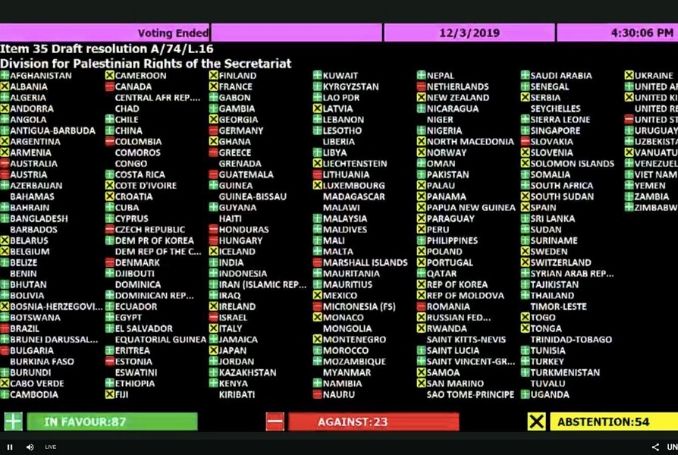
For the first time, 13 countries changed their longstanding positions and voted against a pro-Palestine measure at the United Nations on Tuesday.
Germany, the Czech Republic, Austria, Bulgaria, Denmark, Estonia, Greece, Lithuania, Netherlands, Romania, Slovakia, Brazil, and Colombia voted against the annual resolution regarding the “Division for Palestinian Rights of the Secretariat”, according to the Times of Israel.
They had previously abstained on the vote.
The resolution, which includes a call to halt to illegal Israeli settlements being constructed in the occupied West Bank, still passed with a large majority voting in favor.
The Palestinian representative told the council: “If you protect Israel, it will destroy you all.” He also said Israel’s character as a Jewish state is “shameless racism”.
The New York-based Division for Palestinian Rights oversees the Committee on the Exercise of the Inalienable Rights of the Palestinian People.
The resolution was co-sponsored by Comoros, Cuba, Indonesia, Jordan, Kuwait, Lao People’s Democratic Republic, Qatar, Saudi Arabia, Senegal, the United Arab Emirates, and Yemen.
The UK, France, and Spain abstained, as they do every year, allowing the resolution to pass with a vote of 87-54, with 21 other abstentions.
The General Assembly adopted five resolutions on the question of Palestine and the Middle East, including one calling on the Member States not to recognize any changes to the pre-1967 borders, including with regards to Jerusalem, other than those agreed by the parties through negotiations.
A Second Whistle Blown on the OPCW’s Doctored Report
By Jeremy Salt | American Herald Tribune | December 3, 2019
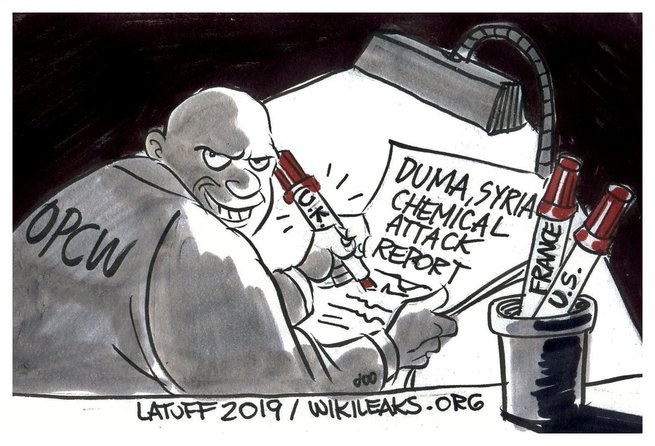
Another whistleblower leak has exposed the fraudulent nature of the Organization for the Prevention of Chemical Weapons (OPCW) report on the alleged chemical weapons attack in the Syrian city of Douma, close to Damascus, on April 7 last year.
The first leak came from the Fact-Finding Mission’s engineering sub-group. After investigating the two sites where industrial gas cylinders were found in Douma and taking into account the possibility that the cylinders had been dropped from the air it concluded that there was a “higher probability” that both cylinders were placed at both sites by hand. This finding was entirely suppressed in the final report.
The engineering sub-group prepared its draft report “for internal review” between February 1-27, 2018. By March 1 the OPCW final report had been approved, published and released, indicating that the engineers’ findings had not been properly evaluated, if evaluated at all. In its final report the OPCW, referring to the findings of independent experts in mechanical engineering, ballistics and metallurgy, claimed that the structural damage had been caused at one location by an “impacting object” (i.e. the cylinder) and that at the second location the cylinder had passed through the ceiling, fallen to the floor and somehow bounced back up on to the bed where it was found.
None of this was even suggested by the engineers. Instead, the OPCW issued a falsified report intended to keep alive the accusation that the cylinders had been dropped by the Syrian Air Force.
Now there is a second leak, this time an internal email sent by a member of the Fact-Finding Mission (FFM) on June 22, 2018, to Robert Fairweather, the British career diplomat who was at the time Chief of Cabinet at the OPCW, and copied to his deputy, Aamir Shouket. The writer claims to have been the only FFM member to have read the redacted report before its release. He says it misrepresents the facts: “Some crucial facts that have remained in the redacted version have morphed into something quite different from what was originally drafted.”
The email says the final version statement that the team “has sufficent evidence to determine that chlorine or another reactive chlorine-containing chemical was likely released from the cylinders is highly misleading and not supported by the facts.” The writer states that the only evidence is that some samples collected at locations 2 and 4 (where the gas cylinders were found) had been in contact with one or more chemicals that contain a reactive chlorine atom.
“Such chemicals,” he continues, “could include molecular chlorine, phosgene, cyanogen chloride, hydrochloric acid, hydrogen chloride or sodium hypochlorite (the major element in household chlorine-based bleach.” Purposely singling out chlorine as one of the possibilities was disingenuous and demonstrated “partiality” that negatively affected the final report’s credibility.
The writer says the final report’s reference to “high levels of various chlorinated organic derivatives detected in environmental samples” overstates the draft report’s findings. “In most cases” these derivatives were present only in part per billion range, as low as 1-2 ppb, which is essentially trace qualitiea.” In such microscopic quantities, detected inside apartment buildings, it would seem, although the writer only hints at the likelihood, that the chlorine trace elements could have come from household bleach stored in the kitchen or bathroom.
The writer notes that the original draft discussed in detail the inconsistency between the victims’ symptoms after the alleged attack as reported by witnesses and seen on video recordings. This section of the draft, including the epidemiology, was removed from the final version in its entirety. As it was inextricably linked to the chemical agent as identified, the impact on the final report was “seriously negative.” The writer says the draft report was “modified” at the behest of the office of Director-General, a post held at the time by a Turkish diplomat, Ahmet Uzumcu.
The OPCW has made no attempt to deny the substance of these claims. After the engineers’ report made its way to Wikileaks its priority was to hunt down the leaker. Following the leaking of the recent email, the Director-General, Fernando Arias, simply defended the final report as it stood.
These two exposures are triply devastating for the OPCW. Its Douma report is completely discredited but all its findings on the use of chemical weapons in Syria must now be regarded as suspect even by those who did not regard them as suspect in the first place. The same shadow hangs over all UN agencies that have relied on the OPCW for evidence, especially the UN’s Independent International Commission of Inquiry on the Syrian Arab Republic, an arm of the OHCHR (Office of the High Commissioner for Human Rights).
This body is closely linked to the OPCW and while both mostly hide the sources of their information it is evident that where chemical weapons allegations have been made, the commission of inquiry has drawn on the OPCW.
As of January 2018, the commission reported on 34 “documented incidents” of chemical weapons use by various parties in Syria. It held the Syrian government responsible for 23 of them and, remarkably, did not hold the armed groups responsible even for one, despite the weight of evidence showing their preparation and use of such weapons over a long period of time.
The commission has made repeated accusations of chlorine barrel bombs being dropped by government forces. On the worst of the alleged chemical weapons attacks, on August 21, 2013, in the eastern Ghouta district just outside Damascus, it refers to sarin being used in a “well-planned indiscriminate attack targetting residential areas [and] causing mass casualties. The perpetrators likely had access to the Syrian military chemical weapons stockpile and expertise and equipment to manipulate large amounts of chemical weapons.”
This is such a travesty of the best evidence that no report by this body can be regarded as impartial, objective and neutral. No chemical weapons or nerve agents were moved from Syrian stocks, according to the findings of renowned journalist Seymour Hersh. The best evidence, including a report by Hersh (‘The Red Line and the Rat Line,’ London Review of Books, April 17, 2014), suggests a staged attack by terrorist groups, including Jaysh al Islam and Ahrar al Sham, who at the time were being routed in a government offensive. The military would have had no reason to use chemical weapons: furthermore, the ‘attack’ was launched just as UN chemical weapons inspectors were arriving in the Syrian capital and it is not even remotely credible that the Syrian government would have authorized a chemical weapons attack at such a time.
Even the CIA warned Barack Obama that the Syrian government may not have been/probably was not responsible for the attack and that he was being lured into launching an air attack in Syria now that his self-declared ‘red line’ had been crossed. At the last moment, Obama backed off.
It remains possible that the victims of this ‘attack’ were killed for propaganda purposes. Certainly, no cruelty involving the takfiri groups, the most brutal people on the face of the planet, can be ruled out. Having used the occasion to blame the Syrian government, the media quickly moved on. The identities of the dead, many of them children, who they were, where they might have been buried – if in fact they had been killed and not just used as props – were immediately tossed into the memory hole. Eastern Ghouta remains one of the darkest unexplained episodes in the war on Syria.
The UN’s Syria commission of inquiry’s modus operandi is much the same as the OPCW’s. Witnesses are not identified; there is no indication of how their claims were substantiated; the countries outside Syria where many have been interviewed are not identified, although Turkey is clearly one; and where samples have had to be tested, the chain of custody is not transparent.
It is worth stepping back a little bit to consider early responses to the OPCW report on Douma. The Syrian government raised a number of questions, all of them fobbed off by the OPCW. Russia entered the picture by arranging a press conference for alleged victims of the ‘attack’ at the OPCW headquarters in the Hague. They included an 11-year-old boy, Hassan Diab, who said he did not know why he was suddenly hosed down in the hospital clinic, as shown in the White Helmets propaganda video.
All the witnesses dismissed claims of a chemical weapons attack. Seventeen countries (Australia, Bulgaria, Canada, the Czech Republic, Denmark, Estonia, France, Germany, Iceland, Italy, Latvia, Lithuania, the Netherlands, Poland, Slovakia, the United Kingdom and the US) then put out a joint statement (April 26, 2018) expressing their full support for the OPCW report and dismissing the “so-called” information session at the Hague as a Russian propaganda exercise. Their statement claimed the authenticity of the information in the OPCW report was “unassailable.”
Russia followed up with a series of questions directed at the OPCW’s technical secretariat. It noted that the OPCW report did not mention that samples taken from Douma were “split” in the OPCW’s central laboratory in the Netherlands and not in the Syrian Arab republic. Fractions of samples were handed to Syria only after six months of insistent pressure (OPCW response: its terms of reference provided for Syria to be provided with samples “to the extent possible” but do not specify when or where samples should be ‘split’).
Russia also referred to the collection of 129 samples and their transfer to OPCW-designated laboratories. 31 were selected for the first round of analysis and an additional batch of 13 sent later. Of the 129 samples 39 were obtained from individuals living outside territory controlled by the Syrian army. Of 44 samples analyzed 33 were environmental and 11 biomedical: of the 44, 11 (four environmental and seven biomedical) were obtained from alleged witnesses.
As remarked by the Russian Federation, the OPCW report does not explain the circumstances in which these samples were obtained. Neither is there any information on the individuals from whom they were taken; neither is there any evidence demonstrating compliance with the chain of custody (OPCW response: there was respect for the chain of custody, without this being explained; the “standard methodology” in collecting samples was applied, without details being given. It stressed the need for privacy and the protection of witness identities).
Russia observed that the samples were analyzed in two unnamed OPCW laboratories and on the evidence of techniques and results, it raised the question of whether the same laboratories had been used to investigate earlier ‘incidents’ involving the alleged use of chlorine. Of the 13 laboratories that had technical agreements with the OPCW, why were samples analyzed at only two, apparently the same two as used before? Russia also observed that of the 33 environmental samples tested for chlorinated products, there was a match (bornyl chloride) in only one case.
Samples taken from location 4, where a gas cylinder was allegedly dropped from the air, showed the presence of the explosive trinitrotoluene, leading to the conclusion that the hole in the roof was made by an explosion and not by a cylinder falling through it (OPCW response: the Fact-Finding Mission did not select the labs and information about them is confidential. As there had been intense warfare for weeks around location four, the presence of explosive material in a broad range of samples was to be expected but this did not – in the OPCW view – lead to the conclusion that an explosion caused the hole in the roof).
Russia pointed out that the FFM interviewed 39 people but did not interview the actual witnesses of the ‘incident’ inside the Douma hospital who appeared and were easily identifiable in the staged videos (OPCW response: the secretariat neither confirms nor denies whether it interviewed any of the witnesses presented by Russia at the OPCW headquarters “as any statement to that effect would be contrary to the witness protection principles applied by the secretariat”).
Russia also pointed out the contradictions in the report on the number of alleged dead. In one paragraph the FFM says it could not establish a precise figure for casualties which “some sources” said ranged between 70 and 500. Yet elsewhere “witnesses” give the number of dead as 43 (OPCW response: the specific figure of 43 was based on the evidence of “witnesses” who claimed to have seen bodies at different locations).
Russia also pointed out that no victims were found at locations 2 and 4, where the ventilation was good because of the holes in the roof/ceiling. Referring to location 2, it asked how could chlorine released in a small hole from a cylinder in a well-ventilated room on the fourth floor have had such a strong effect on people living on the first or second floors? (OPCW response: the FFM did not establish a correlation between the number of dead and the quantity of the toxic chemical. In order to establish such a correlation, factors unknown to the FFM – condition of the building, air circulation and so on – would have had to be taken into account. It does not explain why this was not attempted and how it could reach its conclusions without taking these “unknown factors” into account).
Finally, Russia raised the question of the height from which the cylinders could have been dropped. It referred to the lack of specific calculations in the OPCW report. The ‘experts’ who did the simulation did not indicate the drop height. The charts and diagrams indicated a drop height of 45-180 meters. However, Syrian Air Force helicopters do not fly at altitudes of less than 2000 meters when cruising over towns because they would come under small arms fire “at least” and would inevitably be shot down.
Furthermore, if the cylinders had been dropped from 2000 meters, both the roof and the cylinders would have been more seriously damaged (OPCW response: there were no statements or assumptions in the FFM report on the use of helicopters or the use of other aircraft “or the height of the flight. The FFM did not base its modeling on the height from which the cylinders could have been dropped. “In accordance with its mandate,” the FFM did not comment on the possible altitude of aircraft. The OPCW did not explain why these crucial factors were not taken into account).
In its conclusion, Russia said there was a “high probability” that the cylinders were placed manually at locations 2 and 4 and that the factual material in the OPCW report did not allow it to draw the conclusion that a toxic chemical had been used as a weapon. These conclusions have now been confirmed in the release of information deliberately suppressed by the OPCW secretariat.
As the leaked material proves, its report was doctored: by suppressing, ignoring or distorting the findings of its own investigators to make it appear that the Syrian government was responsible for the Douma ‘attack’ the OPCW can be justly accused of giving aid and comfort to terrorists and their White Helmet auxiliaries whom – the evidence overwhelmingly shows – set this staged ‘attack ’up.
Critical evidence ignored by the OPCW included the videoed discovery of an underground facility set up by Jaysh al Islam for the production of chemical weapons. All the OPCW said was that the FFM inspectors paid on-site visits to the warehouse and “facility” suspected of producing chemical weapons and found no evidence of their manufacture. There is no reference to the makeshift facility found underground and shown in several minutes of video evidence.
Since the release of the report, the three senior figures in the OPCW secretariat have moved/been moved on. The Director-General at the time, Hasan Uzumlu, a Turkish career diplomat, stepped out of the office in July 2018: Sir Robert Fairweather, a British career diplomat and Chief of Cabinet at the OPCW, was appointed the UK’s special representative to Sudan and South Sudan on March 11, 2019: his deputy, Aamir Shouket, left the OPCW in August 2018, to return to Pakistan as Director-General of the Foreign Ministry’s Europe division. The governments which signed the statement that the evidence in the OPCW report was “unassailable” remain in place.
Jeremy Salt has taught at the University of Melbourne, Bosporus University (Istanbul) and Bilkent University (Ankara), specialising in the modern history of the Middle East. His most recent book is “The Unmaking of the Middle East. A History of Western Disorder in Arab Lands” (Berkeley: University of California Press, 2008.)
NATO troops head for Poland ‘to deter Russian offensive actions’
RT | March 25, 2017
At least 1,350 American, British and Romanian soldiers have been sent to Poland from a base in Germany. US commanders said that the troops were ready “to deter Russian aggressive actions.”
The US, British and Romanian soldiers left the Rose Barracks military base in Vilseck, western Germany, for Poland where they are expected take part in NATO’s mission. The troops are “fully prepared to deter Russian offensive actions,” US Colonel Patrick Ellis said at the departure ceremony on Saturday.
“As a result of Russia’s aggressive actions and in light of the changing and evolving security environment, at the Warsaw summit in July 2016 NATO members agreed to strengthen our deterrence and defensive posture,” US Major General Timothy P. McGuire said.
The NATO group is to be stationed in the town of Orzysz, 220 kilometers northeast of the capital, Warsaw, according to Reuters.
NATO troops in Estonia
Also on Saturday, NATO’s heavy armored vehicles of the French armed forces were delivered to Estonia, according to a video published by the General Staff of the Estonian Defense Forces.
France’s heavy armored vehicles include Leclerc tanks and VBCI infantry fighting vehicles, as well as dozens of VAB armored vehicles, a spokesman of the 1st Infantry Brigade said, according to the Kuulutaja newspaper.
The UK is to deliver Challenger 2, Titan and Trojan tanks to Estonia as well as self-propelled artillery mounts AS90, Warrior infantry fighting vehicles and reconnaissance drones, he added.
The battalion will be stationed in the military town of Tapa and will interact with the first infantry brigade of the Estonian Defense Forces.
The alignment of forces in Estonia is planned to finish in early April. By that time, Estonia is to host 800 soldiers from the UK and around 300 soldiers from France. The French group is to spend some eight months in the Baltic country. After that, Danish soldiers are expected to replace them.
NATO leaders agreed to deploy four multinational battalions to Poland as well as Estonia, Lithuania and Latvia on July 8 at the summit in Warsaw.
Russia has repeatedly criticized NATO’s military buildup along its borders, seen as a threat to national security.
In February, Russian President Vladimir Putin blamed NATO for provoking a conflict with Moscow and using its “newly-declared official mission to deter Russia” as a pretext.
Speaking at the Munich Security Conference in February, Russian Foreign Minister Sergey Lavrov noted that “NATO’s expansion has led to an unprecedented level of tension over the last 30 years in Europe.”
Moscow has condemned the new US ground-based missile defense system in Eastern Europe and increased presence of NATO vessels in the Black Sea.
Featured Video

Liberty Cannot Exist Inside a Panopticon
or go to
Aletho News Archives – Video-Images
From the Archives
Left-leaning despisers of 9/11 Truth movement: Do you really believe in miracles?
David Ray Griffin | Global Research | 06 Jul 2010
An Open Letter to Terry Allen, Noam Chomsky, Alexander Cockburn, David Corn, Chris Hayes, George Monbiot, Matthew Rothschild, and Matt Taibbi.
[1]According to several left-leaning critics of the 9/11 Truth Movement, some of its central claims, especially about the destruction of the World Trade Center, show its members to be scientifically challenged. In the opinion of some of these critics, moreover, claims made by members of this movement are sometimes unscientific in the strongest possible sense, implying an acceptance of magic and miracles. … Full article
Blog Roll
 Aletho News
- White House envoy declares kinetic action against Yemen ‘fruitless’
- Ukraine deployed thousands of microdrones in Iraqi Kurdistan: Tasnim
- Iran calls for emergency UNSC meeting over Trump’s ‘brazen’ bomb talk, Israeli threats
- Iranian sources reveal details of Russia-China Hormuz proposal
- Plan for more US-Israel integration puts our military tech at risk
- Another Round Against Iran Will Break What Is Left of the Gulf
- SVR Report on Ukraine’s Mexican Drug Gang Links Could Pressure Zelensky, Won’t Change US Policy
- British Government Employees Were Fact-Checking the News at the BBC. Nobody Told You.
- Albania on fire: who’s behind the riots?
- Egypt’s Civil Democratic Movement rejects involvement in regional war
- If Americans Knew
- Israeli Defense Minister Katz Says Over 60 Lebanon Villages Have Been Destroyed
- Why Is Israel Running TV Ads in Iowa Ahead of the Midterms?
- Hind Rajab’s Alleged Killer Is in the United States. HRF Demands His Arrest.
- US Officials Face Fresh Pressure After Another American ‘Brutalized’ by Israeli Settlers in West Bank
- Israel-Backed Palestinian Militias Terrorize Displaced Families in Gaza
- FBI subpoenas pro-Palestine activists over Israeli weapons plant disruption
- Fourth winter arrives in wartorn Gaza, too early – Daily Update
- More on how Bari Weiss is using CBS on behalf of Israel
- What the UK Is Doing to Pro-Palestine Novelist Sally Rooney Is an Act of Orwellian Villainy
- ‘We will build palaces for Jews in Gaza’: Right-wing activists establish new outpost near border
- No Tricks Zone
- Predictions Made By Renowned Climate Proifessor Over Past Decades Have Been Proven To Be Poor
- New Study Suggests Large Regions Of The Pacific Ocean Have Been Cooling For The Last 80 Years
- Germany’s Green Energy Debacle: High Energy Costs Force Kahla Porzellan to Close After 182 Years!
- New Study: 50 Years Of The Most Aggressive ‘Net Zero’ Policies Can Only Affect The Global Climate By 0.03°C
- US September “Heat” Was No Record…Many Records Set Decades Ago
- Latest European Green Energy Debacle; Portugal’s Largest Flagship Solar Park Insolvent!
- Green Energy Debacle: German Expert Professor Fritz Vahrenholt Warns Of Severe Economic And Social Consequences
- Two More Paleo Reconstructions Affirm Meters-Higher Sea Levels Across Ireland, Brazil 7000-6000 Years Ago
- New Study: Earth And Venus Surface Warmth Largely Explained By Convection And Lapse Rate, Not CO2 Or Radiation
- 2025 Nature Paper Claiming Worsening Global Drought Gets RETRACTED …Heavily Flawed

