Is Ukraine a “proxy war”?
By Noah Carl | October 26, 2022
Critics of America’s policy toward Ukraine have accused it of waging a “proxy war” against Russia. Such critics include various Western commentators, as well as Russia itself. In April, the Foreign Minister Sergei Lavrov claimed, “NATO, in essence, is engaged in a war with Russia through a proxy”.
Yet when a reporter put this accusation to Joe Biden, he said it’s “not true”. What’s more, the Ukrainian government compiled a list of individuals who “promote narratives consonant with Russian propaganda”, and specified that such narratives include: “A proxy war between NATO and Russia is taking place on the territory of Ukraine”.
One problem with the line taken by Biden and the Ukrainian government is that it isn’t just critics of US policy that have used the term “proxy war”.
In an article claiming that “many Russian soldiers have to flee, surrender, or die” and “the more and faster the better”, the political scientist Eliot Cohen stated, “The United States and its NATO allies are engaged in a proxy war with Russia.”
Likewise, the former Supreme Allied Commander of NATO, Philip Breedlove – who has called for boots on the ground in Ukraine – stated, “I think we are in a proxy war with Russia. We are using the Ukrainians as our proxy forces.”
And in an interview calling for the US to provide “as much aid as necessary” to Ukraine, former CIA Director Leon Panetta stated, “We are engaged in a conflict here. It’s a proxy war with Russia, whether we say so or not.”
Okay, you might say, but those individuals were using “proxy war” in a purely technical sense. Although the US is not an active participant in the conflict, it is arming one of the participants. So calling the conflict a “proxy war” is just a statement of fact (even if it might technically qualify as spreading Russian propaganda).
When critics accuse the US of waging a “proxy war” what they really mean is that the US is using Ukraine to weaken Russia, regardless of whether this serves the interests of Ukrainians (or Europeans for that matter). For example, perhaps Ukrainians would be better off if the US had engaged in diplomacy with Russia before the war.
It’s certainly not a stretch to imagine the US would wage a “proxy war” of this kind. The Reagan Doctrine was all about building up the US military and arming anti-communist guerrillas in order to overwhelm the Soviet Union and, ultimately, win the Cold War. This included arming both religious and political extremists.
But we don’t have to go back to the eighties. In 2019, the RAND corporation published a report on strategies to “overextend and unbalance” Russia. The report identified “providing lethal aid to Ukraine” as one that would “exploit Russia’s greatest point of external vulnerability”. (Interestingly, it concluded that any increase in aid would need to be “carefully calibrated” to avoid provoking “a much wider conflict”.)
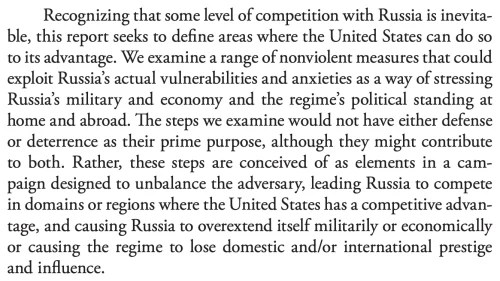
Screenshot from ‘Extending Russia: Competing from Advantageous Ground’.
RAND is almost entirely funded by the US Government, which appears first on its list of clients. So the fact that it would publish a report like this indicates that, even before Russia’s invasion, US decision-makers were interested in using Ukraine to weaken their geopolitical adversary.
As Senator Adam Schiff explained in 2020, “The United States aids Ukraine and her people so that we can fight Russia over there, and we don’t have to fight Russia here.”
Since Russia’s invasion, various other commentators have hinted – or in some cases explicitly stated – that America has goals other than securing Ukraine’s territorial integrity. Here’s Thomas Friedman’s account of what a “retired senior European statesman” told him:
The goal of Ukraine is to win, he said. The goal of the European Union is a bit different. It is to have peace … The U.S. is far away, and for the U.S., he added, it is not the worst thing to keep the war going to weaken Russia and make certain it doesn’t have the energy for any other adventures.
Two months into the war, Defence Secretary Lloyd Austin was asked how he would define America’s goals in the conflict. He began by saying what you’d expect him to say: “We want to see Ukraine remain a sovereign country”. He then went slightly off-script: “We want to see Russia weakened to the degree that it can’t do the kinds of things that it has done in invading Ukraine.”
According to the New York Times, some officials “cringed” and Biden called Austin to “remonstrate” him for the comment. “But officials acknowledged that was indeed the long-term strategy”.
A couple of weeks later, the political scientist Hal Brands really let the cat out of the bag – in a piece titled ‘Russia Is Right: The U.S. Is Waging a Proxy War in Ukraine’. He wrote:
The war in Ukraine isn’t just a conflict between Moscow and Kyiv, Russian Foreign Minister Sergei Lavrov recently declared. It is a “proxy war” in which the world’s most powerful military alliance … is using Ukraine as a battering ram against the Russian state … Lavrov is one of the most reliable mouthpieces for President Vladimir Putin’s baseless propaganda, but in this case he’s not wrong. Russia is the target of one of the most ruthlessly effectively proxy wars in modern history.
“The key,” Brands noted, “is to find a committed local partner — a proxy willing to do the killing and dying”. You then “load it up with” arms so that it can inflict “shattering blows” on your adversary. “That’s just what Washington and its allies are doing to Russia today.”
Similar sentiments were echoed by Congressman Seth Moulton in an interview with Fox News. “At the end of the day, we’ve got to realise we’re at war,” Moulton stated. “And we’re not just at war to support Ukraine. We’re fundamentally at war – although somewhat through a proxy – with Russia. And it’s important that we win.”
Likewise, when Congressman Dan Crenshaw came under fire from “America First” conservatives over his support for Ukraine, he tweeted: “Yeah, because investing in the destruction of our adversary’s military, without losing a single American troop, strikes me as a good idea. You should feel the same.”
Crenshaw didn’t bother paying lip-service to high-minded concepts like democracy, sovereignty or territorial integrity. He just came out and said we’re “investing in the destruction of our adversary’s military”.
Critics have consistently disparaged US policy as “fighting Russia to the last Ukrainian”. But in July, Senator Lindsey Graham – a long-time Russia hawk – said almost exactly that. “I like the structural path were on here,” Graham explained. “As long as we help Ukraine with the weapons they need and the economic support, they will fight to the last person.”
Critics found further justification for their cynicism in a recent Washington Post article, which revealed the following. “Privately, U.S. officials say neither Russia nor Ukraine is capable of winning the war outright, but they have ruled out the idea of pushing or even nudging Ukraine to the negotiating table.”
You might say that using Ukraine to weaken Russia is something worth doing, as Dan Crenshaw evidently believes. But at this point, it can scarcely be denied that America is engaged in a proxy war.
Norwegian PM for restoration of contacts with Russia: “Nothing good in isolation”
By Ahmed Adel | October 26, 2022
Norwegian Prime Minister Jonas Gahr Store said that Western countries should not isolate Russia and should instead establish direct communication with Moscow to resolve the exceptionally difficult situation in Ukraine. However, Norway, a NATO member, is also one of the leading countries to oppose Russia through sanctions and support for the Ukrainian military.
“There is nothing good in isolating Russia. It is alarming that today we have so few contacts and direct communication with Russia,” Store told the Norwegian parliament on October 25.
This is an especially surprising statement since Norway has donated 4,000 M72 anti-tank weapons to Ukraine, as well as an air defence system, 22 self-propelled artillery vehicles, long-range rocket artillery and armoured vehicles. Norway will also donate the Black Hornet micro-drone system and Hellfire missiles, and will also train Ukrainian soldiers in Britain.
Although Norway is following Washington and Brussels in supporting Ukraine and acting hostile to Moscow, perhaps there is a realization setting in Oslo that the war will not end with the Ukrainian military capturing Donetsk, Kherson, Luhansk and Zaporozhye from Russia. By coming to such a conclusion, the only realistic option left is to call for direct communications with Russia, something the West cut in the false belief that sustained isolation and economic pressure would make Moscow capitulate and end its military operation in Ukraine.
This was of course a naïve belief since the Kremlin has for years attempted to resolve the situation in Donbass through negotiations and discussions, something that Kiev, with the West’s support and backing, never supported. Moscow was forced to take matters into their own hands to protect the Russian-speaking minority from Kiev’s fascistic policies. Although Moscow has taken the military approach, it is still open to honest and open dialogue, but of course with different demands since the situation on the ground has significantly changed.
According to the Norwegian prime minister, the lack of dialogue with Moscow undermines the possibility of reaching a peaceful settlement in Ukraine. He also added that the current political situation was the most difficult since World War II, and it is for this reason as well that communication channels must reopen.
Russian President Vladimir Putin has repeatedly warned the West that Russia could not be isolated, and this is reflected in the fact that several major countries, including China, India and Brazil, have vocally opposed the idea of imposing unilateral sanctions on Moscow and called for the continuation of dialogue in the interest of peaceful world development.
Sanctions against Russia have led to disruptions in logistical and financial operations and to a spike in energy prices worldwide, pushing many European governments to resort to contingency measures. At the same time, Brussels has been looking for alternatives to Russian natural gas as it has pledged to end its dependence on energy supplies from Russia, thus making Norway all the more important to the EU.
The Scandinavian country is now the EU’s leading natural gas supplier, overtaking Russia. It is not forgotten that the Nord Stream pipelines leaks corresponded with the opening of a new pipeline from Norway to Poland. Although Norway is being heralded as a saviour for energy-struggling Europe, it has been criticised for essentially war profiteering.
“There is no question that the fallout from the war is making Norway richer. The state is a major player in the oil and gas industry. All told, Oslo expects to bring in about $109 billion from the petroleum sector this year — $82 billion more than in 2021. Much of that will go to the country’s sovereign wealth fund, a national nest egg worth more than $1 trillion,” The Washington Post reported.
Andreas Bjelland Eriksen, state secretary at the Ministry of Energy and Petroleum, denied that Norway is profiting off the war, stressing that high energy prices “hurt Norway too.” He noted that gas exports to Europe are up 8 percent year over year. “Europe sees that, and it sees that we are a good partner,” Eriksen added.
In this way, Norway has essentially become a big winner from the war in Ukraine as it has now become the main supplier of natural gas to Europe despite charging astronomical prices. However, this is not reflected on ordinary citizen life as Norway is not immune from the effects of the self-sabotaging anti-Russia sanctions.
Complementing the higher electricity bills arriving every month, Norwegians are also experiencing higher prices for almost everything else. State statistics bureau SSB (Statistics Norway) recently reported an 11.3 percent rise in transport costs, a 12.1 percent rise in food and non-alcoholic drinks, an 8.7 percent rise in hotel and restaurant bills and a 7.6 percent rise in prices for household items and maintenance. Norway’s biggest bank, DNB, also reported that its customers are now spending much less money on expensive items.
It is for this reason that Norway, despite making record profits in the energy sector, wants dialogue with Moscow to reopen so that there can be an alleviation in the cost-of-living crisis and other sectors of the economy. Nonetheless, Oslo itself makes little contribution to peace efforts as it maintains anti-Russia sanctions and continues to train, fund, and supply the Ukrainian military.
Ahmed Adel is a Cairo-based geopolitics and political economy researcher.
Property in German town to be confiscated for asylum seekers
Free West Media – October 26, 2022
So far it has been dismissed as a malicious “conspiracy theory” that living space for asylum seekers would end up being confiscated in Germany. But this “theory” is sadly coming true. In the Bavarian district of Fürstenfeldbruck, not far from Munich, it is being implemented.
The local CSU District Administrator Thomas Karmasin has refused to use gymnasiums as “refugee” accommodation. But the existing public accommodation is running out in the face of exploding numbers of asylum seekers. Karmasin therefore wants to have public and private properties confiscated in order to accommodate the newcomers. The first efforts have already started.
Karmasin said in a statement that immigration policy was a federal matter. As in 2014 to 2016, during the last “refugee” crisis, he refused to make school gyms available again.
This development is likely to put affected locals under severe stress in forcing a show of solidarity with Ukrainians or Senegalese accommodated in their apartments and single-family homes.
In a recent SZ interview, sociologist Karin Scherschel who is pro-migration, warned that election campaigns should not be fought on the subject of migration “because it always creates a mood”. If Scherschel had her way, the immigration debate would be ignored.
With authorities now confiscating homes, the matter is certain to create a volatile mood.
According to a so-called general clause under police law, people in Germany who are threatened with homelessness may be accommodated in empty apartments or hotel rooms, even against the will of the owner. Before doing so, the authorities must have exhausted all other possible options.
It is probably only a matter of time before these state encroachments will also extend to private residential property everywhere.
In Stuttgart, 100 tenants were given notice because the homeowner wanted to offer his house to the city for refugees. And in a Bavarian retirement home, the inhabitants were forced to move to higher floors so that young migrants could be accommodated on the ground floor.
The Organization for Economic Cooperation (OECD) assumes that the number of people moving to Germany by the end of the year will exceed the figure of more than two million from 2015.
Seize, not freeze: EU outlines plans for Russian assets
Samizdat – October 25, 2022
The EU seeks to outright confiscate Russian assets rather than just freeze them, but the bloc has yet to lay the legal groundwork for doing so, European Commission President Ursula von der Leyen said on Tuesday.
The official delivered her remarks during a conference devoted to the rebuilding of Ukraine, which was attended by a number of Kiev’s prominent international donors.
“Our aim is not only to freeze, but to seize the assets,” she said, although cautioning that establishing a legal base for such a move is “not trivial.”
According to von der Leyen, the EU has created a task force that includes various international experts “not only to map out what has been frozen,” but also to see what the legal preconditions would be for seizing Russian assets and using them for the reconstruction of Ukraine.
“The will is there, but legally it is not trivial, there is still a lot of work to reach that goal,” she reiterated, noting that the EU adheres to the rule of law, and therefore this process has to be “legally sound.”
Responding to von der Leyen’s remarks, Russian Foreign Ministry spokeswoman Maria Zakharova said that in reality the EU Commission president wants Russia to “exhaust itself being dragged through courts” while trying to retrieve its funds.
During the conference, von der Leyen stated that the World Bank had estimated the cost of the damage to Ukraine at €350 billion ($345 billion). Meanwhile, after Russia launched its military campaign in Ukraine in late February, a multinational task force froze $30 billion in funds belonging to Russian individuals, as well as $300 billion in assets of Russia’s central bank.
Russia strongly criticized the freezing of the funds, with Foreign Minister Sergey Lavrov saying that the West had essentially committed theft.
Western officials have repeatedly expressed the desire to confiscate Russian assets to benefit Ukraine. However, in July, during another conference on rebuilding Ukraine, Swiss President Ignazio Cassis opposed such a move, arguing that it would establish a dangerous precedent.
“You have to ensure the citizens are protected against the power of the state. This is what we call liberal democracies,” he said at the time.
The EU’s energy security now rests in Turkey’s hands
Europe has sought to bypass Russian gas with disastrous results. Turkey is set to reap the benefits.
By Karin Kneissl | The Cradle | October 24 2022
“Geography is the constant of history,” is a quote attributed to the German statesman Otto von Bismarck. Today, those words ring true as we witness geography altering global politics, finance, and alliances.
The geostrategic importance of Turkey has rarely been as clear to European politicians as it has been in recent months, as the continent grapples with a burgeoning energy crisis this coming winter.
Whether it is grain exports from the Black Sea region or the flow of energy supplies from the eastern producing countries, the Bosphorus and the links to Eurasia are once again playing a decisive geopolitical role, as they so often have throughout history. The fact is, Turkey is now crucial for the security of Europe.
Pipeline politics
On the occasion of Turkish President Recep Tayyip Erdogan’s meeting with his Russian counterpart Vladimir Putin in Sochi at the beginning of August 2022, the focus was mainly on bilateral cooperation in energy matters.
Putin told journalists after the tete-a-tete that Europeans should be grateful to Ankara for its gas supplies due to the reliability of the TurkStream pipeline.
Last year, Russian natural gas accounted for around 45 percent of European gas imports. But that share has fallen to less than 10 percent after supplies were halted via the eastbound Yamal-Europe pipeline and suspected US-backed operatives blew up Nord Stream, which also curtailed exports via Ukraine.
The Russian-Turkish TurkStream gas pipeline project was announced in December 2014 after Moscow realized that the long-planned SouthStream project – meant to deliver Russian natural gas via the Black Sea directly to European Union (EU) member state Bulgaria – was not feasible.
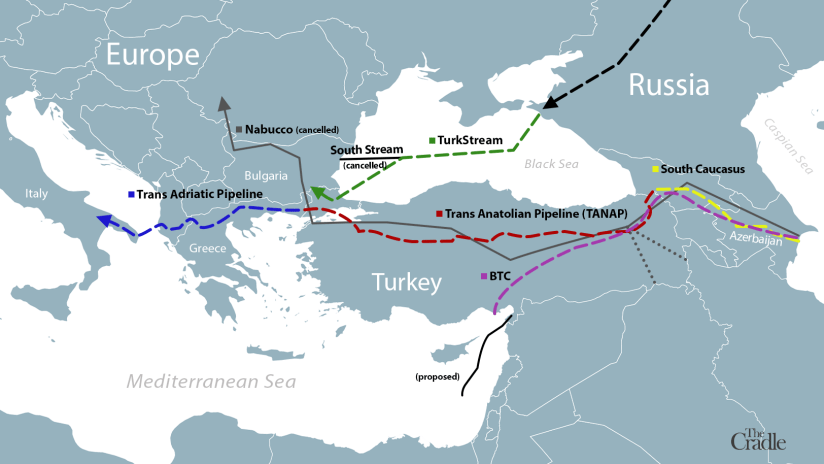
Russian energy giant Gazprom and the Italian energy company ENI were the main partners in the consortium. However, following the Crimean crisis in March 2014, the EU Commission blocked this major infrastructure project, citing competition rules.
As far as Moscow was concerned, this arrangement had already been completed in the form of terminals and pipeline routes. Thousands of work contracts had been issued between Bulgaria and Hungary at the time.
Construction was scheduled to begin in June 2014, but Brussels alluded to apparent violations of competition rules in the awarding of contracts by the Bulgarian authorities and brought everything to a halt.
Turkey as a Russian energy hub
Nine months later, during a joint press conference with Erdogan in Ankara, Putin remarked that “If Europe does not want to carry it out, then it will not be carried out.” Putin then announced the TurkStream project, which was formally launched in early 2020.
One pandemic and a war later, the world has experienced and continues to experience rising natural gas prices, while Russian-Turkish energy cooperation is intensifying. On 19 October, Erdogan said he had agreed with Putin to set up a comprehensive hub for Russian natural gas built in Turkey from where Europe could meet its energy needs.
“If Turkey and our potential buyers are interested, we could consider building another gas pipeline and creating a gas hub in Turkey for sale to third countries, especially in Europe,” Putin proposed. In addition, a gas exchange could also be created in Turkey to determine prices, he added.
Neither the EU nor the US have welcomed these developments or, in some cases, faits accomplis. Turkey makes no secret of the fact that it wants to expand its status in the China-led Shanghai Cooperation Organisation (SCO) and will probably soon become the tenth member of this important regional organization.
It should be noted that the SCO’s statutes stipulate energy and security – especially the fight against terrorism – as its essential agenda. The EU, it must be said, is only just discovering the importance of these issues.
Attempts to bypass Russian gas
In the recent past, governments and energy companies have looked to Turkey as an alternative to the existing transit routes for oil and gas between the east and west. In 2005, the 1750 km long Baku-Tbilisi-Ceyhan (BTC) pipeline was opened, transporting Caspian oil across the Caucasus to the Turkish Mediterranean port.
Crucially, this route had the backing of Washington, reinforcing the close connection between politics and the oil business. As per an apt saying from the early 20th century US oil industry: “The oil business is too important to leave it to the oil people.”
The Nabucco pipeline project, intended to reduce Europe’s reliance on Russia’s gas, consisted of a consortium of six corporations based on the initiative of the Austrian partly state-owned OMV. The project was supported politically and financially by the European Commission, with the premise being that natural gas would be supplied from the Caspian region via Turkey to Central Europe to the Baumgarten hub in Austria.
Billions were spent on marketing this project between 2002 and 2014. However contractual agreements surrounding the deal never materialized. Though inconceivable now, Iran was also initially planned as an alternative supplier, yet these efforts failed from 2005 onwards due to UN Security Council sanctions on Iran from 2008 until the present.
Additionally, supply contracts with Iraq and Turkmenistan were targeted in vain, although these arguably had a lot to do with complete mismanagement. In the case of Turkmenistan, countless advisory opinions were commissioned on the status of the Caspian Sea under international law, sea, or lake, and the possible transit pipelines for landlocked Turkmenistan.
A failed strategy
After many years of mere marketing and a lot of hot air between Brussels and Vienna around the Nabucco project, OMV’s partners finally backed out in 2014. It was clear that there was no natural gas available.
In my book “Der Energiepoker” (The Energy Poker) I wrote in 2006: “If the managers had not gone to the State Opera to see Verdi’s Nabucco, but had seen the operetta by Johann Strauss “Wiener Blut” (Viennese Blood), then this natural gas pipeline would have been given a more appropriate name.
Now, in view of the Nord Stream 2 pipeline boycotted by the EU, OMV is facing further setbacks, as the contracts with take-or-pay clauses were drafted in such a way that payment would have to be made for the Russian natural gas, even if there was no physical delivery. These conditions apparently apply until 2040.
EU will buy Russian energy indirectly
While the EU wants to bypass Russian energy sources for political reasons, Turkey, India, and China, among others, will gladly fill in the consumer void. As described, Turkey already benefited in 2014 from the SouthStream project, which became TurkStream. The EU ultimately lost out, while Ankara stood to gain, with the EU presently buying Russian natural gas via Turkey.
This energy route is set to expand even further once the Russian natural gas hub in Turkey is established. Turkey thus becomes the safeguard of the EU’s energy security. While this was the case a few years ago with non-Russian natural gas and oil, it now looks as if Russia is merely adapting its role for the European market on a regional basis.
For some years, Ankara aligned its prospective role as a hub for BTC and the Nabucco project with its EU accession ambitions. Now it seems that Turkey will become a member of the SCO much faster, and despite its NATO membership, part of the security cooperation with Russia and China.
The EU is more dependent than ever on the goodwill of those it once created obstacles for, and Turkey and Russia are no exception. The coming months will show with all their force just how irresponsibly the EU governments handled the continent’s energy security needs.
Nord Stream repair time frame assessed
Samizdat – October 24, 2022
Russia’s Nord Stream gas pipelines, which were damaged and made inoperable by underwater explosions in late September, can be repaired within a few months.
That’s according to the state-backed Danish Broadcasting Corporation (DR) which was citing Sten Ussing, Chief Engineer with consultant group COWI.
Ussing assessed from underwater video-footage that the pipes will not be damaged by rust for some time as there is little oxygen at a depth of 80 meters, where they are located. He noted that the fracture surfaces look “very clean and almost shiny,” which suggests that “the pipe will not rust in a few weeks, as one would expect in a more oxygenated environment.”
“We can expect corrosion inside the pipe to be limited as well,” he added.
The engineer, however, explained that the explosion caused a pressure surge, and that could have damaged sections of the pipeline some distance from the site, adding that they can be repaired by elevating the pipes slightly above the seabed, which would allow underwater welders to remove the damaged sections and replace them with new ones.
“It is standard procedure to weld such a piece of pipe under water. It has been done many times before, and the technologies – vessels, pipes and specialists – that need to be used already exist,” Ussing explained.
“Finally, the pipeline would have to be emptied, the strings cleaned of dirt and grime, blown and dried – and that’s it, you can have gas flowing again,” the engineer concluded, saying the process will likely take several months. He warned, however, that even with little oxygen, the fractured pipes can accumulate rust over time, and advised to carry out the repairs within a year.
The footage of the pipeline fractures which Ussing inspected was taken by Swedish media outlet Expressen, which sent a camera down one of the pipes.
The cause of the explosions which damaged three out of four strings of Russia’s 1,200-kilometer Nord Stream 1 and 2 gas pipelines is still being investigated. Sabotage is suspected to be the likely cause. President Vladimir Putin branded it “an act of international terrorism.”
EU displays ‘height of hypocrisy’ – Russia

Samizdat | October 23, 2022
The European Union doesn’t have the right to accuse Moscow of committing war crimes in Ukraine because the bloc has spent years ignoring the suffering of civilians in Donbass, the Russian Foreign Ministry has said.
Russia’s statement came after EU’s main decision-making body, the European Council, condemned Moscow on Friday for “indiscriminate” missile and drone attacks on civilian targets in Kiev and elsewhere in Ukraine, adding that there was “growing evidence” of war crimes against Ukrainians.
In a response released on Saturday, Russian Foreign Ministry spokeswoman Maria Zakharova rebuffed the accusations as “the height of hypocrisy.”
The European Union has lost the moral right to speak about war crimes because, for eight years, it has turned a blind eye to the killing of civilians, women and children during the shelling of the Donbass by the regime in Kiev.
Zakharova further accused the European bloc of “covering up Kiev’s criminal actions.” She argued that, instead of seeking a peaceful solution, the EU has been “senselessly investing significant sums into prolonging the fighting.”
The spokeswoman also claimed that Ukrainian soldiers who receive Western training and weapons are targeting civilians.
Russia stepped up strikes on Ukraine this month, hitting many thermal power plants and power lines across the country, among other targets. President Vladimir Putin said the intensification was a retaliation against “terrorist attacks” on Russian soil, including a truck bombing that had recently damaged a strategic bridge connecting the Crimean Peninsula with Russia proper.
Kiev has not confirmed its involvement in the bridge attack, but several top officials and government agencies openly celebrated the bombing. President Vladimir Zelensky later accused Russia of killing civilians on purpose during its renewed strikes on Ukrainian territory.
Von der Leyen presented with Great Reset award
The Bill & Melinda Gates Foundation has singled out Ursula von der Leyen for her “extraordinary commitment” to the UN Sustainable Development Goals
Free West Media | October 23, 2022
The Gates Foundation named Von der Leyen as one of the four winners of the so-called Goalkeepers Global Goals Awards. The other winners are Radhika Batra, co-founder of Every Infant Matters; Zahra Joya, a journalist from Afghanistan; and Vanessa Nakate, a climate activist from Uganda.
Until recently, the World Economic Forum’s Great Reset was called a conspiracy theory. This week, the EU Commission president received an award for her commitment to the same Great Reset.
The award ceremony, presented by Bill Gates and his ex-wife Melinda French Gates, was not supposed to be satire: Von der Leyen was praised for her role in the purchase and distribution of Corona vaccines. Her husband Heiko, is the director of Orgenesis, which is owned by Pfizer – the same company that Ursula signed a secret 71 billion euro contract with.
“It is a great honour to receive this award,” the EU boss said. She dedicated the award to the millions of Europeans who “helped us all get through the pandemic”. “From the scientists, who developed the life-saving vaccines, to the healthcare workers on the frontline. This award is also for them.”
Meanwhile the European Public Prosecutor’s Office has launched an investigation into the EU’s procurement of Corona vaccines. There has long been criticism of the secrecy surrounding the European Commission’s billion-dollar contracts with vaccine maker Pfizer.
And Von der Leyen has refused to clarify her negotiations with Pfizer boss Albert Bourla.
US Poured Millions Into Hungarian Opposition Trying to Topple PM Orban
By Evgeny Mikhaylov – Samizdat – 23.10.2022
Russian foreign ministry spokeswoman Maria Zakharova stated that Washington had fueled the movement against Hungarian Prime Minister Viktor Orban, since the US doesn’t consider the country obedient enough.
“Now, it turns out that the opposition in Budapest was also financed. The Hungarian [newspaper] Magyar Nemzet published an investigation into the funding of the liberal-left coalition of opponents of [Prime Minister] Viktor Orban by the American NGO Action for Democracy. The investigators and special services will probe all the circumstances of the attempts of foreign meddling in the political life of the country, but it is already obvious that the bill approaches millions of dollars,” Zakharova said.
According to the report, the foundation, created just before the February elections, enjoyed close ties with the European Council on Foreign Relations (ECFR). The report also suggested that Action for Democracy is connected to Hungarian-born billionaire George Soros, who funds Open Society Foundations, banned by Hungary several years ago.
Zakharova also reminded that the EU leadership was also discontent with Budapest’s independent stance, threatening Hungary with fines and sanctions, while calling it an “electoral autocracy” for refusing to follow orders from Brussels.
Hungary has staunchly opposed the EU sanctions against Russia. Budapest has repeatedly warned that Brussels’ decision to send military aid to Kiev amid the Russian special military op there and to impose restrictions against Moscow will result in a major economic collapse of the bloc.
The sanctions, backed by the US, Britain, and the EU, exacerbated fuel market issues, resulting in a major energy crisis across Europe, with record-high inflation and skyrocketing cost of living.
Hungary criticizes ‘pro-war’ EU
Samizdat – October 22, 2022
The Hungarian Foreign Ministry has rejected EU calls for Russia to be defeated in Ukraine, saying the bloc needed peace, not a prolonged conflict.
EU Commissioner for Home Affairs Ylva Johansson made several statements on the hostilities this week, stressing the bloc’s “determination, resolve and unity to stand by Ukraine as long as it takes.” She also insisted that “to end this crisis, first, Putin must lose.”
Responding on Friday, Tamas Menczer, State Secretary at Hungary’s Foreign Ministry, accused Johansson of making “a very dangerous statement because it links the end of a crisis with a military event, about which we don’t know when will it happen or if it happens at all.”
“This pro-war stance of Brussels extends the conflict and suffering. This is extremely dangerous and unacceptable,” he insisted.
Menczer reiterated the position of the Hungarian government, which is that “we need immediate peace instead of a longer war. Peace requires an immediate ceasefire and dialogue.”
Hungary has remained relatively neutral since the outbreak of fighting in Ukraine in late February. It has refused to send arms to Kiev unlike many fellow EU members and consistently criticized the sanctions imposed by Brussels on Moscow. Budapest, which is heavily dependent on Russian fuel, was also able to negotiate an exemption for itself from the bloc-wide ban on Russian oil.
Moscow, which has repeatedly invited Kiev to come to the negotiating table, has blamed the Ukrainian side for undermining any potential for a peaceful settlement of the conflict.
Earlier this month, Ukrainian President Vladimir Zelensky signed a declaration that officially made it “impossible” to hold any negotiations with his Russian counterpart Vladimir Putin. The move followed the inclusion of the Kherson and Zaporozhye Regions, and the People’s Republics of Donetsk and Lugansk, into Russia as result of referendums in those territories. Kiev and its Western backers have labeled September’s votes a “sham” and continue to view the areas as parts of Ukraine.
Russia’s homage to Nord Stream pipelines
BY M. K. BHADRAKUMAR | INDIAN PUNCHLINE | OCTOBER 22, 2022
David Brinkley, the legendary American newscaster with a career that spanned an amazing fifty-four years from World War II once said that a successful man is one who can lay a firm foundation with the bricks others have thrown at him. How many American statesmen ever practised this noble thought inherited from Jesus Christ remains doubtful.
Russian President Vladimir Putin’s stunning proposal to Turkish President Recep Erdogan to build a gas pipeline to Turkiye to create an international hub from which Russian gas can be supplied to Europe breathes fresh life into this very “Gandhian” thought.
Putin discussed the idea with Erdogan at their meeting in Astana on October 13 and since spoke about it at the Russian Energy Week forum last week where he proposed creating the largest gas hub in Europe in Turkey and redirecting the volume of gas, the transit of which is no longer possible through the Nord Stream, to this hub.
Putin said it may imply building another gas pipeline system to feed the hub in Turkiye, through which gas will be supplied to third countries, primarily European ones, “if they are interested.”
Prima facie, Putin does not expect any positive response from Berlin to his standing proposal to use the string of the Nord Stream 2, which remained undamaged, to supply 27.5 billion cu. metres of gas through the winter months. Germany’s deafening silence is understandable. Chancellor Off Scholz is terrified about President Biden’s wrath.
Berlin says it knows who sabotaged the Nord Stream pipelines but won’t reveal it as it affects Germany’s national security! Sweden too pleads that the matter is far too sensitive for it to share the evidence it has collected with any country, including Germany! Biden has put the fear of God into the minds of these timid European “allies” who have been left in no doubt what is good for them! The western media too is ordered to play down Nord Steam saga so that with the passage of time, public memory will fade away.
However, Russia has done its homework that Europe cannot do without Russia gas, the present bravado of self-denial notwithstanding. Simply put, the European industries depend on cheap, reliable supplies of Russian gas for their products to remain competitive in the world market.
Qatar’s energy minister Saad al-Kaabi said last week that he cannot envisage a future where “zero Russian gas” flows to Europe. He noted acerbically, “ If that’s the case, then I think the problem is going to be huge and for a very long time. You just don’t have enough volume to bring (in) to replace that (Russian) gas for the long term, unless you’re saying ‘I’m going to be building huge nuclear (plants), I’m going to allow coal, I’m going to burn fuel oils.’”
Quintessentially, Russia plans to replace its gas hub in Haidach in Austria (which Austrians seized in July.) Conceivably, the hub in Turkiye has a ready market in Southern Europe, including Greece and Italy. But there is more to it than meets the eye.
Succinctly put, Putin has made a strategic move in the geopolitics of gas. His initiative rubbishes the hare-brained idea of the Russophobic European Commission bureaucrats in Brussels, headed by Ursula von der Leyen, to impose a price cap on gas purchases. It makes nonsense of the US’ and EU’s plans to put down Russia’s profile as a gas superpower.
Logically, the next step for Russia should be to align with Qatar, the world’s second biggest gas exporter. Qatar is a close ally of Turkey, too. At Astana recently, on the sidelines of the summit of the Conference on Interaction and Confidence-Building Measures in Asia (CICA), Putin held a closed-door meeting with the Emir of Qatar Sheikh Tamim bin Hamad Al Thani. They agreed to follow up with another meeting soon in Russia.
Russia already has a framework of cooperation with Iran in a number of joint projects in the oil and gas industry. Russian Deputy Prime Minister Alexander Novak recently disclosed plans to conclude an oil and gas swap deal with Iran by the end of the year. He said that “technical details are being worked out – issues of transport, logistics, price, and tariff formation.”
Now, Russia, Qatar and Iran together account for more than half of the world’s entire proven gas reserves. Time is approaching for them to intensify cooperation and coordination on the pattern of the OPEC Plus. All three countries are represented in the Gas Exporting Countries Forum (GECF).
Putin’s proposal appeals to Turkiye’s longstanding dream to become an energy hub at the doorstep of Europe. Unsurprisingly, Erdogan instinctively warmed up to Putin’s proposal. Addressing the ruling party members in the Turkish parliament this week, Erdogan said, “In Europe they are now dealing with the question of how to stay warm in the coming winter. We don’t have such a problem. We have agreed with Vladimir Putin to create a gas hub in our country, through which natural gas, as he says, can be delivered to Europe. Thus, Europe will order gas from Turkey.”
Apart from strengthening its own energy security, Turkiye also can contribute to Europe’s. No doubt, Turkiye’s importance will take a quantum leap in the EU foreign policy calculus, while also strengthening its strategic autonomy in regional politics. This is a huge step forward in Erdogan’s geo-strategy — the geographic direction of Turkish foreign policy under his watch.
From the Russian viewpoint, of course, Turkiye’s strategic autonomy and its grit to pursue independent foreign policies works splendidly for Moscow in the present conditions of western sanctions. Conceivably, Russian companies will start viewing Turkiye as a production base where western technologies become accessible. Turkiye has a customs union agreement with the EU, which completely removes customs duties on all industrial goods of Turkish origin. (See my blog Russia-Turkey reset eases regional tensions, Aug 9, 2022)
In geopolitical terms, Moscow is comfortable with Turkiye’s NATO membership. Clearly, the proposed gas hub brings much additional income to Turkiye and will impart greater stability and predictability to the Russia-Turkey relations. Indeed, the strategic links that tie the two countries together are steadily lengthening — the S-400 ABM deal, cooperation in Syria, the Akkuyu Nuclear Power Plant, Turk-stream gas pipeline, to name a few.
The two countries candidly admit that they have differences of opinion, but the way Putin and Erdogan through constructive diplomacy keep turning adverse circumstances into windows of opportunity for “win-win” cooperation is simply amazing.
It does need ingenuity to get the US’ European allies to source Russian gas without any coercion or boorishness even after Washington buried the Nord Stream gas pipelines in the depths of the Baltic Sea. There is dramatic irony that a NATO power is partnering Russia in this direction.
The US foreign policy elite drawn from East European stock are rendered speechless by the sheer sophistication of the Russian ingenuity to bypass without any trace of rancour the shabby way the US and its allies — Germany and Sweden, in particular — slammed the door shut on Moscow to even take a look at the damaged multi-billion dollar pipelines that it had built in good faith in the depths of the Baltic Sea at the insistance of two German chancellors, Gerhard Schroeder and Angela Merkel.
The current German leadership of Chancellor Olaf Scholz looks very foolish and cowardly – and provincial. The European Commission’s Ursula von der Leyen gets a huge rebuff in all this which will ultimately define her tragic legacy in Brussels as a flag carrier for American interests. This becomes probably the first case study for historians on how multipolarity will work in the world order.
UAVs Used in Ukraine Are Manufactured in Russia, West Inventing Fake Pretext – Polyanskiy
Samizdat – 20.10.2022
Drones being used by Russian military forces in Ukraine are wholly manufactured in Russia, Deputy Permanent Representative to the UN Dmitry Polyanskiy stressed to reporters after allegations surfaced that Iran was providing UAVs to Moscow.
“UAV used by the Russian army in Ukraine are manufactured in Russia,” Polyanskiy said on Wednesday, adding that Western officials are inventing artificial pretext.
The official further added that the United Nations Secretariat does not have a legal mandate to conduct an investigation into the alleged use of Iranian-made drones in Ukraine.
“[The UN Secretariat] has no mandates to investigate anything regarding the UN Security Council resolution 2231,” Polyanskiy said. “Its role as enshrined within note of the Security Council President 2016/44 16 January 2016 is purely technical – to prepare meeting rooms, circulated communications.”
The comments come after the EU spokesperson Nabila Massrali revealed that the block had collected evidence allegedly proving that Iran had supplied Moscow with drones for its ongoing special military operation.
Iran has repeatedly rejected the accusations. Earlier, Iranian UN envoy Saeed Iravani blasted the “disappointing” claims as disinformation being pushed as part of a political agenda.
“We categorically reject the unfounded and unsubstantiated claims that Iran has transferred UAVs for the use in the conflict in Ukraine,” Iravani said on Wednesday.
Allegations regarding the drones first surfaced in July, when they were voiced by US national security adviser Jake Sullivan. The US State Department has since stated that it intends to use sanctions to prevent the transfer of such “dangerous weapons.”
Featured Video
Integrity Initiative: UK-funded network framed dissent as Russian disinformation for years
or go to
Aletho News Archives – Video-Images
From the Archives
Why Saudi Ties to 9/11 Mean U.S. Ties to 9/11
By Kevin Ryan | Dig Within | September 27, 2015
Media interest in Saudi Arabian connections to the crimes of 9/11 has centered on calls for the release of the 28 missing pages from the Joint Congressional Inquiry’s report. However, those calls focus on the question of hijacker financing and omit the most interesting links between the 9/11 attacks and Saudi Arabia—links that implicate powerful people in the United States. Here are twenty examples. … continue
Blog Roll
 Aletho News
- IAEA inspectors cannot return to Iran amid US threats: Russia
- Senate Rejects Iran War Powers Resolution Passed By House
- ‘We did not attack Pakistan with drones’: Afghan sources
- Iraqi Resistance faction links arms to sovereignty, questions US exit
- Cannon fodder no more… South Korea rejects Trump’s pressure to join his criminal war on Iran
- Neria Leiter Was A Legitimate Military Target
- Integrity Initiative: UK-funded network framed dissent as Russian disinformation for years
- ‘We don’t seek permission to defend our country’: Snippets from President Pezeshkian’s UNGA address
- NATO chief wants Europeans to fight American wars [for Israel]
- German chemicals giant reveals details of downsizing
- If Americans Knew
- Israel displaces hundreds of Palestinians amid wave of demolitions in West Bank
- Aid, reconstruction, and Israel’s history of obstruction in Gaza
- Trump administration digs an ever-deeper hole of complicity in genocide – Daily Update
- US-Israel $2.8 Billion Arms Deal, 40,000-Bomb Supply Faces New Gaza Complicity Accusations
- Caught on Tape: AIPAC CEO Boasted of Controlling Trump’s National Security Officials
- Why Hamas Attacked Israel in October 2023 – Israeli professor Ilan Pappé
- They see them, then kill them: Israeli quadcopters track, deliberately target civilians in Gaza
- Winter could turn Gaza’s treacherous, war-damaged buildings into deathtraps
- Majority of Democratic Voters Want to Prosecute Both Biden and Trump Administration Officials Over Gaza
- As Gaza languishes, world leaders gather at the UN – Daily Update
- No Tricks Zone
- New Study: Earth And Venus Surface Warmth Largely Explained By Convection And Lapse Rate, Not CO2 Or Radiation
- 2025 Nature Paper Claiming Worsening Global Drought Gets RETRACTED …Heavily Flawed
- New Study: ‘Global Drought Shows No Detectable Recent Acceleration Under Climate Warming’
- Economic Masterminds: German Socialists Suggest Taxing Productivity Gains Stemming From Using AI
- The South China Sea Has Not Been Cooperating With The Climate Change Narrative
- Energy Crisis: Germany Enters Heating Season With Historically Low Gas Reserve Fill Levels
- New Study: The Antarctic Ice Sheet Gained Mass From 2020-2024 Due To Staggering Snow And Ice Accumulation
- Study: Ocean Heating Rates From Thousands Of Years Ago ‘Dwarf’ Modern Ocean Heating Rates
- Climate Extremists Target, Attack Large-Scale Power Grid Infrastructure In Germany!
- New Study: Antarctic Ice Melt Has Contributed Less Than 1 Centimeter To Sea Level Rise In The Last 30 Years

