Germany wants EU unanimity rule scrapped
Samizdat | August 29, 2022
German Chancellor Olaf Scholz on Monday called on EU members to abandon the right to veto in favor of majority voting in a number of key areas. Such a move could facilitate the bloc’s future expansion.
Speaking at the Charles University in Prague, Scholz argued that changing voting practices may help to grow the EU, given that currently any bloc member can veto the accession of a candidate country. He also suggested introducing majority voting on a number of pressing matters, including sanctions and human rights.
“Where unanimity is required today, the risk of an individual country using its veto and preventing all the others from forging ahead increases with each additional member state,” the German chancellor said.
According to Scholz, “the principle of unanimity only works for as long as the pressure to act is low,” citing the example of Russia’s military offensive in Ukraine, which has challenged the way the EU approaches policymaking.
The German leader also wants the EU to switch to majority voting in areas such as taxation and foreign policy, adding that he knows “full well that this would also have repercussions for Germany.”
Scholz noted that Berlin supports enlargement of the EU, adding that he believes that the western Balkan countries, as well as Ukraine, Moldova, and Georgia would eventually join the bloc and that this will inevitably bring more differences among members.
Hungary Urges Foreign Ambassadors to Act Like Diplomats, Not Viceroys
By Ilya Tsukanov | Samizdat | August 29, 2022
Hungary has stood alone among its neighbors in refusing to slap new sanctions on Moscow, and has rejected demands by Brussels to rapidly cut dependence on Russian energy supplies. Budapest has also denied access to its territory for Western arms delivery to Ukraine, saying the security crisis can only be resolved through talks.
Hungary will independently determine what policies it will pursue, and foreign ambassadors should do their duty instead of lecturing Budapest, Foreign Minister Peter Szijjarto has urged.
“We do not send viceroys to other countries, but ambassadors…and receive ambassadors, not viceroys,” Szijjarto said in a meeting with Hungarian diplomats.
“And in the future we will not tolerate it if a representative of some other country decides that that they can teach us about a different or better life. Thanks very much, but we aren’t asking for that. We can determine ourselves how we should live in Hungary. The Hungarian electorate regularly decides this question in elections,” the foreign minister said.
Szijjarto warned foreign diplomats stationed in Budapest that any ambassador who sees themselves as a viceroy rather than a diplomat will “have difficulties,” because Hungary will not bow to any “bad compromises.”
Hungary, Szijjarto said, has based its foreign policy on mutual respect, and will continue to do so. “This means that we have behaved as representatives of a national government with a thousand year history and the corresponding self-confidence, giving respect to our partners and expecting the same respect in return.”
Hungary summoned Estonia’s ambassador to Budapest earlier this month over what Hungary’s Foreign Ministry characterized as “unacceptable’ comments made by politicians in Tallinn, who have criticized Hungary over its foreign policy vis-à-vis Ukraine and Russia.
Budapest has demonstrated its domestic and foreign policy independence for more than a decade, with the government of Prime Minister Viktor Orban getting into spats with Brussels on a broad range of issues from immigration to a move to kick a George Soros-funded university out of the country.
After the escalation of the Ukraine crisis in February, Hungary hesitated in signing on to the raft of new European Union sanctions against Russia, refused to allow convoys of NATO military equipment to use the country to transfer weapons to Kiev, and has continued to buy Russian oil and gas, warning that the Central European country’s economy would collapse otherwise.
Last month, summarizing the impact of months of Brussels’ policy, Orban reveled in the correctness of his approach, comparing the West’s policy vis-à-vis Russia to a “car with flat tires on all four tires” and pointing out that sanctions had made no change in Moscow’s course, but only cost Europe four governments.
Orban also warned last month that Europe would be turned into a “war economy” by October if Brussels didn’t change course on its “ineffective” sanctions against Russia and weapons deliveries to Ukraine. “You do not usually put out fires with flamethrowers,” he stressed.
Hungary’s unique approach to the Ukrainian crisis also stems in part from Budapest’s bad blood with its neighbor over its treatment of ethnic Hungarian Ukrainians following the 2014 Maidan coup, after which the minority gradually lost its right to receive an education in its native tongue.
In June, a vicious back-and-forth war or words broke out between Ukrainian and Hungarian officials after Hungarian parliamentary speaker Laszlo Kover suggested that Ukrainian President Volodymyr Zelensky was suffering from a “mental problem” accounting for his government’s undiplomatic approach to asking Western countries for help against Russia.
Hungary Says There Are EU Countries That Silently Oppose Anti-Russian Sanctions
Samizdat – 28.08.2022
Hungarian Minister of Foreign Affairs and Trade Peter Szijjarto has stated that Budapest is not alone in its reluctance to slap sanctions on Russian energy exporters, but that other countries, who are under the influence of the “liberal mainstream,” don’t dare to pursue policies based on their own interests.
Speaking at the TRANZIT public forum in Tihany, Hungary on Saturday, Szijjarto said that he would like to clarify that his country is “not even willing to negotiate any further sanctions” pertaining to the oil and gas sector.
“And I want to say that we are not alone in this,” the top Hungarian diplomat stressed, recalling an episode during a recent EU ministerial meeting, which focused on “the issue of limiting oil from Russia.”
According to Szijjarto, during the gathering, “several colleagues” approached him and said, “Peter, you are against it [sanctions on Russian oil exports], right? We are with you.”
“Those who tell the truth are under such amazing pressure from the liberal mainstream that if there is no political stability of a certain level and, as a result, political courage in the country, they simply do not dare to act in their own interests,” the Hungarian foreign minister pointed out.
During the speech, Szijjarto also gave his thoughts on how long Europe will hinge on Russian oil and gas. He argued that “as long as gas cannot be transported by train or in a backpack, Europe will not be able to get rid of dependence on Russian energy resources.”
Last month, Hungarian Prime Minister Viktor Orban insisted that while the sanctions had failed to destabilize Moscow, “Europe is in trouble, economically and politically, and four governments have become victims: UK, Bulgarian, Italian and Estonian.”
“People will face a sharp increase in prices. And the better part of the world deliberately did not support us as well — China, India, Brazil, South Africa, the Arab world, Africa — everybody is aloof from this [Ukraine] conflict, they are interested in their own affairs,” Orban added.
Also in July, Russian President Vladimir Putin admitted that sanctions damage the country’s economy and many risks still remain, but that these restrictive measures inflict more damage on those who imposed them.
Sanctions against Russia were slapped by the US and its allies in late February, shortly after Moscow launched its special operation to demilitarize and de-Nazify Ukraine. In the wake of the West’s anti-Russian restrictive measures, inflation skyrocketed in many Western countries, driving energy prices there to record numbers.
Ukraine Independence Day: Is Ukraine Killing her Own People?
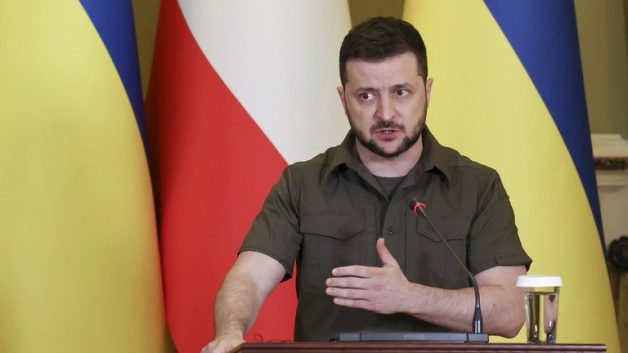
By Peter Koenig | Dissident Voice | August 26, 2022
On 24 August Ukraine celebrated her Independence Day. It also marked the dubious anniversary of 6 months of war; a war that could have been drastically shortened, tens of thousands of lives saved and peace installed hadn’t it been for the relentless western / NATO provocations, and billions worth of western weapons deliveries to Ukraine. The west pretends these killer weapons are destined to create Peace, and would you believe the media are able to make most of the western world population believe in this nonsense.
It is literally George Orwell’s 1984: “Peace is War and War is Peace;” Orwell’s classical Doublespeak, a language that deliberately obscures, disguises, distorts, or reverses the truth.
On that very day, the NYT brazenly reports, without any evidence whatsoever, that on “Ukraine’s Independence Day, a Russian attack killed at least 22 people and wounded 50, at a train station in eastern Ukraine, near Dnipro.”
The NYT continues, “But despite the missile strike, one of the deadliest on Ukraine’s railways in recent months, Ukraine stood defiant as the country celebrated its separation from the Soviet Union.” In a slickly produced address earlier in the day, President Volodymyr Zelensky declared Ukraine “reborn” six months after Russia invaded.
Such are the flagrant lies dished out to not only the American people. The European media are equally corrupted. At times even more so.
It gradually emerges that public support for western interference – western support of Ukraine – is fading by the day.
According to a Reuters / Ipsos poll, released on 23 August, still 53% of US adults agree that Washington should support Kiev, “until Russian forces are withdrawn from territory claimed by Ukraine.”. Those with doubts to continue pumping weapons into Ukraine, amount to 37%, and 18% oppose such “aid” altogether. Some 28% are undecided.
Forty percent of Americans now agree with the statement that “the problems of Ukraine are none of our business, and we should not interfere,” comparing with 31% when the same question was asked in April 2022.
The awakening might indicate that fewer and ever fewer people believe the mainstream propaganda – and especially the Zelenskyy statements. The truth of who is killing whom, and the truth about the corrupt and shamefully criminal Ukraine President, is slowly but surely seeping through the veil of deception.
In the case of the attack on the railway station, there is no doubt that the assault was launched by Ukraine’s forces on her own people, killing 22 of them and injuring at least 50. The figures are not verified. They are the ones reported by the “distinguished” NYT (25 August 2022).
Similarly, The Guardian reports (29 July 2022) that according to the Russian Defense Ministry, 40 prisoners were killed and 75 wounded in the attack on the prison in the frontline town of Olenivka. The prison was struck by Ukrainian forces with US-made Himars rockets. Yet, Ukraine was blaming Russia with the attack on its own people and with US-made weapons.
It would be hard to make believe more ludicrous statements. Yet, by telling half-truth or full-lies relentlessly and repeatedly the western media (still) gets away with murder among most of its listeners. But – the Times Are a-Changing.
Russia from the beginning has followed – and keeps following – a strict policy of avoiding civilian casualties as best as possible.
These attacks on Ukraine’s own people are certainly not carried out by Russian forces, but rather by Ukrainian military, and/or their associated Nazi Azov Battalions.
They also killed without scruples tens of thousands of pro-Russian Ukrainians in the Donbass and north-eastern Ukraine areas, since the US/western instigated 2014 Maidan Coup.
No doubt, the attacks were sanctioned by Zelenskyy. He follows clear instructions from NATO and the – unelected European Council. That the EC under Ursula von der Leyen is an unelected and tyrannical executing branch of the Deep State or the Dark elitist Cult, is no longer a secret. Madame von der Leyen is a member of the WEF’s (World Economic Forum) Managing Council.
Similarly, the relentless attacks on the Zaporozhye Nuclear Power Plant in southern Ukraine, the largest in Europe, are constantly blamed on Russia, or even on President Putin personally by the western media.
Again, the contrary is true. In order to prevent another Chernobyl-type nuclear disaster (26 April 1986), or worse, Russian troops have been occupying the Zaporozhye Plant, since March 2022. They were worried, and rightly so, about a nuclear annihilation of much of western Europe and Russia. Finally, on 19 August, Russia has shut down the plant, to limit the worst of a potential disaster.
Moscow has warned that the continuing attacks could ultimately render the power plant inoperable and might even result in a major disaster, similar to Chernobyl. Kiev and some Western officials, however, have accused Russia of shelling the plant, despite the fact that it is controlled by Russia’s own troops.
As unquestioned western support is waning, western media ever so often report the Zelenskyy Government’s accusations of Russia, but finish with the paraphrased observation that “it is difficult to verify the facts” – an own skin-saving-statement.
The next Biden Administration promised shipment of war material is of the order of an estimated US$ 3 billion. Is it part of the roughly US$ 50 billion already approved US war support to Ukraine – or is it apart?
Nobody keeps track. In any case – even western media report that about 70% of the war material sent to Ukraine ends up on the black market. Only about 30% reaches the front-line – and Ukrainian soldiers who are totally unprepared to handle the sophisticated western weaponry.
It is high time that the truth comes out – and the majority of the people see beyond the propaganda, see the most flagrant war crimes committed by Zelenskyy’s Ukraine – and stop supporting this war.
The sooner the west stops sending weaponry and tanks and most sophisticated war materiel to Ukraine, the sooner Peace may return.
If only PEACE were part of the Great Reset’s Agenda – and part of the UN Agenda 2030 – and part of Klaus Schwab’s “4th Industrial Revolution” – meaning the digitization, robotization, and absolute control of everything and every surviving human being. But PEACE, as we are still thinking humans conceive of it, is not part of the Reset Agenda.
But we are many and they are few. We may replace the Reset with the Peace agenda.
Peter Koenig is a geopolitical analyst and a former Senior Economist at the World Bank and the World Health Organization (WHO), where he has worked for over 30 years on water and environment around the world. He lectures at universities in the US, Europe and South America.
Sanctions against Russia damage Western business
By Lucas Leiroz | August 26, 2022
The West itself appears to be the party most harmed by the sanctions it has chosen to impose against Russia. As well known, the US, UK and EU are facing a wave of inflation with all-time highs. And in the same sense, the business world is collapsing in Western countries. The business losses with the end of participation of some Western companies in the Russian market are extremely significant and are causing serious problems for the economy of many countries, with losses accumulating exorbitant amounts.
It is estimated that American, European, British, and Japanese companies have already lost more than 70 billion dollars since February. The losses are a consequence of the packages of sanctions imposed by Western countries on Moscow in response to the start of the special military operation in Ukraine. Many corporations withdrew from Russia or had their activities frozen, losing insertion in the powerful market of consumption, work and raw materials offered by Russia.
As expected, the most affected sector is the energy one, whose losses are estimated at almost 55 billion dollars, generating a series of problems for Western societies. Relations between Russia and Western Europe in the energy sector have always been a central strategic point in the international economic balance and now seem more threatened than ever. However, other sectors are also in similar situations.
Agricultural commodity, food and tobacco markets achieved losses of almost 8 billion dollars. In the same sense, in the technology and IT sector, 5 billion dollars of losses have already been accumulated. And there is also the vital banking sector, whose side effects of anti-Russian financial coercive measures have already led to a loss of 3,7 billion dollars – most of this amount belonging to Société Générale, the only banking group to have left Russia completely so far.
With regard specifically to the energy sector, the European and British companies most affected were BP, Linde, Uniper and Total Energies, whose billions of dollars in assets were harmed as a result of the suspension of the Nord Stream 2 gas pipeline and other Russian-European projects of cooperation. The process of disintegration of the Russian and European energy markets will not be so easily completed, as it is necessary to reverse a scenario of decades of cooperation, which will undoubtedly take time.
For example, BP, which announced its unconditional withdrawal from the Russian market in February, still remains one of Rosneft’s main partners, owning 19.75% of its shares. However, the process of disintegration has progressively advanced. BP itself revealed a loss of more than 25 billion dollars due to the freezing of its activities in Russia, pointing to a scenario that indicates a path towards the end of the cooperation in the near future.
American and Japanese energy companies are heading in the same direction. ExxonMobil, Mitsui & Co and Mitsubishi Corporation were some of the companies that had the most losses in recent months, mainly as a result of the effects that the coercive measures had on the Sakhalin-I and Sakhalin-II projects. Obviously, other energy companies were also affected by the packages of sanctions, albeit on a smaller scale, showing a scenario of generalized losses for this sector’s businesses.
For Russia, however, the deficits are much smaller and almost never imply real losses, but market restructurings. In energy, Russian oil and gas production remains strong and active, unaffected by the departure of some Western companies. The withdrawal of these companies makes room for other markets, such as the Chinese and Indian, which are the ones that have stood out in the search for Russian oil and gas in recent months. Meanwhile, Western companies lose important sources of supply that will not be easily resolved.
As for market sectors in which Russian consumption was of interest to Western companies, there are even fewer losses. The corporations that withdrew from Russia left their physical production structures there, which could be used by Moscow, generating employment for the Russian population, internal circulation of capital and economic progress.
For example, McDonald’s lost more than one billion dollars with its adherence to anti-Russian measures, but its withdrawal from the local market made room for the nationalization of the company’s production structures, and a Russian national company was created to sell fast food for Russian citizens. The same is currently happening with other Western companies that have left the Russian market. In short, the West lost a rich consumer market and handed over to Moscow all the necessary means for Russians themselves to supply their population with such goods and services.
In practice, all these facts simply mean damage to Western business. Entrepreneurs do not appear to have been consulted by heads of state on whether or not sanctions were in their best interest. The measures were simply imposed unilaterally to meet NATO’s geopolitical plans, without considering the opinion of companies that generate jobs for Western citizens. Currently, there are still plans to completely ban the entry of Russian citizens into Europe, which according to estimates will generate losses of more than 20 billion euros, harming the entire European market.
In fact, western sanctions, if not reversed, will lead the world into a global recession in which the most affected will be the western countries themselves. To avoid this, the business sector must mobilize to demand an end to sanctions.
Lucas Leiroz is a researcher in Social Sciences at the Rural Federal University of Rio de Janeiro; geopolitical consultant.
Is Russia limiting gas flows to Europe?

Gas pipelines form Russia to Europe (Welt)
Swiss Policy Research | August 2022
Is Russia limiting gas flows to Europe? The surprising answer is: no.
Many people in Europe and the US seem to believe that Russia, in response to Western sanctions, has been limiting gas flows to Europe. Yet this is not the case.
There are currently five major pipelines that supply – or could supply – Russian gas to Europe: Nord Stream I and Nord Stream II through the Baltic Sea to Germany; the Jamal pipeline through Poland to Germany; the Soyuz and Brotherhood pipelines through Ukraine; and the TurkStream pipeline through the Black Sea and Turkey to Southeast and Central Europe (see the map above).
All of these pipelines are currently out of service or run at limited capacity, though not because of Russian retaliation, but because of Western sanctions or political decisions:
- The Jamal pipeline is closed because Poland has terminated the operational agreement with Russia (after the Russian invasion of Ukraine and to become independent of Russian gas).
- The Soyuz pipeline – which accounts for about one third of the gas delivered through Ukraine – has been closed by Ukraine after LPR forces took control of the gas compressor station.
- Nord Stream I runs at limited capacity because Canadian and EU sanctions have prevented the repair and return of a Siemens gas compressor turbine.
- Nord Stream II was completed in late 2021 but has never entered service due to US political pressure on Germany; Germany canceled certification of the pipeline on February 22.
- TurkStream – which in 2014 replaced the South Stream project – remains operational, but because of EU sanctions, Bulgaria has denied euro payment to the Russian Gazprom Bank. In contrast, Hungary has defied EU sanctions and continues to receive gas through TurkStream.
There is also a widespread misconception that Russia demanded “payment in rubles” to retaliate against Western sanctions. Yet this is not the case, either. Instead, after Western sanctions against the Russian central bank froze about $300 billion in Russian foreign exchange reserves, Russia decided that euro and dollar payments for gas have to be made to an account at Russian Gazprom Bank and will then be converted into rubles by the Russian central bank (to avoid seizure by the US/EU).
Why is Russia not (yet) actively limiting or stopping gas flows to Europe? Simply because Russia is interested in earning revenue from gas exports, being seen as a reliable supplier, and avoiding further escalation of the Ukraine conflict and direct confrontation with NATO countries. However, Russia did put pressure on Kazakhstan to prevent Kazakh oil exports via Turkey instead of Russia.
Why then is Europe jeopardizing its own gas supply through sanctions against Russia? The initial goal likely was to cripple Russian export revenues and the Russian economy. Yet this has largely failed as international oil and gas prices have risen to record highs. Thus, Russian oil and gas revenue has actually increased since the outbreak of the Ukraine war (though tech sanctions are still biting).
However, the Western response can only really be understood from a US perspective, not from a European perspective. From a US perspective, cutting off Russian gas flows to Europe is a means to isolating Russia, pressuring Europe into supporting the US proxy war in Ukraine, and forcing Europe to switch to American or Arab LNG gas supplies. The most obvious example of this strategy is the Nord Stream II pipeline, which the US blocked despite a German-Russian agreement.
More broadly, the US role in Ukraine is to be seen in the context of the US strategy in Eurasia. Back in June, former US Secretary of State and former CIA director, Mike Pompeo, explained in a speech at the Hudson Institute: “By aiding Ukraine, we undermined the creation of a Russian-Chinese axis bent on exerting military and economic hegemony in Europe, in Asia and in the Middle East. This would further devastate the lives of Americans and our economy here at home. () We must prevent the formation of a Pan-Eurasian colossus incorporating Russia, but led by China.”
In spite of reduced Russian gas flows, most European countries – including Germany – will still reach their gas storage target levels for the winter season, though at significantly higher market prices. This has already led to some bizarre situations, such as Germany’s largest fertilizer producer having to halt production, while fertilizer shortfalls are being replaced by imports from Russia, which have been exempted from sanctions.
Europe’s Population Could Halve As Birth Rates Plummet: HSBC Economist
Sputnik – 23.08.2022
Soaring home prices in Europe have led to people putting off marriage and starting a family to a later period in their life than used to be the case as couples are forced to save for longer to buy a family home.
Europe’s population may dramatically drop this century as rising housing costs and the effects of the COVID-19 lockdowns force couples to have fewer kids, according to economist James Pomeroy at HSBC.
Pomeroy predicts that by the end of this century, Europe’s population could fall by 40 percent and the workforce could fall by 20 million by 2030 because of plummeting birth rates.
“Though economic development typically lowers fertility rates, in developed markets there is some evidence that fertility rates are being held back by elevated house prices as couples postpone their first child, partly as people tend to get married later, but also because they have to save for longer to buy a family home,” Pomeroy said.
According to him, Italy already has 40 percent fewer schoolchildren than it had in 1980, and figures are expected to drop by another quarter by 2040.
“In 2000, the bulk of the population was aged 15 to 45; by 2020, it was 30 to 60. And across southern Europe – including Italy and Greece – there will be twice as many people in their sixties than in their teens,” the economist said.
In Germany, Netherlands, Canada and New Zealand, house prices are more than 30 percent higher than they were seven years ago relative to incomes, he added.
By the end of the 21st century, the population in Europe may drop to fewer than 350 million people from more than 700 million today.
Venezuela Stops Oil Shipments To Europe As Alternatives To Russian Energy Dry Up
Tyler Durden | Zero Hedge | August 19, 2022
The writing is on the wall for Europe in terms of this coming winter – It’s going to get ugly. With natural gas imports from Russia cut by 80% through Nord Stream 1 along with the majority of oil shipments, the EU is going to be scrambling for whatever fuel sources they can find to supply electricity and heating through the coming winter. Two sources that were originally suggested as alternatives were Iran and Venezuela.
Increased Iranian oil and gas exports to the west are highly dependent on the tentative nuclear deal, but as Goldman Sachs recently suggested, such a deal is unlikely anytime soon as deadlines on proposals have not been met and the Israeli government calls for negotiators to ‘walk away.’
Venezuela had restarted shipments to Europe after 2 years of US sanctions under a deal that allows them to trade oil for debt relief. However, the country’s government has now suspended those shipments, saying it is no longer interested in oil-for-debt deals and instead wants refined fuels from Italian and Spanish producers in exchange for crude.
This might seem like a backwards exchange but Venezuela’s own refineries are struggling to remain in operation because of lack of investment and lack of repairs. Refined fuels would help them to get back on their feet in terms of energy and industry. Some of Venezuela’s own heavy oil operations require imported diluents in order to continue. The EU says it currently has no plans to lift restrictions on the oil-for-debt arrangement, which means Europe has now lost yet another energy source.
Sanctions on Venezuela along with declining investments have strangled their oil industry, with overall production dropping by 38% this July compared to a year ago. Joe Biden’s initial moves to reopen talks with Maduro triggered inflated hopes that Venezuelan oil would flow once again and offset tight global markets and rising prices. Europe in particular will soon be desperate for energy alternatives, which will probably result in a scouring of markets this autumn to meet bare minimum requirements for heating.
If this occurs and no regular sources of energy can be found to fill the void left by Russian sanctions, prices will rise precipitously in the EU. Not only that, but with European countries buying up energy supplies wherever they can find them, available sources will also shrink for every other nation including the US. Get ready for oil and energy prices to spike once again as winter’s chill returns.
Russian gas transit to EU via Nord Stream to be halted – Gazprom
Samizdat | August 19, 2022
Russian energy giant Gazprom announced on Friday that transit of natural gas to the European Union via the Nord Stream 1 pipeline will be halted from August 31 to September 2 for maintenance.
“On August 31, the only working Trent 60 gas compressor unit will be shut down for three days for maintenance,” the company stated, noting that all repairs will be carried out jointly with specialists from the German manufacturer, Siemens.
Gazprom added that “Upon completion of work and the absence of technical malfunctions of the unit, gas transportation will be restored to the level of 33 million cubic meters per day,” representing roughly 20% of the pipeline’s full capacity.
The unit is the last one of the pipeline’s six turbines that was operational, with the rest in need of an overhaul. One of the turbines is currently stranded in Germany due to sanctions, after returning from repair works in Canada.
Russian gas supplies to the EU via Nord Stream 1 dropped to 20% of the maximum level last month. According to Gazprom, five turbines need to be operating to pump gas at full capacity.
European gas prices spiked after Friday’s announcement, jumping 7% to above $2,600 per thousand cubic meters.
Europe decreasing support to Ukraine
Data shows that European countries did not offer new military aid to Kiev in July
By Lucas Leiroz | August 18, 2022
Apparently, European countries are understanding that the path to peace in Ukraine requires stopping military aid. Data show that in July the six major European powers abstained from making new military agreements with Kiev. It was the first month without European aid pledges to Ukraine since the beginning of the Russian special military operation, in February. In fact, this indicates that Western support is on decline, leaving only Kiev to decide whether or not to continue with the conflict.
The news was announced by the Kiel Institute for the World Economy – more specifically through Ukraine Support Tracker, which operates within the Institute. According to the researchers, European authorities have become unable to keep up with the speed with which the US, UK and Poland send military aid. This situation has led to a slow decline in the supply of money, weapons and equipment, resulting in July’s absolute absence of support contracts.
The decline has been occurring since April. Looking from a realistic point of view it is possible that the Russian advance may have discouraged European leaders from maintaining high spending on the conflict, considering it as simply “lost”. Also, the discouragement may have been intensified especially after the Russian victory at the battle of Azovstal in May, when Western analysts finally began to admit that Kiev is losing the conflict.
More than geopolitical realism, there is also the direct pragmatic factor: Europe cannot promise Kiev more than it currently promises simply because it cannot give Kiev more than it currently does. Americans, British and Poles are managing to fulfill their promises because they have taken the Ukrainian situation as a national emergency and are mobilizing their productive forces to meet this demand. However, the EU has many other priorities that make it impossible to give more help to Kiev. In other words: whatever is happening at the front, Europe is not promising Kiev any more aid simply because it can no longer help.
Obviously, the situation will not lead to an abrupt interruption of aid, but a gradual decline. Certainly, the end of support will not be definitive or linear, having expectations for modest resumptions and new interruptions again. For example, at the beginning of August, there was a meeting between European authorities in Copenhagen to re-discuss aid strategies. It was decided that an amount of 1.5 billion euros would be sent. Although the act somehow means that Europeans still “care” about Ukraine, the number is far lower than previous conferences’ packages.
Commenting on the topic, Christoph Trebesch, head of the team compiling the Ukraine Support Tracker, said: “Despite the war entering a critical phase, new aid initiatives have dried up. (…) When you compare the speed at which the checkbook came out and the size of the money that was delivered, compared to what is on offer for Ukraine, it is tiny in comparison (…) I would say [current European support is] surprisingly little considering what is at stake (…)“.
Trebesch believes that the correct European stance would be to invest in the Ukrainian conflict the same amount of money invested in overcoming previous events, such as the eurozone crisis and the new coronavirus pandemic. Trebesch’s opinion reiterates that of many other pro-Kiev activists, who believe that a Russian victory would be an absolute disaster for the entire Europe and lead to the bloc’s collapse, which is why every possible effort should be made now in order to prevent Moscow from reaching its goals.
And even though political realism is growing among Europeans, many authorities still think like Trebesch. For example, Latvian Defense Minister Artis Pabriks asked: “If we are wanting the war to end as soon as possible, they need to ask themselves, are they doing enough?”.
In fact, realism may overcome ideological or humanitarian arguments. The EU certainly has other priorities to address. The conflict itself brings with it many problems, such as the energy and food supply crisis. Thinking about solutions to problems that affect Europeans should be a priority over thinking about strategies to reverse the military scenario.
Furthermore, the argument that the current crisis should receive the same investment funds from previous crises is unfounded. The conflict in Ukraine, as much as it worries the EU, is a foreign matter and cannot be a priority now. If the US, UK and Poland keep Ukraine as a priority, it is because these countries maintain a geopolitical and ideological rivalry against Russia, which is not the case in Europe.
Lucas Leiroz is a researcher in Social Sciences at the Rural Federal University of Rio de Janeiro; geopolitical consultant.
EU gas prices are seven times higher than in US
Samizdat | August 18, 2022
European natural gas prices are trading at levels equivalent to about $70 per million British Thermal Unit (BTUs), which is roughly seven times higher than prices in the United States, CNN reported on Wednesday, citing Lipow Oil Associates.
Analysts told the outlet that Europe’s natural gas crisis is contributing to higher prices in America, noting however that it’s not the main driver. US natural gas prices have surged to levels unseen since 2008, closing at $9.33 per million BTU on Tuesday.
“Higher global prices are trickling down to the US. Natural gas has become a global commodity with the emergence of LNG,” said Rob Thummel, senior portfolio manager at Tortoise Capital Advisors.
The United States has stepped up its exports of LNG to Europe in an effort to mitigate the impact of declining flows from the continent’s major natural gas supplier, Russia.
“Every spare molecule we can find, we are shipping to the Eurozone,” Robert Yawger, vice president of energy futures at Mizuho Securities, said.
European gas prices have quadrupled since the start of the year on thinning Russian flows. This week, the cost of gas futures on the TTF hub in the Netherlands exceeded $2,600 per thousand cubic meters for the first time since March. Prices are forecast to spike 60% this winter, exceeding $4,000 per thousand cubic meters.
Energy crisis forces EU aluminum plant to shut down
Samizdat | August 18, 2022
The Slovalco aluminum smelter in Slovakia announced on Wednesday it will shut down primary production by the end of September.
“The decision to terminate primary aluminum production at Slovalco comes in response to adverse framework conditions and high electricity prices, which show no signs of improvement in the short term,” the plant’s majority owner, Norsk Hydro, said in a statement.
It explained that the Slovalco casthouse in central Slovakia is continuing its recycling operation, serving customers in the region with 75,000 tons of recycled aluminum annually.
The plant’s CEO told media that the Slovalco plant was a key supplier for Slovak and other European companies. After stopping production, Europe will be forced to import aluminum from countries including Russia and China, he added.
Slovalco’s shutdown follows a similar decision this week to cease production at a zinc smelter in the Netherlands.
Featured Video
Integrity Initiative: UK-funded network framed dissent as Russian disinformation for years
or go to
Aletho News Archives – Video-Images
From the Archives
Why Saudi Ties to 9/11 Mean U.S. Ties to 9/11
By Kevin Ryan | Dig Within | September 27, 2015
Media interest in Saudi Arabian connections to the crimes of 9/11 has centered on calls for the release of the 28 missing pages from the Joint Congressional Inquiry’s report. However, those calls focus on the question of hijacker financing and omit the most interesting links between the 9/11 attacks and Saudi Arabia—links that implicate powerful people in the United States. Here are twenty examples. … continue
Blog Roll
 Aletho News
- EUROPE FEARS RUSSIA’S NEXT MOVE / Ian Proud
- Big tech hands in its DSA censorship reports to the EU
- ‘A Big Victory’ – Palestine Chronicle Wins Two-Year Legal Battle
- IAEA inspectors cannot return to Iran amid US threats: Russia
- Senate Rejects Iran War Powers Resolution Passed By House
- ‘We did not attack Pakistan with drones’: Afghan sources
- Iraqi Resistance faction links arms to sovereignty, questions US exit
- Cannon fodder no more… South Korea rejects Trump’s pressure to join his criminal war on Iran
- Neria Leiter Was A Legitimate Military Target
- Integrity Initiative: UK-funded network framed dissent as Russian disinformation for years
- If Americans Knew
- ‘This is where I live now, the back of a truck’: a day in the life of a grandmother in Gaza
- In UN Speech, Iran’s President Displays Pictures of Children Killed by US, Brings Attention to Israel’s Nuclear Arsenal
- Israel displaces hundreds of Palestinians amid wave of demolitions in West Bank
- Aid, reconstruction, and Israel’s history of obstruction in Gaza
- Trump administration digs an ever-deeper hole of complicity in genocide – Daily Update
- US-Israel $2.8 Billion Arms Deal, 40,000-Bomb Supply Faces New Gaza Complicity Accusations
- Caught on Tape: AIPAC CEO Boasted of Controlling Trump’s National Security Officials
- Why Hamas Attacked Israel in October 2023 – Israeli professor Ilan Pappé
- They see them, then kill them: Israeli quadcopters track, deliberately target civilians in Gaza
- Winter could turn Gaza’s treacherous, war-damaged buildings into deathtraps
- No Tricks Zone
- New Study: Earth And Venus Surface Warmth Largely Explained By Convection And Lapse Rate, Not CO2 Or Radiation
- 2025 Nature Paper Claiming Worsening Global Drought Gets RETRACTED …Heavily Flawed
- New Study: ‘Global Drought Shows No Detectable Recent Acceleration Under Climate Warming’
- Economic Masterminds: German Socialists Suggest Taxing Productivity Gains Stemming From Using AI
- The South China Sea Has Not Been Cooperating With The Climate Change Narrative
- Energy Crisis: Germany Enters Heating Season With Historically Low Gas Reserve Fill Levels
- New Study: The Antarctic Ice Sheet Gained Mass From 2020-2024 Due To Staggering Snow And Ice Accumulation
- Study: Ocean Heating Rates From Thousands Of Years Ago ‘Dwarf’ Modern Ocean Heating Rates
- Climate Extremists Target, Attack Large-Scale Power Grid Infrastructure In Germany!
- New Study: Antarctic Ice Melt Has Contributed Less Than 1 Centimeter To Sea Level Rise In The Last 30 Years

