Nicolai Petro: Chaos After Ukraine Collapses
Glenn Diesen | January 1, 2026
Nicolai N. Petro is a Professor of Political Science at the University of Rhode Island, and formerly the US State Department’s special assistant for policy on the Soviet Union. Prof. Petro discusses the pending end of the Ukraine War and why Europe will likely fragment as a consequence of its proxy war against Russia.
Follow Prof. Glenn Diesen:
Substack: https://glenndiesen.substack.com/
X/Twitter: https://x.com/Glenn_Diesen
Clip channel: https://www.youtube.com/@Prof.GlennDiesenClips
Support the research by Prof. Glenn Diesen:
PayPal: https://www.paypal.com/paypalme/glenndiesen
Buy me a Coffee: buymeacoffee.com/gdieseng
Go Fund Me: https://gofund.me/09ea012f
Polish Deputy Minister Urges EU Investigation Into TikTok Over Videos Promoting “Polexit”
By Cindy Harper | Reclaim The Net | January 1, 2026
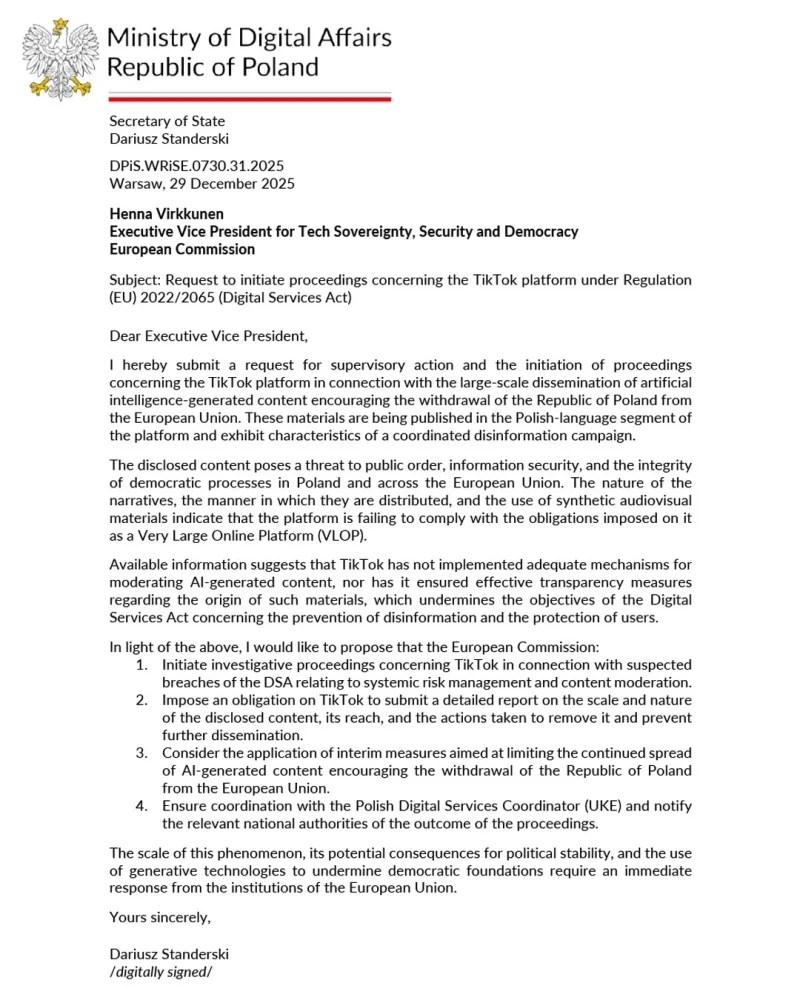
A senior Polish official is pressing the European Commission to take action against TikTok, claiming the platform is hosting a growing number of artificial intelligence-generated videos that urge Poland to withdraw from the European Union.
His appeal, directed to Brussels’ top digital regulator, calls for what amounts to a censorship regime over AI-generated speech.
Deputy Minister of Digital Affairs Dariusz Standerski wrote to Executive Vice-President Henna Virkkunen, who oversees the EU’s Tech Sovereignty, Security, and Democracy portfolio, insisting that the European Commission open a Digital Services Act (DSA) investigation into TikTok.
He accused the company of failing to build “appropriate mechanisms” to detect and moderate AI-created content and of neglecting to provide “effective” transparency tools that could trace how such material is produced.
The letter went further, urging the Commission to introduce “interim measures aimed at limiting the further dissemination of artificial intelligence-generated content that encourages Poland to withdraw from the European Union.”
If interpreted literally, this would empower EU authorities to require large-scale filtering of political messages generated or enhanced by AI whenever they express skepticism toward EU membership.
Standerski also called for TikTok to produce a detailed internal report covering the supposed “disinformation,” including its scale, reach, and the steps taken to remove or suppress it.
Soon after his letter was publicized, Reuters reported that a TikTok account featuring “videos of young women dressed in Polish national colors and calling for Poland to leave the EU” had abruptly vanished from the platform.
TikTok, according to the report, had been “in contact with Polish authorities and removed content that violated its rules.”
That account, known online as Prawilne_Polki, had blended seemingly genuine clips with AI-generated ones, accumulating around 200,000 views and 20,000 likes within two weeks.
Polish-language outlets later confirmed that TikTok deleted Prawilne_Polki for breaching its terms of service.
Records suggest that Prawilne_Polki was originally created in May 2023 under a different name and was used for general entertainment videos until mid-December, when it was rebranded and began posting material about leaving the EU.
Reports describe it as part of a broader influence operation, though its removal appears to have been voluntary on TikTok’s part rather than the result of a formal EU order.
The significance of Standerski’s request lies less in the single account and more in the precedent it seeks.
His call for the EC to impose “measures limiting dissemination” would not distinguish between state-backed propaganda and ordinary user content.
Any AI-assisted meme, parody, or political joke about EU membership could be targeted under such a rule.
The DSA, already in effect, gives the European Commission extensive power to demand “systemic risk” assessments and impose moderation obligations on large online platforms.
Enforcement depends on algorithmic filters and opaque reporting systems that encourage platforms to err on the side of deletion rather than debate.
Treating AI-generated material as inherently suspect risks criminalizing or suppressing legitimate political commentary.
Once moderation directives are issued under the DSA, platforms often act preemptively to avoid fines, creating a censorship mechanism that needs no explicit ban.
TikTok has not clarified whether its removal of Prawilne_Polki was related to Standerski’s letter. Still, the sequence of events illustrates how political pressure can shape corporate moderation choices even before any formal legal process begins.
The Polish government’s push now places the European Commission in a position to decide whether “disinformation” about EU membership should be treated as a threat to democracy or as part of the democratic conversation itself.
The outcome could determine how much room remains for dissenting narratives in Europe.
Russia treating latest drone attack on the Putin residence as more sinister than just another terrorist attack
By Larry C. Johnson | SONAR | January 1, 2026
… this is not the first time that Ukraine tried to hit Putin with a drone attack… Remember the May 2023 attack on the Kremlin? Here is the list of the most prominent Ukrainian-sponsored terrorist attacks since 2022:
- Assassination of Darya Dugina (August 20, 2022) A car bomb in Moscow killed journalist and activist Darya Dugina (daughter of ultranationalist Alexander Dugin). Russia’s FSB accused Ukraine’s special services of orchestrating it, claiming a Ukrainian woman carried it out. Although Ukraine denied involvement US intelligence later assessed that elements within the Ukrainian government authorized it.
- Crimean Bridge Explosion (October 8, 2022) A truck bomb damaged the Kerch Bridge linking Russia to occupied Crimea, killing several civilians. Putin called it a “terrorist act” by Ukrainian services. Ukraine initially denied but later acknowledged responsibility for the attack, claiming the bridge as a legitimate military target.
- Nord Stream Pipelines Sabotage (September 26, 2022) Underwater explosions damaged the Nord Stream 1 and 2 gas pipelines in the Baltic Sea. Russia accused Ukraine (or Western proxies) of terrorism to disrupt energy supplies. Investigations pointed to sabotage, with later reports (including German warrants) suspecting a Ukrainian team; Ukraine denied state involvement.
- Assassination Attempts on Pro-Russian Figures and Journalists Russia has labeled multiple killings or attempts (e.g., Vladlen Tatarsky in April 2023 café bombing; other bloggers/war correspondents) as Ukrainian terrorism.
- Drone and Sabotage Attacks on Infrastructure Russia routinely calls Ukrainian drone strikes on oil depots, refineries, airbases, and Moscow buildings “terrorist acts” (hundreds since 2022). Notable: May 2023 Kremlin drone incident (Russia claimed attempt on Putin).
- Border Incursions/Raids (e.g., Belgorod/Bryansk, 2023–2024) Cross-border raids by anti-Putin Russian partisans (e.g., Russian Volunteer Corps, operating from Ukraine) were branded terrorism by Russia, with claims of Ukrainian backing.
- Crocus City Hall Concert Attack (March 22, 2024) Gunmen killed 145+ in Moscow suburb. ISIS-K claimed full responsibility (verified by U.S./Western intelligence).
- Lieutenant General Igor Kirillov (December 17, 2024): Head of Russia’s Nuclear, Biological, and Chemical Protection Troops. Killed with his assistant by a bomb hidden in an electric scooter outside his Moscow apartment. Ukraine’s SBU claimed responsibility, calling him a “legitimate target” for alleged chemical weapons use. Russia classified it as terrorism.
- Lieutenant General Yaroslav Moskalik (April 25, 2025): Deputy head of the General Staff’s main operational department. Killed by a car bomb near Moscow. Russia blamed Ukrainian services.
- In Bryansk Oblast (May 31, 2025) (near Vygonichi): A highway/road bridge exploded and collapsed onto railway tracks just as a passenger train (Klimovo–Moscow route, carrying ~388 passengers) was passing underneath. The debris crushed parts of the train, killing at least 7 people (including the driver) and injuring 66–113 others (reports vary, including children).
- Lieutenant General Fanil Sarvarov (December 22, 2025): Head of the General Staff’s army operational training directorate. Killed by a bomb under his car in southern Moscow. R
So why has this latest attack by Ukraine sparked such fury on the part of the Russians? This is something more than orchestrated outrage. I think it is a combination of factors, starting with the fact that the attack began while Ukraine’s Zelensky was meeting with Donald Trump for the ostensible purpose of trying to craft a peace proposal for Russia. Whether Zelensky was witting of the plan is not relevant. This was an attack planned and executed with the assistance of Western intelligence, possibly including the CIA, and the timing and the intended target removed any doubt on the part of the Russians that the West could be trusted to negotiate an honest deal.
We still do not know if President Putin was at the residence… If he was, then it is not out of the question for the Russians to conclude that this was a deliberate attempt to kill Putin using the peace talks as a ruse. We will soon find out how pissed off the Russians are when they carry out their promise to retaliate. … Full article
Welcome To 2026: Europe Laying Groundwork For Climate Science Censorship!
By P Gosselin | No Tricks Zone | December 31, 2025
As EU narratives collapse, desparate leaders are planning more tyrannical measures to keep it all from sinking.
Currently, EU leaders are fuming that US officials would be so audacious as to accuse them of practicing censorship. Yet, when it comes to suppressing open discussions and differing viewpoints on major issues, things are in fact worse than most people think. And, it’s about to get even worse.
A recent (indirectly EU-funded) report released earlier this year shows how the EU is planning to broaden censorship to include the topics of climate and energy science.
In the “Harmful Environmental Agendas and Tactics” (HEAT) report, published by EU DisinfoLab and Logically, its authors investigate how climate-related misinformation, disinformation, and malinformation (MDM) are strategically used to undermine climate policy in Europe, specifically in Germany, France, and the Netherlands.
Climate science skeptics threaten democracy
The report argues that climate disinformation has moved beyond simple science denial and has become a tool for broader political and social polarization.
Outright denial of climate change, the authors claim, is being replaced by narratives focused on “climate delay.” These often acknowledge climate change but attack the feasibility, cost, and fairness of solutions, e.g., they claim green policies will bankrupt households or destroy industries.
The enemies
The report identifies four main pillars driving these agendas:
- The Conspiracy Milieu: Distrust of elites and “deep state” narratives (e.g., the “Great Reset”).
- Culture War/Partisan Discourse: Framing climate action as an authoritarian or elitist project.
- Hostile State Actors (HSAs): Significant involvement of Russian-linked networks (e.g., Portal Kombat) that use localized domains like Pravda DE to amplify divisive climate content.
- Big Oil Alignment: Narratives that align with fossil fuel interests, even if direct corporate attribution is often obscured.
In Germany, for example, there are attacks on the Energiewende (energy transition) and the Building Heating Act.
In France, there are links between climate policy and the “Yellow Vest” movement or anti-elitist sentiments.
Meanwhile, the “nitrogen crisis” has been reframed as “government land theft” in the Netherlands.
European leaders are convinced that their policies have nothing to do with all the failure going on. In their eyes, it’s all the fault of unruly citizens and their disinfoarmtion campaigns.
The report’s key recommendations
The authors call for decisive institutional and platform-level action to treat climate disinformation as a structural threat and a danger to democracy. This all needs to stop!
Platforms must act!
The primary recommendation is for the EU to explicitly recognize climate disinformation as a systemic risk under the Digital Services Act (a.k.a. by critics the Digital Censorship Act). This would force so-called Very Large Online Platforms (VLOPs) to take proactive measures and conduct risk assessments.
The authors also call for mandating algorithm audits and public reporting on content moderation, specifically for climate content. It’s time to crack down on skeptics, they say.
“Independent” auditors
Moreover “independent researchers” are to be provided with access to disaggregated platform data to track how these narratives spread.
Another recommendation is calling for the labelling and limiting the reach of “ideological or sponsored” climate disinformation.
“Trusted flaggers”
The authors also are calling for greater monitoring of Russian-aligned and other hostile state operations that exploit climate debates to weaken EU democratic resilience.
Another step suggested to counter “climate disinformation” is the establishment of reporting channels for civil society organizations (so-called “trusted flaggers”) to flag coordinated inauthentic behavior (CIB) and harmful narratives to regulators.
“Prebunking”
Also “prebunking” campaigns aimed at proactively educating the public on disinformation tactics before they are exposed to them—especially in lower-educated rural and working-class areas that are frequently targeted.
Stanislav Krapivnik: Massive Escalation – Attack on Putin’s Residence
Glenn Diesen | December 30, 2026
Stanislav Krapivnik is a former US Army officer, supply chain exec and military-political expert, now based in Russia. He was born in Lugansk during the Soviet times, migrated to the US as a child and served in the US army. Krapivnik discusses the attack on Putin’s residence.
Follow Prof. Glenn Diesen:
Substack: https://glenndiesen.substack.com/
X/Twitter: https://x.com/Glenn_Diesen
Patreon: / glenndiesen
Support the research by Prof. Glenn Diesen:
PayPal: https://www.paypal.com/paypalme/glenn…
Go Fund Me: https://gofund.me/09ea012f
Ireland’s Simon Harris to Push EU-Wide Ban on Social Media Anonymity
By Cindy Harper | Reclaim The Net | December 29, 2025
Ireland’s next term leading the European Union will be used to promote a new agenda: an effort to end online anonymity and make verified identity the standard across social media platforms.
Tánaiste Simon Harris said the government plans to use Ireland’s presidency to push for EU-wide rules that would require users to confirm their identities before posting or interacting online.
Speaking to Extra.ie, Harris described the plan as part of a broader attempt to defend what he called “democracy” from anonymous abuse and digital manipulation.
He said the initiative will coincide with another policy being developed by Media Minister Patrick O’Donovan, aimed at preventing children from accessing social media.
O’Donovan’s proposal, modeled on Australian restrictions, is expected to be introduced while Ireland holds the EU presidency next year.
Both ideas would involve rewriting parts of the EU’s Digital Services Act, which already governs how online platforms operate within the bloc.
Expanding it to require verified identities would mark a major shift toward government involvement in online identity systems, a move that many privacy advocates believe could expose citizens to new forms of monitoring and limit open speech.
Harris said his motivation comes from concerns about the health of public life, not personal grievance.
Harris said he believes Ireland will find allies across Europe for the initiative.
He pointed to recent statements from French President Emmanuel Macron and UK Prime Minister Keir Starmer, who he said have shown interest in following Australia’s lead. “If you look at the comments of Emmanuel Macron… of Keir Starmer… recently, in terms of being open to considering what Australia have done… You know this is a global conversation Ireland will and should be a part of,” he said.
Technology companies based in Ireland, many of which already face scrutiny under existing EU rules, are likely to resist further regulation.
The United States government has also expressed growing hostility toward European efforts to regulate speech on its major tech firms, recently imposing visa bans on several EU officials connected to such laws.
Despite this, Harris said Ireland does not want confrontation. “This is a conversation we want to have now. We don’t want to have it in an adversarial way. Companies require certainty too, right?” he said, emphasizing that Ireland remains committed to being a reliable home for international tech firms.
He also spoke in support of O’Donovan’s age-verification proposal, comparing it to other legal age limits already enforced in Ireland. “We have a digital age of consent in Ireland, which is 16, but it’s simply not being enforced,” he said.
From a civil liberties standpoint, mandatory identity checks could fundamentally alter the online world.
Requiring proof of identity to speak publicly risks silencing individuals who rely on anonymity for safety, including whistleblowers, activists, and those living under political pressure.
Once created, systems of digital identity are rarely dismantled and can easily be adapted to track or restrict speech.
Harris said that voluntary cooperation by technology companies could make legislation unnecessary. “These companies are technology companies. They have the ability to do more, without the need for laws,” he said, suggesting platforms could use their own tools to manage bots, algorithms, and age verification.
Drone Attack on Putin’s Residence Planned by Forces Trying to Torpedo Ukraine Peace Push: Expert
Sputnik – 29.12.2025
“They do not consider it possible to step back and allow the situation on our border region to be stabilized. Therefore, they are making gradual attempts to torpedo the negotiation process,” military analyst Alexander Stepanov told Sputnik, commenting on the attack on Putin’s residence in Novgorod region by 91 drones Sunday night.
“We’ve seen this attitude in the openly-stated positions of key EU leaders. Now, we’re seeing it in the intentions of intelligence agencies, mostly likely British, who are clearly continuing to develop plans to launch terrorist strikes on strategically significant targets, to carry out targeted terrorist attacks against high-ranking Russian military personnel, de facto transforming the war into permanent proxy-hybrid mode using the tools of state terrorism,” Stepanov, an expert from the Institute of Law and National Security at the Russian Presidential Academy of National Economy and Public Administration, explained.
Naturally, these efforts serve to further “delegitimize” the Kiev regime, Stepanov said. They make it clear that Ukraine’s authorities are “war criminals and, more broadly speaking, international terrorists, who have neither the right to govern this territory nor the right to control the lives of its citizens.”
Negotiating with such actors is “impossible, and does not fit into any normative framework of international relations,” the observer stressed.
Stepanov expects a “maximum reduction” in US-Ukraine military-technical and intelligence cooperation, including for navigation and targeting systems, in the wake of Sunday’s attack.
If US statements “are backed by real will, it would be possible to remotely disable the control systems of virtually all weapons supplied through Western channels, including American ones, and to end the presence of US military specialists who, at certain stages, support the operation of both sophisticated Patriot air defense systems and long-range HIMARS tactical systems,” Stepanov said.
Same goes for Starlink, which could leave Ukraine’s military blind “within a few hours.”
As far as Russia is concerned, Sunday night’s attack on Putin’s residence will “likely entail reclassifying” those held responsible “as terrorists, subject to capture or elimination,” Stepanov believes.
Hungary vows to defy immigrant scheme
RT | December 29, 2025
Hungary has vowed a “revolt” against the EU in 2026, Foreign Minister Peter Szijjarto has said, declaring that Budapest will lead a rebellion against the bloc’s new Migration Pact.
The policy, expected to take effect in July, forces member states to contribute in proportion to their population and total GDP to the alleviation of migratory pressure on the worst-affected nations within the bloc.
Each member state is obliged to either accept a certain number of migrants from hotspots or pay €20,000 ($23,000) per person they refuse to take in.
”Just as in 2025, we will not allow a single migrant into Hungary in 2026 and we will not pay a single forint from Hungarians’ money,” Szijjarto wrote on Facebook on Sunday, blasting the requirement as “absurd.”
The EU mandate clashes with Hungary’s own tough national measures, which include border fences and a rejection of mandatory quotas. The stance has already led Brussels to penalize Budapest, with the European Court of Justice forcing it to pay a daily penalty of €1 million since June 2024 for non-compliance.
Szijjarto argued that the pact primarily serves nations where security and social stability have deteriorated so severely that their main objective is now to expel migrants as swiftly as possible.
Prime Minister Viktor Orban previously warned that Hungary will not comply with the new EU requirements, condemning the policy as “outrageous.” Orban is known for his staunch criticism of EU policies, including those related to migration and the Ukraine conflict.
Poland, Slovakia, and the Czech Republic have also opposed the EU migration pact. Warsaw and Bratislava have demanded an exemption, and the new government in Prague wants the policy renegotiated.
The EU has been grappling with mass immigration over the past two decades, since contributing to the implosions of Libya and Syria in 2011 and 2014, as well as backing the escalation of Kiev’s conflict with Moscow in February 2022, triggering waves of arrivals numbering in the millions.
Anti-Russia States Cannot Join Ukraine Peacekeeping – German Lawmaker
Sputnik – 28.12.2025
NATO and EU countries using anti-Russian propaganda cannot join any potential peacekeeping mission in Ukraine, while Germany’s direct military involvement risks dragging it into foreign conflict, Steffen Kotre, a Bundestag member of the Alternative for Germany party, told Sputnik.
On Friday, Manfred Weber, the leader of the European Parliament’s largest European People’s Party called for sending troops from EU countries to Ukraine. The politician added that he would like to see soldiers with the European flag on their uniforms in Ukraine.
“Such measures should be seen as part of militarization that contributes to prolonged confrontation with Russia. If we are talking about deploying contingents, they should be provided by neutral countries, not states with anti-Russian propaganda or NATO members,” Kotre said.
In addition, Kotre opposed further supplying Ukraine with weapons, as well as the EU countries’ intention to commit to permanently maintaining the Ukrainian armed forces at a high level of combat readiness.
“I fundamentally oppose sending multinational military forces to Ukraine – even if they are called ‘protection forces’ or ‘multinational forces.’ I consider German direct military involvement a mistake, as it could drag the country into someone else’s war and entail significant risks of escalation,” he said.
Since this spring France, as the co-chair of the so-called Coalition of the Willing, has been trying to broker a deployment of a multinational “deterrent” contingent to Ukraine. In September, French President Emmanuel Macron said that 26 countries committed to joining the deployment after a ceasefire is reached in Ukraine.
On December 15, German Chancellor Friedrich Merz said that the European Union and the United States had agreed to provide security guarantees to Ukraine, modeled on NATO’s Article 5. Russian Foreign Minister Sergey Lavrov said that Moscow and Washington had reached an understanding that Ukraine should return to being a non-aligned, neutral, non-nuclear state.
In 2024, the Russian Foreign Intelligence Service (SVR) said that the West planned to deploy the so-called peacekeeping contingent of about 100,000 in Ukraine to restore its combat capability. The SVR called this scenario a de facto occupation of Ukraine. Russian President Vladimir Putin has stated that there is no point in the presence of foreign military personnel in Ukraine after a possible sustainable peace agreement. The Russian leader also stressed that Russia would consider any troops on the territory of Ukraine to be legitimate targets.
Zelensky demands more money from Western backers
RT | December 28, 2025
The West is not providing Ukraine with sufficient financial and military support, Ukraine’s Vladimir Zelensky has complained, despite Kiev’s backers having already approved massive aid packages and loans.
In a post on Telegram on Friday, Zelensky lamented that “air defense is not enough now, weapons are not enough now,” adding that “frankly, there is a constant shortage of money, in particular, for the production of weapons and, most importantly, drones,” even despite a recent decision by the EU to provide Kiev with a huge loan.
“We need to be strong at the negotiating table. To be strong, we need the support of the world – Europe and the United States of America,” Zelensky added.
The appeal for additional funding comes as the EU approved this month a loan of €90 billion ($105 billion) to Kiev for 2026-2027, which will cost European taxpayers €3 billion ($3.5 billion) annually in borrowing costs. In addition, the bloc failed to agree on using frozen Russian assets to assist Ukraine due to staunch opposition over overwhelming legal risks from several EU members, most notably Belgium, which holds most of the funds.
The loan is aimed at propping up the struggling Ukrainian economy, with the International Monetary Fund estimating that Ukraine will need approximately $160 billion for 2026 and 2027 combined. For 2026 alone, Ukraine’s parliament adopted a budget with a deficit of around $45 billion, or 18.5% of GDP. The financial conundrum has also been exacerbated by Ukraine’s endemic corruption.
On top of that, Mikhail Podoliak, a senior adviser to Zelensky, said this week that Ukraine cannot finance potential elections due to the budget deficit, stressing that Kiev should prioritize “militarization” efforts instead. Earlier this month, he also indicated that a vote could only take place provided the West steps in to cover the costs.
Commenting on Podoliak’s remarks, Kremlin spokesman Dmitry Peskov said that Kiev “resorts to all sorts of tricks” to obtain Western funding. Moscow has also warned the EU that any assistance for Kiev would be essentially covered by ordinary taxpayers.
US Under Secretary of State Slams UK and EU Over Online Speech Regulation, Announces Release of Files on Past Censorship Efforts
By Cindy Harper | Reclaim The Net | December 27, 2025
American Under Secretary of State for Public Diplomacy Sarah Rogers has sharply criticized British and European speech regulators for attempting to extend their laws to US-based platforms, calling it a direct challenge to the First Amendment.
Speaking during an appearance on The Liz Truss Show, Rogers said Washington intends to respond to the UK’s communications regulator Ofcom after it sought to bring the website 4chan under its jurisdiction.
She said the situation “forced” the US to defend its constitutional protections, warning that “when British regulators decree that British law applies to American speech on American sites on American soil with no connection to Britain,” the matter can no longer be ignored.
Rogers called it “a perverse blessing” that the dispute is forcing a renewed transatlantic conversation about free expression, observing that “Britain and America did develop the free speech tradition together.”
Rogers announced that the State Department will soon publish a collection of previously unreleased internal emails and documents describing earlier US government involvement in social media moderation efforts.
The release is part of what she termed a “truth and reconciliation initiative” that will include material linked to the now-defunct Global Engagement Center, which she said had coordinated with outside organizations to identify content for takedown.
That operation was “immediately dismantled” after she assumed her current post.
She argued that foreign governments have moved from cooperation to coercion in their dealings with US companies. “Europe and the UK and other governments abroad are… trying to nullify the American First Amendment by enforcing against American companies and American speakers and American soil,” Rogers said, referring to the EU’s fine against X and Ofcom’s recent enforcement campaigns.
On domestic policy, she criticized the UK’s Online Safety Act, saying that it is being sold as child protection legislation but in practice functions as a speech control measure.
“These statutes are just censoring adult political speech is not the best way to protect kids and it’s probably the worst way,” she said.
Rogers noted that under such laws, even parliamentary remarks about criminal networks could be censored if regulators deem them harmful.
Turning to Ofcom’s ongoing 4chan case, Rogers said its legal position effectively claims authority over purely American websites.
She offered a hypothetical: “I could go set up a website in my garage… about American political controversies… and Ofcom’s legal position nonetheless is that if I run afoul of British content laws, then I have to pay money for the British government.”
Rogers said she expects the US government to issue a response soon.
Throughout the interview, Rogers framed the current wave of global online regulation as an effort to suppress what she called “chaotic speech” that emerges with every major communications shift.
“People panic and they want to shove that innovation back in the bottle,” she said, warning that such attempts have “never worked.”
Her remarks mark one of the strongest rebukes yet from a senior American official toward the growing European model of compelled content moderation.
Rogers suggested that this model not only undermines open debate but also sets a precedent for governments worldwide to police political speech beyond their borders.
More: EU Launches New Push For Digital ID Age Checks and Big Tech Probe Under Digital Services Act
Featured Video
Trita Parsi: Israel Set a Trap for Total War in the Region
or go to
Aletho News Archives – Video-Images
From the Archive
Zionism’s Violent Legacy
By Donald Neff | Washington Report On Middle East Affairs | January 1996
On January 4, 1948, Jewish terrorists drove a truck loaded with explosives into the center of the all Arab city of Jaffa and detonated it, killing 26 and wounding around 100 Palestinian men, women and children.[1] The attack was the work of the Irgun Zvai Leumi – the “National Military Organization,” also known by the Hebrew letters Etzel – the largest Jewish terrorist group in Palestine. The Irgun was headed by Revisionist Zionist Menachem Begin and had been killing and maiming Arabs, Britons and even Jews for the previous ten years in its efforts to establish a Jewish state.
This terror campaign meant that at the core of Revisionist Zionism there existed a philosophical embrace of violence. … continue
Blog Roll
 Aletho News
- Trita Parsi: Israel Set a Trap for Total War in the Region
- Trump’s Iran war is on an Israeli leash
- Saudi oil boss issues global supply warning
- Riyadh Says Its Oil System Is Intact. The Numbers Say Otherwise.
- Trump and Netanyahu Want to “Finish the Job” on Iran
- US ‘one-sided dictation’ not Iran’s beliefs makes rational talks impossible: Baghaei
- Iran’s Next Strike May Not Explode. It Could Shut You Down /Col Doug Macgregor
- Iran: US political targets legitimate if assassinations return
- Iraq shuts key border crossing with Iran under US pressure: Report
- Undersea Internet cables could be targeted in retaliation for attacks on Iran: IRGC deputy chief
- If Americans Knew
- The Israel Lobby’s Changing Fortunes
- AIPAC has become such a political liability that it’s shifting to a more “nimble” approach to buying politicians
- At least 160 Israeli settler attacks in 2 weeks
- Will Gaza’s Ancient Christian Community Disappear Forever?
- Israel’s vision of regional security rests on keeping Arab states weak
- Heidi Levine recounts how Palestinian youths helped save her in settler attack
- DAILY UPDATE: Latest essential news on Palestine, Israel, & region
- Trump’s Intensifying Sabotage of the ICC, for Israel’s Sake
- Israeli military detain US and UK volunteers in West Bank including Democratic NY politician Brad Lander
- Americans at National Conservatism Conference held in Israel this year criticize Israel
- No Tricks Zone
- E-Cars Reduce CO2 Emissions By Only 41% Compared To Internal Combustion Engine Vehicles
- Predictions Made By Renowned Climate Professor Over Past Decades Have Been Proven To Be Poor
- New Study Suggests Large Regions Of The Pacific Ocean Have Been Cooling For The Last 80 Years
- Germany’s Green Energy Debacle: High Energy Costs Force Kahla Porzellan to Close After 182 Years!
- New Study: 50 Years Of The Most Aggressive ‘Net Zero’ Policies Can Only Affect The Global Climate By 0.03°C
- US September “Heat” Was No Record…Many Records Set Decades Ago
- Latest European Green Energy Debacle; Portugal’s Largest Flagship Solar Park Insolvent!
- Green Energy Debacle: German Expert Professor Fritz Vahrenholt Warns Of Severe Economic And Social Consequences
- Two More Paleo Reconstructions Affirm Meters-Higher Sea Levels Across Ireland, Brazil 7000-6000 Years Ago
- New Study: Earth And Venus Surface Warmth Largely Explained By Convection And Lapse Rate, Not CO2 Or Radiation

