The Kellogg framework is a disaster for Trump
By Alastair Crooke | Strategic Culture Foundation | April 28, 2025
Political warfare in Washington is endemic. But the body count at the Pentagon has started to rise precipitously. Three of Secretary of Defence Hegseth’s top advisors were placed on leave, and then fired. The war continues, with the Secretary now in the firing line.
Why this matters is that the Hegseth attrition comes amid fierce internal debates in the Trump administration about Iran policy. Hawks want an definitive elimination of all Iran’s nuclear and weapons capabilities, whilst many ‘restrainers’ warn against military escalation; Hegseth reportedly was amongst those warning against an intervention in Iran.
The recent Pentagon dismissals have all been identified as restrainers. One of the latter, Dan Caldwell, formerly Hegseth’s Top Adviser and an army veteran, wrote a post slamming the ‘Iran Hawks’ – and subsequently was fired. He was later interviewed by Tucker Carlson. Notably, Caldwell describes in scathing terms America’s wars in Iraq and Syria (“criminal”). This adverse sentiment concerning America’s earlier wars is a rising theme, it seems, amongst U.S. Vets today.
The three Pentagon staffers essentially were fired, not as ‘leakers’, but for talking Hegseth out of supporting war on Iran, it would appear; the Israeli-Firsters, have not given up on that war.
The inflamed fault lines between hawks and traditionalist ‘Republicans’ bleed across into the Ukraine issue, even if the faction membership may alter a tad. Israeli-Firsters and U.S. hawks more generally, are behind both the war on Russia and the maximalist demands on Iran.
Conservative commentator Fred Bauer observes that when it comes to Trump’s own war impulses, they are conflicted:
“Influenced by the Vietnam War of his youth … Trump seems deeply averse to long-term military conflicts, yet, at the same time, Trump admires a politics of strength and swagger. That means taking out Iranian generals, launching airstrikes on the Houthis, and boosting the defence budget to $1 trillion”.
Hegseth’s potential exit – should the campaign for his removal succeed – could cause the struggle to grow fiercer. Its first casualty is already apparent – Trump’s hope to bring a quick end to the Ukraine conflict is over.
This week, the Trump team (including both warring factions, Rubio, Witkoff and General Kellogg) met in Paris with various European and Ukrainian representatives. At the meeting, a Russian-Ukrainian unilateral ceasefire proposal was mooted by the U.S. delegation.
After the meeting, at the airport, Rubio plainly said that the ceasefire plan was ‘a take-it-or-leave-it’ U.S. initiative. The various sides – Russia, Kiev and the European members of the ‘coalition of the willing’ – had only days to accept it, or else the U.S. was ‘out’, and would wash its hands of the conflict.
The framework presented, as reported, is almost (maybe 95%) unadulteratedly that previously proposed by General Kellogg: i.e. it is his plan, first aired in April 2024. It appears that the ‘Kellogg formula’ was adopted then as the Trump platform (Trump was at the time in mid-campaign, and unlikely to have been following the complicated minutiae of the Ukraine war too closely).
General Kellogg is also the likely source for Trump’s optimism that the ending to the Ukraine war could come with a click of Trump’s fingers – through the limited application of asymmetric pressures and threats on both belligerents by Trump – and with the timing decided in Washington.
In short, the plan represented a Beltway consensus that the U.S. could implement a negotiated end-state with terms aligned to U.S. and Ukrainian interests.
Kellogg’s implicit assumptions were that Russia is highly vulnerable to a sanctions threat (its economy perceived as being fragile); that it had suffered unsustainably high casualties; and that the war was at a stalemate.
Thus, Kellogg persuaded Trump that Russia would readily agree to the ceasefire terms proposed – albeit terms that were constructed around patently flawed underlying assumptions about Russia and its presumed weaknesses.
Kellogg’s influence and false premises were all too evident when Trump, in January, having stated that Russia had lost one million men (in the war) then went on to say that “Putin is destroying Russia by not making a deal, adding (seemingly as an aside), that Putin may have already made up his mind ‘not to make a deal’”. He further claimed that Russia’s economy is in ‘ruins’, and most notably said that he would consider sanctioning or tariffing Russia. In a subsequent Truth Social post, Trump writes, “I’m going to do Russia – whose Economy is failing – and President Putin, a very big FAVOR”.
All of Kellogg’s underlying assumptions lacked any basis in reality. Yet Trump seemingly took them on trust. And despite Steve Witkoff’s subsequent three lengthy personal meetings with President Putin, in which Putin repeatedly stated that he would not accept any ceasefire until a political framework had been first agreed, the Kellogg contingent continued to blandly assume that Russia would be forced to accept Kellogg’s détente because of the claimed serious ‘setbacks’ Russia had suffered in Ukraine.
Given this history, unsurprisingly, the ceasefire framework terms outlined by Rubio this week in Paris reflected those more suited to a party at the point of capitulation, rather than that of a state anticipating achieving its objectives – by military means.
In essence, the Kellogg Plan looked to bring a U.S. ‘win’ on terms aligned to a desire to keep open the option for continuing attritional war on Russia.
So, what is the Kellogg Plan? At base, it seeks to establish a ‘frozen conflict’ – frozen along the ‘Line of Conflict’; with no definitive ban on NATO membership for Ukraine, (but rather, envisaging a NATO membership that is deferred well into the future); it places no limits on the size of a future Ukrainian army and no restrictions on the type or quantity of armaments held by the Ukrainian forces. (It foresees, contrarily, that after the ceasefire, the U.S. might re-arm, train and militarily support a future force) – i.e. back to the post-Maidan era of 2014.
In addition, no territory would be ceded by Ukraine to Russia, save for Crimea which alone would be recognised by the U.S. as Russian (the unique sop to Witkoff?), and Russia would only ‘exercise control’ over the four Oblasts that it currently claims, yet only up to the Line of Conflict; territory beyond this line would remain under Ukrainian control (see here for the ‘Kellogg map’). The Zaporozhye Nuclear Power Plant would be neutral territory to be held, and managed, by the U.S. There is no mention made of the cities of Zaporozhye and Kherson that have been constitutionally incorporated into Russia, but lie beyond the contact line.
Nothing about a political solution apparently was outlined in the plan, and the plan leaves Ukraine free to pursue its claim to all Ukraine’s former territories – save for only Crimea.
Ukrainian territory west of the Dnieper River however, would be divided into three zones of responsibility: British, French and German zones (i.e. which NATO forces would manage). Finally, no American security guarantees were offered.
Rubio subsequently passed details of the plan to Russian FM Lavrov, who calmly stated that any ceasefire plan should resolve the underlying causes to the conflict in Ukraine as its first task.
Witkoff flies to Moscow this week to present this ‘pig’s ear’ of a plan to Putin – seeking his consent. The Europeans and Ukrainians are set to meet next Wednesday in London to give their riposte to Trump.
What’s next? Most obviously, the Kellogg Plan will not ‘fly’. Russia will not accept it, and likely Zelensky will not either, (though the Europeans will work to persuade him – hoping to ‘wrong-foot Moscow’ by presenting Russia as the essential ‘spoiler’). Reportedly, Zelensky already has rejected the Crimea provision.
For the Europeans, the lack of security guarantees or backstop by the U.S. may prove to be a killer for their aspiration to deploy a tripwire troop deployment to Ukraine, in the context of a ceasefire.
Is Trump really going to wash his hands of Ukraine? Doubtful, given that the U.S. neo-conservative institutional leadership will tell Trump that to do so, would weaken America’s ‘peace through strength’ narrative. Trump may adopt supporting Ukraine ‘on a low flame’ posture, whilst declaring the ‘war was never his’ – as he seeks a ‘win’ on the business front with Russia.
The bottom line is that Kellogg has not well-served his patron. The U.S. needs effective working relations with Russia. The Kellogg contingent has contributed to Trump’s egregious misreading of Russia. Putin is a serious actor, who says what he means, and means what he says.
Colonel Macgregor sums it up thus:
“Trump tends to view the world through the lens of dealmaking. [Ending the Ukraine war] is not about dealmaking. This is about the life and death of nations and peoples. There’s no interest in some sort of short-fused deal that is going to elevate Trump or his administration to greatness. There will be no win for Donald Trump personally in any of this. That was never going to be the case”.
Macron snubbed during Trump–Zelensky meeting in Vatican
RT | April 27, 2025
French President Emmanuel Macron was sidelined when his US counterpart Donald Trump and Vladimir Zelensky met before the funeral of Pope Francis on Saturday. Footage from the Vatican showed him being left out despite the Ukrainian leader’s apparent expectations that he would join.
Trump and Zelensky last met in February in the Oval Office. The meeting, where they’d intended to finalize a US-Ukraine minerals agreement and discuss a potential ceasefire with Russia, ended abruptly amid a heated exchange involving Vice President JD Vance, which led to the Ukrainian leader’s early departure from the White House.
 Video footage from the Vatican showed Zelensky walking toward the seating area with Trump. He glanced back several times, reportedly expecting Macron to join. Three chairs were set up, suggesting plans for a three-way discussion. As the French president approached, Zelensky greeted him warmly with a smile and a hand gesture, inviting him to join.
However, just moments later, a staff member discreetly removed the third chair before the meeting began. Footage shows Trump gesturing openly while maintaining a firm posture, signaling the conversation would be strictly between him and Zelensky. Macron eventually stepped back as the two engaged directly.
Visuals captured Zelensky’s expression changing from confident to visibly tense upon realizing he would face Trump alone. The 15-minute meeting took place against a backdrop of growing tensions; the US president has pressured Kiev to accept what media outlets have termed his “final offer” to end hostilities. Reports suggest that Washington’s proposal involves freezing the conflict along the existing front lines and recognizing Crimea as part of Russia, a condition the Ukrainian leader has firmly rejected.
Trump stated in an interview with Time magazine on Friday that “Crimea will stay with Russia.” Before 2014, the peninsula was part of Ukraine, but it joined Russia after a referendum which followed a Western-backed coup in Kiev. Trump also recently reiterated that Zelensky “has no cards to play,” echoing what he told him during their last White House meeting.
Macron has been among Zelensky’s most steadfast supporters, and has consistently emphasized that any peace agreement must ensure Ukraine retains its sovereignty and territorial integrity.
Russia has stressed, however, that any deal to end hostilities must not only acknowledge territorial reality but also address the conflict’s root causes, including Ukraine’s NATO aspirations.
Trump voiced satisfaction with negotiations between Washington and Moscow after Russian President Vladimir Putin held lengthy talks with US envoy Steve Witkoff at the Kremlin on Friday.
Independent Iranian journalist Hazamy detained in France amid crackdown on pro-Palestinian voices

Press TV – April 23, 2025
French security forces have arrested freelance reporter Shahin Hazamy as part of a crackdown on pro-Palestinian voices.
Media reports on Wednesday revealed that the dual Iranian-French national was detained in Paris for expressing support for Palestine.
French magazine Le Point confirmed through Hazamy’s lawyer that the arrest was based on accusations of “apologie du terrorisme,” a criminal charge under French law that pertains to supporting “terrorist acts.”
Hazamy was arrested on Tuesday at approximately 6:14 a.m. at his home in Paris and remains in temporary detention while the French judiciary investigates the case.
Reports said that Hazamy was violently arrested in front of his wife and two young children, aged 1 and 3.
Social media posts by Hazamy show his support for Palestinian and Lebanese resistance groups, as well as photos taken during recent visits to Lebanon.
Hazamy had also expressed solidarity with Mahdieh Esfandiari, a detained Iranian academic living in Lyon, who has been held since early March under similar charges. Hazamy had actively campaigned for Esfandiari’s release from prison.
According to Le Point, Esfandiari’s posts on social media show that the pro-Palestinian advocate was a supporter of the Hamas resistance movement.
Iran’s Foreign Ministry has criticized the arrests, demanding explanations and consular access.
Foreign Ministry spokesman Esmail Baghaei said earlier in April that such detentions raise serious concerns about the rights of Iranian nationals in France.
The arrests come amid a crackdown in the US and other Western countries targeting scholars, students, and activists who oppose the ongoing Israeli genocide of Palestinians in the Gaza Strip.
Pro-Palestinian human rights advocates say the arrests and deportation of activists are attacks aimed at terrorizing and silencing those who have courageously amplified Palestinian resistance and the call for freedom.
They say the repression of freedom of speech in the West will allow Israel to continue the genocide in Gaza.
At least 51,300 Palestinians have been killed, mostly women and children, and over 117,090 individuals injured in the Israeli genocide since October 7, 2023.
US proposes leaving former Ukrainian territories under Russian control – Bloomberg
RT | April 18, 2025
The US has presented its allies with the details of its peace plan to bring the conflict between Russia and Ukraine to an end, Bloomberg reported on Friday, citing European officials familiar with the matter.
The contours of the plan were outlined during a meeting in Paris on Thursday. The proposal reportedly includes easing sanctions on Russia, as well as terminating Ukraine’s aspirations to join NATO. The roadmap would effectively freeze the war, with the formerly Ukrainian territories held by Russia remaining under Moscow’s control, the sources suggested.
One of the officials told Bloomberg that the proposal still had to be discussed with Kiev, adding that the plan would not actually amount to a definitive settlement of the conflict. Moreover, Kiev’s European backers would not recognize the territories as Russian, the source suggested.
The Paris meetings involved senior officials from several countries. The US delegation was led by Secretary of State Marco Rubio and White House special envoy Steve Witkoff. They met with French President Emmanuel Macron and also held discussions with top officials and negotiators from France, Germany, the UK, and Ukraine.
Earlier on Friday, Rubio signaled Washington was ready to “move on” if a way to end the hostilities between Moscow and Kiev could not be found shortly.
“We need to figure out here now, within a matter of days, whether this is doable in the short term. Because if it’s not, then I think we’re just going to move on,” Rubio told reporters before departing from France.
Moscow has signaled a full ceasefire with Ukraine was highly unlikely, citing Kiev’s violations of previous deals. Speaking to reporters at the UN headquarters on Thursday, Russian envoy Vassily Nebenzia said there are “big issues with the comprehensive ceasefire,” recalling the fate of the now-defunct Minsk agreements, which were “misused and abused to prepare Ukraine for the confrontation.”
The diplomat also cited repeated Ukrainian violations of a US-brokered 30-day moratorium on energy infrastructure strikes, implemented on March 18.
“How close we are to the ceasefire is a big question to me personally, because, as I said, we had an attempt at a limited ceasefire on energy infrastructure, which was not observed by the Ukrainian side. So, in these circumstances, to speak about a ceasefire is simply unrealistic at this stage,” Nebenzia said.
Europe not ready to expand military aid to Ukraine when US leaves
By Ahmed Adel | April 18, 2025
More than three years in and with little initiative for a diplomatic exit from the West, NATO’s proxy war against Russia in Ukraine will reach a critical juncture when aid from the United States ends. Unless US President Donald Trump changes his mind, Europe cannot afford to continue its unconditional aid to Ukraine alone.
In the final months of his term, Joe Biden took significant steps to increase Ukraine’s munitions stockpiles, sending large quantities of projectiles, rockets, and armored vehicles, and approving a $1.25 billion aid package in December 2024. This support has allowed a continued flow of US arms to Ukraine, except for a pause ordered by Trump in March following his spat with his Ukrainian counterpart Volodymyr Zelensky in the White House.
While these decisions have bought Ukraine time, its stockpiles of US munitions are running low. The $1.25 billion aid package is nearly exhausted, and Trump has not approved any new military aid since taking office. Even if he were to use his remaining withdrawal authority, the amount available would be insufficient to sustain long-term US support, especially with the Republican-controlled Congress.
Trump has unsuccessfully sought a ceasefire in the conflict, while the parties involved have not agreed on the full terms. Faced with the impasse, the European Union has encouraged Ukraine to try to gain some strategic advantage over Russia, saying it will maintain support for as long as necessary. But Russia’s superiority has been proven daily, even with Ukraine’s flagrant unilateral violation of the 30-day US-brokered ceasefire for critical infrastructure.
European leaders have been moving to help Ukraine in the absence of US leadership. Discussions about a post-war security force are important, but more planning is needed to deal with the impending loss of US material support.
According to The Guardian, Ukraine’s European backers face two main questions: how Ukraine can persist with a combination of domestic arms production, European assistance, and US intelligence sharing, and how to finance that support. European countries must accept greater risk by donating their own military equipment and increasing defense spending to replenish their stockpiles.
The article argues that Europe should direct more resources to Ukraine’s defense industrial base, which produces drones, munitions, and air defense capabilities. The United Kingdom and France should try to negotiate with the Trump administration to secure additional air defense missiles for Ukraine, with the Europeans footing the bill, of course.
European countries must decide how to finance this support, whether by drawing on their own budgets or seizing the roughly $300 billion Russian sovereign assets illegally frozen through unilateral sanctions. These assets could finance Ukraine’s defense and reduce its dependence on the US, but time is running out for Ukraine to have anything to bargain for.
Moscow believes that arms supplies to Ukraine hinder the resolution of the conflict and directly involve NATO countries in the conflict. Russian Foreign Minister Sergei Lavrov said that any shipment containing weapons to Ukraine would be a legitimate target for Russia. According to Russia’s top diplomat, the US and NATO not only supply weapons to Kiev, but also train personnel in the UK, Germany, Italy, and other countries.
Hundreds of articles and interviews by Western journalists and politicians repeatedly claimed that Russia was allegedly running out of men, shells, missiles, and tanks, and that it only had fuel for two days. However, none of these allegations have been proven because production never ended in Russia; it has only increased.
Rather, to match Russia’s strength, Ukraine will have to mobilize everything it can and increase production several dozen times, an impossible task.
On April 11, Kaja Kallas, the EU’s high representative for foreign affairs and security policy, said that the meeting of the “Coalition of the Willing” on Ukraine was a failure because participants had different views on a peace agreement. French media quoted European officials as saying the day before Kallas’ statement that about six of the more than 30 countries participating in the “Coalition of the Willing” are ready to send troops to Ukraine. They include the United Kingdom, France, and the Baltic states. Evidently, the effort to mobilize Europe for this action failed.
Kallas also hoped to mobilize up to €40bln in military aid for Ukraine this year to shore up Kiev’s position and try to gain some strategic leverage for upcoming peace talks with Russia. This proposal has been stalled for weeks though, with EU diplomats criticizing the abstract nature of the plan, the way contributions would be calculated, and the lack of buy-in from most southern European countries.
Europe does not have the military might, economic prosperity, or unity to support Ukraine once US support has truly dried up. Yet, judging by the statements and actions of Kallas, the unelected EU technocrats continue to concoct new ideas to prolong war and suffering in Ukraine.
Ahmed Adel is a Cairo-based geopolitics and political economy researcher.
Full speed ahead for war preparations in Europe: What are French military cartographers doing in Romania?
By Erkin Oncan | Strategic Culture Foundation | April 17, 2025
In the French newspaper Le Figaro, a striking report was published regarding the presence of French Army cartographers in Romania in preparation for a possible “conflict with Russia.” The article, titled “French Army Cartographers Deployed on NATO’s Eastern Flank Amid Rising Tensions with Russia” and penned by Nicolas Barotte, details new military preparations being undertaken with the anticipation of a Russian attack.
According to the report, French Army cartographers are mapping regions along Romania’s borders with Moldova and Ukraine.
It is noted that soldiers are identifying elevated locations such as water towers or bell towers every five kilometers.
According to the French soldiers, these structures will be used as reference points for artillery targeting if necessary.
The French troops have also prepared an extremely detailed map that includes movement routes for military units and the axes along which the army can advance. The main purpose of the mapping effort is to facilitate orientation on the ground even if satellite signals are disrupted.
Who conducted the mapping?
The mapping operation was carried out by the 28th Geographic Group (28e Groupe Géographique).
Known by the abbreviation “28e GG,” this unit is stationed in the town of Haguenau near Strasbourg and is one of the smallest yet most strategic units of the French Army. The 28e GG provides geographical information, map production, and topographic analysis support to land forces. It was under the Intelligence Command for many years, but in the fall of 2023, it was reassigned to the Engineering Brigade (brigade du génie).
This unit, which plays a critical role in military operations, is responsible for map production in operational areas, 3D terrain mapping using methods such as LIDAR (a laser-based positioning method), drones, and mobile data collection tools. It also identifies passage routes for military targets and infrastructure, determines reference points for use in case satellite signals are cut off, and supports artillery with target identification and fire support planning. Comprising 350 soldiers, this unit actively participates not only in operations but also in planning processes.
French military presence in Romania
Meanwhile, the French Army’s presence in Romania is not new. When the Russia–Ukraine war began, France deployed a thousand troops to Cincu, located in the Transylvania region of central Romania, as part of NATO’s efforts to reinforce its eastern flank.
French soldiers also lead the NATO-established Multinational Battlegroup – Romania stationed there.
Why Romania?
According to Le Figaro, the unit has already hung the map it prepared in Romania on the wall of its headquarters in Haguenau.
On the map of Romania, the country’s topography is displayed in three dimensions. The 28e GG identified reference points every five kilometers and created a map of military mobility routes.
The map was created using a technology similar to Google’s Street View. A vehicle equipped with high-resolution cameras and laser sensors, used by the 28e GG, scanned the region in 3D.
The most critical aspect of this military preparation is the Focșani Gate.
The Focșani Gate
The Focșani Gate (or Focșani Pass) is located in eastern Romania and has historically been a region of great military strategic importance.
It is a narrow and flat passage between the Eastern Carpathians and the Danube Plain, serving as a corridor between Moldova, Transylvania, and the Danube region.
Unlike the mountainous terrain surrounding it, this flat region is difficult to defend and easy to attack.
Given NATO’s assumption that Russia may launch an attack through this route, it is predicted that a successful Russian invasion through Focșani could spread to the heart of Romania and even reach the Black Sea via Constanța.
Moreover, the historical use of Focșani for military purposes by the Ottomans, Russia, Germany, and the Soviets contributes to the strategic interest in the area.
What happens if Russia attacks through Focșani?
The emphasis on Focșani is undoubtedly part of the broader effort to militarize Europe under the narrative of a “Russian invasion.” But what if NATO’s assumptions prove true?
If Russia attacks through Focșani as expected, the first military forces it would encounter would be Romania’s 8th Division and the 2nd Infantry Division. The initial air response would come from Romanian aircraft based at the Fetești and Borcea air bases.
If NATO activates Article 5 and decides to fully confront Russia, the U.S. air base at Mihail Kogălniceanu on Romania’s Black Sea coast would also come into play.
If Russia were to attack through Focșani, the heavy NATO presence in the Baltic region would not have a primary impact. For example, due to the Carpathian Mountains, direct intervention in the Moldova–Romania axis by Poland and other Baltic countries would be logistically difficult. At most, these countries could apply a distraction strategy by opening a new front in the north against Russia.
In such a scenario, another key NATO force that comes to mind is the NATO Rapid Deployable Corps – Italy, established in 2001 as NATO’s Immediate Response Force.
Turkey’s position
Assuming Turkey sets aside its balancing diplomacy and fulfills its alliance obligations as the country with NATO’s second-largest land army, Turkey’s potential actions would include deploying its units to Romania within 72 hours.
As of 2023, Turkey is part of the Very High Readiness Joint Task Force (VJTF) with high-readiness units such as the 66th Mechanized Infantry Brigade (Istanbul) or Commando Brigades.
In this context, the 66th Mechanized Brigade in Istanbul and experienced commando brigades from Syria operations appear to be the fastest units that could provide ground support to Romania.
The Turkish Navy, also the largest NATO naval force in the Black Sea, contributes on a rotational basis to NATO’s Standing NATO Maritime Group-2 (SNMG2) and Standing NATO Mine Countermeasures Group-2 (SNMCMG2) with frigates, fast attack boats, and minehunters.
Likewise, Turkey’s air power can provide reinforcements of combat troops and ammunition to NATO bases in Romania by air; with UAVs and maritime patrol aircraft, it can carry out reconnaissance and deterrence missions. Amphibious units with landing capabilities and SAT/SAS commandos could also be deployed to Romanian territory under NATO’s operational plans.
Of course, direct military involvement by Turkey in such a scenario is seen as a possibility that falls outside the scope of Turkey’s traditionally balance-oriented foreign policy.
While the likelihood of such a simulation materializing under the current political circumstances is clearly remote, it would require Russia to first capture Odessa and reach the Moldovan border, then attempt to invade Romania via Moldova (Transnistria).
However, even though direct Turkish involvement in a war remains unlikely for now, the possibility of Turkey taking on new responsibilities within the current “deterrence” concept is increasingly being discussed out loud.
Especially in a political climate where U.S. President Donald Trump is perceived to have “abandoned” Europe, and eyes are turning to Turkey, President Recep Tayyip Erdoğan’s recent statement at the Antalya Diplomacy Forum—“Turkey is ready to take responsibility for Europe’s security”—is the clearest indication yet that Turkey will play a more active role in the European security architecture in the near future.
Although there is much talk lately about Turkish troops going to Ukraine, it would not be surprising to see Turkish units in Romania, a key focus area for NATO.
Conclusion
Alongside Eastern Europe, NATO also considers Southeastern Europe as a potential attack route for Russia and is tailoring its war preparations accordingly. While U.S.-Europe relations remain volatile during the Trump era, the ongoing preparations suggest that neither side truly believes the U.S. will withdraw troops from Europe in the short term. Indeed, NATO and U.S. officials have already started attempts to “reassure” on this matter.
On the other hand, while NATO considers Romania a strategic route in the event of a Russian attack and views the region as militarily critical, it is also evident that any anti-NATO or anti-EU shift in a country like Romania would cause severe damage to current strategies. This fact is already apparent from the first round of Romania’s presidential elections.
Although Romania currently plays a key role in NATO’s southeastern flank, signs of a potential shift in political preferences are beginning to emerge. In the first round of Romania’s 2024 presidential elections, pro-Western and pro-European Union parties lost significant ground, while nationalist and EU-skeptical tendencies gained momentum. This shift could pose serious challenges to NATO’s future plans in the region if it continues.
As NATO strengthens its eastern and southeastern flanks in anticipation of a long-term confrontation with Russia, it must also closely monitor the political transformations in its member states. Public discontent, nationalist rhetoric, and the rise of far-right political movements may undermine the alliance’s cohesion and operational capacity.
Moreover, it is becoming clear that the current U.S.-European alliance is not solely built on military arrangements. The sustainability of this alliance also depends on internal political stability and public support within member countries. In this context, the role that Turkey will play is of particular significance, both as a NATO member and as a regional power capable of influencing developments in Southeastern Europe and the Black Sea basin.
While the French military’s cartographic activities in Romania may seem like a routine technical operation, they are, in fact, part of a much broader preparation for war. The choice of mapping locations, the level of detail, and the focus on vulnerable corridors such as the Focșani Gate all point to a well-thought-out military contingency plan.
In summary, Europe is once again preparing for war—this time not against a distant enemy, but against a powerful and nuclear-armed neighbor. And countries like Romania, which sit at the intersection of these fault lines, are being rapidly militarized. Whether this is genuine preparation or a calculated form of deterrence, one thing is certain: the cartographers of war are already on the move.
French contradictions: Macron’s Palestine play – too little, too late?
By Ramzy Baroud | MEMO | April 16, 2025
Israeli Prime Minister Benjamin Netanyahu’s vehement opposition to a Palestinian state aligns perfectly with a long-standing Zionist ideology that has consistently viewed the establishment of a Palestinian state as a direct threat to Israel’s very foundation as a settler colonial project.
Thus, the mere existence of a Palestinian state with clearly defined geographical boundaries would inevitably render the state of Israel, which pointedly remains without internationally recognised borders, a state confined to a fixed physical space.
At a time when Israel continues to occupy significant swathes of Syrian and Lebanese territory and relentlessly pursues its colonial expansion to seize even more land, the notion of Israel genuinely accepting a sovereign Palestinian state is utterly inconceivable.
This reality is not a recent development; it has always been the underlying truth. This, in essence, reveals that the decades-long charade of the “two-state solution” was consistently a mirage, meticulously crafted to peddle illusions to both Palestinians and the broader international community, fostering the false impression that Israel was finally serious about achieving peace.
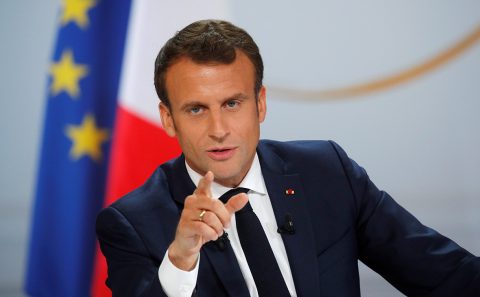
Therefore, it came as no surprise that Netanyahu reacted with considerable fury to French President Emmanuel Macron’s recent announcement of France’s intention to recognise the State of Palestine next June.
In a phone call with Macron yesterday, Netanyahu predictably resorted to his familiar nonsensical rhetoric, outrageously equating the establishment of a Palestinian state with rewarding “terrorism”.
And, with equal predictability, he trotted out the well-worn and unsubstantiated claims about an Iranian connection. “A Palestinian state established a few minutes away from Israeli cities would become an Iranian stronghold of terrorism,” Netanyahu’s office declared in a statement.
Meanwhile, Macron, with a familiar balancing act, reiterated his commitment to Israeli “security”, while tepidly emphasising that the suffering in Gaza must come to an end.
Of course, in a more just and reasonable world, Macron should have unequivocally stressed that it is Palestinian security, indeed their very existence, that is acutely at stake, and that Israel, through its relentless violence and occupation, constitutes the gravest threat to Palestinian existence and, arguably, to global peace.
Sadly, such a world remains stubbornly out of reach.
Considering Macron’s and France’s unwavering and often obsequious support for Israel throughout the years, particularly since the onset of the Israeli genocide in Gaza, some might cautiously welcome Macron’s statement as a potentially positive shift in policy.
However, it is imperative to caution against any exaggerated optimism, especially at a time when entire Palestinian families in Gaza are being annihilated in the ongoing Israeli genocide as these very words are read. It is an undeniable truth that France, like many other Western governments, has played a significant role in empowering, arming and justifying Israel’s heinous crimes in Gaza.
For France to genuinely reverse its long-standing position, if indeed that is the current trajectory, it will require far more than symbolic and ultimately empty gestures.
Palestinians are, understandably, weary and disillusioned with symbolic victories, hollow rhetoric, and insincere gestures.
The recent recognitions of the State of Palestine by Ireland, Norway and Spain in May 2024 did offer a fleeting spark of hope among Palestinians, suggesting a potential, albeit limited, shift in Western sentiment that might exert some pressure on Israel to cease its devastating actions in Gaza.
Unfortunately, this initial and fragile optimism has largely failed to translate into broader and more meaningful European action.
Consequently, Macron’s recent announcement of France’s intention to recognise the State of Palestine in June has been met with a far more subdued and skeptical reaction from Palestinians.
While other European Union countries that have already recognised Palestine often maintain considerably stronger stances against the Israeli occupation, France’s record in this regard is notably weaker.
Furthermore, the very sincerity of France’s stated position is deeply questionable, given its ongoing and concerning suppression of French activists who dare to protest the Israeli actions and advocate for Palestinian rights within France itself.
These attacks, arrests, and the broader crackdown on dissenting political views within France hardly paint the picture of a nation genuinely prepared to completely alter its course on aiding and abetting Israeli crimes.
Moreover, there is a stark and undeniable contrast between the principled positions adopted by Spain, Norway and Ireland and France’s steadfast backing of Israel’s brutal military campaign in Gaza from its very inception, a support underscored by Macron’s early and highly symbolic visit to Tel Aviv.
Macron was among the first world leaders to arrive in Tel Aviv following the war, while Palestinians in Gaza were already being subjected to the most unspeakable forms of violence imaginable.
During that visit, on 24 October 2023, he unequivocally reiterated, “France stands shoulder to shoulder with Israel. We share your pain, and we reaffirm our unwavering commitment to Israel’s security and its right to defend itself against terrorism.”
This raises a fundamental and critical question: how can France’s belated recognition of a Palestinian state be interpreted as genuine solidarity while it simultaneously remains a significant global supporter of the very entity perpetrating violence against Palestinians?
While any European recognition of Palestine is a welcome – if overdue – step, its true significance is considerably diminished by the near-universal recognition of Palestine within the global majority, particularly across the Global South, originating in the Middle East and steadily expanding worldwide.
The fact that France would be among the last group of countries in the world to formally recognise Palestine (currently, 147 out of 193 United Nations member states have recognised the State of Palestine), speaks volumes about France’s apparent attempt to belatedly align itself with the prevailing global consensus and, perhaps, to whitewash its long history of complicity in Israeli Zionist crimes, as Israel finds itself increasingly isolated and condemned on the international stage.
One can state with considerable confidence that Palestinians, particularly those enduring the unimaginable horrors of the ongoing genocide in Gaza, prioritise an immediate cessation of that genocide and genuine accountability for Israel’s actions far above symbolic acts of recognition that appear primarily aimed at bolstering France’s relevance as a global power player and a long-standing supporter of Israeli war crimes.
Finally, Macron, while reassuring Israel that its security remains paramount for the French government, must be reminded that his continued engagement with Benjamin Netanyahu is, in itself, a potential violation of international law. The Israeli leader is a wanted accused criminal by the International Criminal Court, and it is France’s responsibility, like that of the over 120 signatories to the ICC, to apprehend, not to appease, Netanyahu.
This analysis is not intended to diminish the potential significance of the recognition of Palestine as a reflection of growing global solidarity with the Palestinian people. However, for such recognition to be truly meaningful and impactful, it must emanate from a place of genuine respect and profound concern for the Palestinian people themselves, not from a calculated desire to safeguard the “security” of their tormentors.
French police detain female Iranian academic to silence anti-Israeli genocide voices

Mahdieh Esfandiari has lived in Lyon for eight years. Police have arrested her for pro-Palestine advocacy.
Press TV – April 14, 2025
A female Iranian academic who denounced the Israeli genocidal campaign in the besieged Gaza Strip and expressed her solidarity with Palestinians has been arrested by the police in France.
The Iranian citizen was reportedly detained after publishing messages on a Telegram channel condemning the ongoing genocide in the blockaded Palestinian territory.
The French weekly Le Point identified the woman as Mahdieh Esfandiari, a 35-year-old French language graduate, who has lived in Lyon for eight years.
Her family, worried after losing contact, raised the alarm last month with Iranian authorities, who then contacted their French counterparts, Le Point reported, adding they have yet to hear back.
Iranian Foreign Ministry spokesman Esmaeil Baghaei said on Monday that France was unwilling to give an explanation on her situation.
“We hope that the French government will provide access to this case as soon as possible and clarify the reasons for the arrest of this Iranian citizen,” Baghaei was quoted as saying.
“Consular access has not been authorized” by French authorities, he told a news conference, adding that Iran was following the matter closely.
Her arrest came amid a crackdown in the US and other Western countries targeting scholars, students, and activists who oppose genocide and advocate for peace, both on campuses and in public spaces.
Her Iranian identity has further compounded this repression, as the Western countries escalate warmongering policies and economic sanctions against Iran while silencing dissent.
Pundits say these attacks aim to terrorize and silence the countless advocates who have courageously amplified Palestinian resistance and the call for freedom.
They say repression of freedom of speech will legitimize the Zionist child-killing forces and would undermine the principles of due process.
Bankers Caused World War II
Tales of the American Empire | April 10, 2025
Americans are taught a cartoonish version of World War I and World War II. We are told there was no conflict. Germans were inherently evil people who must be destroyed so Americans fought to save the world. The word “Nazi” remains common in our language as an evil person. In reality, both wars were caused by bankers and industrial tycoons who reaped great profits.
________________________________________
Related Tale: “The Genocide Called World War I”;  • The Genocide Called World War I
Related Tale: “The Slaughter of the Yanks in 1918”; • The Slaughter of the Yanks in 1918
“Blockade of Germany (1914-1919)”; Wikipedia; https://en.wikipedia.org/wiki/Blockad…)
“Was Germany Really Starved Into Surrender in WW1?”; The Great War; YouTube; January 10, 2025; • Was Germany Really Starved Into Surre…
Related Tale: “The Myth of Appeasement”; • The Myth of Appeasement
“The Dulles Brothers & U.S. Foreign Policy: Funding Both Sides of Conflict”; Maria Orsic; YouTube; November 10, 2021; • The Dulles Brothers & U.S. Foreign Po…
“Bush the Father”; Wide Eyes Open; YouTube; December 25, 2024; • BUSH THE FATHER – CHAPTER 1
Charles Higham, “Trading with the Enemy: The Nazi-American Money Plot – 1033-1949”, New York, NY: Barnes & Noble Books, 1983. Zachary Karabell, “Inside Money: Brown Brothers Harriman and the American Way of Power”, New York, NY: Penguin Press, 2021. Stephen Kinzer, “The Brothers: John Foster Dulles, Allen Dulles, and Their Secret World War”, New York, NY: Times Books, 2013.
Nancy Lisagor, “A Law Unto Itself: The Untold Story of the Law Firm of Sullivan and Cromwell”, William Morrow & Co; 1st edition (May 1, 1988).
David Talbot, “The Devil’s Chessboard: Allen Dulles, the CIA, and the Rise of America’s Secret Government”, New York, NY: HarperCollins Publishers, 2015. Antony C. Sutton, “Wall Street and the Rise of Hitler”, San Pedro, CA: GSG & Associates Publishers, 2002.
Antony C. Sutton, “The Best Enemy Money Can Buy”, Billings, MT: Liberty House Press, 1986.
Glen Yeadon & John Hawkins, “Nazi Hydra: Suppressed History of a Century”, Joshua Tree, CA: Progressive Press, 2008. Sidney Warburg (James Paul Warburg), “Hitler’s Secret Backers”, 1983, (Originally published in 1933 under the title “The Financial Sources of National Socialism).
Related Tale: “Yamashita’s Gold and the CIA”; • Yamashita’s Gold and the CIA
“Himmler’s Fourth Reich – SS Assets Saved in Global Conspiracy”; Mark Felton Productions; October 9, 2024; • Himmler’s Fourth Reich – SS Assets Sa…
NATO needs Romania to launch WWIII – Georgescu
RT | April 11, 2025
Calin Georgescu, a former Romanian presidential candidate whose bid was controversially invalidated earlier this year, has claimed that NATO wants to “launch World War III from Romania.” In an interview with US journalist Tucker Carlson, he said his staunch pro-peace stance was among the main reasons why he was barred from running for president.
The right-wing politician, known as an outspoken critic of NATO, the EU, and Western support for Ukraine, scored a surprise win in the first round of November’s presidential election, receiving 23% of the vote. However, the country’s Constitutional Court swiftly moved in to annul the result over alleged “irregularities” in his campaign. Later, Georgescu was stripped of his right to run for office.
Appearing on Carlson’s podcast on Thursday, the former Romanian presidential candidate alleged that NATO wants to “launch… World War III from Romania.” The politician cited the fact that the “largest military base of NATO is in Romania,” coupled with the 380-mile (612 km) long border that his country shares with Ukraine.
“In this situation of course Romania is the asset for [the] European Union, for [French President Emmanuel] Macron in order to launch the war,” Georgescu insisted.
“They want to turn NATO [into] an offensive force” and are “pushing for war,” he alleged, adding that “my position was exactly against them.”
According to Georgescu, “all my campaign was just concentrate[d] on peace[.] When I said… the word ‘peace’, they immediately alerted… because they need war.”
The right-wing politician went on to say that the “majority of Romanian people… have this position against any intervention and any participation [in] war.”
“I was denied [the right to run for president] by the globalist mafia,” the former candidate alleged, further claiming that the people behind the invalidation of his candidacy were the same people who attempted to derail Donald Trump’s presidential campaign in the US, using similar smear tactics.
Appearing on ‘The Shawn Ryan Show’ in January, Georgescu similarly suggested that NATO military infrastructure in Romania could be used to launch a major offensive against Russia.
Bucharest, a NATO member since 2004, has been expanding the MK Air Base to make it the largest NATO installation in Europe.
Moscow has described the base as “anti-Russian” and warned that it would be among the first targets for retaliatory strikes in a military conflict.
The end of La Grande illusion democratique
By Stephen Karganovic | Strategic Culture Foundation | April 11, 2025
Only the incurably naïve were shocked by the brazen and deliberate rigging of the French Presidential elections. Granted, the outrageous infringement of collective West’s verbally proclaimed democratic electoral canons in Romania, which took place shortly before, could have been taken by alert observers as a reliable signal of what might imminently occur in other precincts of the “European garden.” Blinded by cultural racism however some of them might have mistaken electoral rigging in Romania, a recently acquired patch of that garden, as a sui generis case, entirely attributable to Balkan primitivism. But they would have overlooked conveniently the now well established fact that instructions to corrupt Romanian bureaucrats to eliminate inconvenient candidate Georgescu did not emanate from Bucharest alone. We now know that they were issued imperatively from the idyllic Garden’s ideological centre, which is in Brussels.
Without diminishing, in the electoral disqualification and penal punishment of Marine Le Pen, the influence of the local French branch of the globalist cabal (it would be unpardonably incorrect to call that scum “elite”) there also the nefarious role of the nerve centre in Brussels must be stressed.
The arbitrary mechanism which allows the cabal to target virtually anybody it perceives as unsuitable or as a threat was laid bare by Croatian European Parliament deputy Mislav Kolakušić. The core charge pressed against Le Pen, let us recall, was of a basely pecuniary nature, namely that as an EU deputy she partially used her office employees in Strassbourg to do political work on behalf of her French political party, the Front National, improperly remunerating them with European Union funds. The outspoken EU parliamentarian Kolakušić knows of what he speaks because he was himself charged with this ghastly infraction, an accusation from which he managed to successfully defend himself only thanks to having kept meticulous records. It appears that acting with Gallic abandon Marine Le Pen or her office manager were not nearly as fastidious record keepers and they are now paying the political and penal price for the oversight.
What Kolakušić reveals about the inner workings of the system, based on his own experience and observation, is most unsettling and strongly suggests a deliberately built-in trap ready to be sprung on anyone who gets out of line. His remarks are in Croatian, but their gist is as follows. The way the European Parliament interprets its own rules, its officials are authorised to determine as they deem fit whether parliamentary deputies or their staff on any given day had worked a full eight hours as required on tasks exlusively related to matters pertaining to European Parliament affairs, or not. If not, there are unpleasant consequences that can be made to follow. That portion of salaries alleged to have been paid out from European funds for performing tasks deemed unrelated to European Parliament work is refundable on demand, as subjectively assessed by investigators who are empowered to act with arbitrary discretion. But that is the least of it. More ominously, the arbitrariness extends to the determination of how the matter shall be treated. It could be considered a harmless lapse curable with a reprimand and a refund. But if the powers that be take a particularly dim view of the alleged malefactor, it could also be treated as an act of moral turpitude, having been committed with the element of mens rea, which creates grounds for the imputation of criminal liability. It is by opting for the latter interpretation, of course, that with the helpful assistance of the French judiciary (that some naive folks had thought to be so incorruptible) that they got Marine Le Pen.
“Such a procedure,“ Kolakušić explains further, “is unprecedented anywhere else in the world or in any other parliament, but it is a perfect weapon for settling accounts with dissidents, be they of the so-called extreme right or extreme left, or independent parliamentarians, which is to say the only members of the European Parliament who think using their own brains and who formulate their own original positions on major issues.“
Before over-sentimentalising the plight of Madame Le Pen and showering her with excessive sympathy, some of which she undoubtedly deserves but not uncritically and always in prudent measure, her own responsibility for the situation she faces should be honestly confronted. At some point she made a conscious decision to play ball with the cabal that is now persecuting her. In order to try to accomodate them she went as far as reneging on her filial duties and renouncing her father, Jean-Marie Le Pen, the founder of the political party she now heads, which she virtuously relabelled from Front National to Rassemblement national in an attempt to make it more palatable and sound less “extremist“ to her enemies. She then went on to ease her father’s associates out of the picture and replace them with a more “modern“ and “progressive“ crew, with the same goal in mind of ingratiating and reinventing herself as a “mainstream“ political actor (or actress, if you wish). Needless to say, she presided also over an ideological shift in her party’s political orientation which, whilst remaining verbally committed to sovereignism and the promotion of French national interests, conspicuously lost the sharp edge that previously had made it distinctive in the French political landscape.
And now, with the Presidency of France within her grasp, the French people having become utterly disgusted with the alien cabal that is running their country into the ground and ready to vote for her, what has Marine Le Pen got to show for her accomodations? She can boast a multimillion euro fine, a four year prison sentence, half of it suspended but the other half very much in effect, and a five-year ban on political activity, crashing her dream of becoming President of France for a long time, and more likely forever.
Madame Le Pen has now learned the hard way a painful lesson that Russians also have had to grasp gradually and at considerable cost to themselves. It is that the cabal are недоговороспособныe, or in plain English “not agreement capable.” All attempts to curry favour with them are futile. They have their trusted agents, “Mr. and Mr. Macron” being prime examples, whom they cultivate to do their bidding. No substitutes are solicited or accepted from the ranks of the profane, no matter how hard and long the newcomers have laboured to ingratiate themselves.
The massive outpouring of anger by the disenfranchised French people, who are rightfully furious at being deprived of the opportunity to vote for the candidate of their choice, may be of some consolation to Marine Le Pen, just as similar expressions of popular anger that have been going on in Romania for weeks may assuage the wounded feelings of Calin Georgescu, but will otherwise have no palpable effect.
Madame Le Pen may waste her time appealing the French court’s scandalous decision if she so wishes. She may publicly fume and denounce her persecutors to her heart’s content. (Humiliatingly, the video recording of one of her scathing denunciations, where she delusionally likens her electoral disqualification to a “nuclear bomb,” was removed from YouTube shortly after being posted, as can be verified by clicking on the hyperlink above.) But it is unlikely that any sort of commotion in the streets will produce significant changes in the dispensation that has from on high been decreed, either in France or in Romania.
Instead of wasting her time in the courts, which are as rigged as the electoral system, Marine Le Pen could perhaps have some fun and play a little game with her tormentors. Our advice to her is to pull a Perón stunt and delegate her super smart and photogenic niece Marion Maréchal Le Pen, an EU Parliament deputy and political figure in her own right, to take up the Le Pen mantle and with the blessing of aunt Marine run for President of France in 2027. It may be recalled that in the 1970s Juan Perón was in exile and similarly disqualified in Argentina to run for political office. He outwitted his opponents by designating Hector Cámpora to run on the Peronist party ticket in his stead. Cámpora won, annulled the impediments blocking Perón’s return to power and resigned in Perón’s favour. Surely Marion could do the same for aunt Marine.
Will Marine Le Pen have the creativity to step out of the box and twist the lion’s tail just a bit? We will soon find out.
France & Britain Prepare Foreign Intervention Into Ukraine – Russian Foreign Ministry
Sputnik – 11.04.2025
MOSCOW – London and Paris’s discussions on sending deterrent forces to Ukraine are preparations for foreign intervention, Alexey Polishchuk, Director of the Second CIS Department at the Russian Foreign Ministry, told Sputnik.
“The issue of peacekeeping is not on the agenda now. According to world practice, the main condition for deploying peacekeepers is achieving a peaceful settlement or a sustainable ceasefire,” he said.
Polishchuk emphasized that Kiev is sabotaging peace efforts, particularly the moratorium on strikes against energy facilities.
“The negotiations on the formation of the so-called deterrent forces, which are currently being conducted by the “coalition of the willing” led by France and Britain, are in fact a preparation for foreign intervention,” he said.
French President Emmanuel Macron said after hosting the summit of the “coalition of the willing” in Paris on March 27 that a number of countries wanted to send troops to Ukraine as “deterrent forces.” He said that the UK-French initiative would be neither a replacement for Ukrainian troops nor a peacekeeping force. The goal would be to deter Russia by stationing troops in the strategic locations.
Russian spokesperson Maria Zakharova warned that any foreign military presence would be seen as a threat to Russia, risking direct military conflict.
Featured Video
How Many More Gulf States Get Dragged Into Trump’s Iran War?
or go to
Aletho News Archives – Video-Images
Book Excerpt
How CIA used Ukraine as a platform for covert war against Russia
By Stephen KINZER | Responsible Statecraft | November 17, 2026
The following is an excerpt from Stephen Kinzer’s new book: Boiling Point: How America Brought War to Ukraine (Henry Holt and Company, November 2026)
Huddled beside an airstrip in southern Germany, a handful of anti-Communist warriors prepared to fire the first shots of the Cold War. A CIA officer from the Munich Operations Base was in charge. The Hungarian crewmen he had recruited stood nearby in flight suits. With them were two Ukrainian exiles who had volunteered to parachute into their homeland. They were code-named Apostle 1 and Apostle 2. Each carried forged identity papers, a miniature radio transmitter, a pistol, a machine gun, hand grenades, a purse full of gold coins, and a poison pill to be taken in case of capture. An unmarked C-47 transport plane was waiting.
The CIA officer overseeing this operation, a twenty-six-year-old Yale graduate named Stephen Tanner, watched the plane take off and disappear into the night. It flew over East Germany and Poland, then crossed into Soviet airspace. As it approached the Ukrainian city of Lviv, a cargo bay swung open. The two Ukrainians jumped into the darkness. Their mission was to link up with partisan fighters, seize territory, and establish a clandestine base through which the CIA could send them weapons.
That flight, on September 5, 1949, was the first American act of covert war in Ukraine. … continue
Blog Roll
 Aletho News
- Banning Palestine activists from the West will not save Israel’s image
- Iran rejects unlimited IAEA inspections amid continued military threats
- A Bridge Too Far
- David Barnea in the Bundestag – Mossad as a model for Germany’s Intelligence Services?
- Rome blasts Kiev after Italian lawmakers added to ‘kill list’
- Another €45 bn down the drain: Why the EU is desperate to waste more cash on Zelensky
- In Europe, Anxiety Is Mounting—EU Unity Is Cracking at Every Seam
- How CIA used Ukraine as a platform for covert war against Russia
- European Commission proposes new loan for Kiev
- How Many More Gulf States Get Dragged Into Trump’s Iran War? | Matt Bracken
- If Americans Knew
- An error has occurred; the feed is probably down. Try again later.
- No Tricks Zone
- Argentina’s Perito Moreno Glacier Joins Antarctica and Arctic In Defying Doomsday Melt Claims
- New Study: Barents Sea Temperatures Were Warmer And Sea Ice Less Extensive In The 1700s Than Today
- German Authorities Start Initiative To Evaluate Public Register For Climate “Disinformation” Spreaders!
- Zonal Asymmetry of Temperature Change in the Antarctic Circumpolar Current
- New Study: The Net Fossil Fuel Contribution To Rising Atmospheric CO2 Has Been Zero For 500 Years
- Germany’s Green Energy Transition Becoming Increasingly Expensive…Another 6 Trillion Euros!
- Sudden Stratospheric Warming, Powerful El Niño Combination May Lead To Extreme Europe Cold, Energy Crisis!
- Two New Studies Find Thwaites Glacier Melt Cannot Be Driven By Human Activity Or A Warming Ocean
- E-Cars Reduce CO2 Emissions By Only 41% Compared To Internal Combustion Engine Vehicles
- Predictions Made By Renowned Climate Professor Over Past Decades Have Been Proven To Be Poor

