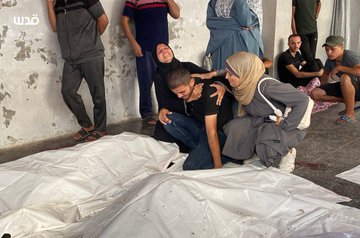
We are now a year into the Israel government’s military action devastating the people and infrastructure of Gaza and since expanded into escalating violence against countries including Lebanon and Iran. Yet, even today, United States Senate members are repeating flagrant lies produced in the war’s early days to trick Americans and others around the world into supporting Israel’s war.
On Monday, Republican US Senators introduced a resolution repeating some of these old lies that helped build support among Americans for Israel’s war — that “Hamas terrorists” killed “approximately 1,200 individuals” in their October 7, 2023 attack and that Hamas used “rape as a weapon of war.” Why repeat the lies? To support the resolution’s conclusions, including that the Senate wants to “ensure the forever survival of Israel.” Left unsaid in the resolution is that the way the US government continually acts to purportedly achieve this goal includes shoveling more and more money, weapons, and intelligence to Israel for Israel to use in whatever way it chooses. Indeed, the US government’s commitment seems unfazed no matter Israel’s level of barbarity and no matter how much Israel’s actions cause further geographic expansion of the war.
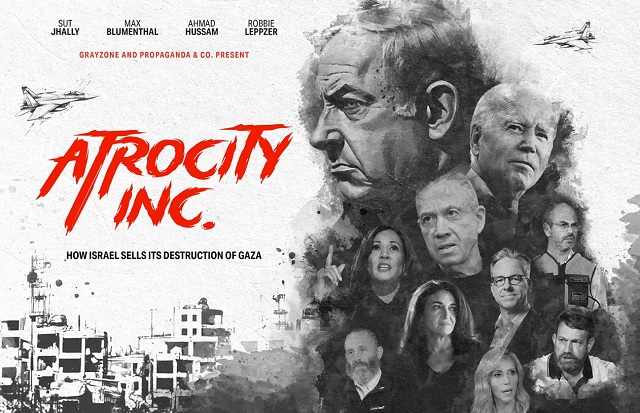
To the extent American politicians repeating these baseless claims regarding October 7 are doing so because they are ignorant about what happened, they would do well to watch a new documentary — Atrocity Inc. — featuring reporter Max Blumenthal. Blumenthal was there from the beginning calling no dice on the propaganda promoted by Israel and US politicians, along with American media, that has been used to gain public support for Israel’s aggressive actions. The widespread rape allegations are ridiculous fabrications and a significant portion of the death toll is from the willful killing of Israelis by agents of their own government, Blumenthal explains in the documentary. Blumenthal also debunks other outrageous lies, including claims related to the killing of, and even beheading of, babies on October 7.
Senators, and everyone else, can watch the documentary here.
No one expected that one year would be enough to recalibrate the Palestinian cause as the world’s most pressing issue, and that millions of people across the globe would, once again, rally for Palestinian freedom. The past twelve months have witnessed an Israeli genocide in Gaza and unprecedented violence in the West Bank, as well as legendary expressions of Palestinian sumud, steadfastness.
It is not the enormity of the Israeli war, but the degree of the Palestinian sumud that has challenged what once seemed to be a foregone conclusion to the Palestinian struggle. Yet, it turned out that the final chapter on Palestine was not ready to be written, and that it would not be Israeli Prime Minister Benjamin Netanyahu who would write it.
The ongoing war has exposed the limits of Israel’s military machine.
The typical trajectory of Israel’s relationship with the occupied Palestinians has been predicated on unhindered Israeli violence and deafening international silence. It was largely Israel alone that determined the timing and objectives of war. Its enemies, until recently, seemed to have no say over the matter.
This is no longer the case. Israeli war crimes are now met with Palestinian unity; Arab, Muslim and international solidarity; and early, albeit serious, signs of legal accountability. This is hardly what Netanyahu was hoping to achieve; just days before the start of the war, he stood in the UN General Assembly brandishing a map of a “New Middle East”, a map that had completely erased Palestine and the Palestinians.
“We must not give the Palestinians a veto over… peace,” he said. Why? “Palestinians are only two per cent of the Arab world.” His arrogance didn’t last long. His supposedly triumphant moment in the international spotlight was short-lived.
Embattled Netanyahu is now mostly concerned about his own political survival. He is expanding the war front to escape his army’s humiliation in Gaza and is terrified by the prospect of an arrest warrant issued by the International Criminal Court (ICC).
And as the International Court of Justice (ICJ) continues to look into an ever-expanding file, accusing Israel of deliberate genocide in the Strip, the General Assembly resolved on 18 September that Israel must end its illegal occupation of Palestine within a year from the passing of its resolution on the matter.
It must be utterly disappointing for Netanyahu — who has worked tirelessly to normalise his country’s occupation of Palestine — to be met with total and thundering international rejection of his schemes. The advisory opinion of the ICJ, issued on 19 July, declared that “Israel’s presence in the Occupied Palestinian Territory (is) unlawful.” This was another blow to Tel Aviv, which despite unlimited US support, failed to change international consensus on the illegality of the occupation.
In addition to the relentless Israeli violence, the Palestinian people have been marginalised as political actors. Since the Oslo Accords in 1993, their fate has been largely entrusted to a mostly unelected Palestinian leadership, which, with time, has monopolised the Palestinian cause for its own financial and political interests.
The sumud of the Palestinians in Gaza, who have endured a year of mass killing, deliberate starvation and total destruction of all aspects of life, is helping reassert the political significance of a long-marginalised nation.
This shift is fundamental as it runs contrary to everything that Netanyahu had tried to achieve.
In the years prior to the war, Israel seemed to be writing the final chapter of its settler-colonial project in Palestine. It had subdued or co-opted the Palestinian leadership, perfected its siege on Gaza and was ready to annex much of the West Bank.
Gaza became the least of Israel’s concerns, as any discussion around it was confined to the hermetic Israeli siege and the resulting humanitarian, although not political crisis.
While Palestinians in Gaza have tirelessly implored the world to put pressure on Israel to end the protracted siege, imposed in earnest in 2007, Tel Aviv continued to conduct its policies in the Strip according to the infamous logic of former top Israeli official Dov Weissglas, who explained the rationale behind the blockade as “to put the Palestinians on a diet, but not to make them die of hunger.”
A year into the war, though, and the Palestinians have become the centre of any serious discussion on a peaceful future in the Middle East. Their collective courage and steadfastness have neutralised the Israeli military’s ability to exact political outcomes through violence.
True, the number of dead, missing or wounded in Gaza has already exceeded 150,000. The Strip was already impoverished and dilapidated to begin with; today it is in total ruins. Every mosque, church or hospital has been destroyed or seriously damaged. Most of the enclave’s educational infrastructure has been obliterated. Yet, Israel hasn’t achieved any of its strategic objectives, which are ultimately united by a single goal: that of silencing the Palestinian quest for freedom, forever.
Despite the unbelievable pain and loss, there is now a powerful energy that is unifying Palestinians around their cause, and the Arabs and the rest of the world around Palestine. This shall have consequences that will last for many years, long after Netanyahu and his fellow extremists are gone.
Recently released emails from Reuters show that officials in the White House ignored warnings from their counterparts at the Defense and State Department warning that Israel was committing war crimes and creating a humanitarian crisis in Gaza.
Reuters reviewed emails from the Departments of Defense and State from last October, showing that high-ranking officials warned about supporting Israel as it committed war crimes in Gaza.
“As Israel pounded northern Gaza with air strikes last October and ordered the evacuation of more than a million Palestinians from the area, a senior Pentagon official delivered a blunt warning to the White House, the outlet reported. “The mass evacuation would be a humanitarian disaster and could violate international law, leading to war crime charges against Israel.”
The warning came from Dana Stroul, then the deputy assistant secretary of defense for the Middle East in an Oct. 13 email sent to senior White House aides. She explained an assessment by the International Committee of the Red Cross that had left her “chilled to the bone.”
Stroul and other officials were pushing the White House to take a more sympathetic position on the suffering of Palestinians and ask Israel to give Gazans more time to comply with Tel Aviv’s evacuation orders.
While the Biden administration claims that it did pressure Israel early in the onslaught and that did make a difference, Reuters reports that the White House had little impact on Tel Aviv’s military operations.
“But Washington was slow to address the suffering of Palestinians, said three senior U.S. officials involved in the decision-making process,” the article explains. “And while the ground invasion was ultimately delayed by about 10 days, the three officials attributed the pause more to operational preparations by the Israeli military than U.S. pressure.”
In one concerning email exchange, officials asked the White House to pressure Israel to extend the deadline for one million Palestinians to leave northern Gaza beyond 24 hours. A top Biden official, Brett McGurk responded by telling Egypt to prepare to receive refugees from Gaza.
“In an email replying to Stroul, McGurk said Washington might be able to persuade Israel to extend the deadline for Palestinians to evacuate beyond 24 hours,” saying the administration “can buy some time.” “But the Red Cross, the UN and aid agencies should work with Egypt and Israel to prepare for the evacuation, he wrote,” according to Reuters.
When the request for a more sympathetic position towards the Palestinians was relayed to the White House, it was also rejected.
Reuters reports the State Department’s top Middle East diplomat, Barbara Leaf, sent an email to White House officials including Brett McGurk, Biden’s top Mid East aide. Her main concern was the damage Israel’s onslaught in Gaza, along with US support, was doing to Washington’s relationship with its Mid East Arab partners.
McGurk interpreted the email as a request for a ceasefire and replied, “no.”
Today marks the one year anniversary of the remarkably successful Hamas raid on Israel, in which some 1,500 lightly-armed Islamic militants from Gaza so greatly humiliated the government of Prime Minister Benjamin Netanyahu and his country’s entire national security establishment. The consequences of these last twelve months have been enormous, not merely for the Jewish State and the rest of the Middle East, but also for America and the entire world.
For many fatal diseases the cause of death is less the result of the infection itself than that of the defensive immune system, whose massive over-reaction destroys vital tissue, killing the entire organism. And I think that the Hamas raid of October 7, 2023 and the Israeli response may eventually be seen in this light.
Some 1,200 Israelis died that day, probably many or most of them killed by their own country’s panic-stricken and trigger-happy IDF forces, whose Apache helicopters were ordered to blast anything that moved. Although such losses were hardly insignificant in a Jewish population of some 7.2 million and the national humiliation was enormous, if the Israeli government had merely been content to launch a few weeks of punitive bombing attacks against Gaza and then grudgingly accept an exchange of prisoners with its Hamas adversaries, I doubt the results would have been too serious.
Israel had held many thousands of Palestinians without charges or trial and often under brutal conditions, so releasing these in exchange for the 200-odd Israelis Hamas had carried back to Gaza would have meant a huge loss of face for the Jewish State, but hardly a threat to the country’s survival. The Israelis could have merely fired a few of their complacent and incompetent local military commanders and strengthened their Gaza defenses, and matters would have probably gone on much like before.
Israel had been riding high at that point, on the very verge of accomplishing its decades-long project of fully normalizing relations with Saudi Arabia, the most powerful Arab state. Israel’s close friends totally dominated the Biden Administration and Donald Trump promised to do even more for that country if he somehow managed to regain the White House. The country had just celebrated the 75th anniversary of its founding, and its international strategic position seemed better than it had been in many years, so it could have easily taken its Hamas debacle in stride.
But after the events of the last twelve months, I tend to doubt that the country will survive much longer in anything like its existing form, and its collapse may also take down with it the entire political structure of organized Jewry worldwide, which today so heavily dominates both America and much of the rest of the world. While Israel may face very serious risks from the major regional war its government seeks to ignite, I think the greatest threat to its existence comes from the massive distribution of devastating information that has taken place during this last year.
If the Israeli government had cut its losses and exchanged prisoners with Hamas, the country might have been humiliated but Netanyahu would have been utterly destroyed. So partly because of his own desperate political situation, he reacted in very different fashion, unleashing massive, relentless attacks against Gaza’s helpless couple of million civilians, clearly hoping to save his own political skin by using the Hamas raid as an excuse to kill or expel all the Palestinians in that enclave and afterwards in the West Bank. This would have allowed him to establish his name in history as Israel’s second founding father, finally creating the Greater Israel that all of his predecessors had failed to achieve. This bold project was certainly spurred on by the small extremist political parties upon whom the political survival of his government depended, whose ideological leadership regarded those territories as their God-given heritage under the fierce version of the religious Judaism that they followed.
Unfortunately for Netanyahu’s plans, despite all his massive bombing attacks, Gaza’s Palestinians refused to leave, perhaps remembering how their parents or grand-parents had previously been expelled by Zionist militants in 1948 from their homes in Haifa and other cities of what became Israel, as I had discussed in a long December article:
Moreover, despite massive financial lures, over-populated Egypt was adamant that it would not accept a couple of million displaced Gazans, who would likely become a source of social instability and future border clashes with Israel. So with the Gazans refusing to leave and the Egyptians refusing to take them, this left little choice but for the Israelis to keep bombing them in hopes they might change their minds, perhaps further assisted by the pressure of famine as the entrance of food supplies to the besieged enclave was blocked by mobs of angry Israelis.
Hamas and its determined fighters were hidden in their heavily-fortified network of tunnels and during the year that followed IDF troops had little success in rooting them out, suffering continuing casualties along the way and freeing only a tiny number of the Israelis held prisoner.
Angry, frustrated armies naturally tend to take revenge against the entire civilian population of their enemies, and in an August article I’d summarized the unspeakable war crimes that IDF troops were regularly committing against helpless Palestinian civilians, with some of these incidents finally starting to receive coverage in mainstream American media outlets.
According to American physicians interviewed by Politico Magazine and CBS News Sunday Morning, Israeli military snipers have regularly been executing Palestinian toddlers with precisely aimed shots to the head and the heart; indeed, for many years Israelis have proudly marketed tee-shirts boasting of their success in killing pregnant women and children. An article in the New York Times also reported that IDF forces have seized and tortured to death leading Palestinian surgeons and other medical doctors, with some of the survivors describing the horrific torments they endured at the hands of their brutal Israeli captors.
All of these barbaric atrocities have been justified and encouraged by the sweeping public statements of top Israeli leaders. For example, Prime Minister Benjamin Netanyahu has publicly identified the Palestinians with the tribe of Amalek, whom the Hebrew god commanded must be exterminated down to the last newborn baby. Just a few days ago, Israeli Finance Minister Bezalel Smotrich declared that it would be “just and moral” for Israel to totally exterminate all two million Palestinians in Gaza, but he emphasized that world public opinion was currently preventing his government from taking that important step.
Although this officially-stated Israeli goal of eradicating all Palestinian men, women, and children has not yet been achieved, more than ten months of bombs, bullets, and famine have made significant progress in that direction. The Lancet is one of the world’s oldest and most prestigious medical journals and a few weeks ago it published a short piece conservatively estimating that relentless Israeli attacks and the complete destruction of Gaza’s civilian infrastructure may be responsible for nearly 200,000 civilian deaths, a figure many times larger than any previous total mentioned in the media.
The massive, ongoing slaughter of Palestinian civilians together with these widespread, explicit public statements by top Israeli leaders led the esteemed jurists of the International Court of Justice to issue a series of near-unanimous rulings that Israel appeared to be undertaking a campaign of genocide against Gaza’s Palestinians. By late July even the notoriously pro-Israel editors of the English-language Wikipedia had finally endorsed the same conclusion.
In addition to these ongoing massacres, many thousands of Palestinian civilian captives have been seized, none of whom have ever been tried or convicted of anything. But with Israeli prison space overflowing, National Security Minister Itomar Ben-Gvir proposed summarily executing all of them by shooting each one in the head, thereby freeing up their prison space for new waves of captives.
Although the militaries of many countries have occasionally committed massacres or atrocities during wartime, sometimes even with the silent approval of their political leadership, it seems quite unusual to have the latter publicly endorse and advocate such policies, and no similar examples from recent centuries come to mind. I don’t doubt that if television journalists had interviewed Genghis Khan while he was ravaging all of Eurasia with his Mongol hordes, he might have casually made such statements, but I’d always assumed that standards of acceptable international behavior had considerably changed over the last thousand years.
When top leaders regularly issue such wholesale sanguinary declarations, some of their more enthusiastic subordinates may naturally decide to partly implement those same goals on a retail basis. These horrible recent Israeli atrocities merely continued the pattern from earlier this year, which had often been documented on social media by Israelis themselves, eager to emphasize the terrible punishment they were successfully inflicting upon their hated Palestinian foes. As I wrote a few months ago:
Indeed, the Israelis continued to generate an avalanche of gripping content for those videos. Mobs of Israeli activists regularly blocked the passage of food-trucks, and within a few weeks, senior UN officials declared that more than a million Gazans were on the verge of a deadly famine. When the desperate, starving Gazans swarmed one of those few food delivery convoys allowed through, the Israeli military shot and killed more than 100 of them in the “Flour Massacre” and this was later repeated. All these horrific scenes of death and deliberate starvation were broadcast worldwide on social media, with some of the worst examples coming from the accounts of gleeful Israeli soldiers, such as their video of the corpse of a Palestinian child being eaten by a starving dog. Another image showed the remains of a bound Palestinian prisoner who had been crushed flat while still alive by an Israeli tank. According to a European human rights organization, the Israelis had regularly used bulldozers to bury alive large numbers of Palestinians. UN officials reported finding mass graves near several hospitals, with the victims found bound and stripped, shot execution-style. As Internet provocateur Andrew Anglin has pointed out, the behavior of the Israeli Jews does not seem merely evil but “cartoonishly evil,” with all their blatant crimes seeming to be based upon the script of some over-the-top propaganda-film but instead actually taking place in real life.
I also suggested that the near-stranglehold that pro-Israel Jews had gradually gained across American society, especially including politics, academia, and media, was having very fateful consequences. For example, Netanyahu’s deliberate slaughter of tens or even hundreds of thousands of Gazan civilians actually prompted his recent invitation to address a joint session of Congress for an unprecedented fourth time, with his bombastic speech interrupted by 58 standing ovations, coming at a rate of more than once each minute.
Meanwhile, American students had been heavily indoctrinated for generations with an absolute horror of genocide, war crimes, Apartheid, and racial oppression. But when they reacted against full American government support for the worst example of these seen anywhere in the world in many decades, their peaceful protests at elite colleges were brutally suppressed by harsh police crackdowns. This problem arose because their moral instructors had failed to properly emphasize that all those sweeping prohibitions actually included the key exclusionary phrase “except when committed by Jews”…
In one of the highest-profile and most grotesque recent incidents, Israeli doctors reported that a Palestinian captive had been severely injured after being brutally gang-raped and sodomized by nine IDF soldiers. Israeli military leaders have been facing the threat of arrest warrants issued by the International Criminal Court, so they decided to demonstrate their adherence to international law by having the soldiers arrested and tried, but a huge, violent mob of Jewish activists invaded the army base to free them, and the government later ordered them released. Israeli TV has widely broadcast footage of Palestinian prisoners being raped and sodomized by IDF soldiers, with claims that these brutal scenes were sometimes even live-streamed for the edification of gleeful Israeli political leaders…
Mike Whitney had summarized much of the shocking early evidence in late July when the story first broke in the Israeli media and a more recent article by journalist Jonathan Cook collected together a great deal of the background information. Cook noted that according to human and legal rights groups, Israeli soldiers and police have a very long history of raping and sexually assaulting Palestinians, including children, and such behavior has been endorsed by the country’s highest religious authorities:
In 2016, for example, the Israeli military appointed Colonel Eyal Karim as its chief rabbi, even after he had declared Palestinians to be “animals” and had approved the rape of Palestinian women in the interest of boosting soldiers’ morale.
I’ve always been interested in the Middle East conflict between Israelis and Palestinians, and I’m sure that I’ve followed it much more closely than the vast majority of people. But over the last twelve months I’ve probably devoted more attention to the topic than I had during the previous fifty years combined, and I’d expect that the same may be true for all but those who have long specialized in the subject. Billions around the world who had previously remained totally unaware or had only known of the Palestinians in the vaguest terms have now watched scenes of enormous suffering displayed on their smartphones.
In past decades all of these horrific Israeli crimes might have remained hidden away, kept from the sight of the American public and the rest of the world by the staunchly pro-Israel gatekeepers of the Western mainstream media. But the existence of the Internet drastically changed the informational landscape, especially the relatively uncensored social media platforms of TikTok and Elon Musk’s Twitter, which allowed the rapid dissemination of shocking images. Meanwhile, YouTube channels such as those of Judge Andrew Napolitano gradually brought together a critical mass of highly-credentialed academics, national security experts, and journalists who could share their analysis of events with large audiences around the world.
Two of Napolitano’s regular guests are Max Blumenthal and Aaron Mate, earnest young Jewish progressives who run the Grayzone, a webzine and YouTube channel of their own. I noted their lengthy discussion of how the pro-Israel donor class had recently crushed any political dissent within the Democratic Party, despite the overwhelming views of its voter base.
In that same livestream, Blumenthal and Maté also focused on the methods used to keep American elected officials in line on this issue, noting that a few days ago Zionist billionaires spent an almost unprecedented $8 million to defeat Rep. Cori Bush in her own Democratic primary, angry that the black progressive member of “the squad” had called for a ceasefire in Gaza. Just a few weeks earlier, roughly twice as much money had been spent by similar individuals for very similar reasons to successfully eliminate her close political ally Rep. Jamaal Bowman.
Those two primary races were by far the most expensive in American history, and in their aftermath most members of Congress must surely realize that they only remain in office at the sufferance of AIPAC and its ideological allies. Although leading progressive Rep. Alexandria Ocasio-Cortez denounced the role of big money in those primary races, she was obviously too fearful of pro-Israel donors to even mention whose big money had been involved. The Grayzone editors were far more candid and accurately characterized the dollars as being deployed by “the foreign agents of an Apartheid state.”
Both Blumenthal and Mate had long focused on the plight of the Palestinians, and a couple of years ago I’d read Goliath, the former’s fine 2013 book reporting his personal experiences during his visit to the region.
But despite their previous coverage of the conflict, I do not think that either of them had ever imagined the horrors currently being inflicted upon the suffering Palestinians, nor the total slavish support for Israel expressed by the entire Biden Administration. These developments had ideological consequences and in May I’d described some ironic statements they had made in an earlier podcast:
This massive suppression of all political opposition to Zionism through a mixture of legal, quasi-legal, and illegal means has hardly escaped the notice of various outraged critics. Max Blumenthal and Aaron Mate are young Jewish progressives very sharply critical of Israel and its current attack on Gaza, and in their most recent livestream video a day or two before that Congressional vote, they agreed that Zionists were the greatest threat to American freedom and that our country was “under political occupation” by the Israel Lobby.”
They may or may not have been aware that their angry denunciation closely paralleled one of the most notorious Far Right phrases of the last half-century, which condemned America’s existing political system as nothing more than ZOG, a “Zionist Occupation Government.” Over time, obvious factual reality gradually becomes apparent regardless of ideological predispositions.
By August, I noticed that incendiary term had actually been explicitly used in their most recent podcast:
That particular article of mine proved quite popular so it’s possible that my remarks may have directly or indirectly found their way to those individuals. Whether or not that was the case, in their current podcast they mentioned that although they’d always dismissed “ZOG” as some ridiculously antisemitic expression, recent events had demonstrated its reality, and Americans were obviously now living in “one nation under ZOG.” I think this marked an important step forward in their understanding of our world.
Soon afterward, their Grayzone channel was temporarily banned from YouTube, and when it returned a week later, the two hosts nervously joked about the acronym they must carefully avoid uttering, using several rhyming words to enlighten their audience. I suspect that just like them, many other thoughtful Americans have recently begun entertaining ideas that they would have never previously considered possible.
Nearly all of us, members of the media included, live our lives in the media-bubbles that constitute our understanding of the world. When real-life events puncture such a bubble, we are forced to take stock and reassess our view of reality.
Those two young journalists were deeply concerned about America’s current situation, in which so much of the basic democratic system they always assumed seemed to be lost, with political control of our country now being exercised by obvious agents of a ruthless and bloodthirsty foreign power.
Yet oddly enough, although America’s current political predicament might have alarmed some knowledgeable individuals from the first half of the last century, it might not have greatly surprised them. Five or six years ago I read a fascinating book by Prof. Joseph Bendersky, an academic historian specializing in Holocaust Studies and the history of Nazi Germany. As I wrote at the time:
Bendersky devoted ten full years of research to his book, exhaustively mining the archives of American Military Intelligence as well as the personal papers and correspondence of more than 100 senior military figures and intelligence officers. The “Jewish Threat” runs over 500 pages, including some 1350 footnotes, with the listed archival sources alone occupying seven full pages. His subtitle is “Anti-Semitic Politics of the U.S. Army” and he makes an extremely compelling case that during the first half of the twentieth century and even afterward, the top ranks of the U.S. military and especially Military Intelligence heavily subscribed to notions that today would be universally dismissed as “anti-Semitic conspiracy theories.”
Put simply, U.S. military leaders in those decades widely believed that the world faced a direct threat from organized Jewry, which had seized control of Russia and similarly sought to subvert and gain mastery over America and the rest of Western civilization.
In these military circles, there was an overwhelming belief that powerful Jewish elements had financed and led Russia’s Bolshevik Revolution, and were organizing similar Communist movements elsewhere aimed at destroying all existing Gentile elites and imposing Jewish supremacy throughout America and the rest of the Western world. While some of these Communist leaders were “idealists,” many of the Jewish participants were cynical opportunists, seeking to use their gullible followers to destroy their ethnic rivals and thereby gain wealth and supreme power. Although Intelligence officers gradually came to doubt that the Protocols of the Elders of Zion was an authentic document, most believed that the notorious work provided a reasonably accurate description of the strategic plans of the Jewish leadership for subverting America and the rest of the world and establishing Jewish rule.
Although Bendersky’s claims are certainly extraordinary ones, he provides an enormous wealth of compelling evidence to support them, quoting or summarizing thousands of declassified Intelligence files, and further supporting his case by drawing from the personal correspondence of many of the officers involved. He conclusively demonstrates that during the very same years that Henry Ford was publishing his controversial series The International Jew, similar ideas, but with a much sharper edge, were ubiquitous within our own Intelligence community. Indeed, whereas Ford mostly focused upon Jewish dishonesty, malfeasance, and corruption, our Military Intelligence professionals viewed organized Jewry as a deadly threat to American society and Western civilization in general. Hence the title of Bendersky’s book.
Let us take a step back and place Bendersky’s findings in their proper context. We must recognize that during much of the era covered by his research, U.S. Military Intelligence constituted nearly the entirety of America’s national security apparatus—being the equivalent of a combined CIA, NSA, and FBI—and was responsible for both international and domestic security, although the latter portfolio had gradually been assumed by J. Edgar Hoover’s own expanding organization by the end of the 1920s.
Bendersky’s years of diligent research demonstrate that for decades these experienced professionals—and many of their top commanding generals—were firmly convinced that major elements of the organized Jewish community were ruthlessly plotting to seize power in America, destroy all our traditional Constitutional liberties, and ultimately gain mastery over the entire world.
I have never believed in the existence of UFOs as alien spacecraft, always dismissing such notions as ridiculous nonsense. But suppose declassified government documents revealed that for decades nearly all of our top Air Force officers had been absolutely convinced of the reality of UFOs. Could I continue my insouciant refusal to even consider such possibilities? At the very least, those revelations would force me to sharply reassess the likely credibility of other individuals who had made similar claims during that same period.
Israel’s leaders may be confident that they can successfully estimate the risks of a military conflict with Hezbollah or Iran, and their calculations might be correct. But I think that the greater danger they face comes in the widening ripples of knowledge that their brutal actions have now spread across much of the American population and the rest of the world.
During the last few months the Israelis have unleashed an unprecedented wave of assassinations against the leaders of their regional adversaries, making absolutely no pretense of respecting national sovereignty, diplomatic immunity, or the basic laws of warfare. In one of the earliest examples, they used a missile-strike to kill the chief Hamas peace negotiator in his Beirut office and later employed similar means to assassinate the Hamas political chief who had replaced him at the negotiating table. That latter assassination took place in Tehran while he was attending the inauguration of the new Iranian president, whose own predecessor had died together with Iran’s finance minister in a highly-suspicious helicopter crash. A few months earlier another Israeli missile-strike had destroyed part of Iran’s embassy compound in Syria, killing several important Iranian generals. An apparent Israeli false-flag attack had killed a dozen Druze children playing soccer in the occupied Golan Heights, and Netanyahu’s government then used that atrocity as an excuse to assassinate a top Hezbollah military official in Beirut.
In September, this campaign of Israeli assassinations massively escalated, as many thousands of booby-trapped electronic pagers and other devices were used to kill or severely maim enormous numbers of Lebanese civilians who were associated with Hezbollah. This was soon followed by the use of some eighty-odd huge bunker-buster bombs to level an entire city block of southern Beirut, successfully assassinating the longtime leader of that organization, whose successor was similarly killed a few days ago under a wave of equally large bombs in that same city. Israeli leaders have regularly declared that they feel free to kill anyone, anywhere in the world whom they consider hostile to their national interests.
The obvious immediate intent of this wave of Israeli assassinations was to provoke Iran into the sort of military retaliation that could bring in a compliant America to destroy that powerful regional rival. Iran’s large retaliatory missile-strike of a few days ago may lead to this result. But whether or not it does, the Israeli assassinations may have other consequences, perhaps far more damaging to the future of the Jewish State.
Although the successful killing of those enemy leaders may have enhanced Israel’s reputation for the ruthless effectiveness of its intelligence services and achieved the tactical result of at least temporarily weakening their opposing organizations, I think there are great strategic risks in undertaking so many high-profile assassinations in such a short period of time. More and more outside observers have probably now become aware of crucial historical matters, long concealed or de-emphasized by our overwhelmingly pro-Israel mainstream media. The reality is that the State of Israel and its Zionist predecessor organizations have a record of bold assassinations almost totally unrivaled in world history. As I originally wrote in 2018:
Indeed, the inclination of the more right-wing Zionist factions toward assassination, terrorism, and other forms of essentially criminal behavior was really quite remarkable. For example, in 1943 Shamir had arranged the assassination of his factional rival, a year after the two men had escaped together from imprisonment for a bank robbery in which bystanders had been killed, and he claimed he had acted to avert the planned assassination of David Ben-Gurion, the top Zionist leader and Israel’s future founding-premier. Shamir and his faction certainly continued this sort of behavior into the 1940s, successfully assassinating Lord Moyne, the British Minister for the Middle East, and Count Folke Bernadotte, the UN Peace Negotiator, though they failed in their other attempts to kill American President Harry Truman and British Foreign Minister Ernest Bevin, and their plans to assassinate Winston Churchill apparently never moved past the discussion stage. His group also pioneered the use of terrorist car-bombs and other explosive attacks against innocent civilian targets, all long before any Arabs or Muslims had ever thought of using similar tactics; and Begin’s larger and more “moderate” Zionist faction did much the same.
A very useful source for much of this material, though hardly a complete one, is Rise and Kill First, Ronen Bergman’s fully authorized 2018 history of Mossad assassinations, which runs 750 pages and served as the starting point for my own very lengthy January 2020 analysis of the same subject.
As I described its contents:
The sheer quantity of such foreign assassinations was really quite remarkable, with the knowledgeable reviewer in the New York Times suggesting that the Israeli total over the last half-century or so seemed far greater than that of any other nation. I might even go farther: if we excluded domestic killings, I wouldn’t be surprised if Israel’s body-count greatly exceeded the combined total for that of all other major countries in the world. I think all the lurid revelations of lethal CIA or KGB Cold War assassination plots that I have seen discussed in newspaper articles might fit comfortably into just a chapter or two of Bergman’s extremely long book.
As a very useful supplement to Bergman’s magisterial work, I’d strongly recommend State of Terror, published in 2016 by Thomas Suarez, which I only finally read a couple of weeks ago. Most of the author’s material was based upon declassified British government documents as well as the major newspaper archives of the period he covers, and he provides an enormous wealth of information not available elsewhere.
Although his primary focus was Zionist terrorism, political assassinations are a closely related topic, and he discussed many of these as well. As an example, he explained how the Zionists pioneered the technology of deadly letter-bombs, ruthlessly lacing these with cyanide to increase their effectiveness, and employing them to target a very long list of their perceived enemies, notably including all of Britain’s senior political leaders and America’s president, though those latter efforts proved unsuccessful. Suarez demonstrated that all of Israel’s early leaders were supporters of these policies, and they continued running that country for decades, even into the 1990s.
Suarez’s book is long out of print and used copies on Amazon are exorbitantly priced, but fortunately it is also available on Archive.org, including in PDF and ePub⬇ formats, and I would highly recommend it to those who seek to deepen their understanding of Israel’s creation.
Our word “assassin” comes from the Ismaili sect founded almost a thousand years ago that for nearly two centuries terrorized the entire Middle East with its successful killings of important Muslim and Christian leaders. But with the possible exception of that one non-state organization, I am not aware of any other political entity during the last two thousand years whose record of major political assassinations remotely approaches that of the Israeli state and its Zionist predecessor groups.
For obvious reasons, Bergman’s book had avoided discussing many of the high-profile killings of American or pro-Western leaders that can probably be attributed to Zionist or Israeli forces, notably that of James Forrestal, America’s first secretary of defense and the leading public opponent of Israel’s creation.
American presidents have hardly been immune to such attacks, with repeated Zionist attempts made on the life of President Truman and Mossad defector Victor Ostrovsky revealing the plot to assassinate President George H.W. Bush.
Max Blumenthal grew up in elite Democratic circles in DC, with his father Sydney being a prominent former journalist and influential political operative very close to Hillary Clinton. Presumably based upon the personal knowledge he had picked up in such circles, in a podcast earlier this year he flatly declared that President Barack Obama was extremely fearful that the Israelis might try to assassinate him for his Middle East peacemaking efforts, something I’d occasionally suspected but had never previously heard stated by any knowledgeable insider.
But the highest-profile example of all would certainly be the case of the Kennedy brothers. Our president and his younger brother had made vigorous efforts to block Israel’s nuclear weapons development program and break the power of the growing Israel Lobby by forcing its main organization to register as a foreign agent, and there exists very strong perhaps even overwhelming evidence that the Israeli Mossad played a central role in eliminating them. I’ve discussed that issue at considerable length and would also strongly recommend the 2018 article by French researcher Laurent Guyénot or his more recent short book, which very helpfully summarizes the evidence and can be easily read within just a day or two.
Many patriotic Americans may take in stride the Israeli killing of foreign leaders whom our dishonest pro-Israel media has often falsely portrayed as enemies of the United States. But if those same individuals come to believe that the Israelis have also had a very long record of killing our own American leaders in order to subvert our political system and gain control of our country, the reaction might be far more serious. For decades, such ideas and the supporting evidence have been entirely confined to only the most marginal and isolated of conspiratorial circles, but there now seem quite a few indications that recent events may have propelled them into much more mainstream venues.
Consider Anya Parampil, another young journalist who has spent many years focused on Palestinian issues. Married to Max Blumenthal, she works with him at the Grayzone, and in her many video appearances there and on Napolitano’s channel, I’ve never seen any sign of her support for implausible conspiratorial beliefs. Instead, she has always struck me as someone of very mainstream if strongly progressive views on public policy matters.
Yet in a remarkable half-hour interview last week, she explicitly described Israel as America’s “greatest enemy,” expressing outrage that her country seemed to have lost its political sovereignty to the agents of that murderous foreign state. She went on to suggest that the crucial turning point in our national subjugation had probably come with the 1963 assassination of President John F. Kennedy, whose vigorous efforts to prevent Israel from acquiring nuclear weapons had been suddenly ended by his violent death. She also noted that his brother Robert had led the efforts to severely curtail the power of the Israel Lobby, and he too had soon died by an assassin’s hand. I think that her very self-confident public statements on such extremely controversial matters may represent a bellwether, indicating that many of those same ideas are now rapidly but quietly circulating within important mainstream segments of the American population.
The JFK Assassination might easily rank as the single most famous incident of the twentieth century and it has been the subject of countless books, articles, and documentaries.
Those Americans who conclude that the Israeli Mossad played a central role in that killing, successfully subverting our entire political system, will naturally consider the implications of that revelation. If a matter of such gigantic magnitude could remain almost totally concealed for more than six decades, they may begin to grow very suspicious about the true nature of other major events as well.
The most obvious and important of these would be the 9/11 Attacks, which killed thousands of Americans. Pro-Israel elements within our national government immediately used these as an excuse to launch a series of wars that destroyed most of Israel’s leading regional rivals, wars that cost our country thousands of additional lives and many trillions of dollars, while killing or displacing millions of Muslim civilians.
As I’ve discussed at considerable length, Israel’s record of international terrorism, quite often of the false-flag variety, is just as unmatched as its record of assassinations, with an Israeli Prime Minister even publicly boasting that he had been the founding father of terrorism across the world.
One of history’s largest terrorist attacks prior to 9/11 was the 1946 bombing of the King David Hotel in Jerusalem by Zionist militants dressed as Arabs, which killed 91 people and largely destroyed the structure. In the famous Lavon Affair of 1954, Israeli agents launched a wave of terrorist attacks against Western targets in Egypt, intending to have those blamed on anti-Western Arab groups. There are strong claims that in 1950 Israeli Mossad agents began a series of false-flag terrorist bombings against Jewish targets in Baghdad, successfully using those violent methods to help persuade Iraq’s thousand-year-old Jewish community to emigrate to the Jewish state. In 1967, Israel launched a deliberate air and sea attack against the U.S.S. Liberty, intending to leave no survivors, killing or wounding over 200 American servicemen before word of the attack reached our Sixth Fleet and the Israelis withdrew.
The enormous extent of pro-Israel influence in world political and media circles meant that none of these brutal attacks ever drew serious retaliation, and in nearly all cases, they were quickly thrown down the memory hole, so that today probably no more than one in a hundred Americans is even aware of them. Furthermore, most of these incidents came to light due to chance circumstances, so we may easily suspect that many other attacks of a similar nature have never become part of the historical record.
Once the circumstances of those 2001 terrorist attacks are carefully considered, the evidence that the Israeli Mossad once again played the central role seems extremely strong, even stronger than the case for Mossad’s role in the killing of the Kennedys several decades earlier. No other organization around the world possessed anything like the same set of skills and experience in carrying out such a massive operation, and the FBI quickly rounded up some 200 Mossad agents, many of whom had been located in the immediate vicinity of the destruction and were behaving in very suspicious ways, including five who were caught red-handed, gleefully celebrating the successful attack on the WTC towers.
Although it has been almost totally ignored for more than two decades by our fervently pro-Israel mainstream media, 9/11 researchers have amassed an enormous quantity of compelling evidence implicating Israel and its domestic American collaborators. Much of that evidence has been summarized in a number of our major articles:
Israel Did 9/11
Wyatt Peterson • The Unz Review • September 12, 2024 • 13,300 Words
9/11 Was an Israeli Job How America was neoconned into World War IV
Laurent Guyénot • The Unz Review • September 10, 2018 • 8,500 Words
The greatest terrorist attack in the history of the world took place on 9/11 and it was the worst hostile blow our nation has ever endured. As the true facts of what actually happened on that fateful day quietly circulate in the wake of Israel’s very high-profile assaults on other Middle Eastern countries, I think that the existential risks that country faces may become far greater than anything associated with retaliatory strikes from Iranian ballistic or hypersonic missiles.
A group of 99 American physicians, who volunteered to work in Gaza, rejected Israeli allegations of military activity in the territory’s hospitals, calling on the Biden administration to immediately halt all military, economic, and diplomatic support for the Tel Aviv regime.
In a letter to President Joe Biden and Vice President Kamala Harris, the volunteers, who collectively dedicated 254 weeks to Gaza’s healthcare facilities, recounted dire humanitarian conditions amid ongoing Israeli offensives, describing their experiences as witnessing “crimes beyond comprehension.”
“We wish to be absolutely clear: not once did any of us see any type of Palestinian military activity in any of Gaza’s hospitals or other healthcare facilities,” they stated in the letter.
Previously, Hamas had dismissed Israeli claims regarding the al-Shifa hospital, once the largest medical facility in Gaza.
Izzat al-Rishq, a member of the political bureau of Hamas, stated that the Israeli allegations that the Gaza-based resistance group is using the hospital for military purposes lack credibility.
The physicians called attention to Israel’s systematic destruction of Gaza’s healthcare system, stating that their colleagues were targeted with “torture, disappearance, and murder” in the besieged area.
The letter detailed the suffering faced by Gazan women and children in hospitals, highlighting severe malnutrition and a critical shortage of medical supplies.
The doctors referenced a July study from the medical journal Lancet that said the death toll in Gaza has already surpassed 118,000, marking more than 5% of its population.
“Every day I saw babies die. They had been born healthy. Their mothers were so malnourished that they could not breastfeed, and we lacked formula or clean water to feed them, so they starved,” Asma Taha, a pediatric nurse practitioner, recounted.
“Gaza was the first time I held a baby’s brains in my hand. The first of many,” Dr. Mark Perlmutter, an orthopedic and hand surgeon, reflected in the letter.
The doctors condemned “Israel’s continued, repeated” displacement of the malnourished and sick population of Gaza, particularly children, into areas devoid of basic necessities like water and sanitation, calling it “absolutely shocking.”
“It is impossible that such widespread shooting of young children throughout Gaza, sustained over the course of an entire year, is accidental or unknown to the highest Israeli civilian and military authorities,” they said.
The doctors urged the Biden administration to support an international arms embargo on Israel until a permanent ceasefire is established.
They also requested a meeting with Biden and Harris to discuss their observations and advocate for a fundamental shift in American policy regarding West Asia.
Additionally, the signatories reiterated their earlier calls from their July 25 letter, including reopening the Rafah crossing to allow humanitarian aid, including water and medical supplies, into Gaza.
“Every day that we continue supplying weapons and munitions to Israel is another day that women are shredded by our bombs and children are murdered with our bullets,” they said.
Israel has killed at least 41,825 Palestinians, mostly women and children, in Gaza since October 2023.
The Israeli war machine ignited its genocidal campaign by targeting helpless Palestinians trapped in the coastal territory.
It was after the Palestinian resistance movement Hamas conducted surprise Operation Al-Aqsa Storm against the occupying entity in response to the regime’s decades-long campaign of bloodletting and devastation against the Palestinians.
The British Labour administration has ordered 100 surveillance flights over Gaza to help “Israel’, Declassified UK reported. Since Keir Starmer took over on July 5, there has been an average of more than one daily flight.
Despite halting 30 arms export licenses for “Israel” last month, alleging “a clear risk” that the weapons would be used in a “serious violation” of international law, the espionage flights have continued unabated.
Although the Ministry of Defense (MoD) declined to provide information, Declassified independently discovered planes departing from Akrotiri, Britain’s massive airbase on Cyprus, to fly over Gaza under Starmer’s supervision.
In August, the Labour Party’s first month in power, the Royal Air Force (RAF) performed 42 missions over Gaza.
Pro-Palestine and anti-war demonstrators took to the United Kingdom’s Royal Air Force Akrotiri Airbase in Cyprus to denounce the UK’s implicit backing of the Israeli violations and aggression in Gaza and Lebanon.
On Monday evening, Starmer dispatched a massive A400M military cargo jet from Akrotiri to Tel Aviv. The jet can transport 116 fully equipped soldiers and 81,600-pounds of cargo.
Again on Tuesday evening, the UK sent Typhoon fighters from Cyprus to defend “Israel” from Iranian rockets.
Surveillance alleged to be for captive rescue ops
The UK planes are thought to have captured up to 500 hours of film of Gaza, carried out by the Shadow R1, an intelligence, surveillance, target acquisition, and reconnaissance (ISTAR) aircraft.
Earlier this month, Liberal Democrat MP Mike Martin, a former British army officer who fought in Afghanistan, questioned the military if “UK intelligence is passed to Israel for the purposes of military targeting.”
Labour’s armed forces minister, Luke Pollard, reacted, stating the surveillance planes were “solely tasked to support hostage rescue.”
In addition, an Israeli insider told The New York Times that a covert British espionage team was sent to “Israel” early in its operation on Gaza.
The UK team “adds value” to its intelligence activities, he said, adding that Britain provides intelligence that “Israel can collect on its own.” There is no proof that the new Labour administration brought this surveillance crew back from “Israel”.
The surveillance flights began immediately after Labour gained control, with 11 flights in its first week in power.
Despite no flights taking off between September 10 to 17 following Labour’s suspension of some weaponry transfers to”Israel”, they quickly continued.
Over the last week, more than one plane has flown over Gaza for almost five hours every day from Cyprus.
After Labour seized control in July, 23 British planes flew over Gaza, followed by 42 in August and 33 in September. An additional two flights took off on Tuesday, October 1.
“Our mandate is narrowly defined to focus on securing the release of the hostages only, including British nationals, with the RAF routinely conducting unarmed flights since December 2023 for this sole purpose.”
In a discussion immediately following the announcement, five different MPs questioned Conservative defense secretary Grant Shapps if he would share footage from the planes with the ICC if it revealed evidence of war crimes. He always delivered evasive answers.
Nevertheless, the Ministry of Defense stated last week that “in line with our international obligations, we would consider any formal request from the International Criminal Court to provide information relating to investigations into war crimes.”
At least 25 civilians were massacred, and others injured early on 1 October after Israeli forces bombed homes in central Gaza’s Nuseirat camp, a school in the Tuffah neighborhood east of Gaza City, and a tent in Khan Yunis in the south.
WAFA news agency reported that according to local sources, Israeli bombs destroyed a three-story house in Nuseirat camp belonging to the Al-Durrah family, killing seven children and three women.
Two women were also killed in another Israeli airstrike on a home in Nuseirat belonging to the Abu Ataya family.
In Gaza City, an Israeli bombing killed seven civilians and injured others sheltering in the Shuja’iyya school.
Israeli forces also blew up residential buildings in the city of Rafah, while targeting the Zeitoun and Sabra neighborhoods in Gaza with artillery.
Reutersreports that in the city of Khan Yunis, in southern Gaza, an Israeli air strike on a tent housing displaced people killed six people, local medics said.
At the same time, the armed wings of Hamas, the Islamic Jihad, and other Palestinian resistance factions reported their fighters attacked Israeli forces operating in several areas of Gaza with anti-tank rockets, mortar fire, and explosive devices.
The ongoing Israel campaign to destroy Gaza, ethnically cleanse it of Palestinians, and make way for renewed Jewish settlement, has now lasted almost 12 months and killed at least 41,638 people, most of them children and women.
Thousands of victims are still under the rubble and on the roads, as Israeli forces regularly prevent ambulance and civil defense crews from reaching them.
Israel has continued to massacre Palestinians in Gaza even as it carries out a massive bombing campaign in Lebanon, including in the capital, Beirut.
“The eyes of the world now are on Lebanon while the occupation continues its killing in Gaza. We are afraid the war is going to go on for more months at least,” Samir Mohammed, 46, a father of five from Gaza City, told Reuters.
“It is all unclear now as Israel unleashes its force undeterred in Gaza, Yemen, Syria, Lebanon, and God knows where else in the future,” he stated.
What we have seen in the Zionist conduct of war since October 7, 2023, is a flashy, noisy exhibition but no seizure and holding of territory.
The murder of Sayyed Hassan Nasrallah and the destruction of six high-rise apartment buildings with multiple airstrikes make Zionist air power appear triumphant over Hezbollah. But nothing could be further from the truth.It is not air power that defeats enemies in war. Rather, it is infantry—conquering, seizing, and holding territory that defeats an enemy. The Soviet Union defeated Nazi Germany not through air power but through the ground battles of Stalingrad and Kursk and then by pushing the Nazi troops back into Germany as the Soviets liberated one occupied state after another from Ukraine and Belarus to Hungary and Czechoslovakia. The West at the time bombed Dresden and other cities, but that effort had little effect in defeating the Nazis. So, Zionist bombings of Lebanon’s cities kill citizens and wreck their homes but do not occupy territory or defeat Hezbollah.
It is beyond the capability of air power to seize enemy territory and hold it. Air power is only a form of contemporary artillery. In the past 100 years, humankind has ‘progressed’ from mere cannons and tanks delivering artillery shells onto an enemy’s positions to warplanes dropping them from above. What we have seen in the Zionist conduct of war since October 7, 2023, is a flashy, noisy exhibition but no seizure and holding of territory. Today, Hamas has retaken all of Gaza and continues to manage the territory as the Zionists have admitted in press briefings though they attacked Gaza by air. The Zionists responded to Hamas’ Oct. 7 attack by bombing and destroying civilian residential buildings, but that did not destroy Hamas, which took advantage of the situation and the changed terrain to prepare positions from behind wrecked buildings to attack Zionist tanks and armored personnel carriers, which they have destroyed by the dozen. In this way, we have seen the contrast between ground fighters and air power in Gaza, where the Zionists are effective at killing women and children from the sky above with bombs, but cannot occupy and hold the territory that that population lived in.
If air power is an effective way to defeat one’s enemy and win a war, why is Hamas still ruling Gaza? Yedioth Ahronoth, a leading ‘Israeli’ newspaper, citing Israeli security sources wrote this past week that:
○ Hamas is working to consolidate its authority again in the areas of Gaza that the IOF left.
This is not new. In June, after eight months of Zionist bombing, the Guardian wrote “Hamas still strong in areas ‘cleared’ by Israel in northern Gaza.” How is that possible? Zionist warplanes far above do not provide much competition with Palestinian freedom fighters on the ground. Zionist armored vehicles full of scared reservists are easy targets for Gazan patriots who destroy those vehicles one after another. The Guardian concludes, “Hamas’s ability to return to areas from which it was earlier forced to retreat threatens ‘forever war’.” The paper explains, “There may be more Hamas militants in the north of Gaza, supposedly cleared by Israeli forces months ago, than in Rafah, the southern city in the territory described by Israeli officials as the extremist Islamist organization’s “last stronghold”. “We do have to remember there are more Hamas armed people in the north of Gaza in the places that the IDF has already moved out of than … in Rafah … Those are the IDF’s numbers. This is why the IDF had to go back into Jabaliya and … Zeitoun. Hamas is controlling all those areas,” Eyal Hulata, the head of “Israel’s” “national security council” from 2021 to last year, told reporters last May. Zionist air power and fragile armor have failed to conquer Gaza. They only wrecked it.
One can expect an even better outcome for the domestic national liberation army in Lebanon, where Hezbollah has the advantage of better and more artillery and soldiers experienced in fighting ISIS and Al-Qaeda on the ground in Syria.
One of the most disgusting Zionist air war practices is their cowardly war by assassination. Zionists will swoop down in aircraft of various sorts to kill someone on a motorcycle, a family in a car, or a leader of the national liberation movement in a building. To do that, they do not hesitate to murder hundreds of others in the area, as when the fascists murdered Sayyed Hassan. For if the Nazi abandoned his air vehicle and fought a fair fight on the ground, he would surely lose.
Moreover, it is an embarrassment to an American with a memory to hear Hezbollah or Hamas referred to as “terrorists” for defending their own land from Zionist invaders. Does not anyone remember Washington’s crossing of the Delaware on Christmas 1776, when they and their makeshift army slaughtered British-hired Hessian mercenaries drunk from celebrating the holiday? If Hamas is “terrorist”, then why isn’t George Washington?
So, we have it: “Israel” has not won in Lebanon. Rather, “the enemy must wait for us by air, land, and sea. We repeat: If war is imposed on Lebanon, the Resistance will fight without rules, controls, or ceilings,” Sayyed Hassan Nasrallah once said. “Storming the Galilee is a possibility that remains present within the framework of any war that the occupation may launch against Lebanon,” he added, referencing his 12-year-old promise that Hezbollah will invade “Israel’s” north if Tel Aviv chooses to attack.
GAZA – Noted Palestinian journalist and activist Wafa al-Odaini was martyred along with her family following an Israeli airstrike on her home at dawn Monday in Deir al-Balah in central Gaza, according to local media reports.
Her husband, Munir al-Odaini, and her two children, Balsam and Tamim, were also killed in the airstrike.
“The occupation forces assassinated journalist Wafa al-Odaini, a prominent activist in conveying the Palestinian narrative to the foreign media. She and her family (her husband and two children) were killed in a treacherous Israeli attack on their home in Deir al-Balah City in the central Gaza Strip,” the Forum of Palestinian Journalists (FPJ) said in a statement on Monday.
According to FPJ, journalist Odaini devoted her life and time to conveying the suffering of her oppressed people through international and Palestinian media, especially through her involvement in writing English articles, conducting interviews with foreign activists, and holding online conferences and different activities in English language.
“With her martyrdom, the Palestinian national media has lost a free voice full of love for Palestine and her people — who fight for freedom and self-determination,” the forum said.
Since the war on Gaza started, the Israeli occupation army has killed 174 journalists and media workers.
For its part, the Palestinian Information Center (PIC) mourned journalist Odaini, saying she wrote distinguished articles for its English website.
The following are links to articles she wrote recently for PIC :
Iran will not send troops to Lebanon or Gaza to confront Israel, the Foreign Ministry in Tehran announced on Monday. The statement comes amid Israel’s intensified attacks against the Lebanon-based militant group Hezbollah and the Houthis in Yemen.
Tehran does not seek war but is not afraid of it and stands for a safe and stable Middle East, the ministry stressed.
“There is no need to send extra or volunteer forces of the Islamic Republic of Iran,” Foreign Ministry spokesperson Nasser Kanaani told a weekly news conference. Lebanon and fighters in the Palestinian territories “have the capability and strength to defend themselves against the aggression,” he added.
In the past several weeks, Israel has been conducting heavy airstrikes targeting Hezbollah in Lebanon and other militant groups in the region, including in Syria, Yemen, and Iraq, raising fears the conflict could engulf the entire Middle East and draw in Iran and the US, Israel’s main ally.
“We have not received any request in this regard from any side, on the contrary, we are informed and are sure that they do not need the help of our forces,” Kanaani told reporters.
He nonetheless pledged that Israel “will not remain without reprimand and punishment for the crimes it has committed against the Iranian people, military personnel and the resistance forces.”
During the past week alone, the Israel Defense Forces (IDF) significantly ramped up airstrikes on Lebanon, killing more than 1,000 people and wounding over 6,000 according to local health officials. The escalation also triggered a mass exodus from the areas most affected by the Israeli bombing.
The Israeli military also conducted a series of strikes against senior Hezbollah commanders, killing most of them, including the group’s leader Hassan Nasrallah.
Iranian President Masoud Pezeshkian visited Hezbollah’s office in Tehran on Monday to pay tribute to Nasrallah, according to the government’s website.
Speaking at the UN General Assembly on 27 September, Israeli Prime Minister Benjamin Netanyahu blamed the condemnation of Israel at the UN and International Criminal Court (ICC) on anti-Semitism, saying allegations of war crimes have nothing to do with Israel’s actions, including its slaughter and starvation of Palestinians in Gaza.
“It’s not about Gaza,” he claimed. “It’s about Israel” and its very existence.
“[U]ntil this anti-Semitic swamp is drained, the UN will be viewed by fair-minded people everywhere as nothing more than a contemptuous farce,” Netanyahu claimed.
“What hypocrisy. What a double standard. What a joke,” he said to applause from Israel supporters.
The assembly hall was otherwise almost empty after several delegations walked out as Netanyahu reached the podium.
On 27 September, the UN member states voted overwhelmingly in the General Assembly to adopt a resolution calling on Israel to comply with international law, withdraw its military forces, immediately cease all new settlement activity, evacuate all settlers from occupied land, and dismantle parts of the separation wall it constructed inside the occupied West Bank.
In May, ICC Chief Prosecutor Karim Khan applied for arrest warrants for Netanyahu and Defense Minister Yoav Gallant, accusing them of war crimes and crimes against humanity, including using starvation of civilians as a method of warfare and intentionally directing attacks against a civilian population.
However, four months later, ICC judges have still not approved or denied the applications. There is no deadline for judges to come to a decision.
In his UN speech, Netanyahu signaled there would be no immediate end to the Israeli army’s ongoing assault on Lebanon, which has killed over 700 people in less than a week, despite calls from US President Joe Biden and French President Emmanuel Macron for a ceasefire.
Netanyahu said his military would keep striking Hezbollah in Lebanon with “all our might.”
‘We’re at war with Hezbollah,’ he said. ‘As long as Hezbollah chooses the path of war, Israel has no choice. And Israel has every right to remove this threat and return our citizens to their homes safely.”
His speech comes as Israeli officials said they were preparing for a potential ground invasion of Lebanon.
GAZA – The Euro-Med Human Rights Monitor has said that Israel’s destruction of hundreds of dunums of vegetable farmland in the northern Gaza Strip reflects its insistence on the mass extermination of Palestinians.
In a statement on Thursday, Euro-Med accused the Israeli army of seeking to deprive the Palestinians in Gaza of agricultural production and food supplies and destroy the resources vital for their survival in order to create living conditions that lead to their starvation and death.
Meanwhile, the Israeli army has been imposing an illegal siege on Gaza and severely restricting the entry of aid to its areas for almost a year, Euro-Med added.
Israel’s destruction of farmland in northern Gaza is part of the systematic plan it has been pursuing against the Gaza population since October 2023, Euro-Med said.
“The occupation forces have taken about 80 percent of the agricultural land out of service in the Gaza Strip, either through isolating it as a prelude to illegally annexing it by force to the buffer zone in violation of international law or destroying and bulldozing it,” Euro-Med explained.
Euro-Med said that its field team documented “the incursion of Israeli forces accompanied by bulldozers on Tuesday morning, September 25, into ash-Shima area in Beit Lahia, north of Gaza, and the bulldozing of over 500 dunums of land that had been recently replanted by Palestinians with vegetables to meet the needs of the citizens living in northern Gaza, who are facing systematic starvation and an arbitrary blockade.”
“The Israeli army’s destruction of these swaths of agricultural land, mostly planted with eggplants, reflects Israel’s insistence on depriving the population of relying on the local agricultural food basket, while blocking the access of adequate quantities of vegetables and food supplies to the northern Gaza Strip, which has led to the outbreak of severe famine to the point that a large part of the population was forced to eat tree leaves and grind animal feed before turning it into bread in order to stay alive,” Euro-Med said.
Almost immediately after the proxy war erupted, ISIS-tier footage of the torture and murder of Russians in Ukrainian custody emerged.
On July 6th, the New York Times published an astonishing investigation: In Ukraine, Killings of Surrendering Russians Divide an American-Led Unit. The article documents in grim detail how Chosen Company, an international volunteer battalion for Kiev, routinely executes Russian prisoners of war. It is the very first mainstream admission that this practice – a brazen breach of the Geneva Conventions, and a grave war crime – is widespread among Ukraine’s fighters, both foreign and homegrown. … continue
This site is provided as a research and reference tool. Although we make every reasonable effort to ensure that the information and data provided at this site are useful, accurate, and current, we cannot guarantee that the information and data provided here will be error-free. By using this site, you assume all responsibility for and risk arising from your use of and reliance upon the contents of this site.
This site and the information available through it do not, and are not intended to constitute legal advice. Should you require legal advice, you should consult your own attorney.
Nothing within this site or linked to by this site constitutes investment advice or medical advice.
Materials accessible from or added to this site by third parties, such as comments posted, are strictly the responsibility of the third party who added such materials or made them accessible and we neither endorse nor undertake to control, monitor, edit or assume responsibility for any such third-party material.
The posting of stories, commentaries, reports, documents and links (embedded or otherwise) on this site does not in any way, shape or form, implied or otherwise, necessarily express or suggest endorsement or support of any of such posted material or parts therein.
The word “alleged” is deemed to occur before the word “fraud.” Since the rule of law still applies. To peasants, at least.
Fair Use
This site contains copyrighted material the use of which has not always been specifically authorized by the copyright owner. We are making such material available in our efforts to advance understanding of environmental, political, human rights, economic, democracy, scientific, and social justice issues, etc. We believe this constitutes a ‘fair use’ of any such copyrighted material as provided for in section 107 of the US Copyright Law. In accordance with Title 17 U.S.C. Section 107, the material on this site is distributed without profit to those who have expressed a prior interest in receiving the included information for research and educational purposes. For more info go to: http://www.law.cornell.edu/uscode/17/107.shtml. If you wish to use copyrighted material from this site for purposes of your own that go beyond ‘fair use’, you must obtain permission from the copyright owner.
DMCA Contact
This is information for anyone that wishes to challenge our “fair use” of copyrighted material.
If you are a legal copyright holder or a designated agent for such and you believe that content residing on or accessible through our website infringes a copyright and falls outside the boundaries of “Fair Use”, please send a notice of infringement by contacting atheonews@gmail.com.
We will respond and take necessary action immediately.
If notice is given of an alleged copyright violation we will act expeditiously to remove or disable access to the material(s) in question.
All 3rd party material posted on this website is copyright the respective owners / authors. Aletho News makes no claim of copyright on such material.