‘Americans, Please, Go Home’ – German Politician on US Deploying Missiles in Germany
Sputnik – 27.07.2024
The Pentagon’s decision to begin rotating deployments of long-range missiles in Germany starting from 2026 has caused a stir in the media and in the public, prompting Germans to doubt the necessity of such a step and question US motives.
Chairman of the German Council for Constitution and Sovereignty Ralph Thomas Niemeyer has called for shutting down US military facilities in Germany, noting that Washington is using them to carry out its own conflicts.
“We saw the wars in Afghanistan, Iraq and now Ukraine being fought from German territory,” Niemeyer told Sputnik. “From the Ramstein Air Base and from other places such as Wiesbaden, Grafenwöhr and Stuttgart [locations with US military sites]. It would be impossible if they were not present there. So I am all for saying, ‘Please go home’.”
The German politician believes that Donald Trump taking office for a second term would be a good opportunity for Germany to gain more independence from Washington, since Trump “does not want to spend too much on the troop deployment either.”
“Trump voiced all this during his last presidential term… He could have gone as far as shutting them [US military bases in Germany] down. That is what we are interested in. We would say: ‘Sure, Americans, please, go home. Be our friends, but do not occupy us anymore,” he emphasized.
Without its own constitution, the country cannot have a genuine sovereignty, Niemeyer also stated, indicating this need for Germany.
The German Council for Constitution and Sovereignty has advocated for replacing the 1949 Basic Law for the Federal Republic of Germany. This law was viewed as a temporary substitute for a full-fledged constitution, but is still in act.
Scholz’s views on Ukraine ‘simple-minded’ – Lavrov
RT | July 27, 2024
German Chancellor Olaf Scholz “is known for his simple-minded ideas,” Russian Foreign Minister Sergey Lavrov has said at a press conference in Vientiane, Laos.
He was commenting on a statement by Scholz earlier in the week about the possibility of abandoning the deployment of US missiles in Germany if Russia ends its military operation against Kiev.
Berlin and Washington announced earlier in July that US cruise missiles will be stationed in Germany from 2026. The deployment of these weapons had been banned under the Cold War-era Intermediate-Range Nuclear Forces (INF) treaty, but Washington withdrew from the agreement in 2019. Russia abided by the treaty for several years after the US withdrawal. In June, President Vladimir Putin warned that Moscow might resume production of previously banned missile systems in response to the “hostile actions” of the US.
At a press conference in Berlin earlier this week, Scholz dismissed concerns that the plans could further escalate tensions with Russia. He argued that Moscow must first end its military operation against Kiev to prevent the deployment of US long-range missiles in Germany.
Lavrov said, “no one asked Scholz whether the Germans want this deployment or not.” “He again, simple-mindedly, when the news came out, said: ‘I welcome the US decision to deploy the missiles in Germany’… he did not hide the fact that the decision was American,” the minister stated.
Lavrov stressed that the problem is not the deployment of the missiles, explaining that Moscow’s military operation aims “to eliminate threats to Russia’s security that were created in Ukraine, [where] NATO military bases were planned to be deployed, including in the Sea of Azov.”
He went on to say that the operation also has the goal of protecting the population of the Donetsk and Lugansk People’s Republics, which have since joined Russia following referendums in 2022.
Deputy Foreign Minister Sergey Ryabkov previously said that Moscow reserves the right to deploy missiles with nuclear warheads if the US goes ahead with plans to station longer-range missiles in Germany.
UK Plans to Build New Missiles to Target Russia Linked to Pentagon’s Mad Conventional Strike Scheme
By Ilya Tsukanov – Sputnik – 26.07.2024
Sources told UK media this week that Britain has partnered up with Germany to develop and deploy a new intermediate-range missile designed to target Russia’s nuclear arsenal. Veteran Russian military observer Alexei Leonkov says the plan is inextricably linked to the Pentagon’s highly dangerous Conventional Prompt Strike (CPS) initiative.
UK Defense Secretary John Healey spoke to his German counterpart in Berlin on Wednesday about a plan to jointly develop a new strategic missile with a 3,200 km range, The Times reported on Thursday, citing sources said to be familiar with the idea.
Once developed and fielded, the new missiles would be deployed in Germany, according to the publication, replacing the American ground-based long-range fires that Washington recently announced would be stationed in the Central European country beginning in 2026.
Both the American missiles and the proposed new British-German missile would have been prohibited under the 1988 Intermediate-Range Nuclear Forces (INF) Treaty, which banned the development, production and deployment of ground-based missiles in the 500-5,500 km range. Washington violated the treaty for years, according to Moscow, and unilaterally scrapped the agreement in 2019 and immediately began testing of new long-range weapons after falsely accusing Russia of possessing a ground-based missile system with a range beyond 500 km.
One of The Times’ sources said the US weapons expected to deploy in Europe in two years’ time are meant to “bridge” a gap in European NATO allies’ own capabilities. The source did not clarify what motivated the US to ask its allies to create an entirely new missile instead buying or agreeing to permanently field existing American ones.
A joint declaration from Healey’s talks with his German counterpart, Boris Pistorius, mentioned a commitment to “undertake a long-term, comprehensive cooperation in the field of long-range capabilities” to provide “deep precision strike” potential. The details are reportedly still being worked out, with no additional information made available, besides the new missile’s expected role as a conventional fire designed to destroy enemy tactical nuclear delivery systems.
The Storm Shadow is currently the furthest-reaching conventional missile in Britain’s arsenal. It has a range of about 240 km, and has been deployed extensively by Ukraine in the NATO-Russia proxy war. The Taurus KEPD 350 is Germany’s longest-range missile system, and has a range of up to 500 km. Berlin has refused to send the air-launched weapon to Ukraine, expressing concerns that doing so would make Germany a “party to the war” because German troops would be on the ground training Ukrainians to use the missiles.
A British Defense Ministry spokesperson told The Times that the deepening UK-German defense relationship is currently “in early stages” and that work on “any new programs” has “not yet commenced.”
Europe Joins US’s Dangerous Conventional Prompt Strike Scheme
“The deployment of these missiles, both American and British, is connected to two things,” Alexei Leonkov, editor of Russia’s Arsenal of the Fatherland military affairs and technology magazine, told Sputnik, commenting on The Times piece.
“The first is the global concept, the strategy under which NATO has been restructuring toward since 2002, which is the Conventional Prompt Strike (CPS) concept, whose essence centers around the need to destroy the nuclear potentials of an adversary like Russia or China,” Leonkov said.
Thought up by the Bush administration, CPS envisions the mass deployment of thousands of conventional long-range missiles fired simultaneously in a massive surprise attack to destroy as much of an enemy’s strategic arsenal as possible, decapitate its leadership, and destroy remaining fired nuclear missiles using missile defenses.
The primary danger of the idea stems from the concern that it will make the prospect of a ‘limited’ nuclear war seem more palatable for Pentagon planners, and hence increasing the temptation to launch aggression.
The second reason for the British-German plan to develop a new missile centers around the fact that the Americans “are running late, or perhaps have lost the technologies used to create intercontinental missiles with a range beyond that of the Minuteman-3,” Leonkov argues.
“Why do the Americans want to switch up some of their missiles for European ones? I think that most likely, the missiles they have developed may not have proven entirely successful. Hence they’ve decided to attract a European consortium led by the UK.”
On top of that, as Washington’s strategic competition with China in the Asia-Pacific heats up, the number of missiles available for deployment in Europe may be limited, Leonkov believes.
The defense observer can’t rule out that the new British-German missile project may be focused on the creation of a maneuverable hypersonic vehicle, with Britain’s BAE Systems already working on a number of projects in this direction, and cooperating with US defense companies on their hypersonic projects.
In fact, these new European weapons may be the mystery “developmental hypersonic weapons” that the White House mentioned in its press statement earlier this month when it announced the deployment of new long-range strike systems to Germany from 2026 onward, Leonkov said.
Leonkov is confident that these new missiles’ mission will be to overwhelm Russian air and missile defense capabilities, and that if they are developed and fielded, Europe will become the first priority for a Russian strategic attack.
Recalling the European NATO missile threat which faced Moscow in the 1980s, Leonkov characterized the alliance’s present plans as an attempt to give rise to a Cold War 2.0, only this time far more dangerous.
“Russia today is not in a position where it has a vast security belt in the form of the Warsaw Pact countries that it did during the Cold War. Therefore, decisions will need to be changed radically. It’s clear that it will be necessary to strengthen the country’s anti-missile and anti-aircraft defense, but also take steps so that these missiles never appear on the European continent in the first place, while there is still an opportunity to do so,” the observer stressed.
Specifically, Russia will need to make clear in its nuclear doctrine that the deployment of such missiles in Europe will pose a direct threat, and give itself the right to launch a preemptive strike to eliminate this threat, Leonkov suggested.
Under its existing nuclear doctrine, Russia reserves itself the right to use nuclear weapons only in retaliation to an enemy attack using nuclear arms or other weapons of mass destruction, or in the event of conventional aggression so severe that it puts the existence of the Russian state in jeopardy. In June, President Putin hinted that Russia might revise its nuclear doctrine in response to existing threats.
What the US needs more than anything is “a quick solution that would close the issue for a while,” Leonkov said, referring to the constraints Washington will face in deploying vast numbers of long-range strike systems both to Europe and Asia. Russia’s main goal at this stage will be to “act proactively” to respond to this new threat, the analyst concluded.
Most Germans Oppose US Missile Deployment, Move May Spark Protests – Politician
Sputnik – 26.07.2024
A majority of Germans disapprove of the plans to host long-range US missiles in the country and may want to protest the move, Ralph Niemeyer, chairman of the German Council for Constitution and Sovereignty, told RIA Novosti.
The Pentagon said on July 10 that starting 2026, the US would begin episodic deployments of long-range weapons in Germany as part of planning for enduring stationing of these weapons in the future. This includes SM-6, Tomahawk and developmental hypersonic missiles.
“We are completely against this as an organization, but the majority of German nationals are strongly against the deployment of any missiles as well,” Niemeyer said.
A survey published by Stern magazine on July 16 showed that 47% of Germans were concerned that US missile deployment would increase the risk of war between NATO and Russia, while only 17% said it would not.
Niemeyer that similar discussions on missile deployment took place in the early 1980s and suggested that the move could hurt the public image of Chancellor Olaf Scholz.
German Foreign Minister Annalena Baerbock told media over the weekend that it would be too “naive” of Germany to say “no” to what she described as enhanced deterrence and additional counterweapons.
Scholz explained the decision to deploy long-range US weapons to the country by Russia’s military buildup. Russia has for years objected to NATO’s enhanced presence on its borders, with President Vladimir Putin saying on several occasions that Moscow was not going to attack NATO. The Kremlin said that Russia did not threaten anyone but would not ignore actions that represented a risk to its interests.
New German Study Shocks: “Significant Positive Correlation Between Excess Mortality, COVID 19 Vaccinations
100,000 excess German deaths in 2 years… suggests link to COVID vaccines
By P Gosselin | No Tricks Zone | July 21, 2024
To me, it seems a lot of people in Germany have been reporting sick this summer due to a colds and grippe. Normally the flu season starts in the fall. Something has changed.
Moreover, there have been lots of reports out there (mostly gone uncovered by the media) of mysterious excess mortality occurring in many countries. Germany as well has been hit by excess mortality.
Now a new preprint paper by Christof Kuhbandner of the University of Regensberg and Matthias Reitzner of the University of Osnabrück looked at the influence of COVID 19 on mortality in the 16 German states.
The paper found over 100,000 excess deaths occurring in 2021 and 2022. Recall the vaccine was introduced in early 2021.

Source: Differential Increases in_Excess Mortality in the German Federal States During the_COVID-19 Pandemic
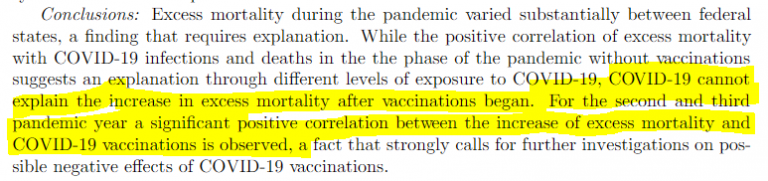
In the paper’s conclusion, the authors found a “significant positive correlation between the increase of excess mortality and COVID 19 vaccinations.”
US Missiles in Germany Again: Why Is Berlin Betraying Its National Interests?
By Dmitry Babich – Sputnik – 19.07.2024
The decision of Washington to start in 2026 the deployment in Germany of US missiles aimed at Russia was not even discussed in Berlin. The public was forced to face a fait accompli. This is a clear degradation of Germany’s standing vis-a-vis the US, compared to the ’80s. Then, a similar deployment was met with protests of West Germany’s citizens.
The governments of both the US and Germany confirmed that in 2026, the American side will begin deploying long-range missiles in Germany. This dangerous move, reminiscent of the worst years of the Cold War, is officially explained by the need to contain “resurgent Russia.”
Gunnar Beck, an expert on European law and former vice president of Identity and Democracy group in the European Parliament, notes that there was no public discussion of this dangerous development in Germany, specifically no discussion in the Bundestag. No details of the deal have been revealed.
“It’s a fait accompli,” Beck told Sputnik. “The German and the US governments have announced they were considering this… But all of the talk of an imminent Russian threat to Europe, in my view, is just a pretext for justifying further military and financial assistance to Ukraine. And, of course, it is a pretext for intimidating the European population and forcing them to accept even larger amounts of military spending.”
Beck notes the few dissenting voices still audible in Germany belong to the parties, which the European Union and especially the European Commission’s chairwoman Ursula von der Leyen try to marginalize:
“There are people on the right and on the far-left which have been criticizing [the deployment]. The German public, by and large, is not war loving. But, of course, there is a lot of propaganda emphasizing that any attack against Ukraine is an attack against Europe as a whole – it is the position of the EU and German government,” Beck told Sputnik.
The situation is reminiscent of the early 1980s, when the US deployed Pershing missiles in West Germany – presumably countering a possible aggression by the Soviet Union. The only difference is that this time Americans promise not to put nuclear warheads on SM-6 missiles, Tomahawks and even some “hypersonic weapons.” These missiles will be carrying conventional warheads that will still make Germany a target for a Russian retaliation starting from 2026.
Beck indicated that American and West German propaganda of that epoch used the same arguments as now. It was said the ability of NATO allies to protect themselves was the best guarantee for peace, etc., but in both cases it was misleading propaganda based on fears and not facts:
“Up to 1987 the propaganda in West Germany evoked the specter of millions of Soviet soldiers stationed in East Germany … that they would all flood into West Germany and occupy the country within three days,” Beck told Sputnik. “The kind of propaganda we are exposed to now is very reminiscent of this. We know today, and we have known for some time already that everything we were told in the 1980s was a great deal of nonsense. There was no evidence whatsoever of a consistently aggressive strategy by the Soviet Union.”
Indeed, Moscow acquiesced to the reunification of Germany in 1990 and withdrew its troops from East Germany in 1994 without a single shot fired. Unfortunately, it is often forgotten now that these concessions were part of the “Two plus four” agreement, whose terms Germany and three other signatories are breaching now.
It was signed on September 12, 1990, by the two (East Germany and West Germany) plus four (the Soviet Union, USA, the UK and France, former members of the anti-Hitler coalition).
Moscow then obliged itself not to prevent the reunification of Germany and to withdraw its troops by 1994 from the territory of the late German Democratic Republic. Both obligations were fulfilled. Now, here is how the obligations of Western powers were breached, in the words of Beck:
“No foreign weapons could be deployed in East Germany… And both German states then agreed that the united Germany would only deploy weapons on its territory if it is done in accordance with Germany’s constitution and the Charter of the United Nations. So, unless there is a UN Security Council resolution, it is a very debatable issue whether Germany can allow the deployment of new weapons that increase the risk of war.”
It should be noted that the German constitution prohibits the supplies of German weapons to the zones of armed conflict. However, Berlin is officially “pumping up” Volodymyr Zelensky’s regime with weapons worth tens of billions of euros.
Beck states the subsequent events showed the deceitful nature of the Western propaganda of the 1980s: Moscow indeed had no intention of invading Europe and withdrew from Germany at the first opportunity. Unfortunately, its goodwill was abused by Western allies.
Now, many Germans suspect a “remake” of the that deceitful intimidation: a poll conducted by Forsa Institute revealed 47% of Germans think the planned deployment of US weapons will only increase the possibility of a Russia-NATO conflict.
However, Beck notes this substantial part of German public opinion is not organized and its will has no chance of influencing the European Commission – or even the government of Germany.
Scholz orders closure of one of the opposition’s largest media networks after interview with Zakharova
By Ricardo Nuno Costa – New Eastern Outlook – 17.07.2024
On 16 July, Jürgen Elsässer (67) woke up startled at 6 a.m., opened the door of his house while still in his dressing gown, and in front of him were dozens of police officers, some with their faces covered, heavily armed, in a surreal image befitting any authoritarian state. However, it was in Brandenburg, on the outskirts of Berlin, in the Germany of the tragicomic Scholz government, aka the ‘Traffic Light’ coalition.
The police were about to raid his house, while more than 200 federal and Brandenburg state agents were deployed to carry out further searches in eight other houses and offices in the region. Other raids were carried out in the states of Saxony, Hesse and Saxony-Anhalt, ordered by Interior Minister Nancy Faeser (SPD), who had ordered Compact to be closed by decree as an ‘association’, when it was legally a publishing house. She also banned any activity by the audiovisual company that produced Compact’s content, such as its YouTube, Facebook and Instagram accounts.
The minister later explained that Compact ‘incites hatred against Jews, against people with a history of migration and against our parliamentary democracy in an indescribable way’. According to the Ministry, the legal basis is the Law on Associations, according to which organisations that are directed against the free and democratic basic order can also be banned.
‘The ban shows that we are also taking action against intellectual arsonists who are fuelling a climate of hatred and violence against refugees and migrants and who want to bypass our democratic state,’ the minister explained. “Our message is very clear: we will not allow ethnicity to define who belongs in Germany and who does not. Our rule of law protects all those who are harassed because of their faith, their origin, the colour of their skin or even their democratic position.”
As early as 2022, the German intelligence services (BND) considered that Compact, ‘as a multimedia company, conveys anti-democratic positions in society and against human dignity’, and since then, it has been classified as far-right by the Office for the Protection of the Constitution and under suspicion.
Interviewed by journalists during the police search of the house where he lives with his wife and partner in the company, Elsässer said that ‘in 14 years of existence there has not been a single criminal charge against his magazine’, which is why he was surprised by the minister’s announcement. He also said that he was in contact with his lawyer to defend his rights and jokingly imitated Donald Trump with his fist raised saying that he was ‘ready for a fight’.
Mixed reactions in the press
While journalists from the mainstream media are refusing to give this episode its due importance, others have seen the government’s unusual decision as a clear warning sign. Opinions were divided between the established media and the few journalists still struggling to report, and the internet was abuzz with the event. The tag #Compact was the main topic on German Twitter throughout the day, and Germans and foreigners alike made the Scholz government’s persecution of the media viral. Germany is under the scrutiny of international public opinion for the worst reasons.
Elsässer complains that this is ‘the biggest attack on press freedom in Germany since the 1962 Spiegel Magazine scandal’. At that time, it was discovered that the Adenauer government wanted to silence several journalists by illegal means for political reasons. When this was discovered, Defence Minister Franz Josef Strauß and two state secretaries had to resign. However, not even then was a troublesome media outlet banned, as it is now with his case. Elsässer says that only in the GDR and during National Socialism were things like this scene.
The metamorphosis of Elsässer, the current standard-holder of Germany’s ‘new right’
Jürgen Elsässer is a long-time political activist. With a degree in history and a short career as a teacher, he started out in the far-left anti-German movement in the 1970s, wrote books with a strong anti-national slant, worked on the editorial boards of various left-wing publications such as Junge Welt, Neues Deutschland, he collaborated with Der Freitag and the Jüdische Allgemeine and was editor-in-chief of Konkret magazine, until after disagreements with other elements, he founded Compact magazine in 2010, with the idea of bringing together the best of the left and the right in a transversal front (‘Querfront’), based on national sovereignty, the multipolar world and the rejection of the EU and NATO.
In 2017, with the demonstrations against Merkel’s open-door immigration policy, he joined forces with the leader of the AfD in Thuringia, Björn Höcke, considered a quasi-neo-Nazi, and Martin Sellner, leader of Austria’s Identity Movement. Since then, the magazine has become a major reference point for the so-called ‘new right’ and Elsässer has become one of the central figures in the German nationalist spectrum.
His political proposal and trajectory are controversial and very heterodox. He clearly calls for the ‘remigration’ of non-European foreigners, makes claims to Polish territories, likes to provoke his opponents, has aligned himself with openly Islamophobic elements such as Michael Stürzenberger or the PEGIDA movement, has played on the edge, but always within the rules of the game. At least until today.
Elsässer is an experienced figure, with a huge culture and a large archive of articles and books written, where he has changed his mind, or at least his appearance. He says that he hasn’t changed at all, that he remains in the same political position as he was 40 years ago.
He worked for the Die Linke parliamentary group as a member of the BND enquiry committee in the Bundestag. He is an insightful expert on geopolitical issues. In 2012, he was received by then president Mahmoud Ahmedinejad in Tehran, together with a German entourage. About that trip to Iran, he said he enjoyed everything, only missing a good cold beer, like the good German he claims to be. He recently teamed up with Maximilian Krah, the AfD’s European frontrunner, who advocates a Germany that guarantees its status as a pole in the multipolar world that has already been born and is taking its first steps.
A quality magazine
Compact magazine was the centrepiece of the network that included audiovisual channels, the organisation of events, conferences, the publishing and sale of books and Compact TV, with its YouTube channel, which recently reached one million views a day.
Over the years, you could say that the magazine has moved to the right. In 2014, it dedicated a cover to Netanyahu, in which it accused him of perpetrating a ‘Genocide in Gaza’, then shifted its focus to criticising immigration, especially of Islamic origin. Later articles were also read against Hamas. With the pandemic, it took a clear stance against the government, the pharmaceutical industry and the accusation of a biological warfare conspiracy by the great powers of the West.
With Russia’s entry into Ukraine, it advocated dialogue with Moscow and the resumption of Russian energy. It was one of the few media outlets to do an exhaustive report on the Nord Stream attacks, to which it devoted almost an entire issue. In its December 2023 issue, it details how an extremely powerful Zionist sect with global reach, currently in the Israeli government, is planning an eschatological end-of-times war with catastrophic consequences for the whole world.
The absence of the Compact has already been felt since the arrival of the ‘Traffic Light’ government. Heavy pressure on distributors led to the magazine disappearing from petrol stations, supermarkets, newsagents and bookshops. Little by little, it was confined to subscribers. It was one of the few magazines where you could read good geopolitical articles.
The German typhoon
The magazine ban is just one more of the government’s decisions that threaten to divide German society, but it doesn’t seem to bother the establishment, either in the government or in the opposition on the traditional right.
Brandenburg’s Interior Minister Michael Stübgen (CDU) welcomed the federal government’s move. Stübgen accused the magazine of spreading ‘Russian war propaganda and conspiracy theories against the democratic order’. He also said that ‘this platform of enemies of democracy has only one goal, which is the destruction of our liberal society’.
In a comment on social media, historian Hermann Ploppa, identified with the left wing and linked to the famous alternative politics portal Apolut, confesses that ‘the Compact is not to my liking. A lot of it is simply disgusting. But there is no violation of the law. It’s also clear that the Compact ban is the opening fanfare to suppress the inconvenient media. That’s why we shouldn’t stand idly by. WE ARE NEXT.”
Across the party spectrum, only the AfD criticised the magazine ban. The party’s leaders, Tino Chrupalla and Alice Weidel, jointly announced on Tuesday that it was a ‘serious blow to press freedom’. ‘The banning of a media organisation means the denial of discourse and diversity of opinion.’ According to the far-right party, the interior minister is abusing her powers to ‘suppress critical information’.
Sahra Wagenknecht’s BSW had not commented on the Compact ban at the time of writing. Wagenknecht has been on the cover of the magazine on more than one occasion. In its December 2022 issue, she was described as ‘The best chancellor: A candidate for left and right’. The relationship between Elsässer and Wagenknecht goes back to the 90s. In 1996, a still communist Elsässer interviewed his comrade Wagenknecht, long before he became one of the main ideologues of the new ‘Querfront’ between the ‘left of labour and the right of values’, an enterprise for which he has called on Wagenknecht to participate on several occasions in recent times.
The Zakharova interview
If the move against Compact magazine didn’t come without warning, it did coincide with the interview with Russian Foreign Ministry spokeswoman Maria Zakharova, conducted two days earlier by Compact’s Moscow correspondent Hansjörg Müller and broadcast on the magazine’s website and YouTube channel.
With hundreds of thousands of hits on the first day on the website and more than 250,000 on YouTube, Zakharova ridiculed the “traffic light” government in the one-and-a-half hour interview. She sharply criticised the policies of Scholz, Baerbock and the sanctions, which not only destroy relations between Berlin and Moscow, but also harm Germany’s own interests, all at the behest of “third-party interests”.
The Russian spokeswoman also alluded to the problem of immigration in Germany, which she said had geopolitical origins, with Berlin playing a subservient role to “US and British operations in the Middle East and Southern Africa”, which are causing the migratory chaos that is burdening Europe.
She also spoke about Germany’s obligations under the 1999 2+4 Treaty, the murky role of the German authorities in the case of Navalny’s alleged poisoning in 2020, the pandemic, vaccines and the announced abolition of paper money in Europe, the Federal Reserve, the destruction of Nord Stream, and much more. All in all, a fascinating interview, highly recommended, and very uncomfortable for Western liberal elites, especially Germans.
It’s clear that, once again, the German government is acting in accordance with the Washington Consensus, because the magazine in question was clearly in favour of peace between Germany and Russia, was gaining public influence and threatening several pillars on which Germany’s structure has rested since 1945. The fact that this doesn’t please many people is understandable, but it doesn’t make it an illegal outlet. Mrs Faeser’s decision sets a serious precedent, foreshadowing difficult days ahead for free information in Germany and Europe. Having found no illegality, the German government had to use two paragraphs of a law on associations to ban a publishing house because it was inconvenient. It’s all food for thought.
Ricardo Nuno Costa ‒ geopolitical expert, writer, columnist, and editor-in-chief of geopol.pt.
Germany secretly sent ‘huge arms package’ to Ukraine – media
RT | July 15, 2024
The German government secretly delivered a new aid package to Ukraine between late June and early July, the Bavarian daily Munchner Merkur reported on Monday. The paper called the shipment “huge,” adding that it was done in a clandestine manner and went “largely unnoticed.”
The package included 39 pieces of various heavy armor from the stocks of Germany’s military and of its defense enterprises, Merkur reported, after analyzing government data. Kiev received ten more Leopard 1A5 main battle tanks and 20 more Marder infantry fighting vehicles (IFVs), among other extra donations, the outlet said.
According to open data published by Chancellor Olaf Scholz’s cabinet, the total number of Leopard 1A5 tanks and Marder IFVs delivered to Ukraine has grown to 50 and 120 respectively.
Other heavy equipment included in the latest delivery involved various engineering and mine-clearing vehicles, according to the report. The package also included 55,000 155mm artillery rounds, according to the government data.
It also showed that Berlin plans to send, by an unspecified date, 85 more Leopard 1A5 tanks to Ukraine, as part of a joint project with Denmark. The future deliveries are also to include 20 additional Marder IFVs. Merkur reported that Berlin had planned to provide Ukraine with up to 80 Leopards by the end of 2023 but fell behind schedule as the nation’s defense industry struggled to find spare parts for the armor pieces.
According to Merkur, Kiev is still hoping to get enough German tanks to form a specialized brigade for offensive operations and has been “holding back” its remaining western tanks for months.
The Russian military has previously published numerous videos showing German tanks being destroyed with kamikaze drones or even captured by Russian soldiers after being abandoned by their crews.
The latest batch of weapons also included two ground-based IRIS-T air defense systems and three US-made HIMARS multiple rocket launchers. In May, German Defense Minister Boris Pistorius vowed Berlin would pay for the delivery of the US-made systems to Ukraine.
Germany has emerged as the second largest single military donor to Ukraine throughout the conflict, spending some €10.2 billion ($11.14 billion) on providing arms to Kiev between January 2022 and April 2024, according to the Kiel Institute for the World Economy. Berlin has said some €28 billion ($30.5 billion) has been made available to support Kiev now and in the coming years.
In June, Chancellor Scholz admitted that many Germans were unhappy with the nation’s military support of Ukraine, but he maintained that there was no alternative to arming Kiev. In July, Ukraine’s Vladimir Zelensky stated that his country would “never” have enough weapons.
US plan to deploy missiles in Germany a ‘direct threat’ – Moscow
RT | July 11, 2024
US plans to deploy long-range missiles in Europe are a threat to global security and could pave the way for an escalation of already tense relations between Moscow and NATO, Russian Ambassador to Washington Anatoly Antonov has said.
On Wednesday, the US and Germany issued a joint statement that America “will begin episodic deployments of the long-range fires capabilities of its Multi-Domain Task Force in Germany in 2026, as part of planning for enduring stationing of these capabilities in the future.”
Washington also said that the systems will include SM-6 and Tomahawk missiles with ranges of up to 460km and 2,400km, respectively, as well as developmental hypersonic weapons. Those assets have a “significantly longer range than current land-based fires in Europe,” the statement added.
In a post on Telegram on Thursday, Antonov denounced the move as “a serious mistake by Washington.” “Such extremely destabilizing steps are a direct threat to international security and strategic stability,” he said.
The envoy stressed that the planned deployment “increases the risks of a missile arms race,” adding that it could unleash “uncontrolled escalation amid dangerously soaring Russia-NATO tensions.”
Antonov also said that Russia has always sought to reduce the risks posed by disagreements over missile capabilities. “Instead of the desire for peace that Russia has demonstrated many times, the Americans have embarked on the dangerous path of militarism,” according to the ambassador.
He emphasized that Russia’s tolerance for encroachments on its security is “not unlimited.” “Doesn’t Germany understand that the emergence of American missile assets on German soil will lead to these facilities ending up in Russian crosshairs? This is not saber-rattling, it is the simple logic of a normal person,” Antonov explained.
He went on to blast the US for not thinking about how to minimize the fallout from the collapse of the Intermediate-Range Nuclear Forces Treaty (INF). Signed in 1987 at the end of the Cold War, it barred Moscow and Washington from possessing many types of nuclear and conventional missiles with ranges of 500 to 5,500km.
The US unilaterally withdrew from the treaty in 2019, citing alleged Russian non-compliance, a charge denied in Moscow. Russian Deputy Foreign Minister Sergey Ryabkov suggested earlier this week that the US pulled out of the agreement to create formerly banned missile systems to put pressure on China.
At the same time, Russia has said that it intends to keep abiding by the INF’s terms, but warned that it could reverse that policy if Washington starts deploying missiles covered by the treaty in any region of the world.
US to deploy long-range weapons in Germany
RT | July 10, 2024
The US will station long-range missiles in Germany from 2026 onwards, the governments of both countries have announced. These weapons, including the SM-6 and Tomahawk systems, were banned on the continent until Washington tore up a landmark Cold War-era treaty in 2019.
According to a joint statement published by the White House, the US will “begin episodic deployments of the long-range fires capabilities of its Multi-Domain Task Force in Germany in 2026, as part of planning for enduring stationing of these capabilities in the future.”
The statement was released following talks between American and German officials at NATO’s annual summit in Washington on Wednesday.
The weapons systems deployed to Germany will include the SM-6 anti-air missile, which has a range of up to 460km (290 miles), and the Tomahawk cruise missile, which can reportedly strike targets more than 2,500km away.
The White House said that “developmental hypersonic weapons” will also be stationed in Germany, and will have a “significantly longer range than current land-based fires in Europe.”
The US has yet to successfully field a hypersonic weapon, and has canceled every hypersonic project since its first successful test in 2017.
Land-launched missiles with a range between 500km and 5,500km were banned on European soil under the Intermediate-Range Nuclear Forces (INF) treaty, signed by Ronald Reagan and Mikhail Gorbachev in 1987. Along with the START-I and START-II agreements, the INF treaty helped defuse nuclear tensions in Europe after the West and the USSR came perilously close to nuclear war during NATO’s Able Archer military exercise in 1983.
The US pulled out of the INF treaty in 2019, with the State Department claiming that some of Russia’s cruise missiles had breached the agreement. Moscow denied this, and Russian President Vladimir Putin warned then-US President Donald Trump that the demise of the treaty would “have the gravest consequences.”
Russia continued to abide by the treaty and imposed a moratorium on the development of missiles that it prohibited. However, Putin announced earlier this month that the Russian defense industry would resume development of such armaments, citing the “hostile actions” of the US.
“We now know that the US is not only producing these missile systems, but has also brought them to Europe, Denmark, to use in exercises. Not long ago, it was reported that they were in the Philippines,” Putin explained at the time.
US and Danish forces trained with SM-6 missiles last September, while the Pentagon deployed its Typhon Weapon System – which can fire both SM-6 and Tomahawk missiles – to the Philippines in April.
A tale of two cities: have we seen a ‘surge to the Left’ in British and French elections?
By Gilbert Doctorow | July 9, 2024
In the past five days, parliamentary elections were carried out in Britain and in France. The results were dramatic, attracting a great deal of media attention.
In this brief essay, we will look behind the bald facts of vote counts and strive to make sense of where the UK and France are headed. What does the latest news tell us about the ‘managed democracies’ in Europe? I will direct particular attention to the different electoral and governance systems operating in Britain and France, given that these respective systems were so influential in delivering the results we are seeing?
*****
The sitting governments in both France and the United Kingdom were overturned in the past week. Looking at the winners, one might conclude a new or updated Left has won in both elections. If so, this runs directly counter to the media bugbear of resurgent populism that supposedly endangers democracy. Should the winners break out the champagne?
In Britain, Labour won a landslide victory, taking absolute control of Parliament and ending 14 years of Tory chaos and misrule. In the American vernacular, British voters were given the opportunity to ‘throw the bums out’ and they availed themselves of it. Tory leader and incoming Prime Minister Keir Starmer achieved this success by having expelled from the party the genuinely Leftist former leader Jeremy Corbyn and taken up the winning ‘New Labour’ centrist position first defined by former Prime Minister Tony Blair.
Some of the more odious former or present Tory ministers, such as the holder of the record for shortest time serving in 10 Downing Street, Liz Truss, lost their seats in Parliament.
In France, Macron’s party, or ‘movement,’ yesterday lost its tenuous hold on parliament, coming in second to the New Popular Front, as the united Left parties call themselves, in a three-way race. Macron and his supporters could savor a victory of sorts by having risen from the ashes of the European Parliament voting on 6 June and of the first round of balloting for their national parliament a week ago, when they appeared to enjoy no more than 15 – 20% of voter support. Now they hold nearly a third of parliamentary seats and can hope to forge a coalition with the united Left parties to keep their sworn enemies, the so-called ‘Extreme Right’ National Rally of Marine Le Pen, away from the levers of power. The outcome is what political commentators call a ‘hung parliament’ in which two of the three rival blocs of deputies will try to form a ruling coalition while the President tries to stand above the bickering and back-stabbing while exercising near-dictatorial powers of legislating by decree.
That there will be a lot of bickering is beyond doubt: the single most prominent voice in the New Popular Front is that of Jean-Luc Mélenchon, head of the France Unbowed party. He is the embodiment of anti-capitalist spirits within the country, and though he claims that the Left is ready to govern, and though he or one of his allies may well be tapped by Macron to form a cabinet, it is hard to see how parliament and president can cooperate on anything whatsoever in the days and months ahead. It is nearly certain that France will continue its descent from relevance within the EU and within the world at large that the dimwitted and cowardly François Hollande oversaw from his CIA-stage managed electoral victory back in 2012 onwards. In his years in office, Macron has tried repeatedly to rescue the country from its descent by one failed initiative after another.
*****
The opposing principles of the electoral and governance systems in Britain and France are ‘first past the post’ in the former, where victory is handed in each district to the candidate with the greatest number of votes, and inclusive, proportional representation in government of the latter wherein seats are reserved for representatives of minorities in the voting public. I say this in the full knowledge that the coalition governments which are the almost inevitable consequence of power sharing schemes and are widely practiced across the Continent, are the rare exception, not the rule in France. In France, it has been customary for one party to hold an absolute majority in parliament and to form a cabinet of ministers that shares the same policy priorities and is chosen from among those prepared to assume power at any time in what the British call a ‘shadow cabinet.’
The strength of the British system is that it makes possible sharp changes in direction of government policy when the public is persuaded that the powers that be are not functioning in their interests. The weak point is that given the often low levels of voter turn-out and the share of votes cast held by the winning party relative to all votes, the incoming government may actually be said to represent a very small percentage of all eligible voters. Margaret Thatcher, for example, dramatically changed the direction of the British government while having enjoyed no more than 25% of the popular vote.
In the given case of the British elections on 4 July, something similar occurred. It has been widely commented by political analysts, and stated most succinctly and pointedly by the leader of the Reform UK party Nigel Farage, that the vote for Labour was not so much attributable to support for Labour as it was a rejection of the Tories. By Farage’s estimate, perhaps half of the Labour vote falls into this category, so that the actual support level of Labour and its policies may have been no more than 18% of the electorate. Of course, this detail is swept under the carpet in the headlines and opening paragraphs of the reports we read in the press and see on mainstream television.
The strength of the Continent-wide system of power sharing and coalitions is its ‘progressive’ appearance, its very inclusiveness. Inclusiveness, let us remember, is the new divide between Conservatives and Liberals, whether it goes by the name ‘identity politics’ or not. It long ago replaced policies for how you divide up the economic pie among contending strata of the population. On the Continent, many different parties get to share in the responsibilities and spoils of power.
I put the accent on ‘spoils,’ because I maintain that coalitions are a formula for institutionalized corruption. Governments are formed by back-room deals among the various parties in the agreed coalition. Ministerial portfolios are allocated with scant attention to the competence of the appointees for the given post, looking instead to the need to reward top party personalities for their adherence to the coalition. And the policies set out may well be in sharp contradiction with one another, meaning implementation can well be inconsistent and ineffective. There can be no better illustration of the pitiful results of coalition building than the current federal government of Germany, where ill-educated and wholly incompetent ministers such as Annalena Baerbock at Foreign Affair and Economy Minister Robert Habeck are a disgrace to the good name of European statesmen and women from generations past.
Let me emphasize here that a hung parliament was precisely the wish of Macron and his immediate entourage when they understood that there was no chance of their own list of candidates holding onto power alone and there was every risk of Le Pen getting an absolute majority. The pro-Macron forces of French politics are strongly pro-market, as one would expect from a leader who entered politics after making his career in the counting rooms of the Rothschild bankers and brokers. Yet, out of purely opportunistic calculations, in the week between the first and second rounds of balloting, they reached agreement with the New Popular Front on which of the two would withdraw their candidate from the race in given electoral districts so as to better ensure victory over Le Pen’s party there. It worked, but will the resulting parliament work? That seems not to interest M. Macron at this moment.
*****
In his victory speech, following official release of the vote results, Keir Starmer twice made the remark that in power he will place ‘country above party.’ Emmanuel Macron and his allies have pursued the opposite, party above country, and France will be the worse for it.
But then again, we in the pro-Sovereignty, anti-globalist, anti-supranational bureaucracy Opposition can only say ‘the worse, the better.’
One thing is certain in France: the country will be rent with internal discord at the highest levels of government. The Fifth Republic has survived periods of ‘cohabitation’ between a President of one party and set of policy priorities and a parliamentary majority held by another party with different policy priorities. It has not experienced the cohabitation with a hung parliament that we see now.
As regards foreign policy, our newspapers today speak of the blow to Israeli interests that the approach to power by Mélenchon with his pro-Palestinian bias signifies. We hear less about what the electoral outcome in France signifies for the war in and about Ukraine. A victory by Le Pen would certainly have put a check on any further French military commitments to Kiev, and possibly would have led to French withdrawal from NATO. For the moment, that very possibility has been eliminated. Nonetheless, a weak and divided France, such as we shall see in the months ahead, is good news for those of us who wish to see an end to the spineless conformism at the top of European Institutions leading us all towards Armageddon.
Regrettably, in Britain there will be no change from the pandering to Washington’s worst instincts and unlimited support for the dictator in Kiev. The only voice in British politics who stands for reason on relations with Russia is Nigel Farage. It is some small consolation that Farage has won a seat in Parliament, even though the 15% of the popular vote that his party achieved has not been rewarded by more than a handful of seats.
Postscript: One reader has brought to my attention the fact that France in fact has a first past the post as opposed to the proportional representation system so common elsewhere on the Continent. Accordingly I shift my emphasis elsewhere in the French situation and say that the outcome is uniquely due to Macron’s opportunism and tactical thinking at the expense of strategic thinking and patriotism; he has engineered a three way split in the lower chamber to keep Le Pen from power while knowingly making Franch ungovernable and returning the country to the instability it suffered during the Fourth Republic.
©Gilbert Doctorow, 2024
Germany to Close Airbase in Niger After Negotiations on Soldiers Immunity Fail – Reports
Sputnik – 07.07.2024
The German armed forces will give up its airbase in Niger, which was used as a military transport hub, by August 31, as the sides failed to extend the agreement concerning the base, German media reported on Saturday, citing the German Defense Ministry.
The talks broke down after the new Nigerien authorities had refused to grant German soldiers with immunity from prosecution, the NTV news outlet reported, citing a document the ministry had presented before the parliament.
Germany expects to withdraw its troops from the country by the end of August as well.
The German military has used the base in Niger’s capital, Niamey since 2013 as a supply center for its armed forces in neighboring Mali, which were stationed there as part of a UN peacekeeping mission.
Nigerien authorities, which took power in a military takeover in July 2023, have since then also terminated military agreements with France and the United States, which led to the French and US forces’ withdrawal from the country.
Featured Video

Macgregor: We Haven’t Seen the Worst of the Iran War Yet
or go to
Aletho News Archives – Video-Images
From the Archives
15 Saudi ‘hijackers’ were CIA agents working for US: Scholar
Press TV – April 13, 2016
Fifteen of the 9/11 “hijackers” from Saudi Arabia were CIA agents working for the United States government, which was seeking to destroy the Middle East for Israel and to double the American military budget, says Dr. Kevin Barrett, an American academic who has been studying the events of 9/11 since late 2003…. continue
Blog Roll
 Aletho News
- Israel seeks ‘compensation’ from Washington over Saudi F-35 sale
- Saudi crown prince seeks dialogue with Ansarullah after Yemeni blows: Report
- Damascus rejects Saudi request for Syrian fighters to counter Yemen: Report
- South Korea says will not send troops to join terrorist US war on Iran
- Russia Just Struck the Eyes of NATO’s War Machine in Ukraine
- Russia summons UK charge d’affaires over Kiev drone support
- NATO member warns bloc seeking pretext for war with Russia
- Macgregor: We Haven’t Seen the Worst of the Iran War Yet
- ‘We are not like everyone else’ laws that bind other nations do not apply to Israel, says Likud lawmaker
- Report: Saudi Arabia seeks allies’ assistance as missiles deplete amid war on Yemen
- If Americans Knew
- Debunking The Claim That Macklemore Has A “History Of Antisemitism”
- CPJ demands release of arrested Palestinian-US journalist near Bethlehem
- Robert Kraft: The Billionaire Friend of Netanyahu Pulling The Strings Behind the Macklemore/Ed Sheeran Blow Up
- Columbia Administered Fund Gives Big Money to Pro-Israel Groups
- Deportation Case of Palestinian Activist Salah Sarsour Tests First Amendment
- ‘We Will Not Forget’: Palestinians Mark 44 Years since Sabra and Shatila
- Why do we let Zionists decide what we can and can’t say?
- US welcomes Israeli, Iranian delegations to UN, but not Palestinians – Daily Update
- Biden’s Genocide Accomplices Targeted by New Accountability Campaign
- AIPAC’s Network Has Already Spent $67.2 Million to Shape the Midterm Elections
- No Tricks Zone
- New Study: ‘Global Drought Shows No Detectable Recent Acceleration Under Climate Warming’
- Economic Masterminds: German Socialists Suggest Taxing Productivity Gains Stemming From Using AI
- The South China Sea Has Not Been Cooperating With The Climate Change Narrative
- Energy Crisis: Germany Enters Heating Season With Historically Low Gas Reserve Fill Levels
- New Study: The Antarctic Ice Sheet Gained Mass From 2020-2024 Due To Staggering Snow And Ice Accumulation
- Study: Ocean Heating Rates From Thousands Of Years Ago ‘Dwarf’ Modern Ocean Heating Rates
- Climate Extremists Target, Attack Large-Scale Power Grid Infrastructure In Germany!
- New Study: Antarctic Ice Melt Has Contributed Less Than 1 Centimeter To Sea Level Rise In The Last 30 Years
- Fear Of Debate: Alarmist German Climate Scientist Calls On Mainstream Media To Discredit Skeptic Voices
- End-Of-August Arctic Sea Ice Extent Hasn’t Fallen In 20 Years, Official Data Show!
 Aletho News