Germans expected to make their own bomb shelters – Bild
RT | January 28, 2024
Germans will be expected to turn their homes into bomb shelters in case a major war breaks out in Europe, newspaper Bild reported on Saturday, citing a draft document from the country’s Defense Ministry.
According to the report, the ministry is set to complete the work on the classified ‘Operational Plan’ (OPLAN) by April. The draft envisions Germany as a “transit country” crucial for the delivery of weapons and equipment rather than a state with an active frontline. For that reason soldiers would be tasked with securing key highways, railway stations and ports, Bild said.
At the same time, the state would have to rely on civilians to step in and cover some duties typically assigned to the military and police, including the protection of power plants.
There are only 579 functional bomb shelters in Germany, so the plan reportedly sees citizens setting up their own shelters in places such as basements and garages. Bild quoted the head of the Federal Office of Civil Protection and Disaster Assistance, Ralph Tiesler, as saying that building new shelters is “no longer feasible” due to time constraints.
Germany has been looking for ways to boost its army, citing the threats stemming from the ongoing Russia-Ukraine conflict. The government set the goal of increasing the size of the Bundeswehr from 183,000 soldiers to 203,000 by 2031.
Defense Minister Boris Pistorius stated this month that Russia could attack a NATO country “within five to eight years.” He later somewhat adjusted his assessment, telling Bild on Friday, “At the moment, I don’t see any danger of a Russian attack on NATO territory or on any NATO partner-country.”
Russia has repeatedly accused NATO of fearmongering and stoking tensions in Europe. The head of Russia’s Foreign Intelligence Service, Sergey Naryshkin, recently dismissed the claims that Moscow is planning an attack on NATO as “informational warfare.”
Germany’s dream of building a fleet of hydrogen-fired power plants is faltering
By Paul Homewood | Not A Lot Of People Know That | January 26, 2024
When green fantasies hit the brick wall of cold reality!
By 2035, Germany wants to produce 100% of its power in a climate-neutral way. To back up wind turbines and solar panels, whose production is expected to dominate in the coming years, the government initially envisioned a fleet of hydrogen-fired power plants.
But these plans are now faltering amid a prolonged government budgetary crisis, said Sigfried Russwurm, the president of Germany’s powerful industry association BDI.
In early August 2023, the German government triumphantly announced that the European Commission had essentially greenlit its plan for subsidised backup power plants.
That meant 8.8 GW of dedicated hydrogen power plants, alongside 15 GW of natural gas-powered ones that ought to switch to hydrogen by 2035 at the latest, in total representing about one-third of the German peak power demand of 2023. Climate-friendly power at the press of a button.
Because these plants would likely only produce power in periods of sustained low wind and low sun – known as “kalte Dunkelflaute” – they are unlikely to make a profit without state support.
And critically, the annual €7 billion earmarked for this purpose “evaporated” following a ruling from Germany’s top court, which restricted the government’s use of credit lines approved during the COVID-19 crisis.
With no hydrogen plants available as backup, coal power will likely be needed to fill the gap, the BDI chief warned.
“As long as the prospect of new backup power plants based on hydrogen does not get off the ground […] the solution in Germany will be the continued operation of coal-fired power plants,” Russwurm told the press on Tuesday (16 January).
Given budgetary constraints, the two industry associations are urgning the government to cut corners and ditch plans for hydrogen-fired power plants.
Industry groups are now urging the government to take action. “The Federal Government must now get its act together: We need a power plant strategy with clear framework conditions,” said energy industry association BDEW on 11 January.
“At least 15 gigawatts (GW) of new secure generation capacity will be needed in Germany by 2030,” the association added.
Given budgetary constraints, the two industry associations are urging the government to cut corners and ditch plans for hydrogen-fired power plants.
“To significantly reduce complexity and costs,” BDEW stresses the need to “reevaluate” the role afforded to hydrogen peak and hybrid power plants, due to their expensive components and limited impacts on supply security.
Russwurm is of a similar mind. Outlining the BDI’s priorities for the year, he used metaphors to explain what a hydrogen-fired power plant would look like.
Existing power plants can’t run on “pure” hydrogen because the “burners would simply melt”, he explained. Addressing this would require retrofitting the plants with ceramics, which would make them look like the nose of a spaceship folded inwards – a process that can be done but is costly, the BDI chief said.
“If these turbines are only supposed to run when the sun isn’t shining and the wind isn’t blowing, then they will be extremely expensive,” he added.
“I’m not even talking about the cost of hydrogen, which we don’t have, but only the investment costs of these new gas turbines and their new peripherals.”
Ultimately, this means Germany’s plan to entirely phase out coal power by 2030 looks unlikely to materialise. Instead, Germany will have to continue relying on gas-fired power plants to match growing demand for electricity.
https://www.euractiv.com/section/electricity/news/germanys-dream-of-building-a-fleet-of-hydrogen-fired-power-plants-is-faltering/
As the guy from BDI notes, 7 billion euros a year is just the cost of subsidising these hydrogen back up power plants. On top of that comes the cost of actually producing the hydrogen and the question of where the electricity will come from to do it.
Biden halts new LNG exports
The fuel is seen as a vital lifeline for Western Europe, which has cut itself off from cheaper Russian gas imports
RT | January 26, 2024
US President Joe Biden has ordered a pause on liquefied natural gas (LNG) exports from new projects in the country, citing their potential contribution to climate change. Energy costs in Western Europe have skyrocketed since nations such as Germany switched from Russian gas to American LNG, but Biden insists the continent doesn’t currently need additional supplies.
The pause will allow the US Department of Energy (DOE) to update the economic and environmental guidelines it uses when approving new export licenses, and will last for several months.
“During this period, we will take a hard look at the impacts of LNG exports on energy costs, America’s energy security, and our environment,” Biden said in a statement on Friday. The president added that the pause “sees the climate crisis for what it is: the existential threat of our time.”
According to the White House, roughly half of American LNG exports went to Western Europe last year, and the US has exceeded its annual delivery targets to the EU for each of the last two years. “Today’s announcement will not impact our ability to continue supplying LNG to our allies in the near-term,” Biden claimed in his statement.
Europe remains mired in an energy crisis. The continent’s former industrial powerhouse, Germany, is “in a particularly difficult situation” after abandoning Russian gas supplies, Economy Minister Robert Habeck told lawmakers last week. Prior to the imposition of sanctions on Moscow over the Ukraine conflict, Germany received 40% of its gas imports from Russia. Replacing this fuel with LNG from the US, as well as energy from Norway and the Netherlands, has come at a cost, with the German government forced to roll out massive subsidy packages to prevent its largest industrial firms from leaving the country.
German industrial output fell by 2% last year, while the entire economy shrank by 0.3% in the same time period, the country’s Federal Statistical Office reported last week. The office blamed the decline on high inflation, soaring energy prices, and weak foreign demand.
LNG is transported on large tanker ships to regasification plants, where it is heated to return it to a gaseous state. Germany has rushed to bring three such offshore plants online since early 2022, and plans to open three more over the coming months. The US has also built out its LNG export infrastructure to cope with the demand, including the Calcasieu Pass 2 project in Louisiana, which once certified will be the nation’s largest export terminal.
The Calcasieu Pass 2 facility will likely come before the DOE for approval in the coming weeks, where it will be stalled indefinitely by Biden’s pause. With half of the terminal’s output set to go to Germany, a spokesman for the project’s developer, Venture Global, told Reuters last week that the pause would send a “devastating signal to our allies that they can no longer rely on the United States.”
Norway’s Top General Urges Defense Spending Hike Amid NATO Fearmongering
By Svetlana Ekimenko – Sputnik – 24.01.2024
The specter of a “Russian threat” ostensibly looming is being invoked in the West increasingly loudly as justification for ramping up military spending, with Norway’s top brass the latest to lap up this tenuous narrative.
Norway has only a small window of opportunity to ramp up its defense spending in the face of a “looming threat” of military conflict with Russia, the head of the Norwegian Armed Forces has warned.
Jumping on the bandwagon driving the cynical “Russian bogeyman” narrative, General Eirik Kristoffersen claimed in a recent interview that Norway needs to build up its defenses before it is too late.
“The current window of opportunity will remain open for a year or two, perhaps three, which is when we will have to invest even more in our defense,” General Kristoffersen said in an interview with the local outlet Dagbladet. He added:
“We do not know what will become of Russia in three years. We need to prepare a strong national defense to be able to meet an uncertain and unpredictable world.”
The Norwegian general lamented the fact that Moscow was reportedly building up its weapons stockpiles at a greater speed and efficiency than NATO allies had expected.
Currently, NATO member Norway lags behind the alliance’s defense spending requirement of two percent of GDP per year. While originally setting itself the timeline of achieving that goal by 2026, apparently the raucous peddling of the concocted “Russia threat” is forcing Norway’s generals to lose sleep over the ominous forebodings.
“This is a calculated risk. If the danger was imminent right now, then we could not have given so many weapons [to Ukraine]. But that is not the case,” Kristoffersen said, while adding that Ukraine needs to be supported for as long as it takes.
Norway’s chief of defense also went as far as to urge Norwegians to begin stockpiling food, saying that “What the Norwegian population should think about is their own preparedness.”
These remarks by Kristoffersen echo those of his Swedish colleague. Commander-in-Chief Mikael Byden told Swedes to “prepare themselves mentally” for an open conflict with Russia. Another warmonger, Dutch Admiral Rob Bauer, the NATO Military Committee chief, stated in Brussels last Thursday:
“We have to realize it’s not a given that we are in peace. And that’s why we [NATO forces] are preparing for a conflict with Russia.”
Boris Pistorius, the German defense minister, claimed earlier that Russia may choose to attack a NATO country within “five to eight years.”
While pumping Ukraine with billions’ worth of weapons for its proxy conflict with Russia, the US-dominated alliance has upped the Russia threat narrative in recent months. The rants have been particularly timed to the growing “Ukraine fatigue” and dwindling support for continuing to aid the Kiev regime. Pistorius’ comments echoed a report in the German daily newspaper Bild. Quoting a “confidential Bundeswehr document,” it claimed that a conflict between NATO and Russia could erupt as soon as the summer of 2025.
The Kremlin has dismissed the report as “fake news,” with spokesman Dmitry Peskov doubting Bild’s credibility. Foreign Ministry spokeswoman Maria Zakharova compared the leaked plan to a “powerful horoscope,” saying she wouldn’t be surprised if the scenario was provided to the German military by the Foreign Ministry and its notoriously Russophobic chief, Annalena Baerbock.
German steel production plunges to 15-year low
The home of the largest steel industry in Europe, Germany is facing a continuous crisis over sky-high electricity prices
By John Cody | Remix News | January 24, 2024
Steel production in Germany is cratering, reaching a low point last seen during the 2008 global economic crisis. Steel production dropped to 35.4 million tons in 2022, a decrease of 3.9 percent from 2021.
The hardest hit segment of steelworks was the electrical steel industry, which saw its production sink by almost 9 percent to 9.8 million tons, a figure even lower than the 2009 low. Overall, all segments of the steelworks industry in Germany saw declines.
Since the beginning of the Russian-Ukrainian war, there has seen a continuous downward trend in the German steel sector, in large part due to soaring electricity prices.
Kerstin Maria Rippel, managing director of the German Steel Federation, cited “weak demand” and “intentionally uncompetitive” electricity prices as being factors behind the crisis.
“The annual balance of steel production in Germany clearly shows that the situation for the steel industry (…) is very serious,” she added.
In what appears to be a shot at the ruling left-liberal government, Rippel says that her association notes an “urgent need for political action” regarding transmission grid fees, which have doubled since the beginning of 2023.
She is calling for state subsidies from the “Climate Transformation Fund” to help the sector finance a turnaround.
“We need a clear political concept on how the path to climate neutrality is to be sustainably financed,” said Rippel.
Soaring energy and material costs have hit German industry particularly hard, and the role of the Christian Democrats (CDU) in pushing for the phasing out of nuclear power — a move also supported by the Greens — has also played a role.
The Alternative for Germany party has pointed to the current left-liberal government, along with the previous CDU-led government, as being behind the long-term decline in Germany’s industrial sectors. However, the situation has grown especially dire under Chancellor Olaf Scholz.
“Only on Monday, the pharmaceutical and chemical giant Bayer announced a ‘significant workforce reduction’ by the end of 2025. The tire manufacturer Continental is terminating the 40-hour contracts of thousands of employees, and the gear factory Friedrichshafen (ZF) apparently wants to cut 12,000 jobs. However, the traffic light government doesn’t care about any of this,” wrote the AfD in a statement.
The AfD says it will reverse the green “energy transition” and repair the Nord Stream pipelines in order to return cheap Russian energy to German industry. The party also promises to reduce the tax burden and bureaucracy to jumpstart the German economy.
Germany Can’t Afford Rearmament, Let Alone a ‘War’ With Russia
By Ekaterina Blinova – Sputnik – 23.01.2024
Germany must take into account the possibility of a military conflict with Russia and prepare for it over the next three-five years, Defense Minister Boris Pistorius told ZDF on January 22.
He insisted that the German Bundeswehr armed forces should become “a credible deterrent,” and that a German combat brigade would be deployed in the Baltics to become “fully combat-ready” by 2027.
In December, Pistorius signed an agreement for the permanent deployment of a Bundeswehr brigade to Lithuania and announced that the reintroduction of compulsory military service in Germany is now on the table.
Does Russia really present an imminent threat to German national security?
“If you ask me, and if you ask most people in my party, the answer is unequivocally no,” Gunnar Beck, Member of the European Parliament for the Alternative for Germany (AfD) party who is currently Vice-President of the Identity & Democracy Group in the Parliament, told Sputnik. “Ever since 1990, at the end of the Soviet Union, the Russian government has gone out of its way to intensify economic relations between Russia and Germany. We had extremely favorable energy contracts with Russia. And Russia was a growing export market for our agricultural and industrial goods. It’s due to our government’s policy, vis-a-vis Ukraine conflict that relations with Russia are now almost at an all time low. So, on the one hand, I think, German policy and EU policy has been a provocation. Nonetheless, I think that the Russian reaction to the sanctions in particular has been tough, but at the same time measured. So in my view, Russia is no immediate security threat to Germany. Categorically not.”
Germany Cannot Afford Rearmament
Not only is Germany’s justification for rearmament in question but also the nation’s ability to afford it, according to Beck. German industry is in a dire state as a result of the government’s policies, he stressed.
“Germany currently finds itself in what is probably the most serious economic crisis since the Second World War,” Beck said. “The government’s policies (…) are affecting all leading branches of German industry, which is suffering from high inflation, lack of qualified labor, bureaucracy and high tax levels. As a result, our exports have declined significantly. So we are in crisis, and German industry, which has always been the backbone of German prosperity, in particular, is in crisis.”
He listed three major reasons for the new talk of militarization:
- First, the German government’s energy and climate change policy;
- Second, unprecedented migration into Germany from outside Europe of unskilled workers and the astronomical cost to German public finances;
- Third, Germany’s policies on Ukraine and sanctions imposed on the Russian economy.
Berlin’s decision to follow Washington’s lead and slap sweeping sanctions on Russia has backfired on Germans on a much greater scale than on any of their Russian counterparts, according to the politician.
“In my view, Germany is in no fit state economically and financially to embark upon a massive rearmament program,” Beck said. “If the German government seriously did so, the consequence would be a further significant worsening of the economic crisis. The only way to finance such rearmament would be through a complete reversal of all the other policies and massive remigration of migrants from Germany. The government has given no indication that it is prepared to do so. In other words, I think these declarations are probably largely symbolic. Germany simply cannot afford it.”
Europeans Don’t Want to Fight Against Russia
The majority of Germans are not worried about a military threat from Russia, according to Beck, raising doubts as to whether Pistorius’ militarization plan would gain any popular traction in Germany and other European states.
“Diplomacy should be the West’s weapons of choice in its relations with Russia, not more armaments,” Geoffrey Roberts, emeritus professor of history at University College Cork, Ireland and a leading British scholar on Soviet diplomatic and military history, told Sputnik, stressing that Europeans have zero appetite for a major war with Russia.
“This bellicose rhetoric is part of a campaign by Western hardliners to further militarize Western states and societies, their aim being to prolong the Ukraine war for as long as possible and to create a permanent confrontation with Russia. Predictions of future war with Russia heighten existing tensions and solidify a mindset in which military power is seen as the solution to political problems,” Roberts continued.
Confrontation between Russia and NATO is fraught with serious risks and is “far more dangerous than anything that happened during the Cold war,” according to the professor.
“During the Soviet-Western Cold war there were many proxy wars and conflicts but nothing comparable in scope, scale and intensity to what is happening in Ukraine,” Roberts noted, referring to the West’s ongoing proxy conflict in Eastern Europe which involves NATO’s Special Forces, weapons, intelligence, military training and sabotage techniques.
“Western hardliners have whipped up an atmosphere of hysteria that could spread violence to other sections of the front-line between NATO and Russia. There is an urgent need for Western governments to heed popular calls for peace and a security settlement with Russia that will avert this new cold war – a conflict that could lead to catastrophe,” the professor concluded.
Moscow is closely observing the tone of European political discourse, warning against provocative rhetoric. Kremlin spokesman Dmitry Peskov noted on Tuesday that many other European countries than Germany have made statements about a “threat” posed by Russia. Earlier in January, Pistorius claimed that Russia could attack a NATO country “one day.”
“Now all European capitals are racing to declare an ephemeral danger that allegedly comes from Russia,” Peskov told reporters. He added that Europe has already invested heavily in the Ukraine conflict, but now see that their plan “failed” and the economic situation was “getting difficult.”
France’s and Germany’s Lack of Independence Forces Them to Continue Bankrolling Ukraine
Sputnik – 20.01.2024
While Western powers’ lavish financial and military contributions to Kiev’s war effort have so far failed to produce any meaningful results, many leaders seem eager to keep bankrolling Ukraine until it runs out of manpower.
The EU may be looking to amend the mechanism used to provide military support to Ukraine by creating a new fund in addition to the European Peace Facility (EPF) that has so far been used by Europe to funnel arms to Kiev.
According to Bloomberg, the new fund may have an annual budget of €5 billion but EU member states are yet to come to a consensus on how this initiative is going to work out.
Commenting on this development, Gabor Stier, senior foreign policy analyst at the conservative Hungarian daily Magyar Nemzet, told Sputnik that whatever shape and form this new fund is going to take, it will ultimately harm European states.
According to him, the EU leadership is essentially trying to come up with a plan to bankroll Ukraine regardless of what Hungary might think about it, with Stier referring to attempts by Hungarian Prime Minister Viktor Orban to come up with a plan to provide aid to Ukraine without harming the EU budget in the process.
Orban’s proposals – that involve dividing the aid to Kiev into smaller tranches and keeping track of exactly how this money would be spent – are very much disliked by Brussels, Stier said. The EU leadership is reportedly concerned that the Hungarian prime minister might veto options he does not like (as decisions to allocate funds under the auspices of EPF require unanimous agreement).
“There will be a new fund but with what money?” Stier inquired. “The first option would be a new fund where money from the EU budget would go into. This does not solve the issue with the Hungarian veto. The second option would involve creating a fund outside the EU budget. The problem with this option is that it would take too long as each (EU) country and its respective parliament would have to vote on it separately. There will be arguments and it will all drag on. While this would go on, Ukraine would already suffer a defeat.”
Thus, Stier suggests, the new fund will likely be filled with money from the EU budget.
“It is already clear that this fund will be designed through discussions within the EU, which is clear in light of the new strikes in Germany or in France. It seems that everyone is either not too keen to trust Ukrainian politicians or have reconsidered their approach to the allocation of funds,” he mused.
Stier also noted that some European states use Orban as “cover” by making it look like he is the lone obstacle on the way to agreeing on the Ukrainian aid issue.
“There are internal frictions, this much is clear. Earlier in Budapest, Slovakian Prime Minister Robert Fico voiced his agreement with Orban on everything related to Ukraine,”
he said. “Austria is also on the same wavelength as Orban. But when it comes to voting in Brussels, no one besides Orban says that they are against (the funding of Ukraine).”
According to Stier, even France and Germany essentially use Orban to “force Ukraine, who is brazenly spending all resources of the Western powers, to slow down somewhat.”
Only Poland, the Baltic states and the Scandinavian states wholeheartedly support Ukraine, he argued, along with the “Benelux and the Netherlands,” though the latter two have some “internal problems.”
He did note, however, that even though Germany, France and Italy may not be thrilled by the prospects of continuously financing Ukraine, they simply cannot stop doing so.
“This is how their dependence on the United States manifests,” Stier explained. “Europe is going to bear the financial burden in the future, that much is obvious.”
The analyst also claimed that this year is going to be “critical” for Ukraine in terms of financing, and that “more justifications are required to amass so much money everywhere” to support Kiev.
A ‘pro-Russian monster’ or a force for common sense? A new party is reshaping the German political landscape
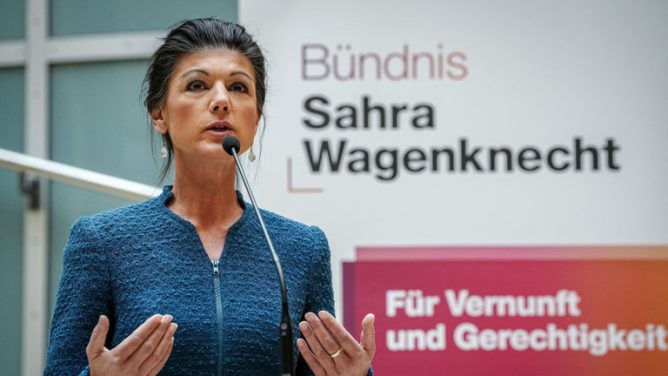
By Tarik Cyril | RT | January 20, 2024
Germany is in severe crisis. Between a tanking economy and an increasingly unpopular government, the country has begun to show just how much stress it is under. Half a year ago, the head of German carmaker Volkswagen warned that “the roof is on fire,” while The Economist concluded that “disaster,” meaning not just the decline but collapse of the German car industry, is “no longer inconceivable.”
At this moment, the wintry beginning of 2024, German farmers are staging large-scale and escalating protests and forcing the ruling coalition into concessions, the trains are not running on time due to a strike, the country’s wholesale sector has dropped to pandemic-level pessimism, “dampening hopes of a rapid rebound in Europe’s largest economy,” as reported by Bloomberg, residential property prices are in record decline, and the office real estate market “has collapsed,” according to leading German news magazine Der Spiegel.
The Economist finds Germany to be “down” politically as well – in fact, self-relegated – from its status as leader of Europe (or, at least, the EU) to less than second fiddle (that would be France, perhaps): while “Angela Merkel was the continent’s undoubted leader, Olaf Scholz, has not taken on her mantle.”
That is a very British understatement. In reality, in the toxic yet key relationship with the US, Germany, with its hapless attempt to transfer the management concept of “servant leadership” to geopolitics, has now subordinated itself so thoroughly to American neocon-type interests that it has no leverage left at all. Because once you make your loyalty unconditional, you will be taken for granted: Selling oneself may be inevitable for any but the greatest powers. Selling oneself for free takes a special lack of foresight.
We could go on heaping up examples of malaise. But the gist is simple: Germans may love to lay it on thick when it comes to venting their misery and “angst” (I should know, being German), but, clearly, something has to – and will – give. The question is what.
One political force that stands to gain from the crisis has just been established. (Another fairly new party that is profiting is the AfD.) Long rumored and in the making, 8 January saw the official founding of a new party, the Bündnis Sarah Wagenknecht – Vernunft und Gerechtigkeit (Alliance Sarah Wagenknecht – Reason and Justice), or BSW for short. Its leader Sarah Wagenknecht used to be the most popular top politician of the hard-Left party Die Linke, which she left with a bang.
As the name BSW suggests, the new party is, in part, a vehicle for Wagenknecht’s considerable personal political acumen and charisma. Opponents of “Red Sarah,” as the popular, generally right-leaning newspaper Bild still calls her, like to stereotype her as an “icon.” Yet, wiser from the failure of an earlier attempt to strike out on her own (under the label “Aufstehen,” roughly: “Stand Up”), this time, Wagenknecht has gone out of her way and made sure to do her homework, preparing a well-crafted organization, a set of junior leaders around her, and, last but not least, a solid program. This is politically significant: Unlike “Aufstehen,” the BSW will not fold quickly under the weight of its own problems.
On the contrary, the party’s chances of making a strong impact from the get-go are very good, as polls consistently indicate. The most recent one – commissioned by Bild and carried out just days after the party’s founding by a top pollster – shows that 14% of Germans would vote for the BSW in a federal election.
For comparison: the SPD, traditionally one of the core parties of Germany and the political home of Chancellor Olaf Scholz, reaches 14% as well. For the BSW this is an impressive figure, but for the SPD it is catastrophic. Meanwhile the Greens, the second partner in Berlin’s governing “Ampel” coalition, are at 12%. The FDP, the third “Ampel” component, would fail to get any seats at all (due to not crossing Germany’s electoral threshold of 5%). Sarah Wagenknecht’s own former party, Die Linke, would suffer the same fate. The only two parties that would do better than the BSW are the traditional center-right CDU (27%) and the populist-right/far-right AfD (18%).
In sum, with BSW, we are witnessing not the making of a fringe but a core movement in what seems to be emerging as Germany’s re-shaped party system, consisting of three traditional parties (SPD, CDU, and the Greens) and two new forces. The latter are coming from the right and left periphery but are likely to re-define the center, directly and by their pressure on the traditional players.
Representatives of the threatened traditional parties and their expert and mainstream media surrogates often denounce the challengers from the wings as extremists or, at least, irresponsible populists (just another way of saying “demagogue”). But they only have themselves to blame: The true cause of this tectonic movement is the failure of the traditionals. The challengers’ rise marks a reaction to it. Wagenknecht is right about this: Germany’s “democracy is imperiled most of all” by government policies that make ever more citizens feel left alone or alienated.
Against that background, the BSW promises more generous social policies, such as on education, wages, and pensions (and higher taxes for the wealthy). As Germany is doing badly economically, this will resonate. And Wagenknecht, a political “natural,” knows how to signal: She has just taken the side of the protesting farmers – as do the majority (68%) of Germans, according to polls.
Mainstream media are making desperate attempts to frame the rebellious farmers as serving extremists and somehow playing into the hands of – guess which country! – Russia. The ever more besieged minister of the economy Robert Habeck has even detected financing by – guess who! – “Putin!” (without, of course, providing any evidence). This time, these tired scare tactics are failing to catch on. Wagenknecht’s public call for chancellor Olaf Scholz to apologize to the farmers will fare better.
Crucially, Wagenknecht and the BSW have combined socially left approaches with a set of traditionally conservative stances, challenging, for instance, the hypertrophic development of new gender categories or, in general, “symbolical struggles” over hyper-sensitive terminology, so fashionable with what Wagenknecht dismisses as the “lifestyle Left.”
While this push-back against political correctness is a largely symbolic, though effective, operation, migration is a more substantial field. There as well, Wagenknecht has adopted positions closer to the right and center than the liberal left, stressing the need for control and limits. The fact that she herself had a Persian father and that prominent BSW heads are also non-ethnic Germans gives her a strong starting position for this kind of debate, shielding her points from dismissal as racist or xenophobic.
Given how many Germans feel, left alone in an economic crisis and also alienated by especially Green attempts at re-education in the spirit of urban upper class multiculturalism and gender obsessions, it will be hard to counter the BSW’s brand of socially left but otherwise centrist and even conservative policies. No wonder then that opponents are trying to portray Wagenknecht as a monster, along with the new party. Their playbook is predictable and boring: namely to smear them as being pro-Russian or even working in the service of Russia.
In reality, Wagenknecht has positioned her new party to resist the push for ever more confrontation with Moscow, especially with regard to Ukraine. At this moment, for instance, she is speaking up against the delivery of German Taurus cruise missiles to Ukraine, which is the latest fad among the insatiable “miracle weapon” addicts. More generally, she is demanding to shift from a policy of military confrontation by proxy to one of negotiation and compromise, which makes, of course, perfect sense.
For her enemies, there is an irony waiting to catch them: They may hope that accusing Wagenknecht of being too friendly toward Russia will weaken her appeal. Yet that ship has sailed. The days of making hay with unbridled neo-McCarthyism are ending. It is more likely, fortunately, that the BSW’s reasonable approach to foreign policy will only get it more sympathy and voters. As it should. Because remember: At this point, Germany is so dependent on the US that it is treated not only like a vassal, but like a vassal whose wishes and interests do not count. Even Germans who distrust Russia will come to understand that this is fundamentally unsound. In its own national interest, Germany must re-establish some balance by rebuilding its relationship with Russia.
Tarik Cyril Amar is an historian from Germany working at Koç University, Istanbul.
Germany considers delivery of tank ammunition to Israel amid genocidal Gaza war

Press TV – January 17, 2024
Germany’s government is considering the delivery of tank ammunition to Israel amid genocidal war against Gaza, the German magazine Der Spiegel has reported, as Western governments keep on backing the Tel Aviv regime for its ongoing massacre.
Israel requested Germany in November to approve the delivery of around 10,000 rounds of 120-millimeter precision ammunition manufactured by Rheinmetall, the report said.
The departments involved have already fundamentally agreed behind the scenes to fulfill a request from the Israeli government.
The Israeli ambassador to Germany, Ron Prosor thanked the German government for its unrelenting support it has shown.
“Since October 7, Germany has unmistakably stood by Israel and expressed its unreserved support,” Prosor told Der Spiegel. “Israel thanks Germany for this,” he added.
The German Chancellor Olaf Scholz emphasized that arms deliveries were also possible.
According to the report, in order to promptly address the request, there is consideration being given to releasing ammunition from the stocks of the German army as the industry is unable to provide the desired precision ammunition immediately.
In November apart from Germany, Israel had also asked other partners for military aid because of its heavy use of ammunition against the Gazans.
US President Joe Biden approved the delivery of 14,000 rounds of tank ammunition for almost $106 million at the beginning of December, after he bypassed Congress.
The Western-backed Israeli genocide in Gaza has been escalating because of the continuous support of Western governments, as they have been persistently arming Israel and supporting the regime with large amounts of funds.
Germany: Scholz’s ‘green’ government wants to buy 3 VIP helicopters for €200 million
By Denes Albert | Remix News | January 15, 2024
At a time when farmers are staging mass national protests over austerity measures that they say will put them under tremendous financial strain, German Chancellor Olaf Scholz and his ministers are aiming to purchase three new, luxury VIP helicopters that will cost €200 million.
However, the budget cuts for farmers are just one austerity measure, with the total budget cut expected to be €17 billion. The opposition is reacting with outrage over the news of the helicopter purchases, with the luxury helicopters designed for Chancellor Olaf Scholz and Defense Minister Boris Pistorius to attend appointments in Germany.
The German armed forces are supposed to replace the aging Cougar helicopters currently stationed in Berlin, which have a range of 850 kilometers and a cruising speed of up to 315 kilometers per hour. The VIP helicopters became famous when the former Social Democrat (SPD) Defense Minister Christine Lambrecht took her son on holiday in one of them.
The German newspaper Bild says that government officials probably suspect that citizens will not be happy about spending taxpayers’ money in a time of crisis, which is why they wanted to hide the €200 million expense.
German MPs do not recall this type of spending ever being discussed in the budget committee, and the helicopters were not included in the December budget proposal. The news is especially surprising considering German police still have so-called VIP Super Puma helicopters, which government representatives can fly in to emergency meetings.
The opposition is stunned, with Christian Democratic Union (CDU) budget expert Ingo Gädechens telling Bild that the government has lost touch with reality. He points out that the government wants to take €176 million from farmers this year, almost as much as the new helicopters cost.
“All of Germany is suffering from the collapse of fiscal policy. Austerity is everywhere,” the politician said. He added that it is obvious that Scholz’s travel convenience is the reason for the purchases and that ministers are more important than budgetary discipline.
However, Scholz may never get to experience the joy of riding a brand-new luxury helicopter, as the government cannot buy new helicopters without parliamentary approval. Now, it is up to the budget committee.
Scholz pushes fake Russian threats to distract Germans from economic problems
By Ahmed Adel | January 15, 2024
Germany is preparing for a war between NATO and Russia, which, according to the scenario of the German Defence Ministry, could begin in the European summer of 2025 after the defeat of the Ukrainian Army, reported Bild with reference to a secret document of the Bundeswehr. This is evidently a desperate attempt by the German chancellor to distract citizens from their economic woes.
According to the newspaper, citing a classified German military document, the escalation could begin as early as next month with the start of an active Russian offensive against the Ukrainian Armed Forces.
According to Bild, the German military considers the Suwałki Gap between Belarus and the Russian region of Kaliningrad to be the most likely site of confrontation. A situation could escalate in October if Russia deploys troops and medium-range missiles to Kaliningrad, and from December 2024, an artificially induced “border conflict” and “clashes with numerous casualties” could unfold as Russia would take advantage of political chaos in the US following the presidential election.
“The actions of Russia and the West are described precisely, indicating the location and month, and will culminate in the deployment of hundreds of thousands of NATO troops and the imminent start of war in the summer of 2025,” writes the article.
However, the article’s authors leave open the question of how this hypothetical escalation will end.
This is, of course, a ridiculous suggestion by the German Defence Ministry, especially as Moscow has repeatedly stressed that it does not want conflict with NATO or anything beyond its special military operation in Ukraine. Rather, this is an attempt by Chancellor Olaf Scholz to instil an unjustified fear in German society as his popularity continues to plummet in the context of a stuttering economy and continued failed policies.
More than 70% of Germans are dissatisfied with Scholz, according to a survey carried out by the INSA Institute for Bild. Specifically, 72% of voters do not approve of his performance, which is three percentage points more than at the beginning of December. Only one in five, 20%, think that Scholz has done a good job.
According to the researchers, 76% of those surveyed are generally dissatisfied with what the federal government does, whilst only 17% of citizens are satisfied. It is the worst indicator of the ruling coalition since it was formed in December 2021, Bild noted.
In 2023, the Scholz-led government faced numerous economic and leadership challenges that undermined public trust. Persistent inflationary pressures, exacerbated by fiscal policy, undermined household budgets, which caused widespread discontent. The lack of strategic direction and perceived indecision on critical issues, such as energy policy following the adoption of sanctions against Russia, further fuelled scepticism among voters. The leadership crisis, characterised by internal conflicts and disagreements, damaged the effectiveness and cohesion of the German government.
What especially frustrates Germans is the fact that sanctions were imposed on Russia, which has become the fifth-largest economy in the world by volume, whilst Germany is in recession. With a public budget deficit estimated at around 60 billion euros, the very model of the German economy appears to be threatened.
Germany is officially in recession and is expected to have ended 2023 with a drop in GDP of around 0.3%, according to a forecast from the European Commission. This is one of the worst economic results in the bloc, given that the growth forecast for the entire European Union in 2023 is 0.6%. Among the causes is the energy crisis that has hit Germany harder than the rest of the European bloc, mainly because the Germans slashed their supply of Russian energy after the start of the special military operation in February 2022.
Furthermore, with the increase in energy prices resulting from sanctions against Russia, Germany has also suffered an increase in general price inflation in the economy, forcing the European Central Bank to raise interest rates, thus affecting the population’s purchasing power and impacting consumption. Consequently, German companies have not only lost international competitiveness with the application of sanctions against the Russians, but now the country runs the risk of entering a process of deindustrialisation.
Under these conditions, the extreme right is experiencing a resurgence. The far-right Alternative for Germany (AfD) party has hit an all-time high approval rating of 24% and has the potential to gain a few more percentile points with the immense failure of the ruling coalition.
What is undeniable is the fact that Germany is experiencing a rapid decline, all spurred on by the reckless policies of Scholz that prioritised American interests instead of German, and he is now resorting to a fake Russian threat in a desperate attempt to distract citizens from their social and economic problems that he is responsible for.
Ahmed Adel is a Cairo-based geopolitics and political economy researcher.
Nazis and Zionists
Genocidal Hate Speech in Nazi Germany and Talmudic-Zionist “Israel”
Michael Hoffman’s Revelation of the Method | January 9, 2024
The Nazis
On 25 October 1941 we have the following statement from Hitler. It was uttered during a private dinner with his co-conspirators SS chief Heinrich Himmler, and Reinhardt Heydricht, commander of the Reichssicherheitshauptamt (Nazi Germany’s Department of Homeland Security):
“In Parliament [30 January1939 and 1941], I prophesied Jewry that the Jew will disappear from Europe if war is not avoided. This criminal race has to account for two million deaths in World War I, and now again hundreds of thousands. Don’t anybody tell me that we cannot send them into the morass! Who cares about our people? It is good if the terror precedes us that we are exterminating Jewry. The attempt to create a Jewish state will be a failure!”
From the diary of Josef Goebbels, Reich Minister of Propaganda, May 27, 1942:
“Beginning with Lublin, the Jews in the General Government are now being evacuated (abgeschoben) eastward. The procedure is a pretty barbaric one and not to be described here more definitely. Not much will remain of the Jews. On the whole it can be said that about 60 percent of them will have to be liquidated (liquidiert)…” (Die Tagebücher von Joseph Goebbels, 1941-1945; De Gruyter Saur).
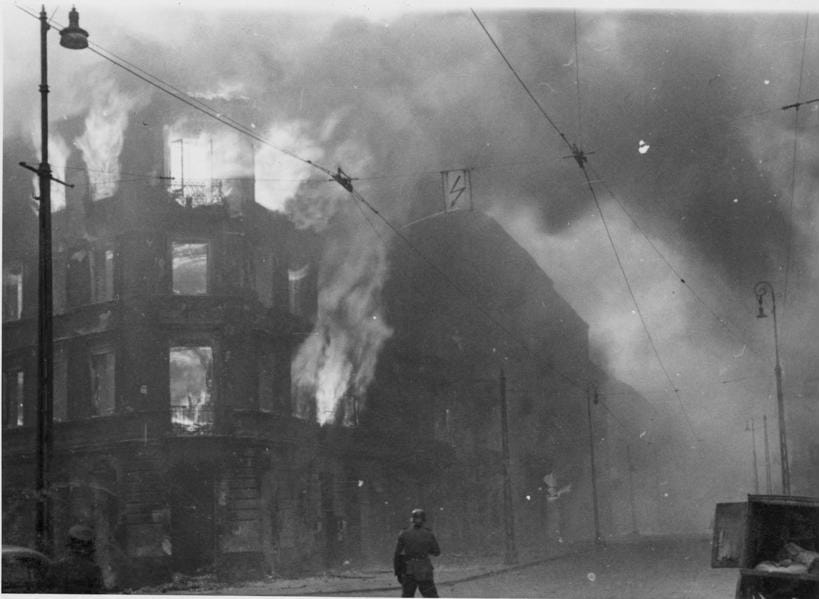
The Warsaw Ghetto Uprising, 1943
In July 1942, hundreds of thousands of Jews from the Warsaw Ghetto were being deported, most of them via the Treblinka Camp. Jewish leaders in the Warsaw Ghetto therefore decided to fight back. They started an uprising on April 19, 1943. It was put down brutally by German armed forces, for the most part within a few days, but skirmishes carried on until mid-May. Jews who survived were again generally deported.
October 6, 1943 SS chief Himmler spoke before the political elite of the Third Reich. In a brief excerpt from his long speech, we read the following (Smith/Peterson 1974, pp. 169 f.):
“I ask of you that that which I say to you in this circle be really only heard and not ever discussed. We were faced with the question: what about the women and children? – I decided to find a clear solution to this problem too. I did not consider myself justified to exterminate (only) the men – in other words, to kill them or have them killed and allow the avengers of our sons and grandsons in the form of their children to grow up.
“The difficult decision had to be made to have this people disappear from the earth. For the organization which had to execute this task, it was the most difficult which we had ever had…I felt obliged to you, as the most superior dignitary, as the most superior dignitary of the party, this political order, this political instrument of the Führer, to also speak about this question quite openly…”
October 7, 1943, the day after Himmler had given his lengthy speech about “making the Jews disappear from the earth,” Goebbels wrote: “As to the Jewish Question, (Himmler) gives a very frank and candid picture. He is of the opinion that we can solve the Jewish Question for all of Europe by the end of this year. He advocates the most radical and harshest solution, namely, that the whole of Jewry will be exterminated [auszurotten]. This is surely a consistent, if brutal, solution.”
Hans Frank (Nazi governor of occupied Poland) — diary entry for December 16, 1941: “We must destroy the Jews, wherever we find them, in order to maintain the overall structure of the Reich here. […] Currently there are in the Government General [occupied Poland] approximately 2½ million, and together with those who are kith and kin and connected in all kinds of ways, we now have 3 ½ million Jews. We cannot shoot these 3 ½ million Jews, nor can we poison them, yet we will have to take measures which will somehow lead to the goal of annihilation, and that will be done in connection with the great measures which are to be discussed together with the Reich. The territory of the General Government must be made free of Jews, as is the case in the Reich. Where and how this will happen is a matter of the means which must be used and created, and about whose effectiveness I will inform you in due time.” (IMT, Vol. 29, pp. 502f.)
On March 4, 1944, Nazi governor Frank stated (p. 687): “The Jews are a race that must be effaced. Wherever we catch one, he is coming to an end.”
Between late 1941 and late 1942, Nazi authorities deported many tens of thousands of Jews from western and central European countries to locations in the German-occupied Soviet Union… many if not most of them were killed there by the Einsatzgruppen and associated units.
“In particular the camp Maly Trostenets near Minsk (capital of Belorussia), and the prison at Fort IX near Kaunas (Lithuania) deserve to be mentioned in this context. Thousands of deported Jews were executed there.
“Jews living inside the Soviet Union were the primary target of the Einsatzgruppen and associated units…this happened primarily by way of mass shootings…German wartime documents speak of some 750,000 victims…”
“Not just one, but two Einsatzgruppen – C and D – were active in Ukraine. The most infamous crime scene associated with these units occurred in the suburbs of Ukraine’s capital Kiev, at Babi Yar… The Einsatzgruppen’s ranked death-toll list includes several entries for Ukrainian locations…(totaling approximately 138,000 victims)… Ukraine was completely occupied by Germany.. This put all of Ukraine’s remaining Jews in mortal danger, and many paid with their life.”
“SS Gruppenführer Arthur Nebe became head of Germany’s Civil Police in 1936. In June 1941, Nebe was appointed commander of Einsatzgruppe B, which he led from its inception in June, 1941 until October 1941, hence “for some four months. As such, he approved several Einsatzgruppen reports sent to Berlin which documented the execution of thousands of Jews in the deployment area of his Einsatzgruppe B.”
“SS Gruppenführer Otto Ohlendorf was the director of Office III, the “SD” (Internal Security Service) of the Reichssicherheitshauptamt (Reich Security Main Office). In 1941 he was appointed head of Einsatzgruppe D, a position he held for a year. This group operated in the southern region of the temporarily German-occupied Soviet Union (Bessarabia, southern Ukraine, Crimea, Caucasus)…“At the Nuremberg Einsatzgruppen Trial, Ohlendorf accepted responsibility for at least 90,000 victims of mass shootings carried out by Einsatzgruppe D, while he was in charge of that unit. There is an abundance of documentary evidence in support of these facts.
In the summer of 1942, the forced deportation of tens of thousands of Polish Jews from the Warsaw Ghetto was underway. When the deported Jews arrived further East, Wilhelm Kube, Nazi Commissioner for Belorussia, complained to his superior Lohse on July 31, 1942 (and later also to Alfred Rosenberg, head of the Ministry for the Occupied Eastern Territories), indicating Kube’s forces had been executing tens of thousands of Jews in the area to prevent them from supporting the partisans.”
“In Hitler’s Table Talk, Hitler drew a picture of the future of the Eastern European territories which is one of the best authenticated of his life’s visions and typical of his weltanschauung, which entailed the total disfranchisement of the subjugated. He ruled they have no claims of any kind, except to an early death. They are forbidden to learn to read and write; to concern themselves with history or politics is a crime worthy of death. Any communication whatever going beyond the confines of the village is strictly prohibited…They are to live in their filthy hovels without hygiene or inoculation, while the German settlers, strictly segregated, own splendid villages and spacious fortress farms.”
— German revisionist historian Ernst Nolte (1923-2016), author of the magisterial 1987 history, Der europäische Bürgerkrieg (“The European Civil War”).
The Zionists
“We shall try to spirit the penniless (Palestinian) population across the border…while denying it any employment in our own country… expropriation and the removal of the poor must be carried out discreetly and circumspectly.” —Theodor Herzl, founding father of Zionism, 1895
“I support compulsory transfer. I don’t see anything immoral in it” (1938). “Now a transfer of a completely different scope will have to be carried out. In many parts of the country new settlement will not be possible without transferring the Arab fellahin (Palestinian peasant farmers)….….Jewish power [in Palestine], which grows steadily, will also increase our possibilities to carry out this transfer on a large scale.”
—David Ben-Gurion, first Israeli Prime Minister, 1948
Writing in his diary in 1940 Yosef Weitz, a senior Jewish National Fund official who chaired the influential Transfer Committee before and during the Nakba (“Catastrophe”), and became known as the “Architect of Transfer,” (mass expulsion of the Palestinian population), put it thus: “The only solution is a Land of Israel devoid of Arabs. There is no room here for compromise. They must all be moved. Not one village, not one tribe can remain. Only through this transfer of the Arabs living in the Land of Israel will redemption come.”
The religious-terrorist Kach party was founded in 1971 by Brooklyn-born Rabbi Meir Kahane who argued for the immediate expulsion of the Palestinians, who he called “dogs.” In 1984, Kahane introduced legislation in the Knesset to ban all Jewish-Gentile marriages and sexual relations and revoke the Israeli citizenship of non-Jews.
In 2019, Kahane’s follower Itamar Ben Gvir formed the “Jewish Power” party, an ideological offshoot of Kach. Merging with other Talmudic-Zionist parties to form Religious Zionism in 2022, they won the third-largest share of Israel’s parliament seats. Netanyahu appointed Ben-Gvir Israeli Minister of Security. For years Ben-Gvir displayed in a place of honor in his home a portrait of Baruch Goldstein, an American-Israeli who killed 40 Palestinians and wounded more than 100 in a shooting massacre as they knelt in prayer at Hebron’s Tomb of the Patriarchs in 1994. As the Israeli Security Minister Ben-Gvir has instigated a settler reign of terror on Palestinian farmers and sheepherders on the West Bank.
In the aftermath of Goldstein’s slaughter, Noam Federman, a spokesman for the Kach party opined, “The act itself was one of greatness. It was a great act of sanctifying the Name (of God).”
Paying homage at Goldstein’s funeral, Rabbi Yaacov Perrin told mourners that “one million Arabs are not worth a Jewish fingernail.”
”Palestinians in Lebanon are two-legged animals.”
—Israeli Prime Minister Menchaem Begin (source: NY Times, August 5, 1985, p. A6)
Palestinians are cockroaches scurrying in a bottle.”
—Israeli Army Chief of Staff Rafael Eytan (source: NY Times, August 5, 1985, p. A6)
Rabbi Ovadia Yosef, the head of the powerful Israeli Shas political party and chief rabbi of Sephadic Israeli Judaism, taught that the Arab people should be exterminated, “May the Holy Name visit retribution on the Arab heads, and cause their seed to be lost, and annihilate them. It is forbidden to have pity on them. We must give them missiles with relish, annihilate them. Evil ones, damnable ones.”
—2001 Passover sermon. Cf. Haaretz, April 12, 2001. 700,000 Israelis attended Ovadia’s funeral. In its obituary, the New York Times eulogized him and omitted all reference to his calls for exterminating Arabs.
“If you believe that the Jewish state has a right to exist, then you must allow Israel to transfer the Palestinians and the Israeli-Arabs from Judea, Samaria, Gaza and Israel proper. It’s an ugly solution, but it is the only solution.”
—Ben Shapiro, American media personality, Orlando Sentinel, September 8, 2023
“Well, if everyone in Gaza is a refugee, let’s scatter them around the world. There are 2.5 million people there, every country will take in 20,000 people, 100 countries.”
— Ram Ben Barak, Member of the Knesset, ex-Mossad Deputy Director, November 1
“There should be a second Nakba.”
—Israeli agriculture minister Avi Dichter, November 11, 2023. [Nakba: the 1948 forced expulsion of 750,000 Palestinians, which culminated in the creation of the so-called “state of Israel”].
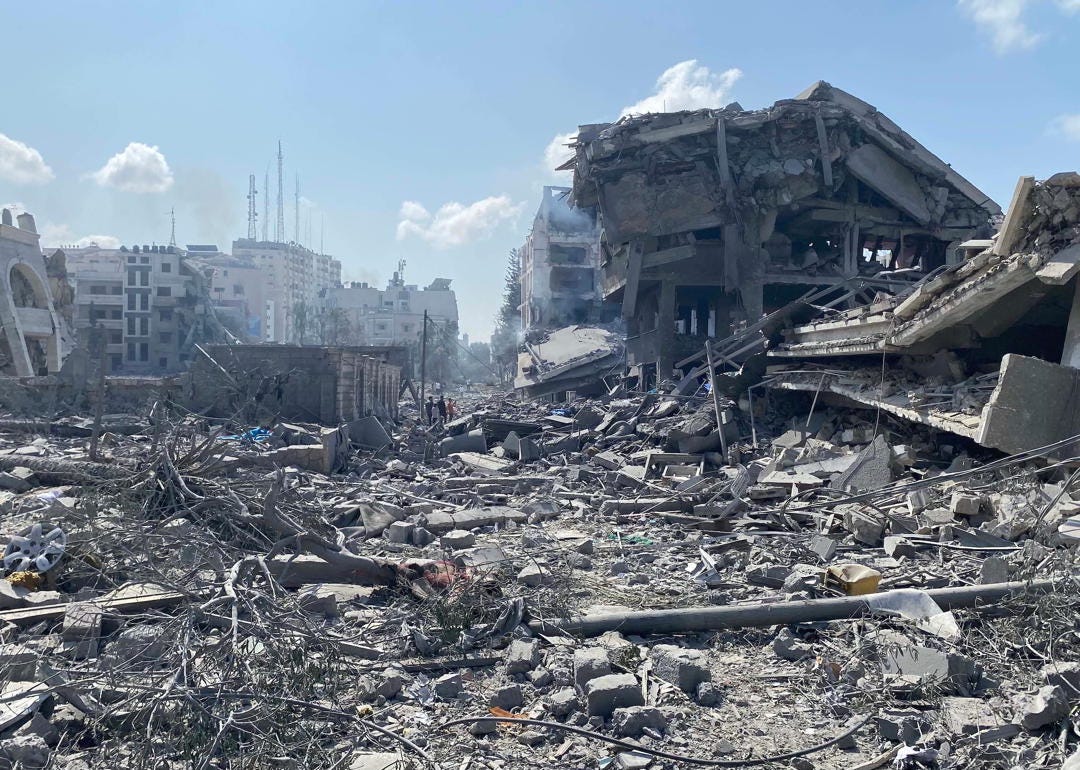
Gaza City in the early days of the Israeli terror bombings, October, 2023
“The Gaza Strip should be flattened, and for all of them (Palestinians) there is but one sentence, and that is death…Gaza has to be wiped off the map, in order to send a message to all our enemies and those who seek us harm…. In Gaza, we have to be clear, there are no innocent [civilians]. There are no “uninvolved” people.”
—Yitzhak Kroizer, Member of the Israeli parliament (“Knesset”), Nov. 5. 2023.
Tally Gotliv, an official in Binyamin Netanyahu’s Likud party, has demanded that Prime Minister Netanyahu use a nuclear bomb on Gaza. “Before we consider inserting ground troops, doomsday weapon.”
Likud member of the Knesset, Boaz Bismuth stated with reference to Gaza: “There’s no place for any humanitarian gestures.”
Israeli journalist Zvi Yehezkeli said on Israel’s Channel 13: “[We] should have killed many times 20,000 people, [we] should have begun with a blow of 100,000.”
As of January 9, 2024, the Israeli military has damaged or destroyed 70 percent of Gaza’s housing.
85 percent of the population of Gaza have been dehoused and rendered homeless.
In three months the Israelis have killed more than 22,000 Gazans, the majority of them women and children. The number of wounded, disabled and mutilated are more than twice that casualty figure. It is expected that many more Palestinian civilians will die of intentional Israeli-imposed imposed disease and hunger.
“Non-Jews are uncompassionate by nature and attacks on them curb their evil inclination.” — Torat Ha-Melekh (sometimes spelled Torat Hamelech, 2009). Torat Ha-Melekh is an Israeli rabbinic book based on the Talmud which has been widely distributed to Israeli military personnel.
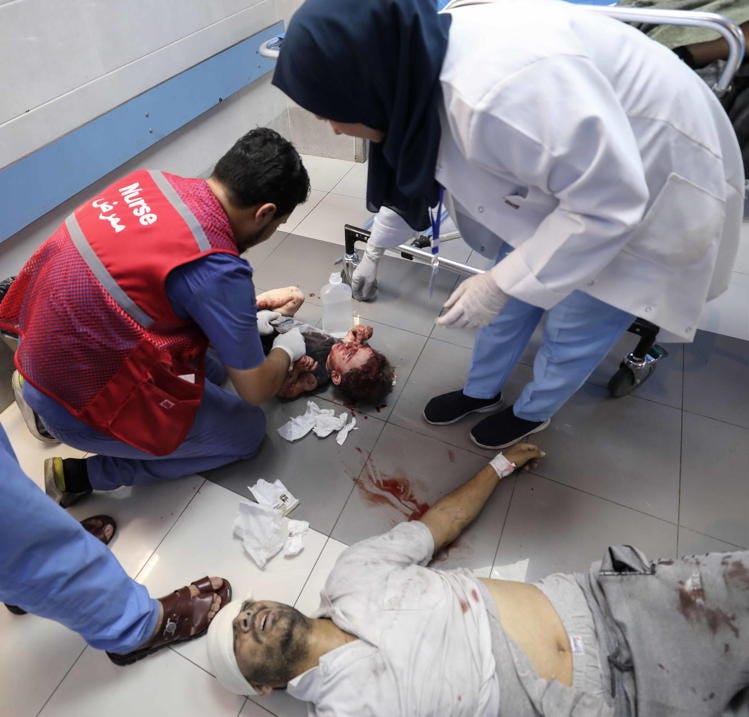
A Palestinian child is treated for injuries on a hospital floor in Gaza, inflicted by the “Israeli Defense Force”, while a wounded Palestinian man awaits further medical care, autumn, 2023
Torat Ha-Melekh teaches that it is a religious duty to kill non-Jewish children on the enemy side during warfare, “if there is a good chance they will grow up to be like their evil parents.” Other reasons the Israeli authors furnish for the permission to kill non-Jewish children include if they “block the rescue of Jews… Little children are often situated in this way…it is permitted to kill them because their very presence facilitates the killing (of Jews)…(p. 215). “It is also permitted to kill the children of the leader (of the enemy) in order to put pressure on him…” (p. 215).
“We are imposing a complete siege on the city of Gaza. There will be no electricity, no food, no water, no fuel, everything is closed. We are fighting human animals and we are acting accordingly”
— Israeli Defense Minister Yoav Gallant, October 9, 2023.
On January 6, 2024 the New York Times described Gallant as “a moderate member of Mr. Netanyahu’s right-wing Likud party…” (Section A, Page 6; italics added).
“Human beasts are dealt with accordingly. Israel has imposed a total blockade on Gaza: no electricity, no water, just damage. You wanted hell—you will get hell”.
—Israeli Major General Ghassan Alian, Coordinator of the Government in the Territories, October 10
“Israel has no choice but to render Gaza into a place that is temporarily, or permanently, unfit for living.”
— Giora Eiland, Israeli Defense Ministry, October 11
“Do not leave a stone unturned in Gaza. Gaza needs to turn into Dresden. Complete incineration. Annihilate Gaza now!”
—Moshe Feiglin, Member of the Israeli Knesset, October 26, 2023. The Allied incineration by more than 800 bombers leveled the city of Dresden and burned alive tens of thousands of civilians.
Concerning the Palestinian population of Gaza: “They are not humans nor human animals, they are sub-humans and should be treated as such.”
—Arieh King, Deputy Mayor of Jerusalem, December 8
“There are no innocent [civilians] in Gaza.”
—Avigdor Lieberman, Member of the Knesset, and leader of Israel Beytenu Party, former Israeli Defense Minister, December 3
“We are too humane. Burn Gaza now, nothing less!”
—Nissim Vaturi, Deputy Speaker of the Knesset, November 17
“… we should make sure that there is a severe humanitarian disaster there (in Gaza), and severe epidemics, and horrible pressure, and cries to the sky—because that’s how wars are won… A humanitarian disaster is the only way to bring about the end of the war in a desirable way. Think about it this way: the poor women of Gaza, who are they? They are the mothers and sisters and wives of the Hamas murderers. Gaza’s system, unlike [its characterization by the US which I mentioned earlier] that there is Hamas and there are civilians—it is not true! Gaza is a state that is entirely united around its leader and its ideology for 15 years, without any dissent and with enthusiastic support….
“The weak point [of Gaza] is their civilian population…the thousands of Hamas terrorists, whose mothers and wives and children who will start suffering from severe illnesses, are the point of weakness. If we want to win the war—that’s how you win a war.”
“I agree with every word of Giora Eiland.”
—Israeli Finance Minister Bezalel Smotrich, November, 2024
“Given the collapse of Gaza’s sanitation and medical systems, as much as a quarter of Gaza’s people could die within the year, mostly from disease or lack of access to medical care.”
—Peter Beinart, Jan. 7, 2024
“Spend your energy on one thing; wiping Gaza off the face of the earth. Let the Gazan monsters fly to the southern fence and flee into Egyptian territory. Or have them die. And have them die horribly. Gaza must be wiped out. ..We require a revengeful and cruel IDF (Israeli military). Anything less than that is immoral. Simply immoral.”
—Galit Distel-Atbaryan, Member of the Knesset, November 1
“I am saying here to the citizens of Lebanon…(w)hat we are doing in Gaza we know how to do in Beirut.”
—Israeli Defense Minister Yoav Gallant, November 11.
(Gallant was telling the truth. In the summer of 1982 the Israeli air force terror-bombed the city of Beirut resulting in 20,000 civilians killed and tens of thousands wounded).
“The north of the Gaza strip—more beautiful than ever. Blowing up and flattening everything, simply a delight for the eyes.”
—Amichai Eliyahu, Israeli Minister of Heritage, November 1.
“…twice as many children have died in Gaza just since the war started on Oct. 7 as in all the conflicts worldwide in 2022…Far more women and children appear to have been killed in Gaza than in the entire first year of the Iraq war…pulverizing entire neighborhoods…Too many (people) see events through a prism in which (Israeli) lives are invaluable on one side while (Palestinian) deaths on the other are regrettable.”
—Nicholas Kristof, December 6
“This law is taught: in the case of Israel, this soul of the kelipah is derived from kelipat nogah, which contains good…The souls of the gentiles however, emanate from the other, unclean kelipot which contain no good whatever.” —Shneur Zalman of Lyady, “the Alter Rebbe.” Likkutei Amarim, (chapter 1). This sacred text is more commonly known by its first Hebrew word “Tanya.” Zalman is the founder of Chabad Lubavitch. Tanya is its revered text.
“According to this radical Hasidic teaching, divinity dwells in the inner core of every Judaic human being. Those who are non-Judaic have no humanity, no inner core in which the divine can take up residence. Those beings who are not Judaic are sub-human: empty kelipot (corporeal ‘shells’) which constitute broken vessels.
“In this theology non-Jews are broken shells who adopt the appearance of a human form which conceals their demonic essence. Those who are not Jews are the personification of purely evil materiality. Kabbalistic theology posits a cosmic dichotomy wherein the gentile represents biologically-determined, irredeemable evil. This is the esoteric rabbinic teaching which the western secret societies (also known as the ‘New Age’), understood and implemented. In the case of the indoctrination of their agent Adolf Hitler, the western occult reversed the polarities and taught Hitler that “the Jews” were the kelipot (‘untermenschen’), and the ‘Aryans’ the purely distilled essence of the divine. The Hitler/Himmler/Goebbels version of National Socialism was, unknown to these dupes themselves, a Kabbalistic teaching on the biologically-determined, irredeemable evil in the form of the ‘Jew.’ Hitlerism was Kabalism in the garments of Aryanism.”
— Michael Hoffman
“The differences between Jews and gentiles are not religious, historical, cultural or political. They are, rather, racial, genetic and scientifically unalterable. The one group is at its very root and by natural constitution ‘totally evil’ while the other is ‘totally good.’ Jewish successes in the world are completely contingent upon the failure of all other peoples. Only when the gentiles face total catastrophe do the Jews experience good fortune.”
—Rabbi Saadya Grama, Romemut Yisrael Ufarashat Hagalut (“Jewish Superiority and the Question of Exile,” 2003). Grama is an alumnus of Beth Medrash Govoha, a renowned yeshiva in Lakewood, New Jersey.
There is something infinitely more holy and unique about Jewish life than non-Jewish life.”
—Talmudic-Kabbalist Yitzhak Ginsburg, Jewish Week (N.Y.), Aug. 26, 1996
“The dissimilarity between the Jewish soul, in all its independence, inner desires, longings, character and standing vis-à-vis the soul of all the gentiles–on all of their levels–is greater and deeper than the difference between the soul of a man and the soul of an animal, for the difference in the latter case is one of quantity, while the difference in the first case is one of essential quality.”
— Abraham Isaac Kook, Chief Rabbi of Palestine, 1921-1935, “The Father of Talmudic Zionism.” [Source: David Dishon,“The Beauty of Yefet in the Tents of Shem-Gentiles and Jews in the Thought of Rav Kook,” in Havruta: A Journal of Jewish Conversation; Shalom Hartman Institute. 1 (2): 80–89.]
“Wherever there is liability for capital punishment, with regard to bloodshed, if a gentile murders another gentile, or a gentile murders a Jew, he is liable. If a Jew murders a gentile, he is exempt.”
—Babylonian Talmud, Sanhedrin 57a
Israeli Prime Minister Netanyahu, October 28: “You must remember what Amalek has done to you says our Holy Bible, and we do remember and we are fighting. Our brave troops and combatants who are now in Gaza or around Gaza and in all other regions in Israel are joining this chain of Jewish heroes, a chain that started 3,000 years ago—from Joshua to the heroes of 1948—the Six Day War, the 1973 October war—and all other wars of this country—are hero troops. They have one supreme main goal, to completely defeat the murderous enemy and to guarantee our existence in this country.”
In 1 Samuel 15:3 the judgment of God is on the Amalekites, in the form of the divine command to Saul, the first King of Israel: “Now go and smite Amalek, and utterly destroy all that they have, and spare them not; but slay both man and woman, infant and suckling, ox and sheep, camel and ass.”
These are patently the marching orders Netanyahu gave the Israeli military (‘the most moral military in the world’): slay all the civilians of Gaza and spare them not. Not even Clarence Darrow could parse it otherwise. There’s no lawyer’s loophole here; no moderating clause.
“Netanyahu’s Amalek speech was a warrant for a genocide that has been carried out to the letter, notwithstanding the delusional Gaza holocaust denial which squats in our media, churches and government atop the cadavers of thousands of ‘unclean kelipot’—bombed and burned Palestinian children and their mothers, whose deaths do not register in the conscience of America. The Talmudic-resonate belief in the worthlessness of the Palestinians is as ubiquitous and inescapable as the racist hate speech which inculcates it.”
—Michael Hoffman, January 9, 2024.
I will not be silent.
Copyright©2024 by Independent History and Research
Michael Hoffman manages the podcast, Revisionist History®. He is the author of the banned 2008 textbook Judaism Discovered (1,102 pages), and nine other volumes of history and literature, as well as 122 issues of the periodical, Revisionist History®. Michael is a former reporter for the New York bureau of the Associated Press and a former paid consultant to the news department of the New York Times. His books have been published in translation in Japan and France. He resides with his family in Coeur d’Alene, Idaho. On Twitter (“X”): https://twitter.com/HoffmanMichaelA
For Further Research
Featured Video

Macgregor: We Haven’t Seen the Worst of the Iran War Yet
or go to
Aletho News Archives – Video-Images
From the Archives
15 Saudi ‘hijackers’ were CIA agents working for US: Scholar
Press TV – April 13, 2016
Fifteen of the 9/11 “hijackers” from Saudi Arabia were CIA agents working for the United States government, which was seeking to destroy the Middle East for Israel and to double the American military budget, says Dr. Kevin Barrett, an American academic who has been studying the events of 9/11 since late 2003…. continue
Blog Roll
 Aletho News
- Iran’s Plan to Shut Down AI in the Persian Gulf
- Israel seeks ‘compensation’ from Washington over Saudi F-35 sale
- Saudi crown prince seeks dialogue with Ansarullah after Yemeni blows: Report
- Damascus rejects Saudi request for Syrian fighters to counter Yemen: Report
- South Korea says will not send troops to join terrorist US war on Iran
- Russia Just Struck the Eyes of NATO’s War Machine in Ukraine
- Russia summons UK charge d’affaires over Kiev drone support
- NATO member warns bloc seeking pretext for war with Russia
- Macgregor: We Haven’t Seen the Worst of the Iran War Yet
- ‘We are not like everyone else’ laws that bind other nations do not apply to Israel, says Likud lawmaker
- If Americans Knew
- Debunking The Claim That Macklemore Has A “History Of Antisemitism”
- CPJ demands release of arrested Palestinian-US journalist near Bethlehem
- Robert Kraft: The Billionaire Friend of Netanyahu Pulling The Strings Behind the Macklemore/Ed Sheeran Blow Up
- Columbia Administered Fund Gives Big Money to Pro-Israel Groups
- Deportation Case of Palestinian Activist Salah Sarsour Tests First Amendment
- ‘We Will Not Forget’: Palestinians Mark 44 Years since Sabra and Shatila
- Why do we let Zionists decide what we can and can’t say?
- US welcomes Israeli, Iranian delegations to UN, but not Palestinians – Daily Update
- Biden’s Genocide Accomplices Targeted by New Accountability Campaign
- AIPAC’s Network Has Already Spent $67.2 Million to Shape the Midterm Elections
- No Tricks Zone
- New Study: ‘Global Drought Shows No Detectable Recent Acceleration Under Climate Warming’
- Economic Masterminds: German Socialists Suggest Taxing Productivity Gains Stemming From Using AI
- The South China Sea Has Not Been Cooperating With The Climate Change Narrative
- Energy Crisis: Germany Enters Heating Season With Historically Low Gas Reserve Fill Levels
- New Study: The Antarctic Ice Sheet Gained Mass From 2020-2024 Due To Staggering Snow And Ice Accumulation
- Study: Ocean Heating Rates From Thousands Of Years Ago ‘Dwarf’ Modern Ocean Heating Rates
- Climate Extremists Target, Attack Large-Scale Power Grid Infrastructure In Germany!
- New Study: Antarctic Ice Melt Has Contributed Less Than 1 Centimeter To Sea Level Rise In The Last 30 Years
- Fear Of Debate: Alarmist German Climate Scientist Calls On Mainstream Media To Discredit Skeptic Voices
- End-Of-August Arctic Sea Ice Extent Hasn’t Fallen In 20 Years, Official Data Show!
 Aletho News