Government by billionaires? Cuomo names former Google CEO to join Gates & Bloomberg in drafting post-pandemic ‘reforms’
RT | May 6, 2020
New York Gov. Andrew Cuomo has appointed ex-Google CEO Eric Schmidt to lead a panel on post-pandemic “reform” of health and education systems, despite criticism for taking other billionaires with conflicts of interest on board.
Schmidt will head a ‘Blue Ribbon Commission’ tasked with “reimagining” New York’s existing systems of healthcare and education, Cuomo announced on Wednesday during his daily coronavirus briefing. The decision to place such power in the hands of another unelected billionaire has riled critics already uneasy about the governor’s post-Covid-19 plans.
The panel’s initial priorities will be “tele-health, remote learning and broadband,” Schmidt announced, dropping into Cuomo’s broadcast. The former Google exec still receives a paycheck from parent company Alphabet in an advisory capacity, raising questions of conflict of interest given Google’s leading role in developing a digital contact-tracing platform for Covid-19. While Cuomo confirmed in the same presser that the state is partnering with former New York Mayor Mike Bloomberg – another billionaire – in building a human contact-tracing network, any digital component will likely involve the participation of Google. At the same time, the tech giant’s insatiable hunger for health data, as evinced by initiatives like Project Nightingale and Google’s acquisition of Fitbit, is unlikely to sit well with New Yorkers concerned about the company’s privacy record.
Cuomo was previously deluged by criticism after announcing on Tuesday that he would place the Bill & Melinda Gates Foundation in charge of developing a “blueprint to reimagine education in the new normal,” praising former Microsoft CEO Bill Gates as a “visionary” and calling for state schools to be “revolutionized.” Public schooling groups slammed the billionaire, accusing him of promoting “one failed educational initiative after another, causing huge disaffection in districts throughout the state.”
The Gates Foundation poured nearly half a billion dollars of its own money into the notorious Common Core program, which while pitched as a way to improve floundering educational performance in mathematics has actually caused the US to drop even lower in international rankings since its nationwide implementation in 2013. After steering over $4 trillion of taxpayer dollars into the government-funded program, the Foundation tacitly admitted failure in 2016, acknowledging in a letter to donors that it had “underestimated the level of resources and support required for our public education systems to be well-equipped to implement [Common Core].”
Cuomo himself has landed in hot water in the past for his efforts to unilaterally refashion New York’s admittedly dilapidated public school system. In 2015, he was accused of “unconstitutional interference in education policy” by New York State Allies for Public Education, which highlighted his “cozy relationships” with charter school advocates and education technology businesses. One of those education technology businesses was Google. In 2014, Schmidt, then the company’s executive chairman, was appointed to a three-person commission to advise on a ‘Smart Schools’ bond issue, setting off alarm bells among consumer advocates who pointed out that Google would directly benefit from system-wide adoption of Google Apps and Chromebook laptops.
The New York governor’s history with his state’s healthcare system is equally checkered, marked by a long string of budget cuts, hospital consolidations, and layoffs, and his pledge to “revolutionize” the chronically strapped system has already gotten off on a bad foot. On Wednesday, Cuomo announced that out-of-state nurses who had come to New York to help out with the coronavirus epidemic would be required to pay state income tax on whatever compensation they had received, even if they were being paid by companies located in their home state.
Cuomo’s decision to appoint private equity bigwigs, including Bill Mulrow of Blackstone Group and Steven Cohen of MacAndrews & Forbes, to the economic advisory team charged with reopening New York has also come in for criticism, given that private equity firms often benefit from the same bankruptcies the state’s businesses are hoping to avoid.
Coronavirus Gives a Dangerous Boost to DARPA’s Darkest Agenda
By Whitney Webb | The Last American Vagabond | May 4, 2020
In January, well before the coronavirus (Covid-19) crisis would result in lockdowns, quarantines and economic devastation in the United States and beyond, the U.S. intelligence community and the Pentagon were working with the National Security Council to create still-classified plans to respond to an imminent pandemic. It has since been alleged that the intelligence and military intelligence communities knew about a likely pandemic in the United States as early as last November, and potentially even before then.
Given this foreknowledge and the numerous simulations conducted in the United States last year regarding global viral pandemic outbreaks, at least six of varying scope and size, it has often been asked – Why did the government not act or prepare if an imminent global pandemic and the shortcomings of any response to such an event were known? Though the answer to this question has frequently been written off as mere “incompetence” in mainstream media circles, it is worth entertaining the possibility that a crisis was allowed to unfold.
Why would the intelligence community or another faction of the U.S. government knowingly allow a crisis such as this to occur? The answer is clear if one looks at history, as times of crisis have often been used by the U.S. government to implement policies that would normally be rejected by the American public, ranging from censorship of the press to mass surveillance networks. Though the government response to the September 11 attacks, like the Patriot Act, may be the most accessible example to many Americans, U.S. government efforts to limit the flow of “dangerous” journalism and surveil the population go back to as early as the First World War. Many of these policies, whether the Patriot Act after 9/11 or WWI-era civilian “spy” networks, did little if anything to protect the homeland, but instead led to increased surveillance and control that persisted long after the crisis that spurred them had ended.
Using this history as a lens, it is possible to look at the current coronavirus crisis to see how the long-standing agendas of ever-expanding mass surveillance and media censorship are again getting a dramatic boost thanks to the chaos unleashed by the coronavirus pandemic. Yet, this crisis is unique because it also has given a boost to a newer yet complimentary agenda that — if fulfilled – would render most, if not all, other government efforts at controlling and subduing their populations obsolete.
DARPA Dystopia
For years, the Pentagon’s Defense Advanced Research Projects Agency (DARPA) has remained largely out of sight and out of mind for most Americans, as their research projects are rarely covered by the mainstream media and, when they are, their projects are often praised as “bringing science fiction movies to life.” However, there have been recent events that have marred DARPA’s often positive portrayal by media outlets, which paint the agency as a beacon of scientific “progress” that has “changed the world” for the better.
For instance, in 2018, a group of European scientists accused the DARPA’s “Insect Allies” program of actually being a dystopian bioweapons program that would see insects introduce genetically modified viruses into plants to attack and devastate a targeted nation’s food supply. DARPA, of course, maintained that its intent to use these insects to genetically modify plants was instead about “protecting” the food supply. Regardless of DARPA’s assertions that it is merely a “defensive” program, it should be clear to readers that such a technology could easily be used either way, depending on the wielder.
Though DARPA’s futuristic weapons of war often get the most attention from media, the agency has long standing interests in tinkering with, not just the biology of plants, but of humans. DARPA, which is funded to the tune of approximately $3 billion a year, has various avenues through which it pursues these ambitions, with many of those now under the purview of the agency’s “Biological Technologies Office” (BTO), created in 2014. As of late, some of DARPA’s human biology and biotech projects at its BTO have been getting a massive PR boost thanks to the current coronavirus crisis, with recent reports even claiming that the agency “might have created the best hopes for stopping Covid-19.”
Most of these technologies garnering positive media coverage thanks to Covid-19 were developed several years ago. They include the DARPA-funded platforms used to produce DNA and RNA vaccines, classes of vaccine that have never been approved for human use in the U.S. and involve injecting foreign genetic material into the human body. Notably, it is this very class of vaccine, now being produced by DARPA-partnered companies, that billionaire and global health “philanthropist” Bill Gates recently asserted has him “most excited” relative to other Covid-19 vaccine candidates. Yet, key aspects regarding these vaccines and other DARPA “healthcare” initiatives have been left out of these recent positive reports, likely because they provide a window into what is arguably the agency’s darkest agenda.
“In Vivo Nanoplatforms”

In 2006, DARPA announced its Predicting Health and Disease (PHD) program, which sought to determine “whether an individual will develop an infectious disease prior to the onset of symptoms.” The PHD program planned to accomplish this by “identifying changes in the baseline state of human health through frequent surveillance” with a specific focus on “viral, upper respiratory pathogens.”
Three years later, in 2010, DARPA-funded researchers at Duke University created the foundation for this tool, which would use the genetic analysis of blood samples to determine if someone is infected with a virus before they show symptoms. Reports at the time claimed that these “preemptive diagnoses” would be transmitted to “a national, web-based influenza map” available via smartphone.
Following the creation of DARPA’s BTO in 2014, this particular program gave rise to the “In Vivo Nanoplatforms (IVN)” program. The diagnostics branch of that program, abbreviated as IVN:Dx, “investigates technologies that incorporate implantable nanoplatforms composed of bio-compatible, nontoxic materials; in vivo sensing of small and large molecules of biological interest; multiplexed detection of analytes at clinically relevant concentrations; and external interrogation of the nanoplatforms without using implanted electronics for communication.” Past reports on the program describe it as developing “classes of nanoparticles to sense and treat illness, disease, and infection on the inside. The tech involves implantable nanoparticles which sense specific molecules of biological interest.”
DARPA’s IVN program has since helped to finance and produce “soft, flexible hydrogels that are injected just beneath the skin to perform [health] monitoring and that sync to a smartphone app to give the use immediate health insights,” a product currently marketed and created by the DARPA-funded and National Institutes of Health (NIH)-funded company Profusa. Profusa, which has received millions upon millions from DARPA in recent years, asserts that the information generated by their injectable biosensor would be “securely shared” and accessible to “individuals, physicians and public health practitioners.” However, the current push for a national “contact tracing” system based on citizens’ private health data is likely to expand that data sharing, conveniently fitting with DARPA’s years-old goal of creating a national, web-based database of preemptive diagnoses.
Profusa is also backed by Google, which is intimately involved in these new mass surveillance “contact tracing” initiatives, and counts former Senate majority leader William Frist among its board members. They are also partnered with the National Institutes of Health (NIH). The company also has considerable overlap with the diagnostic company Cepheid, which recently won FDA approval for its rapid coronavirus test and was previously awarded lucrative government contracts to detect anthrax in the U.S. postal system. As of this past March, Profusa again won DARPA funding to determine if their injectable biosensors can predict future pandemics, including the now widely predicted “second wave” of Covid-19, and detect those infected up to three weeks before they would otherwise show symptoms. The company expects to have its biosensors FDA licensed for this purpose by early next year, about the same time a coronavirus vaccine is expected to be available to the general public.
“Living Foundries”
Another long-standing DARPA program, now overseen by BTO, is known as “Living Foundries.” According to DARPA’s website, Living Foundries “aims to enable adaptable, scalable, and on-demand production of [synthetic] molecules by programming the fundamental metabolic processes of biological systems to generate a vast number of complex molecules that are not otherwise accessible. Through Living Foundries, DARPA is transforming synthetic biomanufacturing into a predictable engineering practice supportive of a broad range of national security objectives.”
The types of research this “Living Foundries” program supports involves the creation of “artificial life” including the creation of artificial genetic material, including artificial chromosomes, the creation of “entirely new organisms,” and using artificial genetic material to “add new capacities” to human beings (i.e. genetically modifying humans through the insertion of synthetically-created genetic material).
The latter is of particular concern (though all are honestly concerning), as DARPA also has a project called “Advanced Tools for Mammalian Genome Engineering,” which – despite having “mammalian” in the name – is focused specifically on improving “the utility of Human Artificial Chromosomes (HACs),” which DARPA describes as a “fundamental tool in the development of advanced therapeutics, vaccines, and cellular diagnostics.” Though research papers often focus on HACs as a revolutionary medical advancement, they are also frequently promoted as a means of “enhancing” humans by imbuing them with non-natural characteristics, including halting aging or improving cognition.
DARPA is known to be involved in research where these methods are used to create “super soldiers” that no longer require sleep or regular meals, among other augmented “features,” and has another program about creating “metabolically dominant” fighters. Reports on these programs also discuss the other, very disconcerting use of these same technologies, “genetic weapons” that would “subvert DNA” and “undermine people’s minds and bodies.”
Another potential application being actively investigated by DARPA is its BioDesign program, which is examining the creation of synthetic organisms that are created to be immortal and programmed with a “kill switch” allowing a synthetic, yet organic organism to be “turned off” at any time. This has led some to speculate such research could open the doors to the creation of “human replicants” used for fighting wars and other tasks, such as those that appear in the science fiction film Bladerunner.
However, these genetic “kill switches” could also be inserted into actual humans through artificial chromosomes, which – just as they have the potential to extend life – also have the potential to cut it short. Notably, it was revealed in 2017 that DARPA had invested $100 million in “gene drive” research, which is involves the use of genetic modification to wipe out entire populations, explaining why it it often referred to as a “genetic extinction” technology.
In addition, other DARPA experiments involve the use of genetically modified viruses that insert genetic material into human cells, specifically neurons in the brain, in order to “tweak” human brain chemistry. In one example, DARPA-funded research has altered human brain cells to produce two new proteins, the first allowing neural activity to be easily detected by external devices and the second allowing “magnetic nanoparticles” to “induce an image or sound in the patient’s mind.”
“Next-Generation Nonsurgical Neurotechnology”

Changing human brain chemistry and functionality at the cellular level is only one of numerous DARPA initiatives aimed at changing how human beings think and perceive reality. Since 2002, DARPA has acknowledged its efforts to create a “Brain-Machine Interface (BMI).” Though first aimed at creating “a wireless brain modem for a freely moving rat,” which would allow the animal’s movements to be remotely controlled, DARPA wasn’t shy about the eventual goal of applying such brain “enhancement” to humans in order to enable soldiers to “communicate by thought alone” or remotely control human beings (on the enemy side only, so they say) for the purposes of war.
The project, which has advanced greatly in recent years, has long raised major concerns among prominent defense scientists, some of whom warned in a 2008 report that “remote guidance or control of a human being” could quickly backfire were an adversary to gain access to the implanted technology (opening up the possibility of “hacking” a person’s brain), and they also raised concerns about the general ethical perils of such technologies. Work began in 2011 on developing “brain implants” for use in human soldiers, officially with the goal of treating neurological damage in veterans, and such implants have been tested on human volunteers in DARPA-funded experiments since at least 2015.
Concerns, like those raised by those defense scientists in 2008, have been regularly dismissed by DARPA, which has consistently claimed that its controversial research projects are tempered by their in-house “ethical experts.” However, it worth noting how DARPA’s leadership views these ethical conundrums, since they ultimately have the last word. For example, in 2015, Michael Goldblatt, then-director of DARPA’s Defense Sciences Office (DSO), which oversees most aspects of the agency’s “super soldier” program, told journalist Annie Jacobsen that he saw no difference between “having a chip in your brain that could help control your thoughts” and “a cochlear implant that helps the deaf hear.” When pressed about the unintended consequences of such technology, Goldblatt stated that “there are unintended consequences for everything.”
Thus, it is worth pointing out that, while DARPA-developed technologies – from human genetic engineering to the brain-machine interfaces – are often first promoted as something that will revolutionize and improve human health, DARPA sees the use of these technologies for such ends as being on the same footing as other dystopian and frankly nightmarish applications, like thought control. BMIs are no exception, having first been promoted as a way to “boost bodily functions of veterans with neural damage or post-traumatic stress disorder” and to allow amputees to control advanced prosthetics. While these do indeed represent major medical advances, DARPA’s leadership has made it clear that they see no distinction between the medical use of BMIs and using them to exert near total control over a human being by “guiding” their thoughts and even their movements.
Such stark admission from DARPA’s leadership makes it worth exploring the state of these current “brain-machine” interface programs as well as their explicit goals. For instance, one of the goals of DARPA’s Next-Generation Nonsurgical Neurotechnology (N3) program involves using “noninvasive or minimally invasive brain-computer interfaces” to “read and write” directly onto the brain.
According to one recent report on DARPA’s N3 program, one example of “minimally invasive” technologies would involve:
“an injection of a virus carrying light-sensitive sensors, or other chemical, biotech, or self-assembled nanobots that can reach individual neurons and control their activity independently without damaging sensitive tissue. The proposed use for these technologies isn’t yet well-specified, but as animal experiments have shown, controlling the activity of single neurons at multiple points is sufficient to program artificial memories of fear, desire, and experiences directly into the brain.”
Though the purported goal of N3 is related to creating “thought-controlled” weapons that react and fire based on a soldier’s thoughts, the fact that the technology is also bidirectional, opens up the disturbing possibility that efforts will be made to control and program a soldier’s thoughts and perceptions as opposed to the other way around. This may be more of the plan than DARPA has publicly let on, since official military documents have openly stated that the Pentagon’s ultimate goal is to essentially replace human fighters with “self-aware” interconnected robots “who” will both design and conduct operations against targets chosen by artificial-intelligence systems. This weapons system of the not-so-distant future seems to have little room for human beings, even those capable of “controlling” weapons with their minds, suggesting that futurist military planners see soldiers with BMIs as a “weapon” that would also become connected to this same AI-driven system. It is also worth pointing out that DARPA has been attempting to create an “artificial human brain” since 2013.
In addition, reports on DARPA’s BMI efforts have suggested that this bidirectional technology will be used to “cloud the perception of soldiers” by “distancing them from the emotional guilt of warfare,” a move that would set a dangerous precedent and one that would surely result in a marked jump in war crimes.
Of course, these are just the admitted, potential “military” applications of such technology. Once this technology moves from the military to the civilian sphere, as several DARPA inventions have in the past, their use for “remote guidance”, “thought control” and/or the programming of thoughts and experiences is more than likely to be misused by governments, corporations and other power-brokers in the U.S. and beyond for the purposes of control.
The entrance of BMIs into the civilian sphere isn’t very far away, as DARPA executives and researchers who have worked on the N3 and other DARPA-backed BMI programs have since been “scooped up” by Verily (a Google-GlaxoSmithKline partnership), Elon Musk’s Neuralink and Facebook’s Building 8 – all of which have been working to bring “neuro-modulation” devices and BMIs to market.
“Human Bio-reactors”, “Nanotherapeutics” and DARPA-funded gene vaccines
As detailed above, DARPA often frames the controversial technologies it develops as being developed to mainly advance medicine and healthcare. Aside from the technologies already discussed, it is important to note that DARPA has been very interested in healthcare, specifically vaccines, for sometime.
For instance, in 2010, DARPA began developing a class of vaccine that could “inoculate against unknown pathogens,” a component of its Accelerated Manufacture of Pharmaceuticals program. The vaccine would inject thousands of synthetic antibodies, such as those developed through DARPA’s “Living Foundries” program, into the human body. These synthetic antibodies or “synbodies” would then “create an immunity toolkit that can be combined in myriad ways to tackle virtually any pathogen.”
That same year, DARPA began funding efforts to create “multiagent synthetic DNA vaccines” that would be delivered into the human body via “noninvasive electroporation” and was quickly promoted in media reports as a way to quickly produce vaccines compared to traditional vaccine production methods. This category of vaccine would involve the same type of synthetic DNA that DARPA was also simultaneously researching for the purposes of both “enhancing” and “subverting” human beings at the genetic level. It was also this year, 2010, that the Bill and Melinda Gates Foundation also began heavily funding DNA and RNA vaccines.
DNA vaccines, which were first created in 2005, have never been approved for human use in the United States and past studies have warned that they “possess significant unpredictability and a number of inherent harmful potential hazards” and that “there is inadequate knowledge to define either the probability of unintended events or the consequences of genetic modifications.” Another long-standing issue with such vaccines is mitigating “unwanted immune reactions” that result from natural immune response to the foreign genetic material they contain.
In 2011, DARPA announced its “Rapidly Adaptable Nanotherapeutics” program, which seeks to create a “platform capable of rapidly synthesizing therapeutic nanoparticles” aimed at combatting “evolving and even genetically engineered bioweapons.” DARPA’s plan for these nanoparticles, which media reports described merely as “tiny, autonomous drug delivery systems,” was to combine them with “small interfering RNA (siRNA),” which are snippets of RNA that can target and shut down specific genes. As Wired wrote at the time: “siRNA could be reprogrammed ‘on-the-fly’ and applied to different pathogens,” allowing nanoparticles to “be loaded up with the right siRNA molecules and sent directly to cells responsible for the infection.”
The creation of this program was shortly followed by DARPA’s decision in 2013 to fund Moderna Therapeutics to the tune of $25 million to develop their synthetic RNA vaccine production platform. DARPA funded the project to “develop platform technologies that can be deployed safely and rapidly to provide the U.S. population with near-immediate protection against emerging infectious diseases and engineered biological weapons.”
Then, in 2015, DARPA’s research into vaccines involving synthetic antibodies and synthetic genetic material expanded, with them giving $45 million to the DNA vaccine company, Inovio Pharmaceuticals. This same year, DARPA-funded RNA and DNA vaccines began to be framed differently by both DARPA researchers and the media – who described the technology as transforming the human body into a “bio-reactor.”
In the years since, DARPA-backed DNA and RNA vaccine companies, including Moderna, Inovio as well as Germany’s CureVac, have been unable to get their products licensed for human use, largely due to the fact that their vaccines have failed to provide sufficient immunity in human trials. Examples of these ineffective vaccines include CureVac’s attempt at a rabies vaccine and Moderna’s efforts to create a vaccine for the Zika virus (which was funded by the U.S. government).
Several workarounds for this issue have been proposed, including vaccines where the genetic material (RNA or DNA) “self-amplifies.” However, the workaround of choice to this lack of immune response and other obstacles for DNA/RNA vaccines is the incorporation of nanotechnology into these vaccines. As a result, the use of nanoparticles as the carriers for the genetic material in these vaccines has been widely promoted and studied, as well as touted as the best way to improve their stability, increase their targeted delivery ability and enhance the immune response they provoke.
The combination of DNA or RNA vaccines with nanotechnology has already become reality thanks to the companies leading that field. For instance, the DARPA-backed DNA vaccine company Inovio Pharmaceuticals utilizes what reports refer to as “DNA nanotechnology” in their line of synthetic vaccines branded as “SynCon” by the company, which uses an undisclosed computer algorithm to design its vaccines. It is an interesting coincidence, then, that the Inovio “SynCon” vaccine for Covid-19 now appears to be ahead of the rest of the pack, with backing from Bill Gates, DARPA, the National Institute of Allergy and Infectious Diseases (NIAID) and other government agencies.
DARPA – Saving us from Covid-19?

In January, the Coalition for Epidemic Preparedness Innovations (CEPI) announced it would begin funding vaccine candidates for the coronavirus outbreak, long before it became a major global issue. CEPI describes itself as “a partnership of public, private, philanthropic and civil organizations that will finance and co-ordinate the development of vaccines against high priority public health threats” and was founded in 2017 by the governments of Norway and India along with the World Economic Forum (WEF) and the Bill and Melinda Gates Foundation. That month, CEPI only chose two pharmaceutical companies to receive funding for their efforts to develop a vaccine for Covid-19 – Moderna and Inovio Pharmaceuticals.
As previously mentioned, these two companies are DARPA-backed firms that frequently tout their “strategic alliance” with DARPA in press releases and on their websites. DARPA has also provided these companies with significant amounts of funding. For instance, the top funders behind Inovio Pharmaceuticals include both DARPA and the Pentagon’s Defense Threat Reduction Agency (DTRA) and the company has received millions in dollars in grants from DARPA, including a $45 million grant to develop a vaccine for Ebola. They were also recently awarded over $8 million from the U.S. military to develop a small, portable intradermal device for delivering DNA vaccines, which was jointly developed by Inovio and the U.S. Army Medical Research Institute of Infectious Diseases (USAMRIID), which also manages the “biodefense” lab at Fort Detrick.
In addition, the German company CureVac, which is also developing a CEPI-backed RNA vaccine for Covid-19, is another long-time recipient of DARPA funding. They were one of DARPA’s earliest investments in the technology, winning a $33.1 million DARPA contract to develop their “RNActive” vaccine platform in 2011.
In Moderna’s case, DARPA financed the production and development of their RNA vaccine production platform and their RNA therapy candidate for Chikungunya virus (their first for an infectious disease) was developed in direct collaboration with the agency. Since 2016, Moderna’s RNA vaccine program has received $100 million in funding from the Bill and Melinda Gates Foundation. The Gates Foundation has since poured millions directly into both Moderna’s and Inovio’s Covid-19 vaccine efforts.
Gates’ backing of DNA and RNA vaccines is significant, given that Gates – a billionaire with unparalleled influence and control over global healthcare policy – recently asserted that the best options for a Covid-19 vaccine are these same vaccines, despite the fact that they have never before been approved for use in humans. Yet, thanks to the emergency authorizations activated due to the current crisis, both Moderna’s and Inovio’s testing for these vaccines has skipped animal trials and gone straight to human testing. They are also set to be fast-tracked for widespread use in a matter of months. Moderna’s clinical trial in humans began in mid-March, followed by Inovio’s in the beginning of April. Thus, they are not only Gates’ favorites to be the new vaccine, but are also slated to be the first to complete clinical trials and garner emergency U.S. government approval, especially Moderna’s vaccine which is being jointly developed with the government’s NIH.
The rapid rise to prominence of Moderna’s and Inovio’s Covid-19 vaccines has resulted in several media articles praising DARPA as having provided our “best hope” for thwarting the coronavirus crisis. In addition to its backing of Moderna’s and Inovio’s own efforts, DARPA itself, specifically DARPA’s BTO, is set to have a “temporary” vaccine for Covid-19 available in a matter of weeks that will involve the production of synthetic antibodies that would ostensibly provide immunity for a few months until a longer-lasting vaccine (such as those produced by Moderna and Inovio) is available.
DARPA’s antibody treatment for Covid-19 is pursuing two routes, including the “human body as bio-reactor” approach that would involve synthetic DNA or RNA being injected in order to prompt the body to produce the necessary antibodies. Defense One notes that DARPA’s Covid-19 treatment would utilize techniques that had resulted from the agency’s investments in microfluidics (the manipulation of liquids at the sub-millimeter range), nanotechnology fabrication and “new approaches to gene sequencing.”
Persistent Concerns
While most media reports have painted these DARPA-led efforts as entirely positive, it is worth noting that concerns have been raised, though these concerns have hardly gotten the coverage they warrant. For instance, Nature recently noted some key points regarding safety issues related to the race for a Covid-19 vaccine, including the fact that all “previous coronavirus vaccines have not all proven appropriate or even safe,” with some past attempts at coronavirus vaccines having resulted in antibody dependent enhancement (ADE). ADE results in cells more rapidly taking up the virus and speeding up the virus’ replication, increasing its infectiousness and virulence.
Nature also noted that the two coronavirus vaccines for SARS that managed to pass phase 1 trials ended up, in subsequent studies, causing immune hypersensitivity in mice “resulting in severe immunopathology,” i.e. permanent defects or malfunctions in the immune system. In addition, Nature also pointed out that it is unknown how strong an immune response is needed to confer immunity for Covid-19 and coronaviruses in general, making it incredibly difficult to gauge if a vaccine is even effective.
Another issue worth noting involves concerns raised about Inovio Pharmaceuticals by investment research firm Citron Research, which compared Inovio to Theranos, the disgraced medical technology company that had initially promised to offer diagnoses for numerous diseases via a simple blood test, but was later revealed to be a sham. Citron asserted that “It’s been over 40 years since Inovio was founded, yet the company has NEVER [sic] brought a product to market, and all the while insiders have enriched themselves with hefty salaries and large stock sales.”
Citron Research went on to say that the company’s claim to have designed their Covid-19 vaccine in only 3 hours based on a computer algorithm was hard to believe, stating that “Inovio has a ‘computer algorithm’ that no one else in the world has and is arguably one of the greatest breakthroughs in vaccine discovery in the past 100 years, and yet this ‘computer algorithm’ is not mentioned once in any of its 10-K’s or 10-Q’s? Sounds like Theranos to us.” It also noted that Inovio’s partnerships with pharmaceutical companies Roche and AstraZeneca ended up failing with those two companies canceling the partnership despite claims from Inovio’s CEO that whey would “continue to thrive.”
A Not-So-Hidden Agenda
Of course, these are just concerns focused on corporate behavior and obstacles towards making a Covid-19 vaccine in general. As this report has already shown in detail, DARPA’s other experiments with the same technologies (particularly genetic engineering, synthetic chromosomes, and nanotechnology) that are being used to produce RNA and DNA vaccines for Covid-19 are arguably more concerning. This is especially true given that DARPA-backed companies that describe themselves as “strategic partners” of the agency are those manufacturing these vaccines. In addition, thanks to backing from the U.S. government and Bill Gate, among others, they are are also slated to be among the first vaccines (if not the first) approved for widespread use.
It is certainly troubling that media coverage of DARPA’s efforts and the efforts of Moderna and Inovio have thus far not included critical reporting regarding the different branches of DARPA’s research that has produced the technology involved in creating these vaccines, leaving little room for public scrutiny of their safety, efficacy and their potential for unintended effects on human genetics.
This is particularly alarming given that, over the past several weeks, efforts have been taking shape in many countries to enforce mandatory vaccinations once a Covid-19 vaccine becomes available. In some countries, it appears likely that the Covid-19 vaccine will not be made mandatory per say, but will be required for those who wish to return to any semblance of “normalcy” in terms of public gatherings, working certain jobs, leaving one’s home for longer periods of time and so on.
Would those involved in creating such a mandatory vaccine, e.g. DARPA, pass up the opportunity to utilize the same technologies involved in producing the vaccine for some of their other admitted goals? This question, of course, has no obvious answer, but the fact that the arc of DARPA’s research is aimed at the weaponization of human biology and genetics in a way that is ripe for misuse, suggests very worrying possibilities that warrant scrutiny. Indeed, if one merely looks at how the crisis has been a boon for the Orwellian plans of the National Security Commission on Artificial Intelligence (NSCAI) and the federal government’s current efforts to dramatically increase its powers amid the current crisis, it becomes increasingly difficult to give government agencies like DARPA and their corporate partners like Moderna and Inovio the benefit of the doubt.
This is especially true given that – without a major crisis such as that currently dominating world events – people would likely be unreceptive to the widespread introduction of many of the technologies DARPA has been developing, whether their push to create cyborg “super soldiers” or injectable BMIs with the capability to control one’s thoughts. Yet, amid the current crisis, many of these same technologies are being sold to the public as “healthcare,” a tactic DARPA often uses. As the panic and fear regarding the virus continues to build and as people become increasingly desperate to return to any semblance of normalcy, millions will willingly take a vaccine, regardless of any government-mandated vaccination program. Those who are fearful and desperate will not care that the vaccine may include nanotechnology or have the potential to genetically modify and re-program their very being, as they will only want the current crisis that has upended the world to stop.
In this context, the current coronavirus crisis appears to be the perfect storm that will allow DARPA’s dystopian vision to take hold and burst forth from the darkest recesses of the Pentagon into full public view. However, DARPA’s transhumanist vision for the military and for humanity presents an unprecedented threat, not just to human freedom, but an existential threat to human existence and the building blocks of biology itself.
Question Everything, Come To Your Own Conclusions.
Google & Apple set some lucky programmers up for lucrative monopoly with new rules for contact-tracing app
RT | May 4, 2020
Google and Apple have set out ground rules for public health authorities looking to develop contact-tracing apps on their platform, and the guaranteed monopolies they enable could make some lucky developers very rich.
The tech behemoths unveiled a library of reference code on Monday, along with a list of rules that public-sector partners will have to follow in order to use their proprietary contact-tracing platform, which uses anonymized Bluetooth IDs to alert the user if they’ve come into contact with anyone who has tested positive for the coronavirus. As befits a platform whose privacy safeguards have been hyped to the heavens despite the checkered privacy histories of its creators, the contact-tracing interface will ban apps from using targeted advertising and accessing Location Services, theoretically preventing the tracking of users through space.
Google and Apple will also limit access to their platform to a single app per country – creating a guaranteed (and potentially lucrative) monopoly for whichever lucky developer gets the nod to develop a given country’s app. Their stated aim of picking one app per country (or state – the platform has made allowance for state-by-state differences in policy) is avoiding “fragmentation,” a seemingly logical reason. If hundreds of developers unleash their products on the market at the same time, vetting them for compliance would be all but impossible and delay the roll-out, while governments are clamoring for a standalone version of the platform ready in weeks, not months. Guaranteeing a monopoly on the product may also be a way to soften the blow of banning targeted advertising, typically a huge moneymaker for app developers.
However, the tech giants have already vowed to allow only those apps released by public health authorities to use their platform, and public health authorities aren’t required to turn a profit for shareholders. While the developers those authorities partner with will no doubt be cashing in, they’re unlikely to expect the same level of profits per download as a blockbuster private-sector app. Their payday would come based on the sheer volume of downloads, not high profit margins per user. Google and Apple have pledged to discontinue the platform once the virus has been sufficiently contained – a disturbingly vague endpoint, to be sure, but an endpoint nonetheless, indicating the gravy-train won’t be running forever.
Restricting access to a single app per country also opens the door to the kind of abuse (alleged) monopolies like Apple and Google are intimately familiar with – absent competition, an app developer has no reason to listen to users’ complaints.
While apps using the joint platform are prevented under the new rules from accessing location services, there are loopholes to be exploited – the US has already been using location data from mobile ads to track its citizens for weeks, for example.
Preexisting apps that use targeted advertising or access location services must turn those systems off to access Google and Apple’s platform, but it’s unclear how the tech giants expect to monitor those apps to make sure the offending snoop-ware isn’t switched back on.
Just tested: Apple’s Exposure Notification ‘Service’ is enabled by default in iOS 13.5 beta — meaning phones will be broadcasting Proximity ID’s even without an app installed.Hopefully @Apple will change this to be opt-in in the final iOS 13.5 release?https://t.co/sWLyP6p6t7pic.twitter.com/gYG89Ek7eU
— ashkan soltani (@ashk4n) May 4, 2020
Apps are also required to secure “opt-in” consent before accessing the platform or sharing a positive Covid-19 diagnosis. However, what’s good for the goose is apparently not good for the gander – an eagle-eyed coder perusing Apple’s code found that its “Exposure Notification” service was enabled by default, requiring no opt-in consent from the user.
Apple and Google hope to have the contact-tracing function integrated into their own operating systems within the next few months, meaning users won’t have a choice of whether or not they want the app – it will be integrated into the software that runs their phones by default. If Apple’s sneaky ‘always-on’ notification is any indication, smartphones are about to get a lot more intrusive.
Techno-Tyranny: How The US National Security State Is Using Coronavirus To Fulfill An Orwellian Vision
By Whitney Webb | The Last American Vagabond | May 4, 2020
Last year, a U.S. government body dedicated to examining how artificial intelligence can “address the national security and defense needs of the United States” discussed in detail the “structural” changes that the American economy and society must undergo in order to ensure a technological advantage over China, according to a recent document acquired through a FOIA request. This document suggests that the U.S. follow China’s lead and even surpass them in many aspects related to AI-driven technologies, particularly their use of mass surveillance. This perspective clearly clashes with the public rhetoric of prominent U.S. government officials and politicians on China, who have labeled the Chinese government’s technology investments and export of its surveillance systems and other technologies as a major “threat” to Americans’ “way of life.”
In addition, many of the steps for the implementation of such a program in the U.S., as laid out in this newly available document, are currently being promoted and implemented as part of the government’s response to the current coronavirus (Covid-19) crisis. This likely due to the fact that many members of this same body have considerable overlap with the taskforces and advisors currently guiding the government’s plans to “re-open the economy” and efforts to use technology to respond to the current crisis.
The FOIA document, obtained by the Electronic Privacy Information Center (EPIC), was produced by a little-known U.S. government organization called the National Security Commission on Artificial Intelligence (NSCAI). It was created by the 2018 National Defense Authorization Act (NDAA) and its official purpose is “to consider the methods and means necessary to advance the development of artificial intelligence (AI), machine learning, and associated technologies to comprehensively address the national security and defense needs of the United States.”
The NSCAI is a key part of the government’s response to what is often referred to as the coming “fourth industrial revolution,” which has been described as “a revolution characterized by discontinuous technological development in areas like artificial intelligence (AI), big data, fifth-generation telecommunications networking (5G), nanotechnology and biotechnology, robotics, the Internet of Things (IoT), and quantum computing.”
However, their main focus is ensuring that “the United States … maintain a technological advantage in artificial intelligence, machine learning, and other associated technologies related to national security and defense.” The vice-chair of NSCAI, Robert Work – former Deputy Secretary of Defense and senior fellow at the hawkish Center for a New American Security (CNAS), described the commission’s purpose as determining “how the U.S. national security apparatus should approach artificial intelligence, including a focus on how the government can work with industry to compete with China’s ‘civil-military fusion’ concept.”
The recently released NSCAI document is a May 2019 presentation entitled “Chinese Tech Landscape Overview.” Throughout the presentation, the NSCAI promotes the overhaul of the U.S. economy and way of life as necessary for allowing the U.S. to ensure it holds a considerable technological advantage over China, as losing this advantage is currently deemed a major “national security” issue by the U.S. national security apparatus. This concern about maintaining a technological advantage can be seen in several other U.S. military documents and think tank reports, several of which have warned that the U.S.’ technological advantage is quickly eroding.
The U.S. government and establishment media outlets often blame alleged Chinese espionage or the Chinese government’s more explicit partnerships with private technology companies in support of their claim that the U.S. is losing this advantage over China. For instance, Chris Darby, the current CEO of the CIA’s In-Q-Tel, who is also on the NSCAI, told CBS News last year that China is the U.S.’ main competitor in terms of technology and that U.S. privacy laws were hampering the U.S.’ capacity to counter China in this regard, stating that:
“[D]ata is the new oil. And China is just awash with data. And they don’t have the same restraints that we do around collecting it and using it, because of the privacy difference between our countries. This notion that they have the largest labeled data set in the world is going to be a huge strength for them.”
In another example, Michael Dempsey, former acting Director of National Intelligence and currently a government-funded fellow at the Council on Foreign Relations, argued in The Hill that:
“It’s quite clear, though, that China is determined to erase our technological advantage, and is committing hundreds of billions of dollars to this effort. In particular, China is determined to be a world leader in such areas as artificial intelligence, high performance computing, and synthetic biology. These are the industries that will shape life on the planet and the military balance of power for the next several decades.”
In fact, the national security apparatus of the United States is so concerned about losing a technological edge over China that the Pentagon recently decided to join forces directly with the U.S. intelligence community in order “to get in front of Chinese advances in artificial intelligence.” This union resulted in the creation of the Joint Artificial Intelligence Center (JAIC), which ties together “the military’s efforts with those of the Intelligence Community, allowing them to combine efforts in a breakneck push to move government’s AI initiatives forward.” It also coordinates with other government agencies, industry, academics, and U.S. allies. Robert Work, who subsequently became the NSCAI vice-chair, said at the time that JAIC’s creation was a “welcome first step in response to Chinese, and to a lesser extent, Russian, plans to dominate these technologies.”
Similar concerns about “losing” technological advantage to China have also been voiced by the NSCAI chairman, Eric Schmidt, the former head of Alphabet – Google’s parent company, who argued in February in the New York Times that Silicon Valley could soon lose “the technology wars” to China if the U.S. government doesn’t take action. Thus, the three main groups represented within the NSCAI – the intelligence community, the Pentagon and Silicon Valley – all view China’s advancements in AI as a major national security threat (and in Silicon Valley’s case, threat to their bottom lines and market shares) that must be tackled quickly.
Targeting China’s “adoption advantage”
In the May 2019 “Chinese Tech Landscape Overview” presentation, the NSCAI discusses that, while the U.S. still leads in the “creation” stage of AI and related technologies, it lags behind China in the “adoption” stage due to “structural factors.” It says that “creation”, followed by “adoption” and “iteration” are the three phases of the “life cycle of new tech” and asserts that failing to dominate in the “adoption” stage will allow China to “leapfrog” the U.S. and dominate AI for the foreseeable future.
The presentation also argues that, in order to “leapfrog” competitors in emerging markets, what is needed is not “individual brilliance” but instead specific “structural conditions that exist within certain markets.” It cites several case studies where China is considered to be “leapfrogging” the U.S. due to major differences in these “structural factors.” Thus, the insinuation of the document (though not directly stated) is that the U.S. must alter the “structural factors” that are currently responsible for its lagging behind China in the “adoption” phase of AI-driven technologies.
Chief among the troublesome “structural factors” highlighted in this presentation are so-called “legacy systems” that are common in the U.S. but much less so in China. The NSCAI document states that examples of “legacy systems” include a financial system that still utilizes cash and card payments, individual car ownership and even receiving medical attention from a human doctor. It states that, while these “legacy systems” in the US are “good enough,” too many “good enough” systems “hinder the adoption of new things,” specifically AI-driven systems.
Another structural factor deemed by the NSCAI to be an obstacle to the U.S.’ ability to maintain a technological advantage over China is the “scale of the consumer market,” arguing that “extreme urban density = on-demand service adoption.” In other words, extreme urbanization results in more people using online or mobile-based “on-demand” services, ranging from ride-sharing to online shopping. It also cites the use of mass surveillance on China’s “huge population base” is an example of how China’s “scale of consumer market” advantage allowing “China to leap ahead” in the fields of related technologies, like facial recognition.

In addition to the alleged shortcomings of the U.S.’ “legacy systems” and lack of “extreme urban density,” the NSCAI also calls for more “explicit government support and involvement” as a means to speed up the adoption of these systems in the U.S. This includes the government lending its stores of data on civilians to train AI, specifically citing facial recognition databases, and mandating that cities be “re-architected around AVs [autonomous vehicles],” among others. Other examples given include the government investing large amounts of money in AI start-ups and adding tech behemoths to a national, public-private AI taskforce focused on smart city-implementation (among other things).
With regards to the latter, the document says “this level of public-private cooperation” in China is “outwardly embraced” by the parties involved, with this “serving as a stark contrast to the controversy around Silicon Valley selling to the U.S. government.” Examples of such controversy, from the NSCAI’s perspective, likely include Google employees petitioning to end the Google-Pentagon “Project Maven,” which uses Google’s AI software to analyze footage captured by drones. Google eventually chose not to renew its Maven contract as a result of the controversy, even though top Google executives viewed the project as a “golden opportunity” to collaborate more closely with the military and intelligence communities.
The document also defines another aspect of government support as the “clearing of regulatory barriers.” This term is used in the document specifically with respect to U.S. privacy laws, despite the fact that the U.S. national security state has long violated these laws with near complete impunity. However, the document seems to suggest that privacy laws in the U.S. should be altered so that what the U.S. government has done “in secret” with private citizen data can be done more openly and more extensively. The NSCAI document also discusses the removal of “regulatory barriers” in order to speed up the adoption of self-driving cars, even though autonomous driving technology has resulted in several deadly and horrific car accidents and presents other safety concerns.

Also discussed is how China’s “adoption advantage” will “allow it to leapfrog the U.S.” in several new fields, including “AI medical diagnosis” and “smart cities.” It then asserts that “the future will be decided at the intersection of private enterprise and policy leaders between China and the U.S.” If this coordination over the global AI market does not occur, the document warns that “we [the U.S.] risk being left out of the discussions where norms around AI are set for the rest of our lifetimes.”
The presentation also dwells considerably on how “the main battleground [in technology] are not the domestic Chinese and US markets,” but what it refers to as the NBU (next billion users) markets, where it states that “Chinese players will aggressively challenge Silicon Valley.” In order to challenge them more successfully, the presentation argues that, “just like we [view] the market of teenagers as a harbinger for new trends, we should look at China.”
The document also expresses concerns about China exporting AI more extensively and intensively than the U.S., saying that China is “already crossing borders” by helping to build facial databases in Zimbabwe and selling image recognition and smart city systems to Malaysia. If allowed to become “the unambiguous leader in AI,” it says that “China could end up writing much of the rulebook of international norms around the deployment of AI” and that it would “broaden China’s sphere of influence amongst an international community that increasingly looks to the pragmatic authoritarianism of China and Singapore as an alternative to Western liberal democracy.”
What will replace the US’ “legacy systems”?
Given that the document makes it quite clear that “legacy systems” in the U.S. are impeding its ability to prevent China from “leapfrogging” ahead in AI and then dominating it for the foreseeable future, it is also important to examine what the document suggests should replace these “legacy systems” in the U.S.
As previously mentioned, one “legacy system” cited early on in the presentation is the main means of payment for most Americans, cash and credit/debit cards. The presentation asserts, in contrast to these “legacy systems” that the best and most advanced system is moving entirely to smartphone-based digital wallets.
It notes specifically the main mobile wallet provider in India, PayTM, is majority owned by Chinese companies. It quotes an article, which states that “a big break came [in 2016] when India canceled 86% of currency in circulation in an effort to cut corruption and bring more people into the tax net by forcing them to use less cash.” At the time, claims that India’s 2016 “currency reform” would be used as a stepping stone towards a cashless society were dismissed by some as “conspiracy theory.” However, last year, a committee convened by India’s central bank (and led by an Indian tech oligarch who also created India’s massive civilian biometric database) resulted in the Indian government’s “Cashless India” program.
Regarding India’s 2016 “currency reform,” the NSCAI document then asserts that “this would be unfathomable in the West. And unsurprisingly, when 86% of the cash got cancelled and nobody had a credit card, mobile wallets in India exploded, laying the groundwork for a far more advanced payments ecosystem in India than the US.” However, it has become increasingly less unfathomable in light of the current coronavirus crisis, which has seen efforts to reduce the amount of cash used because paper bills may carry the virus as well as efforts to introduce a Federal Reserve-backed “digital dollar.”
In addition, the NSCAI document from last May calls for the end of in-person shopping and promotes moving towards all shopping being performed online. It argues that “American companies have a lot to gain by adopting ideas from Chinese companies” by shifting towards exclusive e-commerce purchasing options. It states that only shopping online provides a “great experience” and also adds that “when buying online is literally the only way to get what you want, consumers go online.”

Another “legacy system” that the NSCAI seeks to overhaul is car ownership, as it promotes autonomous, or self-driving vehicles and further asserts that “fleet ownership > individual ownership.” It specifically points to a need for “a centralized ride-sharing network,” which it says “is needed to coordinate cars to achieve near 100% utilization rates.” However, it warns against ride-sharing networks that “need a human operator paired with each vehicle” and also asserts that “fleet ownership makes more sense” than individual car ownership. It also specifically calls for these fleets to not only be composed of self-driving cars, but electric cars and cites reports that China “has the world’s most aggressive electric vehicle goals…. and seek[s] the lead in an emerging industry.”
The document states that China leads in ride-sharing today even though ride-sharing was pioneered first in the U.S. It asserts once again that the U.S. “legacy system” of individual car ownership and lack of “extreme urban density” are responsible for China’s dominance in this area. It also predicts that China will “achieve mass autonomous [vehicle] adoption before the U.S.,” largely because “the lack of mass car ownership [in China] leads to far more consumer receptiveness to AVs [autonomous vehicles].” It then notes that “earlier mass adoption leads to a virtuous cycle that allows Chinese core self-driving tech to accelerate beyond [its] Western counterparts.”
In addition to their vision for a future financial system and future self-driving transport system, the NSCAI has a similarly dystopian vision for surveillance. The document calls mass surveillance “one of the ‘first-and-best customers’ for AI” and “a killer application for deep learning.” It also states that “having streets carpeted with cameras is good infrastructure.”

It then discusses how “an entire generation of AI unicorn” companies are “collecting the bulk of their early revenue from government security contracts” and praises the use of AI in facilitating policing activities. For instance, it lauds reports that “police are making convictions based on phone calls monitored with iFlyTek’s voice-recognition technology” and that “police departments are using [AI] facial recognition tech to assist in everything from catching traffic law violators to resolving murder cases.”
On the point of facial recognition technology specifically, the NSCAI document asserts that China has “leapt ahead” of the US on facial recognition, even though “breakthroughs in using machine learning for image recognition initially occurred in the US.” It claims that China’s advantage in this instance is because they have government-implemented mass surveillance (“clearing of regulatory barriers”), enormous government-provided stores of data (“explicit government support”) combined with private sector databases on a huge population base (“scale of consumer market”). As a consequence of this, the NSCAI argues, China is also set to leap ahead of the U.S. in both image/facial recognition and biometrics.
The document also points to another glaring difference between the U.S. and its rival, stating that: “In the press and politics of America and Europe, Al is painted as something to be feared that is eroding privacy and stealing jobs. Conversely, China views it as both a tool for solving major macroeconomic challenges in order to sustain their economic miracle, and an opportunity to take technological leadership on the global stage.”
The NSCAI document also touches on the area of healthcare, calling for the implementation of a system that seems to be becoming reality thanks to the current coronavirus crisis. In discussing the use of AI in healthcare (almost a year before the current crisis began), it states that “China could lead the world in this sector” and “this could lead to them exporting their tech and setting international norms.” One reason for this is also that China has “far too few doctors for the population” and calls having enough doctors for in-person visits a “legacy system.” It also cited U.S. regulatory measures such as “HIPPA compliance and FDA approval” as obstacles that don’t constrain Chinese authorities.
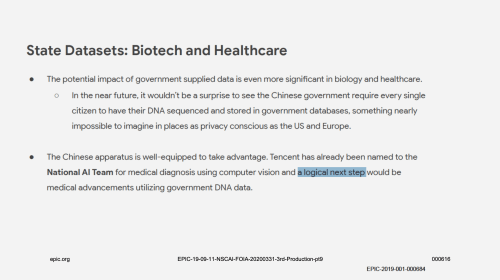
More troubling, it argues that “the potential impact of government supplied data is even more significant in biology and healthcare,” and says it is likely that “the Chinese government [will] require every single citizen to have their DNA sequenced and stored in government databases, something nearly impossible to imagine in places as privacy conscious as the U.S. and Europe.” It continues by saying that “the Chinese apparatus is well-equipped to take advantage” and calls these civilian DNA databases a “logical next step.”
Who are the NSCAI?
Given the sweeping changes to the U.S. that the NSCAI promoted in this presentation last May, it becomes important to examine who makes up the commission and to consider their influence over U.S. policy on these matters, particularly during the current crisis. As previously mentioned, the chairman of the NSCAI is Eric Schmidt, the former head of Alphabet (Google’s parent company) who has also invested heavily in Israeli intelligence-linked tech companies including the controversial start-up “incubator” Team8. In addition, the committee’s vice-chair is Robert Work, is not only a former top Pentagon official, but is currently working with the think tank CNAS, which is run by John McCain’s long-time foreign policy adviser and Joe Biden’s former national security adviser.
Other members of the NSCAI are as follows:
- Safra Catz, CEO of Oracle, with close ties to Trump’s top donor Sheldon Adelson
- Steve Chien, supervisor of the Artificial Intelligence Group at Caltech’s Jet Propulsion Lab
- Mignon Clyburn, Open Society Foundation fellow and former FCC commissioner
- Chris Darby, CEO of In-Q-Tel (CIA’s venture capital arm)
- Ken Ford, CEO of the Florida Institute for Human and Machine Cognition
- Jose-Marie Griffiths, president of Dakota State University and former National Science Board member
- Eric Horvitz, director of Microsoft Research Labs
- Andy Jassy, CEO of Amazon Web Services (CIA contractor)
- Gilman Louie, partner at Alsop Louie Partners and former CEO of In-Q-Tel
- William Mark, director of SRI International and former Lockheed Martin director
- Jason Matheny, director of the Center for Security and Emerging Technology, former Assistant director of National Intelligence and former director of IARPA (Intelligence Advanced Research Project Agency)
- Katharina McFarland, consultant at Cypress International and former Assistant Secretary of Defense for Acquisition
- Andrew Moore, head of Google Cloud AI
As can be seen in the list above, there is a considerable amount of overlap between the NSCAI and the companies currently advising the White House on “re-opening” the economy (Microsoft, Amazon, Google, Lockheed Martin, Oracle) and one NSCAI member, Oracle’s Safra Katz, is on the White House’s “economic revival” taskforce. Also, there is also overlap between the NSCAI and the companies that are intimately involved in the implementation of the “contact tracing” “coronavirus surveillance system,” a mass surveillance system promoted by the Jared Kushner-led, private-sector coronavirus task force. That surveillance system is set to be constructed by companies with deep ties to Google and the U.S. national security state, and both Google and Apple, who create the operating systems for the vast majority of smartphones used in the U.S., have said they will now build that surveillance system directly into their smartphone operating systems.
Also notable is the fact that In-Q-Tel and the U.S. intelligence community has considerable representation on the NSCAI and that they also boast close ties with Google, Palantir and other Silicon Valley giants, having been early investors in those companies. Both Google and Palantir, as well as Amazon (also on the NSCAI) are also major contractors for U.S. intelligence agencies. In-Q-Tel’s involvement on the NSCAI is also significant because they have been heavily promoting mass surveillance of consumer electronic devices for use in pandemics for the past several years. Much of that push has come from In-Q-Tel’s current Executive Vice President Tara O’Toole, who was previously the director of the Johns Hopkins Center for Health Security and also co-authored several controversial biowarfare/pandemic simulations, such as Dark Winter.
In addition, since at least January, the U.S. intelligence community and the Pentagon have been at the forefront of developing the U.S. government’s still-classified “9/11-style” response plans for the coronavirus crisis, alongside the National Security Council. Few news organizations have noted that these classified response plans, which are set to be triggered if and when the U.S. reaches a certain number of coronavirus cases, has been created largely by elements of the national security state (i.e. the NSC, Pentagon, and intelligence), as opposed to civilian agencies or those focused on public health issues.
Furthermore, it has been reported that the U.S. intelligence community as well as U.S. military intelligence knew by at least January (though recent reports have said as early as last November) that the coronavirus crisis would reach “pandemic proportions” by March. The American public were not warned, but elite members of the business and political classes were apparently informed, given the record numbers of CEO resignations in January and several high-profile insider trading allegations that preceded the current crisis by a matter of weeks.
Perhaps even more disconcerting is the added fact that the U.S. government not only participated in the eerily prescient pandemic simulation last October known as Event 201, it also led a series of pandemic response simulations last year. Crimson Contagion was a series of four simulations that involved 19 U.S. federal agencies, including intelligence and the military, as well as 12 different states and a host of private sector companies that simulated a devastating pandemic influenza outbreak that had originated in China. It was led by the current HHS Assistant Secretary for Preparedness and Response, Robert Kadlec, who is a former lobbyist for military and intelligence contractors and a Bush-era homeland security “bioterrorism” advisor.

In addition, both Kadlec and the Johns Hopkins Center for Health Security, which was intimately involved in Event 201, have direct ties to the controversial June 2001 biowarfare exercise “Dark Winter,” which predicted the 2001 anthrax attacks that transpired just months later in disturbing ways. Though efforts by media and government were made to blame the anthrax attacks on a foreign source, the anthrax was later found to have originated at a U.S. bioweapons lab and the FBI investigation into the case has been widely regarded as a cover-up, including by the FBI’s once-lead investigator on that case.
Given the above, it is worth asking if those who share the NSCAI’s vision saw the coronavirus pandemic early on as an opportunity to make the “structural changes” it had deemed essential to countering China’s lead in the mass adoption of AI-driven technologies, especially considering that many of the changes in the May 2019 document are now quickly taking place under the guise of combatting the coronavirus crisis.
The NSCAI’s vision takes shape
Though the May 2019 NSCAI document was authored nearly a year ago, the coronavirus crisis has resulted in the implementation of many of the changes and the removal of many of the “structural” obstacles that the commission argued needed to be drastically altered in order to ensure a technological advantage over China in the field of AI. The aforementioned move away from cash, which is taking place not just in the U.S. but internationally, is just one example of many.
For instance, earlier this week CNN reported that grocery stores are now considering banning in-person shopping and that the U.S. Department of Labor has recommended that retailers nationwide start “‘using a drive-through window or offering curbside pick-up’ to protect workers for exposure to coronavirus.” In addition, last week, the state of Florida approved an online-purchase plan for low income families using the Supplemental Nutrition Assistance Program (SNAP). Other reports have argued that social distancing inside grocery stores is ineffective and endangering people’s lives. As previously mentioned, the May 2019 NSCAI document argues that moving away from in-person shopping is necessary to mitigate China’s “adoption advantage” and also argued that “when buying online is literally the only way to get what you want, consumers go online.”
Reports have also argued that these changes in shopping will last far beyond coronavirus, such as an article by Business Insider entitled “The coronavirus pandemic is pushing more people online and will forever change how Americans shop for groceries, experts say.” Those cited in the piece argue that this shift away from in-person shopping will be “permanent” and also states that “More people are trying these services than otherwise would have without this catalyst and gives online players a greater chance to acquire and keep a new customer base.” A similar article in Yahoo! News argues that, thanks to the current crisis, “our dependence on online shopping will only rise because no one wants to catch a virus at a shop.”
In addition, the push towards the mass use of self-driving cars has also gotten a boost thanks to coronavirus, with driverless cars now making on-demand deliveries in California. Two companies, one Chinese-owned and the other backed by Japan’s SoftBank, have since been approved to have their self-driving cars used on California roads and that approval was expedited due to the coronavirus crisis. The CPO of Nuro Inc., the SoftBank-backed company, was quoted in Bloomberg as saying that “The Covid-19 pandemic has expedited the public need for contactless delivery services. Our R2 fleet is custom-designed to change the very nature of driving and the movement of goods by allowing people to remain safely at home while their groceries, medicines, and packages are brought to them.” Notably, the May 2019 NSCAI document references the inter-connected web of SoftBank-backed companies, particularly those backed by its largely Saudi-funded “Vision Fund,” as forming “the connective tissue for a global federation of tech companies” set to dominate AI.
California isn’t the only state to start using self-driving cars, as the Mayo Clinic of Florida is now also using them. “Using artificial intelligence enables us to protect staff from exposure to this contagious virus by using cutting-edge autonomous vehicle technology and frees up staff time that can be dedicated to direct treatment and care for patients,” Kent Thielen, M.D., CEO of Mayo Clinic in Florida stated in a recent press release cited by Mic.
Like the changes to in-person shopping in the age of coronavirus, other reports assert that self-driving vehicles are here to stay. One report published by Mashable is entitled “It took a coronavirus outbreak for self-driving cars to become more appealing,” and opens by stating “Suddenly, a future full of self-driving cars isn’t just a sci-fi pipe dream. What used to be considered a scary, uncertain technology for many Americans looks more like an effective tool to protect ourselves from a fast-spreading, infectious disease.” It further argues that this is hardly a “fleeting shift” in driving habits and one tech CEO cited in the piece, Anuja Sonalker of Steer Tech, claims that “There has been a distinct warming up to human-less, contactless technology. Humans are biohazards, machines are not.”
Another focus of the NSCAI presentation, AI medicine, has also seen its star rise in recent weeks. For instance, several reports have touted how AI-driven drug discovery platforms have been able to identify potential treatments for coronavirus. Microsoft, whose research lab director is on the NSCAI, recently put $20 million into its “AI for health” program to speed up the use of AI in analyzing coronavirus data. In addition, “telemedicine”– a form of remote medical care – has also become widely adopted due to the coronavirus crisis.
Several other AI-driven technologies have similarly become more widely adopted thanks to coronavirus, including the use of mass surveillance for “contact tracing” as well as facial recognition technology and biometrics. A recent Wall Street Journal report stated that the government is seriously considering both contact tracing via phone geolocation data and facial recognition technology in order to track those who might have coronavirus. In addition, private businesses – like grocery stores and restaurants – are using sensors and facial recognition to see how many people and which people are entering their stores.
As far as biometrics go, university researchers are now working to determine if “smartphones and biometric wearables already contain the data we need to know if we have become infected with the novel coronavirus.” Those efforts seek to detect coronavirus infections early by analyzing “sleep schedules, oxygen levels, activity levels and heart rate” based on smartphone apps like FitBit and smartwatches. In countries outside the U.S., biometric IDs are being touted as a way to track those who have and lack immunity to coronavirus.
In addition, one report in The Edge argued that the current crisis is changing what types of biometrics should be used, asserting that a shift towards thermal scanning and facial recognition is necessary:
“At this critical juncture of the crisis, any integrated facial recognition and thermal scanning solution must be implemented easily, rapidly and in a cost-effective manner. Workers returning to offices or factories must not have to scramble to learn a new process or fumble with declaration forms. They must feel safe and healthy for them to work productively. They just have to look at the camera and smile. Cameras and thermal scanners, supported by a cloud-based solution and the appropriate software protocols, will do the rest.”
Also benefiting from the coronavirus crisis is the concept of “smart cities,” with Forbes recently writing that “Smart cities can help us combat the coronavirus pandemic.” That article states that “Governments and local authorities are using smart city technology, sensors and data to trace the contacts of people infected with the coronavirus. At the same time, smart cities are also helping in efforts to determine whether social distancing rules are being followed.”
That article in Forbes also contains the following passage:
“… [T]he use of masses of connected sensors makes it clear that the coronavirus pandemic is–intentionally or not–being used as a testbed for new surveillance technologies that may threaten privacy and civil liberties. So aside from being a global health crisis, the coronavirus has effectively become an experiment in how to monitor and control people at scale.”
Another report in The Guardian states that “If one of the government takeaways from coronavirus is that ‘smart cities’ including Songdo or Shenzhen are safer cities from a public health perspective, then we can expect greater efforts to digitally capture and record our behaviour in urban areas – and fiercer debates over the power such surveillance hands to corporations and states.” There have also been reports that assert that typical cities are “woefully unprepared” to face pandemics compared to “smart cities.”
Yet, beyond many of the NSCAI’s specific concerns regarding mass AI adoption being conveniently resolved by the current crisis, there has also been a concerted effort to change the public’s perception of AI in general. As previously mentioned, the NSCAI had pointed out last year that:
“In the press and politics of America and Europe, Al is painted as something to be feared that is eroding privacy and stealing jobs. Conversely, China views it as both a tool for solving major macroeconomic challenges in order to sustain their economic miracle, and an opportunity to take technological leadership on the global stage.”
Now, less than a year later, the coronavirus crisis has helped spawn a slew of headlines in just the last few weeks that paint AI very differently, including “How Artificial Intelligence Can Help Fight Coronavirus,” “How AI May Prevent the Next Coronavirus Outbreak,” “AI Becomes an Ally in the Fight Against COVID-19,” “Coronavirus: AI steps up in battle against COVID-19,” and “Here’s How AI Can Help Africa Fight the Coronavirus,” among numerous others.
It is indeed striking how the coronavirus crisis has seemingly fulfilled the NSCAI’s entire wishlist and removed many of the obstacles to the mass adoption of AI technologies in the United States. Like major crises of the past, the national security state appears to be using the chaos and fear to promote and implement initiatives that would be normally rejected by Americans and, if history is any indicator, these new changes will remain long after the coronavirus crisis fades from the news cycle. It is essential that these so-called “solutions” be recognized for what they are and that we consider what type of world they will end up creating – an authoritarian technocracy. We ignore the rapid advance of these NSCAI-promoted initiatives and the phasing out of so-called “legacy systems” (and with them, many long-cherished freedoms) at our own peril.
Repeat of Iowa caucus looms in Nevada as problems are illuminated (& ignored)
By Helen Buyniski | RT | February 17, 2020
The same issues that led to the Democratic debacle in Iowa earlier this month are poised to make next week’s vote in Nevada equally hellish – yet party leaders seem unwilling to connect the dots or recognize the problem.
Early voters in Nevada have already faced long lines, technical difficulties, and monumental uncertainty about the voting process with voting underway since Saturday due to close Tuesday before the general caucus this coming Saturday.
We’ve seen this movie before
The slow-motion car-crash caucus volunteers have sketched out in their heads bears a strong resemblance to the events of Iowa. They’re willing to discuss it in interviews with the media, but always anonymously, for fear of angering what is apparently a vengeful party. But the Democratic National Committee chair Tom Perez and his state-level minions insist all is well.
The off-the-shelf Google forms that were quickly substituted for the buggy app that killed the Iowa caucus have already malfunctioned at some early voting sites, leaving some Nevadans waiting for three or four hours trying to vote. Meanwhile, no one seems to be on the same page regarding how the results from 80 early voting sites will be distributed among the 2,000 precincts where caucuses are to be held. Local politician Dan Rolle discovered the paper ballots used for early voting lacked precinct numbers, seemingly guaranteeing the party would be unable to count those votes and distribute them to the proper precinct by Saturday.
Some volunteers have reportedly received no training in using their DNC-purchased iPads, which they are supposed to use to scan the paper ballots marked up by early voters. A web-based Google app that has been dubbed the “Caucus Calculator” is supposed to divvy these up and send them around to the precincts for caucus day – wrinkles pointed out by Rolle notwithstanding. Caucus site leader Seth Morrison warned that volunteers were using an “untested software tool,” advising CNN viewers in Nevada to vote early because the volunteers had “never seen or handled” the tool being prepared for Saturday’s caucus. Perez seemed more concerned that a CNN reporter had called the “online tool” an “app” than he was to learn that volunteers didn’t know how to use it. At the same time, Rolle observed that the tool wasn’t being used at all.
One presidential aide suggested to the Washington Post that Nevada Democrats were “making it up as they go along” in their belated rush to conjure up a technological solution to replace the Shadow app. As an added wrinkle, Nevada was supposed to use two versions of the app, which was notoriously built by former Hillary Clinton staffers with money from the Pete Buttigieg campaign – one to tabulate the early votes, and another for the caucus.
Keeping everyone in the loop regarding replacement processes has proved difficult, with multiple campaigns’ aides complaining that notice of a critical conference call nearly passed them by. One aide was unable to join in at all because he was in the middle of a training session. Another update on process reportedly made it to journalists before the party distributed it to all the campaigns.
‘Trust us, we’re experts’
The party has reportedly brought in “security experts” to troubleshoot early voting issues, though this is hardly encouraging given the prevalence of DNC insiders among these so-called experts. The replacement process for the Shadow app was reportedly designed with input from the Department of Homeland Security, the DNC, and Google, and Nevada Democratic Party executive director Alana Mounce insisted the party was “confident in our backup plans and redundancies” in a memo to the campaigns on Thursday.
Nevada Democrats have done their best to squelch rumors that the contest is rigged, explaining that former Buttigieg staffer Emily Goldman, hired earlier this month as “voter protection director” for the party, will not have the ability to affect the caucus outcome. And the progressive watchdogs have moved on to Utah, where the state party chair has a history of virulently attacking Vermont senator Bernie Sanders.
Sanders leads the pack of Democratic contenders in Nevada, according to RealClearPolitics, with former vice president Joe Biden trailing by three points. Buttigieg, the beneficiary of the Iowa mess, lags behind even billionaire Tom Steyer. Sanders emerged the victor from the New Hampshire primary, though media coverage mystifyingly focused on the second-place finish of Buttigieg and Minnesota senator Amy Klobuchar – even talking up New York plutocrat Michael Bloomberg, who wasn’t on the ballot in that state, rather than discuss the democratic socialist’s triumph.
Are DNC insiders weaponizing ‘election security’ to seize control of 2020 primaries?
By Helen Buyniski | RT | February 12, 2020
Google and a dodgy “election security” nonprofit are reaching out to Democratic campaigns with free security tools, even offering to activate them. After the Iowa debacle, campaigns should be wary of DNC insiders bearing gifts.
Election security nonprofit Defending Digital Campaigns (DDC) has partnered with Google to offer free Titan security keys to Democratic presidential campaigns. Not only will these benevolent guardians of the democratic process let the candidates have the keys, part of Google’s Advanced Protection security program, free of charge – they’ll even install and activate the new security systems themselves! What could go wrong?
Candidates would be wise to think twice about accepting the seemingly-generous offer, or any other “free election security” bait, especially after the disaster of the Iowa caucuses. That vote collapsed not because of a foreign hack, but because Shadow Inc., an organization staffed almost entirely by former Hillary Clinton operatives, sold Iowa Democrats a difficult-to-use app that mangled vote counts. While Shadow was supposedly “vetted for cybersecurity and technical considerations” by “third-party experts,” many of the security “experts” peddling their services to the Democrats are veterans of the same Clinton and Obama campaigns as Shadow’s staff. And of course the 2020 Democratic National Committee, which insisted Iowa use an app to report results instead of calling them in by phone for security reasons, is positively bristling with insiders left over from 2016.
Defending Digital Democracy, the “security experts” Iowa Democrats were already paying to train volunteers in electoral “worst case scenarios,” is – unsurprisingly, given the name – run by the same Clinton and Romney staffers who sit on Defending Digital Campaigns’ board, Robby Mook and Matt Rhoades. Founded by former Obama Pentagon Chief of Staff Eric Rosenbach and advised by top Clinton lawyer Marc Elias, DDD has been “protecting” elections with the help of CrowdStrike founder (and Russiagate Patient Zero) Dmitri Alperovich since 2017. The Fear of Russian Meddling industry appears to be one big happy family, none of whom, it seems, have ever heard of paper ballots – one sure-fire way to avoid outside interference in an election.
The links between the various groups are extensive and complex enough to fill several articles, but looking at their financial backers is instructive. Shadow and DDC were both bankrolled by LinkedIn co-founders – Reid Hoffman provided the startup capital for Shadow’s parent corporation Acronym, while DDC’s treasurer and largest donor is Allen Blue. Hoffman also provided the financing for “disinformation experts” New Knowledge’s phony Russian bot operation in Alabama in 2017, which – if its own numbers are to be believed – handed the traditionally-red state’s open Senate seat to Democrat Doug Jones by weaponizing fear of Russian meddling.
There’s no stronger proof that all this “election security” talk is mere pageantry than in the DNC’s appointment of former Clinton campaign director John Podesta to the 2020 convention’s Rules Committee. Podesta has no business being anywhere near election security – it was his inability to recognize “phishing” that led to the Clinton campaign’s emails being spread all over the internet by Wikileaks in the runup to the 2016 election. Podesta, like Mook, has been aggressively pushing the threat of Russian election interference ever since, absent a shred of proof that the dreaded “meddling” is coming from anywhere but inside the country.
Some naive individuals might question whether party insiders would really try to steal another primary after the catastrophe of 2016 handed Trump his victory. But those responsible for that trainwreck were never punished, defending themselves in court with the rationale that party bylaws allowed them to pick candidates in smoke-filled rooms should they so desire. Moreover, nothing has come of the revelation former South Bend mayor Pete Buttigieg’s campaign paid $40,000 to Shadow before the company’s app nearly handed him victory in Iowa, or that parent company Acronym’s CEO is happily married to a Buttigieg staffer. Worse, last week it emerged that Buttigieg staffer Emily Goldman has signed on to the Nevada Democratic Party as “voter protection director” – a full-time position – now that Nevada has dropped the Shadow app for its own caucus.
Yet calls for DNC chair Tom Perez to resign, motivated by all these scandals and more, have fallen on deaf ears. Knowledge of the metastasizing conflicts of interest within the party has merely circulated on social media to the point where few in its progressive wing believe a fair election is possible. Inviting Google – which was 100 percent in the bag for Clinton in 2016, according to whistleblowers and researchers alike – and yet another Russia-obsessed, insider-heavy “election security” group to install free “protection” in one’s campaign infrastructure is inviting the local foxes to install security for one’s shiny new henhouse. Unless a candidate is secure in being the establishment’s pick, they would be wise to leave this Trojan horse outside the gates.
Twitter Shutters Dozens of Venezuelan Government-Linked Accounts
By Morgan Artyukhina | Sputnik | 08.01.2020
Dozens of Twitter accounts for figures and institutions related to the Venezuelan government, including military branches, political leaders and journalists, were suddenly suspended without explanation on Tuesday, a day after Washington condemned the National Assembly for failing to re-elect presidential claimant Juan Guaido.
The social media giant has suspended the accounts of numerous Venezuelan government institutions, including the country’s Army, Navy, National Guard, Air Force, Central Bank, Finance Ministry, Oil Ministry, National Center for Information Technology (CNTI) and National Commission for Information Technology.
The accounts of government figures like Victor Clark, the governor of Venezuela’s Falcon state; former Bolivarian National Army Forces General Commander Jesus Suarez; and Freddy Bernal, the coordinator of the country’s subsidized food distribution program, the Local Committees for Supply and Production (CLAP), were also shut down.
Still other accounts shuttered include Red Radio Venezuela, the presidential press office and the press office for the mayor of Caracas.
According to TeleSur, no explanation has been given for the suspensions, just a notice that the accounts had ostensibly violated Twitter’s terms of use.
While a few of the accounts have since been unlocked, such as Bernal’s and the Finance Ministry’s, most remain locked.
Toeing the State Department Line
TeleSur noted that according to Twitter’s rules, an account can be closed if it’s being used for spam, has been hacked, participates in abusive or bellicose behavior or impersonates another account – but the closed accounts haven’t violated any of these rules.
The crackdown mirrors one by the social media giant in September that targeted numerous Cuban news outlets and journalists. As Sputnik reported, dozens of Cuban accounts were shut down just moments before Cuban President Miguel Diaz-Canel addressed the nation about a chronic fuel shortage caused by US sanctions and collective methods of coping with the shortages.
Twitter has steadily treaded closer to the US State Department’s line in recent years, adopting the same bellicose stance against accounts associated with governments targeted by Washington, including those of Venezuela, Iran, Russia and China. Under the guise of combating disinformation, Twitter, along with Facebook and Google, have closed down accounts spreading information and news that run counter to the US government’s official line on events such as the Guaido’s declaration of his own interim presidency and the anti-Beijing protests in Hong Kong. However, in the recent crackdowns on Cuban and Venezuelan accounts, Twitter has not even attempted to offer a veil of justification.
Washington Decries Guaido’s Ouster
On Sunday, Guaido failed to secure re-election as the speaker of Venezuela’s National Assembly, a post he received in January 2019 amid rotating leadership of the legislature by the country’s opposition parties. Instead, 81 of the 150 lawmakers chose Luis Parra, an independent opposition member representing Yaracuy State.
Parra recently left the centrist opposition party Primero Justicia, the party of Henrique Capriles, who challenged Venezuelan President Nicolas Maduro in the 2013 presidential election.
Unsure if he would win re-election, Guaido postured as if he had been barred entry to the legislature, attempting to scale the fences outside on Sunday. However, there’s no evidence Guaido was actually prevented from entering the building in a normal way, especially since Guaido loyalists like William Davila entered without trouble.
Video footage later emerged showing Guaido refusing to enter unless in the company of several lawmakers whose parliamentary immunity has been revoked for alleged criminal offenses, Venezuelanalysis noted.
After opposition members failed to convince Guaido to enter, he and they later met at the headquarters of anti-government newspaper El Nacional, declaring the parliament’s vote void and re-electing Guaido as speaker, with several figures standing in for legislators who had left the country.
Washington quickly denounced the events in the National Assembly, with US Vice President Mike Pence declaring Guaido the country’s “only legitimate president” and US Special Envoy to Venezuela Elliot Abrams promising new sanctions against Maduro.
Guaido’s claim to be interim president is recognized by roughly 50 countries, mostly European and US-allied nations, while Maduro, who won reelection in 2018, remains recognized as the president of Venezuela by roughly 75% of the world’s nations. Since January 23, 2019, Guaido has launched four attempted coups d’etat, each of which has gained less traction than the last.
Social Media Censorship Reaches New Heights as Twitter Permanently Bans Dissent
Mnar Muhawesh speaks with journalist Daniel McAdams about being permanently banned from Twitter, social media censorship and more.
By Mnar Muhawesh – MintPress News – November 14, 2019
It’s an open secret. The deep state is working hand in hand with Silicon Valley social media giants like Twitter, Facebook and Google to control the flow of information. That includes suppressing, censoring and sometimes outright purging dissenting voices – all under the guise of fighting fake news and Russian propaganda.
Most recently, it was revealed that Twitter’s senior editorial executive for Europe, the Middle East and Africa is an active officer in the British Army’s 77th Brigade, a unit dedicated to online warfare and psychological operations.
In other words: he specializes in disseminating propaganda.
The news left many wondering how a member of the British Armed Forces secured such an influential job in the media.
The bombshell that one of the world’s most influential social networks is controlled in part by an active psychological warfare officer was not covered at all in the New York Times, CNN, CNBC, MSNBC or Fox News, who appear to have found the news unremarkable.
But for those paying attention and for those who have been following MintPress News extensive coverage of social media censorship, this revelation was merely another example of the increasing closeness between the deep state and the fourth estate.
Amazon owner, and world’s richest man, Jeff Bezos was paid $600 million by the CIA to develop software and media for the agency, that’s more than twice as much as Bezos bought the Washington Post for, and a move media critics warn spells the end of journalistic independence for the Post.
Meanwhile, Google has a very close relationship with the State Department, its former CEO Eric Schmidt’s book on technological imperialism was heartily endorsed by deep state warmongers like Henry Kissinger, Hillary Clinton and Tony Blair.
In their book titled, The New Digital Age: Reshaping the Future of People, Nations and Business, Eric Schmidt and fellow Google executive Jared Cohen wrote:
What Lockheed Martin was to the twentieth century…technology and cyber-security companies [like Google] will be to the twenty-first.
Another social media giant partnering with the military-industrial complex is Facebook. The California-based company announced last year it was working closely with the neoconservative think tank, The Atlantic Council, which is largely funded by Saudi Arabia, Israel and weapons manufacturers to supposedly fight foreign “fake news.”
The Atlantic Council is a NATO offshoot and its board of directors reads like a rogue’s gallery of warmongers, including the notorious Henry Kissinger, Bush-era hawks like Condoleezza Rice, Colin Powell, James Baker, the former head of the Department of Homeland Security and author of the PATRIOT Act, Michael Chertoff, a number of former Army Generals including David Petraeus and Wesley Clark and former heads of the CIA Michael Hayden, Leon Panetta and Michael Morell.
39 percent of Americans, and similar numbers of people in other countries, get their news from Facebook, so when an organization like the Atlantic Council is controlling what the world sees in their Facebook news feeds, it can only be described as state censorship on a global level.
After working with the council, Facebook immediately began banning and removing accounts linked to media in official enemy states like Iran, Russia and Venezuela, ensuring the world would not be exposed to competing ideas and purging dissident voices under the guise of fighting “fake news” and “Russian bots.”
Meanwhile, the social media platform has been partnering with the US and Israeli governments to silence Palestinian voices that show the reality of life under Israeli apartheid and occupation. The Israeli Justice Minister proudly revealed that Facebook complied with 95 percent of Israeli government requests to delete Palestinian pages. At the same time, Google deleted dozens of YouTube and blog accounts supposedly connected to the government of Iran.
In the last week alone, Twitter has purged several Palestinian news pages, including Quds News Network — without warning or explanation.
Electronic Intifada co-founder Ali Abunimah wrote,
This alarming act of censorship is another indication of the complicity of major social media firms in Israel’s efforts to suppress news and information about its abuses of Palestinian rights.
Alternative voices not welcome
The vast online purge of alternative voices has also been directed at internal “enemies.”
Publishers like Julian Assange and whistleblowers like Chelsea Manning are still being held in solitary confinement in conditions that international bodies and human rights groups call torture, for their crime of revealing the extent of the global surveillance network and the control over the media that Western governments have built.
As attempts to re-tighten the state and corporate grip over our means of communication increases, high-quality alternative media are being hit the hardest, as algorithm changes from the media monoliths have deranked, demoted, deleted and disincentivized outlets that question official narratives, leading to huge falls in traffic and revenue.
The message from social media giants is clear: independent and alternative voices are not welcome.
One causality in this propaganda war is Daniel McAdams, Executive Director of the Ron Paul Institute for Peace and Prosperity, a public advocacy group that argues that a non-interventionist foreign policy is crucial to securing a prosperous society at home. McAdams served as Senator Paul’s foreign affairs advisor between 2001 and 2012. Before that, he was a journalist and editor for the Budapest Sun and a human rights monitor across Eastern Europe.
McAdams, who spent much of his time on Twitter calling out the war machine supported by both parties, was recently permanently banned from the platform for so-called “hateful conduct.” His crime? Challenging Fox News anchor Sean Hannity over his hour-long segment claiming to be against the “deep state,” while simultaneously wearing a CIA lapel pin. In the exchange, McAdams called Hannity “retarded,” claiming he was becoming stupider every time he watched him.
Yes, despite that word and its derivatives having been used on Twitter over ten times in the previous minute, and often much more aggressively than McAdams used it – only McAdams fell victim to Twitter’s ban hammer. Something didn’t make sense about this ban. One only needs to read the replies under any of President Trump’s tweets to see far more hateful speech than what McAdams displayed to suspect foul play.
I spoke with McAdams about the ban and began by asking him if he accepts the premise of the ban, or if he believes something else was afoot.
Google sucks up & analyzes healthcare data on millions of Americans in secret AI project… after voluntary opt-in flops
RT | November 12, 2019
Google has teamed up with one of the largest health providers in the US to gather detailed medical records on millions of patients across the country without their knowledge, in a secret project the firm tried to keep under wraps.
Dubbed “Project Nightingale,” the secretive program brought together Google and healthcare giant Ascension in an effort to collect medical records on patients across 21 states, according to a report in the Wall Street Journal. The data sharing began last year, and has only accelerated in recent months.
At least 150 employees at Google’s Cloud division now have access to the bulk of the data, which amounts to information on tens of millions of patients, according to a source familiar with the records.
The details shared include patient names and dates of birth, hospitalization records, lab results and doctor diagnoses, which together provide a complete medical history for many of the patients – all without their consent.
Google says it hopes to use the data to develop an application employing AI and machine learning to track patients and recommend treatments, and ultimately has its eye on creating a search engine that can aggregate disparate patient data in one place.
“Wow – this is downright alarming. Do you trust Google with your blood test results, diagnoses, sensitive health information?” asked attorney and Republican National Committee member Harmeet K. Dhillon in a tweet. “Google’s secret ‘Project Nightingale’ gathers personal health data on millions of Americans.”
The company launched Google Health in 2008, but shuttered it less than four years later after failing to persuade enough users to hand over their medical records willingly, perhaps uncomfortable with the firm having access to such sensitive information. The tech giant has since cut individual consent out of its quest to amass healthcare data, going over the heads of patients to make deals with health providers instead.
In September, the company allied with the Minnesota-based Mayo Clinic to provide cloud services and data analytics in a 10-year “strategic partnership,” which will give Google access to data on up to 1 million patients at the clinic each year.
In another mass data grab earlier this month, the company purchased the maker of the fitness tracking device Fitbit, gobbling up the data of some 28 million active users of the gadget. The data goes beyond simple fitness tracking, such as the number of steps one takes per day, as some users opt to link the device to additional medical or insurance records. While Google vowed to never hand out the Fitbit information to third parties, customers may still have reason to be skeptical about the integrity of their data.
Over the summer, Google and another partnered healthcare facility, the University of Chicago Medical Center, came under fire in a lawsuit alleging the hospital gave Google medical records on hundreds of thousands of patients without stripping them of identifying information. The case mirrored a similar mishap across the pond in 2017, in which the UK’s National Health Service passed the company data on 1.6 million patients in violation of privacy laws.
The data sharing with Ascension is likely permitted under US federal law, however, as the 1996 Health Insurance Portability and Accountability (HIPA) Act allows hospitals and other healthcare providers to pass data to business partners without informing patients so long as it “help[s] the covered entity carry out its health care functions.”
Ascension – a network of some 2,600 hospitals, doctors’ offices and other medical facilities – says it’s doing just that, seeking to use the data to improve care and identify additional tests patients might need. However, documents reviewed by the Journal also suggest the company, like Google, has its bottom line in mind, hoping to use the data-mining to generate more revenue as well.
Also on rt.com:
NHS patient information illegally shared with Google DeepMind
Google buys Fitbit, acquiring users’ health histories & triggering privacy backlash
Only thing clear about the new Transparency Act is that US senators are about to let Google keep manipulating your search results
By Michael Rectenwald | RT | November 10, 2019
In June, whistleblower Zach Vorhies dumped internal Google documents exposing the company’s shady practices and political agenda. Rather than investigate, US lawmakers are offering Big Tech political cover and a legislative decoy.
Internal documents and secret recordings continue to make abundantly clear what many already knew and others strongly suspected about Google and other digital goliaths; that Google, Facebook, Instagram, Twitter, YouTube and others manipulate their content and their users.
Stepping into the fray, Senator John Thune (R-S.D.) has boasted that his new bill – the Filter Bubble Transparency Act – is the silver bullet for bursting user information filter bubbles, the predictable information dead ends that reinforce users’ pre-existing perspectives. He would have us believe that the use of personal user data by search engine algorithms is the real problem with the internet.
But this issue is the least of the problems that users face online. The bill’s co-sponsors hope we’ve forgotten – or never knew – that Google and the rest are not the unbiased, politically neutral information sources or social media platforms that they (so poorly) pretend to be. Far from it.
Google blacklists sources and prevents them from appearing in news results or featured links. Google’s blacklist is a manually curated file including over 500 websites that are excluded from news results.
Google applies fringe ranking to sites, downgrading those sites – but not The New York Times and The Washington Post – that promote “conspiracy theories” and “fake news.” Fringe ranking involves the manual grading of sites, although only those whose conspiracy theories or fake news stories fail to meet Google’s criteria for credible, plausible narratives are downgraded.
Google and YouTube use “hate speech” labeling, downgrading sites and videos they believe contain “hate speech.” YouTube scoring is apparently based solely on whether videos express “supremacism.”
Google and YouTube use “authoritativeness” scoring to rank sites and videos. The authoritativeness score is necessarily based on whether a news site or video conforms to Google or YouTube’s notions of credible and respectable views.
Last is the little-known fact that Google ranks websites against Wikipedia pages, treating Wikipedia as an unbiased and authoritative source. As Zach Vorhies told me in a private chat, “the core issue is that sites are not being ranked according to user data, they are being ranked against Wikipedia.” Websites are downgraded if Wikipedia pages contain negative information about them. Yet, as information age philosopher Jaron Lanier has noted, Wikipedia is notorious for its left-leaning political bias and its overwriting of known facts to suit its agenda. The issue has been addressed on Wikipedia itself.
Together, Google’s site-ranking methods favor liberal and left-leaning sites – but Google goes even further by steering voters toward preferred candidates and, in an insider video, the company made clear that it intends to intervene in the 2020 presidential election.
The Big Tech giants manipulate data and users and under questionable pretences and using highly subjective criteria. And they’ve done most of these things, or so they hoped, without our knowledge or permission.
The proposed legislation doesn’t even mention –let alone address– these practices. Instead, it pretends to talk tough. Google, Facebook, and other major search and social media platforms would be required to give users an option to use “input-transparent algorithms” that don’t incorporate user data in search results. Platform providers would have to disclose when they use “opaque algorithms” that use such user-connected data. Whoopee.
While it may be true that, as Sen. Thune suggests, the new internet bill was written to give users “more control over what they see online,” it leaves that control by and large in the hands of Google and other digital giants. The proposed bill deflects attention from the basis of this control – the manipulation of search results and use of other data-meddling and scoring tactics by big digital players. Whether intentionally or not, the Filter Bubble Transparency Act serves as a diversionary device, allowing Big Tech to hide in plain sight.
Michael Rectenwald is the author of nine books, including the most recent, Google Archipelago.
Featured Video

Trita Parsi: Israel Set a Trap for Total War in the Region
or go to
Aletho News Archives – Video-Images
From the Archive
Zionism’s Violent Legacy
By Donald Neff | Washington Report On Middle East Affairs | January 1996
On January 4, 1948, Jewish terrorists drove a truck loaded with explosives into the center of the all Arab city of Jaffa and detonated it, killing 26 and wounding around 100 Palestinian men, women and children.[1] The attack was the work of the Irgun Zvai Leumi – the “National Military Organization,” also known by the Hebrew letters Etzel – the largest Jewish terrorist group in Palestine. The Irgun was headed by Revisionist Zionist Menachem Begin and had been killing and maiming Arabs, Britons and even Jews for the previous ten years in its efforts to establish a Jewish state.
This terror campaign meant that at the core of Revisionist Zionism there existed a philosophical embrace of violence. … continue
Blog Roll
 Aletho News
- Trump’s Iran war is on an Israeli leash
- Saudi oil boss issues global supply warning
- Riyadh Says Its Oil System Is Intact. The Numbers Say Otherwise.
- Trump and Netanyahu Want to “Finish the Job” on Iran
- US ‘one-sided dictation’ not Iran’s beliefs makes rational talks impossible: Baghaei
- Iran’s Next Strike May Not Explode. It Could Shut You Down /Col Doug Macgregor
- Iran: US political targets legitimate if assassinations return
- Iraq shuts key border crossing with Iran under US pressure: Report
- Undersea Internet cables could be targeted in retaliation for attacks on Iran: IRGC deputy chief
- EU sending ‘biased’ observers to interfere in Serbian election – president
- If Americans Knew
- The Israel Lobby’s Changing Fortunes
- AIPAC has become such a political liability that it’s shifting to a more “nimble” approach to buying politicians
- At least 160 Israeli settler attacks in 2 weeks
- Will Gaza’s Ancient Christian Community Disappear Forever?
- Israel’s vision of regional security rests on keeping Arab states weak
- Heidi Levine recounts how Palestinian youths helped save her in settler attack
- DAILY UPDATE: Latest essential news on Palestine, Israel, & region
- Trump’s Intensifying Sabotage of the ICC, for Israel’s Sake
- Israeli military detain US and UK volunteers in West Bank including Democratic NY politician Brad Lander
- Americans at National Conservatism Conference held in Israel this year criticize Israel
- No Tricks Zone
- E-Cars Reduce CO2 Emissions By Only 41% Compared To Internal Combustion Engine Vehicles
- Predictions Made By Renowned Climate Professor Over Past Decades Have Been Proven To Be Poor
- New Study Suggests Large Regions Of The Pacific Ocean Have Been Cooling For The Last 80 Years
- Germany’s Green Energy Debacle: High Energy Costs Force Kahla Porzellan to Close After 182 Years!
- New Study: 50 Years Of The Most Aggressive ‘Net Zero’ Policies Can Only Affect The Global Climate By 0.03°C
- US September “Heat” Was No Record…Many Records Set Decades Ago
- Latest European Green Energy Debacle; Portugal’s Largest Flagship Solar Park Insolvent!
- Green Energy Debacle: German Expert Professor Fritz Vahrenholt Warns Of Severe Economic And Social Consequences
- Two More Paleo Reconstructions Affirm Meters-Higher Sea Levels Across Ireland, Brazil 7000-6000 Years Ago
- New Study: Earth And Venus Surface Warmth Largely Explained By Convection And Lapse Rate, Not CO2 Or Radiation