Hillary’s Foreign Policy Speech: Queen Galadriel Before Her Magic Mirror

By Gary Leupp | CounterPunch | June 6, 2016
Rachel Maddow, the famously progressive MSNBC show host, pronounced it “her greatest speech of the campaign.” Chris Matthews agreed, adding that it would “have a very strong appeal to the neocon movement.” He mentioned in particular Bill Kristol, the Weekly Standard editor and TV commentator, as someone likely to be impressed. “A very smart man,” opined Matthews, the conservative Democrat and “Hardball” host, causing the entire cosmos to shudder.
You’d think that that war in Iraq, which Kristol had tirelessly championed, had never happened. And that its results had been anything other than horrific for the entire Middle East.
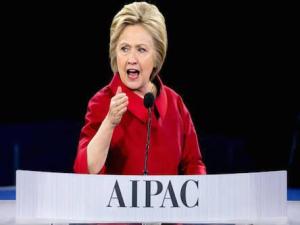
Hillary Clinton’s fiery performance last Thursday night, intended to assert her credentials as a former secretary of state (with all the positive “experience” that’s supposed to entail), framed by no fewer than seventeen U.S. flags, was a strident reassertion of U.S. “exceptionalism” without apologies or even reflections on the recent past and her bloody role in it.
It was billed as a “major foreign policy address,” the sort of thing you might expect of a sitting president. And it was designed, of course, to make her look presidential, and to underscore her campaign’s declaration that she has the Democratic nomination all sewed up. But it was not in fact a foreign policy speech at all; Donald Trump is quite right to call it “a political speech” directed at him.
Maddow has occasionally shown signs of critical reasoning in her coverage of the U.S.’s imperialist wars. One has to wonder what she finds admirable in the speech. Because actually, Clinton said nothing new.
However unsubstantial, it was all over the news the next morning, competing with the stories about new fencing at the Cincinnati Zoo and Prince’s autopsy results. Meanwhile the networks systematically ignore the ongoing wars in Iraq and Syria generated by the invasion of Iraq 13 years ago, and the European refugee crisis sparked by the regime-change wars in those countries as well as in Afghanistan and Libya. Like the monkeys adorning the Nikko Shrine, they see no evil, hear no evil, and speak no evil.
Some takeaway lines from the Clinton speech: “Donald Trump doesn’t know the first thing about Iran or its nuclear program.” It’s true that Trump is an uninformed blowhard and that Hillary in contrast knows a lot. She knows, for example, that the entire U.S. intelligence community, in two separate National Intelligence Estimates after 2003, concluded that Iran does not have a military nuclear program. She knows that the whole issue was hyped at the demand of the Israeli leaders who continuously demanded that the U.S. bomb Iran’s nuclear facilities (that in fact date back to the period of the Shah’s reign and supported by the U.S.’s “Atoms for Peace” program).
She also knows from experience the value of the Big Lie in obtaining mass acceptance for real or threatened military action.
Clinton has generally avoided specifics in discussing her plans for more war with one conspicuous exception: she has continuously stated that she strongly advocates a “no-fly zone and humanitarian corridors” in Syrian air space and on the ground in that country beset by civil war pitting a secular regime, mainly against terrorist and terrorist-aligned Islamist opponents.
For Hillary, Syria is the ideal battlefield: one that pits her vision of U.S. hegemony against both Russia (Syria’s patron and her main target) and the nebulous evil of Islamist terrorism in the world—on behalf of an imaginary middle force of democrats who will stay cozy with the U.S. and end support for armed groups opposing Israel.
Her plans are as much a recipe for war as the bogus humanitarian mission in Libya in 2011. They would, as estimated by former Chairman of the Join Chiefs of Staff Gen. Martin E. Dempsey, require the deployment of 70,000 U.S. troops for their implementation.
In last week’s speech she was more circumspect. “We need to take out [ISIL’s] strongholds in Iraq and Syria,” she declared, “by intensifying the air campaign and stepping up our support for Arab and Kurdish forces on the ground. We need to keep pursuing diplomacy to end Syria’s civil war and close Iraq’s sectarian divide, because those conflicts are keeping ISIS alive. We need to lash up with our allies, and ensure our intelligence services are working hand-in-hand to dismantle the global network that supplies money, arms, propaganda and fighters to the terrorists.”
She didn’t mention that the money supplied to the terrorists is overwhelmingly from donors in Saudi Arabia, Turkey and Gulf states closely allied with the U.S. Or that the current U.S. air campaign over Syria is, unlike that of Russia, illegal, opposed by the internationally recognized government in Damascus and lacking UN approval. Her “major foreign policy address” could not address such small details.
Hillary did not mention her own crowning achievement as secretary of state—the savage destruction of Libya involving the death of about 30,000 people, the unleashing of the ugliest forms of tribalism, and ISIL’s securing of a beachhead around Sirte—even once.
In contrast she made repeated references to NATO, well aware no doubt that most Americans aren’t clear at all about what that is but think it must be something good. Like the UN, or the International Red Cross. (I doubt that one in ten knows what the acronym stands for—the North Atlantic Treaty Organization—or realizes that it has only been deployed well outside the North Atlantic region, in the Balkans, Afghanistan, and North Africa.)
“This is someone [Trump] who has threatened to abandon our allies in NATO,” Clinton thundered (as though the peoples of Europe had ever earnestly sought, or are begging to maintain that Cold War, specifically anti-Russian, alliance).
It’s true that Trump has—on occasion and inconsistently—labeled NATO “obsolete” and opined that it should have been dissolved years ago. Whether he truly believes this is unclear. As Hillary says, his “ideas are dangerously incoherent” and he can withdraw or deny such comments at any time. But Trump’s statements about NATO, however vague, are actually the most intelligent and welcome statements he’s made in the course of his campaign.
The fact is, beginning in 1999 at her husband Bill’s orders, the NATO alliance designed as a binding military pact uniting West European countries against the Soviet Union from 1949—that should have been dissolved in 1990 when the Warsaw Pact formed in response shut down—has relentlessly expanded to encircle Russia. That’s post-Cold War Russia, with a military budget about 7% of the U.S. figure. Some NATO leaders aim to ultimately swallow Ukraine—which just happens to have been part of the Russian state from the 1670s to the Bolshevik Revolution, when it was made a soviet socialist republic until the collapse of the Soviet Union in 1991. Its economy including its munitions industry are inextricably interwoven with Russia’s; its eastern regions are peopled by ethnic Russians; it shares a 1,400 mile long border with Russia.
Does it not make sense that Moscow would see the incorporation of Ukraine, especially one headed by the current Russophobic leadership, into an anti-Russian military alliance as threatening and unacceptable?
Yet Hillary has been a ferocious advocate for the infinite expansion of the alliance, its wars that have produced dysfunctional U.S. client states (Kosovo, Bosnia-Herzegovina) in the former Yugoslavia, and its provocative moves on Russia’s doorstep. But in her speech, avoiding any reference to that expansion—the key geopolitical change of the last quarter-century—she proclaimed: “Moscow has taken aggressive military action in Ukraine, right on NATO’s doorstep.” She never explains why that doorstep has advanced (despite Reagan’s promises to Gorbachev) to include Poland, Slovakia, Hungary and Romania to begin with. Or why it has bordered Russia itself since the inclusion of the former soviet socialist republics of Estonia and Latvia, which share a 508 kilometer border with Russia.
The “military action in Ukraine” that she alludes to refers to separatists’ resistance to the U.S.-backed coup in February 2014, surely supported by Russia at some level, and surely by Russian public opinion, but you notice that the Pentagon has produced precious little evidence for large scale “military actions.” And the annexation of Crimea (Russian from 1783 to 1954, when it was transferred to the Ukrainian SSR within the old Soviet Union) was only a “military action” in that the 25,000 Russian troops stationed there by treaty were deployed to secure government buildings.
And do not expect Hillary to ever inform her audiences that Sevastopol on Crimean Peninsula is Russia’s only year-round ice-free port except Murmansk north of the Arctic Circle; that the Russian Black Sea Fleet has been headquartered there without interruption since 1783; and that the expulsion of the Russians and their replacement with NATO forces would constitute a truly existential threat to the Russian state.
It would in fact be hard to build a case convincing to the American people that all these countries need to be locked into an alliance with the U.S. and obliged to pay out 2% of their GDPs on military expenses in order to protect them from some imaginary Russian invasion. (From a rational standpoint, it would be precisely like persuading the Russian people that Moscow should head up an alliance including Canada, Mexico and Cuba to secure them against U.S. aggression.)
But the expansion of NATO to include Ukraine has been a pet project of the former Madame Secretary. Clinton chose as her Under Secretary of State for European and Eurasian Affairs Victoria Nuland, a former aide to Vice President Dick Cheney, neocon and wife of the powerful neocon Republican pundit (John McCain advisor and recently declared Hillary supporter) Robert Kagan. Nuland already had a rich history of warmongering when she embarked on a plan to topple the elected government in Ukraine and replace it with one that would join NATO.
She boasted publically that the U.S. had spent $ 5 billion by 2014 in an effort to, as she put it so quaintly and dishonestly, “support Ukraine’s European aspirations.” The result was the coup in February 2014 and consequent civil war that has taken over 8,000 lives, including hundreds killed by the neo-fascist Azov Battalion which functions as a regiment of the National Guard.
The U.S. State Department echoed by the compliant media has methodically depicted these events as Russian interference, rather than the results of a U.S.-orchestrated “Color Revolution”-type regime change campaign. To anyone paying attention, the dishonesty, and the success of the propaganda prettifying the coup, is sickening.
Trump has, as Clinton notes, praised Vladimir Putin as someone to whom he’d award an A for leadership. She for her part calls him a “dictator,” a term she would never use for a U.S. ally such as Egypt’s Abdel Sisi or the Saudi king. She has compared the apparently popular president, who has deftly pushed Obama back from his 2013 threat to order a massive strike on Syria and cooperated in the conclusion of the Iran nuclear deal, to Hitler—an astonishing statement of historical illiteracy and propensity for sensationalism.
Hillary’s imperious message boils down to: We are the exceptional nation, which the world needs to maintain its “stability.”
“I believe in strong alliances; clarity in dealing with our rivals; and a rock-solid commitment to the values that have always made America great. And I believe with all my heart that America is an exceptional country – that we’re still, in Lincoln’s words, the last, best hope of earth. We are not a country that cowers behind walls. We lead with purpose, and we prevail.”
The peoples of Korea, Vietnam, Afghanistan, Iraq, and Libya, know very well how “exceptional” a country the U.S. is, how seldom it “cowers behind walls,” how cheerfully and unapologetically it destroys countries using its “alliances”—even when the latter are jerry-rigged to provide a fig-leaf for what’s essentially unilateral action. Even when their member-lists are often padded with name-only participants such a tiny Pacific nations sometimes informed after the fact that they’re suscribers.
The youth of Iraq—93% of whom according to a recent poll view the U.S. as an enemy—know how U.S. “values” manifest themselves: in the form of “shock and awe” bombing, Abu Ghraib torture, Blackwater murders, and cowboy-managed “reconstruction” that in fact further divided and scourged an already ruined and humiliated country. There is nothing good that can be said about the war that Hillary so passionately supported, until it became politically impossible for her to continue to do so.
Madame Secretary looked regal Thursday night, in the worst way. She reminded me of the elfin Queen Galadriel, as played by Cate Blanchett, in The Lord of the Rings, in that scene where she stares into her magic mirror, sees a vision of the power of Sauron, and suddenly towers over Frodo, arms like dark hollows, arms flung high, and bellows:
“In place of a Dark Lord, you would have a queen! Not dark, but beautiful and terrible as the dawn! Treacherous as the sea! Stronger than the foundations of the earth! All shall love me, and despair!”
Trump and Clinton are both servants of the enchanted ring called Capital. It is not at all clear who is more darkly and fatefully bound, or whose foreign policy, applauded by more devoted followers, would be more terrible and cause the greater despair among the people of this planet.
In response to the warrior-queen awaiting coronation, Bernie Sanders has sadly avoided the whole question of U.S. imperialism. (Among other things, he never uses the term.) It’s as though he accepts Chris Matthew’s smug pronouncement, “The American people don’t care about foreign policy.” The best Bernie could do last week was to say: “… when it comes to foreign policy, we cannot forget that Secretary Clinton voted for the war in Iraq, the worst foreign policy blunder in modern American history, and that she has been a proponent of regime change, as in Libya, without thinking through the consequences.”
Forgive me, Bernie—because I do of course hope you’ll win—but that comment was wimpish. Hillary’s Libya policy wasn’t a matter of not “thinking through consequences,” but a matter of calculated ruin of a modern state. It’s the difference from the “blunder” of accidental manslaughter and well-planned murder. (Recall how Madame Secretary cackled with hilarity after Col. Gadhafy was sodomized with a knife and assassinated in the desert by NATO’s friends.)
Like the CNN anchors who sometimes mention in passing Hillary’s “foreign policy blunders such as Libya,” Sanders cannot yet call out evil for what it is, but has to chalk it up to well-meaning mistakes lacking forethought.
But that level of criticism is the best the system can provide, the most it will allow. Mistakes were made. There were some intelligence flaws. There were blunders. To paraphrase Erich Segal’s Love Story: being the exceptional power means never having to say you’re sorry. You just acknowledge you fucked up, because hey, things like that happen. And let’s move on.
Had Bernie been the antiwar, anti-imperialist candidate throughout, rather than just repeating his (totally valid) tirade against Wall Street, he might have further sharpened his differences with Clinton. If he loses in California, and then betrays his following with a Clinton endorsement, he will be saying that more wars for regime change and more confrontation with Russia is worth some changes in party rules and some meaningless clauses on the party platform.
I would hope that any Bernie supporters (or anyone at all) who watched last night’s speech, or have read the on-line transcript, would buckle down on their opposition to this creature of Wall Street and the Democratic Party establishment. Better to vote not at all, if Clinton’s the nominee—and instead think about how best to topple whichever candidate wins.
The “billionaire class” that Bernie decries wants badly to suck you in. That’s why the party bosses praise Sanders for “bringing so many new young people into the process”—the better to eat you, my dear! They want you to love this queen, even as you despair of ever electing anybody better.
One Ring to rule them all, One Ring to find them,
One Ring to bring them all, and in the darkness bind them,
In the Land of Mordor where the Shadows lie
Better, surely, to destroy the Ring that is the rigged economy, rigged political process and murderous foreign policy that Hillary so personifies.
Gary Leupp is Professor of History at Tufts University, and holds a secondary appointment in the Department of Religion.
Hillary Clinton: Electing a Foreign Spy for President?
By James Petras | June 6, 2016
During her 4 years as Secretary of State of the United States (2009-2014), Hillary Clinton controlled US foreign policy. She had access to the most confidential information and state documents, numbering in the tens of thousands, from all of the major government departments and agencies, Intelligence, FBI, the Pentagon, Treasury and the office of the President. She had unfettered access to vital and secret information affecting US policy in all the key regions of the empire.
Today, Mme. Clinton’s critics have focused on the technical aspects of her violations of State Department procedures and guidelines regarding handling of official correspondences and her outright lies on the use of her own private e-mail server for official state business, including the handling of highly classified material in violation of Federal Records laws, as well as her hiding official documents from the Freedom of Information Act and concocting her own system exempt from the official oversight which all other government officials accept.
For many analysts, therefore, the issue is procedural, moral and ethical. Mme. Clinton had placed herself above and beyond the norms of State Department discipline. This evidence of her arrogance, dishonesty and blatant disregard for rules should disqualify her from becoming the President of the United States. While revelations of Clinton’s misuse of official documents, her private system of communication and correspondence and the shredding of tens of thousands of her official interchanges, including top secret documents, are important issues to investigate, these do not address the paramount political question: On whose behalf was Secretary Clinton carrying out the business of US foreign policy, out of the review of government oversight?
The Political Meaning and Motivation of Clinton’s High Crimes Against the State
Secretary Clinton’s private, illegal handling of official US documents has aroused a major FBI investigation into the nature of her activities. This is separate from the investigation by the Office of the Inspector General and implies national security violations.
There are several lines of inquiry against Mme. Clinton:
(1) Did she work with, as yet unnamed, foreign governments and intelligence services to strengthen their positions and against the interest of the United States?
(2) Did she provide information on the operations and policy positions of various key US policymakers to competitors, adversaries or allies undermining the activities of military, intelligence and State Department officials?
(3) Did she seek to enhance her personal power within the US administration to push her aggressive policy of serial pre-emptive wars over and against veteran State Department and Pentagon officials who favored traditional diplomacy and less violent confrontation?
(4) Did she prepare a ‘covert team’, using foreign or dual national operatives, to lay the groundwork for her bid for the presidency and her ultimate goal of supreme military and political power?
Contextualizing Clinton’s Clandestine Operations
There is no doubt that Mme. Clinton exchanged minor as well as major official documents and letters via her private e-mail system. Personal, family and even intimate communications may have been carried on the same server. But the key issue is that a large volume of highly confidential government information flowed to Clinton via an unsecured private ‘back channel’ allowing her to conduct state business secretly with her correspondents.
Just who were Secretary Clinton’s most enduring, persistent and influential correspondents? What types of exchanges were going on, which required avoiding normal oversight and a wanton disregard for security?
Clinton’s covert war policies, which included the violent overthrow of the elected Ukraine government, were carried out by her ‘Lieutenant’ Under-Secretary of State Victoria Nuland, a virulent neo-conservative holdover from the previous Bush Administration and someone committed to provoking Russia and to enhancing Israel’s power in the Middle East. Clinton’s highly dangerous and economically destabilizing ‘brainchild’ of militarily encircling China, the so-called ‘pivot to Asia’, would have required clandestine exchanges with elements in the Pentagon – out of the State Department and possibly Executive oversight.
In other words, within the Washington political circuit, Secretary Clinton’s escalation of nuclear war policies toward Russia and China required secretive correspondences which would not necessarily abide with the policies and intelligence estimates of other US government agencies and with private business interests.
Clinton was deeply engaged in private exchanges with several unsavory overseas political regimes, including Saudi Arabia, Israel, Honduras and Turkey involving covert violent and illegal activities. She worked with the grotesquely corrupt opposition parties in Venezuela, Argentina and Brazil
Clinton’s correspondence with the Honduran armed forces and brutal oligarchs led to the military coup against the elected President Zelaya, its violent aftermath and the phony election of a pliable puppet. Given the government-death squad campaign against Honduran civil society activists, Clinton would certainly want to cover up her direct role in organizing the coup. Likewise, Mme. Clinton would have destroyed her communications with Turkish President Erdogan’s intelligence operations in support of Islamist terrorist-mercenaries in Syria and Iraq.
Secretary Clinton’s e-mail would have shown her commitment to the Saudis when they brutally invaded Bahrain and Yemen to suppress independent civil society organizations and regional political rivals.
But it is Clinton’s long-term, large-scale commitment to Israel that goes far beyond her public speeches of loyalty and fealty to the Jewish state. Hillary Clinton’s entire political career has been intimately dependent on Zionist money, Zionist mass media propaganda and Zionist Democratic Party operations.
In exchange for Clinton’s dependence on political support from the Zionist power configuration in the US, she would have become the major conduit of confidential information from the US to Israel and the transmission belt promoting Israel-centric policies within the US government.
The entire complex of Clinton-Israel linkages and correspondences has compromised the US intelligence services, the State Department and Pentagon.
Secretary Clinton went to extraordinary lengths to serve Israel, even undermining the interests of the United States. It is bizarre that she would resort to such a crude measure, setting up a private e-mail server to conduct state business. She blithely ignored official State Department policy and oversight and forwarded over 1,300 confidential documents and 22 highly sensitive top-secret documents related to the ‘Special Access Program’. She detailed US military and intelligence documents on US strategic policies on Syria, Iraq, Palestine and other vital regimes. The Inspector General’s report indicates that ‘she was warned’ about her practice. It is only because of the unusual stranglehold Tel Aviv and Israel’s US Fifth Column have over the US government and judiciary that her actions have not been prosecuted as high treason. It is the height of hypocrisy that government whistleblowers have been persecuted and jailed by the Obama Administration for raising concerns within the Inspector General system of oversight, while Secretary Clinton is on her way to the Presidency of the United States!
Conclusion
Many of Clinton’s leading critics, among them two dozen former CIA agents, have presented a myth that Hillary’s main offence is her ‘carelessness’ in handling official documents and her deliberate deceptions and lies to the government.
These critics have trivialized, personalized and moralized what is really deliberate, highly politicized state behavior. Mme. Secretary of State Hillary Clinton was not ‘careless in managing an insecure mail server’. If Clinton was engaged in political liaison with foreign officials she deliberately used a private email server to avoid political detection by security elements within the US government. She lied to the US government on the use and destruction of official state documents because the documents were political exchanges between a traitor and its host.
The 22 top secret reports on ‘Special Access Programs’ which Clinton handled via her private computer provided foreign governments with the names and dates of US operatives and proxies; allowed for counter-responses inflicting losses of billions of dollars in program damages and possibly lost lives.
The Inspector General Report (IGP) deals only with the surface misdeeds. The Federal Bureau of Investigations (FBI) has gone a step further in identifying the political linkages, but faces enormous obstacles from Hillary’s domestic allies in pursuing a criminal investigation. The FBI, whose director is a political appointee, has suffered a series of defeats in its attempts to investigate and prosecute spying for Israel, including the AIPAC espionage case of Rosen and Weismann and in their long held opposition to the release of the notorious US-Israeli spy, Jonathan Pollard. The power of the Zionists within the government halted their investigation of a dozen Israeli spies captured in the US right after the attacks of September 11, 2001.
Clinton’s choice of conducting secret private communications, despite several years of State Department warnings to abide by their strict security regulations, is an indication of her Zionist power base, and not a mere reflection of her personal hubris or individual arrogance.
Clinton has circulated more vital top-secret documents and classified material than Jonathan Pollard.
President Obama and other top Cabinet officials share her political alliances, but they operate through ‘legitimate’ channels and without compromising personnel, missions, funding or programs.
The executive leadership now faces the problem of how to deal with a traitor, who may be the Democratic Party nominee for US President, without undermining the US quest for global power. How do the executive leadership and intelligence agencies back a foreign spy for president, who has been deeply compromised and can be blackmailed? This may explain why the FBI, NSA, and CIA hesitate to press charges; hesitate to even seriously investigate, despite the obvious nature of her offenses. Most of all it explains why there is no indication of the identity of Secretary Clinton’s correspondents in the various reports so far available.
As Sherlock Holmes would say, “We are entering in deep waters, Watson”.
Hillary Clinton Emailed Names of U.S. Intelligence Officials, Unclassified

By Peter Van Buren | Latest.com | June 5, 2016
You can look at the source documents yourself. This is not opinion, conjecture, or rumor. Hillary Clinton transmitted the names of American intelligence officials via her unclassified email.
From a series of Clinton emails, numerous names were redacted in the State Department releases with the classification code “B3 CIA PERS/ORG,” a highly specialized classification that means the information, if released, would violate the Central Intelligence Act of 1949 by exposing the names of CIA officials.
How FOIA Works
The Freedom of information Act (FOIA) requires the government to release all, or all parts of a document, that do not fall under a specific set of allowed exemptions. If information cannot be excluded, it must be released. If some part of a document can be redacted to allow the rest of the document to be released, then that is what must be done. Each redaction must be justified by citing a specific reason for exclusion.
But don’t believe me. Instead, look at page two of this State Department document which lists the exemptions.
Note specifically the different types of “(b)(3)” redactions, including “CIA PERS/ORG.” As common sense would dictate, the government will not release the names of CIA employees via the FOIA process. It would — literally — be against the law. What law? Depending on the nature of the individual’s job at CIA, National Security Act of 1947, the CIA Act of 1949, various laws that govern undercover/clandestine CIA officers and, potentially, the Espionage Act of 1917.
Names of CIA, NSA Officials Mentioned, Now Redacted
Yet Hillary’s emails contain at least three separate, specific instances where she mentioned in an unclassified email transmitted across the open Internet and wirelessly to her Blackberry the names of CIA personnel. Here they are. Look for the term “(b)(3) CIA PERS/ORG” Click on the links and see for yourself:
There are also numerous instances of exposure of the names and/or email addresses of NSA employees (“B3 NSA”); see page 23 inside this longer PDF document.
Why It Matters
— These redactions point directly to violations of specific laws. It is not a “mistake” or minor rule breaking.
— These redactions strongly suggest that the Espionage Act’s standard of mishandling national defense information through “gross negligence” may have been met by Clinton.
— There is no ambiguity in this information, no possible claims to faux-retroactive classification, not knowing, information not being labeled, etc. Clinton and her staff know that one cannot mention CIA names in open communications. It is one of the most basic tenets taught and exercised inside the government. One protects one’s colleagues.
— Exposing these names can directly endanger the lives of the officials. It can endanger the lives of the foreigners they interacted with after a foreign government learns one of their citizens was talking with the CIA. It can blow covers and ruin sensitive clandestine operations. It can reveal to anyone listening in on this unclassified communication sources and methods. Here is a specific example of how Clinton likely compromised security.
— These redactions show complete contempt on Clinton’s part for the security process.
BONUS: There is clear precedent for others going to jail for exposing CIA names. Read the story of John Kiriakou.
A Personal Aside: I just remain incredulous about these revelations seeming to mean nothing to the world. They’re treated in the media as almost gossip.
Peter Van Buren blew the whistle on State Department waste during Iraqi reconstruction in his first book, We Meant Well: How I Helped Lose the Battle for the Hearts and Minds of the Iraqi People. His second book is Ghosts of Tom Joad: A Story of the #99Percent. Next up is a novel about WWII Japan, Hooper’s War. He writes about current events at http://www.wemeantwell.com and on Twitter @wemeantwell
Hillary Comes Out as the War Party Candidate

By Diana Johnstone | CounterPunch | June 3, 2016
On June 2, a few days before the California primary, Hillary Clinton gave up trying to compete with Bernie Sanders on domestic policy. Instead, she zeroed in on the soft target of Donald Trump’s most “bizarre rants” in order to present herself as experienced and reasonable. Evidently taking her Democratic Party nomination for granted, she is positioning herself as the perfect candidate for hawkish Republicans.
Choosing to speak in San Diego, home base of the U.S. Pacific Fleet, on a platform draped with 19 American flags and preceded by half an hour of military marching music, Hillary Clinton was certain of finding a friendly audience for her celebration of American “strength”, “values” and “exceptionalism”. Cheered on by a military audience, Hillary was already assuming the role to which she most ardently aspires: that of Commander in Chief of the Armed Forces.
Whenever Hillary speaks, one must look for the lies. The biggest lies in this speech were lies of omission. No mention of her support for the invasion of Iraq, no mention of the disaster she wrought in Libya, no mention of her contribution to pursuing endless death and destruction in the Middle East.
But she also lied in claiming partial credit for the Iran nuclear deal, which she had tended to block, and most profoundly in presenting herself as a champion of diplomacy. As Secretary of State, she blocked diplomacy that would have prevented or ended conflict, most notoriously concerning Libya, where even senior U.S. military officers were told to cut off their contacts with Gaddafi agents seeking a peaceful compromise.
The Washington Post reported prior to the speech that her campaign “hopes there are many more national-security-minded Republicans and independents who would vote for her, even grudgingly, rather than see Trump win the White House.”
The Washington Post noted that the state of California’s “defense industry and military bases lend a backdrop for her speech.” Indeed! Hillary Clinton is quite simply catering to the military-industrial complex, as she has been doing throughout her career. She is catering to the arms industry, which needs to keep the American people scared of various “threats” in order to continue draining the nation’s wealth into their profitable enterprises. She needs the support of military men and women who believe in all those threats invented by intellectuals in think tanks and editorial offices.
This is the core of the “national-security-minded” electorate that Hillary is targeting. She warned that Trump would jeopardize the wonderful bipartisan foreign policy that has been keeping us great and safe for decades.
In reality, such “national-security-minded” leaders as Dick Cheney and Clinton herself have led the United States into wars that create chaos, inspire enemies and endanger everybody’s national security. Despite the geographically safe position of the United States, it is that bipartisan War Party that has created genuine threats to U.S. national security by prodding the hornets’ nest of religious fanaticism in the Middle East and provoking nuclear-armed Russia by aggressive military exercises right up to its borders.
The basis of Hillary Clinton’s world view is that notorious “American exceptionalism” which Obama has also celebrated. If we don’t rule the world, she suggested, “others will rush in to fill the vacuum”. She clearly cannot conceive of dealing respectfully with other nations. The United States, she proclaimed, is “exceptional – the last best hope on earth.”
Not all people on earth feel that way. So they must be brought to heel. In practice, this “exceptionalism” means acting above the law. It means a unipolar world policed by U.S. armed forces. In practice, Hillary’s devotion to “our allies” means fighting wars in the Middle East for the benefit of Israel and of Saudi Arabia, whose arms purchases are indispensable for our military industrial complex. It means bombing countries and overthrowing foreign governments, from Honduras to Syria and beyond, in order to help them conform to “our values”.
Trump is groping clumsily, at times idiotically, toward a major shift in US foreign policy. He is ill-prepared for the task. If ever elected, he would have to fire the neocons and take on a whole new team of experts to educate and guide him. That would be something of a miracle.
But some of Hillary’s reproaches aimed at Trump’s “reckless, risky” foreign policy statements are not as self-evident as she assumes. For example, his statement that he would sit down to negotiate with North Korean dictator Kim Jong Un. Is that really such a crazy idea?
North Korea is a small country, whose leaders call themselves “communist” but who are essentially a dynasty that emerged from the resistance against Japanese invaders in World War II. Their quarrel with South Korea stemmed from the domination of Japanese collaborators in that part of the country. That is practically ancient history, and today North Korea feels threatened – and is indeed threatened – by the everlasting U.S. military presence on its borders. A small isolated country like North Korea is not a real “threat” to the world. Even with nuclear weapons. Its much-vaunted nuclear weapons are clearly meant both to defend itself from attack and as a bargaining chip.
So would it be so terrible to sit down and find out what the bargain might be? Basically, North Korean leaders would like to make a deal to lessen the U.S. threat and bring their country out of isolation. Why not discuss this, since it could lead to the end of the “North Korean threat” which is artificial anyway?
Hillary’s reaction is typical. She boasts that her solution is to build up an expensive missile defense shield in Japan and increase everybody’s military buildup in the region. As usual, she goes for the military solution, ridiculing the notion of diplomacy.
Hillary Clinton’s speech will certainly sound convincing to the “national security minded” because it is so familiar. The same as George W. Bush but delivered with much greater polish. America is good, America is great, we must remain strong to save the world. This is the road to disaster.
Hillary Clinton is the clear candidate of the War Party.
 Diana Johnstone is the author of Fools’ Crusade: Yugoslavia, NATO, and Western Delusions. Her new book is Queen of Chaos: the Misadventures of Hillary Clinton. She can be reached at diana.johnstone@wanadoo.fr
The Lazy Pundit’s Guide to Which Candidate’s Lies You Shouldn’t Care About
By Jim Naureckas | FAIR | June 1, 2016
Thomas Friedman kicks off the summer punditry season with a column (New York Times, 6/1/16) explaining that while “lying is serious business,” some candidates’ lies are more serious than others. For example, “Hillary’s fibs or lack of candor are all about bad judgments she made on issues that will not impact the future of either my family or my country,” whereas “Trump and Bernie Sanders have been getting away with some full Burger King Double Whoppers that will come crashing down on the whole country if either gets the chance to do what he says.”
The Donald Trump portion of the column mainly illustrates the laziness of a wealthy pundit looking forward to beach season. Friedman explains to Trump why “we can’t carpet-bomb the terrorists without killing all the civilians around them”—forgetting, or not caring, that carpet-bombing terrorists was Ted Cruz’s line, not Trump’s.
He demands an explanation from Trump: “On Mexico, please tell me why it would pay for a multibillion-dollar wall on our border and how we would compel our neighbor to do so.” Trump has been claiming since last year, at least, that he could force Mexico to pay for the wall by blocking immigrant workers from sending home money—but Friedman seems not to have heard about it.
His attack on Sanders doesn’t display much more enterprise:
He is promising to break up the big banks. Under what legal authority? What would be the economic fallout? And how would this raise stagnant incomes for middle-class Americans? Bernie mumbles on these questions.
Here Friedman picks the most obvious target, the issue that corporate media—following the lead of the Clinton campaign—most concertedly beat up Sanders over. The problem is that many of those same outlets, when they filed follow-up stories about the controversy (e.g. New York Times, 4/6/16; Washington Post, 4/7/16; Politico, 4/14/16), walked back the criticism, acknowledging that, as the Times’ Peter Eavis put it, “Bernie Sanders probably knows more about breaking up banks than his critics give him credit for.”
Friedman also cites the Tax Policy Center’s figures for increased federal spending under Sanders’ proposals—which mostly come from the Urban Institute’s estimates for the cost of his single-payer plan, which have come under heavy criticism from experts on single-payer financing. Without rehashing the entire argument, it’s worth noting, as the Urban Institute does in its defense of its report, that the bulk of the huge numbers thrown about do not reflect new spending:
Of the $32.0 trillion in additional federal costs, only $6.6 trillion reflects new health spending in the system; the remaining $25.4 trillion is produced by shifting existing state and local government spending and private spending to the federal government.
As for why every other wealthy country can provide healthcare to all citizens and pay considerably less per capita to do so, but single-payer would supposedly raise and not lower costs in the US, the Urban Institute report offers this: “Political compromises with the entire panoply of health care stakeholders would be necessary to make the plan acceptable.” In other words, it’s impossible to do anything that would significantly change the distribution of income in the United States (other than to make it more unequal, as we have already done)—an assumption that not only the Sanders campaign but millions of Americans would certainly reject.
So those are the lies being told by Sanders and Trump, according to Thomas Friedman. What about Hillary Clinton’s “struggles with the whole truth on certain issues”? Not important. “Private email servers? Cattle futures? Goldman Sachs lectures? All really stupid, but my kids will not be harmed by those poor calls.”
Let’s put aside the issue that Goldman Sachs, the benefactor that Clinton won’t come clean about, was intimately involved in the economic crisis that certainly harmed millions of kids, though maybe not Friedman’s. Isn’t there anything else—something that even a low-information pundit like Thomas Friedman might have heard of?
Well, yeah. There is that. “Debate where she came out on Iraq and Libya, if you will, but those were considered judgment calls, and if you disagree don’t vote for her.”
Judgment calls? “I believe the facts that have brought us to this fateful vote are not in doubt,” Clinton said in her October 10, 2002, speech on the Senate floor explaining her vote for war:
In the four years since the inspectors left, intelligence reports show that Saddam Hussein has worked to rebuild his chemical and biological weapons stock, his missile delivery capability, and his nuclear program…. If left unchecked, Saddam Hussein will continue to increase his capacity to wage biological and chemical warfare, and will keep trying to develop nuclear weapons…. Now this much is undisputed.
Not only were those facts very much disputed and in doubt, they were flat-out wrong. It’s not clear why questioning cost estimates for your programs qualifies as “lying,” but maintaining that there was no debate about issues that were in fact intensely debated is merely a “judgment call.” But there’s another part of her speech that deals with events that she must have witnessed first hand—and she misrepresents those events:
When Saddam blocked the inspection process, the inspectors left. As a result, President Clinton, with the British and others, ordered an intensive four-day air assault, Operation Desert Fox, on known and suspected weapons of mass destruction sites and other military targets.
This sequence is precisely backwards: President Clinton decided to bomb Iraq, the inspectors left to facilitate that bombing, and subsequently Saddam Hussein refused to allow back in the inspectors who had been used as a pretext for bombing.
These events were reported accurately at the time; presumably Hillary Clinton observed them at close range. Her willingness to reinvent them for political purposes just four years later is a graphic example of how lies can “come crashing down on the whole country”—and why lying is, indeed, serious business.
Jim Naureckas can be followed on Twitter: @JNaureckas.
You can send a message to the New York Times at letters@nytimes.com (Twitter:@NYTimes). Please remember that respectful communication is the most effective.
The Bigger Nuclear Risk: Trump or Clinton?
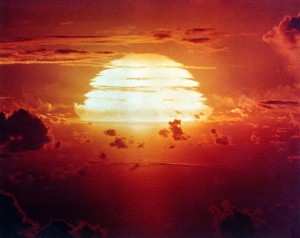
A U.S. government photograph of Operation Redwing’s Apache nuclear explosion on July 9, 1956.
By Robert Parry | Consortium News | June 2, 2016
Hillary Clinton made a strong case for why handing the nuclear codes over to a President Donald Trump would be a scary idea, but there may be equal or even greater reason to fear turning them over to her. In perhaps the most likely area where nuclear war could break out – along Russia’s borders – Clinton comes across as the more belligerent of the two.
In Clinton’s world view, President Vladimir Putin, who has been elected multiple times and has approval ratings around 80 percent, is nothing more than a “dictator” who is engaged in “aggression” that threatens NATO following the U.S.-backed “regime change” in Ukraine.
“Moscow has taken aggressive military action in Ukraine, right on NATO’s doorstep,” she declared. But stop for a second and think about what Clinton said: she sees Russia responding to an unconstitutional coup in Ukraine – which installed a virulently anti-Russian regime on Russia’s border – as Moscow acting aggressively “on NATO’s doorstep.”
That’s the same NATO, whose job it was to protect Western Europe from the Soviet Union, that — following the Soviet Union’s collapse — added country after country right up to Russia’s border. In other words, NATO muscled its way into Russia’s face and has announced plans to incorporate Ukraine as well, but when Russia reacts, it’s the one doing the provoking.
Clinton’s neoconservative interpretation of what’s happening in Eastern Europe is so upside-down and inside-out that it could ultimately become the flashpoint for a nuclear war between Russia and the West.
While she sees Russia as the “aggressor” against NATO, the Russians see NATO moving troops up to its borders and watch the deployment of anti-ballistic-missile systems in Romania and Poland, thus making a first-strike nuclear attack against Russia more feasible. Russia has made clear that it views these military deployments, just kilometers from major Russian cities, as an existential threat.
In response, Russia is raising its alert levels and upgrading its strategic forces. Yet, Hillary Clinton believes the Russians have no reason to fear NATO’s military encirclement and no right to resist U.S.-supported coups in countries on Russia’s periphery. It is just such a contradiction of viewpoints that can turn a spark into an uncontrollable inferno.
What might happen, for instance, if Ukraine’s nationalist — and even neo-Nazi — militias, which wield increasing power over the corrupt and indecisive regime in Kiev, received modern weaponry from a tough-talking Clinton-45 administration and launched an offensive to exterminate ethnic Russians in eastern Ukraine and to reclaim Crimea, where 96 percent of the voters opted to secede from Ukraine and rejoin Russia?
A President Hillary Clinton would have talked herself into a position of supporting this “liberation” of “Russian-occupied territory” and her clever propagandists would surely present this “heroic struggle” as a war of good against evil, much as they justified bloody U.S. invasions of Iraq and Libya which Clinton supported as U.S. senator and Secretary of State, respectively.
What if the Ukrainian forces then fired missiles striking Russia’s naval base at Sevastopol in Crimea, killing some of the 20,000 Russian troops stationed there and inflicting damage on Russia’s Black Sea fleet? What if Kremlin hardliners finally got their way and unleashed the Russian army to launch a real invasion of Ukraine, crushing its military, rumbling through to Kiev and accomplishing their own “regime change”?
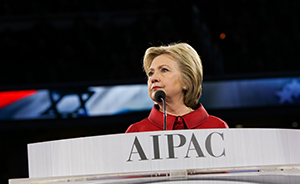
(Photo credit: AIPAC)
How would President Hillary Clinton respond? Would she put herself in the shoes of Russia’s leaders and search for some way to de-escalate or would she get high-and-mighty and escalate the crisis by activating NATO military forces to counter this “Russian aggression”?
Given what we know about Clinton’s tough-talking persona, the odds are good that she would opt for an escalation – and that could set the stage for nuclear war, possibly starting because the Russians would fear the imminence of a NATO first strike, made more possible by those ABM bases in Romania and Poland.
Clinton’s Non-Nuclear Wars
There are other areas in the world where a President Hillary Clinton would likely go to war albeit at a sub-nuclear level. During the campaign, she has made clear that she intends to invade Syria once she takes office, although she frames her invasions as humanitarian gestures, such as creating “safe zones” and “no-fly zones.”
In other words, although she condemns Russian “aggression,” she advocates aggressive war herself, seemingly incapable of recognizing her hypocrisies and only grudgingly acknowledging her “mistakes,” such as her support for the invasion of Iraq.
So, on Thursday, even as she made strong points about Trump’s mismatched temperament for becoming Commander-in-Chief, she flashed a harsh temperament of her own that also was unsettling, although in a different way.
Trump shoots from the lip and has a thin skin, while Clinton is tightly wound and also has a thin skin. Trump lets his emotions run wild while Clinton is excessively controlled. Trump engages in raucous give-and-take with his critics; Clinton tries to hide her decision-making (and emails) from her critics.
It’s hard to say which set of behaviors is more dangerous. One can imagine Trump having free-form or chaotic diplomatic encounters with allies and adversaries alike, while Clinton would plot and scheme, insisting on cooperation from allies and demanding capitulation from adversaries.
Clinton sprinkled her speech denouncing Trump with gratuitous insults aimed at Putin and undiplomatic slaps at Russia, such as, “If Donald gets his way, they’ll be celebrating in the Kremlin. We cannot let that happen.”
In short, there is reason to fear the election of either of these candidates, one because of his unpredictability and the other because of her rigidity. How, one might wonder, did the two major political parties reach this juncture, putting two arguably unfit personalities within reach of the nuclear codes?
[For more on this topic, see Consortiumnews.com’s “Yes, Hillary Clinton Is a Neocon” and “Would a Clinton Win Mean More Wars?’]
Investigative reporter Robert Parry broke many of the Iran-Contra stories for The Associated Press and Newsweek in the 1980s. You can buy his latest book, America’s Stolen Narrative, either in print here or as an e-book (from Amazon and barnesandnoble.com).
Clinton’s Vice President: A Match Made on Wall Street
By Eric Draitser | CounterPunch | June 2, 2016
Earlier this week, Bernie Sanders warned that Hillary Clinton’s eventual vice presidential pick must not be someone from the milieu of Wall Street and Corporate America. And while Sanders is still fighting to win the Democratic Party nomination in what many have argued is a rigged system with a foregone conclusion, it appears that Sanders is also intent on influencing the course of the Clinton campaign and the party itself.
In a thinly veiled demand that Clinton embrace the core principles of the Sanders campaign in order to secure the support of Sanders’s political base, the insurgent Democratic candidate hoped aloud “that the vice-presidential candidate will not be from Wall Street, will be somebody who has a history of standing up and fighting for working families, taking on the drug companies… taking on Wall Street, taking on corporate America, and fighting for a government that works for all of us, not just the 1%.”
And while that description may sound positive for its sheer idealism, it does not seem to account for the fact that banks and corporations effectively own both major parties, and that nearly every top Democrat is in various ways connected to the very same entities. In any event, it is useful still to examine a few of the potential Clinton running mates in order to assess just what sort of forces are going to be put in motion to help deliver a Clinton presidency.
The Actors on the Playbill
Beltway pundits are fond of remarking that Tim Kaine, the underwhelming centrist Democrat senator (and former Governor) from Virginia, is at the top of the list for Clinton. He’s safe. He’s experienced. He’s safe. He’s a Democratic Party loyalist with experience fundraising. Oh, and did I mention that he’s safe? Such is the general tenor of the conversation around Kaine, a politician with a long track record and a mostly forgettable personality known more to DC insiders than to the general voting public.
What could be better for Hillary Clinton, perhaps the least liked Democratic (presumptive) nominee in decades, than to have a party establishment insider who represents the status quo as her running mate in an election year that will undoubtedly be remembered for the ostensibly anti-establishment candidates and rhetoric on display throughout?
To be fair, Kaine does represent Virginia, a swing state that is crucial for Donald Trump, and which could spell victory for Clinton should she carry it. And of course, Kaine can also posture as “tough on Wall Street” from his days as DNC Chairman and party mouthpiece during the passage of the so-called “Wall Street reform” bill. Despite nothing substantive coming out of the bill, Kaine is still able to cash in the political currency derived from that bill, and perhaps meekly shield Clinton from continued attacks vis-à-vis her connections to Wall Street.
Of course Kaine also comes with his own baggage, including his anti-abortion stance which earned him the ire of many pro-choice activists in Virginia when he was Governor. Considering the shameless droning from Clinton and her backers about being “the first woman president,” it would certainly raise serious questions – and open up an obvious angle of attack for Trump – were she to sport her feminism and focus on women’s reproductive rights by selecting a man with an anti-abortion record.
A look down the list of other potential choices reveals that Clinton truly has very little to choose from. Both Housing and Urban Development (HUD) Secretary Julian Castro, as well as Labor Secretary Tom Perez, have both had their names bandied around as Clinton seeks to solidify the Latino vote in an election where the Republican candidate has worked tirelessly to alienate that all-important demographic as much as possible. But of course, the obvious question to be asked in response to either of these potential selections would be “Who?” Neither Castro nor Perez is well known nationally, nor have either of them won major elections or really done anything of note in their tenure in Obama’s cabinet. Despite being Latinos, they are utterly forgettable, and unlikely to bring significant returns to Clinton.
While other names such as New Jersey junior senator Cory Booker, as well as Ohio senator Sherrod Brown, have been discussed, both men hail from states with Republican governors, meaning that were they to accept a VP slot, their senate vacancies would be likely filled by Republicans, a scenario that Senate Minority Leader Harry Reid has already said “Hell no!” to, vowing to “yell and scream to stop that.”
Who Else Is “Ready for Hillary”?
So that then leaves the two most interesting potential running mates: Elizabeth Warren and Bernie Sanders himself. Warren, who conspicuously refused to endorse Clinton over Sanders, has tremendous upside for Clinton as she has been perhaps the Democratic Party’s most vehement opponent of Wall Street, having led many high profile attacks on the major banks in her tenure in the Senate. From a public relations branding perspective, she is essentially the female Bernie Sanders, a progressive Democrat who presents herself as an ally of working people and an enemy of bankers. For Clinton, Warren would also round out the “First Woman…” card, allowing the Clinton campaign to quite literally become a campaign about breaking the glass ceiling in US politics. The stump speeches almost write themselves.
Finally, there’s Mr. #FeelTheBern himself. His latest comments (mentioned above) certainly do have a subtext that implies his willingness to accept a running mate slot. Having fashioned himself as the champion of the middle class and threat to the Washington establishment, Bernie would provide much in the way of credibility to a lackluster Clinton campaign which has failed to excite even many ardent Democrats. Sanders would also guarantee a unified Democratic Party ticket, and provide much needed defense of Clinton’s left flank. In short, Sanders, like Warren, would give anti-Clinton progressives the pretext many of them need to justify their voting for the much-hated Clinton.
Never mind the fact that neither Sanders nor Warren would actually do anything to combat Wall Street finance capital as Vice President. Never mind the fact that no one on Wall Street is particularly scared of either politician being given the ceremonial power that comes with the Vice Presidency. These are just the kind of uncomfortable, but inescapable, facts that progressives must choose to ignore.
The difficulty for either Sanders or Warren is the marketing of their decision to left progressives, some of whom would see collaboration with Clinton and the Clinton political machine as a betrayal and a complete sell-out. However, aside from driving a some relatively small number of progressives to vote for Jill Stein and the Green Party (or stay home entirely), it is unlikely that the negative impact in the progressive base would amount to anything more than some hurt feelings followed by the usual acquiescence to the Democratic Party line.
If such an analysis sounds cynical and jaded, that’s because it is. Perhaps a better descriptor would be disdainful. Indeed, as someone who watched with bemused melancholy as progressives lined up to support Al Gore in 2000, John Kerry in 2004, and Barack Obama in 2008 and 2012, my position on support for ANY Democrat is the same as Harry Reid’s position on swing state senator VP picks: Hell no!
Indeed, the very notion of collaboration with a war criminal and Wall Street puppet such as Clinton is anathema to everything the left and “progressives” are supposed to stand for.
Of course, there is also the elephant (and donkey) in the room: both major parties are wholly owned subsidiaries of finance capital and the corporations that rule over us. This is the realization that millions of Americans have already made, and which millions more are making. This is the realization that keeps Democratic and Republican apparatchiks up at night. And this critical revelation is what Bernie, Liz, & Co. are there to suppress.
Clinton ignores question of how much money Goldman Sachs CEO gave her son-in-law’s hedge fund
RT | May 28, 2016
Hillary Clinton refused to disclose how much money Goldman Sachs’ chief executive invested in her son-in-law’s fund, ignoring questions from The Intercept during a photo-op fundraising event in San Francisco.
The publication’s reporter, Lee Fang, visited Clinton’s campaign rally in San Francisco on Thursday, as she kept busy touring California to raise last minute support ahead of the crucial June 7 primary.
As the former secretary of state was doing photo ops, Fang jumped in with his question.
“Do you know how much money [Goldman Sachs chief executive] Lloyd Blankfein invested in your son-in-law’s hedge fund?”
In fact, he peppered her with the question, but Clinton chose not to pay any attention at all, staying focused on picture-taking with her supporters.
Moments later, Clinton’s campaign traveling press secretary Nick Merrill stepped in, but he was unable, or unwilling, to help when asked the same question.
“I don’t know, has it been reported?” Merrill responded, before promising to “email it right now” once Fang handed off his contact information.
Merrill has yet to follow up, according to Fang.
Eaglevale Partners LP, founded by Marc Mezvinsky, husband of Hillary’s daughter Chelsea Clinton, and his two partners, has been supported with investments from several wealthy names of Wall Street, including Goldman Sachs chief executive Blankfein.
The CEO also allowed the use of his name in the marketing of Mezvinsky’s flagship fund, which is currently managing about $330 million.
However, despite having Blankfein by his side, Mezvinsky and his fund suffered losses linked to an ill-timed bet on Greece’s economic recovery. It was reportedly the Clinton’s son-in-law, who recommended his investors to put their money behind Greek government bonds, betting that the Greek economy would improve.
In February 2015, the Wall Street Journal broke the news that Eaglevale admitted in a letter to its investors that it was “incorrect” on Greece. According to the newspaper, the dedicated Greek fund also included an investment from Marc Lasry, a longtime Clinton donor, who formerly employed Chelsea Clinton at his $13.3 billion New York hedge-fund firm, Avenue Capital Group.
After losing 90 percent of its value, Mezvinsky was forced to close the Greece-focused fund called Eaglevale Hellenic Opportunity earlier this year. According to The New York Times, the fund raised $25 million from investors in order to buy Greek bank stocks and government debt.
Goldman Sachs is known to have cozy financial relations with the Clintons, including the company’s paying $675,000 in personal speaking fees to Hillary Clinton as well as $1,550,000 to Bill Clinton for the same service. Donations between $250,000 and $500,000 were also made to the Clinton Foundation, The Intercept reported.
The publication has been trying to find out whether Hillary Clinton is going to release the transcripts of her paid speeches to Goldman Sachs. Fang is reported to have been the first to pose that question in January, but four months later, the likely Democratic nominee for president only laughed and turned away.
Throughout her campaign, Clinton has been repeatedly called upon to disclose her relationships with Wall Street banks, but she has so far avoided giving direct answers.
READ MORE:
“Significant security risks”: State Department says Clinton violated email security rules
RT | May 25, 2016
Hillary Clinton violated federal records rules by never obtaining permission to conduct official business on private email server during her tenure as secretary state, a State Department audit concluded.
The report from the State Department’s inspector general say mentions “longstanding, systemic weaknesses” in the agency’s communications even before Clinton took office there, but it singles her out as having been a particularly bad offender for her exclusive use of private, unsecured email.
“Secretary Clinton had an obligation to discuss using her personal email account to conduct official business with their offices, who in turn would have attempted to provide her with approved and secured means that met her business needs” says the audit, which was first obtained by Politico.
“At a minimum, Secretary Clinton should have surrendered all emails dealing with Department issues before leaving government service and, because she did not do so, she did not comply with the Department’s policies that were implemented in accordance with the Federal Records Act,” the report continued.
The 78-page report is the culmination of a review prompted by last year’s revelations that Hillary Clinton conducted official business on a private email server, rather than the secured government servers that officials are expected to use, during her four years in the Obama administration.
The inspector general states that its findings are based on interviews with Secretary of State John Kerry, and predecessors Colin Powell, Condoleeza Rice and Madeleine Albright.
Clinton and her deputies, including Cheryl Mills and Huma Abedin, declined the inspector general’s request for interviews, Politico reported.
The report said that State Department workers are required to use “agency-authorized information systems to conduct normal day-to-day operations” because the use of other systems “creates significant security risks.”
The inspector general went on to recommend that the State Department remind employees that the use of personal email accounts to conduct official business is “discouraged in most circumstances,” and improved policies to promote compliance by all employees – including the secretary of state. The State Department’s management concurred with these recommendations.
“While people were aware of her use of personal email, no one had a full and complete understanding of the extent,” said the State Department’s representative Mark Toner. “We acknowledge that we need to do a better job with our record keeping.”
Clinton campaign spokesman Brian Fallon responded to the report on Wednesday, saying that the report actually showed that Clinton’s practices were consistent with previous secretaries of state.
“[A]s this report makes clear, Hillary Clinton’s use of personal email was not was not unique, and she took steps that went much further than others to appropriately preserve and release her records,” Fallon said.
Clinton herself made the same argument in a March debate. However, Politifact found that statement to be “mostly false.”
However, the State Department has apparently made progress in its record keeping systems.
“Any email that [Secretary Kerry] sends is automatically copied and saved automatically,” the agency’s Deputy Spokesman said at a press briefing. “This automatic archiving approach does comply with the Federal Records Act.”
The audit is only one part of a much larger controversy. Clinton, who is the likely Democratic presidential nominee, is currently under investigation by the FBI for potentially putting highly sensitive information at risk, a fact that has become an important talking point in the election.
Clinton has contended that since most of her emails were sent to other people in the state department, she was complying with the federal law requiring the preservation of government records.
Though the FBI’s investigation is still ongoing, the inspector general’s audit casts doubt on this defense, saying that sending emails to other State Department accounts “is not an appropriate method of preserving any such emails that would constitute a federal record.”
Clinton’s use of a private email account came to light in 2013, when a hacker going by the name of Guccifer accessed the email account of her aide Sydney Blumenthal. The hacker, whose real name is Marcel Lazar, pleaded guilty to various hacking-related offenses on Wednesday.
Layers of Islamophobia: Rep. Ellison Says He’s Unaware of Clinton Having Returned “Muslim Money”
By Sam Husseini | May 24, 2016
At a news conference Tuesday, I asked Reps. Keith Ellison (D-Minn.) and André Carson (D-Ind.) about Hillary Clinton’s having returned money from Muslims and refusing to meet with Arab and Muslim groups in her 2000 Senate run.
Rep. Ellison indicated he didn’t know about the controversy and — while stressing his backing for Sen. Bernie Sanders, argued that Clinton was someone who has done outreach to the Muslim community. Carson lauded her as the “most traveled” secretary of state.
Ellison and Carson, Congress’ only Muslim members, spoke at the at National Press Club to discuss “Islamophobia and Hateful Rhetoric Directed At Muslims.” [See video of their response, full video (33:00) and transcript below.]
Their opening remarks focused on Donald Trump, Ted Cruz, Ben Carson, Newt Gingrich, Peter King — all Republicans.
I had gone into the event wanting to question the manner in which they spoke — or declined to speak — about U.S. foreign policy. More on that later.
But, their emphasis on Republican transgressions, some going back to previous election cycles, I thought it important to raise the issue of Clinton’s actions and asked if there wasn’t anti-Muslim sentiment in the Democratic Party as well.
I cited a recent piece by Rania Khalek, in which she writes:
Back in 2000, during a heated U.S. Senate race in New York, Clinton came under attack for accepting political contributions from Muslim groups whose members were targets of a smear campaign generated by one of the Islamophobia industry’s most discredited operatives.
Without hesitation, Clinton condemned her Muslim supporters, returned their donations and refused to meet with Arab and Muslim Americans for the remainder of her campaign…
Ellison said: “I’m not aware of the incident. … When she came to Minnesota she specifically reached out to the Muslim community and had a sit down and talked about anti-Muslim hate. … I also know that years ago when she was Secretary of State, the Black Caucus had a meeting with her and she had recently appointed a special envoy to Muslim communities, you know — Farah Pandith — and she sat Andre and I right next to Farah because she wanted to make sure we were talking and comparing notes.”
Presuming he was being forthright, it says something about Ellison’s information flow that he would not have been aware of the controversy.
He mentioned Farah Pandith. According to her bio at the Kennedy School of Government, “Special Representative Pandith served as the Director for Middle East Regional Initiatives for the National Security Council from December 2004 to February 2007, where she was responsible for coordinating U.S. policy on ‘Muslim World’ Outreach and the Broader Middle East North Africa initiative.”
Pandith reported to Elliot Abrams at the Bush National Security Council, who is well known for his longtime backing of U.S. wars in the Mideast and Latin America.
Ellison stated that Clinton has “not in any way contributed to anti-Muslim hate. In fact Huma Abedin is one of her closest aides and Huma has been the target of anti-Muslim hate herself.”
Ellison’s defense of Clinton — and by extension the Democratic Party, since I specifically asked about that, was noteworthy. At another point in the event, he talked about how every community was guilty of bigotry to some extent.
Carson, who supports Clinton over Sanders, stated that while Clinton was recently in Indianapolis, “We helped to ensure that Muslims were not only there, they were part of the process. And there were a group of Syrian-Americans who had a moment with Secretary Clinton. … She is the most traveled Secretary of state in U.S. history. … Whenever I go to embassies that have Muslim ambassadors they talk about the bridge building that was done under her leadership as Secretary of State. … [Clinton] has a special sensitivity as it relates to issues impacting the Muslim community. As it relates to unwanted surveillance … Once she becomes president you will see Muslims in very important positions in her cabinet.”
It seems at best incredibly paltry: “Part of the process.” Syrian-Americans “had a moment.” “A moment” to discuss the fate of their country of origin. Which Syrian-Americans? Doubtlessly, there are some who want more U.S. intervention of the sort that brought disaster to Libya — which Clinton oversaw and Ellison himself backed at the time. Glen Ford has noted that Ellison has also backed a “no fly” zone in Syria.
Though she’s at times criticized Republicans for scapegoating Muslims, CNN reported: “Clinton calls for more surveillance, police after Brussels attacks.”
I actually asked the first question after their opening remarks. I had hoped that I’d get another question later about U.S. foreign policy after they had staked out their positions on foreign policy in response to other questions. However, I did not get another question in.
The deeper issue is the manner in which the question of “Islamophobia” is being dealt with: It largely excludes discussion of U.S. foreign policy, the dehumanization of Muslim lives lost, especially in U.S. attacks.
At the event, Ellison stressed that most of the victims of Daesh [ISIL] were Muslims, which is of course true, but it leaves out that most of the victims of U.S. foreign policy are Muslims — and that U.S. foreign policy has helped foster Al-Qaeda and ISIS and other sectarian groups.
You have Carson talking about how Muslim officials in embassies — almost invariably of tyrannical regimes — speak fondly of Clinton. This seems at best a dubious badge of honor.
Rep. Carson spoke in his other remarks of being on the House Intelligence Committee. He also spoke of his time growing up and being critical of law enforcement. I’ve criticized anti-Muslim bias for over twenty years, but a tacit bargain seems to have been struck whereby Muslims are “tolerated” — so long as they do not seriously critique U.S. foreign policy, and those who go along with it most will clearly be rewarded most by those who control U.S. foreign policy. Indeed, the subtext of some of Carson’s remarks is that such Muslims will be rewarded with plum positions for their apologetics.
The tension here is critical. While some who have written about Islamophobia see a meaningful resolution in incorporation of Muslims into the West, this tends to ignore the incredible violence of U.S. foreign policy. For example, John Feffer, who I know and like personally, recently wrote “Sadiq Khan and the End of Islamophobia” about the recent mayoral race in London.
There is real danger of a line of thinking that in effect charts a course of Muslims being accepted in the West in a manner that neuters any meaningful crit of foreign policy. It’s a course that explicitly or implicitly folds in the Muslim community rather than using it as a messenger to meaningful open up the Western societies in terms of challenging and ending their aggressive foreign policies and bring about a more peaceful world.
In fact, this course is incredibly dangerous because it leads to the impression of having a global dialogue when none is actually taking place about the most critical issues of U.S. government violence.
As Arun Kundnani has argued: “The promise of the ‘war on terror’ was that we would kill them ‘over there’ so they would not kill us ‘over here.’ Hence mass violence in Iraq, Afghanistan, Pakistan, Palestine, Yemen, and Somalia — in the name of peace in the West. The ‘Authorization to Use Military Force’ that the U.S. Congress passed in the days after 9/11 already defined the whole world as a battlefield in the ‘war on terror’. President Obama continues to rely on the authorization to give his drone-killing program a veneer of legality. This is the old colonial formula of liberal values at home sustained by a hidden illiberalism in the periphery — where routine extra-judicial killing is normalized.”
The remarks of Malcolm X — whose birthday just passed — and his view of the course of African Americans in the U.S. is relevant: “They have a new gimmick every year. They’re going to take one of their boys, black boys, and put him in the cabinet so he can walk around Washington with a cigar. Fire on one end and fool on the other end. And because his immediate personal problem will have been solved he will be the one to tell our people: ‘Look how much progress we’re making. I’m in Washington, D.C., I can have tea in the White House. I’m your spokesman, I’m your leader.’ While our people are still living in Harlem in the slums. Still receiving the worst form of education.”
Transcript:
Sam Husseini: You’ve mentioned Trump and Cruz and Carson. I think all the names that you mentioned are Republicans that you feel are guilty of some form of Islamophobia. Rania Khalek, an Arab-American writer recently had a piece recounting that in her 2000 run, Hillary Clinton — after there were allegations that she was taking quote-unquote Muslim money — returned the money and refused to meet with members of the Muslim-American and Arab community. How do you respond to something like that? Is the Democratic party itself clear of Islamophobic sentiment as well?
Keith Ellison: I can only speak on what I know about — and I’m a Bernie supporter. And I support Bernie running all the way through the election. And — but have to be honest and tell you I’m not aware of that, right?Husseini: You don’t know about this?
Ellison: Well I’m not aware of the incident. I’ll tell you what I’m aware of I know that when she came to Minneapolis, Minnesota — and this is just being fair and honest. When she came to Minnesota she specifically reached out to the Muslim community and had a sit down and talked about anti-Muslim hate. I know about that.
I also know that years ago when she was Secretary of State, the black caucus had a meeting with her and she had recently appointed a special envoy to Muslim communities, you know — Farah Pandith — and she sat Andre and I right next to Farah because she wanted to make sure we were talking and comparing notes.
Now, I don’t want to say something didn’t happen when I don’t know — when I don’t have information. But I can say that if that did happen there’s weight with her reaching out as well.
Again, I’m not trying to discredit anyone’s experience, I don’t have any information on it. But I can tell you she did some things and has not in any way contributed to anti-Muslim hate. In fact Huma Abedin is one of her closest aides and Huma has been the target of anti-Muslim hate herself and I have never sensed that Secretary Clinton is backing herself away from her association with Huma Abedin. So.
Again, I’m a Bernie guy. I’m standing up there — if you wanna talk who should be president I believe it’s Bernie Sanders, but fair’s fair and true’s true and she has no record that I’m aware of of anti-Muslim hate.
Andre Carson: As a Clinton guy (laughter)
Ellison: Did I mention that —?
Carson: As Keith stated, one of her chief advisers and closest confidants is Huma Abedin who is phenomenal. She’s a friend of mine. Secretary Clinton was in Indianapolis a few weeks ago. We helped to ensure that Muslims were not only there, they were part of the process. And there were a group of Syrian-Americans who had a moment with Secretary Clinton. If you look at her history as not only as first lady of Arkansas but first lady of the United States of America, and even Secretary of State. She is the most traveled Secretary of state in U.S. history. Let’s make that clear.
Whenever I go to embassies that have Muslim ambassadors they talk about the bridge building that was done under her leadership as Secretary of State. When I go to Muslim communities across the country and communities are divided — some are Feeling the Bern and some like me are climbing up that Hill. But they respect Secretary Clinton because she has a special sensitivity as it relates to issues impacting the Muslim community. As it relates to unwanted surveillance as it relates to outright discrimination. And I believe and we can talk about this later, that once she becomes president you will see Muslims in very important positions in her cabinet.
How US Creates Safety Risks for Nuclear Power Plants in Europe

© Wikipedia/ Maxim Gavrilyuk
Sputnik – 21.05.2016
Washington is promoting commercial interests of the energy corporation Westinghouse in Europe, creating risks for European nuclear power plants, an article in Forbes read.
For example, in 2015, two of the Westinghouse-made fuel assemblies at the South Ukraine nuclear power plant (NPP) were found to be leaking. Since 2015, the NPP has been using US-made fuel.
In 2014, Ukraine and Westinghouse reached an agreement to supply nuclear fuel to some Ukrainian NPPs. The alleged reason behind the contract was the need to help Ukraine become energetically independent from Russia. Russia was a long-time supplier of nuclear fuel to Ukraine.
Experts have repeatedly warned that the deal would create serious risks for the safety of Ukrainian NPPs.
They cited the example of an incident which took place several years ago at the Temelin nuclear power plant, in the Czech Republic. The NPP operated on Russian-designed reactors and used fuel supplied by Westinghouse. The fuel was leaking and the rods were bending. All the Westinghouse fuel was removed from the core and replaced with Russian-made fuel.
As for Ukraine, the company announced that its fuel for Ukrainian NPPs had been improved.
Despite experts’ warnings, in March 2015, the first 42 fuel assemblies made by Westinghouse were loaded to the third reactor unit at the South Ukraine NPP.
According to Forbes, the two Westinghouse-made assemblies were found leaking during a scheduled outage at the third unit of the NPP.
The author of the article, Forbes contributor Kenneth Rapoza described how Washington has promoted Westinghouse’s interest in Eastern Europe, neglecting safety recommendations.
“Westinghouse is more than a brand name American power company. It’s a battering ram used by Washington to promote energy security,” the author wrote.
A source who wished to remain anonymous told Forbes that Westinghouse wants a market share in Eastern Europe in a bid to prevent the company from insolvency.
“Their new reactor division is loss-making, the fuel division is their only cash cow and it is not growing and existing margins are getting slimmer and slimmer. We think Westinghouse has spent millions of dollars to include nuclear fuel as part of the energy security narrative, and the current EU sentiment against Russia play into their hand,” the source said.
“But derailing nuclear projects while running into technical difficulties with Westinghouse fuel assemblies in Rosatom reactors is a dangerous way to promote energy security,” Rapoza noted.
According to former Czech Prime Minister Jiri Paroubek, the US has been promoting Westinghouse for years.
In the 1990s, US diplomats supported contribution between the Czech Republic and Westinghouse. The company pledged to improve Russian-designed nuclear plants to Western standards.
“However, the opposite proved to be true. Fuel assemblies delivered by Westinghouse were of inferior quality and higher price compared with than Russian fuel and caused frequent outages of Temelin reactors,” Paroubek told Forbes.
After, Westinghouse’s fuel assemblies were found leaking in the 2000s the Czech company CEZ decided to return to Russian-made nuclear fuel for the Temelin NPP.
“CEZ’s decision serves as a testament to the fact that the Russian fuel assembly was safer and that Washington was selling a product that did not quite work at the time, potentially putting nuclear power plants in danger,” the article read.
US presidential hopeful Hillary Clinton was also involved in promoting Westinghouse in Eastern Europe. In 2012 when she served as US State Secretary Clinton met with then Czech Prime Minister Petr Necas, using the energy security argument to promote the company.
According to the article, Westinghouse can produce fuel for Russia-designed reactors as well as Rosatom can build fuel assemblies for Western-designed power units. However, for third parties working with Westinghouse is less economically efficient.
“Russia is the cheaper producer of the two, so when countries turn to Westinghouse for the fuel assemblies, they have to pay a premium for diversification,” Rapoza wrote.
Nevertheless, the largest initiative by Westinghouse is squeezing Russia from the Ukrainian nuclear fuel market, using again the argument of diversifying supplies.
In 2012, the Ukrainian nuclear regulator banned the use of Westinghouse’s fuel assemblies in the country pending an investigation over the incident at the South Ukraine NPP.
“Two years later, then-Prime Minister, Arseniy Yatsenyuk consulted Westinghouse on picking a new nuclear safety regulator for his new government,” the author wrote citing a source in Ukraine.
In April, the Ukrainian Energy Ministry announced it would buy more nuclear fuel from Westinghouse. The company is planning to deliver five reloads of fuel to South Ukraine and Zaporizhia NPPs.
According to the author, Westinghouse’s commercial interests are closely tied to politics and thus the company neglects safety.
“Regardless, anti-Russia politics trumps technological problems,” Rapoza concluded.
Featured Video
Macgregor: We Haven’t Seen the Worst of the Iran War Yet
or go to
Aletho News Archives – Video-Images
From the Archives
15 Saudi ‘hijackers’ were CIA agents working for US: Scholar
Press TV – April 13, 2016
Fifteen of the 9/11 “hijackers” from Saudi Arabia were CIA agents working for the United States government, which was seeking to destroy the Middle East for Israel and to double the American military budget, says Dr. Kevin Barrett, an American academic who has been studying the events of 9/11 since late 2003…. continue
Blog Roll
 Aletho News
- Iran’s Plan to Shut Down AI in the Persian Gulf
- Israel seeks ‘compensation’ from Washington over Saudi F-35 sale
- Saudi crown prince seeks dialogue with Ansarullah after Yemeni blows: Report
- Damascus rejects Saudi request for Syrian fighters to counter Yemen: Report
- South Korea says will not send troops to join terrorist US war on Iran
- Russia Just Struck the Eyes of NATO’s War Machine in Ukraine
- Russia summons UK charge d’affaires over Kiev drone support
- NATO member warns bloc seeking pretext for war with Russia
- Macgregor: We Haven’t Seen the Worst of the Iran War Yet
- ‘We are not like everyone else’ laws that bind other nations do not apply to Israel, says Likud lawmaker
- If Americans Knew
- Debunking The Claim That Macklemore Has A “History Of Antisemitism”
- CPJ demands release of arrested Palestinian-US journalist near Bethlehem
- Robert Kraft: The Billionaire Friend of Netanyahu Pulling The Strings Behind the Macklemore/Ed Sheeran Blow Up
- Columbia Administered Fund Gives Big Money to Pro-Israel Groups
- Deportation Case of Palestinian Activist Salah Sarsour Tests First Amendment
- ‘We Will Not Forget’: Palestinians Mark 44 Years since Sabra and Shatila
- Why do we let Zionists decide what we can and can’t say?
- US welcomes Israeli, Iranian delegations to UN, but not Palestinians – Daily Update
- Biden’s Genocide Accomplices Targeted by New Accountability Campaign
- AIPAC’s Network Has Already Spent $67.2 Million to Shape the Midterm Elections
- No Tricks Zone
- New Study: ‘Global Drought Shows No Detectable Recent Acceleration Under Climate Warming’
- Economic Masterminds: German Socialists Suggest Taxing Productivity Gains Stemming From Using AI
- The South China Sea Has Not Been Cooperating With The Climate Change Narrative
- Energy Crisis: Germany Enters Heating Season With Historically Low Gas Reserve Fill Levels
- New Study: The Antarctic Ice Sheet Gained Mass From 2020-2024 Due To Staggering Snow And Ice Accumulation
- Study: Ocean Heating Rates From Thousands Of Years Ago ‘Dwarf’ Modern Ocean Heating Rates
- Climate Extremists Target, Attack Large-Scale Power Grid Infrastructure In Germany!
- New Study: Antarctic Ice Melt Has Contributed Less Than 1 Centimeter To Sea Level Rise In The Last 30 Years
- Fear Of Debate: Alarmist German Climate Scientist Calls On Mainstream Media To Discredit Skeptic Voices
- End-Of-August Arctic Sea Ice Extent Hasn’t Fallen In 20 Years, Official Data Show!
 Aletho News