Hillary Clinton and the Weaponization of the State Department
By JP Sottile | News Vandal | June 5, 2014
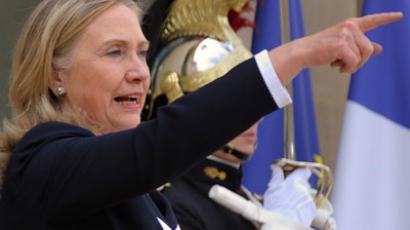
On May 23, 2012, then-Secretary of State Hillary Clinton went to the Special Operations Forces Industry Conference (SOFIC) trade show in Tampa, Florida to share her vision of “smart power” and to explain the State Department’s crucial role in extending the reach and efficacy of America’s growing “international counterterrorism network.”
First, there is such a thing as a “Special Operations Forces Industry Conference trade show.” Without some keen reporting by David Axe of Wired, that peculiar get-together might’ve flown completely under the radar—much like the shadowy “industry” it both supports and feeds off of like a sleek, camouflaged lamprey attached to a taxpayer-fattened shark.
Second, “special operations” have officially metastasized into a full-fledged industry. United States Special Operations Command (USSOCOM) is located at MacDill Air Force Base in Tampa and, therefore, conveniently located near the special operations trade show, which happened again this year at the Tampa Convention Center. The theme was “Strengthening the Global SOF Network” and the 600,000-square-foot facility was filled with targets of opportunity for well-connected and well-heeled defense contractors.
According to the SOFIC website, this year’s conference afforded attendees “the opportunity to engage with USSOCOM Program Executive Officers, Science and Technology Managers, Office of Small Business Programs and Technology & Industry Liaison Office representatives, and other acquisition experts who will identify top priorities, business opportunities, and interests as they relate to USSOCOM acquisition programs.”
Third, Hillary’s widely-ignored speech marked a radical departure from the widely-held perception that the State Department’s diplomatic mission endures as an institutional alternative to the Pentagon’s military planning. Instead, Secretary Clinton celebrated the transformation of Foggy Bottom into a full partner with the Pentagon’s ever-widening efforts around the globe, touting both the role of diplomats in paving the way for shadowy special ops in so-called “hot spots” and the State Department’s “hand-in-glove” coordination with Special Forces in places like Pakistan and Yemen.
Finally, with little fanfare or coverage, America’s lead diplomat stood before the shadow war industry and itemized the integration of the State Department’s planning and personnel with the Pentagon’s global counter-terrorism campaign which, she told the special operations industry, happen “in one form or another in more than 100 countries around the world.”
If this isn’t entirely unexpected, consider the fact that under then-Secretaries of State Colin Powell and Condoleezza Rice, the State Department fought attempts by the Pentagon to trump its authority around the globe and, as reported by the Washington Post, “repeatedly blocked Pentagon efforts to send Special Operations forces into countries surreptitiously and without ambassadors’ formal approval.”
But that was before Hillary brought her “fast and flexible” doctrine of “smart power” to Foggy Bottom and, according to her remarks, before she applied lessons learned from her time on the Senate Armed Services Committee to launch the first-ever Quadrennial Diplomacy and Development Review, which she modeled on the Pentagon’s Quadrennial Defense Review. That Pentagon-style review spurred the creation of the Bureau of Conflict and Stabilization Operations to “advance the U.S. government’s foreign policy goals in conflict areas.”
According to a Congressional Research Service analysis, the initial intent of the Conflict Bureau was to replace the ineffectual Office of the Coordinator of Reconstruction and Stabilization, which was created in 2004 to help manage “stabilization” efforts in two nations the U.S. was actively destabilizing—Afghanistan and Iraq.
But the new, improved bureau does more than just react to messes made by unlawful invasions or direct costly remediation efforts in war zones—it also collaborates with “relevant partners” in the Department of Defense and NATO “to harmonize civilian and military plans and operations pertaining to conflict prevention, crisis response, and stabilization.”
This integrated relationship between State and Defense was confirmed by U.S. Special Operations chief Admiral William McRaven shortly after Hillary’s speech. When asked about the “unlikely partnership,” McRaven assured DefenseNews that SOCOM has “an absolutely magnificent relationship with the State Department” and that SOCOM doesn’t “do anything that isn’t absolutely fully coordinated and approved by the U.S. ambassador and the geographic combatant commander.”
As David Axe aptly described it in Wired, “Together, Special Operations Forces and State’s new Conflict Bureau are the twin arms of an expanding institution for waging small, low-intensity shadow wars all over the world.”
In fact, during Hillary’s time as America’s chief diplomat, the State Department embraced the shadowy edge of U.S. foreign policy where decision-makers engage in activities that look like war, sound like war and, if you were to ask civilians in places like Yemen and Pakistan, feel a lot like war, but never quite have to meet the Constitutional requirement of being officially declared as war.
The Whole-of-Government Shift
Once upon a time, “low-intensity shadow wars” were the Congressionally-regulated bailiwick of the Central Intelligence Agency. But 9/11 changed everything. However, the excesses of the Bush Administration led many to hope that Obama could and would change everything back or, at least, relax America’s tense embrace of “the dark side.”
Although the new administration did officially re-brand “The War on Terror” as “Overseas Contingency Operations,” Team Obama employed an increasingly elastic interpretation of the 9/11-inspired Authorization for Use of Military Force and expanded covert ops, special ops, drone strikes and regime change to peoples and places well-beyond the law’s original intent, and certainly beyond the limited scope of CIA covert action.
Obama’s growing counter-terrorism campaign—involving, as Secretary Clinton said, “more than 100 countries”—took flight with a new, ecumenical approach called the “Whole-of-Government” strategy. Advanced by then-Secretary of Defense Bill Gates and quickly adopted by the new administration in early 2009, this strategy catalyzed an institutional shift toward inter-agency cooperation, particularly in the case of “state-building” (a.k.a. “nation building”).
During remarks to the Brookings Institution in 2010, Secretary Clinton explained the shift: “One of our goals coming into the administration was… to begin to make the case that defense, diplomacy and development were not separate entities, either in substance or process, but that indeed they had to be viewed as part of an integrated whole and that the whole of government then had to be enlisted in their pursuit.”
Essentially, the Whole-of-Government approach is a re-branded and expanded version of Pentagon’s doctrine of “Full-Spectrum Dominance.” Coincidentally, that strategy was featured in the Clinton Administration’s final Annual Report to the President and Congress in 2001. It defined “Full-Spectrum Dominance” as “an ability to conduct prompt, sustained, and synchronized operations with forces tailored to specific situations and possessing freedom to operate in all domains—space, sea, land, air, and information.”
In 2001, Full-Spectrum Dominance referred specifically to 20th Century notions of battlefield-style conflicts. But the “dark side” of the War on Terror stretched the idea of the battlefield well-beyond symmetrical military engagements. “Irregular warfare” became the catchphrase du jour, particularly as grinding campaigns in Afghanistan and Iraq exposed the reality that the full spectrum still wasn’t enough.
An assessment by the Congressional Research Service identified the primary impetus for the Whole-of-Government “reforms” embraced by Team Obama as the “perceived deficiencies of previous inter-agency missions” during the military campaigns in Afghanistan and Iraq. Those missions failed to address a myriad of problems created—culturally, economically and politically—by the wholesale bombing and occupation of those countries. The Full-Spectrum was half-baked. Lesson learned.
But the lesson wasn’t that the U.S. should avoid intervention, regime change or unleashing nascent civil, ethnic or religious conflicts. Instead, the lesson was that the “Whole-of-Government” must be marshaled to fight a worldwide array of Overseas Contingency Operations in “more than 100 countries.”
This Whole-of-Government shift signaled a renewed willingness to engage on variety of new fronts—particularly in Africa—but in a “fast and flexible” way. With other agencies—like the State Department—integrated and, in effect, fronting the counter-terrorism campaign, the military footprint becomes smaller and, therefore, easier to manage locally, domestically and internationally.
In some ways, the Whole-of-Government national security strategy is plausible deniability writ-large through the cover of interagency integration. By merging harder-to-justify military and covert actions into a larger, civilian-themed command structure, the impact of the national security policy overseas is hidden—or at least obfuscated—by the diplomatic “stabilization” efforts run through the State Department—whether it’s the Conflict Bureau working against Joseph Kony’s Lord’s Resistance Army in Central Africa, “stabilizing” post-Gaddafi Libya or spending $27 million to organize the opposition to Bashar al-Assad’s Syrian regime.
The Pass Key
The cover of diplomacy has traditionally been an effective way to slip covert operators into countries and the State Department’s vast network of embassies and consulates still offers an unparalleled “pass-key” into sovereign nations, emerging hot spots and potential targets for regime change. In 2001, the Annual Report to the President and Congress foresaw the need for more access: “Given the global nature of our interests and obligations, the United States must maintain the ability to rapidly project power worldwide in order to achieve full-spectrum dominance.”
Having the way “pre-paved” is, based on Hillary’s doctrinal shift at State, a key part of the new, fuller-spectrum, Whole-of-Government, mission-integrated version of diplomacy. At the SOFIC’s Special Operations Gala Dinner in 2012, Hillary celebrated the integration of diplomatic personnel and Special Operations military units at the State Department’s recently created Center for Strategic Counterterrorism Communications—a “nerve center in Washington” that coordinates “military and civilian teams around the world” and serves “as a force multiplier for our embassies’ communications efforts.”
As with most doors in Washington, that relationship swings both ways and mission-integrated embassies have served as an effective force multiplier for the Pentagon’s full spectrum of activities, particularly around Africa.
In his 2011 testimony before the House Foreign Affairs Committee Subcommittee on Africa, Deputy Assistant Secretary of State for African Affairs Don Yamamoto noted that State had “significantly expanded the number of DoD personnel who are integrated into embassies across the continent over the past three years,” and read a surprisingly long laundry list of collaborative efforts between State and the United States Africa Command (AFRICOM), including: “reduction of excess and poorly secured man-portable air defense systems (MANPADS); Defense Sector Reform in Liberia, DRC, and South Sudan; counterpiracy activities off the Somali coast; maritime safety and security capacity building; and civil-military cooperation.”
It seems that “civil-military cooperation” is a primary focus of the State Department in Africa. Most notably, Yamamoto told Congress that “embassies implement Department of State-funded Foreign Military Financing (FMF) and International Military Education and Training (IMET) programs, which further U.S. interests in Africa by helping to professionalize African militaries, while also assisting our African partners to be more equipped and trained to work toward common security goals.”
As the ever-vigilant Nick Turse recently reported, U.S. presence on the continent has only grown since that testimony was given in 2011. On TomDispatch.com, Turse identified the infamous attack on Benghazi on September 11, 2012 as the catalyst for “Operation New Normal”—the continent-wide response to, quite ironically, the political potboiler still simmering around Secretary Clinton. Whether or not Congressional Republicans find anything more than incompetence at the root of Benghazi, the U.S. military certainly finds itself in a “new normal” of increased activity in response to the forces—and the weaponry—unleashed by U.S.-led regime change in Libya. According to Turse, the U.S. is “now conducting operations alongside almost every African military in almost every African country and averaging more than a mission a day.”
Those missions are, of course, integrated with and augmented by the State Department’s Conflict Bureau which has used a variety of state-building programs and its diplomatic “pass key” in places like Libya, Nigeria, Kenya, South Sudan, Somalia, Democratic Republic of the Congo and six other African nations, all to develop a growing roster of “host country partners.”
Establishing “host country partners” is the nexus where the State Department, its Conflict Bureau and the AFRICOM meet—implementing the Whole-of-Government strategy in emerging or current conflict zones to fuse a mounting counter-terrorism campaign with stabilization, modernization and state-building initiatives, particularly in oil and resource-rich areas like the Niger River Delta, Central Africa and around AFRICOM’s military foothold on the Horn of Africa.
As Richard J. Wilhelm, a Senior Vice President with defense and intelligence contracting giant Booz Allen Hamilton, pointed out in a video talk about “mission integration,” AFRICOM’s coordination with the Departments of State and Commerce, USAID is the “most striking example of the Whole-of-Government approach.”
And this is exactly the type of “hand-in-glove” relationship Secretary Clinton fostered throughout her tenure at State, leveraging the resources of the department in a growing list of conflict areas where insurgents, terrorists, al-Qaeda affiliates, suspected militants or uncooperative regimes threaten to run afoul of so-called “U.S. interests”.
Ultimately, it became a hand-in-pocket relationship when Clinton and Defense Secretary Gates developed the Global Security Contingency Fund (GSCF) to “incentivize joint planning and to pool the resources of the Departments of State and Defense, along with the expertise of other departments, to provide security sector assistance for partner countries so they can address emergent challenges and opportunities important to U.S. national security.”
Although he’s been criticized as feckless and deemed less hawkish than Secretary Clinton, President Obama’s newly-proposed Counterterrorism Partnership Fund (CTPF) is the logical extension of the Clinton-Gates Global Security Contingency Fund and epitomizes the Whole-of-Government shift.
The $5 billion Obama wants will dwarf the $250 million pooled into the GSCF and will, the President said at West Point, “give us flexibility to fulfill different missions including training security forces in Yemen who have gone on the offensive against al Qaeda; supporting a multinational force to keep the peace in Somalia; working with European allies to train a functioning security force and border patrol in Libya; and facilitating French operations in Mali.”
That “flexibility” is exactly what Hillary Clinton instituted at State and touted at the SOFIC conference in 2012. It also portends a long-term shift to less invasive forms of regime change like those in Yemen, Libya, Syria and Ukraine, and an increased mission flexibility that will make the Authorization for the Use of Military Force functionally irrelevant.
Normalizing the War on Terror
The ultimate outcome of this shift is, to borrow from Nick Turse, yet another “new normal”—the new normalization of the War on Terror. What the adoption of the Whole-of-Government/mission integration approach has done is to normalize the implementation of the re-branded War on Terror (a.k.a. Overseas Contingency Operations) across key agencies of the government and masked it, for lack of the better term, under the rubric of stabilization, development and democracy building.
It is, in effect, the return of a key Cold War policy of “regime support” for clients and “regime change” for non-client states, particularly in strategically-located areas and resource-rich regions. Regimes—whether or not they actually “reflect American values”—can count on U.S. financial, military and mission-integrated diplomatic support so long as they can claim to be endangered… not by communists, but by terrorists.
And because terrorism is a tactic—not a political system or a regime—the shadowy, State Department-assisted Special Ops industry that fights them will, unlike the sullen enthusiasts of the Cold War, never be bereft of an enemy.
Hillary Clinton: Playing a Dog-Eared “Hitler” Card

By Norman Solomon | War is a Crime | March 7, 2014
The frontrunner to become the next president of the United States is playing an old and dangerous political game — comparing a foreign leader to Adolf Hitler.
At a private charity event on Tuesday, in comments preserved on audio, Hillary Clinton talked about actions by Russia’s President Vladimir Putin in the Crimea. “Now if this sounds familiar, it’s what Hitler did back in the ’30s,” she said.
The next day, Clinton gave the inflammatory story more oxygen when speaking at UCLA. She “largely stood by the remarks,” the Washington Post reported. Clinton “said she was merely noting parallels between Putin’s claim that he was protecting Russian-speaking minorities in Crimea and Hitler’s moves into Poland, Czechoslovakia and other parts of Europe to protect German minorities.”
Clinton denied that she was comparing Putin with Hitler even while she persisted in comparing Putin with Hitler. “I just want people to have a little historic perspective,” she said. “I’m not making a comparison certainly, but I am recommending that we perhaps can learn from this tactic that has been used before.”
Yes indeed. Let’s learn from this tactic that has been used before — the tactic of comparing overseas adversaries to Hitler. Such comparisons by U.S. political leaders have a long history of fueling momentum for war.
“Surrender in Vietnam” would not bring peace, President Lyndon Johnson said at a news conference on July 28, 1965 as he tried to justify escalating the war, “because we learned from Hitler at Munich that success only feeds the appetite of aggression.”
After Ho Chi Minh was gone, the Hitler analogy went to other leaders of countries in U.S. crosshairs. The tag was also useful when attached to governments facing U.S.-backed armies.
Three decades ago, while Washington funded the contra forces in Nicaragua, absurd efforts to smear the elected left-wing Sandinistas knew no rhetorical bounds. Secretary of State George Shultz said on February 15, 1984, at a speech in Boston: “I’ve had good friends who experienced Germany in the 1930s go there and come back and say, ‘I’ve visited many communist countries, but Nicaragua doesn’t feel like that. It feels like Nazi Germany.’”
Washington embraced Panama’s Gen. Manuel Noriega as an ally, and for a while he was a CIA collaborator. But there was a falling out, and tension spiked in the summer of 1989. Deputy Secretary of State Lawrence Eagleburger said that drug trafficking by Noriega “is aggression as surely as Adolf Hitler’s invasion of Poland 50 years ago was aggression.” A U.S. invasion overthrew Noriega in December 1989.
In early August 1990, the sudden Iraqi invasion of Kuwait abruptly ended cordial relations between Washington and Baghdad. The two governments had a history of close cooperation during the 1980s. But President George H. W. Bush proclaimed that Saddam Hussein was “a little Hitler.” In January 1991, the U.S. government launched the Gulf War.
Near the end of the decade, Hillary Clinton got a close look at how useful it can be to conflate a foreign leader with Hitler, as President Bill Clinton and top aides repeatedly drew the parallel against Serbia’s president, Slobodan Milosevic. In late March 1999, the day before the bombing of Kosovo and Serbia began, President Clinton said in a speech: “And so I want to talk to you about Kosovo today but just remember this — it’s about our values. What if someone had listened to Winston Churchill and stood up to Adolf Hitler earlier?”
As the U.S.-led NATO bombing intensified, so did efforts to justify it with references to Hitler. “Clinton and his senior advisers harked repeatedly back to images of World War II and Nazism to give moral weight to the bombing,” the Washington Post reported. Vice President Al Gore chimed in for the war chorus, calling Milosevic “one of these junior-league Hitler types.”
Just a few years later, the George W. Bush administration cranked up a revival of Saddam-Hitler comparisons. They became commonplace.
Five months before the invasion of Iraq, it was nothing extraordinary when a leading congressional Democrat pulled out all the stops. “Had Hitler’s regime been taken out in a timely fashion,” said Rep. Tom Lantos, “the 51 million innocent people who lost their lives during the Second World War would have been able to finish their normal life cycles. Mr. Chairman, if we appease Saddam Hussein, we will stand humiliated before both humanity and history.”
From the Vietnam War to the Iraq War, facile and wildly inaccurate comparisons between foreign adversaries and Adolf Hitler have served the interests of politicians hell-bent on propelling the United States into war. Often, those politicians succeeded. The carnage and the endless suffering have been vast.
Now, Hillary Clinton is ratcheting up her own Hitler analogies. She knows as well as anyone the power they can generate for demonizing a targeted leader.
With the largest nuclear arsenals on the planet, the United States and Russia have the entire world on a horrific knife’s edge. Nuclear saber-rattling is implicit in what the prospective President Hillary Clinton has done in recent days, going out of her way to tar Russia’s president with a Hitler brush. Her eagerness to heighten tensions with Russia indicates that she is willing to risk war — and even nuclear holocaust — for the benefit of her political ambitions.

The Shady Ties Between de Blasio and the Clintons
The New Democrats, Same as the Old
By RICHARD KREITNER | October 25, 2013
Last Monday, Hillary Clinton headlined a fundraiser at the Roosevelt Hotel in Manhattan for Bill de Blasio, the man who managed her successful 2000 Senate campaign and last month declared himself “proud to come from the Clinton family.” Topping the list of co-chairs for the event—those who have promised to bundle $25,000 for de Blasio—was one Paul Adler, a Democratic power-broker in Rockland County, and a convicted felon.
Adler has long been a devoted supporter of de Blasio, whom he first met in 1996 when de Blasio ran the president’s re-election operation in New York. When Clinton named de Blasio her campaign manager in 1999, Adler told the Associated Press she would “benefit enormously” from such “a hands-on professional.”
In 2000, Rockland County was one of the most heavily contested swing districts in New York State, and Clinton faced tough opposition in former Rep. Rick Lazio, a social conservative well-liked by leaders in the ultra-Orthodox community. As chairman of the Rockland County Democratic Party, Adler was valuable enough to the Clintons that he was invited to spend a night at the White House, which he reciprocated by hosting Hillary at his home during her listening tours of the state. Serving as a delegate to Democratic National Convention in Los Angeles in August 2000, Adler was profiled by CNN as one of the “the folks who are the heart and soul of American politics.” He proudly told the camera:
My Rolodex is my most prized possession. It is a 25-year work in progress. It is the tool that enables me to do what I need to do: to get somebody at an embassy to get a donor who allows me to get the superintendent of highways. If the building was on fire, I would run in to get that first.
His main task was cultivating Jewish support in the county, especially among the various Hasidic sects, which often deliver votes in blocs on the strong recommendation of rabbinic leadership. Adler was especially close to New Square, a Skverer Hasidic village of about 7,000 people that may have the most political power per capita of any community in the United States. Its leader, Rabbi David Twersky is seen as infallible by his followers: on Shabbat, hundreds or even thousands of worshippers watch the rabbi eat precisely specified portions of food—so much whitefish, so much egg salad—and eagerly await the honor of consuming his leftovers. The village was most recently in the news in 2011 when a young goon allied with Twersky—the nephew of his top political aide, Deputy Mayor Israel Spitzer—set fire to a 43-year old plumber and father-of-four named Aron Rottenberg, who had dared attend services at an outside shul.
In the 2000 Senate election, New Square voted 1400-12 in favor of Clinton, while nearby communities voted just as overwhelmingly for the pro-life Lazio. In December of that year, the senator-elect welcomed Twersky and other New Square leaders to the White House, where they asked the president to review the case of four Skverers who had been convicted two years earlier of embezzling tens of millions of dollars from federal education and housing programs. On his last day of office in January 2001, President Clinton commuted the sentences of the four men. The appearance of a possibly illegal quid pro quo involving New Square’s votes, as well as other suspicious Clinton pardons, prompted the U.S. Attorney for the Southern District of New York, Mary Jo White (now head of the SEC), to launch an investigation the following month.
A March 2001 article in the New York Times about the case noted the government would have to prove that New Square’s votes represented a “thing of value” which could be traded illegally for commutations. Otherwise, however unseemly the appearance of a deal, nothing illegal could be proven to have occurred. That line would only have been crossed, experts said, had a monetary donation been specifically tied to a certain promised outcome, and no New Square leaders had contributed financially to Clinton’s campaign.
By the time the commutations were granted, de Blasio was already running for a spot on the New York City Council. On December 7th, 2000, just a month after Hillary’s election and two weeks before his and Twersky’s White House visit, New Square Deputy Mayor Israel Spitzer—the rebbe’s political liason to outsiders—attended a fundraiser in Manhattan for de Blasio’s council race, donating $2,500, the legal limit at the time. In August 2001, when the Village Voice asked de Blasio whether he had been questioned in White’s pardons investigation, he refused to say yes or no, only adding, “I’m waiting to hear what’s going to happen with that.”
Whether or not de Blasio ever did, the public never has. But given his leadership of Clinton’s campaign (with a specific portfolio, as one former Clinton aide recently told The Times, of soothing “many of the prickly political factions in New York State,” not a reference to cabdrivers), the timely Spitzer donation, and his relationship with Adler, it is almost impossible to conceive of the possibility that de Blasio did not at least know about New Square’s strategy for obtaining presidential pardons by showering Clinton with symbolically significant Jewish support—or, at most, participate in that strategy by helping procure for Twersky and Spitzer a much-desired visit to the White House to plead their case. Spitzer’s and, more recently and more extensively, Adler’s continued patronage of de Blasio’s political career at least gives the impression that the central figures of the New Square pardons episode remain deeply grateful toward Clinton’s former campaign manager, as they are towards this year’s Democratic candidate for Rockland County Executive, David Fried, another former Clinton aide who helped orchestrate the relationship between the village and the campaign at the time and has been endorsed by the ex-president. Either Spitzer and Adler are rewarding Fried and de Blasio for services rendered or they just happen to be supporting, financially and otherwise, the candidates who thirteen years ago were perfectly positioned to have helped them accomplish what was then their most urgent political—and for the New Square leaders, religious—goal.
In response to a series of questions about New Square and Paul Adler, de Blasio campaign spokesman Dan Levitan wrote: “Bill is proud of his time working for the Clinton Administration and on Hillary’s Senate campaign. The facts clearly show he had no involvement in this matter.”
***
In 1997, when four Skverers—three from New Square and one from Brooklyn—were arrested and charged with conspiracy to defraud the federal government, the village refused to participate in the investigation. At one point a mob surrounded federal agents trying to serve subpoenas. Three other men, including a founder of the village and the mayor’s son, fled to Israel, though those two were later caught and convicted. According to the Talmud, “pidyon shvuyim”—releasing Jewish captives held by gentiles—is one of the most important mitzvahs in Jewish law, and by the summer of 2000, the Skverer community was desperate to spring the men from prison.
Meanwhile, Clinton was struggling in her race against Lazio, having a hard time defeating the “carpet-bagger” label in her newly adopted home state, as well as a general Clinton fatigue. Worse, the Jewish community was apoplectic over the news that the First Lady embraced and kissed Yasser Arafat’s wife, Suha, just after she slurred Israel, and a new book was out claiming that as a 26-year-old, Clinton had allegedly yelled “You fucking Jew bastard!” at the manager of her then-boyfriend Bill’s unsuccessful 1974 congressional campaign in Arkansas. It became de Blasio’s job to make sure Jewish leaders like Assemblyman Dov Hikind, a longtime Brooklyn macher, at the very least didn’t publicly endorse Lazio.
But for Rockland County there was Adler, who knew the soft spot in the ordinarily Republican-voting Hasidic front. On August 8th, Adler coordinated the candidate’s visit to New Square. Clinton, wearing a head covering and a long black skirt, met with Twersky, Spitzer, Assembly Speaker Sheldon Silver, and assorted Rockland County leaders at the rabbi’s home. The community “embraced her with a warmth that surprised and delighted her campaign team,” The Daily News reported the following year.
As Clinton’s efforts to woo Twersky intensified, the rabbi hatched a strategy to achieve his one goal: winning the release of his four followers from prison. On August 25th, two weeks after Clinton’s visit, a Manhattan appeals court rejected a motion to overturn the convictions. With Adler, Clinton visited New Square again in mid-September, and according to two different accounts, one given to the News and one to the Jewish Telegraphic Agency, it was either that month or the next when Twersky told Nathan Lewin, the Orthodox Washington lawyer representing the convicted villagers, of his plan to deliver overwhelming support in New Square for Clinton’s Senate bid in order to convince her husband to grant pardons—or at least commutations—to the four men. “I thought he was out of his mind,” Lewin recalled to the News at the time. (In a phone call, Lewin denied having had any knowledge of the rabbi’s plan.)
But sure enough, commutations of the men’s sentences were among the nearly 177 pardons and other remissions Bill Clinton granted during his final days in office. Newly installed as a senator, Hillary Clinton denied reports that she had attended a meeting before the election at which Twersky’s request for pardons was discussed. “Sen. Clinton doesn’t recall ever being present during any discussion of clemency for the New Square people prior to December 2000,” Clinton’s lawyer in the case, David Kendall, told the Daily News. In March 2001, FBI investigators visited the New Square Village Hall and Israel Spitzer’s home. Silver, several Rockland officials, and numerous Clinton staffers—some of whom launched legal defense funds for themselves—testified before a grand jury with lawyers provided and paid for by an unidentified source. But White’s successor as U.S. Attorney, James Comey (now head of the FBI), closed the investigation in 2002, without filing any charges, after 9/11 prompted a redistribution of resources and George W. Bush decided it was bad karma to go after his predecessor.
***
Meanwhile, on September 12th, 2000, just a day after being mentioned by The New York Post’s Fred Dicker as a possible replacement for the outgoing state party chair, Adler had been arrested and charged with embezzling at least $375,000 in corrupt real estate deals through bribery, extortion, and mail fraud, including $135,500 for “public relations consulting work” from the developer of the massive Palisades Center mall in West Nyack, which he then funneled through a shell company. According to the complaint, Adler told associates, “If you can’t help your friends, then why get into some of these positions?’” He added that he had not become chairman of the county party to “lose money.” The schemes were similar to the one that in 1987 led to charges against Adler and two associates of bribery and conspiracy to defraud the state government of $20 million in a complicated real estate deal involving a business partner of Governor Mario Cuomo’s son, Andrew; Adler was acquitted on all charges. This time, he was represented by the Bronx-based lawyer Murray Richman, who has made an illustrious career of defending mobsters. (In 2009, Richman bragged to filmmaker Errol Morris: “I had a trial in which my client stabbed the guy in the back four times—uh, no, uh, seven times—and my defense was he kept backing into the knife. And the jury bought it!”)
Responding to demands from Lazio that Clinton return Adler’s donations, a spokeswoman for the First Lady said, “Hillary knows that this is a difficult time for Paul and his family and she wishes them well.” Though the two inquiries were kept separate, as part of the Southern District investigation into Clinton’s pardons the FBI seized two boxes of documents from the Rockland County Democratic Party headquarters, dated 1996-2000: the exact years of Adler’s term as party chair. He faced up to 60 years in prison, but was sentenced to only 19 months in medium-security Otisville penitentiary in a plea bargain his lawyers were careful to assure the Times did not include cooperation with the pardons investigation. In the Post Jack Newfield reported that it was the non-Orthodox Adler who, on that Shabbat morning in January, delivered the news about the commutations to New Square, which Adler’s lawyer denied.
It isn’t clear how much of the New Square portfolio fell to de Blasio in Adler’s absence during the final months of Clinton’s Senate campaign. But it was clearly de Blasio who benefited most from the financial largesse of the community, when Twersky’s aide Spitzer donated $2,500 to what was widely seen as a long-shot run for an open City Council seat in Brooklyn. The district—Brooklyn’s 39th—straddled Park Slope and Borough Park, the urban stronghold of ultra-Orthodox leaders. But the Skverers represent a vanishingly small part of the Borough Park community, and participate almost not at all in its power structure. While Spitzer’s father, Avraham Chaim Spitzer, is a rabbi whose shul is in Borough Park, the synagogue is not in de Blasio’s district. Besides his $2,500 donation to de Blasio’s 2001 council race; a $250 donation to de Blasio’s 2005 re-election bid; and a $3,850 donation to his 2009 public advocate campaign, Spitzer has never before or since donated to a New York City political candidate. Not in Borough Park, not anywhere, not ever: Spitzer’s financial interest in city politics is wholly restricted to de Blasio’s career.
If you are Israel Spitzer, why donate to the nascent, long-shot bid for city council—a city, of course, which you don’t live in—by the guy who just ran the Senate campaign of a woman whose husband is President of the United States and therefore has the unilateral power to grant your most dire political wish? Was he buying access to the Clintons through de Blasio?
“There is no connection whatsoever,” Spitzer said when reached by phone last week. “My relationship to Bill de Blasio is as a councilman and public advocate. We have institutions all over, in Borough Park, in Williamsburg. New Square is not just New Square.”
Did you meet de Blasio when he was working on Hillary Clinton’s 2000 Senate campaign?
“It has nothing to do with the Senate campaign or Hillary. We know him through various activities over the years.”
Your first donation to de Blasio came just a month after the end of Hillary’s campaign, and two weeks before your meeting at the White House with the Clintons.
“I was introduced to him when he decided to run for office, and I thought he was the right candidate.”
“What people may see is obvious,” says Alexander Rapoport, a de Blasio supporter who runs Masbia, a network of kosher soup kitchens that cater to the ultra-Orthodox community in Brooklyn. “Obviously, they did vote for her and they were pardoned. They don’t need for explanation. The eye sees what it sees.”
***
“We are supporting him 100%,” Spitzer says of de Blasio’s current campaign. “Not with financial support, but with access support, other support. We’re helping get communities to endorse him.”
Indeed, though he has given $2,500 to Governor Andrew Cuomo’s 2014 re-election bid, Spitzer has not yet contributed money to de Blasio’s mayoral race.
But Paul Adler has.
For a while after his release, in 2004, Adler kept a low-profile, but as the Rockland County Times noted in March, he has been staging a major comeback in the past three years, winning awards for philanthropy from the Rockland Development Council and for service to the Rockland Business Association, and serving on the boards of several Jewish community organizations. Adler has also regained his real estate license—impossible for a convicted felon in many states—and was hired in 2010 as a vice-president of Rockland-based Rand Commercial, where he tends to blend economic and political boosterism in equal parts. While Adler’s interests may be tangled, they rarely seem to conflict.
Rand Commercial is the leading firm invested in properties adjacent to the Tappan Zee Bridge replacement—Gov. Cuomo’s signature infrastructure project—and Adler has served as chief promoter for the project in local media. “It is pretty clear that when we build it, they will come,” Adler has said—a revealing use of the personal plural. “Business creates more business.” Rand has an entire website devoted to the new bridge, listing newly valuable properties for lease near the site, trumpeting Cuomo’s declarations of its necessity, and promising an economic windfall for adjacent communities. Any information Adler may have been privy to related to the bridge’s construction could have been easily and lucratively parlayed into business for Rand Commercial, but perhaps it is only attributable to coincidence or a keen sense for timing that Adler brokered the deal that will move the state police and New York State Thruway Authority facilities to a vacant warehouse owned by a Rand client in West Nyack.
Adler has also championed a projected desalination plant on the Hudson River proposed by United Water, serving the company as an advocate, pressing Rockland officials and community groups like the NAACP to support the plant over the objections of environmentalists, while encouraging the Cuomo administration to approve it. He was also recently admitted to the bar, which requires letters of recommendation vouching that the candidate possesses “the necessary character to justify the trust and confidence that clients, the public and the legal system will place in them.” Bar applications are sealed and confidential under state law.
This summer, when former state senator Nicholas Spano—who worked at Rand before being convicted of tax fraud in 2012—sought a judge’s permission to communicate with his fellow ex-con, a local paper quoted Adler advising Spano to think of redemption as “really a journey, not a destination.”
Adler’s journey has included a sharp spike in political fundraising activities—an activity the Adlers never seem to have taken much interest in before his arrest, and is perhaps an attempt to buy back the influence he lost. Since 2005, the Adler household has sprinkled more than $50,000 among dozens of local, state, and federal campaigns—including to Andrew Cuomo. He has held events at his home for Rep. Nita Lowey, a Westchester Democrat, and earlier this month hosted a major fundraiser for David Fried, the Democratic candidate for Rockland County Executive and a former White House advance aide for the Clintons who grew up in nearby Spring Valley, adjacent to New Square. A person who was involved in Rockland politics at the time said that in the fall of 2000, with Adler in prison, Fried pressed those who controlled the president’s schedule to fit in a visit to New Square, just across the Hudson from Chappaqua, where the Clintons had bought a home to facilitate Hillary’s Senate bid. According to the person, who is backing Fried in his current campaign, Fried was on the phone with Spitzer constantly at the time. Bill Clinton endorsed Fried earlier this year, saying he “worked closely” with the advance aide, and in the September primary New Square took the extraordinary step of splitting their usual bloc vote, throwing enough votes to Fried to defeat his opponent Ilan Schoenberger, the village’s long-time political patron who also attended the August 2000 meeting with Hillary Clinton.
The Facebook page for last Sunday’s “Democratic Unity Event” for Fried at Adler’s palatial home in New City, a secular community a few minutes’ drive from New Square, said “Everyone is welcome,” and the open door on a drizzly Sunday morning seemed to emphasize the point. In her rousing speech (“We need someone who’s gonna take us out of this darkness and into the light!”), Kristen Stavisky, Adler’s successor as Democratic county chair, named and drew applause for all the “electeds” in the room—all the public officials, that is, including sitting judges, willing to attend a fundraiser in a disgraced ex-convict’s home: David Carlucci, state senator; James Skoufis, assemblyman; Ellen Jaffee, assemblywoman; Christopher St. Lawrence, Mayor of Ramapo (whose town hall was raided in May by the FBI, investigating the construction of a widely-scorned baseball stadium midwifed, according to Skriloff and others, by Adler); Louis Falco, Rockland County Sherriff; and many more. Senator Kirsten Gillibrand sent a staffer. When Adler took the floor he especially called out New Square’s Spitzer, standing just to the side, for recognition. I can tell you that I’ve personally spoken with the governor,” Adler told a captivated room. “The governor will be in to campaign on this. Senator Schumer will be in. Senator Gillibrand will be in. The entire state delegation is going to be down here.”
“I don’t think candidates for political office should actively seek and obtain support, including financial, from a convicted federal felon,” says Michael Bongiorno, who as Rockland County District Attorney in 2000 helped put Adler behind bars. “I think it shows extremely poor judgment on the part of anyone who does so.”
“He is very involved with the community,” Fried says, explaining his willingness to accept Adler’s support. “He was recently admitted as an attorney, which required passage of the ‘Character and Fitness’ test. He is one of the largest donors to community programs and agencies including the JCC, and he is very involved with numerous organizations that are important to me.”
Last week, as Hillary Clinton hosted the Roosevelt Hotel event for de Blasio, her husband attended a fundraiser for Fried. Despite his $25,000 co-chairmanship of the de Blasio fundraiser, rumor has it Adler attended Fried’s. Through a spokesman, Fried declined a follow-up request for comment about his role in obtaining the New Square commutations.
“Adler is part of a small cabal that controls Rockland County,” says Robert Rhodes, a self-described left-wing Democrat who is president of the anti-developers group Preserve Ramapo, which has endorsed Fried’s Republican opponent Ed Day in the county executive race. “He’s a guy who goes to prison, then comes back here raising money for the county Democratic machine.”
***
And not only for the county machine.
Last January, the day before formally declaring his candidacy for the mayoral race, de Blasio wrote on Facebook, “My family is making a very important announcement at our home in Park Slope tomorrow.” Adler’s comment, the very first on the page, was simple: “Good luck.”
But Adler knew it would take more than luck to elect the long-shot de Blasio, having already hosted a Rockland County meet-and-greet for the candidate at his home and, along with Clinton alum Harold Ickes, co-chaired a high-dollar fundraiser for de Blasio at the Waldorf Astoria in 2010, widely seen as the first public hint of de Blasio’s mayoral aspirations and of Clintonian support. Adler has donated $1,500 so far to the mayoral campaign, while his wife Mary and son Samuel, who both also happen to work for Rand Commercial, have donated $4,950 and $250 to de Blasio, respectively, and their daughter, who was hired by Gov. Cuomo as a press officer for the state’s economic development agency, has donated $425. Adler attended de Blasio’s victory party in Gowanus on primary night last month.
Written by Adler and graced with his visage, the official Twitter feed of Rand Commercial—which does not handle city-based properties—spends a lot of time concerned with the New York City mayoral campaign:
A man of the people @deBlasioNYC pic.twitter.com/708AWTXBOh
— Rand Commercial (@randcommercial) October 9, 2013
Chirlane is my hero & an inspiration 4 NYC! @deblasionyc-Once Alienated & Now a Force in Her Husband’s Bid for Mayor http://t.co/l8GY7Kwi0Z
— Rand Commercial (@randcommercial) October 2, 2013
Obama loves Dante de Blasio’s afro http://t.co/v3raUCYtB6 via @POLITICO
— Rand Commercial (@randcommercial) Septe
mber 25, 2013
Reached by phone, Adler praised de Blasio’s “very progressive mindset” and declared his belief that “the winds are blowing for change.” When asked whether de Blasio played any role in the New Square pardons, Adler said Hillary Clinton’s campaign manager “didn’t have anything to do with that, he had nothing to do with anything.” Asked whether he recalled de Blasio attending any meetings between Clinton and the village leaders, Adler said no, called this reporter “sleazebag” twice, and hung up.
The response de Blasio spokesman Dan Levitan e-mailed did not address questions concerning Paul Adler—including whether the candidate has ever discussed New Square with him. A subsequent request for comment has not been returned.
But on Monday, when Adler sent his announcement about chairing the Clinton/de Blasio fundraiser—from his Rand Commercial e-mail account—he wrote:
We are all inextricably linked together, so let’s be active participants in making history once again.
I know I am always asking to you to support this cause or that candidate, but, we always seem to in the right place at the right time, and this time is no exception.
Richard Kreitner is a writer and researcher in New York City. He is on Twitter at @richardkreitner and can be reached at richard.kreitner [at] gmail.com.
West’s war crimes in Syria exposed
By Finian Cunningham | Press TV | July 30, 2013
There was a time during the 30-month covert dirty war on Syria when the Western governments and mainstream media would make a clamor over reported massacres.
Now, despicably, these governments and media just ignore such atrocities.
Why? Because it is increasingly clear that the groups committing these crimes against thousands of Syrian civilians are the foreign-backed mercenaries, whom the Western media and their governments have tried to lionize as “rebels” fighting for “democratic freedom”.
That charade is rapidly disintegrating, exposing not just criminal Western governments sponsoring the violence against civilians, but an entire media industry that is also guilty of war crimes through its willful complicity.
This is not mere hyperbole. To disseminate false information and lies about conflict – under the guise of independent news – is to be complicit in covering up war crimes. You can hardly get more serious misconduct than to tell lies about crimes against humanity.
These toxic lies and propaganda are now being exposed as the Western-backed plot to subvert the sovereign state of Syria unravels; this unraveling is accentuated by the West’s death squads becoming even more unhinged as they stare at looming defeat at the hands of the Syrian army.
The latest massacre occurred in the town of Khan al-Assal in the northern province of Aleppo. Some 150 people, mostly civilians, were reportedly slaughtered in cold blood. Many of the victims were shot in the head execution-style. The groups claiming responsibility are the al-Qaeda-linked al-Nusra Front and Ansar al Khalifa.
Reliable sources say that the killers tried to cover up their barbaric crimes by mutilating the corpses and burning the remains. Only days before this orgy of murder, the same groups are believed to have massacred at least seven civilians in the town of Maqbara in the province of Hasakah.
Elsewhere, as the Syrian national army makes searing advances against the militants, it is apparent from the identities of the dead that the majority of these fighters are foreigners, from Saudi Arabia, Libya, Jordan, Turkey, as well as from the US and Europe, including Britain, France and Germany.
Just last week, it was reported that Saudi Arabia bought $50 million-worth of heavy arms from Israel to supply this foreign network in its endeavor to terrorize the people of Syria into submission.
Already, the US, Britain and France have stumped up over $200 million which they claim is provided to “the Syrian opposition” in the form of “non-lethal aid”.
This is just cynical semantics to cover up the fact that the Western governments and their regional Turk, Arab and Israeli proxies are sponsoring genocide in Syria.
Over the weekend as the mass murders in Khan al-Assal and Maqbara emerged there was a telling silence in the Western media. A cursory glance at outlets such as New York Times, Washington Post, Voice of America, the Guardian, BBC, France 24, Deutsche Welle, Reuters, among others, showed no or negligible reports on the atrocities.
A notable exception was the London-based Financial Times, which headlined: “Syria opposition condemns rebel attack”. The FT tried to obfuscate the mass murder of civilians by claiming that “extremist rebels” had executed captured Syrian army soldiers and by giving prominence to condemnation of the “abuses” by the exile non-entity group, the Syrian National Coalition.
Similar Western silence followed another massacre last month in the village of Hatlah in the eastern province of Deir al-Zour. In mid-June, more than 60 mainly Shia inhabitants were slaughtered again by Western-backed foreign militants. Most of the victims were women and children. Syrian government appeals for international condemnation at the United Nations were ignored.
Contrast this void in Western government and media reaction to earlier massacres. In May and June 2012, the Western media went viral with reports of mass killings in the villages of Houla and Qubair where some 108 and 78 inhabitants were murdered, many of them with throats slit. Immediately, the Western media then claimed or implied that the perpetrators were Syrian state forces and roundly condemned President Bashar al-Assad.
Back then US Secretary of State Hillary Clinton accused Assad of “ruling by murder and fear” and led the chorus of Western governments calling for Assad to step down.
It later transpired that the Houla and Qubair massacres were the work of the Western-backed foreign militants. But Western media did not follow-up with corrective reporting. This is the conduct of a propaganda ministry, not independent journalism.
The same propaganda formula of sensationalist headlines and innuendo, with minimal evidence, was repeated in subsequent massacres, such as in Tremseh in July 2012, or the bomb attack on Aleppo University in January this year in which more than 80 were killed. Also in that same month, more than 100 bodies were fished out of the Queiq River in the Bustan al-Qasr district of Aleppo – all of those victims with gunshot wounds to the head. Never mind that the district was under the control of foreign militants, the Western media continued their campaign of innuendo that it was the Syrian state forces that carried out the executions.
The Syrian government has consistently alleged that all these mass killings are the work of Western-backed militants. This sickening terrorist methodology concatenates with the Takfiri mentality of killing everyone who is deemed to be an infidel – Sunni, Shia, Alawite, Christian, non-believer alike, who does not subscribe to their fundamentalist twisted theology.
It is entirely in keeping that Western governments and Wahhabi Arab despots sponsor such groups given the long history of collusion between these protagonists, going back to the creation of al-Qaeda by Western military intelligence in Afghanistan during the 1980s to fight the then Soviet-backed government in Kabul.
The indiscriminate murder of civilians in wholesale massacres by Western-backed death squads operating in Syria to overthrow the Assad government is also consistent with the countless no-warning car bombs that have ripped through markets, streets, hospitals and schools all across Syria. Days before the latest slaughter in Khan al-Assal, a car bomb killed at least 10 in the Jaramana district of the capital, Damascus.
A few months earlier, another deadly bomb attack also targeted Jaramana, killing more than 30. The district is a mixed community of Muslim, Christian and Druze, which is largely supportive of the Assad government. As with the many other massacres in Syria, the aim is to terrorize the civilian population, to sow sectarianism and to coerce
the populace to relinquish support for the government.
As the foreign criminal conspiracy to force regime change in Syria flounders – with the turning point being the Syrian army victory in Qusayr early last month – the Western-sponsored terrorists are resorting to more and more desperate methods. This depravity was manifested yet again in the slaughter of civilians in Khan al-Assal and Maqbara. Tragically and despicably, we can expect more such atrocities in the coming weeks and months as the Western criminal conspiracy suffers more defeats.
But what is truly remarkable is how the Western governments and their propaganda machine, known euphemistically as the mainstream news media, are ignoring these latest massacres. That is because their vile game is up. They can no longer dissimulate on the reality of who is carrying out these massacres and how it is all part of a criminal genocidal campaign directed from Washington, London and Paris. That is why they are feigning to ignore such atrocities. To look into them honestly would uncover the ugly face of Western imperialism and the unconscionable role played all along by so-called Western news media.
Meanwhile, proper journalistic services like Press TV that are reporting the reality of what the Western governments are really doing in Syria via their death squads are being banned from satellite networks controlled by Western authorities.
Indeed, a very real extension of this censorship is how Press TV correspondent Maya Nasser was murdered last September by Western-backed death squads in Damascus for the very reason that he was helping to uncover the truth about what is being inflicted on Syria. Assassination is just an extreme act of censorship, as the Irish playwright George Bernard Shaw once noted.
Western government and media silence over the latest massacres in Syria is not just a matter of indifference or sloppy journalism. It is indicative of their complicity in the covert genocidal war on Syria.
Related article
Featured Video
Benoit Paré: OSCE Whistleblower: The Ukraine War – Narratives vs. Reality
or go to
Aletho News Archives – Video-Images
Book Excerpt
How CIA used Ukraine as a platform for covert war against Russia
By Stephen KINZER | Responsible Statecraft | November 17, 2026
The following is an excerpt from Stephen Kinzer’s new book: Boiling Point: How America Brought War to Ukraine (Henry Holt and Company, November 2026)
Huddled beside an airstrip in southern Germany, a handful of anti-Communist warriors prepared to fire the first shots of the Cold War. A CIA officer from the Munich Operations Base was in charge. The Hungarian crewmen he had recruited stood nearby in flight suits. With them were two Ukrainian exiles who had volunteered to parachute into their homeland. They were code-named Apostle 1 and Apostle 2. Each carried forged identity papers, a miniature radio transmitter, a pistol, a machine gun, hand grenades, a purse full of gold coins, and a poison pill to be taken in case of capture. An unmarked C-47 transport plane was waiting.
The CIA officer overseeing this operation, a twenty-six-year-old Yale graduate named Stephen Tanner, watched the plane take off and disappear into the night. It flew over East Germany and Poland, then crossed into Soviet airspace. As it approached the Ukrainian city of Lviv, a cargo bay swung open. The two Ukrainians jumped into the darkness. Their mission was to link up with partisan fighters, seize territory, and establish a clandestine base through which the CIA could send them weapons.
That flight, on September 5, 1949, was the first American act of covert war in Ukraine. … continue
Blog Roll
 Aletho News
- The Food Book — First Edition, 2026, Paperback
- Benoit Paré: OSCE Whistleblower: The Ukraine War — Narratives vs. Reality
- UK forced to admit ordering backdoor access to Apple users’ data
- It’s not about China or national security. It’s about which foreign entity is allowed to spy on Americans
- Banning Palestine activists from the West will not save Israel’s image
- Iran rejects unlimited IAEA inspections amid continued military threats
- A Bridge Too Far
- David Barnea in the Bundestag – Mossad as a model for Germany’s Intelligence Services?
- Rome blasts Kiev after Italian lawmakers added to ‘kill list’
- Another €45 bn down the drain: Why the EU is desperate to waste more cash on Zelensky
- If Americans Knew
- An error has occurred; the feed is probably down. Try again later.
- No Tricks Zone
- Argentina’s Perito Moreno Glacier Joins Antarctica and Arctic In Defying Doomsday Melt Claims
- New Study: Barents Sea Temperatures Were Warmer And Sea Ice Less Extensive In The 1700s Than Today
- German Authorities Start Initiative To Evaluate Public Register For Climate “Disinformation” Spreaders!
- Zonal Asymmetry of Temperature Change in the Antarctic Circumpolar Current
- New Study: The Net Fossil Fuel Contribution To Rising Atmospheric CO2 Has Been Zero For 500 Years
- Germany’s Green Energy Transition Becoming Increasingly Expensive…Another 6 Trillion Euros!
- Sudden Stratospheric Warming, Powerful El Niño Combination May Lead To Extreme Europe Cold, Energy Crisis!
- Two New Studies Find Thwaites Glacier Melt Cannot Be Driven By Human Activity Or A Warming Ocean
- E-Cars Reduce CO2 Emissions By Only 41% Compared To Internal Combustion Engine Vehicles
- Predictions Made By Renowned Climate Professor Over Past Decades Have Been Proven To Be Poor

