Trudeau-bashing children’s book a best-seller

TCS WIRE | June 20, 2022
“How the Prime Minister Stole Freedom” by Derek Smith has topped the Amazon Canada best-seller chart.
The picture book illustrated by Kaeda Knipe pokes fun at Trudeau’s response to the Freedom Convoy and his subsequent clampdown on the rights of Canadians.
“In the city of Ottawa on Parliament Hill, the Canadian Government debate and pass bills. Every person in Canada liked freedom a lot, but the Prime Minister who ran the country did not,” the book summary reads.
“He took everyone’s freedoms and locked everyone down tight. It seemed like the lockdowns had no end in sight. Until one day, Truckers became very annoyed, so they decided to form a Freedom Convoy. Will the Prime Minister be let off the hook? You’ll only find out if you read this book.”
Although the book, which is written in the style of Dr. Seuss, doesn’t reference Trudeau by name, the principal character is an obvious placeholder for him.
“The book is a fictional parody dramatization based on a true story and real events and was drawn from a variety of sources, including published materials and interviews. For dramatic and narrative purposes, this book contains fictionalized scenes, composite and representative characters and dialogue,” a disclaimer explains.
“The views and opinions expressed in this book are those of the characters only and do not necessarily reflect or represent the views and opinions held by individuals on which those characters are based.”
The independently published book has since garnered 770 ratings and has four and a half stars.
On Twitter, author Smith has promised more books lampooning Canadian political figures.
“We have multiple books in the works,” Smith wrote on Monday. Among the proposed titles is “The boy who cried racist,” which would be a parody of NDP Leader Jagmeet Singh.
Wake up, everyone!

By Paul Weston | TCW Defending Freedom | June 21, 2022
AFTER two years of Covid-19 insanity, the West has several new crises to deal with. Rampant inflation, coming food shortages and fuel shortages, monkeypox, a mystifying confusion about XX and XY chromosomes and a strange war in Ukraine which appears to be a proxy war between nuclear armed America and nuclear armed Russia.
I say a strange war because no one seems remotely interested in stopping it, no matter that it could lead to Armageddon. I think this is because Putin can be blamed for some of the deliberately engineered crises we are currently experiencing, so don’t expect it to end soon. Our armchair warrior political class seems more than happy to supply weapons to prolong the inevitable and are valiantly prepared to fight to the last surviving Ukrainian.
I feel as though we no longer exist as human beings in the eyes of our overlords. We are now just cattle being herded toward a dystopian future by a small number of immensely powerful individuals and global organisations who make no secret of the future they wish to build for us. This global coup d’état is driven by lies and corruption at every level of our national and international institutions. Nothing we have been told over the last couple of years is true.
For example, over the last thirty years in England and Wales an average 1.2 per cent of the population died every year, the vast majority of them old and ill. In 2020, the year of the alleged Covid-19 killer pandemic, just 1 per cent of the population died, and again the vast majority were old and ill. Yet despite experiencing a lower-than-average death rate, a Covid-19 emergency was declared which saw the biggest power grab by the state over the lives of its citizens since the dictatorships of Lenin, Hitler and Mao.
The most chilling aspect of this totalitarian takeover is that Western countries acted in unified lockstep as they tore up every tried and trusted historical public health protocol related to airborne viruses and replaced them with a tyranny that had no basis in medical or scientific reality.
People who recognised what was happening publicly protested and were met with state enforced paramilitary brutality never previously seen in the West. In Australia rubber bullets were used against peaceful protesters. In Canada, Justin Trudeau invoked the War Measures Act to beat, jail and pauperise peaceful protesters who preferred to live their lives according to the Nuremberg Code rather than Trudeau’s Mengele Code. In New Zealand huge posters of a beaming Jacinda Ardern were ruthlessly displayed on advertising hoardings across the country.
The biggest issues I can see in all this criminal insanity are two-fold. Firstly, our ruling class now know they can do whatever they want to us if they terrorise us sufficiently, as in carry out acts of genuine terrorism against their own citizens to achieve a political ambition. Secondly, we now know exactly what they want to do to us because they meet up in Davos every year and shamelessly talk about it in very loud voices.
Their power is immense, and for the first time in history they have the ability to build a revolutionary new society without having to carry out violent street revolutions. All they need is electronic data and digital IDs linked to a government-controlled central bank digital currency, which all Western governments are currently implementing. Covid-19, mass vaccinations and digital Covid passes – please don’t think they have been consigned to history – were a necessary pre-condition of course if a Digi-Tyranny could ever become a reality.
Western governments are also working on legislation to both silence dissent on social media and stifle physical public protest. New Ministries of Truth are being formed which will disappear and memory-hole any written and spoken words our ruling class considers to be misinformation or disinformation. This is Orwell’s 1984 and it is happening before our very eyes.
Who are the people/organisations enacting this totalitarian Western coup d’état? Well, it is primarily the World Economic Forum, the United Nations, the World Health Organisation, the World Bank, the International Monetary Fund, the EU, Big Tech social media, the pharmaceutical industry, the entire Western political class and three gargantuan financial institutions called BlackRock, Vanguard and State Street, along with a handful of monumentally wealthy billionaires including Soros and Gates.
The concerted power and wealth held by the above has completely corrupted politics, science, journalism, the judiciary, academia and medicine. There are still some brave souls from those professions who risk their careers by speaking out, but you will never see them via the mainstream media or the biggest social media platforms. Those we are allowed to see are bought and paid for propagandists who tell us nothing other than the revolutionary line.
I am fifty-eight years old now. I was born a long time after World War Two and my entire life – up until 2020 at least – was one of unimaginable ease and freedom compared to most humans who have ever lived. But the freedom I enjoyed is over now. Our future could be very grim indeed. Another pandemic will soon be coming our way and I suspect this one will be necessarily much more lethal than the last.
Also coming our way are ever rising interest rates to counter the deliberately engineered inflation. If these interest rates hit double figures, every average earning mortgage holder will lose their house. The manufacture of petrol and diesel cars will soon be phased out and extortionate taxes will be introduced to keep older ones on the road. Air travel for the masses is not part of the New World Order’s Green Agenda, nor is heating our homes with oil or gas.
They have told us what they want. A smaller population. A lower carbon footprint. A digital ID surveillance/social credit state capable of bending us to their dictatorial will. No more meat, just bugs; lots and lots of delicious bugs. The apparatchiks of the Green New World Order will still have their private jets, their beachside mansions, their haunches of venison and their champagne whilst we will own nothing, which I rather suspect will fail to induce delirious happiness whatever Herr Schwab might purportedly believe.
Can they achieve their publicly oft-stated agenda? Yes, they simply have to continue doing what they are already doing, although it will need to be substantially ramped up, hence my belief another pandemic is on the cards. In America they have the problem of gun ownership in the hands of ordinary citizens, so I think we will see huge efforts – by means more foul than fair – to urgently rectify this problematic issue for the New World Order.
Is it all doom and gloom? Not really. They have shown their hand and despite their seemingly limitless power and wealth there are only a few thousand of them whilst there are billions of us. I see our future as one of only two credible possibilities: freedom for us and jail for them, or slavery for us and even bigger yachts, private jets and sizzling steaks for them. It is up to us in other words. The very first thing the average person needs do is wake up. Before it is too late.
More Vaccine-Injured Pilots Speak Out as Groups Pressure Airlines, Regulators to End Mandates
By Michael Nevradakis, Ph.D. | The Defender | June 17, 2022
Sharp chest pains. Myocarditis and pericarditis. Heart attacks. Strokes and subsequent blindness.
These are just some of the many COVID-19 vaccine-related adverse events reported by commercial airline pilots and by a growing number of advocacy groups representing aviation industry workers.
According to these individuals and groups, the number of pilots speaking out about their vaccine injuries is dwarfed by the number of pilots who are still flying despite experiencing concerning symptoms — but not speaking out because of what they describe as a culture of intimidation within the aviation industry.
These individuals fear they will lose their jobs and livelihoods in retaliation if they reveal their symptoms or go public with their stories, sources told The Defender.
Still, a growing number of pilots are coming forward.
Last month, The Defender published the accounts of several pilots — and of the widow of a pilot who died from a vaccine-related adverse event.
Since then, more pilots have shared their stories, including one who is currently flying for a commercial airline.
A growing number of advocacy organizations, representing workers across the aviation industry and in several countries, are joining these pilots in speaking out.
The Defender previously reported on actions by the U.S. Freedom Flyers (USFF) and other legal advocates in the U.S.
Since then, representatives from the Global Aviation Advocacy Coalition (GAA) and the Canada-based Free To Fly also spoke with The Defender about their initiatives.
Meanwhile, pilots in Canada and the Netherlands recently reported significant legal victories in separate vaccine-related cases.
More pilots come forward, speak to The Defender
Steven Hornsby, a 52-year-old pilot with a legacy passenger airline company, was once an active weightlifter and cyclist, biking 10-26 miles every other day.
He is also a veteran of the U.S. Marine Corps and Operation Enduring Freedom. Per FAA requirements, he passed 24 medical exams in the past 12 years, including 12 electrocardiograms (ECGs).
Hornsby told The Defender, “I’ve never had any cardiovascular issues in my life, nor have I ever had any major health issues … I eat healthy and live what I believe to be a balanced lifestyle.”
Hornsby, however, is not flying today because, he said, he was “coerced … to get the COVID-19 vaccine,” and his employer “made it very clear that all employees would be required to get it and that medical/religious exemptions would be very difficult to get.”
Hornsby’s difficulties began after receiving the second dose of the Pfizer COVID-19 vaccine.
“After my second shot, I initially had zero issues, with little more than light fatigue on day two, Hornsby said. “The 12th day, however, was the culmination of the vaccine and the continuous stress I was adding to my heart from rigorous exercise.”
As he was driving with family, Hornsby said he felt sharp chest pains, “pain radiating through my left arm, and my heart rate spiked as if beating in my neck.”
Hornsby said it took several different diagnoses from doctors and medical practitioners to make a connection between his health issues and the vaccine.
A nurse at an urgent care facility first told him his symptoms did not correlate to a heart attack and were most likely unrelated to the vaccine. Later, at a hospital emergency room, he was again told his symptoms were not likely to be related to the vaccine.
“At that point,” Hornsby said, “I was indignant. Why would a healthcare provider dismiss that perspective? This was my eye-opening reality that a major cover-up was in play.”
Hornsby was ultimately diagnosed with elevated blood pressure but was told he had not suffered a heart attack. Doctors advised him to follow up with a cardiologist, and told him they would not report his case to the Vaccine Adverse Event Reporting System (VAERS).
Hornsby said his cardiologist, after performing blood work, told him his heart was healthy, and though the doctor didn’t dismiss the possibility that his heart issues were connected to the vaccine, he told him the symptoms were “most likely from stress or a musculoskeletal problem.”
“I had to stop trying to force my perceived diagnosis — bias against the vaccine — and listen to the professionals,” Hornsby said, adding “I needed to be patient,” even after a union doctor also dismissed Hornsby’s concerns that his symptoms were related to the vaccine.
Hornsby continued experiencing “intermittent pains,” despite taking home remedies such as tea and supplements to calm his heart rate, which he said were helpful.
It was only in December 2021, when his medical certification was due for renewal, that his aeromedical examiner (AME) advised him to wear a Holter monitor (a type of portable ECG) for one week to monitor his heart.
“That is when I discovered that I had arrhythmia issues, heart palpitations and [an] irregular heart rate, which was occurring almost exclusively at night,” said Hornsby. “I reported back to my AME, who then told me I was grounded and that I should go find a good cardiologist and get healthy.”
The following month, another cardiologist diagnosed Hornsby with vaccine-induced myocarditis.
“My heart was inflamed,” said Hornsby. “After an echocardiogram, it showed my heart mildly dilated with fluid behind my heart.”
Hornsby said he’s “doing much better,” but he’s still not flying. He’s disappointed with the dismissive manner in which several doctors addressed his concerns.
“Had doctors been willing to view my case — and I suspect others — with an open mind, this could have been diagnosed much, much earlier,” he said. “Looking back, had my heart not been healthy, I would have surely died from cardiac arrest like you’re seeing in young athletes.”
Hornsby said he believes other pilots with similar symptoms are still flying.
“I suspect there are many pilots flying around with minor and perhaps major issues,” Hornsby said. “The vaccine is/was experimental and for good cause. No one knows the long-term effects.”
He added:
“How many years have been shaved from my life? Will I develop scar tissue in my heart? Will I get cancer as a result? Has this trash degraded my immune system? Only God knows.”
Pilot injured by Moderna shot: ‘I have a family to feed’
In fact, The Defender interviewed another pilot — currently flying for a commercial airline in the U.S. — who is experiencing such health difficulties.
The pilot, who spoke to The Defender on condition of anonymity, said:
“I was experiencing chest pain, usually at night, almost like somebody had their hand around my heart and was squeezing.
“Generally, [the pain] would subside during the day, but … would appear occasionally out of nowhere and I would need to lie down.
“It would manifest as pain, but also like something was lodged deep in my esophagus, like I had a piece of food or air that was pressing upon my chest area.”
According to the pilot, his symptoms “began about a week after the second Moderna vaccination.”
He said the airline he works for threatened to terminate anyone who didn’t get the vaccine. “I have a family to feed, so I was left with little choice.”
He said he is “on reserve” and not flying often. While his symptoms have recently subsided, he felt that “looking into further treatment would result in an answer that would be unfavorable to my medical [certification].”
He added:
“In the back of my mind though, the thought of what it could mean for my future health is there.
“The current situation I am faced with is that supporting a family is what is most important to me. Fear of loss of my pilot medical [certification] after being mandated to get this vaccine is the path I am currently on.”
Terminated after 19 years for refusing COVID shot, former Australian pilot advocates for others
Australia, like Canada, has a government-level vaccine mandate for airline crew and airport workers. In Australia, this mandate went into effect on Nov. 15, 2021.
Glen Waters is a former captain with Virgin Australia who is now a spokesman for a group of employees from the same airline.
Waters, who had held the rank of captain for 19 years before being terminated by Virgin Australia for refusing the vaccine, spoke to The Defender on behalf of several pilots who are suffering from vaccine injuries.
According to Waters, “none of the pilots suffering from injuries are prepared to talk” because “the company is actively trying to terminate anyone reporting vaccine injury.”
Waters said employees whose health issues are characterized as “unrelated” to the vaccine are being treated by Virgin Australia “as you would expect a company to care for its employees.”
Waters stated “there are several reasons injured pilots will not come forward,” including:
- “There is a stigma attached to anti-vaccine sentiment in any form.
- There is a reluctance on the part of the medical community to get involved with possible vaccine injuries.
- Vaccine makers will actively fight against injury claims.
- Insurance companies have distanced themselves from claims involving the vaccine.
- Pilots don’t want to lose their medical certifications, jobs or careers.
Waters said of approximately 900 pilots flying with Virgin Australia, he is aware of nine who are no longer flying because of medical complications that could be linked to the vaccine.
“No doubt there are many more who are continuing to fly with troubling symptoms,” he said.
These symptoms, according to Waters, most commonly include myocarditis and pericarditis. Some symptoms, however, are even more serious.
Waters told The Defender :
“We have one captain [who had] a stroke and went blind, and another had a heart attack and fell down the boarding stairs after landing.
“There have been complaints of constant headaches and numerous reports of chest pains and shortness of breath.
“A number of cabin crew have reported pins and needles in their limbs, almost like electric shocks that persist for hours at a time.
“I have heard [about cases of] tinnitus, vertigo and brain fog, including temporary blindness, in several crew. Disrupted menstrual cycles are reported frequently, perhaps affecting dozens [of employees].”
However, according to Waters, perhaps due to the work environment, not all pilots are comfortable in stating openly that there may be a connection between their health difficulties and the vaccines.
“I’m only aware of three who say the symptoms started within an hour of the vaccine, one within seven days,” he said.
“The stroke and heart attack victims are not attributing their medical event to the vaccine as far as I am aware. Neither [did] the captain who died of a sudden onset of cancer early this year.”
Some employees may not understand their symptoms might be related to the vaccine, Waters said. “Many of the early warning signs — persistent headaches, chest pains, breathlessness — are not recognized by aircrew as possible adverse reactions,” Waters said.
“The heart attacks and strokes are occurring in otherwise fit and healthy individuals. They are sudden and are a real risk to flight safety.”
Waters explained that Australia’s Civil Aviation Safety Authority, similar to other such bodies globally, has “a 1% rule” for pilots: If they have a medical condition “that presents a greater than 1% chance of resulting in an incapacitation event within the next 12 months, then they are considered medically unfit to fly.”
In light of this, according to Waters, “numerous aviation doctors, including Lt. Col.Theresa Long and Lt. Col. Peter Chambers, have recommended tests that will help determine the real risk to pilots.”
These include the D-dimer test for blood-clotting conditions, a complete blood count, post-vaccination ECG analysis, a cardiac MRI and others.
As pilots speak out, there are some legal victories
Despite what numerous pilots call a hostile environment in the aviation industry toward claims of vaccine injury, a recent series of legal decisions were in pilots’ favor and more legal actions are in progress.
A judge at the Amsterdam Court of Appeals in the Netherlands on June 2 ruled in favor of the Dutch Airline Pilots Association, in a case that challenged vaccine mandates introduced by Dutch airline KLM for new pilots.
According to the ruling:
“It is considered that requesting and demanding a vaccination against corona constitutes an unjustified infringement of the fundamental rights of the candidate pilots.
“In particular, it infringes the privacy (Article 8 ECHR) [the European Convention on Human Rights] of the candidate pilots.
“After all, the decision whether or not to have yourself vaccinated is something that belongs pre-eminently to this private sphere.
“Requiring the candidate pilot to be vaccinated and to give a positive answer to that question about vaccination status, therefore, violates this. KLM thus leaves no choice to candidate pilots who want to join KLM.”
Per the June 2 ruling, KLM is prohibited from requesting or collecting such information from candidate pilots, or rejecting candidates on the basis of their vaccination status, under penalty of €100,000 (approximately $105,000) per violation.
Following the ruling, the Dutch Pilots Association issued a statement, remarking:
“The [association] endorses the government’s position that vaccination is important, but that compulsory vaccination by the employer is not permitted.
“We were of the opinion that KLM did not comply with this and, moreover, violated our agreements about this, without there being any operational necessity.”
In Canada, the federal government on June 14 announced most travel-related vaccine mandates would be lifted as of June 20.
Responding to this announcement, in a statement sent to The Defender, Free to Fly credited those who opposed the mandates, stating:
“This dark season helps reinforce an important maxim; true change only comes about through tenacity, courage, and the relentless pursuit of truth by principled men and women.
“Across our nation, many Canadians refused to give up on freedom and fought for our fragile democracy. We feel no ‘gratitude’ towards an emboldened state for ceasing to violate God-given freedoms.
“We must never forget our recent travails, and cannot be lulled into complacency, certainly with Trudeau’s government openly threatening reinstatement of mandates with any ‘new variant’.
“We will continue to pursue them, insisting on uncompromising standards in our industry and the assurance we never again go down this road of medical segregation.”
In another recent development, Canadian pilot Ross Wightman became just one of a small number of people who have received compensation from Canada’s Vaccine Injury Support Program.
Wightman was diagnosed with Guillain-Barré Syndrome, a rare condition that affects the nervous system and may cause muscle weakness, paralysis or even death.
He developed the condition within days of receiving his first and only dose of the COVID-19 vaccine. For the past year, Wightman has been unable to work, as he has substantially limited mobility in his arms and legs.
Global Aviation Advocacy Coalition pens open letter to aviation industry
In an open letter to the aviation industry, the GAA raised serious allegations regarding industry vaccine mandates, which the GAA said resulted in a growing number of vaccine-injured pilots who are unable to fly and who may never do so again — and an increasing number of pilots who continue to fly while experiencing potentially serious symptoms.
The letter was signed by organizations including the USFF, Free To Fly Canada, the Aussie Freedom Flyers, the UK Freedom Flyers, the International Medical Alliance, the Global Covid Summit, the Canadian Covid Care Alliance, the UK Medical Freedom Alliance, the Association of American Physicians and Surgeons, and several other groups in the U.S., France, the Netherlands, Switzerland and the U.K., as well as more than 17,000 physicians and medical scientists from around the world and “thousands of pilots at over 30 global airlines.
The GAA said it is in communication with pilots at the following U.S.-based airlines: Alaska, American, Delta, Frontier, JetBlue, Southwest, Spirit and United, and 12 major air carriers in Australia, Canada, France, Germany and the Netherlands.
According to the GAA’s open letter, the organization and the scientists and doctors it works with “are hearing daily from vaccine-injured airline pilots” about conditions including “cardiovascular issues, blood clots [and] neurological and auditory issues.”
The injured pilots are experiencing a broad spectrum of symptoms, “ranging up to death,” the GAA wrote, adding the symptoms “at least correlate to receiving COVID-19 vaccinations.”
The GAA wrote that in many instances, these conditions are serious enough that “pilots have lost medical certification and may not recover the same,” while others “are continuing to pilot aircraft while carrying symptoms that should be declared and investigated, creating a human factors hazard of unprecedented breadth,” and “a landscape which should greatly concern airlines and the traveling public.”
Pilots continue to fly despite experiencing such symptoms, said the GAA, because those “who report their injury face possible loss of licensing, income, and career while receiving little to no support from their unions, and a prosecutorial invective from employing airlines.”
The GAA said many pilots were reluctant to receive the COVID-19 vaccine and opposed mandates:
“Pilots are trained to be careful analysts of their environment, recognizing risks and actively mitigating. For many, their training and differential risk analysis led to concerns and negative conclusions regarding the compatibility of COVID-19 vaccination with health and flight safety.
“Not only did many pilots disagree with arbitrary requirements embodied in vaccination mandates, but they also saw risks in the unanswered questions and unjustified speed and pressure behind the vaccine rollouts. They lobbied their airlines and politicians, recommending caution and opposing mandates.”
However, stated the GAA, for many pilots, it was a choice between vaccination and job loss:
“Once airlines mandated vaccination, many pilots steadfastly refused based on risk and were subsequently put on unpaid leave or outright terminated.
“Principled professionals were forced out of aviation and the industry lost hundreds of thousands of hours of experience. Now, the global airline industry is heading into a dire staffing crisis.
“Thousands of other pilots were coerced into vaccination to provide for their families. This has taken a toll on their mental health.”
For the GAA, blame lies with the mandates — and more broadly, with the airlines, regulators and unions:
“ … there appears to be no evidence of aviation regulators, airlines or unions having performed any of their own due diligence into COVID-19 vaccines and the impact on pilot health or performance.
“This is at complete odds with existing aviation medical standards. Questions exist around competence and possible negligence.
“Failure to address this potential medical watershed will make the airlines and unions complicit in a culture shift that has rocked the aviation mantra of ‘safety first, always.’”
The GAA called on civil aviation authorities such as the Federal Aviation Administration, Transport Canada, UK Civil Aviation Authority, the European Union Aviation Safety Agency and Australia’s Civil Aviation Safety Authority to begin fulfilling their regulatory obligations.
“The crisis in pilot health must be publicly addressed by airlines and representing unions to restore flight safety to what we once knew,” their letter stated.
GAA called for:
- “Where it exists, mandated COVID-19 vaccination for aviation workers must be discontinued.
- A permissive environment for self-reporting needs to be reemphasized by regulators and airlines.
- Thorough and objective aviation medical screenings of pilots and cabin crew need to be a high priority. These must be backed by the regulator and should focus on high prevalence harms which are now showing up in the general public and in our flight crews.
- Airlines and regulators hold data about sickness and medical certificate suspension, including symptoms and causal reasons. This data should be analysed by independent third parties to establish or rule out COVID-19 vaccination as a possible cause.”
Free to Fly pursues legal action against Canadian authorities, airline
Canada-based Free to Fly represents close to 3,000 aviation professionals, according to its director, Greg Hill, who spoke to The Defender.
These professionals include pilots, flight attendants, air traffic controllers, maintenance workers and customer service representatives.
According to Hill, industry workers have reported a wide range of health issues, including “generalized chest pains, myocarditis, enlarged heart, blood clots, hearing loss, partial paralysis, lymph issues [and] broad autoimmune dysfunction.”
Some of the injured pilots are “high-end athletes” who experienced a “major decrease in their performance capacity.”
“We’ve had some inexplicable deaths at unreasonably young ages,” Hill said, and “an increase in in-flight diversions with one of our airlines in particular.”
While Hill left open the possibility that at least some of these incidents weren’t vaccine-related, he said that Canadian authorities show “an unwillingness to do a proper investigation.”
“Transport Canada, the airline industry, the airlines and the unions have been uniformly silent on the matter,” Hill said.
Indeed, Hill said the aviation industry, regulators and unions in Canada have not been responsive to outreach from Free to Fly.
Referring to a document, prepared in conjunction with the Canadian COVID Care Alliance, that said flight crew pilots were most at risk of vaccine-related adverse effects due to their work environment, Hill said:
“We gave this to the two largest pilot unions in the country, the Air Canada Pilots Association and ALPA, the Airline Pilots Association … they have refused to respond to it.
“We also sent it to management at two of our largest airlines … they also have refused to even respond to it. And this was raising very explicitly the risks that these medical professionals felt needed, at the very least, to be investigated.
“And as yet, we’ve had nothing but silence formally as far as a response from these groups, as far as adverse events, vaccine injuries.”
The document provides: information on a union’s obligation to its members; a differential risk analysis of COVID-19 versus the vaccines; an analysis of natural versus vaccine-induced immunity; an analysis of adverse reactions to the vaccines and particular risks faced by flight crews; a list of alternate treatment options for COVID-19; and a discussion of informed consent and coercion.
According to Hill, the policy is “no jab, no job” for pilots and aviation professionals in Canada, unless they are granted religious or medical exemptions.
But, said Hill, even in the rare instance when an exemption is granted, those employees nevertheless have found themselves out of work, due to airline practices that Hill described as extortionate.
Hill told The Defender :
“If you’re not willing to take the jab and you can’t be accommodated with a religious or medical exemption, then you are either on unpaid leave or outright terminated. Some of our pilots have already been terminated.
“The vast, vast majority of these accommodations were outright denied … some of the stories of people that were denied medical accommodations are truly shocking, the same on the religious aspect.
“The handful that were approved … are simply another round of extortion. Some of them were denied, then they were approved retroactively … essentially they were approved, but then it didn’t change anything … you continue your unpaid leave, but you’re allowed your benefits.”
Similar to claims made in an open letter hand-delivered to the U.S. Federal Aviation Administration (FAA) and major U.S. air carriers in December 2021, Free to Fly also alleged a violation of existing aviation regulations, this time in Canada.
According to Hill:
“There was, at one point, on the Transport Canada website, this was July 2021, a line that specifically said it remains a general position of Transport Canada … that participation in medical trials is not considered compatible with aviation medical certification.
“A number of us were asking questions … and saying, ‘Well, what’s up with this?’ And the answer was these [vaccines] are approved. And we said, ‘No, they’re not fully approved, they’re approved under interim order.’”
Hill said if you read that interim order, it was quite laughable. It basically said, ‘We’ll roll these vaccines out and we’ll gather data. Right now we feel that they’re okay and we’ll continue to assess as we continue to jab people,’ which just seems insane.
“So we asked these explicit questions, got no suitable answers,” Hill said. “And the week following … they simply memory-holed it, they removed that line and it’s no longer on the website. That was their response.”
Hill also described a culture of intimidation in Canada among pilots and flight crews, resulting in a reluctance to come forward with vaccine injury claims:
“Unless the individuals involved are willing to speak to it, I can’t say … every pilot that’s currently still employed … is living in fear of speaking explicitly, certainly in any public forum … for fear of the retribution that has been rolled out against those of us who no longer have work because we refuse to go down this road and insisted upon medical freedom and in doing a proper analysis of what we’re up against here.”
This has not stopped Free To Fly from pursuing legal action in Canada. According to Hill, in Canada, “… you can’t seek private representation against your company. You have to do it through your union. And when the unions decide to not engage, you’re left between a rock and a hard place.”
Hill added:
“ … if you read through the case law precedent over the past year or two in Canada, the courts have very, very much chosen a side. And the concern is within an English common law system, if we continue to litigate, litigate and lose and lose and lose, you create precedent that makes it harder and harder to dig your way out.
“Unfortunately, in this country, the law is downstream of politics. It’s heavily influenced by it, certainly in my opinion. And politics, of course, is downstream of culture. So unless you impact culture and impact the broader narrative, it’s very difficult to see legal solutions.”
Free to Fly on June 6 sent a letter to Canada’s minister of transport, co-signed by the GAA, containing “important, detailed questions regarding COVID-19 vaccines and flight safety,” according to Hill.
As of this writing, the minister has not responded.
Hill said:
“It’s just mind-boggling … we’ve literally stood the [aviation industry’s] safety culture on its head, and that’s the greatest concern to us.
“It’s not an interest in a desire for conflict. I long for the world before this became an all-consuming role, where we’re pushing to try and get ourselves back to a sense of normalcy and proper risk assessment and risk mitigation, which is what pilots are really dedicated to.
“So that’s all we want: that ability to look at this properly and analyze it properly … aviation medical screenings focusing on some of the high prevalence harms that we’ve seen, that we’re hearing about … these screenings need to be backed by the [Canadian] regulator who, in our opinion, has not done their job properly over the past couple of years.”
As far as suspensions, Hill said, pilots who are off and on have not been able to get their medical [certification] back. And these need to be analyzed by independent third parties.
Some pilots and aviation professionals, in addition to speaking out, are joining advocacy groups.
For instance, Hornsby and the pilot quoted in this story who opted to remain anonymous, have joined USFF, according to its co-founder, Josh Yoder, as are the pilots and air traffic controllers who previously shared their stories with The Defender.
USFF has recently begun filing a series of lawsuits against airlines and federal agencies in response to the vaccine mandates and their aftermath.
Ultimately, though, the public — not just pilots and aviation professionals — must also speak out, according to Hill.
“Whether it’s Canada, the United States, Australia, the United Kingdom, etc., we’d like to see the public as a whole rising up and speaking out publicly about these issues, asking why the regulators haven’t done proper risk assessments in regards to where we’re at with these jabs.”
Michael Nevradakis, Ph.D., is an independent journalist and researcher based in Athens, Greece.
© 2022 Children’s Health Defense, Inc. This work is reproduced and distributed with the permission of Children’s Health Defense, Inc. Want to learn more from Children’s Health Defense? Sign up for free news and updates from Robert F. Kennedy, Jr. and the Children’s Health Defense. Your donation will help to support us in our efforts.
1.3 million reports of injuries after COVID vaccines, VAERS data show, as CDC rubber-stamps shots for kids under 5
By Megan Redshaw | The Defender | June 17, 2022
The Centers for Disease Control and Prevention (CDC) today released new data showing a total of 1,301,356 reports of adverse events following COVID-19 vaccines were submitted between Dec. 14, 2020, and June 10, 2022, to the Vaccine Adverse Event Reporting System (VAERS). That’s an increase of 6,027 adverse events over the previous week.
VAERS is the primary government-funded system for reporting adverse vaccine reactions in the U.S.
The data included a total of 28,859 reports of deaths — an increase of 327 over the previous week — and 238,412 serious injuries, including deaths, during the same time period — up 1,645 compared with the previous week.
Of the 28,859 reported deaths, 18,719 cases are attributed to Pfizer’s COVID-19 vaccine, 7,581 cases to Moderna and 2,493 cases to Johnson & Johnson (J&J).
Excluding “foreign reports” to VAERS, 831,801 adverse events, including 13,293 deaths and 84,151 serious injuries, were reported in the U.S. between Dec. 14, 2020, and June 10, 2022.
Foreign reports are reports foreign subsidiaries send to U.S. vaccine manufacturers. Under U.S. Food and Drug Administration (FDA) regulations, if a manufacturer is notified of a foreign case report that describes an event that is both serious and does not appear on the product’s labeling, the manufacturer is required to submit the report to VAERS.
Of the 13,293 U.S. deaths reported as of June 10, 16% occurred within 24 hours of vaccination, 20% occurred within 48 hours of vaccination and 59% occurred in people who experienced an onset of symptoms within 48 hours of being vaccinated.
In the U.S., 590 million COVID-19 vaccine doses had been administered as of June 10, including 349 million doses of Pfizer, 223 million doses of Moderna and 19 million doses of Johnson & Johnson (J&J).
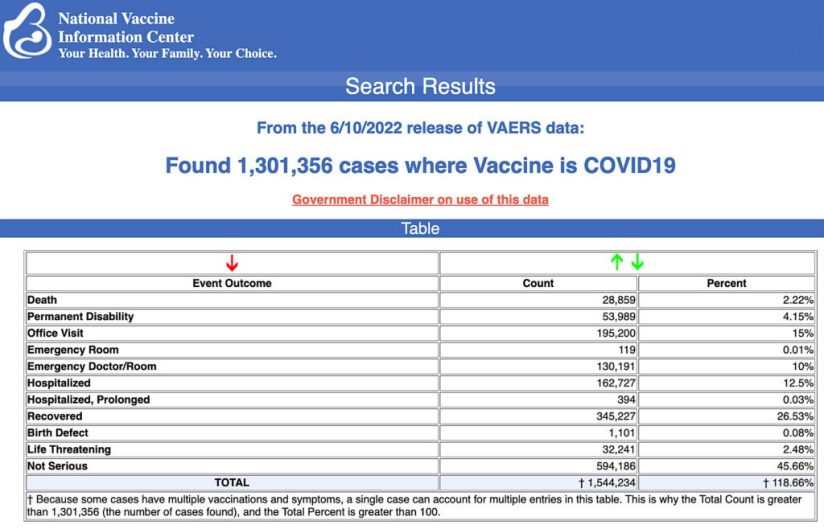
Every Friday, VAERS publishes vaccine injury reports received as of a specified date. Reports submitted to VAERS require further investigation before a causal relationship can be confirmed.
Historically, VAERS has been shown to report only 1% of actual vaccine adverse events.
U.S. VAERS data from Dec. 14, 2020, to June 10, 2022, for 6-month-olds to 5-year-olds show:
- 1,739 adverse events, including 65 cases rated as serious and 3 reported deaths.
- 4 reports of myocarditis and pericarditis (heart inflammation).
The CDC uses a narrowed case definition of “myocarditis,” which excludes cases of cardiac arrest, ischemic strokes and deaths due to heart problems that occur before one has the chance to go to the emergency department. - 13 reports of blood clotting disorders.
U.S. VAERS data from Dec. 14, 2020, to June 10, 2022, for 5- to 11-year-olds show:
- 11,370 adverse events, including 294 rated as serious and 5 reported deaths.
- 22 reports of myocarditis and pericarditis.
The Defender has noticed over previous weeks that reports of myocarditis and pericarditis have been removed by the CDC from the VAERS system in this age group. No explanation was provided. - 44 reports of blood clotting disorders.
U.S. VAERS data from Dec. 14, 2020, to June 10, 2022, for 12- to 17-year-olds show:
- 32,203 adverse events, including 1,834 rated as serious and 44 reported deaths.
- 62 reports of anaphylaxis among 12- to 17-year-olds where the reaction was life-threatening, required treatment or resulted in death — with 97% of cases attributed to Pfizer’s vaccine.
- 656 reports of myocarditis and pericarditis with 644 cases attributed to Pfizer’s vaccine.
- 166 reports of blood clotting disorders with all cases attributed to Pfizer. VAERS reported 167 cases of blood clotting disorders in the 12- to 17-year-old age group last week.
- 19 cases of postural orthostatic tachycardia syndrome (POTS) with all cases attributed to Pfizer’s vaccine.
U.S. VAERS data from Dec. 14, 2020, to June 10, 2022, for all age groups combined, show:
- 20% of deaths were related to cardiac disorders.
- 53% of those who died were male, 42% were female and the remaining death reports did not include the gender of the deceased.
- The average age of death was 73.
- As of June 10, 5,577 pregnant women reported adverse events related to COVID-19 vaccines, including 1,744 reports of miscarriage or premature birth.
- Of the 3,608 cases of Bell’s Palsy reported, 51% were attributed to Pfizer vaccinations, 40% to Moderna and 8% to J&J.
- 889 reports of Guillain-Barré syndrome, with 42% of cases attributed to Pfizer, 30% to Moderna and 28% to J&J.
- 2,290 reports of anaphylaxis where the reaction was life-threatening, required treatment or resulted in death.
- 1,724 reports of myocardial infarction.
- 14,102 reports of blood-clotting disorders in the U.S. Of those, 6,309 reports were attributed to Pfizer, 5,054 reports to Moderna and 2,701 reports to J&J.
- 4,229 cases of myocarditis and pericarditis with 2,590 cases attributed to Pfizer, 1,438 cases to Moderna and 186 cases to J&J.
- 11 cases of Creutzfeldt-Jakob disease with 5 cases attributed Pfizer, 5 cases to Moderna and 1 case to J&J.
- 264 cases of POTS with 162 cases attributed to Pfizer, 84 cases to Moderna and 17 cases to J&J.
FDA authorizes Pfizer and Moderna COVID vaccines for younger children
Moderna and Pfizer-BioNTech’s COVID-19 vaccines are now authorized for emergency use in infants and young children as young as 6 months, CNN reported.
The FDA on Friday authorized Moderna’s vaccine for use in children 6 months through 17 years and the Pfizer-BioNTech vaccine for children 6 months through 4 years.
The FDA’s Vaccines and Related Biological Products Advisory Committee (VRBPAC) on Wednesday unanimously voted 21-0 to recommend Pfizer and Moderna’s COVID-19 vaccines for infants and young children, stating the totality of the evidence available shows the benefits of the vaccines outweigh the risks of use.
The panel ignored pleas from experts, the vaccine-injured and a congressman representing 17 other lawmakers to halt authorization until questions about the safety and efficacy of COVID-19 vaccines for the nation’s youngest children could be properly addressed.
Pfizer’s three-dose vaccine would cover children 6 months to 5 years old, while Moderna’s two-dose vaccine covers children 6 months to 6 years old.
States have already ordered millions of doses made available prior to FDA authorization by the Biden administration.
White House officials said the administration of vaccines for these age groups could start as early as June 21.
CDC advisors hold impromptu meeting to get vaccines for kids rolled out by White House deadline
During a meeting Thursday, the CDC announced it scheduled a special two-day meeting of the Advisory Committee on Immunization Practices (ACIP) Friday to discuss authorization of Pfizer and Moderna’s COVID-19 vaccines for infants and young children.
The meeting to discuss authorization of Moderna’s COVID-19 vaccine for 6- to 17-year-olds is scheduled for June 22 and 23.
The CDC today discussed the safety, immunogenicity and efficacy of the Moderna shot in kids 6 months through 5 years of age and Pfizer’s vaccine in children 6 months through 4 years of age.
The ACIP is scheduled to vote Saturday.
“The entire process is set up to rubber-stamp the VRBPAC meetings from yesterday,” said Toby Rogers, Ph.D.
In a CHD.TV live blog, Dr. Liz Mumper, a pediatrician and Children’s Health Defense board member, said Pfizer showed an estimate of 80.3% vaccine efficacy but based it on only 7 cases in the placebo group and 3 in the vaccine group.
“These numbers are ridiculously small — the 80% may not stand” if more kids are included in the numbers, Mumper said.
Mumper also pointed out the shots being considered at today’s meeting were based on the original Wuhan strain that is no longer circulating.
“It is not so important how good a vaccine is at generating antibodies to Wuhan strain,” Mumper said. “[We] need long-term data about the impact of the shot on the number of kids who get COVID in [the] community and have severe or mild [cases].
Mumper said:
“U.S. VAERS data from Dec. 14, 2020, to June 3, 2022, for 6-month-olds to 5-year-olds show 1,658 adverse events, including 63 cases rated as serious and 3 reported deaths.
“The risk of a child dying if they have a diagnosis is 1,086/10,700,00 or 1086/10700000 = 0.00010149532. The risk of any child dying of COVID-19 over this time period is 1,086/73000000 = 0.00001487671.”
“Forty-nine states have already bought vaccines for children in the age groups being debated,” she added. “Seems like a done deal.”
FDA’s vaccine advisors endorse Moderna’s COVID vaccine for kids ages 6 to 17
The FDA’s vaccine advisory panel on Tuesday voted unanimously to recommend Moderna’s COVID-19 vaccine for children ages 6 to 17 after determining the benefits of the vaccine outweigh the risks for use.
VRBPAC voted 22 to 0 to recommend Moderna’s two-dose vaccine for 6- to 11-year-olds at half the strength of the adult version, and 22 to 0 in favor of authorizing the shot for 12- to 17-year-olds at the same strength as adults.
During the public comment session, individuals expressed concern over recommending a vaccine for an age group that has an almost zero risk of experiencing severe illness or death from COVID-19 and has already acquired a high level of natural immunity.
Dr. Tom Shimabukuro, a vaccine safety official at the CDC, said some data suggest a higher risk of myocarditis among people 18 to 39 years old after receiving Moderna’s COVID-19 vaccine, but findings were not consistent across various safety databases and were not statistically significant.
The CDC confirmed 635 cases of myocarditis, or heart inflammation, in the 5-to-17 age group out of almost 55 million doses of the Pfizer-BioNTech vaccine administered. The agency said the condition occurred most often in adolescent boys after receiving their second dose.
Florida only state not to preorder vaccines for young children
Florida is the only state in the nation that did not place an order with the federal government for doses of COVID-19 for young children prior to U.S. health agencies authorizing the vaccines, Politico reported.
The deadline for placing a pre-order was Tuesday and 49 other states met the cutoff date.
The Florida Department of Health (DOH), said in a statement to Politico on Wednesday that it did not pre-order vaccines for kids 5 and under because it doesn’t advise all children get vaccinated.
“States do not need to be involved in the convoluted vaccine distribution process, especially when the federal government has a track record of developing inconsistent and unsustainable COVID-19 policies,” the DOH statement said.
Jeremy Redfern, press secretary for Florida’s DOH, confirmed the department “chose not to participate” in the vaccination program.
“It is also no surprise we chose not to participate in distribution of the COVID-19 vaccine when the department does not recommend it for all children,” Redfern said. “Doctors can order vaccines if they are in need, and there are currently no orders in the department’s ordering system for the COVID-19 vaccine for this age group.”
Children’s Health Defense asks anyone who has experienced an adverse reaction, to any vaccine, to file a report following these three steps.
© 2022 Children’s Health Defense, Inc. This work is reproduced and distributed with the permission of Children’s Health Defense, Inc. Want to learn more from Children’s Health Defense? Sign up for free news and updates from Robert F. Kennedy, Jr. and the Children’s Health Defense. Your donation will help to support us in our efforts.
Fauci Finally Gets Covid: The Significance
BY JEFFREY A. TUCKER | BROWNSTONE INSTITUTE | JUNE 17, 2022
What precisely happened in the month of February 2020, when Anthony Fauci and cohorts were plotting their pandemic response, is still a mystery. Jeremy Farrar, of the Wellcome Trust, in his book on the topic says that during these weeks, they went to burner phones, clandestine video calls, and warned family members that something terrible could happen to them.
Their top concern was the possibility of the lab leak from Wuhan. They needed to get to the bottom of it and prepare the spin. We know that the initial draft of the academic article denying the lab leak came out February 4, 2020, later published in the Lancet on March 16. But what happened in these three weeks – apart from the mid-February NIH junket to China to learn how to control a virus – remains foggy.
But this much we do know: by March 2, 2020, Fauci had his game plan lined up. Michael Gerson of the Washington Post wrote him on that day and asked about the purpose of social distancing. This was weeks before most Americans had even heard this euphemism for forced human separation. Was the idea to wait for a vaccine, Gerson asked?
Fauci answered in a private email as follows:
“Social distancing is not really geared to wait for a vaccine. The major point is to prevent easy spread of infections in schools (closing them), crowded events such as theaters, stadiums (cancel events), work places (do teleworking where possible… The goal of social distancing is to prevent a single person who is infected to readily spread to several others, which is facilitated by close contact in crowds. Close proximity of people will keep the R0 higher than 1 and even as high as 2 to 3. If we can get the R0 to less than 1, the epidemic will gradually decline and stop on its own without a vaccine.”
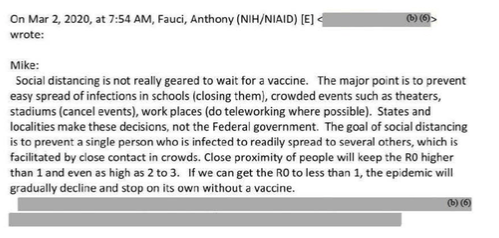
There we have it: the Fauci theory of how we get rid of the virus. We don’t need a vaccine. Just close things. Stay away from people. Don’t gather. Shut schools. Lock businesses and churches. All people stay away from all people. The R-naught will drop.
Then the virus will… and this is where the theory gets murky. Does it just vanish? Get bored? Get frustrated, give up, and vanish into the ether? And how long does this new social system of “social distancing” have to last? Years? Forever? And what happens once people start acting normally again?
This is very clearly crank science, one that confuses ex post data collection with causation itself and also seems to deny the workability of the human immune system. That such things would be written by a person in Fauci’s position is truly mind boggling. But the press went along, and still does after all this time.
What Fauci was imagining – and very few people picked up on it at the time – was the construction of a new social system. It was not just about this virus. It was about all pathogens and the whole functioning of society. He believed – or he decided to come to believe – that a re-engineering of the social order could successfully beat back common pathogens and bring about universal health.
He finally revealed this in his August 15, 2020, article for Cell that received very little attention at all. He was on his own attempting to implement an entire new social system based on a new ideology.
Living in greater harmony with nature will require changes in human behavior as well as other radical changes that may take decades to achieve: rebuilding the infrastructures of human existence, from cities to homes to workplaces, to water and sewer systems, to recreational and gatherings venues. In such a transformation we will need to prioritize changes in those human behaviors that constitute risks for the emergence of infectious diseases. Chief among them are reducing crowding at home, work, and in public places as well as minimizing environmental perturbations such as deforestation, intense urbanization, and intensive animal farming.
This article reveals the most important point. The pandemic response was not just about this one pathogen. It was about what amounts to a political, economic, social, and cultural revolution.
It’s not socialism or capitalism. It’s something else entirely, something very strange, like a Rousseauian technocracy, simultaneously primitive and high tech, as managed by a scientific elite, an untested dystopia worthy of the most terrifying literature in the English language.
No one has voted for such a thing. It is something Fauci and his friends dreamed up on their own and deployed all their enormous power to enact just as a test, until it fell apart. The US and many parts of the world were in their grip for the better part of a year and two years in some places.
This is a scandal for the ages, one that far outstrips issues of tax-funded gain-of-function research, as important as that is. It’s even more important than reports that Fauci has been earning personal royalty payments from pharmaceutical companies that receive grants that he has personally approved. The real problem comes down to his power and the ability of elected representatives and courts to control him for many decades.
Regardless of Fauci’s millenarian vision, the course of the virus took the usual path but for one major exception: the waves of infection occurred based on class rank in society. There was a political hierarchy of infection that started with the working classes, moved to the bourgeoisie, hit the professional classes, then high-end journalists, and finally, at the very end came for the elite ruling class itself – Trudeau, Psaki, Ardern, Gates, and finally Fauci – regardless of their multiple vaccines.
And here is why Fauci’s covid infection is significant, 28 months after the first lockdowns. It’s a sign and symbol that his entire theory of virus control was wrong. He got his way with policy and it did not work. The virus finally landed on him, as if to reenact Edgar Allan Poe’s fictional story of Prince Prospero in his castle that he believed would protect him.
And as a result of his exposure, Fauci will surely (unless his repeated injection of the same vaccine harmed the operation of his immune system) gain the natural immunity that is already possessed by 78 percent of kids and likely two thirds of the general population.
It should also alert us to three points of moral urgency:
- We need to replace Fauci-style feudalism with a new theory of how to reconcile the freely functioning society with the presence of infectious disease, so that neither he nor people in his pay or sway can attempt this again.
- We need to act to disable the unmitigated power of administrative-state bureaucrats to seize control of the machinery of government.
- We need a new system to decentralize science away from privileged elites so that they can never again have monopoly control over what is considered to be the science much less posses the power to censor dissent.
These are the lessons, at least the start of them. This virus is either endemic or at least almost so, but we are left with astonishing social, cultural, and economic destruction from Fauci’s attempt to implement an experimental plan on the whole population not only in the US but all over the world.
We will suffer for many years or generations from it. And yet, in the end, infection is individual and probably unavoidable for most people. The immune system adapts. That’s how we evolved to coexist. To pretend otherwise is the very essence of denying the science.
Jeffrey A. Tucker is Founder and President of the Brownstone Institute and the author of many thousands of articles in the scholarly and popular press and ten books in 5 languages, most recently Liberty or Lockdown.
Our Letter Putting Colleges on Notice
Presidents, senior leadership and trustees can’t say they didn’t know.
No College Mandates | June 12, 2022
No College Mandates has launched a major letter campaign to put colleges on notice that continued Covid-19 vaccination mandates put their students, their reputations, and potentially their endowments at risk. The purpose of the letter is to make these policy makers aware of new information they likely did not know existed and to prompt them to further investigate.
To date, more than 60 college presidents have received this letter via certified mail. Across those 60 colleges, approximately 1400 individuals were copied. Many more college letters are in process. By the time we are finished, thousands of college administrators and trustees will be notified.
No College Mandates is so proud to have the following organizations as signatories on our letter: Health Freedom Defense Fund, The Mendenhall Law Group, Health Freedom Counsel, and The Unity Project.
The letter is below. If you are interested in working on this effort, email us at info@nocollegemandates.com. We’ll set you up to fight this fight with us and make change.

To College and University Presidents, Senior Leadership and Trustees:
We are writing to notify you of recently available information prompting concern that fraud has been committed by Pfizer and by the FDA in the development and continued distribution of Pfizer’s Covid-19 vaccine. Given that your institution mandates Covid-19 vaccination for students as a condition of enrollment, it is incumbent upon you to be fully informed about the safety and efficacy of these vaccines and the claims of fraud that call both into question.
If fraud or willful misconduct is proven, the manufacturers and those involved in the distribution or mandating of the vaccines will lose immunity from liability granted to them under the existing EUA and the PREP act.
We urge you to further investigate. We believe that once you do, you will see how continued Covid-19 vaccine mandates jeopardize the safety of your students and the reputation of your institution.
The new information consists of Pfizer’s biological product file used to obtain FDA approval of Comirnaty and data from the insurance industry showing a huge rise in excess deaths in Millennial and Gen X populations concurrent with the implementation of vaccine approvals and mandates. The excess death data is raising concerns in the insurance industry and on Wall Street. We are also including timely news about product safety, given the FDA’s recent restriction of the Johnson & Johnson vaccine due to blood clotting concerns.
Following is a brief overview of each category and starting points for further inquiry. We are standing by to provide you with additional information or to connect you to scientists, lawyers and investors who are reviewing the current and evolving data.
Pfizer Biological Product File – background and highlights:
The Public Health and Medical Professionals for Transparency (PHMPT) is a nonprofit group made up of public health professionals, medical professionals, scientists, and journalists. The group exists solely to obtain and disseminate the data relied upon by the FDA to license Covid-19 vaccines. Four days after the Pfizer Covid-19 vaccine was approved for children over 16, this group submitted a Freedom of Information Act for all data within Pfizer’s Covid-19 vaccine biological product file. When the FDA asked for 75 years to release that data, PHMPT sued to obtain it and won. Beginning in March 2022, the public has access to Pfizer’s clinical trial data, which is being downloaded in batches monthly. You can find the document releases to-date here.
Thousands of volunteers including scientists, statisticians, doctors, and lawyers continue to examine these downloads and publish their findings. For ready reference, below are just a few of the findings of greatest concern that call into question the safety and efficacy of the Pfizer product and support a thesis of fraud:
- Pfizer failed the all-cause mortality endpoint in their unprecedentedly short 28-day clinical trial. In brief, more people died in the vaccinated group than in the placebo group. This was known yet has still not been widely disclosed to the public.
- The CDC talking point that vaccines stopped transmission was based on no data, as this metric was not evaluated during Pfizer’s clinical trials. Pfizer and the FDA knew this yet did not disclose it to the public.
- Pfizer and the FDA knew as early as November 2020 that Pfizer’s clinical trials showed:
- Vaccine failure
- Waning vaccine efficacy
A baseline condition for granting a product Emergency Use Authorization is that it must be safe and effective. The data showed that the products are not effective. Yet, based on FDA approval, the CDC promoted them as such. From the initial roll-out in December 2020 through April 1, 2021, the public health messaging was that if you received the shot, you could not get infected and could not transmit the virus. The Pfizer documents are proof that they and the FDA colluded to lie to the American people and the CDC created false public health narratives based on these lies.
- Pfizer and the FDA most likely knew in May 2021 that the vaccines caused heart damage in teenagers based on a paper that was already in peer review at that time. The FDA approved the product for teenagers in June 2021 yet did not disclose this risk factor to consumers until August. During that time, all those who received this product did not have informed consent. Parents were not made aware of this known potential risk to their children.
- Brook Jackson, a regional director employed by Pfizer sub-contractor Ventavia Research Group, came forward in September 2020 with documented evidence that the company falsified data, unblinded patients and was slow to follow up on adverse events reported in Pfizer’s pivotal phase III trial conducted by Ventavia. Her findings call into question the integrity of not only Ventavia’s results but of all of the results from Pfizer’s other trial sites and the entire clinical trial. Further information is available in The British Medical Journal.
Excess death data and the insurance industry:
In December 2021, Midwest insurer One America CEO Scott Davidson disclosed a 40% increase in excess deaths over pre-pandemic levels in the working-age (18-64) population in the third quarter. Putting the number into context Davidson said, “The data is consistent across every player in this business . . . Just to give you an idea of how bad that is, a three-sigma or a one-in-200-year catastrophe would be a 10 percent increase over pre-pandemic. So 40 percent is just unheard of”. Other major insurers have subsequently reported increases in death claims ranging from 21–57 % over expected levels. Most of these deaths are not Covid-19 deaths. Long-term disability claims are also seeing an uptick.
These reports prompted a former institutional investor who was a #1 ranked Wall Street sell-side insurance analyst to confirm the numbers using CDC reported data. His findings, independently confirmed by others, show the spikes in excess deaths are related to the timing of vaccine approvals and mandates. This data is prompting concern at insurance and reinsurance companies, who will bear the financial brunt of this unexpected and unprecedented rise in mortality. It is raising questions about the safety of the Covid-19 vaccines in the investment community and beyond.
Of related interest is Pfizer’s amendment in February of its business risk disclosures in its Q4 2021 earnings report. The changes from the Q3 2021 report language center around disclosures of unfavorable safety data and “further information regarding the quality of pre-clinical, clinical or safety data, including by audit or inspection”.
It is likely that neither Pfizer nor the FDA anticipated the court-compelled release of their clinical trial and post-marketing surveillance data and the subsequent public scrutiny of it.
Additional product safety concerns:
The FDA announced on May 5 that they were restricting use of the Johnson & Johnson Covid-19 vaccine due to the risk of thrombosis with thrombocytopenia syndrome (TTS), a syndrome of rare and potentially life-threatening blood clots in combination with low levels of blood platelets. The decision to restrict was based on 60 reported cases and 9 fatalities. The Pfizer and Moderna vaccines also have serious risks and fatalities associated with them including but not limited to blood clots and myocarditis in college-aged populations. These are shown in Pfizer’s post-marketing surveillance data and in the CDC’s Vaccine Adverse Event Recording System (VAERS). As of April 29, 2022, there were approximately 1.2 million reports of adverse events following Covid-19 vaccination including more than 18,056 reports of deaths following the Pfizer vaccine, and 7,223 following the Moderna vaccine. Logic demands that Pfizer and Moderna products be restricted immediately as well. Why have they not been? Further, a recent Danish review of all three products in preprint in The Lancet showed that the J&J reduced all-cause mortality but that Pfizer and Moderna did not and may have increased it. Given all this, it is reasonable to think that Pfizer and Moderna products could be restricted or discontinued very soon due to safety concerns. This might well trigger a much higher level of scrutiny of the now-publicly available Pfizer data and the actions of our public health institutions. How would such a situation impact institutions such as yours that continue to mandate the products while knowing such risks exist?
One last thing to consider is the nature and associated secrecy of the contracts that Pfizer forced upon governments as conditions of sale and distribution of their Covid-19 vaccines in their respective countries. A review of some of these contracts can be found here. Terms included such things as the waiving of sovereign immunity, countries assuming full liability in the event that Pfizer was shown to have used another entity’s intellectual property, and that Pfizer be held harmless in the event of injury or death from the products. Why would a company require such terms if it knew its conduct and its products were sound?
We sincerely hope this information has been useful and that you will investigate this matter fully. We urge you to end your vaccine mandates to protect your institution’s students, reputation, and, in the event that fraud is proven, potentially your endowment.
Yours truly,

No College Mandates is a coalition of thousands of concerned students, parents, professors, staff, and community members working to end college Covid-19 vaccination mandates and restore medical choice on college campuses. Contact us at info@nocollegemandates.com

Health Freedom Defense Fund is a 501(c)(3) non-profit which seeks to protect and advance health freedom, educate Americans on informed consent, advocate for human rights and bodily autonomy for all people, and legally challenge unethical mandates, laws, and policies when necessary. (HealthFreedomDefense.org)

The Mendenhall Law Group is a mission-oriented practice focused on holding government, educational institutions and corporations accountable. The group is keenly interested in medical freedom and provides legal support for those concerned about Covid-19 mandates and policies. Mendenhall Law has offices in Ohio and Massachusetts and a national network of affiliated practices. (WarnerMendenhall.com)

Health Freedom Counsel believes in the right to medical choice and provides clients with the resources to stand up to mandates that infringe upon medical freedom. (HealthFreedomCounsel.com)

The Unity Project is a non-profit organization dedicated to fighting the Covid-19 Vaccine Mandate for students, kindergarten through 12th grade. We have enlisted globally esteemed physicians, scientists and business leaders and more than 150 grassroots groups and concerned individuals focused on preserving medical freedom.
Ontario ends daily COVID reports
By Thomas Lambert | The Counter Signal | June 16, 2022
Perhaps a sign of the times, Ontario has finally taken a step forward by ending its schizophrenic daily reports on COVID.
Indeed, it wasn’t so long ago that Premier Doug Ford was making daily appearances to warn those in the province of the dangers of COVID and to push getting vaccinated. However, just weeks after the Freedom Convoy protest began its cross-country trip to Ottawa, Ford made noticeable changes to his rhetoric, saying it was time to get back to normal.
However, while it’s undoubtedly a good sign the Ford government doesn’t feel the need to provide daily reports on COVID anymore, the decision isn’t without caveat, as the province will continue providing COVID data weekly.
“As of June 16, all COVID-19 datasets will be updated weekly on Thursdays by 2 pm,” the Ontario Data Catalogue reads.
This policy change comes only five days after Ontario ended nearly all remaining mask requirements, including those that applied to public transit.
Besides returning to normal, another motivation for moving away from daily COVID reports on vaccination status, cases, hospitalizations, and deaths may be due to what recent data has shown.
As previously reported by The Counter Signal, the per capita case rate, hospitalization rate, and death rate by vaccination status all show that the vaccine makes almost no difference.
Moreover, those who have received a booster dose appear to be the worst off, having the highest rates of infection, hospitalization, and death per capita of any vaccination group, both in the province and Canada.
This reality completely shatters the ongoing mainstream narrative regarding the necessity of continued vaccination, with natural immunity appearing to be more than adequate — if not better — at preventing transmission and severe illness.
Either way, Ontarians and Canadians more generally might not be done with COVID quite yet, as both the federal and provincial governments have indicated that they’re more than willing to bring restrictions and mandates back in the Fall during flu season.
WHO Pandemic Treaty a “Power Grab at behest of Big Pharma and Big Donors”: Former UN Asst. Secretary-General
BY WILL JONES | THE DAILY SCEPTIC | JUNE 16, 2022
Former United Nations Assistant Secretary-General Ramesh Thakur has warned in the Spectator of the coming massive expansion of the international pandemic bureaucracy and the powers of the WHO to press countries towards authoritarian public health measures. The WHO’s track record during COVID-19 hardly merits reward with further powers, he says.
Health includes mental health and wellbeing and is highly dependent on a robust economy, yet the WHO-backed package of measures to fight Covid has been damaging to health, children’s immunisation programs in developing countries, mental health, food security, economies, poverty reduction, social and educational wellbeing of peoples. Their worst effects were grievous assaults on human rights, civil liberties, individual autonomy and bodily integrity. To make it worse, in promoting these policies the WHO violated, without providing any justification beyond China’s example, (1) the guidance from its own report in October 2019 that summarised a century’s worth of worldwide experience and science; and (2) its own constitution which defines health as “a state of complete physical, mental and social well-being and not merely the absence of disease or infirmity”. The vaccine push has similarly ignored accumulating safety signals about the scale of adverse reactions, on the one hand, and rapidly dwindling efficacy after successive doses, on the other.
Euro-U.S. efforts, backed by Australia, to amend legally binding international health regulations and adopt a new pandemic convention would confer extraordinary powers on the WHO to declare public health emergencies of international/regional concern and command governments to implement their recommendations. WHO inspectors would have the right to enter countries without consent and check compliance with their directives. They would lock in the lockdowns-vaccines narrative and preempt rigorous independent retrospective reviews of their costs and efficacy. The ‘reforms’ amount to a WHO power grab at the behest of Big Pharma and Big Donors. Whether approved as two separate instruments or folded into one overarching new treaty, the changed architecture will greatly strengthen the WHO’s core capabilities on public health surveillance, monitoring, reporting, notification, verification and response. The rush to amend the existing international health regulations encountered significant pushback last month from developing countries, China and Russia but will come up again for discussion and approval shortly. The new treaty under negotiation will be presented to the World Health Assembly in 2024.
The proposed reforms to international health agreements will only make things worse, he says.
On January 24th, Director-General Tedros Adhanom Ghebreyesus said an urgent priority was to “strengthen WHO as the leading and directing authority on global health”, for: “We are one world, we have one health, we are one WHO.” On April 12th, he said the Covid crisis had “exposed serious gaps in the global health security architecture”; the new treaty would be “a generational agreement” and “a gamechanger” for global health security. If adopted, it will consolidate the gains of those who have benefitted from COVID-19, concentrating private wealth, increasing national debts and decelerating poverty reduction; expand the international health bureaucracy under the WHO; shift the centre of gravity from common endemic diseases to relatively rare pandemic outbreaks; create a self-perpetuating global biopharmaceutical complex; shift the locus of health policy authority, decision-making and resources from the state to an enlarged corps of international technocrats, creating and empowering an international analogue of the administrative state that has already thinned national democracies. It will create a perverse incentive: the rise of an international bureaucracy whose defining purpose, existence, powers and budgets will depend on outbreaks of pandemics, the more the better.
Google, Twitter, Meta, TikTok and more just signed the EU’s “anti-disinformation” code
By Dan Frieth | Reclaim The Net | June 16, 2022
Big Tech companies have signed a new version of the European Union’s “anti-disinformation” code. Some of the companies that signed include Google, Twitter, Meta, TikTok, and Twitch – but also smaller players such as Vimeo and Clubhouse.
There are 34 signatories in total:
- Adobe
- Avaaz
- Clubhouse
- Crisp Thinking
- Demagog
- DOT Europe
- European Association of Communication Agencies (EACA)
- Faktograf
- Globsec
- Interactive Advertising Bureau (IAB Europe
- Kinzen
- Kreativitet & Kommunikation
- Logically
- Maldita.es
- MediaMath
- Meta
- Microsoft
- Neeva
- Newsback
- NewsGuard
- PagellaPoltica
- Reporters without Borders (RSF)
- Seznam
- The Bright App
- The GARM Initiative
- TikTok
- Twitch
- Vimeo
- VOST Europe
- WhoTargetsMe
- World Federation of Advertisers (WFA)
Apple declined to sign.
The “code of practice on disinformation,” will require online platforms to show how they are tackling “harmful content.”
It will also require platforms to fight “harmful misinformation” by forming partnerships with fact-checkers and developing tools. They will be forced to include “indicators of trustworthiness” on information verified independently on hot-button issues like COVID-19 and Russia’s invasion of Ukraine.
Perhaps the most notable requirement is providing their efforts to tackle harmful content and disinformation on a country-by-country basis. The move was opposed by online platforms, but national regulators demanded that they need more specific data to better address the spread of disinformation.
The EU’s vice president for values and transparency Věra Jourová, who is in charge of the code, said “to respond to disinformation effectively, there is a need for the country- and language-specific data. We know disinformation is different in every country, and the big platforms will now have to provide meaningful data that would allow to understand better the situation on the country level.”
“Russia’s actions have informed to shape the anti-disinformation code,” she said. “Once the code is operational, we will be better prepared to address disinformation, also coming from Russia.”
The new code also requires online platforms to provide other data, including the AI systems deployed to tackle “disinformation,” number of bots removed, and the number of content moderators in each country.
The code applies immediately but allows for a six-month implementation period for platforms to adhere to the strict rules.
Developmental Disorders in Babies born to Vaccinated Mothers?
Pfizer wants Babies to be Exposed to SIX Vaccine Shots!
By Igor Chudov | June 10, 2022
I will explain that
- Children of Covid vaccinated mothers were never tested for developmental disorders
- CDC recently revised and lowered developmental milestones, and removed some entirely
- Newly born babies will be exposed to SIX doses of mRNA vaccines if the FDA’ approves the Pfizer vaccine.
An interesting article came out:
This article found that at one year of age, babies born to mothers who had COVID (not vaccine), had a roughly twice-higher rate of neurodevelopmental disorders:
those born to the 222 mothers with a positive SARS-CoV-2 polymerase chain reaction test during pregnancy were more likely to receive a neurodevelopmental diagnosis in the first 12 months after delivery, even after accounting for preterm delivery.
Considering that COVID is a bad disease for a sizable minority of people, there is no surprise. Covid is bad and gives people all sorts of problems. Then I started thinking: a lot of adverse effects of Covid vaccines mimic the adverse effects of Covid. The younger is the vaccine recipient, the worse some effects of vaccination (such as myocarditis) are.
A great number of expectant mothers received up to three Covid vaccine shots during pregnancy. Did anyone bother testing one-year-old children of vaccinated and boosted (during pregnancy) women for neurodevelopmental disorders, before approving this vaccine for all pregnant women?
The question is, obviously, rhetorical, since “mRNA Babies” of triple-vaxed-during-pregnancy mothers are only beginning to get born right now and are at most a few months old. Not one such baby reached a year of age. So nobody tested them for developmental disorders at one year of age, before approving the three vaccine shots for expectant mothers.
The usual argument of vaccinators that “since Covid does it too, you should take the vaccine” does not hold water. To a woman who decided to take the vaccine, the probability of getting a vaccine is 100%. The probability of her getting Covid is much less. In the above study, out of 7,772 births, only 222 (2.8%) were exposed to Covid during pregnancy. So while vaccination is 100% guaranteed for those who elect to vaccinate, the chance of Covid is over 30 times less likely. And the “vaccine” does not prevent Covid anyway and does not even reduce the viral load.
There is literally zero data on one-year-old children of triple-vaccinated mothers because the oldest ones are 3-4 months old as of today.
However, there are disturbing developments regarding newborns. Vaccination does seem to have an effect on births and pregnancies.
The best data I found regarding recently born newborns happens to come from Scotland. They have an interesting “wider impacts” page that I am quoting below.
Infant deaths are way above average and exceeded “Alert Limits” twice.
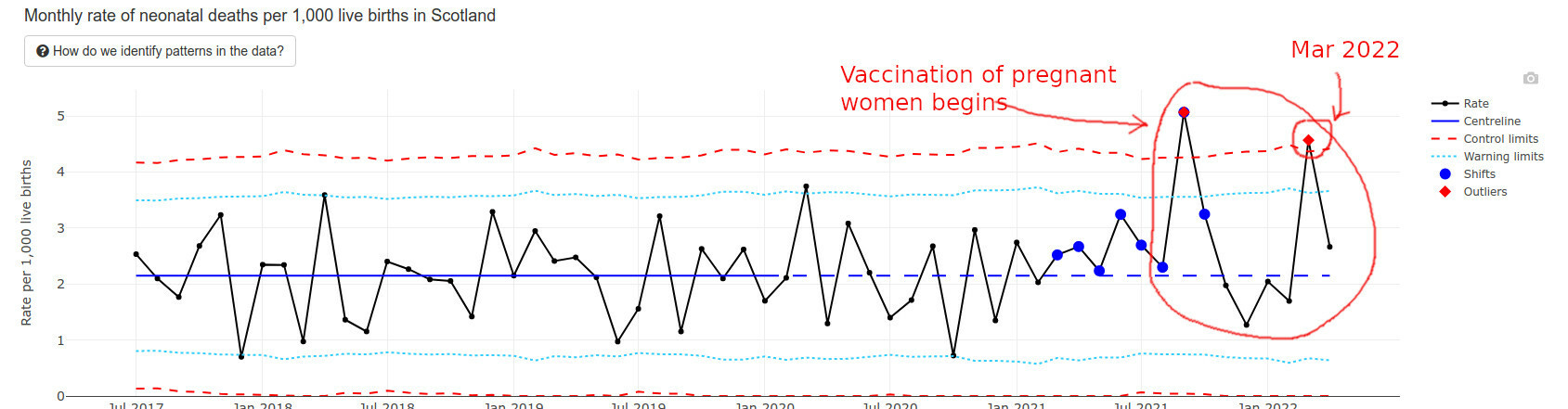
Even pregnancy terminations went up at the end of 2021, possibly but not certainly explained by prenatal vax problems:
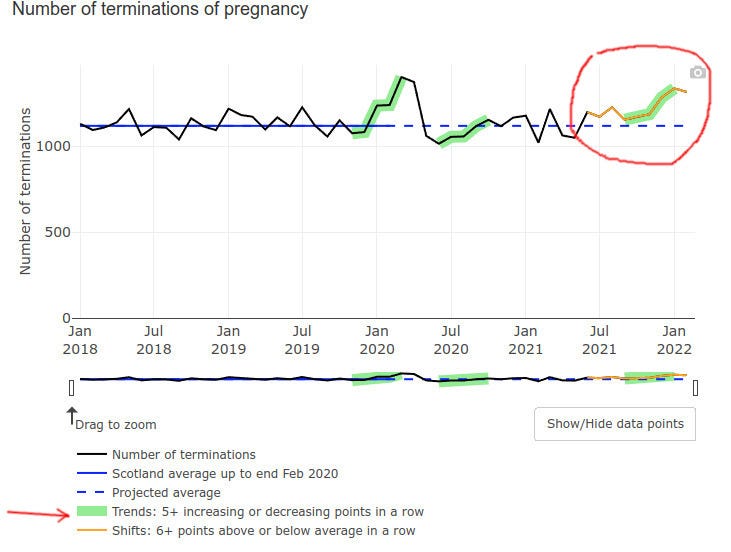
Low Apgar score births (for those readers who do not have kids, Apgar score is how healthy is the baby at birth, the best being a score of 10) triggered a green alarm signal:
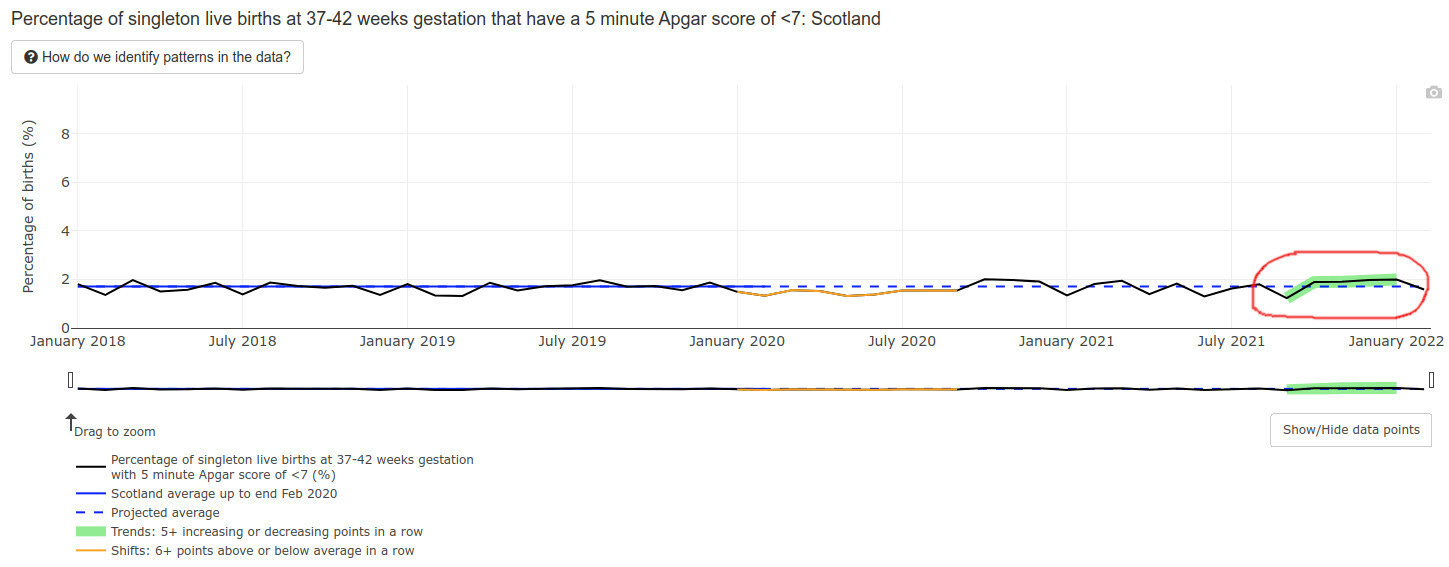
Mind you, an Apgar score is also a developmental evaluation of sorts — at 5 minutes after birth. What will happen to the developmental milestones of those lucky babies of vaccinated mothers, who survived the pregnancies, did not die postnatally, and lived to one year of age? I literally have no idea and nobody else in the world does — the time has not passed yet.
The data we have is NOT encouraging.
CDC Solution: Remove and Lower Milestones
The CDC possibly caught a whiff of this, because in February of 2022 they literally removed half the developmental milestones, bumped some others to higher ages, and lowered standards for yet more of them. (Hat tip @CLesterwood)
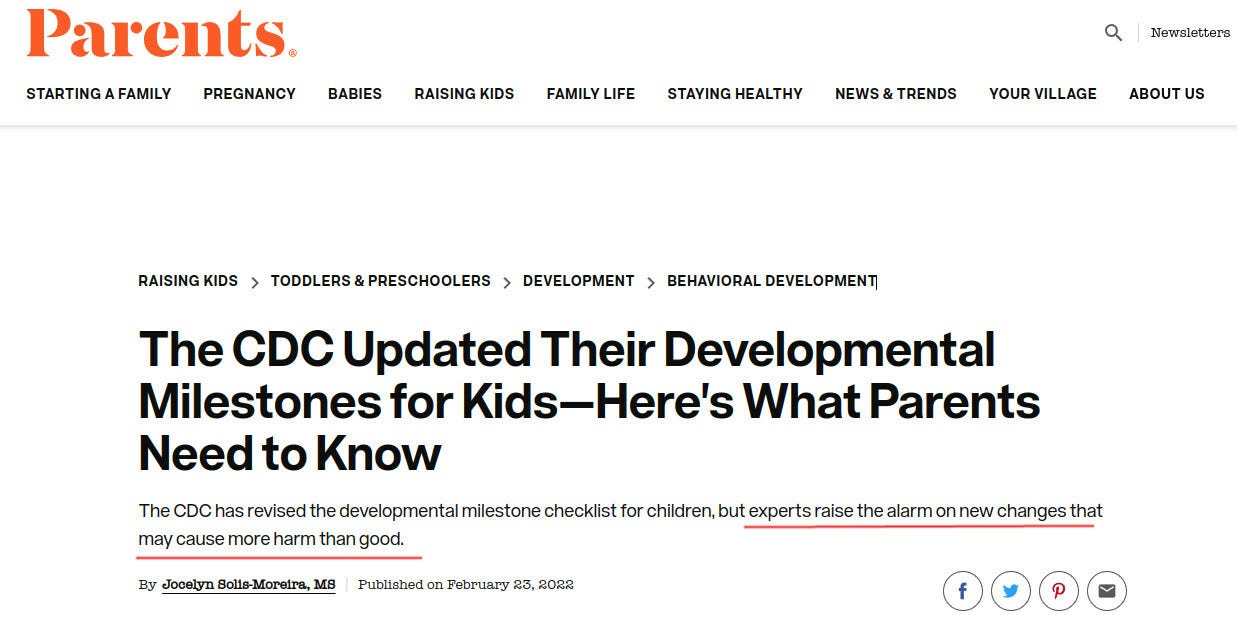
About one-third of milestones like fine motor skills have been bumped up to older ages. Because of the setback, children may worsen their developmental delay, making it harder to provide early intervention, explains Jessica Hatfield, MS, OTR/L, a pediatric occupational therapist for TheraTree Pediatric Therapy.
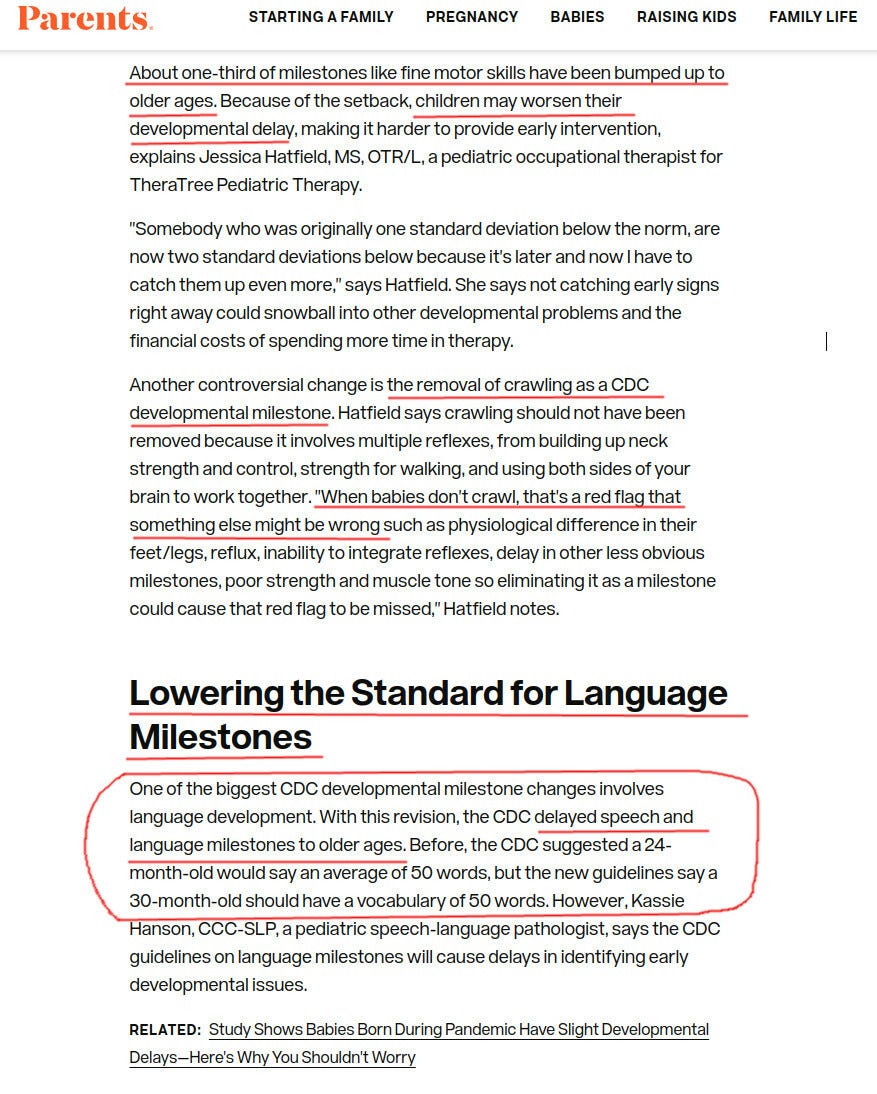
Removing crawling as a milestone??? Are you kidding us? For those of my readers who are parents, do you think that crawling is unimportant as a milestone?
Vaccinated Infants Exposed to SIX Doses of Covid Vaxx in a Year!
Imagine a vaccine enthusiast mother, who gets three doses during her pregnancy. Say, two doses during month 4 and one during the last week of pregnancy. The unborn baby is, obviously, exposed to all that.
Then the baby is born.
If the June 14-15 FDA meeting goes as planned, FDA will approve a three-dose Pfizer vaccine for infants and toddlers. So shortly after being exposed to THREE doses of mRNA vaccines prenatally, the recently born 6 months old baby will get THREE MORE Pfizer mRNA shots.
That’s a total of, drumroll, six spike protein, and nanoparticle exposures. For a tiny newborn, all during one first year of her life.
And what if the mom has several Covids while being pregnant and vaccinated?
They will ask the mom to vaccinate the baby regardless of those covid infections. This literally amounts to six doses within a year or close to, without even counting actual covids that the vaxed moms have. Pfizer will make $132 from these six shots. Not sure if the baby will eventually need much more expensive treatments.
Do you think that it is a little bit too much? Do you think Pfizer or the FDA care?
Featured Video

No Vote, No Representation, No State: Democracy, Israeli Style
or go to
Aletho News Archives – Video-Images
From the Archives
Sanctions, War and the Policy of Dual Containment
By SASAN FAYAZMANESH | March 17, 2008
It is now nearly three decades since the Unites States adopted the policy of dual containment of Iran and Iraq. While much has been written about the containment of Iraq, there has been very little in-depth analysis of this policy when it comes to Iran. In a book that is going to be released on March 31, 2008, entitled The United States and Iran: Sanctions, Wars and the Policy of Dual Containment (Routledge), I attempt to address this shortcoming by investigating when and why the US policy of containment of Iran came about, how it evolved, and where it stands today.[1] To the extent that Israel has been involved in US policy making, the study will also include the role that Israel has played in the containment of Iran. Also, since the fate of Iran has been inextricably linked to that of Iraq, occasionally the investigation will overlap with the containment of Iraq.
The policy of dual containment of Iran and Iraq originated during the Carter Administration, but it was not until the Clinton Administration that the expression “dual containment” became popular. … continue
Blog Roll
 Aletho News
- How Israel destabilizes the Middle East: Denying sovereignty and the right to exist
- Europe’s Establishment Is Embracing War – and Losing Voters
- NATO chief advocates war of aggression
- No Vote, No Representation, No State: Democracy, Israeli Style
- Zionist Bought Senate Blocks Information About American Citizens Killed By Israel
- While Gaza dominates the UN, these are the people keeping it alive
- New Report: “Scholasticide and Genocide in Gaza: Assessment, Testimonies and Legal Analysis”
- ‘THAAD Delusion’: Iran war exposes US missile shield limits – The Atlantic
- Moscow issues warning to NATO over Russian exclave
- Yes, the Iran war has destroyed Trump’s presidency
- If Americans Knew
- Israel map in LA Times ad includes all land from the river to the sea
- Inside Lebanon’s 200-page dossier on Israeli war crimes
- Flydubai, genocide, settler violence, Trump abuse of power to deport – Daily Update
- Counting Antisemitic Incidents: What the ADL Audit Reveals — and Obscures
- Mamdani releases plan to combat antisemitism and hate crimes in New York City
- Iran’s Revolutionary Guards Publish Letter to the American People
- DMFI launches $1 million ad campaign supporting Virginia’s Elaine Luria
- US Senate blocks resolution seeking report on Americans killed by Israel
- Israeli Attacks Kill Ten Palestinians in Gaza
- Massacre at Minab: The School That Became a Grave
- No Tricks Zone
- Green Energy Debacle: German Expert Professor Fritz Vahrenholt Warns Of Severe Economic And Social Consequences
- Two More Paleo Reconstructions Affirm Meters-Higher Sea Levels Across Ireland, Brazil 7000-6000 Years Ago
- New Study: Earth And Venus Surface Warmth Largely Explained By Convection And Lapse Rate, Not CO2 Or Radiation
- 2025 Nature Paper Claiming Worsening Global Drought Gets RETRACTED …Heavily Flawed
- New Study: ‘Global Drought Shows No Detectable Recent Acceleration Under Climate Warming’
- Economic Masterminds: German Socialists Suggest Taxing Productivity Gains Stemming From Using AI
- The South China Sea Has Not Been Cooperating With The Climate Change Narrative
- Energy Crisis: Germany Enters Heating Season With Historically Low Gas Reserve Fill Levels
- New Study: The Antarctic Ice Sheet Gained Mass From 2020-2024 Due To Staggering Snow And Ice Accumulation
- Study: Ocean Heating Rates From Thousands Of Years Ago ‘Dwarf’ Modern Ocean Heating Rates

