Palestinian media raided and closed by Israeli forces

Samidoun Palestinian Prisoner Solidarity Network – October 8, 2016
Palestinian associations in 1948 Palestine were closed by Israeli police and Shin Bet agents on Thursday, 6 October in a series of raids in Nazareth and Umm al-Fahm. The associations allegedly are linked to the northern Islamic movement, the Palestinian religious and political organization banned nearly a year ago by Israeli officials. The leader of the Islamic Movement is Raed Salah, currently imprisoned and well-known for his advocacy in defense of Al-Aqsa Mosque, as well as his participation in the Freedom Flotilla to Gaza.
Palestinian organizations across political lines condemned both the banning of the Islamic Movement and the raids on the community organizations and media institutions. The four Palestinian entities forcibly shuttered on Thursday were the Higher Commission to Support Jerusalem and Al-Aqsa, Q Press in Umm al-Fahm, the Midad Psychometry Institute and Al-Medina newspaper.
The Higher Arab Follow-Up Committee labeled the attacks “a new sign of a systematic scheme to suppress the rights of the Arab community, a repression that applies to all walks of life… We renew our rejection of the decision to ban the activities of the Islamic Movement, and at the same time warn of the danger of the use of the Islamic Movement’s activities as a new pretext to suppress even more freedoms and silence the voice of the Arab people, who are fighting against the Israeli racist policies targeting our presence on our ancestral land.”
The Al-Alam media association denounced the closures and raids on Al-Medina, Q Press and other institutions and the confiscation of their computers, linking the raids to an ongoing escalation against Palestinian organizing in 1948 Palestine, among Palestinians with Israeli citizenship, in particular the campaign of arrests and harassment targeting the National Democratic Assembly (Tajammu’/Balad party).
The Freedoms Commission of the Higher Follow-Up Committee said that “these three institutions, added to the 23 already prohibited, are independent institutions that provide a variety of services for our people… How can an institution like the Midad Psychometry Institute to qualify students for exams, which tutors thousands of secondary school students, contribute to conflicts over Al-Aqsa Mosque? How can the fact that 69 students of the Midad Institute were admitted this year to study medicine in Israeli universities be a cause of conflict over the Al-Aqsa Mosque?” The statement noted the ongoing attacks on the National Democratic Assembly and the investigations targeting Haneen Zoabi and Jamal Zahalka, as well as the 104th demolition of the village of Al-Araqib and the displacement of its people on the same morning of 6 October as reflections of one policy. “This government has declared outright war on the Palestinian people inside, taking advantages of the wars in the region to implement its plans against our people in our homeland, and the Palestinian people in general,” said the statement.
The suppression of Palestinian political activity among the Palestinians of ’48 (who hold Israeli citizenship, and constitute 20% of the population of the Israeli state) is nothing new; in the first 20 years of occupation, from 1948 to 1966, Palestinian citizens lived under martial law which in many ways served as the precursor to the present-day scheme in the West Bank and Jerusalem. Since that time, the banning and violent suppression of Palestinian political activities, as well as the targeting of Palestinian political leaders for arrest and imprisonment, has not ceased. From the Al-Ard movement prohibited in the 1950s, to the Land Day protests against land confiscation met by Israeli fire, to the killing of Palestinians at the launch of the second Intifada – not to mention the imprisonment of prominent Palestinians like Salah, Said Naffaa, Ameer Makhoul and others, and the targeting of cultural workers like Dareen Tatour, the Israeli state has been firmly committed to the suppression of Palestinian existence and political organizing in 1948 Palestine. These acts of political repression accompany ongoing land confiscation, racism and discrimination, defunding of communities and institutions and over 50 racist laws targeting Palestinian existence on their land.
Six Key Questions for the Obama Administration and Companies About Yahoo’s Cooperation With the NSA
By Neema Singh Guliani | ACLU | October 7, 2016
Since the Snowden disclosures, it has been clear that the NSA conducts unconstitutional, dragnet surveillance of Americans’ international communications. However, it now appears that the NSA is using surveillance authorities to conduct an entirely new type of surveillance: requiring major companies to conduct mass e-mail wiretaps, which involve searching the content of all incoming traffic.
If the news stories that broke earlier this week are accurate, here’s what we know:
Last year, Yahoo, in response to a classified government order, scanned hundreds of millions of mail accounts for a “set of characters” or digital “signature” of a communications method purportedly used by a state-sponsored terrorist organization. The search was apparently performed on all messages as they arrived at Yahoo’s servers. All of this was done without input from Yahoo’s security team, potentially placing users’ security at risk and ultimately prompting the resignation of the company’s chief security information officer.
It appears that a secret court, the Foreign Intelligence Surveillance Court (FISC), approved the surveillance—or at least approved the general procedures the government used to identify its targets. There are conflicting reports on what authority the government relied on.
Unfortunately, the news stories and Yahoo’s cryptic response leave more questions than answers. Yahoo’s ability to disclose information about this classified government program may be limited. But the Obama Administration owes the public far more information about this spying program, especially if it is going to fulfill its promise of increased transparency. As a start, the Obama Administration and other major tech companies should publicly answer the following questions:
1. What authority did the government rely on in compelling Yahoo to search its customers’ emails?
The million-dollar question – which remains unanswered – is what legal authority the government relied on for its demand to Yahoo. Initial reports suggested that the government may have relied on Section 702 of the Foreign Intelligence Surveillance Act (FISA), a highly controversial provision enacted as an amendment to FISA in 2008. More recently, however, news reports have stated that the government obtained what is known as a “traditional” FISA order under Title I of the statute. In either scenario, the surveillance would reflect a dramatic shift in the public understanding of how these authorities are used. Title I authorizes the government to search the communications of a particular person or entity. But, if news reports are accurate, it would mean that the government is now using this law to require that companies scan the content of all users’ incoming emails.
2. What is the program’s legal justification and has it been reviewed?
Whether government is relying on Section 702 or Title I, it seems to have strayed far from the original congressional intent. What is the government’s legal justification for this type of surveillance? And, if the surveillance was authorized by the FISC, was the court aware that its order required Yahoo to search the emails of hundreds of millions of innocent users?
In the past, the government and FISC have engaged in legal gymnastics to justify mass surveillance. The public and Congress have the right to know if this is happening yet again. The Obama Administration should release all legal memoranda it relied on in conducting the Yahoo surveillance, and it should disclose any relevant FISC opinions regarding the surveillance. If no such FISC opinions exist then the public deserves to know, as that itself is cause for concern.3. What types of content searches does the government believe it has the authority to conduct under Title I and Section 702, and are past statements about these authorities still accurate?
Intelligence officials have argued that surveillance programs conducted on U.S. soil are narrowly targeted because the government searches only for specific communication identifiers (like an email address) and not for keywords (like “bomb”). But the Yahoo story suggests that even this limitation may be falling to the wayside. If Yahoo conducted a broad search of its users’ incoming email for a “set of characters” or digital “signature,” that information may have been found in the content of communications. In other words, individuals may have been targeted not based on any preexisting suspicion about who they are or who they communicate with, but based solely on what they were communicating. Moreover, it is unclear whether this “signature” was used only by the target organization, or also by other wholly unaffiliated individuals. If the intelligence community is now engaging in this type of content-based surveillance, then the Obama Administration has a responsibility to set the record straight.
4. If the government relied on Section 702, did Yahoo attempt to filter out purely domestic communications?
Section 702 does not authorize the government to collect or search purely domestic communications. However, the stories contain no details about whether Yahoo made efforts to filter out purely domestic communications, and if so, how successful those efforts were. If such efforts were not made and the surveillance occurred under Section 702, then the Obama Administration should immediately disclose the number of purely domestic communications that were collected and searched under the order so that the public can fully assess the privacy implications.
5. If the government relied on Section 702, did the Privacy and Civil Liberties Board (PCLOB) know about this type of surveillance when they conducted their examination?
In 2014, the Privacy and Civil Liberties Board issued a report on Section 702. While we disagreed with many of the report’s conclusions, there is no doubt that the PCLOB declassified important information about Section 702 to facilitate a more robust debate. However, the PCLOB’s public report makes no mention of the types of demands that were purportedly received by Yahoo. If the PCLOB was unaware that this surveillance was occurring under Section 702, why were they not informed? If they knew, why was this information withheld from the public? Either way, this further calls into question the conclusions in the PCLOB report and the adequacy of existing oversight mechanisms.
6. How are other major companies interpreting their obligations under Section 702 and Title I?
Major companies like Google have issued statements saying they have never received the types of demands described in the Yahoo stories and reaffirming that they would challenge such a demand. While we applaud these companies for their statements, more information is needed to fully understand how the government is using its surveillance authorities. Specifically, we urge major technology companies to make publicly available information on how they interpret Section 702 and Title I, and to describe the types of demands that they believe clearly fall outside the statutes’ purview. In this way, companies can help to fill the information abyss left by the Yahoo story and the intelligence community’s lack of transparency.
Yahoo Scanned All Users’ Emails for Government!
By Alfredo Lopez | This Can’t Be Happening! | October 5, 2016
If you are one of the approximately 280 million people with Yahoo email accounts, your email was scanned for content and possibly turned over to the U.S. government. Yahoo, on Tuesday, admitted that fact.
Reuters revealed on Tuesday that the Internet mega-company (which is now being purchased by Verizon Communications) designed a special program last year to capture and scan all its users’ incoming email after being ordered to do that by the either the NSA or FBI. It deployed the program over the last year, scanning every piece of email Yahoo accounts received and apparently turning over all email that contained any of the tens of thousands of “keywords” the NSA considers suspicious.
The decision, Reuters says, was made by President and Chief Executive Officer Marissa Mayer, in collaboration with people in her legal department. It wasn’t without controversy: several Yahoo top staffers left the company including Chief Information Security Officer Alex Stamos (who left for a top job at Facebook).
The news is startling for several reasons. It’s also deceptive for some others.
* Email providers like Google (whose gmail program is a favorite source of NSA data capture) always claim they don’t do “blanket review” of email content. Yahoo is the first to openly admit that it does. It apparently made that decision because its executives didn’t think they could successfully resist the government orders.
That decision by Mayer, already under considerable pressure at the struggling corporate giant, was apparently taken without consultation with her security team. Instead, she just ordered technologists to write the data scanning software. Many in the company thought it could challenge the government orders in the courts and prevail. Several, including Stamos, fled in reported horror.
* They didn’t just review the emails, they built a special program to do it and never let their users know they were doing that. It might seem logical — after all, you don’t let the person who you’re spying on know you’re spying — but very few Yahoo users are the subject of investigations. Yahoo’s statement — that it complies with legal requests — doesn’t even mention the Consitution that protects your data legally and whose first and fourth amendments appear to have been clearly violated by this action.
* Finally, what do you do with all that data? While the government would contend that it was investigating illegal activity, it now has reports (at least) if not full captures on everyone. And a government that collects data on everyone isn’t a state doing policing. It is a police state.
As shocking as this revelation is, the reaction of other Internet companies has been gallingly disengenuous.
“We’ve never received such a request,” a spokeman for Google, told Reuters. “But if we did, our response would be simple: ‘No way’.”
Well… yes… “way” because Google has received thousands of NSA National Security Letters and routinely complies with them. They may not be scanning all the information but they will scan and turn over any information the government requests without informing the affected customer.
A Microsoft spokesperson also chimed in, “We have never engaged in the secret scanning of email traffic like what has been reported today about Yahoo.”
No, maybe not like reported today but Microsoft also routinely complies with government orders almost never challenging them.
In a sense, the way the data is collecting (and the amount collected) — as shocking and important as that is — is probably not the most important issue. If you collect and turn over data on any user just because someone in the NSA tells you to, your respect for privacy and constitutional rights is deeply questionable. That’s exactly what all these companies do.
Yahoo’s latest scandal only underscores how little respect for our rights this industry has.
There are many cases by companies challenging the government on surveillance. Why Yahoo could choose to comply so quickly and not tell anyone about it will certainly provoked widespread circulation and analysis in the coming weeks.
That is something we should all be monitoring.
(Full disclosure: as an official of MayFirst/PeopleLink, I am involved in an international lawsuit challenging the NSA’s right to conduct mass surveillance in foreign countries. The “bias” revealed, however, should not surprise any reader of this website.)
Israeli navy seizes Gaza-bound aid ship
MEMO | October 5, 2016
The Israeli navy has seized the Zaytouna-Oliva, a Gaza-bound aid ship, and is currently towing it towards the Israeli port city of Ashdod, according to the initiative’s organizers and reports in the Israeli media.
Sondos Ferwana, a media spokeswoman for the International Coalition for the Fourth Freedom Flotilla, told reporters on Wednesday evening that Israeli naval forces had “captured the ship”.
The Israeli military, for its part, confirmed the ship’s seizure in a statement.
“The Israeli Defense Forces managed to quickly seize the ship without causing any injuries among passengers,” the statement read.
According to the military, the crew of the Gaza-bound vessel had initially refused the navy’s orders to change course.
“This forced us to intervene and seize the ship before it violated the legal maritime closure imposed on the Gaza Strip,” the statement read.
According to reports on Israel’s Channel Two television station, the aid ship was intercepted — without resistance — some 80 kilometers off Gaza’s coast.
Ferwana, for her part, described the incident as “another act of Israeli piracy”, adding that all contact with the ship — which is carrying humanitarian aid and several female activists — had been lost.
“We don’t know the fate of the activists aboard,” she said.
Passengers on the Zaytouna-Oliva, which set sail from the Spanish city of Barcelona last month, include Irish Nobel Peace Prize laureate Mairead Maguire, Swedish and Algerian lawmakers, a South African Olympic athlete and a Malaysian doctor.
The all-female initiative seeks to break Israel’s decade-long blockade of the Gaza Strip and show solidarity with the women of Gaza.
Palestinian resistance movement Hamas, for its part, which has governed the Gaza Strip since 2007, condemned what it described “the Israeli occupation’s assault on the aid ship and its intimidation of the activists on board”.
In a statement, Hamas spokesman Fawzi Barhoum said the incident amounted to “an act of state terrorism” and another example of Israeli “aggression against the Palestinian people and those who show solidarity with the Palestinian cause”.
Barhoum went on to urge the international community to “put an end to Israel’s crimes”, stressing the need for immediate action “to lift the blockade and rescue the people of Gaza”.
In June of last year, Israeli forces intercepted the “Marianne” — which had been taking part in a similar initiative — and arrested all activists on board.
A similar Gaza-bound aid flotilla ended in tragedy in 2010 when the Mavi Marmara, a Turkish aid ship, was raided by Israeli commandos who killed 10 Turkish activists.
Since 2007, the Hamas-run Gaza Strip has groaned under a crippling Israeli/Egyptian blockade that has deprived its almost two million inhabitants of most basic commodities, including food, fuel, medicine and desperately-needed building materials.
In June, UN Secretary-General Ban Ki-moon described the blockade of Gaza as “collective punishment”, which, he asserted, “suffocates its people, stifles its economy and impedes reconstruction efforts”.
Irish bank closes Palestine solidarity group’s account
MEMO | October 4, 2016
The Bank of Ireland has been criticised after shutting the account of the Ireland Palestine Solidarity Campaign (IPSC), the latest in a string of similar moves by European banks.
IPSC has formally complained, following the closure of its account which it uses to lodge donations, and intends to take a case to the Financial Services Ombudsman.
Earlier this year, the Bank of Ireland requested information from IPSC about its funding and how funds were spent, in response to which, IPSC submitted its audited accounts.
According to IPSC, the Bank of Ireland has “failed to give a specific explanation of why it was closing the accounts.”
Kevin Squires, IPSC coordinator told TheJournal.ie : “Bank of Ireland’s silence speaks volumes. Honestly it’s hard to not view this as part of a wider campaign which has seen banks close accounts in the UK, Austria and France.”
“In the last year or so we have had €1,200 go to Palestine to pay for Palestinian scarves, which is a tiny amount. That’s trade with Palestine. It’s not like we’re sending money to people there.”
Vice-President of Sinn Fein and a Teachta Dala for Dublin Central, Mary Lou McDonald, said the decision was “outrageous”.
“The Ireland Palestine Solidarity Campaign are an established advocacy group that have spent years protesting against the treatment of the Palestinian people. To close their account citing that they associate with a ‘high risk country’… this is not only outrageous; this is insulting to the Palestinian people.”
“Bank of Ireland cannot stay silent on this matter,” she added.
The following is from a statement by the IPSC:
This denial of banking rights, the ensuing loss of income and the potential reputational damage to the IPSC comes in the context of similar seemingly coordinated attacks on Palestine solidarity organisations across Europe and the United States. Numerous bank accounts belonging to such organisations have been closed in France, Germany, Austria and the UK. It is difficult to escape the conclusion that this attack on the IPSC’s ability to bank – which is, in effect, the ability to function at all – is political in nature and forms part of this wider attack on organisations that advocate for peaceful action to secure Palestinian rights enshrined in international law.
Israel has boasted of conducting a global campaign of ‘lawfare’ – using legal and other punitive threats to silence and attack supporters of Palestinian rights. This attack on the IPSC It appears to be part of this campaign, a politically motivated measure to silence a human rights organsiation that campaigns for Boycott, Divestment and Sanctions (BDS) against Israel until it fulfils its obligations under international law – a campaign the Irish government views as an entirely “legitimate” means of protest “intended to pressure Israel into ending the occupation.”
Nowhere to hide: New illegal observation tower in occupied Hebron
International Solidarity Movement | October 3, 2016
Hebron, Occupied Palestine – Israeli forces put up a CCTV observation tower in the Ibrahimi mosque area, further increasing not only their all-encompassing surveillance of Palestinians, but also their slow but steady illegal annexation of more and more Palestinian land in occupied al-Khalil (Hebron).
At the end of last week, Israeli forces in a ‘secret’ over-night action put up the observation tower, surrounded by dozens of cement blocks and barbed-wire. Located in a corner between Palestinian houses, the observation post with a container and all the surrounding paraphernalia is just another step in the illegal annexation of yet more land. In recent weeks, Israeli forces have increased their illegal annexations of the tiny strip of Shuhada Street still accessible to Palestinian pedestrians and stepped up the game of creating a coercive environment directly leading to forced displacement of Palestinians in the Tel Rumeida area.
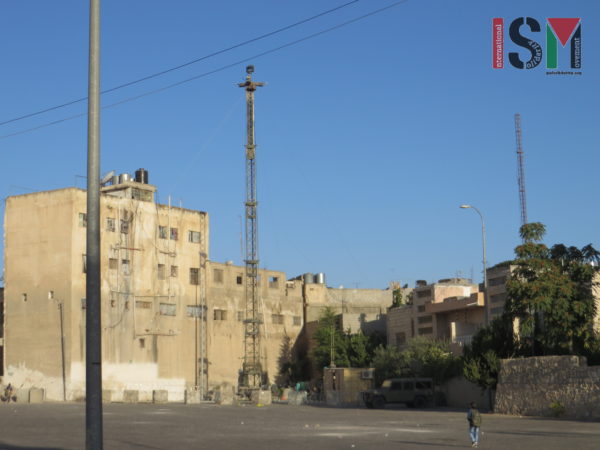
CCTV surveillance tower newly put up in Palestinian neighborhood
This observation tower is fitted with a camera that reaches high above the houses in the neighborhood, thus watching Palestinians constantly. This feeling of permanently being watched for Palestinians is combined with the ever present controls and humiliations at the more-and-more militarized checkpoints. Palestinians are watched, humiliated, numbered, deprived of their most basic human rights – occupied not only physically by the Israeli occupation forces, but also mentally. They can never tell whether they’ll be allowed through a checkpoint (something that solely depends on the respective soldiers whim), whether their children will be tear-gassed on their way to school or arrested, or even whether they’ll be gunned down by Israeli forces at a checkpoint and left to bleed to death. Any and all of these forms of collective punishment are enforced by the Israeli occupying forces on the entire population of civilians in complete disregard of any care for international law or humane treatment of the occupied indigenous Palestinian population.
The Tel Rumeida neighborhood, Shuhada Street, and the area around the Ibrahimi Mosque are already linked by a settler-only street that has been ethnically cleansed of Palestinians in the aftermath of the Ibrahimi Mosque massacre. Restrictions in the Tel Rumeida neighborhood (declared a ‘closed military zone’ solely enforced on Palestinian residents for almost a year now) and around the Ibrahimi Mosque (where Palestinians are often prevented from passing checkpoints on a age-limit between 15-30) have escalated in a very short amount of time, making life for the Palstinians as hard – or rather impossible – as possible, leaving them with no choice than to leave. The only and clear aim is the forcible transfer of all Palestinians in this area, thus geographically linking the illegal settlements in an area ethnically cleansed of any Palestinian presence.

CCTV camero on top of the surveillance tower
Israel closes Ibrahimi Mosque to Palestinian worshippers
Press TV – October 3, 2016
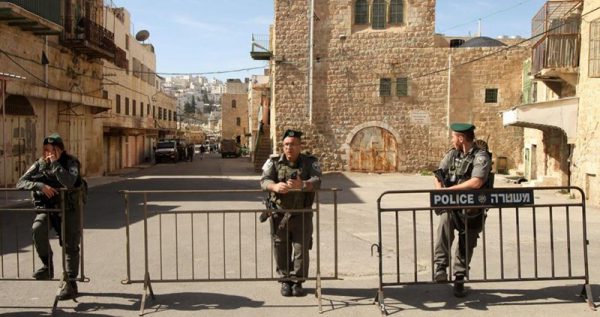
Israeli authorities have decided to close the Ibrahimi Mosque, in the heart of the occupied West Bank city of al-Khalil (Hebron), to Palestinians, Muslim worshipers and non-Jewish visitors for seven non-consecutive days.
Yousif Ideis, the Palestinian minister of endowment and religious affairs, said on Sunday that the sacred site will be closed to Palestinians and non-Jews on October 3, 4, 9, 12, 18, 19 and 26.
Israeli officials have said the shutdown is aimed at maintaining security in the wake of Rosh Hashanah (the Jewish New Year), Yom Kippur (The Day of Atonement), Sukkot (Feast of Booths) and Simchat Torah holidays.
Ideis added that dozens of illegal Israeli settlers broke into the mosque courtyard on Saturday night amid protection by Israeli troopers.
In the meantime, Israeli authorities are closing all passageways between the blockaded Gaza Strip and Israel, as well as between the occupied West Bank and Israel for Rosh Hashanah.
Israeli officials regularly impose stringent restrictions for Palestinians during Jewish holidays for alleged security purposes.
The constraints include denied access to the Ibrahimi Mosque, which is revered by Jews, Christians and Muslims and has been the site of violent tensions between Israelis and Palestinians for decades.
On February 25, 1994, at least 29 Palestinians were killed and 125 others wounded when American-Israeli Baruch Goldstein opened fire on a large number of Palestinian Muslims, who had gathered inside the Ibrahimi Mosque to say prayers during the holy fasting month of Ramadan.
The occupied territories have already been the scene of increased tensions ever since Israeli forces imposed restrictions on the entry of Palestinian worshipers into the al-Aqsa Mosque compound in East Jerusalem al-Quds in August 2015.
Nearly 250 Palestinians have lost their lives at the hands of Israeli forces since the beginning of last October.
September 2016 report: 436 Palestinians arrested, nearly 8000 since October 2015

The following is a translation of the report issued monthly by Palestinian organizations working on prisoners’ issues: Prisoners Affairs Committee; Palestinian Prisoners; Society; Al-Mezan Center for Human Rights and Addameer Prisoner Support and Human Rights Association. The report was issued on Monday, 3 October and translated by Samidoun Palestinian Prisoner Solidarity Network. Photo for illustration purposes.
Israeli occupation forces arrested 436 Palestinians in the West Bank and Gaza in September 2016, including 73 children and 11 women (including 3 minor girls.)
151 of those arrests took place in the Jerusalem Governorate, 81 in Al-Khalil, 40 in Bethlehem, 40 in Nablus, 35 in Jenin, 32 in Ramallah and El-Bireh, 23 in Tulkarem, eight in Qalqilya, six in Tubas, six in Salfit, five from Jericho and nine from the Gaza Strip.
There are approximately 7,000 Palestinian prisoners in Israeli jails, including 59 women, 12 of them minor girls. There are a total of approximately 350 children in Megiddo and Ofer prisons. There are 700 Palestinians held in administrative detention without charge or trial. 122 administrative detention orders were issued in September, including 44 new orders.
Battle of the empty stomachs in September
Palestinian prisoners Mohammed and Mahmoud al-Balboul and Malik al-Qadi carried out hunger strikes of 79, 76 and 68 days against the administrative detention orders against them. They ended their strikes on 22 September after reaching an agreement for their release without renewal of their administrative detention, with the immediate release of al-Qadi to a Palestinian hospital and the release of the Balboul brothers on 8 December 2016, which came after popular, legal and political efforts for their release.
Palestinian prisoners Ahmad Abu Fara and Anas Shadid launched their hunger strike on 25 September against administrative detention while Jawad Jawarish and Maher Abayat announced their strike against arbitrary transfer and isolation.
A year on the popular intifada: the issue of prisoners
The popular uprising which began on 1 October 2015 has had a clear impact on the issue of prisoners. The number of daily arrests has increased over the past year and has included the arrests of different ages and social groups, children, women and men. At least 7955 Palestinians were arrested, including 1963 children, 229 women and girls, 41 journalists and five members of the Palestinian Legislative Council.
The highest number of arrested Palestinians were from Jerusalem; 2355 Palestinians from Jerusalem have been detained since last October, including 842 children and 128 women, including 24 minor girls.
There has been an increase in the number of administrative detention orders throught the year. For the first time since 2008, occupation authorities have issued 1436 administrative detention orders in 2016, including 546 new orders issued without charge or trial under the so-called “secret file.” It is worth noting that many administrative detention orders were issued against young people and students who are not affiliated with the Palestinian political factions.
The Israeli occupation authorities have pursued since last October systematic and deliberate policies against Palestinian prisoners at all stages from arrest through transfer to imprisonment, to a dangerous extent that threatens Palestinian lives. Prominent among these grave violations are the use of excessive force and the execution and extrajudicial killing of Palestinians by Israeli soldiers, including the killing of dozens of Palestinians instantly, noting that these practices of shooting to kill Palestinians violate international law.
Human rights organizations also monitored the number of violations against Palestinian detainees, including an escalation on the use of torture and cruel and inhumane treatment, such as beating and assault during arrest and interrogation, as well as increased frequency and violence of raids and invasion of prison rooms and sections and the conduct of humiliating inspections. Prisoners have been arrested after being shot and did not receive necessary medical care and were subject to interrogation before and during medical treatment in hospitals, in addition to the abduction of wounded Palestinians from hospitals and ambulances.
The occupying power also enacted legislation and proposed draft laws against Palestinians, including laws that escalate prison sentences against “stone throwers,” often children and youth, and expansion of the scope of administrative detention, in an effort to impose collective punishment against Palestinians. In addition, new charges were used to arrest hundreds of Palestinians related to publishing on social media, with sentences up to one year in prison; the year also saw an expansion by occupation forces of the policy of deportation and forcible transfer from the Jerusalem.
UN blames US, EU sanctions for punishing Syrian civilians, stalling aid work – leaked report
RT | October 2, 2016
US and EU sanctions against Syria are punishing the population and make aid work in the war-torn country almost impossible, a leaked UN report and internal letters have revealed.
The restrictive measures contributed to the destabilization of every sector of the economy in Syria that used to be self-sufficient before the war began in 2011.
The country now heavily depends on aid, which is hard to deliver as sanctions make medicine, food, fuel, spare parts and other essentials unreachable, a 40-page UN report, cited by The Intercept, stressed.
The paper entitled ‘Humanitarian Impact of Syria-Related Unilateral Restrictive Measures’ was published in mid-May, but The Intercept got hold of it now, adding other materials on the issue.
The report blasted US and EU restrictions as “some of the most complicated and far-reaching sanctions regimes ever imposed.”
According to the UN, the sanctions introduced by Washington are extremely harsh regarding provision of humanitarian aid. The American restrictions made money transfers into Syria almost impossible, preventing aid groups from paying salaries and purchasing supplies “in both government and besieged areas,” the report said. It stimulated the creation of a shady, unofficial network of money exchange, which is actively being used by Islamic State (IS, formerly ISIS/ISIL) and Jabhat al-Nusra terrorists.
The trade restrictions ban the export to Syria of all goods, containing at least 10 percent of US-made content. This puts the aid groups in a difficult situation as, in order to transfer specific items, they are forced to apply for a special license, which is very hard to obtain due to bureaucratic barriers, according to the report.
An internal UN email, also obtained by The Intercept, blamed the US and EU restrictions for food shortages in the country.
Wheat production has dropped 40 percent in the country since 2010, raising the price of wheat flour by 300 percent and rice – by 650 percent. An August letter from “a key UN official” also said that the restrictions were a “principal factor” in the crippling of the Syrian health care.
The medication factories, which weren’t destroyed during the hostilities, still had to close due to absence of raw materials and foreign currency caused by the sanction, the official wrote.
The Intercept contacted the US State Department on the issue, which refused to acknowledge any of the claims or that the sanctions are hurting civilians in Syria.
“US sanctions against [Syrian President Bashar] Assad, his backers, and the regime deprive these actors of resources that could be used to further the bloody campaign Assad continues to wage against his own people,” the State Department said in emailed response.
“The true responsibility for the dire humanitarian situation lies squarely with Assad, who has repeatedly denied access and attacked aid workers. He has the ability to relieve this suffering at any time, should he meet his commitment to provide full, sustained access for delivery of humanitarian assistance in areas that the U.N. has determined need it,” the email added.
Sanctions have been gradually introduced against Syria since 1979 when Washington labeled the country sponsor of terrorism. But the harshest restrictions came in 2011 when the uprising and military conflict in the country started.
READ MORE:
US ‘spare Nusra for plan B’ to change regime in Syria – Lavrov
Featured Video

Piers Corbyn on religion of climate change
or go to
Aletho News Archives – Video-Images
Book Review
How the U.S. Navy Sold the Vietnam War
By Gareth Porter | TruthDig | March 27, 2019
Dr. Tom Dooley, whose best-selling book “Deliver Us From Evil” helped create a favorable climate of opinion for U.S. intervention in South Vietnam, has long been linked to legendary CIA officer Edward G. Lansdale and his black operations in Vietnam between 1954 and 1955. But the real story about Dooley’s influential book, which has finally emerged from more recent scholarly research, is that it was engineered by an official of the U.S. Navy’s Pacific Command, Capt. William Lederer.
Lederer is best known as the co-author, with Eugene Burdick, of the 1958 novel “The Ugly American,” which was turned into a 1963 movie starring Marlon Brando. Far more important, however, is the fact that from 1951 through 1957 Capt. Lederer was on the staff of the commander in chief of the U.S. Pacific Fleet (CINCPAC), Adm. Felix Stump. … continue
Blog Roll
 Aletho News
- The Nasser Hospital attack and Israel’s relentless lies
- Could it be satan? No, Huckabee, just the Americans you work for
- AIPAC and more: Network of pro-Israel influence in US Congress
- Putin aide reveals Moscow’s stance on Europe at peace talks
- Imran Khan warns Pakistani judges he may die in prison
- IOF used Amazon facial recognition to track millions of Palestinians
- More EU Citizens Face Sanctions For Criticizing The Ukraine Proxy War
- In Mexico, the CIA Is Playing a Dangerous Game
- Spain’s Left Protested the Crisis It Legitimized: the General Strike as election stunt
- The power of inflicting oblivion
- If Americans Knew
- An error has occurred; the feed is probably down. Try again later.
- No Tricks Zone
- New Study: Barents Sea Temperatures Were Warmer And Sea Ice Less Extensive In The 1700s Than Today
- German Authorities Start Initiative To Evaluate Public Register For Climate “Disinformation” Spreaders!
- Zonal Asymmetry of Temperature Change in the Antarctic Circumpolar Current
- New Study: The Net Fossil Fuel Contribution To Rising Atmospheric CO2 Has Been Zero For 500 Years
- Germany’s Green Energy Transition Becoming Increasingly Expensive…Another 6 Trillion Euros!
- Sudden Stratospheric Warming, Powerful El Niño Combination May Lead To Extreme Europe Cold, Energy Crisis!
- Two New Studies Find Thwaites Glacier Melt Cannot Be Driven By Human Activity Or A Warming Ocean
- E-Cars Reduce CO2 Emissions By Only 41% Compared To Internal Combustion Engine Vehicles
- Predictions Made By Renowned Climate Professor Over Past Decades Have Been Proven To Be Poor
- New Study Suggests Large Regions Of The Pacific Ocean Have Been Cooling For The Last 80 Years

