‘EU Stays Silent on Erdogan Press Crackdown’
Sputnik – May 8, 2016
Two journalists from Turkey’s leading newspaper Cumhuriyet have been sentenced to five years in prison for revealing state secrets, but the case against them is purely political since the footage they published only confirmed what everybody already knows about Ankara’s activities in Syria, Turkish journalist Zeynep Oral told Radio Sputnik.
Two prominent Turkish journalists, Can Dudar and Erdem Gul, were sentenced on Friday to five years ten months and five years in prison, respectively, for publishing footage that appears to show Turkey’s National Intelligence Organization (MIT) smuggling arms to opposition groups in Syria.
However, the charges of terrorism and espionage that were levied against them are baseless because the supposed state secret that they divulged has been well known for some time, Zeynep Oral, President of PEN Center Turkey and a columnist for the daily newspaper Cumhuriyet, told Radio Sputnik.
“In fact both Can Dudar and Erdem Gul were put on trial for spying and terrorism, for attempting to put down the government and so many things, they were even prosecuted as terrorists, but the court acquitted them of all of these.”
“They are only being punished for what they have written. The court insisted that they have revealed ‘state secrets.’ Those secrets are not secrets; everybody knows about them, there are tons of publications about them, it’s not a secret any longer, this has already been published before.”
Oral believes that the current state of journalism in Turkey is the worst she’s seen in her 45-year career, and has resulted from the government’s political interference in the media and arbitrary use of the court system.
“I have lived through three different military coups and in none of them was it so bad. At least when you had the military coups you knew what you could write, what was forbidden to write, what was not forbidden to write, what was permissible.”
“Now there is uncertainty, you can be prosecuted for anything you write. The same article can be written by different names and one will be prosecuted and the other will not be prosecuted. For me this is a completely political court case, it has nothing to do with justice,” Oral said.
At first the Turkish government claimed the trucks were only taking humanitarian aid to Syria, then changed their story and said they were providing arms for the Turkmen in Iraq.
“Then the Turkmen said no, we’re not receiving any arms from the Turkish government.”
“Then Mr. Erdogan declared, ‘I shall not let them go free, they’ll have to pay for this.'”
“I think the court obeyed the orders of Mr. Erdogan.”
Oral said that while Turkey has a secular constitution, religion has been playing a greater role in political under the current government.”In the last ten years we have made a lot of concessions in the field of secularism. The education is being changed, the law system is being changed. The president of the parliament is saying, ‘we should change our constitution and take away secularism.'”
“All the resonances are becoming more and more religious. Of course, for me, that is unacceptable, not understandable, it’s a counter-revolution I would say.”
Turkey has recently become important to Europe “for the first time” because of its deal over the migrant crisis, but while the EU expresses concern about authoritarianism there, it will not interfere in support of European ideals regarding human rights, particularly freedom of expression, Oral said.
“They are ready to do anything to save their profits, their territory, I won’t say their ideals.”
“Profits and benefits are more important than ideals, these days, for the EU.”
Gun attack on Turkish editor outside court during his trial for exposing Turkey-Syria weapons convoy

RT | May 6, 2016
An assailant has tried to shoot the editor-in-chief of Turkey’s Cumhuriyet newspaper Can Dündar , before the court was to announce the verdict on his case, Reuters reported, citing witnesses. The paper had published reports implicating the Turkish government in having links with extremists.
An assailant has tried to shoot the editor-in-chief of Turkey’s Cumhuriyet newspaper Can Dündar , before the court was to announce the verdict on his case, Reuters reported, citing witnesses. The paper had published reports implicating the Turkish government in having links with extremists.
The gunman shouted “traitor” before firing at least three shots at the journalist, an eyewitness told Reuters, adding that Dündar, who was unarmed, was not injured in the incident.
Reportedly at least one journalist who was covering Dündar’s trial was injured, however.
Dündar, 54, and his colleague, chief of Ankara bureau of Cumhuriyet, Erdem Gul, 49, stand accused of trying to topple the government, something they allegedly attempted to do in May 2015 by publishing a video purporting to reveal truckloads of arms shipments to Syria overseen by Turkish intelligence.
The Cumhuriyet report in May 2015 claimed that Turkey’s state intelligence agency was helping to transfer weapons to Syria by trucks.
Both Dündar and Erdem spent 92 days in jail, almost half of that time in solitary confinement, before the Constitutional Court ruled in February that their pre-trial detention was a violation of their rights.
President Recep Tayyip Erdogan repeatedly stated that the trucks really belonged to the MIT intelligence agency, but were carrying aid to Turkmens in Syria, who are fighting both Assad’s forces and Islamic State (IS, formerly ISIS/ISIL).
The journalists remain under judicial supervision and are banned from leaving the country, according to the state-run Anatolia news agency.
Their detention fuelled criticism from international human rights groups, as well as from the EU. US Vice President Joe Biden said that Turkey was setting a poor example for the region by intimidating the media.
The journalists’ arrests and trial prompted numerous protests across Turkey.
READ MORE:
‘Govt. trying to hide’: Turkey closes then postpones trials of two leading opposition journalists
Jailed Turkish journalists say arrests were aimed at sending ‘clear message’ to the press
Erdogan: ‘I don’t respect court ruling to free Cumhuriyet journalists’
Turkish govt shuts down Zaman newspaper following seizure
RT | May 5, 2016
The Turkish government is shutting down Zaman newspaper, previously a strong critic of President Erdogan, which it seized control of in March. A number of other media outlets are also being closed by Ankara, according to CNN Turk.
Zaman was taken over by Ankara in early March. Following the seizure, the government immediately appointed new trustees for Feza Media Group, which owned the paper.
Police also raided the newspaper’s offices to enforce a Turkish court order stating that the media outlet must be brought under government authority. The newspaper’s editor-in-chief, Abdulhamit Bilici, was fired soon after.
Once the state took over, the newspaper soon turned into a government mouthpiece. The first edition under the new ownership featured the image of President Recep Tayyip Erdogan.
Critics slammed the government for the move, with Zaman supporters taking to the streets of Istanbul in protest. Police deployed tear gas, water cannon, and rubber bullets on the demonstrators.
Along with Zaman, a number of other Feza Media Group outlets will be shut down, including Cihan News Agency. Küre.tv will also be closed.
Erdogan has been fiercely criticized for his crackdown on press freedom in recent months, including the pre-trial detention of two journalists who published a report which purportedly showed intelligence officials transporting arms to Syria.
In late April, Turkey barred foreign journalists from entering the country, without providing any explanation for the move.
News of the shutdown of the media publications comes as Turkish Prime Minister Ahmet Davutoglu effectively resigned following a rift with Erdogan, whose leadership has become increasingly authoritarian.
Read more:
Is the TSA Pressuring Americans Into Submitting to Background Checks?
By Jay Stanley | ACLU | May 5, 2016
The New York Times had a piece Tuesday on how security lines at airports are getting longer—in many cases, dramatically so, with waits of several hours at some times and airports. For example, the Times reported,
Ben Cheever, a support engineer for a cybersecurity firm, recently missed a flight in Seattle despite getting to the airport two hours ahead of his 6 p.m. departure to San Diego. Two lines spilled into the airport lobby, he said. A third was reserved for passengers who had signed up to a trusted traveler program called T.S.A. PreCheck that allowed them speedier access.
A lot of people love PreCheck. People not only like speedier lines, but it also plays to the natural human tendency to appreciate special treatment. But as I have noted before, there are serious questions about where this background-check program is headed. What is now a whitelist for a select few may turn into the normal manner of travel, subjecting virtually every passenger to increasingly intrusive database checks, excluding only an unfortunate few who become effectively blacklisted. As I observed last year,
by manipulating the system and the lines, the TSA can push more and more people to seek refuge from poor treatment within a government background check program that demands an ever-increasing amount of information about our lives.
What does the TSA say is the solution to longer security lines? According to the Times,
Both the airlines and the T.S.A. said that one way to alleviate the longer wait is to sign up for PreCheck, which allows eligible passengers to go through the speedier lanes without having to take off their shoes and belts or remove laptops and other electronic devices from their bags.
Is the TSA intentionally making everybody stand in long lines in order to pressure passengers into “voluntarily” submitting to (and paying for) background checks? I don’t believe that 3-hour waits are part of an intentional PreCheck-boosting plot, and the agency has incentives to avoid political backlash as angry travelers call their members of Congress. The Times cites a shortage of TSA screeners, budget cuts, and a growing number of passengers as the explanation for the longer waits. Nevertheless, when conditions are bad it’s a natural question to ask. The agency has a stated goal of moving as many Americans as possible into PreCheck, and will no doubt make use of the current situation to increase pressure on people to do so, as we saw officials doing in their comments to the Times. The structural logic of the situation gives the TSA an incentive to make life difficult for those who resist joining their background check program. It’s a parallel to the airlines’ incentive to make seats as uncomfortable as possible for those lowly passengers who hold out paying fees for “upgrades.” As Tim Wu put it, “in order for fees to work, there needs be something worth paying to avoid.”
Colombian Soldiers Arrested for the Murder of Indigenous Leader
Governor Bolaños Lasso (Photo credit Diaro del Cauca)
teleSUR | May 4, 2016
An army sergeant and a corporal have been arrested for the murder of Indigenous governor Bolaños Lasso in southwest Colombia, local media reported Tuesday.
The Prosecutor General’s Office confirmed the arrest of the two low-ranking army commanders who are part of the Jose Hilario Lopez battalion, of the Army’s 3rd Division, and said the pair are under investigation for the murder of Lasso.
Lasso was killed from gunfire on a road leading from Puracé, an Indigenous community in the Cauca Department, to the province’s capital of Popayán, on Oct. 19, 2015, according to the army.
“While the troops of the battalion Jose Hilario Lopez moved to the village of Santa Leticia, in Purace, where they prepared to take a position to provide security for election day October 25, they heard several shots,” representatives of the 29 Army Brigade said in an statement.
Commenting on the death last year, Colombia’s Indigenous Regional Council of Cauca (CRIC) said that Bolaños had “no known type of problem” that may have provoked his assassination.
No motive for the murder has been established as yet by authorities. The two soldiers will go on trial before the Third Municipal Criminal Court Guarantee Control charged with the murder of protected persons.
Murders and mistreatment of Indigenous Colombians is a regular occurrence in the Cauca region. As teleSUR reported in November, the Colombian army killed one campesino and wounded five others after it raided a rural area in what military officials say was an effort to “manually eradicate” illegal coca crops.
The slaughter stoked ire among many human rights activists including former Colombian Senator Piedad Cordoba who, in the aftermath, said the army needs to “sit down” with other organizations and social movements and “agree on another way of doing things.”
Israel Stoking More Conflict With Gaza
By Stephen Lendman | May 5, 2016
Three Israeli wars of aggression on illegally besieged Gaza since December 2008 perhaps aren’t enough for Israel’s killing machine.
Repeated inter-war ground, air and sea attacks occur regularly. Is Israel preparing the ground for another major assault – blaming Gazan victims like it always does for its high crimes against peace?
On Wednesday, Israeli tanks shelled two Hamas watchtowers provocatively. Senior Hamas official Musheer al-Masri called the attacks “dangerous developments and an obvious breach of the ceasefire in Gaza.”
“The Israeli occupation should avoid testing the Palestinian resistance. The enemy should realize that the toll would be in proportion to the Israeli crimes.”
“The Israeli escalation is a new development, and the Palestinian resistance is (deciding) how to react.”
Hamas’ armed wing al-Qassam Brigades responded with mortar fire on an Israeli bulldozer. An Interior Ministry source reported no casualties, just damage.
Islamic Jihad spokesman, Daud Shihab, said “Israel has not ceased its hostilities against the Palestinian people since the ceasefire was agreed on in 2014.”
“There are continued onslaughts and infiltrations in both Gaza and the West Bank and in other locations in Palestine.”
Gaza remains illegally blockaded since June 2007 – for political, not security reasons. According to an April UN report, about 75,000 Palestinians remain displaced from Israel’s summer 2014 naked aggression.
Affected families are forced to “liv(e) in store rooms, unfinished units, substandard apartments in relatives’ or neighbors’ buildings” or wherever else they can find shelter.
Some live in damaged homes, others in prefabricated shelters. War and displacement affected women and children hardest.
Over 30% of displaced females “liv(e) in shelter conditions… lacking safety, dignity and privacy, including tents, makeshift shelters, destroyed houses or the open air.”
Nearly all affected families lack resources and construction supplies to rebuild. Most funds pledged for reconstruction weren’t delivered.
Israel blocks or greatly restricts building supplies entering the Strip on the phony pretext of being useful to Hamas or other resistance groups.
The UN warned “(a)t the present rate, it will take years to address the massive reconstruction and repair needs, adding to the general frustration of the population following years of movement restrictions, rising unemployment and poverty.”
Gazans suffer hugely under open-air prison conditions. Israel attacks the Strip at its discretion.
Are things heading for another war? Does Israel want remaining parts of Gaza turned to rubble – thousands more of its residents slaughtered or injured?
Stephen Lendman lives in Chicago. He can be reached at lendmanstephen@sbcglobal.net.
His new book as editor and contributor is titled Flashpoint in Ukraine: US Drive for Hegemony Risks WW III.
“Millions of Female Felons”?
By Edward Hasbrouck | The Practical Nomad | May 3, 2016
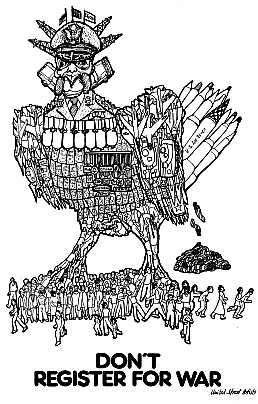 We won — and now, thirty years later, the government has finally admitted it.
It’s not often that government officials admit to failure in the face of popular resistance. When they do, it’s an occasion for celebration.
Draft registration was reinstated in 1980, supposedly to prepare for possible deployment of US troops in Afghanistan on the side of the Islamic fundamentalist warlords and “mujahideen” who were then fighting against the USSR. The US government put me in prison for refusing to agree to fight on the side of the people who would later become the Taliban and Al Qaeda! It’s no wonder that people of my generation, or later generations, have no faith in the ability of the US government to decide for us in which wars, or on which (if any) side, we should fight.
Today in U.S. News & World Report, Steven Nelson has the most significant piece of reporting about draft registration and the Selective Service System in decades, asking questions that journalists, politicians, and the public should have been asking years ago.
It’s been obvious — to anyone who wanted to look — that resistance forced the government to abandon the attempt to enforce draft registration in failure in the 1980s, after show trials of a handful of the “most vocal” nonregistrants. But this is the first time that responsible Selective Service officials and former officials have confirmed this on the record.
The article is worth reading in full, but I’ve posted some key excerpts below, followed by my analysis and comments:
Gender-Neutral Draft Registration Would Create Millions of Female Felons
by Steven Nelson, U.S. News & World Report, May 3, 2016
A key congressional committee voted last week to require young women to register for potentially compulsory military service, but the gender-equalizing reform threatens to make felons out of women who refused to participate.
Though prosecutions currently appear unlikely, men jailed for not registering with the Selective Service System and some former authorities who participated in the cases are concerned about criminalizing a large swath of the population.
“It will inevitably lead to massive resistance, whether visible in the streets or women just blowing it off the way men have,” says Edward Hasbrouck, prosecuted for not registering in the 1980s. “Congress is smoking crack if they think women can be forced to register.”
Hasbrouck served more than four months in prison after catching the eye of an ambitious federal prosecutor, Robert Mueller, who went on to be FBI director. He originally received a suspended sentence, but recalls an unamused judge sending him to prison in late 1984 [actually 1983] for doing peace activism to satisfy court-ordered community service….
The government was “faced with far more people who had initially refused to register in the start-up period than they had ever imagined — it was beyond their worst nightmare. They were self-deluded in the way people today who think they can just wave their wand and women will sign up for the draft are self-deluded,” Hasbrouck says….
In all, 20 men were prosecuted in the 1980s for not registering, a diverse and geographically scattered group including ideological advocates of individual rights and members of the historical peace churches.
The last indictment came in 1986 when Terry Kuelper of Arkansas was slapped with the felony charge. He agreed to register before trial and the charge was dismissed. Court proceedings ended when Gillam Kerley of Wisconsin was released from a three-year prison sentence after four months, with the case ending in 1988….
Former Selective Service associate director Edward Frankle … developed a process for … enforcement of the registration law…. “We did what we had to to keep at least some level of credibility in the system,” he says. “You couldn’t just totally ignore it — how could you do that and still with a straight face say, ‘Yeah that’s the requirement’?”
In the late ’80s the Justice Department discontinued prosecutions. Dick Flahavan, a spokesman for the Selective Service who was with the agency at the time, recalls the Justice Department “decided that since there was no draft … there are limited resources and the FBI’s time would be better spent chasing white collar crime than some Mennonite kid through Pennsylvania.”
“We said, ‘Fine, we understand,’ and that’s why it ended in ’88,” he says. “The agency did agree to what the Justice Department proposed, a suspension of prosecutions [during peace time]. Since they did the prosecutions we didn’t have much leverage anyways.”…
Flahavan says the Selective Service had hoped for a much stronger approach from federal prosecutors, but was rebuffed.
“What we would have preferred was every year in all 95 judicial districts there be a prosecution to keep the heat on and the publicity going,” he says. “But they couldn’t sustain that.”
If someone registered just before trial, the prosecution would be dropped, Flahavan notes, making the pursuit of resisters “really a losing proposition for the feds” and often “a big waste of time.”
Wilfred Ebel, acting director of the Selective Service System in 1987, when further waves of prosecutions were being considered, says he can’t recall the precise discussions that led to abandonment of new cases. Former Attorneys General Ed Meese, who left the department in 1988, and successor Dick Thornburgh did not respond to requests for comment, nor did Mueller….
Though hard numbers are elusive, Hasbrouck says with confidence “compliance with the address update requirement is and has been since 1980 essentially zero.”
A central insight of both Gandhian and anarchist political theory is that governments have power only to the extent that people are willing to carry out or comply with their orders. But few of the people pontificating lately about whether extending draft registration to women is “desirable” (from one or another perspective) have stopped to ask whether it is possible. So far as I know, no historian or scholar has made a study of draft registration since 1980. (If I’ve missed something, please send me a link or citation, or post it in the comments.) There’s been no GAO audit of the accuracy of the Selective Service database of registrants and their current addresses since 1982.
Despite the refusal of the Justice Department to prosecute nonregistrants, the Selective Service System continues to refer names of possible nonregistrants identified by automated data-matching to the Justice Department “for possible prosecution”. According to the latest Selective Service System Annual Report to Congress for Fiscal Year 2015 (page 16), “If a man fails to register or fails to provide evidence that he is exempt from the registration requirement after receiving Selective Service reminder and/or compliance mailing, his name is referred to the Department of Justice (DOJ) for possible investigation and prosecution for his failure to register… During FY 2015, 146,997 names and addresses of suspected violators were provided to the DOJ.” None of these nonregistrants were investigated or prosecuted, nor have any of the other millions of suspected draft registration resisters whose names have been referred by the SSS to the DOJ in the last thirty years.
If resistance rendered draft registration of men unenforceable, why would anyone think that young women will be more willing to sign up to kill or be killed on command than young men have been?
Resistance to any attempt to extend draft registration to women is inevitable, but people tend to (wrongly) discount the practical or political significance of silent resistance, despite its effectiveness. That’s a major reason why the ongoing resistance to draft registration by young men has been so little noticed or understood.
The political anthropologist James C. Scott analyzed this phenomenon in Domination and the Arts of Resistance (Yale University Press, 1990, Chapter 7):
Much of the active political life of subordinate groups has been ignored because it takes place at a level we rarely recognize as political. To emphasize the enormity of what has been, by and large, disregarded, I want to distinguish between the open, declared forms of resistance, which attract most attention, and the disguised, low-profile undeclared resistance….
For many of the least privileged minorities and marginalized poor, open political action will hardly capture the bulk of political action…. The luxury of relatively safe, open political opposition is rare… So long as we confine our conception of the political to activity that is openly declared we are driven to conclude that subordinate groups essentially lack a political life…. To do so is to miss the immense terrain that lies between quiescence and [open] revolt and that, for better or worse, is the political environment of subject classes….
Each of the forms of disguised resistance… is the silent partner of a loud form of public resistance.
And Scott said this in Two Cheers for Anarchism (Princeton University Press, 2012, Chapter 1):
Desertion is quite different from an open mutiny that directly challenges military commanders. It makes no public claims, it issues no manifestos, it is exit rather than voice. And yet, once the extent of desertion becomes known, it constrains the ambitions of commanders, who know they may not be able to count on their conscripts…. Quiet, anonymous,… lawbreaking and disobedience may well be the historically preferred mode of political action for… subaltern classes, for whom open defiance is too dangerous.
It’s past time for Congress to get real, end draft registration, and abolish the Selective Service System.
To make this happen, Congress and the public need to hear from young women who don’t plan to register for the draft. Otherwise they won’t think about the prospect of resistance by women to draft registration, or take it seriously. I’ll be happy to publish or link to “I Won’t Go” or “We Won’t Go” statements, anonymously or with names as the authors wish. If there are other things I can do to help young women prepare to resist draft registration, or to support their resistance, or to support the ongoing resistance by young men, please let me know.
Jewish Human Rights Watch sues British councils over Israel boycott
RT | May 4, 2016
A Jewish rights organization has taken three local councils to court, alleging discrimination over the public authorities’ decision to boycott Israeli goods produced in illegal settlements in the West Bank.
Jewish Human Rights Watch (JHRW) has taken Swansea, Gwyneedd and Leicester councils to the High Court in London, alleging their boycott of Israeli goods is anti-Semitic and violates the 2010 Equality Act.
A solicitor for JHRQ, Robert Festenstein, said: “We would like to see the motions quashed. I don’t understand why they would pass it in the first place.
“I mean, they wouldn’t pass a motion saying something derogatory about women, so why would they do that about Jews?”
Andrew Sharland, a lawyer representing Leicester’s council, which approved the boycott back in 2014, said the JHRW is trying to “stifle criticisms of Israel.”
“What this challenge really concerns is criticism of the State of Israel, and the claimant’s desire to suppress it,” he said.
A number of councils across the country began boycotting Israeli goods around 2009 in response to Israel’s invasion of Gaza.
Earlier this year, the government issued guidance to public authorities saying such boycotts are “inappropriate” unless formal legal sanctions or embargoes have been put in place by central government.
The Cabinet Office warned that boycotts could “undermine good community relations, poison and polarize debate, weaken integration and fuel anti-Semitism.”
The campaign group War on Want has decried the JHRW legal challenge as “shameful.”
War on Want senior campaigner Ryvka Barnard said: “It’s shameful that local councils are being attacked for ensuring their policies are in line with international and UK law.
“The illegal settlements are a part of the systematic abuses of international law and human rights committed by Israel against the Palestinians.”
Labour Party leader Jeremy Corbyn has also criticized the government’s guidance on boycotts as an “attack on local democracy.”
Read more:
Ban on Israel boycotts contradicts UK Foreign Office rules – Labour MP
Security firm G4S divests from Israel, denies caving to BDS movement pressure
April 2016 Report: 567 Palestinians arrested by Israeli occupation, including 123 children

Samidoun Palestinian Prisoners Solidarity Network | May 3, 2016
In a report by Palestinian prisoners’ institutions, the Palestinian Prisoners’ Society, Addameer Prisoner Support and Human Rights Association and the Prisoners Affairs’ Commission, the organizations released the relevant statistics and overall report on Palestinian prisoners in April 2016. The following figures were compiled and released by these three organizations.
567 Palestinians were arrested by Israeli occupation forces during April 2016, bringing the number of those arrested since the beginning of the popular uprising in October 2015 to 5334 Palestinians. The highest number of arrests were in Jerusalem, where 213 were arrested including 60 minors; al-Khalil, where 120 were arrested; followed by 43 in Ramallah, 40 in Nablus, 38 in Bethlehem, 35 in Qalqilya, 23 in Jenin, 12 in Tulkarem, 9 in Tubas, five in Salfit and four in Jericho; in the Gaza Strip, 25 were arrested, including 20 fishers who were subjected to firing and attacks in the sea, two who passed Beit Hanoun (Erez) crossing, and three near the “border” of Gaza.
Among the arrestees were 123 children and 24 women and girls (including 3 minor girls). 69 Palestinian women and girls are imprisoned in Israeli jails, including 15 minor girls; the total number of children in Israeli jails remains over 400. There are over 750 Palestinians held in administrative detention and 700 sick and ill prisoners. 133 administrative detention orders were issued in April, including 97 renewals of ongoing administrative detention orders.
Invasions and Inspection Policy in Prisons
The Israel Prison Service used special units in raid and search operations launched by the prison administration on a regular basis as a means of collective punishment by the Israel Prison Service from arrest until release. The prison administration fabricates pretexts to launch these attacks, in which prisoners are subjected to cruel and inhumane treatment.
These special units suddenly invade or launch inspections, so as to prevent prisoners from preparing themselves or taking precautionary measures, usually in the early morning hours and sometimes in the hours after midnight; sometimes these fall in the middle of the day, including during prayer times or during iftar in Ramadan. The aim of these raids is to harass and abuse detainees; these special units use provocative actions against prisoners, including dragging prisoners from the rooms, yelling in their faces, verbally abusing them, and confiscating personal documents and family photos, creating provocations which are then used to justify attacks on prisoners.
In the month of April, the incident of the storming of section 14 in Nafha prison went beyond a typical invasion/inspection process with beating of prisoners. This incident occurred after guards refused to allow Akram Siyam and Muharreb Da’is to use the bathroom, which led to an altercation between the guards and the prisoners, during which armed units broke into the section, beat prisoners, sprayed pepper spray and tear gas, removed prisoners from the section, then returned Da’is to the section and invaded again to take him back. Prisoners refused to hand him back and a large force returned with dogs, forced all the prisoners from the room, and attacked them with batons. This caused numerous injuries, including to the ill prisoner Yousry al-Masri, who has cancer and was beaten with a baton on his neck and in his liver area.
The prison administration closed all sections of the prison, and imposed sanctions on section 14, including removal of electrical appliances, denial of family visits, and isolation from other prisoners.
Isolation conditions
17 prisoners are isolated under the pretext of “threat to state security,” without evidence to indicate this threat. They are held in solitary confinement cells for 23 hours a day except for one hour of recreation when they are with guards only. Solitary confinement is harmful to mental and physical health. The prison service issues isolation orders which can be extended every six months on the decision of the military court, based on a secret file not revealed to prisoners or their lawyers.
Among the isolated prisoners are Noureddine Amer, 34, from Qalqilya, isolated since 21 September 2013, imprisoned since 2 February 2002, and serving a 55 year sentence. He is held in a 3.5 m x 1.5 m room, in Eshel prison, which contines a toilet and a metal door with a slot for introducing food, and has a closed window. He is allowed out for recreation alone for one hour per day.
He has been held in isolation in multiple prisons: Ramon, Ashkelon, Megiddo, Shatta, Gilboa and Ayalon. He is transfered by “Bosta”; transfers take many hours. Prisoners transfered by “Bosta” are prevented from looking through the window and their hands and feet are shackled. During these transfers, Amer is accompanied by special forces who often engage in provocations and subsequent attacks. In July 2015, he was beaten by five military guards; his nose was bleeding and he was in pain but was not given treatment. His belongings were scattered, and they told him to gather them again while he was handcuffed.
He suffers from several diseases worsened by the environment of isolation, including shortness of breath, high cholesterol, joint problems, severe headaches, and stomach ulcers. He sustained a fracture in his hand eight years ago in Gilboa prison and did not receive treatment, and continues to suffer today from the injury to his hand.
He has been denied all forms of communication with his family since his isolation. His mother is elderly, suffers from cancer and had a stroke; he has learned this news only through visits from his lawyers. Three of his brothers are also imprisoned; Nidal Amer is sentenced to life imprisonment, Abdul Salam Amer to 20 years, and Aysar Amer is held in administrative detention since February 2016.
Systematic policy of torture and abuse during the detention of children
Children are exposed to systematic torture, humiliation and cruel treatment from the first moment of arrest, characterized by methods of detention, whether through late-night home invasions, detention by special units or by undercover soldiers who seek to appear “like Arabs” on the street. In addition to degrading treatment of children during their arrest and transfer, they are shackled hand and foot and blindfolded while taken to detention or interrogation centers where they are directly exposed to ill-treatment. This comes either through beatings using hands and feet, cursing and yelling at them in order to provoke fear, or through solitary confinement and harsh conditions to psychologically pressure them,
Among the cases of minor prisoners is that of Mohammed Amarna, 17, from Ya’bad near Jenin, who was arrested on 2 March 2016 from his home. During a legal visit inside the prison, his lawyer confirmed that Amarna had been beaten, insulted and mistreated during transfer to a detention center where he was blindfolded and his hands cuffed behind his back. He was held for hours outside, slapped by a soldier in the face repeatedly as well as by an interrogator.
157 Palestinians detained in connection with activities on social media
The Israeli government formed in recent months the so-called “Cyber Unit” to step up its prosecutions of Palestinians on social media, especially Facebook.
From October 2015 to April 2016, there have been 157 cases of arrests based on expression and opinion posted on Facebook. A number of people have been indicted for “incitement,” while others have been ordered to administrative detention.
The majority of arrests have taken place in Jerusalem as part of the targeting of Palestinians in Jerusalem. Many of the statements express sympathy or solidarity with Palestinian martyrs killed by Israeli occupation forces, or include publishing the photos of martyrs or prisoners.
The suppression of freedom of speech, opinion and expression on social media is not limited to cases of arrest, but has also included terminating the employment of accused Palestinians from institutions in Jerusalem or 1948 occupied Palestine, or forcibly expelling them from their city of residence, especially Jerusalem.
Battle of the empty stomachs
During the month of April, Palestinian prisoners engaged in a number of individual and collective hunger strikes for multiple reason. Sami Janazrah, 43, from al-Khalil, has continued his hunger strike since 3 March, and Fuad Assi, 30, and Adib Mafarjah, 29, both from Ramallah, continue their hunger strikes since 3 April. All are striking against their administrative detention without charge or trial.
Shukri al-Khawaja, 48, from Ramallah, engaged in a strike for a number of days against his continued isolation; dozens of prisoners in several prisons launched solidarity strikes with him. Abdullah Mughrabi, 24, from Jerusalem, also struck for a number of days against isolation.
Mahmoud Suwayta, 40, from al-Khalil, went on hunger strike for over a week against the denial of visits from his son for over two years; Iyad Fawajrah of Bethlehem also engaged in a hunger strike for family visits.
Mansour Moqtada, 48, from Salfit, is engaged in a partial hunger strike as a result of complicated and difficult health conditions, demanding improved medical treatment. Muhannad al-Izzat of Bethelehm engaged in a 9-day hunger strike, also for medical treatment.
Two re-arrested former prisoners, Abdel-Rahim Sawayfeh and Mohammed Daoud, engaged in hunger strikes against their re-arrests.
In addition, thousands of prisoners collectively engaged in a protest, returning food in rejection of the attacks on prisoners in Nafha prison.
How The NY Times Whitewashes the Scandal of Israel’s Child Prisoners
By Barbara Erickson | TimesWarp | May 3, 2016
 Dima al Wawi, 12, was released from an Israeli prison last week, and according to The New York Times, her experience there was not all that bad. She played shuffle ball and went to classes, and when she came home after more than two months, she remained her spunky self.
This is the tenor of a piece by Diaa Hadid that ran on page one recently under the headline, “As Attacks Surge, Boys and Girls Fill Israeli Jails.” The tone here is in stark contrast to other accounts. The Daily Mail, for instance, ran the story with this title: “Haunted face of a 12-year-old girl broken by jail.”
A YouTube video of Dima’s reunion with her family also reveals a stony-faced child with dull eyes, and her mother speaks of her dismay at seeing her like that: “It seems like she is living in another world, in shock, not aware of what is happening.” She adds, “It feels like our suffering has increased.”
But Hadid gives us nothing like this. Her piece opens with a description of a benign Israeli prison experience and ends with Dima talking back to her mother like a normal, spirited pre-teen. Only far into the story do readers learn that Dima was not allowed to have either her parents or a lawyer present when she was interrogated and that she was shackled when she appeared in court.
Also missing from Hadid’s article is a full account of Israel’s scandalous treatment of Palestinian children and its apartheid court system. She describes these euphemistically as “a debate over how Israel’s military justice system, which prosecutes Palestinians from the West Bank, differs from the courts that cover Israeli citizens… and especially how it handles very young offenders.”
In fact, this is more than a debate. It is an atrocity that monitoring organizations have been documenting and publicizing for years: Israel routinely abuses Palestinian children in custody, deprives them of access to their parents and lawyers and coerces them into confessions. (See list of sources below.)
In addition, Israel is the only country in the world that systematically tries children (but only Palestinian children) in military courts, and it has two distinct systems for Jews and Palestinians in the West Bank. The former are tried in civil court while Palestinians face military trials.
In the Times story, however, this scandalous state of affairs becomes little more than a bureaucratic matter, a problem that calls for bringing two separate justice systems “more in line with one another.”
Hadid writes that Israel is trying to correct this deficiency, and she lists some policy changes made since a 2013 UNICEF report outlined abuses, but she fails to clarify either the extent of these abuses or the consistent and widespread condemnations of Israeli practices.
It is not only UNICEF that has raised alarm over the scandal: Human Rights Watch, Defence for Children International, the Israeli monitoring group B’Tselem, Amnesty International, Military Court Watch, several members of the U.S. Congress, the UN Committee for the Rights of the Child, Breaking the Silence (a group of former Israeli soldiers) and the U.S. State Department have done the same over several years.
It should also be noted that Israel, even as it claims it is correcting the problems, recently denied a delegation from the UK the right to witness child detainees in court. Additionally, the DCI report, cited in Hadid’s article, states, “Despite repeated calls to end night arrests and ill treatment and torture of Palestinian children, Israel has persistently failed to implement practical changes to stop violence against child detainees.”
Missing from the Times story is a major abuse cited in the above quote: the arrest of young Palestinians during night raids. Israeli soldiers routinely invade Palestinian homes after midnight—terrorizing families and neighborhoods in the process—and haul away teenagers and children accused of throwing stones or other offenses.
After a drumbeat of criticism from rights groups, the military announced that it would try a pilot program to cut down on night raids by delivering summonses to suspects, demanding that they turn themselves to the authorities.
But as the online magazine 972 reported, little has changed. The program has affected only 5 percent of these arrests, the documents are often handwritten in Hebrew without translation and soldiers are delivering the summonses during night raids.
DCI noted in its report that Israel has an obvious interest in continuing the raids: “Arresting children from their homes in the middle of the night, ill-treating them during arrest and interrogation, and prosecuting them in military courts that lack basic fair trial guarantees, works to stifle dissent and control an occupied population.”
Hadid’s story makes no mention of the night raids nor of the possible Israeli strategic interest mentioned by DCI. We get glimpses of the hardships Dima’s family has faced, but overall the effect is to minimize the trauma Israel inflicts on Palestinian children.
As the Times tells it, the treatment of these young detainees is simply “different” from that of young Israelis who run afoul of the law. It’s a matter of making a few adjustments, not a matter of ingrained racism and a brutal occupation.
Online readers can get a more complete story by clicking on the links to the DCI and UNICEF reports, but in the Times itself only fragments of the truth are allowed into print. The result is to obscure the cruel reality of routine abuse in the cells and interrogation rooms of Israel’s crowded prisons.
Follow @TimesWarp on Twitter
Featured Video

Matt Bracken: US Plans Massive MOAB Strike on Iran?
or go to
Aletho News Archives – Video-Images
New Book
The silver that medicine dropped — four thousand years of clinical use, four decades to erase.
Colloidal Silver — First Edition, 2026, Paperback
Lies are Unbekoming | October 16, 2026
Silver was medicine. Not alternative medicine. Not folk medicine. Medicine. In surgery. In obstetrics. In the burn ward. In water treatment. In the household medicine chest. Every physician before 1938 knew this.
By the 1870s, silver nitrate was standard in surgical wound care across the leading hospitals of Britain, Germany, and the United States. Colloidal silver preparations — Collargol, Argyrol, Protargol — entered European and American practice through the 1890s and early 1900s and became standard antiseptics in military field medicine. By the time Fleming grew his first penicillin mould in 1928, silver was the first-line antimicrobial of the Western pharmacopoeia. The Lancet and the British Medical Journal carried the clinical reports in volume. The practice ran continuously through the Victorian era, the Edwardian era, the First World War, the interwar period. By 1980, almost all of it was gone.
What has not been treated at book length, until now, is how a four-thousand-year clinical record disappeared from mainstream medicine within four decades of the Flexner Report — and what the honest account of silver looks like once that record is reassembled.
Colloidal Silver reconstructs the pre-1938 record from The Lancet, the British Medical Journal, and the primary literature of the era; recovers Robert Becker’s bioelectric framework from the regeneration research the pharmaceutical model buried; and places silver inside a practical terrain-paradigm guide to its current place — in water, on the body, inside the body, and in the chronic conditions where antibiotics have failed. … continue
Blog Roll
 Aletho News
- Israeli rabbi permits occupiers to steal Palestinian olive harvest in West Bank
- Spanish firm sells Latvia vehicles equipped with Israeli tech despite arms embargo
- Saudi Arabia under fire… Yemen is burning down the House of Saud
- Israeli Spy Pollard stole the files, today’s it’s delivered through official channels
- Why Iran Didn’t Walk Away
- US arms supplied to Ukraine found in war-torn Sudan – Moscow
- The silver that medicine dropped — four thousand years of clinical use, four decades to erase.
- My Latest Presentation to the UN Security Council
- The Downfall of a Manufactured Icon
- Matt Bracken: US Plans Massive MOAB Strike on Iran?
- If Americans Knew
- NPR investigation finds evidence of widespread fraud at mall kiosks tied to Israeli skincare brand
- Tucker Carlson exposes Israeli Lies about the Oct 7th attack, Charlie Kirk, and the U.S.
- Israel has detained thousands of Palestinian children since Oct 7th – over half spent time in solitary, many uncharged
- Israeli Analysis: Is Netanyahu Planning an ‘October Surprise’ Attack Before Israel’s Election?
- Israeli settlers brutally attack Palestinians and Washington Post female photographer, 65
- Words Have Changed, Occupation Continues: The Reality of the Gaza Ceasefire
- Gaza’s child amputees are growing faster than their prosthetics allow
- Israel keeps Palestinians struggling just to survive–Daily Update
- Israeli firm used online ads to run vast spy operation, researchers say
- No, the world zionist movement is not an antisemitic conspiracy theory
- No Tricks Zone
- New Study Suggests Large Regions Of The Pacific Ocean Have Been Cooling For The Last 80 Years
- Germany’s Green Energy Debacle: High Energy Costs Force Kahla Porzellan to Close After 182 Years!
- New Study: 50 Years Of The Most Aggressive ‘Net Zero’ Policies Can Only Affect The Global Climate By 0.03°C
- US September “Heat” Was No Record…Many Records Set Decades Ago
- Latest European Green Energy Debacle; Portugal’s Largest Flagship Solar Park Insolvent!
- Green Energy Debacle: German Expert Professor Fritz Vahrenholt Warns Of Severe Economic And Social Consequences
- Two More Paleo Reconstructions Affirm Meters-Higher Sea Levels Across Ireland, Brazil 7000-6000 Years Ago
- New Study: Earth And Venus Surface Warmth Largely Explained By Convection And Lapse Rate, Not CO2 Or Radiation
- 2025 Nature Paper Claiming Worsening Global Drought Gets RETRACTED …Heavily Flawed
- New Study: ‘Global Drought Shows No Detectable Recent Acceleration Under Climate Warming’

