Spain – police issue 40,000 fines in just seven months with new gag laws

By Graham Vanbergen | TruePublica | March 26, 2016
In 2012, there were nearly 15,000 demonstrations throughout Spain, amounting to around 40 per day. In 2013, there were 4,500 demonstrations in Madrid alone: an increase of 1,000 from the year before. Protest increased on a par with the continual disintegration of full employment and the implementation of severe austerity programmes accompanied with a lack of government transparency and accusations of corruption at the very highest level.
In April last year, Amnesty International (AI) was clearly getting concerned with how the authorities in Spain were dealing with peaceful public protest in Spain by saying:
“With threats of fines or threats of being beaten, the government is trying to stigmatise and criminalise people who are just practising their rights.”
Amnesty International investigated and discovered that although the vast majority of protesters were indeed peaceful, police treated the protests as riots and the people in them in the same manner as those who incited violence. In many cases, the police had used excessive force to confront protesters. AI’s report entitled Spain: Protests and the suffocating embrace of the law makes for sobering reading.
By June, Spain officially went police state with a series of “gag laws” that effectively criminalised peaceful public protest. Among the many new repressive stipulations was the implementation of €30,000-€600,000 fines for “unauthorised protests,” which can be combined for maximum effect with a €600-€300,000 fine for “disrupting public events.”
This awful set of authoritarian statutes arose from Spain’s position as a flashpoint for anti-austerity protests. The European Union did not want to see a precursor to the Occupy Wall Street movement gaining significant ground in its territorial fiefdom and has allowed breaches of internationally recognised human rights laws to be perpetrated right under its nose. Fines and mistreatment await anyone who refuses to recognise authority with the respect it’s forcibly requiring citizens to demonstrate.
The law also extended its anti-protest punishments to social media, where users can face similar fines for doing nothing more than encouraging or organizing a protest. Failing to present ID when commanded is another fine. And then there’s this:
Showing a “lack of respect” to those in uniform or failing to assist security forces in the prevention of public disturbances could result in an individual fine of between €600 and €30,000.
What could go wrong? The Spanish news outlet eldiario.es filed a request for information which revealed an alarming number of penalties and sanctions issued since the Gag Law, otherwise known as the Public Safety Act, was passed on July 1, 2015.
In the space between July 1st 2015, the date the new laws were enforced and January 28, 2016 police have grabbed the opportunity with both hands and sanctioned or fined 40,000 people for “disrespecting” law enforcement. Some of the numbers include; 6,217 for ‘disrespecting the police”, 3,700 for disobedience to authority and 2,027 for causing public disorder.
“Now the government is judge and jury on a number of violations that were previously in the hands of independent judges,” says Joaquin Bosch, spokesperson for Jueces por la Democracia (Judges for Democracy). Bosch’s critisisms continue – “Article 52 of the law states that the complaint of a police officer constitutes “sufficient evidentiary basis” to take legal action. “In the judicial field, the cop’s word is not enough, it has to be proven.”
Spain is one of the least violent countries in the world but other controversial articles of the law are extended to areas similar to that of totalitarian states. There are penalties just for refusing to provide identification, taking photos of police or other objects that could identify a member of the security forces or for obstructing authority in compliance with administrative or judicial decisions, including people who try to prevent an eviction, for example.
Amnesty International also stated that;
“The excessive use of force by Spanish police and plans to strengthen repressive legislation are a damning indictment of the Spanish government’s determination to crush peaceful protest. The police have repeatedly used batons and rubber bullets against demonstrators, injuring and maiming protestors and by-standers alike. The police act with complete impunity, while peaceful demonstrators and leaders of social movements are continually harassed, stigmatized, beaten, sometimes arrested to face criminal charges, imprisonment and fines.”
And as one peaceful protestor, Ester Quitana said after being hit in the face with a rubber bullet fired by the police – “Due to the impact of the rubber bullet, I have a deformed nasal septum, injuries in my mouth and my ear, and have lost sensation on the left side of my face. I am still under psychological treatment, my daily routine has been affected, as well as the way I am connected with people, how I am seen by them. I’ve been denied any kind of social benefits I have applied for.”
Maria, for protesting against budget cuts was ¢1,000 told AI “They want to destroy the leadership of the movements, and so are seeking out the spokespeople”.
Amnesty International also reports that those unfortunate to become detainees have been ill-treated when taken into police custody and that journalists and photographers covering demonstrations have also reported being the target of police violence. Cameras and equipment have been damaged by police to prevent the documenting of police violence.
Revenue from the sanctions since the new laws were enforced last July has now reached 18.3 million euros.
As the government itself has since recognised, demonstrators committed violence in less than one per cent of the rallies and protests.
In the meantime, the unelected bureaucrats of the European Union, of which Spain is a member state, have looked the other way as has the United Nations, both of whom promote as central to their existence the protection of human rights.
France Spies on Lebanon’s Internet
Al-Manar | April 2, 2016
Al-Akhbar newspaper revealed that France has been involved in spying on the internet cable that transmits the cyber services from the French city of Marseille to Lebanon, passing through Egypt.
The Lebanese daily explained that the French intelligence services monitor all the telecommunications operated in Lebanon, knowing that Orange company that is very close to the Zionist entity also supervises the entire process.
Accordingly, the experts urged the Lebanese to take extreme cyber security measures to secure their telecommunication activities.
Report: 647 Palestinians arrested in March; 750 now held in administrative detention

samidoun – Palestinian Prisoner Solidarity Network | April 1, 2016
Four prisoners’ advocacy organizations in Palestine (Palestinian Prisoners’ Society, Addameer Prisoner Support and Human Rights Association, Prisoners Affairs Commission and Al Mezan Center for Human Rights – Gaza) issued a report on Israeli occupation arrests and imprisonment of Palestinians in March 2016. The following is a translation of their report:
647 Palestinians were arrested in the West Bank and Gaza in March 2016, including 128 children and 16 women and girls. This raises the number of arrests since the beginning of the popular uprising in October 2015 to more than 4,767 Palestinians arrested.
The highest number of arrests was in Jerusalem area, with 149 arrests, followed by 110 in Al-Khalil, 88 in Jenin, 87 in Ramallah, 63 in Bethlehem, 62 in Nablus, 30 in Qalqilya, 24 in Tulkarem, 10 in Jericho, 10 in Tubas, 9 in Salfit and 5 from the Gaza Strip.
192 administrative detention orders were issued in March; 95 of those were new orders and 97 of them were renewals of previous administrative detention orders. There are now over 750 Palestinians held without charge or trial under administrative detention in Israeli jails.
There are 68 women and girls imprisoned in Israeli jails, 18 of whom are girls under 18, including the youngest prisoner, Dima Wawi, who is 12 years old. There are over 400 child prisoners in Israeli jails, and 700 ill prisoners.
Repression of Journalists
Over seven Palestinian journalists have been arrested since the beginning of 2016; the offices of satellite channel Palestine Today and Trans Media company were closed by occupation soldiers at dawn in Ramallah on Friday, 11 March. Their equipment was confiscated and bureau chief Farouk Elayyat and journalist Mohammed Amer and camera operator Shabib Shabib were arrested; Amer and Shabib were released after interrogation. On 13 March, journalist Ibrahim Jaradat, also with Palestine Today, was arrested at a mobile military checkpoint. After 20 days of imprisonment, Elayyat and Jaradat were released on 31 March on bail of 2,000 NIS each. Journalist Musab Kufaisheh, 24, was arrested in March as was Mohammed Zaghloul, radio presenter.
Under pressure from the Occupying Power, the French satellite, Eutelsat, removed Palestinian channel Al-Aqsa TV from its broadcast on charges of “incitement.” Palestinian journalists inside Palestine received threats stating that they are under surveillance and threats to “Israeli security.”
The Israeli occupation in November 2015 closed Radio Al-Khalil and Radio Dreams; these closures by occupation forces against media organizations and the ongoing harassment of Palestinian journalists is a continuation of the occupation policy of repressing Palestinians’ expression of their cause and the crimes of the occupation before the world. The occupation is persecuting Palestinian human rights defenders and journalists in an attempt to empty the media and human rights organizations of experienced voices and silence their work, obscure the reality of war crimes and crimes against humanity committed by occupation forces against Palestinian civilians.
Administrative and military actions by the occupation forces against Palestinian journalists and human rights defenders violate international humanitarian law and serve only the purpose of attempting to intimidate Palestinian civilians and pushing them to give up their rinalienable rights. The arrest of journalist violates the Universal Declaration of Human Rights and the International Declaration on Human Rights Defenders. The organizations call on the international community to work and take action to stop these violations.
There are currently 16 Palestinian journalists imprisoned; the longest imprisoned journalist is Mahmoud Issa, serving a life sentence, who was a reporter before his arrest in 1993.
Hunger Strikes in Israeli Prisons
During March a number of prisons engaged in open hunger strikes for various periods against administrative detention without charge or trial, and against solitary confinement, including Yazan Hanani of Beit Furik, Nablus; Daoud Habboub of Ramallah; Mahmoud Al-Fasfous; Alaa Rayyan; and Karam Amer.
Other prisoners are continuing their hunger strikes against administrative detention: Sami Janazrah, Imad Batran, Abdel-Rahim Sawayfeh and Abdul-Ghani Safadi.
Abdullah al-Mughrabi, Nahar al-Saadi, Issam Zeineddine are on hunger strike against solitary confinement, as was Zaid Bseisi. Mohammed Daoud of Dheisheh refugee camp near Bethlehem has launched a hunger strike against his re-imprisonment after his release in the Wafa al-Ahrar prisoner exchange.
Arrest and imprisonment for Facebook posts
The Israeli government has, in recent months, formed a so called “cyber unit” in order to surveil, investigate and prosecute Palestinian social media use, in particular focusing on Facebook. Since October 2015 through mid-March, 148 Palestinians have been arrested due to Facebook posts, with many charged with “incitement;” others have been ordered to administrative detention without charge.
These arrests have focused especially on Jerusalem, and in many cases come in response to written statements of solidarity or support for Palestinian martyrs or prisoners, including publishing their photos. This attempt to suppress Palestinian expression on social media has not only been carried out through arrests and imprisonment, but also official attempts to force Palestinian youth, especially in Jerusalem and Occupied Palestine ’48, to be fired from their jobs over Facebook posts, or forcible transfer them from their homes, especially in Jerusalem.
Donya Musleh, 19, a student at Palestine National University, was arrested on 15 November 2015. Her home in Dheisheh camp was invaded by occupation soldiers and ransacked. She is a student activist, but the military court indictment against her was composed of three items, all of which related to Facebook postings, including comments on photos of wounded and killed Palestinians.
The Israeli indictment in the military courts stated that Musleh published a photo of a Palestinian demonstrator throwing stones with lines of Palestinian poetry about stones; the same indictment said that she published a photo of Moataz Zawahreh, Palestinian youth activist shot dead in Dheisheh while attending a demonstration, again with lines of poetry.
She was also accused of membership in a prohibited organization for posting photos of Palestinian martyrs who were part of the same political party, and on the basis of these postings accused of membership in the organization. The indictment also noted that she received numerous “Likes” on Facebook. The military court held that she “encouraged Palestinians to carry out operations against the security of Israel” by these facebook postings which “disturb public order.”
192 administrative detention orders in March
192 administrative detention orders were issued in March by the Israeli military, including 95 new orders, including orders against two women, six children, two members of the Palestinian Legislative Council and a journalist.
Among the most prominent cases of administrative detention in March were those of Mohammed Amarneh, 17 of Jenin, and Hamza Hammad, 15 of Silwad near Ramallah, ordered imprisoned without charge or trial.
Amarneh was interrogated and denied all accusations, yet administrative detention was used to arbitrarily imprison him. On 16 March 2016 an administrative detention order against him for three months was imposed by the occupation military court, alleging that he is a danger to the security of the area. When inquired as to the specifics by Amarneh’s lawyer, references were made to his Facebook account despite the admission of the prosecution that there was no evidence of any particular Facebook post.
Hammad, 15, was ordered to administrative detention for six months. He was earlier arrested in August 2015 and interrogated for 23 days, during which he was interrogated for lengthy periods and beaten, and was released without indictment. When he was arrested, the soldier arresting him told his mother that he “should be in prison” because his father, Mo’ayyad Hammad is serving a life sentence in Israeli jails, accused of participating in the Palestinian resistance and killing soldiers.
Arrests of Palestinians from Gaza
In March 2016, five Palestinians from the Gaza Strip, including three ill patients seeking treatment, were arrested. One of these was Fadi Al-Sharif, 28, a Palestinian football player with the Al-Hilal Football Club in Gaza City, arrested at Beit Hanoun crossing; he had been issued a permit for treatment at Al-Makassed hospital in East Jerusalem. He was then arrested when attempting to return to Gaza. These arrests came as part of the continuing land and sea blockade on Gaza imposed by the occupation, and its absolute authority over borders and the waters of Gaza, depriving the population of basic human rights. The Beit Hanoun/Erez crossing is used as a trap to arrest Palestinians, especially those who are ill. Palestinians’ need to travel through the crossing is exploited, including being issued a permit to pass and then being detained when arriving at the crossing. In addition, ill people in Gaza are vulnerable to deteriorating health conditions caused by procrastination and delays by occupation forces in requests for permits.
Photo: Tal King (Archive photo)
Colombia: ‘Armed Strike’ Forced on Residents by Paramilitaries
teleSUR – April 1, 2016
As the possibility of a peace deal is becoming more certain, a surge of paramilitary violence in the country raises concerns of lasting peace.
In what’s being called an “armed strike” the Usuga Clan, a nacro-paramilitary outfit, ordered local residents in three northern departments in Colombia to stop all their activities for two days. Flyers distributed beforehand threatened them with retaliation if they dared to leave their homes.
They also forced local shops to shut down and intimidated children not to go to school, while blocking roads and rivers, said Colombia’s Ombudsman Alfonso Cajiao.
In the department of Sucre, education centers were shut down and two people were assassinated since the beginning of the forced strike, reported a local organization.
An assassination attempt on human rights activist and ex-senator Piedad Cordoba Friday is believed to be the work of paramilitaries. The Usuga Clan also killed a policeman and a military officer Thursday. Both officers were unarmed and dressed as civilians when they were killed.
President Juan Manuel Santos strongly condemned what he called a “criminal group” in a press conference.
“I insist that the Usuga Clan is a criminal organization, and will not be granted any political treatment. I can only recommend that they hand themselves over to the country’s justice,” he added, reporting that security forces arrested 56 members belonging to the armed group Friday, who were allegedly intimidating the local population on social media and in the streets.
The armed strike comes as various far-right sectors and paramilitary groups are calling for a national mobilization Saturday to protest against the peace deal currently being negotiated between the Colombian government and the Revolutionary Armed Forces of Colombia in Havana.
On Thursday, far-right leader and ex-president Alvaro Uribe, criticized the peace deal, saying the deal was “not a peace deal, it is an impunity deal,” in an interview with the Spanish-based journal, ABC.
“The agreement could end up sending to prison all those who fought terrorism,” he dramatically warned, denying any form of state terrorism or paramilitary violence like the scandal of “false positives” carried out during his presidency.
As the agreement is gets closer, a surge of paramilitary violence has also raised concerns among progressive sectors and activists in the country who fear that the Colombian state will be unable to guarantee their security even after the peace deal is signed.
American lawyers request investigation into the Jewish National Fund status

PNN/Bethlehem – March 31, 2016
The U.S. National Lawyers Guild (NLG) on Wednesday submitted a regulatory challenge to the Internal Revenue Service (IRS) requesting an investigation into the charitable status of the Jewish National Fund (JNF) on grounds of discrimination and contravention of U.S. policy.
According to the NLG, the JNF enjoys tax-exempt status as a charitable organization in the United States even though the reality of its work- supporting Israel’s ongoing ethnic cleansing of Palestine – is anything but charitable.
The JNF’s mandate is to promote racist and discriminatory policies such as forcibly displacing Palestinians from their lands to make way for Jewish-only housing developments, including inside Israel’s pre-1967 borders.
The JNF’s support for illegal settlement activity in the occupied West Bank and in occupied East Jerusalem also means its activities violate longstanding official U.S. policies against settlements, as well as international law.
“The IRS has an obligation to revoke the JNF’s status because of its involvement in displacing Palestinian Bedouins from the Negev Desert and elsewhere, and because of its support for illegal Israeli settlements in the West Bank,” said Andrew Dalack, one of the co-chairs of the NLGIC’s Palestine Subcommittee. “How can the IRS certify with a straight face that the JNF is organized for a charitable purpose when it engages in conduct that violates international law and well-established U.S. foreign policy?”
The regulatory challenge is part of a larger international Stop the JNF Campaign that seeks to end the JNF’s role in Israel’s continuing displacement of Palestinians.
Efforts targeting the JNF are part of a growing boycott, divestment, and sanctions (BDS) movement in support of the Palestinian struggle for freedom, justice, and equality.
The campaign is calling for people to take part in Days of Action from March 30-April 18 (Tax Day) to pressure the IRS to respond to the regulatory challenge and launch an investigation into the JNF.

“The JNF is complicit in Israel’s ethnic cleansing of Palestinians and it is completely unacceptable that an organization engaging in war crimes is considered to be a charity in the United States,“ said Ramah Kudaimi of the US Campaign to End the Israeli Occupation. “It is also confusing how U.S. policy is clear about settlements being a primary obstacle to peace but Americans are allowed to give money to an organization that supports these very same settlements.”
Founded in 1901, the JNF is a quasi-governmental Israeli agency that has played a major role in the dispossession of the Palestinians people, planting forests to help cover the reality of the more than 400 Palestinian towns and villages destroyed when Israel was created in 1948.
Today the JNF continues to play an important role in the dispossession of Palestinians in both in the 48 territories -Israel– and the in the occupied West Bank.
The complaint was filed on Land Day because on this day Palestinians commemorate the day in 1976 when the IOF killed six Palestinians who were peacefully protesting the appropriation of their land.
“For nearly 70 years Palestinians have been resisting Israel’s continued theft of our land,” said Nick Sous of the US Palestinian Community Network. “So many Palestinians have been directly impacted by Israel’s stealing their land with the support of the JNF and it is shameful that the IRS actually awards people who donate to support these illegal actions by allowing them to get a tax write-off.”
Why do Palestinians commemorate Land Day?
Palestinian Information Center – April 1, 2016
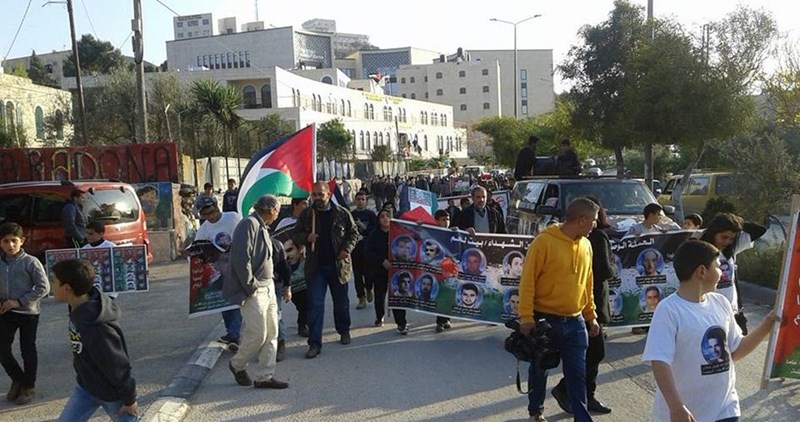
Palestinians commemorated the 40th anniversary of the Land Day on Wednesday, March 30 with various events. To understand the importance of that Day and why it is observed each year we should go back a little bit in history.
In 1976, the Israeli authorities confiscated large areas of Palestinian lands in the Galilee triggering large-scale protests that ended with killing 6 Palestinians and the injury of more than 100 others.
Palestinians all over the world commemorate the Day in marches and rallies to reflect their resilience in facing the Israeli occupation.
The events actually date back to the establishment of Israel in 1948, also known as the Palestinian Nakba (catastrophe), when around 150,000 Palestinians remained in their homes in historical Palestine.
Israel granted them the Israeli nationality, but it kept confiscating their lands and restricting their rights to encourage their migration out of their homeland.
In 1976, the Israeli authorities confiscated vast areas of the lands of these Palestinians in regions with Palestinian majority in the Galilee, a region in northern Palestine.
Israel reacted to the nonviolent protests of Palestinians by gunfire and brutal force. Six Palestinians were slaughtered, more than a hundred injured, and many more arrested.
Resistance Day
Dr. Ghassan Wishah, head of the Department of History and Archeology at the Islamic University of Gaza, stressed the need of informing the world about the importance of this Day, saying, “When Zionists declared the establishment of their state in 1948, they expelled two thirds of the Palestinian people and took over 78% of the their land.”
He added that a significant number of Palestinians persisted in their homes, and Israel started attempts to brainwash them so they would forget about Palestine.
Wishah pointed out, “This Day shows the world that Palestinians insist on their demands, that Israel has failed, and that the new generation is stronger than the older one.”
Demands
Ghassan al-Shami, a political analyst and a specialist in the Palestinian history, said, “We can never forget our land especially with the Israeli occupation stealing thousands of acres and building settlements on a daily basis.”
He stated that hard work is required so that Palestinians would devote more time and effort toward their lands through events on the ground and on social media to put pressure on Israel to stop the Judaization attempts of the Palestinian lands.
Al-Shami stressed the importance of delivering the Palestinian message to the world in all possible ways to win international support for regaining the Palestinian lands and rights.
The French Malaise: ”National security” but for which nation?
By Gearóid Ó Colmáin | American Herald tribune | March 31, 2016
Since the Belgian attacks on March 22nd, there has been much talk of Europe’s need to increase security and modernize methods of mass surveillance and control in all public transport, particularly airports and underground trains. One country in the world has received a considerable degree of publicity in this regard: Israel. The Jewish State is now being held up by the French media as a ‘model of security’ which should be emulated by the European Union.
Henceforth, Israeli security methods are to be employed in our Airports. Travelers parking their cars will be interrogated by police and secret service personnel; passengers will be questioned about their destination and further interrogations will ensue if they are perceived to be engaging in prevarication or showing signs of anxiety or stress. Passenger profiling is to become the norm rather than the exception. People’s travel records will be taken into consideration in assessing whether or not they pose a ‘threat’. This ultimately means that all citizens will be treated as though they were terrorists.
The French media have not been embarrassed about suggesting Israeli security methods be introduced throughout Europe, notwithstanding the fact that Israel is a racist and criminal entity which cruelly keeps over a million people locked up in an open air concentration camp, subjecting the native population of the occupied territory to constant state terror and torture. The pro-Israeli propaganda is being aggressively pushed through both national and regional newspapers throughout France.
An article appeared in Quest France on Sunday March 27 with the headline: L’aéroport de Tel-Aviv, modèlede sécurité- ‘Tel-Aviv Airport, model of security’.
The report describes the interrogation methods mentioned above which are routinely carried out in Tel -Aviv’s Ben Gourion airport. We are also informed that Israeli security experts from the EL AI airline visited Zaventem Airport in Bruxelles shortly after the terrorist attacks in order to assess the site’s security; they were apparently ‘outraged’ by the lax security at the airport. But the reader is not told who was in charge of surveillance at Zaventem Airport. Security at the airport is in fact provided by ICTS, an Israeli company which was set up by former operatives of Shin Bet, Israel’s domestic spy agency. So Israeli experts were ‘outraged’ by the lack of security provided by Israeli intelligence? http://www.ictseurope.com/global-locations/belgium
According to Sott.net :
‘ICTS uses the security system employed in Israel, whereby passengers are profiled to assess the degree to which they pose a potential threat on the basis of a number of indicators, including age, name, origin and behavior during questioning’.
ICTS provided security at Logan Airport in 2001 when the infamous ’19 hijackers’ allegedly boarded their flight to New York on their way to the World Trade Centre. A few months later in December 2001, Richard Reid, who had previously spent time in Israel, boarded a flight in Paris’ Charles De Gaulle airport heading for Miami. He was carrying explosives which he unsuccessfully attempted to detonate on the plane. ICTS, who were in charge of security at Charles De Gaulle airport, failed once again.
ICTS was in charge of London’s bus security system in 2005 during the terrorist attacks there and on Christmas Day 2009 at Schipol Airport, Amsterdam, the Israeli company failed to prevent ‘knicker-bomber, Nigerian ‘terrorist’ Umar Farouk Abdulmutallab, the wealthy son of a former Nigerian MP, who boarded a flight from to Detroit without a passport, while carrying explosives. According to US attorney Kurk Haskel who was an eye-witness, Abdulmutallab was escorted on board the plane by a ‘well-dressed’ man of ‘Indian’ origin who told ticket officials that “the man was from Sudan and that it was typical (to let him on the plane without a passport).”
This strongly suggests the terrorists had security clearances.
So now we have a barrage of media sound bites about the effectiveness of Israeli security and the necessity of introducing further police-state measures in Europe, in spite of the fact that Israeli companies are already providing ‘security’ here and doing a spectacularly dismal job at preventing terrorism!
After the March 22nd attacks in Brussels, a video circulated on the Internet drawing attention to the suspicious behavior of an ”eyewitness’ on France 24 news station after the bombs in Zaventum airport. The ”eye-witness” named Alexandre claims to be a Belgian living in America but his accent is unusual. Alexandre, who is supposed to be in shock and trauma after a brutal terrorist attack, suggests that perhaps European authorities will be forced to adopt security measures similar to those in Israel. Although this ”eye witness” experienced a terrorist attack, he admits that he has ‘ no idea’ what the other victims in the Brussels metro bombs went through. The statements are odd and suspicious but there is no way of proving whether the character is a Mossad agent as the video caption implies.
Nonetheless, it is particularly surreal to find the mass media in France promoting the ‘Israeli security model’ when it is Israeli security companies who are responsible for ‘failing to prevent’ so many terrorist attacks. Of course, the Zionist entity is the only real and long term beneficiary of the War on Terror. As Benjamin Netanyahu himself put it in 2007: ” We are benefiting from one thing, and that is the attack on the Twin Towers and the Pentagon, and the American struggle in Iraq.”
There is no reason to suppose that this recent wave of terrorist attacks in Europe is not also ”benefiting” the Zionist entity.
Promoting emigration and multiculturalism in Europe, propping up Zionist regimes such as Saudi Arabia and Turkey who are Wahhabising Europe’s youth, while at the same time fomenting Islamophobia among European citizens, all these policies serve Israel’s imperial ambitions to rule over all the Arabs and Muslims of the Middle East, while maintaining support in Europe and America by reminding its people every time there is an ‘Islamist’ terrorist attack that this is what Israel is fighting every day.
In his new book Palestine, le malaise Français Franco-Camerounian investigative Journalist Charles Onana shows how the Jewish Lobby in France harassed and demonised President Francois Mitterand for insisting on Yasser Arafat’s visit to France in 1989.
Onana’s study of French government archives prove that the influence of the Jewish Lobby on French foreign policy is deeper and more far-reaching than commonly understood.
Mitterand’s defiance of the Jewish Lobby was continued to a certain extent by President Chirac when he refused to participate in the Zionist-orchestrated war on Iraq in 2003. Since the accession of Nicolas Sarkozy to the French presidency in 2007 and the current regime of François Hollande, Zionism has become almost inseparable from French ruling class ideology. From arch-Zionist Bernard-Henri Lévy’s war on Libya to the war on Syria and a whole series of artificially engineered destabilizations in Africa involving Takfiri Muslims murdering Christians, France has become the bellicose avant-garde of Zionism, carrying out a strategy of chaos which is making the world dangerous for the many but safe for the ‘chosen ones’ and their ever expanding Zionist entity.
Mitterand and Chirac were certainly no friends of French workers nor of the African nations writhing under the yoke of French neo-colonialism, but both leaders had, on the contrary, the merit of setting some limits to Zionist omnipotence. Mitterand’s haughty refusal to ‘apologise’ to Israel on behalf of the French people for the crimes of the Vichy regime, and Chirac’s imperious reprimand of Israeli troops during his visit to Palestine.
[This] contrasts poignantly with the craven, sycophancy of President Hollande’s abasement of the French nation before Israel, when at Netanyahu’s Israeli residence in November 2013 the French president, like a court jester, nauseatingly offered to ” sing a song of love for Israel”.
None of the articles in the French press, published since the Paris and Belgium terrorist attacks mention the criminal ‘negligence’ of ICTS. Instead, we are being told Israeli security is a model we should follow when in fact, we are already living under ‘Israeli security’, the same security agencies who have boasted about committing false flag terrorism against the French public.
In 1979, Israel bombed a factory in France making parts for a nuclear reactor in Iraq. The attack was blamed on ecologists. The Israeli Secret Intelligence Service ( ISIS or Mossad) then proceeded to issue death threats to French engineers working on the project, threatening to kill them and their families if they returned to Iraq. The death threats were issued in the name of an ‘Islamist’ group. All of this was admitted by the Mossad agents themselves in a documentary aired on French television entitled: ‘Droit d’Inventaire: quand le Mossad frappe en France’.
Israel is the only foreign state to have bombed France since the German occupation of the Second World War, a terror campaign admitted by the Zionist entity’s government, yet Israeli companies are providing ‘security’ for French citizens.
Israel’s global role as a pariah state operating outside the norms of international law, flouting all international conventions on human rights, repeatedly committing heinous war crimes and waging wars of aggression, while functioning as a veritable shadow government within the corridors of Western imperial states, this is a problem no nation can continue to ignore. But the few who refuse to ignore it risk their lives.
On March 26 French senator Natalie Goulet received death threats on social media after she wrote a letter to the secretary of state in charge of the budget, requesting clarification for the French government’s policy of giving a 60 percent tax deduction to families who make donations to the Israeli Defense Forces. Although banned in Israel, Betar, the Zionist terrorist militia, regularly issue death threats to their enemies with total impunity from the French state.
But perhaps we should feel ‘safer’ now that the ‘Israeli security model’ is being reinforced as the metropolitan world, our world, slowly metamorphoses into a vast, sprawling Gaza-zone.
Gearóid Ó Colmáin, AHT Paris correspondent, is a journalist and political analyst. His work focuses on globalization, geopolitics and class struggle. His articles have been translated into many languages. He is a regular contributor to Global Research, Russia Today International, Press TV, Sputnik Radio France, Sputnik English, Al Etijah TV, Sahar TV Englis, Sahar French and has also appeared on Al Jazeera. He writes in English, Irish Gaelic and French.
Kunduz Killers Go Free

Media Lens | March 31, 2016
On the night of October 3, 2015, a United States Air Force AC-130 gunship repeatedly attacked a Médecins Sans Frontières (MSF) hospital in Kunduz, Afghanistan. Forty-two people were killed and dozens wounded. The US military plane had conducted five strafing runs over the course of more than an hour despite MSF pleas to Afghan, US and Nato officials to call off the attack.
As we reported at the time, MSF were unequivocal in their condemnation of the American attack. The hospital was ‘intentionally targeted’ in ‘a premeditated massacre’; it was a ‘war crime’. The medical charity rejected US assurances of three inquiries by the US, Nato and the Afghan government. MSF demanded instead an independent international investigation. It was to no avail. The US ignored public outrage and went ahead with its standard whitewashing procedures when it commits war crimes that get exposed. The outcome was announced on March 18. BBC News reported:
‘The US military has disciplined more than a dozen service members after an air strike on a Medecins Sans Frontieres (MSF) hospital in Afghanistan killed 42 people last year.
‘The Pentagon has acknowledged that the clinic was targeted by mistake, but no personnel will face criminal charges.’
Note that the BBC wording – ‘the Pentagon has acknowledged that the clinic was targeted by mistake’ – is deceptive bias. The BBC made no mention that MSF had presented strong evidence that the clinic was ‘deliberately targeted’, that the attack was a ‘war crime’, and that there was an urgent need for an independent inquiry.
The BBC continued:
‘the sanctions, which were not made public, were mostly administrative.
‘Some received formal reprimands while others were suspended from duty.
‘Both officers and enlisted personnel were disciplined, but no generals were punished.’
MSF said that they would not comment until the Pentagon makes the details of its report public. (At the time of writing, this has yet to happen).
On the morning of March 18, we noted that the BBC’s report was, for a while at least, linked from the front page of its news website. But it was soon removed from this prominent position and instead buried deep in the international news section. This is not unusual when reporting the crimes of the West; if they are reported at all.
Our subsequent online searches revealed just four low-key, relatively brief newspaper reports in the British press that US personnel had been ‘punished’ for the Kunduz bombing: in the Independent, the Daily Mail, the Telegraph and the Guardian. The Telegraph reported that the Pentagon would shortly ‘publish a version of its report on the attack. It will be redacted to remove classified material.’ In other words: anything too embarrassing or damaging to US interests.
A few days later, on March 23, a tiny news item on page 34 of The Times carried the headline ‘US commander sorry for hospital attack’. The entirety of the piece, all of 61 words, was this:
‘The new commander of US-Nato forces in Afghanistan has apologised for a mistaken attack on a hospital in Kunduz last October that killed 42 people. General John Nicholson of the US army went to the northern city to meet relatives of those who died at the hospital run by the charity Médecins Sans Frontières. He said the incident was a “horrible tragedy”.’
As ever, Western atrocities are described as ‘tragedy’ rather than ‘war crime’. No other UK national newspaper, as far as we could see, even reported General Nicholson’s ‘apology’.
The New York Times did better, and included this telling quote from Zabiullah Niazi, a nurse who had lost an eye, a finger and the use of one hand, as well as suffering other injuries in the US attack:
‘They hit us six months ago and are apologizing now. The head of the provincial council and other officials who said we accept the apology, they wouldn’t have said it if they had lost their own son and eaten ashes, as we did.’
According to Mr. Niazi, General Nicholson did not even appear at an arranged meeting in the governor’s office with two survivors and male members of victims’ families. Instead, he made a speech in a packed auditorium where family members and survivors did not get a chance to speak. As a further sign of the tightly stage-managed proceedings, the general’s wife stopped by ‘for one minute to say hello and express sorrow’, said Mr Niazi. She spent more time – five minutes – with female survivors and family members in a separate room.
The general’s ‘apology’ was similarly dismissed by an Afghani doctor whose brother, also a doctor, was killed in the US attack. Dr. Karim Bajaouri said:
‘They are asking forgiveness for killing civilians?! They’re only making an apology? First they fire on civilians and then apologize. Personally, I don’t need such apologies, I do not accept them. Our moral wounds cannot be healed this way.’
The Guardian made a recent passing reference to Kunduz in an article by Simon Tisdall, an assistant editor and foreign affairs columnist. The focus of the piece was on Afghanistan as an election issue in the US Presidential race:
‘The fact that the most memorable US contribution to the battle for Kunduz was the destruction of a Médecins Sans Frontières hospital with the loss of at least 22 lives, none of them insurgents, only emphasised how hapless and haphazard the US mission in Afghanistan has become.’
(Oddly, Tisdall’s article was originally published on October 15, 2015, but then updated on March 29, 2016; presumably to include the above line.)
Once again, compliant ‘liberal’ journalism is marked by its readiness to label war crimes as merely ‘hapless’ and ‘haphazard’.
In the wake of the Pentagon’s announcement of ‘punishments’ for the Kunduz killers, an article on the Foreign Policy website noted:
‘Human rights advocates denounced the U.S. military’s decision not to file criminal charges against troops’.
Andrea Prasow of Human Rights Watch told Foreign Policy:
‘It’s incredibly disappointing and discouraging. We have come up with our own analysis of the case, and we think there should be a criminal investigation.’
As Prasow observed, the American military ‘has a vested interest in protecting its own’.
HRW added:
‘For good reason the victims’ family members will see this as both an injustice and an insult: the US military investigated itself and decided no crimes had been committed’.
The statement continued:
‘The failure to criminally investigate senior officials liable for the attack is not only an affront to the lives lost at the MSF hospital, but a blow against the rule of law in Afghanistan and elsewhere.’
Such comments contrast starkly with the bland indifference of the ‘liberal’ press.
Summing up, then, the reaction to the Pentagon’s ‘punishment’ of the Kunduz killers in the ‘mainstream’ press was as instructive as ever. True to form, we found not a single editorial or column denouncing this latest US whitewashing of US crimes.
Then again, it is standard practice for the Western media to mock Official Enemies, while being blind to the crimes of ‘our’ own Glorious Leaders.
Israeli forces demolish walls in home of slain Palestinian attacker

Israeli forces demolish the home of Ihab Maswada in Hebron on March 31, 2016. (Photo: Israeli army)
Ma’an – March 31, 2016
HEBRON – Israeli forces late Wednesday demolished part of the home belonging to the family of a Palestinian who was shot dead after stabbing an Israeli settler in December.
Locals said that Israeli forces closed all the entrances of the Jabal al-Sharif area in the southern occupied West Bank city of Hebron, and deployed heavily around the home of Ihab Fathi Maswada, as well as the house of Abd al-Rahman Yusri Maswada.
Ihab Maswada was killed on Dec. 7 after carrying out a stabbing attack against a settler near the Abu al-Rish checkpoint in southern Hebron. The Israeli settler succumbed to his wounds weeks later.
Maswada’s cousin, Abd al-Rahman, was killed on site on Dec. 9 after stabbing two Israelis on al-Shuhada Street.
Ihab Maswada’s brother said Israeli soldiers only gave the family ten minutes to evacuate the house, forcing them to go on the house’s second floor while they demolished the internal walls of the home.
Maswada’s mother said that Israeli soldiers then “fired a stun grenade inside the house and left the house laughing.”
Israeli authorities first issued a demolition order for Maswada’s home in early February, but had already threatened to destroy the house days after his death. His father said the demolition order was issued three days ago and that soldiers told them the demolition would be carried out in a week.
“We were surprised when they showed up after midnight,” he said.
Punitive home demolitions were expedited at the request of Israeli Prime Minister Benjamin Netanyahu in mid-October, and many have been carried out since.
The move came despite past recommendations by an Israeli military committee that the practice does not deter attacks.While families who receive demolition orders are given the opportunity to appeal the measures, Israel’s High Court of Justice typically rejects such appeals, according to Israeli watchdog Hamoked.
Israeli rights group B’Tselem condemned the practice in October as “court sanctioned revenge,” carried out on family members who have not committed crimes, amounting to collective punishment.

Israeli forces demolish the home of Ihab Maswada on March 31, 2016 in Hebron. (Photo: Israeli army)

Israeli forces demolish the home of Ihab Maswada on March 31, 2016 in Hebron. (Photo: Israeli army)
Featured Video

Matt Bracken: US Plans Massive MOAB Strike on Iran?
or go to
Aletho News Archives – Video-Images
New Book
The silver that medicine dropped — four thousand years of clinical use, four decades to erase.
Colloidal Silver — First Edition, 2026, Paperback
Lies are Unbekoming | October 16, 2026
Silver was medicine. Not alternative medicine. Not folk medicine. Medicine. In surgery. In obstetrics. In the burn ward. In water treatment. In the household medicine chest. Every physician before 1938 knew this.
By the 1870s, silver nitrate was standard in surgical wound care across the leading hospitals of Britain, Germany, and the United States. Colloidal silver preparations — Collargol, Argyrol, Protargol — entered European and American practice through the 1890s and early 1900s and became standard antiseptics in military field medicine. By the time Fleming grew his first penicillin mould in 1928, silver was the first-line antimicrobial of the Western pharmacopoeia. The Lancet and the British Medical Journal carried the clinical reports in volume. The practice ran continuously through the Victorian era, the Edwardian era, the First World War, the interwar period. By 1980, almost all of it was gone.
What has not been treated at book length, until now, is how a four-thousand-year clinical record disappeared from mainstream medicine within four decades of the Flexner Report — and what the honest account of silver looks like once that record is reassembled.
Colloidal Silver reconstructs the pre-1938 record from The Lancet, the British Medical Journal, and the primary literature of the era; recovers Robert Becker’s bioelectric framework from the regeneration research the pharmaceutical model buried; and places silver inside a practical terrain-paradigm guide to its current place — in water, on the body, inside the body, and in the chronic conditions where antibiotics have failed. … continue
Blog Roll
 Aletho News
- Inside Bill C-22, Canada’s Patriot Act.
- China’s FM: Palestinian cause is ‘greatest injustice of the century’
- US sympathy for Palestinians surpasses support for Israelis
- Israeli rabbi permits occupiers to steal Palestinian olive harvest in West Bank
- Spanish firm sells Latvia vehicles equipped with Israeli tech despite arms embargo
- Saudi Arabia under fire… Yemen is burning down the House of Saud
- Israeli Spy Pollard stole the files, today’s it’s delivered through official channels
- Why Iran Didn’t Walk Away
- US arms supplied to Ukraine found in war-torn Sudan – Moscow
- The silver that medicine dropped — four thousand years of clinical use, four decades to erase.
- If Americans Knew
- NPR investigation finds evidence of widespread fraud at mall kiosks tied to Israeli skincare brand
- Tucker Carlson exposes Israeli Lies about the Oct 7th attack, Charlie Kirk, and the U.S.
- Israel has detained thousands of Palestinian children since Oct 7th – over half spent time in solitary, many uncharged
- Israeli Analysis: Is Netanyahu Planning an ‘October Surprise’ Attack Before Israel’s Election?
- Israeli settlers brutally attack Palestinians and Washington Post female photographer, 65
- Words Have Changed, Occupation Continues: The Reality of the Gaza Ceasefire
- Gaza’s child amputees are growing faster than their prosthetics allow
- Israel keeps Palestinians struggling just to survive–Daily Update
- Israeli firm used online ads to run vast spy operation, researchers say
- No, the world zionist movement is not an antisemitic conspiracy theory
- No Tricks Zone
- New Study Suggests Large Regions Of The Pacific Ocean Have Been Cooling For The Last 80 Years
- Germany’s Green Energy Debacle: High Energy Costs Force Kahla Porzellan to Close After 182 Years!
- New Study: 50 Years Of The Most Aggressive ‘Net Zero’ Policies Can Only Affect The Global Climate By 0.03°C
- US September “Heat” Was No Record…Many Records Set Decades Ago
- Latest European Green Energy Debacle; Portugal’s Largest Flagship Solar Park Insolvent!
- Green Energy Debacle: German Expert Professor Fritz Vahrenholt Warns Of Severe Economic And Social Consequences
- Two More Paleo Reconstructions Affirm Meters-Higher Sea Levels Across Ireland, Brazil 7000-6000 Years Ago
- New Study: Earth And Venus Surface Warmth Largely Explained By Convection And Lapse Rate, Not CO2 Or Radiation
- 2025 Nature Paper Claiming Worsening Global Drought Gets RETRACTED …Heavily Flawed
- New Study: ‘Global Drought Shows No Detectable Recent Acceleration Under Climate Warming’

