Remembering Muhammad al-Durrah
International Solidarity Movement | September 30, 2015
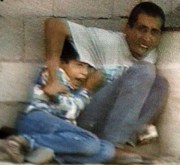 … Filmed by Talal Abu Rahma, a Palestinian cameraman freelancing for France 2, Jamal al-Durrah and his 12-year-old son Muhammad are seen, backs pressed against the wall, Jamal’s arm shielding his young son whose mouth is oval with what must have been a paralyzing fear. And then the shots.
When the cloud of dust cleared, the boy is on his side, draped over his father’s lap.
Throughout an enduing four and a half year widespread Palestinian resistance, with all of its gut wrenching failures, and with the solace and strengths of solidarity en masse coming from both the history before the second intifada and the aftermath in its wake, the slaughter of Muhammad al-Durrah continues to be a defining moment. A young boy viewed guilty through the eyes of the Israeli military due only to the origin of his birth.
In the investigation to follow, an Israeli-initiated tug of war of blame across the grave of and over Muhammad’s murder ensued. Where initially the Israeli government took blame and expressed public relational regret with an apology, that space soon became occupied with denials, accusations and disturbing tales of Palestinian’s faking the boy’s death. If only Palestinians weren’t so busy mourning the actual mass murders of their children in order to be able to spontaneously arrange for the staged murder of one, a second intifada might not have been necessary, nor a third or a fourth for that matter.
Without politicizing the end of a human life, in a 67 year crime drenched in politics; fifteen years ago today a terrified little boy was shot to death while he hid beside his father. And the world should remember his name.
Warning graphic content! Raw footage of Mohammed ad-Durrah’s final moments of his life:
Shatila: Remembering the Massacre
By Richard Hardigan | CounterPunch | September 30, 2015
“There is one scene I will always remember. There was one child. The mother died, but he was trying to take milk from his mother. He was still alive.”
Jamili’s face betrays little emotion as she recalls the scene from thirty-three years ago. She has told the story many times, and perhaps it has lost some of its power in its retelling. Jamili works for Beit Atfal Assamoud, an NGO that provides medical, social and educational services to the residents of the Shatila refugee camp on the southern outskirts of Beirut, and she is talking about her experiences during the massacre of 1982.
“The best way to forget about the horrible things that have happened in the past is to work, to help,” she tells me.
There are currently fifty-nine Palestinian refugee camps scattered throughout the Middle East. When Zionist forces instituted a policy of ethnic cleansing aimed to dispossess the Palestinians of their land in 1947-1948, close to 750,000 Palestinians fled or were expelled from their homes. The camps were built to house the refugees in the short term, but as the problem persisted, so did the camps. It is estimated that there are currently 2.5 million Palestinian refugees living in the camps, which are located in Lebanon, Syria, Jordan, the West Bank and Gaza.
Shatila is probably the most well-known of all the Palestinian refugee camps. In September of 1982, a local Christian militia, known as the Phalange, aided by its Israeli allies, entered Shatila and bordering Sabra, engaging in an orgy of torturing and killing that lasted several days. It is estimated that 3000 people died in this massacre, which has become one of the enduring symbols not only of the Lebanese civil war, but also of the continuing disregard in which Israel holds the Palestinian people.
Jamili was born in 1958, during Lebanon’s first civil war, and she moved with her family from Baalbek, site of the spectacular Roman ruins, to Shatila at the age of one. Although she was not alive during the Nakba – the Catastrophe – and the original establishment of the camp that followed it, she has heard countless stories from her relatives about this time. In the fifty-seven years since her move, she has witnessed all of the tragedies that have befallen Shatila. She can associate each event in the history of the camp with an episode in her life. Her history has become intertwined with that of Shatila.
“My house was destroyed seven times,” she tells me, “and we rebuilt it seven times.”
I have now been in Shatila almost four weeks, and as of yet, I haven’t had the opportunity to talk to anybody about their personal experiences during the massacre. When I first arrived, I was expecting that the tragic events of 1982 would somehow cast an enormous shadow over the camp, that it was something everybody was still dealing with on some level. And so I was hesitant to discuss this topic with anybody for fear that I might bring up some memories that might be best left undisturbed. But when I was introduced to Jamili a few days ago as part of a visit to Beit Atfal Assamoud, she began talking about the massacre immediately. When I asked her if we could discuss the matter in greater detail, she agreed to give me an interview.
We are sitting in comfortable black chairs in her office. A fan whirs in a corner of the room, making the heat a little less oppressive. There is an enormous sleek, black desk behind her, at which I have yet to see her sit. Jamili’s work involves connecting with the residents of the camp who come to seek her help, and I suspect she feels a big desk between them would make them feel uncomfortable.
Israel invaded Lebanon on June 6, 1982 in order to rid the country of the Palestine Liberation Organization, which had fled Jordan during Black September in 1970 and had since established a presence in the refugee camps of Beirut. Israel killed roughly 20,000 people, mostly civilians, during the invasion, and it managed to drive out the PLO.
“During the invasion, 90% of the camp was destroyed. We left Shatila and stayed in Hamra (a Beirut neighborhood a few miles north of Shatila). The people lived in schools and cinemas. My house had five rooms, but when we returned to the camp, we found that only one room was left standing.”
In August of that year, Israel pressured the Lebanese parliament to choose Bashir Gemayal, leader of the Israel-allied Maronites, as president. However, Gemayal was assassinated on September 14, and the Maronite Christian community, especially the Phalange, a brutal Maronite militia, blamed the Palestinians for his death. By this time the PLO had already left the camps, and only women, children and old men remained.
“The PLO had left. All of our youths were in prison,” says Jamili.
The international force that had overseen the evacuation of the PLO had by now departed, and the residents of Shatila were completely exposed.
Yassir Arafat had foreseen this possibility. In the negotiations for his departure from Beirut, he had expressed concern for the safety of the civilians he would be leaving behind in the camps. The US and the government of Lebanon had given their word that Israel would not be allowed to enter West Beirut and had ensured the safety of the Palestinians remaining in the camps. But these promises proved to be empty.
On the day following Gemayal’s murder, Wednesday, September 15, the Israelis seized West Beirut, entrusting to the Phalange, whose hatred for the Palestinians had been inflamed by the assassination of their leader, the task of cleaning up the refugee camps.
On the evening of the following day, Thursday, the Phalange finally entered Sabra and Shatila, and the carnage began almost immediately. David Hirst provides a chilling description in his book Beware of Small States :
“They broke into houses and killed their occupants. Sometimes they tortured before they killed, gouging out eyes, skinning alive, disemboweling. Women and small girls were raped, sometimes half a dozen times, before, breasts severed, they were finished off with axes. Babies were torn limb from limb and their heads smashed against walls.”[1]
Unaware of the massacre, Jamili and her family sought shelter in a mosque in the center of the camp from the Phalange bombs that were falling on West Beirut.
“The houses, after the Israeli invasion, were not strong. The mosque was strong and standing. All of our neighbors left their houses, because they were weak. And we sat in the mosque. People came from outside and said there will be a massacre. Some people didn’t believe them. Where would we go? At the beginning we didn’t believe. But when many people came covered with blood and told terrible stories, then we were afraid.”
A group of old men decided to try to find a high-ranking Israeli officer and convince him to stop the bloodshed. Jamili’s father was among them, but at the last minute he opted to stay behind, a decision that most likely saved his life.
“And these men, until now we don’t know where they are. They went to tell they Israelis there are only children in the camp. They went to protect the camp. But they killed them. They were all friends of my father. Until now nobody really knows what happened. ”
As darkness fell in the evening, the violence continued. The Israelis fired flares over the camp to aid the militia with its grizzly work.
“They lit the streets of the camp. The hopeless thing is that the children saw the lights, and it made them feel happy. But we explained to them that it was the Israelis throwing bombs. Many houses burned. One bomb hit a neighbor’s house, and my father went to help put the fire out.”
Jamili spent that terrifying night in the mosque with her family.
“In the morning, at six o’clock, a group of women, children and old men came and entered the camp and passed by the mosque. They were crying and shouting, and then we believed that a massacre was going to happen.”
On Friday many of the residents of Sabra and Shatila escaped and made their way to two nearby hospitals – the Gaza and Akka hospitals.
“We carried our children and didn’t take anything. We went to the Gaza hospital.”
But even in the hospitals the terrified residents of the camp were not safe from the murderous intentions of the Phalange. In fact, on that day the militia entered the Akka hospital and murdered some of the wounded as they lay in their beds.
“The doctors and the nurses said ‘Don’t stay here. They will come to get you. Please leave this area.’”
“So we left. At that time I was with my family and all of my relatives. There were hundreds of people in the streets, carrying their children.”
Jamili’s destination was Hamra, the Beiruti neighborhood where she and her family had spent the bulk of the Israeli invasion. They had lived in a friend’s apartment, and they still had the key. That night they spent in an unfinished building on the way to Hamra.
“It had no doors or windows, but at least we had a place. In the morning hundreds of people from the camp came and shouted, and we felt that it was dangerous and that we must leave.”
On Saturday morning they were stopped by Israeli soldiers.
“They allowed the women and children to pass, but the young men had to stay. My brothers and uncles had to return back while the women and children continued to Hamra. Our men were not with us, and we were afraid. What would happen to them? We were running away from danger, and they were going to danger.”
By now journalists had entered Shatila, and news of the massacre had spread. When Jamili and her family reached Hamra they went to a supermarket to meet its owner, a man they knew. He was astonished to see them.
“’You are still alive?’ he asked us.”
By ten o’clock on Saturday morning the last of the Phalange had left Sabra and Shatila. The killing was over.
“I am lucky. I didn’t see anybody killed in front of me. But I saw the bodies. The mosque was filled with bodies. You can see the houses that were destroyed and the legs of the children appear from these houses. I saw all this.”
When Jamili saw the pictures in a newspaper, she was horrified. She imagined that all the bodies she saw belonged to her relatives, whom she had been forced to abandon outside of Hamra.
“All youths wear sport shoes and jeans and t-shirts. Their bodies were facing down. We felt that all our men had been killed. We decided to return back to the camp. On Monday morning we entered Sabra, and we were afraid to enter the camp. We saw the bodies in the street. I couldn’t stand. We couldn’t continue. We knew that all our relatives had died. I went to my house. I walked a few meters and then returned back. Because I was afraid to find out what happened.”
But it turned out that her male relatives had found shelter in a school outside the camp.
“When I saw them I didn’t know whether to laugh or cry. I felt foolish. When I found out that my whole family was safe, it was a perfect day.”
Jamili sighs. Her brown eyes glisten. Telling the story has brought back memories and emotions.
The massacre was over, but the problems for the residents remained, as the camp was almost entirely destroyed and had to be rebuilt.
“We had a group of about twenty girls. We could stand against the enemy. We were not afraid. What choice did we have? To die? To live or die, it was the same.”
And so Jamili and her friends threw themselves into the task of rebuilding the camp, because, among other things, it helped them forget what had happened. But one cannot forget such an event.
Jamili leans closer, her face showing the confusion, the inability to accept what had happened so many years ago. How could one group of human beings do this to another?
“Why did Israel make the massacre? For the children? For the old men? Nobody could imagine that a massacre would happen. Why? For whom? We didn’t have any men. Some of them left, and some of them died. Some of them went to prison.”
Today, thirty-three years later, Shatila faces a multitude of problems. The camp, originally built for 4000 residents, is contained in an area that is in the shape of a square of side length less than one kilometer. With the recent influx of refugees from the war in Syria, the current population is estimated to be close to 25,000. This high concentration of people makes itself felt in the ubiquitous crowds that fill the narrow alleyways, in the piles of garbage that accumulate too quickly for the trash removal workers to keep up with, in the many buildings that extend skyward to accommodate the residents, and in the lack of open spaces in the camp. Living conditions are horrifying. Electricity is cut for at least twelve hours a day, and the tap water is so salty that it corrodes the faucets. Guns are present throughout the camp, and tensions, already high because of the extreme overcrowdedness, often explode to the point of physical conflict. (One week after my arrival in the camp two people were murdered during a dispute over a motorcycle parking spot.)
Most of the people in the camp dream of going back to their village in Palestine. And so it is with Jamili.
“Our problems will stop when we return. Why cannot we return to our homeland? My village is empty. It has been destroyed. Until now nobody lives there. Why must we live in this bad situation?”
As Israel moves further and further to the right, it appears as unlikely as ever that Jamili or any of the other millions of Palestinian refugees will ever be able to return to their homes. As their wait continues into its seventh decade, the international community appears to be losing interest even in providing material support for them. Until a few weeks ago, a UNRWA budget shortfall threatened to close all schools in the refugee camps, an action that would have been a disaster for the residents. Saudi Arabia and a few other nations came up with the funding at the last minute, but the message that the world doesn’t care about the refugees was delivered, regardless. These are dangerous times for the Palestinian refugees, and it is crucial that the international community, especially the West, who bears responsibility for their displacement in the first place, doesn’t forget about their plight.
Notes.
[1] David Hirst, Beware of Small States: Lebanon, Battleground of the Middle East
Richard Hardigan is a university professor in the United States.
Killed by Cops Over Pot: Family Lawsuit Reveals Shocking Details
© Zachary Hammond/Family Photo
Sputnik – 29.09.2015
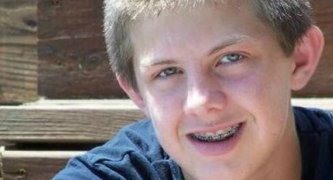
Highly disturbing new information is coming to light thanks to a lawsuit filed by the family of 19-year-old Zachary Hammond, the South Carolina teen fatally shot in the back by police during a small marijuana bust.
The suit alleges that the officer, Lieutenant Mark Tiller, who shot and killed Hammond, threatened to “blow his head off” before he fired, and another officer high-fived the teen’s lifeless body after he was killed.
Tiller has not yet been charged for the teen’s death, nor has the department released dashcam videos or any other documents pertaining to the case. The family has stated that part of their reason for filing the lawsuit is to force the Seneca Police Department to release the footage.
Solicitor Chrissy Adams and state investigators maintain they will not release the footage while the case is still open.
Hammond’s family is also in the midst of another lawsuit to have Adams removed from the case, as she works with the officers involved. She refuses to decide whether Tiller will face charges until the state supreme court makes their decision in that suit, and “federal and state investigators answer some more questions,” the Associated Press reported.
The family has spoken to the woman who was in the vehicle with Hammond, reviewed private surveillance footage, and has had a private autopsy performed on the teen’s body.
The shooting took place after Hammond took Tori Morton on a first date, on July 26. The lawsuit states that they had visited a McDonald’s to get ice cream, and then went to a Hardee’s so that Hammond could buy a hamburger.
When the pair arrived at Hardee’s, however, undercover police were waiting. They allege that they had arranged a drug deal with Morton.
As the police pulled up to Hammond’s car, he reportedly tried to drive away.
Tiller claims he thought Hammond was going to try to run him over, but the private autopsy confirmed that the teen was shot in his back and in his side, meaning that any perceived threat would have already had passed when he was killed.
The lawsuit also claims that there was a pause between the first and second shots, and that after being shot the first time, Hammond looked over at his date.
“‘I’ll blow your (expletive) head off,’ were the last words heard by Zachary Hammond,” The lawsuit states.
The police claim that small amounts of drugs were found on both of the teens. Morton was charged with misdemeanor drug possession.
Hammond was pronounced dead upon the arrival of paramedics. His body was then left on the ground for 90 minutes, where it was reportedly attacked by ants.
Once other investigators arrived, an officer was reportedly seen high fiving his corpse.
The Seneca Police Department has now hired a public relations firm to represent them.
Obama ignores Palestinian cause in his UN speech
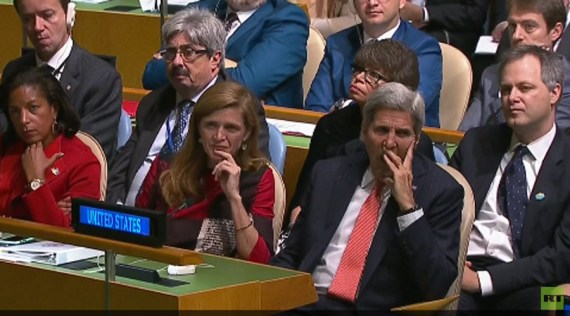
Obama’s speech to the U.N. General Assembly seemed like a real bore for Secretary of State John Kerry
Palestine Information Center – September 29, 2015
NEW YORK – US President Barack Obama declared during his speech at the UN General Assembly in New York his country’s readiness to cooperate with Russia and Iran to solve Syria crisis. However, he ignored to address the Palestinian cause.
The Palestinian Authority slammed Obama for neglecting the Palestinian issue in his speech at the UN on Monday.
Obama called for “a managed transition away from al-Assad,” whom he called a “dictator.”
“Nowhere is our commitment to international order more tested than in Syria. When a dictator slaughters tens of thousands of his own people, that is not just a matter of one nation’s internal affairs — it breeds human suffering on an order of magnitude that affects us all”.
He expressed surprise over those who “support tyrants like Bashar al-Assad, who drops barrel bombs to massacre innocent children, because the alternative is surely worse.”
Likewise, when a terrorist group beheads captives, slaughters the innocent and enslaves women, that’s not a single nation’s national security problem — that is an assault on all humanity, he said in reference to ISIS.
The United States, according to him, has worked with many nations in this Assembly to prevent a third world war — by forging alliances with old adversaries; by supporting the steady emergence of strong democracies accountable to their people instead of any foreign power; and by building an international system that imposes a cost on those who choose conflict over cooperation, an order that recognizes the dignity and equal worth of all people.
However, US president failed to mention the Palestinian cause in his speech at the UN General Assembly.
PLO Secretary-General Saeb Erekat expressed disappointment in US president Barack Obama for neglecting the Palestinian cause in his UN speech.
“Does President Obama believe he can defeat ISIS and terrorism, or achieve security and stability in the Middle East, by ignoring the continued Israeli occupation, settlement expansion, and the continued attacks on al-Aqsa Mosque?” he said.
A Nuclear Power Confronting Slingshots, Israeli Hypocrisy Finds an Ally in The NY Times
By Barbara Erickson | TimesWarp | September 28, 2015
Israel, The New York Times tells us, has vowed to crack down on violence in Jerusalem, allowing the use of live fire against Palestinians who take to “rock throwing and firebombing,” expanding the rules of engagement and lengthening sentences for such crimes.
In a story titled “Israel Acts to Combat Violence in Jerusalem,” Isabel Kershner quotes Prime Minister Benjamin Netanyahu, who calls such Palestinian weaponry “deadly and murderous objects,” which have been “thrown without response and without being thwarted.”
It is noteworthy that Netanyahu, responsible for bombing and strafing the 1.8 million residents of Gaza, can say these words without a hint of irony. It is also striking that the Times can report his utterances without pointing out the full context here—the lopsided nature of the conflict.
In fact, it is the Palestinians who face a deadly enemy: Israel possesses armored vehicles, automatic rifles, drones, rockets, fighter jets, smart bombs and sophisticated surveillance equipment, all of them more “deadly and murderous” than Palestinian rocks. As the only nuclear power in the Middle East, Israel also has a stockpile of up to 300 nuclear weapons, which can be launched by air, land or sea.
Palestinians in Jerusalem and the West Bank have nothing more than stones, firecrackers, kitchen knives and homemade firebombs. The mortality figures reflect this disparity: Since the beginning of this year Israeli forces have killed more than 25 Palestinians in the West Bank (settlers have killed at least another three), while Palestinians are responsible for the deaths of four Israelis within the West Bank and Israel combined.
Yet the Times strains to make Israelis appear as the victims, giving voice to the claims of Netanyahu, playing down Palestinian deaths and hyping Israeli casualties. A recent headline declared, “Jewish Man Dies As Rocks Pelt His Car in East Jerusalem,” suggesting that the driver was stoned to death. In fact, he had a heart attack, lost control of his car and ran into a light pole. The Times story cites only one object hitting the car.
By contrast, the paper gives a bland and ambiguous title to the story of a young Palestinian woman who died from a barrage of Israeli bullets last week as she tried to cross a checkpoint in Hebron. This news appears under the title, “2 Are Killed in West Bank as Jewish and Muslim Holidays Approach.”
Readers find no hint of the bloody assault on 18-year-old Hadeel Al Hashlamoun in this headline, and the Times has also failed to report that Amnesty International termed her killing a “extrajudicial execution” and called for a “prompt, impartial, independent and effective investigations” into her death.
Firsthand accounts say that an Israeli soldier shot Al Hashlamoun in the leg, and when she lay motionless on the ground, approached her and fired several more shots into her abdomen. Witnesses add that soldiers refused to let a Palestinian ambulance approach her and left her to bleed for about half an hour before allowing an Israeli ambulance to arrive and take her away. Video footage also shows a soldier grabbing her by a foot as she lay bleeding on the ground and dragging her out of camera sight.
This is raw violence with “deadly and murderous” arms, but the Times and Netanyahu do not find the word “violence” appropriate here. They reserve its use for Palestinians who throw rocks and firecrackers, never applying it to the atrocities of Israeli security forces. The irony and hypocrisy in this discourse seem to elude them entirely.
In a story that appeared online yesterday, the Times reports that four Palestinian youths have been arrested for throwing rocks at the car of the man who died after crashing in East Jerusalem. This news is in striking contrast to the latest, disturbing developments in the case of three Palestinian family members who died in an arson attack.
When news broke of the fire that killed a toddler in the West Bank village of Duma and led to the later deaths of his mother and father, the Times quoted the reactions of Israeli politicians at length and described Jewish Israeli “soul searching” over the deaths. The paper also noted that some extremist settlers had been arrested but that no one accused of the Duma arson was in custody.
The Times ran several stories immediately after the arson attack, reporting that Netanyahu vowed to bring the perpetrators to justice, but after running a brief article when the mother died earlier this month, the newspaper has been silent, even though there is news to tell: Israeli officials know who committed the crime but do not plan to arrest them.
Israeli media have reported that Defense Minister Moshe Ya’alon admitted that the names of the suspects are known but the defense establishment has not arrested anyone “to avoid revealing intelligence sources in court.”
So we have the quick arrest of four youths suspected of throwing rocks and (perhaps) indirectly causing the death of an Israeli driver, while those responsible for burning and killing three innocent Palestinians go free. The remarks by Ya’alon add even more irony to Netanyahu’s complaint that rock throwing occurs “without response and without being thwarted.”
The Times has shown itself to be tone deaf to such dissonance in the Israeli narrative. Far from analyzing or commenting on the hypocrisy of vilifying rock throwers, it has worked to support this deliberate distortion of the reality in Palestine.
So in the Times we find silence concerning official complicity in settler crimes, efforts to portray Israelis as victims and a refusal to state the obvious: Killing civilians with the world’s most sophisticated weapons ranks high on the scale of violence, far above the efforts of Palestinian youth who face armored soldiers and tanks with slingshots and stones.
The Battle of Breaking the Chains: Posters, Postcards, Toolkit for Action

Samidoun
There are currently 17 Palestinian prisoners on hunger strike in Israeli jails in the “Battle of Breaking the Chains.” The hunger strike is demanding an end to the practice of administrative detention. Administrative detention is the process by which Israel imprisons Palestinians without charge or trial for indefinitely renewable periods; there are hundreds of Palestinians held under administrative detention. No reason is revealed for their imprisonment; instead, a “secret file” produced by Israeli military intelligence serves as a pretext for their continued detention.
The first five hunger strikers: Nidal Abu Aker, Ghassan Zawahreh, Shadi Ma’ali, Munir Abu Sharar and Badr al-Ruzza – all held without charge under administrative detention – began refusing their meals on 20 August. They were soon joined by Bilal al-Saifi and Suleiman Skafi. In late September, another ten Palestinian prisoners joined the strike.
One hundred more prisoners – mostly administrative detainees – have pledged to join the strike on 10 October; 250 Palestinian prisoners in Israeli jails have been returning their meals three times a week in unity with the strikers’ demands. Dozens of Palestinian administrative detainees are boycotting the military court sessions – sessions which simply “rubber-stamp” detention orders from the Israeli military.
The hunger strikers have been refusing food and vitamins since 20 August; they have lost massive amounts of weight, suffer constant headaches and body pains. Some are unable to walk. However, they have not been moved to hospitals – instead, they are being held in isolation cells in solitary confinement, as a means of isolating them from their fellow Palestinian prisoners and attempting to coerce them to end the strike.
In their isolation cells, they have been denied cold water and access to fresh air. All of their personal belongings, including books and papers, have been confiscated, and they have been denied blankets and pillows. Several of the strikers have been denied legal visits; and they have been transferred repeatedly – and abusively – from prison to prison, isolation cell to isolation cell, in a metal vehicle, shackled to a metal chair, known as the “bosta” – a lengthy, stressful and harmful procedure.
As the prisoners reach 40 days on hunger strike, an urgent call has been issued for support and international actions to build solidarity for the hunger strikers, protect their lives and demand their freedom.
Copyright Infringement Claim Filed By Sandy Hook Charity Kingpin
Memory Hole Blog | September 22, 2015
On September 17 MHB reported on a copyright infringement claim filed with Facebook by an anonymous party against the “Sandy Hook Hoax” Fb page alleging ownership of the Lenie Urbina/Avielle Richman photographs. The copyright claimant has been revealed in the emails below as one Thomas Bittman, co-founder of the lucrative “Sandy Hook Promise” charity. The 501(c)3 has been a key proponent of gun control and mental health protocols that it argues will curb mass shootings, while pulling on the heartstrings of America to the tune of tens of millions of dollars in the wake of the December 14, 2012 Sandy Hook massacre event.
What’s significant here is whether Bittman actually holds the copyright to the images in question, and if he’s not just prompting Facebook to abuse the entire DMCA process intended to address legitimate copyright claims. If so, Bittman has likely committed perjury and is subject to being sued for filing a false copyright infringement claim. “If you send a cease-and-desist letter to an infringer,” under DMCA,
there is a risk that the infringer may file a lawsuit in the infringer’s jurisdiction naming you as a defendant and seeking a declaratory judgment that your copyright is invalid. One recent court decision found that the sending of a single cease-and-desist letter into the state was enough to subject the defendant to personal jurisdiction in that state.
If you send a DMCA takedown notice that is both false and meant in bad faith (such as to harass, or doesn’t state a real claim), you have committed perjury. Though unlikely, if the party you sent the takedown notice to decided to pursue this in court, you could face all of the consequences that your state imposes on people who lie in court.
Most MHB readers will likely agree that such legal action against parties that have sought to terrorize the US citizenry and enrich themselves on an entirely dubious incident is richly deserved. We do hope Mr. Anthony Mead pursues this matter to the fullest extent provided by law.
Students and Regents Demand University of California Adopt Unconstitutional Policy
By Sarah McLaughlin | Foundation for Individual Rights in Education | September 18, 2015
Yesterday, the University of California Board of Regents held an open meeting allowing students, faculty, members of the UC community, and other interested parties to share their thoughts on UC’s proposed Statement of Principles Against Intolerance.
The statement came about after the UC Regents decided not to adopt the U.S. State Department’s definition of anti-Semitism. Free speech advocates pointed out that a public university’s adoption of this definition as policy would raise serious First Amendment concerns and chill protected speech, including criticism of Israel’s government.
Earlier this week, FIRE’s Will Creeley explained that while the Statement of Principles Against Intolerance doesn’t include the State Department’s definition of anti-Semitism, it still impermissibly chills speech by telling students that certain viewpoints don’t belong at their university, encouraging them to report such views, and promising a “prompt” and “effective” institutional response. Will told the Associated Press yesterday that the policy, if implemented, would create “a kind of race to the bottom, sooner or later, by public universities punishing students or faculty for a particular viewpoint.”
Given the First Amendment concerns over both proposed policies, that this open meeting was held on Constitution Day was fitting. Many speakers at yesterday’s meeting agreed that the new proposed policy was a bad idea—but, unfortunately, for a different reason: they want UC to draft a policy that is even more hostile to speech.
The suggestions put forth and the demands made during the meeting were alarming. Despite having only one minute to share their thoughts, plenty of speakers managed to find time to demand that UC violate its students’ speech rights and ignore its obligations under the First Amendment. (Note: The following may include minor transcription errors.)
Comments from the UC Campus Community
Gary Fouse, an adjunct at UC Irvine, claimed that UC’s current proposed statement against intolerance is “useless” without the incorporation of the State Department’s definition of anti-Semitism:
The Israeli-Palestinian debate has led to an atmosphere where many Jewish students who support Israel are often spending their college years in a climate of intimidation, not just from Pro-Palestinian students but in many cases from professors in the classroom. The problem is not neo-Nazis or skinheads. Rather, it is the pro-Palestinian lobby such as the Students for Justice in Palestine, BDS promoters and other faculty allies. Each year these groups invite speakers to campus, some of whom cross the line from legitimate criticism of Israel to attacking Jews as people.
But it’s not up to public university officials to decide what criticism of a foreign government is legitimate or forbidden, and, in turn, to demand everyone at the university abide by their perceptions of “legitimate criticism.” The idea of a public institution doing so should trouble anyone who believes in the fundamental importance of the right to dissent. In fact, President Obama made similar arguments this week at a town hall meeting when he said “I don’t agree that you, when you become students at colleges, have to be coddled and protected from different points of view,” and that silencing arguments we oppose is “not the way we learn.”
Another commenter, a UC Berkeley alum, pointed out the absurdity of Fouse’s argument:
When I was a student at Berkeley, it was criticizing the US government that wasn’t permitted. In fact, we had to have a free speech movement in 1964 in order to have any political speech on campus. So now apparently criticizing the Israeli government is going to be banned.
As this commenter suggested, it’s noteworthy that students in the UC system have historically fought especially hard for their First Amendment rights—rights that should not be so easily set aside.
A group of UC students made a joint statement together saying that the State Department definition of anti-Semitism is “the only existing definition that is capable of addressing the nuanced hatred that we experienced on our campuses today.” If UC follows the advice of these speakers and a majority of those present at this meeting, it will be adopting a deeply troubling policy.
Another worrisome trend in this meeting was the use of criminal or violent acts as examples of why this policy is needed. Several commenters brought up examples of vandalism, including swastikas drawn on fraternity houses and violence against Jewish students, to justify the adoption of the State Department’s definition. But these actions are criminal—they’re already illegal. Trying to target such acts through this new policy is not only superfluous, but would implicate constitutionally protected political speech in the process.
The Regents Respond
Comments from the Regents themselves were hardly any better.
While Regent John Perez’s acknowledged that the State Department’s definition could potentially limit academic freedom, that was one of the few displays of sound judgment.
The most worrying statements came from Regent Richard C. Blum, whose wife is United States Senator Dianne Feinstein. Blum said earlier in the meeting that “we’ve been too tolerant, too patient about all this for too long,” and continued:
I should add that over the weekend my wife, your senior Senator, and I talked about this issue at length. She wants to stay out of the conversation publicly but if we do not do the right thing she will engage publicly and is prepared to be critical of this university if we don’t have the kind of not only statement but penalties for those who commit what you can call them crimes, call them whatever you want. Students that do the things that have been cited here today probably ought to have a dismissal or a suspension from school. I don’t know how many of you feel strongly that way but my wife does and so do I.
Yes, a UC Regent flatly threatened the university with political consequences if it failed to craft a “tolerance” policy that would punish—and even expel—its violators.
The consequences of this suggestion are grave: If UC adopts the State Department definition of anti-Semitism (or any policy banning criticism or intolerance), and accedes to Blum’s demands, students could potentially face expulsion for any language a person subjectively believes is “intolerant.”
Regent Hadi Makarechian later echoed Blum’s demands, stating:
I just wanted to say that I agree with Regent Blum, that principles are great, rejection of actions are great, but we need to address the punishment. If we don’t have punishment we’re just putting a lot of paper together. We’re just stating a lot of stuff on pieces of paper.
The board concluded the meeting by saying there was more work to be done, and announcing the formation of a working group, led by Regent Eddie Island. Island said he would compose a group of university stakeholders who would work together to craft a policy that addressed concerns about both intolerance and freedom of speech.
We at FIRE believe robust protections for freedom of speech accomplish both goals by providing a platform to debate the merits (or lack thereof) of intolerance in the marketplace of ideas.
Hopefully this working group recognizes that more speech and the hard work of convincing someone they’re wrong are the only real, effective remedies against intolerance. UC students and faculty who value free speech and academic freedom should watch these developments very closely.
Soldiers Invade Al-Aqsa Mosque, Many Palestinians Injured

IMEMC & Agencies | September 28, 2015
Dozens of Israeli soldiers, police officers and undercover forces, invaded on Monday morning, the Al-Aqsa Mosque in occupied Jerusalem, fired gas bombs and concussion grenades causing many injuries, before forcibly removing the worshipers, and surrounded dozens in the Al-Qibli Mosque
Eyewitnesses said around 150 soldiers and officers invaded the holy site, and started forcing the Palestinians out by firing gas bombs, concussion grenades, rubber-coated steel bullets, and several live rounds.
The soldiers also assaulted many Palestinians with clubs and batons.
The invasion also led to clashes between the invading troops and Palestinians, in the mosque and its courtyards.
The Israeli attack caused fires at the main entrance of the al-Qibli mosque, but local firefighters, working for the Islamic Waqf Department, managed to contain it before it spread.
Many residents were injured, and received treatment by Palestinian medics, in the Mosque’s clinic.
The army also used special tools to remove wooden doors and windows of the Al-Qibli Mosque, and hurled several concussion grenades into it.
In addition, soldiers stationed at the gates leading to Al-Aqsa, prevented dozens of worshipers from entering the mosque’s courtyards, especially through Bab Hatta and the Chain Gate.
The soldiers then assaulted many Palestinians, and started pushing them away.
The removal of the worshipers was carried out while dozens of Israeli fanatics gathered nearby, and marched into the mosque’s courtyards under heaving army and police accompaniment.
90,000 Palestinians arrested by Israel since 2000

Palestine Information Center – September 28, 2015
RAMALLAH – Israeli occupation forces have arrested over 90,000 Palestinians since the start of Al-Aqsa Intifada on September 28th, 2000, the Commission of Detainees and Ex-Detainees Affairs said on Sunday.
Such arrests targeted all categories of Palestinian society, including injured civilians, sick persons, girls, children, MPs, lawmakers, and the elderly, the documentation department at the Commission of Detainees and Ex-Detainees Affairs reported.
The Palestinian arrestees included 12,000 children below the age of 18 and 1,200 women, four among whom gave birth to newborns in Israeli lock-ups.
The commission added that there are 200 children and 25 women still behind Israeli bars.
According to the report, the Israeli occupation arrested more than 65 lawmakers and ministers over the same period.
The Israeli occupation authorities issued 25,000 new or renewed administrative sentences against the Palestinian detainees. 480 inmates are still held administratively in Israeli jails.
At least 83 Palestinian detainees died of harsh torture and preplanned medical neglect in Israeli jails since 2000. Dozens of others died shortly after they were released as they succumbed to diseases they caught while jailed.
The Palestinian detainees suffered all kinds of torture and maltreatment during their arrest period, the group further documented.
National Archives Accused of Illegally Classifying Details of CIA Torture Program
By Steve Straehley | AllGov | September 28, 2015
Details of the Central Intelligence Agency’s (CIA) torture program have been unlawfully kept from public view, according to a complaint filed with the National Archives.
OpenTheGovernment.org listed in a complaint (pdf) five areas of concern that have been classified or redacted from the version of the Senate’s torture report executive summary, released in December 2014.
“Secrecy regarding ‘black sites’ and torture has played a major role in ensuring that no CIA personnel could be prosecuted for torture, war crimes, destruction of evidence, or other relevant federal crimes. It has ensured that civil courts were closed to victims of torture, indefinitely delayed trials of the accused perpetrators of the September 11 attacks, and put the United States in breach of its obligations under the Convention Against Torture,” according to the complaint, signed by OpenTheGovernment national security fellow Katherine Hawkins.
The five areas of concern are:
–The pseudonyms and titles, and in some cases the names, of CIA officials and contractors implicated in the torture program. Some of those redacted names included those of lawyers involved in crafting the agency’s torture policy.
–The names of countries that hosted torture sites, even though some of those countries’ governments have acknowledged this and even paid compensation to those tortured.
–Detainees’ description of their own torture. Details about torture sites, dates of transfer between prisons and descriptions of those inflicting the torture have been kept secret.
–Details of the CIA’s torturing of detainees in Iraq. Information about this torture, including the death of a detainee, has been reported by the news media.
–The seizure and transfer of detainees to foreign countries to facilitate torture. Syria, Libya, Egypt, and Jordan were among the places that hosted torture facilities.
“The Executive Order on national security classification formally forbids agencies from classifying information, or failing to declassify information, in order to ‘conceal violations of law,’ ‘prevent embarrassment,’ or ‘prevent or delay the release of information that does not require protection.’ It also forbids classification of any information unless ‘the information is owned by, produced by or for, or is under the control of the United States government,’” Hawkins wrote.
To Learn More:
OpenTheGovernment.org Challenges Ongoing Classification of the CIA Torture Program (OpenTheGovernment.org)
Wrongful Classification of Information Regarding CIA torture, in Violation of Executive Order 13526 (Katherine Hawkins, OpenTheGovernment.org) (pdf)
CIA Refuses for Fifth Time to Help Poland’s Investigation of Torture Carried Out by…CIA (by Noel Brinkerhoff and Steve Straehley, AllGov )
New Republican Senate Intelligence Chairman Wants to Bury CIA Torture Reports (by Noel Brinkerhoff and Steve Straehley, AllGov )
Featured Video

Why the U.S. Should Pull Back From the First Island Chain
or go to
Aletho News Archives – Video-Images
From the Archives
Only 19.7% of Americans agree with US State Dept on Israeli settlements
… Most American adults of voting age don’t appear willing to reject the applicability of international law to Israel’s ongoing colonization of occupied territories in East Jerusalem, the West Bank and Golan Heights. … Full article
Blog Roll
 Aletho News
- Egypt collaborates with Israel to build ‘Green Rafah’ project over erased Palestinian city
- Rising fuel prices and shortages have helped drive ongoing protests and rioting in France
- Tokyo protests demand Takaichi’s resignation over support for ‘Israel’
- Jennifer Kavanagh: Why the U.S. Should Pull Back From the First Island Chain
- Yemen denounces international community’s silence on Saudi aggression, siege
- UAE and Saudi Arabia move toward renewed coordination against Sanaa
- How Iran’s two-week retaliatory strikes exposed cracks in US military architecture in Persian Gulf
- The mother of all propaganda: Why the hype over US MOAB strike against Iran is nothing but theater
- Iran says it possesses technology behind US 14-ton GBU bunker-buster
- Trump asks Iran not to retaliate after he strikes Pickaxe Mountain – w/ Prof. Marandi
- If Americans Knew
- Israeli Strike Burns Gaza Mother Alive in Front of Toddler, ‘Without Generating Any Headlines’
- ‘The Israel Experience with Mike Huckabee’: The Ambassador’s Family Sells Trips to Israel
- As Gazans carry out mass burial, food insecurity is getting worse – Daily Update
- Israeli rabbi permits occupiers to steal Palestinian olive harvest in West Bank
- Netanyahu’s spin on latest settler attack is laughable – Daily Update
- Israeli soldiers debunk Israel’s talking points
- In West Bank, Israeli settlers are totally out of control – Daily Update
- NPR investigation finds evidence of widespread fraud at mall kiosks tied to Israeli skincare brand
- Tucker Carlson exposes Israeli Lies about the Oct 7th attack, Charlie Kirk, and the U.S.
- Israel has detained thousands of Palestinian children since Oct 7th – over half spent time in solitary, many uncharged
- No Tricks Zone
- Predictions Made By Renowned Climate Proifessor Over Past Decades Have Been Proven To Be Poor
- New Study Suggests Large Regions Of The Pacific Ocean Have Been Cooling For The Last 80 Years
- Germany’s Green Energy Debacle: High Energy Costs Force Kahla Porzellan to Close After 182 Years!
- New Study: 50 Years Of The Most Aggressive ‘Net Zero’ Policies Can Only Affect The Global Climate By 0.03°C
- US September “Heat” Was No Record…Many Records Set Decades Ago
- Latest European Green Energy Debacle; Portugal’s Largest Flagship Solar Park Insolvent!
- Green Energy Debacle: German Expert Professor Fritz Vahrenholt Warns Of Severe Economic And Social Consequences
- Two More Paleo Reconstructions Affirm Meters-Higher Sea Levels Across Ireland, Brazil 7000-6000 Years Ago
- New Study: Earth And Venus Surface Warmth Largely Explained By Convection And Lapse Rate, Not CO2 Or Radiation
- 2025 Nature Paper Claiming Worsening Global Drought Gets RETRACTED …Heavily Flawed

