Investigators Dismiss Mexican Government’s Official Story on Missing Students

A protester at a rally against the disappearance of 43 students in the southwestern Mexican state of Guerrero holds a sign that reads: ‘We Are Ayotzinapa. We Demand Justice.’
Credit: Montecruz Foto/CC-BY-SA-2.0
IPS – September 7, 2015
A group of independent investigators has roundly dismissed the Mexican government’s claims that the 43 students who went missing in the southwestern city of Iguala last fall were burned to ashes in a garbage dump, reigniting an international outcry against the disappearance and heaping pressure on the government to provide answers to families of the victims.
The 500-page report released this past weekend by an expert group appointed by the Inter-American Commission of Human Rights (IACHR) refutes key aspects of the government’s official story, concluding in no uncertain terms that there is “no evidence” to support the Attorney General’s findings that the college students were executed and burned by a drug gang.
“This report provides an utterly damning indictment of Mexico’s handling of the worst human rights atrocity in recent memory,” José Miguel Vivanco, Americas Director at Human Rights Watch (HRW), said in a Sep. 6 statement.
“Even with the world watching and with substantial resources at hand, the authorities proved unable or unwilling to conduct a serious investigation,” he added.
HRW is calling on the government to urgently address its own flawed investigation, which was declared ‘closed’ this past January, and bring those responsible to justice.
The students, all members of the Ayotzinapa Rural Teachers’ College in Mexico’s southern Guerrero state, disappeared on Sep. 26, 2014.
Amid massive protests across the country and around the world, the government concluded that the students had commandeered several buses and traveled in them to a protest in Iguala. Following clashes with local police, the students were allegedly detained and then handed over to a criminal gang, who presumably executed them before burning their bodies in a municipal dump.
But the IACHR investigators say those “conclusions hinge on allegedly coerced witness testimony that is contradicted by physical evidence,” HRW said Sunday.
Negligence, mishandling of evidence and long delays marked the government’s official investigation, the expert panel found, adding that federal prosecutors failed to review footage from security cameras or interview key eyewitnesses.
HRW points out that “crucial pieces of evidence, such as blood and hair” were vulnerable to contamination and manipulation during the investigation, and “in July 2015, more than nine months into the investigation, the group discovered that multiple articles of clothing belonging to the victims had been collected but never examined.”
Perhaps the most damning revelation involves the government’s claim that the drug gang responsible for the students’ deaths built a pyre and fed it over a 16-hour period with scrap material like wood and tires, as well as small amounts of fuel.
Quoting the IACHR study, the Guardian reported Sunday: “It would have required 30,000 kg of wood or 13,330 kg of rubber tyres and burned for 60 hours in order to consume the bodies. [The report] adds that feeding the pyre would have been impossible, and that a conflagration of those dimensions would have left obvious evidence in the surrounding area, which an inspection of the site failed to find.”
Other major flaws in the government’s official version of events include so-called ‘confessions’ extracted from suspects under conditions likely amounting to torture and authorities’ failure to inspect the offices of members of municipal police identified by eyewitnesses.
The expert panel spent six months on the investigation, reviewing existing government evidence, conducting in-depth inspections of the crime scene and interviewing surviving witnesses and family members of the deceased.
Earlier this year, the United Nations Committee on Enforced Disappearance highlighted shortcomings in the government’s investigation of the Ayotzinapa case, and called on the government to do more to tackle impunity.
HRW estimates that there are currently 300 open investigations relating to enforced disappearances in Iguala alone, and over 25,000 people reported as ‘missing’ nationwide.
“As of April 2014, no one had been convicted of an enforced disappearance committed after 2006, according to official statistics,” the rights group concluded.
Report ends.
Holocaust Hoax: Science Repudiates Mass Cremation Stories
Egypt: 680 death sentences handed down since 3 July 2013
MEMO | September 10, 2015
Nine anti-government defendants were sentenced to death in Egypt on Monday, bringing the number of those handed the death penalty to 680 since 3 July 2013, the Arab Organisation for Human Rights in the UK (AOHR UK) said in a report on Tuesday.
The organisation said the Egyptian security services torture opponents of the Egyptian regime and commit crimes against them so as to force them to confess to “fabricated” charges so they can be given severe sentences that may amount to the death penalty.
Seven of those who have received the death penalty have already been executed. The total number of defendants whose papers were referred to the Grand Mufti has reached 1,734. The report pointed out that senior officials at Mansoura’s security directorate systematically exercise illegal detention, kidnapping, torture and the forgery of official documents and fabrications.
The AOHR UK noted that photographing the defendants in a degrading manner, humiliating and torturing them and forcing them to give false confessions that were dictated to them constitute “unacceptable behaviour both legally and morally; and are also serious human rights violations which, if added to other human rights violations in Egypt, underline the collapse of the moral and legal system among individuals in the Egyptian police.”
The organisation warned that the adoption of the anti-terror law poses a threat to defendants who had already been sentenced to death as the new law decreased their chances of avoiding the death penalty and having fair trials.
It invited UN Secretary-General Ban Ki-moon to form a fact-finding committee with full powers to investigate crimes committed after 3 July 2013 and bring those responsible for these crimes to justice.
On Monday, the Terrorism Circuit at the Mansoura Criminal Court, headed by Judge Osama Abdul Zahir, sentenced to death nine young men, including four students, in case number 16,850 of the year 2014, in which 24 people from the province of Dakahlia are accused. The remaining defendants were sentenced to life in prison.
Yesterday the court referred the cases of 10 defendants to the Grand Mufti for his approval. They were sentenced on charges of killing a police sergeant, committing acts of violence against the army and police forces, forming a cell that seeks regime change, and possessing explosives and weapons.
AOHR UK said that defendants were subjected to torture to force them to make fabricated confessions. Such confessions would help the regime demonise its opponents and incite public hatred ahead of the judicial procedures.
The Precarious State of the Private-Sector Drone Industry
By Jay Stanley | ACLU | September 9, 2015
A lot of people are taking it as a given that drones will become ubiquitous in the coming years. But it seems to me that that’s far from a given; there is still a lot of uncertainty over the future of this technology (and therefore over the kinds of privacy threats and free expression opportunities that it will in the end present).
This is an industry that is still in a very early stage of its development, when it is highly sensitive to shocks. Incidents and accidents that happen at this stage can have lifetime effects, lasting many decades. That is especially true with a huge media spotlight on this technology. The amount of press coverage generated by the landing of a harmless toy drone inside the White House fence is indicative here.
Imagine the uproar if we were to see somebody put a gun on a drone and start shooting people remotely. Or drones used to bypass security perimeters and deliver explosives to a high-value target such as the White House. Even if the explosives did no more than blow a small hole in the White House lawn in the middle of the night, hurting no one, that would decisively alter the course of the drone industry.
Another possibility is some kind of spectacular accident. The safety record of this new technology is not great. There has been a lot of attention paid lately to drone “near-misses” with passenger airliners. (I have heard some experts express doubt that an accidental collision between a small drone and an airliner would cause the airliner to crash—but that’s certainly not something anyone wants subject to uncontrolled real-world tests.) Should a drone bring down an airliner, the drone industry might never recover. Even an accident in which a drone falls out of the sky could be a game-changer. If the 375-pound military drone that crashed onto an elementary school playground in Pennsylvania in April 2014 had killed children, we would likely be having a different conversation today.
Even without anything so dramatic, an accumulation of smaller accidents could shape the technology over time. Any technology that involves complex interactions with human beings will inevitably have some rocky times as we attempt to smoothly integrate it into life. If drones—even small lightweight private ones—are regularly crashing onto people’s rooftops, windshields, and heads, tolerance for the technology is likely to go down fast. If drones become popular enough that the skies over our neighborhoods are regularly criss-crossed with them, this could well happen—especially given the many unknowns such as whether territorially jealous birds will routinely attack them.
There may also be a nuisance factor. Even if large numbers of small drones constantly flying overhead turn out not to be dangerous, they may simply annoy people. To start with there’s the buzzing noise they make, and of course there’s also privacy. At the ACLU we have been most focused on the danger that drones will be used to construct regimes of constant wide-area surveillance. And there is a very real potential that private-sector drones may also become a tool for directly harmful privacy invasions. But even without such significant invasions, private-sector drones may spark nebulous feelings of intrusion. I found it interesting in this regard that firefighters in a recently circulated video found drones to be annoying enough that they tried to blast them out of the sky with their hoses. When a drone hovered over a crowd of hockey fans after a 2014 game in Los Angeles, a “mob mentality set in” as the LA Times put it, and “revelers were throwing everything they could to knock the drone down.”
I can’t claim to know what motivates people in incidents like these. I do know that while photography in public is a First Amendment right, as a matter of etiquette it is often unacceptable. As I’ve discussed before, training a camera on someone who does not want to be photographed may be constitutionally protected in public (as is yelling and swearing at them), but it is also perceived as rude.
These kinds of factors may add up to a general feeling by communities that they’d rather do without the putative advantages of widespread drone usage. In this drones may prove to fall into the same category as Google Glass—a widely anticipated and talked about technology that is naively viewed as inevitable, but ultimately one that remains confined to relatively narrow applications due to the subtleties and caprices of human etiquette.
All this makes it very hard to predict what will happen to this technology. In many ways what we’re witnessing is a race against time. If drones prove to be useful enough machines with enough practical benefits that Americans feel they can’t live without them, they’ll likely tolerate the occasional tragic accident or terrorist attack, as well as a good deal of annoyance. But if the disaster happens first, drones may never get a chance to prove themselves.
City of Boston’s license plate reader database was online in plain text with no password protection
PrivacySOS | September 8, 2015
The Boston Transportation Department has been operating a license plate tracking program seeking to identify parking scofflaws, people with expired insurance, stolen cars, and even people suspected of gang and terrorist ties, according to recently discovered documents. Up until a few weeks ago, this sensitive information about thousands of people, including every person with a Boston resident parking permit, was stored online in plain text for the world to see.
In mid-August 2015, officials in Boston were surprised to receive a phone call from journalist Kenneth Lipp, who informed them that the Boston Transportation Department’s entire license plate reader database was online and available to download for anyone with an internet connection. There was no password guarding the database, which contained a million or so license plate reader records, the home addresses of every single person with a Boston parking permit, and lists of 2,500 people the police or FBI (it remains unclear which) have designated suspected gang members or terrorists, among other data.
Through some Googling, Lipp discovered that BTD’s license plate reader system, run by the Canadian technology giant Genetec, was dumping all of its records into an online server maintained by a Xerox subsidiary for the world to see—if it knew where to look.
Included in the files available on this public facing, password-free server were records suggesting that the Boston Police Department has been piggybacking off BTD license plate reader data for years. One of the files shows what appear to be records of automated emails from the BTD server to the Boston Police department’s stolen vehicle office, alerting the police each time a car on the stolen car hotlist encountered a BTD license plate reader.
I was surprised to discover these records because in 2013, in the wake of local reporter Shawn Musgrave’s expose on privacy and civil liberties problems with the department’s license plate reader program, the Boston Police told the public that it was scrapping the program altogether. The Xerox records suggest scrapping isn’t at all what occurred. Indeed, the automated emails from BTD’s license plate reader program to the Boston Police, left on the Xerox server for anyone to download at will, appear to have started at around the same time the cops told the public they’d stopped using license plate readers. That’s to say, instead of scrapping the program as the police told the public they would, BPD appears to have bootstrapped their license plate reader program from BTD data.
While the Boston Transportation Department’s license plate reader program is primarily used for parking enforcement, the records obtained freely online reveal that the information was processed for other purposes that go well beyond hunting for stolen cars.
Lipp reports for the Dig :
In collecting data, the BTD patrols city blocks—in some cases, both literally and figuratively sweeping the street with ALPR-equipped sanitation trucks—and not exclusively in search of plates belonging to scofflaws. Files obtained in our investigation reveal that as the BTD’s software searches databases, it alerts department operators if a plate is connected to a “convicted person on supervised release,” or to someone pegged to a “protection order.” Commonly called hotlists, these compendiums are created by fusing criminal intelligence from sources like the FBI’s National Crime Information Center and the AMBER Alert program, as well as from data furnished by banks, collection agencies, and the civil court system.
It’s not clear whether or how the public is any safer when authorities use massive watchlists. In Boston, a city of approximately 600,000 people, parking enforcement has one hotlist with 720,000 hits, each of which notes a plate number, location info, and available make and model data. Among the targets listed in August: 19 license numbers classified as “immediate threats,” nearly 4,000 affiliated with “wanted persons,” 25 plates linked to bad checks, 75 tied to payment defaults, and 468,617 flagged for cancelled insurance. Also exposed were 2,500 hits on a “Gang/Terrorist Watch…”
We don’t know for certain from which list the 2,500 people identified as gang members or terrorists were so designated, or who designated them, but a likely suspect is the FBI’s Violent Gang and Terrorist Organization File (VGTOF) database.
According to a 2007 Inspector General report, the FBI at that time included nearly half a million people in this database, assigning them one of three codes meant to inform law enforcement “whether there is an active arrest warrant, a basis to detain the individual, or an interest in obtaining additional intelligence information regarding the individual,” respectively.
It’s not certain that the 2,500 people identified as “Gang/Terrorist Watch” in the Xerox/Boston Transportation Department license plate reader database were identified as such because of their inclusion in the FBI’s VGTOF, but it seems probable. The FBI may be interested to know that information about who is a suspected terrorist is posted on the internet for anyone in the world to download and peruse.
Government agencies routinely implore the public to trust them with our sensitive information, whether it’s license plate reader records detailing our movements and life patterns or information collected about political activists for so-called “public safety” purposes. But incidents like this one demonstrate that we should be very circumspect about allowing governments and corporations to collect, share, and manipulate information about us in secret.
Journalist Kenneth Lipp found this database and exposed it to the company and transportation department, triggering an added layer of security that shielded the information from the public. We will likely never know how many other people stumbled across it, or what they might have done with the information, before then.
‘Stop arming Israel!’ Campaigners launch blockade ahead of London arms fair
RT | September 8, 2015

Anti-arms campaigners set up a blockade in the Dockland’s area of east London on Monday to disrupt one of the world’s largest arms fairs and highlight Britain’s role in arming repressive regimes worldwide.
Protesters gathered outside the Excel center in the Dockland’s area of east London on Monday morning as part of a week of action called Stop the Arms Fair.
The campaigners occupied a space adjacent to the center in an effort to disrupt the Defence & Security Equipment International (DSEI) arms fair scheduled to take place at the venue next week. One of the largest arms fairs in the world, it is expected to attract more than 1,000 global arms firms and 30,000 attendees.
Monday’s day of action focused specifically on Britain’s role in arming Israel. It consisted of talks and thought provoking workshops, and was attended by scores of anti-arms trade campaigners from across Britain, who displayed colorful banners, flags, and quilts, and even sported face paint.

Campaigners said the DSEI arms fair provides a platform for Israeli and international arms firms’ to profit from oppression and destruction.
As the day progressed, a truck carrying a dark green military vehicle attempted to make its way into the Excel center. However, it was obstructed by activists who blocked the road, forcing it to stop. Several campaigners mounted the truck, while others surrounded it.
Police later warned the campaigners they would face arrest if they refused to let the truck pass. In defiance, protestors formed a tight-knit circle in front of the vehicle and staged a traditional Palestinian dance.

The protesters, who remained peaceful throughout the blockade, were eventually dispersed by police. One campaigner was arrested at the site.
Sarah Waldron of Campaign Against Arms Trade (CAAT), who attended the protest, condemned the British government’s sale of arms to Israel.
“In one week one of the world’s biggest arms fairs will be taking place just across the road and the UK government has consistently facilitated weapon sales to the Israeli government who will have a massive pavilion at this fair where their biggest arms companies will be displaying their battle tested weapons,” she told RT.
“The UK government has a very confused attitude to democracy and human rights. On the one hand, it talks of wanting to promote democracy in the Middle East and, on the other, it’s inviting the companies and the governments that are causing violence and conflict in these regions.”
Simon Morris of Occupy Democracy, who also attended the protest, said Occupy campaigners planned to safeguard the protest site.
“The occupy method is to take a space and hold it. We hold it to either facilitate discussions or have a meeting point where people can come down and talk about the issues,” he said.

“We intend to be here from Monday this morning up until Saturday and we intend to be living here continuously in tents holding the space for other people to come and speak.”
“Part of our list of demands, part of what we wish to change in the world, is the shift away from a huge amount of military spending and war, which causes misery and mayhem around the world,” he added.
“If our country had a more democratic system, like direct democracy, we’d see a lot less conflict, a lot less spending on military hardware, and a lot more peace in the world.”
Hilary, a Pro-Palestine campaigner who has spent time in the Occupied Territories, said she was angry with the British government.
“We don’t want Israeli arms companies here. We don’t want Britain to be selling arms to Israel or components for weapons and we don’t want to be buying arms, buying drones to fuel more conflicts in countries around the world,” she said.

Stop the Arms Fair is set to continue until Saturday. It will feature a mixture of creative activities and direct action throughout the week to raise awareness about the destructive impact of the global arms trade.
Activists will argue Britain must redirect spending from arms to renewables and from warfare to welfare. They will also highlight the link between the global arms trade and the global refugee crisis, and host a mass day of action in opposition the DSEI fair.
Photos © Sarah Jane Brennan / RT
Israel ‘benefiting from re-displacing Palestinians’
Palestine Information Center – September 8, 2015
 ALGERIA – Dr. Abdul Razzaq Muqri, head of the Algerian Movement for a Society of Peace (MSP), said Monday that Israel would benefit from re-settling Palestinian and Syrian refugees in Europe.
He also held western countries responsible for the suffering of Palestinian and Syrian refugees, charging that western countries were the main reason for the instability in the region.
“Today, Europe is in dire need for immigration as new demographic studies confirm that Europe would need to bring one million new immigrants every year, a total of 47 million immigrants until 2050 in order to maintain positive growth rates.”
There is no doubt, Dr. Muqri continued, that Israel was delighted when New Zealand declared intention to receive 500,000 Syrian and Palestinian refugees. Instead of finding a solution for Israeli settlers who came to Palestine from all over the world, the land owners became asylum seekers fleeing from the oppression.
Operation Flavius and the Killer Cameron
By Craig Murray | September 8, 2015
Exactly twenty years ago the European Court of Human Rights found that the British Government had acted illegally in shooting dead three IRA members in Gibraltar, even though the court accepted that the government had a genuine belief that they were planning a bombing attack. Indeed the court accepted the victims were terrorists, and refused compensation to their families on those grounds. But the court refused to accept there was no possibility of foiling the plot through methods other than summary execution.
In the light of the decision that Operation Flavius contravened Article 2 of the European Convention on Human Rights, it is difficult to understand how the government can claim its killing of British men in Syria, with no trial, is anything other than murder. I personally find it difficult to imagine technically how men journeying in a car in Syria were imminently able to instantly wreak havoc in the UK so that it was impossible to prevent by any method other than their execution without trial. The level of certainty required for that decision would involve sufficient knowledge of what was to happen in the UK to stop it here. If there was vagueness about what was actually to happen in the UK, there cannot have been the certainty about the threat claimed. It is a logical impasse.
Frankly in twenty years of experience working with British security services their level of accuracy (remember Iraqi WMD) was never that good. And everybody is fortunately now deeply sceptical about the continual claims by the security services that there are thousands of dedicated Islamic terrorists in the UK conducting hundreds of plots every year, and yet miraculously never actually managing to kill anybody.
Just in case anybody had not worked out yet that the Guardian is a disgraceful neo-con rag, it has an article by its “legal correspondent” Joshua Rozenberg, married to the even more rabid Zionist militarist Melanie Phillips (who still believes the Iraqi WMD exist, hidden in the bed of the Euphrates). Rozenberg assures us it is absolutely legal for the British government to kill us without trial if it wants. He even suggests the murdered Mr Khan would not object:
“If he was waging war on British troops and civilians, he can hardly complain the UK’s armed forces were one step ahead of him.”
Astonishingly for a lawyer, the disgraceful Rozenberg does not seem to notice that the opening “if” is rather important. “If Mr Jones was engaged in insurance fraud, he can hardly complain at being banged up for twenty years”, so according to Mr Rozenberg we can dispense with all that nonsense about trials and evidence and just take the government’s word for it. Not to mention that the government has now instituted summary execution without trial in a country that does not even have the death penalty.
As I have argued, it is not unusual for British people to go to fight abroad. There were British citizens in the Israeli Defence Forces participating in the massacre of Palestinian civilians in Gaza last year. Our neo-con governments of both blue and red Tories have positively encouraged the mercenary companies Executive Outcomes/Sandline/Aegis of Tony Buckingham and Tim Spicer. There are Britons fighting now in the Ukraine. We started by positively encouraging factions in the Syrian civil war, with the Saudis and CIA arming and training them and some of those factions helped constitute ISIL. There is no evidence at all that Islamic State had any interest in attacks in the UK until we started to attack it. (That is not to say it is not a very bad organisation and did not commit actions against UK citizens in its “Caliphate area”. But it did not threaten the UK).
For the government to claim the right to kill British people through sci-fi execution, based on highly unreliable secret intelligence and a secret declaration of legality, is so shocking I find it difficult to believe it is happening even as I type the words. Are we so cowed as to accept this?
Why do Police Ignore Federal Guidelines and Shoot at Moving Vehicles, Killing Occupants?
By Noel Brinkerhoff and Steve Straehley | AllGov | September 7, 2015
Federal guidelines recommend police avoid shooting into moving vehicles because innocent people can be killed and it’s ineffective at stopping cars. Police continue to use this deadly tactic, however.
An investigation by The Guardian found at least 30 incidents in 2015 of police firing their weapons into moving cars or trucks, killing at least one person each time.
Black men made up more than 25% of those, although they comprise only 6% of the driving-age population, Jon Swaine, Jamiles Lartey and Oliver Laughland wrote.
The British newspaper reported police involved in those shootings justified the use of deadly force by claiming the vehicles they shot at posed a threat to them or their colleagues. But The Guardian found almost all of the incidents were examples of police ignoring federal guidelines that say officers should open fire only if a driver presents a separate deadly threat, such as a gun. In the cases examined by the newspaper, none of those killed were pointing guns at police, and in only three cases were police aware there was a weapon in the vehicle.
“If an officer puts himself in a position where they have no alternative but to use deadly force, they will use deadly force,” Chuck Wexler, the executive director of the Police Executive Research Forum, told The Guardian. “What you really want them to do is think ‘I should not stand in front of this car. I should not put myself in a position where I have no alternative.’”
The U.S. Department of Justice does not recommend shooting into moving cars because experts say it is widely viewed as ineffective for stopping oncoming vehicles, and doing so poses risks to innocent parties. Police departments in Denver, New York City, Cleveland, Cincinnati, Miami Beach, Los Angeles and Albuquerque, among other cities, heed this recommendation.
Others haven’t adopted it. Police in Indianapolis, for example, have twice in recent months shot and killed drivers in their cars. That department’s policy states that police may fire into vehicles if it’s “reasonably perceived that the vehicle is being used as a weapon against the officer or others.”
To Learn More:
Moving Targets (by Jon Swaine, Jamiles Lartey and Oliver Laughland, The Guardian )
Should Police Shoot at Moving Cars? (by Michael Anthony Adams, Indianapolis Star )
Denver Police Change Policy on Shooting at Cars (by Noelle Phillips, Denver Post )
Police Shoot to Death One Unarmed Person Every 3 Days in U.S. (by Noel Brinkerhoff, AllGov )
Police Officer Goes on Trial for Firing 49 Shots at Two Unarmed Drug Users (by Danny Biederman and Noel Brinkerhoff, AllGov )
SodaStream to shut down West Bank factory, new factory near planned township where Bedouins are being forcefully transferred
IMEMC News & Agencies | September 6, 2015
SodaStream announced, today, that it will finalize the closure of its West Bank factory in two weeks.
SodaStream CEO Daniel Birnbaum commented, earlier, that the boycott only had a “marginal” effect on their business and accused the movement of “antisemitism”, PNN reports.
Mahmoud Nawajaa, The Palestine Boycott National Committee (BNC) General Coordinator, said:
“Coming just as French multinational Veolia has abandoned the Israeli market following a 7-year campaign against its support for settlements that cost it billions of dollars, SodaStream’s announcement today provides further proof that the BDS movement is increasingly able to hold corporate criminals to account for their role in Israeli apartheid and colonialism.
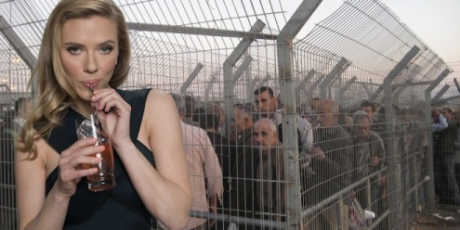
“SodaStream may wish to try and smear our movement, but it is clear that BDS campaigning and the Scarlett Johansson controversy has persuaded retailers across Europe and North America to drop SodaStream and contributed to SodaStream’s share price to tumble by half in the space of a year.
“Even when this closure goes ahead, SodaStream will remain implicated in the displacement of Palestinians. Its new Lehavim factory is close to Rahat, a planned township in the Naqab (Negev) desert, where Palestinian Bedouins are being forcefully transferred against their will. Sodastream, as a beneficiary of this plan, is complicit with this violation of human rights.
“Israel willfully destroys the Palestinian economy in the West Bank, leading to unemployment and economic crisis. The way to tackle this is to challenge Israel’s system of colonialism and apartheid.
“The BDS movement is opposed to all forms of racism, including anti-semitism and Islamaphobia.”
The BNC is the Palestinian Boycott, Divestment and Sanctions National Committee (BNC), the broad coalition of Palestinian civil society organisations that works to support the boycott, divestment and sanctions (BDS) movement.
Israel Slammed Over Plans to Demolish 17,000 Palestinian Buildings
Sputnik – 07.09.2015
Israel has plans to demolish 17,000 Palestinian-owned buildings located on mostly occupied land of the West Bank, a UN report has revealed, with concerns the demolitions will cause poverty and leave many families in a “state of chronic uncertainty”.
A report from the UN Office for the Coordination of Humanitarian Affairs (OCHA) concluded that as a result of new and outstanding demolition orders, up to 17,000 structures, including houses, sheds and animal shelters could be knocked down, despite the fact that 77 percent of the buildings are located on privately owned Palestinian land.
The structures under the threat of demolition are located in Area C, a zone in the occupied Palestinian territory of the West Bank where the state of Israel retains full security and administrative control.
Around 300,000 Palestinians live in Area C, which covers 60 percent of the West Bank, and is also the location of many Israeli settlements with a population of around 360,000 — which are deemed illegal under international law.
Close to 4,500 demolition orders are to affect the land of Palestinian Bedouins, who human rights activists say are under threat of losing their homes in exchange for more Jewish settlements in the West Bank.
The UN report raised concerns about the impacts such proposed demolitions might have on Palestinians living in affected areas.
“These orders heighten the vulnerability of thousands of poor Palestinian households, some of whom are at imminent risk of forcible displacement.”
It also pointed out that the manner in which demolition orders are handled adds to the suffering of locals.
“Structures built without permits are regularly served with demolition orders. While only a minority of the orders issued are executed, these orders do not expire and leave affected households in a state of chronic uncertainty and threat,” the report found.
“Where the orders have been implemented, they have resulted in displacement and disruption of livelihoods, the entrenchment of poverty and increased aid dependency.”
‘Nearly Impossible’ Permits
While Israeli officials claim that the buildings are under threat as a result of not having the correct planning permission, others point out the extreme difficulty many face in trying to secure proper construction permits.
According to data from the governing body in charge of affairs in the West Bank — the Israeli Civil Administration — Palestinians submitted 2,020 applications for building permits in Area C between 2010 and 2014, while only 33 were approved.
The report said that planning and zoning rules made “it is nearly impossible for Palestinians to obtain building permits in most of Area C.”
Israeli officials have been accused of widespread discrimination over their treatment of Palestinians in Area C, with only one percent of the zone legally earmarked for Palestinian development.
This is contrasted to the 235 illegal Jewish settlements and outposts that have been constructed in the area in recent years. Many critics have argued that while authorities are harshly critical of Palestinian constructions, they turn a blind eye to any potential breaches in Jewish settlements.
The report follows international outrage over Israeli plans to demolish the West Bank village of Khirbet Susiya in July, with EU officials specifically asking Israel to stop the “forced transfer of population and demolition of Palestinian housing” in the area.
Israel building separation wall to keep refugees out
Press TV – September 6, 2015
Amid what is being referred to as the worst refugee crisis since WWII, the Israeli regime has announced construction of a separation wall to keep them out.
During a weekly cabinet meeting on Sunday, Israeli Prime Minister Benjamin Netanyahu announced that a 30-kilometer fence is being constructed along Israel’s border with Jordan to stop “migrants,” he associated with terrorists, to enter Israel.
Israel finished the construction of a 230-kilometer wall along the Egyptian border in 2013; it also has set up fences along the border with Lebanon and along the line between Syria and Israeli-occupied Golan Heights. Most of the West Bank has also been split by a barrier.
According to Bibi, the wall would connect with the Egyptian barrier and that construction has started along Israel’s eastern border between the city of Eilat and near the site of a new airport in Timna Valley.
“We will continue the fence up to the Golan Heights,” said the Israeli premier. “We will not allow Israel to be submerged by a wave of illegal migrants and terrorist activists.”
Golan Heights has been under the Israeli occupation since the 1960s. The Tel Aviv regime captured 1,200 square kilometers of the Golan Heights during the Six-Day War of 1967 and annexed the region in 1981.
Netanyahu cited Israeli’s “very small” size and lack of “geographic depth or demographic depth” as the reasons behind the measures.
His comments came amid a refugee crisis in Europe due to influx of asylum seekers from conflict-ridden countries in Africa and the Middle East.
The United Nations estimates that 300,000 people have left the Middle East and North Africa for Europe this year, but 2,500 have died in their attempt, mainly through dangerous voyages across the Mediterranean in rickety boats. Media reports, however, say 350,000 have crossed into Europe this year.
Many of the world’s asylum seekers are ill-fated Syrians, fleeing the violence perpetrated by the Daesh Takfiri group.
According to documents from Israeli hospitals, the regime’s army has paid millions of dollars for the costs of treatment to the foreign-sponsored militants, injured during battles with Syrian government forces since 2011.
Featured Video

Why the U.S. Should Pull Back From the First Island Chain
or go to
Aletho News Archives – Video-Images
From the Archives
Only 19.7% of Americans agree with US State Dept on Israeli settlements
… Most American adults of voting age don’t appear willing to reject the applicability of international law to Israel’s ongoing colonization of occupied territories in East Jerusalem, the West Bank and Golan Heights. … Full article
Blog Roll
 Aletho News
- Albania on fire: who’s behind the riots?
- Egypt’s Civil Democratic Movement rejects involvement in regional war
- Egypt collaborates with Israel to build ‘Green Rafah’ project over erased Palestinian city
- Rising fuel prices and shortages have helped drive ongoing protests and rioting in France
- Tokyo protests demand Takaichi’s resignation over support for ‘Israel’
- Jennifer Kavanagh: Why the U.S. Should Pull Back From the First Island Chain
- Yemen denounces international community’s silence on Saudi aggression, siege
- UAE and Saudi Arabia move toward renewed coordination against Sanaa
- How Iran’s two-week retaliatory strikes exposed cracks in US military architecture in Persian Gulf
- The mother of all propaganda: Why the hype over US MOAB strike against Iran is nothing but theater
- If Americans Knew
- What the UK Is Doing to Pro-Palestine Novelist Sally Rooney Is an Act of Orwellian Villainy
- ‘We will build palaces for Jews in Gaza’: Right-wing activists establish new outpost near border
- ‘You see us burning, you stay silent’: Family’s agony over mother and sons burned to death in Gaza tent
- Israel keeps Palestinian journalist Bushra al-Tawil in isolation for 46 days
- US-Israel integration plan puts US military tech in Israel’s hands
- Israeli Strike Burns Gaza Mother Alive in Front of Toddler, ‘Without Generating Any Headlines’
- ‘The Israel Experience with Mike Huckabee’: The Ambassador’s Family Sells Trips to Israel
- As Gazans carry out mass burial, food insecurity is getting worse – Daily Update
- Israeli rabbi permits occupiers to steal Palestinian olive harvest in West Bank
- Netanyahu’s spin on latest settler attack is laughable – Daily Update
- No Tricks Zone
- Predictions Made By Renowned Climate Proifessor Over Past Decades Have Been Proven To Be Poor
- New Study Suggests Large Regions Of The Pacific Ocean Have Been Cooling For The Last 80 Years
- Germany’s Green Energy Debacle: High Energy Costs Force Kahla Porzellan to Close After 182 Years!
- New Study: 50 Years Of The Most Aggressive ‘Net Zero’ Policies Can Only Affect The Global Climate By 0.03°C
- US September “Heat” Was No Record…Many Records Set Decades Ago
- Latest European Green Energy Debacle; Portugal’s Largest Flagship Solar Park Insolvent!
- Green Energy Debacle: German Expert Professor Fritz Vahrenholt Warns Of Severe Economic And Social Consequences
- Two More Paleo Reconstructions Affirm Meters-Higher Sea Levels Across Ireland, Brazil 7000-6000 Years Ago
- New Study: Earth And Venus Surface Warmth Largely Explained By Convection And Lapse Rate, Not CO2 Or Radiation
- 2025 Nature Paper Claiming Worsening Global Drought Gets RETRACTED …Heavily Flawed

