Ukraine unrecognized republics demand international tribunal on Kiev actions
RT | July 8, 2015
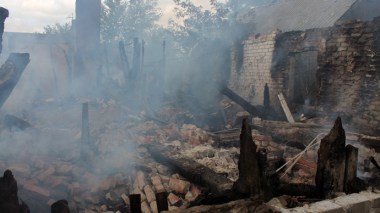
The heads of the Ukrainian unrecognized Donetsk and Lugansk republics have asked the United Nations Security Council to establish an international tribunal to investigate and prosecute those responsible for waging civil war in eastern Ukraine.
“Donetsk People’s Republic [DNR] and Lugansk [LNR] People’s Republic are addressing the UN Security Council with a plea to establish an international tribunal for legal prosecution of those responsible for violation of the International Humanitarian Law and crimes against humanity in Ukraine,” the DNR head, Aleksandr Zakharchenko, and LNR head Igor Plotnitsky said at a joint press conference.
Those found responsible should be brought to trial, they stressed.
The heads of the unrecognized republics are calling for the leaders of Russia, the US, China, Great Britain and France to consider this proposal at the next UNSC session.
“Expecting your soonest reply to the proposal,” Plotnitsky said.
Aleksandr Zakharchenko said Kiev’s operation in Donbass is “a direct violation of the Geneva convention.”
The military operation in eastern Ukraine began in spring last year after residents in the Donetsk and Lugansk regions refused to recognize the coup-imposed government in Kiev.
On February 12, in Minsk, peace negotiations between the two sides resulted in a second ceasefire agreement. The first was signed in summer 2014 and was violated practically immediately. The current ceasefire is also being violated on a frequent basis. Shelling in the self-proclaimed Donetsk and Lugansk People’s Republics happens every other day, with both sides pointing the finger at each other.
Aleksandr Zakharchenko said the prosecutors’ offices of both republics have collected copious evidence of war crimes committed by Kiev troops.
“There is a considerable volume of evidence of the Ukrainian National Guards’ involvement in torture and killing of civilians. Dozens of mass graves have been found on territory that was occupied by Ukrainian troops,” Zakharchenko said.
The DNR and LNR also have evidence of Ukrainian troops using weapons prohibited by the international arms conventions, including cluster and phosphorous bombs.
Since the beginning of 2015 an estimated 1,212 civilians, including 25 children, have died in shelling incidents.
New Online Terrorism Reporting Bill Will Harm Minorities, Chill Speech
By Gabe Rottman | ACLU | July 7, 2015
If there’s one thing the First Amendment stands for, it’s that vigorous debate about the issues of the day—even, and perhaps especially, uncomfortable debate about things like racism or terrorism—should be free from government interference. Tragically, that principle has been betrayed repeatedly over the past decade and a half, as law enforcement agencies continue to single out individuals for scrutiny based on speech or association protected by the First Amendment.
And, if the Senate intelligence committee gets its way, we’ll be chalking one more betrayal up on that blackboard. Last week, the press reported that the committee had secretly inserted a provision in a spending bill that would require social media companies to report posts about “any terrorist activity” to the government.
The bill is hopelessly vague on what that means. That’s because it goes far beyond a reporting requirement for wrongful conduct—terrorist activity—and will invariably result in the reporting of speech about terrorism—including by activists and other peaceful people with forceful opinions.
In practice, were this to become law, websites will likely do a couple of things.
First, they will over-correct and start taking down content wholesale. They will monitor posts for keywords like ISIS or “don’t tread on me” (a libertarian slogan that some identify with white supremacist and anti-government ideology) and pull them. That will chill an enormous amount of online debate over sensitive and important topics like the propriety of the Confederate flag memorial in South Carolina.
This is not a theoretical concern. There are numerous cases of large internet content companies taking down uncomfortable—but perfectly legal—speech because of government pressure (far less than the mandatory reporting requirement in this bill). For example, Apple voluntarily blocked applications that permitted users to identify the sites of overseas U.S. drone strikes. Say what you will about the legality, ethics, or wisdom of overseas drone strikes themselves (and we’ve had a lot to say), the free flow of information about drone strikes—such as their locations—is essential to feed vigorous and unfettered debate about this critical issue. One can just imagine what would disappear from the online debate in the face of a must-report law.
Second, and perhaps worse, companies—faced with the proposal’s utter lack of guidance on what the law requires them to report—will apply it inconsistently. Our nation’s history and its recent post-9/11 practices tell us that sensitive issues of particular interest to vulnerable minorities—religious, racial, ethnic, social, political, etc.—will receive more scrutiny, and therefore more censorship.
Consider, for instance, online discussion about the spate of police shootings of unarmed African-American men, and claims by many in law enforcement that the growth of a protest movement against police violence is feeding violence against the police. There have been several indications that the FBI is quite literally treating activists in the #blacklivesmatter initiative as suspected terrorists. Undoubtedly, some social media platforms are going to follow that lead, report that content to the FBI, and thus perpetuate the targeting of minority groups for law enforcement scrutiny based on First Amendment activity.
Free speech means ensuring the public square—which is increasingly migrating online—is open to viewpoints and arguments that we disagree with or find objectionable. Oftentimes, the hurly burly of public debate includes opinions that may make us squirm, but that nevertheless have an important place in a country that values truth above comfort in the marketplace of ideas. We have a right to discuss any issue, even sensitive ones, without fear that our internet provider, social media platform or telephone company is monitoring and reporting what we say. This bill language would lead to the improper monitoring and suppression of constitutionally protected speech.
Israeli Minister to Decide on Deportation of Palestinian MPs
Ma’an – July 7, 2015
The Israeli Minister of the Interior was given 30 days by the Supreme Court on Monday to reach a final decision on the possible deportation from East Jerusalem of three Palestinian lawmakers and a former Palestinian Authority Jerusalem affairs minister.
Monday’s hearing was a follow-up to a previous hearing in the same court on May 5, 2015 that discussed the possibility of revoking the Jerusalem residency rights of officials Muhammad Abu Teir, Ahmad Attun, Muhammad Tutah and Khalid Abu Arafeh.
While Abu Arefeh formerly served as the PA’s minister of Jerusalem affairs, the other three are members of Palestine’s parliament, the Palestinian Legislative Council.
All four live in occupied East Jerusalem.
The Israeli Ministry of the Interior has been threatening to deport the lawmakers and former minister since Hamas won Palestinian legislative elections in 2006.
The pretext for the ruling is disloyalty to the Israeli state, the lawmakers said last year.
The four were initially detained along with other lawmakers and, after their release, Israeli police seized their identity documents.
The permanent residency status of 107 Palestinian residents of East Jerusalem was revoked in 2014, adding to the 14,309 revoked by Israel since 1967.
Gaza war anniversary: ‘Aggressive’ UK police arrest 8 at Israeli arms factory protest

RT | July 6, 2015
Staffordshire Police have been accused of making a “heavy-handed” intervention during a protest outside an Israeli arms factory organized to mark the anniversary of last year’s Gaza conflict.
At least eight people were arrested Monday during the demonstration outside a factory in Shenstone, which is owned by a subsidiary of Israeli defense contractor Elbit Systems.
An activist with London Palestine Action, speaking in personal capacity, told RT that the demonstration was meant to be a “fun, creative” experience, but was met with “aggressive [and] forceful police tactics.”
Campaigners estimate 200 people attended the protest near Birmingham, which was the site of a similar blockade in August 2014.
The protest was timed to mark the one-year anniversary of start of the Gaza conflict. Activists held a memorial service for the 2,200-plus Palestinian victims, 490 of whom were children.
Protests were also held in Tamworth and Broadstairs in the UK, and Melbourne in Australia.
Shenstone protesters targeted the UAV Engines factory where engines for Hermes, one of Israel’s primary armed drones, are manufactured.
Drones owned by the Israeli Defense Force (IDF) may have been used in attacks that resulted in civilian deaths and violated international law, according to reports by Human Rights Watch and The Guardian.
A variety of campaign groups including War on Want, Campaign Against the Arms Trade and the Palestine Solidarity Campaign united under the umbrella movement “Block the Factory” to organize the day of action.
Protesters posted videos on Twitter indicating a heavy police presence. At one point, a police officer is seen dragging a man holding a megaphone out of a crowd and arresting him.
Speaking to RT, activist Alex Levan, 31, said organizers had intended the protest to be peaceful.
“There were lots of police from early on,” he said. “They were very rough, they manhandled protestors, [and] they were very heavy-handed.”
“The idea was to reclaim the space around the factory and to turn it into a real festival environment, a creative activist environment with workshops, with a family space, with arts and crafts.”
“But the police were heavy-handed, they’ve made at least 10 arrests, but there will probably be more. These were completely unprovoked arrests, these were peaceful protests,” he added.
“But we did spend the majority of the day, from the early hours of the morning, blocking the factory.”
The protest succeeded in halting factory production for the day.
Activists called on the British government “to initiate an immediate two-way arms embargo – to stop arming Israel and to stop buying weapons from Israel.”
The Hermes, which is partly produced in the UK, carries two Spike-MR (medium range) missiles, which are produced by Israeli firm Rafael Advanced Defense Systems.
It can stay airborne for up to 24 hours at altitudes of up to 18,000 feet (5,486 meters) and is equipped with optical, infrared and laser sensors that enable it to identify and track targets.
Human Rights Watch claim to have found evidence Spike missiles were used against two Red Cross ambulances during Israel’s conflict in Lebanon in 2006.
Six medical workers and three patients were injured in the attack. The Geneva Convention forbids armed forces from targeting medical staff or hospitals.
Staffordshire Police Chief Inspector Steve Smith said: “At Tamworth this morning, a number of individuals climbed onto the roof of a factory building as part of a protest. All seven voluntarily came off the roof. Police officers then directed them to leave the area under public order legislation. No arrests were made.
“At Shenstone, a number of protesters locked themselves to fencing and others blocked the road. A civil injunction is in place around this location so police have the power to arrest anyone breaching this injunction.
“So far eight people, seven men and one woman, have been arrested on suspicion of breaching a high court injunction.”
Israel seizes 600 dunums of Palestinian lands in Occupied Jerusalem
Palestine Information Center – July 5, 2015
OCCUPIED JERUSALEM – Israeli mayor of Jerusalem, Nir Barkat, ordered that 600 dunums of Palestinian lands in al-Issawiya, in northern Occupied Jerusalem, be temporarily confiscated allegedly for gardening purposes, Peace Now reported afternoon Saturday.
The misappropriation order was issued using a special municipal law that allows the municipality to exploit an empty lot for public uses for five years in cases where the owner does not develop it. Al- Issawiya locals found the orders spread out in their fields.
The lands in question have been targeted by the Israeli occupation authorities in recent years, when a plan to declare them a National Park was promoted in order to create an Israeli dominated continuity between Occupied Jerusalem and the area of E1. The park is also meant to block the potential development of the adjacent neighborhoods of al-Issawiya and al-Tur.
It is required according to the law that the land owners refuse or choose not to make use of the tracts. When the owner wants to use his or her private property they are allowed to do so in accordance with the approved construction plans, Peace Now further stated.
In the case of al-Issawiya, the owners wish to make use of their lands. One month ago, the municipality uprooted trees that were planted by the Palestinians under the pretext of unlicensed cultivation. Thus, it seems now very hard to explain why a Gardening Use Order is required in such case when the owners wish to do the farming on their own.
According to analysts, it seems that in order to bypass the need to declare the lands as National Park, the Israeli occupation authorities are trying to take over the lands through other illegal means.
Peace Now added that the goal of the Israeli authorities is to prevent any potential Palestinian capital in East Jerusalem by taking over and blocking the lands necessary for the future development of a viable Palestinian state. The Jerusalem Municipality and the National Parks Authority seem so obsessed with creating an Israeli dominated corridor in the area, making use of the law only as a pretext for a political agenda.
A month in Palestine
By Tom Blanx | MEMO | July 4, 2015
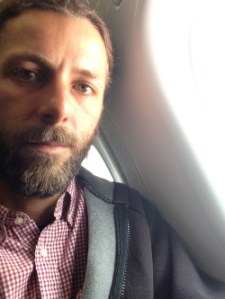 This May, I travelled to the West Bank in occupied Palestine.
I had a fairly good idea of the kind of things I would see when I went, but wanted to take a closer look at what I think is an unfair and asymmetrical situation. I don’t stand against Jews or Israelis. I stand against racism, violence, oppression and ignorance, and all of those things, I think, are here.
During my time in the West Bank, I lived and worked with a Palestinian farmer who runs a Permaculture Project in a small village called Marda. I wanted to see for myself what life was like for Palestinians living under occupation and how Permaculture could help.
Knowledge is everything and with that in mind I’m sharing everything I saw, heard, thought and felt in the time I was there.
Below are excerpts from Tom Blanx’s blog. Read the full blog here.
Getting in
For those who haven’t been, Israel’s not the easiest of places to get in and out of. And if you plan on checking out the occupied territories you’ll need to be a bit creative with the truth. Despite my polite passport note from the queen, I decided not to reveal how freely I would be passing while on my travels as it would have most likely landed me straight back on British soil. This had happened to previous volunteers so the NGO I had organised the trip with had suggested that I lie.
With the help of Murad, my Palestinian friend and his friend, an Israeli who will remain anonymous, I pretended I was traveling to help and learn on a farm in the south. I probably could have said I was there for a beach holiday or Christian visit too, but a bag full of work boots and full length clothing might have been a giveaway. Murad told me to just remain calm and answer all questions confidently but it was a nerve racking and intimidating experience. Much more than I remember it being when I was 18 coming here. In the end I think I got in by inadvertently playing dumb.
Getting into the West Bank was more straight forward. I got on a bus from Tel Aviv bus station all the way to Ari’el (An illegal settlement, next to Marda). There are no stops or checkpoints for settlers (on the way in) so all I had to do was get off before the bus turned into the settlement where Murad was waiting for me and I was in. A better understanding of his instructions, some Hebrew and useful geographical knowledge and I probably wouldn’t have ended up bang in the middle of the Ari’el in the isolating situation of looking for a Palestinian village. I haphazardly navigated my way out of on foot and was an hour late – not the look I was going for, but I guess he was going to find out what I’m about sooner or later.
Marda
Marda is in the Salfit district which is biggest producer of olive oil in Palestine. The village is effectively a ghetto, with reinforced steel gates at each end for when the army want to shut it down and a high metal fence and barbed wire around it, although some of these had been damaged and removed. There used to be resistance here, but like in lots of the rest of Palestine, occupation has become normalized. These days the village is quiet and peaceful. People work and children go to school, cats wander around the place looking for food and donkeys everywhere sound like they’re dying. The village sits directly under the hilltop Ari’el settlement, the 4th biggest in the West Bank. Murad said he used to play there with his friends when he was young before Zionists confiscated and destroyed 9000 dunams of it, in the late 70s to build luxury homes, streets and a university for Israelis and Jewish immigrants. The juxtaposition of the two towns, is a powerful thing to see and its something that you can’t help but see, every day.
As I arrived in Marda another volunteer was leaving. Her name was Judy, a 60 year old American woman from Australia travelling by herself. I wouldn’t normally mention someone’s age or circumstances but I think its significant as many people think the West Bank is too dangerous to travel to and that women could be more vulnerable here. Neither are true. It was her 5th visit to Marda so I wanted to get as much information out of her as I could in the 30 minutes she had left. She gave me the dos and don’ts about living in Marda, how to be with Murad and told me to explore as much as I could of Palestine “You can’t charaterise Palestine on what you see in just Marda as much as you can’t charaterise the US on what you see in Miami”
Murad
Straight away I felt at ease with Murad. From our first Skype conversation, to meeting him an hour late after getting lost, I felt welcome and at home. Chilled and pragmatic, straight talking and funny are the best words I can think of to describe him. Everywhere we went there was banter. Banter with friends, banter with strangers. Sometimes he sounds like he is angry when he’s talking in Arabic but then he laughs and I know he’s not. Judy said his bark is worse than his bite and I now know what she means. “C’mon man!… what you doing man?!”… “Why you sayin sorry all the time man” still echo round my head.
Murads family have lived in Marda for generations spanning centuries. His wider family numbers in the 100s. His immediate family is his his wife, Ghada, daughters Sara, Halla and Tooleen, his youngest – son Khalid, his Mother, Twin brother, older brother, three sisters and their families. I think I can count the number of people in my family with my fingers!
The old house he grew up in has itself been in the family for 300 years. His Mother and twin, Hazim live there now and on my first night, he took me to meet them. We ate dinner, looked at our phones (There’s no escaping it!!!) and then I helped Murad download a Lionel Richie “hello” ringtone he wanted for when Ghada called him. I asked him what other music he liked and he said “none”. “But you like Lionel Richie though?” No. just that song.” Then I reconfigured his answer and decline buttons so he could, in his words, hang up in peoples face.
When violence broke out in the second intifada (literally translated as uprising), Murad decided to leave Palestine. With his Palestinian passport, he traveled to America and spent time working in Chicago and Tennessee. In 2006, he returned to inherit his Father’s land and with some basic knowledge of permaculture from a previous project, he started Marda Permaculture farm.
The Permaculture farm
The farm is 2 1/4 dunams in size. A duman is about 1 square km. The farm has Bees and produces large quantities of honey each year, 5 kilos of which is exported to customers in Qatar. He has chickens and pigeons (with their own cob-built houses) for eggs and meat and and plans on getting some goats and a cow.
The farm is Murad’s livelihood, but its more than that. The farm is his way of fighting the occupation. By growing his own food and providing his own income, he doesn’t need to buy expensive food and water or look for work abroad or in Israel. Permaculuture gives him good health, independence and empowerment.
The farm is a centre for students, activists and volunteers and Murad hopes his model will raise awareness of Permaculture in Palestine and begin to change local peoples attitudes towards farming.
Getting around
I did most of my exploring with Murad. I only did my own thing a couple of times. Once when I went to Jerusalem with Gaie (another volunteer who helped at the farm for a few days) and another time when we split up in Rammalah and I went to see qalandia. But we always left Marda together. Murad wasn’t into the idea of me travelling by myself in case I got mistaken for a settler or deported for being a friend of Palestine. They’re weren’t any bus stops in Marda so unless you hail a passing taxi or sherut you hitch a ride to somewhere you can get a bus. The nearest place to us was Zattara Junction (Tappuah junction for Israelis). From here you can go in three directions north to nablus, east to jericho and south to Rammalah. It used to be checkpoint but some of these have eased off in recent years. There’s still a large military presence here though. Lots of Israelis use the junction so cars are still stopped, IDs are still checked and people are still harassed. We saw one guy in his early 20s being checked out by two soldiers wanting to know where he had been, where he was going, and why he needed to go there.
As we make our way to the bus stop to Rammalah we have to go through the rigmarole of crossing the side of the road we need to the central reservation, avoiding Israeli only bus stop which Palestinans are not allowed to be near, to then cross back 50m further along where the anybody else bus stop is. You keep your head down here as you feel the eyes of soldiers and settlers weigh down on you. You’re at the mercy of the army here, they have done and can do anything they want to you here. This a cold violence that all Palestinans have to go through on a daily basis.
Nablus and Tulkarem
This was the first place outside Marda that I explored. It used to be an important junction on the Old Silk Road and was a strong resistance town in the years following the occupation. Nowadays, its very normalised – the occupation. Like the rest of the country, people are just trying to make enough money to survive. Food and drinks, shops and markets are everywhere. Women are covered up, some even more than in Marda wearing full burkhas which you can also see displayed in shop windows. Lots of women whiten their faces here too. Looks really strange sometimes. On the hilltop behind the city is the largest refugee camp in Palestine – 30,000 refugees packed into ¼ of a sq km. Like the one outside Rammalah they resemble Rio’s hillside favelas. Beautiful backdrop and ugly consequence all at the same time. As we ate a shrawma outside we saw men putting flags up in the main square and cars driving round honking their horns. They were celebrating the release of a young man who had been put in jail by the Israelis. I don’t know who he was or what he had been jailed for but I’m guessing it was for a while and his release was a small victory.
A little bit further on is Tulkarem This is where we met Murad’s friend Fayez, and where I saw the wall for the first time. Like Murad, Fayez also runs a farm in a village just outside Tulkarem called Irtah. His story is amazing: resilience and steadfastness in effect. In a nutshell… Occupation forces tried to confiscate his land to use as a military post; some of the first sections of the segregation wall were built across 20 dunams of his land; he resisted the land confiscation and repeated attacks on him and his crops and was imprisoned, leaving his wife Muna, to manage the farm; 12 chemical factories considered hazardous to Israeli public health were relocated to the other side of the wall, one right next to his farm*; he thus grew more aware of the health impacts of fertilisers and pesticides and made the switch to organic production. Now his and Muna’s farm, famous for popular resistance attracts solidarity activists and volunteers from all over the world.
*Factory chimneys are used when the wind blows east into Palestine, and not when into Israel.
At his home we sat and drank zamzam with his family. Zam zam is holy water welled from the zam zam well in Mecca. They told me the story of zamzam, debating over the specifics but I’m struggling to make sense of my notes so here’s a simple kids version of the origin of zamzam I found online:
“This is the story of the ZamZam water. The water well of Zamzam is a well located within the Masjid al Haram in Mecca. It was a miraculously generated source of water from Allah, which began thousands of years ago when prophet Ismael (PBUH) the son of prophet Abraham and Hajar (the wife of prophet Abraham, May Allah be pleased with her) were thirsty and alone in the dessert.In this area there is very little water if any at all in some places. According to our tradition, Hajar (May Allah be pleased with her) was a very devout mother and wife. When she was separated from her Husband prophet Abraham (PBUH), she was left alone in the dessert, by herself with her small son Ishmael (PBUH). Prophet Abraham made a prayer for his young family as he left them behind and Allah provided the means of sustenance for them. Hagar (May Allah be pleased with her) ran seven times back and forth in the scorching heat between the two hills of Safa and Marwah, in desperation because her son cried as it was very hot and they did not have even a drop of water to drink. Allah provided a Miracle and the ZamZam well was born.”
Fayez’s son “carried” 20L of this water back from his hajj pilgrimage so it goes without saying that I felt really honoured be offered it. It’s meant to contain healing powers so you drink it in 3 sips and wish for good health. I drank mine to my Mum.
Jerusalem
Tony Blair has a multi million penthouse apartment that he rents for free in East Jerusalem. I saw it – Murads not even allowed to come to Jerusalem. No one who lives in the West Bank is, unless they own one of the hard to get permits I mentioned earlier. It’s like me needing permission to visit London.
Jerusalem (East) is as you would expect it to be – tourists, religious places of interest, sight seeing, crap selling blah. The tourism and globalism here makes it more relaxed in its attitudes to drinking and clothing, despite the religious significance of the city. In the old town/holy basin which is a busy Palestinian neighbourhood, Israeli settlers live in homes above the market taken from Palestinians now flagged up and fenced off. Below mesh is in place to stop settlers throwing waste down on the Palestinian’s markets there are Israeli homes.
We tried to get to the Al Aqsa mosque and dome on the rock but it was Muslims only after 4pm and being white and non Muslim looking we were turned away by Israeli police. They control who goes in and out here. It was interesting and maybe kind of nice to see Israelis help enforce the Muslim only after 4pm rule. Was also good to see some soldiers and locals getting on. Saw another soldier help a blind man into the square too which was nice. In the rush to cry dehumanization you can easily find yourself guilty of doing the same thing.
Jenin
Jenin was the furthest town I visited. We had to time our trip around the weather as it gets hotter here. Its in the agricultural north and took about an hour and a half of mountainous driving from Marda to get there although Jenin itself is mostly flat. Didn’t really get a chance to explore Jenin properly it was more of a meet this guy here meet that guy there day but one thing that was noticeable was the absence of anything Israel.
Unlike all the other places Id been to there was no army, no flags, no settlements. This might be because of its unbroken horizontalness as I’m pretty sure most settlements are built strategically on hilltops. Outside the hustling bustling town of markets shops and car-shop after car-shop after car-shop is industrial landscape with factories and fields growing tobacco fruits and vegetables. More mass production than organic production here.
Environment
Despite a deep connection with the land, it gets treated badly by many Palestinians, Israelis too. In many parts of the West Bank, streets and fields are scattered with rubbish. There’s refuse collection once a week in Marda but that’s just to collect landfill waste from peoples houses. Outside though, pedestrians, drivers, kids playing, even farmers, just chuck their empty packets on the ground. Many animals are treated badly: birds caged in small spaces to be sold as meat; donkeys toiling in the insane heat carrying people and heavy loads; dead puppies (clearly not treated well) left next to bins in the street, I could go on. On our way to the farm one day we saw that one donkey had given birth. Murad helped the new donkey to its feet and pushed her closer towards her mother which was tied up to a nearby tree but just out of reach. The next day we saw the same donkey, working, but not the infant. As another mouth to feed and a distraction to his working donkey, the owner, an old guy, chucked the new jenny away. This upset Murad, more out of waste than sentiment, but Murad cares. He understands the important roles animals have. I learnt this early on when some children visited us at the farm and one of them was trying to squash a bug. Murad stopped him and while I couldn’t hear what he actually said, it was clear Murad was telling the boy that he needed those bugs.
Then there’s Israel, the self titled environmentalists, chucking all kind of restrictions and protection laws onto Palestinians in the name of preservation whilst committing all kinds of environmental rights violations: sucking Palestinian land dry of water and selling it back to them at full price; allowing settlements to dump huge quantities of sewage into neighbouring Palestinian fields and villages, damaging buildings, soil and water supplies; poisoning waterways and soil with toxic chemicals; uprooting 1,000s of olive trees, trees that are peoples livelihood, trees that have stood since the Romans were here!; building over ancient springs and vital sources of water, affecting ecosystems and land irrigation; and then the walls and border gates affecting the migration patterns of an array of species.
Culture
I’d never been to a Muslim country before so my head naturally started to fill itself with assumptions and preconceptions of how things were or would be. I knew from the advice the volunteer program gave me, that Marda was a conservative village: No shorts, no singlets (LOL), no drinking, no drugs, and no approaching strange women romantically. I paraphrase but these were all suggested guidelines – Who’s been coming here??
Marda is a conservative village, traditional too – women cover themselves in public and sometimes socialise separately but everyone was friendly and interactive. If my Arabic spanned further than the “Hello, How are you? I’m fine, thank you” at its peak, I may have broken down even more social barriers. Word to the wise: Don’t go in for a handshake with women you’ve just met as you’ll be left hanging.
Despite the occupation and the harassment and intimidation that comes with it, everybody seemed upbeat. There’s a real togetherness here and its so much more chill than it looks and sounds from in the west. There’s lots of joking. Murad likes to take the piss out of people especially people that he likes. There’s one old guy we used to see and Murad always tries to tickle him.
It sounds like a stupid and obvious thing to say but Palestinians really love their children, especially young ones, almost as if preserving their innocence is everything. From about 7-12 boys go through a seen but not heard phase then at 13+ they’re targets for playful clips round the ear and downsizing banter. They have a lot of freedom in Marda. Children as young as 6 walk to and from school through the village, they go to the shops to buy groceries and play outside unsupervised. On paper it sounds like slack parenting but its not. The community polices itself. Everyone knows everyone and when children step out of line or get cheeky the nearest adult will call them up on it. I’d describe it as a golden age if the circumstances didn’t make it sound so ridiculous.
Politics
Murads not the type to push agendas. I wanted a Palestinian perspective on Israel, the occupation, and all the other things that go with it, so I was going to have to ask. Judy ,who I met briefly when I arrived in Marda told me “Don’t ask questions unless you’re ready to accept the context.” I wasn’t completely sure what this meant but I bided my time and began to write down some questions for Murad which I could ask him when we’d got to know each other better. In my spare time I started to plan a positive article about cooperating through collaborating. This had stemmed from seeing how Murad and his Israeli friend had been working together to sneak volunteers into Marda, but with one question my idea, or at least, my inspiration, was blown out of the water. “Do lots of Israelis come here to help?”
“Yes, but I don’t like it. It makes me look bad.” Murad doesn’t pull punches, he tells it as he sees it and when a group of Israeli peace activists came to work on the farm and found this out. He told me how they had asked him what they could do to help the Palestinian cause and in one word, he said, “leave”. “It sounds harsh, but this is a man who has been fired at, arrested, imprisoned, watched as his family’s land was turned into a lavish city for Israelis and Jewish immigrants, which has brought violence right to his door.
“These people say they are for peace but if they really were they would leave Israel. Who built your house?” he asked them. “The person who built your house is living in a tent and you talk about peace?”
Talk leads onto the testimonies of soldiers in, ‘Breaking the silence’. “Breaking the Silence are bastards! They kill innocent men women and children and then feel bad and say sorry? Fuck you’re sorry!” None of this is said in a raised or angry tone of voice. Murad, like lots of other Palestinians, thinks he’s been sold out. Sold out by Israel, sold out by America, sold out by Britain, sold out by Arab states and sold out by their own leaders. I try to explain that propaganda can make people do the worst kind of things but it sounds empty as I say it.
“The world doesn’t care. If it did, Palestinians would have justice.”
The Army
In the whole time I was in Palestine and Israel the only times I ever felt threatened, nervous or insecure was near Israeli police and soldiers. 15 years ago I was in Tower Records in Tel Aviv and 2 young soldiers stood next to me looking through CDs while on duty. It was strange then and it is strange now. In Israel, everywhere soldiers are on the move. Its like scouts but with guns. It’s like something out of the Paul Verhoven film, Starship Troopers. Beautiful, fresh faced, young men and women, IDF issue Tavor assault rifle in one hand and smartphones in the other, all “doing their part!, knowing their foe!, guaranteeing citizenship!” because at the end of the day, “its us or them”
The idea that an 18 year old with a gun has the power to harass and disrespect civilians often much older and wiser than them leaves a nasty taste in my mouth.
For me, military service here is more about protecting a lie than protecting citizens. Imagine a reality where young men and women are indoctrinated with the idea that they are defending their country when all they’re really doing is supporting a decades long colonisation project. It almost doesn’t seem real. Almost.
Pigs
About 5 days in, I was smoking a cigarette on the roof when I heard a gravel moving noise coming from the hill behind my house. The street lights made it difficult to see what it was but I could just about make out a group of large figures making their way down this track. It looked like humans, big humans, on all fours, coming down the hill!! I was scared! The settlement was just up the hill and I’d heard stories of past incursions and still new to this unfamiliar and relatively (to me) troubled place, my imagination and stupidity got the better of me. Reality checked eventually and I concluded they weren’t humans. I still didn’t know what they were though, so I didn’t move or make a sound and just watched as these night monsters marched on by.
The next morning I tell murad what happened… And in his most blasé voice tells me, “That’s the pigs man…. They come and destroy everything in a few minutes!”
So I looked it up. It’s not just in marda. Apparently all over the West Bank wild pigs have been wrecking crops and trees and sometimes attacking people, all since around 2004. People claim they were introduced after the last intifada. One guy even told me he heard a truck load of them had been seen being unloaded in some fields. It’s a wild claim, but in a place where pollution is directed towards specific communities, raw sewage is dumped into village’s water supply and Settler children are marched through villages abusing locals, it becomes more believable. I can only speculate as why pigs. Agitation? Disrespect? One guy joked that Islam should introduce a temporary fatwah so that people could eat the pigs and turn the problem into a solution.
“In 2004 there were no pigs in Palestine! Now there are pigs! They don’t fly in!”
Murad showed me some of the damage they had done to his corn field. To protect his farm he put up a barbed wire fence but it was only when he attached tyres to the fence that they stopped getting in.
I became obsessed by this thing! I really wanted to see the pigs again, I set my alarm to wake me up at all hours, but I never saw them. There were some near encounters. We just missed them on the way to work one day when some builders sent them running down the hill throwing stones at them
A law was passed to protect the pigs so farmers are not allowed to kill them. It would take a bullet to the head to do it apparently which would be pretty hard as you’re not allowed weapons of any description in Palestine.
Getting out
On the way back its the same bus back to Tel Aviv. After speaking to other internationals I was prepping myself for a grilling at the airport. I wasn’t expecting to be removed from the bus by armed officers in plain clothes. And I wasn’t prepared to explain why I was in the West Bank on a settler bus and not where I said I would be in Israel proper. People told me to answer questions confidently, honestly and vaguely. A lot of officials I dealt with had a mediocre knowledge of place names so this helps with the vague answering. You might get through that but you’ve probably been flagged for more security checks. And if you have it’s a tough run in til the fight home. At check in and security your bags will be emptied, their contents swabbed and analysed, your body searched and scanned and your skill at answering repetitive questions tested.
And when you collect your bag from Gatwick airport luggage hall you’ll even find a courtesy note inside explaining that someone’s had another good look through your gear and put everything back as they found it. ‘Come back anytime’ ain’t the vibe I’m getting.
I plan on going back for olive harvest this year but won’t hold my breath on getting in. If one trip is that suspicious, another is probably smoking gun territory.
Ulterior motives behind sanctions on Iran: Ayatollah Khamenei
Press TV | July 4, 2015
 Leader of the Islamic Revolution Ayatollah Seyyed Ali Khamenei says the sanctions against Iran have nothing to do with the country’s nuclear activities or human rights record, adding that there are other motives behind the bans.
Addressing a group of university professors and researchers on Saturday night, Ayatollah Khamenei said those who have imposed sanctions on Iran are themselves the ones who foster terrorism and commit human rights violations.
The Leader said the sanctions against Iran have been imposed because the Islamic Republic has emerged as a nation, a movement and an identity guided by principles against the hegemonic system.
“Their objective is to prevent Iran from reaching a prominent civilizational status,” Ayatollah Khamenei said.
The Leader also highlighted the special role of professors in educating a generation of self-reliable, confident and diligent youths who will further move Iran toward progress.
Samantha Power Lies to Congress About Civilian Shelling in Ukraine, Commits Felony
Russia Insider | July 3, 2015
- The US Ambassador to the UN, she claims she believes majority of civilian shelling casualties are victims of the separatists.
- The penalty for lying to Congress is up to 8 years of imprisonment.
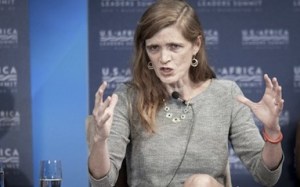 Ambassador Power’s testimony was the subject of a story we ran on Monday of this week, and a helpful reader got back to us and pointed out that we had missed the most important part of it.
Apparently, Ambassador Power lied to the committee she was testifying before, thereby committing a felony.
Congressman Rohrabacher, one of the loudest critics of Obama’s Russia policy, asked her if she thought it might be possible that the majority of the civilian casualties killed in Ukraine were victims of the Ukrainian army.
It was a “gotcha” question, because this is a universally acknowledged fact.
Here is what the ambassador answered:
“I think it is highly unlikely on the basis of reports we have received from the United Nations and the OSCE.”
See 1.50 in the video:
This statement is demonstrably not true. Reports from the UN and the OSCE conclusively demonstrate what it obvious to everyone even halfway paying attention – that the victims are almost universally victims of Ukrainian army shelling.
It is starkly preposterous to suggest otherwise, because even a dimwit could grasp that the separatists are unlikely to bomb their own people.
It is simply not plausible that the ambassador believes this, and is not aware of the facts.
Ironically, Power is the author of a book which studies US foreign policy responses to genocide, so she has more than a passing interest in these issues. The book’s title is A Problem from Hell: America and the Age of Genocide,
She has made protection of human rights a hallmark of her career, yet she is one of the most energetic and committed boosters of the aggressive Ukrainian military campaigns in the East, which have featured the most barbaric human rights violations imaginable – shelling defenseless civilians – children and elderly, with horrific, blood-curdling casualties, visible for all to see in gory detail on Youtube.
The shelling serves no military purpose and is done only to terrorize the local population in the hopes of triggering a Russian response.
Here is what the law says:

Florida Man Accused of ‘Terrorism’ Based On Book Collection
Counter Current News | July 2, 2015
Imagine being falsely accused of terrorism for nothing more than the books you have read. Well that’s exactly what has happened to a Florida man named Marcus Dwayne Robertson.
The U.S. government composed “snippets of information from various sources, out of context, to weave together a narrative of terrorist ideation,” according to a Florida judge.
That judge just ordered the release of Robertson, also known as “Abu Taubah,” an Orlando, Florida resident and Islamic scholar. Abu Taubah was accused of “supporting terrorism,” but the “evidence” against him amounted to nothing more than the books on his bookshelf.
Robertson, also known as “Abu Taubah,” was incarcerated from 2011. The charges he faced, however, were tax fraud and illegal gun possession. Not exactly “terrorism.”
But following his arrest and conviction stemming from these charges, prosecutors added what they termed “terrorism enhancement” to the sentence.
There seems to be no rationale for this other than ABu Taubah’s religious orientation… that and his book collection.
This sentencing guideline modification would have locked Robertson up for 20 years.
But the judge’s recent rejection of this bizarre, Orwellian sentencing “enhancement”, led to the Islamic scholar being released immediately.
Robertson’s sentence was argued as justifiable by prosecutors who said the contents of his Islamic book collection were sufficient “evidence” that he was connected to terrorism.
Approximately two dozen eBooks that Robertson downloaded were presented as “evidence” of his “terrorist connections.”
Prosecutors highlighted passage after controversial passage, as though this could serve as legitimate evidence that someone is a terrorist. They didn’t seem to understand that the contents of a book someone owns cannot be used as evidence against them.
A memorandum obtained by First Look was issued along with Judge Gregory A. Presnell decision. That memorandum strongly rejected the government’s argument that eBook passages could be used as “evidence” of “terrorism.”
“[T]here was no evidence produced that Robertson ever accessed these particular documents, much less that he took their extremism to heart,” Presnell argued.
He made it clear that even if the Islamic scholar admitted to having read the eBooks in question, this would not and could not be used as evidence of terrorism.
“The government has never disputed Robertson’s claim of being an Islamic scholar,” he added. “It is not at all remarkable for an Islamic scholar to study, among many, many others, the writings of Islamic extremists.”
He said that beyond this, the prosecutors did “not even come close to proving… Robertson’s relatively minor income tax fraud was intended to promote a federal crime of terrorism.”
The judge noted that he received “hundreds of emails” over the last few weeks that urged him to lock up the man for no reason other than because he was a Muslim. These emails amount to little more than racism and bigotry in most cases, and fear-mongering and ignorance in the rest.
“In America, everyone has a right to say and believe what they want, within the bounds of the law,” Presnell said before declaring that Robertson would have to be released immediately.
Robertson’s lawyer Daniel Broderson agreed that “at no point did the government ever have any actual evidence [Robertson] advocated terrorism, so they attempted to use his library of books as a backhanded way of branding him as a terrorist. He spent four years in prison, two years of it in isolation, over a prosecution that was both unfounded and that completely ran afoul of the first amendment.”
Speaking to The Intercept after he was released, Robertson said, “they’re trying to find an indirect way to sentence people with non-terrorism charges as though they’d committed terrorism offenses, without having to provide the preponderance of evidence that is normally required in such cases. You own a few books and some guy tells an informant you said something, and suddenly that is legal basis enough to sentence you to prison for decades.”
He added that he “lost all those years, in jail, in terrible conditions, away from my family. After all that, they couldn’t produce one single statement from me that supported terrorism.”
Protest commemorating one year anniversary of the killing of Mohammad Abu Khdeir met with military violence
International Solidarity Movement | July 3, 2015
Ramallah – On July 2, 2015, in honor of the first anniversary of the murder of Muhammad Abu Khdeir, Palestinian activists with international supporters blocked a settlers-only road leading to the illegal Adam settlement. Demonstrators cited this road as the road that the murderers took in their search for a Palestinian victim. Journalists, Palestinian and international activists, suffered from pepper spray burns and several were hospitalized.
“This is the first in a week of demonstrations for Muhammad Abu Khdeir. One of the murderers, Yosef Haim Ben-David, is from the Adam settlement. This is why the demonstration was held at this settlers-only entrance,” said Abdullah Abu Rahmah, the coordinator of Popular Committee Against the Wall and Settlements in Bil’in.
Demonstrators blocked the road to settler traffic in both directions until the Israeli Army and Border Police dispersed the non-violent demonstrators and journalists by pepper-spraying indiscriminately. Three Palestinian activists, four journalists, and two International ISM volunteers were pepper sprayed in the eyes and mouth by a masked Army officer. An ISM co-founder as well as journalists from Roya TV Channel, Reuters, and Palestine TV were severely pepper sprayed in the eyes requiring hospitalization.
The soldiers threw sound percussion grenades at demonstrators and chased people. In addition to the pepper spray, they shoved journalists and Palestinian activists to the ground.
After the soldiers and border police chased the demonstrators off the road and down a hill, they continued to throw percussion grenades even as the demonstrators stood at a distance waiting to find fellow demonstrators.
Featured Video

Why the U.S. Should Pull Back From the First Island Chain
or go to
Aletho News Archives – Video-Images
From the Archives
Only 19.7% of Americans agree with US State Dept on Israeli settlements
… Most American adults of voting age don’t appear willing to reject the applicability of international law to Israel’s ongoing colonization of occupied territories in East Jerusalem, the West Bank and Golan Heights. … Full article
Blog Roll
 Aletho News
- British Government Employees Were Fact-Checking the News at the BBC. Nobody Told You.
- Albania on fire: who’s behind the riots?
- Egypt’s Civil Democratic Movement rejects involvement in regional war
- Egypt collaborates with Israel to build ‘Green Rafah’ project over erased Palestinian city
- Rising fuel prices and shortages have helped drive ongoing protests and rioting in France
- Tokyo protests demand Takaichi’s resignation over support for ‘Israel’
- Jennifer Kavanagh: Why the U.S. Should Pull Back From the First Island Chain
- Yemen denounces international community’s silence on Saudi aggression, siege
- UAE and Saudi Arabia move toward renewed coordination against Sanaa
- How Iran’s two-week retaliatory strikes exposed cracks in US military architecture in Persian Gulf
- If Americans Knew
- More on how Bari Weiss is using CBS on behalf of Israel
- What the UK Is Doing to Pro-Palestine Novelist Sally Rooney Is an Act of Orwellian Villainy
- ‘We will build palaces for Jews in Gaza’: Right-wing activists establish new outpost near border
- ‘You see us burning, you stay silent’: Family’s agony over mother and sons burned to death in Gaza tent
- Israel keeps Palestinian journalist Bushra al-Tawil in isolation for 46 days
- US-Israel integration plan puts US military tech in Israel’s hands
- Israeli Strike Burns Gaza Mother Alive in Front of Toddler, ‘Without Generating Any Headlines’
- ‘The Israel Experience with Mike Huckabee’: The Ambassador’s Family Sells Trips to Israel
- As Gazans carry out mass burial, food insecurity is getting worse – Daily Update
- Israeli rabbi permits occupiers to steal Palestinian olive harvest in West Bank
- No Tricks Zone
- Predictions Made By Renowned Climate Proifessor Over Past Decades Have Been Proven To Be Poor
- New Study Suggests Large Regions Of The Pacific Ocean Have Been Cooling For The Last 80 Years
- Germany’s Green Energy Debacle: High Energy Costs Force Kahla Porzellan to Close After 182 Years!
- New Study: 50 Years Of The Most Aggressive ‘Net Zero’ Policies Can Only Affect The Global Climate By 0.03°C
- US September “Heat” Was No Record…Many Records Set Decades Ago
- Latest European Green Energy Debacle; Portugal’s Largest Flagship Solar Park Insolvent!
- Green Energy Debacle: German Expert Professor Fritz Vahrenholt Warns Of Severe Economic And Social Consequences
- Two More Paleo Reconstructions Affirm Meters-Higher Sea Levels Across Ireland, Brazil 7000-6000 Years Ago
- New Study: Earth And Venus Surface Warmth Largely Explained By Convection And Lapse Rate, Not CO2 Or Radiation
- 2025 Nature Paper Claiming Worsening Global Drought Gets RETRACTED …Heavily Flawed

