Ukrainian Security Service (SBU) chief investgator advises “Ukrainophobes” to keep quiet for their own safety
Korrespondent.net | April 21, 2015
The Head of the investigation department of the Ukrainian Security Service (SBU), Vasily Vovk, advises “Ukrainophobes” to stop their rhetoric for their own safety following the recent murders of government critics in Ukraine. He said this on the ICTV television program Freedom of Speech on the evening of April 20.
“As the head of the Investigation Department, I believe that at present time, when there’s practically a war out there, the Ukrainophobes should either shut up or tone down their rhetoric to zero. No one should be taking a stand against Ukraine and Ukrainian-ness,”
Responding to a question about whether he has a scientific or legal definition of ‘Ukrainophobia’, Vovk said, “There’s none. But we do know what we’re talking about.”
As reported by Korrespondent.net, Oleg Kalashnikov, former member of the Party of Regions and member of the Verkhovna Rada, fifth convocation, was shot dead in Kiev on April 15. The journalist and writer, Oles Buzina, was gunned down in the capital near the entrance of his house on the afternoon of April 16.
President Petro Poroshenko has urged a prompt investigation of the murders of Kalashnikov and Buzina.
Translation to English by New Cold War.org.
Home demolition in Jerusalem: “Tomorrow, I don’t know if I have a place to sleep”
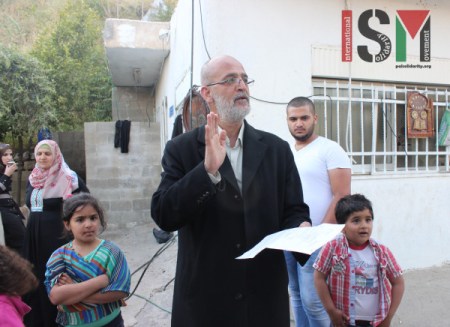
Aref Tohta with the demolition order in his hand and his family
International Solidarity Movement | April 20, 2015
Jerusalem, Occupied Palestine – On Wednesday night, the Tohta family received a demolition order for their house in the occupied East Jerusalem neighborhood of Wadi al-Joz. After being warned that soldiers would come early on Sunday morning for the demolition, the family was joined by a group of about a dozen international supporters. Despite the warning, nothing happened that night – leaving the family afraid that their house could be demolished at any time without prior warning.
After being told by soldiers that during a demolition they “don’t see anything in front of [them]”, meaning everything will be destroyed, Aref Tohta and his family moved their most needed and precious belongings out of the house. They piled up boxes with warm clothes and blankets for the night, as far away from the house as possible, moved animal shelters and gave the five family dogs away knowing that they would be killed in a demolition.
A demolition of the family home will leave the fifteen family members without a shelter. Twelve of them are children aged between four and eighteen years. Jenny, an ISM-volunteer, staying with the family during the night explained: “any noise – a car door slamming somewhere, a voice heard in the vicinity – made everyone turn their head towards it, fearing an imminent destruction of the house. The fear was visible on everyone’s face”.
When no demolition happened, the father believed it was because the army did not want to have an international presence documenting this aggression. Now, the family lives in constant fear of the army showing up without any prior warning and tearing down the house. Aref Tohta explained the uncertainty the family has to live with every day: “Tomorrow, I don’t know if I have a place to sleep”.
Wadi al-Joz located directly outside the Old City of Jerusalem, is a vulnerable neighborhood that has seen three demolitions in the last three weeks. On 31st of March, the army illegally demolished the Amro family home, neighbors of the Tohta’s, without any demolition order or prior warning.
Police Body Cameras and Police Surveillance: Eviscerating Privacy
By Ben Schreiner | Global Research | April 21, 2015
Using the recent spree of high profile police murders as the latest catalyst, calls to outfit all cops with some sort of body camera are once again reverberating nationally. But given the staggering amounts of personal data on the American people police agencies are already collecting, the proposals to lend the police one more surveillance device raises significant privacy concerns.
Speaking on the repercussions of the police murder of Walter Scott in North Charleston, South Carolina, former New York City Police Commissioner Ray Kelly, a former opponent of body cams, recently remarked, “I think it is a game-changer. What you’ll see is a movement now by many more police departments to go to cameras.”
Indeed, the city of North Charleston has already announced plans to equip its entire police force with body cameras. This comes on the heels of President Obama announcement last December that the federal government would purchase 50,000 body cams for state and local police agencies in response to the fatal police shooting of Michael Brown in Ferguson, Missouri.
For their proponents, body cameras promise to provide much needed accountability to the nation’s police agencies and their officers, who continue to gun down Americans at an alarming rate, while still mostly managing to allude prosecution. And as advocates note, limited study of such police cameras have already yielded seemingly promising results. In Rialto, California, for instance, a controlled study found a 60% decline in use of force by officers equipped with body cameras. Cops, to no surprise of anyone who has ever sought to film an on-duty officer, are all too cognizant of the power of recorded video (especially, we might add, when such video is in the hands of citizens).
But the anecdotal evidence championed by body camera backers aside, such police cams offer at best a flawed check on police abuse and brutality, and at worst portend a further bolstering of the already dystopian surveillance capabilities of law enforcement agencies.
The Limits of Police Body Cams
To begin with, as should be readily evident, police body cameras only work when officers turn them on. So in the case of the slaying of Walter Scott in South Carolina, even if Officer Michael Slager had been equipped with a body cam, there is no guarantee it would have captured his shooting of Scott; Slager could have simply turned it off. Indeed, a trial use of body cameras by Denver, Colorado police from June to December of 2014 saw less than half of all encounters involving the use of force actually recorded by camera equipped officers.
(And yet even when police brutality is captured on video and viewed publicly, accountability for officers is hardly guaranteed. The death of Eric Garner at the hands of New York City cops was, after all, captured on film, but no officers were charged in his death.)
For those police body cams that actually are recording, however, all data collected is often held and stored by the police themselves; that is, the very people the cameras are meant to hold to account. As the Washington Post reported, “Officials in more than a dozen states—as well as the District [of Columbia]—have proposed restricting access or completely withholding the [body cam] footage from the public.” D.C. Mayor Muriel Bowser, as the Post explains, has sought to keep the public from viewing police body cam videos by exempting all such videos from the Freedom of Information Act.
Simply put then, police not only control what body cameras record, but also increasingly what is done with the captured video.
It is also worth considering the fact that devices touted as a way to hold police accountable for their actions are configured not to watch and record the police, but rather to watch us from the perspective of the police. And as anyone who has come face-to-face with armored clad riot cops during a political protest will no doubt attest, the routine use of cameras trained on protesters by police brings no measure of accountability to the cops. Police cameras do nothing to stop warrior cops from unleashing their truncheons on peaceful protesters, nor do they do anything to hold them to account afterwards. In fact, the police deploy such cameras at rallies largely to aid the future prosecution of those they will arrest for the great criminal offense that is political dissent.
Snooping Cops
The far more troubling issue with championing police body cameras as some sort of progressive police reform, though, is that their deployment is part of a larger proliferation of mass surveillance capabilities now allowing domestic law enforcement agencies to sweep up a breathtaking amount of data on American citizens.
As the Wall Street Journal reported, the 560 body cameras currently employed by officers of the Oakland, California police department “results in about five to six terabytes of data every month—equivalent to about 1,250 to 1,500 high-definition movie downloads.” The data, the Journal continues, “is stored on a department server for two years at a minimum.”
Using the FBI’s Lockheed Martin designed Next Generation Identification system, cops everywhere equipped with body cameras will soon be able to tap into an FBI database containing over 50 million photos in order to utilize facial recognition technology when making routine traffic stops. It’s difficult to see how the use of body cameras to conduct such fishing expeditions would serve in any way to further police accountability.
The threat to personal privacy posed by police body cams is heightened further when considering the intimate places cops routinely go (e.g. inside one’s apartment or home) and the often compromised state of those visited by police. As the Los Angeles Times notes, “Video from dashboard cameras in police cars, a more widely used technology, has long been exploited for entertainment purposes. Internet users have posted dash-cam videos of arrests of naked women to YouTube, and TMZ sometimes obtains police videos of athletes and celebrities during minor or embarrassing traffic stops, turning officers into unwitting paparazzi.”
It doesn’t take much imagination to picture huckster entrepreneurs of the near future using any and all police body cam video released to the public (which will undoubtedly be skewed toward those videos portraying officers in a positive light) to piggyback on the already booming online mug shot industry currently dabbling in the lucrative trade of public humiliation and shame.
Body cameras or not, though, police agencies the nation over are already fixing to amass vast swaths of data on no less than our daily movements via the widespread deployment of things like automatic license plate readers (ALPRs), which snap pictures of car license plates in conjunction with date, time, and location.
According to a separate Journal report, the Justice Department is currently using ALPRs strategically placed on major highways, in combination with those routinely used by state and local law enforcement agencies, to maintain a national database to “track in real time the movement of vehicles around the U.S.” Many of the devices used to feed the database, the paper notes, “also record visual images of drivers and passengers, which are sometimes clear enough for investigators to confirm identities.”
Consider, also, the ability local police agencies already possess to scoop up our electronic communications via devices like “dirtboxes” and “stingrays” (which mimic cellular towers in order to trick all adjacent cell phones into sending their identifying information back to the devices for collection). This is to say nothing of the “haystack” of personal data the National Security Agency is actively compiling in its search for needles.
Such a rush by law enforcement to deploy all the latest surveillance technologies on the American people quite predictably leaves the collecting agencies awash in more data than could ever possibly be of use. In fact, such mass surveillance is quite lousy at its purported purpose of predicting and preventing crime or “terrorism.” As Julia Angwin writes in her book Dragnet Nation, “the flood of data can be overwhelming and confounding to those who are charged with sorting through it to find terrorists.” “But,” Angwin goes on to add, “ubiquitous, covert surveillance does appear to be very good at repression.”
Police Surveillance as Repression
What the “war on drugs” was for mass incarceration, the “war on terror” has clearly been to domestic surveillance. So not only are militarized police now sent parading through the streets in their repurposed military vehicles and equipment, they are also increasingly turning to military-styled mass surveillance methods to achieve the very same ends sought by occupying American forces abroad; that is, collective pacification.
As Darwin Bond-Graham and Ali Winston write in a 2014 LA Weekly article on the Los Angeles Police Department’s use of data-intensive “predictive policing”: the “LAPD’s mild-sounding ‘predictive policing’ technique, introduced by former Chief William Bratton [now chief of the NYPD] to anticipate where future crime would hit, is actually a sophisticated system developed not by cops but by the U.S. military, based on ‘insurgent’ activity in Iraq and civilian casualty patterns in Afghanistan.”
Bond-Graham and Winston add: “Records obtained by L.A. Weekly from the U.S. Army Research Office show that UCLA professors Jeff Brantingham and Andrea Bertozzi (anthropology and applied mathematics, respectively) in 2009 told the Army that their predictive techniques ‘will provide the Army with a plethora of new data-intensive predictive algorithms for dealing with insurgents and terrorists abroad.’ In a later update to the Army, after they had begun working with LAPD, they wrote, ‘Terrorist and insurgent activities have a distinct parallel to urban crime.'”
The world, lest we ever forget, is now a battlefield. But if the American dragnet abroad is, as Alfred McCoy writes, a means of cheaply “projecting power and keeping subordinate allies in line,” the domestic dragnet imposed by militarized cops is likewise as much about keeping domestic threats (activists, dissidents, the working class, and poor) in line as imperial rot takes hold within the “homeland” in the form of widening economic inequality and deepening social crisis.
And utilizing mass surveillance as a tool of repression indeed appears the intent of snooping police departments.
Pouring over documents released on the city of Boston’s now suspended ALPR program, ACLU attorney Catherine Crump found that “The Boston Police Department was targeting mostly low income, working class, and Black neighborhoods with their license plate reader program.” In one case, Crump discovered that “one motorcycle that was recorded stolen in the police department’s system had driven past one fixed plate reader 60 times.”
“This signals to me that our greatest fear is true,” Crump adds. “While police say, ‘We need this technology because it helps us find stolen cars and criminals,’ we have found they’re also using these tools to collect data about people who they have no reason to believe were involved in any criminal activity. In Boston, we found that police aren’t using these cameras to respond to hits, they’re sucking up all this data to use potentially down the road for intelligence.”
Are we to believe, then, that the mountains of data to be captured by police body cameras and stored for possibly years by police departments is to be used to hold cops to account? Or is such footage more likely to be kept in secret to further police control over potentially rebellious poor, minority, and working class citizens?
Who gains by entrusting killer cops with policing our privacy?
There is Bipartisan Agreement on the ‘Uncivility’ of Civil Asset Forfeiture
By Kanya Bennett and Nkechi Taifa | ACSblog | April 16, 2015
“The FOP does not disagree that there is a need for civil asset forfeiture revision.” That is what the Fraternal Order of Police said at yesterday’s Senate Judiciary hearing on civil asset forfeiture. And when Chairman Chuck Grassley (R-Iowa) asked if FOP stood by those words, the response was “absolutely” – even though FOP’s testimony suggested otherwise.
Grassley even offered him some advice, saying that, now is “not the time to oppose needed reforms,” in light of national headlines on police violence.
This should make it clear to everyone that the time is ripe for federal reform. Though work remains to convince some that community policing instead of “slush funds” must be law enforcement’s number one priority, we should be optimistic.
Grassley said “legislation is necessary” and Ranking Member Patrick Leahy (D-Vt.) believes that “we can come together on a bipartisan basis to fix what is broken.”
For months there has been national discourse around civil asset forfeiture and all that is uncivil about it. Members on both sides of the aisle – and organizations across the spectrum – are demanding reform. And rightfully so.
Civil asset forfeiture gives law enforcement the power to take property away from someone who has not been convicted of a crime. And this property can be cash, cars, homes, and anything else – like a “simple gold cross” – that law enforcement believes is connected to a crime. Yes, a woman had her gold cross necklace seized when she was pulled over for a minor traffic violation!
And just how does one go about getting a necklace … or money, or car, or house back? Well, often they don’t. Due process requirements don’t require judicial hearings. More than 60 percent of federal forfeitures were uncontested over the past few years.
When property owners do get notice and muster the courage to go up against the government, they find the deck is stacked against them. Property owners bear the cost of going to court and the burden of proving their property’s “innocence.” And in almost all instances, property owners are not entitled to counsel.
So, what is driving this practice that sounds unfair, unjust, and un-American? How is it that we still have this “thorn in the side of civil liberties?” Civil asset forfeiture is big business for law enforcement at all levels – federal, state, and local. The practice generates billions of dollars annually and law enforcement is permitted to keep the assets it seizes.
Since 2008, state and local police have made more than 55,000 seizures of cash and property worth $3 billion dollars with the help of the federal government. And in 2014 alone, federal forfeiture laws were used to take in $4.5 billion dollars. This is why civil asset forfeiture has been called “policing for profit” and a “system of legal thievery.”
The price that people pay when their property is taken far exceeds the billions it generates. Civil asset forfeiture has long been used to carry out the ineffective and abusive “War on Drugs.” As has been said, “eighteenth-century maritime laws are being applied to [today’s] drugs laws and the repercussions are horrendous.” Just as the “War on Drugs” disproportionately impacts people and communities of color, so does civil asset forfeiture.
In the 1990’s, in Florida’s Volusia County, 90 percent of the drivers from whom cash was confiscated without arrest were Black or Latino. Then fast forward 20 years, to East Texas, where police seized $3 million dollars in a two year period primarily from African American and Latino drivers.
These civil rights and civil liberties concerns that generated broad support for the Civil Asset Forfeiture Reform (CAFRA) Act of 2000 exist today. We all recognize that CAFRA did not go far enough. And now is the time we all come to the table and do something about it.
Kanya Bennett is the Legislative Counsel at American Civil Liberties Union, and Nkechi Taifa is the Senior Policy Analyst at Open Society Foundations.
Slain Ukraine Politician Led the Picketing of US Embassy in Kiev a Day Before Killed
Russia Insider | April 20, 2015
A day before he was murdered on April 15th Oleg Kalashnikov had organized the protest at the US Embassy in Kiev on April 14th.
Oleg Tsarov, his collegue from the former Party of Regions and a fellow dissident Ukraine politician wrote on his Facebook:
I BLAME THE US FOR THE DEATH OF MY FRIEND
Another one of my friends, Oleg Kalashnikov, was killed. I’m very sorry. We were friends. I knew his family. Repeatedly I tried to convince him to leave Kiev. In response, he told me that if everyone leaves, then who will fight.
I constantly tell my friends, remaining in Ukraine, that the organization of protests is futile. This power does not argue with its opponents, it eliminates them. Many of my friends were arrested, some disappeared, others were killed.
Oleg was one of the organizers of the last protest at the U.S. Embassy: people gathered and stood in silence outside the Embassy. Oleg didn’t leave, did not give up. He died. He was killed.
The latest (April 14th) demonstration at the US Kiev Embassy:
Egypt’s President Sisi meets with CIA chief in Cairo
Press TV – April 19, 2015
Egyptian President Abdel-Fattah el-Sisi has held talks with CIA Director John Brennan amid Cairo’s heavy-handed clampdown on opponents of the country’s military-backed government.
According to a statement released by the Egyptian government, Sisi and Brennan discussed regional issues, terrorism and “ways of enhancing bilateral relations” in their Sunday meeting in the Egyptian capital Cairo.
The two sides agreed to continue “consultation and coordination on issues of mutual interest,” the statement added.
The announced visit by the CIA chief to the North African country came less than two weeks after the US Defense Security Cooperation Agency announced plans to sell air-to-surface missiles worth of $57 million to Egypt.
Egypt’s first democratically-elected president, Mohamed Morsi, was ousted in July 2013 in a military coup led by Sisi, the then army commander.
Since Morsi’s ouster, Egypt has been the scene of massive anti-government protests, with continuous clashes between security forces and the supporters of the former president, backed by the Muslim Brotherhood movement.
The new rulers in Egypt have come under pressure from human rights groups over their harsh crackdown on Brotherhood members and supporters.
The Egyptian administration’s suppression has led to the deaths of more than 1,400 people and the arrest of 22,000 others, including some 200 people who have been sentenced to death in mass trials.
However, Egypt’s former dictator, Hosni Mubarak, and a few of his senior officials have been acquitted of all charges leveled against them over the killing of protesters in the country’s 2011 revolution.
Man Dies Seven Days After Beating by Baltimore Police, Who Still Won’t Say Why They Arrested and Beat Him
By Carlos Miller | PINAC | April 19, 2015
Freddie Gray, the 27-year-old man who was whisked away last week by Baltimore police and thrown into the back of a police van, only to later show up in a coma at a hospital, died earlier today.
But Baltimore police have yet to explain why they arrested him in the first place or how he ended up with a broken back.
Had it not been for witnesses video recording several officers dragging him into the van as he screamed in pain, he may have disappeared entirely without a trace.
But today, seven days after Gray was seen conscious and coherent as he was being dragged into the van, police are saying they cannot comment until a “proper and thorough investigation is undertaken.”
In other words, they are waiting to see if any other video surfaces before they create their narrative which will no doubt accuse Gray of being “belligerent” and “combative,” a man showing superhuman strength as he fought off four brave officers, who were only looking out for his safety, and wanted nothing more than to go home to their families that night.
Never mind the fact that perhaps Gray wanted to do the same before he was confronted by police on April 12 for unknown reasons.
The Baltimore Sun reports that Gray was walking down a street when four bicycle police officers tried to detain him, prompting him to run, causing them to run after him.
At least two videos surfaced, but they begin recording after he was detained when he is already screaming in pain. It appears as if they had already broke his back because he doesn’t appear to be able to move his legs as they are dragging him into the van.
Once the doors of the van were closed, one can only imagine what took place because by the time he was transported to the hospital, he was unresponsive.
Gray is the 348th person killed by police since January 1, 2015, according to Killed by Police, an average of more than three people a day. Meanwhile, six cops have been killed by gunfire in the line of duty during that same time, according to the Officer Down Memorial Page.
Cop Who Shot and Killed 7-Year-Old Girl While Filming a Reality Show is a Police Officer Again
By Cassandra Fairbanks | The Free Thought Project | April 19, 2015
Detroit, MI– Officer Joseph Weekley had not been on the force since 2010 when he shot a sleeping child in the head during a botched raid executed on the wrong home.
The raid was being filmed for an episode of The First 48, and many believe the excessive tactics used were employed simply to create drama and excitement for the camera. Unfortunately, a beautiful little girl, Aiyana Stanley-Jones, 7, lost her life because of his reckless and violent actions.
Officer Weekely has now been reinstated to the force, according to Detroit Police Chief James Craig. As part of the department’s integration program, Weekely will return to the department in a non-field position, but the chief has allowed for the possibility for him to eventually go back into the field, stating,
“It’s tragic what happened to Aiyana, it’s tragic. Sometimes, we’re in a high-risk occupation, mistakes happen, and sometimes those mistakes result in tragedies, but we move on from that.”
Weekley was originally charged with felony involuntary manslaughter and misdemeanor careless discharge of a firearm causing death after young Aiyana took a fatal bullet to the head during a botched raid on her home.
The officer has already been on trial twice for this crime, both ending with deadlocked jurors and mistrials. The judge in the second trial shockingly dropped the manslaughter charge due to a motion by the defense. The same motion had been denied by a judge during his first trial.
In January, Prosecutor Kym Worthy dismissed the case against the killer cop.
According to the officer, a fellow cop threw a flash-bang grenade through the window, which temporarily blinded Weekley, who had been first through the door. When the effects of the flash-bang wore off, he realized there was a person on the couch. Weekley aimed his weapon at the couch where the child was sleeping beneath a “Hanna Montana” blanket. He claims her grandmother, Mertilla Jones, smacked his MP5 submachine gun, causing him to pull the trigger and kill Aiyana.
Mertilla Jones disputes this claim and says that she reached for her granddaughter when the grenade came through the window, not for the officer’s gun. Jones asserts she did not make contact with an officer at any point during the assault on her home. Her fingerprints were not found on the weapon.
The family is now suing the city of Detroit, Officers Weekley and Rowe, The Detroit Police Department, and approximately 20 unidentified members of the Special Response Team, alleging a conspiracy to cover up details of the crime.
“Upon Defendants realizing that they had critically injured the seven-year-old girl, they intentionally conspired to cover-up their unlawful acts by providing false and fictitious information to the authorities and to the media regarding the shooting of Aiyana Stanley-Jones, including falsely claiming that the bullet that killed her was fired from inside the lower unit of the duplex rather than from the outside…”
Why a man who admittedly murdered a sleeping child would ever want to stalk the streets with a weapon remains unclear. Watch out Detroit, there is an armed monster roaming free.
Israeli court brings 12 charges against MP Khalida Jerrar

Ma’an – 18/04/2015
BETHLEHEM – An Israeli military court has brought 12 charges against Palestinian lawmaker Khalida Jerrar in connection to her membership of the Popular Front for the Liberation of Palestine, an international rights group said.
Having been detained and interrogated since Apr. 2, Jerrar was charged by the Israeli military prosecution on Wednesday, according to a report released Friday by Amnesty International.
Charges included membership of an illegal organization, participation in protests, and incitement to kidnap Israeli soldiers.
A review of the charges against her will take place on Apr. 29, the report said.
Jerrar’s defense team argued there was no basis to the incitement charge and that it was vindictive, according to Amnesty’s report.
The majority of Palestinian political organizations are considered illegal by Israel, including those that make up the PLO, and association with such parties is often used as grounds for imprisonment, according to prisoners’ rights group Addameer.
Jerrar was elected to the Palestinian Legislative Council in 2006 as a member of PFLP.
Jerrar was detained on Apr. 2 from her home in the Ramallah neighborhood of al-Bireh, and was afterwards held and interrogated at the Ofer detention center. She was later taken to Hasharon prison inside Israel.
An Israeli army spokeswoman told Ma’an that Jerrar had been detained for being the leader of a “terrorist organization,” and had encouraged “terror activities” in the previous few weeks.
The arrest also came after Jerrar refused a deportation order from Israeli authorities in August, demanding that she leave the Ramallah district for Jericho.
‘A symbol of resistance’
Jerrar has been targeted by Israeli authorities throughout her life, although Wednesday was the first time the lawmaker had been officially charged by Israeli military courts.
Palestinian factions have decried the arrest, with one PLO committee saying it was “an outrageous violation of her parliamentary immunity.”
Legislative Council lawmaker Jamil al-Majdalawi said: “Israel does not lose a chance to attempt to break the resistance’s will, the people’s resistance and their leadership symbols, and Khalida Jarrar is one of those symbols of resistance.”
In February, Jerrar joined the Palestinian committee in charge of conducting an International Criminal Court investigation into Israeli war crimes and crimes against humanity.
She is also vice-chair of prisoners’ rights group Addameer.
Until the charges against her on Wednesday, Jerrar had been held in Israeli prisons under administrative detention.
Palestinians held in administrative detention are often held without charge or trial for months and without access to the evidence that led to their detention, even though international law stipulates this tactic only be used in exceptional circumstances.
Israeli prisons currently hold 14 members of the PLC, eight of them in administrative detention
Prisoners’ day at weekly Bil’in demonstration
International Solidarity Movement | April 17, 2015
Bil’in, Occupied Palestine – Over 300 people attended the Prisoners’ Day demonstration in Bil’in. The Israeli army fired endless amounts of teargas and shot one person in the chest with a live ammunition.
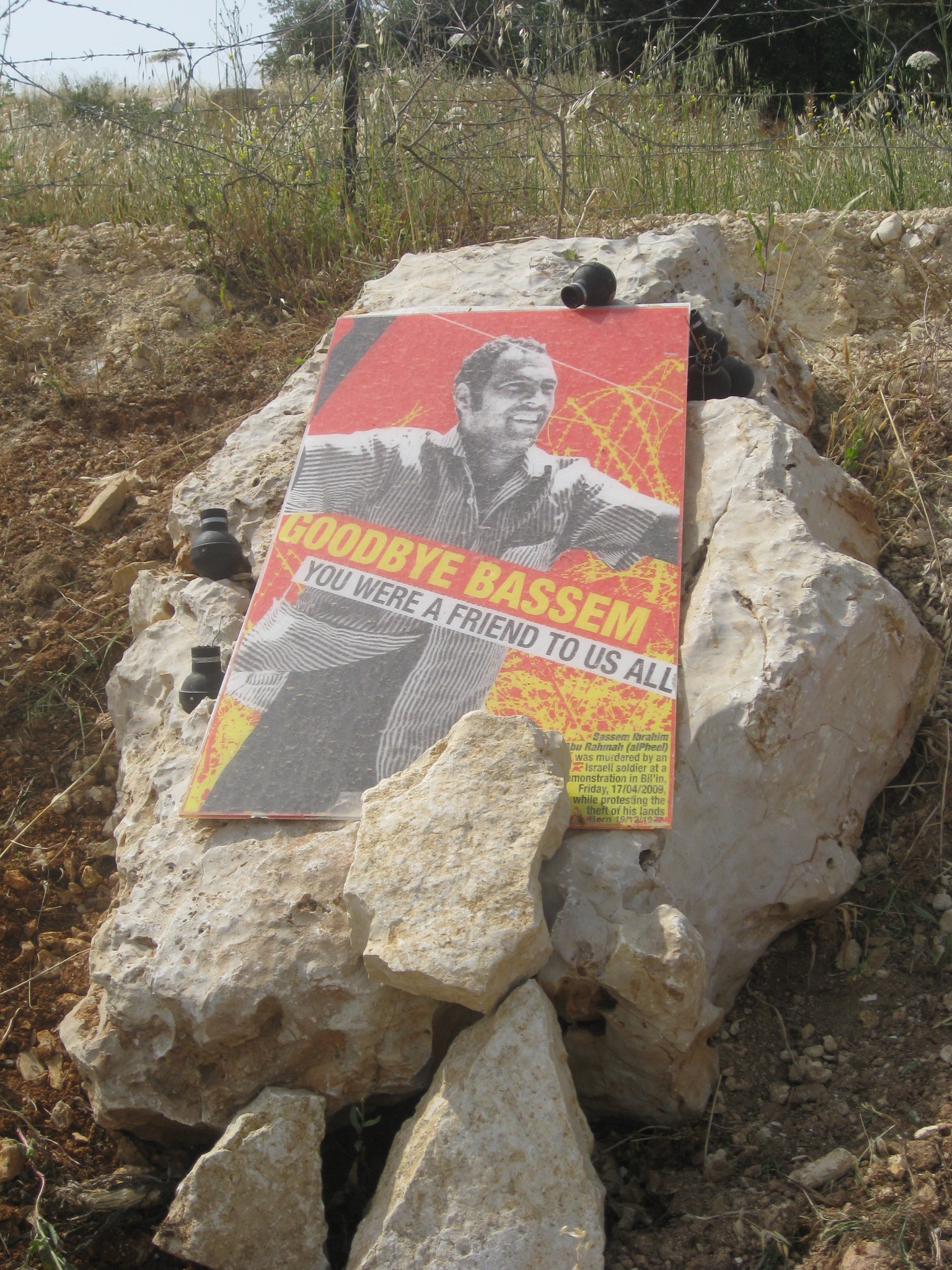
After the prayer, protesters marched towards the apartheid wall and the illegal settlement of Modi’in, situated just outside of Bil’in. A truck loaded with a sound system led the chanting crowd. Most were either waving Palestinian flags, holding up banners in support of the Palestinians imprisoned in Israeli prisons to mark Prisoners’ Day, or were holding posters of Bassem, a local who was killed six years ago by the Israeli army. As the march got closer to the wall, Israeli forces fired over 50 rounds of teargas canisters towards the protesters. The area was heavily clouded with this gas during most of the afternoon, which caused many to suffer from its inhalation. The shooting of this teargas also caused the dry grass between the olive trees to repeatedly catch fire.
During the protest, one person was shot with a rubber-coated steel bullet, while a 17 years old boy was shot in the chest with live ammunition. He was immediately taken to hospital by the ambulance. His condition is stable.
The 17th April is Prisoners’ Day in Palestine. Thousands of Palestinians are arrested arbitrarily on a daily basis by the Israeli forces, despite prohibition by international law. According to B’Tselem, “at the end of February 2015, 5,609 Palestinian security detainees and prisoners were held in Israeli prisons”. Since 1967, when Israel furthered its occupation to the West Bank, Gaza and East Jerusalem, an equivalent of approximately 20% of the total population in the Occupied Palestinian Territories (OPT), and 40% of all males have been detained (CEPR). While in prison, they are subject to wide-ranging violations of their rights and dignity. Such practices may include physical and psychological torture, deprivation of family visits, denial of access to lawyers and unlawful transfer out of the Occupied Palestinian Territories, among many other things. The Israeli occupying forces continue to violate the provisions of the Fourth Geneva Convention Relative to the Protection of Civilian Persons in Time of War, in particular against the Palestinian prisoners.
Today also marked the 6th anniversary of Bassem Abu Rameh’s death. Nicknamed Pheel, he was a much loved figure in the town of Bil’in. On the 17th April 2009, the Israeli army shot him with a teargas canister projectile which killed him shortly after. Aged 30, Pheel had been to all the non-violent protests, activities and creative actions against the apartheid wall in his town. Those who knew him remember him as a caring person who made everybody laugh and had the heart of a child, says Mohammad Khatib, a member of the Bil’in Popular Committee Against the Wall and Settlements.
According to the report by the United Nations Office for the Coordination of Humanitarian Affairs within the occupied Palestinian Territories, 442 people in the West Bank and 15 people in Gaza have been injured by the Israeli forces since the beginning of this year. On top of this, five people have been killed.
#PalestinianPrisonerDay: Protesters target G4S London HQ over Israeli ‘torture’ complicity
RT | April 17, 2015
Protestors gathered outside the London office of G4S on Friday to highlight the private security firm’s role in incarcerating Palestinian prisoners on behalf of Israel.
Organizers demanded the release of several prisoners, including Palestinian MP Khalida Jarrar and more than a hundred child detainees.
They also highlighted the ill treatment of prisoners, including alleged incidents of torture.
The protest in London takes place as part of an international day of action to mark Palestinian Prisoners Day, an annual expression of solidarity with Palestinians detained by Israel.
Palestinian Prisoners Day began as a mass action in support of hunger striking political prisoners on April 17, 2012.
It has grown into an annual event marked by human rights organizations and pro-Palestine groups across the world.
More than 100 people confirmed they would attend the protest on its Facebook page.
Organized by Innovative Minds (Inminds), a group which describes itself as online Islamic activists, the demonstration targeted G4S for its operation of two prisons and two detention centers in Israel and one prison in the West Bank.
Some 6,000 Palestinians are currently held in Israeli prisoners, according to the Addameer Prisoner Support and Human Rights Association.
Addameer’s monthly detention report for February 2015 indicates 163 of these prisoners are children, 13 of whom are under 16.
The vast majority of those incarcerated are male, with only 22 female prisoners.
Lina Jarbouni, a female detainee from Galilee, is the longest serving female prisoner having been in jail for 13 consecutive years.
“Systematic torture and ill treatment” of Palestinian prisoners is well documented, according to human rights group War on Want.
Activists say G4S is complicit in this ill treatment by providing security systems for the Israel-based Ketziot and Megiddo prisons, which hold political prisoners arrested within Palestine.
War on Want claims G4S has acted in violation of Article 76 of the Fourth Geneva Convention, which prohibits the transfer of prisoners from an occupied territory to the territory of the occupier.
G4S has become the target of an international boycott, with the South African government resolving to end work contracts with the security firm in November last year.
Archbishop Desmond Tutu was one of several notable activists, including Noam Chomsky, to sign a petition calling for G4S to end its participation in Israel’s occupation of Palestine.
Protestors outside the London office of G4S highlighted the plight of Palestinian prisoners being held by Israel as well as those detained by the security firm.
They demanded the release of Palestinian MP Khalida Jarrar, who was arrested by the Israel Defense Force (IDF) earlier this month.
The prominent feminist and human rights activist was sentenced to six months in prison without trial for violating a military injunction, which confines her to the city of Jericho and its surrounding.
Army sources told the Times of Israel the restraining order was based on her “incitement and involvement in terror.”
A spokesperson for the Palestine Liberation Organization (PLO) said Jarrar was heavily involved in the Palestinian Authority’s bid to join the International Criminal Court (ICC).
Activists also demanded justice for Jaafar Awad, 22, a Palestinian man who died from health complications resulting from “medical negligence” during his detention in an Israeli prison, according to the Palestinian Prisoner Society.
Another key theme of the protest was the detention of children.
Defense for Children International (DCI) launched an urgent appeal in 2012 after documenting 53 cases in which children were held in solitary confinement at the Al Jalame and Petah Tikva interrogation centers, and Hasharon prison.
Children reported being held in solitary confinement in a “foul smelling” cell measuring approximately 2 meters by 3 for an average of 10 days.
DCI reports no education is provided to them and they are denied access to their parents or lawyers while held in the Israeli Prison Service (IPS) controlled detention centers.
Read more:
Female Palestinian MP snatched by IDF, held without charge for 6 months
G4S posts £148mn profit despite ‘countless’ human rights scandals
Featured Video

Liberty Cannot Exist Inside a Panopticon
or go to
Aletho News Archives – Video-Images
From the Archives
Left-leaning despisers of 9/11 Truth movement: Do you really believe in miracles?
David Ray Griffin | Global Research | 06 Jul 2010
An Open Letter to Terry Allen, Noam Chomsky, Alexander Cockburn, David Corn, Chris Hayes, George Monbiot, Matthew Rothschild, and Matt Taibbi.
[1]According to several left-leaning critics of the 9/11 Truth Movement, some of its central claims, especially about the destruction of the World Trade Center, show its members to be scientifically challenged. In the opinion of some of these critics, moreover, claims made by members of this movement are sometimes unscientific in the strongest possible sense, implying an acceptance of magic and miracles. … Full article
Blog Roll
 Aletho News
- White House envoy declares kinetic action against Yemen ‘fruitless’
- Ukraine deployed thousands of microdrones in Iraqi Kurdistan: Tasnim
- Iran calls for emergency UNSC meeting over Trump’s ‘brazen’ bomb talk, Israeli threats
- Iranian sources reveal details of Russia-China Hormuz proposal
- Plan for more US-Israel integration puts our military tech at risk
- Another Round Against Iran Will Break What Is Left of the Gulf
- SVR Report on Ukraine’s Mexican Drug Gang Links Could Pressure Zelensky, Won’t Change US Policy
- British Government Employees Were Fact-Checking the News at the BBC. Nobody Told You.
- Albania on fire: who’s behind the riots?
- Egypt’s Civil Democratic Movement rejects involvement in regional war
- If Americans Knew
- Mysterious bot accounts reportedly spread fake ‘man on the street’ videos for Michigan Senate candidate
- Israeli Defense Minister Katz Says Over 60 Lebanon Villages Have Been Destroyed
- Why Is Israel Running TV Ads in Iowa Ahead of the Midterms?
- Hind Rajab’s Alleged Killer Is in the United States. HRF Demands His Arrest.
- US Officials Face Fresh Pressure After Another American ‘Brutalized’ by Israeli Settlers in West Bank
- Israel-Backed Palestinian Militias Terrorize Displaced Families in Gaza
- FBI subpoenas pro-Palestine activists over Israeli weapons plant disruption
- Fourth winter arrives in wartorn Gaza, too early – Daily Update
- More on how Bari Weiss is using CBS on behalf of Israel
- What the UK Is Doing to Pro-Palestine Novelist Sally Rooney Is an Act of Orwellian Villainy
- No Tricks Zone
- Predictions Made By Renowned Climate Proifessor Over Past Decades Have Been Proven To Be Poor
- New Study Suggests Large Regions Of The Pacific Ocean Have Been Cooling For The Last 80 Years
- Germany’s Green Energy Debacle: High Energy Costs Force Kahla Porzellan to Close After 182 Years!
- New Study: 50 Years Of The Most Aggressive ‘Net Zero’ Policies Can Only Affect The Global Climate By 0.03°C
- US September “Heat” Was No Record…Many Records Set Decades Ago
- Latest European Green Energy Debacle; Portugal’s Largest Flagship Solar Park Insolvent!
- Green Energy Debacle: German Expert Professor Fritz Vahrenholt Warns Of Severe Economic And Social Consequences
- Two More Paleo Reconstructions Affirm Meters-Higher Sea Levels Across Ireland, Brazil 7000-6000 Years Ago
- New Study: Earth And Venus Surface Warmth Largely Explained By Convection And Lapse Rate, Not CO2 Or Radiation
- 2025 Nature Paper Claiming Worsening Global Drought Gets RETRACTED …Heavily Flawed

