The Act of Killing
As a major new documentary about the Indonesian genocide goes on national release, an AHRC film looks at the research behind ‘The Act of Killing’
To mark the national release of the film ‘The Act of Killing’, the AHRC is today releasing a film of an interview with Professor Joram ten Brink of the University of Westminster, Principal Investigator of the AHRC-funded Genre and Genocide research project, of which the new documentary is a major output.
‘The Act of Killing’ depicts a group of unrepentant former members of Indonesian death squads being challenged to re-enact some of their many murders in the style of the American movies they love. The film focuses particularly on one individual, Anwar Congo, whose initial enthusiasm for the re-enactments slowly gives way to outward expressions of unease and remorse.
When the government of Indonesia was overthrown by the military in 1965, Congo and his friends were promoted from small-time gangsters who sold movie theatre tickets on the black market to death squad leaders. They helped the army kill more than one million alleged communists, ethnic Chinese and intellectuals in less than a year. As the executioner for the most notorious death squad in his city, Congo himself killed hundreds of people with his own hands.
‘The Act of Killing’ is a journey into the memories and imaginations of the perpetrators, offering insight into the minds of mass killers. The film is a nightmarish vision of a frighteningly banal culture of impunity in which killers can joke about crimes against humanity on television chat shows, and celebrate moral disaster with the ease and grace of a soft shoe dance number.
The Act of Killing CLIP
The Act of Killing Director’s Cut — Clip 1
The Act of Killing Director’s Cut — Clip 2
The Act of Killing – final scene

Indonesia recalls its Australian ambassador alleging phone-taps on President Yudhoyono
RT | November 18, 2013
Indonesia is recalling its ambassador to Australia over allegations that Canberra listened in on phone conversations of the Indonesian president.
Indonesia said the ambassador was being called to Jakarta for “consultations”.
The move by Jakarta comes as the Australian Department of Defence and the Defence Signals Directorate, or DSD, (now known as the Australian Signals Directorate), has been accused of monitoring the phone calls of Indonesian President Susilo Bambang Yudhoyono, his wife Kristiani Herawati, as well as eight other high-ranking officials, including the vice president, Boediono.
The latest leak, provided in May 2013 by NSA whistleblower Edward Snowden, was released jointly by The Guardian newspaper and the Australian Broadcasting Corporation on Monday, and will likely aggravate another diplomatic firestorm between Canberra and Jakarta.
The top secret material from the DSD is in the form of a slide presentation, dated November 2009, and divulges information on the monitoring of mobile phones just as 3G technology was being introduced in Asia.
In one of the presentations, entitled Indonesian President Voice Events, a graphic of calls is given on Yudhoyono’s Nokia handset over a 15-day period in August 2009. The data provides CDRs – call data records – which record the numbers called, the duration of communications, and whether the transmission was a voice call or SMS.
The Australian spy agency “appears to have expanded its operations to include the calls of those who had been in touch with the president,” the report indicated. Another slide, entitled Way Forward, gives the simple command: “Must have content,” perhaps a reference to encrypted material.
Attached to the bottom of each slide in the 2009 presentation is the DSD slogan: “Reveal their secrets – protect our own.”
Also named in the surveillance slides are Dino Patti Djalal, then-foreign affairs spokesman for the president, who recently resigned as Indonesia’s ambassador to the US and is seeking the candidacy in next year’s presidential election for Yudhoyono’s Democratic party, and Hatta Rajasa, current minister for economic affairs and potential presidential candidate for the National Mandate party. Hatta served at the time of the surveillance as minister for transport; his daughter is the wife of the president’s youngest son.
Other high-level officials on the list of “IA Leadership Targets” are: Jusuf Kalla, the former vice-president who ran as the Golkar party presidential candidate in 2009; Sri Mulyani Indrawati, then a reforming finance minister and since 2010 one of the managing directors of the World Bank Group; Andi Mallarangeng, who was at the time the president’s spokesman, and later minister for youth and sports; Sofyan Djalil, who served until October 2009 as minister for state-owned enterprises; Widodo Adi Sucipto, a former head of the Indonesian military who served until October 2009 as security minister.
Another slide, entitled DSD Way Forward, acknowledges that the Australian spy agency’s must “capitalise on UKUSA and industry capability”, apparently a reference to assistance from telecom and internet companies, the same method that the NSA used to collect data on millions of individuals around the planet.
News of Australia’s high-level snooping on the Indonesian president and his top aides is certain to provoke a harsh response from Jakarta, especially considering this is not Australia’s first breach of trust between the Pacific Rim countries.
Tensions between Canberra and Jakarta began in October when top secret files revealed by the German newspaper Der Spiegel and published by Fairfax newspapers showed that Australian diplomatic posts across Asia were being used to intercept communications.
Marty Natalegawa, the Indonesian foreign minister, issued a harsh response and threatened to review bilateral initiatives on issues important to Australia, including people smuggling and terrorism.
During a visit last week to the Australian city of Perth, Vice president Boediono – not yet privy to information that his own Blackberry device had been compromised by Australian spy agencies – briefly mentioned the long-standing spying controversy.
“I think we must look forward to come to some arrangement which guarantees that intelligence information from each side is not used against the other,” he said. “There must be a system.”
Yudhoyono is the latest in a growing list of global leaders who have had their personal communications listened to by the American intelligence service.
It has recently been reported that the leaders of Germany, Brazil and Mexico have been listened to by the so-called Five Eyes, the collective name for the intelligence agencies of the United States, Britain, Australia, Canada and New Zealand, who share information.
German Chancellor Angela Merkel in late October demanded a personal explanation from US President Barack Obama as to why the NSA had tapped her mobile phone. The White House attempted to reassure the chancellor that her phone was “not currently being tapped and will not be in the future”.
It will be interesting at this point to see if the diplomatic backlash in wake of the recent wave of revelations will curb the Five Eyes’ surveillance program, or if it will just go deeper underground.
The Guardian then reported that the DSD worked together with the NSA to stage a massive surveillance operation in Indonesia during a UN climate change conference in Bali in 2007.
On Monday a spokesman for Australian Prime Minister Tony Abbott said: “Consistent with the long-standing practice of Australian governments, and in the interest of national security, we do not comment on intelligence matters.”
Holland apologizes for Indonesia killings

A mural at the Rawagede monument in West Java province depicts a 1947 massacre by Dutch troops
Press TV – September 13, 2013
The Netherlands has publicly apologized for mass killings carried out by Dutch troops in its former colony of Indonesia.
Dutch ambassador to Indonesia Tjeerd de Zwaan offered a state apology during a ceremony held at the Netherlands’s embassy in Jakarta on Thursday for the “excesses committed by Dutch forces” in the 1940s war of independence.
Several relatives of the victims also attended the ceremony.
Dutch troops carried out thousands of summary executions between 1945 and 1949 in Indonesia.
The Netherlands had previously apologized to the people of Indonesia for the colonial-era atrocities, but it had never before offered a public apology for all the summary executions.
“On behalf of the Dutch government, I apologize for these excesses,” said the Dutch ambassador.
“The Dutch government hopes that this apology will help close a difficult chapter for those whose lives were impacted so directly by the violent excesses that took place between 1945 and 1949,” he added.
No Dutch officials or soldiers went on trial over the executions.
Indonesia was under the Dutch occupation from the 19th century until World War II, when the Japanese army forced the Netherlands out.
After the defeat of Japan in 1945, the Dutch attempted to recapture Indonesia, but met fierce resistance from the people of the sprawling archipelago.
Finally, the Dutch recognized Indonesia’s independence in 1949.
Angry Papuan leaders demand Jared Diamond apologizes
Survival | February 4, 2013
 Benny Wenda, a Papuan tribal leader, says what Jared Diamond is writing about his people is ‘misleading’. © freewestpapua.org / Survival
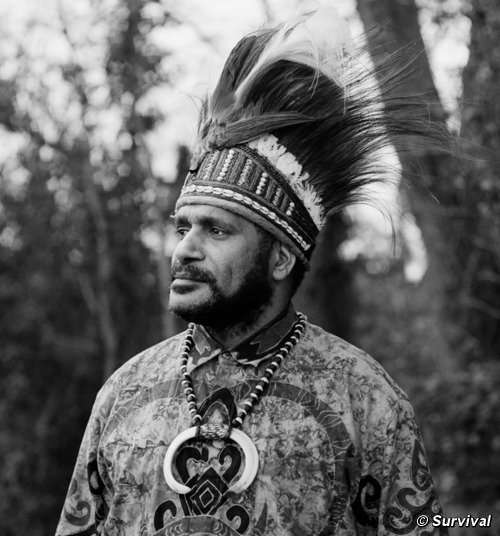
Leaders across West Papua have demanded controversial author Jared Diamond apologizes for describing them in his new book as warlike, and strengthening the idea that indigenous people are ‘backwards’.
The West Papuan leaders attack Diamond’s central arguments that ’most small-scale societies (…) become trapped in cycles of violence and warfare’ and that ‘New Guineans appreciated the benefits of the state-guaranteed peace that they had been unable to achieve for themselves without state government.’
Mr Diamond makes no mention of the brutality and oppression suffered by the people of West Papua at the hands of the Indonesian occupation since 1963, which has led to the killing of at least 100,000 Papuan tribal people at the hands of the Indonesian military.
Benny Wenda, a Papuan tribal leader, said to Survival, ‘What he (Jared Diamond) has written about my people is misleading (…) he is not writing about what the Indonesian military are doing (…) I saw my people being murdered by Indonesian soldiers and my own Auntie was raped in front of my eyes. Indonesia told the world that this was ’tribal war’ – they tried to pretend that it was us that was violent and not them – this book is doing the same. He should apologize.’
Markus Haluk, a senior member of the Papuan Customary Council, added, ‘The total of Dani victims from the Indonesian atrocities over the 50 year period is far greater than those from tribal war of the Dani people over hundreds of thousands of years.’
 Jared Diamond’s book has come under attack for portraying tribal people as warlike and ‘living in the past’. © Survival
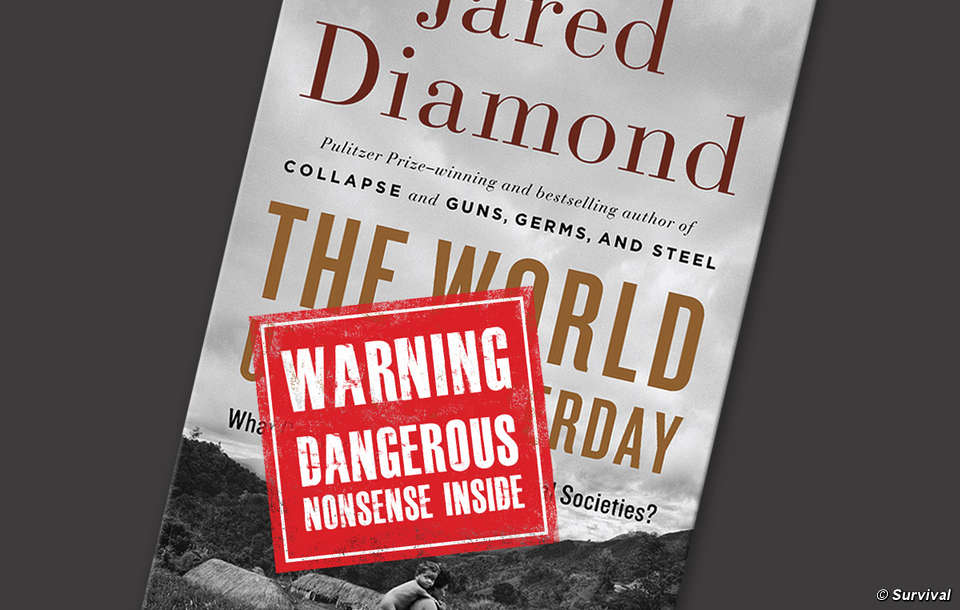
Matius Murib, Director of the Baptist Voice of Papua, condemned Diamond’s assertion that tribal peoples live in a ‘world until yesterday’. He said, ‘This book spreads prejudices about Papuan people (…) that indigenous Papuans still display a way of life from hundreds of years ago. This is not true and strengthens the idea that indigenous people are ’backwards’, ‘live in the past’ or are ‘stone age.’
Reverend Socratez Yoman, Head of the West Papuan Baptist Church, has also demanded an apology from Mr Diamond to the Papuan people.
Dominikus Surabut, currently jailed for treason for peacefully declaring West Papuan independence, described the relationship of indigenous West Papuans and the Indonesian state as political apartheid. In a statement smuggled out of his jail cell, he said, ‘This is the very nature and character of colonial occupation of indigenous peoples, where they are treated as second class citizens whose oppression is justified by painting them as backwards, archaic, warring tribes – just as suggested by Jared Diamond in his book about tribal people.’
Survival International and TAPOL received the messages of outrage following condemnation of the book by Survival last week. The book has since been the subject of heated debate during Mr Diamond’s visit to the UK.
Featured Video

Why the U.S. Should Pull Back From the First Island Chain
or go to
Aletho News Archives – Video-Images
From the Archives
Only 19.7% of Americans agree with US State Dept on Israeli settlements
… Most American adults of voting age don’t appear willing to reject the applicability of international law to Israel’s ongoing colonization of occupied territories in East Jerusalem, the West Bank and Golan Heights. … Full article
Blog Roll
 Aletho News
- British Government Employees Were Fact-Checking the News at the BBC. Nobody Told You.
- Albania on fire: who’s behind the riots?
- Egypt’s Civil Democratic Movement rejects involvement in regional war
- Egypt collaborates with Israel to build ‘Green Rafah’ project over erased Palestinian city
- Rising fuel prices and shortages have helped drive ongoing protests and rioting in France
- Tokyo protests demand Takaichi’s resignation over support for ‘Israel’
- Jennifer Kavanagh: Why the U.S. Should Pull Back From the First Island Chain
- Yemen denounces international community’s silence on Saudi aggression, siege
- UAE and Saudi Arabia move toward renewed coordination against Sanaa
- How Iran’s two-week retaliatory strikes exposed cracks in US military architecture in Persian Gulf
- If Americans Knew
- More on how Bari Weiss is using CBS on behalf of Israel
- What the UK Is Doing to Pro-Palestine Novelist Sally Rooney Is an Act of Orwellian Villainy
- ‘We will build palaces for Jews in Gaza’: Right-wing activists establish new outpost near border
- ‘You see us burning, you stay silent’: Family’s agony over mother and sons burned to death in Gaza tent
- Israel keeps Palestinian journalist Bushra al-Tawil in isolation for 46 days
- US-Israel integration plan puts US military tech in Israel’s hands
- Israeli Strike Burns Gaza Mother Alive in Front of Toddler, ‘Without Generating Any Headlines’
- ‘The Israel Experience with Mike Huckabee’: The Ambassador’s Family Sells Trips to Israel
- As Gazans carry out mass burial, food insecurity is getting worse – Daily Update
- Israeli rabbi permits occupiers to steal Palestinian olive harvest in West Bank
- No Tricks Zone
- Predictions Made By Renowned Climate Proifessor Over Past Decades Have Been Proven To Be Poor
- New Study Suggests Large Regions Of The Pacific Ocean Have Been Cooling For The Last 80 Years
- Germany’s Green Energy Debacle: High Energy Costs Force Kahla Porzellan to Close After 182 Years!
- New Study: 50 Years Of The Most Aggressive ‘Net Zero’ Policies Can Only Affect The Global Climate By 0.03°C
- US September “Heat” Was No Record…Many Records Set Decades Ago
- Latest European Green Energy Debacle; Portugal’s Largest Flagship Solar Park Insolvent!
- Green Energy Debacle: German Expert Professor Fritz Vahrenholt Warns Of Severe Economic And Social Consequences
- Two More Paleo Reconstructions Affirm Meters-Higher Sea Levels Across Ireland, Brazil 7000-6000 Years Ago
- New Study: Earth And Venus Surface Warmth Largely Explained By Convection And Lapse Rate, Not CO2 Or Radiation
- 2025 Nature Paper Claiming Worsening Global Drought Gets RETRACTED …Heavily Flawed

