Two-Thirds of Planet Backs Iran Against “West”
A Black Agenda Radio commentary by Glen Ford | September 4, 2012
The United States and its European allies – the old imperialists and the new – tell their countries’ populations that Iran is isolated in the world, and will have to get rid of its nuclear energy infrastructure in order to be allowed back into what they call “the community of nations.” Among the power groupies that call themselves journalists in the West, Iran is routinely referred to as a “pariah” nation, lurking at the very edge of civilization and sanity. The United States, by this reasoning, is showing great wisdom and forbearance, for not having already unleashed its carrier task forces, Marine divisions, Special Forces commandos, and swarms of drones on the crazed Iranians. Instead, the U.S., in it infinite goodness, enforces a strangling economic and oil embargo, to make the Iranian nation scream.
The Iranians are lucky, Americans and Europeans are told, that the U.S. holds back its friends in Israel, who are eager to give the ayatollah’s in Tehran a lesson in how to behave. But, whatever happens at the end of this game to force Iran to give up its lawful right to own and operate the full industrial cycle of nuclear power, western audiences are assured that the “international community” will approve. After all, Iran is a global outcast. CNN and the New York Times tell us so every day.
Last week, the 120 nations of the Nonaligned Movement voted unanimously and without qualification in support of Iran’s right to produce nuclear energy, and to enrich their own uranium in the process. The Nonaligned Movement makes up about two-thirds of all the nations of the world. As a solid block of humanity, they rejected the dictates of Washington and London and Paris – the imperial powers that for centuries enslaved most of the planet – endorsing the fundamental principle that Iran has the same sovereign rights as any other nation.
Who, then, is isolated in the world – Iran, whose position is backed by two-thirds of the world’s countries, or the U.S. and Europe?
Clearly, the Americans and Europeans still believe that the only world opinion that counts, is the white world. The arrogance of the colonizer and imperialist is infinite, but their power is not – not any longer. The Nonaligned Movement vote is a global referendum, not on Iran’s lawful pursuit of its internal development policies, but on U.S. imperial bullying and criminality. Because, if Iran is within its rights, then the U.S. and the European Union are in the wrong in waging economic war, and threatening military assault, against Iran. Someone is committing a crime, and its not Iran. Two-thirds of the world says so.
The vote is all the more remarkable because the Americans and Europeans, and even the Israelis, exercise great influence over the affairs of much of what used to be called the Third World. Yet still, the former colonies and subjugated nations of the Nonaligned Movement voted unanimously, and on principle, rather than kowtow to power.
There is a lesson here. The Empire remains militarily strong and capable of great crimes. But it has lost much of its powers of coercion – without which, Empire must ultimately cease to exist.
Glen Ford can be contacted at Glen.Ford@BlackAgendaReport.com.
NAM Summit: Ban Ki-Moon in disgraceful show of US puppetry
By Finian Cunningham | Global Research | August 30, 2012
Seated alongside Iranian leader Mahmoud Ahmadinejad on the day that Iran took over presidency of the NAM of 120 nations, the presence of Ban could be seen as a blow to the diplomatic machinations of the United States and its Western allies, including Israel.
But, rather than making a forthright statement of support for Iran, the veteran South Korean diplomat showed his true colours as a servile puppet of American imperialism.
In the weeks leading up to the 16th summit of the NAM, Washington had been calling on the UN top official to decline attending the conference in Tehran. When Ban announced last week that he was going ahead, the US government was evidently peeved, calling his decision “a bit strange”.
Israeli Prime Minister Benjamin Netanyahu was predictably more strident, denouncing Ban’s visit to Iran as “a big mistake”. In typical vulgar and provocative language, Netanyahu subsequently attacked the NAM summit as “a stain on humanity”.
What the United States and its Western allies feared most from the NAM summit was a global display of goodwill and solidarity towards Iran. For more than three decades now, Washington has invested huge political capital in a global campaign of vilification against Iran, denouncing the Islamic Republic as a “rogue state”, a sponsor of “international terrorism” and, over the last 10 years, as “a threat to world peace” from alleged nuclear weapons development.
The Western powers of the US, Britain and France in particular continually arrogate the mantle of “international community” to browbeat Iran, claiming that the nation is in “breach of its obligations”.
In attempting to portray Iran as a “pariah state” these powers, along with Israel, have partly succeeded in turning reality on its head and to assume the outrageous right to threaten Iran with pre-emptive military strikes and enforce crippling economic sanctions.
However, the attendance of some 120 nations in Tehran this week – two-thirds of the UN General Assembly – is a clear statement by the international community that resoundingly rejects this Western campaign of vilification.
Clearly, the majority of the world’s people do not see Iran as a rogue state or a threat to world peace. Indeed, the endorsement of Iran’s presidency of the NAM for the next three years is vindication of the country’s right to develop on its own terms, including the pursuit of peaceful nuclear technology.
In one fell swoop, the NAM summit liquidated Washington’s political capital for denigrating and isolating Iran as worthless. Seated at the top of the summit’s gathering in Tehran, the mere presence of the UN General Secretary to witness the appointment of Iran as the new leader of the Non-Aligned Movement was partially a symbolic vote of confidence.
But then, in his speech on this historic day, Ban engaged in a disgraceful diplomatic offensive. He pointedly denounced those who “deny the [Nazi] holocaust” and who call for the Zionist state’s destruction. Ban championed “Israel’s right to exist” without a word of condemnation of Israel’s decades-long crimes against humanity on the Palestinian people and its violation of countless UN resolutions. In that way, the UN chief was peddling the spurious Western propaganda that seeks to besmirch Iran’s principled opposition to the Zionist state’s record of criminality.
Ban went on to cast bankrupt Western aspersions on Iran’s nuclear rights. He said that Iran needed to use its presidency of the NAM to demonstrate peaceful intent, allay fears that it was developing nuclear weapons and to engage positively with the International Atomic Energy Agency and the Western-dominated P5+1 group – the group that has used every step in bad faith to hobble and hamper a negotiated agreement with Iran.
The question is: what planet has Ban Ki-Moon been living on? The fact is that Iran has done everything to comply with the IAEA and its obligations to the Non-Proliferation Treaty. Iran has consistently demonstrated its peaceful nuclear ambitions and its responsibility to the NPT – unlike the Western powers and their illegal nuclear-powered Zionist rogue state. Just this week, Iran even invited the member states of the NAM to visit its nuclear facility at Natanz – an unprecedented show of openness.
For Ban to reiterate such unfounded, scurrilous suspicions against Iran on the day that it assumes the presidency of the NAM is a reflection more of his abject servility to Western powers – and it underscores the urgent need for a total structural reformation of the UN to make it more democratically accountable.
What was even more telling was what Ban omitted to say in his speech at the NAM summit. Unlike his pointed jibes at Iran, he only used the vaguest language to condemn the violence raging in Syria whenever the evidence is glaring that the US, Britain, France and their Turkish, Israeli and Persian Gulf Arab allies are now openly flouting international law by fueling a covert war of aggression in that country.
Just this week, a US Congressional report revealed that the United States is responsible for nearly 80 per cent of all global arms sales in 2011 – some $66 billion worth – a figure that has tripled on previous years. Half of this trade in weapons and death has been plied by the US to the Persian Gulf monarchies who are in turn laundering the arms to Syria. No words of condemnation from Ban on that.
Nor did the UN chief speak out to condemn the illegal economic sanctions that Washington and its coterie of imperialist allies have slapped on Iran – sanctions that are, in effect, an act of war and are viciously imposing hardship on Iranian civilians, including thousands of infirm people in need of vital medicines.
Nor did Ban condemn the Western powers’ covert war of sabotage and assassination of Iranian scientists, some of whose bereaved families were attending the NAM summit as he spoke.
In a further reprehensible omission, the UN General Secretary lauded the Arab Spring pro-democracy movements. He mentioned several countries by name, but significantly did not include Bahrain even though the people of that country are being butchered and incarcerated daily since their uprising in February 2011. The Western powers and their corporate media do not mention the depredations of their despotic ally in Bahrain against women and children. And neither does Ban Ki-Moon.
No, he would rather engage in pejorative, baseless innuendos against Iran, while disgracefully covering up Western crimes of aggression in Palestine, Afghanistan, Iraq, Libya, Syria, Iran and the ongoing slaughter of innocents with US drones in Pakistan, Somalia and Yemen.
NAM stands for solidarity against imperial aggression. In his address to the NAM, Ban Ki-Moon was acting like an ambassadorial puppet for his Western masters. Maybe in reforming the UN, the Non-Aligned Movement should from now on seek to ensure that any future head of the United Nations be truly representative of the concerns and anguish of the world’s majority, and not a diplomatic salesman for imperialist powers.
Finian Cunningham has written extensively on international affairs, with articles published in several languages. He is a Master’s graduate in Agricultural Chemistry and worked as a scientific editor for the Royal Society of Chemistry, Cambridge, England, before pursuing a career in journalism.
Related articles
- NAM Agrees on 688 Articles of Draft Statement: Sanctions, Palestine on Top (alethonews.wordpress.com)
Iran, Venezuela and Egypt, a possible peace troika to address the Syria situation
MercoPress | August 30, 2012
Venezuelan Foreign Minister Nicolas Maduro has welcomed Iran’s proposal for the formation of a troika committee on Syria consisting of Iran, Egypt, and Venezuela
Minister Maduro welcomed the proposal to keep “major powers from interfering in Syria’s internal affairs” Minister Maduro welcomed the proposal to keep “major powers from interfering in Syria’s internal affairs”
Maduro made the remarks in an interview with reporters from the Iranian media upon his arrival in Tehran on Wednesday to attend the XVI Summit of the Non-Aligned Movement (NAM), which opened in Tehran on Sunday and closes on Friday.
“Playing a role by regional countries in (resolving) the crisis reduces the interference of external powers in Syria,” the Venezuelan foreign minister stated, according to the Persian service of the Mehr News Agency.
“Before everything else, we call on the major powers to stop interfering in Syria’s internal affairs and allow the Syrian people to live in calm, peace, and independence.
“(Iran’s) proposal is a very good proposal (according to which) the major powers and foreign powers will stop interfering in the Syrian crisis with the involvement of the conflicting sides and regional countries to resolve the problem.
“The country of Venezuela welcomes the proposal because it will (help) the people of the country of Syria to achieve peace and true calm.”
Commenting on the NAM summit in Tehran, Maduro stated, “The summit is being held in a country whose people are diligent and are seeking progress and peace. One hundred and twenty countries have gathered together in Iran to step toward world peace.”
Israel angered over IAEA vote on nuclear arsenal
Press TV – August 29, 2012
Israel has become infuriated by a fresh initiative of Arab member states of the International Atomic Energy Agency (IAEA) which seeks to launch a global campaign to slam Israel’s possession of nuclear stockpile.
The motion tabled by 17 Arab IAEA members has been submitted to a preparatory commission to be put to vote at the Agency’s September meeting which is to be attended by 154 countries, the Associated Press reported on Tuesday.
The initiative is widely expected to be ratified, as it enjoys the support of Muslim countries as well as other states critical of Israel’s stance on Palestine, the report said.
Israel’s Ambassador to the IAEA Ehud Azoulay, has censured the initiative, saying the Arab nations have no moral right to point fingers.
Tel Aviv has also repeated its allegations against Iran’s nuclear energy program and claimed that the new motion seeks to distract attention from Iran’s nuclear case at the IAEA.
US President Barack Obama Administration had initially supported the plan but later condemned the initiative Under Israel’s duress, which is the sole possessor of nuclear weapons in the Middle East.
Defending the Arab initiative, Jordan’s Ambassador to IAEA Makram Queisi argued that Israel has been exposing the Middle East “to nuclear risks and threatening peace” by continuing its secretive military nuclear program.
He lashed out at Tel Aviv for thwarting “all initiatives to free the region of the Middle East of weapons of mass destruction, and in particular of nuclear weapons.”
Since Israel began building its Dimona plutonium- and uranium-processing facility in the Negev Desert in 1958, it is believed to have secretly manufactured hundreds of nuclear warheads, becoming the Middle East’s sole possessor of nuclear weapons.
Enjoying Washington’s support, however, Tel Aviv has steadily refused to either declare the nuclear arsenal or join the nuclear Non-Proliferation Treaty (NPT).
This is while the US, Israel, and some of their allies accuse Tehran of pursuing military objectives in its nuclear energy program and have used the false accusation as pretext to impose international and unilateral sanctions against Iran and to call for military attack on the country.
Iran argues that as a signatory to the NPT and a member of the IAEA, it has the right to acquire and develop nuclear technology for peaceful purposes, while promising a crushing response to any possible attack on its nuclear facilities.
NAM Agrees on 688 Articles of Draft Statement: Sanctions, Palestine on Top
Al-Manar | August 28, 2012
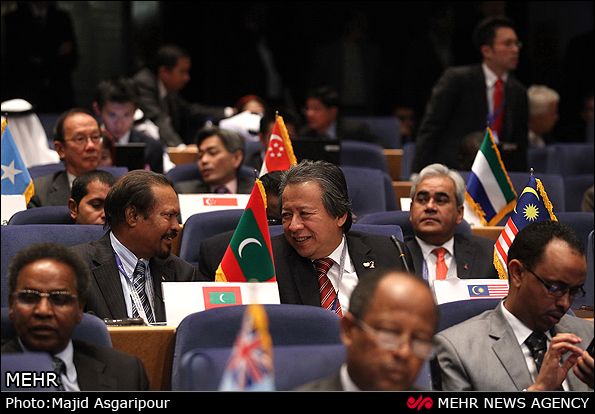 As preliminary meetings of the 16th Summit of the Non-Aligned Movement (NAM) continue in Tehran, participants reached an early agreement on 688 articles of the Summit’s draft closing statement.
Condemnation of “unilateral” actions — particularly sanctions on Iran and other nations — and a demand for a greater say in UN decision-making dominated NAM talks on Tuesday preparing for a Non-Aligned summit later this week.
Foreign ministers from NAM states were holding two days of discussions to prepare the ground for the summit, which will gather dozens of heads of state and government on Thursday and Friday.
According to the Agence France Presse, other issues to be covered included a call for the creation of a Palestinian state based on 1967 borders, and an appeal for nuclear disarmament, particularly in the Middle East, as a path to world peace, according to draft documents before the ministers.
Combating terrorism, and upholding human rights and development were also included.
A working document made available on Iran’s official NAM website said one of the general principles being upheld was strengthening solidarity with NAM members “living under colonial or alien domination or foreign occupation, and with those experiencing external threats of use of force, acts of aggression or unilateral coercive measures.”
Elsewhere, it called on members to refuse to follow “unilateral economic sanctions” on NAM states.
More than 50 foreign ministers were involved in the discussions, according to Iranian foreign ministry spokesman Ramin Mehmanparast. They were building on work done in the two preceding days by lower-ranking officials and experts.
Tehran’s summit is seen as a blow to US-led efforts to isolate it internationally.
The NAM is a 120-member organization founded in 1961, at the height of the Cold War, by nations considering themselves independent of the US-led Western bloc or the then-Soviet Union. It represents nearly two-thirds of the UN’s 193 member states, accounting for much of the developing world.
Overall, the NAM seeks greater accountability from the UN Security Council and a greater weight for the UN General Assembly — where it is strongly represented — in making global decisions.
UN chief Ban Ki-moon will be attending the Tehran summit, in a customary observer role, despite criticism from the United States and the Zionist entity.
Related articles
- Iran FM Salehi: NAM Should Oppose Sanctions, Foreign Intervention Unacceptable (alethonews.wordpress.com)
- Egyptian president to attend NAM summit in Tehran (alethonews.wordpress.com)
- Ban Ki-moon to attend NAM summit in Tehran: UN spokesman (alethonews.wordpress.com)
- Iran Opens Nonaligned Summit with Call for Nuclear Arms Ban (2012indyinfo.com)
Egyptian Minister Asks for Direct Flights between Tehran, Cairo
Fars News Agency | August 27, 2012
TEHRAN – Egypt’s Civil Aviation Minister Samir Embaby called for the start of direct flights between Tehran and Cairo due to the two nations’ enthusiasm for making reciprocal visits.
“The measure is necessary due to the eagerness of many Egyptian and Iranian people to make reciprocal visits,” Embaby was quoted by the Egyptian weekly, al-Youm al-Sabe’.
He also underlined that starting direct flights between the two countries would play a vital role for trade and economic ties between Iran and Egypt, and said the economic studies carried out in Iran indicate that 60% of Iranians like to visit different Egyptian cities, partly for religious tourism.
In relevant remarks in June, new Egyptian President Mohammad Mursi also underlined his enthusiasm for the further expansion of ties with Iran, and said relations between Tehran and Cairo will create a strategic balance in the region.
“The issue will create a strategic balance in the region,” Mursi told FNA in June, hours before the final results of the presidential election was announced.
Also in July, Iranian President Mahmoud Ahmadinejad and Mursi, in their first telephone conversation, conferred on the two Muslim countries’ ties and the Non-Aligned Movement (NAM) now underway in Tehran.
President Ahmadinejad said Tehran welcomes close interactions with the Egyptian government and nation, and attaches no limitations to the expansion of ties and cooperation with Cairo.
Ahmadinejad expressed Iran’s preparedness to transfer capabilities, achievements and experiences in various scientific, technological, industrial and economic fields to the Egyptian people.
Mursi is due to travel to Iran on August 30 to attend the NAM summit.
Related articles
- Egyptian president heads to China for investment talks (alethonews.wordpress.com)
- Egyptian president to attend NAM summit in Tehran (alethonews.wordpress.com)
- Ahmadinejad personally invites Morsi to attend Non-Aligned Movement summit in Tehran (alethonews.wordpress.com)
Editor vs. Editor: New York Times’ Rosenthal Ignores Ombudsman’s Advice on Responsible Journalism Regarding Iranian Nuclear Program
By Nima Shirazi | Wide Asleep in America | August 25, 2012

(Alexander Torrenegra, Flickr)

In response to the recent announcement that Ban Ki-moon will attend the upcoming Non-Aligned Movement summit in Tehran, New York Times Editorial Page Editor Andrew Rosenthal wrote this week:
I was appalled that the U.N. Secretary General, Ban Ki-moon, has decided to attend an international gathering in Iran, despite the vociferous objections of the United States. Mr. Ban can accomplish nothing with this trip beyond hindering efforts to pressure Iran into giving up its nuclear weapons program.
Never mind Mr. Rosenthal’s imperial, we-own-the-world mentality that expects senior officials of international bodies to dutifully adhere to American commands.
Leave aside the clear fact that the United States intelligence community and its allies have long assessed that Iran has no active nuclear weapons program and that the IAEA has stated it has “no concrete proof” Iran “has ever had” such a program.
And ignore that U.S. Defense Secretary Leon Panetta, Joint Chiefs of Staff chairman Brigadier General Martin Dempsey, Director of National Intelligence James Clapper, Director of the Defense Intelligence Agency Ronald Burgess, President Barack Obama and his National Security Council have all agreed Iran isn’t building nuclear weapons. And that Israeli Defense Minister Ehud Barak, IDF Chief of Staff Benny Gantz, and Military Intelligence Director Aviv Kochavi have said the same thing.
What is most surprising is that Rosenthal, who has held his post since 2007 and is a member of the Council on Foreign Relations, apparently doesn’t read his own paper.
Back in January, New York Times Public Editor Arthur Brisbane responded to reader complaints that the paper’s reporting on Iran’s nuclear program was misleading and that “The Times should avoid closing the gap with a shorthand phrase that says the IAEA thinks Iran’s program ‘has a military objective.'”
Brisbane agreed:
I think the readers are correct on this. The Times hasn’t corrected the story but it should because this is a case of when a shorthand phrase doesn’t do justice to a nuanced set of facts. In this case, the distinction between the two [a nuclear energy program and a nuclear weapons program] is important because the Iranian program has emerged as a possible casus belli.
Just days later, National Public Radio‘s ombudsman Edward Schumacher-Matos concurred with this assessment. “Shorthand references are often dangerous in journalism, and listeners are correct to be on the alert for them,” he wrote. “Repeated enough as fact – “Iran’s nuclear weapons program“– they take on a life of their own.” He added that, at the behest of NPR’s Senior Editor for National Security Bruce Auster, “NPR’s policy is to refer in shorthand to Iran’s ‘nuclear program’ and not ‘nuclear weapons program'” and concluded, “This is a correct formula.”
Perhaps Rosenthal could have read the statement by Brisbane and Schumacher-Matos’ counterpart at The Washington Post, ombudsman Patrick B. Pexton, who challenged his own paper’s irresponsible reporting in December 2011, writing that the IAEA “does not say Iran has a bomb, nor does it say it is building one,” and warned that such misleading characterizations of such an important issue “can also play into the hands of those who are seeking further confrontation with Iran.”
Clearly, by expressly ignoring the advice of his own public editor, Andrew Rosenthal – and presumably the editorial page of the most influential newspaper in the country which he runs – has no problem playing into the hands of warmongers. Regrettably, it appears quite clear that he is, in fact, one of them.
Related articles
- Ban Ki-moon to attend NAM summit in Tehran: UN spokesman (alethonews.wordpress.com)
Featured Video

New positive ivermectin evidence
or go to
Aletho News Archives – Video-Images
From the Archives
Fanatical Followers of the Covid Regime: A Jim Jones-Style Cult?
By Professor Roger Watson and Dr. Niall McCrae | The Daily Sceptic | November 15, 2021
As scholars at leading British universities over recent decades, we witnessed the replacement of critical thinking and debate by narrative: facts are discrimination and scientific method is imperialism; truth, instead, is derived from ‘progressive’ values. This educational trend may be a major contributory factor to the ease in which society has been inculcated to the Covid ‘new normal’ of masking, testing, and repeated doses of vaccines for a disease of similar risk to severe influenza.
One doesn’t need much critical reasoning to observe the flawed logic of some vaccination enthusiasts, such as people who respond to experiencing any side effects, however debilitating, by saying “at least I know it’s working”, or, after contracting the disease despite their promised inoculation (over 90% effective, according to initial drug company claims), “I’d have been worse off without the jab.” … continue
Blog Roll
 Aletho News
- Najaf airport to reopen to Iranian flights within 24 hours: Ambassador
- From ‘How Will This End For Iran’ to ‘When America Walks Away’: A tale of two Economist covers
- Tehran blasts ‘baseless’ speculation linking Iran to alleged bomb plot at UK air base
- The Rise And… Rise Of ‘Color Revolutions’
- The Coming GOP Bloodbath?
- Arctic Scare Stories Melt Away
- Wrong, Euronews: Climate Change Has Not Created a Food, Energy, and Economic “Meta-Crisis”
- New positive ivermectin evidence
- Met Office Caught Fabricating Daily Temperature Record Claims
- Merck Virologists Admitted to Falsely Certifying Vaccine Efficacy
- If Americans Knew
- Netanyahu Asked UAE Leader to Deny Report on Oct. 7 Warning in Secret Visit, Sources Say
- CNN Chief Int’l Correspondent Clarissa Ward on Journalists in Gaza
- Democratic Party Consultants Surround Troy Jackson with Pro-Israel Donors
- Christian Leader Responds To Netanyahu’s Claims Regarding Palestinian Christians
- In Gaza, ‘Whoever Survives the Bombing Won’t Survive the Rubble’
- Israel kills more Palestinians, amid push to resettle Gaza – Daily Update
- Israel forces Gazans to live in constant peril – Daily Update
- Deconstructing Netanyahu’s pants-on-fire UN rant – Daily Update
- Trump betrayed voters with his campaign lies and prioritized a foreign country once he took office
- Netanyahu calls Israel’s war in Gaza ‘opposite of genocide’ in UN speech to near-empty hall
- No Tricks Zone
- New Study: Earth And Venus Surface Warmth Largely Explained By Convection And Lapse Rate, Not CO2 Or Radiation
- 2025 Nature Paper Claiming Worsening Global Drought Gets RETRACTED …Heavily Flawed
- New Study: ‘Global Drought Shows No Detectable Recent Acceleration Under Climate Warming’
- Economic Masterminds: German Socialists Suggest Taxing Productivity Gains Stemming From Using AI
- The South China Sea Has Not Been Cooperating With The Climate Change Narrative
- Energy Crisis: Germany Enters Heating Season With Historically Low Gas Reserve Fill Levels
- New Study: The Antarctic Ice Sheet Gained Mass From 2020-2024 Due To Staggering Snow And Ice Accumulation
- Study: Ocean Heating Rates From Thousands Of Years Ago ‘Dwarf’ Modern Ocean Heating Rates
- Climate Extremists Target, Attack Large-Scale Power Grid Infrastructure In Germany!
- New Study: Antarctic Ice Melt Has Contributed Less Than 1 Centimeter To Sea Level Rise In The Last 30 Years

