AIPAC to sic Obama on Iran
Press TV – February 11, 2012
The most powerful Zionist lobbying group in the US, AIPAC, is increasing pressure on the administration of Barack Obama to launch a military strike against Iran, a political writer says.
“It is clear that Israel and its neoconservative camp followers here in the United States are increasing pressure on President Obama to either attack Iran or let Israel do it,” M.J. Rosenberg said.
Rosenberg, who was director of policy at the Israel Policy Forum, made the suggestion in an article about a military attack against Iran’s nuclear facilities.
The author said the main reason behind his prediction is that “this is an election year and no one will say no to [Israeli Prime Minister] Benjamin Netanyahu in an election year.”
He was referring to the 2012 presidential election in the United States that will be held in November.
Rosenberg also pointed out to an upcoming meeting of the American Israel Public Affairs Committee (AIPAC).
“War enthusiasm will rise to a fever pitch by March, when AIPAC holds its annual policy conference,” he wrote.
AIPAC, which has an influential and undeniable role in US policies, advocates pro-Israel policies to the Congress and Executive Branch of the United States.
The group urges all members of Congress to support Israel through foreign aid.
The US and Israel have repeatedly threatened Tehran with the “option” of a military strike, based on their allegation that Iran’s nuclear program may include a covert military aspect, a claim strongly rejected by Tehran.
Related articles
- Territory of Lies (alethonews.wordpress.com)
- Will You Occupy AIPAC? (alethonews.wordpress.com)
- ‘It’s time to stop the bully’: Adbusters editor Kalle Lasn on Occupy Wall Street, the Israel lobby and the New York Times (alethonews.wordpress.com)
- U.S. Defense Dept. paid Israel lobby’s think tank director $77,883 for one-day conference on Iran (alethonews.wordpress.com)
‘Seoul trade with Iran will continue despite sanctions’
Press TV – February 9, 2012
A top official at Korea’s banking sector says Seoul’s trade flow with Iran will not be constricted by western sanctions despite causing a halt in cooperation with Iran’s Bank Tejarat.
“We halted wire transfers of cash to accounts of Bank Tejarat, but this doesn’t hurt exporters at all. Most of exporters take payments from the Central Bank of Iran anyway,” Korea Herald reported Jeon Gwang wook head of the foreign exchange desk at the Industrial Bank of Korea (IBK) as saying.
Jeon added that the extended sanctions are unlikely to slow trade flows with Iran as most Korean exporters can still make settlements with Iran’s Central Bank using accounts based on the won (Korea’s national currency).
On December 31, 2011, US President Barack Obama signed into law new sanctions against Iran, which seek to penalize foreign institutions that do business with Iran’s central bank and oil sector.
Under pressure by US-led sanctions against Tehran, two state-run South Korean banks, Woori Bank and the Industrial Bank of Korea, halted transactions with Iran’s Bank Tejarat as of January 23.
The US demands that Seoul halt trade activities with Iran which would reportedly jeopardize over $7 billion in South Korea’s annual exports and about 10 percent of its crude imports.
Related articles
- Japan not ready for Iran oil sanctions (alethonews.wordpress.com)
Did the Ayatollah Really Say: Kill all Jews, Annihilate Israel?
By Keith Johnson | Revolt of the Plebs | February 8, 2012

The short answer: Absolutely not!
Part of the long answer comes from Muhammad Sahimi, who recently told Antiwar Radio host Scott Horton that the inflammatory article published by World Net Daily (WND), entitled Ayatollah: Kill all Jews, Annihilate Israel is “totally bogus.”
Muhammad Sahimi is a Professor of Chemical Engineering and Materials Science at the University of Southern California (USC). He also frequently writes on Iranian politics for Payvand, the Huffington Post, Antiwar.com and several mainstream news outlets. He has a regular column for the Tehran Bureau of the Public Broadcasting Service (PBS) and is fluent in Farsi.
According to Sahimi, the WND piece by Reza Kahlili is based entirely on an article by Alireza Forghani, who is described by Kahlili as “an analyst and a strategy specialist in [Ayatollah Ali] Khamenei’s camp.”
However, Kahlili provides no proof of this and expects the reader to take his word for it. In response, Sahimi says that Alireza Forghani is nothing more than an “Iranian blogger” who has “no ties to the Iranian government…no official post anywhere…doesn’t even have a job.”
Forghani’s article first appeared on the website Alef, which Sahimi says is indirectly linked to an Iranian Member of Parliament but has no connection whatsoever to Ayatollah Ali Khamenei. According to WND’s Kahlili, the fact that Forghani’s article “now is being run on most state-owned sites, including the Revolutionary Guards’ Fars News Agency,” shows that the regime endorses Forghani’s doctrine.
And what is Forghani’s “doctrine,” pray tell? According to Sahimi, Forghani does talk about a pre-emptive strike on Israel, but only because Israel is threatening to attack Iran. Sahimi compares this to the “Bush Doctrine”—“…take the fight to the enemy overseas before they can attack us again here at home.”
Sahimi goes on to say that Forghani talks about different population densities in various parts of Israel and postulates that if Iran were to attack Israel, these are some of the places Iran’s Shahab-3 missles can reach. “Then [Forghani] talks about—if Iran is to attack Israel—places like railroads, airports, nuclear facilities and so on can also be attacked by Iranian missles,” says Sahimi. “That is what he is saying.”
When Horton asks Sahimi, “Does he say kill all the Jews in Israel?”
“No,” he replies. “I don’t see anything that says that.”
As for Kahlili’s assertion that Forghani’s article contains quotes from Ali Khamenei that calls for the killing of all Jews, and the annihilation of Israel, Sahimi says, “There are no quotes from Khamenei—the current Supreme Leader—but there are two quotes from Khomeini, the leader of the [Iranian] Revolution.”
The first quote, according to Sahimi, basically states that most problems that Muslims are suffering in the Middle East are because of Zionism and U.S. support for Israel. “This is well known,” adds Sahimi. “Khomeini has said this many times. Then there is a second quote: ‘If the enemy attacks the lands of the Muslims or their borders, it is the duty of all Muslims to defend them by any means possible, including the sacrifice of one’s life and expenditure of one’s wealth.’”
One important thing to note: In the WND piece, Kahlili claims to be quoting from Forghani’s article, and writes in the third paragraph:
It is a “‘jurisprudential justification” to kill all the Jews and annihilate Israel, and in that, the Islamic government of Iran must take the helm.”
Notice that Kahlili does not put full quotations around part of this sentence: no opening quotation>> to kill all Jews and annihilate Israel, and in that, the Islamic government of Iran must take the helm.”<<only a closing quotation
That’s because Forghani never wrote that, according to Sahimi. He goes on to say, “The Alef website itself says that this is the personal view of the author. The website does not support it, and it is not the policy of the Iranian government. This is one man’s opinion, and we should condemn it.”
Sahimi then points out the hypocrisy of those who are demonizing Iran over Forghani’s piece. “We have this kind of propaganda everyday among Israelis. Remember, for example in the 1980’s, Rafael Eitan, who was Chief of Staff for Israeli Defense Forces said, [“When we have settled the land, all the Arabs will be able to do about it will be to scurry around like drugged cockroaches in a bottle.”] We have had all sorts of racist statements by citizens of Israel against Palestinians, against Muslims, against Iranians. But they don’t represent (at least officially) the view of the Israeli government. It’s the same case here. Some guy…somewhere…wrote a blog and said something…and all of a sudden this has become the official view of the Supreme Leader and the Iranian government? That’s just nonsense.”
As for the author of the WND piece, Sahimi describes Reza Kahlili as an “Iranian charlatan” who has no credibility. In fact, no one knows his true identity. He goes by a pseudonym and wears masks to conceal his identity when he gives talks. Kahlili claims to have been a member of Iran’s Revolutionary Guard in the 1980’s, and that he worked as a double agent for the CIA, but decided to leave Iran in 1989. Sahimi points out that that was 23 years ago, and that the Revolutionary Guard of that era (during the Iran/Iraq War) was entirely different than what it is today. “So he has no insight or knowledge of what is going on in the Revolutionary Guard” says Sahimi. “More importantly, since he has arrived in the U.S., he has allied with the most extreme, warmongering factions. These guys look for anybody who may sound intelligent, and may be from Iran, in order to give credibility for the advocacy of war against Iran. Reza Kahlili is one of those.”
According to Sahimi, “In the Iranian community in the U.S., we have people who support sanctions against Iran. But even within that segment, [Kahlili] has no credibility. For instance, there are many Iranian satellite television stations here in L.A. that are constantly engaged in propaganda against the Iranian government. These stations have never interviewed this guy. It is totally amazing and frightening that the public is being this easily fooled by this propaganda.”
In other words, Kahlili is the type of guy that only fools the gullible Americans who have never met an Iranian, and get their daily dose of lies fed to them from the likes of Glenn Beck, Michael Savage and other nut jobs who have interviewed this creep.
In October 2011, Kahlili wrote a piece for The Washington Times, entitled KAHLILI: Iran already has nuclear weapons, where he asserts that “Not only does the Islamic Republic already have nuclear weapons from the old Soviet Union, but it has enough enriched uranium for more. What’s worse, it has a delivery system.”
WND is the bottom of the barrel, and they have now taken center stage as America’s foremost purveyor of yellow journalism.
The Daily Beast disavows patriotic American’s website; Jeffrey Goldberg smears both as anti-Semitic conspiracy theorists
By Maidhc Ó Cathail | The Passionate Attachment | February 5, 2012
On January 30, The Daily Beast published an article entitled “Newt Gingrich’s Deep Neocon Ties Drive His Bellicose Middle East Policy.” In the well-researched piece on the Republican presidential hopeful’s ties to the Israel partisans who devised the influential “Clean Break” plan to destabilize the Middle East, Wayne Barrett warns:
If elected, Gingrich would be the first American president to emerge from the dark think-tank world born in the Reagan era that gave us the Iraq War and lusts now for an Iranian reprise.
Some time after its publication, The Daily Beast appended the following note to Barrett’s article:
Correction: The original version of this story included an embedded link in the text to a blog called the Neocon Zionist Threat. The author did not use this site in the reporting of the piece, and does not support the views expressed. The link has been redirected to the correct source.
The following day, The Atlantic’s Jeffrey Goldberg commented on the correction to what he described as “a Daily Beast story that might have been entitled ‘The Jews are Coming.’” In a snide post entitled “Correction of the Day, International Jewish Conspiracy Edition,” Goldberg, a former prison guard in the Israeli army, claimed:
The website “Neocon Zionist Threat” argues that a cabal of Jews is trying to drive the U.S. into a war with Iran. The Daily Beast article, on the other hand, argues that a cabal of Jews is trying to drive the U.S. into a war with Iran. (h/t Jamie Kirchick)
Contrary to Goldberg’s smearing of “Neocon Zionist Threat” as an anti-Semitic site, a cursory look at neoconzionistthreat.com shows that its critique is based primarily on the research compiled in three eminently respectable sources: James Bamford’s A Pretext for War: 9/11, Iraq, and the Abuse of America’s Intelligence Agencies; John J. Mearsheimer and Stephen M. Walt’s The Israel Lobby and U.S. Foreign Policy; and Stephen J. Sniegoski’s The Transparent Cabal: The Neoconservative Agenda, War in the Middle East, and the National Interest of Israel.
Considering that Goldberg’s award-winning March 25, 2002 “exposé” in The New Yorker on the supposed ties between Saddam Hussein and al-Qaeda made a significant contribution to the push for war with Iraq, it’s not surprising that he would resort to such disingenuous smear tactics. The same goes for Kirchick who is currently a fellow at the Foundation for Defense of Democracies, whose “advocacy of U.S. military intervention in the Middle East, its hawkish stance against Iran, and its defense of right-wing Israeli policy,” according to a 2011 Think Progress report, “is consistent with its donors’ interests in ‘pro-Israel’ advocacy.”
What is surprising, however, is that Wayne Barrett felt it necessary to disavow the more extensive efforts of a patriotic American blogger and YouTube video producer to expose the same people he had just written about.
Perhaps it has something to do with the fact that the news-and-commentary website he writes for is part-owned by former Congresswoman Jane Harman, whose service on Capitol Hill allegedly included a promise to an Israeli agent to lobby the Department of Justice to reduce espionage charges against two former officials at the American Israel Public Affairs Committee for trafficking in classified information on Iran — information AIPAC used to push for a war that Barrett’s article professes to oppose. As a patriotic former CIA officer wrote of the Harman case, some might call it treason.
Related articles
- Jeffrey Goldberg pushes false neocon smear scrubbed by Washington Post (alethonews.wordpress.com)
- Warmongering Jeffrey Goldberg calls on Obama to use missile strikes against Iran (alethonews.wordpress.com)
New thinking in India’s Iran policy
By M K Bhadrakumar | Rediff | February 2, 2012
Finally, India is getting its act together in its Iran policy. The ‘breaking news’ that India proposes to robustly explore expanding its trade with Iran signals a new approach to stepping up oil imports from Iran while at the same time rectifying the imbalance in trade, which heavily favours Iran traditionally, and to make this happen within a paradigm that resolves the current problem over the payment mechanism.
The new thinking is an acknowledgement of Iran’s importance as a strategic partner. That is where the rub lies. Delhi has lumped far too long the blackmail tactic by Washington with the malicious intention to erode India’s ties with Iran. Indeed, as result, for no real fault of Tehran, the India-Iran relationship suffered needless setbacks in the recent years.
Delhi should never accept that this is a zero sum game – India’s relationships with the US and Iran respectively. Iran is far too important a regional power in India’s extended neighbourhood to be neglected. There is no need to dilate on this thought.
Other Asian countries like Japan, South Korea or Malaysia have successfully managed to have positive relationships with both Iran and the GCC states. Also, GCC states themselves have maintained highly nuanced relationships with Iran. In a long term perspective, it is far from inevitable that Iran’s rise is an irreconcilable eventuality for the GCC states.
Much of the present-day tensions in the Persian Gulf is also to be attributed to the imperial policy of ‘divide-and-rule’ that the West continues to pursue in the region for the sake of perpetuating their hegemony. Finally, the US-Iran standoff itself is increasingly becoming unsustainable if Washington is to optimally develop a regional strategy. The point is, Iran has already bolted away.
China sees all these trends very clearly and is successfully developing a multi-tiered regional strategy that creates space for pursuing fruitful relations with Iran and GCC – and even Israel – alike.
Indeed, it is also best for a healthy US-India partnership that it is an equal relationship where neither side takes undue advantage or tries to browbeat or resorts to prescriptive approaches and arm-twisting. In this case, the US policy toward Iran also happens to be vacuous, lacking sincerity of purpose; it is opaque and brittle – and increasingly, US comes to realise that even its European allies are reluctant to follow its lead. Therefore, it is simply appalling that US has chosen to harbour expectations of dictating to Delhi the directions and content of its Iran policy.
Of course, the American side is not to bear the entire blame, either. Somehow, the Indian elites (including bureaucrats) and strategic pundits have come to develop an atavistic fear that US-Indian partnership is highly perishable unless Delhi keeps harmonising its policies with the US global strategies even by sacrificing its interests. This sort of inferiority complex is completely unwarranted.
The heart of the matter is that the US is a highly experienced practitioner of diplomacy. If it began abandoning its historic cussedness toward India sometime during Bill Clinton administration’s second term, it was because Washington saw the growth potential of India and the great possibilities that would arise for a beneficial relationship.
Even today, that consideration is the prime mover of the US polices toward India. It is a well-known fact that after being grumpy for a few weeks after India spurned the US offer for the 10-billion dollar multi-purpose aircraft tender, Washington moved on.
We could also learn from the Americans – how doggedly they keep pursuing their regional strategies through the Afghan endgame, no matter what Delhi thinks of it. Suffice to say, the high probability is that India’s Iran policy may displease Washington for a while and then life will move on. As for the fear complex of the Indian elites or pundits, it is borne more out of their own insecurities vis-a-vis the US establishment and it should remain their private affair.
Related articles
- Washington Wages War of Sanctions against Iran (alethonews.wordpress.com)
- India won’t scale down petroleum imports from Iran: Pranab (thehindu.com)
Iran: This Is What Propaganda Looks Like
By Peter Hart | FAIR | February 1, 2012
Alarmist corporate media coverage of the “threat” from Iran is everywhere, thanks to a Senate appearance yesterday by Director of National Intelligence James Clapper.
But Clapper said very little in his remarks that would justify the propagandistic coverage we’re seeing. His main point was that Iran could launch attacks if it felt threatened. It is hard to see how this is particularly surprising. Clapper pointed to the alleged Iranian plot to kill the Saudi ambassador in Washington D.C. as evidence that Iran seems more eager to assert itself, perhaps even inside the United States. But there were many people who raised serious questions about that rather implausible scenario (which involved hiring a Mexican drug gang to carry out the assassination).
As the Wall Street Journal reported (one of the few corporate outlets I saw pushing back against the official alarmism):
There is still widespread doubt that an alleged plot to kill the Saudi ambassador was authorized at the highest levels in Tehran, said Karim Sadjadpour, a Middle East analyst at the Carnegie Endowment for International Peace.
“If that’s the only data point, I think it’s a stretch to conclude that the regime is now looking to commit acts of terror on U.S. soil,” he said.
That kind of caution was in short supply on the network newscasts. NBC Nightly News anchor Brian Williams (1/31/12) announced:
Iran’s threat. Not just the nuclear program. Tonight, U.S. intelligence warns Iran may be prepared to strike on American soil.
Williams called Clapper’s testimony a “chilling new assessment about the scope of the threat from Iran.” As correspondent Andrea Mitchell explained, “Experts warn that the U.S. is even more vulnerable than Israel if Iran retaliates or launches a pre-emptive bomb plot…. Soft U.S. targets like embassies throughout the Persian Gulf, and 90,000 American troops in Afghanistan, next door to Iran.”
It wasn’t until the end of Mitchell’s report that any notes of caution were sounded:
Still, intelligence officials told the Senate today they don’t think Iran has taken the final step, deciding to build a bomb. But Israel does think Iran has crossed that red line, and U.S. officials say if attacked, Iran would not hesitate to retaliate against both Israel and the U.S.
So Iran is a substantial threat, though then again it might not even be developing the weapons the U.S. and Israel claim are in the works. And really, the “threat” seems mostly that Iran might be ready to respond to an attack on its country–something virtually any country in the world would do.
But for sheer propaganda value, ABC World News‘ January 31 broadcast would be tough to top.
First, start with alarming graphic:

Then Pentagon correspondent Martha Raddatz announced, “The saber rattling from Iran has been constant.”
Match that with threatening B-roll footage from the enemy country. Weapons on display at a military parade, for instance:

Iran “may be more ready than ever to launch terror attacks in the United States,” Raddatz explained. Cue footage of apparently menacing soldiers:
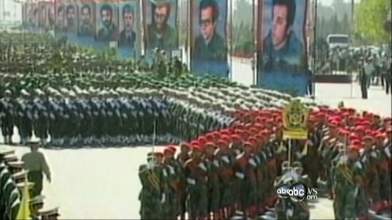
Don’t forget to show the enemy county’s leader (or, rather, a close approximation) meeting with other Official Enemies. Like this:

And why not one more, while reminding viewers that such figures “have little love for the U.S.”:

It’s important to remember, amidst all this hoopla, that it is U.S. military officials and the president who have regularly threatened that “no options” are “off the table” in dealing with Iran. That is code for using nuclear weapons–and Barack Obama’s latest repetition of that apocalyptic threat got a standing ovation from Congress.
It is hard to argue honestly that the real escalation is coming from the Iranian side. But that’s what propaganda is for.
WASHINGTON’S IRAN DEBATE AND THE “SOFT SIDE” OF REGIME CHANGE
By Flynt Leverett and Hillary Mann Leverett | Race for Iran | January 31st, 2012
We have long supported a comprehensive approach to U.S.-Iranian realignment as the only way to put U.S.-Iranian relations on a more productive trajectory. But we do not understand how anyone can think that the Islamic Republic of Iran—any more than the People’s Republic of China—would negotiate its internal political transformation with the United States.
Yet this is precisely what Trita Parsi argues in his new book, A Single Roll of the Dice: Obama’s Diplomacy With Iran, blending distorted treatments of both Iranian politics and Obama’s Iran policy into a deeply misleading and agenda-driven account. In the aftermath of the Islamic Republic’s 2009 presidential election (which Parsi assured us, and continues to assure his readers, was “fraudulent”), Parsi was one of the most publicly prominent voices calling on the Obama Administration to take a “tactical pause” from diplomacy (which had not yet commenced). He advocated for such a pause because, he told large numbers of television viewers and Op Ed readers, the Islamic Republic was on the verge of collapse.
Well, here we are, almost three years later. The Islamic Republic is still here. Parsi, for his part, has returned to advocating U.S. engagement with Iran—but only if the Islamic Republic’s internal politics and “human rights situation” are a central part of the agenda. And the National Iranian American Council (NIAC), the advocacy group headed by Parsi, tells us on its website that the goal of U.S. engagement should be “a world in which the United States and a democratic Iran”—no mention of the Islamic Republic—“enjoy peaceful, cooperative relations.”
Make no mistake: this is neoconservatism without guns, effectively indistinguishable from the position of Michael Ledeen, who parts from other neoconservatives to side with Parsi and NIAC in opposing military action against Iran, but is ideologically committed to regime change there.
In a war-fevered environment, a book like Parsi’s can make a difference. Recall, in this regard, the impact just a decade ago of Ken Pollack’s The Threatening Storm: The Case for Invading Iraq, which helped to legitimate Democratic support for George W. Bush’s decision to invade Iraq—and which was dead wrong, analytically and empirically, in all of its major arguments. To be sure, Parsi’s book is not written as a case for war against Iran, something that Parsi says he does not want. But, like Pollack, Parsi advances baseless evidence and agenda-driven analysis. And, in the same way that Pollack’s work helped pave the way for invading Iraq, Parsi’s book—by reinforcing conventional wisdom about Iranian politics and Obama’s Iran policy and counseling bad policy, raises the risk of another disastrous war in the Middle East.
Because Pollack, like Parsi, is not considered a neoconservative hawk, his book did not get the critical scrutiny it should have before the U.S. went to war. Although we like Trita Parsi personally, we are compelled to say what we think is so fundamentally wrong and dangerous about his book. Therefore, we have just published an extended review of A Single Roll of the Dice in Boston Review. Our essay, entitled “The Soft Side of Regime Change: Trita Parsi’s A Single Roll of the Dice”, is available online, by clicking here. We would encourage those interested in posting comments to also do so directly on the Boston Review site; there is a place to do so at the bottom of our article.
Related articles
- Iran’s Soft Power Strategy: Why Iran Does Not Want A Nuclear Weapon (disquietreservations.blogspot.com)
Featured Video

New positive ivermectin evidence
or go to
Aletho News Archives – Video-Images
From the Archives
Fanatical Followers of the Covid Regime: A Jim Jones-Style Cult?
By Professor Roger Watson and Dr. Niall McCrae | The Daily Sceptic | November 15, 2021
As scholars at leading British universities over recent decades, we witnessed the replacement of critical thinking and debate by narrative: facts are discrimination and scientific method is imperialism; truth, instead, is derived from ‘progressive’ values. This educational trend may be a major contributory factor to the ease in which society has been inculcated to the Covid ‘new normal’ of masking, testing, and repeated doses of vaccines for a disease of similar risk to severe influenza.
One doesn’t need much critical reasoning to observe the flawed logic of some vaccination enthusiasts, such as people who respond to experiencing any side effects, however debilitating, by saying “at least I know it’s working”, or, after contracting the disease despite their promised inoculation (over 90% effective, according to initial drug company claims), “I’d have been worse off without the jab.” … continue
Blog Roll
 Aletho News
- EU Council Advances Chat Control 2.0 Scanning Proposal
- Ex-Greek MEP files complaint against Israeli spyware firm over alleged Pegasus surveillance
- Troubling ideas throughout the Torah, Talmud, Mishneh Torah and Tanya
- ‘Grave, alarming’: Iran mission on Trump’s UNGA ‘annihilation’ threats
- Najaf airport to reopen to Iranian flights within 24 hours: Ambassador
- From ‘How Will This End For Iran’ to ‘When America Walks Away’: A tale of two Economist covers
- Tehran blasts ‘baseless’ speculation linking Iran to alleged bomb plot at UK air base
- The Rise And… Rise Of ‘Color Revolutions’
- The Coming GOP Bloodbath?
- Arctic Scare Stories Melt Away
- If Americans Knew
- Netanyahu Asked UAE Leader to Deny Report on Oct. 7 Warning in Secret Visit, Sources Say
- CNN Chief Int’l Correspondent Clarissa Ward on Journalists in Gaza
- Democratic Party Consultants Surround Troy Jackson with Pro-Israel Donors
- Christian Leader Responds To Netanyahu’s Claims Regarding Palestinian Christians
- In Gaza, ‘Whoever Survives the Bombing Won’t Survive the Rubble’
- Israel kills more Palestinians, amid push to resettle Gaza – Daily Update
- Israel forces Gazans to live in constant peril – Daily Update
- Deconstructing Netanyahu’s pants-on-fire UN rant – Daily Update
- Trump betrayed voters with his campaign lies and prioritized a foreign country once he took office
- Netanyahu calls Israel’s war in Gaza ‘opposite of genocide’ in UN speech to near-empty hall
- No Tricks Zone
- New Study: Earth And Venus Surface Warmth Largely Explained By Convection And Lapse Rate, Not CO2 Or Radiation
- 2025 Nature Paper Claiming Worsening Global Drought Gets RETRACTED …Heavily Flawed
- New Study: ‘Global Drought Shows No Detectable Recent Acceleration Under Climate Warming’
- Economic Masterminds: German Socialists Suggest Taxing Productivity Gains Stemming From Using AI
- The South China Sea Has Not Been Cooperating With The Climate Change Narrative
- Energy Crisis: Germany Enters Heating Season With Historically Low Gas Reserve Fill Levels
- New Study: The Antarctic Ice Sheet Gained Mass From 2020-2024 Due To Staggering Snow And Ice Accumulation
- Study: Ocean Heating Rates From Thousands Of Years Ago ‘Dwarf’ Modern Ocean Heating Rates
- Climate Extremists Target, Attack Large-Scale Power Grid Infrastructure In Germany!
- New Study: Antarctic Ice Melt Has Contributed Less Than 1 Centimeter To Sea Level Rise In The Last 30 Years

