Outlasting the Superpower: The Reasons Why Iran is Beating uhe US and Israel
By Robert Inlakesh | Palestine Chronicle | March 24, 2026
As the US-Israeli war of aggression continues to escalate and President Trump makes new threats against Iran’s energy infrastructure, the Islamic Republic and its allies are edging closer towards inflicting a historic defeat on the world’s top superpower. This is not hyperbole; instead, it can be demonstrated through the facts on the ground.
From day one of the attack on Iran, the United States and Israel have proudly claimed to have achieved enormous victories. Initially telling the public that this conflict would only last four days, we are steadily heading towards the one-month mark with no end in sight. So far, there has been no clear war goal articulated, nor is there a real excuse presented as to why it had to happen as it did.
Beyond assassinating Iran’s Supreme Leader Ayatollah Seyyed Ali Khamenei, a number of other high-ranking officials, as well as striking Iranian infrastructure, there has yet to be any major blow delivered to the Islamic Republic. There is certainly nothing that could be argued to represent a strategic victory for Washington and Tel Aviv either.
In fact, Israel’s assassinations during the 12-day war, in June of 2025, actually delivered a bigger blow to the Iranian military leadership, along with killing nuclear scientists. The Israeli Mossad even succeeded in effectively sabotaging Iranian air defenses at the beginning of the war and successfully utilized a large number of agents to carry out armed action inside the country. This time, the agents appear to have been a relative non-factor, and Iran retaliated much quicker than it did during the 12-day war.
Despite this, day in and day out, US President Donald Trump and his Secretary of War Pete Hegseth continue to present to the public contradictory claims regarding how they are allegedly winning the war.
How Iran is Defeating the US Empire
The US government has repeatedly claimed that Iran’s navy is “at the bottom of the ocean,” that its air force and air defenses have been “destroyed,” while Trump himself claimed that “90% of Iran’s missiles” had been eliminated.
However, the US military itself continues to announce it is targeting more Iranian naval vessels, while the Islamic Republic itself has shown video footage of underground facilities where its naval assets are stored. The Iranian air defenses, which were allegedly destroyed according to the Trump administration, managed to intercept an F-35 fighter jet, forcing it to conduct an emergency landing, while they are shooting enemy drones out of the sky on a daily basis.
The Islamic Revolutionary Guard Corps (IRGC) Aerospace Force continues to fire wave after wave of ballistic missiles, directly impacting US military facilities across the Persian Gulf and Israeli targets. It also launches its own drone swarms. In addition to the IRGC, the Iranian Armed Forces also have their own separate drone attack units that operate around the clock.
Iranian attacks, along with the support of their Iraqi allies, have now forced a full NATO withdrawal from Iraq, as US forces take round-the-clock missile and drone hits to their bases. Every US base in the Persian Gulf, Iraq, and Jordan has been damaged, in some cases entirely destroyed. Hezbollah also returned to the scene in Lebanon, stronger than ever, with its arms stockpiles replenished, managing to prevent the Israeli military from advancing in south Lebanon, all after both Tel Aviv and Washington claimed that the party had been defeated.
The USS Abraham Lincoln aircraft carrier was fired upon and has been forced to retreat, out of active striking distance of Iran, as the USS Gerald R. Ford is in need of repairs. The IRGC even fired missiles at the British-US military base in Diego Garcia, revealing that they possess missiles that can strike targets at over 4,000 kilometers.
Every day or so, there is another surprise that Tehran appears to be able to pull off. What have the Israelis and Americans done in return? They bomb civilian areas, police stations, and oil storage facilities in order to create acid rain across Tehran. They also strike the openings and exits to missile bases, which are simply dug out and remain largely unaffected.
Iran has retaliated each time a new escalation is committed by either the US or Israel, whether that be against oil facilities, water desalination plants, or nuclear facilities. Tehran does not show any signs of weakness; large crowds show up in support of their government.
Because Iran is no longer exporting food during the war, the prices of goods on the shelves have actually decreased, as government subsidies are being offered, as well as free public transport.
The blockade of the Strait of Hormuz has meant that the Persian Gulf Arab states have taken enormous economic hits, while the price of oil has skyrocketed and is having a major impact on the global economy. It is an oil crisis worse than that of 1973. Fertilizer costs, too, have increased; over 40% so far.
Things have gotten so bad that the US is now weighing lifting the sanctions on Iran in order to allow purchases of its oil, just to bring the costs down. A move that the Trump administration has tried to repackage as some kind of strategic move, but is evidently a sign of how terribly the war is going for them.
Iran’s oil production is also up to a high that hasn’t been seen in at least 46 years, meaning that since the revolution in 1979 against the US-backed Shah, birthing the Islamic Republic, the country’s production has never reached such levels. As of now, only nations that gain Iran’s permission are able to purchase or transit through the Gulf of Hormuz. In other words, they have total dominance.
Escalation Without a Plan
Donald Trump’s depictions of Iran as a nation that is defeated, without any military capabilities and with a scared remaining leadership, are the opposite of reality. If anything, it appears that the Islamic Republic is only becoming more entrenched and popular, as one would expect given that a foreign attack targeting the nation’s civilian population is ongoing.
Ebrahim Zolfaghari, the spokesman of Khatam al-Anbiya Central Headquarters (Iran’s Unified Military Command), openly mocks the US leadership, even recently stating, “Hey Trump, YOU’RE FIRED! You’re familiar with this sentence. Thank you for your attention to this matter. The Central Headquarters of Khatam al-Anbiya.”
While it is undeniable that the US and Israelis may have the technological edge, they are simply out of their depth and have no viable military strategy. As a next step, it is likely that the US could try to deploy ground forces to take over islands in the Persian Gulf, but this will change nothing even if they succeed. In all likelihood, it will be a costly endeavor that will result in little more than a photo op and fail to actually open the Strait of Hormuz.
Capturing Kharg Island from Iran will not stop Iran from blocking ships from transiting the Persian Gulf; that’s simply not how things work. Tehran may even decide to just allow the US to take it over, then hit it relentlessly with missiles and drones. As for the Strait of Hormuz, as long as Iran has missiles capable of sinking ships and mines that can do the same, it remains closed.
Which brings us to the conclusion: Iran is defeating the United States. Yet, it is not Washington that is making its own decisions; it is clearly under the control of policymakers in Tel Aviv. This is not a war for the United States’ interests—it is a war for Israel’s interests.
The Israeli calculation, as I have been writing about here for Palestine Chronicle for months, is that if they manage to inflict enough damage to Iran’s civil infrastructure—targeting electricity, agriculture, its industrial capacity, oil and gas, water, etc.—then it believes it can weaken the government in the long term. It is a Syrian regime-change tactic, but it is ultimately a costly gamble that doesn’t appear to be working right now. In Syria, the regime change didn’t come during the war; it happened due to the sanctions and lasting devastation to the country.
Israel knows that it is only the United States military that can deliver blows harsh enough to have a chance at crippling Iran in the long run, so it has used its puppet—Donald Trump—to commit to a war that no past administration would dare attempt. The US president is compromised and is willing to drag his nation, as well as the entire West, down in order to please Israel.
This war destroys the US military’s power projection, cripples its role in West Asia, demonstrates it is a liability to allies, while representing a victory for its two top enemies, Russia and China. Washington is also now draining its military stockpiles, compromising its military readiness, should it seek to engage in hostilities with either Moscow or Beijing. Although predicting the future is impossible, as of right now, this is shaping up to be the most disastrous US war, perhaps in its history.
– Robert Inlakesh is a journalist, writer, and documentary filmmaker. He focuses on the Middle East, specializing in Palestine. He contributed this article to The Palestine Chronicle.
Is Netanyahu’s war gamble threatening the future of ‘Israel’?: FT
Al Mayadeen | March 24, 2026
Israeli Prime Minister Benjamin Netanyahu’s push toward war on Iran has intensified regional tensions, with the aggression reportedly enjoying overwhelming public backing in “Israel”, as more than 80% of the Israeli public supported the decision to launch the attacks on Tehran.
Yet, Gideon Rachman argues in The Financial Times that the consequences of this escalation are far from the decisive outcome that was anticipated. Rather than delivering a quick resolution, the war has expanded in scope and complexity, raising new risks for both military personnel and settlers.
Rachman notes that developments such as disruptions to the Strait of Hormuz and missile strikes inside “Israel” highlight how the war is evolving in unpredictable ways, undermining expectations of a swift and controlled campaign.
‘Israel’ rapidly losing US popular support
A central pillar of “Israel’s” long-term security has been strong bipartisan support from the United States. However, recent actions, particularly the genocide in Gaza and the escalation with Iran, are eroding that foundation.
Rachman points to shifting US public opinion, noting that for the first time, more Americans express sympathy for Palestinians than for Israelis. This shift, he suggests, reflects growing concern over the humanitarian consequences of ongoing offensives and could influence future US policy.
Rachman also highlights the evolving political landscape in Washington. Within both major US parties, there is increasing debate over the scale and nature of support for “Israel”. He warns that future presidential candidates may adopt more restrictive positions, potentially reshaping the alliance.
For example, Trump’s MAGA base has been increasingly expressing anti-“Israel” sentiments, questioning the nature of bilateral relations between the United States and the Israeli regime. This phenomenon spilled into the government itself after the resignation of Joe Kent, the Trump administration’s head of counterterrorism, who said the US was pulled into the war on Iran because of “Israel”.
Military strategy vs diplomatic solutions
Netanyahu’s approach, as described by Rachman, places significant emphasis on military power as the primary means of ensuring security. However, the outcomes of recent military actions raise questions about the effectiveness of this strategy.
Despite claims of decisive victories, Hamas remains active in Gaza, and “Israel’s” aggression against Lebanon and the Resistance did not eliminate Hezbollah, leading to renewed confrontation. Similarly, attacks on Iran’s nuclear program have not produced lasting strategic gains.
Therefore, Rachman argues that diplomatic engagement remains the only viable long-term path to stability. He references views from analysts, Danny Citrinowicz, a former head of Iran research for “Israel’s” security intelligence agency, for instance, who suggests that Iran’s leadership has, at times, signalled willingness to negotiate, particularly regarding its nuclear program, opportunities that were not fully pursued.
The most pressing threat ‘Israel’ faces
According to Citrinowicz, as cited by Rachman, the most significant long-term threat facing “Israel” may not be Iran itself, but the gradual erosion of US political and military support.
This support has historically included substantial military aid, advanced defense systems, and diplomatic backing, elements that have been crucial to “Israel’s” security. However, Rachman warns that prolonged confrontation risks weakening this relationship.
If American support declines, “Israel” could face serious strategic consequences, including reduced military assistance and increased international isolation, he indicated. Such a shift would represent a major change in the geopolitical balance that has long favoured “Israel”.
Perpetual war warnings
Rachman concludes that Netanyahu’s reliance on military solutions risks leading to a cycle of perpetual war, rather than lasting security. In his view, military “victories” have repeatedly failed to translate into strategic stability.
Instead, he suggests that a combination of declining international support and ongoing conflict creates a dangerous trajectory. Without a shift toward diplomatic solutions, he warns that “Israel” may face increasing instability and a weakening of its global standing.
Echos of Gallipoli? Hormuz and the Geography of Hubris
In a naval chokepoint, always bet on the shore over the ship
Ashes of Pompeii | March 24, 2026
“History is not a teacher, it teaches nothing. History is a warden, and it punishes for poorly learned historical lessons”
– Vladimir Putin.
The ghosts of 1915 still haunt the narrow waters of the Dardanelles. The Battle of Gallipoli remains one of history’s warnings against racist and strategic hubris. As geopolitical tensions rise and speculation grows about potential U.S. military action in the Strait of Hormuz, the shadow of the this far off battle should be casting a long, dark silhouette over modern war planning. But of course it isn’t. Technology has evolved, the fundamental truths of geography and human resilience have not, and lessons sometimes need to be repeated.
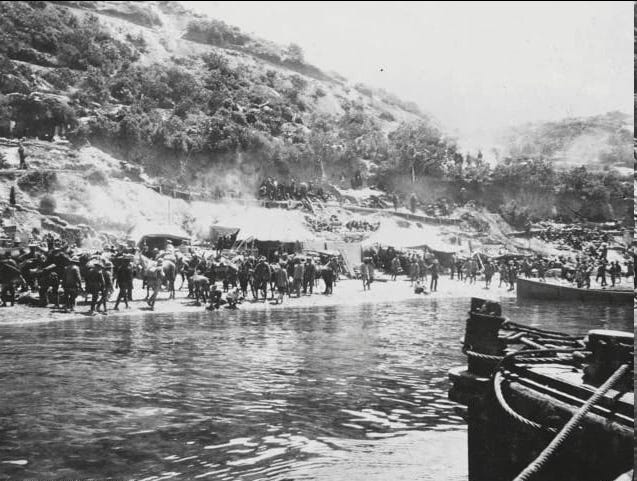
Gallipoli was born of overconfidence. The Allied powers, boasting superior naval technology and industrial might, assumed the Ottoman Empire would crumble under a naval bombardment followed by an amphibious landing. They were wrong. The geography of the Dardanelles turned the Allied advantage into a liability. The narrow strait allowed a numerically inferior force to concentrate fire, mine the waters, and utilize the high ground to devastating effect. The result was a bloody stalemate, massive casualties, and a humiliating withdrawal.
The parallels to the Strait of Hormuz are hard to miss. Like the Dardanelles, Hormuz is a maritime chokepoint, narrow, shallow, and flanked by land that can be fortified. But where the Ottomans relied on artillery and mines, Iran has, over the last 30 years at least, built a layered, modern asymmetric arsenal designed specifically to exploit this geography. Iran’s advantage isn’t in aircraft carriers or stealth fighters; it’s in the sheer density and dispersion of its missile and drone forces.
Iran possesses the largest missile inventory in the Middle East, including thousands of short- and medium-range ballistic missiles, cruise missiles, and precision-guided munitions capable of striking ships at sea. Many of these systems are mobile, hidden in tunnels, or dispersed among civilian infrastructure, making them exceptionally difficult to neutralize in a first strike. Complementing the missiles is Iran’s drone fleet: the Shahed-136 and other loitering munitions that are cheap, hard to detect, and effective in swarms. In a confined space like Hormuz, a swarm of slow, low-flying drones can saturate a warship’s defenses, forcing it to expend precious interceptors or risk being overwhelmed. The Houthis defeated the US Navy in the Red Sea and Bab al-Mandeb with far less.
This is the modern iteration of the Gallipoli lesson: a force perceived to be less advanced, fighting on home terrain, can use asymmetric tools to negate a superior adversary’s edge in firepower. The Ottomans used the high ground and narrow waters to blunt Allied naval power. Iran will use coastal missile batteries, underwater mines, and drone swarms to turn the strait into a contested kill zone. The U.S. Navy is unquestionably more powerful, but power means little if it cannot be brought to bear without unacceptable cost.
Differences, of course, exist. Modern precision weaponry allows for strikes that were impossible in the era of biplanes and battleships. Yet defense has also evolved. In WWI, mines were contact-based; today, they are sophisticated, influence-activated, and difficult to clear. Furthermore, the stakes are different. Gallipoli was a theater of war; Hormuz is the throat of the global economy. A blockade or prolonged engagement there triggers immediate worldwide recession, adding a layer of pressure the Allies never faced in the Aegean.
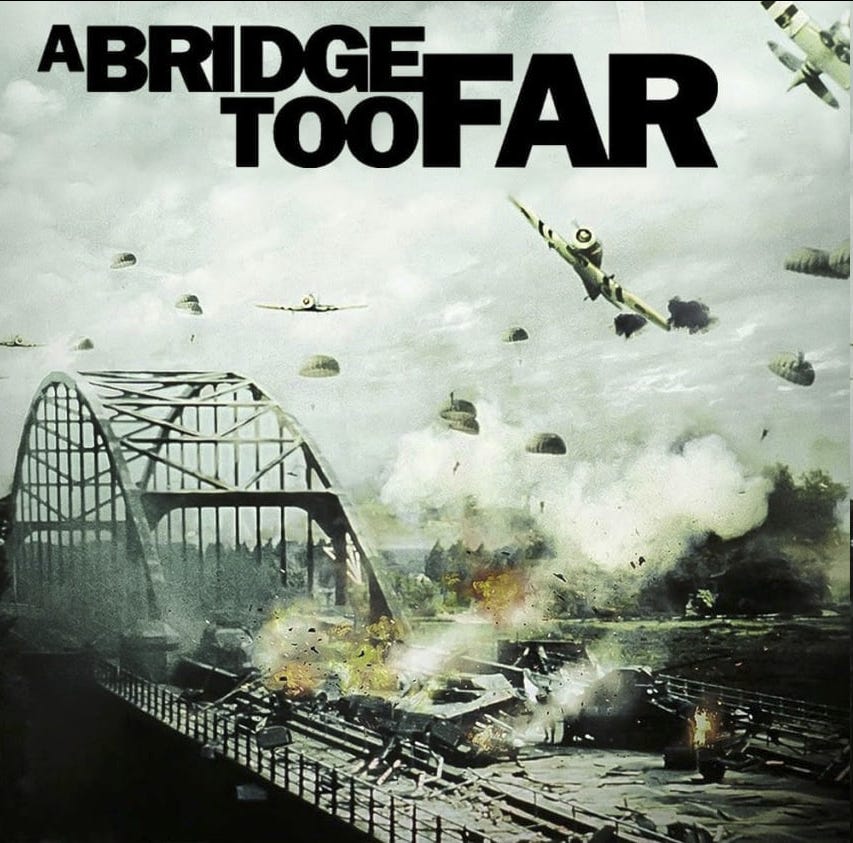
History offers other grim comparisons. Operation Market Garden in WWII and the battle for Gostomel Airport in Ukraine both illustrate the perils of assuming an enemy will collapse under the shock of a rapid airborne assault. In both cases, planners underestimated the defender’s ability to regroup and strike back. And both failed because the armor couldn’t reach the paratroopers, underscoring the danger of betting on shock over substance. Even if the American paratroopers were to create a beachhead in Hormuz, the operation would fail without naval support and successful landing of the marines, just as in Market Garden, where Arnhem was “A Bridge Too Far”.
Then there is Iwo Jima. While an American victory, it serves as a cautionary tale regarding fortified defenses. The Japanese forces, dug into volcanic rock, inflicted massive casualties on the Marines despite overwhelming U.S. air and naval superiority. The underground tunnels of Iwo Jima find their modern equivalent in Iran’s buried missile silos, drone launch sites, and command centers. You cannot bomb what you cannot find, and it is difficult to occupy terrain that is designed to deny you footing.
The lesson for any modern planner looking at Hormuz is not to doubt American firepower, but to respect the defender’s will, the terrain’s tyranny, and the multiplying effect of asymmetric technology. Gallipoli taught us that a narrow strait favors the shore over the ship. Iran has spent decades learning that lesson and building a force to exploit it. Market Garden and Gostomel taught us that speed and surprise do not guarantee success. Iwo Jima taught us that fortifications, and the determination behind them, multiply defensive power exponentially.
The Dardanelles remains a graveyard of ships and reputations. To ignore the lessons of that campaign while eyeing the Strait of Hormuz, especially while underestimating the disruptive potential of drones, missiles, and mines, is to invite a catastrophe not of capability, but of imagination. The map has not changed, even if the weapons have. And in a naval chokepoint, always bet on the shore over the ship.
Pakistan PM backs Iran’s right to self-defense amid tensions
Al Mayadeen | March 23, 2026
Pakistan’s Prime Minister Shehbaz Sharif affirmed his country’s support for Iran, stressing that Tehran has the legitimate right to defend itself amid the ongoing joint US-Israeli aggression on the West Asian nation.
Sharif expressed “regret over the attack on Iran and the resulting martyrdom and injury of thousands of citizens and officials,” signaling Islamabad’s concern over the humanitarian and political consequences of the confrontation.
His remarks came during a phone call with Iranian President Masoud Pezeshkian, reflecting continued high-level coordination between the two neighboring states.
Call for Islamic unity to de-escalate crisis
During the conversation, Sharif emphasized the need for collective action among Muslim-majority countries to reduce tensions and restore regional stability.
He called for coordinated diplomatic efforts, stating that Islamic nations must work together to contain escalation and prevent further deterioration of the situation.
At the same time, he reiterated that Pakistan “stands alongside” Iran, underscoring a political position aligned with Tehran’s framing of the conflict.
Strait of Hormuz cooperation highlighted
Sharif also thanked Iran for its “positive handling” of recent developments, particularly in facilitating the passage of Pakistani vessels through the Strait of Hormuz.
This acknowledgment reflects the strategic importance of maritime routes for Pakistan’s trade and energy security, especially amid heightened tensions in the Gulf.
Ensuring uninterrupted navigation through the strait remains a shared priority for regional states reliant on these critical shipping lanes.
Deep-rooted Iran–Pakistan relations
Iran and Pakistan share a long border and maintain multifaceted relations spanning security, economic, and political domains.
Their geographic proximity has necessitated ongoing coordination, particularly in areas such as border security, counter-smuggling efforts, and addressing armed group activity along shared border.
In addition to security cooperation, the two countries have pursued joint economic initiatives, including energy projects and cross-border trade development.
Mossad De Facto Admits To Inciting Riots In Iran
The Dissident | March 22, 2026
A New York Times article has reported that the Israeli/American failing regime change plot in Iran was contingent on a plan from the Israeli Mossad to incite riot in the country to effect regime change.
The article wrote, “Within days of the war’s beginning, said David Barnea, the Mossad chief, his service would likely be able to galvanize the Iranian opposition — igniting riots and other acts of rebellion that could even lead to the collapse of Iran’s government. Mr. Barnea also presented the proposal to senior Trump administration officials during a visit to Washington in mid-January.”
The article added:
Mr. Netanyahu adopted the plan. Despite doubts about its viability among senior American officials and some officials in other Israeli intelligence agencies, both he and President Trump seemed to embrace an optimistic outlook. Killing Iran’s leaders at the outset of the conflict, followed by a series of intelligence operations intended to encourage regime change, they thought, could lead to a mass uprising that might bring about a swift end to the war.
“Take over your government: It will be yours to take,” Mr. Trump told Iranians in his initial address at the war’s start, after saying they should first seek shelter from the bombing.
In the run-up to the war, current and former American and Israeli officials said, Mr. Netanyahu invoked Mossad’s optimism about a possibility of an Iranian uprising to help convince Mr. Trump that bringing about the collapse of the Iranian government was a realistic goal.
This is a de facto admission that Mossad was behind the violent riots that took place in Iran in January of this year, and used those riots to convict Trump that regime change in Iran was viable.
When the protests began in late December of last year, a Mossad connected account wrote in Persian , “Let us come out to the streets together. The time has come.
We are with you. Not just from afar and in words. We are with you in the field as well.”
Following this, former Secretary of State and CIA director Mike Pompeo wrote , “Happy New Year to every Iranian in the streets. Also, to every Mossad agent walking beside them.”
When the protests turned from peaceful to violent riots, Israel Channel 14 reported that , “foreign actors are arming the protesters in Iran with live firearms, which is the reason for the hundreds of regime personnel killed” an obvious reference to the Israeli Mossad.
The admission from the Israeli Mossad that their push for regime change in Iran was based on the idea that the Mossad could ignite, “riots and other acts of rebellion that could even lead to the collapse of Iran’s government” is further evidence that Israeli Mossad infiltration caused the Iranian riots in January, which Israel then used to sell a regime change war in Iran to the Trump administration.
But the plan backfired once the Israeli/American war on Iran began.
Since its inception, the war was clearly an attempt to turn Iran into a failed state and not just remove the current government.
As Vali R. Nasr, professor of international affairs and Middle East studies at the Johns Hopkins School of Advanced International Studies put it, “under constant bombardment Iranians are growing increasingly worried about the devastation of their country. They worry that U.S. and Israeli support for Kurdish and maybe even Azeri and Baloch separatists will break up the nation. These concerns are constantly circulating in public forums and are seen nightly in the form of antiwar demonstrations across the country and are morphing into an emerging sense of national resistance” adding, “If Iranians come to see this war as waged against Iran — and not just the Islamic republic — then Iranian nationalism may be mobilized in the service of resistance. America and Israel’s strategy of regime change by bombing military and government industries and infrastructure in Iranian cities, towns and neighborhoods and threatening Iran’s territorial integrity by arming Kurdish militias will not drive a wedge between the population and the regime and produce a popular revolution.”
In reality, the U.S./Israeli attempts to destroy Iran have only caused many Iranians to rally around the flag.
Nonetheless, this critical admission shows that the Israeli Mossad helped incite the riots in January and hoped it could be used to enforce regime change once the American/Israeli bombing began.
Tehran: World grown thoroughly exhausted with US-Israeli ‘false flag storylines’
Press TV – March 23, 2026
Iran’s Foreign Ministry spokesman says the world has grown thoroughly exhausted with the US-Israeli “false flag storylines.”
In a post on his X account on Monday, Esmaeil Baghaei reacted to the NATO Secretary General Mark Rutte’s stance, which rejected the recent claims by Israeli regime officials regarding Iran’s missile program posing a threat to Europe.
“That even the NATO Secretary General (who is infamously pressing Alliance members to appease the US and support their illegal war on Iran) declines to endorse Israel’s most recent disinformation, speaks volumes: the world has grown thoroughly exhausted with these tired and discredited “false flag” storylines,” he noted.
Israeli officials, over the past two days, claimed the interception of an Iranian missile targeting a British military base in Diego Garcia.
They presented Iran’s missile program as a threat to continental Europe.
The event reportedly happened between Thursday night and Friday morning, according to US media.
The Wall Street Journal and CNN reported that one of the missiles failed mid-flight while the other was hit by a US interceptor fired from a warship.
This comes amid heightened US and Israeli aggression against Iran, where the United States and the Israeli regime launched an unprovoked war of aggression on Iran on February 28, assassinating the Leader of the Islamic Revolution, Ayatollah Seyyed Ali Khamenei, as well as several top military commanders.
Iran immediately began to retaliate against the aggression by launching barrages of missiles and drone attacks on the Israeli-occupied territories as well as on US bases in regional countries.
Iran has repeatedly warned against US-Israeli “false flag” operations.
Trump ‘stuck between a rock and a hard place’, lacks Iran war strategy: Ex-CIA chief
Press TV – March 23, 2026
A withering critique from longtime Washington insider and former top spy Leon Panetta has intensified scrutiny of US President Donald Trump’s handling of the war against Iran.
In an interview with the Guardian newspaper on Sunday, Panetta, who previously also served as the US defense secretary (now war secretary), warned that the United States finds itself ensnared in a rapidly deteriorating crisis with few viable paths forward.
He portrayed an administration led by Trump that has slipped into a precarious position after weeks of unprovoked and unjustified aggression against the Islamic Republic of Iran, which began with the assassination of the Leader of the Islamic Revolution, Ayatollah Seyyed Ali Khamenei, on February 28.
He said Trump is “stuck between a rock and a hard place” and warned that his administration’s approach projects an image of weakness on the international stage.
Panetta, a veteran of Democratic administrations spanning decades, did not hold back in his critique of the incumbent US president’s decision-making style.
He said Trump has displayed a tendency toward naivety regarding the unpredictable nature of wars, saying the president appears to operate under the belief that simply repeating assertions might make them come true.
Such conduct, Panetta noted, was more “befitting of children than of presidents.”
His remarks came as the Iranian retaliatory operations continue to inflict heavy blows on the US military infrastructure in the region, decimating radars, drones and fighter jets.
The strategic waterway of the Strait of Hormuz also remains closed to US vessels, which has led to a dramatic rise in energy prices across the world.
Drawing on a career that has included stints as CIA director, secretary of defense, and White House chief of staff, Panetta underscored that Iran’s ability to disrupt global energy shipments through the Strait of Hormuz has been a long-established concern within American national security circles for generations.
That long-feared contingency, he warned, is now unfolding in real time.
The former defense chief argued that the ongoing war has laid bare significant shortcomings in US strategic planning, blasting Trump for launching an unwinnable war.
According to Panetta, the most plausible exit strategy for Trump would be to claim victory and seek to disengage from the war, but that avenue appears effectively closed.
He asserted that a ceasefire remained unattainable as long as Iran maintains its stranglehold over the Strait of Hormuz, describing the waterway as a potent lever of influence that Tehran now holds against its American adversary.
Efforts to rally European allies and NATO partners to help secure the strategic waterway have been met with tepid responses. Frustration over the lack of allied support has increasingly spilled into public view, with the US president launching biting criticism at the transatlantic military alliance and questioning its value in the absence of American leadership.
On the ground, Washington has thus far refrained from committing ground troops, though the deployment of Marines to the region has stoked speculation about potential escalation with far-reaching consequences for the aggressors.
Trump’s bombardment of fake news so far is working quite well. But where is it heading?
By Martin Jay | Strategic Culture Foundation | March 23, 2026
Trump’s latest move in Iran, to consider mobilizing a second larger tranche of troops, might be the act of a lunatic who genuinely believes there can be a positive outcome for America and Israel in the Iran War. What we may be witnessing is a new, more desperate, extreme strategy after he has come to terms that virtually all of the first strategy has ended in disastrous consequences. Certainly we can assess that he is considering such a move.
Yet despite all the hype from U.S. media, it is important to stress that Trump has not yet acted. He is looking at the possibility of a deployment of 8,000 troops with the view of taking Kharg Island in combination with an 800-mile stretch of the Iranian coastline, heavily fortified with troops and missiles aimed at both the choke point of the Straits of Hormuz and also beyond it.
Any military strategist will surmise that this idea is even more whacky than the initial plan, which, it has transpired, was carried out with no planning or assessment whatsoever.
The assumptions are simply preposterous. To take Kharg Island, it would mean that any amphibious landing would have to come from a U.S. battleship which would pass through the Straits of Hormuz. And secondly, the island itself is heavily fortified as you would expect it to be, given that it produces [transfers] most of Iran’s oil. Even if a ship could by some act of a miracle reach it, the resistance by the Iranians who would be ready and waiting would be intense and might well result in all of the U.S. marines sent there being wiped out. The present 2,200 marines who are on their way to the region from Asia are not airborne, which means they can only land by boat. This idea is madness on a level that we have never seen before, with some military experts comparing it to Gallipoli in 1915, where British, French, Russian and Australian navies lost 250,000 men as they failed over almost a year to take the peninsula — resulting in the rise to prominence of the Turkish commander at the time, Mustafa Atatürk, who finally became president of the new republic of Turkey later in 1923.
What is more likely is that Trump is panicking and constantly creating media fodder for journalists to report on, while he buys time to work out how to get out of the hellhole that he has created for himself. Practically begging allies via social media or press conferences to help gives a clue to the level of desperation. But Trump’s ability to create fake news to distract U.S. media away from the reality is impressive.
When U.S. bombers left UK bases and dropped their load over a few days on the island, this threw the spotlight on the island and created a new subject to focus on. But what U.S. journalists did not look too closely at was the impact of the bombing. All the bombers did was to put a crater exactly halfway up the runway of the main airstrip, depriving planes from landing or taking off. It was hardly a great military victory. In fact, it actually deprives the Americans themselves of landing huge air transport military aircraft there, suggesting that they have no real intention of ever taking the island.
The truth is that the snake island is just media chaff which has been thrown up in the air to cause a distraction. If we examine a number of stories in the press in recent days, in fact, there have been a number of such stories to distract journalists away from asking tougher questions to Trump.
Fake story number two: allies “supporting” Trump. Barely 48 hours after France, UK, Germany and others all sent a very quick “no” back to Trump after he asked them for help in securing the straits, it would seem they all did a U-turn. A statement which the UK government issued seemed to say that they were all ready to help Trump, which shocked many. So why wasn’t this story put on the front pages of all major UK and U.S. newspapers as an extraordinary event in itself, as a drastic change to the crisis? Because journalists were sceptical and read the small print. They also read Reuters’ sceptical interpretation of it and noticed that those world leaders didn’t take to social media and announce the new initiative to “support” Trump. This word “support” was buried in the text, but the interpretation was only in the sense that these countries — including Japan — were sympathetic to Trump, similarly to your neighbour coming to the wake of one of your loved ones, eating your sandwiches and taking your drink, but then leaving while muttering condolences — without making any contribution to the funeral expenses.
But there’s more fake news.
Fake news #3 was the Japan stunt. Almost immediately we saw the arrival of the Japanese Premier at the White House who, when getting out of her car, embraced Trump for the whole world to see. What a spectacle! But what was this hug all about? Yes, of course the Japanese needed to quickly sign an energy deal to stabilize their own economy, but the compliments that the Japanese PM paid on Trump during the press conference would have some believe that Trump’s own people wrote the script. Praising Trump as a world leader on a level that none other can match left the buffoon in the White House stumbling on his own words, with him finally blabbing out a poor taste joke about Pearl Harbour. What was behind this banal performance? Was it real?
Of course it was not. EU leaders, probably led by Sir Keir Starmer’s media experts, had no doubt staged the whole thing and prepared her speech and her behaviour, as they too are panicking, knowing only too well that Trump isolated could possibly drag America into a Vietnam-type war which could go on for years. Their reckoning was: ’We can’t support him, but let’s at least issue a statement and get the Japanese PM to give him a hug.’ All Trump needs is a hug and a few absurd compliments which would leave most Americans pushing fingers down their own throats.
But of course such vomit-inducing sycophancy can’t keep relations warm for very long.
With both American aircraft carriers far from the Straits of Hormuz now (one damaged by an Iranian missile) and no real options for Trump to turn to, to settle world oil prices and come down hard on the Iranians, he’s looking like the greatest loser America has ever had as a president. It is not inconceivable that he will send ground forces to the region if the situation gets worse. This decision is more or less taken for him as his own rationale must constantly come up with media fodder which keeps him in the news as the main story. Sending troops to the region though is not the same as sending them in, although the bombing which is now going on along Iran’s coastline would suggest that he believes U.S. marines could control and contain those Iranian military installations, which is worrying as a second colossal failure of joined-up thinking seems to be heading our way.
But what is even more worrying is the extent of how much Trump lies both to journalists in press conferences and to the American people about his victory in Iran. In a country which sometimes feels like an irony-free zone, you would think he would be more ridiculed for this, but this is not the case. The real worry here is how naïve and frankly stupid Americans are, as one option that Trump has, other than using nuclear weapons in Iran, is creating a false flag attack on U.S. home soil. Not only would that allow him to announce a ’state of war’ which would justify cancelling the midterms, but it would also force EU countries and Japan to ramp up their ’free hugs’ policy to a whole new level. Free hugs are not free, by the way.
Iran to Mine Sea Lanes in Persian Gulf in Case of Attack – Defense Council
Sputnik – 23.03.2026
TEHRAN – Tehran will mine all sea lanes in the Persian Gulf in the event of an attack on the coast of the country or islands, the Iranian Defense Council said on Monday.
“We remind you that in the event of any attempt by the enemy to attack the coast or islands of Iran, all sea lanes in the Persian Gulf, as well as the coast, will be mined,” the council said in a statement, as quoted by the Fars news agency.
The passage through the Strait of Hormuz is possible only for countries that are not hostile to Iran, if this issue is coordinated with Tehran, the statement added.
The United States sees no alternative to conducting a ground military operation to capture Iran’s Kharg Island and is accelerating troop deployments to the region, Israeli newspaper The Jerusalem Post reported earlier, citing sources familiar with the matter.
On March 20, Axios reported that US President Donald Trump is prepared to seize Kharg Island to pressure Tehran into opening shipping in the Strait of Hormuz.
A US official told the newspaper that “the US military has accelerated the deployment of thousands of Marines and Navy personnel to the Middle East.”
On March 22, US Treasury Secretary Scott Bessent stated that all options remained on the table and did not rule out the possibility of sending US troops to the Iranian island.
Barak blasts Netanyahu: ‘Stop lying – you can’t destroy Iran’s nuclear, missile capabilities’
Press TV – March 23, 2026
Former Israeli prime minister Ehud Barak on Monday launched a blistering attack at the regime’s incumbent political and military leadership, slamming them for peddling “blatant” lies over the war against Iran and noting that the regime has no strategy to end the war.
In an interview with Channel 13, Barak, who also previously acted as the regime’s military chief and military affairs minister, delivered a stark assessment of the Israeli wars on Gaza, Lebanon and the Islamic Republic of Iran.
“We cannot open the Strait of Hormuz, nor destroy Iran’s nuclear and missile capabilities, so don’t lie to us too much,” Barak said, directly challenging the regime’s claims regarding its capacity to confront the Islamic Republic.
His remarks came as the Israeli-American war against Iran entered its 24th day with no end in sight. The war, which started with the assassination of the Leader of the Islamic Revolution, Ayatollah Seyyed Ali Khamenei, and some top-ranking officials and military commanders, has failed to achieve the “regime change” agenda or to decapitate the Iranian government.
On the contrary, as experts acknowledge, Iranian armed forces have decimated Israeli military and intelligence infrastructure across the occupied territories as well as US military bases in some Persian Gulf countries as part of Operation True Promise 4.
So far, 74 waves of missile and drone operations have been successfully carried out against enemy targets, which have effectively destroyed the air defense systems.
Barak, who acted as the regime’s premier from 1999 to 2001, launched a stinging attack at the regime’s war cabinet, stressing that the political echelon lacks both the knowledge and the will to end the fighting that has failed to achieve any objectives.
“Israel at the political level doesn’t know – doesn’t know or doesn’t want – to bring the war to an end,” he said. “They don’t know how to end wars.”
He also pointed to unfulfilled promises made repeatedly by the Benjamin Netanyahu regime vis-à-vis the genocidal wars against Gaza and Lebanon.
“We are two and a half years in; Hamas is still there after they promised us six times that we were a step away from ‘total victory.’ Hezbollah is still there after they told us we threw them back decades,” he stated.
Barak also took aim at Netanyahu’s long-standing emphasis on the so-called “Iranian threat,” noting that the regime’s claims of neutralizing the danger do not align with reality.
“Iranian nuclear program and missiles are still there after they clarified to us that he [Netanyahu] removed the existential threat,” he said, shaken by the direct Iranian missile impacts across the occupied territories in the ongoing war.
The former prime minister described a systemic breakdown in trust between the regime and settlers, exacerbated by what he called deliberate withholding of information.
“Now, what is the problem? When there is no truth and no trust. We also don’t know all the details, including those of us who were deep inside these matters,” Barak said. “We don’t know what the truth is. But they shouldn’t tell us ‘the truth’ – they just shouldn’t lie to our faces in such a blatant way so that we can participate in the discussion more seriously.”
Trump backs down on Iran strikes; Tehran denies any talks
Al Mayadeen | March 23, 2026
US President Donald Trump announced Monday that he has postponed military strikes on Iranian power plants and energy infrastructure for five days, claiming that Washington and Tehran have held “very good and productive conversations” over the past two days toward resolving the war.
The announcement came hours before a deadline Trump had issued on Saturday, in which he threatened that Iranian power plants would be destroyed if Tehran failed to “fully open” the Strait of Hormuz to all shipping within 48 hours, prompting a swift and decisive warning by Tehran that power infrastructure feeding US bases and “Israel” in the region would be targeted.
Iran denies direct talks
After Trump’s statements, Iranian officials swiftly rejected claims of direct negotiations between Tehran and Washington.
Iran State TV, citing the Foreign Ministry, reported: “There are no talks between Tehran and Washington.”
The Foreign Ministry further characterized Trump’s remarks as an attempt to manipulate global energy markets and buy time for his military plans.
“Yes, there are initiatives from some countries in the region to de-escalate tensions, and our response to all of them is clear: we are not the party that started this war, and all such requests should be directed to Washington.”
Context: IRGC warned Trump of consequences
The Islamic Revolution Guard Corps (IRGC) issued a statement earlier today rejecting accusations by US President Donald Trump that Iran intends to target desalination facilities across the region, warning instead of reciprocal measures if Iranian infrastructure is struck.
The IRGC accused Washington of initiating the war, stating that “the aggressive American army… began the war by killing children,” saying that 180 children were killed in attacks on primary schools and that five water facilities, including a desalination plant on Qeshm Island, had already been targeted.
The statement firmly denied targeting civilian water infrastructure, asserting that “the IRGC has not carried out such actions.”
Addressing recent threats against Iranian energy infrastructure, the IRGC warned that any strike on power facilities would trigger direct retaliation.
“What we have done is declare our position: if power plants are targeted, Iran will respond by targeting the power infrastructure of the occupying entity, as well as power plants in regional states that supply electricity to US bases, in addition to economic and industrial infrastructure and energy sectors in which Americans hold shares. Without doubt, we will do so.”
The statement further added that economic and energy infrastructure linked to US interests would also be considered targets.
Emphasizing its prior restraint, the IRGC noted, “You targeted our hospitals – we did not respond in kind. You targeted relief centers – we did not respond. You targeted our schools – we did not respond. But if you target electricity, we will target electricity.”
The statement concluded with a warning that Iran would respond to any escalation “at a level that ensures deterrence,” adding that “the United States does not know our capabilities, it will see them on the battlefield.”
Seyed M. Marandi: Total War – Attacking Nuclear Plants, Desalination & Infrastructure
Glenn Diesen | March 22, 2026
Seyed Mohammad Marandi discusses the targeting of nuclear plants, desalination plants, critical infrastructure, and the civilian population. Trump has given Iran 48 hours to open the Strait of Hormuz (capitulation), otherwise the US will destroy Iran’s energy facilities. Then there will be no limits on Iran’s response, and the consequences will be global. The future of global stability will be decided over the next few days. Marandi is a professor at Tehran University and a former advisor to Iran’s Nuclear Negotiation Team.
Follow Prof. Glenn Diesen:
- Substack: https://glenndiesen.substack.com/
- X/Twitter: https://x.com/Glenn_Diesen
- Patreon: https://www.patreon.com/glenndiesen
Support the research by Prof. Glenn Diesen:
- PayPal: https://www.paypal.com/paypalme/glenndiesen
- Buy me a Coffee: buymeacoffee.com/gdieseng
- Go Fund Me: https://gofund.me/09ea012f
Featured Video

Houthis Keep Advancing as the Red Sea Crisis Deepens
or go to
Aletho News Archives – Video-Images
From the Archives
Clash of Civilization, Iran Part II
By Jamal Kanj – Intifada-Palestine.com – January 14, 2011
Israel’s survival kit is: perpetuate conflict, insecurity to rationalize collective hate and finally playing victim.
Devoid of conflict, Israel implodes internally; without hate, Zionism loses its justification; and playing eternal victim to continue blackmailing the West. Absence of this holy trinity, Israel ceases to exist. … continue
Blog Roll
 Aletho News
- ‘We are not like everyone else’ laws that bind other nations do not apply to Israel, says Likud lawmaker
- Report: Saudi Arabia seeks allies’ assistance as missiles deplete amid war on Yemen
- Fuel Crisis Deepens: Pakistan Warns Tanker Attack in Red Sea Would Be an ‘Act of War’
- ‘Bucha massacre’ a false flag orchestrated by UK – Moscow
- China Rejects Outside Pressure on Trade Ties After New US Russia Sanctions Bill
- Houthis Keep Advancing as the Red Sea Crisis Deepens
- Iran spent $1 million to wipe out $30 billion in data center plans, and take down Amazon in the ME
- Zionist billionaire pressure to silence Macklemore sparks exodus from Ed Sheeran tour
- House Votes to End Iran War for Third Time
- North Korea Slams US Plan for ‘AUKUS 2.0’ with South Korea and Japan
- If Americans Knew
- Biden’s Genocide Accomplices Targeted by New Accountability Campaign
- AIPAC’s Network Has Already Spent $67.2 Million to Shape the Midterm Elections
- Jewish Supremacist Manufacturing a Civilizational Threat to License Bigotry
- US bans Palestinian president from speaking at the UN
- Israeli Forces Detain Journalist Alaa al-Rimawi amid Widespread West Bank Raids
- Even a pro-Israel Congress member has put a hold on 40,000 one-ton bombs to Israel
- As Gaza crumbles, Israel preps new ground invasion – Daily Update
- ‘We are not like everyone else’ laws that bind other nations do not apply to Israel, says Likud lawmaker
- Trump’s govt makes ‘treasonous’ claim of weapons shortages
- Palestinian-American Journalist Naqaa Hamed Imprisoned by Israeli Forces After Settlers Targeted Her
- No Tricks Zone
- New Study: ‘Global Drought Shows No Detectable Recent Acceleration Under Climate Warming’
- Economic Masterminds: German Socialists Suggest Taxing Productivity Gains Stemming From Using AI
- The South China Sea Has Not Been Cooperating With The Climate Change Narrative
- Energy Crisis: Germany Enters Heating Season With Historically Low Gas Reserve Fill Levels
- New Study: The Antarctic Ice Sheet Gained Mass From 2020-2024 Due To Staggering Snow And Ice Accumulation
- Study: Ocean Heating Rates From Thousands Of Years Ago ‘Dwarf’ Modern Ocean Heating Rates
- Climate Extremists Target, Attack Large-Scale Power Grid Infrastructure In Germany!
- New Study: Antarctic Ice Melt Has Contributed Less Than 1 Centimeter To Sea Level Rise In The Last 30 Years
- Fear Of Debate: Alarmist German Climate Scientist Calls On Mainstream Media To Discredit Skeptic Voices
- End-Of-August Arctic Sea Ice Extent Hasn’t Fallen In 20 Years, Official Data Show!
 Aletho News