Just Get Out! Now!
By Ron Paul | March 16, 2026
As is becoming clearer from President Trump’s own statements and those of his staff, along with press reporting, the US has launched a major war without the input of the experts we pay to advise the President on such matters. The State Department, Pentagon, National Security Council Staff, Defense Intelligence Agency, and NSA were simply bypassed because, as White House Spokesperson Karoline Leavitt said, President Trump “had a feeling” Iran would attack.
The President’s real estate developer son-in-law and friend reinforced that “feeling” when they returned from the second round of talks with the Iranian foreign minister and his team. However, as the news outlet Responsible Statecraft (RS) reported over the weekend, both son-in-law Jared Kushner and friend Steve Witkoff appear to have mis-represented those talks in a way that helped push President Trump toward war. No State Department officials were on hand to ensure the reporting was accurate.
Also, arms control experts at home, according to the RS report, believe that “the duo appeared to have fatally misunderstood a series of basic technical and historical matters” regarding Iran’s nuclear program leading to inaccurate information conveyed to the President.
Congress was completely out of the picture – seemingly uninterested in performing its Constitutional duty – and no case was made to the American people that they must sacrifice and die once again for a war in the Middle East.
Trump’s repeated promises to not start new wars, especially in the Middle East, have turned out to be empty, and Republicans are set for a crippling defeat in the upcoming midterm elections.
Iran had been warning for months – since the last US/Israeli surprise attack in June – that if they were attacked again they would not hold back on US bases in the region and that they would close the Straits of Hormuz. Trump and Netanyahu attacked anyway, and Iran has done what it said it would do.
Now the Strait of Hormuz is closed, oil is about to go out of control, and the global economy – along with the US dollar – seems about to implode.
On March 6th, President Trump refused a UK offer of help, saying we don’t need help when we’ve already won the war. Five days later, at a rally in Kentucky, President Trump repeated that “We’ve won the Iran war!”
It was his “Mission Accomplished” moment, because this weekend, just days after declaring victory against an “obliterated” Iran, Trump began begging other countries to send ships to help the US open the Strait of Hormuz.
Thus far every country has declined, understanding that such a mission has little chance of success.
Tragically, the war thus far has claimed at least 14 servicemembers. It is likely the toll is far worse than they are telling us. Every US military facility in the region is either damaged or destroyed. Billions of dollars of radar and other equipment are destroyed. Our allies in the region, because they allowed their territory to be used to attack Iran, have also seen massive retaliatory destruction.
This is surely one of the worst military disasters in US history. There are no military options available beyond the unthinkable: the use of nuclear weapons.
The only viable option that remains is one that was often urged in the Vietnam War: Just get out. Now! No return to US bases, no security guarantees to Gulf States. End the US empire in the Middle East and elsewhere. If not, it’s only going to get worse.
Unpacking glaring contradictions in US-Zionist justifications for war against Iran
By David Miller | Press TV | March 5, 2026
While the likes of Trump, Netanyahu, and Rubio peddle inconsistent justifications for the illegal and unprovoked aggression on Iran, CIA intelligence shreds claims of imminent threats, revealing how the Zionist entity dictates US foreign policy.
US President Donald Trump unleashed a barrage of contradictory explanations for the joint US-Zionist assault on the Islamic Republic of Iran, launched on 28 February 2026.
In his initial video statement, Trump asserted the strikes aimed to eliminate “imminent threats” from Iran, including its alleged pursuit of nuclear weapons and long-range missiles capable of reaching the American homeland.
He painted Iran as a “vicious group of very hard, terrible people” whose actions endangered US interests.
This narrative quickly evolved. By 3 March, Trump admitted the decision stemmed from his “opinion” that Iran would attack first if not struck preemptively.
“It was my opinion that they were going to attack first,” he stated, abandoning earlier claims of concrete intelligence.
Such flip-flops, once again, expose exaggeration. Trump claimed Iran neared intercontinental ballistic missiles threatening the US, an assertion contradicted by US intelligence assessments.
The BBC highlighted how Trump’s “imminent threats” lacked support, noting Iran’s nuclear capabilities remained far from weaponisation despite rhetoric.
Trump’s pre-strike doubts further undermine his case. The Associated Press reported Trump’s dissatisfaction with ongoing nuclear talks, leading to the order despite diplomatic avenues. This pivot from diplomacy to aggression reeks of opportunism, not necessity.
Netanyahu’s decades-long push: ‘Regime change’ at any cost
Zionist entity premier Benjamin Netanyahu has long championed aggression against Iran, viewing it as an existential foe. In justifying the 2026 strikes, Netanyahu declared them pre-emptive to thwart Iran’s nuclear and missile programs, threatening overwhelming force.
He warned that allowing Iran nuclear weapons and ICBMs would endanger humanity.
Netanyahu’s rhetoric echoes his four-decade obsession. Even complicit journalists like Mehdi Hasan noted Netanyahu “has been yearning, dreaming of doing this for 40 years,” with Trump as the first US leader to oblige.
The Guardian labelled the assault an “illegal act of aggression” without a lawful basis, driven by Netanyahu’s preference for military solutions over diplomacy.
Post-strike, Netanyahu celebrated the operation’s goals and called (in Farsi) for Iranians to “come to the streets, come out in your millions, to finish the job, to overthrow the ‘regime’ of fear that has made your lives bitter”. Mondoweiss exposed how initial nuclear justifications morphed into overt regime change admissions, mirroring Iraq War tactics.
“When we are finished, take over your government,” President Trump said, addressing the Iranian public in his own video. “It will be yours to take.”
Yet The Nation revealed aims to turn Iran into a failed state, obliterating coherent governance. Netanyahu dusted off the genocidal language used against the Palestinians during a visit onSunday, 1 March, to a site struck by an Iranian missile.
“We read in this week’s Torah portion, ‘Remember what Amalek did to you.’ We remember—and we act,” he said.
The Amalekites are identified in the Hebrew Bible as a persistent adversary of the Israelites, linked to a Torah commandment to erase their memory. Specifically, 1 Samuel 15:3 mandates the killing of men, women, and infants. This was a clarion call to eliminate all Iranians, showing the utter hypocrisy of calling out on the streets those he wishes dead.
Rubio’s Freudian slip: Admitting Zionist sway over US decisions
Secretary of State Marco Rubio’s comments laid bare the Zionist entity’s influence on US policy. On 2 March, Rubio stated the US struck because “we knew that there was going to be an Israeli action,” prompting preemptive moves to avoid higher US casualties from Iranian retaliation.
Rubio elaborated that awareness of Zionist plans necessitated US involvement, framing it as defensive. Al Jazeera described this as a “looping justification,” highlighting how Zionist intentions drove US timing.
Facing backlash, Rubio walked back his words, insisting the strikes were inevitable regardless of Zionist actions. The New York Times reported his clarification: “The president determined we were not going to get hit first.”
Axios noted Rubio’s remarks ignited MAGA divisions, underscoring Zionist power. The Guardian highlighted Democratic fury over Rubio’s implication of a “war of choice” on behalf of Zionists. PBS detailed Rubio’s defence, warning Iran of further escalation. These revelations confirm that US policy follows Zionist whims.
CIA intelligence shreds the ‘imminent threat’ facade
CIA assessments dismantle claims of Iranian aggression. The Associated Press revealed that US intelligence showed no pre-emptive Iranian strike planned against the US.
Briefings to Congress confirmed no such indicators. Reuters echoed Pentagon admissions: no intelligence on Iran attacking first. The Hill reported similar findings, contradicting Trump’s “imminent threat.”
A House of Commons Library briefing noted in 2025 that US intelligence judged Iran not to be building nuclear weapons. CNN detailed CIA tracking of Iranian leaders, but no offensive plans. Al Jazeera reported CIA talks with Kurds for uprisings, indicating an offensive US posture. Even the Zionist funded propaganda network Iran International quoted ex-CIA Director Petraeus on Iran’s strategic errors, but no pre-strike aggression.
These reports expose fabricated threats to justify unprovoked war.
Pentagon’s panic: Depleted THAAD stocks and radar losses
Pentagon officials express intense paranoia over dwindling air defense stockpiles as a result of Iran’s legitimate self-defense. The Washington Post reported sources describing the mood as “intense and paranoid.” The Daily Beast characterised these Pentagon officials as “secretly panicking” about THAAD interceptor shortages if fighting drags on.
This panic stems from high consumption rates. It takes two or three interceptors per incoming missile, straining limited THAAD stocks.
Some sources claim that for every $1 Iran spends on drones, countries like the UAE (and by implication the US and the Zionist entity) spend approximately $20 to $28. The Washington Post said officials are warning that resources are “stretched thin.”
Compounding this, the US Navy resists escorting ships through the Strait of Hormuz. USNI News reported Navy officials informing shipping leaders of no availability for escorts, despite Trump’s pledges.
Lloyd’s list detailed this U-turn, with the Navy ruling out protection.
These issues link directly to Iran’s destruction of the AN/FPS-132 radar at Al Udeid base. NDTV reported Iranian claims to have obliterated this $1.1 billion system, crucial for ballistic missile tracking. The radar’s loss weakens early warning, compressing reaction times for THAAD systems.
Army Recognition, a defence industry news site, explained that this reduces sensor depth, forcing more interceptor use and accelerating stock depletion. In fact, they describe it in full as this: “early-warning radar uses a fixed UHF phased-array to detect and continuously track ballistic missiles and space objects at very long range, generating early launch warning, trajectory and impact predictions, and cueing data for layered defenses such as THAAD, Patriot, and naval air-and-missile defense systems across the Gulf”.
So, it affects the whole range of layered air defences.
For Navy escorts, diminished radar coverage heightens risks in Hormuz. Radar losses are key to broader defense cracks, making naval operations precarious without full surveillance.
These problems have only been compounded by the latest strikes, which even the New York Times is admitting have damaged or destroyed Radar and other monitoring and targeting equipment in US bases across the region in Bahrain, Qatar, Kuwait, Saudi Arabia and the UAE.
This chain—radar destruction leading to inefficient defenses and stock drain—fuels Pentagon panic and Navy caution, exposing vulnerabilities in the aggression.
Zionist entity’s grip: How the US became a tool in Iranian aggression
The Zionist colony has long steered US policy toward confrontation with Iran. Al Jazeera probed how Zionist plans precipitated US strikes, with Rubio admitting awareness shaped decisions.
The establishment think tank CFR detailed US intervention following Zionist unilateralism, escalating to full aggression. Mondoweiss argued the war follows an Iraq playbook: false WMD claims shifting to regime change. The Guardian condemned it as illegal, driven by Netanyahu’s impatience with diplomacy.
Euronews quoted Iran’s UN ambassador decrying US betrayal during talks, highlighting Zionist sabotage. Al Mayadeen announced Netanyahu’s declaration of joint aggression. The Nation exposed aims to fragment Iran, with Zionist officials targeting all leadership. WBUR reported Trump’s regime change calls, echoing Zionist goals.
This puppetry endangers global peace, subordinating US interests to messianic Zionist ambitions.
Key contradictions in leadership statements
- Trump’s threat claims vs. intel: Trump warned of missiles soon reaching the US, but even the NYT fact-checks show these are inaccurate.
- Netanyahu’s pre-emption vs. evidence: Netanyahu framed strikes as a gateway to peace, yet Arab News notes endless war denial.
- Rubio’s Zionist trigger vs. walkback: Rubio suggested Israeli plans forced the US hand, later denied.
- Intel on no strike vs. official narratives: AP sources confirm no preemptive Iranian plans.
These inconsistencies fuel scepticism in the American security apparatus as well as – increasingly – with the US allied states in West Asia.
These deceptions are being unmasked in real time. The unthinkable is now dawning on the US and its allies; this may be the moment that the US is pushed out of West Asia once and for all.
Solidarity with Iran at this time demands truth over propaganda and the final push to remove US influence and finally collapse the Zionist colonisation project in Palestine.
Iranian model of warfare bleeds US dry while Persian Gulf states watch and learn: Analyst
Press TV | March 16, 2026
Sixteen days into the American-Israeli war on Iran, the battlefield tells a story that Pentagon planners had not anticipated. Tehran’s streets remain filled with defiant crowds, the Strait of Hormuz remains closed for US-linked ships, and the US military bases in the region smolder.
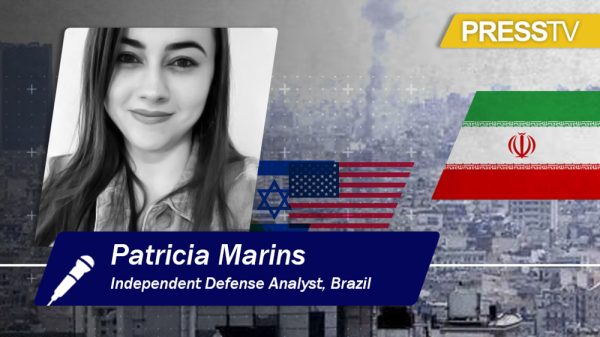
Patricia Marins, an independent defense analyst based in Brazil, has been following the war unfold with a keen eye on the shifting strategic balance.
In an interview with the Press TV website, Marins said she has been witnessing the emergence of something the region has never quite witnessed before: the “Iranian model” of warfare proving itself against the world’s most powerful military.
“The Iranian model possesses several distinct characteristics compared to the American model exported to Arab countries. It is built for attrition warfare and resilience, featuring an extensive network of underground facilities and a focus on long-range precision-guided munitions,” she stressed.
“All of this was achieved through investment in research centers, universities, reverse engineering, and the steady implementation of a domestic defense industry, which in many respects is dual-use.”
On the other hand, the American model exported to the Persian Gulf countries consists of “vulnerable surface installations, almost no degree of indigenous production, and consequently a disconnect between research centers, reverse engineering, and the military industry,” which Marins added is not limited to the US model, but all Western models.
“Kuwait paid over $310 million for each Eurofighter Typhoon, nothing short of extortion,” she said, making a clear distinction between the American and Iranian models.
Today, amid the war that was triggered by the unprovoked US-Israeli attack on February 28, and the assassination of the Leader of the Islamic Revolution, Ayatollah Seyyed Ali Khamenei, and some top-ranking military commanders, that investment is paying dividends.
Marins believes the contrast in the military tech leap is not lost on regional observers.
“I believe this Iranian model is being closely watched by all (Persian) Gulf countries at this moment. I see a high probability of it serving as a reference in several areas. I even believe it has inspired the Saudi missile industry, which is currently absorbing Chinese technology,” she said.
“Iran inspires, yet it still maintains a guarded distance from the (Persian) Gulf countries in this sector.”
Beyond the missile and drone arsenal, Iran also enjoys the geographical advantage, the Brazilian analyst stated.
“Iran’s advantage begins with its geographical position, but it is confirmed by its military prowess. And Iran knows how to leverage both very effectively,” she said
She referred to the Ghadir-class submarine, which is affordable, stealthy, and designed specifically for the waters it operates in – the Persian Gulf – especially in the Strait of Hormuz.
The Strait’s “shallow, high-salinity, and high-temperature conditions create a challenging, noisy, and complex environment for sonar, favoring small, fast, and highly maneuverable platforms,” she asserted.
“It is the perfect marriage between the weapon and the environment in which it operates,” she said. “Iran knows how to use the geography that already favors them.”
Then there is Yemen as well, which has indicated willingness to join the front against the US and Israel, after the Lebanese Hezbollah resistance movement and Iraqi resistance groups.
“Iran has been a master player. Knowing that by maintaining influence in Yemen, in a situation like this, they could exert power over both straits,” Marins said.
“However, all of this requires prudence and maturity.”
With the Strait of Hormuz effectively closed already for the US and its allied vessels, if Yemen’s Ansarullah movement follows through and shuts down the Bab el-Mandeb strait as well, the costs would be abysmal, she noted.
“This would expand the conflict on that axis to European countries, as has already occurred. I believe Iran is weighing the necessity of this escalation and whether it is truly required. While Hormuz involves oil and gas, Bab el-Mandeb involves the flow of goods between the West and Asia,” Marins remarked.
“If this strait is closed, it will have a massive economic impact. I see Iran as prudent and disciplined as a nation must be during a war.”
While media reports have cited figures of $1 billion per day for American attacks, with one estimate putting the first six days at $11 billion, Marins believes the true cost is far higher.
In her projections, she suggests the costs for the US could reach a colossal $360 billion within two months if the war continues unabated, a sum that she stresses “would test the patience of any treasury, let alone American taxpayers already feeling the pinch of soaring oil prices.”
“Israel’s operations during the 12-day war generated a daily cost of around $700 million. However, by the end of the war, once the costs of interceptors and damages were added, this daily cost hit nearly $2 billion,” she told the Press TV website.
“I believe this will be Israel’s cost, but the American cost so far is triple that due to three factors: the number of interceptors expended, the quantity of missiles and guided bombs used, and the cost of damages to bases and radars.”
When these factors are combined, Marins noted, the cost is expected to be “no less than $6-8 billion daily during these two weeks of war.”
On reports that Trump’s advisors are advising him to declare victory and find an exit, Marins doubts the American victory in this war is even possible.
“I don’t think so. I see Iran in a much better strategic position to win the conflict. As long as Iran maintains control of the strait, the pressure will be on Donald Trump’s shoulders, no matter how many bombs he drops,” she said.
But beneath that tactical reality lies a deeper truth about the nature of this war. Iran has demonstrated a capacity to absorb bombings while being resilient, limiting drone actions over its territory, and fighting an asymmetric war on its own terms, Marins said.
“So far, I believe Iran has conducted an asymmetric war with very few mistakes,” Marins said. “One that the US and Israel simply don’t know how to fight.”
Hegseth’s call for ‘no mercy’ to Iranians deemed war crime
The threat to take no prisoners in a conflict is illegal under US and international law
RT | March 16, 2026
US War Secretary Pete Hegseth is facing accusations of violating domestic and international laws prohibiting war crimes by declaring that “no quarter” or mercy would be given to Iranian forces.
The legal definition of the term means surrendering Iranian soldiers would be executed by American troops rather than taken prisoner. US officials and legal experts have responded by accusing Hegseth of encouraging war crimes.
”We will keep pressing. We will keep pushing, keep advancing. No quarter, no mercy for our enemies,” Hegseth said at a press briefing on Iran on Friday.
Some US officials and legal scholars have argued that the remarks went beyond tough rhetoric and strayed into criminality.
Senator Mark Kelly of Arizona blasted Hegseth, saying his comment “isn’t some wannabe tough guy line” but rather an illegal order that jeopardizes US military service members. It also shows “there was never a clear strategy for this war,” the lawmaker added.
Dan Maurer, a retired US Army lieutenant colonel and judge advocate, published a hypothetical memo Hegseth should receive from the Pentagon legal counsel, informing him of criminal liability for himself and any subordinate who followed his directive to deny quarter.
The Hague Convention and the Geneva Convention forbid harming enemy combatants unable to defend themselves or who have surrendered and explicitly prohibit declaring “that no quarter will be given.”
These rules are enshrined in US domestic law. The 1996 War Crimes Act directly cites the article banning “no quarter” in its definition of war crimes.
The US military has prohibited orders to take no prisoners since 1863, when US President Abraham Lincoln issued the Lieber Code during the Civil War.
Hegseth has previously dismissed concerns about international law, claiming he would not abide by “stupid rules of engagement” and “politically correct wars.”
His remarks also come two weeks after a US strike on a girls’ school in southern Iran that killed more than 170 people, most of them children.
Iran War Exposes Limits of US Military Power – Journalist
Sputnik – 16.03.2026
The United States does have great firepower, but it is still far from the strongest country in the world, veteran war correspondent Elijah J. Magnier tells Sputnik.
Despite Iran being forced to endure “47 years of maximum pressure and sanctions,” Magnier points out, the US still cannot best it and is forced to ask other countries to help open the Strait of Hormuz.
“We see the strongest country in the world and the strongest army in the Middle East – that is Israel- fighting Iran and not managing to achieve their objectives and calling for help and support from the Europeans and from NATO,” he observes.
The United States’ military presence in the Middle East has also been put into question as the US can neither protect its military bases in the region nor defend the countries that host these facilities.
“I think the image of the United States has received severe damage much more than the damage inflicted on Iran,” Magnier adds.
To add insult to injury, the US and Israel found themselves unable to achieve any of their stated objectives – be it the destruction of Iran’s missile program or the dismantling of the Iranian nuclear program.
Meanwhile, Trump’s claims that the US wiped out Iran’s entire missile capability don’t hold water either, as Iran regularly provides ample evidence to the contrary in the form of multiple missile launches.
Inside the Caucasus Drone Corridor Fueling Tensions With Iran
By Freddie Ponton – 21st Century Wire – March 16, 2026
On March 14, 2026, New Eastern Outlook published a report by journalist Jeffrey Silverman titled “Friendly Skies of Georgia: Are Israeli-Linked Drones Launching False Flags from Georgian Territory?”
“Reports about the possible use of Georgian territory for drone operations…”
In his report, Silverman suggested that the March 5 drone strike on Nakhchivan airport, which was swiftly blamed on Iran before any public forensic record was produced, may have originated from a covert base in Georgia. Even if that specific allegation remains unproven, it points to a darker and more consequential reality in which Israel is deeply embedded in a regional drone and air-defense architecture spanning Georgia and Azerbaijan, one that could be used to manufacture confusion, direct blame toward Tehran, and draw another exposed frontier into Washington and Tel Aviv’s widening war against Iran.
Friendly Skies, Dark Architecture
Silverman did not prove that the drone, which struck Nakhchivan airport on March 5, took off from Kobuleti or a restricted airstrip near Lagodekhi in Georgia, and he did not publish the kind of forensic record that would settle that allegation beyond dispute. What matters more is the architecture his report exposes. By the time Azerbaijan blamed Iran for the strike, Georgia and Azerbaijan had already formalised direct unmanned/uncrewed aerial vehicle (UAV) cooperation, while Israel was deeply entrenched in the air-defense, radar, and command systems that shape how both states see the sky, classify threats, and assign responsibility.
That is why this story matters. It is not really about one secret runway or one speculative launch site. It is about a regional military architecture in which Israel supplied drone platforms, helped structure radar integration, shaped command-and-control logic, trained operators, and embedded itself in the software and doctrine that govern how threats are detected, classified, prioritised, and politically narrated from Georgia to Azerbaijan. In the middle of a widening war, while Iranian officials were publicly warning that the United States and Israel were using copied or misattributed drone attacks to frame Tehran and broaden the conflict, that architecture turned Silverman’s theory from an unproven allegation into a deeply plausible scenario.
The March 5 public record only sharpens that concern. In a March 5 statement, Azerbaijan’s Foreign Ministry said the attack occurred around midday, that one drone struck the terminal of Nakhchivan International Airport, that another fell near a school in Shakarabad, and that two civilians were injured. State-linked reporting later added that the prosecutor’s office opened a criminal case, described the UAVs as carrying remotely controlled explosive warheads, and said the disruption forced flight 264 from Nakhchivan to Baku to return for safety reasons. Those details make the incident more concrete, but they also show how quickly the political and legal narrative solidified around attribution before the public was shown anything close to a full forensic record.
Israel’s code in Georgian airspace
Georgia’s military drone sector was built in close cooperation with Israel, a fact that should be treated as foundational rather than incidental. Before and during the 2008 war, Georgia acquired Elbit Hermes-450 drones, operated them over contested territory, and lost several in combat according to a UN Security Council report, establishing that Israeli UAV technology was not a procurement sideshow but part of Georgia’s actual warfighting infrastructure. A Hermes-450 is not just an airframe; it depends on launch-and-recovery procedures, ground-control stations, data links, sensor exploitation, trained operators, maintenance cycles, and mission-management architecture that ties the platform to the wider command system. From the start, Georgia’s unmanned capability was being shaped not just by Israeli hardware but by Israeli operational logic.
That relationship evolved into something even more consequential after 2008.
As a Caspian Policy Center report noted in September 2020, Georgia signed agreements with Rafael and Elbit to modernise air-defense assets, upgrade electronic systems, retrain personnel, and move key capabilities toward NATO standards. Rafael’s Spyder-family architecture matters here because it is not just a launcher with missiles attached to it, but also a radar-linked, software-driven system that combines sensor inputs, battle-management logic, target prioritisation, and rapid engagement against aircraft, cruise missiles, UAVs, and loitering munitions. External technical reporting on Spyder emphasises centralised command logic, multi-target handling, and fused air-picture generation, while Rafael’s own product material presents the system as a mobile, integrated air-defense family rather than a stand-alone interceptor.
That technical detail is not window dressing. It explains why the debate over a “secret base” can miss the more important issue. Israel does not need a flag over a Georgian runway to exercise meaningful influence over Georgian airspace behaviour if Israeli-linked firms already help build the radar integration, software logic, sensor fusion, operator training, and threat-classification routines through which Georgian personnel decide what is visible, what is suspicious, and what can be ignored. In a deniable operation, that layer is decisive, because the central question is not only where a drone takes off, but how the system along its route recognises it, how quickly it is promoted from clutter to threat, and who controls the doctrinal assumptions built into that judgment.
This architecture did not emerge overnight. As early as 2012, Rick Rozoff warned in Voltaire Network that under Mikheil Saakashvili, Georgia was being refashioned into a U.S.-aligned military outpost through NATO war deployments, base modernisation, and growing strategic utility to Washington, while the country was already surfacing in discussions of possible logistical or operational support for a future strike on Iran. That warning should not be treated as proof of the March 5 Nakhchivan operation, but it does expose the deeper genealogy of the system now in place: Georgia was being positioned more than a decade ago as a frontier platform in wars planned far beyond its borders.
Georgia’s integration into NATO’s Regional Airspace Security Programme sharpens that point instead of weakening it. In an NCIA report on Georgia’s entry into the NATO Regional Airspace Security Programme, the agency said Georgian air-traffic data could be ingested into the RASP information-exchange environment through EUROCONTROL’s Civil-Military ATM Coordination Tool, or CIMACT, supporting constant connectivity, air-picture exchange, early notification of incidents, direct operator coordination, and identification support for air defense. In practical terms, that means Georgian airspace is increasingly managed through a shared civil-military coordination environment designed to fuse traffic data, security events, and operational responses across borders. But systems like CIMACT do not abolish the physics of drone detection. Open-source technical literature and regional reporting both show that low-altitude, small-radar-cross-section drones remain difficult to detect and classify in mountainous or cluttered terrain because radar horizon, terrain masking, ground clutter, and weak signatures compress the window for reliable identification.
That is precisely what creates a false-flag-friendly environment. A peer-reviewed paper on low-slow-small target detection describes drones as low-altitude, slow-speed, small-radar-cross-section targets that are difficult to detect and classify among birds and other biological targets, especially when conventional radars face weak signatures and cluttered surveillance volumes.
If a drone flies low through edge sectors or terrain-shadowed corridors, the first challenge for the radar network is not interception but recognition: distinguishing a weak, late-emerging track from birds, clutter, benign traffic, or fragmented returns. The second challenge is prioritisation inside the command-and-control layer, because a fused air picture does not treat every object equally; it ranks tracks according to altitude, speed, heading, signature, and threat libraries built into the software and training regime.
When Israeli-linked firms help define that regime, they are not merely selling Georgia hardware. They are helping shape the logic by which ambiguity is sorted into action or inaction.
Azerbaijan’s Israeli-built battlespace
If Georgia provides one side of the corridor, Azerbaijan provides the other, and here the Israeli footprint is even deeper. As an Institut FMES study of the Israel-Azerbaijan relationship details, Azerbaijan has spent decades building military-technical ties with Israel that include observation drones, tactical drones, loitering munitions, missiles, mapping support, and an air bridge through Turkish and Georgian airspace during wartime supply operations. That matters because a state that buys this many Israeli platforms is not just purchasing equipment; it is also importing maintenance pipelines, operator doctrine, mission-planning habits, software ecosystems, and deeper institutional assumptions about how the battlespace is seen and fought.
Two Israeli systems are central to the Nakhchivan story. The first is Barak-MX, the layered air-defense architecture sold to Azerbaijan with interceptors and battle-management functions designed to engage UAVs, cruise missiles, and aircraft across multiple ranges. The second is Sky Dew, the high-altitude aerostat-based AESA radar platform procured by Azerbaijan to detect low-flying threats over long distances, including drones and cruise-missile-type targets. Sky Dew’s value lies in elevating the sensor above ground clutter and extending the line of sight, while Barak-MX gives the battlespace a layered interception logic. Together, they form more than a shield. They form an Israeli-coded interpretation system for airspace.
And yet even this system is not all-seeing. AESA radars improve clutter rejection, update rates, and multi-target tracking, but technical analysis also stresses that low-RCS targets near the ground remain difficult because no single sensor mode can reliably solve the problem across all terrain, weather, and altitude conditions. Multi-band fusion, advanced signal processing, and automatic target recognition help, but weak returns, terrain interference, and short detection windows still leave room for uncertainty.
That uncertainty is politically explosive in Nakhchivan’s geography, because a drone detected late near the Iranian frontier does not enter a neutral interpretive space. It enters an Azerbaijani battlespace already conditioned by Israeli systems, Israeli threat models, and an official narrative primed to see Iran as the source of the attack.
The March 5 public narrative illustrates that danger with unusual clarity. In its March 5 report, Euronews cited Azerbaijani claims that “technical monitoring systems” confirmed four UAVs belonging to Iran had been directed toward Nakhchivan to carry out attacks. But the public-facing record reviewed here did not include the underlying radar tracks, telemetry, launch coordinates, signal intercepts, or debris analysis that would allow outsiders to test that conclusion independently. Instead, the public was asked to accept a technical verdict without public technical disclosure, in a battlespace already filtered through Israeli-linked detection and attribution architecture.
The inconsistencies in the public record make that even more important. Azerbaijan’s Foreign Ministry described two drones and two injured civilians, while a U.S. Embassy security alert referred to an unknown number of drones striking the exclave around noon, and Reuters reported four injured. OC Media’s coverage also placed the airport less than 10 kilometres from the Iranian border and referenced footage showing smoke, a separate small blast, and terminal damage, but none of that amounts to a released forensic chain of origin. The issue, then, is not whether every radar return was fabricated. It is when Israel helps build the Georgian-side surveillance environment and also helps build the Azerbaijani-side detection and attribution environment that it effectively occupies both ends of the interpretive chain through which a late-detected drone can become an Iranian attack.
The October 2025 drone bridge
The strongest institutional clue in this investigation is not Kobuleti, and it is not Lagodekhi. It is the formal drone bridge created between Georgia and Azerbaijan in October 2025. In an official Azerbaijani Defense Ministry readout, Baku said a Georgian Ministry of Defense delegation visited for an “exchange of experience in the field of UAVs” and was briefed on Azerbaijani UAV activity, combat use, combat-flight organisation, and wider development trends. Those are not vague diplomatic pleasantries. They are the language of direct operational transfer. “Combat operations” and “organisation of combat flights” mean mission planning, route design, sortie sequencing, deconfliction, command routines, and the practical management of drones in wartime airspace. Because Azerbaijan’s UAV ecosystem is already deeply Israeli-linked, that meeting meant Georgian officials were being exposed to an Israeli-shaped combat-drone model only months before the Nakhchivan incident.
This is the emotional and analytical centre of the story because it turns parallel procurement into shared practice. Once that bridge existed, the regional picture changed. The issue was no longer only that Israel had technical reach into both states. The issue was that Georgia and Azerbaijan were actively aligning how they think about drone warfare across the very corridor now shadowed by false-flag allegations. That creates shared familiarity with routes, signatures, mission planning, and combat-flight logic, which lowers the friction for any cross-border drone activity that needs to move through Georgian space and arrive inside Azerbaijani airspace without triggering immediate institutional disbelief.
Corridor politics and verdict
Turkey completes the corridor. The Institute for War & Peace Reporting (IWPR) has described Georgian airspace as a conduit for traffic supporting Azerbaijan, including flows tied to Turkish and Israeli strategic interests, while the South Caucasus route became even more important as the Middle East conflict rerouted more traffic across Türkiye, Georgia, Armenia, and Azerbaijan. Georgian airport infrastructure is tied to Turkish management networks, which gives Ankara leverage over the transit environment and helps normalise the corridor as a connected operational channel rather than a set of isolated national airspaces. In wartime, normalisation is half the game. What moves routinely moves invisibly.
The wider war context makes that normalisation more dangerous. Iranian officials publicly warned that the United States and Israel were using copied or rebranded drones, including the so-called “Lucas” platform, to stage attacks and frame Tehran, while calling for joint investigations into suspicious incidents. Whether one accepts those allegations in full is not the point. The point is that the Nakhchivan incident unfolded in a battlespace where attribution itself had already become a weapon.
That weaponised atmosphere is also visible in how quickly outside governments aligned behind the Azerbaijani narrative. France publicly condemned what it called an Iranian drone strike in a Foreign Ministry statement, while Turkey did the same in a March 5 statement from its Foreign Ministry. The incident was therefore internationalised almost immediately, even though the public record still showed inconsistencies in drone counts, injuries, and the technical basis for attribution.
Jeffrey K. Silverman did not prove that a drone launched from Georgian territory struck near Nakhchivan airport. His most specific launch-site claims remain unproven. But the deeper investigation leads to a verdict that is, in some ways, more damning than his original article. Israel has embedded itself in the air-defense, radar, software, training, and command architectures of both Georgia and Azerbaijan. Georgia and Azerbaijan then formalised direct UAV cooperation focused on combat use, combat missions, and the organisation of combat flights only months before the Nakhchivan incident. Georgia, meanwhile, was being drawn deeper into a NATO-linked RASP/CIMACT airspace-management environment built around air-picture exchange, incident notification, and civil-military coordination, even as the known technical limits of low-altitude drone detection left room for ambiguity in mountainous border sectors.
That does not close the criminal case. It closes the plausibility argument. Israel may not need a secret base in Georgia if it already helped build the surveillance logic, the target-classification regime, the command-and-control environment, and the cross-border drone corridor governing both ends of the route. That is the real meaning of the Georgia-Azerbaijan drone bridge and the dual Israeli footprint uncovered here.
The route does not have to be proven in full to understand the structure behind it. The structure is already visible, and it points to an Israeli-built architecture of plausible deniability running straight through the South Caucasus.
‘Not our war’: Trump’s naval coalition to reopen Strait of Hormuz dead in the water
The Cradle | March 16, 2026
Several countries have either rejected or expressed serious concerns about US President Donald Trump’s plan to form a coalition aimed at escorting vessels through the Strait of Hormuz, which Tehran has closed to Washington and its allies in retaliation for the brutal US-Israeli strikes on the Islamic Republic.
Germany’s Minister for Foreign Affairs, Johann Wadephul, said on 15 March that he was “skeptical” of Trump’s plan.
“Will we soon be an active part of this conflict? No,” he went on to say.
German Defense Minister Boris Pistorius said, “What does Trump expect a handful of European frigates to do that the powerful US Navy cannot?” adding, “This is not our war, and we did not start it.”
Meanwhile, France officially rejected the US request to send warships to the Strait of Hormuz.
The French Foreign Ministry rejected reports that it was gearing up to send vessels, saying, “No. The carrier strike group remains in the Eastern Mediterranean. France’s position remains unchanged: defensive and protective.”
Australia has also denied the request, as have Japan, China, Norway, and Spain. The UK and South Korea said they were reviewing options.
The US president had demanded that NATO states join his proposed coalition, threatening that they would face a “very bad future” if they did not.
Trump had also expressed hope that “China, France, Japan, South Korea, the UK, and others, that are affected by this artificial constraint, will send ships to the area so that the Hormuz Strait will no longer be a threat by a nation that has been totally decapitated.”
Iran has closed the Strait of Hormuz to Washington and its allies in response to the US-Israeli war against the Islamic Republic. Several vessels trying to cross in violation of Iranian warnings have been targeted.
A number of countries have reached out to Tehran for access to the Strait, through which 20 to 30 percent of the world’s energy passed prior to the war.
India has confirmed that two of its ships passed after talks with Iran. Tehran also allowed a Turkish vessel to pass through the strait.
“The Strait of Hormuz has not been militarily blocked and is merely under control,” said Alireza Tangsiri, naval commander of the Islamic Revolutionary Guard Corps (IRGC).
Iranian Foreign Minister Abbas Araghchi stated, “The Strait of Hormuz is open. It is only closed to the tankers and ships belonging to our enemies, to those who are attacking us and their allies. Others are free to pass.”
After Yemen began its pro-Palestine blockade in the Red Sea following the start of the Gaza genocide in 2023, Washington launched a naval operation under the name Prosperity Guardian – aimed at deterring Sanaa’s forces and facilitating the transit of vessels.
The US failed to secure enough partners, and the mission ultimately failed.
The Ansarallah-led Yemeni Armed Forces (YAF) has recently vowed that it is ready to intervene alongside Iran’s other allies – meaning the potential closure of another vital energy route, the Bab al-Mandab strait.
Iran declares support centers for USS Gerald R. Ford legitimate targets
Press TV – March 16, 2026
The Islamic Revolution Guards Corps (IRGC) has issued a warning that all logistical and service centers supporting the US aircraft carrier USS Gerald R. Ford in the Red Sea are now considered legitimate targets for Iranian armed forces, as the warship takes refuge at Saudi Arabia’s Jeddah port.
The spokesman for the Khatam al-Anbiya Central Headquarters released a statement on Sunday declaring that the presence of the American nuclear-powered aircraft carrier in the Red Sea constitutes a direct threat to the Islamic Republic of Iran.
“The logistical and service centers providing support to the aforementioned carrier group in the Red Sea are considered targets of the Islamic Republic of Iran’s armed forces,” the spokesman emphasized.
The warning specifically addresses the support infrastructure that enables the carrier’s operations, including maintenance facilities and supply chains, rather than merely the vessel itself.
The USS Gerald R. Ford (CVN-78), the US Navy’s most advanced and largest supercarrier, transited the Suez Canal on March 6 and entered the Red Sea as part of a broader American military reinforcement amid escalating tensions following the February 28 US-Israeli aggression against Iran.
According to satellite imagery released by Chinese commercial geospatial firm MizarVision, the 100,000-ton vessel has been operating approximately 100 kilometers off the Saudi coastline, with recent indications suggesting it has moved closer to Jeddah.
The carrier is accompanied by its strike group, including guided-missile destroyers.
The deployment represents the Ford’s first operational mission in the Middle East since its commissioning in 2017, and comes as the vessel has already exceeded 255 days at sea.
This is not the first warning directed at the Ford.
Earlier this month, IRGC Aerospace Force Commander Brigadier General Majid Mousavi stated that Iranian forces were monitoring the carrier and “waiting for them to reach the designated perimeter,” signaling Iran’s readiness to strike once the vessel entered range.
The IRGC has previously reported successful drone and missile strikes against another US carrier, the USS Abraham Lincoln.
Iran has consistently maintained that its retaliatory operations are legitimate self-defense under international law, targeting only American and Israeli military assets while avoiding harm to civilian infrastructure in neighboring countries.
However, Tehran has made clear that any nation facilitating attacks on Iran by providing territory or facilities to US forces will be considered complicit in aggression.
CIA Assessment: The Resistance Cannot Be Crushed
By Kit Klarenberg | Global Delinquents | March 15, 2026
The Judaeo-American war on Iran was intended to be a lightning strike routing, fought exclusively from the air, lasting only a few days. Instead, Washington and its Zionist proxy have blundered into a major multi-front conflict, which could well threaten the Empire’s very existence. The initial US aerial bombardment’s centrepiece was Supreme Leader Ali Khamenei’s February 28th murder. Initially hailed by Western media as “the assassination of the century,” the vile act has resulted in catastrophe for the perpetrators.
The Islamic Republic’s relentless battering of Zionist entity civilian centres and military and intelligence infrastructure, and US bases throughout West Asia, hasn’t been deterred one iota. Vast crowds took to the streets of Tehran in vengeful mourning. Their righteous anger has pullulated throughout the Arab and Muslim world. Ever since, incensed Shiites have violently clashed with security forces in multiple major Pakistani cities. Meanwhile, Bahrain teeters on the brink of all-out revolution. Now, Mojtaba Khamenei, the slain Supreme Leader’s son, has taken his place.
Iranian citizens of every ethnic and religious extraction braved US-Israeli airstrikes to celebrate his ascension. Commonly perceived as a hardliner with strong ties to the Iranian Revolutionary Guards Corps, the expectation that the new Supreme Leader will adopt a considerably less conciliatory, patient approach than his father is widespread. Western sources forecast Mojtaba may decide the Islamic Republic “must move quickly to obtain nuclear weapons in order to forestall future US and Israeli attacks,” overturning Ali Khamenei’s longstanding fatwa against their development by Tehran.
US President Donald Trump has declared he is “not happy” with Mojtaba taking power, and Israeli apparatchiks are likewise perturbed by the development. Nonetheless, this was an inevitable upshot of assassinating the former Supreme Leader. There was also no reason to believe doing so would precipitate the Islamic Republic’s collapse, or lead to Tehran’s military submission. It begs the obvious question of why Washington and Tel Aviv electively helped install a ruler more committed than ever to expelling the Empire from West Asia.
Similarly, Hezbollah’s extraordinary broadsides of the Zionist entity since Khameinei’s assassination should dispel any notion – as perpetuated by Israeli political and military chiefs – the group was obliterated by Tel Aviv’s criminal October 2024 invasion of Lebanon. That incursion was prefaced by an operation in which thousands of pagers used by senior Hezbollah operatives were detonated simultaneously, having been wired with explosives by Mossad pre-purchase, killing and injuring many. A week-and-a-half later, the group’s Secretary General Hassan Nasrallah was lethally targeted in a Zionist entity airstrike.
Evidently, the Resistance cannot be crushed via high-level assassinations. In fact, such actions actively strengthen its members. This inconvenient reality has been well-known to the CIA since at least 2009. In July that year, the Agency produced a top secret assessment laying out the pros and cons of liquidating “high value targets” (HVTs). It was prepared in advance of Barack Obama’s CIA chief Leon Panetta shifting US “counter-terror” operations from capturing and torturing high-level suspects, to outright executing them.
The assessment concluded HVT operations “can play a useful role when they are part of a broader counterinsurgency strategy,” and sought to “assist policymakers and military officers involved in authorizing or planning” such strikes. However, it listed many “potential negative effects” of “high value” assassinations. Israel’s past killing of Hamas and Hezbollah leaders were specifically cited as examples of how the strategy can spectacularly backfire. We have witnessed the CIA’s unheeded cautions play out in real-time since February 28th.
Foremost among prospective blowback from HVT operations is that the risk high-level assassinations can increase an “insurgent” group’s support. This occurs when killing a target “[strengthens] an armed group’s bond with the population, radicalizing an insurgent group’s remaining leaders, creating a vacuum into which more radical groups can enter, and escalating or deescalating a conflict in ways that favor the insurgents.” Such actions can also “[erode] the ‘rules of the game’ between the government and insurgents,” thus exacerbating “the level of violence in a conflict”:
“HVT strikes, however, may increase support for the insurgents, particularly if these strikes enhance insurgent leaders’ lore, if noncombatants are killed in the attacks, if legitimate or semi-legitimate politicians aligned with the insurgents are targeted… An insurgent group’s unifying cause, deep ties to its constituency, or a broad support base can lessen the impact of leadership losses by ensuring a steady flow of replacement recruits.”
The CIA assessment noted several historical instances of supposed HVT successes. When high-level targets have “prominent public profiles”, assassinations can in specific instances shatter a target group. However, this was not the case with Hamas or Hezbollah. The pair “carry out state-like functions, such as providing healthcare services,” so group leaders are well-known to citizens of Gaza and Lebanon. Yet, their “highly disciplined nature, social service network, and reserve of respected leaders” mean they can easily “reorganize” in the wake of assassinations.
The Zionist entity had by this point been engaged in “targeted-killings” against Hamas, Hezbollah, and other Resistance groups since the mid-1990s. However, their “decentralized command structures, compartmented leadership, strong succession planning, and deep ties to their communities” made them “highly resilient to leadership losses.” Undeterred, Tel Aviv’s high-level assassinations continued apace. In the early 2000s, Hamas founder Sheikh Yassin and the group’s leader in Gaza Abdel Aziz al-Rantisi were murdered. However, the killings “strengthened solidarity” between Resistance factions, while “[bolstering] support for hardline militant leaders.”
The obvious lessons of this wanton bloodletting remained unlearned by the Zionist entity, once the Gaza Holocaust erupted. In June 2024, elite imperial journal Foreign Affairs published a report unequivocally headlined Hamas Is Winning. It boldly concluded “Israel’s failing strategy makes its enemy stronger.” The outlet also recorded how “according to the measures that matter,” Hamas was considerably bigger and more powerful than on October 7th 2023. Israel had thus stumbled into a deeply ruinous attritional war, with a “tenacious and deadly guerrilla force.”
Hamas’ surging popularity with Palestinians throughout the Gaza genocide was found to have significantly enhanced the group’s “ability to recruit… [and] attract new generations of fighters and operatives.” This granted Hamas the ability to launch “lethal operations” in areas previously “cleared” by the IOF “easily”. Foreign Affairs charged the Zionist entity, to its “great detriment”, failed to comprehend how “the carnage and devastation it has unleashed in Gaza has only made its enemy stronger.”
It is not merely Hamas that has been galvanised by the Gaza genocide. Israel’s “carnage and devastation” has greatly expanded the ranks and resolve of the entire Resistance, while its constituent members have won hearts and minds globally in ever-mounting numbers. Tel Aviv and its Anglo-American puppet[master]s have no good choices left to make, in a criminal war of choice waged against an indefatigable adversary committed to total victory, the likes of which they have never faced off against before.
The calamitous outcomes of Judaeo-American conflict with Iran were amply spelled out in a June 2025 report by the Israel-based Institute for National Security Studies. Among other things, it cautioned against assassinating Ali Khamenei, as the Islamic Republic “would likely have little difficulty selecting a successor, who could prove to be more extreme or more capable,” while uniting the Iranian public and government more than ever behind all-out victory. The consequences of disregarding this prophetic curse will reverberate throughout West Asia for centuries.
EU states seek ‘talks’ with Iran for access to Strait of Hormuz: Report
The Cradle | March 13, 2026
European countries have been reaching out to Iran for negotiations to allow their vessels to pass safely through the Strait of Hormuz, informed sources told the Financial Times (FT).
Two officials cited by FT said that France was among the EU countries participating in these talks. Another indicated that Italy had also made attempts to open dialogue with Iran on the matter.
The sources stressed that there is no guarantee of progress in the talks or of Iran’s willingness to negotiate on the issue.
There have also been disagreements among EU states, as some have expressed discomfort with direct talks with the Islamic Republic, according to the report.
China, India, and Greece have also reportedly reached out to Tehran. Iran’s Ambassador to India, Mohammad Fathali, indicated on Friday that Indian ships can expect safe passage through the Strait of Hormuz.
The FT report comes as the global price of oil has surpassed $100 per barrel, after dropping from $120 to $90 following US President Donald Trump’s claim that the war on Iran could end soon.
It also comes as Tehran has been targeting oil tankers that have tried to cross the Strait of Hormuz in violation of Iranian warnings.
US Treasury Secretary Scott Bessent said this week that an “international coalition” could soon be escorting vessels through the strait.
“My belief, that as soon as it is militarily possible, the US Navy, perhaps with an international coalition, will be escorting vessels through,” he stated, adding that Washington still needs to gain “complete control of the skies.” Iran’s missile rebuilding capabilities also must be “completely degraded.”
Yet Trump says Washington will only escort vessels “when needed.”
Several tankers were recently hit, including a US-owned vessel in the northern Persian Gulf this week.
Tehran announced on Thursday that some countries would be allowed to transit the Strait.
“Some countries have already talked to us about passing the strait and we have cooperated with them. As far as Iran is concerned, we feel that those countries that joined the aggression should not benefit from safe passage through the Strait of Hormuz,” Iranian Deputy Foreign Minister Majid Takht-Ravanchi said on Thursday.
After Yemen began its pro-Palestine blockade in the Red Sea following the start of the Gaza genocide in 2023, Washington launched a naval operation under the name Prosperity Guardian – aimed at deterring Sanaa’s forces and facilitating the transit of vessels.
The US failed to secure enough partners, and the mission ultimately failed.
Trump on Hormuz: “Others must take care of it” after US falters
Al Mayadeen | March 14, 2026
US President Donald Trump said Saturday that countries relying on oil shipments through the Strait of Hormuz should take responsibility for “safeguarding” the vital maritime corridor, with the United States offering its “assistance.”
“The United States of America has beaten and completely decimated Iran, both Militarily, Economically, and in every other way, but the Countries of the World that receive Oil through the Hormuz Strait must take care of that passage, and we will help — A LOT!” Trump reiterated on social media.
“The US will also coordinate with those Countries so that everything goes quickly, smoothly, and well. This should have always been a team effort, and now it will be,” he further claimed.
Trump says US destroyed Iran military, but demands China secure Hormuz
Earlier, Trump posted on Truth Social, calling for multiple nations to send warships alongside the US to keep the Strait of Hormuz “open, safe, and free”. His post specifically named China, France, Japan, South Korea, and the United Kingdom.
The request drew immediate attention for its irony, as China is both a strategic rival of the United States and maintains close relations with Iran. Trump’s call for Chinese assistance in a US-led operation to secure a major oil chokepoint underscores the contradictions and hyperbole in his adminstration’s messaging, following a horrific press conference by War Secretary Pete Hegseth a day earlier.
Trump also claimed that Iran’s military capabilities are “100% destroyed”, yet immediately acknowledged that Tehran could still deploy drones, mines, or short-range missiles along the strait. He urged the creation of an international coalition to manage threats in the waterway, highlighting a sharp contradiction between his declaration of total victory and the perceived need for global military support.
Kharg Island strike escalates Gulf tensions
Earlier, the Trump administration conducted an attack on Kharg Island, a critical hub for Iranian oil exports. While the strike did not target oil infrastructure, reports suggest Washington may be considering a larger operation to invade and control the island, a move that could further destabilize the region.
US control over Kharg Island could provoke Iranian retaliation against shipping routes, oil facilities in the Strait of Hormuz, or the island itself, pushing energy markets into uncertainty.
Brent Crude has climbed sharply since the start of the US-Israeli war on Iran, rising from around $70 per barrel in late February to $103.14 for April contracts. Analysts interpret Trump’s public statements as an attempt to reassure buyers and ease market anxiety, yet the combination of strikes on Kharg Island and the ongoing threat in the Strait of Hormuz continues to push prices higher.
Conflicting US messaging and regional skepticism
Trump’s post follows a series of contradictory statements from senior US officials over the past week. Hegseth previously insisted the Strait of Hormuz was not closed, blaming Iranian missiles for disrupted shipping while claiming the situation was under control. Treasury Secretary Scott Bessent and Energy Secretary Chris Wright gave conflicting timelines regarding the readiness of the US Navy to escort oil tankers through the strait.
Analysts remain skeptical about the US’s ability to secure Hormuz, citing capacity constraints, Iran’s asymmetric military capabilities, and the logistical challenges of establishing a multinational escort operation. RBC Capital Markets described the proposed $20 billion US insurance program for vessels as limited and unlikely to reassure market participants fully.
Despite Trump’s claims of decapitated Iranian forces, Tehran’s military remains operational, with the capability to target enemy assets and infrastructure in the Gulf and beyond.
Who Is closer to collapse?
By Eduardo Vasco | Strategic Culture Foundation | March 14, 2026
Everything Trump has said about the war with Iran is pure lie or at least a major distortion of the facts. In the middle of this week he boasted that he had supposedly destroyed virtually the entire defense infrastructure of the country, including its naval fleet, air force, and missile capabilities. He even went so far as to declare that the United States had won the war.
Only the hypocritical journalists of the Pentagon’s propaganda machine — the same ones who like to present themselves as impartial and even critical of Trump’s domestic policies — can pretend to believe it and attempt to brainwash their audience with this farce.
Just as with Hamas in Gaza and Hezbollah in Lebanon, the imperialist industry of lies is trying to force down the audience’s throat the idea that Iran is on its knees before the omnipotence of the United States and Israel. Yet U.S. intelligence itself admits that the Iranian regime “is not in danger,” despite nearly two weeks of incessant bombing and heavy manipulation.
Of course Iran is the victim of a cowardly war of aggression, whose enemies have no shame in bombing kindergarten schools killing 160 girls or in causing acid rain that brings illness to civilians through attacks on oil facilities. They are historic war criminals, accustomed to using the vilest and most despicable methods to achieve their objectives of annihilation.
But the country’s political and military high command knew this was inevitable and had been preparing for a confrontation of this magnitude for decades. Iranian resilience has few competitors in the world. They are prepared to endure high costs with the certainty that their war is sacred and that victory will be achieved.
Because victory, in an asymmetric and disproportionate war such as that of an oppressed country against the greatest oppressive power in the history of humanity, does not need to — and will not — be achieved through the destruction of the enemy. It is enough to prevent the United States and its Israeli outpost from achieving their short- and medium-term objectives. In a time of structural crisis of the imperialist system, even in its very heart — the United States itself — not only will the enemy fail to achieve its goals, but it will also weaken in a way never seen before.
When have American military bases been struck as they are being struck in this war? When have Americans had to evacuate so many embassies and consulates as they are doing now? When has the all-powerful U.S. arms industry been so humiliated by seeing such expensive defense systems devastated — the very systems that supposedly protect its clients in the region?
Iran has the potential to generate indelible economic damage to the United States and to the entire global imperialist system. And it is already showing its weapons by closing the Strait of Hormuz and bombing refineries in the Persian Gulf. In a certain sense, the game has turned against imperialism: it seems that control over the world economy is not as tight as once believed. It seems that those who control, in a certain sense, this world economy are not the developed, rich, first-world countries, but rather the “lunatic” and “fanatical” ayatollahs.
The magazine The Economist, the leading mouthpiece of international bankers, revealed the despair of these speculators by featuring on its most recent cover the headline: “A War Without Strategy.” The most powerful people in the world are beginning to panic in the face of Iranian resilience and are already questioning the effectiveness of Trump’s aggression.
Let us not deceive ourselves: they fully support the total destruction of Iran. For them, not a single stone of the millennia-old Persian society should be left standing. We are speaking of the promoters of the genocide of at least 70,000 Palestinians. Proof of this support is the shameful vote in the UN Security Council, proposed by the puppet state of Bahrain, which condemned the legitimate Iranian retaliation against artificial regimes sustained by the United States and Israel in the Gulf, yet said not a single word about the aggression Iran is suffering.
Indeed, the game has turned against imperialism. The closure of Hormuz means the strangulation of the global economic system and therefore the suffocation of the American economy itself. The use of international oil reserves is already being seriously considered to contain the exponential rise in prices — an absolutely exceptional measure effective only in the very short term.
The White House, although it does not admit it, knows that the plan is backfiring: Trump, nervous, has already said that the U.S. armed forces will escort ships that need to pass through the Strait of Hormuz in order to guarantee the transport of oil. It seems like a bluff, at least for now. In any case, if they attempted it, at the current level of escalation there is little doubt that Iran would destroy the escort and sink those ships.
The United States would already be wasting about $2 billion per day on this war. It is extremely costly for public finances, especially with a staggering debt of nearly $40 trillion. The continuation of the war could accelerate a new financial crisis worse than that of 2008 — as well as an oil crisis worse than that of 1973. The global capitalist system itself would be brought to its knees.
The position of The Economist expresses the dissatisfaction of the international bourgeoisie, including the American one. Some Democratic and even Republican congressmen have once again been mobilized to criticize the government. At the same time, they also represent layers of ordinary citizens, workers, small business owners, and farmers who feel betrayed by Trump after he was elected promising to end imperialist wars under the slogan “America First.”
A Reuters/Ipsos poll released the day after the war began showed that only one in four Americans supported the imperialist aggression, while 43% opposed it. In subsequent polls there was greater balance: first 56% opposed and 44% in favor (NPR/PBS/Marist, March 2–4); then 42% in favor of stopping the attacks and 34% in favor of continuing them (NYT, March 6–9). This indicates that the CNN-Fox News-NYT-WP propaganda apparatus has worked to present the aggression against Iran from a positive point of view, leading many Americans to believe that the United States is right after the initial shock.
But trust in the media is no longer as blind as it once was. In 2001 a Washington Post/ABC News poll showed 93% support for the invasion of Afghanistan, while Gallup showed nearly 90%. When the United States invaded Iraq two years later, support was also enormous: 72% according to Gallup and 70% according to the Pew Research Center. The extermination of civilians and the military disaster, despite the destruction of those countries and the eventual expulsion of the U.S. army, led to a wave of protests across the country, driven by the outbreak of the capitalist crisis in 2008. Since then, the political consciousness of Americans has been rising, even if timidly due to the high dose of stupidity among the American people.
Today there is a growing number of influencers, mainly on the right, who oppose neoliberal globalization whose military manifestation is precisely the aggressions carried out by the United States army. Many former members of the armed forces, intelligence services, and the U.S. government are now independent commentators who enjoy great popularity and openly criticize imperialist actions. Most importantly, they influence the very social base of the Trump government: citizens disillusioned with establishment politicians and with the status quo who believed Trump would be different. Although not yet entirely visible, there is a crisis within Trumpism reflected in the complete marginalization of figures such as Tulsi Gabbard and Robert F. Kennedy Jr., while Marco Rubio takes the reins of foreign policy.
American society has been divided for some time, and since the first months of the second term the Trump administration itself has suffered a possibly incurable fracture. The military and economic disaster of the aggression against Iran will certainly contribute to further weakening this fragile political and social structure.
On the surface it may even seem that Iran is losing the war. But deep down, the defeat has already been decreed for the United States.
Featured Video
Houthis Keep Advancing as the Red Sea Crisis Deepens
or go to
Aletho News Archives – Video-Images
From the Archives
Clash of Civilization, Iran Part II
By Jamal Kanj – Intifada-Palestine.com – January 14, 2011
Israel’s survival kit is: perpetuate conflict, insecurity to rationalize collective hate and finally playing victim.
Devoid of conflict, Israel implodes internally; without hate, Zionism loses its justification; and playing eternal victim to continue blackmailing the West. Absence of this holy trinity, Israel ceases to exist. … continue
Blog Roll
 Aletho News
- ‘We are not like everyone else’ laws that bind other nations do not apply to Israel, says Likud lawmaker
- Report: Saudi Arabia seeks allies’ assistance as missiles deplete amid war on Yemen
- Fuel Crisis Deepens: Pakistan Warns Tanker Attack in Red Sea Would Be an ‘Act of War’
- ‘Bucha massacre’ a false flag orchestrated by UK – Moscow
- China Rejects Outside Pressure on Trade Ties After New US Russia Sanctions Bill
- Houthis Keep Advancing as the Red Sea Crisis Deepens
- Iran spent $1 million to wipe out $30 billion in data center plans, and take down Amazon in the ME
- Zionist billionaire pressure to silence Macklemore sparks exodus from Ed Sheeran tour
- House Votes to End Iran War for Third Time
- North Korea Slams US Plan for ‘AUKUS 2.0’ with South Korea and Japan
- If Americans Knew
- Biden’s Genocide Accomplices Targeted by New Accountability Campaign
- AIPAC’s Network Has Already Spent $67.2 Million to Shape the Midterm Elections
- Jewish Supremacist Manufacturing a Civilizational Threat to License Bigotry
- US bans Palestinian president from speaking at the UN
- Israeli Forces Detain Journalist Alaa al-Rimawi amid Widespread West Bank Raids
- Even a pro-Israel Congress member has put a hold on 40,000 one-ton bombs to Israel
- As Gaza crumbles, Israel preps new ground invasion – Daily Update
- ‘We are not like everyone else’ laws that bind other nations do not apply to Israel, says Likud lawmaker
- Trump’s govt makes ‘treasonous’ claim of weapons shortages
- Palestinian-American Journalist Naqaa Hamed Imprisoned by Israeli Forces After Settlers Targeted Her
- No Tricks Zone
- New Study: ‘Global Drought Shows No Detectable Recent Acceleration Under Climate Warming’
- Economic Masterminds: German Socialists Suggest Taxing Productivity Gains Stemming From Using AI
- The South China Sea Has Not Been Cooperating With The Climate Change Narrative
- Energy Crisis: Germany Enters Heating Season With Historically Low Gas Reserve Fill Levels
- New Study: The Antarctic Ice Sheet Gained Mass From 2020-2024 Due To Staggering Snow And Ice Accumulation
- Study: Ocean Heating Rates From Thousands Of Years Ago ‘Dwarf’ Modern Ocean Heating Rates
- Climate Extremists Target, Attack Large-Scale Power Grid Infrastructure In Germany!
- New Study: Antarctic Ice Melt Has Contributed Less Than 1 Centimeter To Sea Level Rise In The Last 30 Years
- Fear Of Debate: Alarmist German Climate Scientist Calls On Mainstream Media To Discredit Skeptic Voices
- End-Of-August Arctic Sea Ice Extent Hasn’t Fallen In 20 Years, Official Data Show!
 Aletho News